
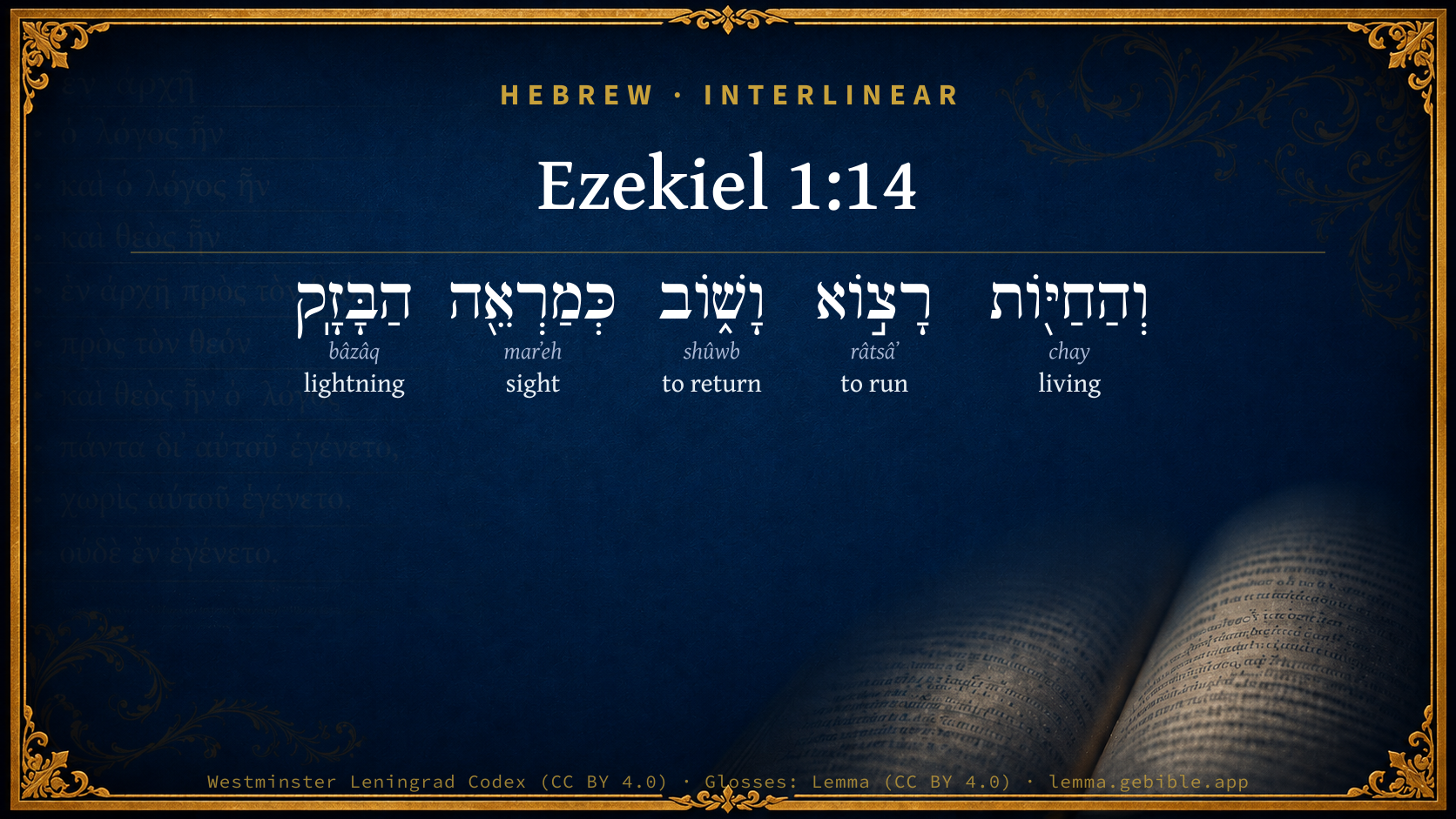
Ezekiel 1:14

Hebrew (Westminster Leningrad Codex) Ezekiel 1:14 appears in the Hebrew Old Testament. The text above is from the Westminster Leningrad Codex. Each word links to its Strong’s number, a concise gloss, and parsing drawn from the Open Scriptures Hebrew Bible morphology. Click any word for its full Brown-Driver-Briggs (BDB) entry.
Download image
Cite this verse

Ezekiel 1:14 (World English Bible). Public Domain. Lemma interlinear Bible study tool, https://lemma.gebible.app/v/ezekiel/1/14.

Show BibTeX & RIS
BibTeX
RIS
English Translation
The living creatures ran and returned as the appearance of a flash of lightning.
World English Bible · Public Domain
Highlights
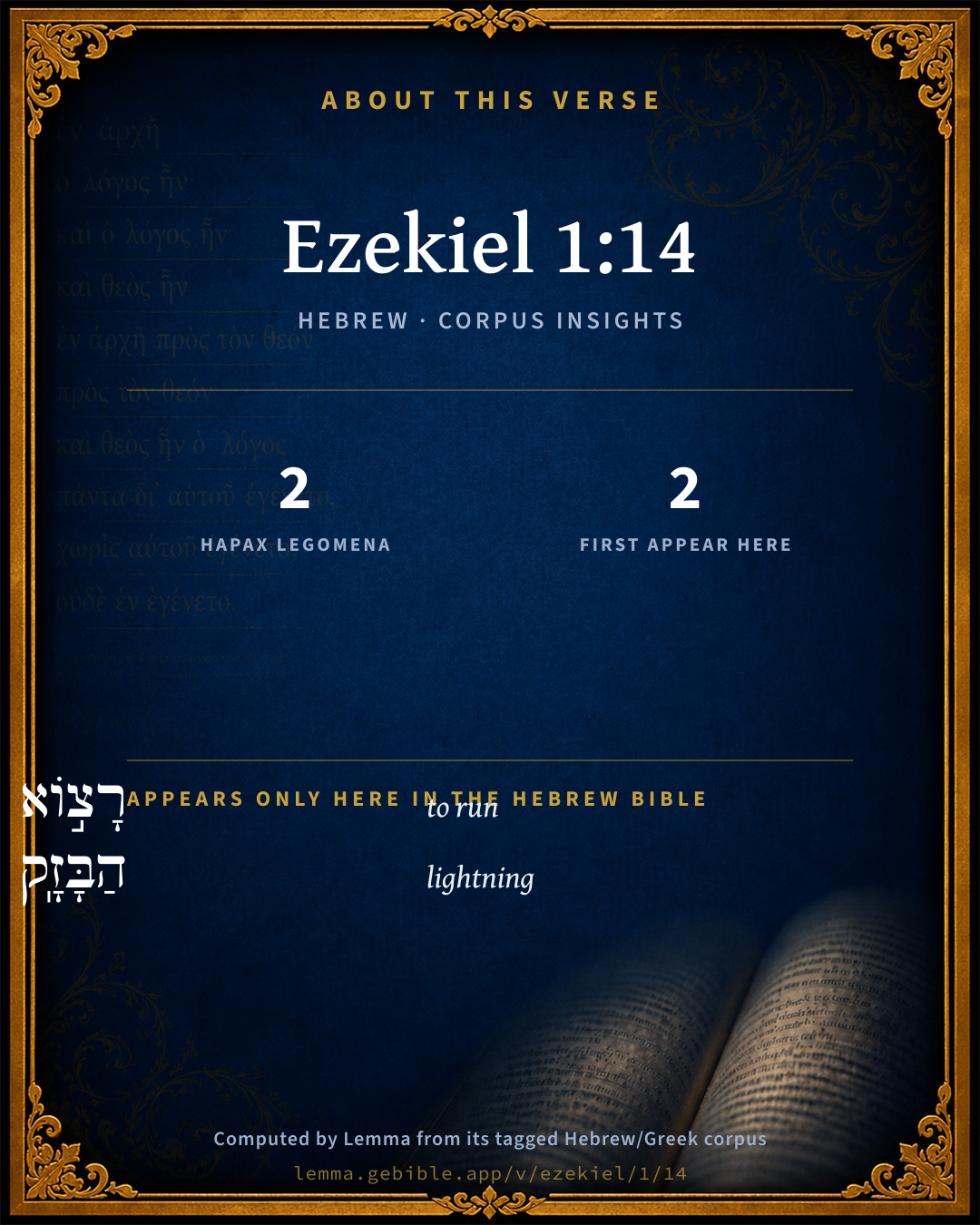
  • 2 hapax legomena — only here in the Hebrew Bible
  • 2 first appearances in the Hebrew Bible
Full analysis ↓
Download a study sheet

One document with this verse’s original text, its word-by-word gloss line, the meaning frame, cross-references with their text, attributed commentary, and full source and license credits — printable, and it pastes into notes with its structure intact.

This verse Autodidact and up

Study sheet (.html) Plain text (.txt)

A passage Seminary Student

Up to 50 verses in one chapter. A passage sheet keeps up to 6 commentary sources and 12 cross-references per verse, in the order this page ranks them, and says so on the sheet whenever that leaves anything out. Ask for a single verse and you get the Autodidact verse sheet above.

Everything on this page stays free to read, with no account — the sheet is a download of what is already on screen, not access to it.

Want to remove ads? Support Godless Engineer
Compare translations 3

The same verse in 3 English versions, stacked beneath the original-language interlinear above. Click any original word for its lexicon entry.

Each is an independent rendering of the whole verse — the interlinear is not word-aligned to these translations.

Highlighted words mark where these versions differ — a whole-verse word diff, not a word-by-word alignment.

  • World English Bible Public Domain
    The living creatures ran and returned as the appearance of a flash of lightning.
  • King James Version Public Domain
    And the living creatures ran and returned as the appearance of a flash of lightning.
  • unfoldingWord Literal Text CC BY-SA 4.0
    The living creatures were moving swiftly back and forth, and they had the appearance of lightning!

unfoldingWord Literal Text — © unfoldingWord, licensed CC BY-SA 4.0. Word-aligned USFM3 via Door43 (git.door43.org/unfoldingWord/en_ult).

Versions to compare (up to 4)

3 of 4 selected

Show all 18 translations

Every available English version of this verse, each an independent rendering of the whole verse.

  • World English Bible Public Domain
    The living creatures ran and returned as the appearance of a flash of lightning.
  • Berean Standard Bible Public Domain
    The creatures were darting back and forth as quickly as flashes of lightning.
  • Majority Standard Bible Public Domain
    The creatures were darting back and forth as quickly as flashes of lightning.
  • King James Version Public Domain
    And the living creatures ran and returned as the appearance of a flash of lightning.
  • American Standard Version (1901) Public Domain
    And the living creatures ran and returned as the appearance of a flash of lightning.
  • Revised Version (1885) Public Domain
    And the living creatures ran and returned as the appearance of a flash of lightning.
  • Geneva Bible (1599) Public Domain
    And the beastes ranne, and returned like vnto lightning.
  • Douay-Rheims (1899) Public Domain
    And the living creatures ran and returned like flashes of lightning.
  • Young's Literal Translation Public Domain
    And the living creatures are running, and turning back, as the appearance of the flash.
  • Literal Standard Version CC BY-SA 4.0
    And the living creatures are running, and turning back, as the appearance of the flash.
  • Unlocked Literal Bible CC BY-SA 4.0
    The living creatures were moving swiftly back and forth, and they had the appearance of lightning!
  • unfoldingWord Literal Text CC BY-SA 4.0
    The living creatures were moving swiftly back and forth, and they had the appearance of lightning!
  • Darby Bible Public Domain
    And the living creatures ran and returned as the appearance of a flash of lightning.
  • World Messianic Bible Public Domain
    The living creatures ran and returned as the appearance of a flash of lightning.
  • Webster's Bible Public Domain
    And the living creatures ran and returned as the appearance of a flash of lightning.
  • Free Bible Version CC BY-SA 4.0
    The beings raced to and fro as fast as the lightning flashes.
  • Bible in Basic English Public Domain
    And the living beings went out and came back as quickly as a thunder-flame.
  • JPS Tanakh (1917) Public Domain
    And the living creatures ran and returned as the appearance of a flash of lightning.

Literal Standard Version (2020), Covenant Press — licensed CC BY-SA 4.0. Text via the HelloAO Bible API (eBible.org). Unlocked Literal Bible (unfoldingWord) — licensed CC BY-SA 4.0. Text via the HelloAO Bible API (eBible.org). unfoldingWord Literal Text — © unfoldingWord, licensed CC BY-SA 4.0. Word-aligned USFM3 via Door43 (git.door43.org/unfoldingWord/en_ult). Free Bible Version, Dr. Jonathan Gallagher — licensed CC BY-SA 4.0. Text via the HelloAO Bible API (eBible.org).

Word by word

More ways to search: Search by grammar → Find every occurrence → Compare this word →

Practice this passage: Drill this verse → Learn its vocabulary →

About this verse

These counts appear in no published source. They are computed here, from the morphology-tagged text and Lemma’s own curated glosses. What Lemma adds →

5
words
5
distinct lemmas
Prophets
section

Notable vocabulary

2 hapax legomena — words that appear only here in the entire Hebrew Bible:

  • רָצ֣וֹא to run H7519
  • הַבָּזָֽק lightning H965

First appearance in Scripture

These words make their first canonical appearance in the Hebrew Bible here:

  • רָצ֣וֹא to run H7519
  • הַבָּזָֽק lightning H965

Grammatical profile

  • 2 verbs
  • 3 nouns

Verb forms

  • רָצ֣וֹא Qal · Infinitive Absolute
  • וָשׁ֑וֹב Qal · Infinitive Absolute

Cross-references

8

Topical passages linked to Ezekiel 1:14 in the Treasury of Scripture Knowledge — connected by theme and wording, ordered by reader-vote popularity; previews shown in the World English Bible.

  • Zechariah 4:10 Indeed, who despises the day of small things? For these seven shall rejoice, and shall see the plumb line in the hand of Zerubbabel. These are the eyes of Yahweh, which run back and forth through the whole earth."
  • Matthew 24:27 For as the lightning comes forth from the east, and is seen even to the west, so will be the coming of the Son of Man.
  • Psalms 147:15 He sends out his commandment to the earth. His word runs very swiftly.
  • Daniel 9:21 yes, while I was speaking in prayer, the man Gabriel, whom I had seen in the vision at the beginning, being caused to fly swiftly, touched me about the time of the evening offering.
  • Matthew 24:31 He will send out his angels with a great sound of a trumpet, and they will gather together his chosen ones from the four winds, from one end of the sky to the other.
  • Mark 13:27 Then he will send out his angels, and will gather together his chosen ones from the four winds, from the ends of the earth to the ends of the sky.
  • Luke 17:24 for as the lightning, when it flashes out of the one part under the sky, shines to the other part under the sky; so will the Son of Man be in his day.
  • Zechariah 2:3–4 Behold, the angel who talked with me went forth, and another angel went out to meet him,

Cross-references courtesy of OpenBible.info (CC BY 4.0).

Hebrew and Greek witnesses Masoretic Hebrew ↔ Greek Septuagint

The same verse in the two great witnesses to the Old Testament, shown verse-for-verse.

These are two independent witnesses, not word-aligned to each other, and the Septuagint is shown in lemma (dictionary) form.

Hebrew Ezekiel 1:14 Masoretic · Westminster Leningrad Codex

וְהַחַיּ֖וֹת רָצ֣וֹא וָשׁ֑וֹב כְּמַרְאֵ֖ה הַבָּזָֽק

The living creatures ran and returned as the appearance of a flash of lightning.

World English Bible · Public Domain

On this verse, The Cambridge Bible for Schools and Colleges discusses the Septuagint’s reading. Read the note in Commentary ↓

Hebrew: Westminster Leningrad Codex (CC BY 4.0). Greek: Septuagint (public domain); English from a public-domain English Septuagint. How the Septuagint differs from the Hebrew →

Targum (Aramaic paraphrase)

1

The Targum is the ancient Jewish Aramaic paraphrase of the Hebrew Scriptures — an interpretive translation, not the Hebrew text itself. Onkelos (literal) and Pseudo-Jonathan (expansive) render the Torah, and Jonathan the Prophets. Coverage is partial: where no permissively-licensed English translation exists for a verse, only the Aramaic is shown. This is verse-level text, not a word-by-word alignment to the Hebrew.

  1. Targum Jonathan Prophets (Joshua–Malachi)
    וּבִרְיָתָא בְּאִשְׁתַּלְחוּתְהֵין לְמֶעְבַּד רְעוּת רִבּוֹנְהֵן דְאַשְׁרֵי שְׁכִינְתֵּיהּ בִּמְרוֹמָא עֵלָא מִנְהֵן בַּאֲנָפָא עֵינָא לְמֶחֱזֵי חֶזְרָן וּמַקְפַן וּמְכַסָן יַת עַלְמָא וְתָיְבִין בִּרְיָתָא כַּחֲדָא וְקַלִילָן כְּחֵיזוּ בַרְקָא:

    (no public-domain English translation for this verse)

    Targum Jonathan — Aramaic: “Mikraot Gedolot” (public domain). English: “Sefaria Community Translation” (CC0 1.0 (public-domain dedication)); “London "Chaldee Paraphrase," 1871” (public domain). Text via Sefaria.

Commentary

Notes on Ezekiel 1:14 from classic Christian and Jewish commentators (each source and its license shown beneath its notes). The classic Christian expositions comment on the surrounding passage and are grouped to its opening verse, so a note may address several verses; the Jewish commentaries on the Tanakh (Rashi and others) are per-verse, so they appear only where the commentator wrote on this verse.

Lemma curates 59 commentaries, every one of them public domain or Creative Commons licensed, each selected and text-cleaned for this edition rather than reprinted as found. About our sources →

Trapp's Complete Commentary

John Trapp

Eze 1:14 And the living creatures ran and returned as the appearance of a flash of lightning.

Ver. 14. And the living creatures ran and returned.] As soon as ever their work was done, they came back to him who sent them out to know his further pleasure, and to do him more service. When the angel had lessoned the good women about our Saviour’s resurrection, he biddeth them "go quickly and tell his disciples," &c., and then dismisseth them, with "Lo, I have told you," {Mat 28:6-7} q.d., Begone now about your business, you have your full errand; why linger ye? pack away.

As the appearance of a flash of lightning.] Which appeareth aud disappeareth in an instant.

John Trapp, A Commentary or Exposition upon All the Books of the Old and New Testament (1647–1656) — public domain. Text from a community e-Sword module.

Geneva Bible (1599)

Geneva Bible translators

That is, when they had executed God’s will: for afore they returned not till God had changed the state of things.

Geneva Bible (1599) marginal notes — public domain. Text via Bolls.life.

Jamieson, Fausset & Brown

Robert Jamieson, A. R. Fausset & David Brown

ran and returned--Incessant, restless motion indicates the plenitude of life in these cherubim; so in Rev 4:8, "they rest not day or night" (Zac 4:10).

flash of lightning--rather, as distinct from "lightning" (Eze 1:13), "the meteor flash," or sheet lightning [FAIRBAIRN].

Jamieson, Fausset & Brown — Commentary Critical and Explanatory on the Whole Bible (1871) — public domain (CC PDM 1.0). Text via the HelloAO Bible API.

Adam Clarke's Commentary

Verse 14. The living creatures ran and returned] They had a circular movement; they were in rapid motion, but did not increase their distance from the spectator. So I think this should be understood.

Adam Clarke's Commentary on the Bible (1810–1826) — public domain. Text from a community e-Sword/MySword module.

John Calvin's Commentaries

Here the Prophet explains more clearly what would otherwise be obscure. He says that the living creatures ran, and returned like lightning: by which words he doubtless signifies their amazing swiftness. For lightning (as Christ uses that comparison when he speaks of his own Advent — Matthew 24:27) goes forth from one part of the world and penetrates instantly to the opposite. Since, then, the swiftness of lightning is so great that it reaches in a moment through the immensity of heaven, for this reason the Prophet says, the living creatures ran, and returned like lightning: as if he had said, in whatever direction God wishes to impel them, they were ready to obey; as we have formerly said, angels are at hand to obey the commands of God: but we cannot comprehend the extreme swiftness of their course, unless by this comparison of lightning. Now we see how well these two things agree, that they did return and yet did not: they did not return until they had arrived, as I have already said, at the goal, because, although many hindrances occur, yet God breaks through them, so that they never interrupt his actions. The devil, indeed, by his obstacles, endeavors to compel God to recede; but here the Prophet shows that when God determines anything, the angels are ready to govern the world, and that they have so much vigor in them, that they go on constantly to the end, as far as God inspires them with his own power. Afterwards it follows —

John Calvin's Commentaries (1540-1563) — public domain. Text from the Calvin Translation Society English edition (1840s-50s) via the Christian Classics Ethereal Library (ccel.org). Calvin's coverage is partial (roughly two-thirds of the Bible); uncommented books and verses are honest gaps, never fabricated. The 19th-century editor's footnotes and remarks are omitted so the notes are faithfully Calvin's own voice.

Ellicott's Commentary for English Readers

(14) A flash of lightning.—Not only was the appearance of the cherubim thus glittering, but also their speed as they “ran and returned” was that of the lightning.

The vision up to this point, so far as we may venture to interpret its object, seems designed to show forth the power and activity, the irresistible energy of the agencies employed for the fulfilment of the Divine purposes, and at the same time their perfectly harmonious action, controlled by one supreme will. We now enter upon a fresh phase of the vision, in which the same things are represented still further by an additional and peculiar symbolism.

A Bible Commentary for English Readers, edited by Charles John Ellicott (1878–1897) — public domain. Text from a community e-Sword module.

The Cambridge Bible for Schools and Colleges

gen. ed. J. J. S. Perowne

14. Jerome testifies that this verse was not found in LXX. The verse both in regard to terminology and construction is untranslateable. The word rendered “ran” has no existence, and that translated “flash of lightning” is equally unknown. Attempts have been made to amend the verse by substituting for “ran” a real word, “went out” (yaço for raço), and the ordinary word “lightning” for the unknown term so rendered (baraḳ for bazaḳ). But such a movement to and fro or backwards and forwards of the living creatures is not suggested by anything said of them hitherto or afterwards; they could not move without a movement of the whole chariot, and such a darting about like lightning offends against that which is becoming in the divine manifestation. The verse is probably a marginal amplification of Eze_1:13, due to the error which had already crept into that verse, making it apply to the living creatures instead of to the fire between them.

The Cambridge Bible for Schools and Colleges (gen. ed. J. J. S. Perowne; Cambridge University Press, 1878–1918) — public domain. Text from a community e-Sword module.

John Gill's Exposition

And the living creatures ran,.... Did their work with great readiness and swiftness; so, especially in the latter day, ministers of the Gospel shall run to and fro, and knowledge shall be increased, Dan 12:4;

and returned; for though before it is said, "they turned not when they went", they kept straight on till they had done their work; but when they have done it, then they return, and give an account of it to him that has sent them: and their running and returning are said to be,

as the appearance of a flash of lightning; very sudden and swift.

John Gill's Exposition of the Whole Bible (1746–1763) — public domain (CC PDM 1.0). Text via the HelloAO Bible API.

Haydock's Catholic Bible Commentary

Flashes. Hebrew Bazak. (Haydock) --- Theodotion retains the original. His version seems to have been inserted in the Septuagint, (Calmet) who omitted this verse, as seeming to contradict ver. 9., and 12. (St. Jerome) --- Yet it only signifies that the motion was quick as lightning, though they did not alter their situation with respect to each other.

George Leo Haydock (1774–1849), Haydock's Catholic Family Bible and Commentary, 1859 edition — public domain. Excludes Psalms (Douay-Rheims chapter numbering differs from Protestant) and Deuterocanonical books (Catholic canon only).

Matthew Poole's English Annotations

The living creatures; angels, ministers of the Divine pleasure, as above, Eze 1:5.

Ran; were speedy in their motions; this signified by this expression figuratively applied to angels.

Returned; yet, Eze 1:9,12, it is said they returned not, where this seeming contradiction is reconciled; the 9th and 12th verse deny their turning aside from their work, this 14th affirms they returned, i.e. when they had done their work.

As the appearance of a flash of lightning; very quick, with vehemency, splendour, and irresistible efficacy.

Matthew Poole's English Annotations on the Holy Bible (1683–1685) — public domain. Text from a community e-Sword/MySword module.

Whedon's Commentary on the Bible

Daniel D. Whedon

14. This verse is probably a marginal gloss (Kautzsch). The Hebrew text is damaged and obscure. This fact did not prevent Mr. Wesley obtaining from it a high spiritual meaning: “They ran into the lower world, to do what was to be done there; and when they had done, returned as a flash of lightning to the upper world, to the vision of God. Thus we should be in the affairs of this world: though we run into them we must not repose in them, but our souls must presently return like lightning to God, their rest and center.”

Daniel D. Whedon (gen. ed.), Commentary on the Old and New Testaments (1874–1909) — public domain. Text from a community e-Sword module.

The Pulpit Commentary

Ran and returned. Compare the "to and fro" of Zec_4:10. The comparison implies at once suddenness (as in Mat_24:27) and overwhelming brightness.

The Pulpit Commentary (1880–1919), ed. H.D.M. Spence-Jones & Joseph S. Exell — public domain. Text from a community e-Sword module.

John Wesley's Explanatory Notes

Ran - They ran into the lower world, to do what was to be done there: and when they had done, returned as a flash of lightning, to the upper world, to the vision of God. Thus we should be in the affairs of this world: though we run into them we must not repose in them, but our souls must presently return like lightning, to God, their rest and center.

John Wesley, Explanatory Notes Upon the Whole Bible (1754–1765) — public domain. Text via the GEBible commentary corpus.

Rashi

Rabbi Shlomo Yitzchaki (Rashi)

would run and return, like the appearance of the sparks Our Sages explained (Chag. 13b): They would run and return like the flame of a furnace, which constantly shoots out of the mouth of the furnace and hastens back to enter. So, when they would thrust their heads out from under the expanse that was extended above themas is delineated in the chapterthey would recoil because of the Shechinah, which is above the expanse, and they hasten to pull their heads [down].

like the appearance of the sparks Heb. הֲבָּזָק, de l’etincelle in French, and the color of their fire is like the color of the fire that emanates from between the shards within which gold is refined in a furnace. The fire that emanates from there is colored with these colors (ibid.). [Addendum—Others explain הַבָּזָק as an expression of scattering, as our Sages explained it (Gen. Rabbah 50:1): “like the appearance of the bazak” R. Judah in the name of R. Simon in the name of R. Levi the son of Perata: Like one who scatters (הַבּוֹזֵק) ‘gefeth’ in a stove, i.e., he scatters ‘gefeth’ the residue of olives in a stove: it ignites quickly and raises a flame, and the flame ascends and descends, and this is the meaning of “would run and return.” Furthermore we find in their words (Sanh. 108b, according to Aruch) בזק used as an expression of scattering: “He scattered (בָּזַק) dust on them and it turned into swords,” meaning he scattered, and so in the Mishnah (Eruvin 10:14): “We may scatter (בּוֹזְקִין) salt on the ramp so that they should not slip.” בזק may also be defined as ברק (lightning), which is an expression of searching. End of addendum, not found in (sic) all editions.]

Rashi on the Tanakh — English translations: “The Judaica Press complete Tanach with Rashi, translated by A. J. Rosenberg” (CC BY 4.0); “Pentateuch with Rashi's commentary by M. Rosenbaum and A.M. Silbermann, 1929-1934” (public domain); “The Metsudah Tanach series, Lakewood, N.J” (CC BY 4.0); and “The Book of Joshua, Metsudah Publications, 1997” (CC BY 4.0). Text via Sefaria.

Lesson kit

Teaching starters — assembled from the data on this page, not authored interpretation. Every prompt links to the verse data it draws on. Edit before teaching.

Ezekiel, in the Prophets, opens this verse with 5 words (5 distinct Hebrew lemmas). Its most distinctive word is râtsâʼ (“to run”). A historical commentator’s framing appears above. Read the whole chapter for the surrounding context.

Discussion questions

  1. What does “to run” (râtsâʼ) contribute to the verse as a whole?
  2. 2 words here appear nowhere else in the Hebrew Bible. Why might the author reach for such rare wording?
  3. 2 words make their first appearance in Scripture here. What does this debut establish?
  4. How does Zechariah 4:10, which shares this passage’s theme, read alongside this verse?
  5. These translations render this verse differently. What is at stake in choosing one wording over another?
  6. «רָצ֣וֹא» is a Qal Infinitive Absolute verb. How does that grammatical form shape the action described?
  7. Compare how Trapp's Complete Commentary and Geneva Bible (1599) read this verse. Where do they agree or differ?

Things to notice

  • 2 words in this verse appear nowhere else in the Hebrew Bible.
  • 2 words make their first canonical appearance in Scripture here.
  • These translations choose different wording for 8 words in this verse.
  • 5 distinct Hebrew lemmas span 5 words in this verse.

Reading settings

Reading text

Shown beneath each verse's original-language words.

Old Testament
Old Testament edition

Read the OT as the Masoretic Hebrew (MT) or the Greek Septuagint (LXX).

English shown for the Greek Septuagint (in the Hebrew ↔ Greek comparison).

Comparing translations? Open the Compare panel on any verse page to stack up to four side by side.