
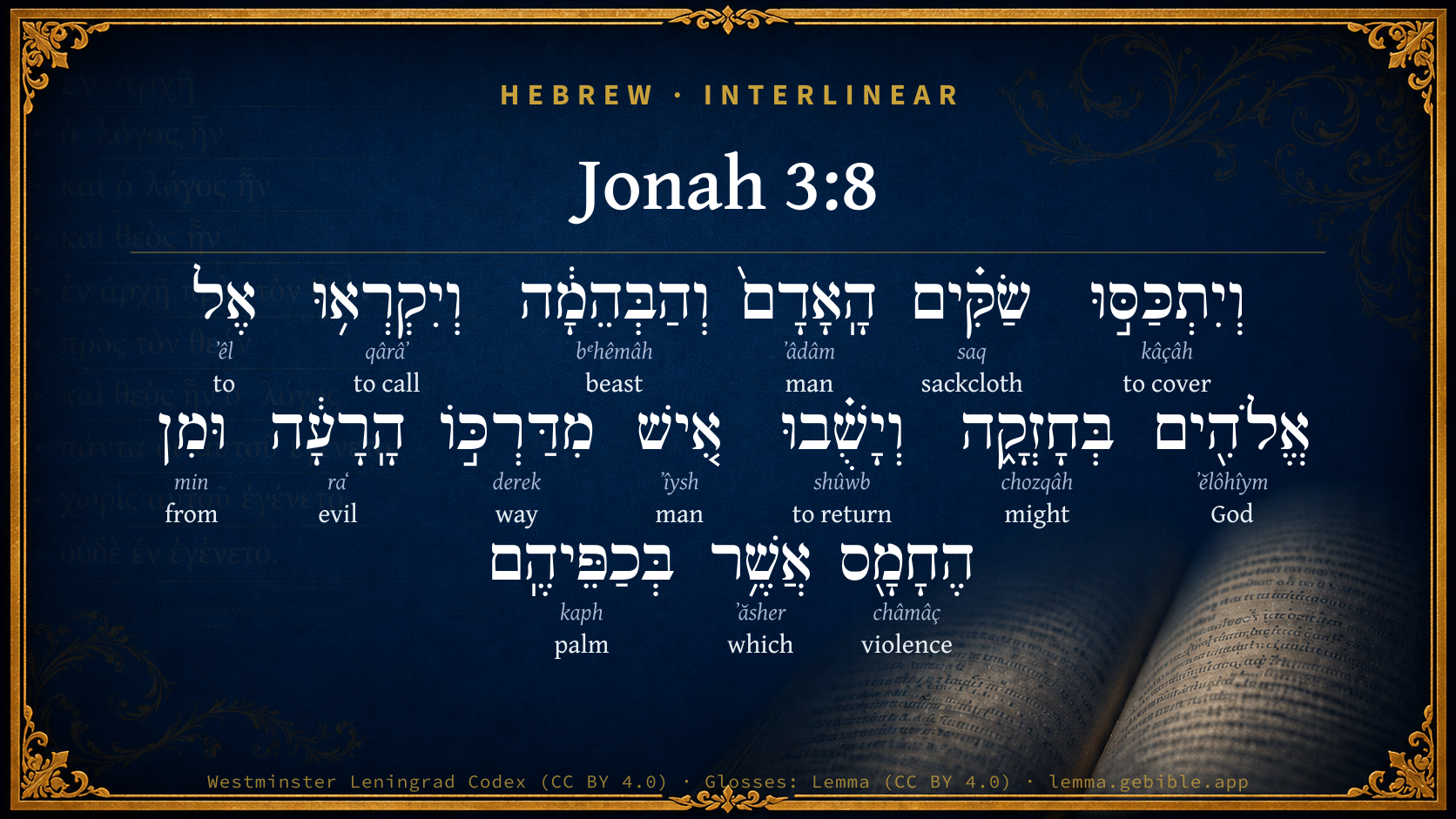
Jonah 3:8

Hebrew (Westminster Leningrad Codex) Jonah 3:8 appears in the Hebrew Old Testament. The text above is from the Westminster Leningrad Codex. Each word links to its Strong’s number, a concise gloss, and parsing drawn from the Open Scriptures Hebrew Bible morphology. Click any word for its full Brown-Driver-Briggs (BDB) entry.
Download image
Cite this verse

Jonah 3:8 (World English Bible). Public Domain. Lemma interlinear Bible study tool, https://lemma.gebible.app/v/jonah/3/8.

Show BibTeX & RIS
BibTeX
RIS
English Translation
but let them be covered with sackcloth, both man and animal, and let them cry mightily to God. Yes, let them turn everyone from his evil way, and from the violence that is in his hands.
World English Bible · Public Domain
Download a study sheet

One document with this verse’s original text, its word-by-word gloss line, the meaning frame, cross-references with their text, attributed commentary, and full source and license credits — printable, and it pastes into notes with its structure intact.

This verse Autodidact and up

Study sheet (.html) Plain text (.txt)

A passage Seminary Student

Up to 50 verses in one chapter. A passage sheet keeps up to 6 commentary sources and 12 cross-references per verse, in the order this page ranks them, and says so on the sheet whenever that leaves anything out. Ask for a single verse and you get the Autodidact verse sheet above.

Everything on this page stays free to read, with no account — the sheet is a download of what is already on screen, not access to it.

Want to remove ads? Support Godless Engineer
Compare translations 3

The same verse in 3 English versions, stacked beneath the original-language interlinear above. Click any original word for its lexicon entry.

Each is an independent rendering of the whole verse — the interlinear is not word-aligned to these translations.

Highlighted words mark where these versions differ — a whole-verse word diff, not a word-by-word alignment.

  • World English Bible Public Domain
    but let them be covered with sackcloth, both man and animal, and let them cry mightily to God. Yes, let them turn everyone from his evil way, and from the violence that is in his hands.
  • King James Version Public Domain
    But let man and beast be covered with sackcloth, and cry mightily unto God: yea, let them turn every one from his evil way, and from the violence that is in their hands.
  • unfoldingWord Literal Text CC BY-SA 4.0
    But let the man and the beast be covered sackcloth, and they must cry out to God with strength, and each man must turn back from his evil way and from the violence that is in their hands.

unfoldingWord Literal Text — © unfoldingWord, licensed CC BY-SA 4.0. Word-aligned USFM3 via Door43 (git.door43.org/unfoldingWord/en_ult).

Versions to compare (up to 4)

3 of 4 selected

Show all 18 translations

Every available English version of this verse, each an independent rendering of the whole verse.

  • World English Bible Public Domain
    but let them be covered with sackcloth, both man and animal, and let them cry mightily to God. Yes, let them turn everyone from his evil way, and from the violence that is in his hands.
  • Berean Standard Bible Public Domain
    Furthermore, let both man and beast be covered with sackcloth, and have everyone call out earnestly to God. Let each one turn from his evil ways and from the violence in his hands.
  • Majority Standard Bible Public Domain
    Furthermore, let both man and beast be covered with sackcloth, and have everyone call out earnestly to God. Let each one turn from his evil ways and from the violence in his hands.
  • King James Version Public Domain
    But let man and beast be covered with sackcloth, and cry mightily unto God: yea, let them turn every one from his evil way, and from the violence that is in their hands.
  • American Standard Version (1901) Public Domain
    but let them be covered with sackcloth, both man and beast, and let them cry mightily unto God: yea, let them turn every one from his evil way, and from the violence that is in his hands.
  • Revised Version (1885) Public Domain
    but let them be covered with sackcloth, both man and beast, and let them cry mightily unto God: yea, let them turn every one from his evil way, and from the violence that is in their hands.
  • Geneva Bible (1599) Public Domain
    But let man and beast put on sackecloth, and crie mightily vnto God: yea, let euery man turne from his euill way, and from the wickednesse that is in their handes.
  • Douay-Rheims (1899) Public Domain
    And let men and beasts be covered with sackcloth, and cry to the Lord with all their strength, and let them turn every one from his evil way, and from the iniquity that is in their hands.
  • Young's Literal Translation Public Domain
    and cover themselves `with' sackcloth let man and beast, and let them call unto God mightily, and let them turn back each from his evil way, and from the violence that `is' in their hands.
  • Literal Standard Version CC BY-SA 4.0
    and let man and beast cover themselves [with] sackcloth, and let them call to God mightily, and let them each turn back from his evil way, and from the violence that [is] in their hands.
  • Unlocked Literal Bible CC BY-SA 4.0
    But let both man and animal be covered with sackcloth and let them cry out loudly to God. Let every one turn from his evil way and from the violence that is in his hands.
  • unfoldingWord Literal Text CC BY-SA 4.0
    But let the man and the beast be covered sackcloth, and they must cry out to God with strength, and each man must turn back from his evil way and from the violence that is in their hands.
  • Darby Bible Public Domain
    and let man and beast be covered with sackcloth, and cry mightily unto God; and let them turn every one from his evil way, and from the violence that is in their hands.
  • World Messianic Bible Public Domain
    but let them be covered with sackcloth, both man and animal, and let them cry mightily to God. Yes, let them turn everyone from his evil way and from the violence that is in his hands.
  • Webster's Bible Public Domain
    But let man and beast be covered with sackcloth, and cry mightily to God: yes, let them turn every one from his evil way, and from the violence that is in their hands.
  • Free Bible Version CC BY-SA 4.0
    Every person and every animal is to wear sackcloth. Everyone is to pray sincerely to God, give up the evil things they do, and stop using violence.
  • Bible in Basic English Public Domain
    And let man and beast be covered with haircloth, and let them make strong prayers to God: and let everyone be turned from his evil way and the violent acts of their hands.
  • JPS Tanakh (1917) Public Domain
    but let them be covered with sackcloth, both man and beast, and let them cry mightily unto God; yea, let them turn every one from his evil way, and from the violence that is in their hands.

Literal Standard Version (2020), Covenant Press — licensed CC BY-SA 4.0. Text via the HelloAO Bible API (eBible.org). Unlocked Literal Bible (unfoldingWord) — licensed CC BY-SA 4.0. Text via the HelloAO Bible API (eBible.org). unfoldingWord Literal Text — © unfoldingWord, licensed CC BY-SA 4.0. Word-aligned USFM3 via Door43 (git.door43.org/unfoldingWord/en_ult). Free Bible Version, Dr. Jonathan Gallagher — licensed CC BY-SA 4.0. Text via the HelloAO Bible API (eBible.org).

Word by word

More ways to search: Search by grammar → Find every occurrence → Compare this word →

Practice this passage: Drill this verse → Learn its vocabulary →

בְּחָזְקָ֑ה
chozqâh
H2394
“in/at · might”
Preposition + Noun, Common, Feminine, Singular, Absolute
Part of Speech
Preposition + Noun
Type
Common
Gender
Feminine
Number
Singular
State
Absolute
Full BDB Definition

Origin: from H2392

TWOT: 636d

force, might, strength, violence
  1. וְיִתְכַּסּ֣וּ kâçâh H3680 “and · to cover” Conjunction + Verb, Hithpael, Imperfect, 3rd Person, Masculine, Plural
  2. שַׂקִּ֗ים saq H8242 “sacks” Noun, Common, Masculine, Plural, Absolute
  3. הָֽאָדָם֙ ʼâdâm H120 “the · man” Particle, Definite Article + Noun, Common, Masculine, Singular, Absolute
  4. וְהַבְּהֵמָ֔ה bᵉhêmâh H929 “and · the · beast” Conjunction + Particle, Definite Article + Noun, Common, Feminine, Singular, Absolute
  5. וְיִקְרְא֥וּ qârâʼ H7121 “and · to call” Conjunction + Verb, Qal, Imperfect, 3rd Person, Masculine, Plural
  6. אֶל ʼêl H413 “to” Preposition
  7. אֱלֹהִ֖ים ʼĕlôhîym H430 “God(s)” Noun, Common, Masculine, Plural, Absolute
  8. וְיָשֻׁ֗בוּ shûwb H7725 “and · to return” Conjunction + Verb, Qal, Imperfect, 3rd Person, Masculine, Plural
  9. אִ֚ישׁ ʼîysh H376 “man” Noun, Common, Masculine, Singular, Absolute
  10. מִדַּרְכּ֣וֹ derek H1870 “from · way · his” Preposition + Noun, Common, Both, Singular, Construct + Suffix, Personal, 3rd Person, Masculine, Singular
  11. הָֽרָעָ֔ה raʻ H7451 “the · evil” Particle, Definite Article + Adjective, Adjective, Feminine, Singular, Absolute
  12. וּמִן min H4480 “and · from” Conjunction + Preposition
  13. הֶחָמָ֖ס châmâç H2555 “the · violence” Particle, Definite Article + Noun, Common, Masculine, Singular, Absolute
  14. אֲשֶׁ֥ר ʼăsher H834 “which” Particle, Relative
  15. בְּכַפֵּיהֶֽם kaph H3709 “in/at · palms · their” Preposition + Noun, Common, Feminine, Dual, Construct + Suffix, Personal, 3rd Person, Masculine, Plural

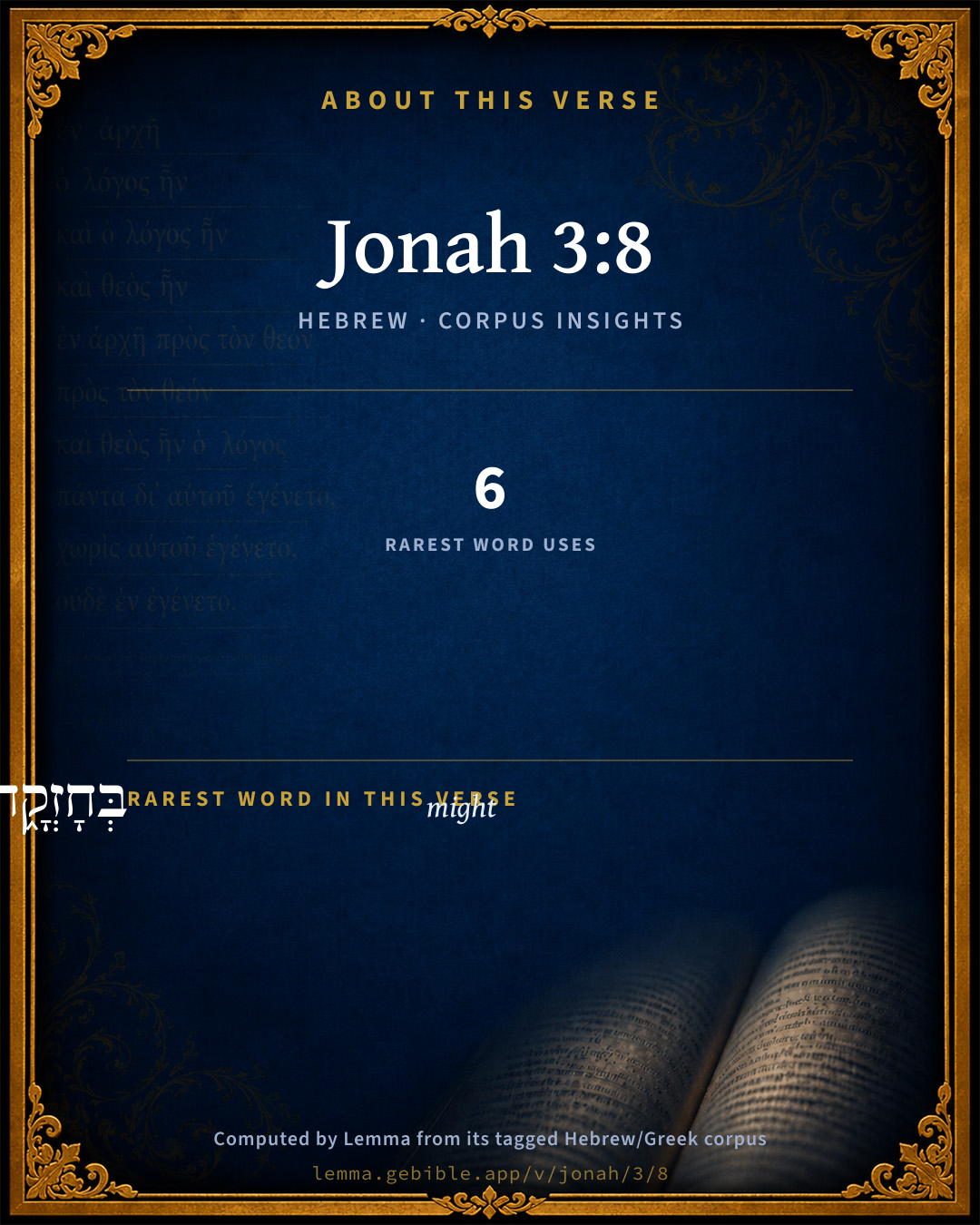
About this verse

These counts appear in no published source. They are computed here, from the morphology-tagged text and Lemma’s own curated glosses. What Lemma adds →

16
words
16
distinct lemmas
Prophets
section

Notable vocabulary

The rarest word here is בְּחָזְקָ֑ה might H2394 — appearing just 6 times in the whole Hebrew Bible.

Shared distinctive vocabulary

בְּחָזְקָ֑ה might H2394 occurs in 6 verses of the Hebrew Bible. Also found in:

Grammatical profile

  • 3 verbs
  • 9 nouns
  • 1 adjective
  • 2 prepositions
  • 1 particle

Verb forms

  • וְיִתְכַּסּ֣וּ Hithpael · Imperfect
  • וְיִקְרְא֥וּ Qal · Imperfect
  • וְיָשֻׁ֗בוּ Qal · Imperfect

Hebrew & Septuagint length

In English translation the verse runs 36 words from the Hebrew and 32 from the Septuagint (LXX English) — closely comparable.

A rough comparison of the two English renderings, which tokenize alike — not a word-level alignment.

Word counts can differ between the Hebrew and the Greek without any difference in meaning — e.g. the Hebrew direct-object marker אֵת has no separate Greek word, and Greek often adds the article ὁ.

Cross-references

16

Topical passages linked to Jonah 3:8 in the Treasury of Scripture Knowledge — connected by theme and wording, ordered by reader-vote popularity; previews shown in the World English Bible.

  • Isaiah 55:6–7 Seek you Yahweh while he may be found; call you on him while he is near:
  • Isaiah 59:6 Their webs shall not become garments, neither shall they cover themselves with their works: their works are works of iniquity, and the act of violence is in their hands.
  • Jonah 1:6 So the shipmaster came to him, and said to him, "What do you mean, sleeper? Arise, call on your gods! Maybe the gods will notice us, so that we won't perish."
  • Isaiah 1:16–19 Wash yourselves, make yourself clean. Put away the evil of your doings from before my eyes; Cease to do evil.
  • Ezekiel 18:21–24 But if the wicked turn from all his sins that he has committed, and keep all my statutes, and do that which is lawful and right, he shall surely live, he shall not die.
  • Jonah 1:14 Therefore they cried to Yahweh, and said, "We beg you, Yahweh, we beg you, let us not perish for this man's life, and don't lay on us innocent blood; for you, Yahweh, have done as it pleased you."
  • Acts 3:19 "Repent therefore, and turn again, that your sins may be blotted out, so that there may come times of refreshing from the presence of the Lord,
  • Psalms 130:1–2 Out of the depths I have cried to you, Yahweh.
  • Isaiah 58:6 Isn't this the fast that I have chosen: to loose the bonds of wickedness, to undo the bands of the yoke, and to let the oppressed go free, and that you break every yoke?
  • Jeremiah 18:11 Now therefore, speak to the men of Judah, and to the inhabitants of Jerusalem, saying, Thus says Yahweh: Behold, I frame evil against you, and devise a device against you: return you now everyone from his evil way, and amend your ways and your doings.
  • Ezekiel 18:27–28 Again, when the wicked man turns away from his wickedness that he has committed, and does that which is lawful and right, he shall save his soul alive.
  • Ezekiel 18:30–32 Therefore I will judge you, house of Israel, everyone according to his ways, says the Lord Yahweh. Return you, and turn yourselves from all your transgressions; so iniquity shall not be your ruin.
  • Ezekiel 33:11 Tell them, As I live, says the Lord Yahweh, I have no pleasure in the death of the wicked; but that the wicked turn from his way and live: turn you, turn you from your evil ways; for why will you die, house of Israel?
  • Daniel 4:27 Therefore, O king, let my counsel be acceptable to you, and break off your sins by righteousness, and your iniquities by showing mercy to the poor; if there may be a lengthening of your tranquillity.
  • Matthew 3:8 Therefore bring forth fruit worthy of repentance!
  • Acts 26:20 but declared first to them of Damascus, at Jerusalem, and throughout all the country of Judea, and also to the Gentiles, that they should repent and turn to God, doing works worthy of repentance.

Cross-references courtesy of OpenBible.info (CC BY 4.0).

Hebrew and Greek witnesses Masoretic Hebrew ↔ Greek Septuagint

The same verse in the two great witnesses to the Old Testament, shown verse-for-verse.

These are two independent witnesses, not word-aligned to each other, and the Septuagint is shown in lemma (dictionary) form.

Hebrew Jonah 3:8 Masoretic · Westminster Leningrad Codex

וְיִתְכַּסּ֣וּ שַׂקִּ֗ים הָֽאָדָם֙ וְהַבְּהֵמָ֔ה וְיִקְרְא֥וּ אֶל אֱלֹהִ֖ים בְּחָזְקָ֑ה וְיָשֻׁ֗בוּ אִ֚ישׁ מִדַּרְכּ֣וֹ הָֽרָעָ֔ה וּמִן הֶחָמָ֖ס אֲשֶׁ֥ר בְּכַפֵּיהֶֽם

but let them be covered with sackcloth, both man and animal, and let them cry mightily to God. Yes, let them turn everyone from his evil way, and from the violence that is in his hands.

World English Bible · Public Domain

Greek LXX Jonah 3:8 Septuagint · lemma form

καί περιβάλλω σάκκος ὁ ἄνθρωπος καί ὁ κτῆνος καί ἀναβοάω πρός ὁ θεός ἐκτενῶς καί ἀποστρέφω ἕκαστος ἀπό ὁ ὁδός αὐτός ὁ πονηρός καί ἀπό ὁ ἀδικία ὁ ἐν χείρ αὐτός λέγω

So men and cattle were clothed with sackcloths, and cried earnestly to God; and they turned every one from their evil way, and from the iniquity that was in their hands, saying,

LXX2012 (modern English Septuagint) · Public Domain

On this verse, John Gill's Exposition discusses the Septuagint’s reading. Read the note in Commentary ↓

Hebrew: Westminster Leningrad Codex (CC BY 4.0). Greek: Septuagint (public domain); English from LXX2012 (modern English Septuagint) (Public Domain). How the Septuagint differs from the Hebrew →

Targum (Aramaic paraphrase)

1

The Targum is the ancient Jewish Aramaic paraphrase of the Hebrew Scriptures — an interpretive translation, not the Hebrew text itself. Onkelos (literal) and Pseudo-Jonathan (expansive) render the Torah, and Jonathan the Prophets. Coverage is partial: where no permissively-licensed English translation exists for a verse, only the Aramaic is shown. This is verse-level text, not a word-by-word alignment to the Hebrew.

  1. Targum Jonathan Prophets (Joshua–Malachi)
    וְיִתְכַּסוּן סַקִין אֱנָשָׁא וּבְעִירָא וִיצַלוּן קֳדָם יְיָ בִּתְקוֹף וִיתוּבוּן גְבַר מֵאוֹרְחֵיהּ בִּישְׁתָּא וּמִן חֲטוֹפָא דְבִידֵיהוֹן:

    And people and animals were covered in sackcloth and prayed before the LORD vigorously, and each man turned from his wicked way and from the robbery of his hands.

    Targum Jonathan — Aramaic: “Mikraot Gedolot” (public domain). English: “Sefaria Community Translation” (CC0 1.0 (public-domain dedication)); “London "Chaldee Paraphrase," 1871” (public domain). Text via Sefaria.

Commentary

Notes on Jonah 3:8 from classic Christian and Jewish commentators (each source and its license shown beneath its notes). The classic Christian expositions comment on the surrounding passage and are grouped to its opening verse, so a note may address several verses; the Jewish commentaries on the Tanakh (Rashi and others) are per-verse, so they appear only where the commentator wrote on this verse.

Lemma curates 59 commentaries, every one of them public domain or Creative Commons licensed, each selected and text-cleaned for this edition rather than reprinted as found. About our sources →

Trapp's Complete Commentary

John Trapp

Jon 3:8 But let man and beast be covered with sackcloth, and cry mightily unto God: yea, let them turn every one from his evil way, and from the violence that [is] in their hands.

Ver. 8. But let man and beast be covered with sackcloth] Let all best means be used for the humbling of the heart; without which what is a humbling day but a religious incongruity (saith one) and a very high provocation; like Zimri’s act, when all the congregation were weeping before the door of the tabernacle? The beasts covered with sackcloth were as a house hung with black, to move men to mourn the more. Chrysostom tells us of a custom in his time (and it is still in use among us), that when great men were buried their horses followed the hearse clothed in black, as seeming to mourn for their masters. The coarsest weeds are fittest for fasting days; to show that but for shame we would have none, as having forfeited all; and that we look upon our better apparel but as finer covers of the foulest shame.

And cry mightily unto God] Cry with a courage; let the beasts roar lustily and rend the clouds, as it were, with their clamours; want of food will make them do so. And as God can so speak as that the brute beasts shall understand him, Joe 2:11 Amo 5:8; Amo 9:4 Joh 2:10; so can they, after a sort, so speak or moan that he can understand them, Joe 1:20 Hos 2:21 Psa 147:9 : he heareth the young ravens that cry unto him, though but with a hoarse and harsh note; whence also they have their name in Hebrew. Much more will he hear men that cry unto him, if they cry mightily with intention of spirit, and extension or rather contention of speech; if they set up their note, as the noise of many waters, Rev 19:6; if they thunder and threaten heaven, as Nazianzen saith his sister Gorgonia did; if they bounce hard at heaven’s gates, and resolve to wring mercy from God by a holy violence, as Tertullian saith the good people of his time did, Preces fundimus, coelum tundimus, misericordium extorquemus (Tert.). "The effectual fervent prayer of a righteous man availeth much"; but then it must be the working, stirring, labourful prayer, as the word ενεργουμενη, Jas 5:16, signifieth; that strives and struggles, and strains every vein in the heart (as Elias seemed to do by that posture in prayer of "putting his head between his legs," 1Ki 18:42); that sets to work all the faculties of the soul and all the graces of the spirit; that stirs up dust, as Jacob did; maketh a man sweat, as our Saviour; who, being in "an agony, prayed the more earnestly," Luk 22:44; not without strong crying and tears, and was heard in that he feared, Heb 5:7. For such a prayer, when a man cries to God, εξ ισχυος αυτου, mightily, or with all his strength, πολυ ισχυει, it availeth much, it can do anything, as Paul, using the same words, saith, "I can do all things through Christ who strengtheneth me," Php 4:13.

Yea, let them turn every one from his evil way, &c.] For else prayer profits not, humiliation is to no purpose without reformation; repentance for sin, without repentance from sin; there must be fruits meet for repentance, answerable to amendment of life, tantamount as repentance, and that weigh just as much as it, αξια; for, Optima et aptissima poenitentia est nova vita, saith Luther, the best and truest repentance is a new life; and if God’s people will humble themselves, and pray and seek his face, and also turn from their evil ways, then he will do much for them, 2Ch 7:14.

And from the violence that is in their hands] Heb. In the hollow of their hands, where it lay hidden, as it were, but not from God, who here bids them turn from their wrong dealing and rapacity. This was their special sin ( ut in magnis imperiis et emporiis magnae sunt rapinae), therefore are they charged to relinquish it. It is a speech, saith Mercer, like to that of our Saviour, "Go, tell my disciples and Peter," &c. Tell them all, but be sure you tell Peter. So here, turn from all your evil ways, but especially from the violence that is in your hands. See Isa 59:6 Eze 23:27 Psa 7:4. The Hebrews understand this text of restitution to be made of ill-gotten goods, or wrongfully detained from the right owners. This, say they, must be done, or the party can be no more renewed by repentance than a man could be legally purified by the washing of water, when he continued to hold in his hand an unclean thing. That of Austin is well known. The sin is not remitted till that which hath been ill-gotten from another be restored, Non remittitur peccatum nisi restituatur ablatum (Aug.). And that of Father Latimer: "Restore, or else you will cough in hell, and the devils will laugh at you. Gravel in the kidneys will not grate so upon you as a little guiltiness of this kind will do upon your consciences." The same Latimer tells us, in a sermon before King Edward VI, that the first day that he preached about restitution there came one and gave him twenty pounds to restore; the next time another, and brought him in thirty pounds; another time another gave him two hundred pounds ten shillings. The law for restitution, see Num 5:6-7; the party must not only confess but restore, or he is not a true convert. And this will well appear when death comes to draw the curtain, and look in upon a man. Hence our Henry VII in his last will and testament, after the disposition of his soul and body, he willed restitution should be made of all such monies as had unjustly been levied by his officers. And the like we read of Selimus, the Grand Signior, in the Turkish history.

John Trapp, A Commentary or Exposition upon All the Books of the Old and New Testament (1647–1656) — public domain. Text from a community e-Sword module.

The Biblical Illustrator

Joseph S. Exell

Jon_3:8

But let man and beast be covered with sackcloth, and cry mightily unto God.

The sin and repentance of Nineveh

We have in these words part of the means which the king of Nineveh and his nobles judged necessary for averting the calamities which threatened their city. Fasting and prayer were only subsidiary to personal reformation.

1. The guilt and danger of conduct which is at variance with the Divine requirements, and let us feel the necessity of actual reformation. These heathen felt that amendment of life was the truest devotion. There have always been persons who have cherished the expectation of acceptance with God while they continued in sin. They divorce religion and morality. They would secure Divine favour by ritual observances, while their conduct is in other respects habitually at variance with the Divine requirements. The men of Nineveh may be their reprovers, and teach them that they must reform before they can expect to be forgiven.

2. The guilt and danger of sins of injustice and violence, and the necessity of relinquishing them. These sins are specially connected with large cities. Inadequate payment of labourers. Grinding the faces of the poor. Reckless selfishness.

3. The necessity of individually relinquishing these and other sins to which we are addicted. Men naturally shut their eyes on their own deficiencies. To turn unreservedly from sin unto God is the last thing which a sinner will do. So the words are, Let them turn every one. The great question for each to determine is, not what are the defects of others, but what are his own, and how the demands and threatenings of revelation affect him in particular. The duty required of us is, that every man should mend one. The principal lesson of this history is, that we should duly impress our minds with the guilt, and incompatibility with a religious profession, of all acts of injustice and dishonesty. You cannot be in friendship with God while you are at enmity with man. (Robert Brodie.)

The Biblical Illustrator, edited by Joseph S. Exell (c. 1880s–1900s) — public domain. Text from a community e-Sword module.

Geneva Bible (1599)

Geneva Bible translators

He willed that the men should earnestly call unto God for mercy.

Geneva Bible (1599) marginal notes — public domain. Text via Bolls.life.

Jamieson, Fausset & Brown

Robert Jamieson, A. R. Fausset & David Brown

cry . . . turn--Prayer without reformation is a mockery of God (; ). Prayer, on the other hand, must precede true reformation, as we cannot turn to God from our evil way unless God first turns us ().

Jamieson, Fausset & Brown — Commentary Critical and Explanatory on the Whole Bible (1871) — public domain (CC PDM 1.0). Text via the HelloAO Bible API.

Adam Clarke's Commentary

Verse 8. Let man and beast be covered] This was done that every object which they beheld might deepen the impression already made, and cause them to mourn after a godly sort. Virgil tells us that the mourning for the death of Julius Caesar was so general, that the cattle neither ate nor drank: -

Non ulli pastos illis egere diebus

Frigida, Daphni, boves ad flumina: nulla neque amnem

Libavit quadrupes, nec graminis attigit herbam.

Ecl. v. 24.

"The swains forgot their sheep, nor near the brink

Of running waters brought their herds to drink.

The thirsty cattle of themselves abstain'd,

From water, and their grassy fare disdain'd."

DRYDEN.

And that they sometimes changed: or reversed the harness and ornaments of cattle, as indicative of mourning, we have a proof in Virgil's description of the funeral procession in honour of Pallas, slain by Turnus, AEn. xi. ver. 89.

Post bellator equus, positis insignibus, AEthon

It lacrymans, guttisque humectat grandibus ora.

"Stripp'd of his trappings, and his head declined,

AEthon, his generous warrior-horse, behind,

Moves with a solemn, slow, majestic pace;

And the big tears come rolling down his face."

Adam Clarke's Commentary on the Bible (1810–1826) — public domain. Text from a community e-Sword/MySword module.

John Calvin's Commentaries

Jonah afterwards adds, And they cried mightily to God This must be confined to men; for it could not have been applied to brute animals. Men then, as well as the beasts, abstained from meat and drink, and they cried to God. This crying could not have proceeded except from fear and a religious feeling: hence, as I have said, this cannot be applied indiscriminately to the beasts as well as to men. But it deserves to be noticed, that the king of Nineveh commanded the people to cry mightily to God; for we hence learn that they were really frightened, inasmuch as he speaks not here of ordinary crying, but he adds mightily, as when we say, with all our power, or as we say in French, A force, or, fort et ferme. Jonah then expresses something uncommon and extraordinary, when he tells us that it was contained in the king’s edict, that men should cry mightily to God; for it was the same as though he said, “Let all men now awake and shake off their indifference; for every one of us have hitherto greatly indulged ourselves in our vices: it is now time that fear should possess our minds, and also constrain us to deprecate the wrath of God.” And it is also worthy of being observed, that the king proposes no other remedy, but that the people should have recourse to prayer. It might indeed have been, that Jonah exhorted the Ninevites to resort to this duty of religion, etc. We may, however, undeniably conclude that it is a feeling implanted in us by nature, that when we are pressed by adversities, we implore the favor of God. This then is the only remedy in afflictions and distresses, to pray to God. But when we, taught by the Law and by the Gospel, use not this remedy, whenever God warns us and exhorts us to repentance, what shadow of excuse can we have, since heathens, even those who understood not a syllable of true religion, yet prayed to God, and the king himself commanded this with the consent of his nobles? Hence this edict of the king ought to fill us with more shame than if one adduced the same doctrine only from the word of God: for though the authority of that king is not the same with that of God, yet when that miserable and blind prince acknowledged through the dictates of nature, that God is to be pacified by prayer, what excuse, as I have said, can remain for us?

But Jonah shows more clearly afterwards, that it was no feigned repentance when the Ninevites put on sackcloth, and abstained also from meat and drink; for it follows in the kings edict, And let every one turn from his own wicked ways and from the plunder which is in their hands Here the heathen king shows for what purpose and with what design he had given orders respecting fasting and other things; it was done that the Ninevites might thus more effectually stimulate themselves to fear God; for he here exhorts them to turn from their evil way. By “way” the Scripture usually means the whole course or manner of man’s life; it was as though he said, “Let every one of you change his disposition and his conduct; let us all become new creatures.” And this is true penitence, the conversion of man to God; and this the heathen king meant. The more shameful then is their dullness who seek to pacify God by frivolous devices, as the Papists do; for while they obtrude on God trifles, I know not what, they think that these are so many expiations, and they tenaciously contend for them. They need no other judge than this heathen king, who shows that true penitence is wholly different, that it then only takes place when men become changed in mind and heart, and wholly turn to a better course of life.

Let every one then turn, he says, from his evil way, and from the plunder which is in their hand. One kind of evil is here subjoined, a part being stated for the whole, for plunders were not the only things which stood in need of amendment among the Ninevites, as it is probable that they were polluted by other vices and corruptions. In a city so large, drunkenness probably prevailed, as well as luxury, and pride, and ambition, and also lusts. It cannot indeed be doubted, but that Nineveh was filled with innumerable vices: but the king, by mentioning a part for the whole, points out here the principal vice, when he says, Let every one turn from his evil way, and from his rapacity. It was the same as though he had said that the principal virtue is equity or justice, that is, when men deal with one another without doing any hurt or injury: and well would it be were this doctrine to prevail at this day among all those who falsely assume the Christian name. For the Papists, though they accumulate expiations, pass by charity; and in the whole course of life equity has hardly any place. Let them then learn, from the mouth of a heathen king, what God principally requires from men, and approves of in their life, even to abstain from plunder and from the doing of any injury. We now then perceive why rapacity was especially mentioned. But we must bear in mind that the king, as yet a novice, and hardly in a slight degree imbued with the elements of religion, through hearing what Jonah preached, gave orders to his people according to the measure of his faith and knowledge: but if he made such progress in so short a time, what excuse can we pretend, whose ears have been stunned by continual preaching for twenty or thirty years, if we yet come short of the novitiate of this king? These circumstances ought then to be carefully observed by us. Let us now proceed —

John Calvin's Commentaries (1540-1563) — public domain. Text from the Calvin Translation Society English edition (1840s-50s) via the Christian Classics Ethereal Library (ccel.org). Calvin's coverage is partial (roughly two-thirds of the Bible); uncommented books and verses are honest gaps, never fabricated. The 19th-century editor's footnotes and remarks are omitted so the notes are faithfully Calvin's own voice.

The Cambridge Bible for Schools and Colleges

gen. ed. J. J. S. Perowne

8. and cry mightily] These words are to be restricted to “man.” They do not include, as some have thought (comparing Joe_1:18; Joe_1:20), “beast” as well. The addition “mightily” favours the restriction, and so also does the exact order of the Hebrew: “Let them be clothed with sackcloth, man and beast (the parenthesis is inserted here as qualifying what precedes only), and let them cry … and let them turn,” &c.

let them turn] The prominence of the moral element in the repentance of heathen Nineveh is very striking. Complete as was the outward act of humiliation, the king’s decree implies that it would be worthless without a corresponding moral reformation. The tenth verse tells us that it was to this that God had respect, “He saw their works, that they turned from their evil way,” and the heathen king seems clearly to have understood that it would be so. Here again, the favourable light in which these heathen show, in comparison with the chosen people, is most marked. Frequent and indignant is the remonstrance of the Hebrew prophets against the attempt of their countrymen to gain the favour or avert the displeasure of Almighty God by fasting and sackcloth, while the heart remained unchanged and the life unrenewed. “Is it such a fast that I have chosen?” is God’s own indignant question to His people by the prophet Isaiah (ch. 58).

the violence that is in their hands] “Violence” was their chief sin, as all we learn of the Assyrians, both from sacred and secular history, shows. Comp. Nah_2:11-12; Nah_3:1, and Isa_10:13-14. The form of expression, in their hands, the hand being the instrument of violence, is the same as in Psa_7:3 (Hebrews 4), and elsewhere.

The Cambridge Bible for Schools and Colleges (gen. ed. J. J. S. Perowne; Cambridge University Press, 1878–1918) — public domain. Text from a community e-Sword module.

John Gill's Exposition

But let man and beast be covered with sackcloth,.... As the king was, and the people also were; and this order enjoined the same to the beasts, horses, and camels, whose rich trappings were to be taken off, and sackcloth put upon them, for the greater solemnity, of the mourning; as at this day, at the funerals of great persons, not only the horses which draw the hearse and mourning, coaches are covered with black velvet, to make the solemnity more awful: but others are led, clothed in like manner:

and cry mightily unto God; which clause stands so closely connected with the former, as if it respected beasts as well as men, who sometimes are said to cry for food in times of drought and distress, Joe 1:20; and who here might purposely be kept from food and drink, that they might cry, and so the more affect the minds of the Ninevites, in their humiliation and abasement; but men are principally meant, at least who were to cry unto God intensely and earnestly, with great ardour, fervency, and importunity; not only aloud, and with a strong voice, but with their whole heart, as Kimchi and Ben Melech interpret it; heartily, sincerely, and devoutly, for the averting divine wrath, and the pardon of their sins, and the sparing of their city:

yea, let them turn everyone from his evil way; as well knowing that fasting and prayer would be of no avail, without leaving everyone their sinful courses, and reforming their life and manners:

and from the violence that is in their hands: their rapine and oppression, their thefts and robberies, and preying upon the substance of others; which seem to be the reigning vices of this city, in doing which many murders were committed also; see Nah 3:1; the Jewish writers interpret this of making restitution for rapine and violence, which is a genuine fruit of repentance; see Luk 19:8. The Septuagint version understands this, not as a direction from the king to the men of Nineveh what they should do, but as a narrative of what they did; and no doubt but they did these things, put on sackcloth, fast, pray, and turn from their evil ways; yet they are the instructions of the king unto them and the orders he gave them.

John Gill's Exposition of the Whole Bible (1746–1763) — public domain (CC PDM 1.0). Text via the HelloAO Bible API.

Albert Barnes' Notes on the Bible

Let man and beast be covered with sackcloth - The gorgeous caparisons of horses, mules and camels was part of Eastern magnificence. Who knows not how man’s pride is fed by the sleekness of his stud, their “well-appointed” trappings? Man, in his luxury and pride, would have everything reflect his glory, and minister to pomp. Self-humiliation would have everything reflect its lowliness. Sorrow would have everything answer to its sorrow. People think it strange that the horses at Nineveh were covered with sackcloth, and forget how, at the funerals of the rich, black horses are chosen and are clothed with black velvet.

And cry unto God mightily - , “with might which conquereth judgment.” A faint prayer does not express a strong desire, nor obtain what it does not strongly ask for, as having only half a heart.

And let them turn, every man from his evil way - Isa 59:6. “See what removed that inevitable wrath. Did fasting and sackcloth alone? No, but the change of the whole life. How does this appear? From the prophet’s word itself. For he who spake of the wrath of God and of their fast, himself mentions the reconciliation and its cause. “And God saw their works.” What works? that they fasted? that they put on sackcloth? He passes by these, and says, “that every one turned from his evil ways, and God repented of the evil which He had said that He would do unto them.” Seest thou, that not the fast plucked them from the peril, but the change of life made God propitious to these pagan. I say this, not that we should dishonor, but that we may honor fasting. For the honor of a fast is not in abstinence from food, but in avoidance of sin. So that tie who limiteth fasting to the abstinence from food only, he it is, who above all dishonoreth it. Fastest thou? Show it me by its works. ‘What works?’ askest thou? if you see a poor man, have mercy; if an enemy, be reconciled; if a friend doing well, envy him not; if a beautiful woman, pass on. Let not the mouth alone fast; let eyes too, and hearing and feet, and hands, and all the members of our bodies. Let the hands fast, clean from rapine and avarice! let the feet fast, holding back from going to unlawful sights! let the eyes fast, learning never to thrust themselves on beautiful objects, nor to look curiously on others’ beauty, for the food of the eye is gazing. Let the ear too fast, for the fast of the ears is not to hear detractions and calumnies. Let the mouth too fast from foul words and reproaches. For what boots it, to abstain from birds and fish, while we bite and devour our brethren? The detractor preys on his brother’s flesh.”

He says, each from his evil way, because, in the general mass of corruption, each man has his own special heart’s sin. All were to return, but by forsaking, each, one by one, his own habitual, favorite sin.

And from the violence - “Violence” is singled out as the special sin of Nineveh, out “of all their evil way;” as the angel saith, Mar 16:7. “tell His diciples and Peter.” This was the giant, Goliath-sin. When this should be effaced, the rest would give way, as the Philistines fled, when their champion was fallen to the earth dead. “That is in their hands,” literally “in their palms” , the hollow of their hand. The hands being the instruments alike of using violence and of grasping its fruits, the violence cleaves to them in both ways, in its guilt and in its gains. So Job and David say, Job 16:17; 1Ch 12:17. “while there was no violence in my hands;” and Isaiah, “the work of wickedness is in their hands.” Repentance and restitution clear the hands from the guilt of the violence: restitution, which gives back what was wronged; repentance, which, for love of God, hates and quits the sins, of which it repents. “Keep the winning, keep the sinning. The fruits of sin are temporal gain, eternal loss. We cannot keep the gain and escape the loss. Whoever keeps the gain of sin, loves it in its fruits, and will have them, all of them. The Hebrews had a saying , “Whoso hath stolen a beam, and used it in building a great tower, must pull down the whole tower and restore the beam to its owner,” i. e., restitution must be made at any cost. “He,” they say , “who confesses a sin and does not restore the thing stolen, is like one who holds a reptile in his hands, who, if he were washed with all the water in the world, would never be purified, until he cast it out of his hands; when he has done this, the first sprinkling cleanses him.”

Albert Barnes' Notes on the Bible (1834–1885) — public domain. Text from a community e-Sword/MySword module.

Matthew Poole's English Annotations

But let man, every man, from the greatest, the king on the throne, to the least, the beggar on the dunghill, put off his usual and softer habit, and afflict himself in coarsest garments.

And beast; their horses, in which they gloried much, their camels also, both which they adorned with rich and costly clothing in their stables, and with as rich furniture for saddles, bridles, and trappings when they were used abroad, now all, in testimony of a hearty repentance, must clothe with sackcloth; the clothing of beasts must witness for men.

Cry mightily unto God: beasts in distress and starving cry to God, as the young ravens and hungry lions, and so here beasts of the herd and flock cry. But it is to be referred to men lamenting their sins, deprecating judgments. imploring mercy with all earnestness and vehemency Of desire, called here a crying mightily to God, as Amo 1:5.

Let them turn; the inhabitants of Nineveh, whether traders, or who live at their ease and pleasure there, let them reform and amend their doings. Every one: the edict for ceasing from violence is as full and particular as the edict for fasting, alt are commanded to be just and righteous.

From his evil way; not cease from single acts only, but change the course and habitual manner of life, called here their way: every one was vicious, and each one almost had some particular method of sin, which was his way of sinning; this must they turn from. Violence: oppression and rapine, as a chief sin, is here particularly mentioned: compare this with Nah 3:1.

That is in their hands; which acted by them is still in their bands, both in the guilt of it, the effects of it, and as publicly known as what is seen in a man’s hands: see Psa 7:3.

Matthew Poole's English Annotations on the Holy Bible (1683–1685) — public domain. Text from a community e-Sword/MySword module.

The Pulpit Commentary

Let man and beast be covered with sackcloth. As we put trappings on horses in funerals. The LXX wrongly makes this verse give an account of the execution of the edict instead of being part of the edict itself; thus: "And men and beasts were clothed with sackcloth," etc. Cry mightily; i.e. let man cry mightily; Septuagint, ektenwv , "with intensity;" Vulgate, in Fortitudine. let them turn every one from his evil way. (2Sa_12:22) An expression of hope that the Divine, wrath may be averted by the timely repentance. It is the same form of words as in Joe_2:14, "Perhaps God would thereby indicate that he had himself put it into their mouths". (Pusey; comp. Jer_18:11) If God; i.e. the one God, whom the king and his people now acknowledge as supreme, like the idol worshippers at Carmel, when they fell on their faces, crying, "Jehovah, he is the God". (1Ki_18:39)

Hoping for mercy.

The pathos of this question is increased as we call to mind the ignorance of the Ninevites regarding the true God. Their own religion was as likely to conceal as to make known the real character of the Deity. And what they had heard from Jonah was but very slender ground upon which to proceed in their approaches to Heaven. Hence the uncertainty, the commingling of fear with hope in the language they employed: "Who can tell," etc.?

I THE NEED OF MERCY. This appears from considering

(1) human sin;

(2) Divine justice; and

(3) the express threatenings of the Divine Word.

All this was very apparent in the case of the Ninevites, and accounts for their attitude of contrition and supplication. But the same holds good of men of every nation and in every state of society.

II THE GROUND OF HOPE.

1. With the Ninevites this could have been nothing but some instinct in their own heart. A Creator who has implanted pity in the Breasts of his creatures cannot surely be destitute of that quality himself.

2. With those to whom the gospel is preached the case is otherwise; they have not to ask, "Who can tell?" for the Lord of all has made himself known to them as delighting in mercy, and has given his own Son to be the Mediator and the Pledge of mercy.

III THE OBJECT OF ENTREATY.

1. With regard to God, the aversion of his anger. Applying human languageto the infinite God, the suppliants hoped for his turning and repentance.

2. With regard to themselves, the suppliants desired that they might notperish, that the doom deserved and threatened might not come upon them, that, in a word, they might be saved. It is not easy to form any judgment as to the measure in which desire for spiritual blessing entered into the prayers of the men of Nineveh. But enlightened Christians are constrained to feel that the salvation which they seek is not merely release from suffering and penalty, but restoration to the favour and the obedience of God.

The Pulpit Commentary (1880–1919), ed. H.D.M. Spence-Jones & Joseph S. Exell — public domain. Text from a community e-Sword module.

John Wesley's Explanatory Notes

And beast - Their horses and camels, both which they adorned with rich and costly clothing, they must now in testimony of an hearty repentance, clothe with sackcloth; the clothing of beasts must witness for men. The violence - Oppression and rapine. In their hands - Which are practiced by them.

John Wesley, Explanatory Notes Upon the Whole Bible (1754–1765) — public domain. Text via the GEBible commentary corpus.

Fairbairn on Ezekiel, Jonah & the Pastoral Epistles

Patrick Fairbairn

4. The last step in a true repentance—the return in faith and confidence to God—is also represented to have been taken by the Ninevites. Without this their repentance could certainly not have been complete; for as the essence of all sin consists in the spirit of independence and enmity it manifests in respect to God, so it is only when the soul has returned to seek repose and blessing in God, that the evil can be said to have ceased in its root. This return, we are led to understand, was made by the people of Nineveh, since they are said to have “cried mightily to the Lord,” and to have sought with one heart to obtain an interest in his favour and blessing;—a procedure the more remarkable in their case, as, being naturally heathens, they had to break through the wall of long-established prejudices before they could make any approach to Jehovah. And remarkable still farther, when it is considered how narrow the ground was on which they had to stand for the exercise of hope and confidence toward God. For the word, which they are said to have believed, held out no promise of good; it breathed only threatening and destruction; it was with them now precisely as it had already been with Jonah when cast into the deep—the heavens seemed all so enveloped in darkness, that scarcely an opening remained for hope to enter. Without any special grounds of encouragement, they were obliged to betake themselves to merely general considerations. “Who can tell,” they said, “but God will turn and repent, and turn away from his fierce anger, that we perish not? We cannot plead this on the score of justice, neither can we ply his faithfulness with any specific assurance of mercy, given to meet the necessities of our case; we have nothing to encourage us but the general character of God himself, as manifested in his dealings with men on earth. But still we have that, and the matter is not altogether hopeless. For why should God have sent his prophet to admonish us of sin, and foretell his approaching judgment, a prophet, too, who has himself been the subject of singular mercy and forbearance? If destruction alone had been his object, would he not rather have allowed us to sleep on in our sinfulness? And why, in particular, should these forty days have been made to run between our doom and our punishment? Surely this bespeaks some thought of mercy in God; it must have been meant to leave the door still open to us for forgiveness and peace.”

So undoubtedly they reasoned, and, as the event proved, reasoned justly. Like men in earnest to be saved, they were determined to seize the present moment; and, in their manner of doing so, showed somewhat of that quickness of perception in apprehending grounds of forgiveness and hope, which had previously been manifested by Jonah himself in the hour of his extremity. Little as they had to warrant their confidence in God, that little, with faith, was sufficient. And, putting the whole together, we certainly have before us, in the case of the people of Nineveh, an example of sincere and genuine repentance. Their conduct on the occasion exhibited the usual marks and exercises of grace, which are the proper characteristics of such a repentance; and it received the indubitable seal of the divine approbation. For we are told, “God saw their works, that they turned from their evil way;” and our Lord pointed to them as a people who had in truth repented of sin and turned to God.

Possibly, however, certain thoughts may suggest themselves not altogether consistent with the view now given; for if the Ninevites indeed broke off their sins, and turned with one heart to the living God, why, it may be asked, do we hear nothing of their frequenting, as true worshippers, the temple of God in Jerusalem? and why, in all the subsequent accounts presented to us of Nineveh, both in the history of ancient Israel and in the prophets, do they constantly appear as a race of idolaters, maintaining a rival interest with God’s covenant people, and themselves, in process of time, visited with destruction, for their intolerable pride, revelry, and lust?

There can be no question that the reformation effected at Nineveh, through the instrumentality of Jonah, was not perpetuated so as to impress a lasting change on the character of the people, and it is possible that in comparatively few of them was it of that high kind which endures unto life everlasting. Yet we have no reason to suppose that there was an immediate or even very rapid return to the former state of things. For, taking the visit of Jonah to have occurred about the middle of the reign of Jeroboam II, which is probably even later than the period of its actual occurrence, the earliest notice we have subsequently of the Assyrian empire or people is at a distance of thirty or forty years, and consists simply of the fact, that Pul, the king of Assyria, came up against Menahem, king of Israel, and laid him under tribute; but in what spirit this act of aggression was made, or what it indicated morally respecting Assyria, we are utterly ignorant. It is not till the invasion of Judah by Sennacherib, in the reign of Hezekiah, that the king and people of Nineveh appear in the attitude of defiers of Jehovah, and as the representatives of the world-power in its opposition to the kingdom and glory of God. But this could scarcely have been less than a century after the preaching of Jonah, leaving ample room for an entire change meanwhile entering into the moral condition of the people, as there seems also to have sprung up a new spirit in the government and direction of its civil affairs—a spirit of military ambition and conquest, of which no traces exist in the earlier history of the kingdom. By the period of Sennacherib’s reign, not only had two entire generations passed away since the memorable preaching of Jonah; but it is more than probable that, as happened shortly after in Babylon, a new and more warlike race had obtained the mastery of affairs at Nineveh, so that no conclusion can be drawn thence respecting the posture of things at the time now under consideration. (No one who is at all read in ancient history needs to be told of the sudden changes, and even entire revolutions, to which the cities and empires of a remote antiquity were subject. The revolution referred to above in the case of Babylon may especially help us to understand, how easily the whole aspect of affairs may have changed at Nineveh in a far shorter time than that now supposed. Speaking of the Babylonians about 630 years before Christ, Heeren says, “A revolution then took place in Asia, similar to that which Cyrus afterwards effected. A nomad people, under the name of Chaldean, descending from the mountains of Taurus and Caucasus, overwhelmed Southern Asia, and made themselves masters of the Syrian and Babylonian plains. Babylonia, which they captured, became the chief seat of their empire, and their king Nebuchadnezzar, by subduing Asia to the shores of the Mediterranean, earned his title to be ranked among the most famous of Asiatic conquerors.” To this event the prophet Isaiah has been thought to point in chap. 23:13, “Behold the land of the Chaldeans; this people was not; Assyria founded it for them that dwelt in the wilderness;”—i.e. as many understand it, the Chaldeans, who possessed Babylon, were not its original occupants, nor were they of ancient origin; the Assyrians in a manner founded and prepared it for them.)

If these later notices of the Assyrian empire are not fitted to involve the reformation effected by Jonah in any doubt, neither certainly is the absence of any intimation of worshippers having come from Nineveh to Jerusalem. It was in the nature of things impossible, that persons at so great a distance, on the supposition of their being sincere converts to the knowledge and worship of Jehovah, should come in any considerable numbers to wait on him at Jerusalem. And it is doubtful how far this was required at the hands of any not actually incorporated with the seed of Jacob, and residing within the bounds of the land of Canaan. The whole economy and institutions of Moses were adapted to such; and those who might come to the knowledge of God, while incapable from their situation or distance of complying with the letter of the law, were left to follow such a course as seemed most accordant with the general spirit of its enactments. Hence no fault is found with Naaman the Syrian because he purposed to erect an altar in his native land, and call there upon the name of the Lord. Nor, at a much later period, is the least doubt thrown upon the sincerity of the homage paid to the infant Jesus by the eastern Magi, or the worth of their testimony depreciated on account of their at once and for ever disappearing from the scene of gospel history. They had a special light granted them from heaven, and their wisdom consisted in faithfully following its direction as far as it carried them. In like manner, the Ninevites in the days of Jonah were placed for the time under a peculiar dispensation; it was their wisdom to have followed with ready alacrity the light of that dispensation; and our inability to lift the veil which scripture has allowed to rest upon their future condition, or to determine certain ulterior questions respecting them, should on no account be turned into an occasion for disputing the reality of their conversion, or depreciating the character of the work wrought in the midst of them. They had for a time a supernatural light; they so used and rejoiced in that light as to receive the benediction of God; and who are we, that we should eye them with suspicion and doubt?

The case of the Ninevites stands for all ages as a memorable example how little instruction will suffice when the heart is properly disposed to make a profitable use of it. The light that shone upon them was but a faint glimmering compared with the full blaze of truth which now irradiates the world—and yet it proved sufficient to bring them into the way of peace and blessing. Would that the believing and earnest spirit, which then wrought so powerfully at Nineveh, did but pervade and rest upon the lands of the Bible now—what different fruits would appear from those which are commonly seen amongst men! Instead of seeking for excuses to cloak their indifference, or standing aloof under benumbing fears and doubts, as multitudes are wont to do, sinners would be every where seen awaking to spiritual life, and laying hold of the arm of God for salvation. Nineveh, alas! must still be to most but a witness to condemn in judgment, not an example to prompt and encourage their return to God. Yet seldom has God given a more unequivocal proof, than in his dealings with Nineveh, that he wills not the death of the sinner, but that the sinner should turn to him and live.

Patrick Fairbairn — An Exposition of Ezekiel (1851), Jonah (1849), and The Pastoral Epistles (1874) — public domain. Text from a community e-Sword module.

unfoldingWord translationNotes

Door43 World Missions Community

General Information:

This is a continuation of what the king told the people of Nineveh.

But let both

"Let both"

let both man and animal be covered with sackcloth

This can be stated in active form. AT: "let people and animals wear sackcloth" or "let people cover themselves and their animals with sackcloth" (See: Active or Passive)

animal

The word "animal" refers to animals that people own.

cry out loudly to God

"pray earnestly to God." What they were to pray for can be made explicit. AT: "cry out loudly to God and ask for mercy" (See: Assumed Knowledge and Implicit Information)

the violence that is in his hands

This means "the violent things that he does"

Who knows?

The king used this rhetorical question to get the people to think about something that they might not have thought possible, that if they would stop sinning, God might not kill them. It could be translated as a statement: "We do not know." Or it could be stated as a word and be part of the next sentence: "Perhaps." (See: Rhetorical Question)

God may relent and change his mind

"God may decide to do something different" or "God may not do what he said he will do"

we do not perish

"we do not die." Here perish equates to drowning at sea.

translationWords

sackcloth

God

evil

unfoldingWord translationNotes — © Distant Shores Media and the Door43 World Missions Community, licensed CC BY-SA 4.0. Source: git.door43.org/Door43/en_tn.

Rashi

Rabbi Shlomo Yitzchaki (Rashi)

and they shall call mightily to God—They bound the dams alone and the young alone. They said to Him, “Lord of the world! If You have no pity on us, we will not have pity on these.” [See Taanith 16a]

Rashi on the Tanakh — English translations: “The Judaica Press complete Tanach with Rashi, translated by A. J. Rosenberg” (CC BY 4.0); “Pentateuch with Rashi's commentary by M. Rosenbaum and A.M. Silbermann, 1929-1934” (public domain); “The Metsudah Tanach series, Lakewood, N.J” (CC BY 4.0); and “The Book of Joshua, Metsudah Publications, 1997” (CC BY 4.0). Text via Sefaria.

Radak

Rabbi David Kimhi (Radak)

"And they shall cover themselves...with strength"- [cry out] with all one's heart].

"From his evil way"- [this is referring to] other transgressions.

"And from the treachery"- It is [considered equal] opposite all of them and on it was their decree decreed.

Radak on the Tanakh — English translations: “Sefaria Community Translation” (CC0 1.0 (public-domain dedication)); “Eliyahu Munk, HaChut Hameshulash” (CC BY 4.0); “Rabbi Mike Feuer, Jerusalem Anthology” (CC BY 4.0); and “R. David Kimhi on the first book of Psalms, Translated by R.G. Finch, London, 1919” (public domain). Text via Sefaria.

Ibn Ezra

Rabbi Abraham ibn Ezra

"And they shall cover themselves," "and they shall call out [to God]"- [The king's proclamation said:] "Any man who is a knowledgeable person, or someone who knows they have done evil," or [the decree was saying] like [that which it says when Avraham entreated God regarding Sodom] "Perhaps [there are ten good men to be found there?]" (Bereshit 18:32).

And the word "and he will return" is [going] on the glorious name [of God].

Ibn Ezra on the Tanakh — English translations: “Sefaria Community Translation” (CC0 1.0 (public-domain dedication)); “Yalkut, Sifsei Chachomim Chumash, Metsudah Publications, 2009” (CC BY 4.0); and “Commentary of Ibn Ezra on Isaiah - trans. by M. Friedlander, 1873” (public domain). Text via Sefaria.

Lesson kit

Teaching starters — assembled from the data on this page, not authored interpretation. Every prompt links to the verse data it draws on. Edit before teaching.

Jonah, in the Prophets, opens this verse with 16 words (16 distinct Hebrew lemmas). Its most distinctive word is chozqâh (“might”). A historical commentator’s framing appears above. Read the whole chapter for the surrounding context.

Discussion questions

  1. How does “might” (chozqâh) shape what this verse is saying?
  2. How does Judges 4:3, which shares the word «might», read alongside this verse?
  3. The translations on this page render this verse differently — a whole-verse word diff, not a word-by-word alignment. What might account for the different wordings?
  4. «וְיִתְכַּסּ֣וּ» is a Hithpael Imperfect verb. How does that grammatical form shape the action described?
  5. Compare how Trapp's Complete Commentary and The Biblical Illustrator read this verse. Where do they agree or differ?

Things to notice

Reading settings

Reading text

Shown beneath each verse's original-language words.

Old Testament
Old Testament edition

Read the OT as the Masoretic Hebrew (MT) or the Greek Septuagint (LXX).

English shown for the Greek Septuagint (in the Hebrew ↔ Greek comparison).

Comparing translations? Open the Compare panel on any verse page to stack up to four side by side.