
Judges 11:8

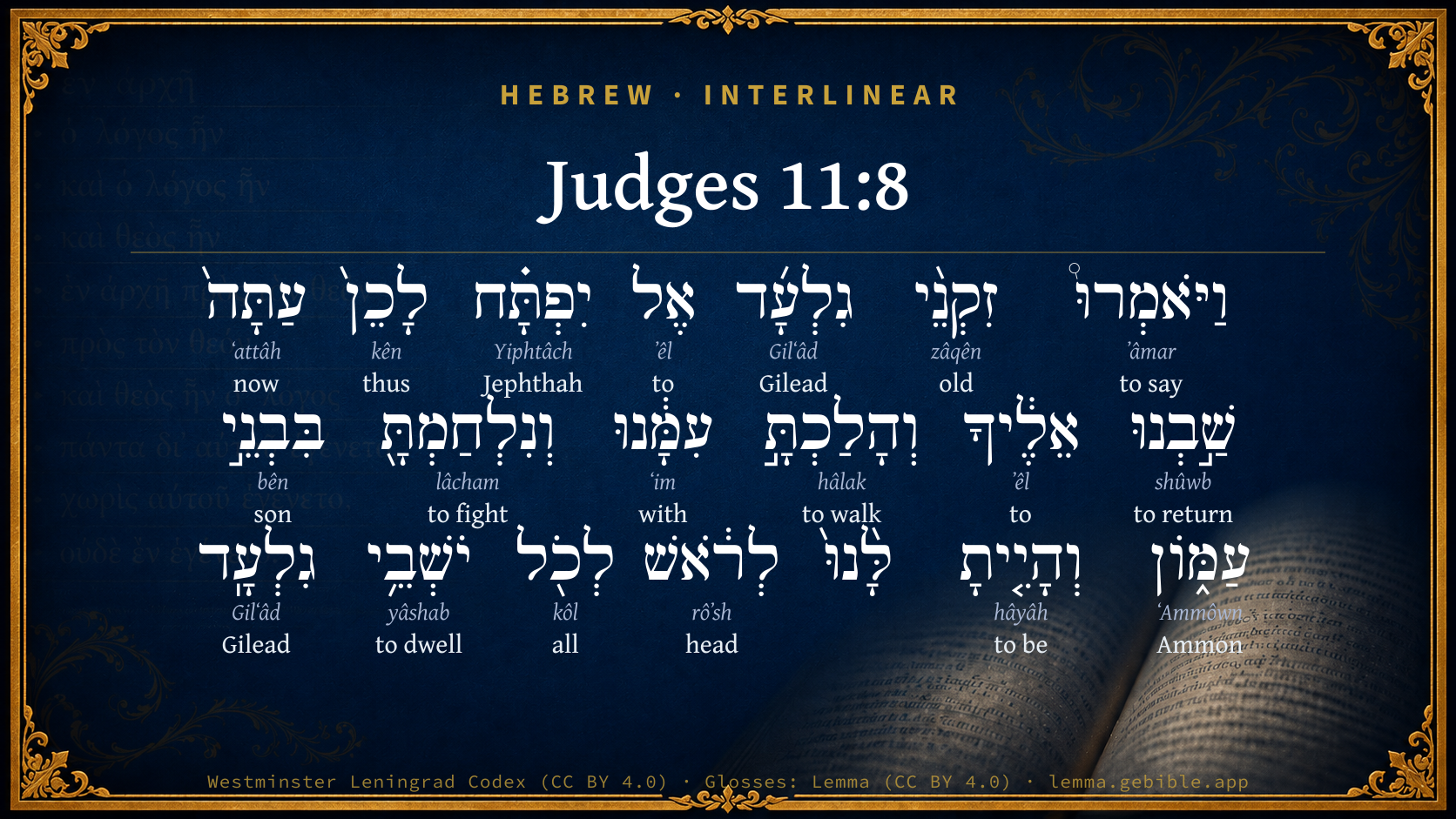
Hebrew (Westminster Leningrad Codex) Judges 11:8 appears in the Hebrew Old Testament. The text above is from the Westminster Leningrad Codex. Each word links to its Strong’s number, a concise gloss, and parsing drawn from the Open Scriptures Hebrew Bible morphology. Click any word for its full Brown-Driver-Briggs (BDB) entry.
Download image
Cite this verse

Judges 11:8 (World English Bible). Public Domain. Lemma interlinear Bible study tool, https://lemma.gebible.app/v/judges/11/8.

Show BibTeX & RIS
BibTeX
RIS
English Translation
The elders of Gilead said to Jephthah, Therefore are we turned again to you now, that you may go with us, and fight with the children of Ammon; and you shall be our head over all the inhabitants of Gilead.
World English Bible · Public Domain
Download a study sheet

One document with this verse’s original text, its word-by-word gloss line, the meaning frame, cross-references with their text, attributed commentary, and full source and license credits — printable, and it pastes into notes with its structure intact.

This verse Autodidact and up

Study sheet (.html) Plain text (.txt)

A passage Seminary Student

Up to 50 verses in one chapter. A passage sheet keeps up to 6 commentary sources and 12 cross-references per verse, in the order this page ranks them, and says so on the sheet whenever that leaves anything out. Ask for a single verse and you get the Autodidact verse sheet above.

Everything on this page stays free to read, with no account — the sheet is a download of what is already on screen, not access to it.

Want to remove ads? Support Godless Engineer
Compare translations 3

The same verse in 3 English versions, stacked beneath the original-language interlinear above. Click any original word for its lexicon entry.

Each is an independent rendering of the whole verse — the interlinear is not word-aligned to these translations.

Highlighted words mark where these versions differ — a whole-verse word diff, not a word-by-word alignment.

  • World English Bible Public Domain
    The elders of Gilead said to Jephthah, Therefore are we turned again to you now, that you may go with us, and fight with the children of Ammon; and you shall be our head over all the inhabitants of Gilead.
  • King James Version Public Domain
    And the elders of Gilead said unto Jephthah, Therefore we turn again to thee now, that thou mayest go with us, and fight against the children of Ammon, and be our head over all the inhabitants of Gilead.
  • unfoldingWord Literal Text CC BY-SA 4.0
    Then the elders of Gilead said to Jephthah, “Therefore we have now returned to you. So you shall come with us and fight with the sons of Ammon, and you shall be for us the head of all of the dwellers of Gilead.”

unfoldingWord Literal Text — © unfoldingWord, licensed CC BY-SA 4.0. Word-aligned USFM3 via Door43 (git.door43.org/unfoldingWord/en_ult).

Versions to compare (up to 4)

3 of 4 selected

Show all 18 translations

Every available English version of this verse, each an independent rendering of the whole verse.

  • World English Bible Public Domain
    The elders of Gilead said to Jephthah, Therefore are we turned again to you now, that you may go with us, and fight with the children of Ammon; and you shall be our head over all the inhabitants of Gilead.
  • Berean Standard Bible Public Domain
    They answered Jephthah, “This is why we now turn to you, that you may go with us, fight the Ammonites, and become leader over all of us who live in Gilead.”
  • Majority Standard Bible Public Domain
    They answered Jephthah, “This is why we now turn to you, that you may go with us, fight the Ammonites, and become leader over all of us who live in Gilead.”
  • King James Version Public Domain
    And the elders of Gilead said unto Jephthah, Therefore we turn again to thee now, that thou mayest go with us, and fight against the children of Ammon, and be our head over all the inhabitants of Gilead.
  • American Standard Version (1901) Public Domain
    And the elders of Gilead said unto Jephthah, Therefore are we turned again to thee now, that thou mayest go with us, and fight with the children of Ammon; and thou shalt be our head over all the inhabitants of Gilead.
  • Revised Version (1885) Public Domain
    And the elders of Gilead said unto Jephthah, Therefore are we turned again to thee now, that thou mayest go with us, and fight with the children of Ammon, and thou shalt be our head over all the inhabitants of Gilead.
  • Geneva Bible (1599) Public Domain
    Then the Elders of Gilead saide vnto Iphtah, Therefore we turne againe to thee now, that thou mayest goe with vs, and fight against the children of Ammon, and bee our head ouer all the inhabitants of Gilead.
  • Douay-Rheims (1899) Public Domain
    And the princes of Galaad said to Jephte: For this cause we are now come to thee, that thou mayst go with us, and fight against the children of Ammon, and be head over all the inhabitants of Galaad.
  • Young's Literal Translation Public Domain
    and the elders of Gilead say unto Jephthah, `Therefore, now, we have turned back unto thee; and thou hast gone with us, and fought against the Bene-Ammon, and thou hast been to us for head -- to all the inhabitants of Gilead.'
  • Literal Standard Version CC BY-SA 4.0
    And [the] elderly of Gilead say to Jephthah, “Therefore, now, we have turned back to you; and you have gone with us, and have fought against the sons of Ammon, and you have been for head to us—to all the inhabitants of Gilead.”
  • Unlocked Literal Bible CC BY-SA 4.0
    The elders of Gilead said to Jephthah, “That is why we are turning to you now; come with us and fight with the people of Ammon, and you will become the leader over all who live in Gilead.”
  • unfoldingWord Literal Text CC BY-SA 4.0
    Then the elders of Gilead said to Jephthah, “Therefore we have now returned to you. So you shall come with us and fight with the sons of Ammon, and you shall be for us the head of all of the dwellers of Gilead.”
  • Darby Bible Public Domain
    And the elders of Gilead said to Jephthah, "That is why we have turned to you now, that you may go with us and fight with the Ammonites, and be our head over all the inhabitants of Gilead."
  • World Messianic Bible Public Domain
    The elders of Gilead said to Jephthah, “Therefore we have turned again to you now, that you may go with us and fight with the children of Ammon. You will be our head over all the inhabitants of Gilead.”
  • Webster's Bible Public Domain
    And the elders of Gilead said to Jephthah, Therefore we turn again to thee now, that thou mayest go with us, and fight against the children of Ammon, and be our head over all the inhabitants of Gilead.
  • Free Bible Version CC BY-SA 4.0
    “Yes, that's why we've turned to you now,” the elders of Gilead replied. “Come with us and fight the Ammonites, and you will be the leader of all the people of Gilead.”
  • Bible in Basic English Public Domain
    And the responsible men of Gilead said to Jephthah, That is the reason we have come back to you; so go with us and make war against the children of Ammon, and we will make you our head over all the people of Gilead.
  • JPS Tanakh (1917) Public Domain
    And the elders of Gilead said unto Jephthah: 'Therefore are we returned to thee now, that thou mayest go with us, and fight with the children of Ammon, and thou shalt be our head over all the inhabitants of Gilead.'

Literal Standard Version (2020), Covenant Press — licensed CC BY-SA 4.0. Text via the HelloAO Bible API (eBible.org). Unlocked Literal Bible (unfoldingWord) — licensed CC BY-SA 4.0. Text via the HelloAO Bible API (eBible.org). unfoldingWord Literal Text — © unfoldingWord, licensed CC BY-SA 4.0. Word-aligned USFM3 via Door43 (git.door43.org/unfoldingWord/en_ult). Free Bible Version, Dr. Jonathan Gallagher — licensed CC BY-SA 4.0. Text via the HelloAO Bible API (eBible.org).

Word by word

More ways to search: Search by grammar → Find every occurrence → Compare this word →

Practice this passage: Drill this verse → Learn its vocabulary →

יִפְתָּ֗ח
Yiphtâch
H3316
“Jephthah”
Noun, Proper
Part of Speech
Noun
Type
Proper
Full BDB Definition

Origin: from H6605

TWOT: None

Jephthah or Jiphtah = "he opens" - a son of Gilead and a concubine and the judge who defeated the Ammonites; after the victory because of a vow taken before the battle he sacrificed his daughter as a burnt offering (noun proper masculine) - a city in Judah (noun proper locative)
  1. וַיֹּאמְרוּ֩ ʼâmar H559 “and · to say” Conjunction + Verb, Qal, Sequential Imperfect, 3rd Person, Masculine, Plural
  2. זִקְנֵ֨י zâqên H2205 “old of” Adjective, Adjective, Masculine, Plural, Construct
  3. גִלְעָ֜ד Gilʻâd H1568 “Gilead” Noun, Proper
  4. אֶל ʼêl H413 “to” Preposition
  5. לָכֵן֙ kên H3651 “to/for · thus” Preposition + Adverb
  6. עַתָּה֙ ʻattâh H6258 “now” Adverb
  7. שַׁ֣בְנוּ shûwb H7725 “to return” Verb, Qal, Perfect, 1st Person, Common, Plural
  8. אֵלֶ֔יךָ ʼêl H413 “to · you” Preposition + Suffix, Personal, 2nd Person, Masculine, Singular
  9. וְהָלַכְתָּ֣ hâlak H1980 “and · to walk” Conjunction + Verb, Qal, Sequential Perfect, 2nd Person, Masculine, Singular
  10. עִמָּ֔נוּ ʻim H5973 “with · us” Preposition + Suffix, Personal, 1st Person, Common, Plural
  11. וְנִלְחַמְתָּ֖ lâcham H3898 “and · to fight” Conjunction + Verb, Niphal, Sequential Perfect, 2nd Person, Masculine, Singular
  12. בִּבְנֵ֣י bên H1121 “in/at · sons of” Preposition + Noun, Common, Masculine, Plural, Construct
  13. עַמּ֑וֹן ʻAmmôwn H5983 “Ammon” Noun, Proper
  14. וְהָיִ֤יתָ hâyâh H1961 “and · to be” Conjunction + Verb, Qal, Sequential Perfect, 2nd Person, Masculine, Singular
  15. לְרֹ֔אשׁ rôʼsh H7218 “to/for · head” Preposition + Noun, Common, Masculine, Singular, Absolute
  16. לְכֹ֖ל kôl H3605 “to/for · all of” Preposition + Noun, Common, Masculine, Singular, Construct
  17. יֹשְׁבֵ֥י yâshab H3427 “dwelling” Verb, Qal, Participle Active, Masculine, Plural, Construct
  18. גִלְעָֽד Gilʻâd H1568 “Gilead” Noun, Proper

About this verse

These counts appear in no published source. They are computed here, from the morphology-tagged text and Lemma’s own curated glosses. What Lemma adds →

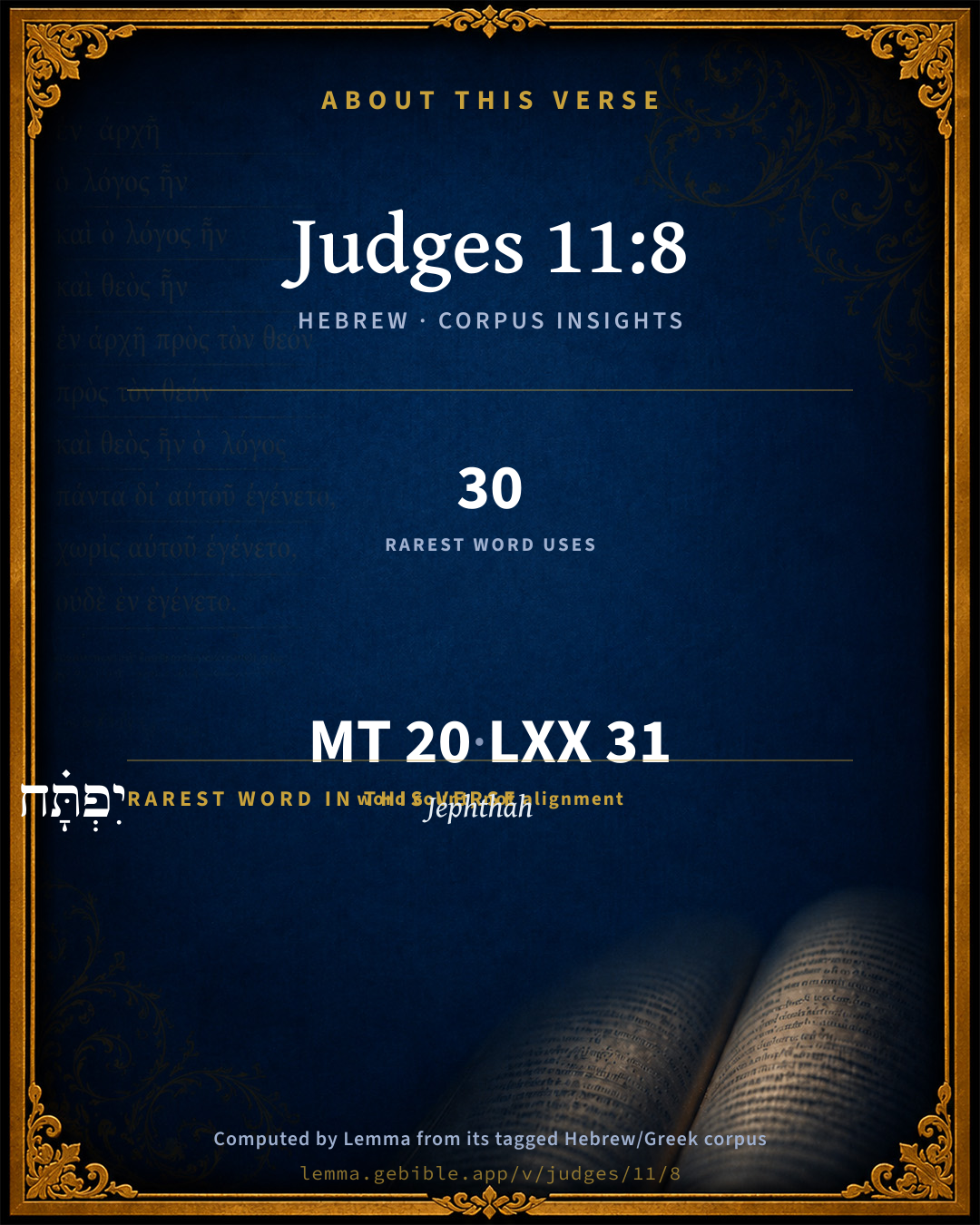
20
words
17
distinct lemmas
Historical
section

Shared distinctive vocabulary

יִפְתָּ֗ח Jephthah H3316 occurs in 26 verses of the Hebrew Bible. Also found in:

Grammatical profile

  • 6 verbs
  • 7 nouns
  • 1 adjective
  • 4 prepositions
  • 2 adverbs

Verb forms

  • וַיֹּאמְרוּ֩ Qal · Sequential Imperfect
  • שַׁ֣בְנוּ Qal · Perfect
  • וְהָלַכְתָּ֣ Qal · Sequential Perfect
  • וְנִלְחַמְתָּ֖ Niphal · Sequential Perfect
  • וְהָיִ֤יתָ Qal · Sequential Perfect
  • יֹשְׁבֵ֥י Qal · Participle Active

Repetition

Words recur within this verse — often emphatic in Hebrew:

  • גִלְעָ֜ד Gilead H1568 ×2
  • אֶל to H413 ×2

Hebrew & Septuagint length

In English translation the verse runs 40 words from the Hebrew and 38 from the Septuagint (LXX English) — closely comparable.

A rough comparison of the two English renderings, which tokenize alike — not a word-level alignment.

Word counts can differ between the Hebrew and the Greek without any difference in meaning — e.g. the Hebrew direct-object marker אֵת has no separate Greek word, and Greek often adds the article ὁ.

In the original languages it is 20 Hebrew tokens and 31 Greek tokens — but the two are counted differently (Hebrew bundles its prefixes and suffixes into one token; the Greek is in lemma form), so that isn’t a like-for-like length.

Cross-references

7

Topical passages linked to Judges 11:8 in the Treasury of Scripture Knowledge — connected by theme and wording, ordered by reader-vote popularity; previews shown in the World English Bible.

  • Judges 10:18 The people, the princes of Gilead, said one to another, What man is he who will begin to fight against the children of Ammon? he shall be head over all the inhabitants of Gilead.
  • Exodus 9:28 Pray to Yahweh; for there has been enough of mighty thunderings and hail. I will let you go, and you shall stay no longer."
  • Exodus 10:17 Now therefore please forgive my sin again, and pray to Yahweh your God, that he may also take away from me this death."
  • Exodus 8:8 Then Pharaoh called for Moses and Aaron, and said, "Entreat Yahweh, that he take away the frogs from me, and from my people; and I will let the people go, that they may sacrifice to Yahweh."
  • Exodus 8:28 Pharaoh said, "I will let you go, that you may sacrifice to Yahweh your God in the wilderness, only you shall not go very far away. Pray for me."
  • 1 Kings 13:6 The king answered the man of God, Entreat now the favor of Yahweh your God, and pray for me, that my hand may be restored me again. The man of God entreated Yahweh, and the king's hand was restored him again, and became as it was before.
  • Luke 17:3–4 Be careful. If your brother sins against you, rebuke him. If he repents, forgive him.

Cross-references courtesy of OpenBible.info (CC BY 4.0).

Hebrew and Greek witnesses Masoretic Hebrew ↔ Greek Septuagint

The same verse in the two great witnesses to the Old Testament, shown verse-for-verse.

These are two independent witnesses, not word-aligned to each other, and the Septuagint is shown in lemma (dictionary) form.

Hebrew Judges 11:8 Masoretic · Westminster Leningrad Codex

וַיֹּאמְרוּ֩ זִקְנֵ֨י גִלְעָ֜ד אֶל יִפְתָּ֗ח לָכֵן֙ עַתָּה֙ שַׁ֣בְנוּ אֵלֶ֔יךָ וְהָלַכְתָּ֣ עִמָּ֔נוּ וְנִלְחַמְתָּ֖ בִּבְנֵ֣י עַמּ֑וֹן וְהָיִ֤יתָ לָּ֨נוּ֙ לְרֹ֔אשׁ לְכֹ֖ל יֹשְׁבֵ֥י גִלְעָֽד

The elders of Gilead said to Jephthah, Therefore are we turned again to you now, that you may go with us, and fight with the children of Ammon; and you shall be our head over all the inhabitants of Gilead.

World English Bible · Public Domain

Greek LXX Judges 11:8 Septuagint · lemma form

καί εἶπον ὁ πρεσβύτερος γαλαάδ πρός ιεφθαε διά οὗτος νῦν ἐπιστρέφω πρός σύ καί πορεύομαι μετά ἐγώ καί παρατάσσω πρός υἱός αμμων καί εἰμί ἐγώ εἰς ἄρχων πᾶς ὁ οἰκέω γαλαάδ

And the elders of Galaad said to Jephthae, Therefore have we now turned to you, that you should go with us, and fight against the sons of Ammon, and be our head over all the inhabitants of Galaad.

LXX2012 (modern English Septuagint) · Public Domain

Hebrew: Westminster Leningrad Codex (CC BY 4.0). Greek: Septuagint (public domain); English from LXX2012 (modern English Septuagint) (Public Domain). How the Septuagint differs from the Hebrew →

Targum (Aramaic paraphrase)

1

The Targum is the ancient Jewish Aramaic paraphrase of the Hebrew Scriptures — an interpretive translation, not the Hebrew text itself. Onkelos (literal) and Pseudo-Jonathan (expansive) render the Torah, and Jonathan the Prophets. Coverage is partial: where no permissively-licensed English translation exists for a verse, only the Aramaic is shown. This is verse-level text, not a word-by-word alignment to the Hebrew.

  1. Targum Jonathan Prophets (Joshua–Malachi)
    וַאֲמַרוּ סָבֵי גִלְעָד לְיִפְתָּח בְּכֵן כְּעַן תַּבְנָא לְוָתָךְ וּתְהַךְ עִמָנָא וְתַגִיחַ קְרָבָא בִּבְנֵי עַמוֹן וּתְהֵי לָנָא לְרֵישׁ לְכֹל יַתְבֵי גִלְעָד:

    (no public-domain English translation for this verse)

    Targum Jonathan — Aramaic: “Mikraot Gedolot” (public domain). English: “Sefaria Community Translation” (CC0 1.0 (public-domain dedication)); “London "Chaldee Paraphrase," 1871” (public domain). Text via Sefaria.

Commentary

Notes on Judges 11:8 from classic Christian and Jewish commentators (each source and its license shown beneath its notes). The classic Christian expositions comment on the surrounding passage and are grouped to its opening verse, so a note may address several verses; the Jewish commentaries on the Tanakh (Rashi and others) are per-verse, so they appear only where the commentator wrote on this verse.

Lemma curates 59 commentaries, every one of them public domain or Creative Commons licensed, each selected and text-cleaned for this edition rather than reprinted as found. About our sources →

Trapp's Complete Commentary

John Trapp

Jdg 11:8 And the elders of Gilead said unto Jephthah, Therefore we turn again to thee now, that thou mayest go with us, and fight against the children of Ammon, and be our head over all the inhabitants of Gilead.

Ver. 8. Therefore we turn again to thee now.] We see our former oversight, and are ready to make thee amends.

John Trapp, A Commentary or Exposition upon All the Books of the Old and New Testament (1647–1656) — public domain. Text from a community e-Sword module.

Joseph Benson's Commentary

Jdg 11:8. Therefore we turn again to thee — Being sensible we have done thee an injury, we come now to make thee full reparation. That thou mayest go with us — They acknowledge that they need his assistance and are humble enough to request it.

Joseph Benson's Commentary on the Old and New Testaments (1811–1818) — public domain. Text from a community e-Sword module.

Adam Clarke's Commentary

Verse 8. Therefore we turn again to thee now] We are convinced that we have dealt unjustly by thee, and we wish now to repair our fault, and give thee this sincere proof of our regret for having acted unjustly, and of our confidence in thee.

Adam Clarke's Commentary on the Bible (1810–1826) — public domain. Text from a community e-Sword/MySword module.

The Cambridge Bible for Schools and Colleges

gen. ed. J. J. S. Perowne

8. Therefore are we turned again] i.e. this being so, since we have driven thee out. Instead of answering the objection directly, the elders state the reason for the reply they give. For this idiom in conversation cf. Jdg_8:7, Gen_4:15; Gen_30:15, 1Ki_22:19.

head … Gilead] Similarly Jdg_10:18.

The Cambridge Bible for Schools and Colleges (gen. ed. J. J. S. Perowne; Cambridge University Press, 1878–1918) — public domain. Text from a community e-Sword module.

John Gill's Exposition

And the elders of Gilead said unto Jephthah,.... In reply to his objection:

therefore we turn again unto thee now; being sensible of the injury they had done him, and repenting of it, of which their return to him was an evidence; it being with this view to remove the disgrace and dishonour that had been cast upon him, by conferring such honour on him, as to be their chief ruler:

that thou mayest go with us, and fight against the children of Ammon, and be our head over all the inhabitants of Gilead; the end of their coming to him was not only to bring him back with them to his own country, and to fight against the Ammonites, and the defence of it, but to be the sole governor of it; not of all Israel, but of the tribes beyond Jordan, which inhabited the land of Gilead: more than this they could not promise, though he afterwards was judge over all Israel, notwithstanding there was a law in Israel, that no spurious person should enter into the congregation, or bear any public office; so it was a law with the Athenians (i), that unless a man was born of both parents citizens, he should be reckoned spurious, and have no share in the government, see Jdg 11:2.

(i) Aelian. Var. Hist. l. 6. c. 10. l. 13. c. 24. "Suidas in voce"

John Gill's Exposition of the Whole Bible (1746–1763) — public domain (CC PDM 1.0). Text via the HelloAO Bible API.

Haydock's Catholic Bible Commentary

Cause to make some reparation for our offence, though we must acknowledge that our present distress caused us to think of doing so. (Haydock) --- Hebrew, "therefore we turn again to thee," &c. (Calmet) --- Galaad. they only engage that the tribes of Gad and Manasses, who inhabited that country, should submit to his authority. (Menochius) --- But as they were the most in danger, they first make head against the enemy, not doubting but their brethren in other parts would come to their assistance, chap. xii. 1. God ratified their choice, ver. 11, 29; (Haydock) and he was acknowledged, after his victory, judge of all Israel. (Menochius)

George Leo Haydock (1774–1849), Haydock's Catholic Family Bible and Commentary, 1859 edition — public domain. Excludes Psalms (Douay-Rheims chapter numbering differs from Protestant) and Deuterocanonical books (Catholic canon only).

Matthew Poole's English Annotations

Therefore we turn again to thee now; being sensible that we have done thee injury, we come now to make time full reparations.

Matthew Poole's English Annotations on the Holy Bible (1683–1685) — public domain. Text from a community e-Sword/MySword module.

Whedon's Commentary on the Bible

Daniel D. Whedon

8. Therefore — Inasmuch as we did thee wrong, we turn again to thee now to repair, as far as possible, that wrong by electing thee our head, that is, our captain and chief.

Daniel D. Whedon (gen. ed.), Commentary on the Old and New Testaments (1874–1909) — public domain. Text from a community e-Sword module.

John Wesley's Explanatory Notes

Therefore - Being sensible that we have done thee injury, we come now to make thee full reparation.

John Wesley, Explanatory Notes Upon the Whole Bible (1754–1765) — public domain. Text via the GEBible commentary corpus.

Keil & Delitzsch

C. F. Keil & F. Delitzsch

The elders replied, "Therefore (לכן, because we have formerly done thee wrong) we have now come to thee again to make thee our head, if thou comest with us and fightest against the Ammonites." The clauses והלכתּ, ונלהמתּ, and והיית, which are formally co-ordinate, are logically to be subordinated to one another, the first two expressing the condition, the third the consequence, in this sense, "If thou go with us and fight, ... thou shalt be head to us, namely, to all the inhabitants of Gilead," i.e., to the two tribes and a half on the east of the Jordan.

Keil & Delitzsch — Biblical Commentary on the Old Testament (1861–1891) — public domain (CC PDM 1.0). Text via the HelloAO Bible API. (Old Testament only.)

Lesson kit

Teaching starters — assembled from the data on this page, not authored interpretation. Every prompt links to the verse data it draws on. Edit before teaching.

Judges, in the Historical, opens this verse with 20 words (17 distinct Hebrew lemmas). Its most distinctive word is Yiphtâch (“Jephthah”). A historical commentator’s framing appears above. Read the whole chapter for the surrounding context.

Discussion questions

  1. The word Yiphtâch carries the sense “Jephthah.” How does it shape the verse?
  2. Joshua 15:43 shares the word «Jephthah» with this verse. How do the two illuminate each other?
  3. “Gilead” occurs 2× in this one verse. What is the effect of the repetition?
  4. The translations on this page render this verse differently — a whole-verse word diff, not a word-by-word alignment. What might account for the different wordings?
  5. The verb «וַיֹּאמְרוּ֩» is Qal Sequential Imperfect. How does its form color the action?
  6. Reading how Trapp's Complete Commentary and Joseph Benson's Commentary read this verse, where do the two commentators agree and where do they part?

Things to notice

Reading settings

Reading text

Shown beneath each verse's original-language words.

Old Testament
Old Testament edition

Read the OT as the Masoretic Hebrew (MT) or the Greek Septuagint (LXX).

English shown for the Greek Septuagint (in the Hebrew ↔ Greek comparison).

Comparing translations? Open the Compare panel on any verse page to stack up to four side by side.