
Ezekiel 38:12

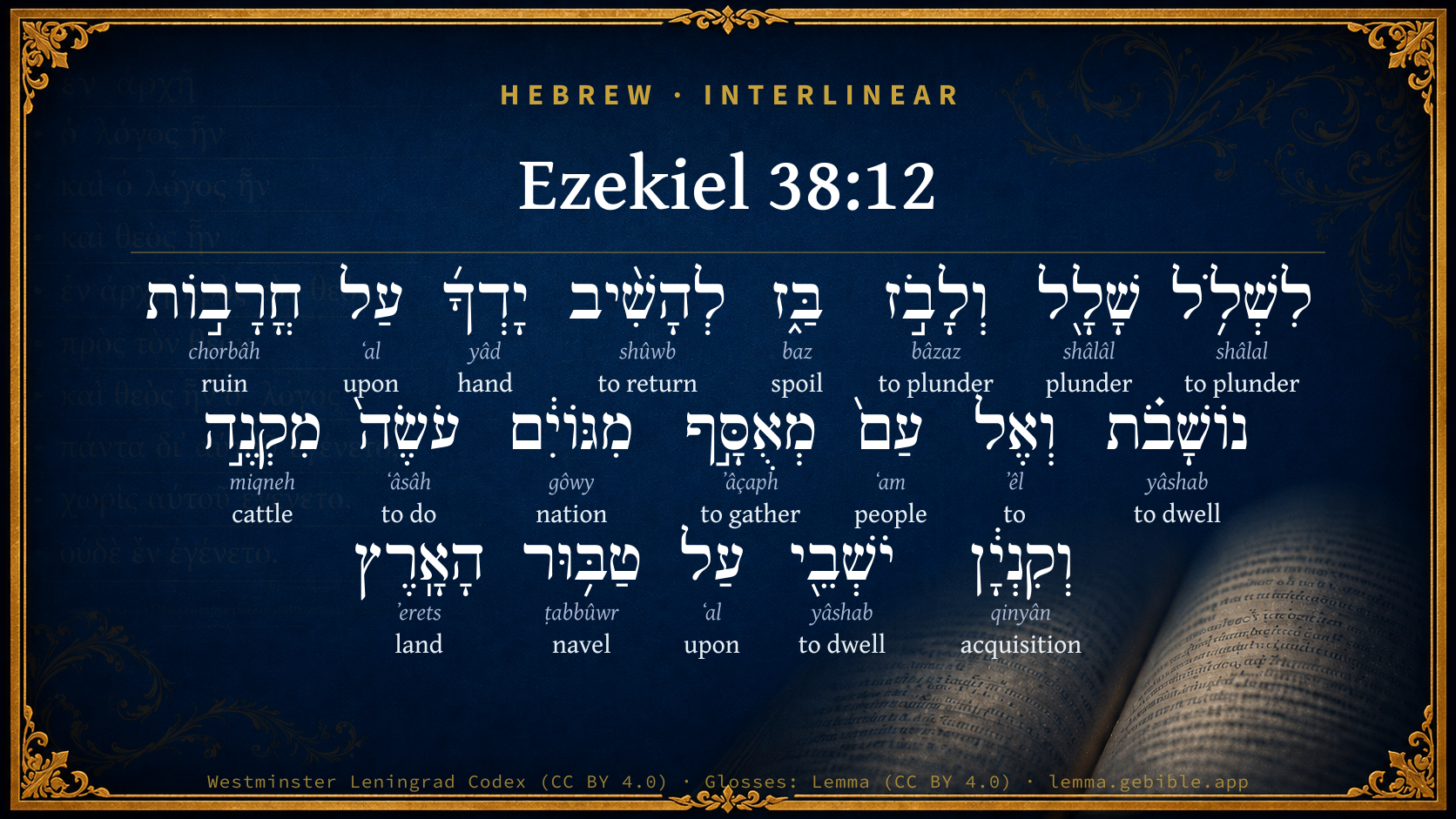
Hebrew (Westminster Leningrad Codex) Ezekiel 38:12 appears in the Hebrew Old Testament. The text above is from the Westminster Leningrad Codex. Each word links to its Strong’s number, a concise gloss, and parsing drawn from the Open Scriptures Hebrew Bible morphology. Click any word for its full Brown-Driver-Briggs (BDB) entry.
Download image
Cite this verse

Ezekiel 38:12 (World English Bible). Public Domain. Lemma interlinear Bible study tool, https://lemma.gebible.app/v/ezekiel/38/12.

Show BibTeX & RIS
BibTeX
RIS
English Translation
to take the spoil and to take the prey; to turn your hand against the waste places that are [now] inhabited, and against the people who are gathered out of the nations, who have gotten cattle and goods, who dwell in the middle of the earth.
World English Bible · Public Domain
Download a study sheet

One document with this verse’s original text, its word-by-word gloss line, the meaning frame, cross-references with their text, attributed commentary, and full source and license credits — printable, and it pastes into notes with its structure intact.

This verse Autodidact and up

Study sheet (.html) Plain text (.txt)

A passage Seminary Student

Up to 50 verses in one chapter. A passage sheet keeps up to 6 commentary sources and 12 cross-references per verse, in the order this page ranks them, and says so on the sheet whenever that leaves anything out. Ask for a single verse and you get the Autodidact verse sheet above.

Everything on this page stays free to read, with no account — the sheet is a download of what is already on screen, not access to it.

Want to remove ads? Support Godless Engineer
Compare translations 3

The same verse in 3 English versions, stacked beneath the original-language interlinear above. Click any original word for its lexicon entry.

Each is an independent rendering of the whole verse — the interlinear is not word-aligned to these translations.

Highlighted words mark where these versions differ — a whole-verse word diff, not a word-by-word alignment.

  • World English Bible Public Domain
    to take the spoil and to take the prey; to turn your hand against the waste places that are [now] inhabited, and against the people who are gathered out of the nations, who have gotten cattle and goods, who dwell in the middle of the earth.
  • King James Version Public Domain
    To take a spoil, and to take a prey; to turn thine hand upon the desolate places that are now inhabited, and upon the people that are gathered out of the nations, which have gotten cattle and goods, that dwell in the midst of the land.
  • unfoldingWord Literal Text CC BY-SA 4.0
    I will capture booty and steal plunder, in order to bring my hand against the ruins that are newly inhabited, and against the people gathered from the nations, people who are gaining livestock and property, and who are living at the center of the earth.’

unfoldingWord Literal Text — © unfoldingWord, licensed CC BY-SA 4.0. Word-aligned USFM3 via Door43 (git.door43.org/unfoldingWord/en_ult).

Versions to compare (up to 4)

3 of 4 selected

Show all 18 translations

Every available English version of this verse, each an independent rendering of the whole verse.

  • World English Bible Public Domain
    to take the spoil and to take the prey; to turn your hand against the waste places that are [now] inhabited, and against the people who are gathered out of the nations, who have gotten cattle and goods, who dwell in the middle of the earth.
  • Berean Standard Bible Public Domain
    in order to seize the spoil and carry off the plunder, to turn a hand against the desolate places now inhabited and against a people gathered from the nations, who have acquired livestock and possessions and who live at the center of the land.’
  • Majority Standard Bible Public Domain
    in order to seize the spoil and carry off the plunder, to turn a hand against the desolate places now inhabited and against a people gathered from the nations, who have acquired livestock and possessions and who live at the center of the land.’
  • King James Version Public Domain
    To take a spoil, and to take a prey; to turn thine hand upon the desolate places that are now inhabited, and upon the people that are gathered out of the nations, which have gotten cattle and goods, that dwell in the midst of the land.
  • American Standard Version (1901) Public Domain
    to take the spoil and to take the prey; to turn thy hand against the waste places that are `now' inhabited, and against the people that are gathered out of the nations, that have gotten cattle and goods, that dwell in the middle of the earth.
  • Revised Version (1885) Public Domain
    to take the spoil and to take the prey; to turn thine hand against the waste places that are now inhabited, and against the people that are gathered out of the nations, which have gotten cattle and goods, that dwell in the middle of the earth.
  • Geneva Bible (1599) Public Domain
    Thinking to spoyle the pray, and to take a bootie, to turne thine hande vpon the desolate places that are nowe inhabited, and vpon the people, that are gathered out of the nations which haue gotten cattell and goods, and dwell in the middes of the land.
  • Douay-Rheims (1899) Public Domain
    To take spoils, and lay hold on the prey, to lay thy hand upon them that had been wasted, and afterwards restored, and upon the people that is gathered together out of the nations, which hath begun to possess and to dwell in the midst of the earth.
  • Young's Literal Translation Public Domain
    To take a spoil, and to take a prey, To turn back thy hand on inhabited wastes, And on a people gathered out of nations, Making cattle and substance, Dwelling on a high part of the land.
  • Literal Standard Version CC BY-SA 4.0
    To take a spoil, and to take a prey, || To turn back your hand on inhabited ruins, || And on a people gathered out of nations, || Making livestock and substance, || Dwelling on a high part of the land.
  • Unlocked Literal Bible CC BY-SA 4.0
    I will capture booty and steal plunder, in order to bring my hand against the ruins that are newly inhabited, and against the people gathered from the nations, people who are gaining livestock and property, and who are living at the center of the earth.'
  • unfoldingWord Literal Text CC BY-SA 4.0
    I will capture booty and steal plunder, in order to bring my hand against the ruins that are newly inhabited, and against the people gathered from the nations, people who are gaining livestock and property, and who are living at the center of the earth.’
  • Darby Bible Public Domain
    to seize a spoil, and to take a prey; to turn thy hand against the waste places that are [now] inhabited, and against a people gathered out of the nations, which have gotten cattle and goods, that dwell in the middle of the land.
  • World Messianic Bible Public Domain
    to take the plunder and to take prey; to turn your hand against the waste places that are inhabited, and against the people who are gathered out of the nations, who have gotten livestock and goods, who dwell in the middle of the earth.’
  • Webster's Bible Public Domain
    To take a spoil, and to take a prey; to turn thy hand upon the desolate places that are now inhabited, and upon the people that are gathered out of the nations, which have gotten cattle and goods, that dwell in the midst of the land.
  • Free Bible Version CC BY-SA 4.0
    I'll be able to loot them—I'll rob them of their possessions. I'll attack those places that were once ruined but now are inhabited again. I'll attack a people brought back from the other nations, who now own livestock and possessions, living in the center of the country.’
  • Bible in Basic English Public Domain
    To take their property by force and go off with their goods; turning your hand against the waste places which now are peopled, and against the people who have been got together out of the nations, who have got cattle and goods for themselves, who are living in the middle of the earth.
  • JPS Tanakh (1917) Public Domain
    to take the spoil and to take the prey; to turn thy hand against the waste places that are now inhabited, and against the people that are gathered out of the nations, that have gotten cattle and goods, that dwell in the middle of the earth.

Literal Standard Version (2020), Covenant Press — licensed CC BY-SA 4.0. Text via the HelloAO Bible API (eBible.org). Unlocked Literal Bible (unfoldingWord) — licensed CC BY-SA 4.0. Text via the HelloAO Bible API (eBible.org). unfoldingWord Literal Text — © unfoldingWord, licensed CC BY-SA 4.0. Word-aligned USFM3 via Door43 (git.door43.org/unfoldingWord/en_ult). Free Bible Version, Dr. Jonathan Gallagher — licensed CC BY-SA 4.0. Text via the HelloAO Bible API (eBible.org).

Word by word

More ways to search: Search by grammar → Find every occurrence → Compare this word →

Practice this passage: Drill this verse → Learn its vocabulary →

טַבּ֥וּר
ṭabbûwr
H2872
“navel of”
Noun, Common, Masculine, Singular, Construct
Part of Speech
Noun
Type
Common
Gender
Masculine
Number
Singular
State
Construct
Full BDB Definition

Origin: from an unused root meaning to pile up; properly, accumulated

TWOT: 790a

centre, midst, navel, highest part
  1. לִשְׁלֹ֥ל shâlal H7997 “to plunder” Preposition + Verb, Qal, Infinitive Construct
  2. שָׁלָ֖ל shâlâl H7998 “plunder” Noun, Common, Masculine, Singular, Absolute
  3. וְלָבֹ֣ז bâzaz H962 “and · to plunder” Conjunction + Preposition + Verb, Qal, Infinitive Construct
  4. בַּ֑ז baz H957 “spoil” Noun, Common, Masculine, Singular, Absolute
  5. לְהָשִׁ֨יב shûwb H7725 “to return” Preposition + Verb, Hiphil, Infinitive Construct
  6. יָדְךָ֜ yâd H3027 “hand · your” Noun, Common, Both, Singular, Construct + Suffix, Personal, 2nd Person, Masculine, Singular
  7. עַל ʻal H5921 “upon” Preposition
  8. חֳרָב֣וֹת chorbâh H2723 “ruins” Noun, Common, Feminine, Plural, Absolute
  9. נוֹשָׁבֹ֗ת yâshab H3427 “dwelled” Verb, Niphal, Participle Passive, Feminine, Plural, Absolute
  10. וְאֶל ʼêl H413 “and · to” Conjunction + Preposition
  11. עַם֙ ʻam H5971 “people” Noun, Common, Masculine, Singular, Absolute
  12. מְאֻסָּ֣ף ʼâçaph H622 “gathered” Verb, Pual, Participle Passive, Masculine, Singular, Absolute
  13. מִגּוֹיִ֔ם gôwy H1471 “from · nations” Preposition + Noun, Common, Masculine, Plural, Absolute
  14. עֹשֶׂה֙ ʻâsâh H6213 “doing” Verb, Qal, Participle Active, Masculine, Singular, Absolute
  15. מִקְנֶ֣ה miqneh H4735 “cattle” Noun, Common, Masculine, Singular, Absolute
  16. וְקִנְיָ֔ן qinyân H7075 “and · acquisition” Conjunction + Noun, Common, Masculine, Singular, Absolute
  17. יֹשְׁבֵ֖י yâshab H3427 “dwelling” Verb, Qal, Participle Active, Masculine, Plural, Construct
  18. עַל ʻal H5921 “upon” Preposition
  19. הָאָֽרֶץ ʼerets H776 “the · land” Particle, Definite Article + Noun, Common, Both, Singular, Absolute

About this verse

These counts appear in no published source. They are computed here, from the morphology-tagged text and Lemma’s own curated glosses. What Lemma adds →

20
words
18
distinct lemmas
Prophets
section

Notable vocabulary

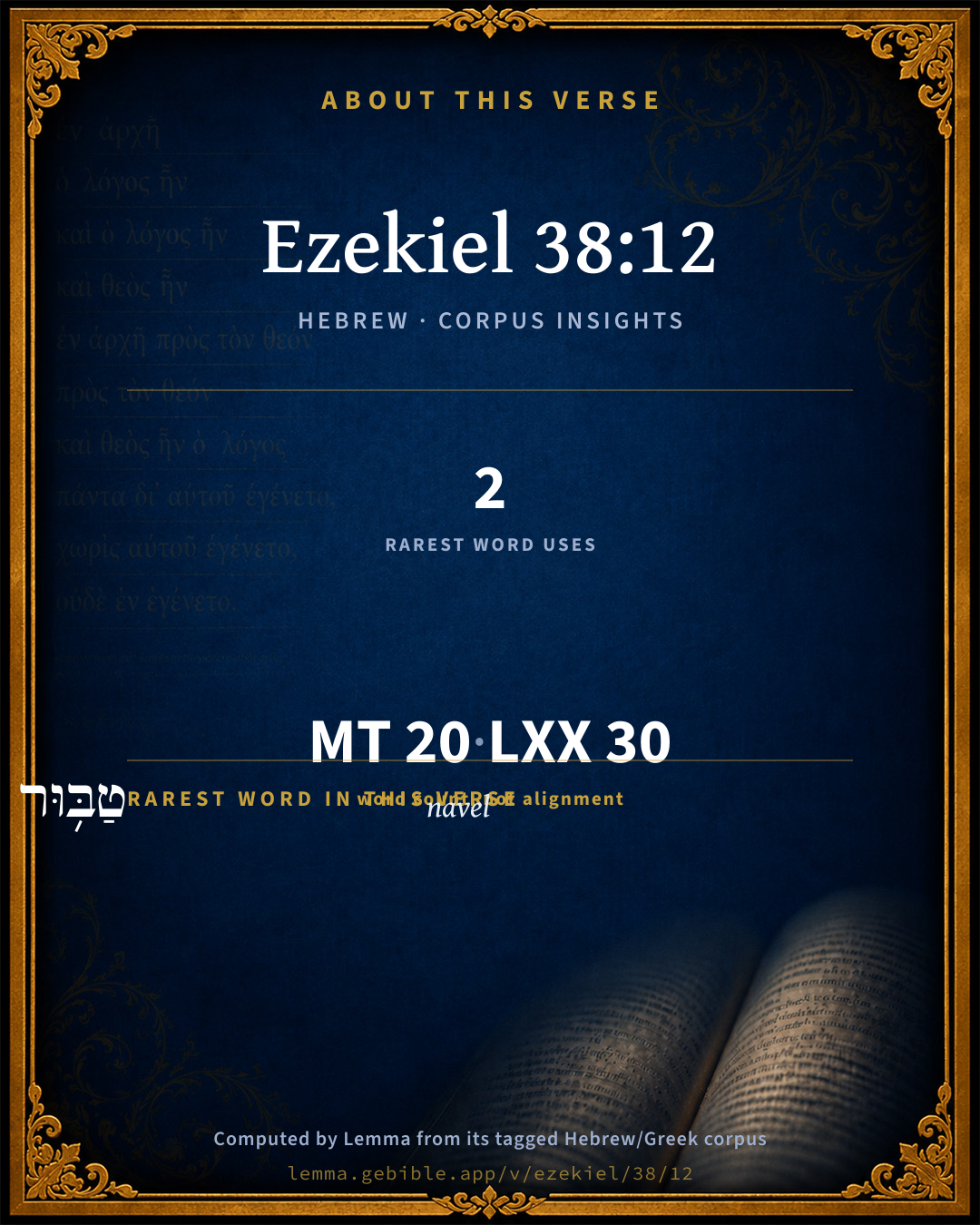
The rarest word here is טַבּ֥וּר navel H2872 — appearing just 2 times in the whole Hebrew Bible.

Shared distinctive vocabulary

טַבּ֥וּר navel H2872 occurs in 2 verses of the Hebrew Bible. Also found in:

Grammatical profile

  • 7 verbs
  • 10 nouns
  • 3 prepositions

Verb forms

  • לִשְׁלֹ֥ל Qal · Infinitive Construct
  • וְלָבֹ֣ז Qal · Infinitive Construct
  • לְהָשִׁ֨יב Hiphil · Infinitive Construct
  • נוֹשָׁבֹ֗ת Niphal · Participle Passive
  • מְאֻסָּ֣ף Pual · Participle Passive
  • עֹשֶׂה֙ Qal · Participle Active
  • יֹשְׁבֵ֖י Qal · Participle Active

Repetition

Words recur within this verse — often emphatic in Hebrew:

  • עַל upon H5921 ×2
  • נוֹשָׁבֹ֗ת to dwell H3427 ×2

Hebrew & Septuagint length

In English translation the verse runs 46 words from the Hebrew and 41 from the Septuagint (LXX English) — closely comparable.

A rough comparison of the two English renderings, which tokenize alike — not a word-level alignment.

Word counts can differ between the Hebrew and the Greek without any difference in meaning — e.g. the Hebrew direct-object marker אֵת has no separate Greek word, and Greek often adds the article ὁ.

In the original languages it is 20 Hebrew tokens and 30 Greek tokens — but the two are counted differently (Hebrew bundles its prefixes and suffixes into one token; the Greek is in lemma form), so that isn’t a like-for-like length.

Cross-references

14

Topical passages linked to Ezekiel 38:12 in the Treasury of Scripture Knowledge — connected by theme and wording, ordered by reader-vote popularity; previews shown in the World English Bible.

  • Isaiah 10:6 I will send him against a profane nation, and against the people of my wrath will I give him a charge, to take the spoil, and to take the prey, and to tread them down like the mire of the streets.
  • Ezekiel 29:19 Therefore thus says the Lord Yahweh: Behold, I will give the land of Egypt to Nebuchadrezzar king of Babylon; and he shall carry off her multitude, and take her spoil, and take her prey; and it shall be the wages for his army.
  • Ezekiel 38:8 After many days you shall be visited: in the latter years you shall come into the land that is brought back from the sword, that is gathered out of many peoples, on the mountains of Israel, which have been a continual waste; but it is brought forth out of the peoples, and they shall dwell securely, all of them.
  • Judges 9:37 Gaal spoke again and said, Behold, there come people down by the middle of the land, and one company comes by the way of the oak of Meonenim.
  • Isaiah 1:24–25 Therefore the Lord, Yahweh of Hosts, The Mighty One of Israel, says: "Ah, I will get relief from my adversaries, And avenge myself of my enemies;
  • Jeremiah 30:16 Therefore all those who devour you shall be devoured; and all your adversaries, everyone of them, shall go into captivity; and those who despoil you shall be a spoil, and all who prey on you will I give for a prey.
  • Jeremiah 32:43–44 Fields shall be bought in this land, about which you say, It is desolate, without man or animal; it is given into the hand of the Chaldeans.
  • Jeremiah 33:12–13 Thus says Yahweh of Hosts: Yet again shall there be in this place, which is waste, without man and without animal, and in all the cities of it, a habitation of shepherds causing their flocks to lie down.
  • Ezekiel 36:33–35 Thus says the Lord Yahweh: In the day that I cleanse you from all your iniquities, I will cause the cities to be inhabited, and the waste places shall be built.
  • Amos 1:8 I will cut off the inhabitant from Ashdod, And him who holds the scepter from Ashkelon; And I will turn my hand against Ekron; And the remnant of the Philistines will perish," says the Lord Yahweh.
  • Zechariah 1:12 Then the angel of Yahweh replied, "O Yahweh of Hosts, how long will you not have mercy on Jerusalem and on the cities of Judah, against which you have had indignation these seventy years?"
  • Zechariah 1:17 "Proclaim further, saying, 'Thus says Yahweh of Hosts: "My cities will again overflow with prosperity, and Yahweh will again comfort Zion, and will again choose Jerusalem."'"
  • Zechariah 10:8–10 I will signal for them, and gather them; For I have redeemed them; And they will increase as they have increased.
  • Zechariah 13:7 "Awake, sword, against my shepherd, And against the man who is close to me," says Yahweh of Hosts. Strike the shepherd, and the sheep will be scattered; And I will turn my hand against the little ones.

Cross-references courtesy of OpenBible.info (CC BY 4.0).

Hebrew and Greek witnesses Masoretic Hebrew ↔ Greek Septuagint

The same verse in the two great witnesses to the Old Testament, shown verse-for-verse.

These are two independent witnesses, not word-aligned to each other, and the Septuagint is shown in lemma (dictionary) form.

Hebrew Ezekiel 38:12 Masoretic · Westminster Leningrad Codex

לִשְׁלֹ֥ל שָׁלָ֖ל וְלָבֹ֣ז בַּ֑ז לְהָשִׁ֨יב יָדְךָ֜ עַל חֳרָב֣וֹת נוֹשָׁבֹ֗ת וְאֶל עַם֙ מְאֻסָּ֣ף מִגּוֹיִ֔ם עֹשֶׂה֙ מִקְנֶ֣ה וְקִנְיָ֔ן יֹשְׁבֵ֖י עַל טַבּ֥וּר הָאָֽרֶץ

to take the spoil and to take the prey; to turn your hand against the waste places that are [now] inhabited, and against the people who are gathered out of the nations, who have gotten cattle and goods, who dwell in the middle of the earth.

World English Bible · Public Domain

Greek LXX Ezekiel 38:12 Septuagint · lemma form

προνομεύω προνομή καί σκυλεύω σκῦλον αὐτός ὁ ἐπιστρέφω χείρ σύ εἰς ὁ ἐρημόω ὅς καταοἰκίζω καί ἐπί ἔθνος συνἄγω ἀπό ἔθνος πολύς ποιέω κτῆσις καταοἰκέω ἐπί ὁ ὀμφαλός ὁ γῆ

to seize plunder, and to take their spoil; to turn my hands against the desolate land that is now inhabited, and against a nation that is gathered from many nations, that have acquired property, dwelling in the midst of the land.

LXX2012 (modern English Septuagint) · Public Domain

On this verse, John Gill's Exposition discusses the Septuagint’s reading. Read the note in Commentary ↓

Hebrew: Westminster Leningrad Codex (CC BY 4.0). Greek: Septuagint (public domain); English from LXX2012 (modern English Septuagint) (Public Domain). How the Septuagint differs from the Hebrew →

Targum (Aramaic paraphrase)

1

The Targum is the ancient Jewish Aramaic paraphrase of the Hebrew Scriptures — an interpretive translation, not the Hebrew text itself. Onkelos (literal) and Pseudo-Jonathan (expansive) render the Torah, and Jonathan the Prophets. Coverage is partial: where no permissively-licensed English translation exists for a verse, only the Aramaic is shown. This is verse-level text, not a word-by-word alignment to the Hebrew.

  1. Targum Jonathan Prophets (Joshua–Malachi)
    לְמִבַּז בִּזָא וּלְמֶעְדֵי עֲדָאָה לְכַנָשָׁא מַשִׁרְיָתָךְ עַל חָרְבָתָא דְאִתְיַתְבָא וְעַל עַמָא דְאִתְכַּנְשׁוּ מִבֵּינֵי עַמְמַיָא דְאִצְלָחוּ בְּנִכְסִין וְקִנְיָנִין יָתְבִין עַל תּוּקְפָא דְאַרְעָא:

    (no public-domain English translation for this verse)

    Targum Jonathan — Aramaic: “Mikraot Gedolot” (public domain). English: “Sefaria Community Translation” (CC0 1.0 (public-domain dedication)); “London "Chaldee Paraphrase," 1871” (public domain). Text via Sefaria.

Commentary

Notes on Ezekiel 38:12 from classic Christian and Jewish commentators (each source and its license shown beneath its notes). The classic Christian expositions comment on the surrounding passage and are grouped to its opening verse, so a note may address several verses; the Jewish commentaries on the Tanakh (Rashi and others) are per-verse, so they appear only where the commentator wrote on this verse.

Lemma curates 59 commentaries, every one of them public domain or Creative Commons licensed, each selected and text-cleaned for this edition rather than reprinted as found. About our sources →

Trapp's Complete Commentary

John Trapp

Eze 38:12 To take a spoil, and to take a prey; to turn thine hand upon the desolate places [that are now] inhabited, and upon the people [that are] gathered out of the nations, which have gotten cattle and goods, that dwell in the midst of the land.

Ver. 12. To take a spoil.] Heb., To spoil the spoil, and to prey the prey. The antichristian rout are all for robbing and ravaging. What vast sums of money raked the Pope once out of England, which was therefore truly and trimly called by Pope Innocent IV, Hortus deliciarum et puteus inexhaustus, His delicate garden, and pit that could not be drawn dry.

To turn thine hand.] To plunder them to the very bones, as they say. There was a time when the Pope’s receivers here left not so much money in the whole kingdom as they either carried with them, or sent to Rome before them. Of this Papal expilation King John heavily complained, and could get no remedy, but Henry VIII would bear it no longer. England is no more a babe, said he, in his protestation against the Pope; there is no man here but now he knoweth that they do foolishly that give gold for lead, more weight of that than they receive of this, &c. {a}

{a} Acts and Mon., 990.

John Trapp, A Commentary or Exposition upon All the Books of the Old and New Testament (1647–1656) — public domain. Text from a community e-Sword module.

Jamieson, Fausset & Brown

Robert Jamieson, A. R. Fausset & David Brown

midst of the land--literally, "the navel" of the land (Jdg 9:37, Margin). So, in Eze 5:5, Israel is said to be set "in the midst of the nations"; not physically, but morally, a central position for being a blessing to the world: so (as the favored or "beloved city," Rev 20:9) an object of envy. GROTIUS translates, "In the height of the land" (so Eze 38:8), "the mountains of Israel," Israel being morally elevated above the rest of the world.

Jamieson, Fausset & Brown — Commentary Critical and Explanatory on the Whole Bible (1871) — public domain (CC PDM 1.0). Text via the HelloAO Bible API.

Adam Clarke's Commentary

Verse 12. To take a spoil - and a prey] When Antiochus took Jerusalem he gave the pillage of it to his soldiers, and spoiled the temple of its riches, which were immense. See Joseph. WAR, B. i. c. 1.

Adam Clarke's Commentary on the Bible (1810–1826) — public domain. Text from a community e-Sword/MySword module.

Ellicott's Commentary for English Readers

(12) In the midst of the land.—Literally, in the navel of the earth. (See Note on Eze_5:5.) The important position of Israel in reference to the other nations of the earth combined with its unsuspecting security and its riches to tempt the cupidity of Gog and his allies,

A Bible Commentary for English Readers, edited by Charles John Ellicott (1878–1897) — public domain. Text from a community e-Sword module.

The Cambridge Bible for Schools and Colleges

gen. ed. J. J. S. Perowne

12. On “take a spoil” cf. Eze_29:19; Isa_10:6. The phrase “turn the hand upon” is always used in a hostile sense (Isa_1:25). Eze_38:11-12 give the prophet’s idea of the condition of the restored community and of the state of the world in those days which permits it. He does not furnish details, but previous prophecies (ch. 25–32) describe how all the nations formerly hostile to Israel are humbled or taken out of the way. The period of Israel’s restoration is a time of universal peace. Only distant nations on the outskirts of the world, that have never entered upon the stage of history, remain unaware of the fame and glory of the God of Israel (Isa_66:19). The same circle of ideas appears in the passage relating to the period of a thousand years in the Apocalypse: outside the historical world there remain distant nations unaffected by the kingdom of Christ.

midst of the land] of the earth, lit. the navel of the earth, i.e. the mountain—land of Israel, the centre of the earth, cf. Eze_38:5. The prophet speaks of the world as known in his day.

The Cambridge Bible for Schools and Colleges (gen. ed. J. J. S. Perowne; Cambridge University Press, 1878–1918) — public domain. Text from a community e-Sword module.

John Gill's Exposition

Sheba, and Dedan, and the merchants of Tarshish,.... These are not any of the people that shall come along with Gog on his expedition; but some neighbouring nations bordering on Judea, who will address him in the following manner, as he passes through them, or by them. Sheba and Dedan design the Arabians inhabiting that part of Arabia which lay near to Judea, even Arabia Petraea and Felix; and the merchants of Tarshish are the Tyrians and Zidonians that traded by sea, as Tarshish sometimes signifies; or to Tartessus in Spain, where they had much traffic; and may design the people of those places that will at this time be living in Palestine, that trade by sea to foreign parts. The Septuagint and Arabic versions render it the "Carthaginian merchants", or "the merchants of Carthage":

with all the young lions thereof; which some interpret of sea pirates, for their cruelty and voraciousness. The Targum paraphrases it, all the kings thereof; and so Kimchi thinks kings and princes are meant; but the Septuagint version renders it, all their villages; and so the Syriac version, all the cities:

shall say unto thee, art thou come to take a spoil? either out of compassion to the people of the Jews; or rather by way of congratulation, and as expressive of joy at it; or else out of envy that they have no share in it; suggesting that they would gladly join with him, and partake of the booty:

hast thou gathered thy company together to take a prey? to carry away silver and gold, to take away cattle and goods, to take a great spoil? all which it is supposed might easily be done; only they might wonder that so rich a potentate as the Turk should give himself the trouble to raise such an army, and come so far, for cattle and goods, and silver and gold of which he had such plenty. Gog gives no answer, but God does.

John Gill's Exposition of the Whole Bible (1746–1763) — public domain (CC PDM 1.0). Text via the HelloAO Bible API.

Haydock's Catholic Bible Commentary

Midst. Literally, "navel." Hebrew, "Thabor," intimating a mountain rising in a plain, Judges ix. 7. (Calmet) --- Alluding to this intended blunder of the Jews lately returned, he speaks of Antichrist and of all heretics, who seek to pervert or suppress Catholics rescued from the power of the devil, by the sacraments of Christ. (Worthington)

George Leo Haydock (1774–1849), Haydock's Catholic Family Bible and Commentary, 1859 edition — public domain. Excludes Psalms (Douay-Rheims chapter numbering differs from Protestant) and Deuterocanonical books (Catholic canon only).

Matthew Poole's English Annotations

To take a spoil: the Scythians, and those other nations in this army, were from their original a violent, unjust, and thievish people, addicted to robberies; and they now, under this Gog, follow the old trade.

To take a prey; the same repeated. To turn thine hand: either it speaks the ease with which Gog presumeth he shall do what he intendeth, or the sad desolation which he would cause to return upon the Jews.

The desolate places; made so by the Babylonians, and continued so till of late years past.

Now inhabited; newly repeopled and rebuilt upon their return out of Babylon.

Which have gotten cattle and goods; or which are now by their husbandry and diligence getting somewhat of estate and riches; or, as we read it,

have gotten; for it was to the time of Antiochus Epiphanes from their return near three hundred and fifty years, and from the finishing the walls of Jerusalem by Nehemiah to the time of Antiochus two hundred years, so that in that time the Jews might be grown rich enough to be accounted a great prey to him, if he were this Gog. However, such the Jews will be thought, when Gog attempts this enterprise.

Matthew Poole's English Annotations on the Holy Bible (1683–1685) — public domain. Text from a community e-Sword/MySword module.

Whedon's Commentary on the Bible

Daniel D. Whedon

12. In the midst of the land — The R.V., margin, gives “in the navel of the earth.” Palestine was really the center of the ancient civilized world. Winckler sees a reference here to the Mount of the Gods. (See note Eze_28:14.) Cheyne (Expository Times, 1899), by a slight change of text, translates “on the high places of the land.” (Compare Deu_32:13.)

Daniel D. Whedon (gen. ed.), Commentary on the Old and New Testaments (1874–1909) — public domain. Text from a community e-Sword module.

Rashi

Rabbi Shlomo Yitzchaki (Rashi)

to return your hand upon the resettled ruins To destroy a second time the cities that were in ruins until now, and now have been settled.

and to a people gathered from peoples, who now acquire livestock and possessions.

on the navel of the earth In the height and the strength of the earth, like the navel, which is in the center of a person and slopes downward from all its sides.

Rashi on the Tanakh — English translations: “The Judaica Press complete Tanach with Rashi, translated by A. J. Rosenberg” (CC BY 4.0); “Pentateuch with Rashi's commentary by M. Rosenbaum and A.M. Silbermann, 1929-1934” (public domain); “The Metsudah Tanach series, Lakewood, N.J” (CC BY 4.0); and “The Book of Joshua, Metsudah Publications, 1997” (CC BY 4.0). Text via Sefaria.

Lesson kit

Teaching starters — assembled from the data on this page, not authored interpretation. Every prompt links to the verse data it draws on. Edit before teaching.

Ezekiel, in the Prophets, opens this verse with 20 words (18 distinct Hebrew lemmas). Its most distinctive word is ṭabbûwr (“navel”). A historical commentator’s framing appears above. Read the whole chapter for the surrounding context.

Discussion questions

  1. What does “navel” (ṭabbûwr) contribute to the verse as a whole?
  2. How does Judges 9:37, which shares the word «navel», read alongside this verse?
  3. What does the repetition of “upon” (2× in this one verse) do in this verse?
  4. The translations on this page render this verse differently — a whole-verse word diff, not a word-by-word alignment. What might account for the different wordings?
  5. «לִשְׁלֹ֥ל» is a Qal Infinitive Construct verb. How does that grammatical form shape the action described?
  6. Compare how Trapp's Complete Commentary and Jamieson, Fausset & Brown read this verse. Where do they agree or differ?

Things to notice

Reading settings

Reading text

Shown beneath each verse's original-language words.

Old Testament
Old Testament edition

Read the OT as the Masoretic Hebrew (MT) or the Greek Septuagint (LXX).

English shown for the Greek Septuagint (in the Hebrew ↔ Greek comparison).

Comparing translations? Open the Compare panel on any verse page to stack up to four side by side.