
Jeremiah 15:19

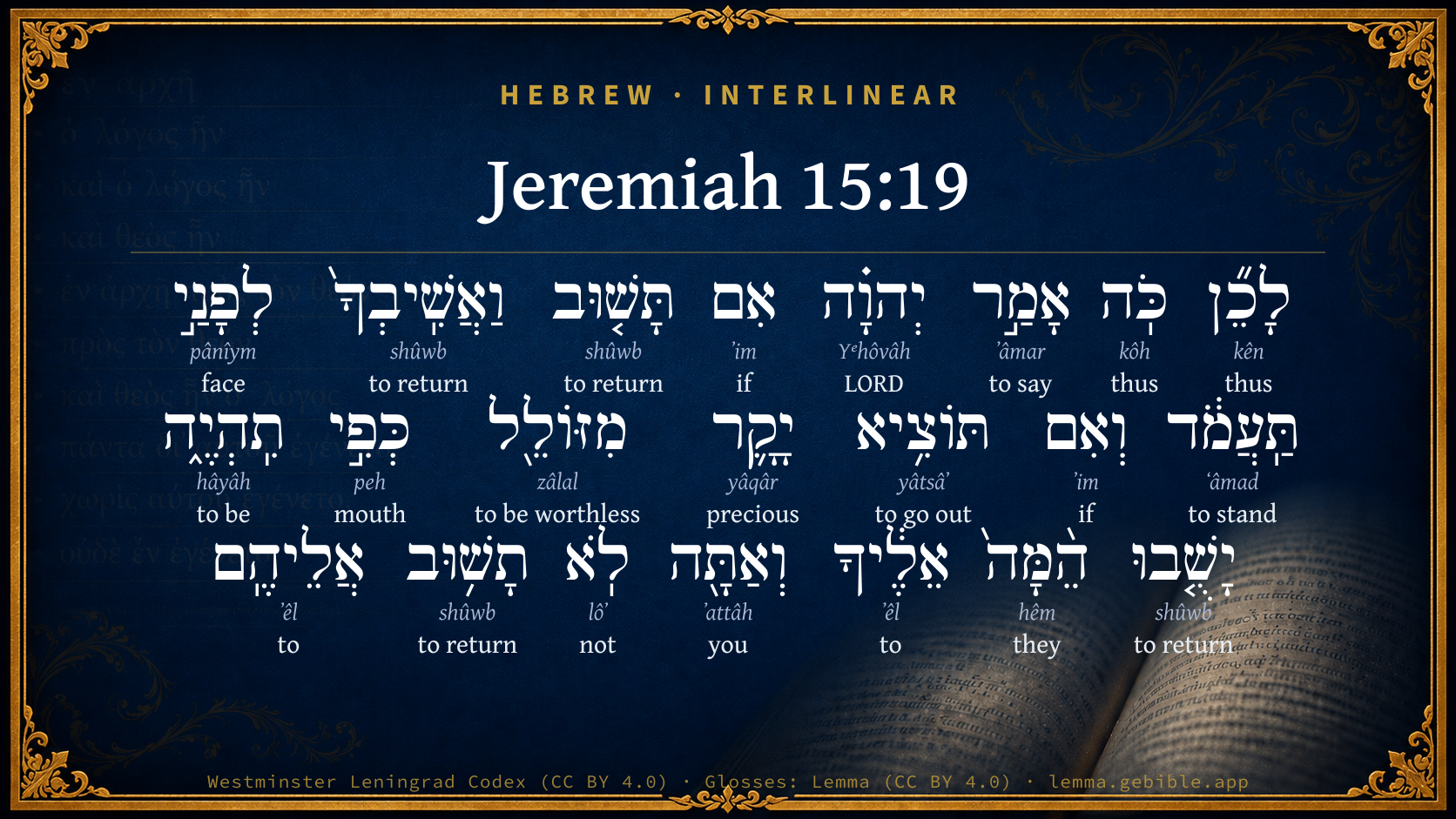
Hebrew (Westminster Leningrad Codex) Jeremiah 15:19 appears in the Hebrew Old Testament. The text above is from the Westminster Leningrad Codex. Each word links to its Strong’s number, a concise gloss, and parsing drawn from the Open Scriptures Hebrew Bible morphology. Click any word for its full Brown-Driver-Briggs (BDB) entry.
Download image
Cite this verse

Jeremiah 15:19 (World English Bible). Public Domain. Lemma interlinear Bible study tool, https://lemma.gebible.app/v/jeremiah/15/19.

Show BibTeX & RIS
BibTeX
RIS
English Translation
Therefore thus says Yahweh, If you return, then will I bring you again, that you may stand before me; and if you take forth the precious from the vile, you shall be as my mouth: they shall return to you, but you shall not return to them.
World English Bible · Public Domain
Download a study sheet

One document with this verse’s original text, its word-by-word gloss line, the meaning frame, cross-references with their text, attributed commentary, and full source and license credits — printable, and it pastes into notes with its structure intact.

This verse Autodidact and up

Study sheet (.html) Plain text (.txt)

A passage Seminary Student

Up to 50 verses in one chapter. A passage sheet keeps up to 6 commentary sources and 12 cross-references per verse, in the order this page ranks them, and says so on the sheet whenever that leaves anything out. Ask for a single verse and you get the Autodidact verse sheet above.

Everything on this page stays free to read, with no account — the sheet is a download of what is already on screen, not access to it.

Want to remove ads? Support Godless Engineer
Compare translations 3

The same verse in 3 English versions, stacked beneath the original-language interlinear above. Click any original word for its lexicon entry.

Each is an independent rendering of the whole verse — the interlinear is not word-aligned to these translations.

Highlighted words mark where these versions differ — a whole-verse word diff, not a word-by-word alignment.

  • World English Bible Public Domain
    Therefore thus says Yahweh, If you return, then will I bring you again, that you may stand before me; and if you take forth the precious from the vile, you shall be as my mouth: they shall return to you, but you shall not return to them.
  • King James Version Public Domain
    Therefore thus saith the LORD, If thou return, then will I bring thee again, and thou shalt stand before me: and if thou take forth the precious from the vile, thou shalt be as my mouth: let them return unto thee; but return not thou unto them.
  • unfoldingWord Literal Text CC BY-SA 4.0
    Therefore, thus says Yahweh, “If you return, then I will restore you, you shall stand to my face. And if you take out the precious from the one who is worthless, you will be as my mouth. They themselves shall turn to you, but you yourself shall not turn to them.

unfoldingWord Literal Text — © unfoldingWord, licensed CC BY-SA 4.0. Word-aligned USFM3 via Door43 (git.door43.org/unfoldingWord/en_ult).

Versions to compare (up to 4)

3 of 4 selected

Show all 18 translations

Every available English version of this verse, each an independent rendering of the whole verse.

  • World English Bible Public Domain
    Therefore thus says Yahweh, If you return, then will I bring you again, that you may stand before me; and if you take forth the precious from the vile, you shall be as my mouth: they shall return to you, but you shall not return to them.
  • Berean Standard Bible Public Domain
    Therefore this is what the LORD says: “If you return, I will restore you; you will stand in My presence. And if you speak words that are noble instead of worthless, you will be My spokesman. It is they who must turn to you, but you must not turn to them.
  • Majority Standard Bible Public Domain
    Therefore this is what the LORD says: “If you return, I will restore you; you will stand in My presence. And if you speak words that are noble instead of worthless, you will be My spokesman. It is they who must turn to you, but you must not turn to them.
  • King James Version Public Domain
    Therefore thus saith the LORD, If thou return, then will I bring thee again, and thou shalt stand before me: and if thou take forth the precious from the vile, thou shalt be as my mouth: let them return unto thee; but return not thou unto them.
  • American Standard Version (1901) Public Domain
    Therefore thus saith Jehovah, If thou return, then will I bring thee again, that thou mayest stand before me; and if thou take forth the precious from the vile, thou shalt be as my mouth: they shall return unto thee, but thou shalt not return unto them.
  • Revised Version (1885) Public Domain
    Therefore thus saith the LORD, If thou return, then will I bring thee again, that thou mayest stand before me; and if thou take forth the precious from the vile, thou shalt be as my mouth: they shall return unto thee, but thou shalt not return unto them.
  • Geneva Bible (1599) Public Domain
    Therefore thus saith the Lord, If thou returne, then wil I bring thee againe, and thou shalt stand before me: and if thou take away the precious from the vile, thou shalt be according to my worde: let them returne vnto thee, but returne not thou vnto them.
  • Douay-Rheims (1899) Public Domain
    Therefore thus saith the Lord: If thou wilt be converted, I will convert thee, and thou shalt stand before my face; and if thou wilt separate the precious from the vile, thou shalt be as my mouth: they shall be turned to thee, and thou shalt not be turned to them.
  • Young's Literal Translation Public Domain
    Therefore, thus said Jehovah: If thou turnest back, then I bring thee back, Before Me thou dost stand, And if thou bringest out the precious from the vile, As My mouth thou art! They -- they turn back unto thee, And thou dost not turn back unto them.
  • Literal Standard Version CC BY-SA 4.0
    Therefore, thus said YHWH: “If you turn back, then I bring you back, || You stand before Me, || And if you bring out the precious from the vile, || You are as My mouth! They return to you, || And you do not return to them.
  • Unlocked Literal Bible CC BY-SA 4.0
    Therefore Yahweh said this, “If you repent, Jeremiah, then I will restore you, and you will stand before me and serve me. For if you separate the foolish things from the precious things, you will be like my mouth. The people will come back to you, but you yourself must not go back to them.
  • unfoldingWord Literal Text CC BY-SA 4.0
    Therefore, thus says Yahweh, “If you return, then I will restore you, you shall stand to my face. And if you take out the precious from the one who is worthless, you will be as my mouth. They themselves shall turn to you, but you yourself shall not turn to them.
  • Darby Bible Public Domain
    Therefore thus saith Jehovah: If thou return, then will I bring thee again, thou shalt stand before me; and if thou take forth the precious from the vile, thou shalt be as my mouth. Let them return unto thee; but return not thou unto them.
  • World Messianic Bible Public Domain
    Therefore the LORD says, “If you return, then I will bring you again, that you may stand before me; and if you take out the precious from the vile, you will be as my mouth. They will return to you, but you will not return to them.
  • Webster's Bible Public Domain
    Therefore thus saith the LORD, If thou shalt return, then will I bring thee again, and thou shalt stand before me: and if thou shalt separate the precious from the vile, thou shalt be as my mouth: let them return to thee; but return not thou to them.
  • Free Bible Version CC BY-SA 4.0
    So this is what the Lord says: If you come back to me, I will take you back and you will serve me again. If what you talk about are worthwhile subjects and not nonsense, you will be my spokesman, Jeremiah. They must be the ones who follow you; you must not follow them.
  • Bible in Basic English Public Domain
    For this cause the Lord has said, If you will come back, then I will again let you take your place before me; and if you give out what is of value and not that which has no value, you will be as my mouth: let them come back to you, but do not go back to them.
  • JPS Tanakh (1917) Public Domain
    Therefore thus saith the LORD: If thou return, and I bring thee back, thou shalt stand before Me; and if thou bring forth the precious out of the vile, thou shalt be as My mouth; let them return unto thee, but thou shalt not return unto them.

Literal Standard Version (2020), Covenant Press — licensed CC BY-SA 4.0. Text via the HelloAO Bible API (eBible.org). Unlocked Literal Bible (unfoldingWord) — licensed CC BY-SA 4.0. Text via the HelloAO Bible API (eBible.org). unfoldingWord Literal Text — © unfoldingWord, licensed CC BY-SA 4.0. Word-aligned USFM3 via Door43 (git.door43.org/unfoldingWord/en_ult). Free Bible Version, Dr. Jonathan Gallagher — licensed CC BY-SA 4.0. Text via the HelloAO Bible API (eBible.org).

Word by word

More ways to search: Search by grammar → Find every occurrence → Compare this word →

Practice this passage: Drill this verse → Learn its vocabulary →

מִזּוֹלֵ֖ל
zâlal
H2151
“from · being worthless”
Preposition + Verb, Qal, Participle Active, Masculine, Singular, Absolute
Part of Speech
Preposition + Verb
Stem
Qal
Form
Participle Active
Gender
Masculine
Number
Singular
State
Absolute
Full BDB Definition

Origin: a primitive root [compare H2107 ]

TWOT: 553

to be worthless, be vile, be insignificant, be light - (Qal) - to be worthless, be insignificant - to make light of, squander, be lavish with - to shake, tremble, quake - (Niphal) to shake, quake
  1. לָכֵ֞ן kên H3651 “to/for · thus” Preposition + Adverb
  2. כֹּֽה kôh H3541 “thus” Adverb
  3. אָמַ֣ר ʼâmar H559 “to say” Verb, Qal, Perfect, 3rd Person, Masculine, Singular
  4. יְהוָ֗ה Yᵉhôvâh H3068 “LORD” Noun, Proper
  5. אִם ʼim H518 “if” Conjunction
  6. תָּשׁ֤וּב shûwb H7725 “to return” Verb, Qal, Imperfect, 2nd Person, Masculine, Singular
  7. וַאֲשִֽׁיבְךָ֙ shûwb H7725 “and · to return · you” Conjunction + Verb, Hiphil, Imperfect, 1st Person, Common, Singular + Suffix, Personal, 2nd Person, Masculine, Singular
  8. לְפָנַ֣י pânîym H6440 “to/for · face(s) · my” Preposition + Noun, Common, Both, Plural, Construct + Suffix, Personal, 1st Person, Common, Singular
  9. תַּֽעֲמֹ֔ד ʻâmad H5975 “to stand” Verb, Qal, Imperfect, 2nd Person, Masculine, Singular
  10. וְאִם ʼim H518 “and · if” Conjunction + Conjunction
  11. תּוֹצִ֥יא yâtsâʼ H3318 “to go out” Verb, Hiphil, Imperfect, 2nd Person, Masculine, Singular
  12. יָקָ֛ר yâqâr H3368 “precious” Adjective, Adjective, Masculine, Singular, Absolute
  13. כְּפִ֣י peh H6310 “like/as · mouth · my” Preposition + Noun, Common, Masculine, Singular, Construct + Suffix, Personal, 1st Person, Common, Singular
  14. תִֽהְיֶ֑ה hâyâh H1961 “to be” Verb, Qal, Imperfect, 2nd Person, Masculine, Singular
  15. יָשֻׁ֤בוּ shûwb H7725 “to return” Verb, Qal, Imperfect, 3rd Person, Masculine, Plural
  16. הֵ֨מָּה֙ hêm H1992 “they” Pronoun, Personal, 3rd Person, Masculine, Plural
  17. אֵלֶ֔יךָ ʼêl H413 “to · you” Preposition + Suffix, Personal, 2nd Person, Masculine, Singular
  18. וְאַתָּ֖ה ʼattâh H859 “and · you” Conjunction + Pronoun, Personal, 2nd Person, Masculine, Singular
  19. לֹֽא lôʼ H3808 “not” Particle, Negative
  20. תָשׁ֥וּב shûwb H7725 “to return” Verb, Qal, Imperfect, 2nd Person, Masculine, Singular
  21. אֲלֵיהֶֽם ʼêl H413 “to · them” Preposition + Suffix, Personal, 3rd Person, Masculine, Plural

About this verse

These counts appear in no published source. They are computed here, from the morphology-tagged text and Lemma’s own curated glosses. What Lemma adds →

22
words
17
distinct lemmas
Prophets
section

Notable vocabulary

The rarest word here is מִזּוֹלֵ֖ל to be worthless H2151 — appearing just 8 times in the whole Hebrew Bible.

Shared distinctive vocabulary

מִזּוֹלֵ֖ל to be worthless H2151 occurs in 8 verses of the Hebrew Bible. Also found in:

Grammatical profile

  • 9 verbs
  • 3 nouns
  • 1 adjective
  • 2 pronouns
  • 2 prepositions
  • 2 conjunctions
  • 2 adverbs
  • 1 particle

Verb forms

  • אָמַ֣ר Qal · Perfect
  • תָּשׁ֤וּב Qal · Imperfect
  • וַאֲשִֽׁיבְךָ֙ Hiphil · Imperfect
  • תַּֽעֲמֹ֔ד Qal · Imperfect
  • תּוֹצִ֥יא Hiphil · Imperfect
  • מִזּוֹלֵ֖ל Qal · Participle Active
  • תִֽהְיֶ֑ה Qal · Imperfect
  • יָשֻׁ֤בוּ Qal · Imperfect
  • תָשׁ֥וּב Qal · Imperfect

Repetition

Words recur within this verse — often emphatic in Hebrew:

  • תָּשׁ֤וּב to return H7725 ×4
  • אִם if H518 ×2
  • אֵלֶ֔יךָ to H413 ×2

Hebrew & Septuagint length

In the original languages it is 22 Hebrew tokens and 37 Greek tokens — but the two are counted differently (Hebrew bundles its prefixes and suffixes into one token; the Greek is in lemma form), so that isn’t a like-for-like length.

Cross-references

28

Topical passages linked to Jeremiah 15:19 in the Treasury of Scripture Knowledge — connected by theme and wording, ordered by reader-vote popularity; previews shown in the World English Bible.

  • Zechariah 3:7 "Thus says Yahweh of hosts: 'If you will walk in my ways, and if you will keep my charge, then you also shall judge my house, and shall also keep my courts, and I will give you a place of access among these who stand by.
  • Luke 21:15 for I will give you a mouth and wisdom which all your adversaries will not be able to withstand or to contradict.
  • Leviticus 10:10 and that you are to make a distinction between the holy and the common, and between the unclean and the clean;
  • Ezekiel 44:23 They shall teach my people the difference between the holy and the common, and cause them to discern between the unclean and the clean.
  • Ezekiel 22:26 Her priests have done violence to my law, and have profaned my holy things: they have made no distinction between the holy and the common, neither have they caused men to discern between the unclean and the clean, and have hid their eyes from my Sabbaths, and I am profaned among them.
  • Jude 1:24 Now to him who is able to keep them from stumbling, and to present you faultless before the presence of his glory in great joy,
  • Galatians 1:10 For am I now seeking the favor of men, or of God? Or am I striving to please men? For if I were still pleasing men, I wouldn't be a servant of Christ.
  • Hebrews 5:14 But solid food is for those who are full grown, who by reason of use have their senses exercised to discern good and evil.
  • Exodus 4:12 Now therefore go, and I will be with your mouth, and teach you what you shall speak."
  • Exodus 4:15–16 You shall speak to him, and put the words in his mouth. I will be with your mouth, and with his mouth, and will teach you what you shall do.
  • Jeremiah 15:1 Then said Yahweh to me, Though Moses and Samuel stood before me, yet my mind would not be toward this people: cast them out of my sight, and let them go forth.
  • Luke 10:16 Whoever listens to you listens to me, and whoever rejects you rejects me. Whoever rejects me rejects him who sent me."
  • Acts 20:27 for I didn't shrink from declaring to you the whole counsel of God.
  • Ezekiel 2:7 You shall speak my words to them, whether they will hear, or whether they will forbear; for they are most rebellious.
  • Jeremiah 20:9 If I say, I will not make mention of him, nor speak any more in his name, then there is in my heart as it were a burning fire shut up in my bones, and I am weary with forbearing, and I can't [contain].
  • Jeremiah 38:20–21 But Jeremiah said, They shall not deliver you. Obey, I beg you, the voice of Yahweh, in that which I speak to you: so it shall be well with you, and your soul shall live.
  • Luke 1:19 The angel answered him, "I am Gabriel, who stands in the presence of God. I was sent to speak to you, and to bring you this good news.
  • Luke 12:12 for the Holy Spirit will teach you in that same hour what you must say."
  • Proverbs 22:29 Do you see a man skilled in his work? He will serve kings; He won't serve obscure men.
  • Ezekiel 3:10–11 Moreover he said to me, Son of man, all my words that I shall speak to you receive in your heart, and hear with your ears.
  • Luke 21:36 Therefore be watchful all the time, asking that you may be counted worthy to escape all these things that will happen, and to stand before the Son of Man."
  • Galatians 2:5 to whom we gave no place in the way of subjection, not for an hour, that the truth of the Gospel might continue with you.
  • Exodus 6:29–30 that Yahweh spoke to Moses, saying, "I am Yahweh. Speak to Pharaoh king of Egypt all that I speak to you."
  • 1 Kings 17:1 Elijah the Tishbite, who was of the foreigners of Gilead, said to Ahab, As Yahweh, the God of Israel, lives, before whom I stand, there shall not be dew nor rain these years, but according to my word.
  • Jeremiah 15:10–18 Woe is me, my mother, that you have borne me a man of strife and a man of contention to the whole earth! I have not lent, neither have men lent to me; [yet] everyone of them does curse me.
  • Isaiah 32:5–6 The fool shall be no more called noble, nor the scoundrel be highly respected.
  • Jonah 3:2 "Arise, go to Nineveh, that great city, and preach to it the message that I give you."
  • 2 Corinthians 5:16 Therefore we know no one after the flesh from now on. Even though we have known Christ after the flesh, yet now we know him so no more.

Cross-references courtesy of OpenBible.info (CC BY 4.0).

Hebrew and Greek witnesses Masoretic Hebrew ↔ Greek Septuagint

The same verse in the two great witnesses to the Old Testament, shown verse-for-verse.

These are two independent witnesses, not word-aligned to each other, and the Septuagint is shown in lemma (dictionary) form.

Hebrew Jeremiah 15:19 Masoretic · Westminster Leningrad Codex

לָכֵ֞ן כֹּֽה אָמַ֣ר יְהוָ֗ה אִם תָּשׁ֤וּב וַאֲשִֽׁיבְךָ֙ לְפָנַ֣י תַּֽעֲמֹ֔ד וְאִם תּוֹצִ֥יא יָקָ֛ר מִזּוֹלֵ֖ל כְּפִ֣י תִֽהְיֶ֑ה יָשֻׁ֤בוּ הֵ֨מָּה֙ אֵלֶ֔יךָ וְאַתָּ֖ה לֹֽא תָשׁ֥וּב אֲלֵיהֶֽם

Therefore thus says Yahweh, If you return, then will I bring you again, that you may stand before me; and if you take forth the precious from the vile, you shall be as my mouth: they shall return to you, but you shall not return to them.

World English Bible · Public Domain

Greek LXX Structure differs

In the Septuagint, Jeremiah is about an eighth shorter than the Hebrew and arranges its material differently — the Oracles Against the Nations (Hebrew chapters 46–51) appear in the middle of the Greek book, after 25:13. Because the chapter and verse boundaries do not line up, a verse-for-verse comparison with the Hebrew is not shown.

A verse-for-verse comparison isn’t shown here because the chapters and verses don’t line up. Switch to the LXX edition with the MT / LXX toggle above to read the Greek directly.

On this verse, The Pulpit Commentary discusses the Septuagint’s reading. Read the note in Commentary ↓

Hebrew: Westminster Leningrad Codex (CC BY 4.0). Greek: Septuagint (public domain); English from a public-domain English Septuagint. How the Septuagint differs from the Hebrew →

Targum (Aramaic paraphrase)

1

The Targum is the ancient Jewish Aramaic paraphrase of the Hebrew Scriptures — an interpretive translation, not the Hebrew text itself. Onkelos (literal) and Pseudo-Jonathan (expansive) render the Torah, and Jonathan the Prophets. Coverage is partial: where no permissively-licensed English translation exists for a verse, only the Aramaic is shown. This is verse-level text, not a word-by-word alignment to the Hebrew.

  1. Targum Jonathan Prophets (Joshua–Malachi)
    בְּכֵן כִּדְנַן אֲמַר יְיָ אִם תְּתוּב וַאֲתֵיבִינָךְ קָדָמֵי תְּשַׁמֵשׁ וְאִם תְּתֵיב רַשִׁיעַיָא לְמֶהֱוֵי צַדִיקַיָא רַעֲוַת מֵימְרִי תְקַיֵם יְתוּבוּן אִינוּן לְפִתְגָמָךְ וְאַתְּ לָא תְתוּב לְמִטְעֵי בַּתְרֵיהוֹן:

    (no public-domain English translation for this verse)

    Targum Jonathan — Aramaic: “Mikraot Gedolot” (public domain). English: “Sefaria Community Translation” (CC0 1.0 (public-domain dedication)); “London "Chaldee Paraphrase," 1871” (public domain). Text via Sefaria.

Commentary

Notes on Jeremiah 15:19 from classic Christian and Jewish commentators (each source and its license shown beneath its notes). The classic Christian expositions comment on the surrounding passage and are grouped to its opening verse, so a note may address several verses; the Jewish commentaries on the Tanakh (Rashi and others) are per-verse, so they appear only where the commentator wrote on this verse.

Lemma curates 59 commentaries, every one of them public domain or Creative Commons licensed, each selected and text-cleaned for this edition rather than reprinted as found. About our sources →

Trapp's Complete Commentary

John Trapp

Jer 15:19 Therefore thus saith the LORD, If thou return, then will I bring thee again, [and] thou shalt stand before me: and if thou take forth the precious from the vile, thou shalt be as my mouth: let them return unto thee; but return not thou unto them.

Ver. 19. Therefore, thus saith the Lord.] Or, Notwithstanding, man’s perverseness breaketh not off the course of God’s goodness.

If thou return.] If thou cast out this devil of discontent, and (accounting distrust worse than distress) apply thyself cheerfully and constantly to the work of the ministry, I will continue and confirm thee in thine office, notwithstanding thy present frailties and failings. {a} So our Saviour, presently upon their repentance for their shameful forsaking him at his apprehension, restored his disciples to their apostolic function. {Joh 20:21-23}

And if thou take forth the precious from the vile,] i.e., The gracious from the vicious, preaching comfort to those and terror to these; not giving, as he in the fable did, straw to the dog and a bone to the ass, but to every one his proper portion, without fear or flattery. {b}

Thou shall be as my mouth.] Speaking as a prophet of mine, and as I myself would do, if in thy place.

Let them return to thee,] i.e., Conform to thee, but do not thou chime in with them, as the false prophets do.

{a} Hic vides non praescribi gratiae Dei menses et annos.

{b} Probe vir, hae nihil ad te, dixit Zwinglius cum in vitia acriter inveheretur.

John Trapp, A Commentary or Exposition upon All the Books of the Old and New Testament (1647–1656) — public domain. Text from a community e-Sword module.

The Biblical Illustrator

Joseph S. Exell

Jer_15:19-20

If thou shalt take forth the precious from the vile, thou shalt be as My mouth.

The personal factor in our thought of God and man

If Jeremiah at the time he wrote these words had been asked our modern question, Is life worth living? he would have returned a negative answer. For here you have the significant spectacle of a prophet of the Lord cursing the day of his birth. He finds that he is a man of strife and contention to the whole earth; everyone curses him, he says, though he has not given men cause to do so. And God is not keeping His word with him either. Why is my pain perpetual? he cries, and my wound incurable, which refuseth to be healed? Wilt Thou, he says to God, be altogether unto me as a liar, and as waters that fail? The prophet cries out for revenge upon his persecutors. Let us admit at once that he was plunged deeply into disappointments. The sense of the Divine pressure in life had come to him early. When he first felt that he must do some great work for God he was very young, and he felt his youth as an objection to undertaking the work. The consciousness of duty and the consciousness of unfitness were there together as they have often been in men. Great geniuses have often begun to show themselves very early, but it is also true that in going on they have had much to unlearn and much to cancel, and they have had to bear the shattering of many dreams. A youth inspired from such heights must needs be bitterly disappointed on the planes of practical life. It was so with Jeremiah. What it was that brought him under the pressure of the higher things so early we do not know. It has been conjectured, and Professor Cornill favours the conjecture, that he had descended from Abiathar, the high priest of David, whom Solomon banished to Anathoth. Jeremiah was brought up there, we know, and his father was a priest. If the conjecture is right, the tale of banishment, the story of the hardship, would come down from sire to son, and the old family virtues and heroisms would be told the children of each generation. In young Jeremiah these found responsive soil, and his enthusiasm was kindled. The lad set out to be a reformer; he was going to put the world right! Now it is certain beforehand that he will meet with terrible disappointments, and not at all unlikely that they will sometimes be so severe that he will curse the day of his birth. That is what befell Jeremiah, as it has befallen others since. In these verses he is in the depths of misery. He notes the sins he has not been guilty of: he has not exacted usury, for example; he recalls how zealous he had been for God: he had found the Divine words and eaten them, assimilated them and made them his own, and had found joy in them. But all to no purpose; everybody was against him; everyone cursed him. But now, here is the significant thing: in the midst of all this, just when he was seeing all men and God in the worst possible light, another thought struck him--the thought that, after all, perhaps it was he himself who was most at fault. Thus saith the Lord: If thou becomest again Mine, thou shalt be My servant, and if thou wilt separate thy better self from the vile, thou shalt still be as My mouth. What had Jeremiah been doing in his pessimism? He had been allowing the personal factor too much room. Listen: Revenge me upon my persecutors; take me not away in Thy long-suffering--as if he said: Do not be so merciful and patient with them as to let them kill me; take care of me even if they be killed. Pull them out like sheep for the slaughter, and prepare them for the day of throttling, he once said. This was not Jeremiahs character, not his better self; this was his mood when stung with disappointment. And this mood was bad; it was what my text calls the vile. The personal factor was so large that it cast men and God into deep shadow. Jeremiah saw so much of himself, his own virtue, his own failure, that he saw men worse than they were, and God almost as a gigantic untruth. But a great character conquers such moods, and Jeremiah conquered them. It was through his better self that the word of the Lord came to him, and Jeremiah saw that he, in thinking so much of himself, had ceased to be his true self, and had lapsed out of Gods service, and that if he wanted to speak again as the mouth of God, and to do Gods work, he must separate the precious from the vile, the better self from the baser self in his own nature. Now we are living in an age when pessimism is said to be very prevalent; men take gloomy views of things. I think it is true that when we are pessimistic about things in general the fault is mostly in ourselves. Unreasonable selfishness in some form or other is at the bottom of most pessimism; we allow the personal factor to make a larger claim than the universe is prepared to acknowledge, and we grow sullen at the refusal.

1. This may be the case, and often is in the nobler form of intellectual pursuits, and often in the greaser form of material pursuits. Through philosophy we see some men become pessimistic. They think, and think, they tell us, but the mystery increases, and they despair of thought altogether: the universe is a riddle, and no one can guess its meaning. Now, it is a fine thing to see a man in quest after truth, and it is very honourable in him to make the fullest and frankest inquiry into the nature of things. But, nevertheless, the pessimism, the despair, the wretchedness even here is due to an unreasonable claim on the part of the individual. Is it not rather irrational to suppose that you can uncover the final secret? If that privilege were granted to you, what interest would there be in the world to you or to anyone else? It is the glory of the Lord, said an old writer, to conceal a thing, and there was more philosophic insight in the saying than in any number of moderns who whimper and cower before the Great Unknown. Cut down your demands to something like what is reasonable, and then your inquiries will give you much-prized gains--things to rejoice and sing over, and not to break your heart about. There is a peace of mind to be got from knowing what is not possible to us, and accepting the fact like men. Ii man could fully understand God, he would be God. Let him know his own place and fill it like a man.

2. But it is through the material pursuits many grow pessimistic. Many peoples thought of God and their neighbours is gloomy simply because they claim too much room for themselves in the world. There are men who are very prosperous in money matters, and in getting position and power, and yet who are always dissatisfied, only because self is their God--the greatest tyrant in the world, never satisfied. It is astonishing how much adversity and disappointment men can bear when they are thinking of another, or others, and how little when thinking of themselves.

3. And out of this arises one other truth--namely, that you must take yourself in hand, and separate the precious from the vile, the better from the baser, in order to be again the servant of the living God, and the exponent of Divine truth. Whenever you see all the world in shadow, all men bad, and doubt even God, be sure it is you who need reforming. There is badness in the world, badness in men, and circumstances may be very trying, but if you are rightly minded, and rightly hearted, you can hope and conquer. It would be a good thing for each of us in melancholy or in bitter moods to stop speaking of the faults of others, and the wrongs of the world, and the problems of God, and ask, Whats wrong with me? Every mans biggest problem is himself. Not that the circumstances were not trying--they were very trying; not that others had no faults--they had, perhaps, great faults; but faith in God is possible in the worst of situations, so long as we are humble, and in manly relation to our sorrow. When unworthy feelings come in, separate the vile, release the better self, and you will yet be Gods servant, and speak for Him. A clean personal life will give you a strong hold on truth, even in the midst of trouble; a pure mind will give you access to Divine reality, though your circumstances might be terribly hard, and though all men reviled you. Mark: Jesus does not say that the circumstances will change; and all that God says to Jeremiah is that he shall be His servant again, and speak for Him. If you separate the better self from the vile, it does not follow that you will create outward success, but you shall go on with your work, and your work shall be a speech for God. I believe that God speaks to us in nature, but I grant that I do not always understand. The notes of the speech are discordant. In the world of man, too, there is much that staggers one. But there is one fact in which I always read the mind of God--this act of separating the precious from the vile in man. Whenever I make an effort to expel something bad, I know I am acting for God; whenever I seek to put down anything that is unworthy, to overcome any animosity or uncharitableness, to make my better nature supreme, I have no doubt of God then. There we find His mind, there we get the beatific vision, and there we equip for the worlds work. Will you remember that God says to each one of us, If thou wilt separate the precious from the vile, thou shalt again be My servant? Pure life is a clear vision of God for you, and a definite speech for God by you. Nothing speaks like it. A clean soul reflects God as a clear river reflects the sky. You will be yourself an exponent of the eternal in separating the good from the bad in your own life. They mingle strangely--the base with the noble, the false with the true; and their persistent separation speaks of the eternal purpose of redemption. And I am glad of another word in this text. It is the little word again--If thou becomest again Mine. We know what it is to lapse--to feel the relation to God gone; indifference holds us in its icy grasp, where all was once enthusiasm. Let me emphasise this little word--again. It opens a door; it marks a possibility; it is a Fathers voice coming out after you into the darkness. There is a restoring power at work; you may be reunited consciously to God; you may feel Him again to be the Greatest Reality in your life. (T. R. Williams.)

The essential distinction between saints and sinners

I. There is an essential distinction between saints and sinners.

1. The inspired writers divide all mankind into two, and but two classes, and distinguish them by very different and opposite appellations. They call the saints the precious, but sinners the vile. They call saints the godly, but sinners the ungodly. They call saints the children of God, but sinners the children of the wicked one. They call saints the elect, but sinners the reprobate. They call saints vessels of mercy, but sinners vessels of wrath.

2. God does that for saints which He does not do for sinners; He regenerates saints, but not sinners; gives a new heart to saints, but not to sinners; softens the hearts of saints, but hardens the hearts of sinners; and gives a spiritual discerning of spiritual things to saints, but not to sinners; so there must be an essential distinction between them.

3. God has made promises of good to saints, but none to sinners; which proves they are essentially different in their moral characters.

4. God has threatened that evil to sinners, which He has not threatened to saints.

II. Why ministers should, in their preaching, constantly exhibit and keep up this great moral and essential distinction between those who have, and those who have not the love of God in them.

1. This is necessary, in order to preach the Word of God intelligibly to their people.

2. It is necessary, in order to give pertinent and profitable instruction to their hearers.

3. Ministers must distinguish saints from sinners, in order to preach faithfully, as well as profitably.

Application--

1. It is utterly a fault in ministers, either designedly or undesignedly, to keep the essential distinction between saints and sinners out of sight.

2. In the view of this subject, we may see how easy it is for ministers to lead people insensibly into great and fatal errors. They may do so, by not mentioning or not explaining the essential distinction between saints and sinners; or by not mentioning or not explaining the peculiar doctrines of the Gospel which flow from this distinction; while, at the same time, they preach some valuable truths.

3. If there be an essential distinction between saints and sinners, then sinners are very liable to be fatally deceived and corrupted by those who lie in wait to deceive and destroy. Saints have an antidote against the poison of error, that sinners are entirely destitute of. Saints are lovers of God and of His Word; they desire the sincere milk of the Word, that they may grow thereby in grace, and in the knowledge of the Lord Jesus Christ. The hearts of all good men are attached to Divine truth. But sinners are lovers of their own selves, and haters of God, and equally haters of His Word.

4. The best way the ministers of the Gospel can take to guard their people against every species of error and errorists, is to make and keep up the essential distinction between saints and sinners.

5. The people may easily discover the real sentiments of ministers by their preaching.

6. There may be a great deal of good preaching in the land, and at the same time, a great want of good preaching. How many ministers do not take forth the precious from the vile, nor cause their hearers to see and feel the difference!

7. This subject calls upon saints to walk worthy of their high and holy calling. They are called the precious, the holy, the godly, the excellent of the earth. (N. Emmons, D. D.)

Unsullied character

The degree of impurity in any precious stone is just the measure of its depreciation. The initial act of their formation is separation. The dark drift of the inland river, or stagnant slime of inland pool and lake, divides or resolves itself, as it dries, into layers of its several elements: slowly purifying each by the patient withdrawal of it from the anarchy of the mass in which it was mingled. Thus begin both the crystallisation of the gem and the life of the Christian. Come out, and be separate! Take forth the precious from the vile, is the call of the Lord to His saints. For our call is to saintliness; and as the unseen foundations of the New Jerusalem are of as precious stones as the dazzling walls, so the part of our life and character which is hidden from the eyes of the world is to be as clear and unsullied as that which all see and admire. Keep thyself pure, thou child of God. (W. Y. Fullerton.)

Righteous zeal encouraged by Divine protection

I. Gods direction to the prophet, and in him to all eat do His work in such a season as this described. Let them return to thee, return not thou to them. Plausible compliances of men in authority, with those against whom they are employed, are treacherous contrivances against the God of heaven, by whom they are employed.

1. It cannot be done but by preferring the creature before the Creator, especially in those things which are the proximate causes of deviation. Two principal causes I have observed of this crooked walking.

(1) Fear.

(2) That desire of perishing things, which hath a mixture of covetousness and ambition.

II. The supportment and assistance promised. I will make thee to this people a brazen and a fenced wall. Now the Lord will do this--

1. Because of His own engagement.

2. For our encouragement.

III. The opposition which men cleaving to the Lord in all His ways shall find, with the issue and success of it. They shall fight against thee, but shall not prevail. The words may be considered either as a prediction depending on Gods prescience of what will be; or a commination from His just judgment, of what shall be. In the first sense the Lord tells the prophet, from the corruption, apostasy, stubbornness of that people, what would come to pass. In the second, what for their sins and provocations, by His just judgment, should come to pass. I shall take up the latter only, namely, That it is a commination of what shall be for the further misery of that wretched people; they shall judicially be given up to a fighting against Him. Now the Lord doth this--

1. To seal up a sinful peoples destruction. Elis sons hearkened not, because the Lord would slay them (1Sa_2:25).

2. To manifest His own power and sovereignty in maintaining a small handful, ofttimes a few single persons, a Moses, a Samuel, two witnesses against the opposing rage of a hardened multitude.

Use--

1. Let men, constant, sincere, upright in the ways of God, especially in difficult times, know what they are to expect from many, yea, the most of the generation, whose good they intend, and among whom they live; opposition and fighting is like to be their lot; and that not only it will be so because of mens lusts, corruptions, prejudices; but also it shall be so, from Gods righteous judgments against a stubborn people; they harden their hearts that it may be so, to compass their ends; and God hardens their hearts that it shall be so to bring about His aims; they will do it to execute their revenge upon others, they shall do it to execute Gods vengeance upon themselves.

2. Let men set upon opposition make a diligent inquiry, whether there be no hand in the business, but their own? whether their counsels be not leavened with the wrath of God, and their thoughts mixed with a spirit of giddiness, and themselves carried on to their own destruction? (J. Owen, D. D.)

The ministry of the Word

1. A ministry of Divine authority.

2. A ministry of Divine revelations.

3. A ministry of wise discrimination.

4. A ministry often opposed by those to whom it is sent.

5. A ministry requiring much courage.

6. A ministry which will be Divinely vindicated.

7. A ministry which lifts up Christ as the Saviour of men. (W. Whale.)

The power of rebuke

I. The Christian ministry includes an office of commination. If the messengers of heaven, when among the outcasts of mankind, who, in ignorance of God, have gone astray from virtue, speak more of virtue than of wrath; when they stand among those who, being well informed in matters of religion, use the grace of the Gospel to palliate their vices, the messages of wrath must be most on their lips.

II. The tendency of the Christian ministry is to move down from its remedial functions to become an office of delectation.

1. Furnishing intellectual entertainment; uttering, as matters of gorgeous eloquence, the appalling verities of eternal justice. Nature forbids such an incongruity, and the renovating Spirit refuses to yield the energy of His power to the sway of a mere minister of public recreation.

2. Affording spiritual entertainment; by exhibiting the conceits and ingenuities of mystic exposition; by painting in high colours the honours and privileges of the believer, and allowing professors of all sorts to appropriate the fulsome description; or by pealing out thunders of wrath against distant adversaries, rather than at the impure, unjust, rapacious and malicious around.

III. It behoves preachers to beware of the indurating effect of accustomed phrases and forms of words. Such conventional phrases conceal from the mind the ideas they should convey; hence preachers should continually endeavour to break up the mental incrustations which are always spreading themselves over the sensitive surface of the sails. This is especially necessary in reference to matters wherein the drowsy formalities of language tend directly to augment the stupefying influence that belongs to all vicious indulgences.

IV. It is a pressing duty of the minister of religion to maintain in vigour the spirit he needs as the reprover of sin and guardian of virtue. It is easy to teach the articles of belief, to illustrate the branches of Christian ethics, to proclaim the Divine mercy, to meet and assuage the fears of the feeble and sorrows of the afflicted. But to keep in full activity the power of rebuke, demands rare qualities. To speak efficaciously of the holiness and justice of God, and of its future consequences; to speak in modesty, tenderness, and power of the approaching doom of the impenitent, must be left to those whose spirits have had much communion with the dread Majesty on high.

V. Three indispensable qualifications for the vigorous exercise of the Christian minister for this power of rebuke.

1. Such a conviction of the truth of Christianity as shall render him proof against assaults from within and without. Fatal to his influence as a refuter of sin must be a lurking scepticism in the preachers breast. The infection of his own doubts will pass into the heart of the hearer, and will serve to harden each transgressor in his impenitence.

2. A resolute loyalty to the Divine administration. Such loyalty will break through the mazes of much sophistry, will support the servant of God when assailed by more fallacies than he can at the moment refute, and enable him to cleave under all obloquies and embarrassments to what he inwardly knows must in the end prove the better cause.

3. An unaffected and sensitive compassion towards his fellow men. The end of all reproof is mercy. If there were no redemption at hand, it were idle or cruel to talk of judgment. (Isaac Taylor, LL. D.)

Ministerial obligations

My text refers us to three distinct characters of the pastoral office--to be the servant of God; to be the mouth of God; and to be the guide whom the people shall follow. And these involve three several duties, in which the pastors own personal responsibility is closely linked with the solemn responsibilities of his office--that of preparing his own heart to seek the Lord; that of discriminating the precious from the vile in his instruction and conversation; and that of guarding himself and his flock against all declension after the ways of them who depart from God.

I. A Divine admonition as to personal religion. To stand before, implies the office of one who stands in the presence of his sovereign, ready to execute His commands. It is the highest order of dignity and of service to which a subject can be called. He enjoys the privilege of constant access to the presence of majesty, a knowledge of the high affairs of government, and a share in the splendours of courtly life. Such is the relation in which a minister of true religion stands to the court of Heaven, in order that he may bring near a people prepared for the Lord, to whom, when they have received his message, he may say, Ye are a chosen generation, etc. See, then, the unspeakable importance of personal religion in one who shall perform such a ministration. He that would cause the people to hear the words of God must habitually listen to the voice of God in his own conscience, as often as he turns aside--and who is not conscious of too frequently doing so?--saying, If thou return, then will I bring thee again, and thou shalt stand before Me. And then with confidence--the confidence of one who comes from a nearer access to the throne on high--he may go forth to his charge, and say, having the words of God in his mouth, Turn ye, turn ye at My reproof.

II. A divine direction. If thou take forth the precious from the vile, thou shalt be as My mouth. The prophet may seem to have been charged with having, in some respect, mistaken his duty. In the view he took of his personal trials he had lost sight of the principal object of his ministry, namely, to cause the precious to come out from the vile. In times like the present, there may be an undue regard to the trials of the Church at large. From a just and pious jealousy of the dangers to which it is exposed, or by which it has been affected as a community, we may lose sight of the especial end of our ministry. In our reasonable remonstrance with unreasonable foes, and from just indignation at the treachery or declension of pretended friends, we may overlook the faithful use of the word for reproof, for correction, for instruction in righteousness. In our zeal to mark an open enemy, or to discriminate an unsound adherent, we may forget the true flock of Christ; or in our eager cooperation with mere defenders of our Church polity, we may put aside from our own view, and obscure from the view of others, the real distinction which must ever be admitted in the doctrine of visible Church communion between the precious and the vile.

III. A divine caution: Let them return unto thee; but return not thou unto them. No object or consideration must induce the prophet to identify himself with their apostasy: he must take a decidedly contrary course. He must so order his life and conversation, his doctrines and his admonitions, that those who desire to return unto God may see in him the way and pattern. In this, as in every age of the Church, no inconsiderable portion of those who profess themselves its members are yet under the influence of that love of the world which is opposed to the love of God. To counteract the tendency of this spirit, rests greatly with the clergy. It is their duty more strictly to define the Christian character by precept and example, and more clearly to exhibit Christian truth, than to allow those who pursue so inconsistent a course to indulge in vain confidence as to their religious state. The clergy at least ought to define the boundary between the world and the people of God. If they are negligent in doing so, it cannot but be obscured. If they pass the boundary, they lead many across it who probably never return. The clergy are preeminently the salt of the earth; but if the salt have lost its savour, woe to the Church, and woe to them by whom the offence cometh; Let them return unto Thee; but return not Thou unto them. (W. Wilson, D. D.)

A ministry of discrimination

I. What is supposed.

1. The vast importance and responsibility of the work assigned to ministers with a view to the welfare of their people. Ministers are to take the precious from the vile; to separate the wheat from the weeds; to distinguish the dross from the gold.

2. That there are some essential distinctions between right and wrong, good and evil, truth and error.

3. That there is a standard of truth. As the office of a judge is not to make but declare the law, so that of a minister is not to burden the ears of people with his own doubtful disputations, but to declare the whole counsel of God.

4. That these characters are closely intermingled, and that there is a great disinclination in mankind to have the truth fully told them, and to be brought to the decisive test.

5. That it is of the utmost consequence to both parties that the separation should be made. Take forth the precious from the vile, and the most advantageous results will immediately accrue to each.

(1) Is it not desirable to the children of God to know that they are so--that they are heirs according to the promise--that they are precious in His sight and honourable?

(2) If the distinction be valuable to the precious, it would be scarcely less advantageous to the vile themselves. To be robbed of the cloak of a false profession would be no loss, for we know it does them no honour and brings them no peace.

II. What is demanded of ministers with a view to this solemn discrimination?

1. A plain and decisive exhibition of the truth as it is in Jesus. We are to contend earnestly for the faith--to vindicate it from the blasphemies of the infidel, the perversions of the worldling, the mistakes of the Pharisee, and the corruptions of the Antinomian.

2. A fearless application of Scripture truth.

(1) To the careless and thoughtless.

(2) To the apostate.

(3) To the young.

(4) To the aged.

(5) To the precious.

(6) To the vile.

3. To point ourselves and our hearers to the only Agent who can make the Word effectual.

III. What is promised? Thou shalt be as My mouth. The accredited and approved servant--to speak in accordance with His will--be the organ of His clemency--all His authenticated messages crowned with success. Mighty and blessed such a ministry. (S. Thodey.)

I am with thee to save thee and to deliver thee.--

Divine assistance promised to Church governors

I. Gods qualification of Jeremy to be an overseer in His Church. I will make thee a brazen fenced wall.

1. A wall implies enclosure. God did not think fit to leave His Church without enclosure, open like a common, for every beast to feed upon and devour it. Commons are always bare, pilled, and shorn, as the sheep that feed upon them. And our experience has shown us, as soon as the enclosures of our Church were plucked up, what a herd of cattle of all sorts invaded it. It contained, as commons usually do, both multitude and mixture.

2. A wall imports fortification. No city can be secure without it. It is, as it were, a standing inanimate army; a continual defence without the help of defenders. Something must encircle the Church, that will both discriminate and protect it. And the altar must be railed in, not only for distinction, but defence. And such a thing is a church governor, a well-qualified bishop. Which title that he may make good and verify, there are required in him these three qualifications--

(1) Courage, which leads the way to all the rest. A wall, nay, a brazen wall, will not sometimes prove a defence if it is not well manned. Every churchman should have the spirit of a soldier.

(2) Innocence and integrity. A brazen wall admits of no cracks and flaws. The enemies of the Church may fear your power, but they dread your innocence. It is this that stops the open sepulchre, and beats back the accusation upon the teeth of the accuser.

(3) Authority; it is to be a fenced, as well as a brazen wall. The inward firmness of one must be corroborated by the exterior munitions of the other. Courage is like a giant with his hands tied, if it has not authority and jurisdiction to draw forth and actuate its resolution.

II. The opposition that the Church governor, thus qualified, will be sure to meet with in the administration of his office.

1. They will assault their governors with seditious preaching and praying. To preach Christ out of contention is condemned by the apostle; but to preach contention instead of Christ, certainly is most abominable.

2. Their second way of fighting against the officers of the Church will be by railing and libels.

3. They may oppose the governors and government of the Church by open force: and this is fighting indeed; but yet the genuine, natural consequent of the other: he that rails, having opportunity, would rebel; for it is the same malice in a various posture, in a different way of eruption; and as he that rebels shows what he can do, so he that rails does as really demonstrate what he would do.

III. That, as in all fights, we see the issue and success, which is exhibited to us in these words, But they shall not prevail against thee.

1. Moral causes will afford but a moral certainty but so far as the light of this shines, it gives us a good prospect into our future success. For which is most likely to prevail, a force marshalled into order, or disranked and scattered into confusion? A force united and compacted with the strength of agreement, or a force shrivelled into parties, and crumbled into infinite subdivisions?

2. But besides the arguments of reason, we have the surer ground of Divine revelation. God has engaged His assistance, made Himself a party, and obliged His omnipotence as a second in the cause. (R. South, D. D.)

.

The Biblical Illustrator, edited by Joseph S. Exell (c. 1880s–1900s) — public domain. Text from a community e-Sword module.

Joseph Benson's Commentary

Jer 15:19-21. Therefore thus saith the Lord — In these verses we have God’s gracious answer to the preceding expostulation. Though the prophet betrayed much human frailty in his address, yet God vouchsafed to answer him with good and comfortable words, for he knows our frame. If thou return — Namely, from thy diffidence and distrust in my providence and promises; then will I bring thee again, and thou shalt stand before me — I will restore thee to the former favour thou hadst with me, and thou shalt be my prophet, to reveal my mind to the people. And if thou take the precious from the vile — If thou separate the precious truths of God from the vile fancies of men; or rather, if thou preach so as to distinguish good and bad men from each other, encouraging the good, and reproving the wicked, then I will continue thee as my prophet, to speak in my name; and thou wilt answer the character of a true prophet, whose office it is to utter the words that God puts into his mouth, without adding thereto, or diminishing from them. Let them return unto thee, &c. — He here charges the prophet to keep his ground, and not to go over to wicked men, but to use his endeavour to reduce them to that obedience which he yielded to God. And I will make thee unto this people a fenced wall — Which the storm batters and beats violently upon, but cannot shake; and they shall fight against thee — They will still continue their opposition; but they shall not prevail — Namely, to drive thee from off thy work, or to cut thee off from the land of the living. For I am with thee to save thee — And I have wisdom and power enough to deal with the most formidable enemy. I will deliver thee out of the hand of the wicked — The wicked Jews; and out of the hand of the terrible — The power of the terrible Chaldeans, into whose hands thou shalt come, but shalt be preserved from any harm by the workings of my providence in thy favour.

Joseph Benson's Commentary on the Old and New Testaments (1811–1818) — public domain. Text from a community e-Sword module.

Tyndale Open Study Notes

Tyndale Open Resources

15:19 The Lord confronted Jeremiah with the need to make a decision. If Jeremiah decided to return to a disposition of service and submission, the Lord would restore him to further usefulness. If Jeremiah took care to utter good words of submission, faith, and obedience, and reject worthless ones (such as those that the false prophets spoke, 14:14-16), Jeremiah could continue to be the Lord’s spokesman.

Tyndale Open Study Notes — © Tyndale Open Resources, licensed CC BY-SA 4.0. Text via the HelloAO Bible API.

Geneva Bible (1599)

Geneva Bible translators

Conform not thyself to their wickedness, but let them follow thy godly example.

If thou forget these carnal considerations, and faithfully execute thy charge.

That is, seek to win the good from the bad.

To wit, as my mouth hath pronounced, Jer. 1:18, and as here followeth, verse 20.

Geneva Bible (1599) marginal notes — public domain. Text via Bolls.life.

Jamieson, Fausset & Brown

Robert Jamieson, A. R. Fausset & David Brown

God's reply to Jeremiah.

return . . . bring . . . again--Jeremiah, by his impatient language, had left his proper posture towards God; God saith, "If thou wilt return (to thy former patient discharge of thy prophetic function) I will bring thee back" to thy former position: in the Hebrew there is a play of words, "return . . . turn again" (Jer 8:4; Jer 4:1).

stand before me--minister acceptably to Me (Deu 10:8; Kg1 17:1; Kg1 18:15).

take . . . precious from . . . vile--image from metals: "If thou wilt separate what is precious in thee (the divine graces imparted) from what is vile (thy natural corruptions, impatience, and hasty words), thou shall be as My mouth": my mouthpiece (Exo 4:16).

return not thou unto them--Let not them lead you into their profane ways (as Jeremiah had spoken irreverently, Jer 15:18), but lead thou them to the ways of godliness (Jer 15:16-17). Eze 22:26 accords with the other interpretation, which, however, does not so well suit the context, "If thou wilt separate from the promiscuous mass the better ones, and lead them to conversion by faithful warnings," &c.

Jamieson, Fausset & Brown — Commentary Critical and Explanatory on the Whole Bible (1871) — public domain (CC PDM 1.0). Text via the HelloAO Bible API.

Adam Clarke's Commentary

Verse 19. If thou return] By repentance unto me, -

Then will I bring thee again] Restore thee to thy own country. But some think the words are spoken to the prophet in reference to his ministry. He had greatly repined because of the persecutions which he endured. The Lord reprehends him, and is about to take from him the prophetic gift; but exhorts him first to take the precious from the vile - not to attend to the deceitful words of the people, but boldly declare the message he had given him; not to return unto the people, but let the people return unto him. And then he should be as God's mouth - his words should appear to be what they were, the genuine words of God; and the people should be obliged to acknowledge them as such.

Adam Clarke's Commentary on the Bible (1810–1826) — public domain. Text from a community e-Sword/MySword module.

John Calvin's Commentaries

From this answer of God we may gather more clearly the design of the Prophet, for his purpose was, in order more fully to prove the people guilty, to set before their eyes as it were his own perverseness. Had he spoken only according to the heroic elevation of his own mind, so as not to appear touched by any human feeling, they might have derided him as hardhearted or a fanatic, for so we find that the proud of this world speak and think of the faithful servants of Christ. They call them melancholy, they consider them as unfeeling, and as they neither dread death, nor are drawn away by the allurements of this life, they think that all this proceeds from brutal savageness. Had then the Prophet only performed the duties of his office, the ungodly might have derided his insensibility, but he wished to set forth his own infirmity, his sorrows, his fears, and his anxieties, that he might thus lead the Jews to view things aright. This answer of God ought then to be connected with the complaint of the Prophet, and we may hence learn the meaning of the whole.

God gives this answer, If thou wilt be turned, I will turn thee, that thou mayest stand before me It is the same as though he had said, that he was reproved by the Lord because he fluctuated amidst the commotions of the people. A similar passage is found in the eighth chapter of Isaiah. The Lord there exhorts his Prophet to separate himself from the people, and not to connect himself with those who might have often easily disturbed him, because they continued not in his word; then he says,

“Seal my law for my disciples, sign the testimony,” (Isaiah 8:12, 16)

as though he had said, “Have now nothing to do with so perverse a people.” So also now the Lord speaks, If thou wilt be turned, that is, if thou wilt not be guided by the false judgments of the people, nor heed what they say of thee, but boldly despise them and persevere in thy separation from them, I will turn thee, that is, I will by my spirit so strengthen thee, that they may perceive at length that thou art my faithful servant. Then he adds, that thou mayest stand before me. We hence see more plainly what is the meaning of the word “turn” in the second clause, even that the Prophet would render his office approved of God, however clamorous the Jews might be; though they even rose up tumulmously against him, yet he says, thou shalt stand before me. There is implied here a contrast in the word “stand,” for though the Prophet should be most violently assailed by the false words of men, yet God would support and sustain him. The rest we defer until to-morrow.

John Calvin's Commentaries (1540-1563) — public domain. Text from the Calvin Translation Society English edition (1840s-50s) via the Christian Classics Ethereal Library (ccel.org). Calvin's coverage is partial (roughly two-thirds of the Bible); uncommented books and verses are honest gaps, never fabricated. The 19th-century editor's footnotes and remarks are omitted so the notes are faithfully Calvin's own voice.

Ellicott's Commentary for English Readers

(19) Therefore thus saith the Lord . . .—The Divine voice within makes answer to the passionate complaint. The prophet also needs, not less than the people, to “return” to his true mind, to repent of his murmurings and distrust. Upon that condition only can he again “stand before” the Lord in the full sense of that word, and minister to Him as a prophet-priest (comp. 1Ki_17:1; 1Ki_18:15; 2Ki_3:14). He has to distinguish between “the precious and the vile,” between the gold and the dross, between a righteous zeal and the despondent bitterness which is its spurious counterfeit, not in the people only to whom he speaks but in himself. Above all he must beware of being tempted by his sense of failure, to return to the people in the temper of one who tunes his voice according to the time. Rather must they “return” to him and rise to his level, both “returning” to Jehovah.

A Bible Commentary for English Readers, edited by Charles John Ellicott (1878–1897) — public domain. Text from a community e-Sword module.

The Cambridge Bible for Schools and Colleges

gen. ed. J. J. S. Perowne

19. If thou return] If thou wilt dismiss thy doubts and thy tone of reproach and distrust, which is virtually apostasy from Me.

mayest stand before me] mayest be My minister. The phrase is a common one in this sense, e.g. 1Ki_18:15; 2Ki_3:14 : cp. Pro_22:29. But see also on Jer_15:1.

if thou take forth the precious from the vile] i.e. if that which comes forth from thy lips (cp. the expression in Jer_17:16) be choice, and wholly separate from the common. “Vile” is a misleading translation. It should be common, i.e. of no account.

my mouth] My mouth-piece, spokesman. Cp. Exo_4:16.

they shall, etc.] Du. rejects this last part of the v., as an unsuitable play on the word “return” at the beginning of the v., as well as because the despisers of Jehovah’s words had no intention of returning to the prophet.

19–21. See summary at commencement of section.

The Cambridge Bible for Schools and Colleges (gen. ed. J. J. S. Perowne; Cambridge University Press, 1878–1918) — public domain. Text from a community e-Sword module.

John Gill's Exposition

And I will make thee unto this people a fenced brasen wall,.... As he had promised him, when he first called him to his office, Jer 1:18, and so would not be as a liar to him:

and they shall fight against thee; by words and blows, by menaces and imprisonment:

but they shall not prevail against thee; so as to cause him to call in his words, and contradict his prophecies; or so as to take away his life:

for I am with thee, to save thee, and deliver thee, saith the Lord; the presence of God with his ministers is sufficient to save and deliver them out of all their troubles, and to protect and defend them against all their enemies; see Mat 28:20.

John Gill's Exposition of the Whole Bible (1746–1763) — public domain (CC PDM 1.0). Text via the HelloAO Bible API.

Albert Barnes' Notes on the Bible

Jeremiah had questioned God’s righteousness (see Jer 12:1 note); he is told, “If thou return,” if thou repent thee of thy doubts, and think only of thy duty, “then will I bring thee again, then will I cause thee again to stand before Me.” To stand before a person means to be his chief officer or vicegerent. It implies therefore the restoration of Jeremiah to the prophetic office.

If thou take forth the precious from the vile - i. e., if thou cause the precious metal to come forth from the dross. Jeremiah was to separate in himself what was divine and holy from the dross of human passion. Let him abandon this mistrust, this sensitiveness, this idea that God did not deal righteously with him, and then “he shall be as God’s mouth, i. e., as the organ by which God speaks.

Let them return ... - Rather, “they shall return unto thee, but thou shalt not return unto them.” A flattering prophet perishes with the people whom his soft speeches have confirmed in their sin: but the truthful speaking of God’s word saves both.

Albert Barnes' Notes on the Bible (1834–1885) — public domain. Text from a community e-Sword/MySword module.

Haydock's Catholic Bible Commentary

Converted, and cease to fear the people; (Calmet) and confide in my precious words, (Haydock) despising the vile threats of the people. (Menochius) --- Mouth; interpreter, Exodus iv. 16. Chaldean, "If thou wilt recall the wicked into the way of justice, though shalt fulfill my will." See St. Jerome in Psalm cv. 32. --- To thee. Thus Sedecias and the people acted, chap. xxi. 1., and xlii. 2. (Calmet) --- The prophet must not give way to sinners, but hey must be reclaimed. (Worthington)

George Leo Haydock (1774–1849), Haydock's Catholic Family Bible and Commentary, 1859 edition — public domain. Excludes Psalms (Douay-Rheims chapter numbering differs from Protestant) and Deuterocanonical books (Catholic canon only).

Matthew Poole's English Annotations

If thou return, then will I bring thee again, and thou shalt stand before me: at the first reading of these words, one would take them to be a promise of God to restore this people to their former state, if they would reform; but upon a more wise and diligent consideration of what follows, both in this and in the following verse, they seem rather God’s words unto the prophet, rebuking his diffidence and distrust in God, and promising him, that if he did return from that his diffidence and distrust in God’s promise and providence, he would restore him to the former favour he had had with him, and he should be his prophet to reveal his mind to the people. And if he would separate the precious truths of God from the vile conceits of men, or rather preach so as to distinguish good and bad men one from another, then God would continue him as his prophet, to speak in his name unto the people.

Let them return unto thee; but return not thou unto them: he chargeth the prophet to keep his ground, and not to go over unto wicked men, but to use his endeavour to reduce them to that obedience which he yielded to him.

Matthew Poole's English Annotations on the Holy Bible (1683–1685) — public domain. Text from a community e-Sword/MySword module.

Whedon's Commentary on the Bible

Daniel D. Whedon

19. If thou return — That is, from thy doubtings and complaints. This is Jehovah’s answer to Jeremiah’s complaint.

Again — The whole clause should read: Then will I cause thee again to stand before me: the first of the two verbs joined by and being adverbial, according to a very common Hebrew idiom. This language must have been a poignant reproof to the prophet’s sensitive spirit. While he is in the very act of recounting his faithfulness, God reproves him in language which implies unfaithfulness.

Daniel D. Whedon (gen. ed.), Commentary on the Old and New Testaments (1874–1909) — public domain. Text from a community e-Sword module.

The Pulpit Commentary

If thou return, etc. Most commentators regard these words as containing a gentle rebuke to Jeremiah for his doubts respecting God"s care of him. It may be questioned, however, whether such passing doubts could be described as a turning away from Jehovah. If the word "return" is to be interpreted in a spiritual sense, we must surely conclude that the people is addressed. (comp. Jer_3:12 Jer_4:1) But this does not agree with the context. Hence Gratz"s view seems very plausible, that the reference is to the proposal that Jeremiah should place himself under the protection of Gedaliah. (comp. Jer_40:5, "Go back also to Gedaliah," etc.) Then will I bring thee again; viz. into the right relation to me, so as to be my minister (Keil). But by altering one of the vowel-points (which form no part of the text), on the authority of the Septuagint, we get a more satisfactory sense, I will give thee a settled place. The verb must in any case be coupled with the following one. Jeremiah longs for a quiet home, only as supplying the conditions of prophetic activity. Thou shalt stand before me. The phrase is taken from the wont of slaves to stand in their masters" presence, waiting for commands. It is also applied to courtiers (Pro_22:29) and royal councilors, (1Ki_12:6) to angels (Luk_1:19) and to prophets. (1Ki_17:1 2Ki_3:14) Jeremiah was by God"s will to find a new and important mission to the Jews with Gedaliah. If thou take forth the precious from the vile, etc. The metaphor is derived from metallurgy. (comp. Jer_6:27-30) The prophet is compared to a smelter. By the fervor of his inspired exhortations, he seeks to draw away from the mass of unbelievers all those who are spiritually capable of better things. The "vine-dressers and husbandmen," whom Nebuzar-adan had left after the capture of Jerusalem, though outwardly "the poor of the laud," might yet be ennobled by the word and example of Jeremiah. Some explain "the precious" and "the vile" differently, taking the former to be the pure Word of God, (comp. Psa_12:6 Pro_30:5) the latter the base, human elements which are apt to be mixed with the Divine message. (comp. Jer_23:28) But was it not the very fidelity of Jeremiah which exposed him to the persecutions of which he has been complaining? Others suppose an inward purification of Jeremiah himself to be intended, "the vile" being those human infirmities of which he had just given evidence, as opposed to "the precious," i.e. the spiritual impulses which come from above. But is not such an explanation too evangelical, too Pauline, for this context? Thou shalt be as my mouth. For devoting himself to this possible "mustard seed" of a better and holier people, the prophet should be rewarded

(1) by close prophetic intercourse with his God, and

(2) as the next clause states, by a moral victory over his opponents. "Mouth" for "prophet," as Exo_4:16. (comp. Exo_7:1) Let them return unto thee, etc.; rather, they shall return unto thee , but thou shalt not return unto them. They shall come over to thy side, and thou shalt not need to make humiliating advances to them.

A wide recognition of the good without compromise with the evil.

Jeremiah is bidden to return from his solitude to his mission among his people when he will owned and encouraged by God if he will see the goodness that still lingers among them- and yet not enter into any unrighteous compromise with the wicked ways of the multitude of them.

I WE SHOULD EXERCISE A WIDE RECOGNITION OF THE GOOD IN ALL THINGS take out the precious from the vile. The gold-washer may find but a grain of gold in a ton of gavel; yet he will search diligently for it, and treasure it when he finds it. Carelessness and uncharitableness lead to an unjust, wholesale repudiation of what is no doubt largely corrupt. But it is not right to judge of things thus "in the lump.

1. Apply the principle to persons. Because ninety-nine men out of a company of a hundred are guilty, it is grossly iniquitous to condemn the whole hundred the one innocent man with the rest. Jeremiah was directed to look out for the pious remnant among the mass of the unfaithful people. We are too ready to ignore the existence of the seven thousand who have not bowed the knee to Baal. Goodness should be recognized in bad society, in heathen nations, in corrupt Christian communities, in questionable avocations. We should beware of sweeping condemnations of a whole class; e.g. of actors, of publicans, etc.

2. Apply the principle to religious systems. Few are wholly good; but few are wholly bad. The dross and precious metal are mixed, though in varying degrees, in all of them. The various Church systems of Christendom partake of this mixed character. Most Churches have some peculiarly precious ideas to which it seems to be their mission each severally to testify. It is well if we have the insight to seize on these, and the charity to begrudge none of their value because of the error, the superstition, or the perversion with which they may be associated. Thus, not by an amorphous eclecticism which can minister to no deep, organic unity of life, but by a genuine assimilating power, we should learn to gather from all sources the good of spiritual thought. The same process should be observed in dealing with non-Christian religions. Beneath a vast heap of the vile a few glittering gems of precious merit may be found in the Talmud, and also in the Zeud-Avesta, in the Koran, in the religious writings of Greece, India, China, etc.

3. Apply the principle to life generally. Take the precious from the vile in literature, in conversation, in social usage, in recreation, in politics. Discriminate in all these things. Do not reject the whole of any of them, even if the larger part may be bad, but select the pure and good and reject the evil.

II WE SHOULD MAINTAIN A STOUT REFUSAL TO COMPROMISE WITH THE EVIL IN ANYTHING. Jeremiah is not to sacrifice principle for the sake of any advantage. He is not to embrace the vile for the sake of the precious, but to separate the two. He is not to yield his position of truth and right for the sake of winning the friendship of his neighbors, but patiently to expect them to come over to him. It is the very love of truth that should make us welcome it in the most unlikely quarters; but if we go on to receive the error that is closely associated with it, we at once become unfaithful to the very motive of our search. The silver is useless so long as the dross is preserved with it. The largest charity cannot sanction any compromise with evil. Compromise belongs to the region of expediency, not to that of truth and righteousness. It is a mistake to conciliate our enemies by yielding up our fortress. If we abandon the essential mysteries of Christianity for the sake of winning over our opponents, we are really only giving them the victory. Should we come to terms, this is at best on their grounds, and the peace we ratify is no record of a victory for Christ. In the end the policy of compromise fails. It indicates weakness and leaves no decided position about which to rally. We must dare to be firm to our principles, and wait patiently till the world comes round to them. This was how Christ acted. If we eagerly recognize the good in everything and earnestly desire to take forth the precious from the vile, we shall find our uncompromising fidelity to principle resting on a firmer and safer basis than if we are narrowly jealous of all good outside our own little circle of notions and habits.

Vers. 19-21. The preacher"s weakness and strength.

I HUMAN MOTIVES OFTEN LEAD HIM ASIDE FROM THE PATH OF DUTY ETC. The prophet is a man like other men and subject to the same passions. It is difficult for him to maintain the attitude of continual spiritual loyalty. Flesh and blood will fail and he will fall into temptations peculiar to his office. Of these he must be especially jealous, and a stricter standard of holiness should govern his conduct. Unfaithfulness in such a position will produce an exaggerated effect upon those whom he influences. His influence itself will cease to be purely spiritual, his love less certain, and his conduct less irreproachable. Deflection like this should be at once corrected, and he who tries the reins is especially watchful over those who have to deliver his message and represent his cause. "If thou return." How instant and yet how gentle the reproof!

II REPENTANT FIDELITY WILL BE REWARDED WITH USEFULNESS AND STRENGTH.

1. Mediatorship to "stand before me.

2. Infallibility "As my mouth.

3. Irresistible power a "brazen wall;" but not prevail over thee.

4. The presence and protection of God. M.

The Pulpit Commentary (1880–1919), ed. H.D.M. Spence-Jones & Joseph S. Exell — public domain. Text from a community e-Sword module.

John Wesley's Explanatory Notes

If thou - These are God's words to the prophet, rebuking his distrust in God, and promising him, that if he did return from his distrust in God's providence, he would restore him to the former favour he had with him, and he should be his prophet to reveal his mind to the people; and that if he would separate the precious truths of God from the vile conceits of men, then God would continue him as his prophet, to speak in his name to the people. But - He charges the prophet to keep his ground, and not to go over to wicked men.

John Wesley, Explanatory Notes Upon the Whole Bible (1754–1765) — public domain. Text via the GEBible commentary corpus.

unfoldingWord translationNotes

Door43 World Missions Community

you will be like my mouth

Jeremiah is compared to the mouth of Yahweh because he will be used to speak Yahweh's message. AT: "you will speak for me" (See: Simile)

you yourself

The pronoun, "yourself", is used here to emphasis the command was specifically for Jeremiah. (See: Reflexive Pronouns)

like an impenetrable bronze wall to this people

Yahweh compares Jeremiah to a wall because the people will not be able to defeat him. AT: "I will make you strong, like a bronze wall" (See: Simile)

they will wage war against you

This speaks of the people fighting with Jeremiah as if he were an army that they waged war against. AT: "they will fight against you" or "they will oppose you" (See: Metaphor)

save and rescue

The words "save" and "rescue" mean the same thing and emphasize the safety that God promises. (See: Doublet)

this is Yahweh's declaration

Yahweh speaks of himself by name to express the certainty of what he is declaring. See how you translated this in Jeremiah 1:8. AT: "this is what Yahweh has declared" or "this is what I, Yahweh, have declared" (See: First, Second, or Third Person)

rescue you from ... and redeem you from

These phrases have similar meanings and are used together to emphasize the safety that God provides. (See: Parallelism)

the hand of the wicked ... the hand of the tyrant

Here the word "hand" represents control. AT: "the control of the wicked ... the control of the tyrant" (See: Metonymy)

the wicked

This refers to wicked people. AT: "wicked people" or "those who are wicked" (See: Nominal Adjectives)

tyrant

a ruler who demands absolute obedience and is not friendly for the people under his rule

translationWords

Yahweh

repent

Jeremiah

restore

servant

fool

precious

save

hand

evil

redeem

unfoldingWord translationNotes — © Distant Shores Media and the Door43 World Missions Community, licensed CC BY-SA 4.0. Source: git.door43.org/Door43/en_tn.

Rashi

Rabbi Shlomo Yitzchaki (Rashi)

Therefore Because I suffer from these troubles.

so said the Lord to me.

If you return You, Israel, through me, and I will return you to Him, He said to Me, “You will stand before Me.”

and if you take precious out of the vile If you take a pious man from a wicked man, i.e., if you bring him to repentance.

You shall be as my mouth For I make a decree and you annul it.

Let them return to you, but you shall not return to them Let them return to your word, but you shall not return to stray after them.

Rashi on the Tanakh — English translations: “The Judaica Press complete Tanach with Rashi, translated by A. J. Rosenberg” (CC BY 4.0); “Pentateuch with Rashi's commentary by M. Rosenbaum and A.M. Silbermann, 1929-1934” (public domain); “The Metsudah Tanach series, Lakewood, N.J” (CC BY 4.0); and “The Book of Joshua, Metsudah Publications, 1997” (CC BY 4.0). Text via Sefaria.

Lesson kit

Teaching starters — assembled from the data on this page, not authored interpretation. Every prompt links to the verse data it draws on. Edit before teaching.

Jeremiah, in the Prophets, opens this verse with 22 words (17 distinct Hebrew lemmas). Its most distinctive word is zâlal (“to be worthless”). A historical commentator’s framing appears above. Read the whole chapter for the surrounding context.

Discussion questions

  1. The word zâlal carries the sense “to be worthless.” How does it shape the verse?
  2. How does Deuteronomy 21:20, which shares the word «to be worthless», read alongside this verse?
  3. What does the repetition of “to return” (4× in this one verse) do in this verse?
  4. These translations render this verse differently; the difference is in the English rendering, not the original. What questions does that raise?
  5. «אָמַ֣ר» is a Qal Perfect verb. How does that grammatical form shape the action described?
  6. Compare how Trapp's Complete Commentary and The Biblical Illustrator read this verse. Where do they agree or differ?

Things to notice

Reading settings

Reading text

Shown beneath each verse's original-language words.

Old Testament
Old Testament edition

Read the OT as the Masoretic Hebrew (MT) or the Greek Septuagint (LXX).

English shown for the Greek Septuagint (in the Hebrew ↔ Greek comparison).

Comparing translations? Open the Compare panel on any verse page to stack up to four side by side.