Zechariah 10:9

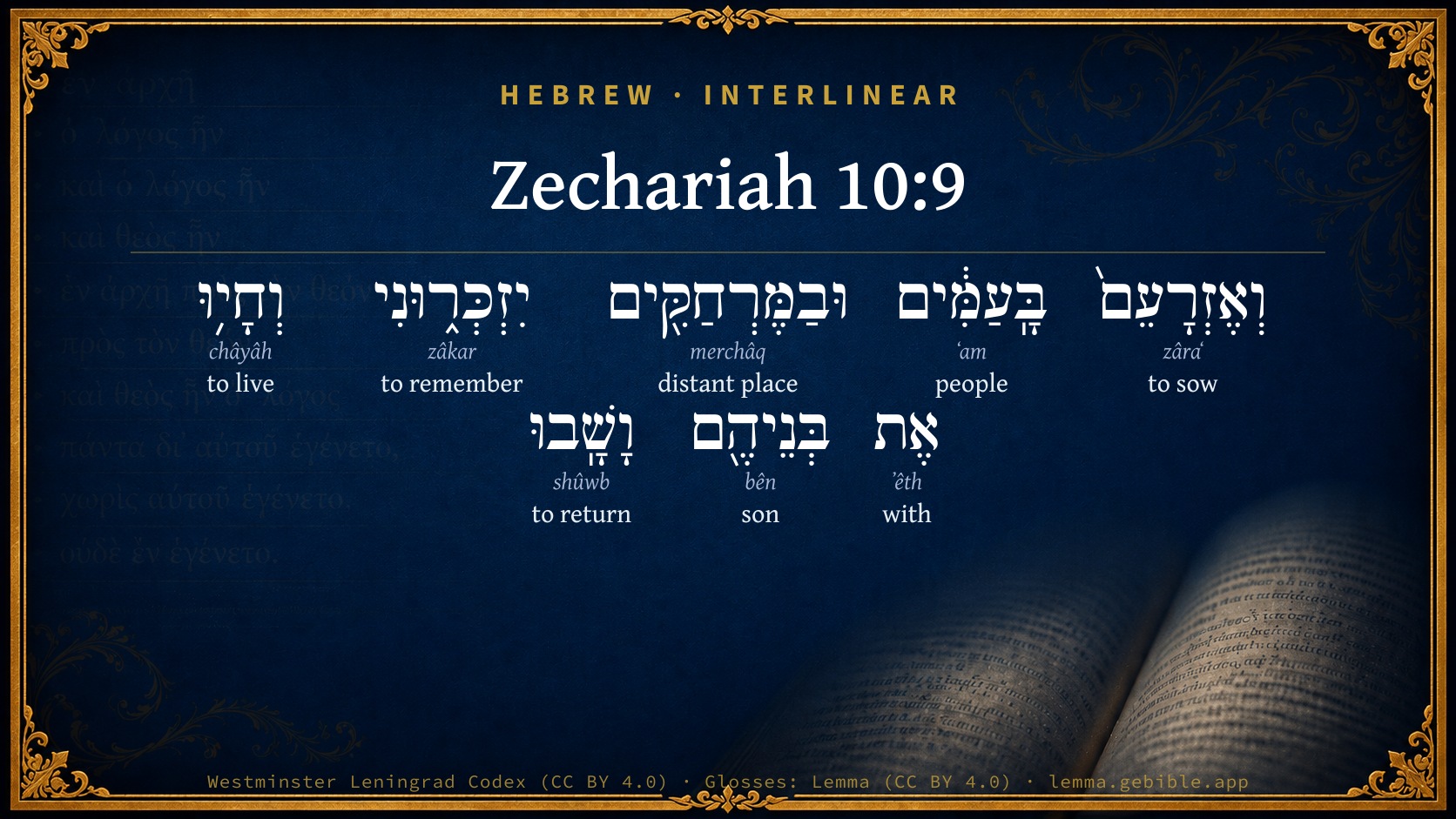
Hebrew (Westminster Leningrad Codex) Zechariah 10:9 appears in the Hebrew Old Testament. The text above is from the Westminster Leningrad Codex. Each word links to its Strong’s number, a concise gloss, and parsing drawn from the Open Scriptures Hebrew Bible morphology. Click any word for its full Brown-Driver-Briggs (BDB) entry.
Download image
Cite this verse

Zechariah 10:9 (World English Bible). Public Domain. Lemma interlinear Bible study tool, https://lemma.gebible.app/v/zechariah/10/9.

Show BibTeX & RIS
BibTeX
RIS
English Translation
I will sow them among the peoples; And they will remember me in far countries; And they will live with their children, and will return.
World English Bible · Public Domain
Download a study sheet

One document with this verse’s original text, its word-by-word gloss line, the meaning frame, cross-references with their text, attributed commentary, and full source and license credits — printable, and it pastes into notes with its structure intact.

This verse Autodidact and up

Study sheet (.html) Plain text (.txt)

A passage Seminary Student

Up to 50 verses in one chapter. A passage sheet keeps up to 6 commentary sources and 12 cross-references per verse, in the order this page ranks them, and says so on the sheet whenever that leaves anything out. Ask for a single verse and you get the Autodidact verse sheet above.

Everything on this page stays free to read, with no account — the sheet is a download of what is already on screen, not access to it.

Want to remove ads? Support Godless Engineer
Compare translations 3

The same verse in 3 English versions, stacked beneath the original-language interlinear above. Click any original word for its lexicon entry.

Each is an independent rendering of the whole verse — the interlinear is not word-aligned to these translations.

Highlighted words mark where these versions differ — a whole-verse word diff, not a word-by-word alignment.

  • World English Bible Public Domain
    I will sow them among the peoples; And they will remember me in far countries; And they will live with their children, and will return.
  • King James Version Public Domain
    And I will sow them among the people: and they shall remember me in far countries; and they shall live with their children, and turn again.
  • unfoldingWord Literal Text CC BY-SA 4.0
    I sowed them among the peoples, but they will remember me in distant countries, so they and their children will live and return.

unfoldingWord Literal Text — © unfoldingWord, licensed CC BY-SA 4.0. Word-aligned USFM3 via Door43 (git.door43.org/unfoldingWord/en_ult).

Versions to compare (up to 4)

3 of 4 selected

Show all 18 translations

Every available English version of this verse, each an independent rendering of the whole verse.

  • World English Bible Public Domain
    I will sow them among the peoples; And they will remember me in far countries; And they will live with their children, and will return.
  • Berean Standard Bible Public Domain
    Though I sow them among the nations, they will remember Me in distant lands; they and their children will live and return.
  • Majority Standard Bible Public Domain
    Though I sow them among the nations, they will remember Me in distant lands; they and their children will live and return.
  • King James Version Public Domain
    And I will sow them among the people: and they shall remember me in far countries; and they shall live with their children, and turn again.
  • American Standard Version (1901) Public Domain
    And I will sow them among the peoples; and they shall remember me in far countries; and they shall live with their children, and shall return.
  • Revised Version (1885) Public Domain
    And I will sow them among the peoples; and they shall remember me in far countries: and they shall live with their children, and shall return.
  • Geneva Bible (1599) Public Domain
    And I will sowe them among the people, and they shall remember me in farre countreys: and they shall liue with their children and turne againe.
  • Douay-Rheims (1899) Public Domain
    And I will sow them among peoples: and from afar they shall remember me: and they shall live with their children, and shall return.
  • Young's Literal Translation Public Domain
    And I sow them among peoples, And in far-off places they remember Me, And they have lived with their sons, And they have turned back.
  • Literal Standard Version CC BY-SA 4.0
    And I sow them among peoples, || And in far-off places they remember Me, || And they have lived with their sons, || And they have turned back.
  • Unlocked Literal Bible CC BY-SA 4.0
    I sowed them among the peoples, but they will remember me in distant countries, so they and their children will live and return.
  • unfoldingWord Literal Text CC BY-SA 4.0
    I sowed them among the peoples, but they will remember me in distant countries, so they and their children will live and return.
  • Darby Bible Public Domain
    And I will sow them among the peoples, and they shall remember me in far countries; and they shall live with their children and return.
  • World Messianic Bible Public Domain
    I will sow them among the peoples. They will remember me in far countries. They will live with their children and will return.
  • Webster's Bible Public Domain
    And I will sow them among the people: and they shall remember me in remote countries; and they shall live with their children, and turn again.
  • Free Bible Version CC BY-SA 4.0
    I have scattered them like seed among the nations, and in distant places they will remember me. They will bring up their children, and together they will return.
  • Bible in Basic English Public Domain
    Though I had them planted among the peoples, they will keep me in mind in far countries: and they will take care of their children and will come back.
  • JPS Tanakh (1917) Public Domain
    And I will sow them among the peoples, and they shall remember Me in far countries; and they shall live with their children, and shall return.

Literal Standard Version (2020), Covenant Press — licensed CC BY-SA 4.0. Text via the HelloAO Bible API (eBible.org). Unlocked Literal Bible (unfoldingWord) — licensed CC BY-SA 4.0. Text via the HelloAO Bible API (eBible.org). unfoldingWord Literal Text — © unfoldingWord, licensed CC BY-SA 4.0. Word-aligned USFM3 via Door43 (git.door43.org/unfoldingWord/en_ult). Free Bible Version, Dr. Jonathan Gallagher — licensed CC BY-SA 4.0. Text via the HelloAO Bible API (eBible.org).

Word by word

More ways to search: Search by grammar → Find every occurrence → Compare this word →

Practice this passage: Drill this verse → Learn its vocabulary →

וּבַמֶּרְחַקִּ֖ים
merchâq
H4801
“and · in/at the · distant places”
Conjunction + Preposition, Determined + Noun, Common, Masculine, Plural, Absolute
Part of Speech
Conjunction + Preposition + Noun
Type
Common
Gender
Masculine
Number
Plural
State
Absolute
Full BDB Definition

Origin: from H7368

TWOT: 2151c

distant place, distance, far country
  1. וְאֶזְרָעֵם֙ zâraʻ H2232 “and · to sow · them” Conjunction + Verb, Qal, Imperfect, 1st Person, Common, Singular + Suffix, Personal, 3rd Person, Masculine, Plural
  2. בָּֽעַמִּ֔ים ʻam H5971 “in/at the · peoples” Preposition, Determined + Noun, Common, Masculine, Plural, Absolute
  3. יִזְכְּר֑וּנִי zâkar H2142 “to remember · me” Verb, Qal, Imperfect, 3rd Person, Masculine, Plural + Suffix, Personal, 1st Person, Common, Singular
  4. וְחָי֥וּ châyâh H2421 “and · to live” Conjunction + Verb, Qal, Perfect, 3rd Person, Common, Plural
  5. אֶת ʼêth H854 “with” Preposition
  6. בְּנֵיהֶ֖ם bên H1121 “sons · their” Noun, Common, Masculine, Plural, Construct + Suffix, Personal, 3rd Person, Masculine, Plural
  7. וָשָֽׁבוּ shûwb H7725 “and · to return” Conjunction + Verb, Qal, Perfect, 3rd Person, Common, Plural

About this verse

These counts appear in no published source. They are computed here, from the morphology-tagged text and Lemma’s own curated glosses. What Lemma adds →

8
words
8
distinct lemmas
Prophets
section

Notable vocabulary

The rarest word here is וּבַמֶּרְחַקִּ֖ים distant place H4801 — appearing just 17 times in the whole Hebrew Bible.

Shared distinctive vocabulary

וּבַמֶּרְחַקִּ֖ים distant place H4801 occurs in 17 verses of the Hebrew Bible. Also found in:

Grammatical profile

  • 4 verbs
  • 3 nouns
  • 1 preposition

Verb forms

  • וְאֶזְרָעֵם֙ Qal · Imperfect
  • יִזְכְּר֑וּנִי Qal · Imperfect
  • וְחָי֥וּ Qal · Perfect
  • וָשָֽׁבוּ Qal · Perfect

Hebrew & Septuagint length

In English translation the verse runs 25 words from the Hebrew and 26 from the Septuagint (LXX English) — closely comparable.

A rough comparison of the two English renderings, which tokenize alike — not a word-level alignment.

Word counts can differ between the Hebrew and the Greek without any difference in meaning — e.g. the Hebrew direct-object marker אֵת has no separate Greek word, and Greek often adds the article ὁ.

Cross-references

22

Topical passages linked to Zechariah 10:9 in the Treasury of Scripture Knowledge — connected by theme and wording, ordered by reader-vote popularity; previews shown in the World English Bible.

  • Ezekiel 6:9 Those of you that escape shall remember me among the nations where they shall be carried captive, how that I have been broken with their lewd heart, which has departed from me, and with they eyes, which play the prostitute after their idols: and they shall loathe themselves in their own sight for the evils which they have committed in all their abominations.
  • Nehemiah 1:9 but if you return to me, and keep my commandments and do them, though your outcasts were in the uttermost part of the heavens, yet will I gather them from there, and will bring them to the place that I have chosen, to cause my name to dwell there.
  • Isaiah 65:23 They shall not labor in vain, nor bring forth for calamity; for they are the seed of the blessed of Yahweh, and their offspring with them.
  • 1 Kings 8:47–48 yet if they shall repent themselves in the land where they are carried captive, and turn again, and make supplication to you in the land of those who carried them captive, saying, We have sinned, and have done perversely, we have dealt wickedly;
  • Esther 8:17 In every province, and in every city, wherever the king's commandment and his decree came, the Jews had gladness and joy, a feast and a good day. Many from among the peoples of the land became Jews; for the fear of the Jews was fallen on them.
  • Isaiah 65:9 I will bring forth a seed out of Jacob, and out of Judah an inheritor of my mountains; and my chosen shall inherit it, and my servants shall dwell there.
  • Jeremiah 31:27 Behold, the days come, says Yahweh, that I will sow the house of Israel and the house of Judah with the seed of man, and with the seed of animal.
  • Hosea 2:23 I will sow her to me in the earth; And I will have mercy on her who had not obtained mercy; And I will tell those who were not my people, 'You are my people;' And they will say, 'My God!'"
  • Micah 5:7 The remnant of Jacob will be in the midst of many peoples, Like dew from Yahweh, Like showers on the grass, That don't wait for man, Nor wait for the sons of men.
  • Jeremiah 51:50 You who have escaped the sword, go you, don't stand still; remember Yahweh from afar, and let Jerusalem come into your mind.
  • Daniel 3:1–6 Nebuchadnezzar the king made an image of gold, whose height was sixty cubits, and the breadth of it six cubits: he set it up in the plain of Dura, in the province of Babylon.
  • Amos 9:9 "For, behold, I will command, and I will sift the house of Israel among all the nations, as grain is sifted in a sieve, yet not the least kernel will fall on the earth.
  • Deuteronomy 30:1–4 It shall happen, when all these things are come on you, the blessing and the curse, which I have set before you, and you shall call them to mind among all the nations, where Yahweh your God has driven you,
  • Acts 2:38–39 Peter said to them, "Repent, and be baptized, everyone of you, in the name of Jesus Christ for the forgiveness of sins, and you will receive the gift of the Holy Spirit.
  • Acts 3:25–26 You are the children of the prophets, and of the covenant which God made with our fathers, saying to Abraham, 'In your seed will all the families of the earth be blessed.'
  • Acts 8:1 Saul was consenting to his death. A great persecution arose against the assembly which was in Jerusalem in that day. They were all scattered abroad throughout the regions of Judea and Samaria, except for the apostles.
  • Acts 8:4 Therefore those who were scattered abroad went around preaching the word.
  • Acts 11:19–21 They therefore who were scattered abroad by the oppression that arose about Stephen traveled as far as Phoenicia, Cyprus, and Antioch, speaking the word to no one except to Jews only.
  • Acts 13:1–38 Now in the assembly that was at Antioch there were some prophets and teachers: Barnabas, Simeon who was called Niger, Lucius of Cyrene, Manaen the foster-brother of Herod the tetrarch, and Saul.
  • Acts 14:1–21 It happened in Iconium that they entered together into the synagogue of the Jews, and so spoke that a great multitude both of Jews and of Greeks believed.
  • Romans 11:11–17 I ask then, did they stumble that they might fall? May it never be! But by their fall salvation has come to the Gentiles, to provoke them to jealousy.
  • Romans 11:24 For if you were cut out of that which is by nature a wild olive tree, and were grafted contrary to nature into a good olive tree, how much more will these, which are the natural branches, be grafted into their own olive tree?

Cross-references courtesy of OpenBible.info (CC BY 4.0).

Hebrew and Greek witnesses Masoretic Hebrew ↔ Greek Septuagint

The same verse in the two great witnesses to the Old Testament, shown verse-for-verse.

These are two independent witnesses, not word-aligned to each other, and the Septuagint is shown in lemma (dictionary) form.

Hebrew Zechariah 10:9 Masoretic · Westminster Leningrad Codex

וְאֶזְרָעֵם֙ בָּֽעַמִּ֔ים וּבַמֶּרְחַקִּ֖ים יִזְכְּר֑וּנִי וְחָי֥וּ אֶת בְּנֵיהֶ֖ם וָשָֽׁבוּ

I will sow them among the peoples; And they will remember me in far countries; And they will live with their children, and will return.

World English Bible · Public Domain

Greek LXX Zechariah 10:9 Septuagint · lemma form

καί σπείρω αὐτός ἐν λαός καί ὁ μακράν μιμνήσκω ἐγώ ἐκτρέφω ὁ τέκνον αὐτός καί ἐπιστρέφω

And I will sow them among the people; and they that are afar off shall remember me: they shall nourish their children, and they shall return.

LXX2012 (modern English Septuagint) · Public Domain

Hebrew: Westminster Leningrad Codex (CC BY 4.0). Greek: Septuagint (public domain); English from LXX2012 (modern English Septuagint) (Public Domain). How the Septuagint differs from the Hebrew →

Targum (Aramaic paraphrase)

1

The Targum is the ancient Jewish Aramaic paraphrase of the Hebrew Scriptures — an interpretive translation, not the Hebrew text itself. Onkelos (literal) and Pseudo-Jonathan (expansive) render the Torah, and Jonathan the Prophets. Coverage is partial: where no permissively-licensed English translation exists for a verse, only the Aramaic is shown. This is verse-level text, not a word-by-word alignment to the Hebrew.

  1. Targum Jonathan Prophets (Joshua–Malachi)
    וּכְמָא דְבַדַרְתִּינוּן בֵּינֵי עַמְמַיָא וּבְאַרְעָא רְחִיקָא הֲווֹ דְכִירִין לִדְחַלְתִּי וְיוֹרְכוּן שְׁנֵי חַיִין עִם בְּנֵיהוֹן וִיתוּבוּן:

    (no public-domain English translation for this verse)

    Targum Jonathan — Aramaic: “Mikraot Gedolot” (public domain). English: “Sefaria Community Translation” (CC0 1.0 (public-domain dedication)); “London "Chaldee Paraphrase," 1871” (public domain). Text via Sefaria.

Commentary

Notes on Zechariah 10:9 from classic Christian and Jewish commentators (each source and its license shown beneath its notes). The classic Christian expositions comment on the surrounding passage and are grouped to its opening verse, so a note may address several verses; the Jewish commentaries on the Tanakh (Rashi and others) are per-verse, so they appear only where the commentator wrote on this verse.

Lemma curates 59 commentaries, every one of them public domain or Creative Commons licensed, each selected and text-cleaned for this edition rather than reprinted as found. About our sources →

Trapp's Complete Commentary

John Trapp

Zec 10:9 And I will sow them among the people: and they shall remember me in far countries; and they shall live with their children, and turn again.

Ver. 9. And I will sow them among the people] Scatter them indeed, but for an excellent purpose, that they may bring forth fruit to God; and be a blessed means of bringing in the fulness of the Gentiles’ harvest. Some kind of the knowledge of God was diffused by the Jews wherever they came, and when at length the gospel was preached by the apostles, they first dealt with the Jews (who had their synagogues in all places) as it was necessary, Act 13:46 that as they had been the only people of God, so now they might be the first invited guests. This invitation when they put from them and so judged themselves unworthy of eternal life, what remained but that the halt and the blind Gentiles should be fetched in from the highways and hedges, that so God s house might be full. So then their dispersion was a semination; and their exile opened a gate for the gospel. Hence also it is called διασπορα, a dissemination or scattering; as when a man soweth seed abroad, 1Pe 1:1 Jas 1:1.

And they shall remember me in far countries] Saint Paul testifieth that the twelve tribes instantly served God day and night, Act 26:7, a great deal better, doubtless, than they do at this day; being as reverend in their synagogues as grammar boys are at school when their master is absent, saith an eyewitness.

And they shall live with their children, and turn again] They or their posterity shall. God’s promises bear a long date many times, and the believing Hebrews are told that they had need of patience or tolerance (υπομονη), that, after they had done the will of God and suffered it too, if need be, they might receive the promise, Heb 10:36. And they are further exhorted to run with patience the race that is set before them, Heb 12:1, wherein he that believeth maketh not haste, but can want and wait for what he wisheth, till God please: being desirous rather that God may be glorified than himself gratified, if both may not stand together.

John Trapp, A Commentary or Exposition upon All the Books of the Old and New Testament (1647–1656) — public domain. Text from a community e-Sword module.

The Biblical Illustrator

Joseph S. Exell

Zec_10:9

And I will sow them among the people

Gods sowings

At the end of the seventy years captivity the people of Gods ancient choice were distributed through Parthia, Media, Persia, Mesopotamia, Cappadocia, Pontus, Phrygia, Pamphylia, Egypt, Libya and Rome, Crete and Arabia.

Everywhere, throughout the great Roman Empire, they fell into the ground to die. So far as their natural life was concerned, they seemed on the point of being obliterated among the nations of the world; but you might as well talk of the obliteration of the seed which the husbandman casts into the autumn furrows. They built their synagogues, throve in the quarters assigned to them in the great cities, and disseminated new conceptions of God, high ethical standards, a fresh religious speech, destined to be of incalculable service to the early preachers of Christs Evangel. It was thus with the first believers. By the rough hand of the persecutor, the rich wheat of Pentecost, which had lain too long in the bin of the mother Church, was scattered abroad throughout the regions of Judaea and Samaria. They therefore that were scattered abroad went everywhere preaching the Word. They therefore that were scattered abroad, upon the tribulation that arose about Stephen, travelled as far as Phoenicia, and Cyprus, and Antioch. These spring sewings yielded a marvellous return. How many illustrations have existed, throughout the entire history of the Church, of the effect of Gods sowings! My Father is the Husbandman, said our Lord. With both hands He has prosecuted His work of sowing. There was a grand quality in the corn of the Waldensian Valleys, in the Paulicians, the Hussites, the Lollards, which was sown by the Master in the dungeons of the Inquisition, in mockings and scourgings, in bonds and imprisonment, in the fires of martyrdom, and in the current of swiftly flowing rivers. But what harvests it all yielded! There was, for instance, the harvest of the Reformation in Germany, of the Huguenots in France, and of the Puritans in England. (F. B. Meyer, B. A.)

The Biblical Illustrator, edited by Joseph S. Exell (c. 1880s–1900s) — public domain. Text from a community e-Sword module.

Geneva Bible (1599)

Geneva Bible translators

Though they shall yet be scattered and seem to be lost, yet it shall be profitable unto them: for there they shall come to the knowledge of my Name, which was accomplished under the Gospel, among whom it was first preached.

Not that they should return into their country, but be gathered and joined in one faith by the doctrine of the Gospel.

Geneva Bible (1599) marginal notes — public domain. Text via Bolls.life.

Jamieson, Fausset & Brown

Robert Jamieson, A. R. Fausset & David Brown

sow them among . . . people--Their dispersion was with a special design. Like seed sown far and wide, they shall, when quickened themselves, be the fittest instruments for quickening others (compare Mic 5:7). The slight hold they have on every soil where they now live, as also the commercial and therefore cosmopolitan character of their pursuits, making a change of residence easy to them, fit them peculiarly for missionary work [MOORE]. The wide dispersion of the Jews just before Christ's coming prepared the way similarly for the apostles' preaching in the various Jewish synagogues throughout the world; everywhere some of the Old Testament seed previously sown was ready to germinate when the New Testament light and heat were brought to bear on it by Gospel preachers. Thus the way was opened for entrance among the Gentiles. "Will sow" is the Hebrew future, said of that which has been done, is being done, and may be done afterwards [MAURER], (compare Hos 2:23).

shall remember me in far countries-- (Deu 30:1; Ch2 6:37). Implying the Jews return to a right mind in "all the nations" where they are scattered simultaneously. Compare Luk 15:17-18, with Psa 22:27, "All the ends of the world remembering and turning unto the Lord," preceded by the "seed of Jacob . . . Israel . . . fearing and glorifying Him"; also Psa 102:13-15.

live--in political and spiritual life.

Jamieson, Fausset & Brown — Commentary Critical and Explanatory on the Whole Bible (1871) — public domain (CC PDM 1.0). Text via the HelloAO Bible API.

Adam Clarke's Commentary

Verse 9. I will sow them among the people] Wherever they have been dispersed, my voice in the preaching of the Gospel shall reach them. And they shall remember me, and they and their children shall turn again to the Lord, through Messiah their King.

Adam Clarke's Commentary on the Bible (1810–1826) — public domain. Text from a community e-Sword/MySword module.

John Calvin's Commentaries

He continues the same subject, and employs here a most suitable metaphor — that the dispersion of the people would have a better issue than what any one then could have conceived, for it would be like sowing. The verb for scattering or sowing is often taken in a bad sense; for when people rested in their country, they ought then to have considered that they were living under God’s protection. Dispersion, then, was an evidence of a curse, and it is often so taken by Moses. Now God uses it here in an opposite meaning, as though he had said, that he would at his pleasure turn darkness into light. The meaning then is, that the people had been dispersed through God being angry with them, but that the issue of this dispersion would be joyful; for the Jews would dwell everywhere, and be God’s seed, and thus be made to produce abundant fruit. We then see that the meaning is, that God’s favor would surpass the wickedness of the people; for those would bear fruit who had been scattered, and scattered because God would no longer exercise care over them, and defend them in the promised land. As God then had so often threatened by Moses that he would scatter the Jews, he now says in another sense, that he would sow them, and for this ends that they might everywhere produce fruit.

It was an instance of the wonderful grace of God, that he so ordered his dreadful judgment as to make the dispersion, as it has been said, a sowing of the people; for it hence happened, that the knowledge of celestial truth shone everywhere; and at length when the gospel was proclaimed, a freer access was had to the Gentiles, because Jews were dispersed through all lands. The first receptacles (Hospitia) of the gospel were the synagogues. We see that the apostles everywhere went first to the Jews, and when a few were converted, the door was now opened that more might come, and Gentiles were also added to the Jews. Thus the punishment of exile, which had been inflicted on them, was the means of opening the door for the gospel; and God thus scattered his seed here and there, that it might in due time produce fruit beyond the expectation of all; and this consideration availed not a little to moderate the impatient desires of the people; for the Prophet intimates that this alone ought to have satisfied them — that their exile would be productive of good, for the Lord would thereby gather much people to himself. Had the Jews been confined within their own borders, the name of the God of Israel would not have been heard of elsewhere; but as there was no part of the East, no part of Asia and of Greece, which had not some Jews — and they inhabited many cities of Italy — hence it was that the Apostles found, as we have said, wherever they came, some already prepared to embrace the gospel.

He afterwards adds, They shall remember me in distant lands. He shows the manner how the memory of God would be preserved: though the Jews sacrificed not in the temple, though they dwelt not in the holy land, they would yet ever worship the only true God; as then the seed cast on the ground, though it may not appear, and seem even to be wholly lost, being apparently consumed by rottenness, does yet germinate in its season, and produces fruit; so God teaches us, that the memory of his name will occasion this people to fructify in their dispersion. But as God promises this, we hence learn that it is through his singular kindness that we cherish piety in our hearts, when he sharply and severely chastises us. When therefore we cease not to worship God, it is certain that we are kept by his Spirit; for were this in the power of man, this promise would be useless, and even absurd.

He says further, They shall live with their sons, and shall return. He again speaks of sons, that the Jews might not make too much haste; for we know that men, having strong desires, hurry on immoderately. That they might not then prescribe time to God, the Prophet reminds them that it ought to have been enough for them that the Lord would quicken them as it were from the dead, together with their children. He however promises them a return, not that they would return to their own country, but that they would be all united by the faith of the gospel. Though then they changed not their place, nor moved a foot from the lands where they sojourned, yet a return to their country would be that gathering which would be made by the truth of the gospel, as it is well known, according to the common mode of speaking adopted by all the Prophets. It follows —

John Calvin's Commentaries (1540-1563) — public domain. Text from the Calvin Translation Society English edition (1840s-50s) via the Christian Classics Ethereal Library (ccel.org). Calvin's coverage is partial (roughly two-thirds of the Bible); uncommented books and verses are honest gaps, never fabricated. The 19th-century editor's footnotes and remarks are omitted so the notes are faithfully Calvin's own voice.

Ellicott's Commentary for English Readers

(9) Sow is never used in a bad sense, i.e., “to scatter,” but rather means to spread and multiply (Hos. 2:25; Jer_31:27). There is, therefore, no word here of a new dispersion of the people, but rather of an increasing and in-gathering.

Shall live with.—Comp. Eze_37:14.—i.e., survive with. They will “turn again,” because they “remember” God in the land of their captivity, and feel a yearning for the place where He hath set His name again.

A Bible Commentary for English Readers, edited by Charles John Ellicott (1878–1897) — public domain. Text from a community e-Sword module.

The Cambridge Bible for Schools and Colleges

gen. ed. J. J. S. Perowne

9. I will sow them among the people] peoples, R. V. Their dispersion among the nations of the earth shall not be for their destruction, but like the sowing of corn, which is scattered broad-cast, not that it may be lost and perish, but that it may bring forth much fruit. Comp. Hos_2:23. “Ego eos multiplicabo, ut dispersio in populis non videatur esse divisio, sed sementis operatio, et liberorum et nepotum segete multiplicata vivant cum filiis suis.” Hieron.

they shall live] Comp. Eze_37:14.

turn again] or, return to God. Jer_3:12; Jer_3:14; Isa_10:21. The consequent return to their own land is promised in the next verse.

The Cambridge Bible for Schools and Colleges (gen. ed. J. J. S. Perowne; Cambridge University Press, 1878–1918) — public domain. Text from a community e-Sword module.

John Gill's Exposition

And I will sow them among the people, The people of God in the Gentile world: this is to be understood of the conversion of the Jews, when they will become the good seed that hear the word, and understand it, and bring forth fruit; and of their being known, acknowledged, and reckoned among the people of God, who now are not; and of their being planted in Gospel churches, where the word is truly preached; the ordinances are faithfully administered; the Lord grants his presence, and saints have communion one with another; to be in such a fruitful soil, and in such sacred enclosures, fenced by the power and grace of God, is a great happiness:

and they shall remember me in far countries; they shall call to mind what their ancestors did to Christ, and mourn on account of a pierced Saviour; they shall remember him in the ordinance of the supper, being in a Gospel church state; they shall remember what he did and suffered for them, and his love to them in all, and that with faith, affection, and thankfulness:

and they shall live with their children; a very happy, comfortable, temporal life; and they shall live a spiritual life; a life of faith on Christ; of communion with him, and of holiness from him, and to his glory: and their children also shall live the same life, being regenerated and quickened by the same grace; these are the church's children:

and turn again; that is, when they shall turn again, either to the Lord, shall be converted unto him; or return to their own land.

John Gill's Exposition of the Whole Bible (1746–1763) — public domain (CC PDM 1.0). Text via the HelloAO Bible API.

Albert Barnes' Notes on the Bible

And I will sow them among the nations - Such had been the prophecy of Hosea; “I will sow her unto Me in the earth,” as the prelude of spiritual mercies, “and I will have mercy on her that had not obtained mercy, and I will say to not-my-people, Thou art My people, and they shall say, my God” . Hosea’s saying, “I will sow her in the earth” that is, the whole earth and that “to Me,” corresponds to, and explains Zechariah’s brief saying, “I will sow them among the nations.” The sowing, which was future to Hosea, had begun; but the purpose of the sowing, the harvest, was wholly to come; when it should be seen, that they were indeed sown by God, that “great” should “be the day of Jezreel” (Hos 1:11. See vol. i. p. 25). And Jeremiah said, “Behold the days come, saith the Lord, that I will sow the house of Israel and the house of Judah, with the seed of man and with the seed of beast” Jer 31:27. The word is used of sowing to multiply, never of mere scattering .

And they shall remember Me in far countries - So Ezekiel had said, “And they that escape of you shall remember Me among the nations, whither they shall be carried captive - and they shall loath themselves for the evils which they have committed in all their abominations, and they shall know that I am the Lord” Eze 6:9.

And shall live - As Ezekiel again says, “Ye shall know that I am the Lord, when I open your graves, and bring you up out of your graves, O My people, and shall put My Spirit in you, and ye shall live” Eze 37:13-14. “With their children.” A continuous gift, as Ezekiel, “they and their children, and their children’s children forever: and My servant David shall be their prince forever.” Eze 37:25.

And turn again - To God, being converted, as Jeremiah had been bidden to exhort them; “Go and proclaim these words toward the north” Jer 3:12, the cities of the Medes whither they were carried captive, “and say, Return, thou backsliding Israel, and I will not cause Mine anger to fall upon you;” “Turn, O backsliding children - and I with take you, one of a city, and two of a family, and will bring you to Zion, and I will give you pastors according to Mine heart” Jer 3:14-15. “Return, ye backsliding children; I will heal your backslidings.” And they answer, “Behold, we come unto Thee; for Thou art the Lord our God” Jer 3:22. So Isaiah had said, “A remnant shall return, the remnant of Jacob, unto the mighty God” . Dionysius: “They shall return by recollection of mind and adunation and simplification of the affections toward God so as ultimately to intend that one thing, which alone is necessary.”

Albert Barnes' Notes on the Bible (1834–1885) — public domain. Text from a community e-Sword/MySword module.

Haydock's Catholic Bible Commentary

Me. The Jews were spread throughout the world, and adhered to their own customs. (Philo) See Acts ii. 8. --- While they enjoyed the greatest prosperity, they kept together in a small territory. It is wonderful how they have since increased.

George Leo Haydock (1774–1849), Haydock's Catholic Family Bible and Commentary, 1859 edition — public domain. Excludes Psalms (Douay-Rheims chapter numbering differs from Protestant) and Deuterocanonical books (Catholic canon only).

Matthew Poole's English Annotations

I will sow them: it might seem impossible the Jews should so increase, but to satisfy us herein God promiseth to sow them, so their increase should be like the increase of rich soil that hath much seed cast on it, Jer 31:27; Hos 2:23; that land shall soon be full of men and cattle, when God sows both.

Among the people; the heathen; where dispersed, there they should multiply.

They shall remember me; there they shall think of me, and long for me, and desire to return to Jerusalem, and to my temple.

In far countries; whithersoever they were driven in the farthest parts of the Persian empire.

They shall live with their children; though captives and poor, yet they nor their children shall starve; nay, their children born to them shall live, and grow up with them; this young fry shall fill the earth.

Turn again to me, my temple, their city, and country. That this may also refer somewhat to the conversion of the Jews to the gospel, and to their spreading the gospel unto others for multiplying of the seed of Israel according to the faith, as I doubt not, so neither shall I particularly inquire, since the letter so fairly suits with history and matter of fact, as is evident from the multitudes that were gathered to the passover, when Titus Vespasianus cooped them up in a close siege.

Matthew Poole's English Annotations on the Holy Bible (1683–1685) — public domain. Text from a community e-Sword/MySword module.

The Pulpit Commentary

I will sow them among the people (peoples). The "sowing" here does not mean scattering, but increase, and this was to go on while they were dispersed among the nations. The word is used in the same sense in Hos_2:23 Jer_31:27. This continued dispersion was a part of their discipline, a test of their loyalty to God. They shall remember me. In the countries where they are living they shall worship the Lord and observe his Law, and be a witness for him among the heathen. They shall live with their children. (Eze_37:14) The promised blessing is not for a time only, but perpetual. Turn again; i.e. return to their own land. (Isa_35:10) It cannot mean, "turn to the Lord," for they are said already to remember the Lord, and their "conversion must precede the promise of life." The next verse describes the return more particularly.

The hand of God in Jewish history.

I IN THEIR LONG DESCENT. Origin of nations is generally obscure. As difficult to find as the source of the Nile. The Jews are like their own Jordan. They are the only people that can trace their descent. "Children of Abraham." Two friends were visiting the museum at Berlin. One said how strange it was to look at the intellectual features of Julius Caesar, and to think of his triumphal march northward when the Britons were but roving barbarians. "Speak for your own ancestors," answered the other, who was a Jew; "as for mine, they were singing the psalms of David, and worshipping God as members of his true Church on earth, centuries before Julius Caesar was born!

II IN THE VICISSITUDES OF THEIR HISTORY. "As the modern traveller surveys the remains of the arch of Titus at Rome, he feels bewildered in endeavouring to realize the distant date of its erection; and yet it commemorates only the last of a long series of Jewish dispersions. You read of the fragments of antiquity dug up from the ruins of Babylon, and your mind is carried still further back than by the Roman arch; but the Jew possibly formed that Babylonian brick, and imprinted on it those arrow-hearted characters. The pyramids of Egypt take your imagination still further back; the Jew not improbably helped to build the oldest of them. Time was young when God said to Abram, "I will make of thee a great nation (Dr. Harris). In the various dispersions we see the fulfilment of Scripture (Deu_28:64-67) and the preparation for the gospel of Christ. (Act_2:5, Act_2:9-11)

III IN THE PERMANENCY OF THEIR CHARACTER. From Jacob down to our own day we see the same prevailing elements of character. Their very physiognomy is that painted on the walls of Thebes. They are still a separate people. Their purity of blood, their education and training throughout the ages, have raised them high physically and intellectually. In the struggle for existence, they seem an instance of the survival of the fittest.

IV IS THE GREATNESS OF THEIR DESTINY. Preserved but why? Surely for some great purpose. Witnesses for God. Servants of righteousness. Ministers of the cross. F. (Rom_11:1-27)

The Pulpit Commentary (1880–1919), ed. H.D.M. Spence-Jones & Joseph S. Exell — public domain. Text from a community e-Sword module.

John Wesley's Explanatory Notes

I will sow them - Their increase shall be like the increase of rich soil that hath much seed cast on it. The people - The Heathen. In far countries - Whithersoever they were driven. With their children - The children born to them shall live, and grow up with them. Turn again - To their city and country.

John Wesley, Explanatory Notes Upon the Whole Bible (1754–1765) — public domain. Text via the GEBible commentary corpus.

Rashi

Rabbi Shlomo Yitzchaki (Rashi)

And I will sow them first among the peoples, as a person sows a seah to bring in many korim.

And they shall live with their children אֶת-בְנֵיהֶם

Rashi on the Tanakh — English translations: “The Judaica Press complete Tanach with Rashi, translated by A. J. Rosenberg” (CC BY 4.0); “Pentateuch with Rashi's commentary by M. Rosenbaum and A.M. Silbermann, 1929-1934” (public domain); “The Metsudah Tanach series, Lakewood, N.J” (CC BY 4.0); and “The Book of Joshua, Metsudah Publications, 1997” (CC BY 4.0). Text via Sefaria.

Lesson kit

Teaching starters — assembled from the data on this page, not authored interpretation. Every prompt links to the verse data it draws on. Edit before teaching.

Zechariah, in the Prophets, opens this verse with 8 words (8 distinct Hebrew lemmas). Its most distinctive word is merchâq (“distant place”). A historical commentator’s framing appears above. Read the whole chapter for the surrounding context.

Discussion questions

  1. The word merchâq carries the sense “distant place.” How does it shape the verse?
  2. How does Psalms 138:6, which shares the word «distant place», read alongside this verse?
  3. These translations render this verse differently. What is at stake in choosing one wording over another?
  4. «וְאֶזְרָעֵם֙» is a Qal Imperfect verb. How does that grammatical form shape the action described?
  5. Compare how Trapp's Complete Commentary and The Biblical Illustrator read this verse. Where do they agree or differ?

Things to notice

Reading settings

Reading text

Shown beneath each verse's original-language words.

Old Testament
Old Testament edition

Read the OT as the Masoretic Hebrew (MT) or the Greek Septuagint (LXX).

English shown for the Greek Septuagint (in the Hebrew ↔ Greek comparison).

Comparing translations? Open the Compare panel on any verse page to stack up to four side by side.