
1 Kings 8:47

Hebrew (Westminster Leningrad Codex) 1 Kings 8:47 appears in the Hebrew Old Testament. The text above is from the Westminster Leningrad Codex. Each word links to its Strong’s number, a concise gloss, and parsing drawn from the Open Scriptures Hebrew Bible morphology. Click any word for its full Brown-Driver-Briggs (BDB) entry.
Download image
Cite this verse

1 Kings 8:47 (World English Bible). Public Domain. Lemma interlinear Bible study tool, https://lemma.gebible.app/v/1-kings/8/47.

Show BibTeX & RIS
BibTeX
RIS
English Translation
yet if they shall repent themselves in the land where they are carried captive, and turn again, and make supplication to you in the land of those who carried them captive, saying, We have sinned, and have done perversely, we have dealt wickedly;
World English Bible · Public Domain
Download a study sheet

One document with this verse’s original text, its word-by-word gloss line, the meaning frame, cross-references with their text, attributed commentary, and full source and license credits — printable, and it pastes into notes with its structure intact.

This verse Autodidact and up

Study sheet (.html) Plain text (.txt)

A passage Seminary Student

Up to 50 verses in one chapter. A passage sheet keeps up to 6 commentary sources and 12 cross-references per verse, in the order this page ranks them, and says so on the sheet whenever that leaves anything out. Ask for a single verse and you get the Autodidact verse sheet above.

Everything on this page stays free to read, with no account — the sheet is a download of what is already on screen, not access to it.

Want to remove ads? Support Godless Engineer
Compare translations 3

The same verse in 3 English versions, stacked beneath the original-language interlinear above. Click any original word for its lexicon entry.

Each is an independent rendering of the whole verse — the interlinear is not word-aligned to these translations.

Highlighted words mark where these versions differ — a whole-verse word diff, not a word-by-word alignment.

  • World English Bible Public Domain
    yet if they shall repent themselves in the land where they are carried captive, and turn again, and make supplication to you in the land of those who carried them captive, saying, We have sinned, and have done perversely, we have dealt wickedly;
  • King James Version Public Domain
    Yet if they shall bethink themselves in the land whither they were carried captives, and repent, and make supplication unto thee in the land of them that carried them captives, saying, We have sinned, and have done perversely, we have committed wickedness;
  • unfoldingWord Literal Text CC BY-SA 4.0
    and they bring back to their heart in the land where they have been taken captive there, and they turn back and supplicate to you in the land of their captors, saying, ‘We have sinned and done iniquity, we have acted wickedly,’

unfoldingWord Literal Text — © unfoldingWord, licensed CC BY-SA 4.0. Word-aligned USFM3 via Door43 (git.door43.org/unfoldingWord/en_ult).

Versions to compare (up to 4)

3 of 4 selected

Show all 18 translations

Every available English version of this verse, each an independent rendering of the whole verse.

  • World English Bible Public Domain
    yet if they shall repent themselves in the land where they are carried captive, and turn again, and make supplication to you in the land of those who carried them captive, saying, We have sinned, and have done perversely, we have dealt wickedly;
  • Berean Standard Bible Public Domain
    and when they come to their senses in the land to which they were taken, and they repent and plead with You in the land of their captors, saying, ‘We have sinned and done wrong; we have acted wickedly,’
  • Majority Standard Bible Public Domain
    and when they come to their senses in the land to which they were taken, and they repent and plead with You in the land of their captors, saying, ‘We have sinned and done wrong; we have acted wickedly,’
  • King James Version Public Domain
    Yet if they shall bethink themselves in the land whither they were carried captives, and repent, and make supplication unto thee in the land of them that carried them captives, saying, We have sinned, and have done perversely, we have committed wickedness;
  • American Standard Version (1901) Public Domain
    yet if they shall bethink themselves in the land whither they are carried captive, and turn again, and make supplication unto thee in the land of them that carried them captive, saying, We have sinned, and have done perversely, we have dealt wickedly;
  • Revised Version (1885) Public Domain
    yet if they shall bethink themselves in the land whither they are carried captive, and turn again, and make supplication unto thee in the land of them that carried them captive, saying, We have sinned, and have done perversely, we have dealt wickedly;
  • Geneva Bible (1599) Public Domain
    Yet if they turne againe vnto their heart in the lande (to the which they be caryed away captiues) and returne and pray vnto thee in the lande of them that caryed them away captiues, saying, We haue sinned, we haue transgressed, and done wickedly,
  • Douay-Rheims (1899) Public Domain
    Then if they do penance in their heart in the place of captivity, and being converted make supplication to thee in their captivity, saying: We have sinned, we have done unjustly, we have committed wickedness:
  • Young's Literal Translation Public Domain
    and they have turned `it' back unto their heart in the land whither they have been taken captive, and have turned back, and made supplication unto Thee, in the land of their captors, saying, We have sinned and done perversely -- we have done wickedly;
  • Literal Standard Version CC BY-SA 4.0
    and they have turned [it] back to their heart in the land to where they have been taken captive, and have turned back, and made supplication to You in the land of their captors, saying, We have sinned and done perversely—we have done wickedly;
  • Unlocked Literal Bible CC BY-SA 4.0
    Then suppose that they realize they are in the land where they have been exiled, and suppose that they repent and seek favor from you from the land of their captors. Suppose that they say, 'We have acted perversely and sinned. We have behaved wickedly.'
  • unfoldingWord Literal Text CC BY-SA 4.0
    and they bring back to their heart in the land where they have been taken captive there, and they turn back and supplicate to you in the land of their captors, saying, ‘We have sinned and done iniquity, we have acted wickedly,’
  • Darby Bible Public Domain
    and if they shall take it to heart in the land whither they were carried captive, and repent, and make supplication unto thee in the land of them that carried them captive, saying, We have sinned, and have done iniquity, we have dealt perversely;
  • World Messianic Bible Public Domain
    yet if they repent in the land where they are carried captive, and turn again, and make supplication to you in the land of those who carried them captive, saying, ‘We have sinned and have done perversely; we have dealt wickedly,’
  • Webster's Bible Public Domain
    Yet if they shall bethink themselves in the land whither they were carried captives, and repent and make supplication to thee in the land of them that carried them captives, saying, We have sinned, and have done perversely, we have committed wickedness;
  • Free Bible Version CC BY-SA 4.0
    But if they think again in their land of captivity and repent and plead for mercy from you, saying, ‘We have sinned, we have done wrong, we have acted wickedly,’
  • Bible in Basic English Public Domain
    And if they take thought, in the land where they are prisoners, and are turned again to you, crying out in prayer to you in that land, and saying, We are sinners, we have done wrong, we have done evil;
  • JPS Tanakh (1917) Public Domain
    yet if they shall bethink themselves in the land whither they are carried captive, and turn back, and make supplication unto Thee in the land of them that carried them captive, saying: We have sinned, and have done iniquitously, we have dealt wickedly;

Literal Standard Version (2020), Covenant Press — licensed CC BY-SA 4.0. Text via the HelloAO Bible API (eBible.org). Unlocked Literal Bible (unfoldingWord) — licensed CC BY-SA 4.0. Text via the HelloAO Bible API (eBible.org). unfoldingWord Literal Text — © unfoldingWord, licensed CC BY-SA 4.0. Word-aligned USFM3 via Door43 (git.door43.org/unfoldingWord/en_ult). Free Bible Version, Dr. Jonathan Gallagher — licensed CC BY-SA 4.0. Text via the HelloAO Bible API (eBible.org).

Word by word

More ways to search: Search by grammar → Find every occurrence → Compare this word →

Practice this passage: Drill this verse → Learn its vocabulary →

וְהֶעֱוִ֖ינוּ
ʻâvâh
H5753
“and · to twist”
Conjunction + Verb, Hiphil, Perfect, 1st Person, Common, Plural
Part of Speech
Conjunction + Verb
Stem
Hiphil
Form
Perfect
Person
1st Person
Gender
Common
Number
Plural
Full BDB Definition

Origin: a primitive root

TWOT: 1577

to bend, twist, distort - (Niphal) to be bent, be bowed down, be twisted, be perverted - (Piel) to twist, distort - (Hiphil) to do perversely - to commit iniquity, do wrong, pervert - (Qal) to do wrong, commit iniquity - (Hiphil) to commit iniquity
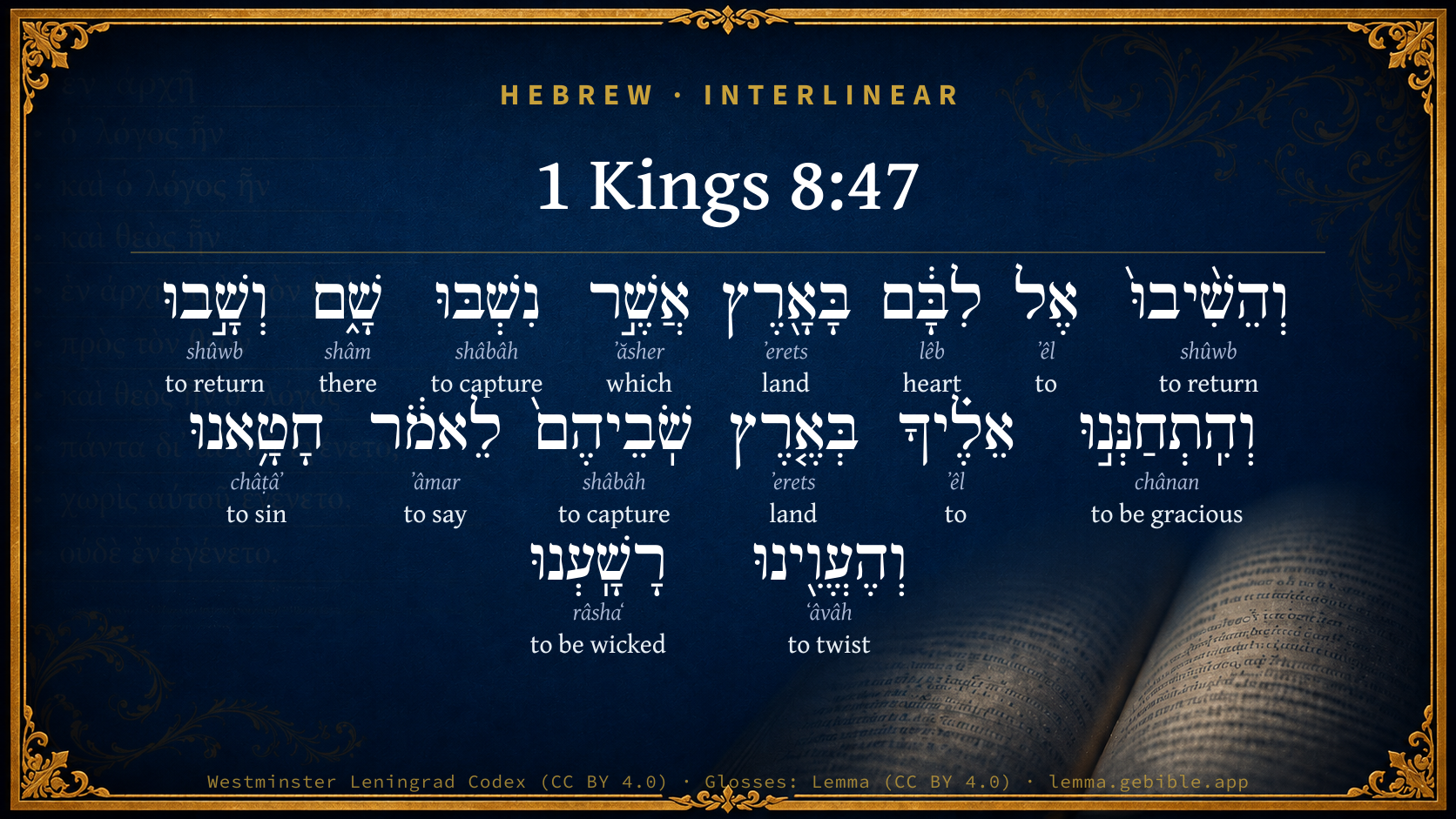
  1. וְהֵשִׁ֨יבוּ֙ shûwb H7725 “and · to return” Conjunction + Verb, Hiphil, Sequential Perfect, 3rd Person, Common, Plural
  2. אֶל ʼêl H413 “to” Preposition
  3. לִבָּ֔ם lêb H3820 “heart · their” Noun, Common, Masculine, Singular, Construct + Suffix, Personal, 3rd Person, Masculine, Plural
  4. בָּאָ֖רֶץ ʼerets H776 “in/at the · land” Preposition, Determined + Noun, Common, Both, Singular, Absolute
  5. אֲשֶׁ֣ר ʼăsher H834 “which” Particle, Relative
  6. נִשְׁבּוּ shâbâh H7617 “to capture” Verb, Niphal, Perfect, 3rd Person, Common, Plural
  7. שָׁ֑ם shâm H8033 “there” Adverb
  8. וְשָׁ֣בוּ shûwb H7725 “and · to return” Conjunction + Verb, Qal, Sequential Perfect, 3rd Person, Common, Plural
  9. וְהִֽתְחַנְּנ֣וּ chânan H2603 “and · to be gracious” Conjunction + Verb, Hithpael, Sequential Perfect, 3rd Person, Common, Plural
  10. אֵלֶ֗יךָ ʼêl H413 “to · you” Preposition + Suffix, Personal, 2nd Person, Masculine, Singular
  11. בְּאֶ֤רֶץ ʼerets H776 “in/at · land of” Preposition + Noun, Common, Both, Singular, Construct
  12. שֹֽׁבֵיהֶם֙ shâbâh H7617 “capturing · them” Verb, Qal, Participle Active, Masculine, Plural, Construct + Suffix, Personal, 3rd Person, Masculine, Plural
  13. לֵאמֹ֔ר ʼâmar H559 “to say” Preposition + Verb, Qal, Infinitive Construct
  14. חָטָ֥אנוּ châṭâʼ H2398 “to sin” Verb, Qal, Perfect, 1st Person, Common, Plural
  15. רָשָֽׁעְנוּ râshaʻ H7561 “to be wicked” Verb, Qal, Perfect, 1st Person, Common, Plural

About this verse

These counts appear in no published source. They are computed here, from the morphology-tagged text and Lemma’s own curated glosses. What Lemma adds →

16
words
12
distinct lemmas
Historical
section

Notable vocabulary

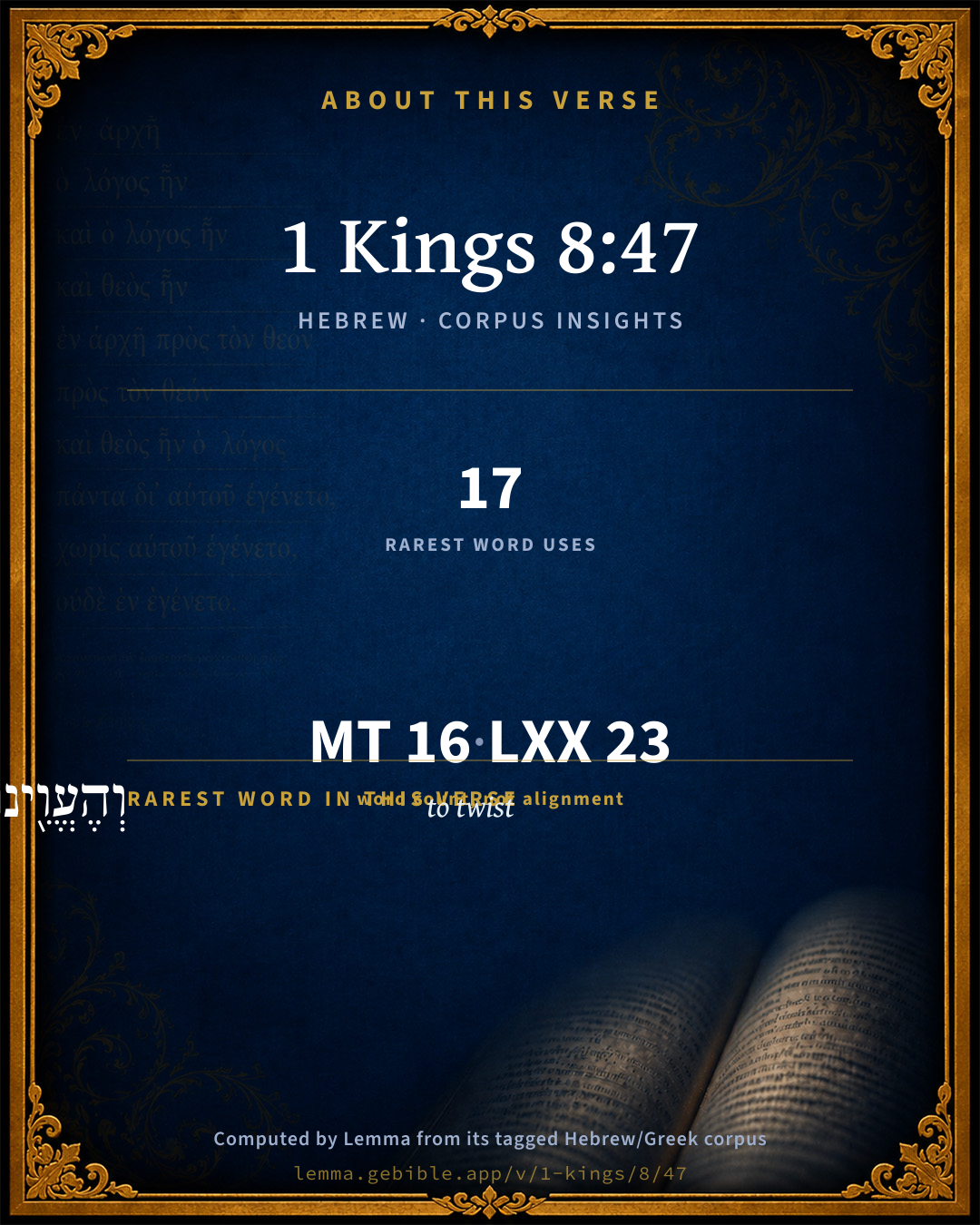
The rarest word here is וְהֶעֱוִ֖ינוּ to twist H5753 — appearing just 17 times in the whole Hebrew Bible.

Shared distinctive vocabulary

וְהֶעֱוִ֖ינוּ to twist H5753 occurs in 17 verses of the Hebrew Bible. Also found in:

Grammatical profile

  • 9 verbs
  • 3 nouns
  • 2 prepositions
  • 1 adverb
  • 1 particle

Verb forms

  • וְהֵשִׁ֨יבוּ֙ Hiphil · Sequential Perfect
  • נִשְׁבּוּ Niphal · Perfect
  • וְשָׁ֣בוּ Qal · Sequential Perfect
  • וְהִֽתְחַנְּנ֣וּ Hithpael · Sequential Perfect
  • שֹֽׁבֵיהֶם֙ Qal · Participle Active
  • לֵאמֹ֔ר Qal · Infinitive Construct
  • חָטָ֥אנוּ Qal · Perfect
  • וְהֶעֱוִ֖ינוּ Hiphil · Perfect
  • רָשָֽׁעְנוּ Qal · Perfect

Repetition

Words recur within this verse — often emphatic in Hebrew:

  • וְהֵשִׁ֨יבוּ֙ to return H7725 ×2
  • בָּאָ֖רֶץ land H776 ×2
  • נִשְׁבּוּ to capture H7617 ×2
  • אֶל to H413 ×2

Hebrew & Septuagint length

In English translation the verse runs 43 words from the Hebrew and 37 from the Septuagint (LXX English) — closely comparable.

A rough comparison of the two English renderings, which tokenize alike — not a word-level alignment.

Word counts can differ between the Hebrew and the Greek without any difference in meaning — e.g. the Hebrew direct-object marker אֵת has no separate Greek word, and Greek often adds the article ὁ.

In the original languages it is 16 Hebrew tokens and 23 Greek tokens — but the two are counted differently (Hebrew bundles its prefixes and suffixes into one token; the Greek is in lemma form), so that isn’t a like-for-like length.

Cross-references

19

Topical passages linked to 1 Kings 8:47 in the Treasury of Scripture Knowledge — connected by theme and wording, ordered by reader-vote popularity; previews shown in the World English Bible.

  • Psalms 106:6 We have sinned with our fathers. We have committed iniquity. We have done wickedly.
  • Ezra 9:6–7 and I said, my God, I am ashamed and blush to lift up my face to you, my God; for our iniquities are increased over our head, and our guiltiness is grown up to the heavens.
  • Nehemiah 1:6–11 Let your ear now be attentive, and your eyes open, that you may listen to the prayer of your servant, which I pray before you at this time, day and night, for the children of Israel your servants while I confess the sins of the children of Israel, which we have sinned against you. Yes, I and my father's house have sinned:
  • Nehemiah 9:26–30 Nevertheless they were disobedient, and rebelled against you, and cast your law behind their back, and killed your prophets that testified against them to turn them again to you, and they committed awful blasphemies.
  • Leviticus 26:40–45 "'If they confess their iniquity, and the iniquity of their fathers, in their trespass which they trespassed against me, and also that, because they walked contrary to me,
  • Deuteronomy 4:29–31 But from there you shall seek Yahweh your God, and you shall find him, when you search after him with all your heart and with all your soul.
  • Deuteronomy 30:1–2 It shall happen, when all these things are come on you, the blessing and the curse, which I have set before you, and you shall call them to mind among all the nations, where Yahweh your God has driven you,
  • 2 Chronicles 33:12–13 When he was in distress, he begged Yahweh his God, and humbled himself greatly before the God of his fathers.
  • 2 Chronicles 6:37 yet if they shall repent themselves in the land where they are carried captive, and turn again, and make supplication to you in the land of their captivity, saying, We have sinned, we have done perversely, and have dealt wickedly;
  • Job 33:27–28 He sings before men, and says, 'I have sinned, and perverted that which was right, And it didn't profit me.
  • Isaiah 64:6–12 For we are all become as one who is unclean, and all our righteousness are as a polluted garment: and we all do fade as a leaf; and our iniquities, like the wind, take us away.
  • Jeremiah 31:18–20 I have surely heard Ephraim bemoaning himself [thus], You have chastised me, and I was chastised, as a calf unaccustomed [to the yoke]: turn you me, and I shall be turned; for you are Yahweh my God.
  • Ezekiel 16:61 Then shall you remember your ways, and be ashamed, when you shall receive your sisters, your elder [sisters] and your younger; and I will give them to you for daughters, but not by your covenant.
  • Ezekiel 16:63 that you may remember, and be confounded, and never open your mouth any more, because of your shame, when I have forgiven you all that you have done, says the Lord Yahweh.
  • Ezekiel 18:28 Because he considers, and turns away from all his transgressions that he has committed, he shall surely live, he shall not die.
  • Daniel 9:5–11 we have sinned, and have dealt perversely, and have done wickedly, and have rebelled, even turning aside from your precepts and from your ordinances;
  • Haggai 1:7 This is what Yahweh of Hosts says: "Consider your ways.
  • Zechariah 12:10 I will pour on the house of David, and on the inhabitants of Jerusalem, the spirit of grace and of supplication; and they will look to me whom they have pierced; and they shall mourn for him, as one mourns for his only son, and will grieve bitterly for him, as one grieves for his firstborn.
  • Luke 15:17–18 But when he came to himself he said, 'How many hired servants of my father's have bread enough to spare, and I'm dying with hunger!

Cross-references courtesy of OpenBible.info (CC BY 4.0).

Hebrew and Greek witnesses Masoretic Hebrew ↔ Greek Septuagint

The same verse in the two great witnesses to the Old Testament, shown verse-for-verse.

These are two independent witnesses, not word-aligned to each other, and the Septuagint is shown in lemma (dictionary) form.

Hebrew 1 Kings 8:47 Masoretic · Westminster Leningrad Codex

וְהֵשִׁ֨יבוּ֙ אֶל לִבָּ֔ם בָּאָ֖רֶץ אֲשֶׁ֣ר נִשְׁבּוּ שָׁ֑ם וְשָׁ֣בוּ וְהִֽתְחַנְּנ֣וּ אֵלֶ֗יךָ בְּאֶ֤רֶץ שֹֽׁבֵיהֶם֙ לֵאמֹ֔ר חָטָ֥אנוּ וְהֶעֱוִ֖ינוּ רָשָֽׁעְנוּ

yet if they shall repent themselves in the land where they are carried captive, and turn again, and make supplication to you in the land of those who carried them captive, saying, We have sinned, and have done perversely, we have dealt wickedly;

World English Bible · Public Domain

Greek LXX 1 Kings 8:47 Septuagint · lemma form

καί ἐπιστρέφω καρδία αὐτός ἐν ὁ γῆ οὗ μεταἄγω ἐκεῖ καί ἐπιστρέφω καί δέω σύ ἐν γῆ μετοικία αὐτός λέγω ἁμαρτάνω ἀνομέω ἀδικέω

and they shall turn their hearts in the land whither they have been carried captives, and turn in the land of their sojourning, and supplicate you, saying, We have sinned, we have done unjustly, we have transgressed,

LXX2012 (modern English Septuagint) · Public Domain

Hebrew: Westminster Leningrad Codex (CC BY 4.0). Greek: Septuagint (public domain); English from LXX2012 (modern English Septuagint) (Public Domain). How the Septuagint differs from the Hebrew →

Targum (Aramaic paraphrase)

1

The Targum is the ancient Jewish Aramaic paraphrase of the Hebrew Scriptures — an interpretive translation, not the Hebrew text itself. Onkelos (literal) and Pseudo-Jonathan (expansive) render the Torah, and Jonathan the Prophets. Coverage is partial: where no permissively-licensed English translation exists for a verse, only the Aramaic is shown. This is verse-level text, not a word-by-word alignment to the Hebrew.

  1. Targum Jonathan Prophets (Joshua–Malachi)
    וִיתוּבוּן לְלִבְּהוֹן בְּאַרְעָא דְאִשְׁתְּבִיאוּ לְתַמָן וִיתוּבוּן וְיִבְעוּן מִן קֳדָמָךְ בְּאַרְעָא שִׁבְיֵהוֹן לְמֵימַר חַבְנָא וְאִטְפַשְׁנָא סְרַחְנָא:

    (no public-domain English translation for this verse)

    Targum Jonathan — Aramaic: “Mikraot Gedolot” (public domain). English: “Sefaria Community Translation” (CC0 1.0 (public-domain dedication)); “London "Chaldee Paraphrase," 1871” (public domain). Text via Sefaria.

Commentary

Notes on 1 Kings 8:47 from classic Christian and Jewish commentators (each source and its license shown beneath its notes). The classic Christian expositions comment on the surrounding passage and are grouped to its opening verse, so a note may address several verses; the Jewish commentaries on the Tanakh (Rashi and others) are per-verse, so they appear only where the commentator wrote on this verse.

Lemma curates 59 commentaries, every one of them public domain or Creative Commons licensed, each selected and text-cleaned for this edition rather than reprinted as found. About our sources →

Trapp's Complete Commentary

John Trapp

1Ki 8:47 [Yet] if they shall bethink themselves in the land whither they were carried captives, and repent, and make supplication unto thee in the land of them that carried them captives, saying, We have sinned, and have done perversely, we have committed wickedness;

Ver. 47. Yet if they shall bethink themselves.] Heb., Bring back to their heart; turn short again upon themselves, and see what an "evil and a bitter thing sin is." This is the first thing in true repentance, as is to be seen in Ephraim, {Jer 31:19} and the prodigal, who "came to himself," and then resolved to return to his father. {Luk 15:17-18}

We have sinned, and have done perversely.] Sin must be confessed with utmost aggravation, - load must be laid upon it, and the worst made of it.

John Trapp, A Commentary or Exposition upon All the Books of the Old and New Testament (1647–1656) — public domain. Text from a community e-Sword module.

Joseph Benson's Commentary

1Ki 8:47-49. If they shall bethink themselves — Consider their ways, and reflect on their past conduct as the cause of their sufferings. Hebrew, If they shall bring back their hearts from their idols and vanities; from going out after, and trusting in, any creature. And repent — Afflictions are calculated to bring men, first to serious consideration, and then to repentance; and when they are truly penitent, they wilt confess their sins and humble themselves. Saying — Sensibly, and with an honest heart; we have sinned and done perversely. And return unto thee with all their heart and all their soul — Sincerely, universally, and steadfastly. Then hear thou, and maintain their cause — Hebrew, their right against their invaders and oppressors; for they had forfeited all their rights to God only, but not to their enemies; whom though God used as scourges to chastise his people’s sins, yet they had no pretence of right to their land.

Joseph Benson's Commentary on the Old and New Testaments (1811–1818) — public domain. Text from a community e-Sword module.

Geneva Bible (1599)

Geneva Bible translators

Though the Temple was the chief place of prayer, yet he secludeth not them, that being let with necessity call upon him in other places.

Or, if they repent.

Geneva Bible (1599) marginal notes — public domain. Text via Bolls.life.

John Gill's Exposition

Yet if they shall bethink themselves in the land whither they were carried captives,.... Or, "return to their heart" (a); remember their sins, the cause of their captivity, and reflect upon them:

and repent of them, and make supplication unto thee in the land of them that carried them captives; though and while they are in such a state:

saying, we have sinned, and have done perversely, we have committed wickedness; which phrases include all their sins, with all the aggravated circumstances of them, and their sense of them, and contrition for them.

(a) "et reversi fuerint ad cor suum", Pagninas, Montanus, Vatablus.

John Gill's Exposition of the Whole Bible (1746–1763) — public domain (CC PDM 1.0). Text via the HelloAO Bible API.

Albert Barnes' Notes on the Bible

Bethink themselves - literally, as in the margin - i. e. “reflect,” “consider seriously.” Compare Deu 30:1.

Sinned, done perversely, committed wickedness - The words here used seem to have become the standard form of expressing contrition when the time of the captivity arrived and the Israelites were forcibly removed to Babylon (compare the margin reference). The three expressions are thought to form a climax, rising from negative to positive guilt, and from mere wrongful acts to depravation of the moral character.

Albert Barnes' Notes on the Bible (1834–1885) — public domain. Text from a community e-Sword/MySword module.

Haydock's Catholic Bible Commentary

Heart. Without this, external repentance will not suffice. (Worthington)

George Leo Haydock (1774–1849), Haydock's Catholic Family Bible and Commentary, 1859 edition — public domain. Excludes Psalms (Douay-Rheims chapter numbering differs from Protestant) and Deuterocanonical books (Catholic canon only).

Matthew Poole's English Annotations

If they shall bethink themselves, Heb. bring back their hearts, to wit, their sin; expressed 1Ki 8:46, and implied in the following word,

repent. Saying, sensibly, and with an honest heart,

We have sinned, & c.

Matthew Poole's English Annotations on the Holy Bible (1683–1685) — public domain. Text from a community e-Sword/MySword module.

The Pulpit Commentary

Yet if they shall bethink themselves Heb. as marg., bring back to their heart. Same phrase, Deu_4:39 Deu_30:1. The latter passage, it should be noticed, treats of the captivity, so that Solomon, consciously or unconsciously, employs some of the very words used by Moses in contemplating this contingency. These repeated coincidences lead to the belief that the prayer was based upon and compiled from the Pentateuch in the land whither they were carried captives, and repent, and make supplication unto thee in the land of them that carried them captives, saying, We have sinned, and have done perversely, we have Committed wickedness. This verse is full of paronomasia, wby wb wb etc. Words almost identical with this confession were used (Dan_9:5 Psa_106:6) by the Jews in their captivity at Babylon, from which it has been concluded that this part of the prayer must belong to the time of the captivity. But surely it is, to say the least, just as likely that the Jews, when the captivity of which Solomon spoke befel them, borrowed the phrase in which their great king by anticipation expressed their penitence. Seeing in the captivity a fulfilment of his prediction, they would naturally see in this formula, which no doubt had been preserved in the writings of the prophets, a confession specially appropriate to their case, and indeed provided for their use.

The Pulpit Commentary (1880–1919), ed. H.D.M. Spence-Jones & Joseph S. Exell — public domain. Text from a community e-Sword module.

Lesson kit

Teaching starters — assembled from the data on this page, not authored interpretation. Every prompt links to the verse data it draws on. Edit before teaching.

1 Kings, in the Historical, opens this verse with 16 words (12 distinct Hebrew lemmas). Its most distinctive word is ʻâvâh (“to twist”). A historical commentator’s framing appears above. Read the whole chapter for the surrounding context.

Discussion questions

  1. How does “to twist” (ʻâvâh) shape what this verse is saying?
  2. 1 Samuel 20:30 shares the word «to twist» with this verse. How do the two illuminate each other?
  3. “to return” occurs 2× in this one verse. What is the effect of the repetition?
  4. These translations render this verse differently; the difference is in the English rendering, not the original. What questions does that raise?
  5. The verb «וְהֵשִׁ֨יבוּ֙» is Hiphil Sequential Perfect. How does its form color the action?
  6. Reading how Trapp's Complete Commentary and Joseph Benson's Commentary read this verse, where do the two commentators agree and where do they part?

Things to notice

Reading settings

Reading text

Shown beneath each verse's original-language words.

Old Testament
Old Testament edition

Read the OT as the Masoretic Hebrew (MT) or the Greek Septuagint (LXX).

English shown for the Greek Septuagint (in the Hebrew ↔ Greek comparison).

Comparing translations? Open the Compare panel on any verse page to stack up to four side by side.