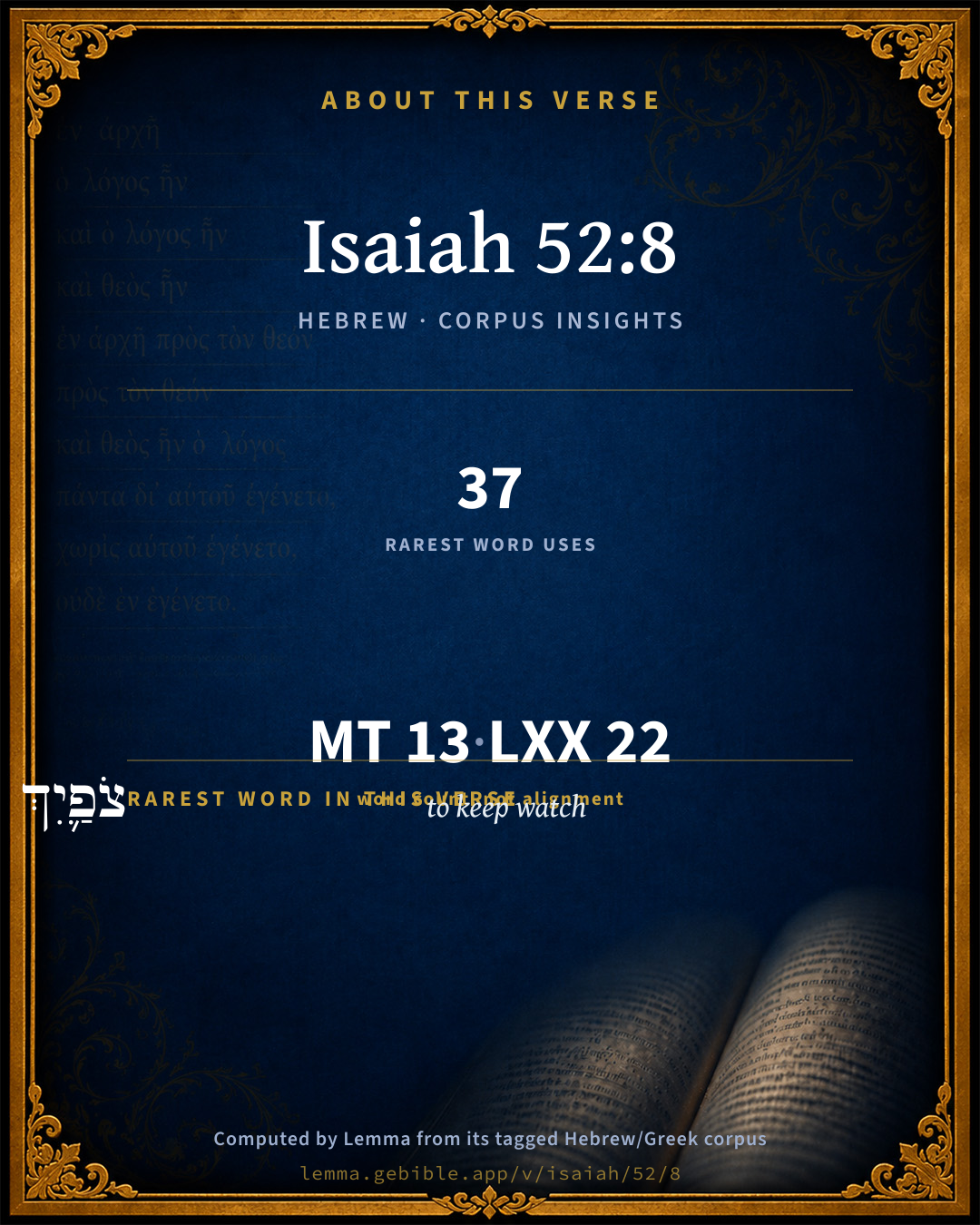
Isaiah 52:8

Hebrew (Westminster Leningrad Codex) Isaiah 52:8 appears in the Hebrew Old Testament. The text above is from the Westminster Leningrad Codex. Each word links to its Strong’s number, a concise gloss, and parsing drawn from the Open Scriptures Hebrew Bible morphology. Click any word for its full Brown-Driver-Briggs (BDB) entry.
Download image
Cite this verse

Isaiah 52:8 (World English Bible). Public Domain. Lemma interlinear Bible study tool, https://lemma.gebible.app/v/isaiah/52/8.

Show BibTeX & RIS
BibTeX
RIS
English Translation
The voice of your watchmen! they lift up the voice, together do they sing; for they shall see eye to eye, when Yahweh returns to Zion.
World English Bible · Public Domain
Download a study sheet

One document with this verse’s original text, its word-by-word gloss line, the meaning frame, cross-references with their text, attributed commentary, and full source and license credits — printable, and it pastes into notes with its structure intact.

This verse Autodidact and up

Study sheet (.html) Plain text (.txt)

A passage Seminary Student

Up to 50 verses in one chapter. A passage sheet keeps up to 6 commentary sources and 12 cross-references per verse, in the order this page ranks them, and says so on the sheet whenever that leaves anything out. Ask for a single verse and you get the Autodidact verse sheet above.

Everything on this page stays free to read, with no account — the sheet is a download of what is already on screen, not access to it.

Want to remove ads? Support Godless Engineer
Compare translations 3

The same verse in 3 English versions, stacked beneath the original-language interlinear above. Click any original word for its lexicon entry.

Each is an independent rendering of the whole verse — the interlinear is not word-aligned to these translations.

Highlighted words mark where these versions differ — a whole-verse word diff, not a word-by-word alignment.

  • World English Bible Public Domain
    The voice of your watchmen! they lift up the voice, together do they sing; for they shall see eye to eye, when Yahweh returns to Zion.
  • King James Version Public Domain
    Thy watchmen shall lift up the voice; with the voice together shall they sing: for they shall see eye to eye, when the LORD shall bring again Zion.
  • unfoldingWord Literal Text CC BY-SA 4.0
    The voice of your watchmen! They lift up a voice; they sing joyfully together, for eye to eye they will look upon the returning of Yahweh Zion.

unfoldingWord Literal Text — © unfoldingWord, licensed CC BY-SA 4.0. Word-aligned USFM3 via Door43 (git.door43.org/unfoldingWord/en_ult).

Versions to compare (up to 4)

3 of 4 selected

Show all 18 translations

Every available English version of this verse, each an independent rendering of the whole verse.

  • World English Bible Public Domain
    The voice of your watchmen! they lift up the voice, together do they sing; for they shall see eye to eye, when Yahweh returns to Zion.
  • Berean Standard Bible Public Domain
    Listen! Your watchmen lift up their voices, together they shout for joy. For every eye will see when the LORD returns to Zion.
  • Majority Standard Bible Public Domain
    Listen! Your watchmen lift up their voices, together they shout for joy. For every eye will see when the LORD returns to Zion.
  • King James Version Public Domain
    Thy watchmen shall lift up the voice; with the voice together shall they sing: for they shall see eye to eye, when the LORD shall bring again Zion.
  • American Standard Version (1901) Public Domain
    The voice of thy watchmen! they lift up the voice, together do they sing; for they shall see eye to eye, when Jehovah returneth to Zion.
  • Revised Version (1885) Public Domain
    The voice of thy watchmen! they lift up the voice, together do they sing; for they shall see, eye to eye, when the LORD returneth to Zion.
  • Geneva Bible (1599) Public Domain
    The voyce of thy watchmen shalbe heard: they shall lift vp their voyce, and shoute together: for they shall see eye to eye, when the Lord shall bring againe Zion.
  • Douay-Rheims (1899) Public Domain
    The voice of thy watchmen: they have lifted up their voice, they shah praise together: for they shall see eye to eye when the Lord shall convert Sion
  • Young's Literal Translation Public Domain
    The voice of thy watchmen! They have lifted up the voice, together they cry aloud, Because eye to eye they see, in Jehovah's turning back `to' Zion.
  • Literal Standard Version CC BY-SA 4.0
    The voice of your watchmen! They have lifted up the voice, together they cry aloud, || Because they see eye to eye, || In YHWH’s turning back [to] Zion.
  • Unlocked Literal Bible CC BY-SA 4.0
    Listen, your watchmen raise their voices, together they shout for joy, for they will see, every eye of theirs, Yahweh's return to Zion.
  • unfoldingWord Literal Text CC BY-SA 4.0
    The voice of your watchmen! They lift up a voice; they sing joyfully together, for eye to eye they will look upon the returning of Yahweh Zion.
  • Darby Bible Public Domain
    -- The voice of thy watchmen, they lift up the voice, they sing aloud together; for they shall see eye to eye, when Jehovah shall bring again Zion.
  • World Messianic Bible Public Domain
    Your watchmen lift up their voice. Together they sing; for they shall see eye to eye when the LORD returns to Zion.
  • Webster's Bible Public Domain
    Thy watchmen shall lift up the voice; with the voice together shall they sing: for they shall see eye to eye, when the LORD shall bring again Zion.
  • Free Bible Version CC BY-SA 4.0
    The city watchmen shout loudly and sing for joy together; they all see the Lord returning to Jerusalem.
  • Bible in Basic English Public Domain
    The voice of your watchmen! their voices are loud in song together; for they will see him, eye to eye, when the Lord comes back to Zion.
  • JPS Tanakh (1917) Public Domain
    Hark, thy watchmen! they lift up the voice, together do they sing; for they shall see, eye to eye, the LORD returning to Zion.

Literal Standard Version (2020), Covenant Press — licensed CC BY-SA 4.0. Text via the HelloAO Bible API (eBible.org). Unlocked Literal Bible (unfoldingWord) — licensed CC BY-SA 4.0. Text via the HelloAO Bible API (eBible.org). unfoldingWord Literal Text — © unfoldingWord, licensed CC BY-SA 4.0. Word-aligned USFM3 via Door43 (git.door43.org/unfoldingWord/en_ult). Free Bible Version, Dr. Jonathan Gallagher — licensed CC BY-SA 4.0. Text via the HelloAO Bible API (eBible.org).

Word by word

More ways to search: Search by grammar → Find every occurrence → Compare this word →

Practice this passage: Drill this verse → Learn its vocabulary →

צֹפַ֛יִךְ
tsâphâh
H6822
“keeping watch · you”
Verb, Qal, Participle Active, Masculine, Plural, Construct + Suffix, Personal, 2nd Person, Feminine, Singular
Part of Speech
Verb
Stem
Qal
Form
Participle Active
Gender
Masculine
Number
Plural
State
Construct
Full BDB Definition

Origin: a primitive root

TWOT: 1950

to look out or about, spy, keep watch, observe, watch - (Qal) to keep watch, spy - (Piel) to watch, watch closely
  1. ק֥וֹל qôwl H6963 “voice of” Noun, Common, Masculine, Singular, Construct
  2. נָ֥שְׂאוּ nâsâʼ H5375 “to lift” Verb, Qal, Perfect, 3rd Person, Common, Plural
  3. ק֖וֹל qôwl H6963 “voice” Noun, Common, Masculine, Singular, Absolute
  4. יַחְדָּ֣ו yachad H3162 “together” Adverb
  5. יְרַנֵּ֑נוּ rânan H7442 “to shout” Verb, Piel, Imperfect, 3rd Person, Masculine, Plural
  6. כִּ֣י kîy H3588 “that” Conjunction
  7. עַ֤יִן ʻayin H5869 “eye” Noun, Common, Both, Singular, Absolute
  8. בְּעַ֨יִן֙ ʻayin H5869 “in/at · eye” Preposition + Noun, Common, Both, Singular, Absolute
  9. יִרְא֔וּ râʼâh H7200 “to see” Verb, Qal, Imperfect, 3rd Person, Masculine, Plural
  10. בְּשׁ֥וּב shûwb H7725 “in/at · to return” Preposition + Verb, Qal, Infinitive Construct
  11. יְהוָ֖ה Yᵉhôvâh H3068 “LORD” Noun, Proper
  12. צִיּֽוֹן Tsîyôwn H6726 “Zion” Noun, Proper

About this verse

These counts appear in no published source. They are computed here, from the morphology-tagged text and Lemma’s own curated glosses. What Lemma adds →

13
words
11
distinct lemmas
Prophets
section

Shared distinctive vocabulary

צֹפַ֛יִךְ to keep watch H6822 occurs in 33 verses of the Hebrew Bible. Also found in:

Grammatical profile

  • 5 verbs
  • 6 nouns
  • 1 conjunction
  • 1 adverb

Verb forms

  • צֹפַ֛יִךְ Qal · Participle Active
  • נָ֥שְׂאוּ Qal · Perfect
  • יְרַנֵּ֑נוּ Piel · Imperfect
  • יִרְא֔וּ Qal · Imperfect
  • בְּשׁ֥וּב Qal · Infinitive Construct

Repetition

Words recur within this verse — often emphatic in Hebrew:

  • ק֥וֹל voice H6963 ×2
  • עַ֤יִן eye H5869 ×2

Hebrew & Septuagint length

In English translation the verse runs 26 words from the Hebrew and 32 from the Septuagint (LXX English) — closely comparable.

A rough comparison of the two English renderings, which tokenize alike — not a word-level alignment.

Word counts can differ between the Hebrew and the Greek without any difference in meaning — e.g. the Hebrew direct-object marker אֵת has no separate Greek word, and Greek often adds the article ὁ.

In the original languages it is 13 Hebrew tokens and 22 Greek tokens — but the two are counted differently (Hebrew bundles its prefixes and suffixes into one token; the Greek is in lemma form), so that isn’t a like-for-like length.

Cross-references

31

Topical passages linked to Isaiah 52:8 in the Treasury of Scripture Knowledge — connected by theme and wording, ordered by reader-vote popularity; previews shown in the World English Bible.

  • Isaiah 62:6 I have set watchmen on your walls, Jerusalem; they shall never hold their peace day nor night: you who call on Yahweh, take no rest,
  • Jeremiah 32:39 and I will give them one heart and one way, that they may fear me forever, for the good of them, and of their children after them:
  • Ezekiel 33:7 So you, son of man, I have set you a watchman to the house of Israel; therefore hear the word at my mouth, and give them warning from me.
  • Isaiah 30:26 Moreover the light of the moon shall be as the light of the sun, and the light of the sun shall be sevenfold, as the light of seven days, in the day that Yahweh binds up the hurt of his people, and heals the stroke of their wound.
  • Isaiah 35:10 and the ransomed of Yahweh shall return, and come with singing to Zion; and everlasting joy shall be on their heads: they shall obtain gladness and joy, and sorrow and sighing shall flee away.
  • Isaiah 40:9 You who tell good news to Zion, go up on a high mountain; you who tell good news to Jerusalem, lift up your voice with strength; lift it up, don't be afraid; say to the cities of Judah, Behold, your God!
  • Isaiah 48:20 Go you forth from Babylon, flee you from the Chaldeans; with a voice of singing declare you, tell this, utter it even to the end of the earth: say you, Yahweh has redeemed his servant Jacob.
  • Isaiah 56:10 His watchmen are blind, they are all without knowledge; they are all mute dogs, they can't bark; dreaming, lying down, loving to slumber.
  • Isaiah 58:1 Cry aloud, don't spare, lift up your voice like a trumpet, and declare to my people their disobedience, and to the house of Jacob their sins.
  • Jeremiah 6:17 I set watchmen over you, [saying], Listen to the sound of the trumpet; but they said, We will not listen.
  • Jeremiah 33:11 the voice of joy and the voice of gladness, the voice of the bridegroom and the voice of the bride, the voice of those who say, Give thanks to Yahweh of Hosts, for Yahweh is good, for his loving kindness endures forever; [and of them] who bring [sacrifices of] thanksgiving into the house of Yahweh. For I will cause the captivity of the land to return as at the first, says Yahweh.
  • Ezekiel 3:17 Son of man, I have made you a watchman to the house of Israel: therefore hear the word at my mouth, and give them warning from me.
  • Zephaniah 3:9 For then I will purify the lips of the peoples, that they may all call on the name of Yahweh, to serve him shoulder to shoulder.
  • Zechariah 12:8 In that day Yahweh will defend the inhabitants of Jerusalem. He who is feeble among them at that day will be like David, and the house of David will be like God, like the angel of Yahweh before them.
  • 1 Corinthians 1:10 Now I beg you, brothers, through the name of our Lord, Jesus Christ, that you all speak the same thing and that there be no divisions among you, but that you be perfected together in the same mind and in the same judgment.
  • 1 Corinthians 13:12 For now we see in a mirror, dimly, but then face to face. Now I know in part, but then I will know fully, even as I was also fully known.
  • Song of Solomon 3:3 The watchmen who go about the city found me; "Have you seen him whom my soul loves?"
  • Song of Solomon 5:7 The watchmen who go about the city found me. They beat me. They bruised me. The keepers of the walls took my cloak away from me.
  • Isaiah 12:4–6 In that day you will say, "Give thanks to Yahweh! Call on his name. Declare his doings among the peoples. Proclaim that his name is exalted!
  • Isaiah 24:14 These shall lift up their voice, they shall shout; for the majesty of Yahweh they cry aloud from the sea.
  • Isaiah 26:1 In that day shall this song be sung in the land of Judah: we have a strong city; salvation will he appoint for walls and bulwarks.
  • Isaiah 27:2 In that day: A vineyard of wine, sing you to it.
  • Jeremiah 31:6–7 For there shall be a day, that the watchmen on the hills of Ephraim shall cry, Arise you, and let us go up to Zion to Yahweh our God.
  • Acts 2:1 Now when the day of Pentecost had come, they were all with one accord in one place.
  • Acts 2:46–47 Day by day, continuing steadfastly with one accord in the temple, and breaking bread at home, they took their food with gladness and singleness of heart,
  • Acts 4:32 The multitude of those who believed were of one heart and soul. Not one of them claimed that anything of the things which he possessed was his own, but they had all things in common.
  • Ephesians 1:17–18 that the God of our Lord Jesus Christ, the Father of glory, may give to you a spirit of wisdom and revelation in the knowledge of him;
  • Revelation 5:8–10 Now when he had taken the book, the four living creatures and the twenty-four elders fell down before the Lamb, each one having a harp, and golden bowls full of incense, which are the prayers of the saints.
  • Revelation 18:20 Rejoice over her, O heaven, you saints, apostles, and prophets; for God has judged your judgment on her."
  • Revelation 19:4 The twenty-four elders and the four living creatures fell down and worshiped God who sits on the throne, saying, "Amen! Hallelujah!"
  • Hebrews 13:17 Obey your leaders and submit to them, for they watch on behalf of your souls, as those who will give account, that they may do this with joy, and not with groaning, for that would be unprofitable for you.

Cross-references courtesy of OpenBible.info (CC BY 4.0).

Hebrew and Greek witnesses Masoretic Hebrew ↔ Greek Septuagint

The same verse in the two great witnesses to the Old Testament, shown verse-for-verse.

These are two independent witnesses, not word-aligned to each other, and the Septuagint is shown in lemma (dictionary) form.

Hebrew Isaiah 52:8 Masoretic · Westminster Leningrad Codex

ק֥וֹל צֹפַ֛יִךְ נָ֥שְׂאוּ ק֖וֹל יַחְדָּ֣ו יְרַנֵּ֑נוּ כִּ֣י עַ֤יִן בְּעַ֨יִן֙ יִרְא֔וּ בְּשׁ֥וּב יְהוָ֖ה צִיּֽוֹן

The voice of your watchmen! they lift up the voice, together do they sing; for they shall see eye to eye, when Yahweh returns to Zion.

World English Bible · Public Domain

Greek LXX Isaiah 52:8 Septuagint · lemma form

ὅτι φωνή ὁ φυλάσσω σύ ὑψόω καί ὁ φωνή ἅμα εὐφραίνω ὅτι ὀφθαλμός πρός ὀφθαλμός ὁράω ἡνίκα ἄν ἐλεέω κύριος ὁ σιων

For the voice of them that guard you is exalted, and with the voice together they shall rejoice: for eyes shall look to eyes, when the Lord shall have mercy upon Sion.

LXX2012 (modern English Septuagint) · Public Domain

On this verse, Albert Barnes' Notes on the Bible discusses the Septuagint’s reading. Read the note in Commentary ↓

Hebrew: Westminster Leningrad Codex (CC BY 4.0). Greek: Septuagint (public domain); English from LXX2012 (modern English Septuagint) (Public Domain). How the Septuagint differs from the Hebrew →

Targum (Aramaic paraphrase)

1

The Targum is the ancient Jewish Aramaic paraphrase of the Hebrew Scriptures — an interpretive translation, not the Hebrew text itself. Onkelos (literal) and Pseudo-Jonathan (expansive) render the Torah, and Jonathan the Prophets. Coverage is partial: where no permissively-licensed English translation exists for a verse, only the Aramaic is shown. This is verse-level text, not a word-by-word alignment to the Hebrew.

  1. Targum Jonathan Prophets (Joshua–Malachi)
    קַל פַּרְנָסַיִךְ דִמְרִימִין קָלְהוֹן כַּחֲדָא מְשַׁבְּחִין אֲרֵי בְעֵינֵיהוֹן יֶחֱזוּן גְבוּרָן דִי עֲבַד יְיָ כַּד יְתִיב שְׁכִנְתֵּהּ לְצִיוֹן:

    The voice of thy rulers! They are lifting up their voice, together they offer praise; because with their eyes they see the mighty works which the Lord shall do, when He shall return His Shekinah to Zion.

    Targum Jonathan — Aramaic: “Mikraot Gedolot” (public domain). English: “Sefaria Community Translation” (CC0 1.0 (public-domain dedication)); “London "Chaldee Paraphrase," 1871” (public domain). Text via Sefaria.

Commentary

Notes on Isaiah 52:8 from classic Christian and Jewish commentators (each source and its license shown beneath its notes). The classic Christian expositions comment on the surrounding passage and are grouped to its opening verse, so a note may address several verses; the Jewish commentaries on the Tanakh (Rashi and others) are per-verse, so they appear only where the commentator wrote on this verse.

Lemma curates 59 commentaries, every one of them public domain or Creative Commons licensed, each selected and text-cleaned for this edition rather than reprinted as found. About our sources →

Trapp's Complete Commentary

John Trapp

Isa 52:8 Thy watchmen shall lift up the voice; with the voice together shall they sing: for they shall see eye to eye, when the LORD shall bring again Zion.

Ver. 8. Thy watchmen shall lift up the voice.] Heb., The voice of thy watchmen - sc., " Thy God reigneth"; or, as in the following verse, "Break forth into joy," &c.

They lift up the voice, they sing together.] As having "no greater joy than that their children walk in the truth," {2Jn 1:4 1Th 3:8} and the contrary.

For they shall {a} see eye to eye.] And be able to say, as 1Jn 1:1, "That which we have seen with our eyes, which we have looked upon" (and what so sure as sight?) "declare we unto you."

{a} Id est cominus evidentisaime, ut Num 14:14. - Jun.

John Trapp, A Commentary or Exposition upon All the Books of the Old and New Testament (1647–1656) — public domain. Text from a community e-Sword module.

The Biblical Illustrator

Joseph S. Exell

Isa_52:8-12

Thy watchmen shall lift up the voice

The return from exile

From the glowing periods of this paragraph we can reconstruct the picture of the return from exile, as it presented itself to the seer.

It was notably the return of the Lord to Zion (Isa_52:8, R.V.). The stately procession moves slowly and fearlessly. It is not the escape of a band of fugitive slaves, dreading pursuit and recapture: Ye shall not go out in haste, neither shall ye go by flight. Before it speed the messengers, appearing on the sky-line of the mountains of Zion, with good tidings of good, publishing peace, and publishing salvation. The main body is composed of white-robed priests, bearing with reverent care the holy vessels, which Nebuchadnezzar carried from the temple, which Belshazzar introduced with mockery into his feast, but which Cyrus restored. Their number and weight are carefully specified, 5, 400 in all (Ezr_1:7-11). As the procession emerges from its four months of wilderness march on the mountains which were about Jerusalem, her watchmen, who had long waited for the happy moment, lift up their voice; with the voice together do they sing. They see eye to eye. And the waste places of Jerusalem, with their charred wood and scorched stones, break forth into joy and sing together. The valleys and hills become vocal, constituting an orchestra of praise; and the nations of the world are depicted as coming to behold, and acknowledge that the Lord had made bare His holy arm. But they do not see--what is hidden from all but anointed eyes--that the Lord goes before His people, and comes behind as their rearward; so that their difficulties are surmounted by Him before they reach them, and no foe can attack them from behind. The literal fulfilment of this splendid prevision is described in the Book of Ezra. There we find the story of the return of a little band of Jews, 1,700 only in number. They halted at the River Ahava, the last station before they entered the desert, for three days, to put themselves with fasting and prayer into Gods hand. They had no experience of desert marching. Their caravan was rendered unwieldy by the number of women and children in it. They had to thread a district infested by wild bands of robbers. But they scorned to ask for an escort of soldiers and horsemen to protect them, so sure were they that their God went before them to open up the way, and came behind to defend against attack. In the midst of the march were priests and Levites, with their sacred charge of which Ezra had said, Watch and keep them, until ye weigh them in the chambers of the house of the Lord. (F. B. Meyer, B.A.)

Expectation and accomplishment

In several respects there seems a falling short between the radiant expectations of the prophet, and the actual accomplishment in the story of Ezra: but we must remember that it is the business of the historian to record the facts, rather than the emotions that coloured them, as the warm colours of the sun colour the hard, grey rocks. And is it not always so, that through our want of faith and obedience we come short of the fulness of blessing which our God has prepared for us? (F. B.Meyer, B. A. )

Eye to eye

Eye to eye do they behold the Lord s return to Zion. Eye to eye is face to face with the event. (A. B. Davidson, D. D.)

Eye to eye

The expression plainly intimates the clear and satisfying manifestations of the presence and glory of Jehovah to be enjoyed by His servants at the period wherein the foundations of the Messiahs kingdom were to be laid. (R. Macculloch.)

The Biblical Illustrator, edited by Joseph S. Exell (c. 1880s–1900s) — public domain. Text from a community e-Sword module.

Joseph Benson's Commentary

Isa 52:8. Thy watchmen shall lift up the voice — Partly to give notice to all people of these glad tidings, and partly by way of exultation, to sing forth the praises of God for this glorious season and exercise of mercy. If we consider this passage as referring to the deliverance from Babylon, by the watch-men here, we must understand those prophets who prophesied at or after the time of that deliverance, such as Haggai and Zechariah: but if the good tidings be interpreted of the publication of peace and salvation by the gospel, then by the watchmen its ministers are meant, and especially the apostles and evangelists, and other first messengers of Christ. For they shall see eye to eye — Those prophets that shall witness the release of the Jews from captivity shall see an exact agreement and correspondence between the prophecy and the event whereby it is accomplished, between the promise and the performance. It may still be affirmed with more propriety, that the preachers of the gospel saw eye to eye when the Messiah was manifested in the flesh, and they saw his glory, the glory of the only begotten of the Father, full of grace and truth, Joh 1:14; when they saw with their eyes, looked upon, and their hands handled the word of life; when the life was manifested, and they saw it and bore witness, and could show unto others that eternal life which was with the Father, and was manifested unto men, 1Jn 1:2. And being eye and ear witnesses of the words and works of Christ, their testimony became more certain and more valuable. Add to this, that true gospel ministers in general, and even ordinary Christians, who receive the Spirit of wisdom and revelation, (Eph 1:17,) have a more distinct and clear view of the grace of God in Christ than the Old Testament saints could have. When the Lord shall bring again Zion — When God shall complete the work of bringing his church out of captivity, which was begun at the return out of Babylon, and perfected by Christ’s coming into the world. Bishop Lowth, however, reads the clause, When Jehovah returneth to Zion; a translation which the Hebrew text will certainly bear. Thus the Chaldee: When he shall bring back his presence to Zion. “God is considered as having deserted his people during their captivity; and, at the restoration, as returning himself with them to Zion, his former habitation.” But in a much higher degree was God present in his church, when he was manifested in the flesh, and they could call him, Immanuel, God with us.

Joseph Benson's Commentary on the Old and New Testaments (1811–1818) — public domain. Text from a community e-Sword module.

Tyndale Open Study Notes

Tyndale Open Resources

52:8 The watchmen were those looking for the news of Zion’s redemption. • the Lord returning to Jerusalem: The sin of the city’s inhabitants had driven God away.

Tyndale Open Study Notes — © Tyndale Open Resources, licensed CC BY-SA 4.0. Text via the HelloAO Bible API.

Geneva Bible (1599)

Geneva Bible translators

The Prophets which are thy watchmen shall publish this thy deliverance: this was begun under Zerubbabel, Ezra, and Nehemiah, but was accomplished under Christ.

Geneva Bible (1599) marginal notes — public domain. Text via Bolls.life.

Jamieson, Fausset & Brown

Robert Jamieson, A. R. Fausset & David Brown

watchmen--set on towers separated by intervals to give the earliest notice of the approach of any messenger with tidings (compare Isa 21:6-8). The Hebrew is more forcible than English Version, "The voice of thy watchmen" (exclamatory as in Sol 2:8). "They lift up their voice! together they sing."

eye to eye--that is, close at hand, and so clearly [GESENIUS]; Num 14:14, "face to face"; Num 12:8, "mouth to mouth." Compare Co1 13:12; Rev 22:4, of which Simeon's sight of the Saviour was a prefiguration (Luk 2:30). The watchmen, spiritually, are ministers and others who pray for the peace of Jerusalem (Isa 62:6-7),

bring again--that is, restore. Or else, "return to" [MAURER].

Jamieson, Fausset & Brown — Commentary Critical and Explanatory on the Whole Bible (1871) — public domain (CC PDM 1.0). Text via the HelloAO Bible API.

Adam Clarke's Commentary

Verse 8. Thy watchmen lift up the voice - "All thy watchmen lift up their voice"] There is a difficulty in the construction of this place which, I think, none of the ancient versions or modern interpreters have cleared up satisfactorily. Rendered word for word it stands thus: "The voice of thy watchmen: they lift up their voice." The sense of the first member, considered as elliptical, is variously supplied by various expositors; by none, as it seems to me, in any way that is easy and natural. I am persuaded there is a mistake in the present text, and that the true reading is כל צפיך col tsophayich, all thy watchmen, instead of קול צפיך kol tsophayich, the voice of thy watchmen. The mistake was easy from the similitude in sound of the two letters כ caph and ק koph. And in one MS. the ק koph is upon a rasure. This correction perfectly rectifies the sense and the construction. - L.

They shall see eye to eye] May not this be applied to the prophets and apostles; the one predicting, and the other discovering in the prediction the truth of the prophecy. The meaning of both Testaments is best understood by bringing them face to face.

When the Lord shall bring again Zion - "When JEHOVAH returneth to Zion"] So the Chaldee: כד יתיב שכנתיה לציון cad yethib shechinteih letsiyon, "when he shall place the shechinah in Zion." God is considered as having deserted his people during the captivity; and at the restoration, as returning himself with them to Zion, his former habitation. See Ps 60:1; Isa 40:9, and note.

Adam Clarke's Commentary on the Bible (1810–1826) — public domain. Text from a community e-Sword/MySword module.

Ellicott's Commentary for English Readers

(8) Thy watchmen . . .—The sentinels see the heralds from their watch-towers (Isa_21:6; Hab_2:1), and sing out for joy, as they see, not only afar off, but “eye to eye,” the presence of the God who has become the King.

A Bible Commentary for English Readers, edited by Charles John Ellicott (1878–1897) — public domain. Text from a community e-Sword module.

The Cambridge Bible for Schools and Colleges

gen. ed. J. J. S. Perowne

8. Thy watchmen … sing] Render, Hark, thy watchmen! they lift up the voice, together do they sing (see R.V.). Although the prophets are often called “watchmen” (ch. Isa_56:10; Hab_2:1; Jer_6:17; Eze_33:2 ff.) there is no reason to suppose that they are referred to here. Prophets are no longer required after the herald of salvation has arrived and Jehovah Himself is at hand. The word is used in its ordinary sense of the watchmen posted on the city walls, who are naturally represented as the first to see and announce the actual approach of the King.

for they shall see &c.] Rather, for eye to eye do they look upon Jehovah’s return to Zion. The expression eye to eye occurs only once again, in Num_14:14, where Jehovah is said to be “seen eye to eye” in Israel; i.e. He is visibly present there (cf. Jer_32:4, “his eyes shall look on the eyes of Nebuchadnezzar”). The idea here must be similar; Jehovah shall be seen in person when He comes to Zion, as closely and clearly as when two men look one another in the face. The phrase certainly has not in Hebr. the sense of harmony and unity which it has come to bear in English. But it can hardly mean merely that the watchmen shall form a dense throng, looking each other in the face! That is a thought quite irrelevant in the context.

The Cambridge Bible for Schools and Colleges (gen. ed. J. J. S. Perowne; Cambridge University Press, 1878–1918) — public domain. Text from a community e-Sword module.

John Gill's Exposition

The watchmen shall lift up the voice,.... Not the Levites in the temple, nor the prophets of the Old Testament; rather the evangelists and apostles of Christ; best of all Gospel ministers in the latter day, so called in allusion to watch men on the walls of cities looking out, and giving notice of approaching danger; see Isa 62:6. The words may be rendered, "the voice of the watchmen; they shall lift up the voice; together shall they sing"; that is, this is the voice of the watchmen, namely, the voice of peace and salvation, which the bringer of good tidings, the same with these watchmen, publish. "Lifting up" their "voice" denotes the publicness of their ministrations, the vehemency of them, and their importance; "singing together", their joy and cheerfulness, their harmony and unity.

For they shall see eye to eye; most clearly, Zion's King reigning before his ancients gloriously; the great doctrines of peace and salvation published by them; and the great and wonderful things God will do for his church, in fulfilling prophecies relating thereunto. So the Targum,

"for with their eyes they shall see the great things which the Lord will do;''

and as their light and discerning will be most clear, like the light of seven days, so it will be alike in them; their sentiments and doctrines will exactly agree; there will be no difference nor dissension among them:

when the Lord shall bring again Zion: return his church and people to their former state, from whence they were declined; restore them as at the beginning; revive his work among them; cause his Gospel and ordinances to be professed and observed in their purity; call in his ancient people the Jews, and bring in the fulness of the Gentiles; pour out his spirit in a plentiful manner on them, and grant his gracious presence to them; so the Targum,

"when he shall return his Shechinah or divine Majesty to Zion.''

This text is by the Jews (n) applied to the times of the Messiah, and to the resurrection of the dead (o).

(n) Pesikta in Kettoreth Hassammim in Targ. in Numb. fol. 25. 4. (o) T. Bab. Sanhedrhin. fol. 91. 2.

John Gill's Exposition of the Whole Bible (1746–1763) — public domain (CC PDM 1.0). Text via the HelloAO Bible API.

Albert Barnes' Notes on the Bible

Thy watchmen - This language is taken from the custom of placing watchmen on the walls of a city, or on elevated towers, who could see if an enemy approached, and who of course would be the first to discern a messenger at a distance who was coming to announce good news. The idea is, that there would be as great joy at the announcement of the return of the exiles, as if they who were stationed on the wall should see the long-expected herald on the distant hills, coming to announce that they were about to return, and that the city and temple were about to be rebuilt. It was originally applicable to the return from Babylon. But it contains also the general truth that they who are appointed to watch over Zion and its interests, will rejoice at all the tokens of God’s favor to his people, and especially when he comes to bless them after long times of darkness, depression, and calamity. It is by no means, therefore, departing from the spirit of this passage, to apply it to the joy of the ministers of religion in the visits of divine mercy to a church and people. ‘Shall lift up the voice.’ That is, with rejoicing.

With the voice together shall they sing - They shall mingle their praises and thanksgivings. The idea is, that all who are appointed to guard Zion, should feel a common interest in her welfare, and rejoice when the Lord comes to visit and bless his people. The Hebrew here is more abrupt and emphatic than our common translation would make it. It is literally, ‘The voice of thy watchmen! They lift up the voice together; they sing’ - as if the prophet suddenly heard a shout. It is the exultling shout of the watchmen of Zion; and it comes as one voice, with no discord, no jarring.

For they shall see eye to eye - Lowth renders this, ‘For face to face shall they see.’ Noyes, ‘For with their own eyes shall they behold.’ Jerome renders it, Oculo ad oculum - ‘Eye to eye.’ The Septuagint renders it, Ὀφθαλμοὶ πρός ὀφθαλμοὺς, κ.τ.λ. Ophthalmoi pros ophthalmous, etc. ‘Eyes shall look to eyes when the Lord shall have mercy upon Zion.’ Interpreters have been divided in regard to its meaning. The sense may be, either that they shall see face to face, that is, distinctly, clearly, as when one is near another; or it may mean that they shall be united - they shall contemplate the same object, or look steadily at the same thing. Rosenmuller, Gesenius, Forerius, Junius. and some others, understand it in the former sense. So the Chaldee, ‘For they shall see with their own eyes the great things which the Lord will do when he shall bring back his own glory to Zion.’ The phrase in Hebrew occurs in no other place, except in Num 14:14, which our translators have rendered, ‘For thou, Lord, art seen face to face.’ Hebrew, ‘Eye to eye;’ that is, near, openly, manifestly, without any veil or interposing medium.

The expression, ‘face to face,’ meaning openly, plainly, manifestly, as one sees who is close to another, occurs frequently in the Bible (see Gen 32:30; Exo 33:11; Deu 5:4; Deu 34:10; Jdg 6:22; Pro 27:19; Eze 20:35; Act 25:16; 1Co 13:12; 2Jo 1:12; 3Jo 1:14). So the phrase, ‘mouth to mouth,’ occurs in a similar sense Num 12:8. And there can be but little doubt, it seems to me, that this is the sense here, and that the prophet means to say, that the great and marvelous doings of Yahweh would be seen openly and manifestly, and that the watchmen would thence have occasion to rejoice. Another reason for this opinion, besides the fact that it accords with the common usage, is, that the phrase, ‘to see eye to eye,’ in the sense of being united and harmonious, is not very intelligible. It is not easy to form an image or conception of the watchman in this attitude as denoting harmony. To look into the eyes of each other does not of necessity denote harmony, for people oftentimes do this for other purposes. The idea therefore is, that when Yahweh should bring back and bless his people, the watchmen would have a full and glorious exhibition of his mercy and goodness, and the result would be, that they would greatly rejoice, and unitedly celebrate his name. According to this interpretation, it does not mean that the ministers of religion would have the same precise views, or embrace the same doctrines, however true this may be, or however desirable in itself, but that they would have an open, clear, and bright manifestation of the presence of God, and would lift up their voices together with exultation and praise.

When the Lord shall bring again Zion - Zion here denotes the people who dwelt in Jerusalem; and the idea is, when the Lord shall again restore them to their own land. It is not a departure from the sense of the passage, however, to apply it in a more general manner, and to use it as demonstrating that any signal interposition of God in favor of his people should be the occasion of joy, and shall lead the ministers of religion to exult in God, and to praise his name.

Albert Barnes' Notes on the Bible (1834–1885) — public domain. Text from a community e-Sword/MySword module.

Haydock's Catholic Bible Commentary

Watchmen, prophets. The angels sung at the birth of Christ, Luke ii. 14.

George Leo Haydock (1774–1849), Haydock's Catholic Family Bible and Commentary, 1859 edition — public domain. Excludes Psalms (Douay-Rheims chapter numbering differs from Protestant) and Deuterocanonical books (Catholic canon only).

Matthew Poole's English Annotations

Thy watchmen, thy ministers, who shall descry the approach and coming of this heavenly King and kingdom, shall lift up the voice; partly to give notice to all people of these glad tidings; and partly by way of exultation, to sing forth the praises of God for this glorious day and mercy, as it here follows.

They shall see; they shall understand, and so be able to teach, Divine mysteries.

Eye to eye; very distinctly, and clearly, and familiarly, their eyes beholding the eyes of this King of glory; as it is said of Zedekiah, Jer 34:3,

Thine eyes shall behold the eyes of the king of Babylon; and as it is said, mouth to mouth, Num 12:8, and face to face, Gen 32:30; Exo 33:11; Num 14:14. They shall see with their bodily eyes the King of the church, or the Word made flesh, as they are said to have done, Joh 1:14; 1Jo 1:1. They shall be eye and ear witnesses of the words and works of Christ, and therefore their testimony of these things shall be more certain and valuable.

When the Lord shall bring again Zion; when God shall complete the work of bringing his church out of captivity; which was begun at the return out of Babylon, and perfected by Christ’s coming into the world.

Matthew Poole's English Annotations on the Holy Bible (1683–1685) — public domain. Text from a community e-Sword/MySword module.

Whedon's Commentary on the Bible

Daniel D. Whedon

8. Thy watchmen… lift… voice — Watchtowers along the line are here supposed, on which runs, from one to the other, the shouts of the coming caravans.

They shall see eye to eye — This means, that so near to each other are the watchmen that they all in succession see face to face, not only of one another, but also of the exile columns as they advance and pass on their way. Other explanations are given of this phrase, but the scene is one of poetic movement, and no other explanation seems so well to fit it.

Daniel D. Whedon (gen. ed.), Commentary on the Old and New Testaments (1874–1909) — public domain. Text from a community e-Sword module.

The Pulpit Commentary

Thy watchmen shall lift up the voice; literally, The voice of thy watchers. They have lifted up the voice; they sing (or, shout joyfully, Kay) together. The "watchmen" are regarded by some as the prophets of the Captivity-time (Delitzsch), by others as the faithful who "waited for the redemption of Israel" (Kay); but are considered by the best critics (Cheyne, Alexander) to be "supersensible beings," or, in other words, angels, who "watch" over the fortunes of Israel, and sympathize with their weal and woe. (see Dan_4:13, Dan_4:17, Dan_4:23, etc.) These "watchers" now "sing" or "shout" with joy. They shall see eye to eye. (compare the "face to face" of Num_14:14 Deu_34:10) The "watchers" would watch closely God"s dealings with his Church, and would see them as clearly as a man sees his friend when he leeks into his face. When the Lord shall bring again Zion. It is, perhaps, best to translate, with Houbigant and Mr. Cheyne, "When the Lord shall return to Zion." The prophet sees God as the Leader of his people, not merely by his providence bringing them back, but "returning" at their head (comp. ver. 12).

The Pulpit Commentary (1880–1919), ed. H.D.M. Spence-Jones & Joseph S. Exell — public domain. Text from a community e-Sword module.

John Wesley's Explanatory Notes

Thy watchmen - Thy ministers, who descry the approach of this heavenly king. Lift up thy voice - To give notice to all people of these glad tidings; and by way of exultation, to sing forth the praises of God for this glorious day. Eye - Distinctly and familiarly, their eyes beholding the eyes of this king of glory. They shall be eye and ear-witnesses of the words and works of Christ, and therefore their testimony shall be more certain and valuable. Bring again - When God shall complete the work of bringing his church out of captivity.

John Wesley, Explanatory Notes Upon the Whole Bible (1754–1765) — public domain. Text via the GEBible commentary corpus.

Keil & Delitzsch

C. F. Keil & F. Delitzsch

How will the prophets rejoice, when they see bodily before them what they have already seen from afar! "Hark, thy watchers! They lift up the voice together; they rejoice: for they see eye to eye, how Jehovah bringeth Zion home." קול followed by a genitive formed an interjectional clause, and had almost become an interjection itself (see Gen 4:10). The prophets are here called tsōphı̄m, spies, as persons who looked into the distance as if from a watch-tower (specula, Isa 21:6; Hab 2:1) just as in Isa 56:10. It is assumed that the people of the captivity would still have prophets among them: in fact, the very first word in these prophecies (Isa 40:1) is addressed to them. They who saw the redemption from afar, and comforted the church therewith (different from mebhassēr, the evangelist of the fulfilment), lift up their voice together with rejoicing; for they see Jehovah bringing back Zion, as closely as one man is to another when he looks directly into his eyes (Num 14:14). בּ is the same as in the construction בּ ראה; and שׁוּב has the transitive meaning reducere, restituere (as in Psa 14:7; Psa 126:1, etc.), which is placed beyond all doubt by שׁוּבנוּ in Psa 85:5.

Keil & Delitzsch — Biblical Commentary on the Old Testament (1861–1891) — public domain (CC PDM 1.0). Text via the HelloAO Bible API. (Old Testament only.)

J. A. Alexander on Isaiah

Joseph Addison Alexander

“The voice of thy watchmen! They raise the voice, together will they shout; for eye to eye shall they see in Jehovah’s returning (i.e., when he returns) to Zion.” The first clause is obviously a poetical apostrophe or exclamation. The second clause seems to intimate that they should have still further cause to shout hereafter; they have already raised the voice, and ere long they shall all shout together. Because the prophets are elsewhere represented as watchmen on the walls of Zion (Isa 56:10; Jer 6:17; Eze 3:17; Eze 33:2; Eze 33:7) most interpreters attach that meaning to the figure here; but the restriction is unnecessary, since the application of a metaphor to one object does not preclude its application to another, and objectionable, as it mars the unity and beauty of the scene presented, which is simply that of a messenger of good news drawing near to a walled town, whose watchmen take up and repeat his tidings to the people within. The phrase ‘eye to eye’, or ‘eye in eye’, occurs only here and in Num 14:14. It is properly descriptive of two persons so near as to look into each other’s eyes. The phrases ‘face to face’ (Exo 33:11) and ‘mouth to mouth’ (Num 12:8) are kindred and analogous, but not identical with that before us. ‘They (i.e., the people of Jerusalem or men in general) shall see.’ The transitive meaning (restore or bring back) ascribed to shub in this and many other places is doubtful and disputed. In this case the proper sense is not only appropriate but required by the context and the analogy of other places in which the reconciliation between God and His people is represented as a return after a long absence. (See above, on Isa 40:11)

Joseph Addison Alexander, The Prophecies of Isaiah (1846–1847; New York: Scribner, 1870–1878) — public domain. Text from a community e-Sword module.

Rashi

Rabbi Shlomo Yitzchaki (Rashi)

The voice of your watchmen The watchmen who are stationed on the walls and the towers to report and to see (to see and to report [Parshandatha]) who comes to the city.

Rashi on the Tanakh — English translations: “The Judaica Press complete Tanach with Rashi, translated by A. J. Rosenberg” (CC BY 4.0); “Pentateuch with Rashi's commentary by M. Rosenbaum and A.M. Silbermann, 1929-1934” (public domain); “The Metsudah Tanach series, Lakewood, N.J” (CC BY 4.0); and “The Book of Joshua, Metsudah Publications, 1997” (CC BY 4.0). Text via Sefaria.

Ibn Ezra

Rabbi Abraham ibn Ezra

קול צפיך נשאו קול יחדיו ירננו The voice of thy watchmen, all of them shall lift up their voices, they shall shout, bringing good tidings to thee.

For they shall see, etc. For all of them shall see with their own eyes that the Lord has returned to Zion. Comp. That thou, Lord, art seen face to face (Num. 14:14)

Ibn Ezra on the Tanakh — English translations: “Sefaria Community Translation” (CC0 1.0 (public-domain dedication)); “Yalkut, Sifsei Chachomim Chumash, Metsudah Publications, 2009” (CC BY 4.0); and “Commentary of Ibn Ezra on Isaiah - trans. by M. Friedlander, 1873” (public domain). Text via Sefaria.

Lesson kit

Teaching starters — assembled from the data on this page, not authored interpretation. Every prompt links to the verse data it draws on. Edit before teaching.

Isaiah, in the Prophets, opens this verse with 13 words (11 distinct Hebrew lemmas). Its most distinctive word is tsâphâh (“to keep watch”). A historical commentator’s framing appears above. Read the whole chapter for the surrounding context.

Discussion questions

  1. What does “to keep watch” (tsâphâh) contribute to the verse as a whole?
  2. Genesis 31:49 shares the word «to keep watch» with this verse. How do the two illuminate each other?
  3. “voice” occurs 2× in this one verse. What is the effect of the repetition?
  4. The translations on this page render this verse differently — a whole-verse word diff, not a word-by-word alignment. What might account for the different wordings?
  5. The verb «צֹפַ֛יִךְ» is Qal Participle Active. How does its form color the action?
  6. Reading how Trapp's Complete Commentary and The Biblical Illustrator read this verse, where do the two commentators agree and where do they part?

Things to notice

Reading settings

Reading text

Shown beneath each verse's original-language words.

Old Testament
Old Testament edition

Read the OT as the Masoretic Hebrew (MT) or the Greek Septuagint (LXX).

English shown for the Greek Septuagint (in the Hebrew ↔ Greek comparison).

Comparing translations? Open the Compare panel on any verse page to stack up to four side by side.