
Ezekiel 34:4

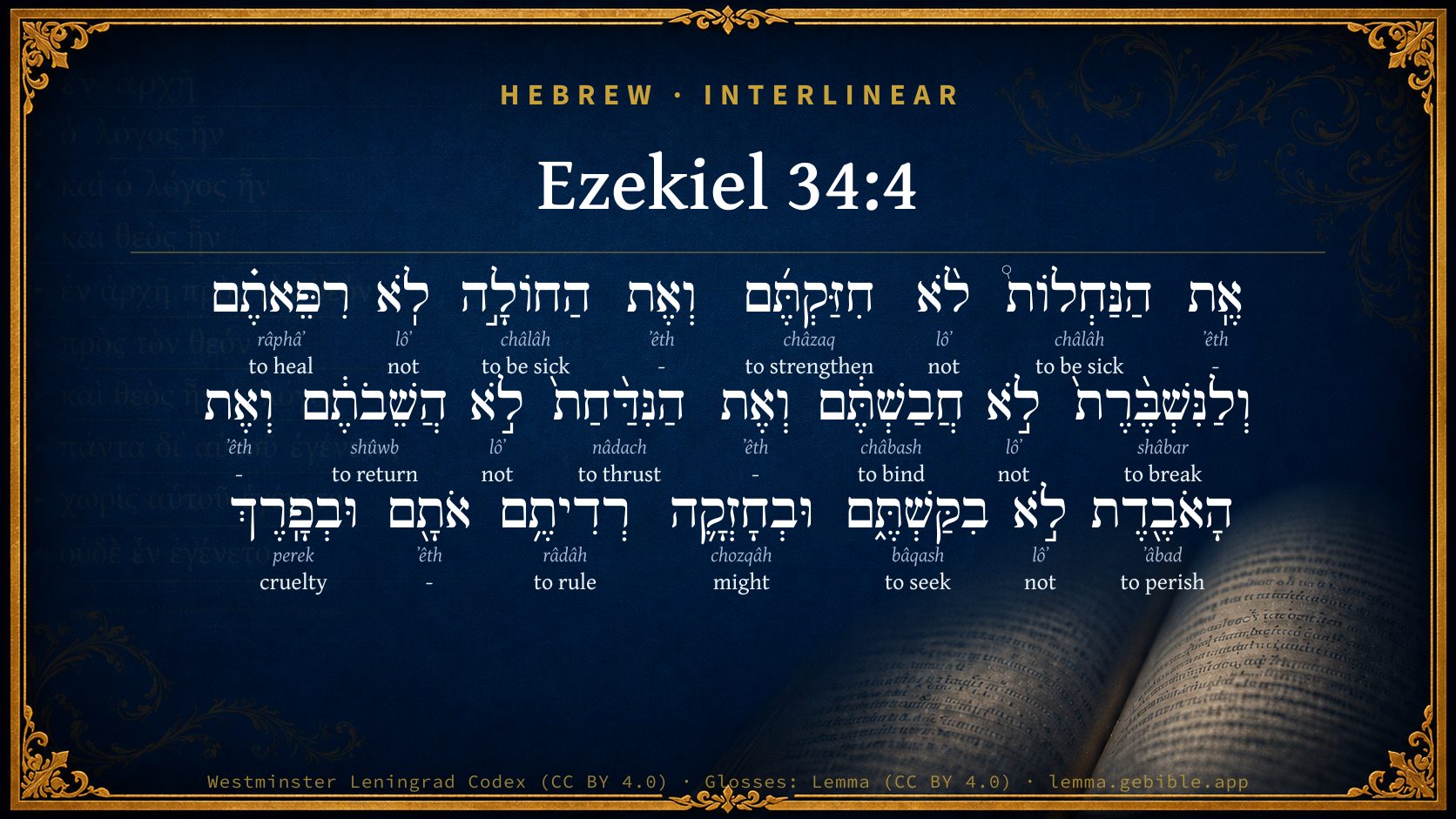
Hebrew (Westminster Leningrad Codex) Ezekiel 34:4 appears in the Hebrew Old Testament. The text above is from the Westminster Leningrad Codex. Each word links to its Strong’s number, a concise gloss, and parsing drawn from the Open Scriptures Hebrew Bible morphology. Click any word for its full Brown-Driver-Briggs (BDB) entry.
Download image
Cite this verse

Ezekiel 34:4 (World English Bible). Public Domain. Lemma interlinear Bible study tool, https://lemma.gebible.app/v/ezekiel/34/4.

Show BibTeX & RIS
BibTeX
RIS
English Translation
You haven't strengthened the diseased, neither have you healed that which was sick, neither have you bound up that which was broken, neither have you brought back that which was driven away, neither have you sought that which was lost; but with force and with rigor have you ruled over them.
World English Bible · Public Domain
Download a study sheet

One document with this verse’s original text, its word-by-word gloss line, the meaning frame, cross-references with their text, attributed commentary, and full source and license credits — printable, and it pastes into notes with its structure intact.

This verse Autodidact and up

Study sheet (.html) Plain text (.txt)

A passage Seminary Student

Up to 50 verses in one chapter. A passage sheet keeps up to 6 commentary sources and 12 cross-references per verse, in the order this page ranks them, and says so on the sheet whenever that leaves anything out. Ask for a single verse and you get the Autodidact verse sheet above.

Everything on this page stays free to read, with no account — the sheet is a download of what is already on screen, not access to it.

Want to remove ads? Support Godless Engineer
Compare translations 3

The same verse in 3 English versions, stacked beneath the original-language interlinear above. Click any original word for its lexicon entry.

Each is an independent rendering of the whole verse — the interlinear is not word-aligned to these translations.

Highlighted words mark where these versions differ — a whole-verse word diff, not a word-by-word alignment.

  • World English Bible Public Domain
    You haven't strengthened the diseased, neither have you healed that which was sick, neither have you bound up that which was broken, neither have you brought back that which was driven away, neither have you sought that which was lost; but with force and with rigor have you ruled over them.
  • King James Version Public Domain
    The diseased have ye not strengthened, neither have ye healed that which was sick, neither have ye bound up that which was broken, neither have ye brought again that which was driven away, neither have ye sought that which was lost; but with force and with cruelty have ye ruled them.
  • unfoldingWord Literal Text CC BY-SA 4.0
    You have not strengthened those who have diseases, nor do you heal the ones who are ill. You do not bind up the ones who are broken, and you do not restore the outcasts or seek the lost. Instead, you rule over them through strength and violence.

unfoldingWord Literal Text — © unfoldingWord, licensed CC BY-SA 4.0. Word-aligned USFM3 via Door43 (git.door43.org/unfoldingWord/en_ult).

Versions to compare (up to 4)

3 of 4 selected

Show all 18 translations

Every available English version of this verse, each an independent rendering of the whole verse.

  • World English Bible Public Domain
    You haven't strengthened the diseased, neither have you healed that which was sick, neither have you bound up that which was broken, neither have you brought back that which was driven away, neither have you sought that which was lost; but with force and with rigor have you ruled over them.
  • Berean Standard Bible Public Domain
    You have not strengthened the weak, healed the sick, bound up the injured, brought back the strays, or searched for the lost. Instead, you have ruled them with violence and cruelty.
  • Majority Standard Bible Public Domain
    You have not strengthened the weak, healed the sick, bound up the injured, brought back the strays, or searched for the lost. Instead, you have ruled them with violence and cruelty.
  • King James Version Public Domain
    The diseased have ye not strengthened, neither have ye healed that which was sick, neither have ye bound up that which was broken, neither have ye brought again that which was driven away, neither have ye sought that which was lost; but with force and with cruelty have ye ruled them.
  • American Standard Version (1901) Public Domain
    The diseased have ye not strengthened, neither have ye healed that which was sick, neither have ye bound up that which was broken, neither have ye brought back that which was driven away, neither have ye sought that which was lost; but with force and with rigor have ye ruled over them.
  • Revised Version (1885) Public Domain
    The diseased have ye not strengthened, neither have ye healed that which was sick, neither have ye bound up that which was broken, neither have ye brought again that which was driven away, neither have ye sought that which was lost; but with force and with rigour have ye ruled over them.
  • Geneva Bible (1599) Public Domain
    The weake haue ye not strengthened: the sicke haue ye not healed, neither haue ye bounde vp the broken, nor brought againe that which was driuen away, neither haue yee sought that which was lost, but with crueltie, and with rigour haue yee ruled them.
  • Douay-Rheims (1899) Public Domain
    The weak you have not strengthened, and that which was sick you have not healed, that which was broken you have not bound up, and that which was driven away you have not brought again, neither have you sought that which was lost: but you ruled over them with rigour, and with a high hand.
  • Young's Literal Translation Public Domain
    The weak ye have not strengthened, And the sick one ye have not healed, And the broken ye have not bound up, And the driven away have not brought back, And the lost ye have not sought, And with might ye have ruled them and with rigour.
  • Literal Standard Version CC BY-SA 4.0
    You have not strengthened the weak, || And you have not healed the sick one, || And you have not bound up the broken, || And have not brought back the driven away, || And you have not sought the lost, || And you have ruled them with might and with rigor.
  • Unlocked Literal Bible CC BY-SA 4.0
    You have not strengthened those who have diseases, nor do you heal the ones who are ill. You do not bind up the ones who are broken, and you do not restore the outcasts or seek the lost. Instead, you rule over them through strength and violence.
  • unfoldingWord Literal Text CC BY-SA 4.0
    You have not strengthened those who have diseases, nor do you heal the ones who are ill. You do not bind up the ones who are broken, and you do not restore the outcasts or seek the lost. Instead, you rule over them through strength and violence.
  • Darby Bible Public Domain
    The weak have ye not strengthened, nor have ye healed the sick, and ye have not bound up [what was] broken, neither have ye brought again that which was driven away, neither have ye sought for that which was lost; but with harshness and with rigour have ye ruled over them.
  • World Messianic Bible Public Domain
    You haven’t strengthened the diseased. You haven’t healed that which was sick. You haven’t bound up that which was broken. You haven’t brought back that which was driven away. You haven’t sought that which was lost, but you have ruled over them with force and with rigor.
  • Webster's Bible Public Domain
    The diseased ye have not strengthened, neither have ye healed that which was sick, neither have ye bound up that which was broken, neither have ye brought again that which was driven away, neither have ye sought that which was lost; but with force and with cruelty have ye ruled them.
  • Free Bible Version CC BY-SA 4.0
    You haven't taken care of the weak, healed the sick, bandaged the injured, brought home the strays, or looked for the lost. On the contrary, you ruled them using violence and cruelty.
  • Bible in Basic English Public Domain
    You have not made the diseased ones strong or made well that which was ill; you have not put bands on the broken or got back that which had been sent away or made search for the wandering ones; and the strong you have been ruling cruelly.
  • JPS Tanakh (1917) Public Domain
    The weak have ye not strengthened, neither have ye healed that which was sick, neither have ye bound up that which was broken, neither have ye brought back that which was driven away, neither have ye sought that which was lost; but with force have ye ruled over them and with rigour.

Literal Standard Version (2020), Covenant Press — licensed CC BY-SA 4.0. Text via the HelloAO Bible API (eBible.org). Unlocked Literal Bible (unfoldingWord) — licensed CC BY-SA 4.0. Text via the HelloAO Bible API (eBible.org). unfoldingWord Literal Text — © unfoldingWord, licensed CC BY-SA 4.0. Word-aligned USFM3 via Door43 (git.door43.org/unfoldingWord/en_ult). Free Bible Version, Dr. Jonathan Gallagher — licensed CC BY-SA 4.0. Text via the HelloAO Bible API (eBible.org).

Word by word

More ways to search: Search by grammar → Find every occurrence → Compare this word →

Practice this passage: Drill this verse → Learn its vocabulary →

וּבְחָזְקָ֛ה
chozqâh
H2394
“and · in/at · might”
Conjunction + Preposition + Noun, Common, Feminine, Singular, Absolute
Part of Speech
Conjunction + Preposition + Noun
Type
Common
Gender
Feminine
Number
Singular
State
Absolute
Full BDB Definition

Origin: from H2392

TWOT: 636d

force, might, strength, violence
  1. אֶֽת ʼêth H853 “-” Particle, Direct Object
  2. הַנַּחְלוֹת֩ châlâh H2470 “the · sick” Particle, Definite Article + Verb, Niphal, Participle Passive, Feminine, Plural, Absolute
  3. לֹ֨א lôʼ H3808 “not” Particle, Negative
  4. חִזַּקְתֶּ֜ם châzaq H2388 “to strengthen” Verb, Piel, Perfect, 2nd Person, Masculine, Plural
  5. וְאֶת ʼêth H853 “and · -” Conjunction + Particle, Direct Object
  6. הַחוֹלָ֣ה châlâh H2470 “the · being sick” Particle, Definite Article + Verb, Qal, Participle Active, Feminine, Singular, Absolute
  7. לֹֽא lôʼ H3808 “not” Particle, Negative
  8. רִפֵּאתֶ֗ם râphâʼ H7495 “to heal” Verb, Piel, Perfect, 2nd Person, Masculine, Plural
  9. וְלַנִּשְׁבֶּ֨רֶת֙ shâbar H7665 “and · to/for the · broken” Conjunction + Preposition, Determined + Verb, Niphal, Participle Passive, Feminine, Singular, Absolute
  10. לֹ֣א lôʼ H3808 “not” Particle, Negative
  11. חֲבַשְׁתֶּ֔ם châbash H2280 “to bind” Verb, Qal, Perfect, 2nd Person, Masculine, Plural
  12. וְאֶת ʼêth H853 “and · -” Conjunction + Particle, Direct Object
  13. הַנִּדַּ֨חַת֙ nâdach H5080 “the · thrust” Particle, Definite Article + Verb, Niphal, Participle Passive, Feminine, Singular, Absolute
  14. לֹ֣א lôʼ H3808 “not” Particle, Negative
  15. הֲשֵׁבֹתֶ֔ם shûwb H7725 “to return” Verb, Hiphil, Perfect, 2nd Person, Masculine, Plural
  16. וְאֶת ʼêth H853 “and · -” Conjunction + Particle, Direct Object
  17. הָאֹבֶ֖דֶת ʼâbad H6 “the · perishing” Particle, Definite Article + Verb, Qal, Participle Active, Feminine, Singular, Absolute
  18. לֹ֣א lôʼ H3808 “not” Particle, Negative
  19. בִקַּשְׁתֶּ֑ם bâqash H1245 “to seek” Verb, Piel, Perfect, 2nd Person, Masculine, Plural
  20. רְדִיתֶ֥ם râdâh H7287 “to rule” Verb, Qal, Perfect, 2nd Person, Masculine, Plural
  21. אֹתָ֖ם ʼêth H853 “- · them” Particle, Direct Object + Suffix, Personal, 3rd Person, Masculine, Plural
  22. וּבְפָֽרֶךְ perek H6531 “and · in/at · cruelty” Conjunction + Preposition + Noun, Common, Masculine, Singular, Absolute

About this verse

These counts appear in no published source. They are computed here, from the morphology-tagged text and Lemma’s own curated glosses. What Lemma adds →

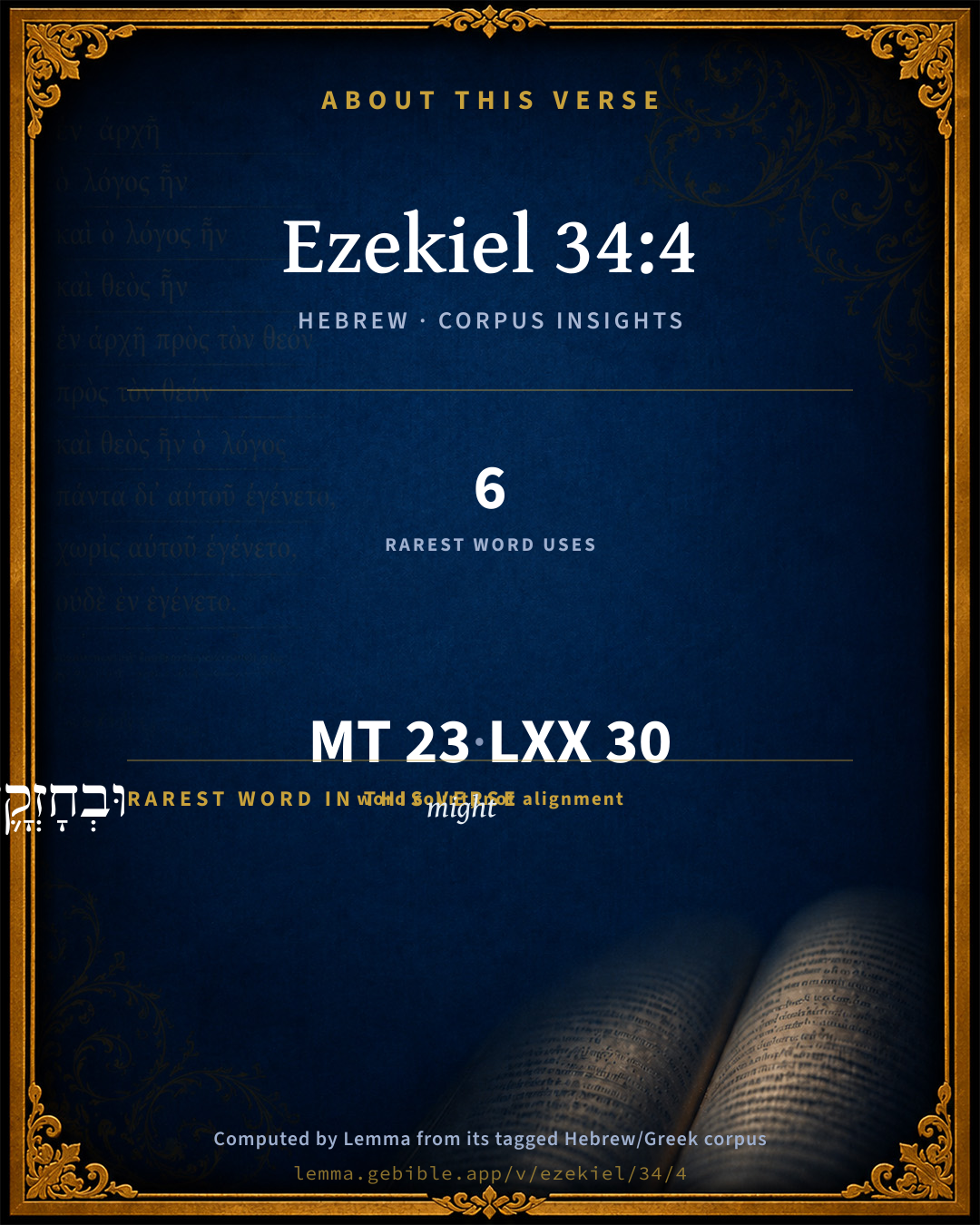
23
words
14
distinct lemmas
Prophets
section

Notable vocabulary

The rarest word here is וּבְחָזְקָ֛ה might H2394 — appearing just 6 times in the whole Hebrew Bible.

Shared distinctive vocabulary

וּבְחָזְקָ֛ה might H2394 occurs in 6 verses of the Hebrew Bible. Also found in:

Grammatical profile

  • 11 verbs
  • 2 nouns
  • 10 particles

Verb forms

  • הַנַּחְלוֹת֩ Niphal · Participle Passive
  • חִזַּקְתֶּ֜ם Piel · Perfect
  • הַחוֹלָ֣ה Qal · Participle Active
  • רִפֵּאתֶ֗ם Piel · Perfect
  • וְלַנִּשְׁבֶּ֨רֶת֙ Niphal · Participle Passive
  • חֲבַשְׁתֶּ֔ם Qal · Perfect
  • הַנִּדַּ֨חַת֙ Niphal · Participle Passive
  • הֲשֵׁבֹתֶ֔ם Hiphil · Perfect
  • הָאֹבֶ֖דֶת Qal · Participle Active
  • בִקַּשְׁתֶּ֑ם Piel · Perfect
  • רְדִיתֶ֥ם Qal · Perfect

Repetition

Words recur within this verse — often emphatic in Hebrew:

  • הַנַּחְלוֹת֩ to be sick H2470 ×2
  • לֹ֨א not H3808 ×5

Hebrew & Septuagint length

In English translation the verse runs 51 words from the Hebrew and 46 from the Septuagint (LXX English) — closely comparable.

A rough comparison of the two English renderings, which tokenize alike — not a word-level alignment.

Word counts can differ between the Hebrew and the Greek without any difference in meaning — e.g. the Hebrew direct-object marker אֵת has no separate Greek word, and Greek often adds the article ὁ.

In the original languages it is 23 Hebrew tokens and 30 Greek tokens — but the two are counted differently (Hebrew bundles its prefixes and suffixes into one token; the Greek is in lemma form), so that isn’t a like-for-like length.

Cross-references

18

Topical passages linked to Ezekiel 34:4 in the Treasury of Scripture Knowledge — connected by theme and wording, ordered by reader-vote popularity; previews shown in the World English Bible.

  • Matthew 18:12–13 "What do you think? If a man has one hundred sheep, and one of them goes astray, doesn't he leave the ninety-nine, go to the mountains, and seek that which has gone astray?
  • Ezekiel 34:16 I will seek that which was lost, and will bring back that which was driven away, and will bind up that which was broken, and will strengthen that which was sick: but the fat and the strong I will destroy; I will feed them in justice.
  • Matthew 9:36 But when he saw the multitudes, he was moved with compassion for them, because they were harassed and scattered, like sheep without a shepherd.
  • Matthew 10:6 Rather, go to the lost sheep of the house of Israel.
  • Zechariah 11:15–16 Yahweh said to me, "Take for yourself yet again the equipment of a foolish shepherd.
  • 1 Peter 5:2–3 Shepherd the flock of God which is among you, exercising the oversight, not under compulsion, but voluntarily, not for dishonest gain, but willingly;
  • Exodus 1:13–14 The Egyptians ruthlessly made the children of Israel serve,
  • Hebrews 12:12 Therefore, lift up the hands that hang down and the feeble knees,
  • Jeremiah 8:22 Is there no balm in Gilead? is there no physician there? why then isn't the health of the daughter of my people recovered?
  • Revelation 17:5–6 And on her forehead a name was written, "MYSTERY, BABYLON THE GREAT, THE MOTHER OF THE PROSTITUTES AND OF THE ABOMINATIONS OF THE EARTH."
  • Isaiah 56:10 His watchmen are blind, they are all without knowledge; they are all mute dogs, they can't bark; dreaming, lying down, loving to slumber.
  • Matthew 24:49 and begins to beat his fellow-servants, and eat and drink with the drunken,
  • 2 Corinthians 1:24 Not that we have lordship over your faith, but are fellow workers with you for your joy. For you stand firm in faith.
  • James 5:1–6 Come now, you rich, weep and howl for your miseries that are coming on you.
  • Revelation 13:14–17 He deceives my own people who dwell on the earth because of the signs he was granted to do in front of the beast; saying to those who dwell on the earth, that they should make an image to the beast who had the sword wound and lived.
  • Jeremiah 22:13 Woe to him who builds his house by unrighteousness, and his chambers by injustice; who uses his neighbor's service without wages, and doesn't give him his hire;
  • Matthew 21:35 The farmers took his servants, beat one, killed another, and stoned another.
  • Luke 15:4–6 "Which of you men, if you had one hundred sheep, and lost one of them, wouldn't leave the ninety-nine in the wilderness, and go after the one that was lost, until he found it?

Cross-references courtesy of OpenBible.info (CC BY 4.0).

Hebrew and Greek witnesses Masoretic Hebrew ↔ Greek Septuagint

The same verse in the two great witnesses to the Old Testament, shown verse-for-verse.

These are two independent witnesses, not word-aligned to each other, and the Septuagint is shown in lemma (dictionary) form.

Hebrew Ezekiel 34:4 Masoretic · Westminster Leningrad Codex

אֶֽת הַנַּחְלוֹת֩ לֹ֨א חִזַּקְתֶּ֜ם וְאֶת הַחוֹלָ֣ה לֹֽא רִפֵּאתֶ֗ם וְלַנִּשְׁבֶּ֨רֶת֙ לֹ֣א חֲבַשְׁתֶּ֔ם וְאֶת הַנִּדַּ֨חַת֙ לֹ֣א הֲשֵׁבֹתֶ֔ם וְאֶת הָאֹבֶ֖דֶת לֹ֣א בִקַּשְׁתֶּ֑ם וּבְחָזְקָ֛ה רְדִיתֶ֥ם אֹתָ֖ם וּבְפָֽרֶךְ

You haven't strengthened the diseased, neither have you healed that which was sick, neither have you bound up that which was broken, neither have you brought back that which was driven away, neither have you sought that which was lost; but with force and with rigor have you ruled over them.

World English Bible · Public Domain

Greek LXX Ezekiel 34:4 Septuagint · lemma form

ὁ ἀσθενέω οὐ ἐνἰσχύω καί ὁ κακῶς ἔχω οὐ σωματοποιέω καί ὁ συντρίβω οὐ καταδέω καί ὁ πλανάω οὐ ἐπιστρέφω καί ὁ ἀποὀλλύω οὐ ζητέω καί ὁ ἰσχυρός καταἐργάζομαι μόχθος

The weak one you⌃ have not strengthened, and the sick you⌃ have not cherished, and the bruised you⌃ have not bound up, and the stray one you⌃ have not turned back, and the lost you⌃ have not sought; and the strong you⌃ have wearied with labor.

LXX2012 (modern English Septuagint) · Public Domain

Hebrew: Westminster Leningrad Codex (CC BY 4.0). Greek: Septuagint (public domain); English from LXX2012 (modern English Septuagint) (Public Domain). How the Septuagint differs from the Hebrew →

Targum (Aramaic paraphrase)

1

The Targum is the ancient Jewish Aramaic paraphrase of the Hebrew Scriptures — an interpretive translation, not the Hebrew text itself. Onkelos (literal) and Pseudo-Jonathan (expansive) render the Torah, and Jonathan the Prophets. Coverage is partial: where no permissively-licensed English translation exists for a verse, only the Aramaic is shown. This is verse-level text, not a word-by-word alignment to the Hebrew.

  1. Targum Jonathan Prophets (Joshua–Malachi)
    יַת כְּאֵיבַיָא לָא תַקֵיפְתּוּן וְלִמְרִיעַיָא לָא אֲסֵיתוּן וְלִתְבִירַיָא לָא צְמַדְתּוּן וְיַת דְאִיטַלְטַלוּ לָא אֲתֵיבְתּוּן וְיַת דַאֲבַדוּ לָא בְעִיתוּן וּבְתוּקְפָא פְלַחְתּוּן בְּהוֹן וּבְקַשְׁיוּ:

    (no public-domain English translation for this verse)

    Targum Jonathan — Aramaic: “Mikraot Gedolot” (public domain). English: “Sefaria Community Translation” (CC0 1.0 (public-domain dedication)); “London "Chaldee Paraphrase," 1871” (public domain). Text via Sefaria.

Commentary

Notes on Ezekiel 34:4 from classic Christian and Jewish commentators (each source and its license shown beneath its notes). The classic Christian expositions comment on the surrounding passage and are grouped to its opening verse, so a note may address several verses; the Jewish commentaries on the Tanakh (Rashi and others) are per-verse, so they appear only where the commentator wrote on this verse.

Lemma curates 59 commentaries, every one of them public domain or Creative Commons licensed, each selected and text-cleaned for this edition rather than reprinted as found. About our sources →

Trapp's Complete Commentary

John Trapp

Eze 34:4 The diseased have ye not strengthened, neither have ye healed that which was sick, neither have ye bound up [that which was] broken, neither have ye brought again that which was driven away, neither have ye sought that which was lost; but with force and with cruelty have ye ruled them.

Ver. 4. The diseased have ye not strengthened.] Five sorts of sheep are here reckoned up that needed the shepherd’s best care and cure, but nothing was done; or, if anything, it was overdone, for with force and cruelty they ruled over them. See 1Pe 5:3.

John Trapp, A Commentary or Exposition upon All the Books of the Old and New Testament (1647–1656) — public domain. Text from a community e-Sword module.

Geneva Bible (1599)

Geneva Bible translators

He describeth the office and duty of a good pastor, who ought to love and succor his flock, and not to be cruel toward them.

Geneva Bible (1599) marginal notes — public domain. Text via Bolls.life.

Jamieson, Fausset & Brown

Robert Jamieson, A. R. Fausset & David Brown

The diseased--rather, those weak from the effects of "disease," as "strengthened" (that is, with due nourishment) requires [GROTIUS].

broken--that is, fractures from wounds inflicted by the wolf.

brought again . . . driven away-- (Exo 23:4). Those "driven away" by the enemy into foreign lands through God's judgments are meant (Jer 23:3). A spiritual reformation of the state by the rulers would have turned away God's wrath, and "brought again" the exiles. The rulers are censured as chiefly guilty (though the people, too, were guilty), because they, who ought to have been foremost in checking the evil, promoted it.

neither . . . sought . . . lost--Contrast the Good Shepherd's love (Luk 15:4).

with force . . . ruled-- (Exo 1:13-14). With an Egyptian bondage. The very thing forbidden by the law they did (Lev 25:43; compare Pe1 5:3).

Jamieson, Fausset & Brown — Commentary Critical and Explanatory on the Whole Bible (1871) — public domain (CC PDM 1.0). Text via the HelloAO Bible API.

Adam Clarke's Commentary

Verse 4. The diseased have ye not strengthened] No person is fit for the office of a shepherd, who does not well understand the diseases to which sheep are incident, and the mode of cure. And is any man fit for the pastoral office, or to be a shepherd of souls, who is not well acquainted with the disease of sin in all its varieties, and the remedy for this disease, and the proper mode of administering it, in those various cases? He who does not know Jesus Christ as his own Saviour, never can recommend him to others. He who is not saved, will not save.

Neither have ye healed that which was sick] The prophet first speaks of the general disease; next, of the different kinds of spiritual infirmity.

Neither have ye bound up that which was broken] If a sheep have broken a leg, a proper shepherd knows how to set the bones, and splint and bind it till the bones knit and become strong. And the skilful spiritual pastor knows, if one of the flock be overtaken in a fault, how to restore such. Those sudden falls, where there was not a strong propensity to sin, are, to the soul, as a broken bone to the body.

Neither have ye brought again] A proper shepherd loves his sheep: he feels interested for their welfare; he acquaints himself with them all, so that he knows and can distinguish each. He knows also their number, and frequently counts to see that none is missing; if one be lost or strayed, he goes immediately and seeks it; and as he is constantly on the watch, it cannot have strayed far before he is apprised of its absence from the flock; and the less it has strayed, the sooner it is found and brought back to the fold.

The shepherds of Israel knew nothing about their flock; they might have been diseased, infirm, bruised, maimed, their limbs broken, strayed, and lost; for they watched not over them. When they got fat sheep and wool for their table and their clothing, they regarded nothing else; as they considered the flock given them for their own use, and scarcely ever supposed that they were to give any thing in return for the milk and the wool.

But with force and with cruelty] Exacting tithes and dues by the strong arm of the law, with the most ungodly feeling; and with a cruelty of disposition that proved it was the fat and the wool they sought, and not the safety or comfort of the flock.

Adam Clarke's Commentary on the Bible (1810–1826) — public domain. Text from a community e-Sword/MySword module.

The Cambridge Bible for Schools and Colleges

gen. ed. J. J. S. Perowne

4. Five classes are here mentioned, in Eze_34:16 only four, the “diseased” being wanting, and “strengthen” used here of the diseased is said there of the sick. The “broken” is the hurt or bruised; the “lost” that which has wandered away of itself, in distinction from that “driven away” by violence.

The Cambridge Bible for Schools and Colleges (gen. ed. J. J. S. Perowne; Cambridge University Press, 1878–1918) — public domain. Text from a community e-Sword module.

John Gill's Exposition

The diseased have ye not strengthened,.... Such, in the civil polity, who were poor, and in necessitous circumstances, were not relieved; such who were injured and oppressed by others were not vindicated; and such as were forced to flee to other countries, or were carried captive, no care was taken, or methods used, to ransom them, and, bring them back; all which may be meant by this and the following metaphors, taken from the evil things that befall a flock of sheep: and such who were weak through spiritual diseases, their prophets and teachers took no care to cure them of their diseases, and to strengthen these feeble minded ones with divine cordials and spiritual food, and confirm them in the faith:

neither have ye healed that which was sick; by directing them to the great Physician of souls, and to his precious blood for healing and pardon of sin:

neither have ye bound up that which was broken; whose consciences were wounded, and hearts broken, with a sense of sin; or who had fallen to the breaking of their bones, and should be restored in a spirit of meekness and dealt gently with, as surgeons do in setting and binding up broken bones:

neither have ye brought again that which was driven away; or, "was gone astray" (r); being seduced by false teachers; and yet, though it was known they were, no care nor pains were taken to reclaim and restore them:

neither have ye sought that which was lost; that wandered of their own accord, and perished for want of knowledge, and were lost for lack of a guide to direct them, and no one would do this good office to them:

but with force and with cruelty have ye ruled them; in an arbitrary and tyrannical way, lording it over God, s heritage, Pe1 5:3.

(r) "vagam aut errantem", Bochartus, and some in Vatablus.

John Gill's Exposition of the Whole Bible (1746–1763) — public domain (CC PDM 1.0). Text via the HelloAO Bible API.

Haydock's Catholic Bible Commentary

Healed. God alone can restore to life. But pastors will not be excused by ignorance if they know not the maladies and the remedies of their flock. --- Hand. This was blamed in the Pharisees, and is contrary to the spirit of the gospel, Matthew xxiii. 4., and 1 Peter v. 2.

George Leo Haydock (1774–1849), Haydock's Catholic Family Bible and Commentary, 1859 edition — public domain. Excludes Psalms (Douay-Rheims chapter numbering differs from Protestant) and Deuterocanonical books (Catholic canon only).

Matthew Poole's English Annotations

The weak and languishing, ( such there are in the church and state,) with your hand, countenance, and counsel; so these metaphorical shepherds should as the other strengthen their sheep, with carrying them into good and quiet pastures. The sheep in our pastures are subject to many sicknesses, the sheep in church and state to more, and shepherds in both should be as physicians to heal them; but here these did not so. Sometimes violent and ravenous beasts break their bones, sometimes the stronger and fatter sheep bruise or break them, these should the shepherds bind up; violent oppressors in the state and in the church broke many of them, but these shepherds bound them not up. Sheep are often driven out of the pasture, frighted, hunted, and pursued by dogs, or other mischievous creatures; these the shepherd should find out, and bring back: in church and state there were many such, frighted and driven by fierce men like dogs running upon them, but the Jewish rulers took no care to inquire for them, or to bring them back to their own. country. Sheep wander and lose themselves, shepherds should seek such and bring them home; many political sheep among the Jews wandered from their country, their king, religion, and God, and these careless rulers never sought them, but ruled them with hard hand, that held fast all that should look like royal power and privilege, and rigorously executed all their grievous laws and edicts. With cruelty, such as the Egyptians used toward the Jews, Exo 1:13,14; instead of acting like shepherds, these tyrants in the Jewish polity acted like merciless butchers in church and state.

Matthew Poole's English Annotations on the Holy Bible (1683–1685) — public domain. Text from a community e-Sword/MySword module.

The Pulpit Commentary

The diseased have ye not strengthened. The verbs indicate the difference between the "diseased," i.e. the weak sheep (comp. Isa_40:11; Psa_78:71) and the sick, that were suffering from more definite maladies. So the broken are the sheep that have fallen from a rock and thus maimed themselves. Each case required its appropriate treatment, and none had met with it.

The Pulpit Commentary (1880–1919), ed. H.D.M. Spence-Jones & Joseph S. Exell — public domain. Text from a community e-Sword module.

John Wesley's Explanatory Notes

The diseased - The weak and languishing. Bound up - Oppressors in the state, or church, broke many then, but these shepherds bound them not up.

John Wesley, Explanatory Notes Upon the Whole Bible (1754–1765) — public domain. Text via the GEBible commentary corpus.

unfoldingWord translationNotes

Door43 World Missions Community

General Information:

Yahweh continues giving Ezekiel his message to the leaders of Israel.

General Information:

Yahweh continues speaking of the people of Israel as if they were a flock of sheep and the leaders of Israel as if they were shepherds who have not cared for the flock. (See: Metaphor)

have diseases

Possible meanings are 1) "are sick" or 2) "are weak"

You do not bind up the ones who are broken

"You do not wrap cloth around the broken bones of those who are wounded"

the ones who are broken

"the sheep that have broken bones" or "the sheep that are injured"

you do not restore

"you do not bring back"

the outcasts

"the sheep that have been chased away" or "those that others have chased away"

the lost

The words "the sheep or goats" are left out of this phrase, but they are intended to be understood. AT: "the sheep or goats that are lost" (See: Ellipsis)

through strength and violence

"forcefully and cruelly"

Then they were scattered without a shepherd

This can be stated in active form. AT: "Then they scattered because they did not have a shepherd" (See: Active or Passive)

they became food for all the living beasts in the fields

"all of the wild animals could attack and eat them"

it is dispersed over the entire surface of the earth

"my flock is spread out all over the earth"

translationWords

cure

restore

disperse

unfoldingWord translationNotes — © Distant Shores Media and the Door43 World Missions Community, licensed CC BY-SA 4.0. Source: git.door43.org/Door43/en_tn.

Rashi

Rabbi Shlomo Yitzchaki (Rashi)

The frail [Heb. הַנַחְלוֹת,] those emaciated without strength, maigre in French, lean, which need strengthening, to support them with the hand.

you did not bind to bind the fragments of the bone, one with the other, as is the practice of the physicians.

those astray who strayed from the midst of the flock, to the outside.

you chastised [Heb. רְדִיתֶם,] chastised.

Rashi on the Tanakh — English translations: “The Judaica Press complete Tanach with Rashi, translated by A. J. Rosenberg” (CC BY 4.0); “Pentateuch with Rashi's commentary by M. Rosenbaum and A.M. Silbermann, 1929-1934” (public domain); “The Metsudah Tanach series, Lakewood, N.J” (CC BY 4.0); and “The Book of Joshua, Metsudah Publications, 1997” (CC BY 4.0). Text via Sefaria.

Lesson kit

Teaching starters — assembled from the data on this page, not authored interpretation. Every prompt links to the verse data it draws on. Edit before teaching.

Ezekiel, in the Prophets, opens this verse with 23 words (14 distinct Hebrew lemmas). Its most distinctive word is chozqâh (“might”). A historical commentator’s framing appears above. Read the whole chapter for the surrounding context.

Discussion questions

  1. What does “might” (chozqâh) contribute to the verse as a whole?
  2. Judges 4:3 shares the word «might» with this verse. How do the two illuminate each other?
  3. “to be sick” occurs 2× in this one verse. What is the effect of the repetition?
  4. These translations render this verse differently. What is at stake in choosing one wording over another?
  5. The verb «הַנַּחְלוֹת֩» is Niphal Participle Passive. How does its form color the action?
  6. Reading how Trapp's Complete Commentary and Geneva Bible (1599) read this verse, where do the two commentators agree and where do they part?

Things to notice

Reading settings

Reading text

Shown beneath each verse's original-language words.

Old Testament
Old Testament edition

Read the OT as the Masoretic Hebrew (MT) or the Greek Septuagint (LXX).

English shown for the Greek Septuagint (in the Hebrew ↔ Greek comparison).

Comparing translations? Open the Compare panel on any verse page to stack up to four side by side.