
Job 33:25

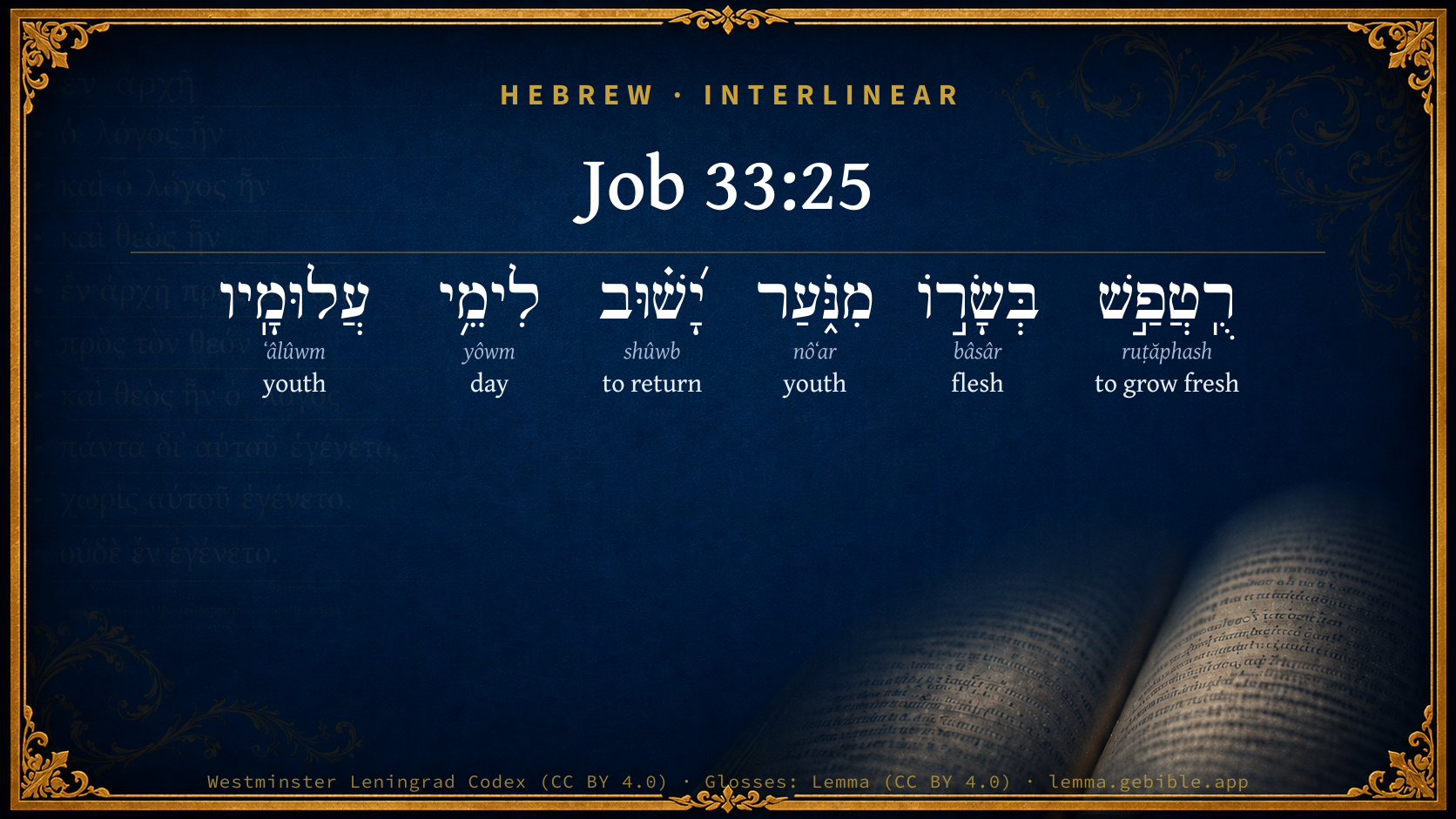
Hebrew (Westminster Leningrad Codex) Job 33:25 appears in the Hebrew Old Testament. The text above is from the Westminster Leningrad Codex. Each word links to its Strong’s number, a concise gloss, and parsing drawn from the Open Scriptures Hebrew Bible morphology. Click any word for its full Brown-Driver-Briggs (BDB) entry.
Download image
Cite this verse

Job 33:25 (World English Bible). Public Domain. Lemma interlinear Bible study tool, https://lemma.gebible.app/v/job/33/25.

Show BibTeX & RIS
BibTeX
RIS
English Translation
His flesh shall be fresher than a child's; He returns to the days of his youth.
World English Bible · Public Domain
Highlights Full analysis ↓
Download a study sheet

One document with this verse’s original text, its word-by-word gloss line, the meaning frame, cross-references with their text, attributed commentary, and full source and license credits — printable, and it pastes into notes with its structure intact.

This verse Autodidact and up

Study sheet (.html) Plain text (.txt)

A passage Seminary Student

Up to 50 verses in one chapter. A passage sheet keeps up to 6 commentary sources and 12 cross-references per verse, in the order this page ranks them, and says so on the sheet whenever that leaves anything out. Ask for a single verse and you get the Autodidact verse sheet above.

Everything on this page stays free to read, with no account — the sheet is a download of what is already on screen, not access to it.

Want to remove ads? Support Godless Engineer
Compare translations 3

The same verse in 3 English versions, stacked beneath the original-language interlinear above. Click any original word for its lexicon entry.

Each is an independent rendering of the whole verse — the interlinear is not word-aligned to these translations.

Highlighted words mark where these versions differ — a whole-verse word diff, not a word-by-word alignment.

  • World English Bible Public Domain
    His flesh shall be fresher than a child's; He returns to the days of his youth.
  • King James Version Public Domain
    His flesh shall be fresher than a child's: he shall return to the days of his youth:
  • unfoldingWord Literal Text CC BY-SA 4.0
    his flesh becomes fresher than childhood; it returns to the days of his youth.

unfoldingWord Literal Text — © unfoldingWord, licensed CC BY-SA 4.0. Word-aligned USFM3 via Door43 (git.door43.org/unfoldingWord/en_ult).

Versions to compare (up to 4)

3 of 4 selected

Show all 18 translations

Every available English version of this verse, each an independent rendering of the whole verse.

  • World English Bible Public Domain
    His flesh shall be fresher than a child's; He returns to the days of his youth.
  • Berean Standard Bible Public Domain
    then his flesh is refreshed like a child’s; he returns to the days of his youth.
  • Majority Standard Bible Public Domain
    then his flesh is refreshed like a child’s; he returns to the days of his youth.
  • King James Version Public Domain
    His flesh shall be fresher than a child's: he shall return to the days of his youth:
  • American Standard Version (1901) Public Domain
    His flesh shall be fresher than a child's; He returneth to the days of his youth.
  • Revised Version (1885) Public Domain
    His flesh shall be fresher than a child’s; he returneth to the days of his youth:
  • Geneva Bible (1599) Public Domain
    Then shall his flesh be as fresh as a childes, and shall returne as in the dayes of his youth.
  • Douay-Rheims (1899) Public Domain
    His flesh is consumed with punishment, let him return to the days of his youth.
  • Young's Literal Translation Public Domain
    Fresher `is' his flesh than a child's, He returneth to the days of his youth.
  • Literal Standard Version CC BY-SA 4.0
    Fresher [is] his flesh than a child’s, || He returns to the days of his youth.
  • Unlocked Literal Bible CC BY-SA 4.0
    then his flesh will become fresher than a child's; he will return to the days of his youthful strength.
  • unfoldingWord Literal Text CC BY-SA 4.0
    his flesh becomes fresher than childhood; it returns to the days of his youth.
  • Darby Bible Public Domain
    His flesh shall be fresher than in childhood; he shall return to the days of his youth.
  • World Messianic Bible Public Domain
    His flesh will be fresher than a child’s. He returns to the days of his youth.
  • Webster's Bible Public Domain
    His flesh shall be fresher than a child's: he will return to the days of his youth:
  • Free Bible Version CC BY-SA 4.0
    Then their bodies will be renewed as if they were young again; they will be as strong as when they were in their prime.
  • Bible in Basic English Public Domain
    Then his flesh becomes young again, and he comes back to the days of his early strength;
  • JPS Tanakh (1917) Public Domain
    His flesh is tenderer than a child's; he returneth to the days of his youth;

Literal Standard Version (2020), Covenant Press — licensed CC BY-SA 4.0. Text via the HelloAO Bible API (eBible.org). Unlocked Literal Bible (unfoldingWord) — licensed CC BY-SA 4.0. Text via the HelloAO Bible API (eBible.org). unfoldingWord Literal Text — © unfoldingWord, licensed CC BY-SA 4.0. Word-aligned USFM3 via Door43 (git.door43.org/unfoldingWord/en_ult). Free Bible Version, Dr. Jonathan Gallagher — licensed CC BY-SA 4.0. Text via the HelloAO Bible API (eBible.org).

Word by word

More ways to search: Search by grammar → Find every occurrence → Compare this word →

Practice this passage: Drill this verse → Learn its vocabulary →

About this verse

These counts appear in no published source. They are computed here, from the morphology-tagged text and Lemma’s own curated glosses. What Lemma adds →

6
words
6
distinct lemmas
Wisdom
section

Notable vocabulary

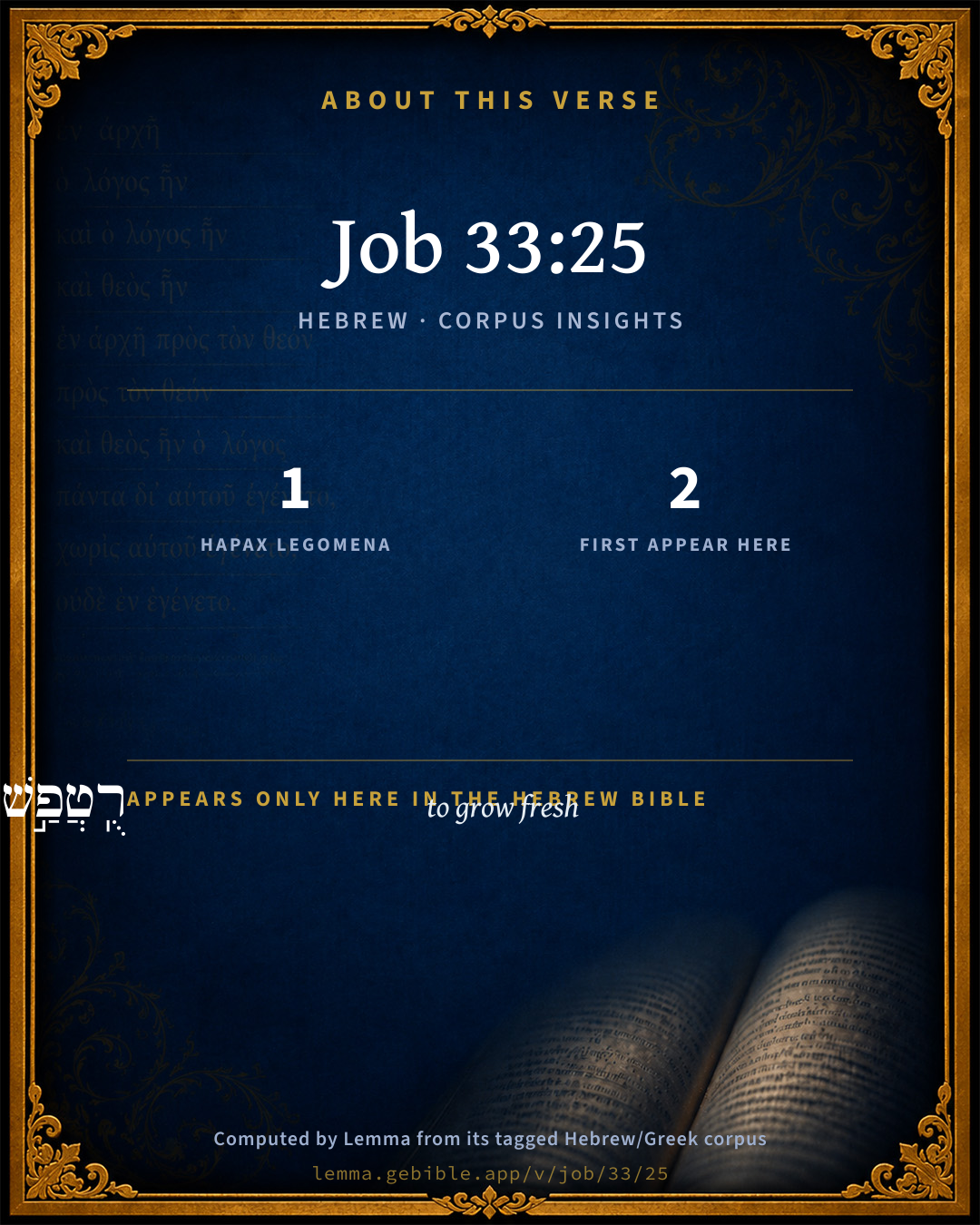
1 hapax legomenon — a word that appears only here in the entire Hebrew Bible:

  • רֻֽטֲפַ֣שׁ to grow fresh H7375

First appearance in Scripture

These words make their first canonical appearance in the Hebrew Bible here:

  • רֻֽטֲפַ֣שׁ to grow fresh H7375
  • מִנֹּ֑עַר youth H5290

Shared distinctive vocabulary

מִנֹּ֑עַר youth H5290 occurs in 4 verses of the Hebrew Bible. Also found in:

Grammatical profile

  • 2 verbs
  • 4 nouns

Verb forms

  • רֻֽטֲפַ֣שׁ Qal Passive · Perfect
  • יָ֝שׁ֗וּב Qal · Imperfect

Hebrew & Septuagint length

In English translation the verse runs 16 words from the Hebrew and 23 from the Septuagint (LXX English) — the Septuagint runs noticeably longer here. See the side-by-side →

A rough comparison of the two English renderings, which tokenize alike — not a word-level alignment.

Word counts can differ between the Hebrew and the Greek without any difference in meaning — e.g. the Hebrew direct-object marker אֵת has no separate Greek word, and Greek often adds the article ὁ.

Cross-references

6

Topical passages linked to Job 33:25 in the Treasury of Scripture Knowledge — connected by theme and wording, ordered by reader-vote popularity; previews shown in the World English Bible.

  • Psalms 103:5 Who satisfies your desire with good things, So that your youth is renewed like the eagle's.
  • 2 Kings 5:14 Then went he down, and dipped [himself] seven times in the Jordan, according to the saying of the man of God; and his flesh came again like the flesh of a little child, and he was clean.
  • Joshua 14:10–11 Now, behold, Yahweh has kept me alive, as he spoke, these forty-five years, from the time that Yahweh spoke this word to Moses, while Israel walked in the wilderness: and now, behold, I am this day eighty-five years old.
  • Deuteronomy 34:7 Moses was one hundred twenty years old when he died: his eye was not dim, nor his natural force abated.
  • Job 42:16 After this Job lived one hundred forty years, and saw his sons, and his sons' sons, to four generations.
  • Hosea 2:15 I will give her vineyards from there, And the valley of Achor for a door of hope; And she will respond there, As in the days of her youth, And as in the day when she came up out of the land of Egypt.

Cross-references courtesy of OpenBible.info (CC BY 4.0).

Hebrew and Greek witnesses Masoretic Hebrew ↔ Greek Septuagint

The same verse in the two great witnesses to the Old Testament, shown verse-for-verse.

Here the Septuagint runs noticeably longer than the Hebrew — LXX2012 (modern English Septuagint) 23 words vs World English Bible 16. A rough length comparison of the two English translations, not a word-level alignment — read both below.

These are two independent witnesses, not word-aligned to each other, and the Septuagint is shown in lemma (dictionary) form.

Hebrew Job 33:25 Masoretic · Westminster Leningrad Codex

רֻֽטֲפַ֣שׁ בְּשָׂר֣וֹ מִנֹּ֑עַר יָ֝שׁ֗וּב לִימֵ֥י עֲלוּמָֽיו

His flesh shall be fresher than a child's; He returns to the days of his youth.

World English Bible · Public Domain

Greek LXX Job 33:25 Septuagint · lemma form

ἁπαλύνω δέ αὐτός ὁ σάρξ ὥσπερ νήπιος ἀπο καταἵστημι δέ αὐτός ἀνδρόω ἐν ἄνθρωπος

And he will make his flesh tender as that of a babe, and he will restore him among men in his full strength.

LXX2012 (modern English Septuagint) · Public Domain

On this verse, Keil & Delitzsch discusses the Septuagint’s reading. Read the note in Commentary ↓

Hebrew: Westminster Leningrad Codex (CC BY 4.0). Greek: Septuagint (public domain); English from LXX2012 (modern English Septuagint) (Public Domain). How the Septuagint differs from the Hebrew →

Commentary

Notes on Job 33:25 from classic Christian and Jewish commentators (each source and its license shown beneath its notes). The classic Christian expositions comment on the surrounding passage and are grouped to its opening verse, so a note may address several verses; the Jewish commentaries on the Tanakh (Rashi and others) are per-verse, so they appear only where the commentator wrote on this verse.

Lemma curates 59 commentaries, every one of them public domain or Creative Commons licensed, each selected and text-cleaned for this edition rather than reprinted as found. About our sources →

Trapp's Complete Commentary

John Trapp

Job 33:25 His flesh shall be fresher than a child’s: he shall return to the days of his youth:

Ver. 25. His flesh shall be fresher than a child’s] Tender and smooth, full of good blood and fresh spirits, he shall be battle and blithe like a suckling. See a like hyperbole concerning Naaman the Syrian restored to health, 2Ki 5:14, implying that his disease was thoroughly cured, and his flesh in better case than ever. There is a memorable story in the Acts and Monuments of the Church, which here may not unfitly be inserted, to show the sweet fruits of remission of sins by the free mercy of God. In the dungeon with Petrus Bergerius at Lyons, in France, was a certain thief and malefactor, who had lain in the dungeon for seven or eight months. This thief, for pain and torment, cried out for God, and cursed his parents that begat him, being almost eaten up with lice, miserably handled, and fed with such bread as dogs and horses had refused to eat. So it pleased the goodness of the Almighty, that through the teaching and prayer of this Bergerius, he was brought to repentance and the knowledge of God, learning much comfort and patience by the word of the gospel preached unto him. Touching his conversion, himself wrote a sweet letter to some friends, declaring therein that the next day after he had taken hold of the gospel, and framed himself to patience according to the same, his lice (which he could pluck out before by twenty at once between his fingers) now were so gone from him, that he had not one; his rotten flesh (the Vulgate translateth this text thus, Consumpta est eius caro a suppliciis) was recruited, and the alms of good people so extended toward him, that he was fed with white bread, and that which was very good. His name was John Chambone.

He shall return to the days of his youth] Reiuvenescet, He shall grow young again, and renew his youth, like the eagle’s, Psa 103:5. He shall be vigorous and active, as Isa 40:31.

John Trapp, A Commentary or Exposition upon All the Books of the Old and New Testament (1647–1656) — public domain. Text from a community e-Sword module.

The Biblical Illustrator

Joseph S. Exell

Job_33:25

He shall return to the days of his youth.

The autumn crocus

If the snowdrop may be called the morning star that ushers in the dawn of the floral year, the crocus may be said to be its sunrise. So much is the crocus associated with the showers and the sunbeams of April, that it requires a special mental effort, even when the fact is known, to realise that it also blooms in the fading light and amid the withering foliage of September. There are well-known species of crocus that flower only during the autumnal months. In Switzerland the sandy meadows along the banks of the Alpine streams are covered with myriads of autumn crocuses, whose exquisitely pure and delicate amethystine hue in the glowing sunshine is a feast of colour of which the eye never wearies. Every one is familiar with the pale violet saffron crocus, which blooms according to soil and position from the end of September to the beginning of November. If the yellow spring crocus is the golden sunrise of the floral year, the lilac autumn crocus is its sunset. The autumn crocus is a type of one of the most interesting phenomena of nature and of human life. In many departments there are numerous instances of the recurrence at a later period of something that belongs to an earlier time. The crimson and gold of the sunrise is repeated in the splendour of sunset. The older one grows, the more pathetic does the tender grace of each spring become. So much of what we loved and lost never comes back, that the beauty of the spring touches us like the brightness of a perfect day, when the grave is closing over dear eyes that shall never more behold it. Why should the inferior things of nature return, and those for whose use they were all made, lie unconscious in the dust? The aged live in the springs of the past and their life goes forward to another and brighter spring in the eternal world, of which the springs of earth are only fleeting types and shadows. But though the bright flame of their spring crocus has burnt down to the socket, and only the green monotonous leaves remain behind, is there no re-kindling in the withered plot of their life of the autumn crocus, whose more sober hue befits the sadder character of the season? Yes, mans life, too, has its Indian summer and its autumn crocus. The season of decay brings to him also reminiscences of the bright season of renewal. Often, where others see only withered leaves, the heart feels the springing of vernal flowers. Job, describing the happiness which he had in former years, and longing for its return, says, Oh that I were as I was in the days of my youth! This phrase literally means the vintage season, the time of fruit gathering; and the authorised version, adopting another translation which the phrase also bears, unwittingly expresses the subtle connection between youth and age, the spring and the autumn, the blossoming and the fruit time of life. The true days of Jobs youth was the period when his life became young again through the maturity of his powers, and the consummation of his hopes. It was in the autumn of his life that he enjoyed all those blessings of prosperity whose loss he deplores. The legitimate symbolic use of autumn is as the season of ripeness--fulness of power, not of decay. That there are days and signs of youth in the time of the harvest and vintage of life everyone can testify. The autumn fields are happy with the flowers that tell of spring, with the remembrance of days that are no more. True, indeed, the autumn crocus is not the same flower as the spring crocus. It has hues deeper and more intense. It speaks of change and decay. So the joys of our early life, which we recall in late years, are not the same as when they stirred our young blood; we colour them with the deeper and tenderer hues of our own spirit. In the physical sphere of man there are numerous instances of the spring crocus blooming again in the autumn. The cutting of new teeth, and the growth of young hair, in old age, are by no means so infrequent as we might suppose. The eagles power of self-renewal has been manifested by many an aged form. In the mental sphere the growth of the autumn crocus is much more common than in the physical, and much more precious and beautiful. How numerous and splendid are the examples of intellect disclosing its fullest powers at the very close of life! As an old man Cute learnt Greek. Goethe was fourscore years old when he completed the second part of Faust. Literary men have often recorded the peculiar delight with which in their later years they have returned to the studies of their youth. The Chinese encourage their students to persevere in their mental pursuits to extreme old age, by bestowing the golden button of the successful candidate upon a man when he is eighty years old, although he has failed in all his previous examinations. But it is in the sphere of the soul that the autumn crocus blooms most beautifully. The rejuvenescence of the soul, the renewal of the spiritual life, may be the experience of all. This youthful victoriousness--the inward man being renewed more and more while the outward man is decaying--is the glory of every true Christians old age. Only the fire that comes down from heaven can preserve the youth of the spirit amid all the changes and sorrows of life. Religion really lived keeps the heart always young, always tender. It teaches us that nothing beautiful or good once possessed is wholly lost to us; that there is a deeper truth in the words, A thing of beauty is a joy forever, than even its poet knew. (Hugh Macmillan, D. D.)

The Biblical Illustrator, edited by Joseph S. Exell (c. 1880s–1900s) — public domain. Text from a community e-Sword module.

Joseph Benson's Commentary

Job 33:25-26. His flesh shall be fresher than a child’s — Presently the sick man shall begin to recover: these joyful tidings delivered to him by God’s messenger shall revive his spirit, and, by degrees, restore his former health and vigour; so that he shall become a new man in his body, as well as in his mind: his flesh shall look as fresh as when he was a child; and he shall return to the days of his youth — To the same healthful and strong constitution of body which he had in his youth. He shall pray unto God — The sick man shall, being encouraged and engaged so to do, either by the aforesaid gracious message, or by the goodness of God manifested in his miraculous recovery. And he will be favourable unto him — In hearing and answering his prayers, which before he seemed to neglect. And he shall see his face with joy — God will lift up upon him the light of his reconciled countenance; whereas, before, he either hid his face from him, or seemed to frown upon him: in other words, he shall now be sensible that God looks graciously upon and is pleased with him. For he will render unto man his righteousness — He will deal with him as with one now reconciled to him through the Mediator, and turning from sin to righteousness.

Joseph Benson's Commentary on the Old and New Testaments (1811–1818) — public domain. Text from a community e-Sword module.

Keil & Delitzsch

C. F. Keil & F. Delitzsch

25 His flesh swelleth with the freshness of youth,

He returneth to the days of his youth.

26 If he prayeth to Eloah, He showeth him favour,

So that he seeth His face with joy,

And thus He recompenseth to man his uprightness.

27 He singeth to men and saith:

"I had sinned and perverted what was straight,

"And it was not recompensed to me.

28 "He hath delivered my soul from going down into the pit,

"And my life rejoiceth in the light."

Misled by the change of the perf. and fut. in Job 33:25, Jer. translates Job 33:25 : consumta est caro ejus a suppliciis; Targ.: His flesh had been weakened (אתחלישׁ), or made thin (אתקלישׁ), more than the flesh of a child; Raschi: it had become burst (French אשקושא, in connection with which only פשׁ appears to have been in his mind, in the sense of springing up, prendre son escousse) from the shaking (of disease). All these interpretations are worthless; נער, peculiar to the Elihu section in the book of Job (here and Job 36:14), does not signify shaking, but is equivalent to נערים (Job 13:26; Job 31:18); and רטפשׁ is in the perf. only because the passive quadriliteral would not so easily accommodate itself to inflexion (by which all those asserted significations, which suit only the perf. sense, fall to the ground). The Chateph instead of the simple Sehev is only in order to give greater importance to the passive u. But as to the origin of the quadriliteral (on the four modes of the origin of roots of more than three radicals, vid., Jesurun, pp. 160-166), there is no reason for regarding it as a mixed form derived from two different verbs: it is formed just like פּרשׁז (from פּרשׁ, by Arabizing = פּרשׂ) with a sibilant termination from רטף = רטב, and therefore signifies to be (to have been made) over moist or juicy. However, there is yet another almost more commendable explanation possible. In Arab. ṭrfš signifies to recover, prop. to grow green, become fresh (perhaps from tarufa, as in the signification to blink, from tarafa). From this Arab. tarfasha, or even from a Hebr. טרפּשׁ,

(Note: The Talmud. טרפשׁא דליבא (Chullin, 49b) signifies, according to the customary rendering, the pericardium, and טרפשׁא דכבדא (ib. 46a) the diaphragm, or rather the little net (omentum minus). Originally, however, the former signified the cushion of fat under the pericardium on which the heart rests, especially in the crossing of the furrows; the latter the accumulation of fat on the porta (πύλη) and between the laminae of the little net. For טרפשׁ is correctly explained by שׁומן, fat. It has nothing to do with τράπεζα (an old name for a part of the liver), with which Ges. after Buxtorf connects it.)

pinguefacere (which may with Frst be regarded as springing from טפשׁ, to be fleshy, like כּרבּל, כּרסם), רטפשׁ might have sprung by transposition. In a remarkable manner one and the same idea is attained by all these ways: whether we regard וטפשׁ as a mixed form from רטב and טפשׁ, or as an extended root-form from one or other of these verbs, it is always according to the idea: a superabundance of fresh healthfulness. The מן or מנּער is chiefly regarded as comparative: more than youth, i.e., leaving this behind, or exceeding it, Ew. 221, a; but Job 33:25, according to which he who was hitherto sick unto death actually renews his youth, makes it more natural to take the מן as causal: it swells from youth or youthfulness. In this description of the renovation which the man experiences, it is everywhere assumed that he has taken the right way announced to him by the mediating angel. Accordingly, Job 33:26 is not intended of prayer that is heard, which resulted in pardon, but of prayer that may be heard continually, which results from the pardon: if he prays to Eloah (fut. hypotheticum as Job 22:27, vid., on Job 29:24), He receives him favourably (רצה, Arab. raḍiya, with ב, Arab. b, to have pleasure in any one, with the acc. eum gratum vel acceptum habere), and he (whose state of favour is now established anew) sees God's countenance (which has been hitherto veiled from him, Job 34:29) with rejoicing (as Psa 33:3 and freq.), and He (God) recompenses to the man his uprightness (in his prolonged course of life), or prop., since it is not ויּשׁלּם, but ויּשׁב, He restores on His part his relation in accordance with the order of redemption, for that is the idea of צדקה; the word has either a legal or a so-to-speak evangelical meaning, in which latter, used of God (as so frequently in Isaiah II), it describes His rule in accordance with His counsel and order of redemption; the primary notion is strict observance of a given rule.

In Job 33:27 the favoured one is again the subj. This change of person, without any indication of the same, belongs to the peculiarities of the Hebrew, and, in general, of the Oriental style, described in the Geschichte der jd. Poesie, S. 189 [History of Jewish Poetry;] the reference of ויּרא, as Hiph., to God, which is preferred by most expositors, is consequently unnecessary. Moreover, the interpretation: He causes his (the favoured one's) countenance to behold joy (Umbr., Ew.), is improbable as regards the phrase (נראה) ראה פני ה, and also syntactically lame; and the interpretation: He causes (him, the favoured one) to behold His (the divine) countenance with joy (Hirz., Hahn, Schlottm., and others), halts in like manner, since this would be expressed by ויּראהוּ (ויּראנּוּ). By the reference to psalmody which follows in Job 33:27 (comp. Job 36:24), it becomes natural that we should understand Job 33:26 according to such passages in the Psalms as Psa 90:2; Psa 67:2; Psa 17:15. ישׂר is a poetically contracted fut. after the manner of a jussive, for ישׁוּר; and perhaps it is a dialectic form, for the Kal שׁוּר = שׁיר occurs only besides in Sa1 18:6 as Chethb. With על (comp. Pro 25:20) it signifies to address a song to any one, to sing to him. Now follows the psalm of the favoured one in outline; Job 33:28 also belongs to it, where the Keri (Targ. Jer.), without any evident reason whatever, gets rid of the 1 pers. (lxx, Syr.). I had sinned - he says, as he looks back ashamed and thankful - and perverted what was straight (comp. the confession of the penitent, Psa 106:6), ולא שׁוה לי, et non aequale factum s. non aequatum est mihi,

(Note: In Arabic swy (sawa) is the most general expression for "to be worth, to cost," usually with the acc. of price, but also with li, e.g., in the proverb hal ka‛ke mâ tiswe li-hal da‛ke, this (wretched) bite of bread (of subsistence) is not worth this (excessive) pressure after it. Accordingly ולא שׁוה לי would signify: it (what I suffered) came not equal to me (did not balance me), which at any rate is equivalent to "it did not cost my life" (Wetzst.), but would be indistinctly expressed.)

i.e., it has not been recompensed to me according to my deserts, favour instead of right is come upon me. שׁוה (Arab. sawâ) is intended neutrally, not so that God would be the subj. (lxx καὶ οὐκ ἄξια ἤτασέ με ὧν ἥμαρτον). Now follows, Job 33:28, the positive expression of the favour experienced. The phrase עבר בשׁחת, after the analogy of עבר בשׁלח above, and also חיּה for חיּים, are characteristic of the Elihu section. Beautiful is the close of this psalm in nuce: "and my life refreshes itself (ראה בּ as Job 20:17 and freq.) in the light," viz., in the light of the divine countenance, which has again risen upon me, i.e., in the gracious presence of God, which I am again become fully conscious of.

Keil & Delitzsch — Biblical Commentary on the Old Testament (1861–1891) — public domain (CC PDM 1.0). Text via the HelloAO Bible API. (Old Testament only.)

Geneva Bible (1599)

Geneva Bible translators

He shall feel God’s favor and rejoice: declaring hereby wherein standeth the true joy of the faithful, and that God will restore him to health of body, which is a token of his blessing.

Geneva Bible (1599) marginal notes — public domain. Text via Bolls.life.

Jamieson, Fausset & Brown

Robert Jamieson, A. R. Fausset & David Brown

Effects of restoration to God's favor; literally, to Job a temporal revival; spiritually, an eternal regeneration. The striking words cannot be restricted to their temporal meaning, as used by Elihu (Pe1 1:11-12).

his flesh shall be fresher than a child's--so Naaman, Kg2 5:14, spiritually, Joh 3:3-7.

Jamieson, Fausset & Brown — Commentary Critical and Explanatory on the Whole Bible (1871) — public domain (CC PDM 1.0). Text via the HelloAO Bible API.

Adam Clarke's Commentary

Verse 25. His flesh shall be fresher than a child's] He shall be born a new creature.

He shall return to the days of his youth] He shall be born again, and become a child of God, through faith in Christ Jesus.

Adam Clarke's Commentary on the Bible (1810–1826) — public domain. Text from a community e-Sword/MySword module.

The Cambridge Bible for Schools and Colleges

gen. ed. J. J. S. Perowne

25. His restoration out of his affliction to health is like the freshness of a new childhood and the strength of a new youth.

25, 26. The sufferer’s restoration. For the future tenses of A. V. present tenses would be better in these two verses.

The Cambridge Bible for Schools and Colleges (gen. ed. J. J. S. Perowne; Cambridge University Press, 1878–1918) — public domain. Text from a community e-Sword module.

John Gill's Exposition

His flesh shall be fresher than a child's,.... Being recovered from illness and restored to health, through the gracious dealings of God with him. This is to be understood not simply and absolutely, but comparatively, or with respect to his former condition; that he, who before was reduced to skin and bone, is now become fat and plump; and whose flesh was dry and withered, now moist, succulent, and juicy; and whose skin was wrinkled, now soft and smooth, and sleek; and whose face was pale, now bloomy and ruddy. The Targum is,

"his flesh is weakened more than a child,''

and the Vulgate Latin,

"is consumed,''

referring to his former state:

he shall return to the days of his youth. His youth renewed, and he seem young again; become hale and robust as in his youthful days; see Psa 103:5.

John Gill's Exposition of the Whole Bible (1746–1763) — public domain (CC PDM 1.0). Text via the HelloAO Bible API.

Albert Barnes' Notes on the Bible

His flesh shall be fresher than a child’s - Margin, “childhood.” The meaning is obvious. He would be restored again to health. The calamity which had been brought upon him for purposes of discipline, would be removed. This was the theory of Elihu in regard to afflictions, and he undoubtedly meant that it should be applied to Job. If he would now, understanding the nature and design of affliction, turn to God, he would be recovered again, and enjoy the health and rigor of his youth. We are not to suppose that this is universally true, though it is undoubtedly often a fact now, that if those who are afflicted become truly penitent, and call upon God, the affliction will be removed. It will have accomplished its object, and may be withdrawn. Hence, they who pray that their afflictions may be withdrawn, should first pray that they may accomplish on their own hearts the effect which God designs, producing in them penitence, deadness to the world, and humiliation, and then that his hand may be withdrawn.

He shall return to the days of his youth - That is, to health and rigor.

Albert Barnes' Notes on the Bible (1834–1885) — public domain. Text from a community e-Sword/MySword module.

Haydock's Catholic Bible Commentary

Consumed. Hebrew, "fresher than a child’s," (Haydock) as was the case of Naaman, 4 Kings v. 14.

George Leo Haydock (1774–1849), Haydock's Catholic Family Bible and Commentary, 1859 edition — public domain. Excludes Psalms (Douay-Rheims chapter numbering differs from Protestant) and Deuterocanonical books (Catholic canon only).

Matthew Poole's English Annotations

Fresher than a child’s, i.e. more sound and tender. These joyful tidings delivered to him by God’s messenger shall revive his spirit, and by degrees restore his former health and vigour.

To the days of his youth, i. e. to the same healthful and strong constitution of body which he had in his youth.

Matthew Poole's English Annotations on the Holy Bible (1683–1685) — public domain. Text from a community e-Sword/MySword module.

Whedon's Commentary on the Bible

Daniel D. Whedon

25. Fresher than a child’s — His flesh swells with the vigour of youth, (Delitzsch,) or, more than in his youth, (Hitzig,) according as מן is regarded as causal or comparative. The word ratphash appears in the Arabic with letters transposed, tarphasha, and signifies to “become fresh or convalescent,” or to “grow green.” The figure is taken from plants long withered, but restored to more than pristine vigour under the life-giving power of copious showers of rain. The change Elihu speaks of is like that which took place in Naaman when delivered from leprosy, the type of sin. In the view of Elihu the perfect health of the body sets forth in emblem the work wrought in the soul. Thus Christ spoke the outward healing, and at the same time healed the soul. “If any man be in Christ he is a new creature.” In the old economy temporal blessings were brought into greater prominence than in the new.

Daniel D. Whedon (gen. ed.), Commentary on the Old and New Testaments (1874–1909) — public domain. Text from a community e-Sword module.

The Pulpit Commentary

His flesh shall be fresher than a child"s. The chastisement having done its work, and the sufferer being delivered from death by the mediating angel, a restoration to health follows. The recovery of "flesh fresher than a child"s" stands as the natural antithesis to Job"s leprosy. He shall return to the days of his youth. Youthful strength, youthful vigour, youthful feelings, shall come back to. He shall be once more as he was in the days of his prime.

The Pulpit Commentary (1880–1919), ed. H.D.M. Spence-Jones & Joseph S. Exell — public domain. Text from a community e-Sword module.

unfoldingWord translationNotes

Door43 World Missions Community

General Information:

Elihu continues speaking to Job.

then

The word "then" is used here to mark what will happen if God grants the angel's request. AT: "then as a result" or "as a result of the angel's request to God"

his flesh will become fresher than a child's

This speaks of the man being healed and his body growing strong again as if his body became new like a child's body. AT: "the sick man's body will become new again like a young person's body" (See: Simile)

fresher than a child's

In this comparison, the word "fresher" is an exaggeration. AT: "fresh like a child's" (See: Hyperbole and Generalization)

a child's

This refers to a child's flesh. AT: "a child's flesh" (See: Ellipsis)

he will return to the days of his youthful strength

This speaks of the man being strong again like when he was young as if he was in fact actually young again. AT: "he will become strong again, like when he was young" (See: Metaphor)

he sees God's face with joy

This is an idiom. AT: "he joyfully worships God" (See: Idiom)

God's face

Here God is represented by his "face." AT: "God" (See: Synecdoche)

God will give the person his triumph

"God will save the person" or "God will make things right for the person again"

translationWords

pray

face

joy

unfoldingWord translationNotes — © Distant Shores Media and the Door43 World Missions Community, licensed CC BY-SA 4.0. Source: git.door43.org/Door43/en_tn.

Rashi

Rabbi Shlomo Yitzchaki (Rashi)

His flesh is agitated from shaking Heb. רֻטֲפַש means escos in French, shaken.

from shaking His flesh was agitated from the shaking, that it was shaken [by the suffering of] his illness. This word [רֻטֲפַש] has no similarity in Scripture, and according to the context, we found it necessary to explain according to the meaning of the topic. But the one who interprets it as an expression of mire (רפש) and claims that the “teth” is added to it, as in (Gen. 44:16), “How can we clear ourselves (נצטדק)?” is in great error, because the “teth” is added to a word only in the reflexive voice, and to a word in which there is a radical “zaddi,” but nor in other words. for example, צדק and נצטדק, and like (Lev. 13:44) צרוּע, stricken with “zaraath,” and נצטרע, was stricken with “zaraath.” (Prov. 25: 13), “an emissary (ציר) faithful,” and (Josh. 9:4), “and they went and disguised as ambassadors (ויצטירו)”; (Gen. 45:21) “צֵדָה, provision,” and (Josh. 9:12) “הִצְטַיַדְנוּ, we took... for our provision.”

he will be restored with his strength and with healing to the days of his youth.

Rashi on the Tanakh — English translations: “The Judaica Press complete Tanach with Rashi, translated by A. J. Rosenberg” (CC BY 4.0); “Pentateuch with Rashi's commentary by M. Rosenbaum and A.M. Silbermann, 1929-1934” (public domain); “The Metsudah Tanach series, Lakewood, N.J” (CC BY 4.0); and “The Book of Joshua, Metsudah Publications, 1997” (CC BY 4.0). Text via Sefaria.

Lesson kit

Teaching starters — assembled from the data on this page, not authored interpretation. Every prompt links to the verse data it draws on. Edit before teaching.

Job, in the Wisdom, opens this verse with 6 words (6 distinct Hebrew lemmas). Its most distinctive word is ruṭăphash (“to grow fresh”). The Greek Septuagint runs longer here. A historical commentator’s framing appears above. Read the whole chapter for the surrounding context.

Discussion questions

  1. What does “to grow fresh” (ruṭăphash) contribute to the verse as a whole?
  2. This verse holds 1 word here found nowhere else in the Hebrew Bible. What might the rare word draw attention to?
  3. 2 words here appear for the first time in Scripture. What is being introduced at this debut?
  4. Job 36:14 shares the word «youth» with this verse. How do the two illuminate each other?
  5. Compared with the Hebrew, the Septuagint runs longer here. What questions does that raise?
  6. These translations render this verse differently. What is at stake in choosing one wording over another?
  7. The verb «רֻֽטֲפַ֣שׁ» is Qal Passive Perfect. How does its form color the action?
  8. Reading how Trapp's Complete Commentary and The Biblical Illustrator read this verse, where do the two commentators agree and where do they part?

Things to notice

  • 1 word in this verse appears nowhere else in the Hebrew Bible.
  • 2 words make their first canonical appearance in Scripture here.
  • These translations choose different wording for 6 words in this verse.
  • 6 distinct Hebrew lemmas span 6 words in this verse.

Reading settings

Reading text

Shown beneath each verse's original-language words.

Old Testament
Old Testament edition

Read the OT as the Masoretic Hebrew (MT) or the Greek Septuagint (LXX).

English shown for the Greek Septuagint (in the Hebrew ↔ Greek comparison).

Comparing translations? Open the Compare panel on any verse page to stack up to four side by side.