
Lamentations 1:19

Hebrew (Westminster Leningrad Codex) Lamentations 1:19 appears in the Hebrew Old Testament. The text above is from the Westminster Leningrad Codex. Each word links to its Strong’s number, a concise gloss, and parsing drawn from the Open Scriptures Hebrew Bible morphology. Click any word for its full Brown-Driver-Briggs (BDB) entry.
Download image
Cite this verse

Lamentations 1:19 (World English Bible). Public Domain. Lemma interlinear Bible study tool, https://lemma.gebible.app/v/lamentations/1/19.

Show BibTeX & RIS
BibTeX
RIS
English Translation
I called for my lovers, [but] they deceived me: My priests and my elders gave up the spirit in the city, While they sought them food to refresh their souls.
World English Bible · Public Domain
Download a study sheet

One document with this verse’s original text, its word-by-word gloss line, the meaning frame, cross-references with their text, attributed commentary, and full source and license credits — printable, and it pastes into notes with its structure intact.

This verse Autodidact and up

Study sheet (.html) Plain text (.txt)

A passage Seminary Student

Up to 50 verses in one chapter. A passage sheet keeps up to 6 commentary sources and 12 cross-references per verse, in the order this page ranks them, and says so on the sheet whenever that leaves anything out. Ask for a single verse and you get the Autodidact verse sheet above.

Everything on this page stays free to read, with no account — the sheet is a download of what is already on screen, not access to it.

Want to remove ads? Support Godless Engineer
Compare translations 3

The same verse in 3 English versions, stacked beneath the original-language interlinear above. Click any original word for its lexicon entry.

Each is an independent rendering of the whole verse — the interlinear is not word-aligned to these translations.

Highlighted words mark where these versions differ — a whole-verse word diff, not a word-by-word alignment.

  • World English Bible Public Domain
    I called for my lovers, [but] they deceived me: My priests and my elders gave up the spirit in the city, While they sought them food to refresh their souls.
  • King James Version Public Domain
    I called for my lovers, but they deceived me: my priests and mine elders gave up the ghost in the city, while they sought their meat to relieve their souls.
  • unfoldingWord Literal Text CC BY-SA 4.0
    I called to those who love me; they, they deceived me. My priests and my elders expired in the city, when they were seeking food for themselves to restore their life. RESH

unfoldingWord Literal Text — © unfoldingWord, licensed CC BY-SA 4.0. Word-aligned USFM3 via Door43 (git.door43.org/unfoldingWord/en_ult).

Versions to compare (up to 4)

3 of 4 selected

Show all 18 translations

Every available English version of this verse, each an independent rendering of the whole verse.

  • World English Bible Public Domain
    I called for my lovers, [but] they deceived me: My priests and my elders gave up the spirit in the city, While they sought them food to refresh their souls.
  • Berean Standard Bible Public Domain
    I called out to my lovers, but they have betrayed me. My priests and elders perished in the city while they searched for food to keep themselves alive.
  • Majority Standard Bible Public Domain
    I called out to my lovers, but they have betrayed me. My priests and elders perished in the city while they searched for food to keep themselves alive.
  • King James Version Public Domain
    I called for my lovers, but they deceived me: my priests and mine elders gave up the ghost in the city, while they sought their meat to relieve their souls.
  • American Standard Version (1901) Public Domain
    I called for my lovers, `but' they deceived me: My priests and mine elders gave up the ghost in the city, While they sought them food to refresh their souls.
  • Revised Version (1885) Public Domain
    I called for my lovers, but they deceived me: my priests and mine elders gave up the ghost in the city, while they sought them meat to refresh their souls.
  • Geneva Bible (1599) Public Domain
    I called for my louers, but they deceiued me: my Priestes and mine Elders perished in the citie while they sought their meate to refresh their soules.
  • Douay-Rheims (1899) Public Domain
    Coph. I called for my friends, but they deceived me: my priests and my ancients pined away in the city: while they sought their food, to relieve their souls.
  • Young's Literal Translation Public Domain
    I called for my lovers, they -- they have deceived me, My priests and my elders in the city have expired; When they have sought food for themselves, Then they give back their soul.
  • Literal Standard Version CC BY-SA 4.0
    I called for my lovers, they have deceived me, || My priests and my elderly have expired in the city; When they have sought food for themselves, || Then they give back their soul.
  • Unlocked Literal Bible CC BY-SA 4.0
    I called for my friends, but they were treacherous toward me. My priests and my elders perished in the city, while they sought food to restore their lives.
  • unfoldingWord Literal Text CC BY-SA 4.0
    I called to those who love me; they, they deceived me. My priests and my elders expired in the city, when they were seeking food for themselves to restore their life. RESH
  • Darby Bible Public Domain
    I called for my lovers, they have deceived me; my priests and mine elders have expired in the city, while they sought them food to revive their soul.
  • World Messianic Bible Public Domain
    “I called for my lovers, but they deceived me. My priests and my elders gave up the spirit in the city, while they sought food for themselves to refresh their souls.
  • Webster's Bible Public Domain
    I called for my lovers, but they deceived me: my priests and my elders resigned their breath in the city, while they sought their food to relieve their souls.
  • Free Bible Version CC BY-SA 4.0
    I called out for help to my lovers, but they betrayed me. My priests and elders starved to death in the city as they tried to find food to keep themselves alive.
  • Bible in Basic English Public Domain
    I sent for my lovers, but they were false to me: my priests and my responsible men were breathing their last breath in the town, while they were looking for food to give them new life.
  • JPS Tanakh (1917) Public Domain
    I called for my lovers, but they deceived me; my priests and mine elders perished in the city, while they sought them food to refresh their souls.

Literal Standard Version (2020), Covenant Press — licensed CC BY-SA 4.0. Text via the HelloAO Bible API (eBible.org). Unlocked Literal Bible (unfoldingWord) — licensed CC BY-SA 4.0. Text via the HelloAO Bible API (eBible.org). unfoldingWord Literal Text — © unfoldingWord, licensed CC BY-SA 4.0. Word-aligned USFM3 via Door43 (git.door43.org/unfoldingWord/en_ult). Free Bible Version, Dr. Jonathan Gallagher — licensed CC BY-SA 4.0. Text via the HelloAO Bible API (eBible.org).

Word by word

More ways to search: Search by grammar → Find every occurrence → Compare this word →

Practice this passage: Drill this verse → Learn its vocabulary →

רִמּ֔וּנִי
râmâh
H7411
“to throw · me”
Verb, Piel, Perfect, 3rd Person, Common, Plural + Suffix, Personal, 1st Person, Common, Singular
Part of Speech
Verb
Stem
Piel
Form
Perfect
Person
3rd Person
Gender
Common
Number
Plural
Full BDB Definition

Origin: a primitive root

TWOT: 2168 , 2169

to cast, shoot, hurl - (Qal) - to throw - bow-shooters, bowmen (participle) - (Piel) to throw down - to beguile, deceive, mislead, deal treacherously - (Piel) - to beguile, deceive, mislead, trick - to deal treacherously with, betray
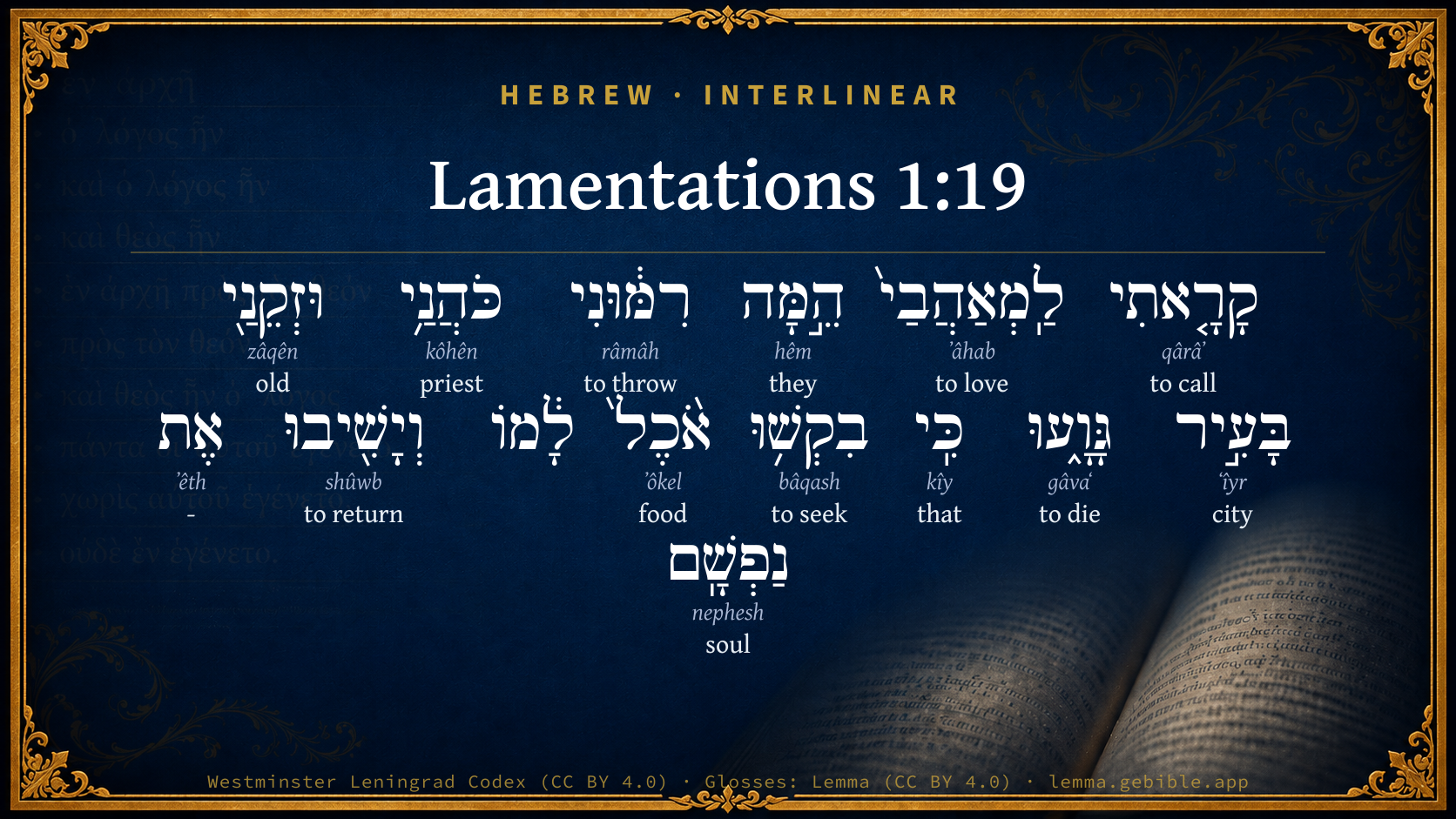
  1. קָרָ֤אתִי qârâʼ H7121 “to call” Verb, Qal, Perfect, 1st Person, Common, Singular
  2. לַֽמְאַהֲבַי֙ ʼâhab H157 “to/for the · loving · me” Preposition, Determined + Verb, Piel, Participle Active, Masculine, Plural, Construct + Suffix, Personal, 1st Person, Common, Singular
  3. הֵ֣מָּה hêm H1992 “they” Pronoun, Personal, 3rd Person, Masculine, Plural
  4. כֹּהֲנַ֥י kôhên H3548 “priests · my” Noun, Common, Masculine, Plural, Construct + Suffix, Personal, 1st Person, Common, Singular
  5. וּזְקֵנַ֖י zâqên H2205 “and · old · my” Conjunction + Adjective, Adjective, Masculine, Plural, Construct + Suffix, Personal, 1st Person, Common, Singular
  6. בָּעִ֣יר ʻîyr H5892 “in/at the · city” Preposition, Determined + Noun, Common, Feminine, Singular, Absolute
  7. גָּוָ֑עוּ gâvaʻ H1478 “to die” Verb, Qal, Perfect, 3rd Person, Common, Plural
  8. כִּֽי kîy H3588 “that” Conjunction
  9. בִקְשׁ֥וּ bâqash H1245 “to seek” Verb, Piel, Perfect, 3rd Person, Common, Plural
  10. אֹ֨כֶל֙ ʼôkel H400 “food” Noun, Common, Masculine, Singular, Absolute
  11. וְיָשִׁ֖יבוּ shûwb H7725 “and · to return” Conjunction + Verb, Hiphil, Jussive, 3rd Person, Masculine, Plural
  12. אֶת ʼêth H853 “-” Particle, Direct Object
  13. נַפְשָֽׁם nephesh H5315 “soul · their” Noun, Common, Both, Singular, Construct + Suffix, Personal, 3rd Person, Masculine, Plural

About this verse

These counts appear in no published source. They are computed here, from the morphology-tagged text and Lemma’s own curated glosses. What Lemma adds →

15
words
14
distinct lemmas
Prophets
section

Notable vocabulary

The rarest word here is רִמּ֔וּנִי to throw H7411 — appearing just 13 times in the whole Hebrew Bible.

Shared distinctive vocabulary

רִמּ֔וּנִי to throw H7411 occurs in 13 verses of the Hebrew Bible. Also found in:

Grammatical profile

  • 6 verbs
  • 4 nouns
  • 1 adjective
  • 1 pronoun
  • 1 preposition
  • 1 conjunction
  • 1 particle

Verb forms

  • קָרָ֤אתִי Qal · Perfect
  • לַֽמְאַהֲבַי֙ Piel · Participle Active
  • רִמּ֔וּנִי Piel · Perfect
  • גָּוָ֑עוּ Qal · Perfect
  • בִקְשׁ֥וּ Piel · Perfect
  • וְיָשִׁ֖יבוּ Hiphil · Jussive

Hebrew & Septuagint length

In English translation the verse runs 30 words from the Hebrew and 32 from the Septuagint (LXX English) — closely comparable.

A rough comparison of the two English renderings, which tokenize alike — not a word-level alignment.

Word counts can differ between the Hebrew and the Greek without any difference in meaning — e.g. the Hebrew direct-object marker אֵת has no separate Greek word, and Greek often adds the article ὁ.

Cross-references

13

Topical passages linked to Lamentations 1:19 in the Treasury of Scripture Knowledge — connected by theme and wording, ordered by reader-vote popularity; previews shown in the World English Bible.

  • Lamentations 1:2 She weeps sore in the night, and her tears are on her cheeks; Among all her lovers she has none to comfort her: All her friends have dealt treacherously with her; they are become her enemies.
  • Lamentations 1:11 All her people sigh, they seek bread; They have given their pleasant things for food to refresh the soul: Look, Yahweh, and see; for I am become abject.
  • Lamentations 2:20 Look, Yahweh, and see to whom you have done thus! Shall the women eat their fruit, the children that are dandled in the hands? Shall the priest and the prophet be killed in the sanctuary of the Lord?
  • Job 19:13–19 "He has put my brothers far from me. My acquaintances are wholly estranged from me.
  • Jeremiah 2:28 But where are your gods that you have made you? let them arise, if they can save you in the time of your trouble: for according to the number of your cities are your gods, Judah.
  • Jeremiah 14:15–18 Therefore thus says Yahweh concerning the prophets who prophesy in my name, and I didn't send them, yet they say, Sword and famine shall not be in this land: By sword and famine shall those prophets be consumed.
  • Jeremiah 23:11–15 for both prophet and priest are profane; yes, in my house have I found their wickedness, says Yahweh.
  • Jeremiah 27:13–15 Why will you die, you and your people, by the sword, by the famine, and by the pestilence, as Yahweh has spoken concerning the nation that will not serve the king of Babylon?
  • Jeremiah 30:14 All your lovers have forgotten you; they don't seek you: for I have wounded you with the wound of an enemy, with the chastisement of a cruel one, for the greatness of your iniquity, because your sins were increased.
  • Jeremiah 37:7–9 Thus says Yahweh, the God of Israel, Thus shall you tell the king of Judah, who sent you to me to inquire of me: Behold, Pharaoh's army, which is come forth to help you, shall return to Egypt into their own land.
  • Lamentations 4:7–9 Her nobles were purer than snow, they were whiter than milk; They were more ruddy in body than rubies, their polishing was as of sapphire.
  • Lamentations 4:17 Our eyes do yet fail [in looking] for our vain help: In our watching we have watched for a nation that could not save.
  • Lamentations 5:12 Princes were hanged up by their hand: The faces of elders were not honored.

Cross-references courtesy of OpenBible.info (CC BY 4.0).

Hebrew and Greek witnesses Masoretic Hebrew ↔ Greek Septuagint

The same verse in the two great witnesses to the Old Testament, shown verse-for-verse.

These are two independent witnesses, not word-aligned to each other, and the Septuagint is shown in lemma (dictionary) form.

Hebrew Lamentations 1:19 Masoretic · Westminster Leningrad Codex

קָרָ֤אתִי לַֽמְאַהֲבַי֙ הֵ֣מָּה רִמּ֔וּנִי כֹּהֲנַ֥י וּזְקֵנַ֖י בָּעִ֣יר גָּוָ֑עוּ כִּֽי בִקְשׁ֥וּ אֹ֨כֶל֙ לָ֔מוֹ וְיָשִׁ֖יבוּ אֶת נַפְשָֽׁם

I called for my lovers, [but] they deceived me: My priests and my elders gave up the spirit in the city, While they sought them food to refresh their souls.

World English Bible · Public Domain

Greek LXX Lamentations 1:19 Septuagint · lemma form

καλέω ὁ ἐραστής ἐγώ αὐτός δέ παραλογίζομαι ἐγώ ὁ ἱερεύς ἐγώ καί ὁ πρεσβύτερος ἐγώ ἐν ὁ πόλις ἐκλείπω ὅτι ζητέω βρῶσις αὐτός ἵνα ἐπιστρέφω ψυχή αὐτός καί οὐ εὑρίσκω

KOPH. I called my lovers, but they deceived me: my priests and my elders failed in the city; for they sought meat that they might restore their souls, and found it not.

LXX2012 (modern English Septuagint) · Public Domain

On this verse, Keil & Delitzsch discusses the Septuagint’s reading. Read the note in Commentary ↓

Hebrew: Westminster Leningrad Codex (CC BY 4.0). Greek: Septuagint (public domain); English from LXX2012 (modern English Septuagint) (Public Domain). How the Septuagint differs from the Hebrew →

Commentary

Notes on Lamentations 1:19 from classic Christian and Jewish commentators (each source and its license shown beneath its notes). The classic Christian expositions comment on the surrounding passage and are grouped to its opening verse, so a note may address several verses; the Jewish commentaries on the Tanakh (Rashi and others) are per-verse, so they appear only where the commentator wrote on this verse.

Lemma curates 59 commentaries, every one of them public domain or Creative Commons licensed, each selected and text-cleaned for this edition rather than reprinted as found. About our sources →

Trapp's Complete Commentary

John Trapp

Lam 1:19 I called for my lovers, [but] they deceived me: my priests and mine elders gave up the ghost in the city, while they sought their meat to relieve their souls.

Ver. 19. I called for my lovers, but they deceived me.] My confederates, idols, and other sweethearts, never yet true to any that trusted them. See Jer 22:20; Jer 30:14.

My priests and mine elders, &c.] What then became of poor folk? and how gracious was God to Jeremiah in the provision made for him by the king, who yet loved him not!

John Trapp, A Commentary or Exposition upon All the Books of the Old and New Testament (1647–1656) — public domain. Text from a community e-Sword module.

The Biblical Illustrator

Joseph S. Exell

Lam_1:19-22

I called for my lovers, but they deceived me.

Deceitful helpers

1. It is an increase of sorrow to be disappointed of their help by whom we looked to be delivered out of our troubles.

2. God often maketh our friends, that love us unfeignedly, utterly unable to do us any good in our distress.

3. The misery of that people must needs be great, whose rulers can neither hold themselves nor others.

4. Gods plagues do often overtake the great ones, as well as others.

5. Gods people may come to the extremest beggary that can be in this life.

(1) Outward things are no part of their felicity, which is purchased for them by Christ Jesus.

(2) God will now and then show Himself the preserver of His people, when all means do fail. (J. Udall.)

Behold, O Lord; for I am in distress.--

Prayer in distress

1. We must not give over, but continue in prayer, though we be not heard in that we entreat for. God hath commanded us to pray without ceasing, and set no time when we shall be heard.

2. God seeth all things; but we must with lamentation lay open our miseries before Him.

(1) Mercy is denied to them that hide their sins.

(2) Forgiveness is granted upon a free confession.

3. We then pray most earnestly when we feet most sensibly the burden of that we would be rid of, and the want of that we would have.

4. There is no rest or quietness within us, when God presseth us with the weight of our own sins.

5. The godly do always, in the due consideration of their sins, aggravate them against themselves in greatest measure.

(1) They see best into their own offences.

(2) They measure them by the heavy anger of God, deserved by the same (Luk_18:13).

6. The things that are ordained for our greatest good in this life, do turn to our greatest harm when our sins provoke Gods anger to break forth against us. (J. Udall.)

There is none to comfort me.

Comfortless

1. It is the duty of all men to comfort the afflicted, and not to add to their miseries (Mat_25:40; Jam_1:27; 1Co_12:26; Heb_13:3).

(1) We owe this duty one to another.

(2) No misery can befall another, but when God will it may light upon ourselves.

2. It is the property of the wicked to rejoice at the miseries of the godly, with whom they should mourn (Psa_69:12; Psa_137:3; Jdg_16:25).

(1) They are affected as their father the devil, who rejoiceth in nothing but the calamity of mankind.

(2) Their hatred maketh them glad when any evil lighteth on the righteous.

3. We are the fittest scholars to learn Gods Word and make right use of it, when afflictions are upon us.

(1) In prosperity we forget God and ourselves also.

(2) We are in our corrupt nature as naughty children that will not learn except they be well whipped.

(3) In afflictions we can more easily consider of our estate, both present, past, and to come.

4. Every tittle of Gods Word shall be accomplished in due season (Mat_5:18).

5. Though the troubles of the righteous be many, yet arc not the elect to be discerned from the reprobate by affliction.

6. It greatly easeth the godly in their afflictions to consider that their foes shall be destroyed (Rev_18:20).

7. The punishments that Gods people sustain in this life are sure tokens that the wicked shall be plagued, howsoever they escape for a time. (J. Udall.)

Thou wilt bring the day that Thou hast called.--

The day that right all wrongs

In that day--

1. God shall no longer be shut out of His own world.

2. Christ shall no longer be denied and blasphemed.

3. Evil shall no longer prevail.

4. Error shall give place to truth.

5. The saints shall no longer be maligned. (H. Bonar, D. D.)

.

The Biblical Illustrator, edited by Joseph S. Exell (c. 1880s–1900s) — public domain. Text from a community e-Sword module.

Keil & Delitzsch

C. F. Keil & F. Delitzsch

Lam 1:19 is not a continuation of the direct address to the nations, to whom she complains of her distress, but merely a complaint to God regarding the sorrow she endures. The perfects קראתי, רמּוּני, are not preterites, and thus are not to be referred to the past, as if complaint were made that, in the time of need, the lovers of Jerusalem forsook her; they rather indicate accomplished facts, whose consequences reach down to the present time. It was not merely in former times, during the siege, that Jerusalem called to her friends for help; but even now she still calls, that she may be comforted by them, yet all in vain. Her friends have deceived her, i.e., shamefully disappointed her expectations. From those who are connected with her, too, she can expect neither comfort nor counsel. The priests and the elders, as the helpers and advisers of the city, - the former as representing the community before God, and being the medium of His grace, the latter as being leaders in civil matters, - pined away ( ,גּועexspirare; here, to pine away through hunger, and expire). כּי is a temporal particle: "when they were seeking for bread" to prolong their life ('השׁיב נ as in Lam 1:11). The lxx have added καὶ οὐχ ευ, which Thenius is inclined to regard as a portion of the original text; but it is very evidently a mere conjecture from the context, and becomes superfluous when כּי ne is taken as a particle of time.

Keil & Delitzsch — Biblical Commentary on the Old Testament (1861–1891) — public domain (CC PDM 1.0). Text via the HelloAO Bible API. (Old Testament only.)

Tyndale Open Study Notes

Tyndale Open Resources

1:19 I begged my allies: Egypt had a great deal of interest in Judah because Judah controlled the only good route to the north. However, Egypt turned her back on Judah when Babylon attacked Jerusalem (Jer 37:5-11). • When there was little rain in the fall and spring in Palestine, a summer without rain could destroy crops and cause a food shortage. The food supply also ran out under the prolonged siege of a city (Jan 588–July 586 BC), and many people starved to death (2 Kgs 25:2-3; cp. Jer 37:21).

Tyndale Open Study Notes — © Tyndale Open Resources, licensed CC BY-SA 4.0. Text via the HelloAO Bible API.

Geneva Bible (1599)

Geneva Bible translators

That is, they died for hunger.

Geneva Bible (1599) marginal notes — public domain. Text via Bolls.life.

Jamieson, Fausset & Brown

Robert Jamieson, A. R. Fausset & David Brown

lovers-- (Lam 1:2; Jer 30:14).

elders--in dignity, not merely age.

sought . . . meat--Their dignity did not exempt them from having to go and seek bread (Lam 1:11).

Jamieson, Fausset & Brown — Commentary Critical and Explanatory on the Whole Bible (1871) — public domain (CC PDM 1.0). Text via the HelloAO Bible API.

Adam Clarke's Commentary

Verse 19. I called for my lovers] My allies; the Egyptians and others.

Adam Clarke's Commentary on the Bible (1810–1826) — public domain. Text from a community e-Sword/MySword module.

John Calvin's Commentaries

Here the people of God complain in the person of a woman, as we have before seen, that in their calamity they were left destitute of every comfort. And it is a circumstance which increases grief, when no one is present to shew any kindness to the miserable; for it is no small alleviation of sorrow, when friends offer their kind services, and as far as they can, endeavor to mitigate the severity of the evil.

The Church of God now says, that she was so forsaken by friends as to be left alone to pine away in her mourning and sorrow. There may, however, be here an allusion to shameful and impure connections; for by this term, friends, the Spirit often points out the Egyptians as well as others in whom the Israelites had foolishly trusted; for in this manner, we know, they had turned aside from conjugal fidelity. God had bound them to himself, that they might acquiesce in his favor alone; and so to acquiesce was their spiritual chastity. Rightly, then, does Scripture compare both the Egyptians and the Assyrians to harlots, whenever the Israelites sought aid from them. But as this explanation seems too refined, I am content to view what is said simply as a complaint., that the people of God, though looking in all directions, yet could find no comfort in the world. I cried, she said, to my friends; they deceived me.

It is then added, My priests and mine elders expired in the city. Had they been slain in battle, it would have been no wonder; for they who go against an enemy, go as it were to meet death. But God’s people here deplore a more grievous evil, that the priests died in the city, not through the enemies’ sword, but through famine, which is as it were the extreme of evils. It is then said, that the priests as well as the elders perished through famine, because they could not find food. And when it is said that they sought food to refresh the soul, there is a contrast to be understood between ordinary food and a remedy for the famine; for we naturally seek food whenever we feel hungry; but the Prophet refers here to something more than this, even that the priests and the elders sought food, because long abstinence urged them; and it was very sad, that the priests, who excelled in honor, and also the elders, were thus reduced to want. Had such a thing happened to the common people, it would not have been so wonderful; for the long siege of the city had consumed all their provisions. But when the priests, and those who had wealth, were thus oppressed with hunger, we may conclude that the want which the Prophet wished to describe was extreme. It follows, —

John Calvin's Commentaries (1540-1563) — public domain. Text from the Calvin Translation Society English edition (1840s-50s) via the Christian Classics Ethereal Library (ccel.org). Calvin's coverage is partial (roughly two-thirds of the Bible); uncommented books and verses are honest gaps, never fabricated. The 19th-century editor's footnotes and remarks are omitted so the notes are faithfully Calvin's own voice.

Ellicott's Commentary for English Readers

(19) I called for.—Better, to. The “lovers,” as in Lam_1:2, are the former allies of Judah.

My priests and mine elders.—The pressure of the famine of the besieged city is emphasised by the fact that even these, the honoured guides of the people, had died of hunger. On the phrase that follows, see Lam_1:11. A conjectural addition, at the end of the verse, “and found not,” is supplied in the LXX and Syriac versions; but rhetorically there is more force in the aposiopesis, the suggestive silence, of the Hebrew.

A Bible Commentary for English Readers, edited by Charles John Ellicott (1878–1897) — public domain. Text from a community e-Sword module.

The Cambridge Bible for Schools and Colleges

gen. ed. J. J. S. Perowne

19. my lovers] See on Lam_1:2.

meat to refresh their souls] See on Lam_1:11. The LXX add (but unnecessarily, and with injury to the metre), and found it not.

The Cambridge Bible for Schools and Colleges (gen. ed. J. J. S. Perowne; Cambridge University Press, 1878–1918) — public domain. Text from a community e-Sword module.

John Gill's Exposition

I called for my lovers, but they deceived me,.... Either her idols, with whom she had committed spiritual adultery, that is, idolatry; but these could not answer her expectations, and help her: or the Egyptians, that courted her friendship, and with whom she was in alliance, and in whom she trusted; and these, in the times of her distress, she called upon to make good their engagements, but they disappointed her, and stood not to their covenant and promises, but left her to stand and fall by herself; this Jerusalem said, according to the Targum, when she was delivered into the hands of Nebuchadnezzar; but these words, "they deceived me", it makes to be the Romans, that came with Titus and Vespasian, and built bulwarks against Jerusalem:

my priests and mine elders gave up the ghost in the city; or died in the city of Jerusalem; not by the sword of the enemy, but through famine; and so, in the Arabic language, the word (i) signifies to labour under famine, and want of food, and perish through it; and if this was the case of their priests that officiated in holy things, and of their elders or civil magistrates, what must be the case of the common people?

while they sought their meat to relieve their souls; or "fetch (k) them back"; which were just fainting and dying away through hunger; and who did expire while they were begging their bread, or inquiring in one place after another where they could get any, either freely or for money.

(i) "esurivit et fame ac inedia laboravit", Golius, col. 556. (k) "et reducerent animam suam", Montanus.

John Gill's Exposition of the Whole Bible (1746–1763) — public domain (CC PDM 1.0). Text via the HelloAO Bible API.

Albert Barnes' Notes on the Bible

I called for ... - Rather, to “my lovers.”

While they sought their meat - literally, “for they sought food for themselves to revive their souls.” Complete the sense by adding, “and found none.”

Albert Barnes' Notes on the Bible (1834–1885) — public domain. Text from a community e-Sword/MySword module.

Haydock's Catholic Bible Commentary

Me. Egypt attempted to relieve Juda, to no purpose, ver. 2. (Calmet) --- It could not, or at least did not, prove of any service to the Jews, chap. ii. 18. (Worthington)

George Leo Haydock (1774–1849), Haydock's Catholic Family Bible and Commentary, 1859 edition — public domain. Excludes Psalms (Douay-Rheims chapter numbering differs from Protestant) and Deuterocanonical books (Catholic canon only).

Matthew Poole's English Annotations

I desired help of my allies and confederates who courted my friendship and alliance in any prosperity, but they failed mine expectation, none of them either would or could succour me. My misery was such through the famine, that not only my common people, but those of the best rank in the city, magistrates and priests, fainted as they went along the street seeking bread to satisfy their hunger.

Matthew Poole's English Annotations on the Holy Bible (1683–1685) — public domain. Text from a community e-Sword/MySword module.

Whedon's Commentary on the Bible

Daniel D. Whedon

19. I called for, etc. — Rather, I called to, my lovers.

Priests and… elders — The men to whom the people should have recourse in times of trouble: the former as representing the community before God, and being the medium of his grace; and the latter as the leaders in civil matters. Even these have pined away while they sought (in vain) their meat to relieve their souls.

Daniel D. Whedon (gen. ed.), Commentary on the Old and New Testaments (1874–1909) — public domain. Text from a community e-Sword module.

The Pulpit Commentary

For my lovers; render, to my lovers (see on ver. 2).

The Pulpit Commentary (1880–1919), ed. H.D.M. Spence-Jones & Joseph S. Exell — public domain. Text from a community e-Sword module.

John Wesley's Explanatory Notes

Deceived - They did not answer my expectation.

John Wesley, Explanatory Notes Upon the Whole Bible (1754–1765) — public domain. Text via the GEBible commentary corpus.

Rashi

Rabbi Shlomo Yitzchaki (Rashi)

I called to my lovers Heb. לַמְאַהֲבַי, to those who make themselves appear as lovers.

[but] they deceived me e.g., the children of Ishmael, who went forth toward the exiles when the captors were leading them on the road nearby, as if they were compassionate toward them. And they brought them various kinds of salty foods and inflated skin flasks. They [the Jews] thought that these were [flasks of] wine, so they ate and became thirsty and wished to drink, and when they untied the flask with their teeth, the air entered their intestines and they died. This is what Scripture says (Isa. 21:13f.): “In the forest in Arabia you shall lodge, etc. Bring water toward the thirsty! The inhabitants of the land of Tema came before the wanderer with bread.”

to revive their souls so that they should revive their souls.

Rashi on the Tanakh — English translations: “The Judaica Press complete Tanach with Rashi, translated by A. J. Rosenberg” (CC BY 4.0); “Pentateuch with Rashi's commentary by M. Rosenbaum and A.M. Silbermann, 1929-1934” (public domain); “The Metsudah Tanach series, Lakewood, N.J” (CC BY 4.0); and “The Book of Joshua, Metsudah Publications, 1997” (CC BY 4.0). Text via Sefaria.

Lesson kit

Teaching starters — assembled from the data on this page, not authored interpretation. Every prompt links to the verse data it draws on. Edit before teaching.

Lamentations, in the Prophets, opens this verse with 15 words (14 distinct Hebrew lemmas). Its most distinctive word is râmâh (“to throw”). A historical commentator’s framing appears above. Read the whole chapter for the surrounding context.

Discussion questions

  1. What does “to throw” (râmâh) contribute to the verse as a whole?
  2. Genesis 29:25 shares the word «to throw» with this verse. How do the two illuminate each other?
  3. The translations on this page render this verse differently — a whole-verse word diff, not a word-by-word alignment. What might account for the different wordings?
  4. The verb «קָרָ֤אתִי» is Qal Perfect. How does its form color the action?
  5. Reading how Trapp's Complete Commentary and The Biblical Illustrator read this verse, where do the two commentators agree and where do they part?

Things to notice

Reading settings

Reading text

Shown beneath each verse's original-language words.

Old Testament
Old Testament edition

Read the OT as the Masoretic Hebrew (MT) or the Greek Septuagint (LXX).

English shown for the Greek Septuagint (in the Hebrew ↔ Greek comparison).

Comparing translations? Open the Compare panel on any verse page to stack up to four side by side.