Micah 2:8

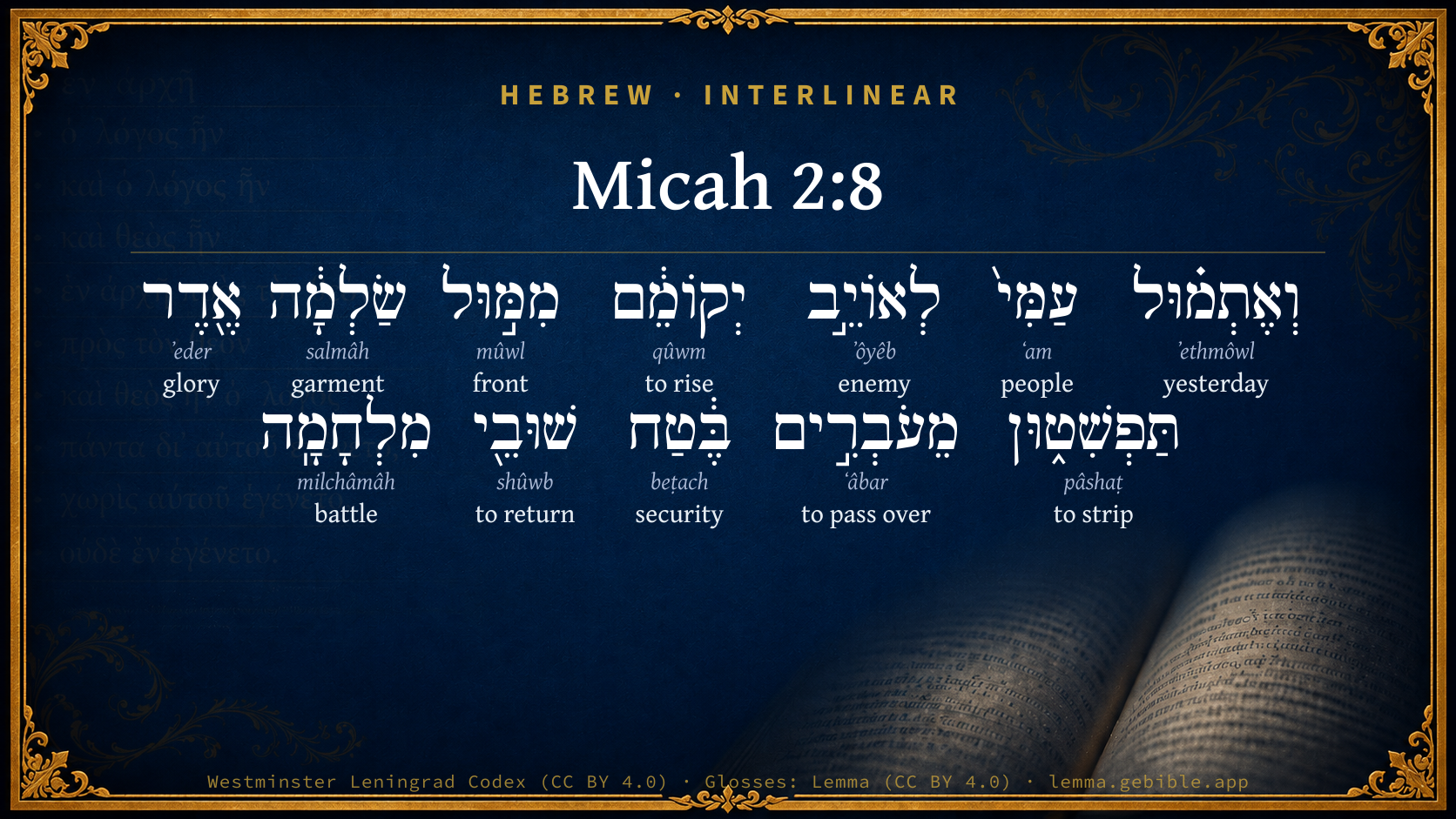
Hebrew (Westminster Leningrad Codex) Micah 2:8 appears in the Hebrew Old Testament. The text above is from the Westminster Leningrad Codex. Each word links to its Strong’s number, a concise gloss, and parsing drawn from the Open Scriptures Hebrew Bible morphology. Click any word for its full Brown-Driver-Briggs (BDB) entry.
Download image
Cite this verse

Micah 2:8 (World English Bible). Public Domain. Lemma interlinear Bible study tool, https://lemma.gebible.app/v/micah/2/8.

Show BibTeX & RIS
BibTeX
RIS
English Translation
But lately my people have risen up as an enemy. You strip the robe and clothing from those who pass by without a care, returning from battle.
World English Bible · Public Domain
Highlights
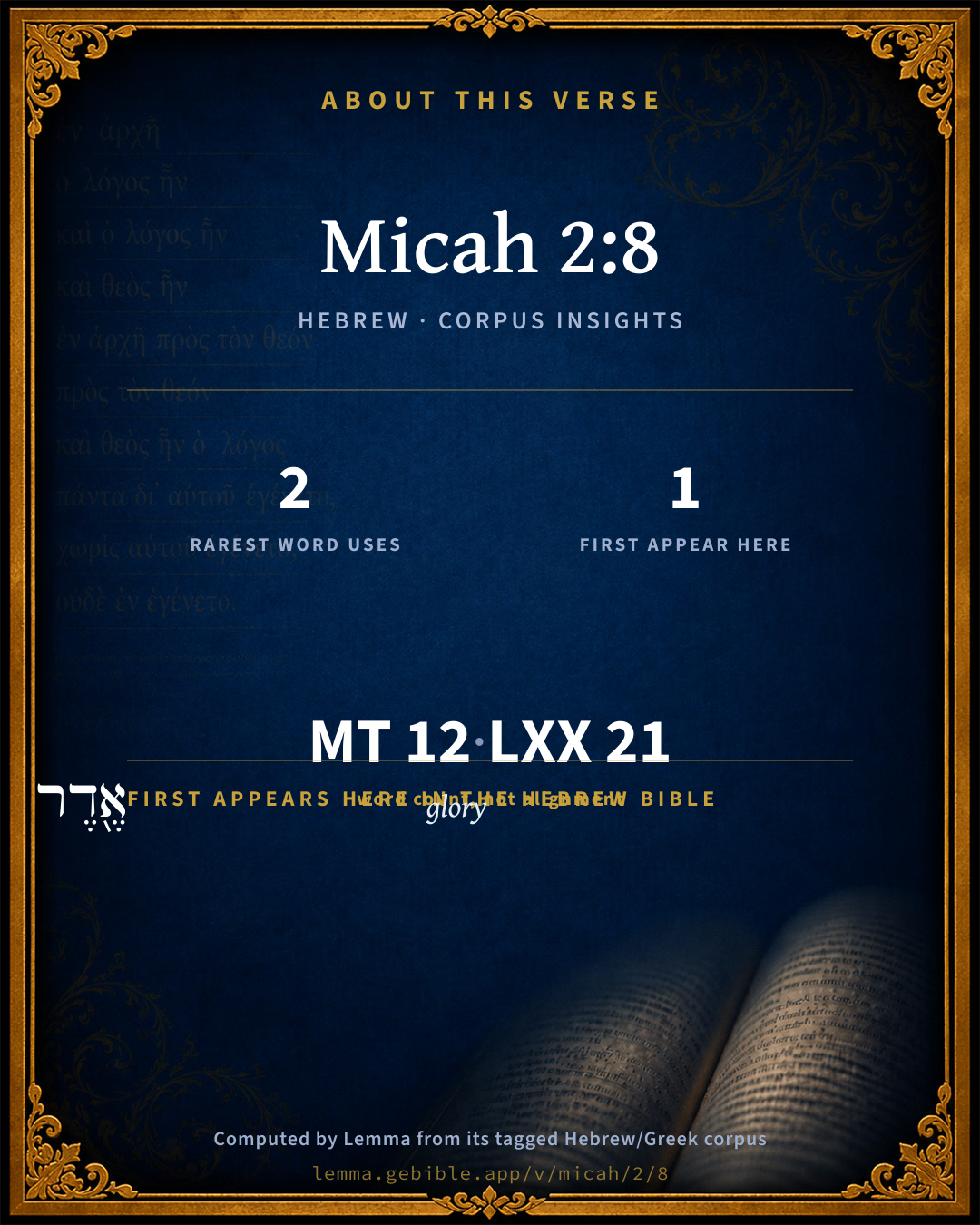
  • 1 first appearance in the Hebrew Bible
Full analysis ↓
Download a study sheet

One document with this verse’s original text, its word-by-word gloss line, the meaning frame, cross-references with their text, attributed commentary, and full source and license credits — printable, and it pastes into notes with its structure intact.

This verse Autodidact and up

Study sheet (.html) Plain text (.txt)

A passage Seminary Student

Up to 50 verses in one chapter. A passage sheet keeps up to 6 commentary sources and 12 cross-references per verse, in the order this page ranks them, and says so on the sheet whenever that leaves anything out. Ask for a single verse and you get the Autodidact verse sheet above.

Everything on this page stays free to read, with no account — the sheet is a download of what is already on screen, not access to it.

Want to remove ads? Support Godless Engineer
Compare translations 3

The same verse in 3 English versions, stacked beneath the original-language interlinear above. Click any original word for its lexicon entry.

Each is an independent rendering of the whole verse — the interlinear is not word-aligned to these translations.

Highlighted words mark where these versions differ — a whole-verse word diff, not a word-by-word alignment.

  • World English Bible Public Domain
    But lately my people have risen up as an enemy. You strip the robe and clothing from those who pass by without a care, returning from battle.
  • King James Version Public Domain
    Even of late my people is risen up as an enemy: ye pull off the robe with the garment from them that pass by securely as men averse from war.
  • unfoldingWord Literal Text CC BY-SA 4.0
    “But recently my people rise up as an enemy. You strip the splendor from the front of the garment, from those passing by in security, returning from war.

unfoldingWord Literal Text — © unfoldingWord, licensed CC BY-SA 4.0. Word-aligned USFM3 via Door43 (git.door43.org/unfoldingWord/en_ult).

Versions to compare (up to 4)

3 of 4 selected

Show all 18 translations

Every available English version of this verse, each an independent rendering of the whole verse.

  • World English Bible Public Domain
    But lately my people have risen up as an enemy. You strip the robe and clothing from those who pass by without a care, returning from battle.
  • Berean Standard Bible Public Domain
    But of late My people have risen up like an enemy: You strip off the splendid robe from unsuspecting passersby like men returning from battle.
  • Majority Standard Bible Public Domain
    But of late My people have risen up like an enemy: You strip off the splendid robe from unsuspecting passersby like men returning from battle.
  • King James Version Public Domain
    Even of late my people is risen up as an enemy: ye pull off the robe with the garment from them that pass by securely as men averse from war.
  • American Standard Version (1901) Public Domain
    But of late my people is risen up as an enemy: ye strip the robe from off the garment from them that pass by securely `as men' averse from war.
  • Revised Version (1885) Public Domain
    But of late my people is risen up as an enemy: ye strip the robe from off the garment from them that pass by securely as men averse from war.
  • Geneva Bible (1599) Public Domain
    But hee that was yesterday my people, is risen vp on the other side, as against an enemie: they spoyle the beautifull garment from them that passe by peaceably, as though they returned from the warre.
  • Douay-Rheims (1899) Public Domain
    But my people, on the contrary, are risen up as an enemy: you have taken away the cloak off from the coat: and them that passed harmless you have turned to war.
  • Young's Literal Translation Public Domain
    And yesterday My people for an enemy doth raise himself up, From the outer garment the honourable ornament ye strip off, From the confident passers by, Ye who are turning back from war.
  • Literal Standard Version CC BY-SA 4.0
    And recently My people raise up as an enemy, || You strip off the honorable ornament from the outer garment, || From the confident passers by, || You who are turning back from war.
  • Unlocked Literal Bible CC BY-SA 4.0
    Lately my people have risen up like an enemy. You strip the robe, the garment, from those who pass by unsuspectingly, as soldiers return from war to what they think is safety.
  • unfoldingWord Literal Text CC BY-SA 4.0
    “But recently my people rise up as an enemy. You strip the splendor from the front of the garment, from those passing by in security, returning from war.
  • Darby Bible Public Domain
    But of late my people is risen up as an enemy: ye strip off the mantle with the garment from them that pass by securely, that are averse from war.
  • World Messianic Bible Public Domain
    But lately my people have risen up as an enemy. You strip the robe and clothing from those who pass by without a care, returning from battle.
  • Webster's Bible Public Domain
    Even of late my people hath risen up as an enemy: ye pull off the robe with the garment from them that pass by securely as men averse to war.
  • Free Bible Version CC BY-SA 4.0
    Lately my people have risen up against me like an enemy. You steal the coats off the backs of those passing by, men returning from war who expect to be safe in their homeland.
  • Bible in Basic English Public Domain
    As for you, you have become haters of those who were at peace with you: you take the clothing of those who go by without fear, and make them prisoners of war.
  • JPS Tanakh (1917) Public Domain
    But of late My people is risen up as an enemy; with the garment ye strip also the mantle from them that pass by securely, so that they are as men returning from war.

Literal Standard Version (2020), Covenant Press — licensed CC BY-SA 4.0. Text via the HelloAO Bible API (eBible.org). Unlocked Literal Bible (unfoldingWord) — licensed CC BY-SA 4.0. Text via the HelloAO Bible API (eBible.org). unfoldingWord Literal Text — © unfoldingWord, licensed CC BY-SA 4.0. Word-aligned USFM3 via Door43 (git.door43.org/unfoldingWord/en_ult). Free Bible Version, Dr. Jonathan Gallagher — licensed CC BY-SA 4.0. Text via the HelloAO Bible API (eBible.org).

Word by word

More ways to search: Search by grammar → Find every occurrence → Compare this word →

Practice this passage: Drill this verse → Learn its vocabulary →

אֶ֖דֶר
ʼeder
H145
“glory”
Noun, Common, Masculine, Singular, Absolute
Part of Speech
Noun
Type
Common
Gender
Masculine
Number
Singular
State
Absolute
Full BDB Definition

Origin: from H142

TWOT: 28a

glory, magnificence - mantle, cloak (as wide)
  1. וְאֶתְמ֗וּל ʼethmôwl H865 “and · yesterday” Conjunction + Adverb
  2. עַמִּי֙ ʻam H5971 “people · my” Noun, Common, Masculine, Singular, Construct + Suffix, Personal, 1st Person, Common, Singular
  3. לְאוֹיֵ֣ב ʼôyêb H341 “to/for · enemy” Preposition + Verb, Qal, Participle Active, Masculine, Singular, Absolute
  4. יְקוֹמֵ֔ם qûwm H6965 “to rise” Verb, Polel, Imperfect, 3rd Person, Masculine, Singular
  5. מִמּ֣וּל mûwl H4136 “from · front” Preposition + Preposition
  6. שַׂלְמָ֔ה salmâh H8008 “garment” Noun, Common, Feminine, Singular, Absolute
  7. תַּפְשִׁט֑וּן pâshaṭ H6584 “to strip” Verb, Hiphil, Imperfect, 2nd Person, Masculine, Plural + Suffix, n
  8. מֵעֹבְרִ֣ים ʻâbar H5674 “from · passing over” Preposition + Verb, Qal, Participle Active, Masculine, Plural, Absolute
  9. בֶּ֔טַח beṭach H983 “security” Noun, Common, Masculine, Singular, Absolute
  10. שׁוּבֵ֖י shûwb H7725 “returned” Verb, Qal, Participle Passive, Masculine, Plural, Construct
  11. מִלְחָמָֽה milchâmâh H4421 “battle” Noun, Common, Feminine, Singular, Absolute

About this verse

These counts appear in no published source. They are computed here, from the morphology-tagged text and Lemma’s own curated glosses. What Lemma adds →

12
words
12
distinct lemmas
Prophets
section

Notable vocabulary

The rarest word here is אֶ֖דֶר glory H145 — appearing just 2 times in the whole Hebrew Bible.

First appearance in Scripture

This word makes its first canonical appearance in the Hebrew Bible here:

  • אֶ֖דֶר glory H145

Shared distinctive vocabulary

אֶ֖דֶר glory H145 occurs in 2 verses of the Hebrew Bible. Also found in:

Grammatical profile

  • 5 verbs
  • 5 nouns
  • 1 preposition
  • 1 adverb

Verb forms

  • לְאוֹיֵ֣ב Qal · Participle Active
  • יְקוֹמֵ֔ם Polel · Imperfect
  • תַּפְשִׁט֑וּן Hiphil · Imperfect
  • מֵעֹבְרִ֣ים Qal · Participle Active
  • שׁוּבֵ֖י Qal · Participle Passive

Hebrew & Septuagint length

In English translation the verse runs 27 words from the Hebrew and 26 from the Septuagint (LXX English) — closely comparable.

A rough comparison of the two English renderings, which tokenize alike — not a word-level alignment.

Word counts can differ between the Hebrew and the Greek without any difference in meaning — e.g. the Hebrew direct-object marker אֵת has no separate Greek word, and Greek often adds the article ὁ.

In the original languages it is 12 Hebrew tokens and 21 Greek tokens — but the two are counted differently (Hebrew bundles its prefixes and suffixes into one token; the Greek is in lemma form), so that isn’t a like-for-like length.

Cross-references

5

Topical passages linked to Micah 2:8 in the Treasury of Scripture Knowledge — connected by theme and wording, ordered by reader-vote popularity; previews shown in the World English Bible.

  • 2 Samuel 20:19 I am of those who are peaceable and faithful in Israel: you seek to destroy a city and a mother in Israel: why will you swallow up the inheritance of Yahweh?
  • Psalms 120:6–7 My soul has had her dwelling too long With him who hates peace.
  • 2 Chronicles 28:5–8 Therefore Yahweh his God delivered him into the hand of the king of Syria; and they struck him, and carried away of his a great multitude of captives, and brought them to Damascus. He was also delivered into the hand of the king of Israel, who struck him with a great slaughter.
  • Psalms 55:20 He raises his hands against his friends. He has violated his covenant.
  • Isaiah 9:21 Manasseh, Ephraim; and Ephraim, Manasseh; and they together shall be against Judah. For all this his anger is not turned away, but his hand is stretched out still.

Cross-references courtesy of OpenBible.info (CC BY 4.0).

Hebrew and Greek witnesses Masoretic Hebrew ↔ Greek Septuagint

The same verse in the two great witnesses to the Old Testament, shown verse-for-verse.

These are two independent witnesses, not word-aligned to each other, and the Septuagint is shown in lemma (dictionary) form.

Hebrew Micah 2:8 Masoretic · Westminster Leningrad Codex

וְאֶתְמ֗וּל עַמִּי֙ לְאוֹיֵ֣ב יְקוֹמֵ֔ם מִמּ֣וּל שַׂלְמָ֔ה אֶ֖דֶר תַּפְשִׁט֑וּן מֵעֹבְרִ֣ים בֶּ֔טַח שׁוּבֵ֖י מִלְחָמָֽה

But lately my people have risen up as an enemy. You strip the robe and clothing from those who pass by without a care, returning from battle.

World English Bible · Public Domain

Greek LXX Micah 2:8 Septuagint · lemma form

καί ἔμπροσθεν ὁ λαός ἐγώ εἰς ἔχθρα ἀντιἵστημι κατέναντι ὁ εἰρήνη αὐτός ὁ δορά αὐτός ἐκδέρω ὁ ἀποαἱρέω ἐλπίς συντριμμός πόλεμος

Even beforetime my people withstood him as an enemy against his peace; they have stripped off his skin to remove hope in the conflict of war.

LXX2012 (modern English Septuagint) · Public Domain

On this verse, Whedon's Commentary on the Bible discusses the Septuagint’s reading. Read the note in Commentary ↓

Hebrew: Westminster Leningrad Codex (CC BY 4.0). Greek: Septuagint (public domain); English from LXX2012 (modern English Septuagint) (Public Domain). How the Septuagint differs from the Hebrew →

Targum (Aramaic paraphrase)

1

The Targum is the ancient Jewish Aramaic paraphrase of the Hebrew Scriptures — an interpretive translation, not the Hebrew text itself. Onkelos (literal) and Pseudo-Jonathan (expansive) render the Torah, and Jonathan the Prophets. Coverage is partial: where no permissively-licensed English translation exists for a verse, only the Aramaic is shown. This is verse-level text, not a word-by-word alignment to the Hebrew.

  1. Targum Jonathan Prophets (Joshua–Malachi)
    מִקָבֵיל חוֹבֵיהוֹן עַמִי לְבָעֵיל דְבָבָא מְסִירִין מִקִבְלְהוֹן עַמְמַיָא קַיְמִין מַחְסְנִין יַתְהוֹן מָמוֹן יְקָרְהוֹן מִנְהוֹן נָסְבִין עָדָן בְּאַרְעֲהוֹן לְרוֹחֲצָן תָּיְבִין בְּהוֹן כִּתְבִירֵי קְרָבָא:

    (no public-domain English translation for this verse)

    Targum Jonathan — Aramaic: “Mikraot Gedolot” (public domain). English: “Sefaria Community Translation” (CC0 1.0 (public-domain dedication)); “London "Chaldee Paraphrase," 1871” (public domain). Text via Sefaria.

Commentary

Notes on Micah 2:8 from classic Christian and Jewish commentators (each source and its license shown beneath its notes). The classic Christian expositions comment on the surrounding passage and are grouped to its opening verse, so a note may address several verses; the Jewish commentaries on the Tanakh (Rashi and others) are per-verse, so they appear only where the commentator wrote on this verse.

Lemma curates 59 commentaries, every one of them public domain or Creative Commons licensed, each selected and text-cleaned for this edition rather than reprinted as found. About our sources →

Trapp's Complete Commentary

John Trapp

Mic 2:8 Even of late my people is risen up as an enemy: ye pull off the robe with the garment from them that pass by securely as men averse from war.

Ver. 8. Even of late my people is risen up as an enemy] Heb. yesterday, no longer ago; to all their former flagitious practices they have now newly added this of execrable rapine and robbery, which is still fresh, and as it were flagrant in mine eyes. Although the truth is, that God looketh upon former sins as presently committed, for as there is no beginning of eternity, so neither is there any succession. But let men take heed how they heap up sin, lest they heap up wrath, for although God may bear with people for one or two backslidings, yet when once it comes to three transgressions and to four, he will not turn away the punishment, Amo 1:2; and one new sin may set many old to work in the conscience, making it like Ezekiel’s scroll, wherein was written "lamentations, and mourning, and woe," Eze 2:10. "Surely I have seen yesterday the blood of Naboth, and the blood of his sons, saith the Lord," 2Ki 9:26. The word signifieth last night, though it were done some while before. See the word yesterday so used by the apostle Hebraizing with his Hebrews, Heb 13:8. Some read the text thus, He that was yesterday my people is risen up on the other side as against an enemy, viz. raging against God and ranging against all men, biting all they came near, as mad dogs. See Isa 9:21 1Th 2:12; they please not God, but rise up in rebellion against him, and are contrary to all men, being rather Ishmaelites than Israelites, Gen 16:12; and therefore not rightly named the house of Jacob (that plain man, Gen 25:27, without welt or guard, guile or gall), nor could the word of the Lord do good unto them so long as their deeds were evil, and they "loved darkness rather than light," Joh 3:19.

To pull off the robe with the garment] Robbing and pillaging passengers with greatest inhumanity; not leaving them a rag to cover them or a cross to bless them with, as the proverb is. This was common in Scotland and Africa, saith Dameus here. It was in England also, till the days of King Alfred, who first divided the land into shires, and then the subjects into tenths or tithings; every one of which severally should give bond for the good bearing of each other. By this course men were not careful only of their own actions, but had an eye to all the nine, for which they stood bound, as the nine had over each. Insomuch that a poor girl might travel safely with a bag of gold in her hand, and none dared meddle with her.

From men that pass by securely, as men averse from war] There are a sort of such as delight in war, Psa 68:30, that make a sport of it, as Abner, 2Sa 2:14; that take more pleasure in it than in an empire, as Justin saith of Pyrrhus, King of Epirots, Nulli maior ex imperio, quam illi ex belle fur voluptas. David was none such; and yet he wanted not for courage. His motto was, I am for peace, or (as the Hebrew hath it) I am peace. He had seen the woe of war, and knew well the lawlessness of it. The law is no more, saith the Church in the Lamentations, Lam 2:9. Inter arma silent leges, saith the heathen, The noise of wars drowns the voice of laws. A reverend man hath well observed, that as those three commandments, "Thou shalt not kill; thou shalt not commit adultery; thou shalt not steal," are ranked together in the law; so they are commonly violated, together, by unruly soldiers. Isa 13:16, "Their children also shall be dashed in pieces before their eyes; their houses shall be spoiled, and their waves ravished." These are the miseries of war. But what meant these miscreants to shed the blood of war in peace, 1Ki 2:5, to strip the innocent and therefore fearless passenger of his raiment, as those thieves did him that went down from Jerusalem to Jericho, dreading no such danger, Luk 10:30; neither to rob him only, but to ravish him too, Psa 10:8-10, that they might "find all precious substance, and fill their houses with spoil," Pro 1:13. And what meant the corrupt rulers to suffer it so to be, and not to brandish the sword of justice against such stigmatical Belialists?

John Trapp, A Commentary or Exposition upon All the Books of the Old and New Testament (1647–1656) — public domain. Text from a community e-Sword module.

The Biblical Illustrator

Joseph S. Exell

Mic_2:8-9

My people is risen up as an enemy

Sin an antagonist

This chapter refers to the character and doings of Israel during the last nine years of Ahaz.

A very dark period in Israelitish history was this. We are told in 2Ch_28:24-25, that Ahaz shut up the doors of the temple and erected altars in every corner of Jerusalem. We may safely conclude, from the language of Micah (chap. 2) and Isaiah (chap. 11), that when he did so, abominations of every kind overran the land. A prophet like Micah was no longer permitted to speak. The testimony of Isaiah (chaps. 7, 8) had borne no fruit; the fruitlessness of invoking the aid of Assyria had taught him no better. Ahaz did not repent, like Manasseh, but persisted in his evil ways. What a melancholy course of conduct! Like Uzziah, Ahaz was denied honourable burial (2Ch_28:27). The prophet here, in denouncing the sins which were then most prevalent in Judah and Ephraim, alludes expressly to the acts of oppression and violence then common, and tells them that for these they would be driven out of the land. The verses lead us to look at sin in the aspect of an antagonist, and suggest--

I. That it is an antagonist to the Divine. Even of late [marg., yesterday] My people has risen up as an enemy. It is not stated, says Delitzsch, against whom the people rise up as an enemy; but, according to the context, it can only be against Jehovah. Sin is an antagonist to God; it lifts up the soul in hostility against its Maker. Unregenerated men say that they are not conscious of any enmity in their hearts towards their Maker; on the contrary, sometimes they feel a passing glow of gratitude and adoration for Him. But it is the conduct of a man that proves the settled state of his heart.

1. This enmity is most unjustifiable. Enmity sometimes admits of justification, but never in this case.

2. This enmity is most wicked. It is against reason and justice.

3. This enmity is most miserable. Enmity to God is the fountain of all the misery in the universe. The words suggest another idea concerning sin--

II. That it is an antagonist to the human. Ye pull off the robe with the garment [marg., over against the garment] from them that pass by securely as men averse from war. Not content with the outer garment, ye greedily rob passers-by of the ornamental robe fitting the body closely and flowing down to the feet; and this you do, not to enemies, but to friends, to those who are averse from war. More: The women of My people have ye cast out from their pleasant houses. The widows of the men slain by you in battle you have deprived of their homes. They devoured widows houses. This was not all. From their children have ye taken away My glory for ever. The orphan children you have despoiled. In all this there is the manifestation of sin, as an antagonist to human rights and human happiness. Sin puts man against his brother; hence the slanders, quarrels, litigations, wars that are rife in every human scene. (Homilist.)

The Biblical Illustrator, edited by Joseph S. Exell (c. 1880s–1900s) — public domain. Text from a community e-Sword module.

Joseph Benson's Commentary

Mic 2:8-9. Of late my people is risen up as an enemy — AGAINST ME is to be here understood, namely, against God; for this is still spoken in the person of God. The sense is more evident in the Hebrew than in our translation, namely, But they who were yesterday (or lately) my people rise up (now, or to-day) as an enemy. Ye pull off the robe with the garment — Ye are guilty of grievous oppression and inhumanity: ye are not content with spoiling the poor, and those who are weaker than yourselves, of their cloak, but take their coat also. Taking the robe with the garment, or the cloak and coat also, seems to have been a proverbial expression to signify a high degree of oppression and injury. From them that pass by securely — Who, fearing no evil, are going about their private affairs; as men averse from war — Who are willing to live peaceably with you, and give you no manner of provocation: even these, you in a violent manner strip of all their substance, even to their wearing apparel. The women of my people have ye cast out, &c. — The widows, wives, and daughters of my people have you, by acts of injustice and oppression, turned out of their habitations, which to them were pleasant, and in which they delighted. From their children have ye taken away my glory for ever — You have robbed their children, or posterity, of their houses and estates, which were secured to them by the law of God from any sale or alienation beyond the year of jubilee, which was the glory of my bounty to them: yet you have confiscated these their inheritances for ever. Or, as some think, the sense of this clause may be, “When you plunder their houses you take away their children, and sell them to strangers and idolaters; and they are no longer esteemed my children, because they become the worshippers of false gods.”

Joseph Benson's Commentary on the Old and New Testaments (1811–1818) — public domain. Text from a community e-Sword module.

Whedon's Commentary on the Bible

Daniel D. Whedon

Mic_2:8-9 contain a picture of the corruption and oppression found on every hand.

Of late — Literally, yesterday. This is certainly not equivalent to “long ago,” but points to the recent past. The prosperity growing out of the efficient reign of Uzziah was largely responsible for the corruption that met the prophet’s eye (see pp. 357ff.).

My people — This expression is used sometimes of the whole people, sometimes primarily of the poor and needy who suffer oppression and whose only defender is Jehovah (Isa_3:12; Isa_3:15). A comparison of Mic_2:8 with Mic_2:9 shows that in the former the reference is primarily to the oppressing nobles, in the latter to the oppressed poor.

As an enemy — The nobles prove themselves enemies of Jehovah, whose property is to have mercy, by the cruel treatment they accord to the poor and needy, who are under the special care of Jehovah (Exo_22:21 ff.; Deu_27:19).

Pass by securely… averse from war — They pounce upon their victims without provocation; as they pass by peaceably, attending to their own business, they fall upon them.

Pull off the robe with the garment — R.V., “strip the robe from off the garment.” A very obscure clause; A.V. evidently means that they take both the robe and the garment, though it may be difficult to distinguish between the two pieces of clothing named. The accusation clearly implies highway robbery; there may also be an allusion to the crime condemned in Amo_2:8. However, it is practically impossible to justify the translation of A.V.; R.V. is more accurate, but what does it mean to “strip the robe from off the garment”? The difficulty is generally recognized, and various emendations have been proposed, affecting also other parts of Mic_2:8. With a few changes, justified in part by LXX., Mic_2:8 might be read, “But ye are the foes of my people, rising against those who are peaceful; the garment ye strip from them that pass by quietly, averse to war.”

9. Women — The prophet has in mind widows, who, being without defenders, fall an easy prey to the greedy nobles; they are driven from their possessions.

Their children — Who were unable to defend themselves.

Have ye taken away my glory forever — This glory was their citizenship in the nation of Jehovah. When they were sold as slaves they were cut off from the nation, and thus they lost a privilege and glory belonging to them. Special care for the fatherless and the widows is enjoined in Exo_22:22; Deu_27:19; compare Isa_1:17; and the neglect of this duty is condemned again and again by the prophets (compare Isa_1:23; Isa_10:2).

Wellhausen and others propose a slight alteration of the text, which, though not necessary, emphasizes even more the heartless cruelty. They change “from their pleasant houses” into “from their pleasant children”; literally, from the children of their pleasure. This would add the thought that they tear the mother from the children by selling them to different masters.

Daniel D. Whedon (gen. ed.), Commentary on the Old and New Testaments (1874–1909) — public domain. Text from a community e-Sword module.

The Preacher's Complete Homiletical Commentary

Joseph S. Exell (gen. ed.)

CRITICAL NOTES.]

Mic_2:8. Late] Lit. yesterday = not long since; or again, recently, the people stood up, took an hostile attitude. Pull off] Not content with the outer garment, they rob passers-by of the ornamental robe, strip them of their habiliments as spoils of war.

Mic_2:9. Women] Widows, unprotected (Isa_10:2), were driven from houses to which they were attached, and which they inherited from their husbands. Children] Orphans of widows not spared. Glory] My ornament, i.e. garment or upper-coat. For ever] No repentance, no return of the coat according to law (Exo_22:25-27).

Mic_2:10. Arise] As you have cast out others, so must you be cast out. Canaan was no longer a rest to them.

HOMILETICS

GRIEVOUS SINS AND RIGHTEOUS RETRIBUTION.—Mic_2:8-10

The Prophet describes the sad change that had come over the people. Their fathers were famous in war, heroic in the defence of their country against the enemy, and humane towards others. But they had barbarously treated peaceful subjects and innocent women and children. God threatens to do to them as they had done to others.

I. What are the sins denounced?

1. Rebellion against God. “My people is risen up as an enemy.” (a) This rebellion was recent. “Even of late;” only yesterday you have added to former sins. When men cast off the restraints of God’s Word and God’s Spirit they will commit greater folly. No bonds will check the ungodly and rebellious. (b) This rebellion was unprovoked. God was not their enemy, but designed their good. They had risen up vehemently (Cf. Mic_5:4; Mic_7:14; 1Ki_11:14) against God and man, and become Ishmaelites rather than Israelites. (c) This rebellion was universal. They rose up as one man. Whatever their profession, they were one in their sympathies and conduct. Sin is determined opposition to God. Those who assume this attitude are enemies to God and their country, put themselves away from the benefits of God’s Word, and prefer darkness to light because their deeds are evil.

2. Hostility to man. Casting off the fear of God, they had no regard for man. (a) They robbed peaceful travellers. Men averse from war and strife were hindered in their journey, stripped of their comely dress, and violently treated as prisoners of war. What injustice to permit this! What inhumanity to man! “Deliver me, O my God, out of the hand of the wicked; out of the hand of the unrighteous and cruel man.” (b) They abused defenceless women. “The women of my people have ye cast out from their pleasant houses.” God, the preserver of men, has tender regard for the weaker sex, and will punish aggravations against them. “They devoured widows’ houses.” (c) They maltreated innocent children. They robbed them of the fitting apparel which God had given them, kept the garments for ever which they had taken, and never made restitution. They sold into captivity, and never ceased their oppression. Sex did not save the women, nor age the children. Human rights and human happiness were disregarded. Thus they provoked God, who is a husband to the widow and a father to the fatherless.

II. What is the punishment threatened?

1. They were treated as enemies. They had set upon quiet citizens as if they were suspicious characters; ill used friends as if they had been enemies. God now considers them as enemies. “My people is risen up as an enemy.”

2. They were deprived of their possessions. As they had driven helpless widows from their homes, so God gives them corresponding punishment. The land shall not be their rest; they must quit it by force, for it is polluted by their sin. “Arise ye and depart.” There can be no resting-place in sin. A place polluted by guilt will soon become “the sore destruction” of its inhabitants. “He that leadeth into captivity shall go into captivity; he that killeth with the sword must be killed with the sword.”

THE CHRISTIAN’S CALL FROM EARTH.—Mic_2:10

We may take these words as a call to Christians to arise from the world with all its attractions—an admonition not to live too much for earth. For everything proclaims the transitory nature of things below, and reminds us that “here we have no continuing city.” Every condition justifies the sentiment of the poet—

“Too low they build who build beneath the skies.”

I. Earth is not the scene of repose. “This is not your rest.” We get no repose physically. Outward circumstances, however smooth, get upset and changed. Intellectually we get no satisfaction. The more we know, the more we desire to know. The eye is not satisfied with seeing, nor the intellect with knowing. But spiritually rest is impossible on earth. Earth is an inn, not a home; our passage, not our portion. Only at the end of our journey will be “quietness and assurance for ever.”

II. Earth is not the place of destination. Many idolize the world, and live as if they had not to depart hence; but the Christian is a stranger and a pilgrim on the earth. “I am a citizen of the whole world,” said Diogenes, when asked what countryman he was. Our citizenship is in heaven, and, like Abraham, Isaac, and Jacob, we look “for a city which hath foundations, whose builder and maker is God,” “a better country, even a heavenly.”

III. Earth is not suitable for our residence. “It is good for pilgrimage, but miserable for residence,” says one. With all its beauties and pleasures it is polluted. Sin and death abound and blacken its fair skies. Sin defiles the land in which it is committed. “Corruption in the world through lust.” If you do not keep yourselves unspotted from the world, but settle down in it and make it your rest, you will be overturned “with a sore destruction.”

“It is not for me to be seeking my bliss,

Or building my hopes in a region like this;

I look for a city that hands have not piled,

I pant for a country by sin undefiled.”

HOMILETIC HINTS AND SUGGESTIONS

I. The description of the world.

1. It is polluted.

2. It is dangerous. “It shall destroy you.”

3. Hence it is not a rest. II. The command to depart from it. “Arise,” &c.

1. It is comprehensive. Separate yourselves from the world, and touch not the unclean. Avoid its company. “The friendship of the world is enmity with God.” Renounce its maxims and conversations. “Those who are bound for Canaan must not speak the language of Ashdod,” says Philip Henry. Live above the allurements and pleasures, the anxieties and cares of the world. Set your affections on things above.

2. It is urgent. “Arise and depart.” Like Israel from Egypt, and the pilgrim from the city of destruction, we must hasten and delay not.

3. It is needed. We are apt to grow careless, settle down and say, “In my prosperity I shall never be moved,” but God wakens us by his providence and Word, “Arise, and depart.”

The present is not our rest. It was not designed to be our rest. It is not fit to be our rest. If we are Christians we have relinquished it and chosen another rest. But many, like Reuben and Gad, prefer an inheritance on this side Jordan. The godly themselves have need to have their pure minds stirred up by way of remembrance. God sends them therefore the message, “Arise ye,” &c. There are five ways by which he sends it. The first is his Word. The second is affliction. The third is worldly success. The fourth is the earnests and foretastes of a better world. The last is death. This orders us to depart really as well as morally. Every apprehension and approach of it cries, “It is high time to awake out of sleep,” &c. [From Jay]

ILLUSTRATIONS TO CHAPTER 2

Mic_2:8-9. Women and children.

“The cries of orphans, and the oppressor’s rage

Doth reach the stars” [Dryden].

Mic_2:10. Not your rest.

“This is the scene of combat, not of rest;

Man’s is laborious happiness at best;

On this side death his dangers never cease,

His joys are joys of conquest, not of peace.”

The Preacher's Complete Homiletical Commentary (gen. ed. Joseph S. Exell; Funk & Wagnalls, c. 1892) — public domain (pre-1929). A full-Bible homiletical/sermon-outline anthology covering 65 of 66 books (2 John is absent from the source module). Text from a community e-Sword module.

Geneva Bible (1599)

Geneva Bible translators

That is, aforetime.

The poor can have no commodity by them, but they spoil them, as though they were enemies.

Geneva Bible (1599) marginal notes — public domain. Text via Bolls.life.

Jamieson, Fausset & Brown

Robert Jamieson, A. R. Fausset & David Brown

Your ways are not such that I can deal with you as I would with the upright.

Even of late--literally, "yesterday," "long ago." So "of old." Hebrew, "yesterday" (Isa 30:33); "heretofore," Hebrew, "since yesterday" (Jos 3:4).

my people is risen up as an enemy--that is, has rebelled against My precepts; also has become an enemy to the unoffending passers-by.

robe with the garment--Not content with the outer "garment," ye greedily rob passers-by of the ornamental "robe" fitting the body closely and flowing down to the feet [LUDOVICUS DE DIEU] (Mat 5:40).

as men averse from war--in antithesis to (My people) "as an enemy." Israel treats the innocent passers-by, though "averse from war," as an enemy" would treat captives in his power, stripping them of their habiliments as lawful spoils. GROTIUS translates, "as men returning from war," that is, as captives over whom the right of war gives the victors an absolute power. English Version is supported by the antithesis.

Jamieson, Fausset & Brown — Commentary Critical and Explanatory on the Whole Bible (1871) — public domain (CC PDM 1.0). Text via the HelloAO Bible API.

Adam Clarke's Commentary

Verse 8. My people is risen up as an enemy] Ye are not only opposed to me, but ye are enemies to each other. Ye rob and spoil each other. Ye plunder the peaceable passenger; depriving him both of his upper and under garment; ye pull off the robe from those who, far from being spoilers themselves, are averse from war.

Adam Clarke's Commentary on the Bible (1810–1826) — public domain. Text from a community e-Sword/MySword module.

John Calvin's Commentaries

As the words of the Prophet are concise, they contain some obscurity. Hence interpreters differ. First, as to the word אתמיל, atmul, some think it to be one word, others divide it into את, at and מול, mul, which means, over against, opposite; and they regard it of the same import with ממול, which immediately follows. But as the repetition would be frigid, the Prophet no doubt intended that it should be taken here in its proper sense, and its meaning is yesterday. But this time is not strictly taken by the Hebrews, for they take yesterday as meaning the past time, even when many years have elapsed. I have therefore rendered it formerly, which suits this place. There is also another difference as to the sense of the text, for some think that this אתמול, atmul, is to be joined to the verb קומם, kumum; but it is rather to be connected with the word עמי, omi, My people formerly There is another diversity, that is, as to the term אויב, avib, for some apply it to God, and others to the people; that they rose up or stood one against another. For this verb is explained in two ways: some view it as a verb neuter, They stand against the enemy; and others render it, They rise up against the enemy; and this second meaning is most approved, and harmonizes best with the context.

I will now refer to what I consider to be the real meaning. The Prophet, in the first place, says, that the people were formerly under the power and government of God, but that now they were become wholly alienated from him. Formerly, then, it was my people, as though God now renounced all friendship with them. “I have hitherto owned you as my people, but hereafter I shall have nothing to do with you, for the whole authority of my word is by you entirely abolished; ye have violated your faith: in short, as you have destroyed my covenant, ye have ceased to be my people; for whatever favor I have conferred on you, you have deprived yourselves of it by your wickedness; and though I have adopted you, yet your wickedness now strips you of this privilege.” This is one thing.

It then follows, They have risen up as against an enemy. I consider a note of likeness to be here understood. The Prophet says simply, Against an enemy have they risen up; but I regard the meaning to be, that they had risen up as against an enemy; that is that they had made God, their best father, their enemy, inasmuch as they had by their crimes provoked his displeasure. He then confirms this truth by saying, that they practiced robberies among themselves. We indeed know that hypocrites ever hide themselves under their religious rites, and spread them forth as their shield whenever they are reproved. Hence the Prophet says, that they were not to be deemed the people of God for spending their labors on sacrifices, for they were at the same time robbers, and plundered innocent men.

The garment of comeliness, he says, or, the garment and the cloak, (about such words I do not labor much,) they take away from those who pass by securely; that is from all who are peaceable. For when there is a suspicion of war, or when a traveler does any mischief, he rightly deserves to be punished. But the Prophet says here, that they were robbed, who passed by securely as though they were in a safe country. “When travelers fear nothing, ye strip them of their garments, as though they were returning from war: as they are wont, when war is over, to seize on spoils wherever found, and no one can keep his own; so now, during peace, ye take to yourselves the same liberty, as though all things were exposed to plunder, and ye were in a hostile country, lately the scene of warfare.”

We now then perceive the meaning of the Prophet. He first intimates that the people were now rejected by God, for they had rendered themselves, by their most abandoned life, wholly unworthy of his benefits; and at the same time he reproves their ingratitude that having been the people of God, they choose to make war with him rather than to observe the covenant which he had made for their safety; for it was a most shameful wickedness in them, since they had been chosen from the whole world to be a peculiar people, to prefer going to war with God rather than to live quietly under his protection. And that they did rise up against God he proves, for they gave themselves up to robberies; they plundered, even during times of peace, which circumstance greatly aggravated their wickedness. It now follows —

John Calvin's Commentaries (1540-1563) — public domain. Text from the Calvin Translation Society English edition (1840s-50s) via the Christian Classics Ethereal Library (ccel.org). Calvin's coverage is partial (roughly two-thirds of the Bible); uncommented books and verses are honest gaps, never fabricated. The 19th-century editor's footnotes and remarks are omitted so the notes are faithfully Calvin's own voice.

Ellicott's Commentary for English Readers

(8) Ye pull off the robe.—Micah dwells upon the continued rapacity of the people. They robbed the quiet inoffensive traveller of both outer and inner garment; they took away both “cloke” and “coat.” (Comp. Mat_5:40; Luk_6:29.)

A Bible Commentary for English Readers, edited by Charles John Ellicott (1878–1897) — public domain. Text from a community e-Sword module.

The Cambridge Bible for Schools and Colleges

gen. ed. J. J. S. Perowne

8–10. Parallel to Mic_2:1-5

8. Even of late my people, &c.] Rather, But of late, &c. The divine speaker states the cause of His enforced deviation from His natural course of action. Man has misused His gift of free will: God’s people has of late been taking a hostile attitude. Towards whom? Not immediately against Jehovah, whom indeed they cannot cease to recognize as their national deity, but against those who are under His most immediate care—the poor and needy. (The rendering and even the reading of this verse is very doubtful, but the above explanation probably gives the general sense. One difficulty is that in this verse, according to the received text, the phrase ‘my people’ means the oppressive grandees, whereas in Mic_2:9 it is applied to the oppressed poor; comp. Isa_3:15.)

ye pull off the robe with the garment, &c.] Rather, clean away from the garment. The ‘robe’ is the spreading mantle; the ‘garment’ is the so-called ‘upper garment.’ The former would of course be the most valuable article of apparel; the richest mantles were imported from Babylon (Jos_7:21).—It is probably not vulgar robbery which is here denounced, but a remorseless use of the rights of a creditor (contrary to the spirit of Exo_22:26-27).

The Cambridge Bible for Schools and Colleges (gen. ed. J. J. S. Perowne; Cambridge University Press, 1878–1918) — public domain. Text from a community e-Sword module.

John Gill's Exposition

Even of late my people is risen up as an enemy,.... Or "yesterday" (o); meaning a very little while before this prophecy, the people of Israel, those of the ten tribes, who were the people of God by profession, rose up as an enemy, not only to God and true religion, worshipping idols; but rather to their brethren, those of the two tribes of Judah and Benjamin; as they did in the times of Pekah king of Israel, who slew a hundred and twenty thousand of them in one day, Ch2 28:6; and which is here mentioned as a reason why the Spirit of the Lord in his prophets threatened them with evil, and did not promise them good things:

ye pull off the robe with the garment; the upper and nether garment, and so stripped them naked: or, "they stripped the robe from off the garment", as some (p); they took the upper garment or cloak from them, and left them only the under garment:

for them that pass by securely, as men averse from war: who were travelling from place to place about their proper business, and thought themselves very safe; were peaceable men themselves, and suspected no harm from others: or, "returning from war" (q); such who escaped in the battle, and fled for their lives; and when they imagined they, were safe, and out of danger, fell into the hands of robbers, who stripped them of their garments. Gussetius (r) interprets it of such who were returning to the battle, and yet so used.

(o) "heri", Pagninus, Montanus, Junius & Tremellius, Piscator, Cocceius, Burkius. (p) "a veste togam spoliatis", Noldius; "a veste pallium exuitis", Burkius. (q) "revertentibus a bello", Piscator; "redeunt a bello", Cocceius; "et revertuntur a bello", De Dieu; "uti essetis reversi ex bello", Burkius. (r) "Redeuntes in bellum", Comment. Ebr. p. 836.

John Gill's Exposition of the Whole Bible (1746–1763) — public domain (CC PDM 1.0). Text via the HelloAO Bible API.

Albert Barnes' Notes on the Bible

Even of late - (Literally, yesterday.) Jerome: “He imputeth not past sins, but those recent and, as it were, of yesterday.” “My people is risen up vehemently”. God upbraideth them tenderly by the title, “Mine own people,” as John complaineth, “He came unto His own, and His own received Him not” Joh 1:11. God became not their enemy, but they arose as one man, - “is risen up,” the whole of it, as His. In Him they might have had peace and joy and assured gladness, but they arose in rebellion against Him, requiting Him evil for good, (as bad Christians do to Christ,) and brought war upon their own heads. This they did by their sins against their brethren. Casting off the love of man, they alienated themselves from the love of God.

Ye pull off (strip off violently) the robe with the garment - Literally, “over against the cloak.” The שׂלמה s'almâh is the large enveloping cloak, which was worn loosely over the other dress, and served by night for a covering Deu 22:17. Eder, translated “robe,” is probably not any one garment, but the remaining dress, the comely, becoming , array of the person. These they stripped violently off from persons, peaceable, unoffending, off their guard, “passing by securely, men averse from war” and strife. These they stripped of their raiment by day, leaving them half-naked, and of their covering for the night. So making war against God’s peaceful people, they, as it were, made war against God.

Albert Barnes' Notes on the Bible (1834–1885) — public domain. Text from a community e-Sword/MySword module.

Haydock's Catholic Bible Commentary

Away. You have often stripped people of their necessary garments; and have treated such as were innocently passing on the way, as if they were at war with you. (Challoner) --- He alludes to Israel attacking Juda without cause, and killing 120,000 at once, while they took 200,000 women and children (ver. 9.) captives, whom Oded indeed persuaded them to release, 2 Paralipomenon xxviii. 6. Septuagint are very obscure in this chapter. (Calmet)

George Leo Haydock (1774–1849), Haydock's Catholic Family Bible and Commentary, 1859 edition — public domain. Excludes Psalms (Douay-Rheims chapter numbering differs from Protestant) and Deuterocanonical books (Catholic canon only).

Matthew Poole's English Annotations

This verse to me seems to be designed as a proof of the perverseness and iniquity of this people, and consequently a justifying of God, and his prophet, threatening severity against them: they flattered themselves, and were angry with the prophet; but God doth in these words convince them that they could not with reason expect better tidings. For from a long time since they have revolted from me, and

of late they have renewed, with addition of new violence to their old. All of them have

risen up, and acted hostilities among themselves; Israel against Judah, and Judah against Israel, and of late the ten tribes have conspired against one another, subjects against their kings, and great ones against the meaner sort; all places’ are full of the sins and woeful effects of civil seditions, and the treasonable practices of violent men.

Ye pull off the robe with the garment, you strip those to their skin, take away their clothes, and leave them naked,

that pass by securely; that in peace, and fearing no evil, go about their private affairs,

as men averse from war; disliking such rebellious, bloody, and oppressive-courses, and wishing every one might enjoy his right without plunderings, sequestrations, confiscations, and decimations, for not being of their party. All which we may easily believe attended the factious and rebellious times which succeeded after Jeroboam’s death, briefly mentioned 2Ki 15:8, &c., which read with this verse, and diligently consider how it paints out those times of Israel’s sinning.

Matthew Poole's English Annotations on the Holy Bible (1683–1685) — public domain. Text from a community e-Sword/MySword module.

The Pulpit Commentary

Even of late; but of late; literally, yesterday, implying an action recent and repeated. Septuagint, emprosyen , "before;" Vulgate, e contrario. The prophet exemplifies the iniquity which has led God to punish. They are not old offences which the Lord is visiting, but sins of recent and daily occurrence. My people is risen up as an enemy. A reading, varying by a letter or two, is rendered, "But against my people one setteth himself." But them is no valid reason for altering the received text; especially as, according to Ewald, the present reading may be taken in a causative sense "They set up my people as an enemy," i.e. the grandees treat the Lord"s people as enemies, robbing and plundering them. This translation obviates the difficulty of referring the words, "my people," in this verse to the oppressor, and in ver. 7 to the oppressed. According to the usual view, and retaining the authorized rendering, the meaning is that the princes exhibit themselves as enemies of the Lord by their acts of violence and oppression, which the prophet proceeds to particularize. Septuagint, O laov mou eiv ecyran antesth , "My people withstood as an enemy." Ye pull off the robe with the garment; ye violently strip off the robe away from the garment. The "robe" (eder) is the wide cloak, the mantle sufficient to wrap the whole person, and which was often of very costly material. The "garment" (salmah) is the principal inner garment, or tunic. There may be an allusion to the enactment which forbade a creditor retaining the pledged garment during the night. (Exo_22:26, etc.) Septuagint, Katenanti thv eirhnhv autou thdeiran , "Against his peace they stripped off his skin." From them that pass by securely as men averse from war. This is probably the correct translation. The grandees rob those who are peaceably disposed, perhaps strip their debtors of their cloaks as they pass quietly along the road. The versions vary considerably from the received Hebrew text. The LXX (with which the Syriac partially agrees) has, Tou afelesyai elpidav suntrimmomou , "To remove hope in the destruction of war;" Vulgate, Eos qui transibant simpliciter convertistis in bellum. From this rendering Trochon derives the paraphrase Ye treat them as if they were prisoners of war. Hitzig considers that the reference is to fugitives from the northern kingdom who passed through Judaea in their endeavour to escape the evils of the war, leaving wives and children in the hands of the Judaeans. But these treated the refugees harshly.

Vers. 8, 9. Sin an antagonist.

"Even of late my people is risen up as an enemy: ye pull off the robe with the garment from them that pass by securely as men averse from war. The women of my people have ye cast out from their pleasant houses; from their children have ye taken away my glory forever." This chapter refers to the character and doings of Israel during the last nine years of Ahaz. A very dark period in Israelitish history was this. "We are told in 2Ch_28:24, 25 that Ahaz shut up the doors of the temple, and erected altars in every corner of Jerusalem. We may safely conclude, from the language of Micah (2) and Isaiah (11), that when he did so, abominations of every kind overran the land. A prophet like Micah was no longer permitted to speak. The testimony of Isaiah (Isa_7:8) had borne no fruit; the fruitlessness of invoking the aid of Assyria had taught him no better. Ahaz did not repent, like Manasseh, but persisted in his evil ways. What a melancholy course of conduct! Like Uzziah, Ahaz was denied honourable burial. (2Ch_28:27) The prophet here, in denouncing the sins which were then moat prevalent in Judah and Ephraim, alludes expressly to the acts of oppression and violence then common, and tells them that for these they would be driven out of the land." The verses lead us to look at sin in the aspect of an antagonist, and suggest

I THAT IT IS AN ANTAGONIST TO THE DIVINE. "Even of late margin, "yesterday my people has risen up as an enemy." "It is not stated," says Delitzsch, "against whom the people rise up as an enemy; but, according to the context, it can only be against Jehovah." Sin is an antagonist to God; it lifts up the soul in hostility against its Maker. We are told that the carnal mind is at enmity with God; it is not only alienated from him, but in deadly opposition to him. Unregenerated men say that they are not conscious of any enmity in their hearts towards their Maker; on the contrary, sometimes they feel a passing glow of gratitude and adoration for him. But it is the conduct of a man that proves the settled state of his heart. What though a man may say that he has no unkind feeling towards me, on the contrary, that he has some amount of respect; if he pursues a course of conduct that he knows is in direct opposition to my wishes, interests, and reputation, can I believe him? I judge his state of heart towards me, not by his words, but by his habitual conduct. Thus men prove their enmity to God; they pursue a course of life which they know is repugnant to his nature, hostile to his government, and injurious to the order and happiness of his universe.

1. This enmity is most unjustifiable. Enmity sometimes admits of justification, but never in this case. "They hated me without a cause." There is nothing in his character or procedure to justify one spark of animosity m any intelligent creature in the universe towards him.

2. This enmity is most wicked. It is against reason and justice. The character and relations of God are such as to demand the supreme love of all his intelligent creatures.

3. This enmity is most miserable. Enmity to God is the fountain of all the misery in the universe; it is the root of all the cursed passions of the soul. The soul"s salvation is in love, its damnation is in enmity.

II THAT IT IS AN ANTAGONIST TO THE HUMAN. "Ye pull off the robe with the garment margin, "over against the garment from them that pass by securely as men averse from war." Not content with the outer garment, ye greedily rob passers-by of the ornamental robe fitting the body closely and flowing down to the feet; and this you do, not to enemies, but to friends, to those who are "averse from war." More, "The women of my people have ye cast out from their pleasant houses." The widows of the men slain by you in battle you have deprived of their homes. They "devoured widows" houses." This was not all. "From their children have ye taken away my glory forever." The orphan children you have despoiled. In all this there is the manifestation of sin, as an antagonist to human fights and human happiness. Sin puts man against his brother; hence the slanders, quarrels, litigations, wars, that are rife in every human society. John says, "If a man love God, he will love his brother." The converse of this is true too. If a man hate God, he will hate his brother.

CONCLUSION. Look at sin as an antagonist to God and man, shun it with horror, and battle against it with all the force of your being. This is the great battle of life. D.T.

The Pulpit Commentary (1880–1919), ed. H.D.M. Spence-Jones & Joseph S. Exell — public domain. Text from a community e-Sword module.

John Wesley's Explanatory Notes

Is risen up - They have risen up, Israel against Judah, and Judah against Israel, and of late the tribes have conspired against one another; subjects against their kings, and great ones against the meaner sort. With the garment - You strip those that fearing no evil, go about their private affairs.

John Wesley, Explanatory Notes Upon the Whole Bible (1754–1765) — public domain. Text via the GEBible commentary corpus.

Keil & Delitzsch

C. F. Keil & F. Delitzsch

"But yesterday my people rises up as en enemy: off from the garment ye draw the cloak from those who pass by carelessly, averted from war. Mic 2:9. The women of my people ye drive away out of the house of their delights; from their children ye take my ornament for ever." 'Ethmūl, yesterday, lately, not = long ago, but, as yeqōmēm shows, denoting an action that is repeated, equivalent to "again, recently." קומם is not used here in a causative sense, "to set up," but as an intensified kal, to take a standing = to stand up or rise up. The causative view, They set up my people as an enemy (Ewald), yields no fitting sense; and if the meaning were, "My people causes me to rise up as its enemy" (Caspari), the suffixes could not be omitted. If this were the thought, it would be expressed as clearly as in Isa 63:10. There is no valid ground for altering the text, as Hitzig proposes. It is not stated against whom the people rise up as an enemy, but according to the context it can only be against Jehovah. This is done by robbing the peaceable travellers, as well as the widows and orphans, whereby they act with hostility towards Jehovah and excite His wrath (Exo 22:21.; Deu 27:19). ממּוּל שׂלמה, from before, i.e., right away from, the garment. Salmâh is the upper garment; אדר = אדּרת the broad dress-cloak. They take this away from those who pass carelessly by. שׁוּבי is an intransitive participle: averted from the war, averse to conflict, i.e., peaceably disposed (see Psa 120:7). We have not only to think of open highway robbery, but also of their taking away the cloak in the public street from their own poor debtors, when they are walking peaceably along, suspecting nothing, for the purpose of repaying themselves. The "wives of my people" are widows, whom they deprive of house and home, and indeed widows of the people of Jehovah, in whose person Jehovah is injured. These children are fatherless orphans (עלליה with a singular suffix: the children of the widow). Hădârı̄, my ornament, i.e., the ornament which I have given them. The reference, as מעל shows, is to the garment or upper coat. The expression "for ever" may be explained from the evident allusion to the Mosaic law in Exo 22:25, according to which the coat taken from the poor as a pledge was to be returned before sunset, whereas ungodly creditors retained it for ever.

Keil & Delitzsch — Biblical Commentary on the Old Testament (1861–1891) — public domain (CC PDM 1.0). Text via the HelloAO Bible API. (Old Testament only.)

Rashi

Rabbi Shlomo Yitzchaki (Rashi)

And the matter for which My people causes [Me] to rise as an enemy—Heb. וְאֶתְמוּל. The verse is connected to the one preceding it. I am good and do good, but the matter for which and because of which My people make me rise as an enemy to them...

because of the garment, and the mantle that you strip—Because you rob the garment, and you strip the glorious raiment from all those who pass you by on the road.

from those who pass by confidently, who return from war—Instead of passing by confidently, as they expected to, they became like men returning from war without clothing or food, for their enemies took everything they had. who return Heb. שׁוּבִי, as in (Jer. 2:21) “A degenerate (סוּרֵי) wild vine” and (Zeph. 3:18) “Those taken away (נוּגֵי) from the appointed season.”

Rashi on the Tanakh — English translations: “The Judaica Press complete Tanach with Rashi, translated by A. J. Rosenberg” (CC BY 4.0); “Pentateuch with Rashi's commentary by M. Rosenbaum and A.M. Silbermann, 1929-1934” (public domain); “The Metsudah Tanach series, Lakewood, N.J” (CC BY 4.0); and “The Book of Joshua, Metsudah Publications, 1997” (CC BY 4.0). Text via Sefaria.

Lesson kit

Teaching starters — assembled from the data on this page, not authored interpretation. Every prompt links to the verse data it draws on. Edit before teaching.

Micah, in the Prophets, opens this verse with 12 words (12 distinct Hebrew lemmas). Its most distinctive word is ʼeder (“glory”). A historical commentator’s framing appears above. Read the whole chapter for the surrounding context.

Discussion questions

  1. The word ʼeder carries the sense “glory.” How does it shape the verse?
  2. The word “glory” first appears here in Scripture. What is being introduced at this debut?
  3. Zechariah 11:13 shares the word «glory» with this verse. How do the two illuminate each other?
  4. These translations render this verse differently; the difference is in the English rendering, not the original. What questions does that raise?
  5. The verb «לְאוֹיֵ֣ב» is Qal Participle Active. How does its form color the action?
  6. Reading how Trapp's Complete Commentary and The Biblical Illustrator read this verse, where do the two commentators agree and where do they part?

Things to notice

Reading settings

Reading text

Shown beneath each verse's original-language words.

Old Testament
Old Testament edition

Read the OT as the Masoretic Hebrew (MT) or the Greek Septuagint (LXX).

English shown for the Greek Septuagint (in the Hebrew ↔ Greek comparison).

Comparing translations? Open the Compare panel on any verse page to stack up to four side by side.