
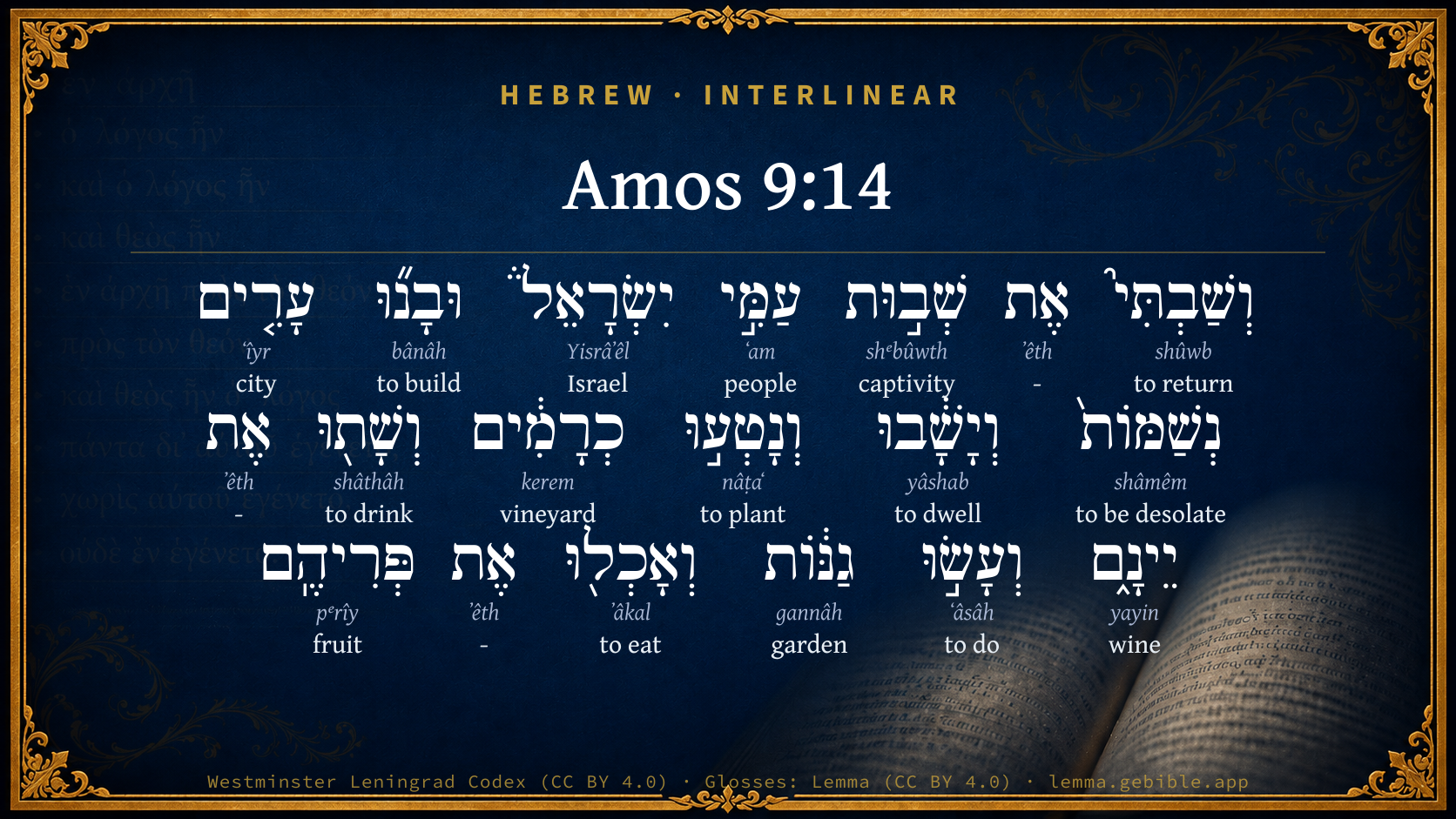
Amos 9:14

Hebrew (Westminster Leningrad Codex) Amos 9:14 appears in the Hebrew Old Testament. The text above is from the Westminster Leningrad Codex. Each word links to its Strong’s number, a concise gloss, and parsing drawn from the Open Scriptures Hebrew Bible morphology. Click any word for its full Brown-Driver-Briggs (BDB) entry.
Download image
Cite this verse

Amos 9:14 (World English Bible). Public Domain. Lemma interlinear Bible study tool, https://lemma.gebible.app/v/amos/9/14.

Show BibTeX & RIS
BibTeX
RIS
English Translation
I will bring back the captivity of my people Israel, And they will rebuild the ruined cities, and inhabit them; and they will plant vineyards, and drink wine from them. They shall also make gardens, And eat the fruit of them.
World English Bible · Public Domain
Download a study sheet

One document with this verse’s original text, its word-by-word gloss line, the meaning frame, cross-references with their text, attributed commentary, and full source and license credits — printable, and it pastes into notes with its structure intact.

This verse Autodidact and up

Study sheet (.html) Plain text (.txt)

A passage Seminary Student

Up to 50 verses in one chapter. A passage sheet keeps up to 6 commentary sources and 12 cross-references per verse, in the order this page ranks them, and says so on the sheet whenever that leaves anything out. Ask for a single verse and you get the Autodidact verse sheet above.

Everything on this page stays free to read, with no account — the sheet is a download of what is already on screen, not access to it.

Want to remove ads? Support Godless Engineer
Compare translations 3

The same verse in 3 English versions, stacked beneath the original-language interlinear above. Click any original word for its lexicon entry.

Each is an independent rendering of the whole verse — the interlinear is not word-aligned to these translations.

Highlighted words mark where these versions differ — a whole-verse word diff, not a word-by-word alignment.

  • World English Bible Public Domain
    I will bring back the captivity of my people Israel, And they will rebuild the ruined cities, and inhabit them; and they will plant vineyards, and drink wine from them. They shall also make gardens, And eat the fruit of them.
  • King James Version Public Domain
    And I will bring again the captivity of my people of Israel, and they shall build the waste cities, and inhabit them; and they shall plant vineyards, and drink the wine thereof; they shall also make gardens, and eat the fruit of them.
  • unfoldingWord Literal Text CC BY-SA 4.0
    I will bring back from captivity my people Israel. They will build the ruined cities and inhabit them, they will plant vineyards and drink their wine, and they will make gardens and eat their fruit.

unfoldingWord Literal Text — © unfoldingWord, licensed CC BY-SA 4.0. Word-aligned USFM3 via Door43 (git.door43.org/unfoldingWord/en_ult).

Versions to compare (up to 4)

3 of 4 selected

Show all 18 translations

Every available English version of this verse, each an independent rendering of the whole verse.

  • World English Bible Public Domain
    I will bring back the captivity of my people Israel, And they will rebuild the ruined cities, and inhabit them; and they will plant vineyards, and drink wine from them. They shall also make gardens, And eat the fruit of them.
  • Berean Standard Bible Public Domain
    I will restore My people Israel from captivity; they will rebuild and inhabit the ruined cities. They will plant vineyards and drink their wine; they will make gardens and eat their fruit.
  • Majority Standard Bible Public Domain
    I will restore My people Israel from captivity; they will rebuild and inhabit the ruined cities. They will plant vineyards and drink their wine; they will make gardens and eat their fruit.
  • King James Version Public Domain
    And I will bring again the captivity of my people of Israel, and they shall build the waste cities, and inhabit them; and they shall plant vineyards, and drink the wine thereof; they shall also make gardens, and eat the fruit of them.
  • American Standard Version (1901) Public Domain
    And I will bring back the captivity of my people Israel, and they shall build the waste cities, and inhabit them; and they shall plant vineyards, and drink the wine thereof; they shall also make gardens, and eat the fruit of them.
  • Revised Version (1885) Public Domain
    And I will bring again the captivity of my people Israel, and they shall build the waste cities, and inhabit them; and they shall plant vineyards, and drink the wine thereof; they shall also make gardens, and eat the fruit of them.
  • Geneva Bible (1599) Public Domain
    And I will bring againe the captiuitie of my people of Israel: and they shall build the waste cities, and inhabite the, and they shall plant vineyardes, and drinke the wine thereof: they shall also make gardens, and eate the fruites of them.
  • Douay-Rheims (1899) Public Domain
    And I will bring back the captivity of my people Israel: and they shall build the abandoned cities, and inhabit them: and they shall plant vineyards, and drink the wine of them: and shall make gardens, and eat the fruits of them. And I will plant them upon their own land: and I will no more pluck them out of their land which I have given them, saith the Lord thy God.
  • Young's Literal Translation Public Domain
    And I have turned back `to' the captivity of My people Israel, And they have built desolate cities, and inhabited, And have planted vineyards, and drunk their wine, And made gardens, and eaten their fruit.
  • Literal Standard Version CC BY-SA 4.0
    And I have turned back [to] the captivity of My people Israel, || And they have built desolate cities, and inhabited, || And have planted vineyards, and drunk their wine, || And made gardens, and eaten their fruit.
  • Unlocked Literal Bible CC BY-SA 4.0
    I will bring back from captivity my people Israel. They will build the ruined cities and inhabit them, they will plant vineyards and drink their wine, and they will make gardens and eat their fruit.
  • unfoldingWord Literal Text CC BY-SA 4.0
    I will bring back from captivity my people Israel. They will build the ruined cities and inhabit them, they will plant vineyards and drink their wine, and they will make gardens and eat their fruit.
  • Darby Bible Public Domain
    And I will turn again the captivity of my people Israel, and they shall build the waste cities, and inhabit them; and they shall plant vineyards, and drink the wine thereof; and they shall make gardens, and eat the fruit of them.
  • World Messianic Bible Public Domain
    I will bring my people Israel back from captivity, and they will rebuild the ruined cities, and inhabit them; and they will plant vineyards, and drink wine from them. They shall also make gardens, and eat their fruit.
  • Webster's Bible Public Domain
    And I will bring again the captivity of my people of Israel, and they shall build the waste cities, and inhabit them; and they shall plant vineyards, and drink the wine of them; they shall also make gardens, and eat the fruit of them.
  • Free Bible Version CC BY-SA 4.0
    I will bring my people back from captivity, and they will rebuild the ruined cities, and they shall live in them. They shall plant vineyards and drink their wine; they will plant gardens and eat the fruit they produce.
  • Bible in Basic English Public Domain
    And I will let the fate of my people Israel be changed, and they will be building up again the waste towns and living in them; they will again be planting vine-gardens and taking the wine for their drink; and they will make gardens and get the fruit of them.
  • JPS Tanakh (1917) Public Domain
    And I will turn the captivity of My people Israel, and they shall build the waste cities, and inhabit them; and they shall plant vineyards, and drink the wine thereof; they shall also make gardens, and eat the fruit of them.

Literal Standard Version (2020), Covenant Press — licensed CC BY-SA 4.0. Text via the HelloAO Bible API (eBible.org). Unlocked Literal Bible (unfoldingWord) — licensed CC BY-SA 4.0. Text via the HelloAO Bible API (eBible.org). unfoldingWord Literal Text — © unfoldingWord, licensed CC BY-SA 4.0. Word-aligned USFM3 via Door43 (git.door43.org/unfoldingWord/en_ult). Free Bible Version, Dr. Jonathan Gallagher — licensed CC BY-SA 4.0. Text via the HelloAO Bible API (eBible.org).

Word by word

More ways to search: Search by grammar → Find every occurrence → Compare this word →

Practice this passage: Drill this verse → Learn its vocabulary →

גַנּ֔וֹת
gannâh
H1593
“gardens”
Noun, Common, Feminine, Plural, Absolute
Part of Speech
Noun
Type
Common
Gender
Feminine
Number
Plural
State
Absolute
Full BDB Definition

Origin: from H1588

TWOT: 367b

garden, orchard
  1. וְשַׁבְתִּי֮ shûwb H7725 “and · to return” Conjunction + Verb, Qal, Sequential Perfect, 1st Person, Common, Singular
  2. אֶת ʼêth H853 “-” Particle, Direct Object
  3. שְׁב֣וּת shᵉbûwth H7622 “captivity of” Noun, Common, Feminine, Singular, Construct
  4. עַמִּ֣י ʻam H5971 “people · my” Noun, Common, Masculine, Singular, Construct + Suffix, Personal, 1st Person, Common, Singular
  5. יִשְׂרָאֵל֒ Yisrâʼêl H3478 “Israel” Noun, Proper
  6. וּבָנ֞וּ bânâh H1129 “and · to build” Conjunction + Verb, Qal, Sequential Perfect, 3rd Person, Common, Plural
  7. עָרִ֤ים ʻîyr H5892 “cities” Noun, Common, Feminine, Plural, Absolute
  8. נְשַׁמּוֹת֙ shâmêm H8074 “being desolate” Verb, Niphal, Participle Active, Feminine, Plural, Absolute
  9. וְיָשָׁ֔בוּ yâshab H3427 “and · to dwell” Conjunction + Verb, Qal, Sequential Perfect, 3rd Person, Common, Plural
  10. וְנָטְע֣וּ nâṭaʻ H5193 “and · to plant” Conjunction + Verb, Qal, Sequential Perfect, 3rd Person, Common, Plural
  11. כְרָמִ֔ים kerem H3754 “vineyards” Noun, Common, Both, Plural, Absolute
  12. וְשָׁת֖וּ shâthâh H8354 “and · to drink” Conjunction + Verb, Qal, Sequential Perfect, 3rd Person, Common, Plural
  13. אֶת ʼêth H853 “-” Particle, Direct Object
  14. יֵינָ֑ם yayin H3196 “wine · their” Noun, Common, Masculine, Singular, Construct + Suffix, Personal, 3rd Person, Masculine, Plural
  15. וְעָשׂ֣וּ ʻâsâh H6213 “and · to do” Conjunction + Verb, Qal, Sequential Perfect, 3rd Person, Common, Plural
  16. וְאָכְל֖וּ ʼâkal H398 “and · to eat” Conjunction + Verb, Qal, Sequential Perfect, 3rd Person, Common, Plural
  17. אֶת ʼêth H853 “-” Particle, Direct Object
  18. פְּרִיהֶֽם pᵉrîy H6529 “fruit · their” Noun, Common, Masculine, Singular, Construct + Suffix, Personal, 3rd Person, Masculine, Plural

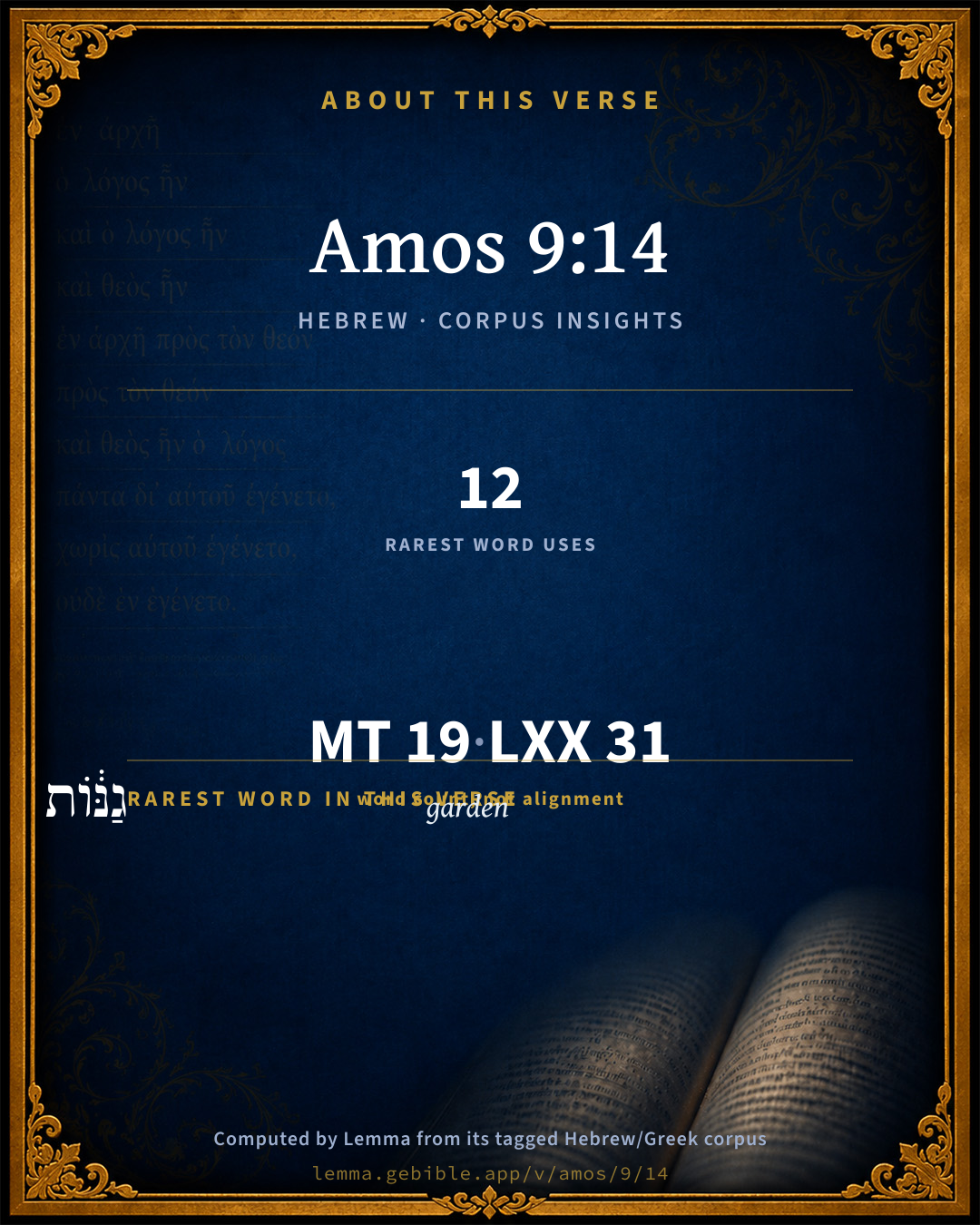
About this verse

These counts appear in no published source. They are computed here, from the morphology-tagged text and Lemma’s own curated glosses. What Lemma adds →

19
words
17
distinct lemmas
Prophets
section

Notable vocabulary

The rarest word here is גַנּ֔וֹת garden H1593 — appearing just 12 times in the whole Hebrew Bible.

Shared distinctive vocabulary

גַנּ֔וֹת garden H1593 occurs in 12 verses of the Hebrew Bible. Also found in:

Grammatical profile

  • 8 verbs
  • 8 nouns
  • 3 particles

Verb forms

  • וְשַׁבְתִּי֮ Qal · Sequential Perfect
  • וּבָנ֞וּ Qal · Sequential Perfect
  • נְשַׁמּוֹת֙ Niphal · Participle Active
  • וְיָשָׁ֔בוּ Qal · Sequential Perfect
  • וְנָטְע֣וּ Qal · Sequential Perfect
  • וְשָׁת֖וּ Qal · Sequential Perfect
  • וְעָשׂ֣וּ Qal · Sequential Perfect
  • וְאָכְל֖וּ Qal · Sequential Perfect

Hebrew & Septuagint length

In English translation the verse runs 41 words from the Hebrew and 44 from the Septuagint (LXX English) — closely comparable.

A rough comparison of the two English renderings, which tokenize alike — not a word-level alignment.

Word counts can differ between the Hebrew and the Greek without any difference in meaning — e.g. the Hebrew direct-object marker אֵת has no separate Greek word, and Greek often adds the article ὁ.

In the original languages it is 19 Hebrew tokens and 31 Greek tokens — but the two are counted differently (Hebrew bundles its prefixes and suffixes into one token; the Greek is in lemma form), so that isn’t a like-for-like length.

Cross-references

17

Topical passages linked to Amos 9:14 in the Treasury of Scripture Knowledge — connected by theme and wording, ordered by reader-vote popularity; previews shown in the World English Bible.

  • Isaiah 61:4 They shall build the old wastes, they shall raise up the former desolations, and they shall repair the waste cities, the desolations of many generations.
  • Jeremiah 30:3 For, behold, the days come, says Yahweh, that I will turn again the captivity of my people Israel and Judah, says Yahweh; and I will cause them to return to the land that I gave to their fathers, and they shall possess it.
  • Jeremiah 30:18 Thus says Yahweh: Behold, I will turn again the captivity of Jacob's tents, and have compassion on his dwelling-places; and the city shall be built on its own hill, and the palace shall be inhabited after its own manner.
  • Ezekiel 28:26 They shall dwell securely therein; yes, they shall build houses, and plant vineyards, and shall dwell securely, when I have executed judgments on all those who do them despite round about them; and they shall know that I am Yahweh their God.
  • Jeremiah 31:28 It shall happen that, like as I have watched over them to pluck up and to break down and to overthrow and to destroy and to afflict, so will I watch over them to build and to plant, says Yahweh.
  • Psalms 53:6 Oh that the salvation of Israel would come out of Zion! When God brings back the captivity of his people, Then Jacob shall rejoice. Israel shall be glad.
  • Isaiah 65:21 They shall build houses, and inhabit them; and they shall plant vineyards, and eat the fruit of them.
  • Ezekiel 37:25–28 They shall dwell in the land that I have given to Jacob my servant, in which your fathers lived; and they shall dwell therein, they, and their children, and their children's children, forever: and David my servant shall be their prince for ever.
  • Isaiah 62:8–9 Yahweh has sworn by his right hand, and by the arm of his strength, Surely I will no more give your grain to be food for your enemies; and foreigners shall not drink your new wine, for which you have labored:
  • Jeremiah 31:23 Thus says Yahweh of Hosts, the God of Israel, Yet again shall they use this speech in the land of Judah and in the cities of it, when I shall bring again their captivity: Yahweh bless you, habitation of righteousness, mountain of holiness.
  • Jeremiah 31:38–40 Behold, the days come, says Yahweh, that the city shall be built to Yahweh from the tower of Hananel to the gate of the corner.
  • Ezekiel 16:53 I will turn again their captivity, the captivity of Sodom and her daughters, and the captivity of Samaria and her daughters, and the captivity of your captives in the midst of them;
  • Ezekiel 36:33–36 Thus says the Lord Yahweh: In the day that I cleanse you from all your iniquities, I will cause the cities to be inhabited, and the waste places shall be built.
  • Ezekiel 39:25 Therefore thus says the Lord Yahweh: Now will I bring back the captivity of Jacob, and have mercy on the whole house of Israel; and I will be jealous for my holy name.
  • Joel 3:1–2 "For, behold, in those days, And in that time, When I restore the fortunes of Judah and Jerusalem,
  • Amos 5:11 Forasmuch therefore as you trample on the poor, And take taxes from him of wheat: You have built houses of hewn stone, But you will not dwell in them. You have planted pleasant vineyards, But you shall not drink their wine.
  • Zephaniah 1:13 Their wealth will become a spoil, and their houses a desolation. Yes, they will build houses, but won't inhabit them. They will plant vineyards, but won't drink their wine.

Cross-references courtesy of OpenBible.info (CC BY 4.0).

Hebrew and Greek witnesses Masoretic Hebrew ↔ Greek Septuagint

The same verse in the two great witnesses to the Old Testament, shown verse-for-verse.

These are two independent witnesses, not word-aligned to each other, and the Septuagint is shown in lemma (dictionary) form.

Hebrew Amos 9:14 Masoretic · Westminster Leningrad Codex

וְשַׁבְתִּי֮ אֶת שְׁב֣וּת עַמִּ֣י יִשְׂרָאֵל֒ וּבָנ֞וּ עָרִ֤ים נְשַׁמּוֹת֙ וְיָשָׁ֔בוּ וְנָטְע֣וּ כְרָמִ֔ים וְשָׁת֖וּ אֶת יֵינָ֑ם וְעָשׂ֣וּ גַנּ֔וֹת וְאָכְל֖וּ אֶת פְּרִיהֶֽם

I will bring back the captivity of my people Israel, And they will rebuild the ruined cities, and inhabit them; and they will plant vineyards, and drink wine from them. They shall also make gardens, And eat the fruit of them.

World English Bible · Public Domain

Greek LXX Amos 9:14 Septuagint · lemma form

καί ἐπιστρέφω ὁ αἰχμαλωσία λαός ἐγώ ἰσραήλ καί οἰκοδομέω πόλις ὁ ἀπο ἀναἵζω καί καταοἰκέω καί καταφυτεύω ἀμπελών καί πίνω ὁ οἶνος αὐτός καί φυτεύω κῆπος καί ἐσθίω ὁ καρπός αὐτός

And I will turn the captivity of my people Israel, and they shall rebuild the ruined cities, and shall inhabit them; and they shall plant vineyards, and shall drink the wine from them; and they shall form gardens, and eat the fruit of them.

LXX2012 (modern English Septuagint) · Public Domain

Hebrew: Westminster Leningrad Codex (CC BY 4.0). Greek: Septuagint (public domain); English from LXX2012 (modern English Septuagint) (Public Domain). How the Septuagint differs from the Hebrew →

Targum (Aramaic paraphrase)

1

The Targum is the ancient Jewish Aramaic paraphrase of the Hebrew Scriptures — an interpretive translation, not the Hebrew text itself. Onkelos (literal) and Pseudo-Jonathan (expansive) render the Torah, and Jonathan the Prophets. Coverage is partial: where no permissively-licensed English translation exists for a verse, only the Aramaic is shown. This is verse-level text, not a word-by-word alignment to the Hebrew.

  1. Targum Jonathan Prophets (Joshua–Malachi)
    וְאָתֵיב יַת גָלוּת עַמִי יִשְׂרָאֵל וְיִבְנוּן קִרְוִין דְצַדְיָן וִיתוּבוּן וְיִצְבּוּן כַּרְמִין וְיִשְׁתּוּן יַת חַמְרֵהוֹן וְיַעְבְּדוּן גַנִין וְיֵכִלוּן יַת אִבֵּיהוֹן:

    (no public-domain English translation for this verse)

    Targum Jonathan — Aramaic: “Mikraot Gedolot” (public domain). English: “Sefaria Community Translation” (CC0 1.0 (public-domain dedication)); “London "Chaldee Paraphrase," 1871” (public domain). Text via Sefaria.

Commentary

Notes on Amos 9:14 from classic Christian and Jewish commentators (each source and its license shown beneath its notes). The classic Christian expositions comment on the surrounding passage and are grouped to its opening verse, so a note may address several verses; the Jewish commentaries on the Tanakh (Rashi and others) are per-verse, so they appear only where the commentator wrote on this verse.

Lemma curates 59 commentaries, every one of them public domain or Creative Commons licensed, each selected and text-cleaned for this edition rather than reprinted as found. About our sources →

Trapp's Complete Commentary

John Trapp

Amo 9:14 And I will bring again the captivity of my people of Israel, and they shall build the waste cities, and inhabit [them]; and they shall plant vineyards, and drink the wine thereof; they shall also make gardens, and eat the fruit of them.

Ver. 14. And I will bring again the captivity of my people] There is an elegance in the original that cannot be translated into English, and God seems delighted with such alliteration, as hath been before observed; to show the lawful use of rhetoric in divine discourses, so it be not affected, abused, idolized. This promise is fulfilled when believers are by the gospel brought "from darkness to light, and from the power of Satan unto God, that they may receive forgiveness of sins," Act 26:18, and be set free from the tyranny of corruption and terror of death, Heb 2:14-15 Col 1:13 Luk 1:74 Zec 9:11 Psa 68:19.

And they shall build the waste cities] Restore the sincere service of God, as those noble reformers did in all ages; fetching the Church, as it were, out of the wilderness, where she had long lain hidden, Rev 12:6, and whence she is said at length to come "leaning upon her beloved," Son 8:5.

And they shall plant vineyards] That is, particular Churches.

And drink the wine thereof] Have the fruit and comfort of their labours in the Lord, which they shall see not to be in vain, 1Co 15:58.

They shall also make gardens, and eat of the fruit] While they shall see their people to be neither barren nor unfruitful in the knowledge of Jesus Christ, 2Pe 1:8, but far off flourishing, Psa 92:13, actuosi et fructuosi, Isa 51:3. The Popish commentators (as it is the manner of many of them to mar and bemire the text with their absurd glosses) by cities here would have men to understand the state of married people, by vineyards their prelates, and by gardens monks. Is not this to wrest the Scriptures, and so to set them on the rack, as to make them speak more than ever they intended? Is it not to compel them to go two miles when they are willing to go but one? Is it not to taw them, and gnaw them, as Tertullian saith that Marcion, the heretic (that Mus Ponticus, as he therefore calls him), did, to make them serviceable to his vile purposes?

John Trapp, A Commentary or Exposition upon All the Books of the Old and New Testament (1647–1656) — public domain. Text from a community e-Sword module.

Joseph Benson's Commentary

Amo 9:14-15. I will bring again the captivity of my people — I will restore them to their own country, and settle them in it. See the following verse, and notes on Isa 11:12; and Eze 28:25. They shall build the waste cities, &c. — Compare the texts referred to in the margin. This and the following part of the verse contains a promise that they should enjoy the fruit of their labours, in opposition to that curse denounced against them, chap. Amo 5:11; Deu 28:30, that they should build houses and not dwell in them. I will plant them, &c., they shall no more be pulled up — This part of the prophecy will receive its completion on the future restoration of the Jews to their own land.

Joseph Benson's Commentary on the Old and New Testaments (1811–1818) — public domain. Text from a community e-Sword module.

Tyndale Open Study Notes

Tyndale Open Resources

9:14-15 God promised not to completely destroy his people (9:8) but to bring the surviving remnant back to the land (see Hos 2:23).

Tyndale Open Study Notes — © Tyndale Open Resources, licensed CC BY-SA 4.0. Text via the HelloAO Bible API.

Geneva Bible (1599)

Geneva Bible translators

The accomplishment thereof is under Christ, when they are planted in this Church, out of the which they can never be pulled, after they are once grafted therein.

Geneva Bible (1599) marginal notes — public domain. Text via Bolls.life.

Jamieson, Fausset & Brown

Robert Jamieson, A. R. Fausset & David Brown

build the waste cities-- (Isa 61:4; Eze 36:33-36).

Jamieson, Fausset & Brown — Commentary Critical and Explanatory on the Whole Bible (1871) — public domain (CC PDM 1.0). Text via the HelloAO Bible API.

Adam Clarke's Commentary

Verse 14. They shall plant vineyards, and drink the wine] When threatened with great evils, Am 5:11, it is said, "They shall plant pleasant vineyards but shall not drink the wine of them." Previously to their restoration, they shall labour for others; after their restoration, they shall labour for themselves.

Adam Clarke's Commentary on the Bible (1810–1826) — public domain. Text from a community e-Sword/MySword module.

John Calvin's Commentaries

As the prophecy we have noticed was one difficult to be believed, especially when the people were led away into exile, the Prophet comes to the help of this lack of faith, and shows that this would be no hindrance to God to lead his people to the felicity of which he speaks. These things seem indeed to be quite contrary, the one to the other, — that the people, spoiled of all dignity, should be driven to a far country to live in miserable exile, and that they should also be scattered into various parts and oppressed by base tyranny; — and that at the same time a most flourishing condition should be promised them, and that such an extension of their kingdom should be promised them, as had never been previously witnessed. Lest then their present calamities should fill their minds with fear and bind them fast in despair; he says that the Israelites shall return from exile, not indeed all; but as we have already seen, this promise is addressed to the elect alone: at the same time he speaks here simply of the people. But, this prophecy is connected with other prophecies: it ought not therefore to be extended except to that remnant seed, of whom we have before taken notice.

Restore then will I the captivity of my people Israel; and then, They shall build nested cities and dwell there; they shall plant vineyards, and their wine shall they drink; they shall make gardens, and shall eat their fruit. He reminds the people here of the blessings mentioned in the Law. They must indeed have known that the hand of the Lord was opposed to them in their exile. Hence the Prophet now shows, that as soon as the Lord would again begin to be propitious to them, there would be a new state of things; for when God shows his smiling countenance, prosperity follows and a blessed success in all things. This then is what the Prophet now intends to show, that the miserable exiles might not faint in despair, when the Lord chastised them. It follows at last —

John Calvin's Commentaries (1540-1563) — public domain. Text from the Calvin Translation Society English edition (1840s-50s) via the Christian Classics Ethereal Library (ccel.org). Calvin's coverage is partial (roughly two-thirds of the Bible); uncommented books and verses are honest gaps, never fabricated. The 19th-century editor's footnotes and remarks are omitted so the notes are faithfully Calvin's own voice.

The Cambridge Bible for Schools and Colleges

gen. ed. J. J. S. Perowne

14. To the land thus blessed by nature, Israel shall be restored: it shall rebuild its waste places, and dwell in them securely; it shall also enjoy, without interruption or interference, the varied produce of the soil.

I will turn the captivity] The precise sense of the Hebrew expression is disputed; and others—as Ewald, Kuenen, Dillmann (on Job_42:10), Cheyne and Kirkpatrick on Psa_14:7—prefer to render “turn the fortune (lit. turn the turning) of my people,” i.e. effect a decisive and epoch-making change in its lot. In the present passage, however, even though the latter be the true meaning, the general sense remains the same: for, as Amos pictures the people as exiled (Amo_7:17 &c.), the change of fortune which, upon this view would be predicated in the expression, would of course be a return from captivity. Comp. Hos_6:11. The promise of restoration from exile (or captivity) is naturally common in the later prophets: for similar promises in earlier prophets, see Hos_11:10-11.

and they shall build waste cities, and inhabit them] waste cities, as Jer_33:10, Isa_54:3; cf. Eze_36:35. The similar promise in Isa_65:21 may also be compared (“they shall build houses, and inhabit them,”—opposed to Isa_65:22 “they shall not build, and another inhabit”). Contrast ch. Amo_5:11; also Deu_28:30 (“thou shalt build a house, and not inhabit it”), Zep_1:13.

and they shall plant vineyards, and drink the wine thereof] Cf. Isa_65:21 (“they shall plant vineyards, and eat the fruit thereof”); also Eze_28:26. Contrast ch. Amo_4:9, Amo_5:11; also Deu_28:30; Deu_28:39; Zep_1:13.

and they shall make gardens, and eat the fruit of them] Contrast ch. Amo_4:9.

The Cambridge Bible for Schools and Colleges (gen. ed. J. J. S. Perowne; Cambridge University Press, 1878–1918) — public domain. Text from a community e-Sword module.

John Gill's Exposition

And I will bring again the captivity of my people of Israel,.... Which is not to be understood of the captivity of the Jews in Babylon, and their return from thence, with whom some of the ten tribes of Israel were mixed; for they were not then so planted in their own land as no more to be pulled up again, as is here promised; for they afterwards were dispossessed of it by the Romans, and carried captive, and dispersed among the nations again; but the captivity both of Judah and Israel is meant, their present captivity, which will be brought back, and they will be delivered from it, and return to their own land, and possess it as long as it is a land; see Jer 30:3; as well as be freed from the bondage of sit, Satan, and the law, under which they have been detained some hundreds of years; but now shall be delivered into the glorious liberty of the children of God, of Christians, with which Christ has made them free:

and they shall build the waste cities, and inhabit them; literally the cities in Judea wasted by the Turks, and others; and mystically the churches of Christ, of which saints are fellow citizens, and will be in a desolate condition before the conversion of the Jews, and the gathering in the fulness of the Gentiles; but by these means will be rebuilt, and be in a flourishing condition, and fall of inhabitants:

and they shall plant vineyards, and drink the wine thereof; they shall also make gardens, and eat the fruit of them; which, as before, will be literally true; and in a spiritual sense may signify the churches of Christ, compared to vineyards and gardens, which will be planted everywhere, and be set with pleasant and fruitful plants, and will turn to the advantage of those who have been instruments in planting them; see Sol 6:2.

John Gill's Exposition of the Whole Bible (1746–1763) — public domain (CC PDM 1.0). Text via the HelloAO Bible API.

Albert Barnes' Notes on the Bible

And I will bring again the captivity of My people - Where all around is spiritual, there is no reason to take this alone as earthly. An earthly restoration to Canaan had no value, except as introductory to the spiritual. The two tribes were, in a great measure, restored to their own land, when Zachariah, being “filled with the Holy Spirit, prophesied,” as then about to accomplished, that “God hath visited and redeemed his people, and hath raised up a horn of salvation to us in the house of His servant David, as He spake by the mouth of His holy prophets - that we, being delivered from the hands of our enemies, might serve Him without fear, in holiness and righteousness before Him” Luk 1:68-70, Luk 1:74-75. So our Lord said; “ye shall know the truth, and the truth shall make you free. Whosoever committeth sin, is the servant of sin. If the Son shall make you free, ye shall be free indeed” Joh 8:32, Joh 8:34, Joh 8:36. And Paul, “The law of the Spirit of life in Christ Jesus has made me free from the law of sin and death” Rom 8:2.

And they shall build the waste - (Rather “shall build waste”) “cities.” “As they who are freed from captivity and are no longer in fear of the enemy, “build cities and plant vineyards” and gardens,” so shall these unto God. “This,” says one of old , “needs no exposition, since, throughout the world, amid the desert of pagandom, which was before deserted by God, Churches of Christ have arisen, which, for the firmness of faith may be called “cities,” and, for the gladness of “hope which maketh not ashamed, vineyards,” and for the sweetness of charity, gardens; wherein they dwell, who have builded them through the word; whence they drink the wine of gladness, who formed them by precepts; whence they eat fruits, who advanced them by counsels, because, as “he who reapeth,” so he too who “buildeth” such “cities,” and he who “planteth” such “vineyards,” and he who “maketh” such “gardens, receiveth wages and gathereth fruit unto life eternal” Joh 4:36.

Albert Barnes' Notes on the Bible (1834–1885) — public domain. Text from a community e-Sword/MySword module.

Haydock's Catholic Bible Commentary

CHAPTER IX.

George Leo Haydock (1774–1849), Haydock's Catholic Family Bible and Commentary, 1859 edition — public domain. Excludes Psalms (Douay-Rheims chapter numbering differs from Protestant) and Deuterocanonical books (Catholic canon only).

Matthew Poole's English Annotations

What is contained in this verse is an express promise of a return to captive Israel, and it is an implicit stating of the time when those former promises, Amo 9:11-13, should be fulfilled.

I will bring again: Cyrus was the person who proclaimed liberty of return to captive Israel, but God stirred up his spirit to do this, and it was God’s eminent work; he was seen in it, as Psa 126:3,4.

The captivity of my people of Israel; of those Shalmaneser carried captive and those Nebuchadnezzar carried captive, both falling under the disposal of Cyrus by his conquest over Babylon; by which means Israel, the remnant of the ten tribes, as well as the two tribes, had leave to return.

They shall build the waste cities, of Judah and of Israel too, as well as Jerusalem, many of which we meet with in the latter histories of the Jews and their wars.

Inhabit them; so they did from the time of their return till the Roman captivity, and were not by the space of six hundred years pulled out of their habitation.

Shall plant vineyards, and drink the wine thereof; be blessed in the increase of them and enjoy it, freed from that curse, Deu 28:39.

Shall also make gardens, and eat the fruit of them; these, planted for delight, should be blessed too; both vineyards and gardens should be fruitful, and they that planted them should dwell in their houses safely, and eat the fruit of them.

Matthew Poole's English Annotations on the Holy Bible (1683–1685) — public domain. Text from a community e-Sword/MySword module.

Whedon's Commentary on the Bible

Daniel D. Whedon

14. To this fertile soil the exiles will be brought back, there to live in prosperity and happiness.

Bring again the captivity of my people — See on Hos_6:11, and p. 133.

Build the waste cities — Destroyed by the invader (Amo_3:15; Amo_5:11; compare Jer_33:10; Isa_54:3).

Inhabit — Compare the threat in Amo_5:11.

Plant vineyards,… drink the wine — Compare Amo_4:9; Amo_5:11; for a similar promise see Isa_65:21; Eze_28:26.

Make gardens,… eat the fruit — They will be permitted to enjoy the fruit of their labor (compare Amo_4:9).

Daniel D. Whedon (gen. ed.), Commentary on the Old and New Testaments (1874–1909) — public domain. Text from a community e-Sword module.

The Pulpit Commentary

I will bring again the captivity; i.e. I will repair the misery which they have suffered. The expression is here metaphorical, and does not necessarily refer to any restoration to an earthly Canaan. Shall build the waste cities. (Isa_54:3) All these promised blessings are inmarked contrast to the punishments threatened. (Deu_28:30, Deu_28:33, Deu_28:39; compare similar premises in Isa_65:21, etc.)

The Pulpit Commentary (1880–1919), ed. H.D.M. Spence-Jones & Joseph S. Exell — public domain. Text from a community e-Sword module.

unfoldingWord translationNotes

Door43 World Missions Community

I will plant them upon their land, and they will never again be uprooted from the land

Bringing the people back to their land and keeping them safe from enemies is spoken of as if Israel were a plant that Yahweh would put in the ground and not let anyone pull the plant up from the ground. AT: "I will cause them to live in the land forever like a plant that is never uprooted" (See: Metaphor)

they will never again be uprooted from the land

This can be stated in active form. AT: "no one will ever again uproot them from the land" (See: Active or Passive)

uprooted

for a plant and its roots to be pulled out of the ground

translationWords

captive

people of God

ruin

vineyard

wine

Yahweh

God

unfoldingWord translationNotes — © Distant Shores Media and the Door43 World Missions Community, licensed CC BY-SA 4.0. Source: git.door43.org/Door43/en_tn.

Lesson kit

Teaching starters — assembled from the data on this page, not authored interpretation. Every prompt links to the verse data it draws on. Edit before teaching.

Amos, in the Prophets, opens this verse with 19 words (17 distinct Hebrew lemmas). Its most distinctive word is gannâh (“garden”). A historical commentator’s framing appears above. Read the whole chapter for the surrounding context.

Discussion questions

  1. How does “garden” (gannâh) shape what this verse is saying?
  2. Numbers 24:6 shares the word «garden» with this verse. How do the two illuminate each other?
  3. These translations render this verse differently; the difference is in the English rendering, not the original. What questions does that raise?
  4. The verb «וְשַׁבְתִּי֮» is Qal Sequential Perfect. How does its form color the action?
  5. Reading how Trapp's Complete Commentary and Joseph Benson's Commentary read this verse, where do the two commentators agree and where do they part?

Things to notice

Reading settings

Reading text

Shown beneath each verse's original-language words.

Old Testament
Old Testament edition

Read the OT as the Masoretic Hebrew (MT) or the Greek Septuagint (LXX).

English shown for the Greek Septuagint (in the Hebrew ↔ Greek comparison).

Comparing translations? Open the Compare panel on any verse page to stack up to four side by side.