
Zechariah 10:6

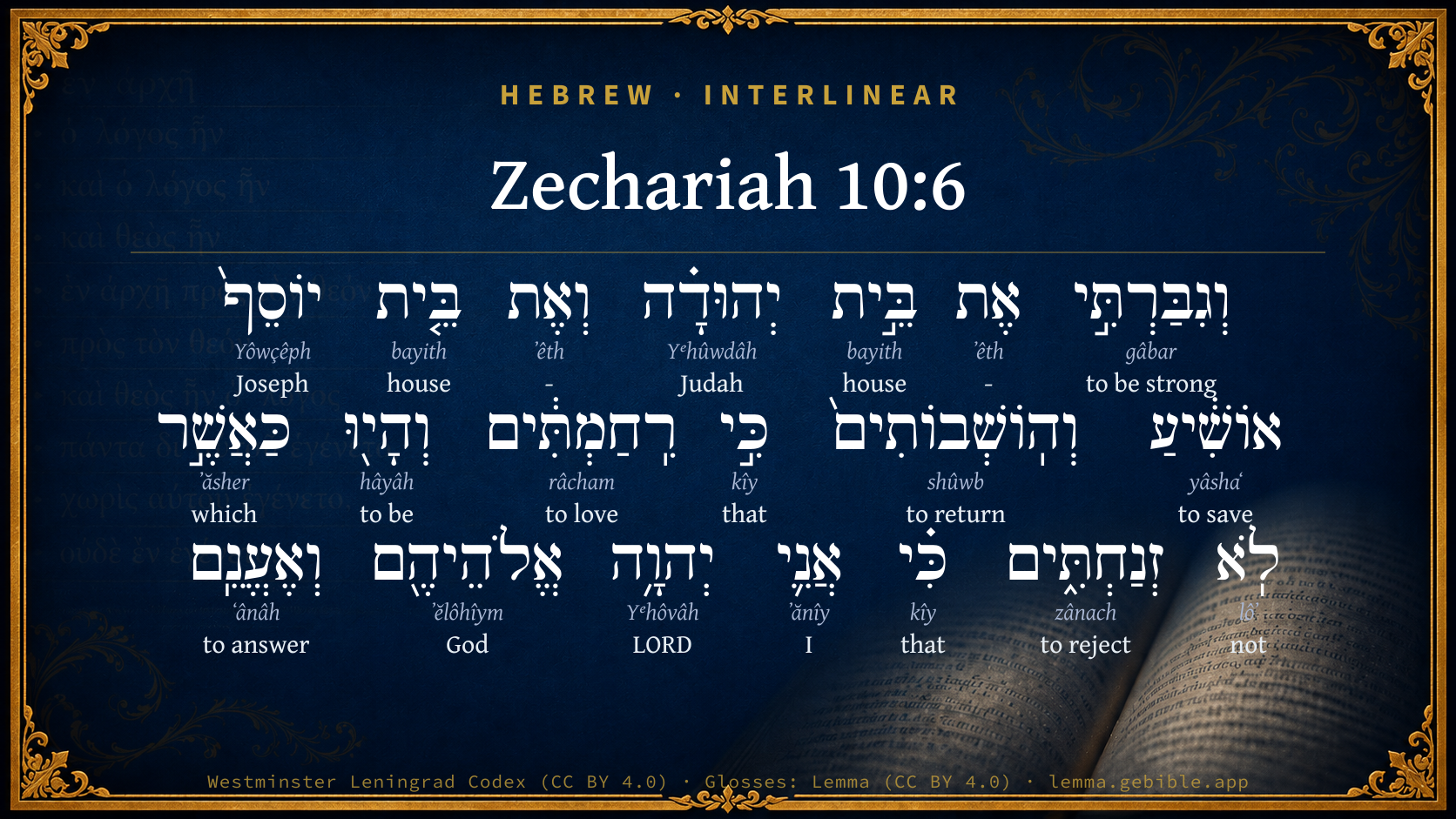
Hebrew (Westminster Leningrad Codex) Zechariah 10:6 appears in the Hebrew Old Testament. The text above is from the Westminster Leningrad Codex. Each word links to its Strong’s number, a concise gloss, and parsing drawn from the Open Scriptures Hebrew Bible morphology. Click any word for its full Brown-Driver-Briggs (BDB) entry.
Download image
Cite this verse

Zechariah 10:6 (World English Bible). Public Domain. Lemma interlinear Bible study tool, https://lemma.gebible.app/v/zechariah/10/6.

Show BibTeX & RIS
BibTeX
RIS
English Translation
"I will strengthen the house of Judah, And I will save the house of Joseph, And I will bring them back; For I have mercy on them; And they will be as though I had not cast them off: For I am Yahweh their God, and I will hear them.
World English Bible · Public Domain
Download a study sheet

One document with this verse’s original text, its word-by-word gloss line, the meaning frame, cross-references with their text, attributed commentary, and full source and license credits — printable, and it pastes into notes with its structure intact.

This verse Autodidact and up

Study sheet (.html) Plain text (.txt)

A passage Seminary Student

Up to 50 verses in one chapter. A passage sheet keeps up to 6 commentary sources and 12 cross-references per verse, in the order this page ranks them, and says so on the sheet whenever that leaves anything out. Ask for a single verse and you get the Autodidact verse sheet above.

Everything on this page stays free to read, with no account — the sheet is a download of what is already on screen, not access to it.

Want to remove ads? Support Godless Engineer
Compare translations 3

The same verse in 3 English versions, stacked beneath the original-language interlinear above. Click any original word for its lexicon entry.

Each is an independent rendering of the whole verse — the interlinear is not word-aligned to these translations.

Highlighted words mark where these versions differ — a whole-verse word diff, not a word-by-word alignment.

  • World English Bible Public Domain
    "I will strengthen the house of Judah, And I will save the house of Joseph, And I will bring them back; For I have mercy on them; And they will be as though I had not cast them off: For I am Yahweh their God, and I will hear them.
  • King James Version Public Domain
    And I will strengthen the house of Judah, and I will save the house of Joseph, and I will bring them again to place them; for I have mercy upon them: and they shall be as though I had not cast them off: for I am the LORD their God, and will hear them.
  • unfoldingWord Literal Text CC BY-SA 4.0
    I will strengthen the house of Judah and save the house of Joseph; for I will restore them and have mercy on them. They will be as though I had not cast them off, for I Yahweh their God, and I will respond to them.

unfoldingWord Literal Text — © unfoldingWord, licensed CC BY-SA 4.0. Word-aligned USFM3 via Door43 (git.door43.org/unfoldingWord/en_ult).

Versions to compare (up to 4)

3 of 4 selected

Show all 18 translations

Every available English version of this verse, each an independent rendering of the whole verse.

  • World English Bible Public Domain
    "I will strengthen the house of Judah, And I will save the house of Joseph, And I will bring them back; For I have mercy on them; And they will be as though I had not cast them off: For I am Yahweh their God, and I will hear them.
  • Berean Standard Bible Public Domain
    I will strengthen the house of Judah and save the house of Joseph. I will restore them because I have compassion on them, and they will be as though I had not rejected them. For I am the LORD their God, and I will answer them.
  • Majority Standard Bible Public Domain
    I will strengthen the house of Judah and save the house of Joseph. I will restore them because I have compassion on them, and they will be as though I had not rejected them. For I am the LORD their God, and I will answer them.
  • King James Version Public Domain
    And I will strengthen the house of Judah, and I will save the house of Joseph, and I will bring them again to place them; for I have mercy upon them: and they shall be as though I had not cast them off: for I am the LORD their God, and will hear them.
  • American Standard Version (1901) Public Domain
    And I will strengthen the house of Judah, and I will save the house of Joseph, and I will bring them back; for I have mercy upon them; and they shall be as though I had not cast them off: for I am Jehovah their God, and I will hear them.
  • Revised Version (1885) Public Domain
    And I will strengthen the house of Judah, and I will save the house of Joseph, and I will bring them again, for I have mercy upon them; and they shall be as though I had not cast them off: for I am the LORD their God, and I will hear them.
  • Geneva Bible (1599) Public Domain
    And I will strengthen the house of Iudah, and I will preserue the house of Ioseph, and I wil bring them againe, for I pitie them: and they shall be as though I had not cast them off: for I am the Lord their God, and will heare them.
  • Douay-Rheims (1899) Public Domain
    And I will strengthen the house of Juda, and save the house of Joseph: and I will bring them back again, because I will have mercy on them: and they shall be as they were when I had cast them off, for I am the Lord their God, and will hear them.
  • Young's Literal Translation Public Domain
    And I have made mighty the house of Judah, And the house of Joseph I do save, And I have caused them to dwell, for I have loved them, And they have been as `if' I had not cast them off, For I `am' Jehovah their God, And I answer them.
  • Literal Standard Version CC BY-SA 4.0
    And I have made the house of Judah mighty, || And I save the house of Joseph, || And I have caused them to dwell, for I have loved them, || And they have been as [if] I had not cast them off, || For I [am] their God YHWH, || And I answer them.
  • Unlocked Literal Bible CC BY-SA 4.0
    I will strengthen the house of Judah and save the house of Joseph; for I will restore them and have mercy on them. They will be as though I had not cast them off, for I am Yahweh their God, and I will respond to them.
  • unfoldingWord Literal Text CC BY-SA 4.0
    I will strengthen the house of Judah and save the house of Joseph; for I will restore them and have mercy on them. They will be as though I had not cast them off, for I Yahweh their God, and I will respond to them.
  • Darby Bible Public Domain
    And I will strengthen the house of Judah, and I will save the house of Joseph, and I will bring them back again; for I will have mercy upon them; and they shall be as though I had not cast them off: for I am Jehovah their God, and I will answer them.
  • World Messianic Bible Public Domain
    “I will strengthen the house of Judah, and I will save the house of Joseph. I will bring them back, for I have mercy on them. They will be as though I had not cast them off, for I am the LORD their God, and I will hear them.
  • Webster's Bible Public Domain
    And I will strengthen the house of Judah, and I will save the house of Joseph, and I will bring them again to place them; for I have mercy upon them: and they shall be as though I had not cast them off: for I am the LORD their God, and will hear them.
  • Free Bible Version CC BY-SA 4.0
    I will strengthen the people of Judah; I will save the people of Joseph. I will bring them back home because I am concerned for them. It will be like I had never rejected them, for I am the Lord their God and I will answer their cries for help.
  • Bible in Basic English Public Domain
    And I will make the children of Judah strong, and I will be the saviour of the children of Joseph, and I will make them come back again, for I have had mercy on them: they will be as if I had not given them up: for I am the Lord their God and I will give them an answer.
  • JPS Tanakh (1917) Public Domain
    And I will strengthen the house of Judah, and I will save the house of Joseph, and I will bring them back, for I have compassion upon them, and they shall be as though I had not cast them off; for I am the LORD their God, and I will hear them.

Literal Standard Version (2020), Covenant Press — licensed CC BY-SA 4.0. Text via the HelloAO Bible API (eBible.org). Unlocked Literal Bible (unfoldingWord) — licensed CC BY-SA 4.0. Text via the HelloAO Bible API (eBible.org). unfoldingWord Literal Text — © unfoldingWord, licensed CC BY-SA 4.0. Word-aligned USFM3 via Door43 (git.door43.org/unfoldingWord/en_ult). Free Bible Version, Dr. Jonathan Gallagher — licensed CC BY-SA 4.0. Text via the HelloAO Bible API (eBible.org).

Word by word

More ways to search: Search by grammar → Find every occurrence → Compare this word →

Practice this passage: Drill this verse → Learn its vocabulary →

זְנַחְתִּ֑ים
zânach
H2186
“to reject · them”
Verb, Qal, Perfect, 1st Person, Common, Singular + Suffix, Personal, 3rd Person, Masculine, Plural
Part of Speech
Verb
Stem
Qal
Form
Perfect
Person
1st Person
Gender
Common
Number
Singular
Full BDB Definition

Origin: a primitive root meaning to push aside

TWOT: 564

to cast off, reject, spurn - (Qal) to reject - (Hiphil) to forcefully reject someone - to stink, emit stench, become odious - (Hiphil) stink (perfect)
  1. וְגִבַּרְתִּ֣י gâbar H1396 “and · to be strong” Conjunction + Verb, Piel, Perfect, 1st Person, Common, Singular
  2. אֶת ʼêth H853 “-” Particle, Direct Object
  3. בֵּ֣ית bayith H1004 “house of” Noun, Common, Masculine, Singular, Construct
  4. יְהוּדָ֗ה Yᵉhûwdâh H3063 “Judah” Noun, Proper
  5. וְאֶת ʼêth H853 “and · -” Conjunction + Particle, Direct Object
  6. בֵּ֤ית bayith H1004 “house of” Noun, Common, Masculine, Singular, Construct
  7. יוֹסֵף֙ Yôwçêph H3130 “Joseph” Noun, Proper
  8. אוֹשִׁ֔יעַ yâshaʻ H3467 “to save” Verb, Hiphil, Imperfect, 1st Person, Common, Singular
  9. וְהֽוֹשְׁבוֹתִים֙ shûwb H7725 “and · to return · them” Conjunction + Verb, Hiphil, Perfect, 1st Person, Common, Singular + Suffix, Personal, 3rd Person, Masculine, Plural
  10. כִּ֣י kîy H3588 “that” Conjunction
  11. רִֽחַמְתִּ֔ים râcham H7355 “to love · them” Verb, Piel, Perfect, 1st Person, Common, Singular + Suffix, Personal, 3rd Person, Masculine, Plural
  12. וְהָי֖וּ hâyâh H1961 “and · to be” Conjunction + Verb, Qal, Perfect, 3rd Person, Common, Plural
  13. כַּאֲשֶׁ֣ר ʼăsher H834 “like/as · which” Preposition + Particle, Relative
  14. לֹֽא lôʼ H3808 “not” Particle, Negative
  15. כִּ֗י kîy H3588 “that” Conjunction
  16. אֲנִ֛י ʼănîy H589 “I” Pronoun, Personal, 1st Person, Common, Singular
  17. יְהוָ֥ה Yᵉhôvâh H3068 “LORD” Noun, Proper
  18. אֱלֹהֵיהֶ֖ם ʼĕlôhîym H430 “God(s) · their” Noun, Common, Masculine, Plural, Construct + Suffix, Personal, 3rd Person, Masculine, Plural
  19. וְאֶעֱנֵֽם ʻânâh H6030 “and · to answer · them” Conjunction + Verb, Qal, Imperfect, 1st Person, Common, Singular + Suffix, Personal, 3rd Person, Masculine, Plural

About this verse

These counts appear in no published source. They are computed here, from the morphology-tagged text and Lemma’s own curated glosses. What Lemma adds →

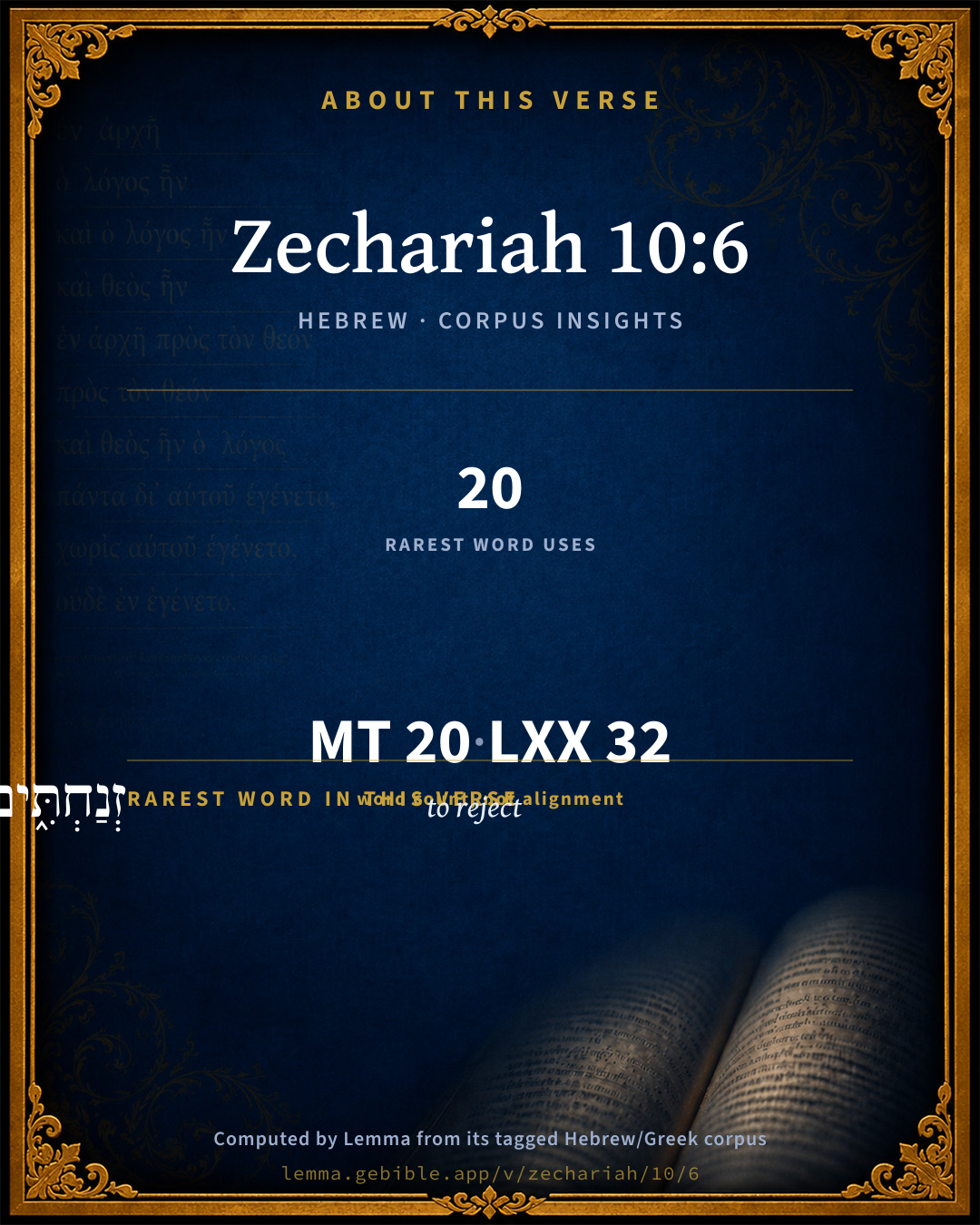
20
words
17
distinct lemmas
Prophets
section

Notable vocabulary

The rarest word here is זְנַחְתִּ֑ים to reject H2186 — appearing just 20 times in the whole Hebrew Bible.

Shared distinctive vocabulary

זְנַחְתִּ֑ים to reject H2186 occurs in 20 verses of the Hebrew Bible. Also found in:

Grammatical profile

  • 7 verbs
  • 6 nouns
  • 1 pronoun
  • 2 conjunctions
  • 4 particles

Verb forms

  • וְגִבַּרְתִּ֣י Piel · Perfect
  • אוֹשִׁ֔יעַ Hiphil · Imperfect
  • וְהֽוֹשְׁבוֹתִים֙ Hiphil · Perfect
  • רִֽחַמְתִּ֔ים Piel · Perfect
  • וְהָי֖וּ Qal · Perfect
  • זְנַחְתִּ֑ים Qal · Perfect
  • וְאֶעֱנֵֽם Qal · Imperfect

Repetition

Words recur within this verse — often emphatic in Hebrew:

  • בֵּ֣ית house H1004 ×2
  • כִּ֣י that H3588 ×2

Hebrew & Septuagint length

In English translation the verse runs 50 words from the Hebrew and 48 from the Septuagint (LXX English) — closely comparable.

A rough comparison of the two English renderings, which tokenize alike — not a word-level alignment.

Word counts can differ between the Hebrew and the Greek without any difference in meaning — e.g. the Hebrew direct-object marker אֵת has no separate Greek word, and Greek often adds the article ὁ.

In the original languages it is 20 Hebrew tokens and 32 Greek tokens — but the two are counted differently (Hebrew bundles its prefixes and suffixes into one token; the Greek is in lemma form), so that isn’t a like-for-like length.

Cross-references

31

Topical passages linked to Zechariah 10:6 in the Treasury of Scripture Knowledge — connected by theme and wording, ordered by reader-vote popularity; previews shown in the World English Bible.

  • Zechariah 10:12 I will strengthen them in Yahweh; And they will walk up and down in his name," says Yahweh.
  • Zechariah 13:9 I will bring the third part into the fire, And will refine them as silver is refined, And will test them like gold is tested. They will call on my name, and I will hear them. I will say, 'It is my people;' And they will say, 'Yahweh is my God.'"
  • Jeremiah 3:18 In those days the house of Judah shall walk with the house of Israel, and they shall come together out of the land of the north to the land that I gave for an inheritance to your fathers.
  • Zephaniah 3:19–20 Behold, at that time I will deal with all those who afflict you, and I will save those who are lame, and gather those who were driven away. I will give them praise and honor, whose shame has been in all the earth.
  • Isaiah 41:10 Don't you be afraid, for I am with you; don't be dismayed, for I am your God; I will strengthen you; yes, I will help you; yes, I will uphold you with the right hand of my righteousness.
  • Ezekiel 36:37 Thus says the Lord Yahweh: For this, moreover, will I be inquired of by the house of Israel, to do it for them: I will increase them with men like a flock.
  • Zechariah 8:11 But now I will not be to the remnant of this people as in the former days," says Yahweh of Hosts.
  • Hosea 1:11 The children of Judah and the children of Israel will be gathered together, and they will appoint themselves one head, and will go up from the land; for great will be the day of Jezreel.
  • Isaiah 14:1 For Yahweh will have compassion on Jacob, and will yet choose Israel, and set them in their own land: and the foreigner shall join himself with them, and they shall cleave to the house of Jacob.
  • Jeremiah 33:2–3 Thus says Yahweh who does it, Yahweh who forms it to establish it; Yahweh is his name:
  • Hosea 2:23 I will sow her to me in the earth; And I will have mercy on her who had not obtained mercy; And I will tell those who were not my people, 'You are my people;' And they will say, 'My God!'"
  • Micah 4:13 Arise and thresh, daughter of Zion; For I will make your horn iron, And I will make your hoofs brass; And you will beat in pieces many peoples: And I will devote their gain to Yahweh, And their substance to the Lord of the whole earth.
  • Micah 5:8 The remnant of Jacob will be among the nations, In the midst of many peoples, Like a lion among the animals of the forest, Like a young lion among the flocks of sheep; Who, if he goes through, treads down and tears in pieces, And there is no one to deliver.
  • Micah 7:16 The nations will see and be ashamed of all their might. They will lay their hand on their mouth. Their ears will be deaf.
  • Micah 7:18–20 Who is a God like you, who pardons iniquity, And passes over the disobedience of the remnant of his heritage? He doesn't retain his anger forever, Because he delights in loving kindness.
  • Zechariah 8:7–8 Thus says Yahweh of Hosts: "Behold, I will save my people from the east country, and from the west country;
  • Psalms 89:21 With whom my hand shall be established. My arm will also strengthen him.
  • Isaiah 41:17–20 The poor and needy seek water, and there is none, and their tongue fails for thirst; I, Yahweh, will answer them, I, the God of Israel, will not forsake them.
  • Isaiah 49:17–21 Your children make haste; your destroyers and those who made you waste shall go forth from you.
  • Jeremiah 23:6 In his days Judah shall be saved, and Israel shall dwell safely; and this is his name by which he shall be called: Yahweh our righteousness.
  • Jeremiah 30:18 Thus says Yahweh: Behold, I will turn again the captivity of Jacob's tents, and have compassion on his dwelling-places; and the city shall be built on its own hill, and the palace shall be inhabited after its own manner.
  • Jeremiah 31:1 At that time, says Yahweh, will I be the God of all the families of Israel, and they shall be my people.
  • Jeremiah 31:20 Is Ephraim my dear son? is he a darling child? for as often as I speak against him, I do earnestly remember him still: therefore my heart yearns for him; I will surely have mercy on him, says Yahweh.
  • Jeremiah 31:31 Behold, the days come, says Yahweh, that I will make a new covenant with the house of Israel, and with the house of Judah:
  • Ezekiel 36:11 and I will multiply on you man and animal; and they shall increase and be fruitful; and I will cause you to be inhabited after your former estate, and will do better [to you] than at your beginnings: and you shall know that I am Yahweh.
  • Ezekiel 37:16 You, son of man, take one stick, and write on it, For Judah, and for the children of Israel his companions: then take another stick, and write on it, For Joseph, the stick of Ephraim, and [for] all the house of Israel his companions:
  • Ezekiel 39:25 Therefore thus says the Lord Yahweh: Now will I bring back the captivity of Jacob, and have mercy on the whole house of Israel; and I will be jealous for my holy name.
  • Romans 11:25–26 For I don't desire, brothers, to have you ignorant of this mystery, so that you won't be wise in your own conceits, that a partial hardening has happened to Israel, until the fullness of the Gentiles has come in,
  • Hosea 1:7 But I will have mercy on the house of Judah, and will save them by Yahweh their God, and will not save them by bow, nor by sword, nor by battle, by horses, nor by horsemen."
  • Obadiah 1:18 The house of Jacob will be a fire, the house of Joseph a flame, and the house of Esau for stubble. They will burn among them, and devour them. There will not be any remaining to the house of Esau." Indeed, Yahweh has spoken.
  • Micah 4:6 "In that day," says Yahweh, "I will assemble that which is lame, And I will gather that which is driven away, And that which I have afflicted;

Cross-references courtesy of OpenBible.info (CC BY 4.0).

Hebrew and Greek witnesses Masoretic Hebrew ↔ Greek Septuagint

The same verse in the two great witnesses to the Old Testament, shown verse-for-verse.

These are two independent witnesses, not word-aligned to each other, and the Septuagint is shown in lemma (dictionary) form.

Hebrew Zechariah 10:6 Masoretic · Westminster Leningrad Codex

וְגִבַּרְתִּ֣י אֶת בֵּ֣ית יְהוּדָ֗ה וְאֶת בֵּ֤ית יוֹסֵף֙ אוֹשִׁ֔יעַ וְהֽוֹשְׁבוֹתִים֙ כִּ֣י רִֽחַמְתִּ֔ים וְהָי֖וּ כַּאֲשֶׁ֣ר לֹֽא זְנַחְתִּ֑ים כִּ֗י אֲנִ֛י יְהוָ֥ה אֱלֹהֵיהֶ֖ם וְאֶעֱנֵֽם

"I will strengthen the house of Judah, And I will save the house of Joseph, And I will bring them back; For I have mercy on them; And they will be as though I had not cast them off: For I am Yahweh their God, and I will hear them.

World English Bible · Public Domain

Greek LXX Zechariah 10:6 Septuagint · lemma form

καί καταἰσχύω ὁ οἶκος ιουδα καί ὁ οἶκος ιωσηφ σώζω καί καταοἰκίζω αὐτός ὅτι ἀγαπάω αὐτός καί εἰμί ὅς τρόπος οὐ ἀποστρέφω αὐτός διότι ἐγώ κύριος ὁ θεός αὐτός καί ἐπιἀκούω αὐτός

And I will strengthen the house of Juda, and save the house of Joseph, and I will settle them; because I have loved them: and they shall be as if I had not cast them off: for I am the Lord their God, and I will hear them.

LXX2012 (modern English Septuagint) · Public Domain

On this verse, The Pulpit Commentary discusses the Septuagint’s reading. Read the note in Commentary ↓

Hebrew: Westminster Leningrad Codex (CC BY 4.0). Greek: Septuagint (public domain); English from LXX2012 (modern English Septuagint) (Public Domain). How the Septuagint differs from the Hebrew →

Targum (Aramaic paraphrase)

1

The Targum is the ancient Jewish Aramaic paraphrase of the Hebrew Scriptures — an interpretive translation, not the Hebrew text itself. Onkelos (literal) and Pseudo-Jonathan (expansive) render the Torah, and Jonathan the Prophets. Coverage is partial: where no permissively-licensed English translation exists for a verse, only the Aramaic is shown. This is verse-level text, not a word-by-word alignment to the Hebrew.

  1. Targum Jonathan Prophets (Joshua–Malachi)
    וְאַדַבֵּר יַת דְבֵית יְהוּדָה וְיַת דְבֵית יוֹסֵף אֶפְרוֹק וְאֶכְנוֹשׁ גָלוּתְהוֹן וְאֶרְחַם עֲלֵיהוֹן וִיהוֹן כִּדְלָא טַלְטַלְתִּינוּן אֲרֵי אֲנָא יְיָ אֱלָהָהוֹן וַאֲקַבֵּיל צְלוֹתְהוֹן:

    (no public-domain English translation for this verse)

    Targum Jonathan — Aramaic: “Mikraot Gedolot” (public domain). English: “Sefaria Community Translation” (CC0 1.0 (public-domain dedication)); “London "Chaldee Paraphrase," 1871” (public domain). Text via Sefaria.

Commentary

Notes on Zechariah 10:6 from classic Christian and Jewish commentators (each source and its license shown beneath its notes). The classic Christian expositions comment on the surrounding passage and are grouped to its opening verse, so a note may address several verses; the Jewish commentaries on the Tanakh (Rashi and others) are per-verse, so they appear only where the commentator wrote on this verse.

Lemma curates 59 commentaries, every one of them public domain or Creative Commons licensed, each selected and text-cleaned for this edition rather than reprinted as found. About our sources →

Adam Clarke's Commentary

Verse 6. I will strengthen the house of Judah] I doubt whether the sixth, seventh, eighth, and ninth verses (Zec 10:6-9) are not to be understood of the future ingathering of the Jews in the times of the Gospel. See Jer 3:14; Jer 23:6; Ho 1:2; Ho 6:11.

Adam Clarke's Commentary on the Bible (1810–1826) — public domain. Text from a community e-Sword/MySword module.

Trapp's Complete Commentary

John Trapp

Zec 10:6 And I will strengthen the house of Judah, and I will save the house of Joseph, and I will bring them again to place them; for I have mercy upon them: and they shall be as though I had not cast them off: for I [am] the LORD their God, and will hear them.

Ver. 6. And I will strengthen the house of Judah] Robustos, ac quasi Gabrieles efficiam (a Lapide). See Zec 12:8 Isa 10:34 Zec 10:5. The saints shall be strengthened with all might according to his glorious power, Col 1:11, at the resurrection especially when Christ shall change their vile bodies, and make them like unto his glorious body, in strength, agility, beauty. The bodies of the saints, saith Luther, shall have that power as to toss the greatest mountains in the world like a ball. Anselm saith, such as they shall be able to shake the whole earth at their pleasure Our Saviour saith that they shall be as the angels of God, Luk 20:36, more like spirits, than bodies, while they are here. In quiet and confidence is their strength, Isa 30:15; and again in the same chapter, Zec 10:7, their strength is to sit still. They expected much strength from Egypt; but the prophet tells them that by sitting still and waiting for the salvation of God by faith they shall have an Egypt; and better, out of weakness they should be made strong, wax valiant in fight, turn to flight the armies of the aliens, Heb 11:34, as the Maccabees did, and as Michael and his angels, Rev 12:7-9, the noble army of the apostles, who were more than conquerors; and martyrs, who tired their tormentors and laughed at their cruelty the valour of the patients, the savageness of the persecutors strove together; till both exceeding nature and belief, bred wonder and astonishment in beholders and readers. These were those lion-like men of the tribe of Judah that took the kingdom by violence. Judah, which signifieth the confessor, had the kingdom, as Levi had the priesthood, both forfeited by Reuben, who was weak as water, Gen 49:4.

And I will save the house of Joseph] That is, Ephraim, put for the ten tribes, whom God here promiseth to save, not to bring back, {See Geneva on "Zec 10:9"} But others there are that gather from these words and those that follow that God will not only preserve them, but reduce and re-settle them in their own country, yea, and multiply them so abundantly, as that their country shall not be able to hold them, Zec 10:10. Whence cometh Asshur’s and Egypt’s subjection to Christ; that is, all the tract of the east and of the south, Zec 10:11, and their perpetual establishment in the faith.

And I will bring them again to place them] I will place them in their houses, as Hos 11:11. The Sept. render it, I will cause them to dwell. The Chaldee, I will gather together their captivity. Some special mercy is assured them by this special word of a mixed conjugation, compos, שׁוב et הושׁכחים ιשׁα.

For I have mercy upon them] Here is a double cause alleged, of these so great and gracious promises; and both excluding works. First, God’s mere mercy. Secondly, his election of grace, for "I am the Lord their God." This latter is the cause of the former; for God chose his people for his love, and then loveth them for his choice. The effects of which love are here set down: 1. That he heareth their prayers, "I will hear them." 2. That he re-accepteth and restoreth them in Christ, as if they had never offended against him, "They shall be as though I had not cast them off." That was a cutting speech, and far worse than their captivity, Jer 16:13, when God not only threateneth to cast them out of their country into a strange land, but that there "he would show them no favour." Here he promiseth to pity them; and then they must needs think deliverance was at next door by.

And they shall be as though I had not cast them off] And this the sooner and the rather because they called them outcasts, saying, "This is Zion, whom no man seeketh after," Jer 30:17. The Jewish nation, saith Cicero, show how God regards them that have been so often overcome, viz. by Nebuchadnezzar, Pompey, &c. God therefore promiseth to provide for his own great name, by being fully reconciled to his poor people, whom the world looked upon as abjects.

For I am the Lord their God] And if I should not see to their safety, it would much reflect upon me. This David well knew; and therefore prays thus, "I am thine, Lord, save me," Psa 119:94.

And will hear them, or, I will speak with them] Speak to their hearts. It is no more, saith one, than if a man were in a fair dining room with much good company, and there is some special friend whom he loveth dearly that calleth him aside to speak in private of business that nearly concerneth him; and though he go into a worse room, yet he is well enough pleased. So if God, in loss of friends, houses, country, comforts whatsoever, will speak with us, will answer us, the loss will be easily made up. Philip, Landgrave of Hesse, being a long time prisoner under Charles V, was demanded what upheld him all that time? He answered, that he had felt the favour of God, and the Divine consolations of the martyrs. There are Divine comforts that are felt only under the cross. I will bring her into the wilderness, and there speak to her heart, Hos 2:14. Israel was never so royally provided for with manna, quails, and other cares as when they were in the wilderness. The cross is anointed with comfort, which makes it not only light, but sweet; not only not troublesome and importable, but desirable and delightful, saith Bernard. Thy presence, O Lord, made the very gridiron sweet to Laurence, saith another. How easily can God make up our losses and breaches?

John Trapp, A Commentary or Exposition upon All the Books of the Old and New Testament (1647–1656) — public domain. Text from a community e-Sword module.

Tyndale Open Study Notes

Tyndale Open Resources

10:6 save: This Hebrew word is also used for the exodus from Egypt (see Exod 14:30). Salvation and victory come from God (Ps 3:8; Isa 63:1). • God saves and restores his people Israel because of his compassion (see Exod 33:19; Pss 103:13; 111:4; Lam 3:32).

Tyndale Open Study Notes — © Tyndale Open Resources, licensed CC BY-SA 4.0. Text via the HelloAO Bible API.

Geneva Bible (1599)

Geneva Bible translators

That is, the ten tribes, which should be gathered under Christ to the rest of the Church.

Geneva Bible (1599) marginal notes — public domain. Text via Bolls.life.

Jamieson, Fausset & Brown

Robert Jamieson, A. R. Fausset & David Brown

Judah . . . Joseph--that is, the ten tribes. The distinct mention of both Judah and Israel shows that there is yet a more complete restoration than that from Babylon, when Judah alone and a few Israelites from the other tribes returned. The Maccabean deliverance is here connected with it, just as the painter groups on the same canvas objects in the foreground and hills far distant; or as the comparatively near planet and the remote fixed star are seen together in the same firmament. Prophecy ever hastens to the glorious final consummation under Messiah.

bring them again to place them--namely, securely in their own land. The Hebrew verb is compounded of two, "I will bring again," and "I will place them" (Jer 32:37) MAURER, from a different form, translates, "I will make them to dwell."

Jamieson, Fausset & Brown — Commentary Critical and Explanatory on the Whole Bible (1871) — public domain (CC PDM 1.0). Text via the HelloAO Bible API.

John Calvin's Commentaries

Zechariah pursues the same subject, — that the work of redemption, the beginning of which the Jews saw, would not be incomplete, for the Lord would at length fulfill what he had begun. The Jews themselves could not acquiesce in those beginnings, which were not a hundredth part of what God had promised; it was hence necessary for them to raise up their minds above, that they might hope for much more than what was evident before their eyes.

And this truth is very useful to us, for we are wont to confine God’s promises to a short duration of time, and when we thus include him within narrow limits, we prevent him as it were to do what we stand in need of. Let then the example of the return of the people of Israel ever come to our minds, for the Lord had promised by his Prophets that they would become very eminent, and in every way rich and happy; but when this did not take place after their return to their country, many of the Jews thought that they had been deceived, as they had expected God to fulfill his word immediately, but they ought to have suspended their hope and expectation until Christ came to the world. On this then the Prophet now insists — that the Jews were to rest patiently, until the ripened time came, when the Lord would prove that he is not only in part but a complete redeemer of his people.

Now he says, I will strengthen the house of Judah, and the house of Joseph will I save. The kingdom of Israel, we know, had by degrees wholly fallen; for at first four tribes were driven into exile, and afterwards the whole people perished, so that all thought that the name of the ten tribes had become extinct. The Lord afterwards visited the kingdom with dreadful ruin. But it must be observed, that while the two kingdoms existed, they entertained grievous enmities towards each other; for the defection which happened under Jeroboam, ever made the Jews violently to hate their brethren, the Israelites, as they indeed deserved; for they had in a manner rejected God by rejecting the son of David, and became in a manner alienated from the body of the Church. Now then Zechariah promises something uncommon, when he says that the two peoples shall be united, so as to be again one, as before the defection: for the house of Joseph means the same as the house of Ephraim; and we know that by taking a part for the whole, the house of Ephraim is taken for the whole kingdom of Israel. We now then understand the Prophet’s meaning — that the state of the people would be happier than it had been since the ten tribes separated from the kingdom of Judah, or from the house of David; for God would gather for himself a Church from all the children of Abraham.

He then adds, I will bring them back and cause them to dwell. The verb here, הושבותים, eushebutim, is supposed to be derived from שב, sheb, or from שוב, shub; but they are mistaken who think these to be words of different meanings, because some refer to the one root, and others to the other; nor can this be maintained: but those who minutely consider the rules of grammar, say that the verb is a compound, and means that God would not only restore the ten tribes, but also make them to dwell, that is, give them a fixed habitation in their country.

He then adds, Because I have pitied them. Some read this in the future tense, but I retain the past, for the Lord assigns here a reason for their future gathering, even because he would deal mercifully with his people. He recalls then the attention of the Jews to the fountains of his mercy, as if he had said, “Though they have deserved perpetual ruin, He will yet hear their greenings, because he will be propitious to them.” As their calamity was an hindrance, which prevented the Jews from expecting any such thing, he adds, They shall be as though I had not cast them away. By which words he reminds them that the punishment which had been inflicted on the people, would be only for a time. He then bids them to take courage, though they were like the lost or the dead, for he would put an end to their miseries. And when God says that he had cast away his people, it ought to be taken according to the perceptions of men, as we have observed elsewhere; for adoption was unchangeable, but external appearance could have led to no other conclusion, but that the people had been rejected by God. The meaning of the Prophet is, however, clearly this — that though God had dealt severely with that people, and inflicted on them the heaviest punishment on account of their perfidy, yet his vengeance would not be for ever, for he would give place to mercy.

He adds another reason, For I Jehovah am their God. He means by this sentence that adoption would not be void, though he had for a time rejected the Jews: for by calling himself their God, he reminds them of his covenant, as though he had said, that he had not in vain made a covenant with Abraham, and promised that his seed would be blessed. Since then God had pledged his faith to Abraham, he says here that he would be the God of his people; not that they deserved anything, but because he had gratuitously chosen both Abraham and his seed.

He in the last place says, And I will hear them He seems here to exhort them to prayer, that, relying on this promise, they might ask of God what had been promised. Though this verb is often taken in a sense not strictly correct, for God is said to hear those who do not flee to him; but what I have stated is more suitable to this place — that the people are stimulated to prayer, as God freely invites us to himself for this end, that is, that our prayers may harmonise with his promises. This is the meaning. It now follows —

John Calvin's Commentaries (1540-1563) — public domain. Text from the Calvin Translation Society English edition (1840s-50s) via the Christian Classics Ethereal Library (ccel.org). Calvin's coverage is partial (roughly two-thirds of the Bible); uncommented books and verses are honest gaps, never fabricated. The 19th-century editor's footnotes and remarks are omitted so the notes are faithfully Calvin's own voice.

The Cambridge Bible for Schools and Colleges

gen. ed. J. J. S. Perowne

6–12. The return of the whole nation to their own land

6. bring them again to place them] A single word in Hebrew, which however is irregular in form, and may be referred to either of two regular forms, meaning respectively, “I will cause them to return,” “I will cause them to dwell.” The A. V. with the Jewish commentators, followed by Rosenm and Pusey, regards the combination of the two forms as designed by the writer to combine the two ideas. (Comp. Jer_32:37.) It is more probable, however, that one only of the two ideas is here intended, I will bring them again (or, cause them to dwell, margin), R. V.

The Cambridge Bible for Schools and Colleges (gen. ed. J. J. S. Perowne; Cambridge University Press, 1878–1918) — public domain. Text from a community e-Sword module.

John Gill's Exposition

And I wilt strengthen the house of Judah,.... Both with internal and external strength, so that they shall be able to stand their ground against enemies of every sort:

and I will save the house of Joseph: the ten tribes, such of them that shall be found, for all Israel shall be saved, Rom 11:26 not only temporally, but spiritually, with an everlasting salvation:

and I will bring them again to place them; there is but one word in the original text; it is composed of two words, as Kimchi observes, of "to return", and "to sit" or "dwell" (o), quietly, constantly, and at ease; and our version takes in both senses: the meaning is, that these people should be returned from the state and condition and from each of the places they are in, and be settled either in their own land, or in Gospel churches, under a Gospel ministry, enjoying Gospel ordinances, or in both:

for I have mercy upon them; which is the spring and source of all the above benefits promised, or that are after mentioned; even of the covenant and its blessings; the mission of Christ, and salvation by him; regeneration, pardon, and eternal life; hence they that had a "loammi" upon them, and were not the people of God, now will be his people; and those who had not obtained mercy shall obtain it, even those that were concluded in unbelief:

and they shall be as though I had not cast them off; or rejected them from being his people; which was done when the natural branches, the Jews, were broken off, and the Gentiles of the wild olive tree were grafted in; when their civil and church state were dissolved, and their city and temple destroyed:

for I am the Lord their God; covenant interest always remains, and is the source of all the blessings of grace, and will be of the conversion of the Jews, Rom 11:26,

and will hear them; when, the Spirit of grace and supplication being poured upon them, they shall cry unto the Lord, and look to him for salvation. The Targum is,

"and I will receive their prayer.''

(o) "et reverti et habitare faciam", Burkius.

John Gill's Exposition of the Whole Bible (1746–1763) — public domain (CC PDM 1.0). Text via the HelloAO Bible API.

Albert Barnes' Notes on the Bible

I will bring them again to place them - Zechariah seems to have condensed into one word two of Jeremiah, “I will bring them again” unto this place, and “I will cause them to dwell” safely Jer 32:37. Kimchi. It is not a confusion of forms, but the blending of two words into one. So also Ibn Ezra): “The two ideas are here both implied, he will cause them to return to their land, and will cause them to dwell there in peace and security.”

For I will have mercy upon them - Dionysius: “For the goodness and lovingkindness of God, not any merits of our’s, is the first and principal cause of our whole salvation and grace. Therefore the Psalmist says, ‘neither did their own arm save them; but Thy right hand and Thine arm, and the light of Thy countenance, because Thou hadst a favor unto them’ Psa 44:3.”

And they shall be, as though I had not cast them off - (Etymologically, “loathed,” “cast off as a thing abhorrent” .) God is ever “the God of the present.” He does not half-forgive. “Their sins and their iniquities I will remember no more” Heb 8:12. God casts off the sinner, as being what he is, a thing abhorrent, as penitence confesses of itself that it is “a dead dog, a loathsome worm, a putrid corpse.” God will not clothe with a righteousness, which He does not impart. He restores to the penitent all his lost graces, as though he had never forfeited them, and cumulates them with the fresh grace whereby He converts him (see vol. i. on Joe 2:25, pp. 192, 193). It is an entire re-creation. “They shall be, as though I had not cast them off.” “I will settle you as in your old estates, and will do good, more than at your beginnings, and ye shall know that I am the Lord” Eze 36:11.

For I am the Lord their God, and will hear them - As He says by Malchi, “I am the Lord; I change not” Mal 3:6. His unchangeableness belongs to His Being; “I Am; therefore ye sons of Jacob are not consumed;” and by Hosea, “The Lord of hosts, The Lord is His memorial, therefore turn thou to thy God” (Hos 12:5-6, (6, 7 Heb.) See vol. i. pp. 119, 120). Because God was “their God,” and as surely as He was “their God,” He would hear them. His Being was the pledge of His hearing. “I, the Lord, will hear them; I, the God of Israel, will not forsake them” Isa 41:17.

Albert Barnes' Notes on the Bible (1834–1885) — public domain. Text from a community e-Sword/MySword module.

Haydock's Catholic Bible Commentary

Joseph. All the tribes shall embrace the gospel at last. (Worthington) --- Back, from the caverns to which they had fled.

George Leo Haydock (1774–1849), Haydock's Catholic Family Bible and Commentary, 1859 edition — public domain. Excludes Psalms (Douay-Rheims chapter numbering differs from Protestant) and Deuterocanonical books (Catholic canon only).

Matthew Poole's English Annotations

I will strengthen the house of Judah: God will give both courage and strength, courage to attempt, and also strength to go through and finish the attempt; in this they of the house of Judah were famous in the wars of the Jews against the Seleucidae, in which wars they had wonderful difficulties, and as wonderful courage and success.

I will save the house of Joseph; the remnant of the kingdom of Israel, the residue of the ten tribes, called the house of Joseph, for that Ephraim and Manasseh, part of that kingdom, were the sons of Joseph.

I will bring them again, both Judah and Joseph, out of Babylonish captivity, to place them; to settle them in their own land, and in their own cities: how far this doth warrant the expectation of a universal gathering of this people I do not undertake to determine.

I have mercy upon them; I pity them in what they have already suffered, and my mercy is not clean gone from them; I have yet rich mercy for them, and will show it when they have built city and temple, and restored religion.

They shall be as though I had not cast them off; in every respect they shall so multiply, thrive, and prosper, that though they remember it with grief and shame, yet the generations to come shall discern no sad marks of a rejected people.

I am the Lord their God, in a perpetual covenant, which I never can nor will break: I am and will be their God; they should, yea shall, be my people, as Zec 8:8.

And will hear them: they will pray, and I will hear, for they are mine, they will seek me as their God, and I will save them as my people.

Matthew Poole's English Annotations on the Holy Bible (1683–1685) — public domain. Text from a community e-Sword/MySword module.

The Pulpit Commentary

House of Joseph; i.e. Israel, or the ten tribes, called Ephraim in the next verse. (see note on Amo_5:6) Israel and Judah alike shall share in the contest and the victory, under the protection of God. I will bring them again to place them. This is one word in Hebrew, which may mean either "I bring them again," or "I make them dwell." The Authorized Version unwarrantably combines both significations. Septuagint, katoikiw autouv , "I will settle them;" Vulgate, convertam eos. It is better taken here, in contrast with "cast off" in a following clause, in the sense of "I will cause them to dwell," i.e. in safety and comfort. As though I had not cast them off. The happy restoration shall make thrum forget former troubles and the calamities of their rejection. (Isa_43:18, Isa_43:19) Will hear them. (Zec_13:9 Isa_58:9)

Vers. 6-12. The restoration of Israel.

"And I will strengthen the house of Judah," etc. The separate mention in this passage (vers. 6, 7) of Judah, Joseph, and Ephraim, taken together with that of Gilead, Lebanon, Egypt, and Assyria, in vers. 10, 11, seems an indication that we now have to do especially with Israel "after the flesh.

The previous verses spoke of "the times of the Gentiles," and of the great spiritual conquests to be inaugurated amongst the Gentiles during those times by teacher warriors of Jewish birth. "Jerusalem" itself, however, in all the mean time, was to be "trodden down of the Gentiles". (Luk_21:24) What was to happen to it when that long "tribulation" (Mat_24:29 Mar_13:24) should be over? The present passage seems to reply, teaching us, apparently, that the literal Israel should then be restored

(1) to their former favour; and

(2) to their former inheritance.

I THEIR RESTORATION TO FAVOUR. We may notice:

1. Its reality; as shown by the expressions, "I will strengthen"; (comp. Psa_80:14, Psa_80:15, Psa_80:17) "I will save;" "I have mercy upon them;" "I will hear them". (comp. Psa_66:18-20)

2. Its universality; as embracing both "Judah" and "Joseph," the two rival and long divided leading families of Jacob. (see Isa_11:13, 14 Jer_3:18 Eze_37:16, Eze_37:17, etc.)

3. Its completeness. What "Judah" needs, viz. "strengthening," being accomplished for it; what "Joseph" needs, as having been more heavily punished, viz. "saving," being accomplished for it; and that, in both cases, so effectually as entirely to obliterate the evil past: "They shall be as though I had not cast them off.

4. Its blessedness. Causing special rejoicing and exhilaration, like that occasioned through "wine.

5. Its solidity. Causing joy in the "heart". (comp. Psa_4:7, and context)

6. fits permanence. Their "children" sharing in the joy as well as themselves. (comp. Isa_65:22, Isa_65:23, "their offspring with them

II THEIR RESTORATION (APPARENTLY) TO PALESTINE. See, generally, ver. 6, "I will bring them again to place them." And observe, more particularly:

1. The call. They are to be summoned aloud, ("I will hiss," comp. Isa_5:26) as people living afar off; also as people belonging to God, because "redeemed;" as rightly also belonging to that place in which they had formerly "increased" so amazingly; and possibly, once more, as having been long intended for this very destiny, like seed "sown" (ver. 9) with the ultimate object of reaping a harvest to correspond.

2. The response. However "far off," however widely dispersed, when that call is given, they will "remember" that voice, and hear it; and, together with their children (see end of ver. 9), prepare to return.

3. The return. In correspondence with this preparation, they are

(1) to be "brought out" of the countries of their dispersion, whether lying, like "Egypt," to the south, or lying, like "Assyria," to the north; and

(2) are also, in a manner as wonderful and as humbling to their enemies as when the Red "Sea" and the "river" Jordan in former days had been divided and dried up before them, to be "brought into" their ancient possession; and that further,

(3) in such exuberant numbers as not only to occupy the trans-Jordanie region of Gilead, but even a territory like that of Lebanon, almost beyond the limits of ancient Israel; and not, even so, to have sufficient room. (end of ver. 10; comp. Isa_49:20)

4. The happy result. The strength of their enemies (end of ver. 11) being forever broken, and they themselves being "strengthened in Jehovah," they shall be able to rent the whole land then as fully their own; (comp. Gen_13:14-17) they themselves, also, as God"s own people, doing everything therein in his Name. (Psa_67:6 Mic_4:5 Col_3:17)

These things may teach us, in conclusion:

1. To take an ever-increasing interest in Israels lot. Whether right or wrong in our view of details, the general principle is undoubted. The future history of the world, as its past history, turns on the history of Abraham"s seed. (Gen_12:3, etc.)

2. To place ever-increasing confidence in Israel"s God. In whatever circumstances, through whatever vicissitudes, under whatever provocations, how amazingly faithful to his ancient promise! (Rom_11:1, Rom_11:28, Rom_11:29)

The Pulpit Commentary (1880–1919), ed. H.D.M. Spence-Jones & Joseph S. Exell — public domain. Text from a community e-Sword module.

John Wesley's Explanatory Notes

Of Joseph - The remnant of the kingdom of Israel, the residue of the ten tribes. To place them - To settle them in their own land, and in their own cities.

John Wesley, Explanatory Notes Upon the Whole Bible (1754–1765) — public domain. Text via the GEBible commentary corpus.

unfoldingWord translationNotes

Door43 World Missions Community

General Information:

In verses 6-12, Yahweh is speaking to the people of Israel.

the house of Judah

The word "house" is a metonym for the family that lives in the house. In this case it refers to the kingdom of Judah, which included the descendants of Judah and Benjamin. AT: "Judah" or "the kingdom of Judah" or "the people of Judah" (See: Metonymy)

the house of Joseph

The word "house" is a metonym for the family that lives in the house. In this case it refers to the kingdom of Israel. AT: "Israel" or "the kingdom of Israel" or "the people of Israel" (See: Metonymy)

I had not cast them off

This speaks of the people as a torn or dirty garment that Yahweh took off and threw away. This symbolizes rejection. AT: "I had not rejected them" (See: Metaphor and Symbolic Action)

Ephraim will be like a warrior

"Ephraim" refers here to the northern kingdom of Israel. Warriors are strong. AT: "Ephraim will be very strong" (See: Simile)

their hearts will rejoice as with wine

Here "hearts" refers to the whole person. They will have the same joy as a person who is enjoying drinking wine. AT: "and they will be very happy" (See: Synecdoche and Simile)

their children will see and rejoice. Their hearts will rejoice in me!

"their children will see what has taken place and will be happy because of what Yahweh has done for them!"

translationWords

house

Judah

save

Joseph (OT)

restore

mercy

God

Ephraim

heart

joy

unfoldingWord translationNotes — © Distant Shores Media and the Door43 World Missions Community, licensed CC BY-SA 4.0. Source: git.door43.org/Door43/en_tn.

Rashi

Rabbi Shlomo Yitzchaki (Rashi)

And I will strengthen the house of Judah in the war against the Greeks.

and the house of Joseph I will save in the place where they were exiled - in Halah and in Habor in the days of Sennacherib.

And I will cause them to settle Like וְהוֹשַּׁבְתִּים, an expression of settling.

And they shall be as though I had not forsaken them As though I had never forsaken them.

Rashi on the Tanakh — English translations: “The Judaica Press complete Tanach with Rashi, translated by A. J. Rosenberg” (CC BY 4.0); “Pentateuch with Rashi's commentary by M. Rosenbaum and A.M. Silbermann, 1929-1934” (public domain); “The Metsudah Tanach series, Lakewood, N.J” (CC BY 4.0); and “The Book of Joshua, Metsudah Publications, 1997” (CC BY 4.0). Text via Sefaria.

Lesson kit

Teaching starters — assembled from the data on this page, not authored interpretation. Every prompt links to the verse data it draws on. Edit before teaching.

Zechariah, in the Prophets, opens this verse with 20 words (17 distinct Hebrew lemmas). Its most distinctive word is zânach (“to reject”). A historical commentator’s framing appears above. Read the whole chapter for the surrounding context.

Discussion questions

  1. The word zânach carries the sense “to reject.” How does it shape the verse?
  2. 1 Chronicles 28:9 shares the word «to reject» with this verse. How do the two illuminate each other?
  3. “house” occurs 2× in this one verse. What is the effect of the repetition?
  4. The translations on this page render this verse differently — a whole-verse word diff, not a word-by-word alignment. What might account for the different wordings?
  5. The verb «וְגִבַּרְתִּ֣י» is Piel Perfect. How does its form color the action?
  6. Reading how Adam Clarke's Commentary and Trapp's Complete Commentary read this verse, where do the two commentators agree and where do they part?

Things to notice

Reading settings

Reading text

Shown beneath each verse's original-language words.

Old Testament
Old Testament edition

Read the OT as the Masoretic Hebrew (MT) or the Greek Septuagint (LXX).

English shown for the Greek Septuagint (in the Hebrew ↔ Greek comparison).

Comparing translations? Open the Compare panel on any verse page to stack up to four side by side.