
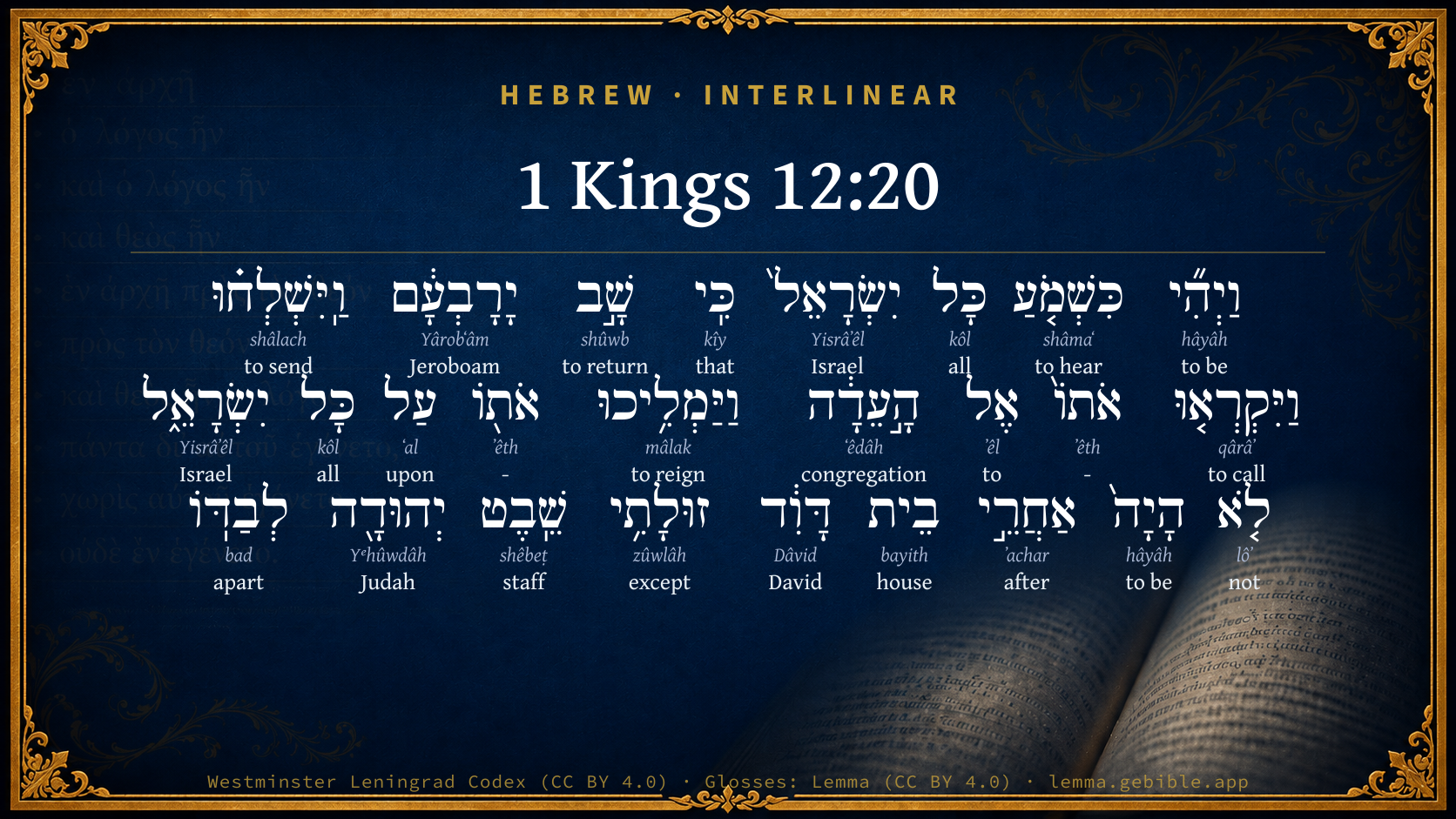
1 Kings 12:20

Hebrew (Westminster Leningrad Codex) 1 Kings 12:20 appears in the Hebrew Old Testament. The text above is from the Westminster Leningrad Codex. Each word links to its Strong’s number, a concise gloss, and parsing drawn from the Open Scriptures Hebrew Bible morphology. Click any word for its full Brown-Driver-Briggs (BDB) entry.
Download image
Cite this verse

1 Kings 12:20 (World English Bible). Public Domain. Lemma interlinear Bible study tool, https://lemma.gebible.app/v/1-kings/12/20.

Show BibTeX & RIS
BibTeX
RIS
English Translation
It happened, when all Israel heard that Jeroboam was returned, that they sent and called him to the congregation, and made him king over all Israel: there was none who followed the house of David, but the tribe of Judah only.
World English Bible · Public Domain
Download a study sheet

One document with this verse’s original text, its word-by-word gloss line, the meaning frame, cross-references with their text, attributed commentary, and full source and license credits — printable, and it pastes into notes with its structure intact.

This verse Autodidact and up

Study sheet (.html) Plain text (.txt)

A passage Seminary Student

Up to 50 verses in one chapter. A passage sheet keeps up to 6 commentary sources and 12 cross-references per verse, in the order this page ranks them, and says so on the sheet whenever that leaves anything out. Ask for a single verse and you get the Autodidact verse sheet above.

Everything on this page stays free to read, with no account — the sheet is a download of what is already on screen, not access to it.

Want to remove ads? Support Godless Engineer
Compare translations 3

The same verse in 3 English versions, stacked beneath the original-language interlinear above. Click any original word for its lexicon entry.

Each is an independent rendering of the whole verse — the interlinear is not word-aligned to these translations.

Highlighted words mark where these versions differ — a whole-verse word diff, not a word-by-word alignment.

  • World English Bible Public Domain
    It happened, when all Israel heard that Jeroboam was returned, that they sent and called him to the congregation, and made him king over all Israel: there was none who followed the house of David, but the tribe of Judah only.
  • King James Version Public Domain
    And it came to pass, when all Israel heard that Jeroboam was come again, that they sent and called him unto the congregation, and made him king over all Israel: there was none that followed the house of David, but the tribe of Judah only.
  • unfoldingWord Literal Text CC BY-SA 4.0
    And it happened, when all of Israel heard that Jeroboam had returned, that they sent and called him to the congregation, and they made him reign over all of Israel. One was not after the house of David except the tribe of Judah by itself.

unfoldingWord Literal Text — © unfoldingWord, licensed CC BY-SA 4.0. Word-aligned USFM3 via Door43 (git.door43.org/unfoldingWord/en_ult).

Versions to compare (up to 4)

3 of 4 selected

Show all 18 translations

Every available English version of this verse, each an independent rendering of the whole verse.

  • World English Bible Public Domain
    It happened, when all Israel heard that Jeroboam was returned, that they sent and called him to the congregation, and made him king over all Israel: there was none who followed the house of David, but the tribe of Judah only.
  • Berean Standard Bible Public Domain
    When all Israel heard that Jeroboam had returned, they summoned him to the assembly and made him king over all Israel. Only the tribe of Judah followed the house of David.
  • Majority Standard Bible Public Domain
    When all Israel heard that Jeroboam had returned, they summoned him to the assembly and made him king over all Israel. Only the tribe of Judah followed the house of David.
  • King James Version Public Domain
    And it came to pass, when all Israel heard that Jeroboam was come again, that they sent and called him unto the congregation, and made him king over all Israel: there was none that followed the house of David, but the tribe of Judah only.
  • American Standard Version (1901) Public Domain
    And it came to pass, when all Israel heard that Jeroboam was returned, that they sent and called him unto the congregation, and made him king over all Israel: there was none that followed the house of David, but the tribe of Judah only.
  • Revised Version (1885) Public Domain
    And it came to pass, when all Israel heard that Jeroboam was returned, that they sent and called him unto the congregation, and made him king over all Israel: there was none that followed the house of David, but the tribe of Judah only.
  • Geneva Bible (1599) Public Domain
    And when all Israel had heard that Ieroboam was come againe, they sent and called him vnto the assemblie, and made him King ouer all Israel: none followed the house of Dauid, but the tribe of Iudah onely.
  • Douay-Rheims (1899) Public Domain
    And it came to pass when all Israel heard that Jeroboam was come again, that they gathered an assembly, and sent and called him, and made him king over all Israel, and there was none that followed the house of David but the tribe of Juda only.
  • Young's Literal Translation Public Domain
    And it cometh to pass, at all Israel's hearing that Jeroboam hath returned, that they send and call him unto the company, and cause him to reign over all Israel; none hath been after the house of David save the tribe of Judah alone.
  • Literal Standard Version CC BY-SA 4.0
    And it comes to pass, at all Israel hearing that Jeroboam has returned, that they send and call him to the congregation, and cause him to reign over all Israel; none has been after the house of David except the tribe of Judah alone.
  • Unlocked Literal Bible CC BY-SA 4.0
    It happened that when all Israel heard that Jeroboam had returned, they sent and called him to their assembly and made him king over all Israel. There was no one who followed the family of David, except only the tribe of Judah.
  • unfoldingWord Literal Text CC BY-SA 4.0
    And it happened, when all of Israel heard that Jeroboam had returned, that they sent and called him to the congregation, and they made him reign over all of Israel. One was not after the house of David except the tribe of Judah by itself.
  • Darby Bible Public Domain
    And it came to pass when all Israel heard that Jeroboam had come back, that they sent and called him to the assembly, and made him king over all Israel: none followed the house of David, but the tribe of Judah only.
  • World Messianic Bible Public Domain
    When all Israel heard that Jeroboam had returned, they sent and called him to the congregation, and made him king over all Israel. There was no one who followed David’s house, except for the tribe of Judah only.
  • Webster's Bible Public Domain
    And it came to pass when all Israel heard that Jeroboam had come again, that they sent and called him to the congregation, and made him king over all Israel: there was none that followed the house of David, but the tribe of Judah only.
  • Free Bible Version CC BY-SA 4.0
    When all the Israelites heard that Jeroboam had returned, they sent for him, summoning him to the assembly and made him king over all Israel. Only the tribe of Judah was left to the house of David.
  • Bible in Basic English Public Domain
    Now when all Israel had news that Jeroboam had come back, they sent for him to come before the meeting of the people, and made him king over Israel: not one of them was joined to the family of David but only the tribe of Judah.
  • JPS Tanakh (1917) Public Domain
    And it came to pass, when all Israel heard that Jeroboam was returned, that they sent and called him unto the congregation, and made him king over all Israel; there was none that followed the house of David, but the tribe of Judah only.

Literal Standard Version (2020), Covenant Press — licensed CC BY-SA 4.0. Text via the HelloAO Bible API (eBible.org). Unlocked Literal Bible (unfoldingWord) — licensed CC BY-SA 4.0. Text via the HelloAO Bible API (eBible.org). unfoldingWord Literal Text — © unfoldingWord, licensed CC BY-SA 4.0. Word-aligned USFM3 via Door43 (git.door43.org/unfoldingWord/en_ult). Free Bible Version, Dr. Jonathan Gallagher — licensed CC BY-SA 4.0. Text via the HelloAO Bible API (eBible.org).

Word by word

More ways to search: Search by grammar → Find every occurrence → Compare this word →

Practice this passage: Drill this verse → Learn its vocabulary →

זוּלָתִ֥י
zûwlâh
H2108
“except”
Preposition
Part of Speech
Preposition
Full BDB Definition

Origin: from H2107

TWOT: 537a

a removal, a putting away (noun feminine) - except, besides, with the exception of, with removal of (preposition) - except that (conjunction)
  1. וַיְהִ֞י hâyâh H1961 “and · to be” Conjunction + Verb, Qal, Sequential Imperfect, 3rd Person, Masculine, Singular
  2. כִּשְׁמֹ֤עַ shâmaʻ H8085 “like/as · to hear” Preposition + Verb, Qal, Infinitive Construct
  3. כָּל kôl H3605 “all of” Noun, Common, Masculine, Singular, Construct
  4. יִשְׂרָאֵל֙ Yisrâʼêl H3478 “Israel” Noun, Proper
  5. כִּֽי kîy H3588 “that” Conjunction
  6. שָׁ֣ב shûwb H7725 “to return” Verb, Qal, Perfect, 3rd Person, Masculine, Singular
  7. יָרָבְעָ֔ם Yârobʻâm H3379 “Jeroboam” Noun, Proper
  8. וַֽיִּשְׁלְח֗וּ shâlach H7971 “and · to send” Conjunction + Verb, Qal, Sequential Imperfect, 3rd Person, Masculine, Plural
  9. וַיִּקְרְא֤וּ qârâʼ H7121 “and · to call” Conjunction + Verb, Qal, Sequential Imperfect, 3rd Person, Masculine, Plural
  10. אֹתוֹ֙ ʼêth H853 “- · him” Particle, Direct Object + Suffix, Personal, 3rd Person, Masculine, Singular
  11. אֶל ʼêl H413 “to” Preposition
  12. הָ֣עֵדָ֔ה ʻêdâh H5712 “the · congregation” Particle, Definite Article + Noun, Common, Feminine, Singular, Absolute
  13. וַיַּמְלִ֥יכוּ mâlak H4427 “and · to reign” Conjunction + Verb, Hiphil, Sequential Imperfect, 3rd Person, Masculine, Plural
  14. אֹת֖וֹ ʼêth H853 “- · him” Particle, Direct Object + Suffix, Personal, 3rd Person, Masculine, Singular
  15. עַל ʻal H5921 “upon” Preposition
  16. כָּל kôl H3605 “all of” Noun, Common, Masculine, Singular, Construct
  17. יִשְׂרָאֵ֑ל Yisrâʼêl H3478 “Israel” Noun, Proper
  18. לֹ֤א lôʼ H3808 “not” Particle, Negative
  19. הָיָה֙ hâyâh H1961 “to be” Verb, Qal, Perfect, 3rd Person, Masculine, Singular
  20. אַחֲרֵ֣י ʼachar H310 “after” Preposition
  21. בֵית bayith H1004 “house of” Noun, Common, Masculine, Singular, Construct
  22. דָּוִ֔ד Dâvid H1732 “David” Noun, Proper
  23. שֵֽׁבֶט shêbeṭ H7626 “staff of” Noun, Common, Masculine, Singular, Construct
  24. יְהוּדָ֖ה Yᵉhûwdâh H3063 “Judah” Noun, Proper
  25. לְבַדּֽוֹ bad H905 “to/for · apart · his” Preposition + Noun, Common, Masculine, Singular, Construct + Suffix, Personal, 3rd Person, Masculine, Singular

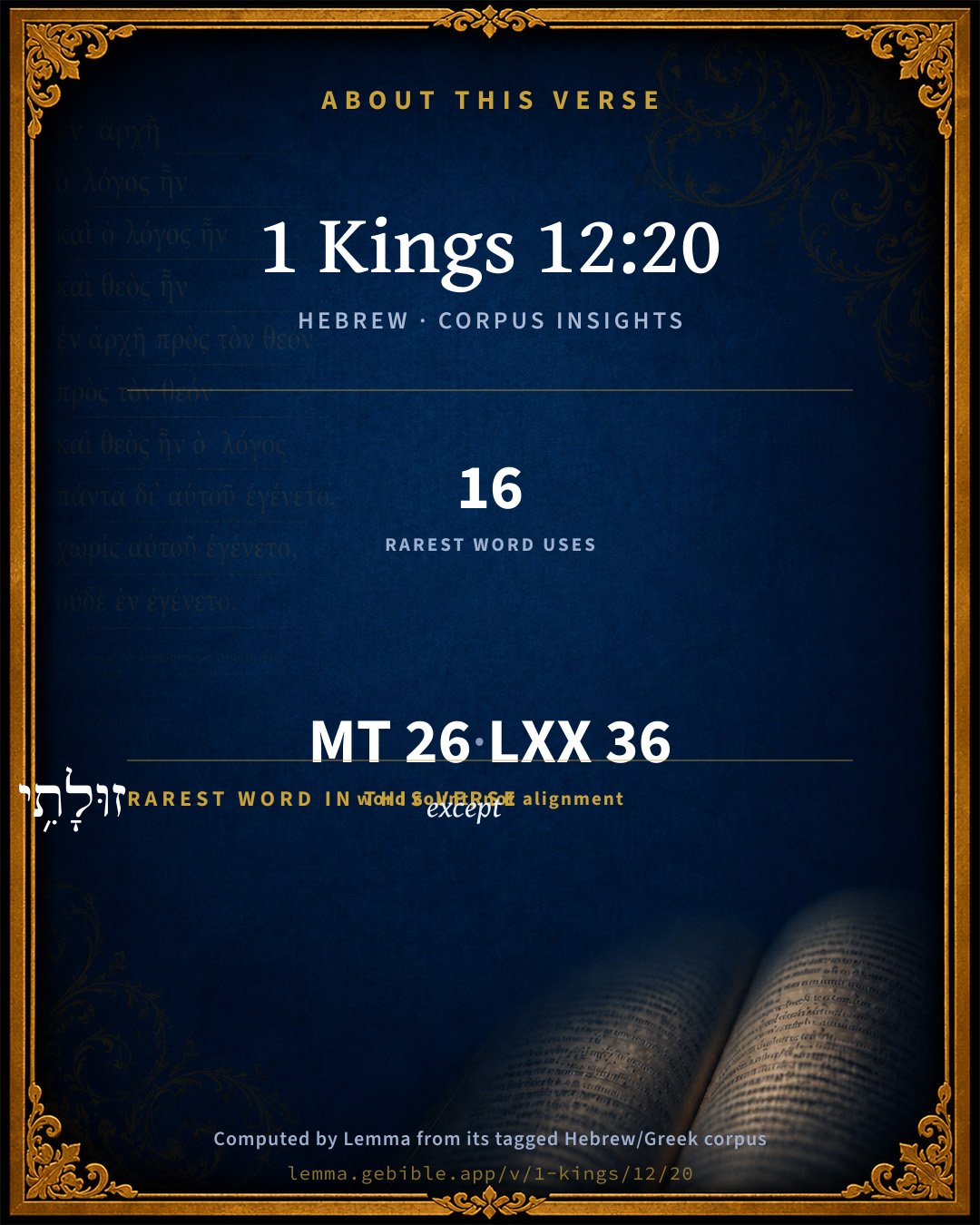
About this verse

These counts appear in no published source. They are computed here, from the morphology-tagged text and Lemma’s own curated glosses. What Lemma adds →

26
words
22
distinct lemmas
Historical
section

Notable vocabulary

The rarest word here is זוּלָתִ֥י except H2108 — appearing just 16 times in the whole Hebrew Bible.

Shared distinctive vocabulary

זוּלָתִ֥י except H2108 occurs in 16 verses of the Hebrew Bible. Also found in:

Grammatical profile

  • 7 verbs
  • 11 nouns
  • 4 prepositions
  • 1 conjunction
  • 3 particles

Verb forms

  • וַיְהִ֞י Qal · Sequential Imperfect
  • כִּשְׁמֹ֤עַ Qal · Infinitive Construct
  • שָׁ֣ב Qal · Perfect
  • וַֽיִּשְׁלְח֗וּ Qal · Sequential Imperfect
  • וַיִּקְרְא֤וּ Qal · Sequential Imperfect
  • וַיַּמְלִ֥יכוּ Hiphil · Sequential Imperfect
  • הָיָה֙ Qal · Perfect

Repetition

Words recur within this verse — often emphatic in Hebrew:

  • וַיְהִ֞י to be H1961 ×2
  • כָּל all H3605 ×2
  • יִשְׂרָאֵל֙ Israel H3478 ×2

Hebrew & Septuagint length

In English translation the verse runs 41 words from the Hebrew and 47 from the Septuagint (LXX English) — closely comparable.

A rough comparison of the two English renderings, which tokenize alike — not a word-level alignment.

Word counts can differ between the Hebrew and the Greek without any difference in meaning — e.g. the Hebrew direct-object marker אֵת has no separate Greek word, and Greek often adds the article ὁ.

In the original languages it is 26 Hebrew tokens and 36 Greek tokens — but the two are counted differently (Hebrew bundles its prefixes and suffixes into one token; the Greek is in lemma form), so that isn’t a like-for-like length.

Cross-references

7

Topical passages linked to 1 Kings 12:20 in the Treasury of Scripture Knowledge — connected by theme and wording, ordered by reader-vote popularity; previews shown in the World English Bible.

  • 1 Kings 11:13 However I will not tear away all the kingdom; but I will give one tribe to your son, for David my servant's sake, and for Jerusalem's sake which I have chosen.
  • 1 Kings 11:32 (but he shall have one tribe, for my servant David's sake and for Jerusalem's sake, the city which I have chosen out of all the tribes of Israel);
  • 1 Samuel 10:24 Samuel said to all the people, "You see him whom Yahweh has chosen, that there is none like him among all the people?" All the people shouted, and said, [Long] live the king.
  • 1 Kings 11:36 To his son will I give one tribe, that David my servant may have a lamp always before me in Jerusalem, the city which I have chosen me to put my name there.
  • 1 Kings 12:17 But as for the children of Israel who lived in the cities of Judah, Rehoboam reigned over them.
  • Hosea 8:4 They have set up kings, but not by me. They have made princes, and I didn't approve. Of their silver and their gold they have made themselves idols, That they may be cut off.
  • Hosea 11:12 Ephraim surrounds me with falsehood, And the house of Israel with deceit; And Judah still us unruly with God, And is unfaithful to the Holy One.

Cross-references courtesy of OpenBible.info (CC BY 4.0).

Hebrew and Greek witnesses Masoretic Hebrew ↔ Greek Septuagint

The same verse in the two great witnesses to the Old Testament, shown verse-for-verse.

These are two independent witnesses, not word-aligned to each other, and the Septuagint is shown in lemma (dictionary) form.

Hebrew 1 Kings 12:20 Masoretic · Westminster Leningrad Codex

וַיְהִ֞י כִּשְׁמֹ֤עַ כָּל יִשְׂרָאֵל֙ כִּֽי שָׁ֣ב יָרָבְעָ֔ם וַֽיִּשְׁלְח֗וּ וַיִּקְרְא֤וּ אֹתוֹ֙ אֶל הָ֣עֵדָ֔ה וַיַּמְלִ֥יכוּ אֹת֖וֹ עַל כָּל יִשְׂרָאֵ֑ל לֹ֤א הָיָה֙ אַחֲרֵ֣י בֵית דָּוִ֔ד זוּלָתִ֥י שֵֽׁבֶט יְהוּדָ֖ה לְבַדּֽוֹ

It happened, when all Israel heard that Jeroboam was returned, that they sent and called him to the congregation, and made him king over all Israel: there was none who followed the house of David, but the tribe of Judah only.

World English Bible · Public Domain

Greek LXX 1 Kings 12:20 Septuagint · lemma form

καί γίγνομαι ὡς ἀκούω πᾶς ἰσραήλ ὅτι ἀνακάμπτω ιεροβοαμ ἐκ αἴγυπτος καί ἀποστέλλω καί καλέω αὐτός εἰς ὁ συναγωγή καί βασιλεύω αὐτός ἐπί ἰσραήλ καί οὐ εἰμί ὀπίσω οἶκος δαυίδ πάρεξ σκῆπτρον ιουδα καί βενιαμίν μόνος

And it came to pass when all Israel heard that Jeroboam had returned out of Egypt, that they sent and called him to the assembly, and they made him king over Israel: and none followed the house of David except the tribe of Juda and Benjamin only.

LXX2012 (modern English Septuagint) · Public Domain

On this verse, The Cambridge Bible for Schools and Colleges discusses the Septuagint’s reading. Read the note in Commentary ↓

Hebrew: Westminster Leningrad Codex (CC BY 4.0). Greek: Septuagint (public domain); English from LXX2012 (modern English Septuagint) (Public Domain). How the Septuagint differs from the Hebrew →

Targum (Aramaic paraphrase)

1

The Targum is the ancient Jewish Aramaic paraphrase of the Hebrew Scriptures — an interpretive translation, not the Hebrew text itself. Onkelos (literal) and Pseudo-Jonathan (expansive) render the Torah, and Jonathan the Prophets. Coverage is partial: where no permissively-licensed English translation exists for a verse, only the Aramaic is shown. This is verse-level text, not a word-by-word alignment to the Hebrew.

  1. Targum Jonathan Prophets (Joshua–Malachi)
    וַהֲוָה כַּד שְׁמָעוּ כָל יִשְׂרָאֵל אֲרֵי תַב יְרָבְעָם וּשְׁלַחוּ וּקְרוֹ יָתֵיהּ לְוַת כְּנִשְׁתָּא וְאַמְלִיכוּ יָתֵיהּ עַל כָּל יִשְׂרָאֵל לָא הֲוָה בָּתַר בֵּית דָוִד אֱלָהֵין שִׁבְטָא דִיהוּדָה בִּלְחוֹדוֹהִי:

    (no public-domain English translation for this verse)

    Targum Jonathan — Aramaic: “Mikraot Gedolot” (public domain). English: “Sefaria Community Translation” (CC0 1.0 (public-domain dedication)); “London "Chaldee Paraphrase," 1871” (public domain). Text via Sefaria.

Commentary

Notes on 1 Kings 12:20 from classic Christian and Jewish commentators (each source and its license shown beneath its notes). The classic Christian expositions comment on the surrounding passage and are grouped to its opening verse, so a note may address several verses; the Jewish commentaries on the Tanakh (Rashi and others) are per-verse, so they appear only where the commentator wrote on this verse.

Lemma curates 59 commentaries, every one of them public domain or Creative Commons licensed, each selected and text-cleaned for this edition rather than reprinted as found. About our sources →

Jamieson, Fausset & Brown

Robert Jamieson, A. R. Fausset & David Brown

JEROBOAM MADE KING OVER THEM. (Kg1 12:20-33)

when all Israel heard that Jeroboam was come again--This verse closes the parenthetical narrative begun at Kg1 12:2, and Kg1 12:21-24 resume the history from Kg1 12:1. Rehoboam determined to assert his authority by leading a large force into the disaffected provinces. But the revolt of the ten tribes was completed when the prophet Shemaiah ordered, in the Lord's name, an abandonment of any hostile measures against the revolutionists. The army, overawed by the divine prohibition, dispersed, and the king was obliged to submit.

Jamieson, Fausset & Brown — Commentary Critical and Explanatory on the Whole Bible (1871) — public domain (CC PDM 1.0). Text via the HelloAO Bible API.

Trapp's Complete Commentary

John Trapp

1Ki 12:20 And it came to pass, when all Israel heard that Jeroboam was come again, that they sent and called him unto the congregation, and made him king over all Israel: there was none that followed the house of David, but the tribe of Judah only.

Ver. 20. And made him king.] See Hos 8:4. {See Trapp on "Hos 8:4"}

But the tribe of Judah only.] See on 1Ki 12:17. This tribe only followed the house of David ex animo, heartily and of free choice; the other ex occasione, occasionally, for religion’s sake, or otherwise.

John Trapp, A Commentary or Exposition upon All the Books of the Old and New Testament (1647–1656) — public domain. Text from a community e-Sword module.

Joseph Benson's Commentary

1Ki 12:20. When all Israel heard that Jeroboam was come — From Egypt; which was known to the great men, and to such as met at Shechem before, and was now spread over the country; they sent — To his tent, or habitation, to which he had retired from Shechem, as the others, who had met there had generally done. And called him unto the congregation — Which had been summoned by the elders of the several tribes, to consider how to settle their affairs, which they easily agreed to do, by conferring the crown on Jeroboam, according to God’s promise made to him. None followed the house of David — No entire tribe; but the tribe of Judah — Which comprehended Benjamin also, being one with it, as was observed before, 1Ki 11:32. And it was by the singular providence of God that they did not also desert such a haughty prince as Rehoboam was. There were, however, many families and individuals of some of the other tribes, especially of Levi and Simeon, which dwelling in the cities of Judah, continued to be subject to Rehoboam, see 1Ki 12:17.

Joseph Benson's Commentary on the Old and New Testaments (1811–1818) — public domain. Text from a community e-Sword module.

Whedon's Commentary on the Bible

Daniel D. Whedon

JEROBOAM IS MADE KING OF ISRAEL; REHOBOAM VAINLY ATTEMPTS TO SUBDUE THE REBELLION, 1Ki_12:20-24.

20. All Israel heard that Jeroboam was come again — The representatives of the people, when they were about to assemble at Shechem to demand of Rehoboam a lightening of their burdens, had sent and called Jeroboam from Egypt, and he was at the head of the assembly at Shechem when they made their demands; (compare 1Ki_12:2-3; 1Ki_12:12;) but it was not till after the congregation at Shechem was broken up, and the people had departed to their tents, (1Ki_12:16,) that all Israel, in the wider sense, (that is, the masses who went not to Shechem but were only represented there by their elders or delegates,) heard of Jeroboam’s return.

Sent and called him unto the congregation — The congregation that had assembled to anoint him king. Here we have an instance of the rapidity with which the sacred writer passes over the minor details of his history. The call for this assembly — the time, and place, and manner, of its coming together — and the ceremonies of the election and crowning of their new king, are all passed over in silence.

Judah only — Though Benjamin seems to have adhered to Rehoboam, (1Ki_12:21,) and also many Israelites of other tribes that dwelt in the cities of Judah, (1Ki_12:17,) yet they are all looked upon thenceforth as absorbed in the tribe of Judah. See on 1Ki_19:3.

Daniel D. Whedon (gen. ed.), Commentary on the Old and New Testaments (1874–1909) — public domain. Text from a community e-Sword module.

Adam Clarke's Commentary

Verse 20. Made him king over all Israel] What is called Israel here, was ten-twelfths of the whole nation; and had they a right to call another person to the throne? They had not, - they had neither legal nor constitutional right. Jeroboam was not of the blood royal; he had no affinity to the kingdom. Nothing could justify this act, but the just judgment of God. God thus punished a disobedient and gainsaying people; and especially Solomon's family, whose sins against the Lord were of no ordinary magnitude.

Adam Clarke's Commentary on the Bible (1810–1826) — public domain. Text from a community e-Sword/MySword module.

Ellicott's Commentary for English Readers

(20) Jeroboam was come again.—The assembly at Shechem probably broke up in disorder, carrying everywhere the news of the rebellion. It would be quite in harmony with Jeroboam’s astuteness, if, after setting the revolution on foot, he himself stood aloof from leadership, and waited till “the congregation,” the duly summoned assembly, sent for him and offered him the crown. The title “king over all Israel” certainly indicates a claim on the part of the ten tribes to be the true Israel, relying perhaps on the prophetic choice and blessing of Jeroboam, and professing to have risen in the name of the Lord against the idolatry of Solomon and his house. Perhaps it also indicated a desire for the subjugation of Judah, which Jeroboam, with the aid of Shishak, certainly seems to have subsequently attempted.

(20, 21) In these two verses we have again the same curious juxtaposition of “the tribe of Judah only” and “the house of Judah, with the tribe of Benjamin.” The army gathered would be, no doubt, drawn from Solomon’s established and disciplined forces, as well as from the levy of Judah and Benjamin generally—perhaps including (as in 2Sa_17:27) contingents from the tributary races—who would be attached with a strong personal allegiance to the house of Solomon, and prepared to stamp out the rebellion, before it could thoroughly organise itself for disciplined resistance.

A Bible Commentary for English Readers, edited by Charles John Ellicott (1878–1897) — public domain. Text from a community e-Sword module.

The Cambridge Bible for Schools and Colleges

gen. ed. J. J. S. Perowne

20. when all Israel heard that Jeroboam was come again] R.V. was returned. This change is made because the words are like 2Ch_10:2, and the two should be represented as agreeing. The movement described in these words is that of the whole ten tribes. At first Jeroboam had been summoned by the leading men that he might be their adviser and perhaps spokesman. Now when their request has been rejected the whole people agree that he shall be made their king.

but the tribe of Judah only] So Rehoboam was left in the position of David at his accession, king of Judah only. The LXX. adds here ‘and Benjamin’ to accord with the previous variations in 1Ki_11:32; 1Ki_11:36. See notes there.

The Cambridge Bible for Schools and Colleges (gen. ed. J. J. S. Perowne; Cambridge University Press, 1878–1918) — public domain. Text from a community e-Sword module.

John Gill's Exposition

But the word of God came unto Shemaiah the man of God,.... A prophet in those days, see Ch2 12:15 and the word that came to him, as in the Targum, is called the word of prophecy:

saying; as follows.

John Gill's Exposition of the Whole Bible (1746–1763) — public domain (CC PDM 1.0). Text via the HelloAO Bible API.

Albert Barnes' Notes on the Bible

The first act of the Israelites, on learning what had occurred at Shechem, was to bring together the great “congregation” of the people (compare Jdg 20:1), in order that, regularly and in solemn form, the crown might be declared vacant, and a king elected in the room of the monarch whose authority had been thrown off. The congregation selected Jeroboam. The rank, the talent, and the known energy of the late exile, his natural hostility to the house of Solomon, his Ephraimitic descent, his acquaintance with the art of fortification, and the friendly relations subsisting between him and the great Egyptian king, pointed him out as the most suitable man for the vacant post. If, according to the Septuagint, Shishak had not only protected him against Solomon, but also given him an Egyptian princess, sister to his own queen, in marriage, his position must have been such that no other Israelite could have borne comparison with him. Again, the prophecy of Ahijah would have been remembered by the more religious part of the nation, and would have secured to Jeroboam their adhesion; so that every motive, whether of policy or of religion, would have united to recommend the son of Nebat to the suffrages of his countrymen.

Albert Barnes' Notes on the Bible (1834–1885) — public domain. Text from a community e-Sword/MySword module.

Haydock's Catholic Bible Commentary

Again, from Egypt, ver. 2. (Haydock) --- He had not been present, it seems, at the second assembly; or, at least, he had retired as soon as Roboam had given his decision. But the people having stoned Aduram, and thus rendered a reconciliation very difficult, Jeroboam was invited to accept the crown. (Calmet) --- As this was conformable to his utmost desires and the prophet’s declaration, he made no demur, chap. xi. 37. (Haydock) Only. Benjamin was a small tribe, and so intermixed with the tribe of Juda, (the very city of Jerusalem being partly in Juda, partly in Benjamin) that hey are here counted but as one tribe. (Challoner) --- Perhaps Benjamin at first hesitated; but, considering the greater danger to which it would be exposed, embraced the party of Roboam, ver. 21. (Salien)

George Leo Haydock (1774–1849), Haydock's Catholic Family Bible and Commentary, 1859 edition — public domain. Excludes Psalms (Douay-Rheims chapter numbering differs from Protestant) and Deuterocanonical books (Catholic canon only).

Matthew Poole's English Annotations

That Jeroboam was come again, to wit, from Egypt, which was known before to the chief of the tribes, and to them who met at Shechem, and now was more universally known by all the people. They

sent to his tent or habitation, to which he had retired himself, as others also generally did: see above, 1Ki 12:16.

Called him unto the congregation; which was summoned by the elders of the several tribes, to take advice how to settle their affairs, which they easily agreed to do, by conferring the crown upon Jeroboam, according to God’s promise made to him.

There was none, i.e. no entire tribe. See Poole "1Ki 11:13,31,32".

Matthew Poole's English Annotations on the Holy Bible (1683–1685) — public domain. Text from a community e-Sword/MySword module.

The Pulpit Commentary

And it came to pass, when all Israel heard that Jeroboam was come again These words are hardly consistent with the idea that Jeroboam had been from the first the spokesman of "all Israel" in their interviews with Rehoboam. If, however, the received text of vers. 8, 12 is retained (see on ver. 3), then we must understand the "all Israel" in ver. 1 of the representatives of the different tribes, and here, of the entire nation who had heard from its representatives, on their return to their homes (ver. 16), of the presence of Jeroboam in the country, that they sent and called him unto the congregation Where and when this gathering was held we are not informed. Probably it was at Shechem, and soon after Rehoboam"s flight. After the open and irreparable breach which they had made (ver. 18), the leaders of the tribes would naturally assemble at once to concert measures for their defence and future government, and made him king by anointing. Note on ver. 1 over all Israel This public and formal consecration of Jeroboam completed the secession of the northern tribes. Was this secession sinful? Bahr, Keil, and others, who start from the assumption that secession was determined upon even before Rehoboam came to Shechem, and that the complaints of the people respecting the grievous service to which they had been subjected by Solomon were groundless, naturally conclude that it was altogether treasonable and unjustifiable. But is this conclusion borne out by the facts? We may readily admit that the schism was not accomplished without sin: we cannot but allow that Israel acted with undue precipitation, and that Rehoboam, who was "young and tenderhearted," was entitled, for David"s and Solomon"s sake, as well as his own, to greater forbearance and consideration, and it is almost certain that both the "envy of Ephraim" and the ambition of Jeroboam largely influenced the result. At the same time, it is to be remembered that the division of the kingdom was ordained of God, and that the people had just cause of complaint, if not, indeed, sufficient warrant for resistance, in the arbitrary and insolent rejection of their petition by the young king. No law of God requires men to yield themselves up without a struggle to such cruel and abject slavery as Rehoboam threatened these men with. They judged and who shall say unreasonably? from his words that they had only tyranny and cruelty to expect at his hands, and what wonder if they stood on their defence? They are only to be blamed because they did more. But lawful resistance not uncommonly ripens into unlawful rebellion: there was none that followed the house of David, but the tribe of Judah only. This general statement is qualified immediately afterwards (ver. 21). The tribe of Benjamin, "the smallest of the tribes of Israel", (1Sa_9:21) "little Benjamin", (Psa_68:27) is here omitted as of comparatively small account. Exact precision has never characterized Oriental writers. There is no suspicion of untruth: it is the genius of the people to

disdain the lore, Of nicely calculated less and more.

It may be added here that Edom remained under the sway of Judah until the reign of Jehoram, (2Ki_8:20) just as Moab and other portions of Solomon"s empire for a considerable period formed part of the new kingdom of Israel. (2Ki_1:1 2Ki_3:4, 2Ki_3:5)

The Pulpit Commentary (1880–1919), ed. H.D.M. Spence-Jones & Joseph S. Exell — public domain. Text from a community e-Sword module.

John Wesley's Explanatory Notes

Was come - From Egypt; which was known to them before who met at Shechem, and now by all the people. Was none - That is, no entire tribe.

John Wesley, Explanatory Notes Upon the Whole Bible (1754–1765) — public domain. Text via the GEBible commentary corpus.

unfoldingWord translationNotes

Door43 World Missions Community

It happened that

This phrase is used here to mark an important event in the story. If your language has a way for doing this, you could consider using it here.

when all Israel heard

"All Israel" here is a generalization that means the capable men of Israel who represent the rest of the people by a synecdoche. AT: "when all the leaders of Israel heard" (See: Synecdoche and Hyperbole and Generalization)

king over all Israel

"Israel" implicitly means the northern ten tribes that rebelled against Rehoboam. AT: "king over all of the 10 tribes of Israel" (See: Assumed Knowledge and Implicit Information)

the family of David

"David's descendants"

translationWords

Jeroboam

assembly

king

family

tribe

unfoldingWord translationNotes — © Distant Shores Media and the Door43 World Missions Community, licensed CC BY-SA 4.0. Source: git.door43.org/Door43/en_tn.

Lesson kit

Teaching starters — assembled from the data on this page, not authored interpretation. Every prompt links to the verse data it draws on. Edit before teaching.

1 Kings, in the Historical, opens this verse with 26 words (22 distinct Hebrew lemmas). Its most distinctive word is zûwlâh (“except”). A historical commentator’s framing appears above. Read the whole chapter for the surrounding context.

Discussion questions

  1. What does “except” (zûwlâh) contribute to the verse as a whole?
  2. Deuteronomy 1:36 shares the word «except» with this verse. How do the two illuminate each other?
  3. “to be” occurs 2× in this one verse. What is the effect of the repetition?
  4. These translations render this verse differently; the difference is in the English rendering, not the original. What questions does that raise?
  5. The verb «וַיְהִ֞י» is Qal Sequential Imperfect. How does its form color the action?
  6. Reading how Jamieson, Fausset & Brown and Trapp's Complete Commentary read this verse, where do the two commentators agree and where do they part?

Things to notice

Reading settings

Reading text

Shown beneath each verse's original-language words.

Old Testament
Old Testament edition

Read the OT as the Masoretic Hebrew (MT) or the Greek Septuagint (LXX).

English shown for the Greek Septuagint (in the Hebrew ↔ Greek comparison).

Comparing translations? Open the Compare panel on any verse page to stack up to four side by side.