
Lamentations 2:8

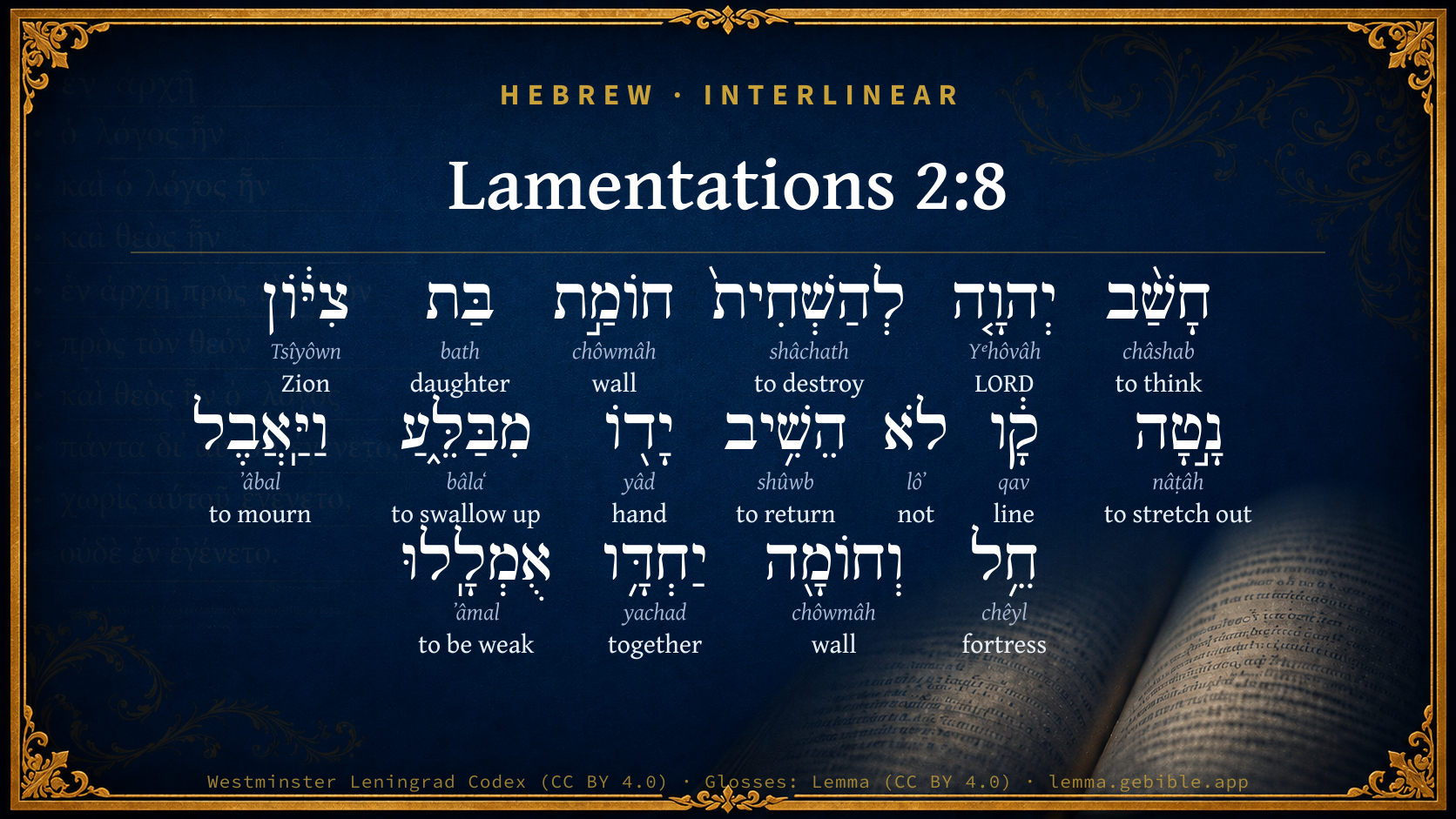
Hebrew (Westminster Leningrad Codex) Lamentations 2:8 appears in the Hebrew Old Testament. The text above is from the Westminster Leningrad Codex. Each word links to its Strong’s number, a concise gloss, and parsing drawn from the Open Scriptures Hebrew Bible morphology. Click any word for its full Brown-Driver-Briggs (BDB) entry.
Download image
Cite this verse

Lamentations 2:8 (World English Bible). Public Domain. Lemma interlinear Bible study tool, https://lemma.gebible.app/v/lamentations/2/8.

Show BibTeX & RIS
BibTeX
RIS
English Translation
Yahweh has purposed to destroy the wall of the daughter of Zion; He has stretched out the line, he has not withdrawn his hand from destroying; He has made the rampart and wall to lament; they languish together.
World English Bible · Public Domain
Download a study sheet

One document with this verse’s original text, its word-by-word gloss line, the meaning frame, cross-references with their text, attributed commentary, and full source and license credits — printable, and it pastes into notes with its structure intact.

This verse Autodidact and up

Study sheet (.html) Plain text (.txt)

A passage Seminary Student

Up to 50 verses in one chapter. A passage sheet keeps up to 6 commentary sources and 12 cross-references per verse, in the order this page ranks them, and says so on the sheet whenever that leaves anything out. Ask for a single verse and you get the Autodidact verse sheet above.

Everything on this page stays free to read, with no account — the sheet is a download of what is already on screen, not access to it.

Want to remove ads? Support Godless Engineer
Compare translations 3

The same verse in 3 English versions, stacked beneath the original-language interlinear above. Click any original word for its lexicon entry.

Each is an independent rendering of the whole verse — the interlinear is not word-aligned to these translations.

Highlighted words mark where these versions differ — a whole-verse word diff, not a word-by-word alignment.

  • World English Bible Public Domain
    Yahweh has purposed to destroy the wall of the daughter of Zion; He has stretched out the line, he has not withdrawn his hand from destroying; He has made the rampart and wall to lament; they languish together.
  • King James Version Public Domain
    The LORD hath purposed to destroy the wall of the daughter of Zion: he hath stretched out a line, he hath not withdrawn his hand from destroying: therefore he made the rampart and the wall to lament; they languished together.
  • unfoldingWord Literal Text CC BY-SA 4.0
    Yahweh planned to destroy the wall of the daughter of Zion. He stretched out the measuring line; he did not turn back his hand from swallowing up. And he caused the rampart and wall to mourn; together they have languished. TETH

unfoldingWord Literal Text — © unfoldingWord, licensed CC BY-SA 4.0. Word-aligned USFM3 via Door43 (git.door43.org/unfoldingWord/en_ult).

Versions to compare (up to 4)

3 of 4 selected

Show all 18 translations

Every available English version of this verse, each an independent rendering of the whole verse.

  • World English Bible Public Domain
    Yahweh has purposed to destroy the wall of the daughter of Zion; He has stretched out the line, he has not withdrawn his hand from destroying; He has made the rampart and wall to lament; they languish together.
  • Berean Standard Bible Public Domain
    The LORD determined to destroy the wall of the Daughter of Zion. He stretched out a measuring line and did not withdraw His hand from destroying. He made the ramparts and walls lament; together they waste away.
  • Majority Standard Bible Public Domain
    The LORD determined to destroy the wall of the Daughter of Zion. He stretched out a measuring line and did not withdraw His hand from destroying. He made the ramparts and walls lament; together they waste away.
  • King James Version Public Domain
    The LORD hath purposed to destroy the wall of the daughter of Zion: he hath stretched out a line, he hath not withdrawn his hand from destroying: therefore he made the rampart and the wall to lament; they languished together.
  • American Standard Version (1901) Public Domain
    Jehovah hath purposed to destroy the wall of the daughter of Zion; He hath stretched out the line, he hath not withdrawn his hand from destroying; And he hath made the rampart and wall to lament; they languish together.
  • Revised Version (1885) Public Domain
    The LORD hath purposed to destroy the wall of the daughter of Zion; he hath stretched out the line, he hath not withdrawn his hand from destroying: but he hath made the rampart and wall to lament; they languish together.
  • Geneva Bible (1599) Public Domain
    The Lord hath determined to destroy the wall of the daughter of Zion: hee stretched out a lyne: hee hath not withdrawen his hande from destroying: therefore hee made the rampart and the wall to lament: they were destroyed together.
  • Douay-Rheims (1899) Public Domain
    Heth. The Lord hath purposed to destroy the wall of the daughter of Sion: he hath stretched out his line, and hath not withdrawn his hand from destroying: and the bulwark hath mourned, and the wall hath been destroyed together.
  • Young's Literal Translation Public Domain
    Devised hath Jehovah to destroy the wall of the daughter of Zion, He hath stretched out a line, He hath not turned His hand from destroying, And He causeth bulwark and wall to mourn, Together -- they have been weak.
  • Literal Standard Version CC BY-SA 4.0
    YHWH has devised to destroy the wall of the daughter of Zion, || He has stretched out a line, || He has not turned His hand from destroying, || And He causes bulwark and wall to mourn, || Together—they have been weak.
  • Unlocked Literal Bible CC BY-SA 4.0
    Yahweh decided to destroy the city wall of the daughter of Zion. He has stretched out the measuring line and has not withheld his hand from destroying the wall. He has made the ramparts and wall to lament; together they wasted away.
  • unfoldingWord Literal Text CC BY-SA 4.0
    Yahweh planned to destroy the wall of the daughter of Zion. He stretched out the measuring line; he did not turn back his hand from swallowing up. And he caused the rampart and wall to mourn; together they have languished. TETH
  • Darby Bible Public Domain
    Jehovah hath purposed to destroy the wall of the daughter of Zion: he hath stretched out the line, he hath not withdrawn his hand from destroying; and he hath made the rampart and the wall to lament: they languish together.
  • World Messianic Bible Public Domain
    The LORD has purposed to destroy the wall of the daughter of Zion. He has stretched out the line. He has not withdrawn his hand from destroying; He has made the rampart and wall lament. They languish together.
  • Webster's Bible Public Domain
    The LORD hath purposed to destroy the wall of the daughter of Zion: he hath stretched out a line, he hath not withdrawn his hand from destroying: therefore he made the rampart and the wall to lament; they languished together.
  • Free Bible Version CC BY-SA 4.0
    The Lord was determined to destroy the defensive walls of the Daughter of Zion. He measured out what he would destroy, and didn't hesitate to do it. He made the battlements and walls weep; they both disintegrated.
  • Bible in Basic English Public Domain
    It is the Lord's purpose to make waste the wall of the daughter of Zion; his line has been stretched out, he has not kept back his hand from destruction: he has sent sorrow on tower and wall, they have become feeble together.
  • JPS Tanakh (1917) Public Domain
    The LORD hath purposed to destroy the wall of the daughter of Zion; He hath stretched out the line, He hath not withdrawn His hand from destroying; but He hath made the rampart and wall to mourn, they languish together.

Literal Standard Version (2020), Covenant Press — licensed CC BY-SA 4.0. Text via the HelloAO Bible API (eBible.org). Unlocked Literal Bible (unfoldingWord) — licensed CC BY-SA 4.0. Text via the HelloAO Bible API (eBible.org). unfoldingWord Literal Text — © unfoldingWord, licensed CC BY-SA 4.0. Word-aligned USFM3 via Door43 (git.door43.org/unfoldingWord/en_ult). Free Bible Version, Dr. Jonathan Gallagher — licensed CC BY-SA 4.0. Text via the HelloAO Bible API (eBible.org).

Word by word

More ways to search: Search by grammar → Find every occurrence → Compare this word →

Practice this passage: Drill this verse → Learn its vocabulary →

אֻמְלָֽלוּ
ʼâmal
H535
“to be weak”
Verb, Pulal, Perfect, 3rd Person, Common, Plural
Part of Speech
Verb
Stem
Pulal
Form
Perfect
Person
3rd Person
Gender
Common
Number
Plural
Full BDB Definition

Origin: a primitive root

TWOT: 114

to be weak, to droop, to languish, to be exhausted - (Qal) passive participle (of the heart) - to be weak - to droop - (Pulal) - to be or grow feeble - to languish
  1. חָשַׁ֨ב châshab H2803 “to think” Verb, Qal, Perfect, 3rd Person, Masculine, Singular
  2. יְהוָ֤ה Yᵉhôvâh H3068 “LORD” Noun, Proper
  3. לְהַשְׁחִית֙ shâchath H7843 “to destroy” Preposition + Verb, Hiphil, Infinitive Construct
  4. חוֹמַ֣ת chôwmâh H2346 “wall of” Noun, Common, Feminine, Singular, Construct
  5. בַּת bath H1323 “daughter of” Noun, Common, Feminine, Singular, Construct
  6. צִיּ֔וֹן Tsîyôwn H6726 “Zion” Noun, Proper
  7. נָ֣טָה nâṭâh H5186 “to stretch out” Verb, Qal, Perfect, 3rd Person, Masculine, Singular
  8. קָ֔ו qav H6957 “line” Noun, Common, Masculine, Singular, Absolute
  9. לֹא lôʼ H3808 “not” Particle, Negative
  10. הֵשִׁ֥יב shûwb H7725 “to return” Verb, Hiphil, Perfect, 3rd Person, Masculine, Singular
  11. יָד֖וֹ yâd H3027 “hand · his” Noun, Common, Both, Singular, Construct + Suffix, Personal, 3rd Person, Masculine, Singular
  12. מִבַּלֵּ֑עַ bâlaʻ H1104 “from · to swallow up” Preposition + Verb, Piel, Infinitive Construct
  13. וַיַּֽאֲבֶל ʼâbal H56 “and · to mourn” Conjunction + Verb, Hiphil, Sequential Imperfect, 3rd Person, Masculine, Singular
  14. חֵ֥ל chêyl H2426 “fortress” Noun, Common, Masculine, Singular, Absolute
  15. וְחוֹמָ֖ה chôwmâh H2346 “and · wall” Conjunction + Noun, Common, Feminine, Singular, Absolute
  16. יַחְדָּ֥ו yachad H3162 “together” Adverb

About this verse

These counts appear in no published source. They are computed here, from the morphology-tagged text and Lemma’s own curated glosses. What Lemma adds →

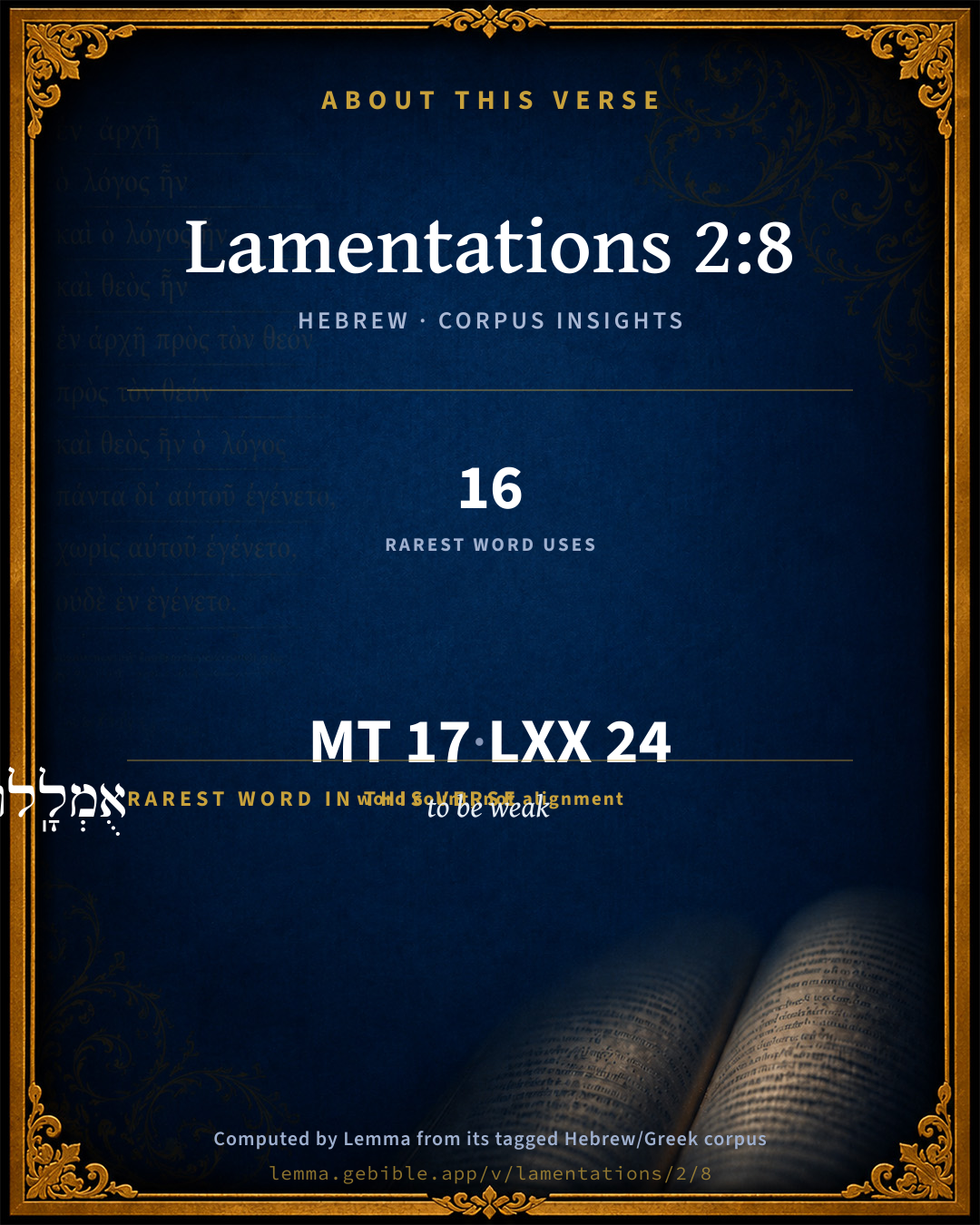
17
words
16
distinct lemmas
Prophets
section

Notable vocabulary

The rarest word here is אֻמְלָֽלוּ to be weak H535 — appearing just 16 times in the whole Hebrew Bible.

Shared distinctive vocabulary

אֻמְלָֽלוּ to be weak H535 occurs in 14 verses of the Hebrew Bible. Also found in:

Grammatical profile

  • 7 verbs
  • 8 nouns
  • 1 adverb
  • 1 particle

Verb forms

  • חָשַׁ֨ב Qal · Perfect
  • לְהַשְׁחִית֙ Hiphil · Infinitive Construct
  • נָ֣טָה Qal · Perfect
  • הֵשִׁ֥יב Hiphil · Perfect
  • מִבַּלֵּ֑עַ Piel · Infinitive Construct
  • וַיַּֽאֲבֶל Hiphil · Sequential Imperfect
  • אֻמְלָֽלוּ Pulal · Perfect

Repetition

A word recurs within this verse — often emphatic in Hebrew:

  • חוֹמַ֣ת wall H2346 ×2

Hebrew & Septuagint length

In English translation the verse runs 38 words from the Hebrew and 42 from the Septuagint (LXX English) — closely comparable.

A rough comparison of the two English renderings, which tokenize alike — not a word-level alignment.

Word counts can differ between the Hebrew and the Greek without any difference in meaning — e.g. the Hebrew direct-object marker אֵת has no separate Greek word, and Greek often adds the article ὁ.

In the original languages it is 17 Hebrew tokens and 24 Greek tokens — but the two are counted differently (Hebrew bundles its prefixes and suffixes into one token; the Greek is in lemma form), so that isn’t a like-for-like length.

Cross-references

14

Topical passages linked to Lamentations 2:8 in the Treasury of Scripture Knowledge — connected by theme and wording, ordered by reader-vote popularity; previews shown in the World English Bible.

  • 2 Kings 21:13 I will stretch over Jerusalem the line of Samaria, and the plummet of the house of Ahab; and I will wipe Jerusalem as a man wipes a dish, wiping it and turning it upside down.
  • Isaiah 3:26 Her gates shall lament and mourn; And she shall be desolate and sit on the ground.
  • Isaiah 34:11 But the pelican and the porcupine shall possess it; and the owl and the raven shall dwell therein: and he will stretch over it the line of confusion, and the plummet of emptiness.
  • Jeremiah 14:2 Judah mourns, and the gates of it languish, they sit in black on the ground; and the cry of Jerusalem is gone up.
  • Jeremiah 5:10 Go up on her walls, and destroy; but don't make a full end: take away her branches; for they are not Yahweh's.
  • Amos 7:7–8 Thus he showed me and, behold, the Lord stood beside a wall made by a plumb line, with a plumb line in his hand.
  • 2 Samuel 8:2 He struck Moab, and measured them with the line, making them to lie down on the ground; and he measured two lines to put to death, and one full line to keep alive. The Moabites became servants to David, and brought tribute.
  • Job 13:21 Withdraw your hand far from me; And don't let your terror make me afraid.
  • Isaiah 5:5 Now I will tell you what I will do to my vineyard. I will take away its hedge, and it will be eaten up. I will break down its wall of it, and it will be trampled down.
  • Isaiah 28:17 I will make justice the line, and righteousness the plummet; and the hail shall sweep away the refuge of lies, and the waters shall overflow the hiding-place.
  • Lamentations 2:2 The Lord has swallowed up all the habitations of Jacob, and has not pitied: He has thrown down in his wrath the strongholds of the daughter of Judah; He has brought them down to the ground; he has profaned the kingdom and the princes of it.
  • Lamentations 2:5 The Lord is become as an enemy, he has swallowed up Israel; He has swallowed up all her palaces, he has destroyed his strongholds; He has multiplied in the daughter of Judah mourning and lamentation.
  • Lamentations 2:17 Yahweh has done that which he purposed; he has fulfilled his word that he commanded in the days of old; He has thrown down, and has not pitied: He has caused the enemy to rejoice over you; he has exalted the horn of your adversaries.
  • Ezekiel 20:22 Nevertheless I withdrew my hand, and worked for my name's sake, that it should not be profaned in the sight of the nations, in whose sight I brought them forth.

Cross-references courtesy of OpenBible.info (CC BY 4.0).

Hebrew and Greek witnesses Masoretic Hebrew ↔ Greek Septuagint

The same verse in the two great witnesses to the Old Testament, shown verse-for-verse.

These are two independent witnesses, not word-aligned to each other, and the Septuagint is shown in lemma (dictionary) form.

Hebrew Lamentations 2:8 Masoretic · Westminster Leningrad Codex

חָשַׁ֨ב יְהוָ֤ה לְהַשְׁחִית֙ חוֹמַ֣ת בַּת צִיּ֔וֹן נָ֣טָה קָ֔ו לֹא הֵשִׁ֥יב יָד֖וֹ מִבַּלֵּ֑עַ וַיַּֽאֲבֶל חֵ֥ל וְחוֹמָ֖ה יַחְדָּ֥ו אֻמְלָֽלוּ

Yahweh has purposed to destroy the wall of the daughter of Zion; He has stretched out the line, he has not withdrawn his hand from destroying; He has made the rampart and wall to lament; they languish together.

World English Bible · Public Domain

Greek LXX Lamentations 2:8 Septuagint · lemma form

καί ἐπιστρέφω κύριος ὁ διαφθείρω τεῖχος θυγάτηρ σιων ἐκτείνω μέτρον οὐ ἀποστρέφω χείρ αὐτός ἀπό καταπάτημα καί πενθέω ὁ προτείχισμα καί τεῖχος ὁμοθυμαδόν ἀσθενέω

HETH. And he has turned to destroy the wall of the daughter of Sion: he has stretched out the measuring line, he has not turned back his hand from afflicting her: therefore the bulwark mourned, and the wall was weakened with it.

LXX2012 (modern English Septuagint) · Public Domain

Hebrew: Westminster Leningrad Codex (CC BY 4.0). Greek: Septuagint (public domain); English from LXX2012 (modern English Septuagint) (Public Domain). How the Septuagint differs from the Hebrew →

Commentary

Notes on Lamentations 2:8 from classic Christian and Jewish commentators (each source and its license shown beneath its notes). The classic Christian expositions comment on the surrounding passage and are grouped to its opening verse, so a note may address several verses; the Jewish commentaries on the Tanakh (Rashi and others) are per-verse, so they appear only where the commentator wrote on this verse.

Lemma curates 59 commentaries, every one of them public domain or Creative Commons licensed, each selected and text-cleaned for this edition rather than reprinted as found. About our sources →

Trapp's Complete Commentary

John Trapp

Lam 2:8 The LORD hath purposed to destroy the wall of the daughter of Zion: he hath stretched out a line, he hath not withdrawn his hand from destroying: therefore he made the rampart and the wall to lament; they languished together.

Ver. 8. The Lord hath purposed to destroy.] Non casu, non subito, non temere, sed maturo el destinato decreto. God’s providence (which is nothing else but the carrying on of his decree) extendeth to smallest matters, much more to the subversion of states and cities.

He that stretched out a line,] scil., Of destruction, or a levelling line. See 2Ki 21:13 Isa 34:11. Jerusalem was built by line, and so it was destroyed by him who doeth all things in number, weight, and measure.

John Trapp, A Commentary or Exposition upon All the Books of the Old and New Testament (1647–1656) — public domain. Text from a community e-Sword module.

Joseph Benson's Commentary

Lam 2:8-9. The Lord hath purposed to destroy the wall of Zion — The word wall is here to be taken in a metaphorical sense, for the strength and security of the city. He hath stretched out a line, &c. — Called emphatically, Isa 34:11, קו תהו, the line of confusion or devastation, being designed to mark out the extent of what was to be pulled down. For the instruments designed for building are in some places applied to destroying, because men sometimes mark out those buildings they intend to demolish. Thus, 2Ki 21:13, God says, I will stretch over Jerusalem the line of Samaria, and the plummet of the house of Ahab: see likewise Amo 7:7-8. Therefore he made the rampart, &c., to lament — Made their walls and ramparts feeble, ready to shake like a man under some languishing distemper, who had no strength left. Her gates are sunk into the ground, &c. — The gates of Jerusalem are destroyed and covered over with rubbish, and the bolts of the gates are broken. Her king and her princes are among the Gentiles — Zedekiah and the nobles of Judah, who were not slain, are in a state of miserable captivity. The law is no more — It is no longer read and expounded; the priests and the Levites, whose office it is to instruct the people, being dispersed among the heathen; and that part of the law which respects the public worship of God, being rendered impracticable by the temple’s being destroyed. Her prophets also find no vision from the Lord — The prophets are either dead, or in a state of captivity, and these latter are not favoured with divine revelations as they were wont to be, and so cannot resolve the doubts of those who come to them for advice.

Joseph Benson's Commentary on the Old and New Testaments (1811–1818) — public domain. Text from a community e-Sword module.

Keil & Delitzsch

C. F. Keil & F. Delitzsch

The lament over the destruction of the kingdom concludes, in Lam 2:8, Lam 2:9, by mentioning that the walls of Jerusalem are destroyed; with this the Chaldeans ended the work of demolition. The expression חשׁב יהוה represents this as the execution of a divine decree, - a turn which forms an appropriate introduction to the close of the work of destruction. "Raschi makes the following remark concerning this: a longo inde tempore, in animum induxerat, hanc urbem vastare secundum illud quod Jer 32:31 dixit. This intention He has now carried out. The words, "He stretched out the measuring-line," are more exactly determined by what follows, "He withdrew not His hand from destroying;" this shows the extent to which the destruction was carried out. The measuring-line was drawn out for the purpose of determining the situation and direction of buildings (Job 38:5; Zac 1:15); but Jahveh applies it also for the purpose of pulling down buildings (Kg2 21:13; Isa 34:11; Amo 7:7), in order to indicate that He carried out the destruction with the same precision as that of the builder in finishing his work. The rampart and the wall sorrow over this. חל (from חוּל) is the rampart, i.e., the low wall with the ditch, surrounding the fortress outside the city wall; cf. Sa2 20:15; Isa 26:1. The gates of the daughter of Zion (i.e., of Jerusalem) are sunk into the earth, i.e., have been completely buried under rubbish by the demolition, as if they had sunk into the ground. The subject to אבּד ושׁבּר is Jahveh. The bars of the daughter of Zion are those with which the city gates were closed, for the protection of the inhabitants. With the destruction of Jerusalem the kingdom of God is destroyed. King and princes are among the heathen, - carried away into exile. It must, indeed, be allowed that אין תּורה is connected by the accents with what precedes; and Gerlach defends the construction, "they are among the heathen without law,", - not only agreeing with Kalkschmidt in taking אין תּורה as a designation of the גּוים as ethnici, - -ad gentes, quibus divina nulla erat revelatio, - but also with Luther, who translates: "her king and her princes are among the heathen, because they cannot administer the law," or generally, have it not. But, on the other hand, the accents merely indicate the stichometrical arrangement, not the relation of the words according to their sense; and the remark, "that Lam 2:9 sets forth the fate of the persons who stood to the city in the relation of helpers and counsellors or comforters (her king, her prophets), of whose help (counsel, or comfort) the city was deprived, as well as of the external means of defending her" (first member), proves nothing at all, for the simple reason that the priests also belonged to the number of the helpers, counsellors, and comforters of the city; hence, if this were the meaning, and the two halves of the verse were meant to stand in this relation, then the priests would certainly have been mentioned also. The second half of the verse is not connected with the first in the manner supposed by Gerlach; but, from the whole preceding description of the way in which the divine wrath has been manifested against Jerusalem, it draws this conclusion: "Judah has lost its king and its princes, who have been carried away among the heathen: it has also lost the law and prophecy." "Law" and "vision" are mentioned as both media of divine revelation. the law is the summary of the rule of life given by God to His people: this exists no more for Judah, because, with the destruction of Jerusalem and of the temple, the divinely appointed constitution of Israel was abolished and destroyed. Prophecy was the constant witness to the presence of God among His people; by this means the Lord sought to conduct Israel to the object of their election and calling, and to fit them for becoming a holy nation and a kingdom of priests. The perf. מצאוּ is not a preterite, but the expression of an accomplished fact. The prophets of the daughter of Zion no longer obtain any vision or revelation from Jahveh: the revelation of God by prophets has ceased for Zion. The words imply that there are still prophets, and merely affirm that they do not receive any revelation from God. This is not opposed to the fact that Jeremiah, some months after the destruction of Jerusalem, again received a revelation; cf. Jer 42:4 with Lam 2:7. The meaning of the complaint is simply that Jahveh no longer owns His people, no longer gives them a token of His gracious presence, just as it is said in Psa 74:9, "There is no more any prophet." But it is not thereby declared that prophecy has altogether and for ever been silenced, but merely that, when Jerusalem was destroyed, Israel received no prophetic communication, - that God the Lord did not then send them a message to comfort and sustain them. The revelation which Jeremiah (Jer 42:7) received regarding the determination of the people who sought to flee to Egypt, has no connection with this at all, for it does not contain a word as to the future destiny of Jerusalem. Hence it cannot be inferred, with Thenius, from the words now before us, that the present poem was composed before that revelation given in Jer 42:7.; nor yet, with Ngelsbach, that the writer had here before his mind the condition of the great mass of the people who had been carried away into exile. Neither, indeed, were the people in exile without prophetic communications; for, even so early as six years before the overthrow of Jerusalem, God had raised up to the exiles a prophet in the person of Ezekiel.

Keil & Delitzsch — Biblical Commentary on the Old Testament (1861–1891) — public domain (CC PDM 1.0). Text via the HelloAO Bible API. (Old Testament only.)

Tyndale Open Study Notes

Tyndale Open Resources

2:8 Ramparts were stone walls or mounds of earth built around a city to protect it from assault by an enemy army.

Tyndale Open Study Notes — © Tyndale Open Resources, licensed CC BY-SA 4.0. Text via the HelloAO Bible API.

Geneva Bible (1599)

Geneva Bible translators

This is a figurative speech, as that was, when he said, the ways did lament, Lam. 1:4, meaning, that this sorrow was so great, that the insensible things had their part thereof.

Geneva Bible (1599) marginal notes — public domain. Text via Bolls.life.

Jamieson, Fausset & Brown

Robert Jamieson, A. R. Fausset & David Brown

stretched . . . a line--The Easterns used a measuring-line not merely in building, but in destroying edifices (Kg2 21:13; Isa 34:11); implying here the unsparing rigidness with which He would exact punishment.

Jamieson, Fausset & Brown — Commentary Critical and Explanatory on the Whole Bible (1871) — public domain (CC PDM 1.0). Text via the HelloAO Bible API.

Adam Clarke's Commentary

Verse 8. He hath stretched out a line] The line of devastation; marking what was to be pulled down and demolished.

Adam Clarke's Commentary on the Bible (1810–1826) — public domain. Text from a community e-Sword/MySword module.

John Calvin's Commentaries

The verb to think, has more force than what is commonly assigned to it; for it would be very flat to say, that God thought to destroy; but to think here means to resolve or to decree. This is one thing. And then we must bear in mind the contrast between this and those false imaginations, by which men are wont to be drawn away, so as not to believe that God is present in adversities as well as prosperity. As, therefore, men go willfully astray through various false thoughts, and thus withdraw themselves, as it were, designedly from God, the Prophet says here that the walls of Jerusalem had not fallen by chance, but had been overthrown through a divine decree, because God had so determined, according to what we have seen in many places throughout the book of Jeremiah: “See, these are the thoughts which God has thought respecting Jerusalem, which he has thought respecting Babylon.” The Prophet, then, in these instances, taught what he now confirms in this place, that when the city Jerusalem was destroyed, it was not what happened by chance; but because God had brought there the Chaldeans, and employed them as his instruments in taking and destroying the city: God, then, has thought to destroy the wall of the daughter of Zion. It is, indeed, true, that the Chaldeans had actively carried on the war, and omitted nothing as to military skill, in order to take the city: but the Prophet calls here the attention of the Jews to a different thought, so that they might acknowledge that they suffered justly for their sins, and that God was the chief author of that war, and that the Chaldeans were to be viewed as hired soldiers.

He afterwards adds, that God had extended a line or a rule, as it is usually done in separating buildings. And then he says, He hath not drawn back his hand from scattering; and so it was, that the ramparts and the walls mourned, and fell down together We now see that what the Prophet had in view was to lead the Jews fully to believe that the destruction was not to be ascribed to the Chaldeans, but, on the contrary, to God. Added at the same time must be another part of what is here taught, that God would not have been so displeased with the holy city which he had chosen, had not the people extremely provoked him with their sins. It now follows, —

John Calvin's Commentaries (1540-1563) — public domain. Text from the Calvin Translation Society English edition (1840s-50s) via the Christian Classics Ethereal Library (ccel.org). Calvin's coverage is partial (roughly two-thirds of the Bible); uncommented books and verses are honest gaps, never fabricated. The 19th-century editor's footnotes and remarks are omitted so the notes are faithfully Calvin's own voice.

Ellicott's Commentary for English Readers

(8) He hath stretched out a line.—The phrase implies (See Notes on 2Ki_21:13; Isa_34:11; Amo_7:7) the systematic thoroughness of the work of destruction.

He made the rampart.—Even the very stones of the walls of Zion are thought of as “crying out” and wailing over their own downfall. (Comp. Hab_2:11; Luk_19:40.)

A Bible Commentary for English Readers, edited by Charles John Ellicott (1878–1897) — public domain. Text from a community e-Sword module.

The Cambridge Bible for Schools and Colleges

gen. ed. J. J. S. Perowne

8. stretched out the line] i.e. marked for destruction. Cp. 2Ki_21:13; Isa_34:2; Amo_7:7 ff.

destroying] lit. as mg. swallowing up.

they languish together] For the personification of rampart and wall cp. Lam_2:18 and Jer_14:2.

8, 9. The walls were broken down and the gates removed (2Ki_25:10; Jer_52:14) to preclude rebellion. Cp. Ezr_4:12 ff.

The Cambridge Bible for Schools and Colleges (gen. ed. J. J. S. Perowne; Cambridge University Press, 1878–1918) — public domain. Text from a community e-Sword module.

John Gill's Exposition

The Lord hath purposed to destroy the wall of the daughter of Zion,.... Either the wall of the city, as Aben Ezra; or the wall that encompassed the temple, and all the outward courts of it, as Dr. Lightfoot (s) thinks; this the Lord had determined to destroy, and according to his purposes did destroy it, or suffer it to be demolished; and so all were laid open for the enemy to enter:

he hath stretched out a line; a line of destruction, to mark out how far the destruction should go, and bow much should be laid in ruins; all being as exactly done, according to the purpose and counsel of God, as if it was done by line and rule; see Isa 34:11;

he hath not withdrawn his hand from destroying; till he made a full end of the city and temple, as he first designed:

therefore he made the rampart and the wall to lament: the "chel" and the wall; all that space between the courts of the temple and the wall that surrounded it was called the "chel"; and so the Targum, the circumference or enclosure; and these were laid waste together, and so said to lament: according to others they were two walls, a wall the son of a wall, as Jarchi interprets it; an outward and an inward wall, one higher than another; a low wall over against a high wall; which was as a rampart or bulwark, for the strength and support of it:

they languished together; or fell together, as persons in a fit faint away and full to the ground.

(s) Prospect of the Temple, c. 17. p. 1089.

John Gill's Exposition of the Whole Bible (1746–1763) — public domain (CC PDM 1.0). Text via the HelloAO Bible API.

Albert Barnes' Notes on the Bible

A line - Compare Isa 34:11. The destruction is systematic and thorough.

Albert Barnes' Notes on the Bible (1834–1885) — public domain. Text from a community e-Sword/MySword module.

Haydock's Catholic Bible Commentary

Line, to level it with the ground, (Isaias xxxiv. 11.; Calmet) or to treat it with just severity. (Theodoret) --- Bulwark. Literally, "the first wall," (Haydock) or ditch, lined with palisades. Alexander [the Great] ordered the towers to be levelled, and the horses’ manes to be cut, when Hephæstion died, to denote the general sorrow.

George Leo Haydock (1774–1849), Haydock's Catholic Family Bible and Commentary, 1859 edition — public domain. Excludes Psalms (Douay-Rheims chapter numbering differs from Protestant) and Deuterocanonical books (Catholic canon only).

Matthew Poole's English Annotations

The term

wall in this verse seemeth to be taken in a metaphorical sense, for the strength and security of the Jews (the strength and security of a place lying much in ifs walls).

He hath stretched out a line: artificers use with lines not only to mark out places for building, but also for destruction, to direct them what to cut off; such a line is here meant.

He hath not withdrawn his hand from destroying; God had gone on in destroying them: and had made their walls and ramparts feeble, and to shake like a man under some languishing distemper, that had no strength left.

Matthew Poole's English Annotations on the Holy Bible (1683–1685) — public domain. Text from a community e-Sword/MySword module.

Whedon's Commentary on the Bible

Daniel D. Whedon

8. Wall of the daughter of Zion — Walls of Jerusalem. The line which had been stretched out for the purpose of erection is now used for the purpose of destruction, and thus is suggested the precision and thoroughness of the work.

Daniel D. Whedon (gen. ed.), Commentary on the Old and New Testaments (1874–1909) — public domain. Text from a community e-Sword module.

The Pulpit Commentary

He hath stretched out a line. It is the "line of desolation" mentioned in Isaiah. (Isa_34:11; comp. Amo_7:7 2Ki_21:13) Such is the unsparing rigour of Jehovah"s judgments.

The Pulpit Commentary (1880–1919), ed. H.D.M. Spence-Jones & Joseph S. Exell — public domain. Text from a community e-Sword module.

John Wesley's Explanatory Notes

The wall - The strength and security of the Jews. A line - Artificers used with lines not only to mark out places for building, but also for destruction, to direct them what to cut off; and such a line is here meant.

John Wesley, Explanatory Notes Upon the Whole Bible (1754–1765) — public domain. Text via the GEBible commentary corpus.

unfoldingWord translationNotes

Door43 World Missions Community

Yahweh decided to destroy the city wall

Yahweh chose to have the wall destroyed and caused Jerusalem's enemy to destroy it. He did not destroy it himself. (See: Metonymy)

daughter of Zion

This is a poetic name for Jerusalem, which is spoken of here as if it were a woman. (See: Personification)

He has stretched out the measuring line

This speaks of preparing to destroy the wall as if he measured it before he destroyed it, so that he knew how much to destroy. AT: "It is as though he has measured the wall" (See: Metaphor)

has not withheld his hand from destroying

This can be stated without the double negatives. Also, here the Lord is referred to by his "hand." AT: "with his hand he has destroyed the wall" or "he has destroyed the wall" (See: Double Negatives and Synecdoche)

He has made the ramparts and wall to lament; together they wasted away

The walls and ramparts are spoken of as if they were people who lamented and died. AT: "Because he has destroyed the ramparts and walls, they are like people who lament and have lost their strength" (See: Personification)

ramparts

Ancient cities had a main "wall" to keep attackers out, and an outer line of "ramparts" to keep attackers from the wall.

translationWords

Yahweh

Zion

hand

lament

gate

king

prince

Gentile

law

prophet

vision

unfoldingWord translationNotes — © Distant Shores Media and the Door43 World Missions Community, licensed CC BY-SA 4.0. Source: git.door43.org/Door43/en_tn.

Rashi

Rabbi Shlomo Yitzchaki (Rashi)

The Lord determined to destroy It is already many days since this entered His mind, as it is written (Jer. 32:31): “For this city has aroused My anger and My wrath until this day, to remove it from before My face.”

He stretched out a line of judgment to be punished for our iniquities.

rampart and wall a large wall and a small wall, a low wall opposite a high wall.

Rashi on the Tanakh — English translations: “The Judaica Press complete Tanach with Rashi, translated by A. J. Rosenberg” (CC BY 4.0); “Pentateuch with Rashi's commentary by M. Rosenbaum and A.M. Silbermann, 1929-1934” (public domain); “The Metsudah Tanach series, Lakewood, N.J” (CC BY 4.0); and “The Book of Joshua, Metsudah Publications, 1997” (CC BY 4.0). Text via Sefaria.

Lesson kit

Teaching starters — assembled from the data on this page, not authored interpretation. Every prompt links to the verse data it draws on. Edit before teaching.

Lamentations, in the Prophets, opens this verse with 17 words (16 distinct Hebrew lemmas). Its most distinctive word is ʼâmal (“to be weak”). A historical commentator’s framing appears above. Read the whole chapter for the surrounding context.

Discussion questions

  1. What does “to be weak” (ʼâmal) contribute to the verse as a whole?
  2. How does 1 Samuel 2:5, which shares the word «to be weak», read alongside this verse?
  3. What does the repetition of “wall” (2× in this one verse) do in this verse?
  4. The translations on this page render this verse differently — a whole-verse word diff, not a word-by-word alignment. What might account for the different wordings?
  5. «חָשַׁ֨ב» is a Qal Perfect verb. How does that grammatical form shape the action described?
  6. Compare how Trapp's Complete Commentary and Joseph Benson's Commentary read this verse. Where do they agree or differ?

Things to notice

Reading settings

Reading text

Shown beneath each verse's original-language words.

Old Testament
Old Testament edition

Read the OT as the Masoretic Hebrew (MT) or the Greek Septuagint (LXX).

English shown for the Greek Septuagint (in the Hebrew ↔ Greek comparison).

Comparing translations? Open the Compare panel on any verse page to stack up to four side by side.