
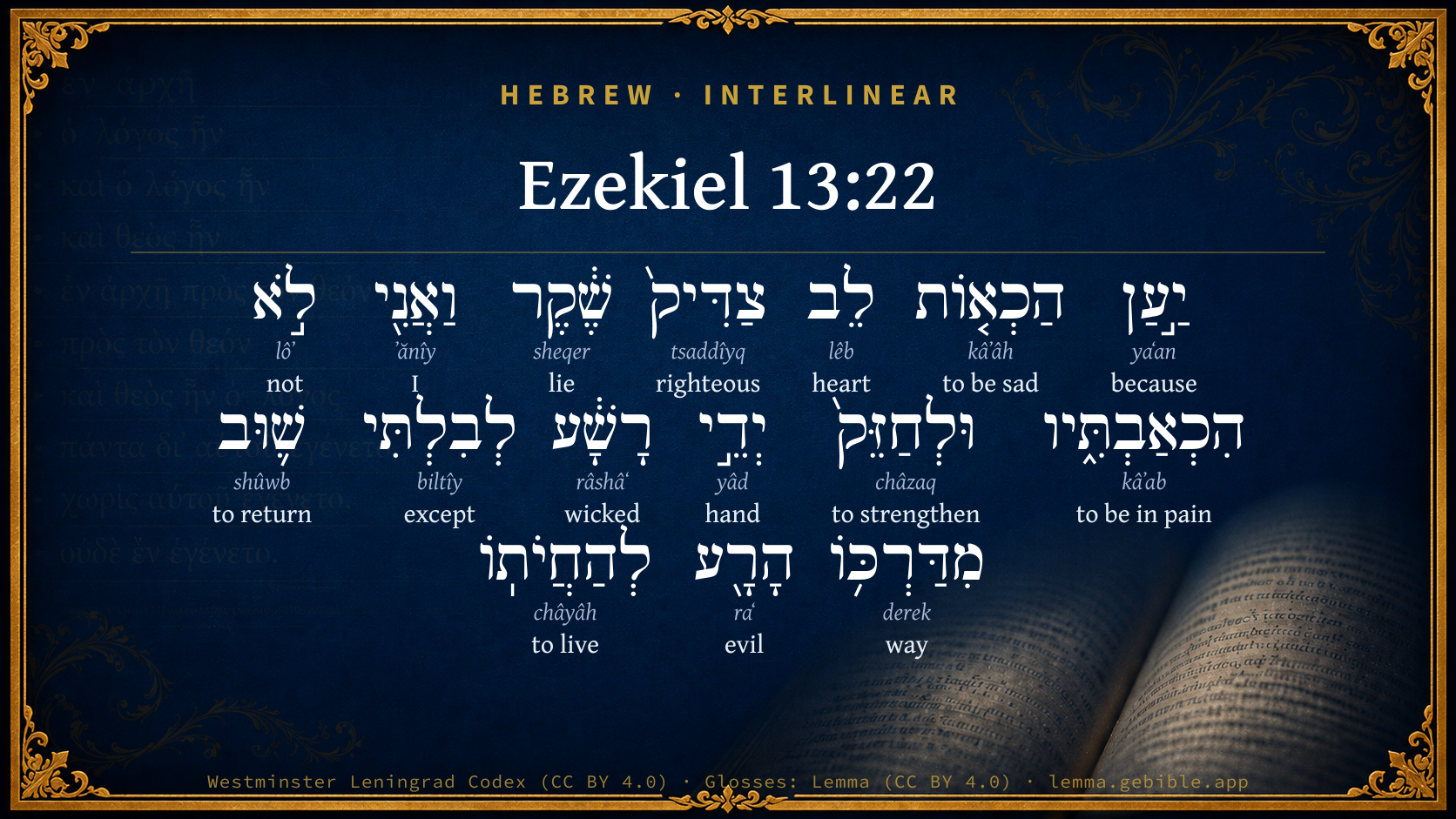
Ezekiel 13:22

Hebrew (Westminster Leningrad Codex) Ezekiel 13:22 appears in the Hebrew Old Testament. The text above is from the Westminster Leningrad Codex. Each word links to its Strong’s number, a concise gloss, and parsing drawn from the Open Scriptures Hebrew Bible morphology. Click any word for its full Brown-Driver-Briggs (BDB) entry.
Download image
Cite this verse

Ezekiel 13:22 (World English Bible). Public Domain. Lemma interlinear Bible study tool, https://lemma.gebible.app/v/ezekiel/13/22.

Show BibTeX & RIS
BibTeX
RIS
English Translation
Because with lies you have grieved the heart of the righteous, whom I have not made sad; and strengthened the hands of the wicked, that he should not return from his wicked way, and be saved alive:
World English Bible · Public Domain
Download a study sheet

One document with this verse’s original text, its word-by-word gloss line, the meaning frame, cross-references with their text, attributed commentary, and full source and license credits — printable, and it pastes into notes with its structure intact.

This verse Autodidact and up

Study sheet (.html) Plain text (.txt)

A passage Seminary Student

Up to 50 verses in one chapter. A passage sheet keeps up to 6 commentary sources and 12 cross-references per verse, in the order this page ranks them, and says so on the sheet whenever that leaves anything out. Ask for a single verse and you get the Autodidact verse sheet above.

Everything on this page stays free to read, with no account — the sheet is a download of what is already on screen, not access to it.

Want to remove ads? Support Godless Engineer
Compare translations 3

The same verse in 3 English versions, stacked beneath the original-language interlinear above. Click any original word for its lexicon entry.

Each is an independent rendering of the whole verse — the interlinear is not word-aligned to these translations.

Highlighted words mark where these versions differ — a whole-verse word diff, not a word-by-word alignment.

  • World English Bible Public Domain
    Because with lies you have grieved the heart of the righteous, whom I have not made sad; and strengthened the hands of the wicked, that he should not return from his wicked way, and be saved alive:
  • King James Version Public Domain
    Because with lies ye have made the heart of the righteous sad, whom I have not made sad; and strengthened the hands of the wicked, that he should not return from his wicked way, by promising him life:
  • unfoldingWord Literal Text CC BY-SA 4.0
    Because you discourage the heart of the righteous person with lies, even though I did not desire his discouragement, and because you encourage instead the actions of the wicked person so that he will not turn from his way to save his life—

unfoldingWord Literal Text — © unfoldingWord, licensed CC BY-SA 4.0. Word-aligned USFM3 via Door43 (git.door43.org/unfoldingWord/en_ult).

Versions to compare (up to 4)

3 of 4 selected

Show all 18 translations

Every available English version of this verse, each an independent rendering of the whole verse.

  • World English Bible Public Domain
    Because with lies you have grieved the heart of the righteous, whom I have not made sad; and strengthened the hands of the wicked, that he should not return from his wicked way, and be saved alive:
  • Berean Standard Bible Public Domain
    Because you have disheartened the righteous with your lies, even though I have caused them no grief, and because you have encouraged the wicked not to turn from their evil ways to save their lives,
  • Majority Standard Bible Public Domain
    Because you have disheartened the righteous with your lies, even though I have caused them no grief, and because you have encouraged the wicked not to turn from their evil ways to save their lives,
  • King James Version Public Domain
    Because with lies ye have made the heart of the righteous sad, whom I have not made sad; and strengthened the hands of the wicked, that he should not return from his wicked way, by promising him life:
  • American Standard Version (1901) Public Domain
    Because with lies ye have grieved the heart of the righteous, whom I have not made sad; and strengthened the hands of the wicked, that he should not return from his wicked way, and be saved alive:
  • Revised Version (1885) Public Domain
    Because with lies ye have grieved the heart of the righteous, whom I have not made sad; and strengthened the hands of the wicked, that he should not return from his wicked way, and be saved alive:
  • Geneva Bible (1599) Public Domain
    Because with your lyes yee haue made the heart of the righteous sadde, whome I haue not made sad, and strengthened the hands of the wicked, that he should not returne from his wicked way, by promising him life,
  • Douay-Rheims (1899) Public Domain
    Because with lies you have made the heart of the just to mourn, whom I have not made sorrowful: and have strengthened the hands of the wicked, that he should not return from his evil way, and live.
  • Young's Literal Translation Public Domain
    Because of paining the heart of the righteous with falsehood, And I have not pained it, And strengthening the hands of the wicked, So as not to turn back from his evil way, To keep him alive,
  • Literal Standard Version CC BY-SA 4.0
    Because of paining the heart of the righteous with falsehood, || And I have not pained it, || And strengthening the hands of the wicked, || So as not to turn [him] back from his evil way, || To keep him alive,
  • Unlocked Literal Bible CC BY-SA 4.0
    Because you discourage the heart of the righteous person with lies, even though I did not desire his discouragement, and because you encourage instead the actions of the wicked person so that he will not turn from his way to save his life—
  • unfoldingWord Literal Text CC BY-SA 4.0
    Because you discourage the heart of the righteous person with lies, even though I did not desire his discouragement, and because you encourage instead the actions of the wicked person so that he will not turn from his way to save his life—
  • Darby Bible Public Domain
    Because with falsehood ye have grieved the heart of the righteous, whom I have not made sad; and have strengthened the hands of the wicked, that he should not return from his wicked way, to save his life:
  • World Messianic Bible Public Domain
    Because with lies you have grieved the heart of the righteous, whom I have not made sad; and strengthened the hands of the wicked, that he should not return from his wicked way, and be saved alive.
  • Webster's Bible Public Domain
    Because with lies ye have made the heart of the righteous sad, whom I have not made sad; and strengthened the hands of the wicked, that he should not return from his wicked way, by promising him life:
  • Free Bible Version CC BY-SA 4.0
    Because you have discouraged good people with your lies, even though I didn't have anything against them, and because you have encouraged the wicked that they shouldn't give up from their evil ways to save their lives,
  • Bible in Basic English Public Domain
    Because with your false words you have given pain to the heart of the upright man when I had not made him sad; in order to make strong the hands of the evil-doer so that he may not be turned from his evil way and get life:
  • JPS Tanakh (1917) Public Domain
    Because with lies ye have cowed the heart of the righteous, when I have not grieved him; and strengthened the hands of the wicked, that he should not return from his wicked way, that he be saved alive;

Literal Standard Version (2020), Covenant Press — licensed CC BY-SA 4.0. Text via the HelloAO Bible API (eBible.org). Unlocked Literal Bible (unfoldingWord) — licensed CC BY-SA 4.0. Text via the HelloAO Bible API (eBible.org). unfoldingWord Literal Text — © unfoldingWord, licensed CC BY-SA 4.0. Word-aligned USFM3 via Door43 (git.door43.org/unfoldingWord/en_ult). Free Bible Version, Dr. Jonathan Gallagher — licensed CC BY-SA 4.0. Text via the HelloAO Bible API (eBible.org).

Word by word

More ways to search: Search by grammar → Find every occurrence → Compare this word →

Practice this passage: Drill this verse → Learn its vocabulary →

הַכְא֤וֹת
kâʼâh
H3512
“to be sad”
Verb, Hiphil, Infinitive Construct
Part of Speech
Verb
Stem
Hiphil
Form
Infinitive Construct
Full BDB Definition

Origin: a primitive root

TWOT: 941

to be sad, be disheartened, be cowed - (Niphal) to be disheartened, be cowed - (Hiphil) to make sad
  1. יַ֣עַן yaʻan H3282 “because” Conjunction
  2. לֵב lêb H3820 “heart” Noun, Common, Masculine, Singular, Absolute
  3. צַדִּיק֙ tsaddîyq H6662 “righteous” Adjective, Adjective, Masculine, Singular, Absolute
  4. שֶׁ֔קֶר sheqer H8267 “lie” Noun, Common, Masculine, Singular, Absolute
  5. וַאֲנִ֖י ʼănîy H589 “and · I” Conjunction + Pronoun, Personal, 1st Person, Common, Singular
  6. לֹ֣א lôʼ H3808 “not” Particle, Negative
  7. הִכְאַבְתִּ֑יו kâʼab H3510 “to be in pain · him” Verb, Hiphil, Perfect, 1st Person, Common, Singular + Suffix, Personal, 3rd Person, Masculine, Singular
  8. וּלְחַזֵּק֙ châzaq H2388 “and · to strengthen” Conjunction + Preposition + Verb, Piel, Infinitive Construct
  9. יְדֵ֣י yâd H3027 “hands of” Noun, Common, Both, Dual, Construct
  10. רָשָׁ֔ע râshâʻ H7563 “wicked” Adjective, Adjective, Masculine, Singular, Absolute
  11. לְבִלְתִּי biltîy H1115 “to/for · except” Preposition + Conjunction
  12. שׁ֛וּב shûwb H7725 “to return” Verb, Qal, Infinitive Construct
  13. מִדַּרְכּ֥וֹ derek H1870 “from · way · his” Preposition + Noun, Common, Both, Singular, Construct + Suffix, Personal, 3rd Person, Masculine, Singular
  14. הָרָ֖ע raʻ H7451 “the · evil” Particle, Definite Article + Adjective, Adjective, Masculine, Singular, Absolute
  15. לְהַחֲיֹתֽוֹ châyâh H2421 “to live · him” Preposition + Verb, Hiphil, Infinitive Construct + Suffix, Personal, 3rd Person, Masculine, Singular

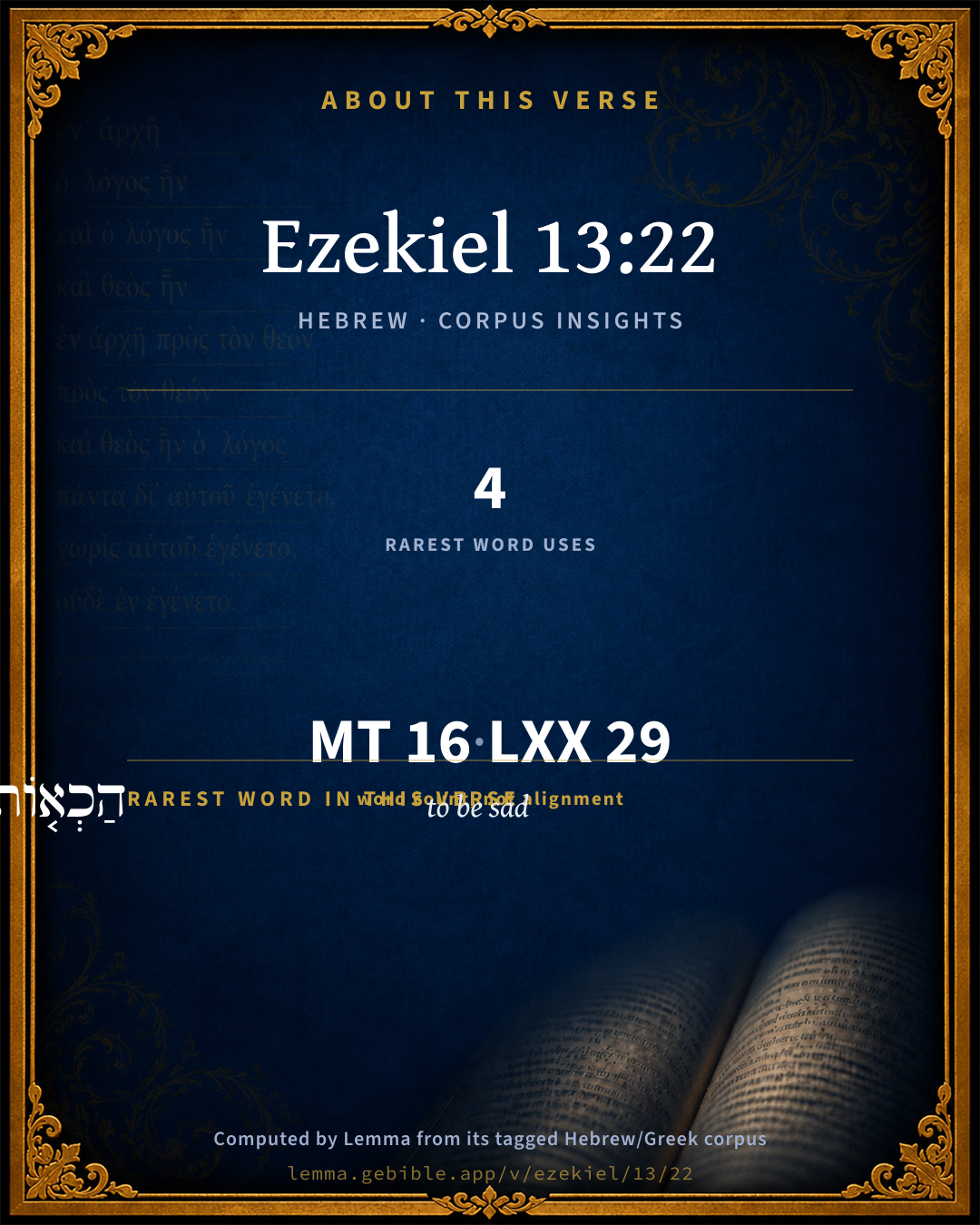
About this verse

These counts appear in no published source. They are computed here, from the morphology-tagged text and Lemma’s own curated glosses. What Lemma adds →

16
words
16
distinct lemmas
Prophets
section

Notable vocabulary

The rarest word here is הַכְא֤וֹת to be sad H3512 — appearing just 4 times in the whole Hebrew Bible.

Shared distinctive vocabulary

הַכְא֤וֹת to be sad H3512 occurs in 4 verses of the Hebrew Bible. Also found in:

Grammatical profile

  • 5 verbs
  • 4 nouns
  • 3 adjectives
  • 1 pronoun
  • 2 conjunctions
  • 1 particle

Verb forms

  • הַכְא֤וֹת Hiphil · Infinitive Construct
  • הִכְאַבְתִּ֑יו Hiphil · Perfect
  • וּלְחַזֵּק֙ Piel · Infinitive Construct
  • שׁ֛וּב Qal · Infinitive Construct
  • לְהַחֲיֹתֽוֹ Hiphil · Infinitive Construct

Hebrew & Septuagint length

In English translation the verse runs 37 words from the Hebrew and 38 from the Septuagint (LXX English) — closely comparable.

A rough comparison of the two English renderings, which tokenize alike — not a word-level alignment.

Word counts can differ between the Hebrew and the Greek without any difference in meaning — e.g. the Hebrew direct-object marker אֵת has no separate Greek word, and Greek often adds the article ὁ.

In the original languages it is 16 Hebrew tokens and 29 Greek tokens — but the two are counted differently (Hebrew bundles its prefixes and suffixes into one token; the Greek is in lemma form), so that isn’t a like-for-like length.

Cross-references

17

Topical passages linked to Ezekiel 13:22 in the Treasury of Scripture Knowledge — connected by theme and wording, ordered by reader-vote popularity; previews shown in the World English Bible.

  • Jeremiah 23:14 In the prophets of Jerusalem also I have seen a horrible thing: they commit adultery, and walk in lies; and they strengthen the hands of evil-doers, so that none does return from his wickedness: they are all of them become to me as Sodom, and the inhabitants of it as Gomorrah.
  • Jeremiah 14:13–17 Then said I, Ah, Lord Yahweh! behold, the prophets tell them, You shall not see the sword, neither shall you have famine; but I will give you assured peace in this place.
  • Genesis 3:4–5 The serpent said to the woman, "You won't surely die,
  • Jeremiah 23:17 They say continually to those who despise me, Yahweh has said, You shall have peace; and to everyone who walks in the stubbornness of his own heart they say, No evil shall come on you.
  • Ezekiel 9:4 Yahweh said to him, Go through the midst of the city, through the midst of Jerusalem, and set a mark on the foreheads of the men that sigh and that cry over all the abominations that are done in the midst of it.
  • Ezekiel 13:16 [to wit], the prophets of Israel who prophesy concerning Jerusalem, and who see visions of peace for her, and there is no peace, says the Lord Yahweh.
  • 2 Peter 2:18–19 For, uttering great swelling words of emptiness, they entice in the lusts of the flesh, by licentiousness, those who are indeed escaping from those who live in error;
  • Jeremiah 4:10 Then said I, Ah, Lord Yahweh! surely you have greatly deceived this people and Jerusalem, saying, You shall have peace; whereas the sword reaches to the life.
  • Jeremiah 6:14 They have healed also the hurt of my people slightly, saying, Peace, peace; when there is no peace.
  • Jeremiah 8:11 They have healed the hurt of the daughter of my people slightly, saying, Peace, peace; when there is no peace.
  • Jeremiah 23:9 Concerning the prophets. My heart within me is broken, all my bones shake; I am like a drunken man, and like a man whom wine has overcome, because of Yahweh, and because of his holy words.
  • Jeremiah 27:14–17 Don't listen to the words of the prophets who speak to you, saying, You shall not serve the king of Babylon; for they prophesy a lie to you.
  • Jeremiah 28:16 Therefore thus says Yahweh, Behold, I will send you away from off the surface of the earth: this year you shall die, because you have spoken rebellion against Yahweh.
  • Jeremiah 29:32 therefore thus says Yahweh, Behold, I will punish Shemaiah the Nehelamite, and his seed; he shall not have a man to dwell among this people, neither shall he see the good that I will do to my people, says Yahweh, because he has spoken rebellion against Yahweh.
  • Lamentations 2:11–14 My eyes do fail with tears, my heart is troubled; My liver is poured on the earth, because of the destruction of the daughter of my people, Because the young children and the infants swoon in the streets of the city.
  • Ezekiel 18:21 But if the wicked turn from all his sins that he has committed, and keep all my statutes, and do that which is lawful and right, he shall surely live, he shall not die.
  • Ezekiel 33:14–16 Again, when I say to the wicked, You shall surely die; if he turn from his sin, and do that which is lawful and right;

Cross-references courtesy of OpenBible.info (CC BY 4.0).

Hebrew and Greek witnesses Masoretic Hebrew ↔ Greek Septuagint

The same verse in the two great witnesses to the Old Testament, shown verse-for-verse.

These are two independent witnesses, not word-aligned to each other, and the Septuagint is shown in lemma (dictionary) form.

Hebrew Ezekiel 13:22 Masoretic · Westminster Leningrad Codex

יַ֣עַן הַכְא֤וֹת לֵב צַדִּיק֙ שֶׁ֔קֶר וַאֲנִ֖י לֹ֣א הִכְאַבְתִּ֑יו וּלְחַזֵּק֙ יְדֵ֣י רָשָׁ֔ע לְבִלְתִּי שׁ֛וּב מִדַּרְכּ֥וֹ הָרָ֖ע לְהַחֲיֹתֽוֹ

Because with lies you have grieved the heart of the righteous, whom I have not made sad; and strengthened the hands of the wicked, that he should not return from his wicked way, and be saved alive:

World English Bible · Public Domain

Greek LXX Ezekiel 13:22 Septuagint · lemma form

ἀντί ὅς διαστρέφω καρδία δίκαιος ἀδίκως καί ἐγώ οὐ διαστρέφω αὐτός καί ὁ καταἰσχύω χείρ ἄνομος ὁ καθόλου μή ἀποστρέφω ἀπό ὁ ὁδός αὐτός ὁ πονηρός καί ζάω αὐτός

Because you⌃ have perverted the heart of the righteous, whereas I perverted him not, and that in order to strengthen the hands of the wicked, that he should not at all turn from his evil way and live:

LXX2012 (modern English Septuagint) · Public Domain

On this verse, The Pulpit Commentary discusses the Septuagint’s reading. Read the note in Commentary ↓

Hebrew: Westminster Leningrad Codex (CC BY 4.0). Greek: Septuagint (public domain); English from LXX2012 (modern English Septuagint) (Public Domain). How the Septuagint differs from the Hebrew →

Targum (Aramaic paraphrase)

1

The Targum is the ancient Jewish Aramaic paraphrase of the Hebrew Scriptures — an interpretive translation, not the Hebrew text itself. Onkelos (literal) and Pseudo-Jonathan (expansive) render the Torah, and Jonathan the Prophets. Coverage is partial: where no permissively-licensed English translation exists for a verse, only the Aramaic is shown. This is verse-level text, not a word-by-word alignment to the Hebrew.

  1. Targum Jonathan Prophets (Joshua–Malachi)
    חֲלַף דְאַכְהֵיתֵן לֵב זַכַּאי לִמֶהֱוֵי שְׁקַר וּמִן קֳדָם מֵימְרִי לָא אִתְבְּהִי וּלְתַקָפָא יְדֵי רַשִׁיעָא בְּדִיל דְלָא לְמֵיתָב מֵאוֹרְחֵיהּ בִּישְׁתָא לְקַיָמוּתֵיהּ:

    (no public-domain English translation for this verse)

    Targum Jonathan — Aramaic: “Mikraot Gedolot” (public domain). English: “Sefaria Community Translation” (CC0 1.0 (public-domain dedication)); “London "Chaldee Paraphrase," 1871” (public domain). Text via Sefaria.

Commentary

Notes on Ezekiel 13:22 from classic Christian and Jewish commentators (each source and its license shown beneath its notes). The classic Christian expositions comment on the surrounding passage and are grouped to its opening verse, so a note may address several verses; the Jewish commentaries on the Tanakh (Rashi and others) are per-verse, so they appear only where the commentator wrote on this verse.

Lemma curates 59 commentaries, every one of them public domain or Creative Commons licensed, each selected and text-cleaned for this edition rather than reprinted as found. About our sources →

Trapp's Complete Commentary

John Trapp

Eze 13:22 Because with lies ye have made the heart of the righteous sad, whom I have not made sad; and strengthened the hands of the wicked, that he should not return from his wicked way, by promising him life:

Ver. 22. Because with lies ye have made the heart of my people sad.] False doctrines and wicked practices grieve the hearts of the godly, and strengthen the hands of the ungodly, as these unhappy times do abundantly evince. The times truly are good (and in many respects better than they have been), but the days are evil.

By promising him life.] Though he walk in hell’s ways.

John Trapp, A Commentary or Exposition upon All the Books of the Old and New Testament (1647–1656) — public domain. Text from a community e-Sword module.

The Biblical Illustrator

Joseph S. Exell

Eze_13:22

Because with lies ye have made the heart of the righteous sad.

The baleful influence of infidelity

I. Infidelity exerts a baleful influence upon the righteous. Note the charge, Because, etc.

1. It casts a shadow upon his pathway. It is the shadow of midnight. Leaves him to grope his way in darkness. Ignoring Gods Word, it points to the light of nature, and says, This is sufficient, walk here! But these are questions that the voice of the winds, the hills, the stars do not answer, Can sins be forgiven? If so, how? In the hour of trial natures light grows dim. The mariner may follow the stars till the storm at midnight; then the lighthouse.

2. It is a blight to his sweetest joys. Because with lies ye have made the heart of the righteous sad, whom I have not made sad. God makes the righteous glad, not sad. True religion is as the oil of joy to the heart. The righteous have songs in the night. But as frost is to the flower, so is unbelief to the better impulses of the heart. What ray of hope, what ground for rejoicing does infidelity afford? Ah! it is the ruthless hand that snatches away the staff upon which the struggling soul rests.

3. It seeks to undermine his hopes--strikes at the very foundation of them (Psa_11:3). Ah! he may sit down in sadness and heave an unending sigh. He may hang his harp upon the willows.

II. Infidelity exerts a baleful influence upon the wicked.

1. It encourages him to follow his own inclinations as his guide. The false prophets are described as those that follow their own spirit, and have seen nothing. So they taught all to do. And so is the spirit of infidelity in all ages of the world. The depraved heart is its criterion.

2. It encourages him to continue in sin--That he should not return from his wicked way. It advocates no such return. Nothing to turn from--nothing to turn to. Nay, it rather strengthens his hands.

3. It encourages him to dismiss from his mind all thought of the future. It cries to the sin-stricken soul, Peace, peace. Think not of the hereafter; there may be none, no heaven to gain, no hell to shun. Be at peace! It is opposed to God, good men, and bad men. It must be destroyed--Wall of bulrushes must fall--There shall be an overflowing shower. And ye shall know that I am the Lord. (M. L. Bibb.)

Making the righteous sad

That is a severe indictment. It was brought by God, and was addressed to the false prophets, and especially to the lying prophetess, who exercised their evil ministry in the days of Ezekiel. In holy wrath, the Lord hurls this flaming impeachment upon these cruel and deceitful ministrants, Ye have grieved the heart of the righteous: whom I have not made sad. (Revised Version.) We are here introduced to sad people. They were righteous--God declares them such. But they were full of grief. Grief and righteousness are often associated. But the sadness of these grieved ones was not imposed by God. He recognises the sorrow, but disavows it. I have not made them sad is His express word of repudiation. Sometimes sadness is from God. He doth not willingly grieve the children of men. Especially reluctant is He to grieve those who are covenanted unto Him. But anon He does it. Sadness is one of Gods methods of education for His righteous ones. Thou didst it, the saddened righteous can confidently and resignedly say in certain of lifes calamitous hours. Let all the sad inquire whence cometh their sadness. From what fountain does the dark and turbid stream arise? It may spring from yourself. Has some strong besetting sin wrecked your gladness? Sadness often originates in temperament. Do not blame God if you are melancholic; blame your yielding to your temperament. Grace can enable a man to rise above his temperament. If self makes a man presumptuous, it full as often makes him despondent. The worry of these worrying days frequently issues in sadness. O righteous one! Thy sadness is not the frown of thy God. Thou art cumbered with much serving. The pace of life is exhausting thee. God has not made you sad. Nerve and body and brain are overwrought. Sadness is wrought, all too often, by our fellow men. Why are you sad? An enemy hath done this. An ingrate friend is responsible. A prodigal child. A remorseless creditor. A thankless debtor. Oh, the inhumanity of humanity! Charge not God foolishly because of sadness. Asperse not the kind Lord. Satan often seeks to ruin us by sadness. Quite as often as by pleasure he seeks to spoil us by grief. Sadness is one of the fiercest of his fiery darts. Beware of Giant Despair, O pilgrim. I am sure we far too often charge God with our sadness. It is well we should weigh this ancient disclaimer of His: Whom I have not made sad. Trace your sadness to its true source. It may be that God has done it. But it may be He is in no wise responsible. Some impose sadness upon the righteous in Gods name. That is exactly what these false prophetesses did. The Almighty charges them with the high crime. He says, Ye have made the heart of the righteous sad. They had spoken in Jehovahs name. They professed to be His forthtellers, but they lied. They spake out of their own hearts. What awful things have been done in Gods name! Men have stolen the livery of heaven to serve the devil in. In the name of God mankind has accomplished its worst infamies. Men have lied and persecuted and slain, claiming the while that they thereby fulfilled the counsel of God. Let us see if this wrong-doing is not perpetrated even in our time. Do not some confound religion and sadness? Assuredly they do. But, thank God, they are not synonymous. Religion and seriousness are essentially allied, but not so religion and sadness. Say ye to the righteous, It shall be well with him. The work of righteousness is not sadness, but peace and assurance. Do not measure the depth of a mans piety by the length of his face. Sadness is far oftener the consequence of a disordered liver than of a righteous heart. Beware, above all things, of prophet or prophetess representing righteousness as essential sadness! Here is a great test of a ministry. Is it generally saddening to the righteous? Then it is undivine. They are no true prophets who make the heart of the righteous sad. Sadden the evil-doer by all means. Make him to pierce himself through with many sorrows. But do not sadden the righteous. Dr. A.B. Davidson renders my text, Ye have discouraged the righteous. So they showed how essentially ungodlike was their ministry. God never discourages the righteous. He is the God of all encouragement. He ministers every form of legitimate encouragement. God is the supreme encourager. Fellow servant of God, is yours a saddening ministry to the saint? Then there is surely a grave wrongness in it. Let all whose ideal and endeavour it is to be righteous be of good cheer. Refuse to be loaded with sadness in Gods name. Be glad in the Lord, ye righteous, and shout for joy, all ye that are upright in heart. How had these godless prophetesses accomplished their beglooming ministry? The Lord supplies the answer, and in no measured terms: With lies ye have made the heart of the righteous sad. They had uttered false predictions of calamities which were to descend upon the godly. False teaching usually has a saddening effect upon the righteous. Truth sometimes makes Gods people sad, but it is not intended to do so. But lies palmed off as religious truth make the heart of the righteous sad. They often encourage and delight the evil-doer. They give him warrant to take his licence. Today, as in days past, we can readily see false teaching working upon the righteous its unkindly work. This is true of teaching which is intrinsically false. Inveracious theologies sadden the righteous. What evil presentations we sometimes hear and read! He is represented now as a despot, and now as morally indifferent. A false theology makes the heart of the righteous sad. Has not erroneous teaching concerning the Bible the same effect? If its inspiration were the dubious thing it is sometimes declared to be, it would indeed be a miserable estate in which the righteous are found. When the Word of God is described as a farago of myths and legends and forgeries, is not the heart of the righteous sad? False teaching regarding the atonement works kindred sorrow. Paul said, We joy in God, by whom we have received the atonement. Destroy that cardinal truth, and you make the heart of the righteous sad. Resolve the death of Christ into a martyrdom, an ethical example, the supreme historic instance of altruism, and you dry up the freshest spring of gladness which humanity knows. Preach the doleful tidings that our moral chains must weight us long as we live beneath. And by such erroneous teaching the heart of the righteous is fatally saddened. Proclaim that there is no privilege of assurance for Gods children. And again you plunge the righteous in nocturnal gloom. But this sadness is evoked not alone by indoctrination which is inherently false, but by that which is such relatively. When true teaching is perverted in its application, it has the value of false teaching. This was the fallacy of which Jobs comforters were guilty. They were capable theologians. Their theology was true in its essence, but false in its application. Thereby they made Jobs heart sad with sore sadness. We must study the relativity of truth. Truth misapplied is as untruth. Assurance is a glorious truth, and a radiant possibility for all, but preach it as essential to salvation, and you must make the heart of the righteous sad. There is a Divine retribution for such as give sadness to the righteous. In the two verses which precede the text, the particular punishment of these false prophetesses is described. And the verse of my text adds that it is because with lies ye have made the heart of the righteous sad. In the verse which follows the threat of God is repeated. All who effect this saddening of the saints shall suffer for their deed. This principle has worldwide application. Let ministers and teachers of religion beware lest God judge them for this disservice to His people. Oh, the delicacy of our office who speak Gods messages! Masters and mistresses need to watch their ways in this regard. Take heed lest inadvertently you make the heart of a righteous servant sad. Friends and acquaintances should be alert to prevent this evil. A thoughtless word may arouse the anger of God by creating sadness in His righteous ones. Restrain unkind speech. Parents may grieve right-doing children. Oh, pray that the judgment of God may never light on us because we have made the heart of the righteous sad! We do a godly deed when we cheer the righteous. Is not that plainly implied in this word of Jehovah which we are studying? We are never more clearly Gods fellow workers than when we hearten Gods people. Be sure you are a true minister of Christ if you encourage the righteous. They greatly need good cheer in these strenuous days. They have grievous burdens to bear. Covet to be an encourager! Strive to uplift the heart of Gods people. Do you ask how you can accomplish this grateful ministry? Speak cheering words. We can hearten the righteous by kindly acts. Eloquent deeds have a sonority which no eloquent speech can attain. A timely gift may fill a sad heart with melody sweeter than an angels song. Our very deportment may accomplish the service of God upon sad souls. There is a Gospel in some mens smile. Faces may be benedictions. Righteousness is the ultimate cure of sadness. Does not this text proclaim that gospel? Character is the final secret of gladness. They who hate evil and do righteousness are anointed with gladness above their fellows. The righteous have a right of gladness. This is especially true in the Christian dispensation. Christian righteousness is realised by faith in the crucified and risen Lord. Such as believe rejoice in the Lord, and this joy none can take from them. (D. T. Young.)

.

The Biblical Illustrator, edited by Joseph S. Exell (c. 1880s–1900s) — public domain. Text from a community e-Sword module.

Geneva Bible (1599)

Geneva Bible translators

By threatening them that were godly, and upholding the wicked.

Geneva Bible (1599) marginal notes — public domain. Text via Bolls.life.

Jamieson, Fausset & Brown

Robert Jamieson, A. R. Fausset & David Brown

ye have made . . . the righteous sad--by lying predictions of calamities impending ever the godly.

strengthened . . . wicked-- (Jer 23:14).

heart of . . . righteous . . . hands of . . . wicked--Heart is applied to the righteous because the terrors foretold penetrated to their inmost feelings; hands, to the wicked because they were so hardened as not only to despise God in their minds, but also to manifest it in their whole acts, as if avowedly waging war with Him.

Jamieson, Fausset & Brown — Commentary Critical and Explanatory on the Whole Bible (1871) — public domain (CC PDM 1.0). Text via the HelloAO Bible API.

Adam Clarke's Commentary

Verse 22. With lies ye have made the heart of the righteous sad] Here is the ministry of these false prophetesses, and its effects. They told lies: they would speak, and they had no truth to tell; and therefore spoke falsities. They "saddened the souls of the righteous, and strengthened the hands of the wicked." They promised them life, and prevented them from repenting and turning from their sins.

Adam Clarke's Commentary on the Bible (1810–1826) — public domain. Text from a community e-Sword/MySword module.

John Calvin's Commentaries

He explains in other words what we saw yesterday: but the repetition adds to the weight of the matter. The Prophet therefore shows that he had a just cause of complaint, because the women so deceived the people. He says now that they made the heart of the righteous sad, and strengthened the hands of the wicked: the sentiment is the same, though the words are changed. He had previously said that they gave life to those devoted to death, and slew those destined to life; but now he shows more clearly the meaning of killing the soul that should not, or ought not to die, when the heart of the righteous is made sorrowful. By the righteous he means those whom the false prophets inspired with causeless terror. But why, it is asked, does he say that the righteous are grieved, since we have formerly taught that no others were deceived unless those who spontaneously throw themselves into the snares and traps of Satan? I answer, that the false prophets thundered so, and their lies were so spread about here and there as to involve the simple: for they scatter their threats so as to reach all men. Hence they wound weak consciences; as at this day when the lies of Satan fly about; by which true religion is corrupted, many simple ones are frightened, for they are destitute of judgment, and do not distinguish whether God threatens, or man vaunts himself rashly.

We see, then, how false prophets cause the righteous sorrow, when they suggest scruples, and, under the penalty of mortal sin, denounce first one thing and then another: then they deprive them of confidence in God’s favor, and strike them with various terrors, as we discern clearly in the papacy of this very day. Let us take that one point which is with them without controversy, that our confidence springs from our works, and hence that we cannot determine whether God is propitious to us or not., and thus they overthrow all assurance of faith. They retain, indeed, the name of faith, but meantime they wish wretched consciences to vacillate and be turned about with disquiet, since no one can know whether he can invoke God as a father. That confidence which Paul says is common to all Christians, they call presumption and rashness. (Ephesians 3:12.) We see, then, how that point not only grieves the righteous, but disturbs innocent consciences: for a series of traditions is afterwards added, and the penalty of eternal death is always annexed. hence it happens that those who wish to worship God in any other way, when they are thus rendered spiritless, know not which way to turn: hence also they lose all fear of God, since no one can seriously reverence God unless he who feels him to be easily entreated, as we learn from Psalm 130:6.

We now understand what the Holy Spirit means when he reproves the women because they made the heart of the righteous sad. It is added, but I was unwilling to grieve them. For God’s faithful servants often inspire terror, but only when necessary. For they cannot otherwise subdue those who exult in their lusts, and they cannot bring them to obedience unless they overcome them with fear. Hence even true prophets and evangelists cause pain, as Paul says: If I have caused you sorrow, I do not repent of it: for so I thought to do: for there is salutary grief. (2 Corinthians 7:8.) Besides, true prophets do not afflict men for nothing; they only cause anxiety in the minds of those whom God wishes to grieve: hence they do not fabricate the material for sorrow and pain in their own brain, but receive it from God’s mouth and the spirit of revelation. Hence the word righteous is used, and falsely is added, by which particle the severity which true prophets are often compelled to use is distinguished from the roughness, or rather savage rudeness, of false prophets. For as I have said, they frighten wretched consciences. But by what right? by transferring God’s power to themselves; just as at the present day the Pope with swelling cheeks thunders forth that himself and his throne are apostolic, and therefore infallible. Since, therefore, false prophets thus contend by fallacies, the simple are overcome by fear.

It is now added, that they strengthened the hands of the impious (literally, of the impious man in the singular). When the Prophet spoke of the righteous, he used the word heart: he now uses the word hand, and not without reason. For the false terrors in which the false prophets indulged, penetrate even to the intimate affections, and as each is affected by the fear of God, so he becomes afraid of those threats which he hears uttered in God’s name. We see, then, that it was said with very good reason that the mind of the righteous was sadly grieved; and now when he says that he had strengthened the hands of the impious, he means that audacity was added, so that not only the wicked always remain obstinate against God, but they break out in unbridled license, and hesitate not openly to violate God’s law: for strengthening the hands is more than grieving the mind. For it may and it does happen, that a man may swell with pride and contempt of God, and yet modesty may hinder him from basely contaminating himself with many crimes. But when the hands themselves are engaged in licentiousness, all evils are heaped together. Now, therefore, we understand the reason of this difference. In fine, Ezekiel means that the impious had been hardened by the blandishments of these women, so as not only to despise God in their minds, but to bear witness through their whole life, that they were openly and confessedly erecting the standard of war against God. In this sense, then, he says, that they had strengthened the hands of the impious.

He adds, that he should not be converted. Here he more clearly defines how those souls which were devoted to death were kept alive, since such confidence was set before them as to lull and stupefy their consciences. He does not say, then, that the hands of the impious were strengthened, as in a conspiracy of the wicked one often assists another, as if they mutually bound their hands together. But the Prophet now speaks in another sense, namely, that these women so hardened the wicked that they went on securely in their wickedness, and made a laughing-stock of God and his law. You have strengthened the hands that they should not be converted: but how? by affording them life. Hence we gather that men cannot be humbled otherwise than by placing death before them, because all willingly indulge themselves, and hypocrisy is so ingrained in us by natural corruption, that every one readily persuades himself that all things will turn out well. Unless, therefore, death is presented before our eyes, and God himself appears as a judge to destroy us, we remain like ourselves, and proceed to still greater audacity. The Prophet signifies this when he says, that by giving life to the impious the false prophets strengthened their hands, and opposed their repentance altogether. How so? When the sinner thinks God propitious to him, he is not anxious about reconciliation, but abuses God’s forbearance, and is daily rendered bolder, until at last he puts off all sense of fear. Hence this is the true preparation for conversion, when the sinner is slain; that is, acknowledges himself liable to the judgment of God, and takes a formidable view of his wrath. When, therefore, he sees himself lost, then he begins to think of conversion; but when men sleep over their sins, as I have said, they persist till they arrive at constant apathy, as Paul says when he remarks that they have no longer any sense of sorrow. (Ephesians 4:19.)

John Calvin's Commentaries (1540-1563) — public domain. Text from the Calvin Translation Society English edition (1840s-50s) via the Christian Classics Ethereal Library (ccel.org). Calvin's coverage is partial (roughly two-thirds of the Bible); uncommented books and verses are honest gaps, never fabricated. The 19th-century editor's footnotes and remarks are omitted so the notes are faithfully Calvin's own voice.

The Cambridge Bible for Schools and Colleges

gen. ed. J. J. S. Perowne

22. heart of the righteous sad] Or, discourage the heart of the righteous—opposed to “strengthen the hands” of the wicked. The word rendered “made sad” or pained in the end of the clause might have been expected.

by promising him life] Rather: and be saved alive; lit. so as to save him alive. The agent is not expressed.

The Cambridge Bible for Schools and Colleges (gen. ed. J. J. S. Perowne; Cambridge University Press, 1878–1918) — public domain. Text from a community e-Sword module.

Haydock's Catholic Bible Commentary

CHAPTER XIII.

Just. Jeremias, or any other, particularly the more simple, who were easily seduced and filled with apprehensions. You shall therefore die, (ver. 23.) and your imposture shall be made known. (Calmet)

George Leo Haydock (1774–1849), Haydock's Catholic Family Bible and Commentary, 1859 edition — public domain. Excludes Psalms (Douay-Rheims chapter numbering differs from Protestant) and Deuterocanonical books (Catholic canon only).

Matthew Poole's English Annotations

With lies; diametrically opposing what my prophets told to my people in my name.

The heart; the soul, which in weak ones received some saddening impressions from your lies; in the strongest and wisest it was matter of grief, to see so many contradict the Lord to their own ruin.

The righteous; who keep my law, and have respect to all my precepts, though none can fulfil the law; the upright and just, against whom you do thunder out your woes; but I know better how to distribute my orders. I never commissioned, nor ever will commission, any prophet to sadden the heart of a just one, who needs and is fit for encouragement, or to threaten where they should promise.

By promising him life; your flatteries persuade the worst to think they are in a good way, need not repent and return, and so, their hearts hardened in wickedness, their hands do work it. God would convince and turn the wicked, but you confirm them that they return not from sin; you assure them, but it is with lying words, that they shall not die by pestilence, nor famine, nor sword, but live and prosper.

Matthew Poole's English Annotations on the Holy Bible (1683–1685) — public domain. Text from a community e-Sword/MySword module.

Whedon's Commentary on the Bible

Daniel D. Whedon

22. By promising him life — Rather, he should live. (Compare Eze_18:9; Eze_18:17; Ezekiel 33.)

Daniel D. Whedon (gen. ed.), Commentary on the Old and New Testaments (1874–1909) — public domain. Text from a community e-Sword module.

The Pulpit Commentary

Because with lies, etc. What specially stirred Ezekiel"s indignation was taut the false prophetesses saddened the hearts of the righteous (of those who looked to him and Jeremiah for guidance) with prophecies of evil and deluded the evil door by false hopes, so that he should not turn from his evil way and live. For by promising him life, read, with the LXX, Vulgate, and Luther and the Revised Version, that he should live, as he would do, if he turned from his wickedness. (Eze_3:21 Eze_18:9, Eze_18:17)

Misplaced sorrow.

We have here set before us the twofold mischief of the false preaching of peace. The righteous are made needlessly sad, and the wicked are spared the sorrows which they need to drive them from their evil ways, and are thus confirmed in their wickedness.

I FALSE IDEAS IN RELIGION BRING NEEDLESS SORROW TO GOOD PEOPLE. One particular aspect of this mischief is here brought before us that of the triumph of sin and the prospect of its immunity, together with the persecution of men who resist it. Such was the condition of things at Jerusalem under the influence of the popular prophets in the days of Jeremiah; and a similar state appears to have prevailed when Ezekiel was writing. But we may see other aspects of the same mischief.

1. Doubt as to Divine justice. If sin is to be unrestrained, goodness may fail. It looks then as though the world were left to drift without control.

2. Doubt as to the Fatherly care of God. This is an opposite mistake in appearance, and yet the two lie near together. They both come from losing the perception of God"s active presence. In the second case, however, good people may trouble themselves by dwelling exclusively on the stern features of judgment, through a reaction against the laxity of popular notions.

3. Misapplication of the doctrine of election. Good people have feared they might not be among the elect. A false fatalism has hung like a pall over their hopes. They have not seen the freedom of grace, the perfect love of God forevery soul, the open door for return.

4. A horror of the unpardonable sin. Yet they who fear they have committed this sin prove by their very distress that they have not, because that distress shows that they are not dead to spiritual things.

II FALSE IDEAS IN RELIGION KEEP AWAY NEEDFUL SORROW FROM BAD PEOPLE. Sorrow for sin is a wholesome experience, and nothing can be more dangerous than to be able to do evil without experiencing any feeling of compunction. The flattering theology which would encourage such a condition is the most deadly enemy to its dupes, and while it professes kindness to the sinners whom it lulls to sleep as they float down the rapids of increasing wickedness, it is really murdering their souls by rendering them deaf to the thunders of the cataract. Let us note some of the delusions which lead to this fatal result:

1. Disbelief in judgment to come. Soothed by such a notion, reckless men imagine that they can sin with impunity. It would be better for them if they were pained by visions of judgment. No doubt the extravagant, coarse pictures of a medieval hell have led to a revolt against the idea of future punishment. Yet whatever may be the nature of that punishment, justice requires some terrible retribution for terrible sin.

2. The belief that God is only mild. His love is infinite. But therefore it must include wrath against sin. Soft-hearted benevolence is not perfect love.

3. Light views of sin. The evil being slightly regarded, its punishment is not expected to be great. Moreover, apart from slavish fears of future suffering, sin itself should be sorrowed over as a hateful thing. But while it is painted in flattering hues it will not be followed by wholesome compunction.

The Pulpit Commentary (1880–1919), ed. H.D.M. Spence-Jones & Joseph S. Exell — public domain. Text from a community e-Sword module.

unfoldingWord translationNotes

Door43 World Missions Community

discourage the heart of the righteous person

Here the word "heart" represents the person and his emotions. AT: "discourage the righteous person" (See: Synecdoche)

turn from his way

To stop doing something is referred to as turning in a different direction. AT: "stop what he is doing" (See: Metaphor)

have false visions or continue to make predictions

Both of these phrases refer to talking about what will happen in the future. AT: "continue to make false predictions" (See: Parallelism)

I will rescue my people out of your hand

Here the word "hand" represents power or control. See how you translated a similar phrase in Ezekiel 13:21. AT: "I will rescue my people from your power" (See: Metonymy)

translationWords

heart

righteous

evil

people of God

unfoldingWord translationNotes — © Distant Shores Media and the Door43 World Missions Community, licensed CC BY-SA 4.0. Source: git.door43.org/Door43/en_tn.

Rashi

Rabbi Shlomo Yitzchaki (Rashi)

Because you break the heart of the righteous one with falsehood When you divine unfavorably for him, and he is anguished, and his heart is broken.

Rashi on the Tanakh — English translations: “The Judaica Press complete Tanach with Rashi, translated by A. J. Rosenberg” (CC BY 4.0); “Pentateuch with Rashi's commentary by M. Rosenbaum and A.M. Silbermann, 1929-1934” (public domain); “The Metsudah Tanach series, Lakewood, N.J” (CC BY 4.0); and “The Book of Joshua, Metsudah Publications, 1997” (CC BY 4.0). Text via Sefaria.

Lesson kit

Teaching starters — assembled from the data on this page, not authored interpretation. Every prompt links to the verse data it draws on. Edit before teaching.

Ezekiel, in the Prophets, opens this verse with 16 words (16 distinct Hebrew lemmas). Its most distinctive word is kâʼâh (“to be sad”). A historical commentator’s framing appears above. Read the whole chapter for the surrounding context.

Discussion questions

  1. How does “to be sad” (kâʼâh) shape what this verse is saying?
  2. How does Psalms 10:10, which shares the word «to be sad», read alongside this verse?
  3. These translations render this verse differently; the difference is in the English rendering, not the original. What questions does that raise?
  4. «הַכְא֤וֹת» is a Hiphil Infinitive Construct verb. How does that grammatical form shape the action described?
  5. Compare how Trapp's Complete Commentary and The Biblical Illustrator read this verse. Where do they agree or differ?

Things to notice

Reading settings

Reading text

Shown beneath each verse's original-language words.

Old Testament
Old Testament edition

Read the OT as the Masoretic Hebrew (MT) or the Greek Septuagint (LXX).

English shown for the Greek Septuagint (in the Hebrew ↔ Greek comparison).

Comparing translations? Open the Compare panel on any verse page to stack up to four side by side.