

Isaiah 58:12

Hebrew (Westminster Leningrad Codex) Isaiah 58:12 appears in the Hebrew Old Testament. The text above is from the Westminster Leningrad Codex. Each word links to its Strong’s number, a concise gloss, and parsing drawn from the Open Scriptures Hebrew Bible morphology. Click any word for its full Brown-Driver-Briggs (BDB) entry.
Download image
Cite this verse

Isaiah 58:12 (World English Bible). Public Domain. Lemma interlinear Bible study tool, https://lemma.gebible.app/v/isaiah/58/12.

Show BibTeX & RIS
BibTeX
RIS
English Translation
Those who shall be of you shall build the old waste places; you shall raise up the foundations of many generations; and you shall be called The repairer of the breach, The restorer of paths to dwell in.
World English Bible · Public Domain
Download a study sheet

One document with this verse’s original text, its word-by-word gloss line, the meaning frame, cross-references with their text, attributed commentary, and full source and license credits — printable, and it pastes into notes with its structure intact.

This verse Autodidact and up

Study sheet (.html) Plain text (.txt)

A passage Seminary Student

Up to 50 verses in one chapter. A passage sheet keeps up to 6 commentary sources and 12 cross-references per verse, in the order this page ranks them, and says so on the sheet whenever that leaves anything out. Ask for a single verse and you get the Autodidact verse sheet above.

Everything on this page stays free to read, with no account — the sheet is a download of what is already on screen, not access to it.

Want to remove ads? Support Godless Engineer
Compare translations 3

The same verse in 3 English versions, stacked beneath the original-language interlinear above. Click any original word for its lexicon entry.

Each is an independent rendering of the whole verse — the interlinear is not word-aligned to these translations.

Highlighted words mark where these versions differ — a whole-verse word diff, not a word-by-word alignment.

  • World English Bible Public Domain
    Those who shall be of you shall build the old waste places; you shall raise up the foundations of many generations; and you shall be called The repairer of the breach, The restorer of paths to dwell in.
  • King James Version Public Domain
    And they that shall be of thee shall build the old waste places: thou shalt raise up the foundations of many generations; and thou shalt be called, The repairer of the breach, The restorer of paths to dwell in.
  • unfoldingWord Literal Text CC BY-SA 4.0
    And from you will build the desolations of eternity; you will raise up the foundations of generation and generation, and one will call you Repairer of the Breach, Restorer of Streets to Dwell In.

unfoldingWord Literal Text — © unfoldingWord, licensed CC BY-SA 4.0. Word-aligned USFM3 via Door43 (git.door43.org/unfoldingWord/en_ult).

Versions to compare (up to 4)

3 of 4 selected

Show all 18 translations

Every available English version of this verse, each an independent rendering of the whole verse.

  • World English Bible Public Domain
    Those who shall be of you shall build the old waste places; you shall raise up the foundations of many generations; and you shall be called The repairer of the breach, The restorer of paths to dwell in.
  • Berean Standard Bible Public Domain
    Your people will rebuild the ancient ruins; you will restore the age-old foundations; you will be called Repairer of the Breach, Restorer of the Streets of Dwelling.
  • Majority Standard Bible Public Domain
    Your people will rebuild the ancient ruins; you will restore the age-old foundations; you will be called Repairer of the Breach, Restorer of the Streets of Dwelling.
  • King James Version Public Domain
    And they that shall be of thee shall build the old waste places: thou shalt raise up the foundations of many generations; and thou shalt be called, The repairer of the breach, The restorer of paths to dwell in.
  • American Standard Version (1901) Public Domain
    And they that shall be of thee shall build the old waste places; thou shalt raise up the foundations of many generations; and thou shalt be called The repairer of the breach, The restorer of paths to dwell in.
  • Revised Version (1885) Public Domain
    And they that shall be of thee shall build the old waste places: thou shalt raise up the foundations of many generations; and thou shalt be called The repairer of the breach, The restorer of paths to dwell in.
  • Geneva Bible (1599) Public Domain
    And they shalbe of thee, that shall builde the olde waste places: thou shalt rayse vp the foundations for many generations, and thou shalt be called the repairer of the breach and the restorer of the pathes to dwell in.
  • Douay-Rheims (1899) Public Domain
    And the places that have been desolate for ages shall be built in thee: thou shalt raise up the foundations of generation and generation: and thou shalt be called the repairer of the fences, turning the paths into rest.
  • Young's Literal Translation Public Domain
    And they have built out of thee the wastes of old, The foundations of many generations thou raisest up, And one calleth thee, `Repairer of the breach, Restorer of paths to rest in.'
  • Literal Standard Version CC BY-SA 4.0
    And they have built the ancient ruins from you, || You raise up the foundations of many generations, || And one calls you, Repairer of the breach, || Restorer of paths to rest in.
  • Unlocked Literal Bible CC BY-SA 4.0
    Some of you will rebuild the ancient ruins; you will raise up the ruins of many generations; you will be called “The repairer of the wall,” “The restorer of streets to live on.”
  • unfoldingWord Literal Text CC BY-SA 4.0
    And from you will build the desolations of eternity; you will raise up the foundations of generation and generation, and one will call you Repairer of the Breach, Restorer of Streets to Dwell In.
  • Darby Bible Public Domain
    And they [that come] of thee shall build the old waste places: thou shalt raise up the foundations [that have remained] from generation to generation; and thou shalt be called, Repairer of the breaches, restorer of frequented paths.
  • World Messianic Bible Public Domain
    Those who will be of you will build the old waste places. You will raise up the foundations of many generations. You will be called Repairer of the Breach, Restorer of Paths with Dwellings.
  • Webster's Bible Public Domain
    And they that shall be of thee shall build the old waste places: thou shalt raise up the foundations of many generations; and thou shalt be called, The repairer of the breach, The restorer of paths to dwell in.
  • Free Bible Version CC BY-SA 4.0
    Some among you will rebuild the ancient ruins; you will restore generations-old foundations. You will be called the Repairer of the Break in the Wall, the Restorer of Life's Pathways.
  • Bible in Basic English Public Domain
    And your sons will be building again the old waste places: you will make strong the bases of old generations: and you will be named, He who puts up the broken walls, and, He who makes ready the ways for use.
  • JPS Tanakh (1917) Public Domain
    And they that shall be of thee shall build the old waste places, thou shalt raise up the foundations of many generations; and thou shalt be called The repairer of the breach, the restorer of paths to dwell in.

Literal Standard Version (2020), Covenant Press — licensed CC BY-SA 4.0. Text via the HelloAO Bible API (eBible.org). Unlocked Literal Bible (unfoldingWord) — licensed CC BY-SA 4.0. Text via the HelloAO Bible API (eBible.org). unfoldingWord Literal Text — © unfoldingWord, licensed CC BY-SA 4.0. Word-aligned USFM3 via Door43 (git.door43.org/unfoldingWord/en_ult). Free Bible Version, Dr. Jonathan Gallagher — licensed CC BY-SA 4.0. Text via the HelloAO Bible API (eBible.org).

Word by word

More ways to search: Search by grammar → Find every occurrence → Compare this word →

Practice this passage: Drill this verse → Learn its vocabulary →

גֹּדֵ֣ר
gâdar
H1443
“walling up”
Verb, Qal, Participle Active, Masculine, Singular, Absolute
Part of Speech
Verb
Stem
Qal
Form
Participle Active
Gender
Masculine
Number
Singular
State
Absolute
Full BDB Definition

Origin: a primitive root

TWOT: 318

to wall up, wall off, close off, build a wall - (Qal) - to wall up, shut off - masons (participle)
  1. וּבָנ֤וּ bânâh H1129 “and · to build” Conjunction + Verb, Qal, Sequential Perfect, 3rd Person, Common, Plural
  2. מִמְּךָ֙ min H4480 “from · you” Preposition + Suffix, Personal, 2nd Person, Masculine, Singular
  3. חָרְב֣וֹת chorbâh H2723 “ruins of” Noun, Common, Feminine, Plural, Construct
  4. עוֹלָ֔ם ʻôwlâm H5769 “forever” Noun, Common, Masculine, Singular, Absolute
  5. מוֹסְדֵ֥י môwçâdâh H4146 “foundations of” Noun, Common, Both, Plural, Construct
  6. דוֹר dôwr H1755 “generation” Noun, Common, Masculine, Singular, Absolute
  7. וָד֖וֹר dôwr H1755 “and · generation” Conjunction + Noun, Common, Masculine, Singular, Absolute
  8. תְּקוֹמֵ֑ם qûwm H6965 “to rise” Verb, Polel, Imperfect, 2nd Person, Masculine, Singular
  9. וְקֹרָ֤א qârâʼ H7121 “and · to call” Conjunction + Verb, Pual, Sequential Perfect, 3rd Person, Masculine, Singular
  10. פֶּ֔רֶץ perets H6556 “breach” Noun, Common, Masculine, Singular, Absolute
  11. מְשֹׁבֵ֥ב shûwb H7725 “returning” Verb, Polel, Participle Active, Masculine, Singular, Absolute
  12. נְתִיב֖וֹת nâthîyb H5410 “paths” Noun, Common, Both, Plural, Absolute
  13. לָשָֽׁבֶת yâshab H3427 “to dwell” Preposition + Verb, Qal, Infinitive Construct

About this verse

These counts appear in no published source. They are computed here, from the morphology-tagged text and Lemma’s own curated glosses. What Lemma adds →

15
words
13
distinct lemmas
Prophets
section

Notable vocabulary

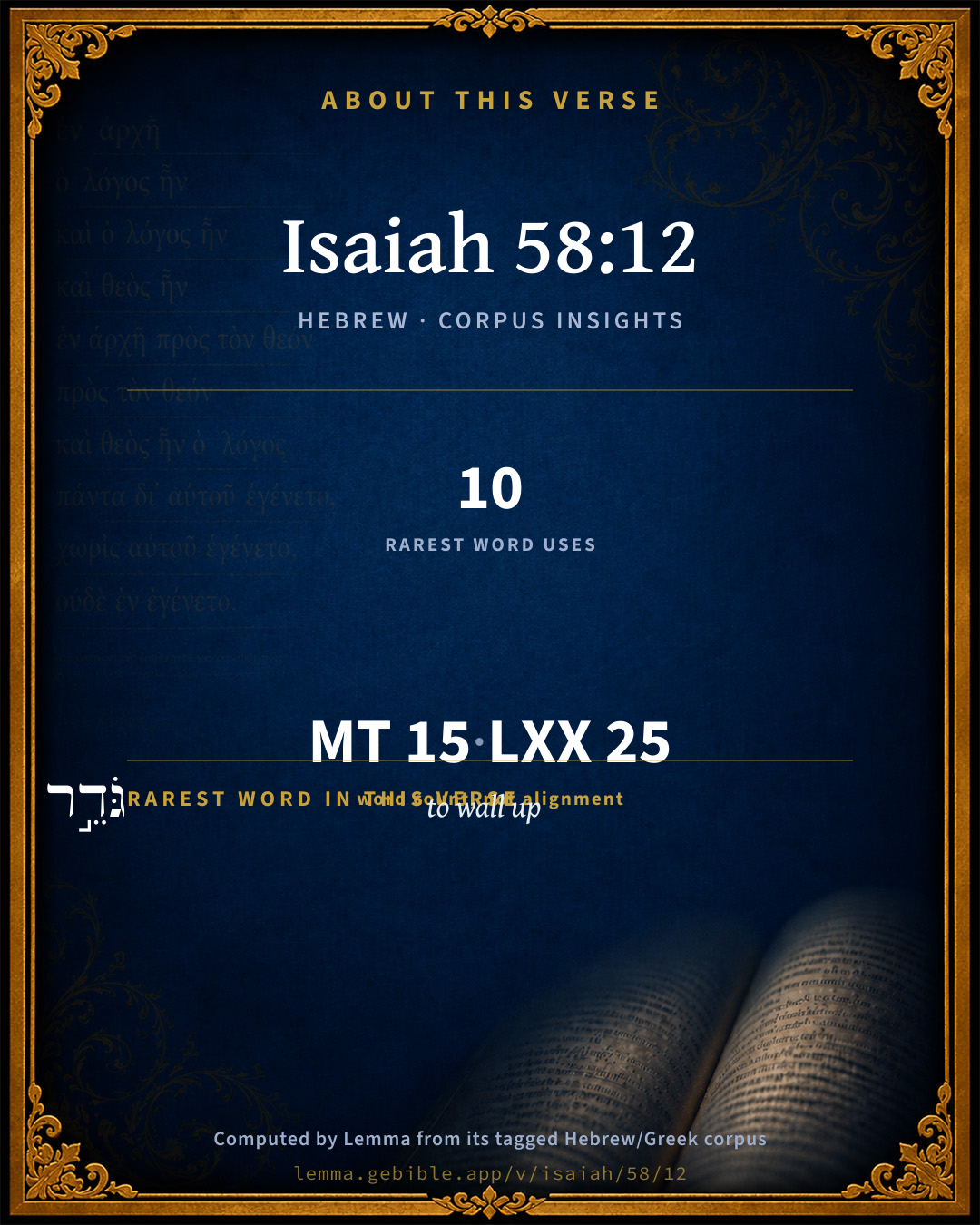
The rarest word here is גֹּדֵ֣ר to wall up H1443 — appearing just 10 times in the whole Hebrew Bible.

Shared distinctive vocabulary

גֹּדֵ֣ר to wall up H1443 occurs in 10 verses of the Hebrew Bible. Also found in:

Grammatical profile

  • 6 verbs
  • 7 nouns
  • 2 prepositions

Verb forms

  • וּבָנ֤וּ Qal · Sequential Perfect
  • תְּקוֹמֵ֑ם Polel · Imperfect
  • וְקֹרָ֤א Pual · Sequential Perfect
  • גֹּדֵ֣ר Qal · Participle Active
  • מְשֹׁבֵ֥ב Polel · Participle Active
  • לָשָֽׁבֶת Qal · Infinitive Construct

Repetition

A word recurs within this verse — often emphatic in Hebrew:

  • דוֹר generation H1755 ×2

Hebrew & Septuagint length

In English translation the verse runs 38 words from the Hebrew and 38 from the Septuagint (LXX English) — the same length.

A rough comparison of the two English renderings, which tokenize alike — not a word-level alignment.

Word counts can differ between the Hebrew and the Greek without any difference in meaning — e.g. the Hebrew direct-object marker אֵת has no separate Greek word, and Greek often adds the article ὁ.

In the original languages it is 15 Hebrew tokens and 25 Greek tokens — but the two are counted differently (Hebrew bundles its prefixes and suffixes into one token; the Greek is in lemma form), so that isn’t a like-for-like length.

Cross-references

16

Topical passages linked to Isaiah 58:12 in the Treasury of Scripture Knowledge — connected by theme and wording, ordered by reader-vote popularity; previews shown in the World English Bible.

  • Isaiah 61:4 They shall build the old wastes, they shall raise up the former desolations, and they shall repair the waste cities, the desolations of many generations.
  • Ezekiel 36:33 Thus says the Lord Yahweh: In the day that I cleanse you from all your iniquities, I will cause the cities to be inhabited, and the waste places shall be built.
  • Amos 9:14 I will bring back the captivity of my people Israel, And they will rebuild the ruined cities, and inhabit them; and they will plant vineyards, and drink wine from them. They shall also make gardens, And eat the fruit of them.
  • Nehemiah 2:17 Then said I to them, You see the evil case that we are in, how Jerusalem lies waste, and the gates of it are burned with fire: come, and let us build up the wall of Jerusalem, that we be no more a reproach.
  • Amos 9:11 In that day I will raise up the tent of David who is fallen, and close up its breaches, and I will raise up its ruins, and I will build it as in the days of old;
  • Ezekiel 36:8–11 But you, mountains of Israel, you shall shoot forth your branches, and yield your fruit to my people Israel; for they are at hand to come.
  • Isaiah 51:3 For Yahweh has comforted Zion; he has comforted all her waste places, and has made her wilderness like Eden, and her desert like the garden of Yahweh; joy and gladness shall be found therein, thanksgiving, and the voice of melody.
  • Jeremiah 31:38 Behold, the days come, says Yahweh, that the city shall be built to Yahweh from the tower of Hananel to the gate of the corner.
  • Isaiah 49:8 Thus says Yahweh, In an acceptable time have I answered you, and in a day of salvation have I helped you; and I will preserve you, and give you for a covenant of the people, to raise up the land, to make them inherit the desolate heritage:
  • Ezekiel 36:4 therefore, you mountains of Israel, hear the word of the Lord Yahweh: Thus says the Lord Yahweh to the mountains and to the hills, to the watercourses and to the valleys, to the desolate wastes and to the cities that are forsaken, which are become a prey and derision to the residue of the nations that are round about;
  • Nehemiah 2:5 I said to the king, If it please the king, and if your servant have found favor in your sight, that you would send me to Judah, to the city of my fathers' tombs, that I may build it.
  • Nehemiah 4:1–7 But it happened that when Sanballat heard that we were building the wall, he was angry, and took great indignation, and mocked the Jews.
  • Nehemiah 6:1 Now it happened, when it was reported to Sanballat and Tobiah, and to Geshem the Arabian, and to the rest of our enemies, that I had built the wall, and that there was no breach left therein; (though even to that time I had not set up the doors in the gates;)
  • Isaiah 44:28 Who says of Cyrus, [He is] my shepherd, and shall perform all my pleasure, even saying of Jerusalem, She shall be built; and of the temple, Your foundation shall be laid.
  • Isaiah 52:9 Break forth into joy, sing together, you waste places of Jerusalem; for Yahweh has comforted his people, he has redeemed Jerusalem.
  • Daniel 9:25 Know therefore and discern, that from the going forth of the commandment to restore and to build Jerusalem to the Anointed One, the prince, shall be seven weeks, and sixty-two weeks: it shall be built again, with street and moat, even in troubled times.

Cross-references courtesy of OpenBible.info (CC BY 4.0).

Hebrew and Greek witnesses Masoretic Hebrew ↔ Greek Septuagint

The same verse in the two great witnesses to the Old Testament, shown verse-for-verse.

These are two independent witnesses, not word-aligned to each other, and the Septuagint is shown in lemma (dictionary) form.

Hebrew Isaiah 58:12 Masoretic · Westminster Leningrad Codex

וּבָנ֤וּ מִמְּךָ֙ חָרְב֣וֹת עוֹלָ֔ם מוֹסְדֵ֥י דוֹר וָד֖וֹר תְּקוֹמֵ֑ם וְקֹרָ֤א לְךָ֙ גֹּדֵ֣ר פֶּ֔רֶץ מְשֹׁבֵ֥ב נְתִיב֖וֹת לָשָֽׁבֶת

Those who shall be of you shall build the old waste places; you shall raise up the foundations of many generations; and you shall be called The repairer of the breach, The restorer of paths to dwell in.

World English Bible · Public Domain

Greek LXX Isaiah 58:12 Septuagint · lemma form

καί οἰκοδομέω σύ ὁ ἔρημος αἰώνιος καί εἰμί σύ ὁ θεμέλιον αἰώνιος γενεά γενεά καί καλέω οἰκοδόμος φραγμός καί ὁ τρίβος ὁ ἀνά μέσος παύσις

And your old waste desert places shall be built up, and your foundations shall last through all generations; and you shall be called a repairer of breaches, and you shall cause your paths between to be in peace.

LXX2012 (modern English Septuagint) · Public Domain

On this verse, Albert Barnes' Notes on the Bible discusses the Septuagint’s reading. Read the note in Commentary ↓

Hebrew: Westminster Leningrad Codex (CC BY 4.0). Greek: Septuagint (public domain); English from LXX2012 (modern English Septuagint) (Public Domain). How the Septuagint differs from the Hebrew →

Targum (Aramaic paraphrase)

1

The Targum is the ancient Jewish Aramaic paraphrase of the Hebrew Scriptures — an interpretive translation, not the Hebrew text itself. Onkelos (literal) and Pseudo-Jonathan (expansive) render the Torah, and Jonathan the Prophets. Coverage is partial: where no permissively-licensed English translation exists for a verse, only the Aramaic is shown. This is verse-level text, not a word-by-word alignment to the Hebrew.

  1. Targum Jonathan Prophets (Joshua–Malachi)
    וְיִבְנוֹן מִנָךְ חָרְבַת עֲלַם יְסוֹדֵי דַר וְדַר תְּקוֹמֵם וְיִקְרוּן לָךְ מְקַיֵים אוֹרְחָא דְתַקְנָא מֵתִיב רַשִׁיעַיָא לְאוֹרַיְתָא:

    Thy offspring shall build the old waste places: thou shalt raise up the foundations of many generations, and they shall call thee, The restorer of the right way; The converter of the wicked to the law.

    Targum Jonathan — Aramaic: “Mikraot Gedolot” (public domain). English: “Sefaria Community Translation” (CC0 1.0 (public-domain dedication)); “London "Chaldee Paraphrase," 1871” (public domain). Text via Sefaria.

Commentary

Notes on Isaiah 58:12 from classic Christian and Jewish commentators (each source and its license shown beneath its notes). The classic Christian expositions comment on the surrounding passage and are grouped to its opening verse, so a note may address several verses; the Jewish commentaries on the Tanakh (Rashi and others) are per-verse, so they appear only where the commentator wrote on this verse.

Lemma curates 59 commentaries, every one of them public domain or Creative Commons licensed, each selected and text-cleaned for this edition rather than reprinted as found. About our sources →

Trapp's Complete Commentary

John Trapp

Isa 58:12 And [they that shall be] of thee shall build the old waste places: thou shalt raise up the foundations of many generations; and thou shalt be called, The repairer of the breach, The restorer of paths to dwell in.

Ver. 12. And they that shall be of thee.] Thy posterity, that have taken their being and beginning from thee.

Shall build the old waste places.] Heb., The wastes of antiquity, i.e., the ruinous places of Jerusalem. The apostles, also, as master builders, and others as builders together with them, have a happy hand in rearing the fair fabric of the new man, that "hidden man of the heart." See Eph 2:20-22.

And thou shalt be called, The repairer of the breach.] The father of thy country, the repairer of peace, the restorer of lost liberty, &c. Such honour had Nehemiah of old; Hunniades of late, who, having overthrown Mesites, the Turkish general, at his return into the camp a wonderful number of the poor captives came, and falling at his feet and kissing them, gave God thanks for their deliverance by him; some called him the father, some the defender of his country; the soldiers, their invincible general; the captives, their deliverer; the women, their protector; the young men and children, their most loving father. He again, with tears standing in his eyes, courteously embraced them, rejoicing at the public good; and himself giving most hearty thanks to God, commanded the like to be done in all the churches of that province, &c. {a} On the contrary, our Henry III, for his ill managing of matters, was called Regni dilapidator, destroyer of the kingdom; and Richard III, the calamity of his country.

{a} Turkish History, 269.

John Trapp, A Commentary or Exposition upon All the Books of the Old and New Testament (1647–1656) — public domain. Text from a community e-Sword module.

Tyndale Open Study Notes

Tyndale Open Resources

58:12 a rebuilder of walls: Nehemiah would later fulfill this promise (see Neh 2:17).

Tyndale Open Study Notes — © Tyndale Open Resources, licensed CC BY-SA 4.0. Text via the HelloAO Bible API.

Geneva Bible (1599)

Geneva Bible translators

Signifying, that of the Jews should come such as should build again the ruins of Jerusalem and Judea: but chiefly this is meant of the spiritual Jerusalem, whose builders were the Apostles.

Geneva Bible (1599) marginal notes — public domain. Text via Bolls.life.

Jamieson, Fausset & Brown

Robert Jamieson, A. R. Fausset & David Brown

they . . . of thee--thy people, the Israelites.

old waste places--the old ruins of Jerusalem (Isa 61:4; Eze 36:33-36).

foundations of many generations--that is, the buildings which had lain in ruins, even to their foundations, for many ages; called in the parallel passage (Isa 61:4), "the former desolations"; and in the preceding clause here, "the old waste places." The literal and spiritual restoration of Israel is meant, which shall produce like blessed results on the Gentile world (Amo 9:11-12; Act 15:16-17).

be called--appropriately: the name truly designating what thou shalt do.

breach--the calamity wherewith God visited Israel for their sin (Isa 30:26; Ch1 15:13).

paths to dwell in--not that the paths were to be dwelt in, but the paths leading to their dwellings were to be restored; "paths, so as to dwell in the land" [MAURER].

Jamieson, Fausset & Brown — Commentary Critical and Explanatory on the Whole Bible (1871) — public domain (CC PDM 1.0). Text via the HelloAO Bible API.

Adam Clarke's Commentary

Verse 12. The restorer of paths to dwell in - "The restorer of paths to be frequented by inhabitants."] To this purpose it is rendered by the Syriac, Symmachus, and Theodotion.

Adam Clarke's Commentary on the Bible (1810–1826) — public domain. Text from a community e-Sword/MySword module.

Ellicott's Commentary for English Readers

(12) Shall build the old waste places.—The prophet contemplates primarily the restoration of the public and private buildings of Jerusalem, but the words have obviously a wider spiritual application.

The foundations of many generations—i.e., those that had been lying in ruins, with no superstructure, for even a longer period than the seventy years of exile.

Thou shalt be called . . .—This was to be the special work, and was to constitute the enduring fame, of the new Israel.

Paths to dwell in—i.e., the streets of the city shall be once more flanked with houses on either side, and not merely roads from one point to another.

A Bible Commentary for English Readers, edited by Charles John Ellicott (1878–1897) — public domain. Text from a community e-Sword module.

The Cambridge Bible for Schools and Colleges

gen. ed. J. J. S. Perowne

12. Comp. ch. Isa_61:4, Isa_49:8. The importance attached to the restoration of the ruined places shews that what the prophet has in view is chiefly the recovery of temporal and political prosperity. It may also throw some light on the date of the prophecy. The description of the ruins as “ancient” suggests a period considerably later than the Exile (which only lasted half a century), although the argument is not one that can be rigorously pressed.

they that shall be of thee] Strictly “some of thee.” Weir and Cheyne emend the text and read “thy children” (בניך for ממך). König on the other hand (Syntax, p. 37) suggests a change of the verb (reading ונבנו): “and the wastes shall be built by thee.”

the old waste places] Better, the ancient ruins (Isa_44:26).

the foundations of many generations] might mean places which had been founded many generations back, but the correspondence with ch. Isa_61:4 seems to shew that foundations which have lain waste for many generations are referred to.

The repairer of the breach &c.] The restoration of the walls and highways will be an achievement by which the community is remembered.

paths to dwell in] Cf. Job_24:13.

The Cambridge Bible for Schools and Colleges (gen. ed. J. J. S. Perowne; Cambridge University Press, 1878–1918) — public domain. Text from a community e-Sword module.

John Gill's Exposition

And they that shall be of thee shall build the old waste places,.... As the cities in Israel and Judea, which had been long laid waste by the Assyrians and Chaldeans, were rebuilt by those of the Jewish nation, who returned from the captivity of Babylon, to which there is at least an allusion; and as the church of God, the tabernacle of David, which was fallen down, and had lain long in ruins, through corruptions in doctrine and worship, to the times of Christ, when the apostles, who were of the Jews, those wise masterbuilders, were instruments of raising it up again, and repairing its ruins: so, in the latter day, "the waste places of the world" (n), as the words may be rendered, shall be built by a set of men, that shall be of the church of God, who shall be instruments in his hand of converting many souls, and so of peopling it with Christians; such places as before were desolate, where before there was no preaching of the word, no administration of ordinances, nor any Gospel churches:

thou shalt raise up the foundations of many generations; either such foundations as have been razed up, and lay so for ages past; or raise up such as shall continue for generations to come. It may allude to the raising the foundations of the city and temple of Jerusalem; but rather refers to the founding of churches in Gospel times, which, as it was done in the first times of it by the apostles in the Gentile world, so shall be again in the latter day, which will continue for many ages:

and thou shalt be called the repairer of the breach, and the restorer of paths to dwell in; that is, the church and her builders, that shall be of her, shall be so called; the Jews and Gentiles will be converted in great numbers, and coalesce in the same Gospel church state, and so the breach between them will be repaired. Christians of various denominations, who now break off and separate one from another, will be of the same sentiment and judgment in doctrine and discipline; they shall see eye to eye, and cement together, and all breaches will be made up, and there will be no schism in the body; and they shall dwell together in unity, and walk in the same paths of faith and duty, of truth and holiness; and such who will be the happy instruments of all this will have much honour, and be called by these names.

The Targum is,

"they shall call thee one that confirms the right way, and converts, the ungodly to the law.''

(n) "desolata seculi", Munster, Vatablus, Vitringa; "deserta seculi", Pagninus, Montanus.

John Gill's Exposition of the Whole Bible (1746–1763) — public domain (CC PDM 1.0). Text via the HelloAO Bible API.

Albert Barnes' Notes on the Bible

And they that shall be of thee - They that spring from thee; or thy people.

Shall build the old waste places - Shall repair the old ruins, and restore the desolate cities and fields to their former beauty. This language is taken from the condition of Judea during the long captivity at Babylon. The land would have been desolated by the Chaldeans, and lain waste for a period of seventy years. Of course all the remains of their former prosperity would have gone to decay, and the whole country would be filled with ruins. But all this, says the prophet, would be restored if they were obedient to God. and would keep his law. Their descendants would be so numerous that the land would be entirely occupied and cultivated again, and cities and towns would rise with their former beauty and magnificence.

Thou shalt raise up the foundations of many generations - That is, the foundations which had endured for generations. The word ‘foundations’ here (מוסד môsâd), means properly the foundation of a building, that is, on which a building rests. Here it means the foundation when that alone remains; and is equivalent to ruins. The Hebrew phrase translated ‘of many generational’ (דור־ודור dôr-vâdôr, generation and generation), is equivalent to one generation after another, and is the usual form of the superlative degree. The exact amount of time is not designated; but the phrase is equivalent to a long time - while one generation passes away after another. Vitringa applies this to the gospel, and supposes that it means that the church, after long decay and desolation, would rise to its former beauty and glory. The promise is indeed general; and though the language is taken from the recovery of Palestine from its ruins after the captivity, yet there can be no objection to applying it in a more general sense, as teaching that the people of God, if they are faithful in keeping his commandments, and in manifesting the spirit which becomes the church, will repair the ruins which sin has made in the world, and rebuild the wastes and the desolations of many ages.

Sin has spread its desolations far and wide. Scarce the foundations of righteousness remain in the earth. Where they do remain, they are often covered over with ruined fragments, and are surrounded by frightful wastes. The world is full of the ruins which sin has caused; and there could be no more striking illustration of the effects of sin on all that is good, than the ruins of Judea during the seventy years of exile, or than those of Palmyra, of Baalbec, of Tyre, of Ephesus, and of Persepolis, at present. It is for the church of God to rebuild these wastes, and to cause the beauties of cultivated fields, and the glories of cities rebuilt, to revisit the desolate earth; in other words, to extend the blessings of that religion which will yet clothe the earth with moral loveliness, as though sin had not spread its gloomy and revolting monuments over the world.

And thou shalt be called - The name which shall appropriately designate what you will do.

The repairer of the breach - Lowth, ‘The repairer of the broken mound.’ The phrase properly means, ‘the fortifier of the breach;’ i. e:, the one who shall build up the breach that is made in a wall of a city, either by the lapse of time, or by a siege.

The restorer of paths to dwell in - Lowth and Noves render this, ‘The restorer of paths to be frequented by inhabitants.’ The Septuagint renders it, ‘And thou shalt cause thy paths to rest in the midst of thee;’ and Jerome. Avertens semitas in quietem - ‘Turning the paths into rest,’ which the Jewish exposition explains to mean, ‘Thou shalt build walls so high that no enemy can enter them.’ So Grotius renders it, ‘Turning thy paths to rest;’ that is, thou shalt leave no way of access to robbers. The Chaldee renders it, ‘Converting the wicked to the law.’ The common English version has probably expressed correctly the sense. The idea is, that they would repair the public highways which had long lain desolate, by which access was had to their dwelling-places. It does not mean, however, that the paths or ways were to be places in which to dwell, but that the ways which led to their dwelling-places were to be restored, or repaired. These roads, of course, in the long desolations would be ruined. Thorns, and brambles, and trees would have grown upon them; and having been long neglected, they would be impassable. But the advantages of a free contact from one dwelling and one city to another, and throughout the land, would be again enjoyed. Spiritually applied, it means the same as the previous expression, that the church of God would remove the ruins which sin has caused, and diffuse comfort and happiness around the world. The obstructed and overrun paths to a quiet and peaceable dwelling on earth would be cleared away, and the blessings of’ the true religion would be like giving free and easy access from one tranquil and prosperous dwelling-place to another.

Albert Barnes' Notes on the Bible (1834–1885) — public domain. Text from a community e-Sword/MySword module.

Haydock's Catholic Bible Commentary

Generation. As the Jews did not comply with the condition, the Church falls heir to these promises.

George Leo Haydock (1774–1849), Haydock's Catholic Family Bible and Commentary, 1859 edition — public domain. Excludes Psalms (Douay-Rheims chapter numbering differs from Protestant) and Deuterocanonical books (Catholic canon only).

Matthew Poole's English Annotations

They that shall be of thee, i.e. either,

1. A remnant of thee among the captivity, that shall be as persons raised from the dead; or,

2. Thy posterity, expressed thus, because they sprang or proceeded from them.

The old waste places, Heb. wastes of eternity, i.e. which have lain long waste; for holam doth not always signify what is bounded by no time, but what respects a long time, looking either forward, as Gen 13:15; Exo 21:6, or backward, as here, viz. the space of seventy years, and so may truly be rendered the wastes of an age. By waste places he means the city and temple, with cities and places adjacent, turned as it were all into a waste, or wilderness, void and untilled, and which was done not only by Nebuchadnezzar king of Babylon, but by Sennacherib also, and the other kings of Assyria. They had lain so long desolate, that the foxes inhabited them instead of men, Lam 5:18. And it was turned so much into a desert, that they were forced to fight with the beasts that possessed it to get their food, Lam 5:9.

The foundations of many generations; either the foundations that were laid many generations ago, as those of Jerusalem, which was not only built, but was the head of a kingdom, in the days of Melchizedek, who was king thereof in the days of Abraham, as appears, Gen 14:18; if that Salem were Jerusalem, as is generally agreed, and Josephus writes, lib. 1. Antiquit. cap. 10; who was born about the three hundredth year after the flood: the superstructures were now destroyed, viz. of Jerusalem, and divers other cities. Or, that shall continue for many generations yet to come.

Thou shalt be called; thou shalt be honoured with this title, as we use to say the father of our country, i.e. deservedly so called, because thou art so; the like phrase Isa 48:8.

The repairer of the breach: breach is put here collectively for breaches, which were made by God’s judgment breaking in upon them in suffering the walls of their towns and cities to be demolished, and their state broken, Isa 5:5.

The restorer of paths; such a one was Moses, Psa 106:23. And this tends to the same sense with the former expression, because men were wont to make paths over those breaches, to go the nearest way. Or it may more particularly point at the recovering of the ancient paths, and bringing them into their wonted course, which were either those chief streets through the gates of the cities, or other lanes out of those streets, which were now forgotten and lost, partly by being covered with rubbish, and partly by those shorter paths that were trod and made over the breaches; such a restorer of paths was Nehemiah, Neh 6:1. And we read of the several repairers he made use of, Ne 3. Or those paths that leads from city to city, which being now laid desolate, and uninhabited, were grown over with grass and weeds, for want of travellers, or safety of travelling, (of something a like case we read in the time of the judges, Jdg 5:6,7) and so lost as in a wilderness, wherein there is no way; and by building up those cities again the several paths leading to them would be restored.

To dwell in; these accommodations being all recovered, their ancient cities might be fit to be reinhabited.

Matthew Poole's English Annotations on the Holy Bible (1683–1685) — public domain. Text from a community e-Sword/MySword module.

Whedon's Commentary on the Bible

Daniel D. Whedon

12. Build the old waste places — The beautiful figures used here are unsurpassable. The prose of it is, Thy children or posterity shall inherit your renewed character, and build up Zion in the far future, and in and through them, thyself shall be called the repairer of the breach, so fearfully made in the spiritual Zion.

The restorer of paths — That is, the old paths. Jer_6:16.

To dwell in — The figure relates, most likely, to the demoralized Jerusalem which, on the return from Babylon, is to be rebuilt, and its streets and walks restored.

Daniel D. Whedon (gen. ed.), Commentary on the Old and New Testaments (1874–1909) — public domain. Text from a community e-Sword module.

The Pulpit Commentary

They that shall be of thee shall build the old waste places. Thy descendants shall restore all that has fallen into decay in Israel, whether it be cities or customs. They shall restore "breaches" of every kind, and bring back the old paths for thee to walk in. The restoration of the ruined cities of Judah may be glanced at, but is far from exhausting the writer"s meaning. (comp. Isa_61:4)

The Pulpit Commentary (1880–1919), ed. H.D.M. Spence-Jones & Joseph S. Exell — public domain. Text from a community e-Sword module.

John Wesley's Explanatory Notes

They shall be of thee - Thy posterity. Waste places - Cities which have lain long waste; that shall continue for many generations to come. The breach - Breach is put for breaches, which was made by God's judgment breaking in upon them in suffering the walls of their towns and cities to be demolished. Paths - Those paths that led from city to city, which being now laid desolate, and uninhabited, were grown over with grass, and weeds. To dwell in - These accommodations being recovered, their ancient cities might be fit to be re-inhabited.

John Wesley, Explanatory Notes Upon the Whole Bible (1754–1765) — public domain. Text via the GEBible commentary corpus.

J. A. Alexander on Isaiah

Joseph Addison Alexander

“And they shall build from thee the ruins of antiquity (or perpetuity), foundations of age and age (i.e., of ages) shalt thou raise up; and it shall be called to thee (or thou shalt be plea) Repairer of the breach, Restorer of paths for dwelling.” ‘From thee’ denotes something more than mere connection or descent, and, unless forbidden by something in the context, must be taken to signify a going forth from Israel into other lands. Thus understood, the clause agrees exactly with the work assigned to Israel in these prophecies, viz. that of reclaiming the apostate nations, and building the wastes of a desolated world. As ‘olam’ (antiquity) obviously refers to past time, this is the only natural interpretation of the corresponding phrase, ‘generation and generation’. Foundations which have lain bare, or buildings whose foundations have lain bare, for ages. For this metaphor, compare Amo 9:11; for that of a highway, Isa 19:23; Isa 35:8; and for that of the breach, Eze 13:5; Eze 22:30. ‘For dwelling’, (i.e., that the land may be inhabited).

Joseph Addison Alexander, The Prophecies of Isaiah (1846–1847; New York: Scribner, 1870–1878) — public domain. Text from a community e-Sword module.

unfoldingWord translationNotes

Door43 World Missions Community

General Information:

Yahweh continues speaking to the people of Israel.

you will be called

This can be stated in active form. AT: "people will call you" (See: Active or Passive)

translationWords

ruin

generation

call

restore

unfoldingWord translationNotes — © Distant Shores Media and the Door43 World Missions Community, licensed CC BY-SA 4.0. Source: git.door43.org/Door43/en_tn.

Rashi

Rabbi Shlomo Yitzchaki (Rashi)

restorer of the paths, to dwell in Heb. מְשׁוֹבֵב. Jonathan renders: restorer of the wicked to the Torah.

מְשׁוֹבֵב is like מֵשִׁיב, restores.

to dwell, to the Torah, which insures the settlement of the world.

Rashi on the Tanakh — English translations: “The Judaica Press complete Tanach with Rashi, translated by A. J. Rosenberg” (CC BY 4.0); “Pentateuch with Rashi's commentary by M. Rosenbaum and A.M. Silbermann, 1929-1934” (public domain); “The Metsudah Tanach series, Lakewood, N.J” (CC BY 4.0); and “The Book of Joshua, Metsudah Publications, 1997” (CC BY 4.0). Text via Sefaria.

Ibn Ezra

Rabbi Abraham ibn Ezra

ובנו ממך And they that shall be of thee shall build.

The foundations of many generations, that is, a building standing on a foundation, which will last for generations.

תקומם Thou shalt raise up. It is Polel like תשובב (Ps. 60:3). The restorer of paths to dwell in. After people had ceased to tread them, thou wilt restore them, that people will dwell therein.

Ibn Ezra on the Tanakh — English translations: “Sefaria Community Translation” (CC0 1.0 (public-domain dedication)); “Yalkut, Sifsei Chachomim Chumash, Metsudah Publications, 2009” (CC BY 4.0); and “Commentary of Ibn Ezra on Isaiah - trans. by M. Friedlander, 1873” (public domain). Text via Sefaria.

Lesson kit

Teaching starters — assembled from the data on this page, not authored interpretation. Every prompt links to the verse data it draws on. Edit before teaching.

Isaiah, in the Prophets, opens this verse with 15 words (13 distinct Hebrew lemmas). Its most distinctive word is gâdar (“to wall up”). A historical commentator’s framing appears above. Read the whole chapter for the surrounding context.

Discussion questions

  1. How does “to wall up” (gâdar) shape what this verse is saying?
  2. How does 2 Kings 12:12, which shares the word «to wall up», read alongside this verse?
  3. What does the repetition of “generation” (2× in this one verse) do in this verse?
  4. These translations render this verse differently; the difference is in the English rendering, not the original. What questions does that raise?
  5. «וּבָנ֤וּ» is a Qal Sequential Perfect verb. How does that grammatical form shape the action described?
  6. Compare how Trapp's Complete Commentary and Tyndale Open Study Notes read this verse. Where do they agree or differ?

Things to notice

Reading settings

Reading text

Shown beneath each verse's original-language words.

Old Testament
Old Testament edition

Read the OT as the Masoretic Hebrew (MT) or the Greek Septuagint (LXX).

English shown for the Greek Septuagint (in the Hebrew ↔ Greek comparison).

Comparing translations? Open the Compare panel on any verse page to stack up to four side by side.