
Ezekiel 46:17

Hebrew (Westminster Leningrad Codex) Ezekiel 46:17 appears in the Hebrew Old Testament. The text above is from the Westminster Leningrad Codex. Each word links to its Strong’s number, a concise gloss, and parsing drawn from the Open Scriptures Hebrew Bible morphology. Click any word for its full Brown-Driver-Briggs (BDB) entry.
Download image
Cite this verse

Ezekiel 46:17 (World English Bible). Public Domain. Lemma interlinear Bible study tool, https://lemma.gebible.app/v/ezekiel/46/17.

Show BibTeX & RIS
BibTeX
RIS
English Translation
But if he give of his inheritance a gift to one of his servants, it shall be his to the year of liberty; then it shall return to the prince; but as for his inheritance, it shall be for his sons.
World English Bible · Public Domain
Download a study sheet

One document with this verse’s original text, its word-by-word gloss line, the meaning frame, cross-references with their text, attributed commentary, and full source and license credits — printable, and it pastes into notes with its structure intact.

This verse Autodidact and up

Study sheet (.html) Plain text (.txt)

A passage Seminary Student

Up to 50 verses in one chapter. A passage sheet keeps up to 6 commentary sources and 12 cross-references per verse, in the order this page ranks them, and says so on the sheet whenever that leaves anything out. Ask for a single verse and you get the Autodidact verse sheet above.

Everything on this page stays free to read, with no account — the sheet is a download of what is already on screen, not access to it.

Want to remove ads? Support Godless Engineer
Compare translations 3

The same verse in 3 English versions, stacked beneath the original-language interlinear above. Click any original word for its lexicon entry.

Each is an independent rendering of the whole verse — the interlinear is not word-aligned to these translations.

Highlighted words mark where these versions differ — a whole-verse word diff, not a word-by-word alignment.

  • World English Bible Public Domain
    But if he give of his inheritance a gift to one of his servants, it shall be his to the year of liberty; then it shall return to the prince; but as for his inheritance, it shall be for his sons.
  • King James Version Public Domain
    But if he give a gift of his inheritance to one of his servants, then it shall be his to the year of liberty; after it shall return to the prince: but his inheritance shall be his sons' for them.
  • unfoldingWord Literal Text CC BY-SA 4.0
    But if he gives a gift from his inheritance to one of his servants, then it will be that servant’s until the year of liberty, and then it will return to the prince. His inheritance will certainly be for his sons.

unfoldingWord Literal Text — © unfoldingWord, licensed CC BY-SA 4.0. Word-aligned USFM3 via Door43 (git.door43.org/unfoldingWord/en_ult).

Versions to compare (up to 4)

3 of 4 selected

Show all 18 translations

Every available English version of this verse, each an independent rendering of the whole verse.

  • World English Bible Public Domain
    But if he give of his inheritance a gift to one of his servants, it shall be his to the year of liberty; then it shall return to the prince; but as for his inheritance, it shall be for his sons.
  • Berean Standard Bible Public Domain
    But if he gives a gift from his inheritance to one of his servants, it will belong to that servant until the year of freedom; then it will revert to the prince. His inheritance belongs only to his sons; it shall be theirs.
  • Majority Standard Bible Public Domain
    But if he gives a gift from his inheritance to one of his servants, it will belong to that servant until the year of freedom; then it will revert to the prince. His inheritance belongs only to his sons; it shall be theirs.
  • King James Version Public Domain
    But if he give a gift of his inheritance to one of his servants, then it shall be his to the year of liberty; after it shall return to the prince: but his inheritance shall be his sons' for them.
  • American Standard Version (1901) Public Domain
    But if he give of his inheritance a gift to one of his servants, it shall be his to the year of liberty; then it shall return to the prince; but as for his inheritance, it shall be for his sons.
  • Revised Version (1885) Public Domain
    But if he give of his inheritance a gift to one of his servants, it shall be his to the year of liberty; then it shall return to the prince; but as for his inheritance, it shall be for his sons.
  • Geneva Bible (1599) Public Domain
    But if hee giue a gift of his inheritance to one of his seruantes, then it shall bee his to the yere of libertie: after, it shall returne to ye prince, but his inheritance shall remaine to his sonnes for them.
  • Douay-Rheims (1899) Public Domain
    But if he give a legacy out of his inheritance to one of his servants, it shall be his until the year of release, and it shall return to the prince: but his inheritance shall go to his sons.
  • Young's Literal Translation Public Domain
    And when he giveth a gift out of his inheritance to one of his servants, then it hath been to him till the year of freedom, and it hath turned back to the prince, only the inheritance of his sons is theirs.
  • Literal Standard Version CC BY-SA 4.0
    And when he gives a gift out of his inheritance to one of his servants, then it has been his until the year of freedom, and it has turned back to the prince, only the inheritance of his sons is theirs.
  • Unlocked Literal Bible CC BY-SA 4.0
    But if he gives a gift from his inheritance to one of his servants, then it will be that servant's until the year of liberty, and then it will return to the prince. His inheritance will certainly be for his sons.
  • unfoldingWord Literal Text CC BY-SA 4.0
    But if he gives a gift from his inheritance to one of his servants, then it will be that servant’s until the year of liberty, and then it will return to the prince. His inheritance will certainly be for his sons.
  • Darby Bible Public Domain
    But if he give a gift of his inheritance to one of his servants, it shall be his until the year of liberty; and it shall return to the prince: to his sons alone shall his inheritance remain.
  • World Messianic Bible Public Domain
    But if he gives of his inheritance a gift to one of his servants, it shall be his to the year of liberty; then it shall return to the prince; but as for his inheritance, it shall be for his sons.
  • Webster's Bible Public Domain
    But if he shall give a gift of his inheritance to one of his servants, then it shall be his to the year of liberty; afterward it shall return to the prince: but his inheritance shall be to his sons for them.
  • Free Bible Version CC BY-SA 4.0
    However, if he gives a gift of his property to one of his servants, that servant will only own it until the Jubilee Year. Then ownership will return to the prince. His property that he passes on through inheritance belongs only to his sons—it is theirs.
  • Bible in Basic English Public Domain
    And if he gives a part of his heritage to one of his servants, it will be his till the year of making free, and then it will go back to the ruler; for it is his sons' heritage, and is to be theirs.
  • JPS Tanakh (1917) Public Domain
    But if he give of his inheritance a gift to one of his servants, it shall be his to the year of liberty; then it shall return to the prince; but as for his inheritance, it shall be for his sons.

Literal Standard Version (2020), Covenant Press — licensed CC BY-SA 4.0. Text via the HelloAO Bible API (eBible.org). Unlocked Literal Bible (unfoldingWord) — licensed CC BY-SA 4.0. Text via the HelloAO Bible API (eBible.org). unfoldingWord Literal Text — © unfoldingWord, licensed CC BY-SA 4.0. Word-aligned USFM3 via Door43 (git.door43.org/unfoldingWord/en_ult). Free Bible Version, Dr. Jonathan Gallagher — licensed CC BY-SA 4.0. Text via the HelloAO Bible API (eBible.org).

Word by word

More ways to search: Search by grammar → Find every occurrence → Compare this word →

Practice this passage: Drill this verse → Learn its vocabulary →

הַדְּר֔וֹר
dᵉrôwr
H1865
“the · flowing”
Particle, Definite Article + Noun, Common, Masculine, Singular, Absolute
Part of Speech
Particle + Noun
Type
Common
Gender
Masculine
Number
Singular
State
Absolute
Full BDB Definition

Origin: from an unused root (meaning to move rapidly)

TWOT: 454b

a flowing, free run, liberty - flowing (of myrrh) - liberty
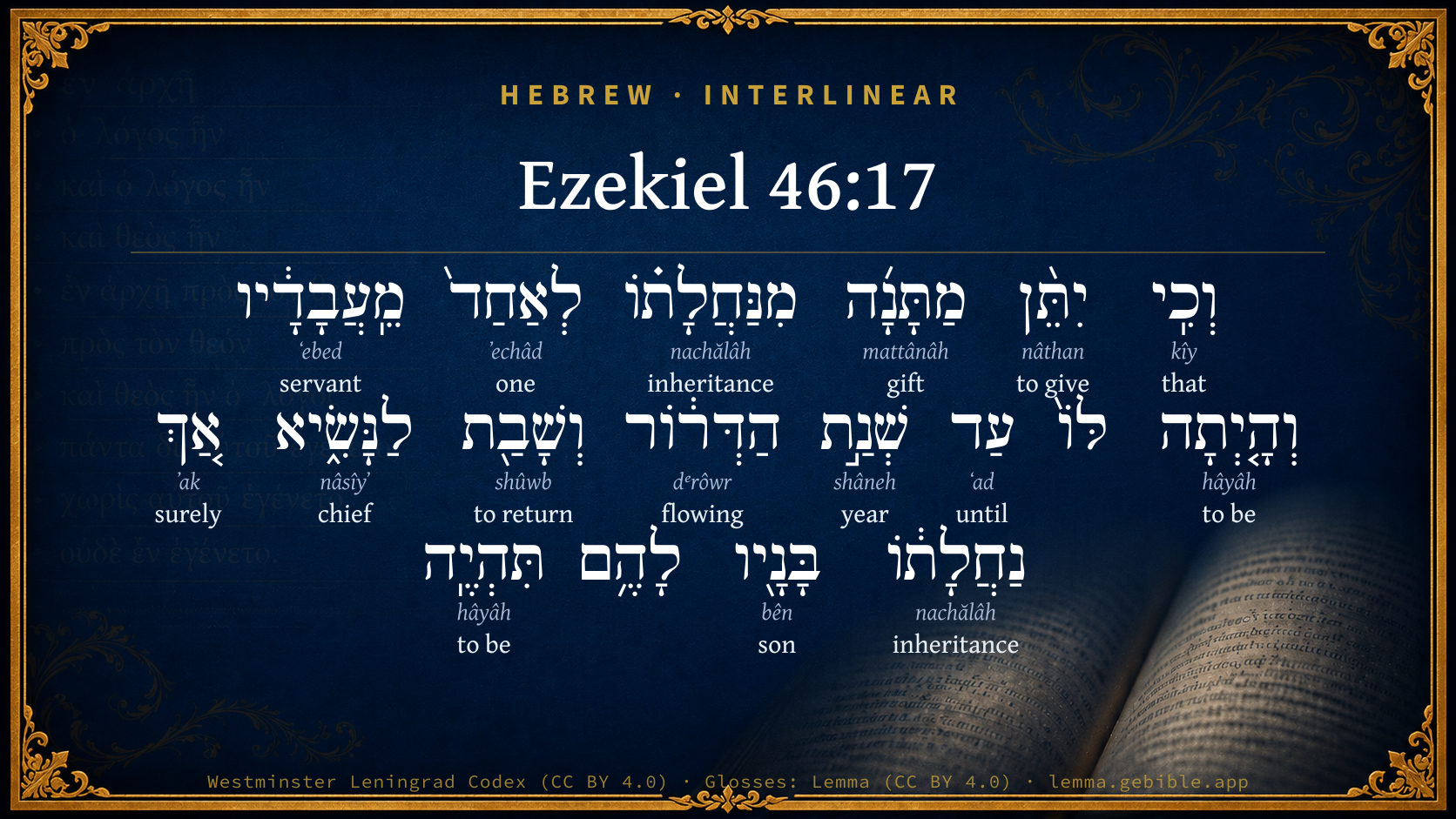
  1. וְכִֽי kîy H3588 “and · that” Conjunction + Conjunction
  2. יִתֵּ֨ן nâthan H5414 “to give” Verb, Qal, Imperfect, 3rd Person, Masculine, Singular
  3. מַתָּנָ֜ה mattânâh H4979 “gift” Noun, Common, Feminine, Singular, Absolute
  4. מִנַּחֲלָת֗וֹ nachălâh H5159 “from · inheritance · his” Preposition + Noun, Common, Feminine, Singular, Construct + Suffix, Personal, 3rd Person, Masculine, Singular
  5. לְאַחַד֙ ʼechâd H259 “to/for · one” Preposition + Adjective, Cardinal number, Masculine, Singular, Absolute
  6. מֵֽעֲבָדָ֔יו ʻebed H5650 “from · servants · his” Preposition + Noun, Common, Masculine, Plural, Construct + Suffix, Personal, 3rd Person, Masculine, Singular
  7. וְהָ֤יְתָה hâyâh H1961 “and · to be” Conjunction + Verb, Qal, Sequential Perfect, 3rd Person, Feminine, Singular
  8. עַד ʻad H5704 “until” Preposition
  9. שְׁנַ֣ת shâneh H8141 “year of” Noun, Common, Feminine, Singular, Construct
  10. וְשָׁבַ֖ת shûwb H7725 “and · to return” Conjunction + Verb, Qal, Sequential Perfect, 3rd Person, Feminine, Singular
  11. לַנָּשִׂ֑יא nâsîyʼ H5387 “to/for the · chief” Preposition, Determined + Noun, Common, Masculine, Singular, Absolute
  12. אַ֚ךְ ʼak H389 “surely” Particle, Accusative
  13. נַחֲלָת֔וֹ nachălâh H5159 “inheritance · his” Noun, Common, Feminine, Singular, Construct + Suffix, Personal, 3rd Person, Masculine, Singular
  14. בָּנָ֖יו bên H1121 “sons · his” Noun, Common, Masculine, Plural, Construct + Suffix, Personal, 3rd Person, Masculine, Singular
  15. תִּהְיֶֽה hâyâh H1961 “to be” Verb, Qal, Imperfect, 3rd Person, Feminine, Singular

About this verse

These counts appear in no published source. They are computed here, from the morphology-tagged text and Lemma’s own curated glosses. What Lemma adds →

18
words
14
distinct lemmas
Prophets
section

Notable vocabulary

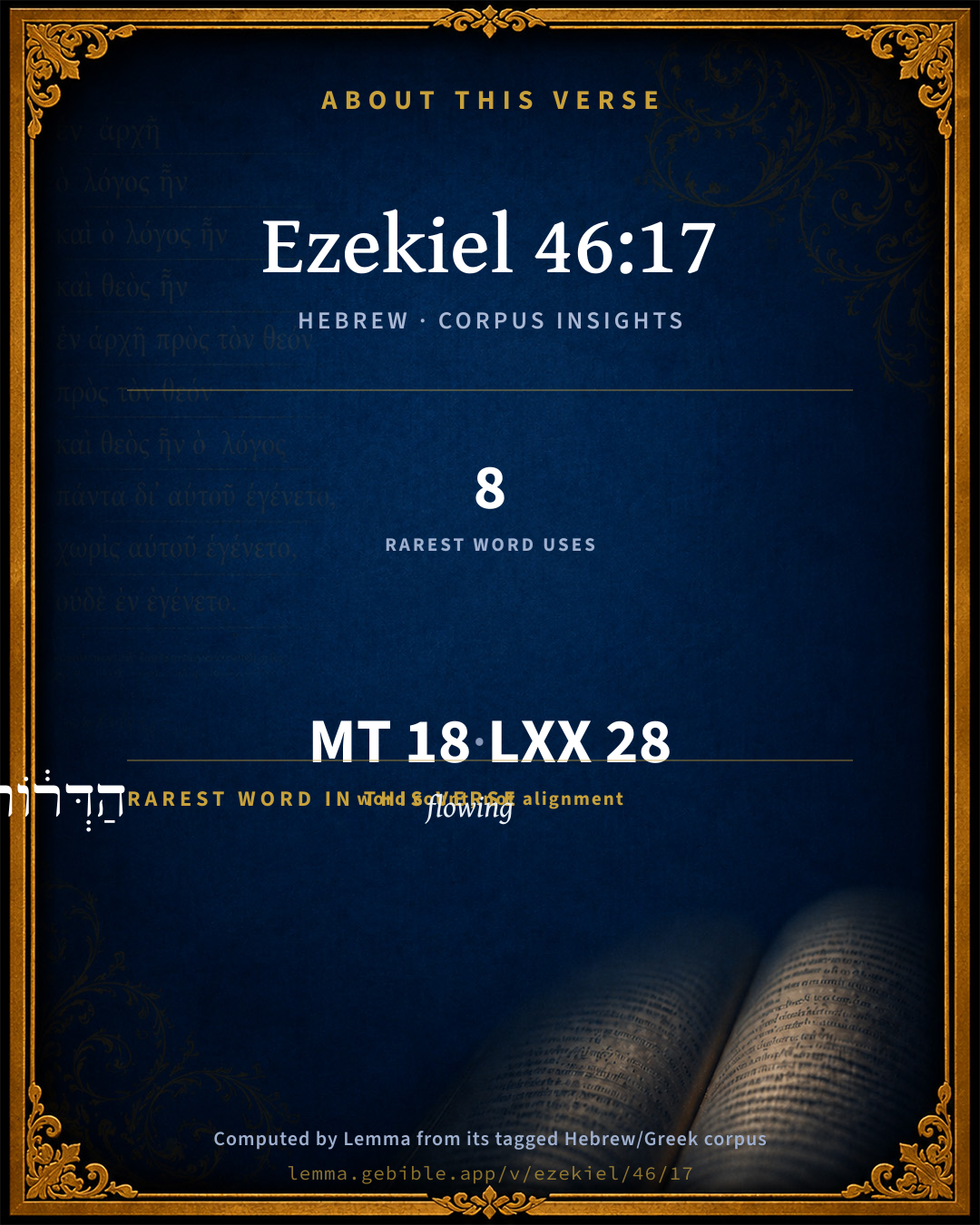
The rarest word here is הַדְּר֔וֹר flowing H1865 — appearing just 8 times in the whole Hebrew Bible.

Shared distinctive vocabulary

הַדְּר֔וֹר flowing H1865 occurs in 7 verses of the Hebrew Bible. Also found in:

Grammatical profile

  • 4 verbs
  • 8 nouns
  • 1 adjective
  • 3 prepositions
  • 1 conjunction
  • 1 particle

Verb forms

  • יִתֵּ֨ן Qal · Imperfect
  • וְהָ֤יְתָה Qal · Sequential Perfect
  • וְשָׁבַ֖ת Qal · Sequential Perfect
  • תִּהְיֶֽה Qal · Imperfect

Repetition

Words recur within this verse — often emphatic in Hebrew:

  • מִנַּחֲלָת֗וֹ inheritance H5159 ×2
  • וְהָ֤יְתָה to be H1961 ×2

Hebrew & Septuagint length

In English translation the verse runs 41 words from the Hebrew and 44 from the Septuagint (LXX English) — closely comparable.

A rough comparison of the two English renderings, which tokenize alike — not a word-level alignment.

Word counts can differ between the Hebrew and the Greek without any difference in meaning — e.g. the Hebrew direct-object marker אֵת has no separate Greek word, and Greek often adds the article ὁ.

In the original languages it is 18 Hebrew tokens and 28 Greek tokens — but the two are counted differently (Hebrew bundles its prefixes and suffixes into one token; the Greek is in lemma form), so that isn’t a like-for-like length.

Cross-references

4

Topical passages linked to Ezekiel 46:17 in the Treasury of Scripture Knowledge — connected by theme and wording, ordered by reader-vote popularity; previews shown in the World English Bible.

  • Leviticus 25:10 You shall make the fiftieth year holy, and proclaim liberty throughout the land to all its inhabitants. It shall be a jubilee to you; and each of you shall return to his own property, and each of you shall return to his family.
  • Matthew 25:14–29 "For it is like a man, going into another country, who called his own servants, and entrusted his goods to them.
  • Luke 19:25–26 "They said to him, 'Lord, he has ten minas!'
  • Galatians 4:30–31 However what does the Scripture say? "Throw out the handmaid and her son, for the son of the handmaid will not inherit with the son of the free woman."

Cross-references courtesy of OpenBible.info (CC BY 4.0).

Hebrew and Greek witnesses Masoretic Hebrew ↔ Greek Septuagint

The same verse in the two great witnesses to the Old Testament, shown verse-for-verse.

These are two independent witnesses, not word-aligned to each other, and the Septuagint is shown in lemma (dictionary) form.

Hebrew Ezekiel 46:17 Masoretic · Westminster Leningrad Codex

וְכִֽי יִתֵּ֨ן מַתָּנָ֜ה מִנַּחֲלָת֗וֹ לְאַחַד֙ מֵֽעֲבָדָ֔יו וְהָ֤יְתָה לּוֹ֙ עַד שְׁנַ֣ת הַדְּר֔וֹר וְשָׁבַ֖ת לַנָּשִׂ֑יא אַ֚ךְ נַחֲלָת֔וֹ בָּנָ֖יו לָהֶ֥ם תִּהְיֶֽה

But if he give of his inheritance a gift to one of his servants, it shall be his to the year of liberty; then it shall return to the prince; but as for his inheritance, it shall be for his sons.

World English Bible · Public Domain

Greek LXX Ezekiel 46:17 Septuagint · lemma form

ἐάν δέ δίδωμι δόμα εἷς ὁ παῖς αὐτός καί εἰμί αὐτός ἕως ὁ ἔτος ὁ ἄφεσις καί ἀποδίδωμι ὁ ἀποἡγέομαι πλήν ὁ κληρονομία ὁ υἱός αὐτός αὐτός εἰμί

But if he give a gift to one of his servants, then it shall belong to him until the year of release; and then he shall restore it to the prince: but of the inheritance of his sons the possession shall continue to them.

LXX2012 (modern English Septuagint) · Public Domain

On this verse, The Cambridge Bible for Schools and Colleges discusses the Septuagint’s reading. Read the note in Commentary ↓

Hebrew: Westminster Leningrad Codex (CC BY 4.0). Greek: Septuagint (public domain); English from LXX2012 (modern English Septuagint) (Public Domain). How the Septuagint differs from the Hebrew →

Targum (Aramaic paraphrase)

1

The Targum is the ancient Jewish Aramaic paraphrase of the Hebrew Scriptures — an interpretive translation, not the Hebrew text itself. Onkelos (literal) and Pseudo-Jonathan (expansive) render the Torah, and Jonathan the Prophets. Coverage is partial: where no permissively-licensed English translation exists for a verse, only the Aramaic is shown. This is verse-level text, not a word-by-word alignment to the Hebrew.

  1. Targum Jonathan Prophets (Joshua–Malachi)
    וַאֲרֵי יִתֵּן מַתְּנָא מֵאַחֲסַנְתֵּיהּ לְחַד מֵעַבְדוֹהִי וּתְהֵי לֵיהּ עַד שַׁתָּא דְיוֹבֵלָא וּתְתֵיב לְרַבָּא בְּרַם אַחֲסַנְתֵּיהּ דִי בְנוֹהִי דִילְהוֹן תְּהֵי:

    (no public-domain English translation for this verse)

    Targum Jonathan — Aramaic: “Mikraot Gedolot” (public domain). English: “Sefaria Community Translation” (CC0 1.0 (public-domain dedication)); “London "Chaldee Paraphrase," 1871” (public domain). Text via Sefaria.

Commentary

Notes on Ezekiel 46:17 from classic Christian and Jewish commentators (each source and its license shown beneath its notes). The classic Christian expositions comment on the surrounding passage and are grouped to its opening verse, so a note may address several verses; the Jewish commentaries on the Tanakh (Rashi and others) are per-verse, so they appear only where the commentator wrote on this verse.

Lemma curates 59 commentaries, every one of them public domain or Creative Commons licensed, each selected and text-cleaned for this edition rather than reprinted as found. About our sources →

Trapp's Complete Commentary

John Trapp

Eze 46:17 But if he give a gift of his inheritance to one of his servants, then it shall be his to the year of liberty; after it shall return to the prince: but his inheritance shall be his sons’ for them.

Ver. 17. But if he give a gift of his inheritance to one of his servants.] As Alexander the Great, who, going to subdue a great part of the habitable world, gave away to his servants almost all he had, and when one of his officers asked him what he would leave for himself? he said, Hope. Messiah the prince, besides his choicest gifts ( Dona throni) to his dear children, giveth gifts unto men, even to the rebellious also; {Psa 68:18} these are common gifts ( Dona scabelli), temporal favours, external privileges. See Mat 7:22-23; Mat 25:14-30 Luk 19:12-27, &c. But as "the servant abideth not in the house for ever," as the son doth; {Joh 8:35} so these gifts to servants, but for the behoof and benefit of his sons, are but till the year of liberty, or jubilee, till the last day at utmost. {Lev 25:10} Then shall the wicked give a dreadful account of all, with the whole world flaming about their ears.

John Trapp, A Commentary or Exposition upon All the Books of the Old and New Testament (1647–1656) — public domain. Text from a community e-Sword module.

Geneva Bible (1599)

Geneva Bible translators

Which was at the Jubilee, Lev. 25:9.

Geneva Bible (1599) marginal notes — public domain. Text via Bolls.life.

Adam Clarke's Commentary

Verse 17. To the year of liberty] That is, to the year of jubilee, called the year of liberty, because there was then a general release. All servants had their liberty, and all alienated estates returned to their former owners.

Adam Clarke's Commentary on the Bible (1810–1826) — public domain. Text from a community e-Sword/MySword module.

The Cambridge Bible for Schools and Colleges

gen. ed. J. J. S. Perowne

17. year of liberty] In Jer_34:14 the year of liberty is that of the freeing of the bondservant in the seventh year; and this year may be meant here. Cf. Isa_61:1. Otherwise the year of Jubilee, the fiftieth year, is referred to, when all landed property that had been alienated reverted to its original owner, Lev_25:10; Lev_27:24.

but his inheritance … them] lit. but (or, only as for) his inheritance, his sons, it shall be theirs, i.e. the portion of his inheritance which the prince may bestow on his sons shall remain theirs, without reverting to the prince (Eze_46:16). LXX., Syr. more clearly; the inheritance of his sons, it shall be theirs.

The Cambridge Bible for Schools and Colleges (gen. ed. J. J. S. Perowne; Cambridge University Press, 1878–1918) — public domain. Text from a community e-Sword module.

John Gill's Exposition

Moreover the prince shall not take of the people's inheritance by oppression, to thrust them out of their possession,.... Christ, the Prince, will never do this; he will never take any part of his people's inheritance from them, or thrust them out of the possession of any benefit or blessing of grace; they have chosen that good part which shall never be taken from them, Luk 10:42, this is said, not as a direction to the prince, as a law enjoined him, or a caution to him against oppression; but as expressing his clemency, grace, and goodness to his subjects, and their safety and security under him:

but he shall give his sons inheritance out of his own possession; whatever Christ gives his sons, whether present grace, or future glory, it is out of his own possession; for all that the Father has are his; all the blessings of goodness are with him; all the fulness of grace is in him; the eternal inheritance is reserved with him in heaven; and it is all his own he gives, and not another's:

that my people be not scattered every man from his possession; or, "that therefore my people may not be scattered every" "men from his possession" (o); because what is given them, and they are in possession of, was Christ's own, and not another's; and which he had a right to dispose of, and therefore they need not fear being dispossessed by another claimant.

(o) "ideo ne dispergantur populus meus", Starckius.

John Gill's Exposition of the Whole Bible (1746–1763) — public domain (CC PDM 1.0). Text via the HelloAO Bible API.

Haydock's Catholic Bible Commentary

Sons. If any portion of his land was made over to them, it still remained in the family; but if any other had a present of it, the land must revert to the royal family, agreeably to the law, Leviticus xxv. 10. (Calmet) --- This insinuates that works done by the true children of God, in the state of grace, merit an eternal reward, while moral good works performed in the state of sin, can only have a temporal one. (Worthington)

George Leo Haydock (1774–1849), Haydock's Catholic Family Bible and Commentary, 1859 edition — public domain. Excludes Psalms (Douay-Rheims chapter numbering differs from Protestant) and Deuterocanonical books (Catholic canon only).

Matthew Poole's English Annotations

Of his inheritance; of any part or parcel of the crown land, or the prince’s inheritance.

To one of his servants; whether such servant be, strictly taken, a servant or bondman or in more large sense any of his servants in the court, and in office about it.

The year of liberty; the year of jubilee, as Lev 25:10,13,28.

To the prince; or his heirs, if the prince be dead.

His inheritance: this may be understood either of the prince or the servant. Either thus, though the land by gift go back to the prince or his heirs from the servant, yet what lands this servant had of his own inheritance shall descend to the heirs of that servant, and be theirs: or else thus, whatever lands of the prince are given to servants, by gift, shall at the year of jubilee revert to the sons of the prince, who shall repossess them, forasmuch as they are lands of inheritance, and of right belong to the heir.

For them; and for theirs after them.

Matthew Poole's English Annotations on the Holy Bible (1683–1685) — public domain. Text from a community e-Sword/MySword module.

The Pulpit Commentary

The second regulation. Should the prince, however, bestow a portion of his inheritance on one of his servants, what was thus bestowed should not belong to that servant in perpetuity, but should be regarded simply as a temporary loan which should be his till the year of liberty, tnv rwOrDh i.e. the year of free flowing general comp. Exo_30:23, rwOrDArm pure myrrh (Authorized Version) or flowing myrrh (Revised Version) hence the year of release; after which it should return to the prince. Smend thinks Ezekiel could hardly have had in view the year of jubilee, (Lev_25:10 Lev_27:24) else he would not have employed the term "liberty," which Jeremiah (Jer_34:8, Jer_34:15, Jer_34:17) uses to denote the freedom regained by Hebrew bondmen in the seventh year. (Exo_21:2; Deu_15:12) But

(1) the seventh year was only a year of the release of bondmen, not of the reversion of property, and to this rather than to that Ezekiel refers.

(2) The year of jubilee might properly be called the "year of liberty," since in it both slaves were emancipated and property was liberated. And

(3) Ezekiel"s phraseology is not framed (nor is Jeremiah"s) in imitation of either Exodus or Deuteronomy, the latter of which in particular speaks of "the year of release" (hF; miCh tn but adheres closely to the style of Leviticus, which, in fact, it presupposes. rwOrDhtnv can only signify the year of the release, i.e. the well-known year of emancipation. The last clause should be rendered, as in the Revised Version, "As for his inheritance (generally), it shall be for his sons," or, as Keil translates, "Only his inheritance it is," i.e. the prince"s; "as for his sons, it shall be for them."

The Pulpit Commentary (1880–1919), ed. H.D.M. Spence-Jones & Joseph S. Exell — public domain. Text from a community e-Sword module.

John Wesley's Explanatory Notes

His inheritance - Whatever lands of the prince are given to servants, shall at the year of Jubilee revert to the sons of the prince. For them - And to theirs after them.

John Wesley, Explanatory Notes Upon the Whole Bible (1754–1765) — public domain. Text via the GEBible commentary corpus.

Rashi

Rabbi Shlomo Yitzchaki (Rashi)

the year of liberty the Jubilee year.

and then it comes back [Heb. וְשָּׁבָת], like וְשָּׁבָה.

only to his sons shall his inheritance belong [Only his inheritance has sons, to them it shall be.] This is like: only to his sons shall his inheritance belong, and it shall not be given permanently to anyone else.

Rashi on the Tanakh — English translations: “The Judaica Press complete Tanach with Rashi, translated by A. J. Rosenberg” (CC BY 4.0); “Pentateuch with Rashi's commentary by M. Rosenbaum and A.M. Silbermann, 1929-1934” (public domain); “The Metsudah Tanach series, Lakewood, N.J” (CC BY 4.0); and “The Book of Joshua, Metsudah Publications, 1997” (CC BY 4.0). Text via Sefaria.

Lesson kit

Teaching starters — assembled from the data on this page, not authored interpretation. Every prompt links to the verse data it draws on. Edit before teaching.

Ezekiel, in the Prophets, opens this verse with 18 words (14 distinct Hebrew lemmas). Its most distinctive word is dᵉrôwr (“flowing”). A historical commentator’s framing appears above. Read the whole chapter for the surrounding context.

Discussion questions

  1. What does “flowing” (dᵉrôwr) contribute to the verse as a whole?
  2. How does Exodus 30:23, which shares the word «flowing», read alongside this verse?
  3. What does the repetition of “inheritance” (2× in this one verse) do in this verse?
  4. These translations render this verse differently. What is at stake in choosing one wording over another?
  5. «יִתֵּ֨ן» is a Qal Imperfect verb. How does that grammatical form shape the action described?
  6. Compare how Trapp's Complete Commentary and Geneva Bible (1599) read this verse. Where do they agree or differ?

Things to notice

Reading settings

Reading text

Shown beneath each verse's original-language words.

Old Testament
Old Testament edition

Read the OT as the Masoretic Hebrew (MT) or the Greek Septuagint (LXX).

English shown for the Greek Septuagint (in the Hebrew ↔ Greek comparison).

Comparing translations? Open the Compare panel on any verse page to stack up to four side by side.