Ezekiel 18:28

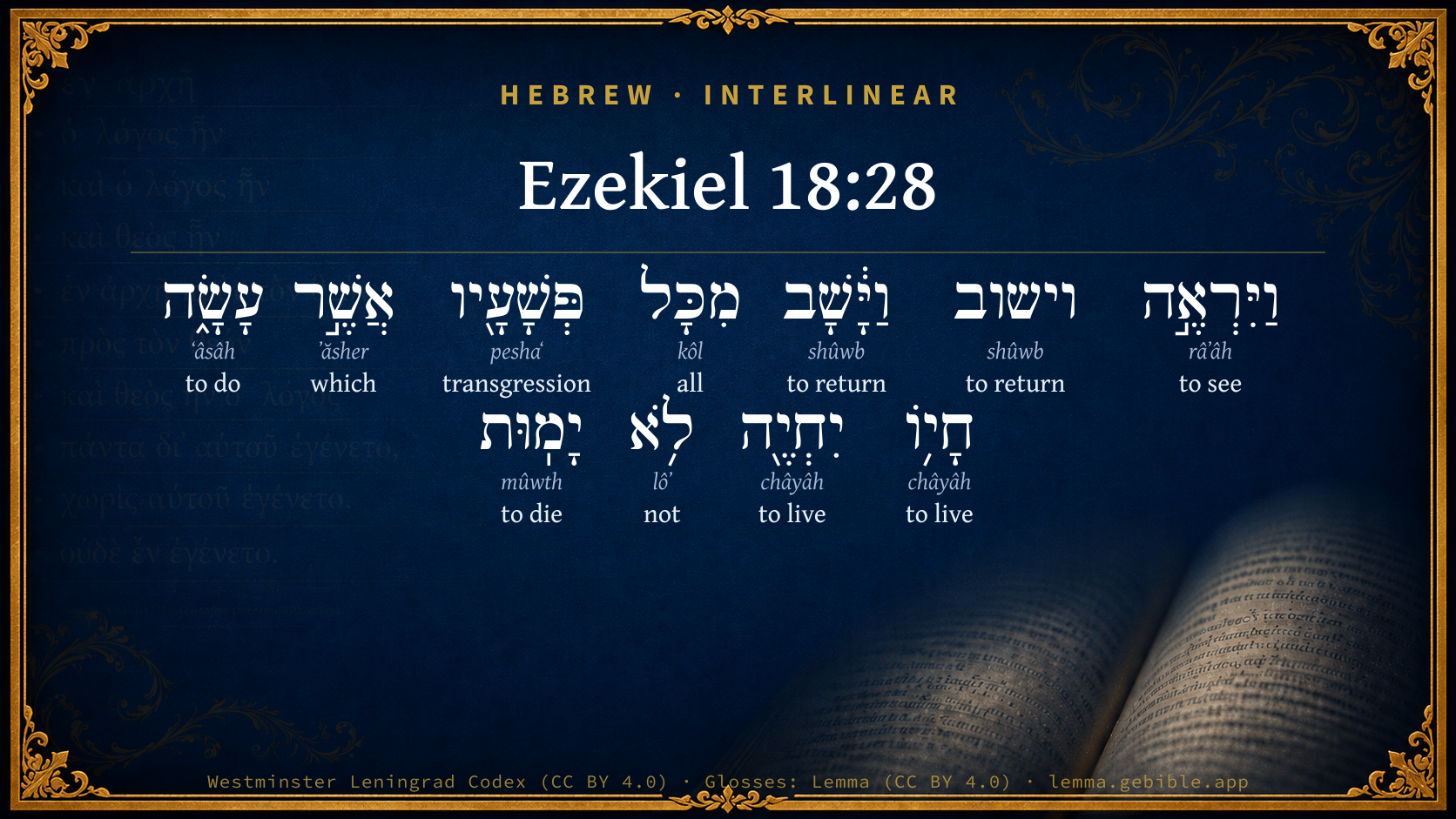
Hebrew (Westminster Leningrad Codex) Ezekiel 18:28 appears in the Hebrew Old Testament. The text above is from the Westminster Leningrad Codex. Each word links to its Strong’s number, a concise gloss, and parsing drawn from the Open Scriptures Hebrew Bible morphology. Click any word for its full Brown-Driver-Briggs (BDB) entry.
Download image
Cite this verse

Ezekiel 18:28 (World English Bible). Public Domain. Lemma interlinear Bible study tool, https://lemma.gebible.app/v/ezekiel/18/28.

Show BibTeX & RIS
BibTeX
RIS
English Translation
Because he considers, and turns away from all his transgressions that he has committed, he shall surely live, he shall not die.
World English Bible · Public Domain
Download a study sheet

One document with this verse’s original text, its word-by-word gloss line, the meaning frame, cross-references with their text, attributed commentary, and full source and license credits — printable, and it pastes into notes with its structure intact.

This verse Autodidact and up

Study sheet (.html) Plain text (.txt)

A passage Seminary Student

Up to 50 verses in one chapter. A passage sheet keeps up to 6 commentary sources and 12 cross-references per verse, in the order this page ranks them, and says so on the sheet whenever that leaves anything out. Ask for a single verse and you get the Autodidact verse sheet above.

Everything on this page stays free to read, with no account — the sheet is a download of what is already on screen, not access to it.

Want to remove ads? Support Godless Engineer
Compare translations 3

The same verse in 3 English versions, stacked beneath the original-language interlinear above. Click any original word for its lexicon entry.

Each is an independent rendering of the whole verse — the interlinear is not word-aligned to these translations.

Highlighted words mark where these versions differ — a whole-verse word diff, not a word-by-word alignment.

  • World English Bible Public Domain
    Because he considers, and turns away from all his transgressions that he has committed, he shall surely live, he shall not die.
  • King James Version Public Domain
    Because he considereth, and turneth away from all his transgressions that he hath committed, he shall surely live, he shall not die.
  • unfoldingWord Literal Text CC BY-SA 4.0
    For he has seen and turned away from all the transgressions that he had done. He will surely live, and he will not die.

unfoldingWord Literal Text — © unfoldingWord, licensed CC BY-SA 4.0. Word-aligned USFM3 via Door43 (git.door43.org/unfoldingWord/en_ult).

Versions to compare (up to 4)

3 of 4 selected

Show all 18 translations

Every available English version of this verse, each an independent rendering of the whole verse.

  • World English Bible Public Domain
    Because he considers, and turns away from all his transgressions that he has committed, he shall surely live, he shall not die.
  • Berean Standard Bible Public Domain
    Because he considered and turned from all the transgressions he had committed, he will surely live; he will not die.
  • Majority Standard Bible Public Domain
    Because he considered and turned from all the transgressions he had committed, he will surely live; he will not die.
  • King James Version Public Domain
    Because he considereth, and turneth away from all his transgressions that he hath committed, he shall surely live, he shall not die.
  • American Standard Version (1901) Public Domain
    Because he considereth, and turneth away from all his transgressions that he hath committed, he shall surely live, he shall not die.
  • Revised Version (1885) Public Domain
    Because he considereth, and turneth away from all his transgressions that he hath committed, he shall surely live, he shall not die.
  • Geneva Bible (1599) Public Domain
    Because he considereth, and turneth away from all his transgressions that hee hath committed, he shall surely liue and shall not die.
  • Douay-Rheims (1899) Public Domain
    Because he considereth and turneth away himself from all his iniquities which he hath wrought, he shall surely live, and not die.
  • Young's Literal Translation Public Domain
    And he seeth and turneth back, From all his transgressions that he hath done, He doth surely live, he doth not die,
  • Literal Standard Version CC BY-SA 4.0
    And he sees and turns back, || From all his transgressions that he has done, || He surely lives, he does not die,
  • Unlocked Literal Bible CC BY-SA 4.0
    For he has seen and turned away from all the transgressions that he had done. He will surely live, and he will not die.
  • unfoldingWord Literal Text CC BY-SA 4.0
    For he has seen and turned away from all the transgressions that he had done. He will surely live, and he will not die.
  • Darby Bible Public Domain
    Because he considereth, and turneth from all his transgressions which he hath committed, he shall certainly live, he shall not die.
  • World Messianic Bible Public Domain
    Because he considers, and turns away from all his transgressions that he has committed, he shall surely live. He shall not die.
  • Webster's Bible Public Domain
    Because he considereth and turneth away from all his transgressions that he hath committed, he shall surely live, he shall not die.
  • Free Bible Version CC BY-SA 4.0
    Because they thought about it and gave up their wicked ways, they will certainly live—they won't die.
  • Bible in Basic English Public Domain
    Because he had fear and was turned away from all the wrong which he had done, life will certainly be his, death will not be his fate.
  • JPS Tanakh (1917) Public Domain
    Because he considereth, and turneth away from all his transgressions that he hath committed, he shall surely live, he shall not die.

Literal Standard Version (2020), Covenant Press — licensed CC BY-SA 4.0. Text via the HelloAO Bible API (eBible.org). Unlocked Literal Bible (unfoldingWord) — licensed CC BY-SA 4.0. Text via the HelloAO Bible API (eBible.org). unfoldingWord Literal Text — © unfoldingWord, licensed CC BY-SA 4.0. Word-aligned USFM3 via Door43 (git.door43.org/unfoldingWord/en_ult). Free Bible Version, Dr. Jonathan Gallagher — licensed CC BY-SA 4.0. Text via the HelloAO Bible API (eBible.org).

Word by word

More ways to search: Search by grammar → Find every occurrence → Compare this word →

Practice this passage: Drill this verse → Learn its vocabulary →

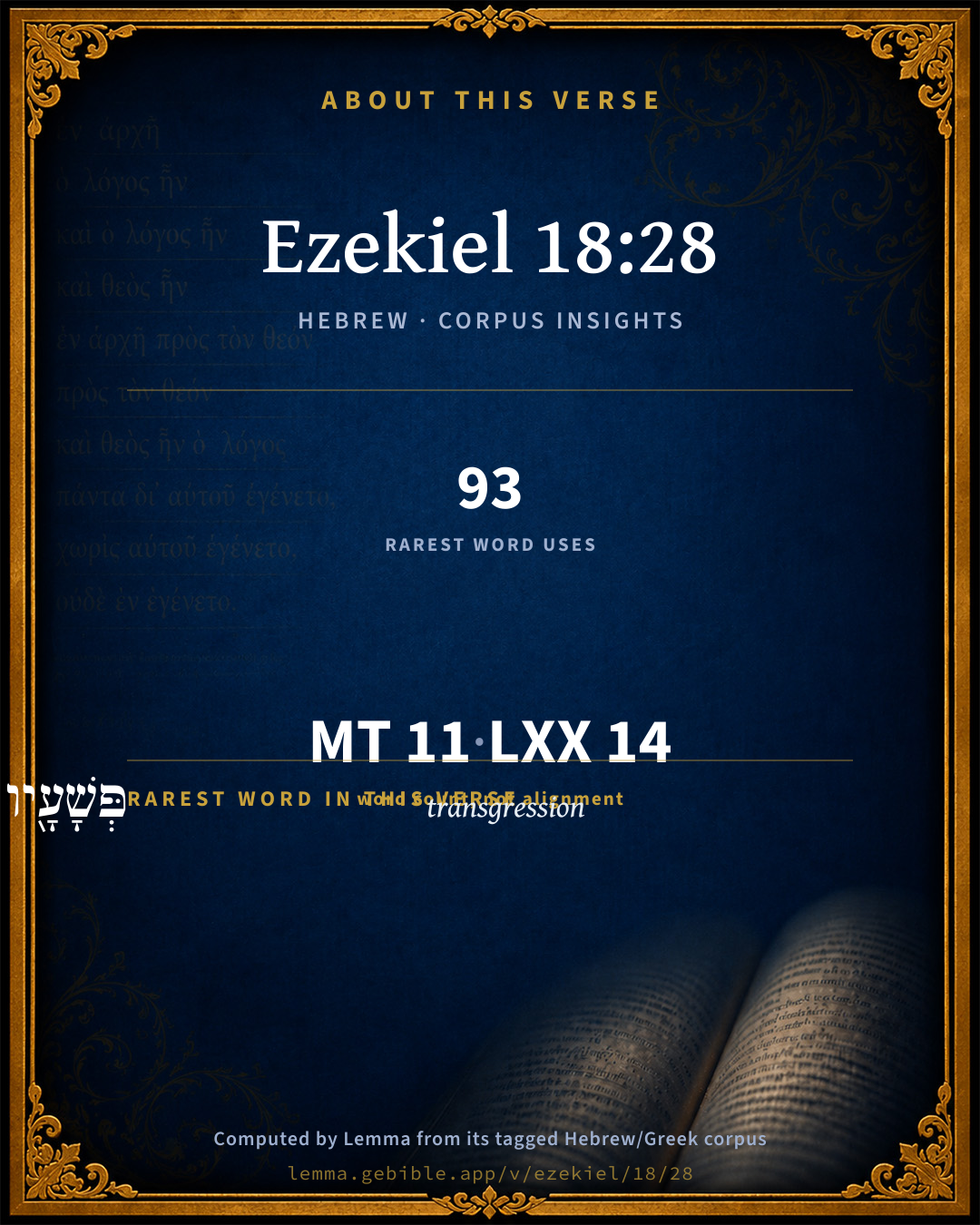
פְּשָׁעָ֖יו
peshaʻ
H6588
“transgressions · his”
Noun, Common, Masculine, Plural, Construct + Suffix, Personal, 3rd Person, Masculine, Singular
Part of Speech
Noun
Type
Common
Gender
Masculine
Number
Plural
State
Construct
Full BDB Definition

Origin: from H6586

TWOT: 1846a

transgression, rebellion - transgression (against individuals) - transgression (nation against nation) - transgression (against God) - in general - as recognised by sinner - as God deals with it - as God forgives - guilt of transgression - punishment for transgression - offering for transgression
  1. וַיִּרְאֶ֣ה râʼâh H7200 “and · to see” Conjunction + Verb, Qal, Sequential Imperfect, 3rd Person, Masculine, Singular
  2. וישוב shûwb H7725 “and · to return” Conjunction + Verb, Qal, Sequential Imperfect, 3rd Person, Masculine, Singular
  3. וַיָּ֔שָׁב shûwb H7725 “and · to return” Conjunction + Verb, Qal, Sequential Imperfect, 3rd Person, Masculine, Singular
  4. מִכָּל kôl H3605 “from · all of” Preposition + Noun, Common, Masculine, Singular, Construct
  5. אֲשֶׁ֣ר ʼăsher H834 “which” Particle, Relative
  6. עָשָׂ֑ה ʻâsâh H6213 “to do” Verb, Qal, Perfect, 3rd Person, Masculine, Singular
  7. חָי֥וֹ châyâh H2421 “to live” Verb, Qal, Infinitive Absolute
  8. יִחְיֶ֖ה châyâh H2421 “to live” Verb, Qal, Imperfect, 3rd Person, Masculine, Singular
  9. לֹ֥א lôʼ H3808 “not” Particle, Negative
  10. יָמֽוּת mûwth H4191 “to die” Verb, Qal, Imperfect, 3rd Person, Masculine, Singular

About this verse

These counts appear in no published source. They are computed here, from the morphology-tagged text and Lemma’s own curated glosses. What Lemma adds →

11
words
9
distinct lemmas
Prophets
section

Grammatical profile

  • 7 verbs
  • 2 nouns
  • 2 particles

Verb forms

  • וַיִּרְאֶ֣ה Qal · Sequential Imperfect
  • וישוב Qal · Sequential Imperfect
  • וַיָּ֔שָׁב Qal · Sequential Imperfect
  • עָשָׂ֑ה Qal · Perfect
  • חָי֥וֹ Qal · Infinitive Absolute
  • יִחְיֶ֖ה Qal · Imperfect
  • יָמֽוּת Qal · Imperfect

Repetition

Words recur within this verse — often emphatic in Hebrew:

  • וישוב to return H7725 ×2
  • חָי֥וֹ to live H2421 ×2

Hebrew & Septuagint length

In English translation the verse runs 22 words from the Hebrew and 20 from the Septuagint (LXX English) — closely comparable.

A rough comparison of the two English renderings, which tokenize alike — not a word-level alignment.

Word counts can differ between the Hebrew and the Greek without any difference in meaning — e.g. the Hebrew direct-object marker אֵת has no separate Greek word, and Greek often adds the article ὁ.

In the original languages it is 11 Hebrew tokens and 14 Greek tokens — but the two are counted differently (Hebrew bundles its prefixes and suffixes into one token; the Greek is in lemma form), so that isn’t a like-for-like length.

Cross-references

15

Topical passages linked to Ezekiel 18:28 in the Treasury of Scripture Knowledge — connected by theme and wording, ordered by reader-vote popularity; previews shown in the World English Bible.

  • Deuteronomy 32:29 Oh that they were wise, that they understood this, That they would consider their latter end!
  • Luke 15:17–18 But when he came to himself he said, 'How many hired servants of my father's have bread enough to spare, and I'm dying with hunger!
  • Colossians 3:5–9 Put to death therefore your members which are on the earth: sexual immorality, uncleanness, depraved passion, evil desire, and covetousness, which is idolatry;
  • James 2:10–12 For whoever shall keep the whole law, and yet stumble in one point, he has become guilty of all.
  • Psalms 119:1 Blessed are those whose ways are blameless, Who walk according to Yahweh's law.
  • Psalms 119:6 Then I wouldn't be disappointed, When I consider all of your commandments.
  • Psalms 119:59 I considered my ways, And turned my steps to your statutes.
  • Jeremiah 31:18–20 I have surely heard Ephraim bemoaning himself [thus], You have chastised me, and I was chastised, as a calf unaccustomed [to the yoke]: turn you me, and I shall be turned; for you are Yahweh my God.
  • Ezekiel 12:3 Therefore, you son of man, prepare you stuff for removing, and remove by day in their sight; and you shall remove from your place to another place in their sight: it may be they will consider, though they are a rebellious house.
  • Ezekiel 18:14 Now, behold, if he fathers a son, who sees all his father's sins, which he has done, and fears, and does not such like;
  • Ezekiel 18:21 But if the wicked turn from all his sins that he has committed, and keep all my statutes, and do that which is lawful and right, he shall surely live, he shall not die.
  • Ezekiel 18:31 Cast away from you all your transgressions, in which you have transgressed; and make you a new heart and a new spirit: for why will you die, house of Israel?
  • Ezekiel 33:12 You, son of man, tell the children of your people, The righteousness of the righteous shall not deliver him in the day of his disobedience; and as for the wickedness of the wicked, he shall not fall thereby in the day that he turns from his wickedness; neither shall he who is righteous be able to live thereby in the day that he sins.
  • Titus 2:14 who gave himself for us, that he might redeem us from all iniquity, and purify for himself a people for his own possession, zealous for good works.
  • 1 Samuel 7:3–4 Samuel spoke to all the house of Israel, saying, If you do return to Yahweh with all your heart, then put away the foreign gods and the Ashtaroth from among you, and direct your hearts to Yahweh, and serve him only; and he will deliver you out of the hand of the Philistines.

Cross-references courtesy of OpenBible.info (CC BY 4.0).

Hebrew and Greek witnesses Masoretic Hebrew ↔ Greek Septuagint

The same verse in the two great witnesses to the Old Testament, shown verse-for-verse.

These are two independent witnesses, not word-aligned to each other, and the Septuagint is shown in lemma (dictionary) form.

Hebrew Ezekiel 18:28 Masoretic · Westminster Leningrad Codex

וַיִּרְאֶ֣ה וישוב וַיָּ֔שָׁב מִכָּל פְּשָׁעָ֖יו אֲשֶׁ֣ר עָשָׂ֑ה חָי֥וֹ יִחְיֶ֖ה לֹ֥א יָמֽוּת

Because he considers, and turns away from all his transgressions that he has committed, he shall surely live, he shall not die.

World English Bible · Public Domain

Greek LXX Ezekiel 18:28 Septuagint · lemma form

καί ἀποστρέφω ἐκ πᾶς ὁ ἀσέβεια αὐτός ὅς ποιέω ζωή ζάω οὐ μή ἀποθνήσκω

and has turned away from all his ungodliness which he has committed: he shall surely live, he shall not die.

LXX2012 (modern English Septuagint) · Public Domain

Hebrew: Westminster Leningrad Codex (CC BY 4.0). Greek: Septuagint (public domain); English from LXX2012 (modern English Septuagint) (Public Domain). How the Septuagint differs from the Hebrew →

Targum (Aramaic paraphrase)

1

The Targum is the ancient Jewish Aramaic paraphrase of the Hebrew Scriptures — an interpretive translation, not the Hebrew text itself. Onkelos (literal) and Pseudo-Jonathan (expansive) render the Torah, and Jonathan the Prophets. Coverage is partial: where no permissively-licensed English translation exists for a verse, only the Aramaic is shown. This is verse-level text, not a word-by-word alignment to the Hebrew.

  1. Targum Jonathan Prophets (Joshua–Malachi)
    וַחֲזָא וְתַב מִכָּל חוֹבוֹהִי דִי עֲבַד מֵיחָא יְחֵי לָא יְמוּת:

    (no public-domain English translation for this verse)

    Targum Jonathan — Aramaic: “Mikraot Gedolot” (public domain). English: “Sefaria Community Translation” (CC0 1.0 (public-domain dedication)); “London "Chaldee Paraphrase," 1871” (public domain). Text via Sefaria.

Commentary

Notes on Ezekiel 18:28 from classic Christian and Jewish commentators (each source and its license shown beneath its notes). The classic Christian expositions comment on the surrounding passage and are grouped to its opening verse, so a note may address several verses; the Jewish commentaries on the Tanakh (Rashi and others) are per-verse, so they appear only where the commentator wrote on this verse.

Lemma curates 59 commentaries, every one of them public domain or Creative Commons licensed, each selected and text-cleaned for this edition rather than reprinted as found. About our sources →

Trapp's Complete Commentary

John Trapp

Eze 18:28 Because he considereth, and turneth away from all his transgressions that he hath committed, he shall surely live, he shall not die.

Ver. 29. Because he considereth.] Consideration necessarily precedeth conversion. {Psa 119:59 Lam 3:40 Jer 8:6} The prodigal came to himself first, and then went home to his father. See on Eze 18:14.

John Trapp, A Commentary or Exposition upon All the Books of the Old and New Testament (1647–1656) — public domain. Text from a community e-Sword module.

Jamieson, Fausset & Brown

Robert Jamieson, A. R. Fausset & David Brown

considereth--the first step to repentance; for the ungodly do not consider either God or themselves (Deu 32:29; Psa 119:59-60; Luk 15:17-18).

Jamieson, Fausset & Brown — Commentary Critical and Explanatory on the Whole Bible (1871) — public domain (CC PDM 1.0). Text via the HelloAO Bible API.

John Gill's Exposition

Yet saith the house of Israel, the way of the Lord is not equal,.... Though the case was put so many ways, and the thing was made so clear and plain, by the instances given; as, if a man was a just man, let his father be what he would, he should live; but, if his son was a wicked man, he should die; yet, if his son should do well, he should not die for his father's sins, his father only should suffer for his iniquity; and then again, on the one hand, if a seemingly righteous man become an apostate, he should be treated as such; but, on the other hand, if a wicked man repented and reformed, things would go well with him; by all which it most clearly appeared that God did not, and would not, punish children for the sins of their fathers, unless they themselves were guilty of the same; and that the methods of Providence in dealing with men in this world, as they were good or bad, were equal and right, and to be justified:

O house of Israel, are not my ways equal? are not your ways unequal? This is an appeal to their own consciences, upon the evidence before given.

John Gill's Exposition of the Whole Bible (1746–1763) — public domain (CC PDM 1.0). Text via the HelloAO Bible API.

Matthew Poole's English Annotations

God’s promise is to pardon, spare, and preserve the penitent, such therefore shall not die.

Considereth: see Eze 18:14.

Turneth; converteth: see Eze 18:21.

He shall surely live, he shall not die: secure, self-justifying sinners misapprehend the justice of God, as we have heard, and repenting sinners are apt to mistrust the mercy of God, and therefore it is doubly assured in this promise.

Matthew Poole's English Annotations on the Holy Bible (1683–1685) — public domain. Text from a community e-Sword/MySword module.

John Wesley's Explanatory Notes

He shall surely live - "That is, he shall be restored to the favour of God, which is the life of the soul."

John Wesley, Explanatory Notes Upon the Whole Bible (1754–1765) — public domain. Text via the GEBible commentary corpus.

Lesson kit

Teaching starters — assembled from the data on this page, not authored interpretation. Every prompt links to the verse data it draws on. Edit before teaching.

Ezekiel, in the Prophets, opens this verse with 11 words (9 distinct Hebrew lemmas). Its most distinctive word is peshaʻ (“transgression”). A historical commentator’s framing appears above. Read the whole chapter for the surrounding context.

Discussion questions

  1. How does “transgression” (peshaʻ) shape what this verse is saying?
  2. Deuteronomy 32:29 shares this passage’s theme. How do the two illuminate each other?
  3. “to return” occurs 2× in this one verse. What is the effect of the repetition?
  4. These translations render this verse differently. What is at stake in choosing one wording over another?
  5. The verb «וַיִּרְאֶ֣ה» is Qal Sequential Imperfect. How does its form color the action?
  6. Reading how Trapp's Complete Commentary and Jamieson, Fausset & Brown read this verse, where do the two commentators agree and where do they part?

Things to notice

Reading settings

Reading text

Shown beneath each verse's original-language words.

Old Testament
Old Testament edition

Read the OT as the Masoretic Hebrew (MT) or the Greek Septuagint (LXX).

English shown for the Greek Septuagint (in the Hebrew ↔ Greek comparison).

Comparing translations? Open the Compare panel on any verse page to stack up to four side by side.