2 Samuel 16:12

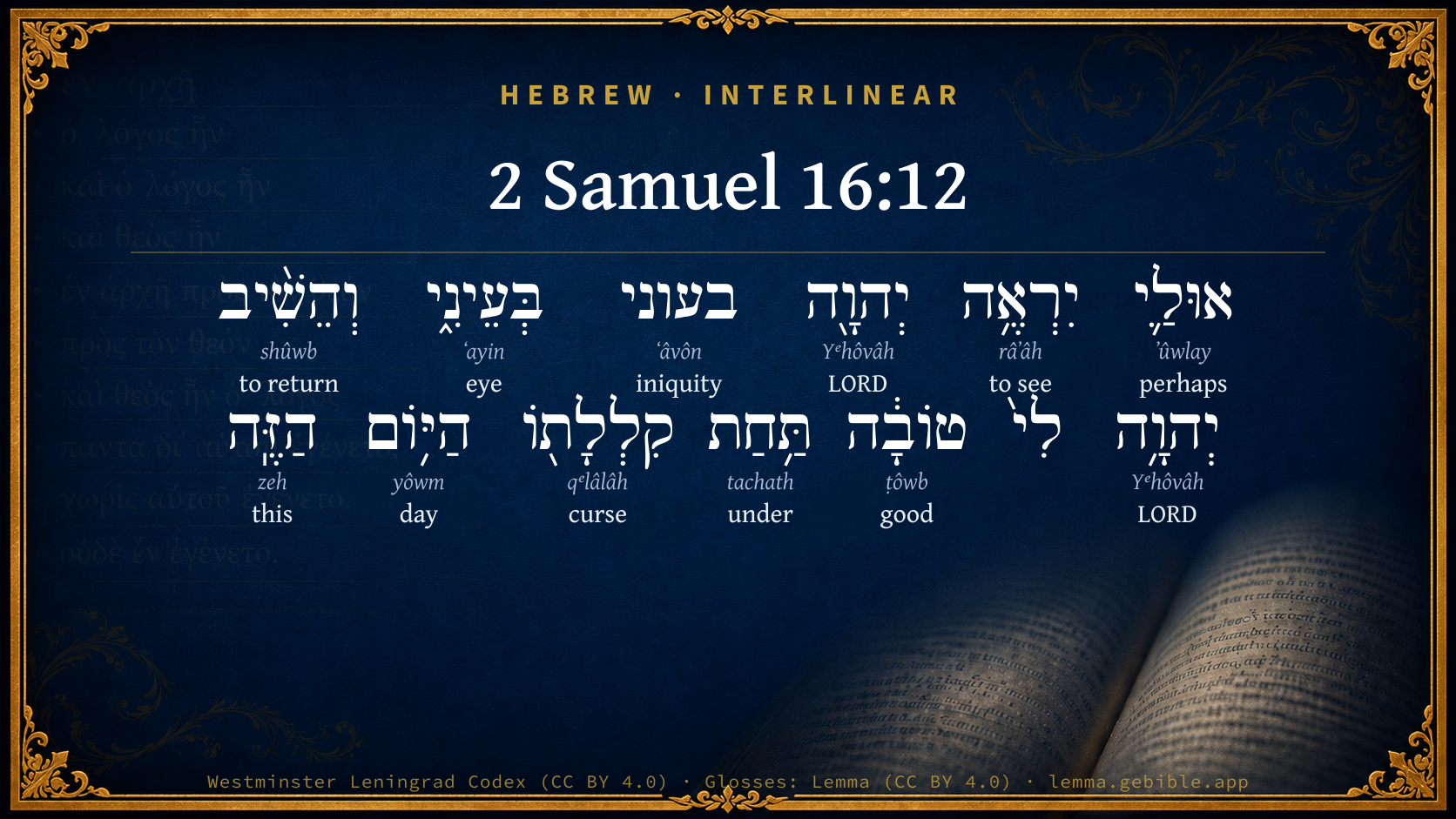
Hebrew (Westminster Leningrad Codex) 2 Samuel 16:12 appears in the Hebrew Old Testament. The text above is from the Westminster Leningrad Codex. Each word links to its Strong’s number, a concise gloss, and parsing drawn from the Open Scriptures Hebrew Bible morphology. Click any word for its full Brown-Driver-Briggs (BDB) entry.
Download image
Cite this verse

2 Samuel 16:12 (World English Bible). Public Domain. Lemma interlinear Bible study tool, https://lemma.gebible.app/v/2-samuel/16/12.

Show BibTeX & RIS
BibTeX
RIS
English Translation
It may be that Yahweh will look on the wrong done to me, and that Yahweh will requite me good for [his] cursing of me this day.
World English Bible · Public Domain
Download a study sheet

One document with this verse’s original text, its word-by-word gloss line, the meaning frame, cross-references with their text, attributed commentary, and full source and license credits — printable, and it pastes into notes with its structure intact.

This verse Autodidact and up

Study sheet (.html) Plain text (.txt)

A passage Seminary Student

Up to 50 verses in one chapter. A passage sheet keeps up to 6 commentary sources and 12 cross-references per verse, in the order this page ranks them, and says so on the sheet whenever that leaves anything out. Ask for a single verse and you get the Autodidact verse sheet above.

Everything on this page stays free to read, with no account — the sheet is a download of what is already on screen, not access to it.

Want to remove ads? Support Godless Engineer
Compare translations 3

The same verse in 3 English versions, stacked beneath the original-language interlinear above. Click any original word for its lexicon entry.

Each is an independent rendering of the whole verse — the interlinear is not word-aligned to these translations.

Highlighted words mark where these versions differ — a whole-verse word diff, not a word-by-word alignment.

  • World English Bible Public Domain
    It may be that Yahweh will look on the wrong done to me, and that Yahweh will requite me good for [his] cursing of me this day.
  • King James Version Public Domain
    It may be that the LORD will look on mine affliction, and that the LORD will requite me good for his cursing this day.
  • unfoldingWord Literal Text CC BY-SA 4.0
    Perhaps Yahweh will look at my affliction, and Yahweh will return good to me in place of his cursing this day.”

unfoldingWord Literal Text — © unfoldingWord, licensed CC BY-SA 4.0. Word-aligned USFM3 via Door43 (git.door43.org/unfoldingWord/en_ult).

Versions to compare (up to 4)

3 of 4 selected

Show all 18 translations

Every available English version of this verse, each an independent rendering of the whole verse.

  • World English Bible Public Domain
    It may be that Yahweh will look on the wrong done to me, and that Yahweh will requite me good for [his] cursing of me this day.
  • Berean Standard Bible Public Domain
    Perhaps the LORD will see my affliction and repay me with good for the cursing I receive today.”
  • Majority Standard Bible Public Domain
    Perhaps the LORD will see my affliction and repay me with good for the cursing I receive today.”
  • King James Version Public Domain
    It may be that the LORD will look on mine affliction, and that the LORD will requite me good for his cursing this day.
  • American Standard Version (1901) Public Domain
    It may be that Jehovah will look on the wrong done unto me, and that Jehovah will requite me good for `his' cursing of me this day.
  • Revised Version (1885) Public Domain
    It may be that the LORD will look on the wrong done unto me, and that the LORD will requite me good for his cursing of me this day.
  • Geneva Bible (1599) Public Domain
    It may be that the Lord will looke on mine affliction, and doe me good for his cursing this day.
  • Douay-Rheims (1899) Public Domain
    Perhaps the Lord may look upon my affliction, and the Lord may render me good for the cursing of this day.
  • Young's Literal Translation Public Domain
    it may be Jehovah doth look on mine affliction, and Jehovah hath turned back to me good for his reviling this day.'
  • Literal Standard Version CC BY-SA 4.0
    it may be YHWH looks on my affliction, and YHWH has turned back good to me for his reviling this day.”
  • Unlocked Literal Bible CC BY-SA 4.0
    Perhaps Yahweh will look at the misery unleashed on me, and repay me with good for his cursing me today.”
  • unfoldingWord Literal Text CC BY-SA 4.0
    Perhaps Yahweh will look at my affliction, and Yahweh will return good to me in place of his cursing this day.”
  • Darby Bible Public Domain
    It may be that Jehovah will look on mine affliction, and that Jehovah will requite me good for my being cursed this day.
  • World Messianic Bible Public Domain
    It may be that the LORD will look on the wrong done to me, and that the LORD will repay me good for the cursing of me today.”
  • Webster's Bible Public Domain
    It may be that the LORD will look on my affliction, and that the LORD will requite me good for his cursing this day.
  • Free Bible Version CC BY-SA 4.0
    Perhaps the Lord will see how I'm suffering and will pay me back with good for his curses today.”
  • Bible in Basic English Public Domain
    It may be that the Lord will take note of my wrongs, and give me back good in answer to his cursing of me today.
  • JPS Tanakh (1917) Public Domain
    It may be that the LORD will look on mine eye, and that the LORD will requite me good for his cursing of me this day.'

Literal Standard Version (2020), Covenant Press — licensed CC BY-SA 4.0. Text via the HelloAO Bible API (eBible.org). Unlocked Literal Bible (unfoldingWord) — licensed CC BY-SA 4.0. Text via the HelloAO Bible API (eBible.org). unfoldingWord Literal Text — © unfoldingWord, licensed CC BY-SA 4.0. Word-aligned USFM3 via Door43 (git.door43.org/unfoldingWord/en_ult). Free Bible Version, Dr. Jonathan Gallagher — licensed CC BY-SA 4.0. Text via the HelloAO Bible API (eBible.org).

Word by word

More ways to search: Search by grammar → Find every occurrence → Compare this word →

Practice this passage: Drill this verse → Learn its vocabulary →

קִלְלָת֖וֹ
qᵉlâlâh
H7045
“curse · his”
Noun, Common, Feminine, Singular, Construct + Suffix, Personal, 3rd Person, Masculine, Singular
Part of Speech
Noun
Type
Common
Gender
Feminine
Number
Singular
State
Construct
Full BDB Definition

Origin: from H7043

TWOT: 2028d

curse, vilification, execration
  1. אוּלַ֛י ʼûwlay H194 “perhaps” Adverb
  2. יִרְאֶ֥ה râʼâh H7200 “to see” Verb, Qal, Imperfect, 3rd Person, Masculine, Singular
  3. יְהוָ֖ה Yᵉhôvâh H3068 “LORD” Noun, Proper
  4. בעוני ʻâvôn H5771 “in/at · iniquity · my” Preposition + Noun, Common, Both, Singular, Construct + Suffix, Personal, 1st Person, Common, Singular
  5. בְּעֵינִ֑י ʻayin H5869 “in/at · eye · my” Preposition + Noun, Common, Masculine, Singular, Construct + Suffix, Personal, 1st Person, Common, Singular
  6. וְהֵשִׁ֨יב shûwb H7725 “and · to return” Conjunction + Verb, Hiphil, Sequential Perfect, 3rd Person, Masculine, Singular
  7. יְהוָ֥ה Yᵉhôvâh H3068 “LORD” Noun, Proper
  8. טוֹבָ֔ה ṭôwb H2896 “good” Adjective, Adjective, Feminine, Singular, Absolute
  9. תַּ֥חַת tachath H8478 “under” Preposition
  10. הַיּ֥וֹם yôwm H3117 “the · day” Particle, Definite Article + Noun, Common, Masculine, Singular, Absolute
  11. הַזֶּֽה zeh H2088 “the · this” Particle, Definite Article + Pronoun, Demonstrative, Masculine, Singular

About this verse

These counts appear in no published source. They are computed here, from the morphology-tagged text and Lemma’s own curated glosses. What Lemma adds →

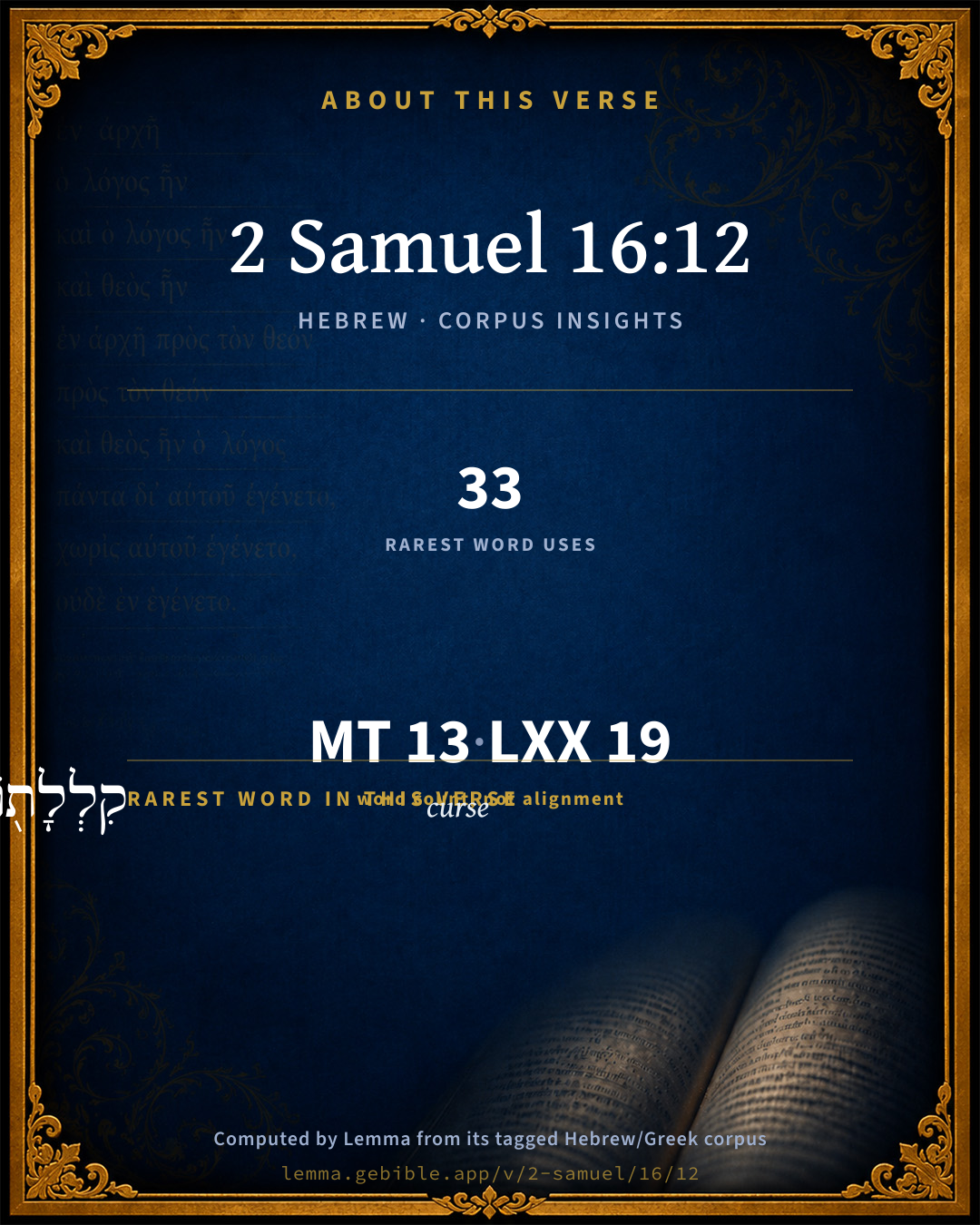
13
words
11
distinct lemmas
Historical
section

Shared distinctive vocabulary

קִלְלָת֖וֹ curse H7045 occurs in 33 verses of the Hebrew Bible. Also found in:

Grammatical profile

  • 2 verbs
  • 6 nouns
  • 1 adjective
  • 1 pronoun
  • 2 prepositions
  • 1 adverb

Verb forms

  • יִרְאֶ֥ה Qal · Imperfect
  • וְהֵשִׁ֨יב Hiphil · Sequential Perfect

Repetition

A word recurs within this verse — often emphatic in Hebrew:

  • יְהוָ֖ה LORD H3068 ×2

Hebrew & Septuagint length

In English translation the verse runs 27 words from the Hebrew and 22 from the Septuagint (LXX English) — closely comparable.

A rough comparison of the two English renderings, which tokenize alike — not a word-level alignment.

Word counts can differ between the Hebrew and the Greek without any difference in meaning — e.g. the Hebrew direct-object marker אֵת has no separate Greek word, and Greek often adds the article ὁ.

In the original languages it is 13 Hebrew tokens and 19 Greek tokens — but the two are counted differently (Hebrew bundles its prefixes and suffixes into one token; the Greek is in lemma form), so that isn’t a like-for-like length.

Cross-references

13

Topical passages linked to 2 Samuel 16:12 in the Treasury of Scripture Knowledge — connected by theme and wording, ordered by reader-vote popularity; previews shown in the World English Bible.

  • Deuteronomy 23:5 Nevertheless Yahweh your God wouldn't listen to Balaam; but Yahweh your God turned the curse into a blessing to you, because Yahweh your God loved you.
  • Hebrews 12:10 For they indeed, for a few days, punished us as seemed good to them; but he for our profit, that we may be partakers of his holiness.
  • Exodus 2:24–25 God heard their groaning, and God remembered his covenant with Abraham, with Isaac, and with Jacob.
  • Psalms 25:18 Consider my affliction and my travail. Forgive all my sins.
  • Matthew 5:11–12 "Blessed are you when people reproach you, persecute you, and say all kinds of evil against you falsely, for my sake.
  • Romans 8:28 We know that all things work together for good for those who love God, to those who are called according to his purpose.
  • Genesis 29:32–33 Leah conceived, and bore a son, and she named him Reuben. For she said, "Because Yahweh has looked at my affliction. For now my husband will love me."
  • 1 Samuel 1:11 She vowed a vow, and said, Yahweh of hosts, if you will indeed look on the affliction of your handmaid, and remember me, and not forget your handmaid, but will give to your handmaid a man-child, then I will give him to Yahweh all the days of his life, and there shall no razor come on his head.
  • 2 Thessalonians 1:7 and to give relief to you that are afflicted with us, when the Lord Jesus is revealed from heaven with his mighty angels in flaming fire,
  • 2 Corinthians 4:17 For our light affliction, which is for the moment, works for us more and more exceedingly an eternal weight of glory;
  • Exodus 3:7–8 Yahweh said, "I have surely seen the affliction of my people who are in Egypt, and have heard their cry because of their taskmasters, for I know their sorrows.
  • Isaiah 27:7 Has he struck them as he struck those who struck them? or are they slain according to the slaughter of those who were slain by them?
  • 1 Peter 4:12–19 Beloved, don't be astonished at the fiery trial which has come upon you, to test you, as though a strange thing happened to you.

Cross-references courtesy of OpenBible.info (CC BY 4.0).

Hebrew and Greek witnesses Masoretic Hebrew ↔ Greek Septuagint

The same verse in the two great witnesses to the Old Testament, shown verse-for-verse.

These are two independent witnesses, not word-aligned to each other, and the Septuagint is shown in lemma (dictionary) form.

Hebrew 2 Samuel 16:12 Masoretic · Westminster Leningrad Codex

אוּלַ֛י יִרְאֶ֥ה יְהוָ֖ה בעוני בְּעֵינִ֑י וְהֵשִׁ֨יב יְהוָ֥ה לִי֙ טוֹבָ֔ה תַּ֥חַת קִלְלָת֖וֹ הַיּ֥וֹם הַזֶּֽה

It may be that Yahweh will look on the wrong done to me, and that Yahweh will requite me good for [his] cursing of me this day.

World English Bible · Public Domain

Greek LXX 2 Samuel 16:12 Septuagint · lemma form

εἰ πως ὁράω κύριος ἐν ὁ ταπείνωσις ἐγώ καί ἐπιστρέφω ἐγώ ἀγαθός ἀντί ὁ κατάρα αὐτός ὁ ἡμέρα οὗτος

If by any means the Lord may look on my affliction, thus shall he return me good for his cursing this day.

LXX2012 (modern English Septuagint) · Public Domain

On this verse, Ellicott's Commentary for English Readers discusses the Septuagint’s reading. Read the note in Commentary ↓

Hebrew: Westminster Leningrad Codex (CC BY 4.0). Greek: Septuagint (public domain); English from LXX2012 (modern English Septuagint) (Public Domain). How the Septuagint differs from the Hebrew →

Targum (Aramaic paraphrase)

1

The Targum is the ancient Jewish Aramaic paraphrase of the Hebrew Scriptures — an interpretive translation, not the Hebrew text itself. Onkelos (literal) and Pseudo-Jonathan (expansive) render the Torah, and Jonathan the Prophets. Coverage is partial: where no permissively-licensed English translation exists for a verse, only the Aramaic is shown. This is verse-level text, not a word-by-word alignment to the Hebrew.

  1. Targum Jonathan Prophets (Joshua–Malachi)
    מָאִים גְלֵי קֳדָם יְיָ דִמְעַת עֵינִי וִיתֵיב יְיָ לִי טַבְתָא חֲלַף לְוַטָתֵיהּ יוֹמָא הָדֵין:

    (no public-domain English translation for this verse)

    Targum Jonathan — Aramaic: “Mikraot Gedolot” (public domain). English: “Sefaria Community Translation” (CC0 1.0 (public-domain dedication)); “London "Chaldee Paraphrase," 1871” (public domain). Text via Sefaria.

Commentary

Notes on 2 Samuel 16:12 from classic Christian and Jewish commentators (each source and its license shown beneath its notes). The classic Christian expositions comment on the surrounding passage and are grouped to its opening verse, so a note may address several verses; the Jewish commentaries on the Tanakh (Rashi and others) are per-verse, so they appear only where the commentator wrote on this verse.

Lemma curates 59 commentaries, every one of them public domain or Creative Commons licensed, each selected and text-cleaned for this edition rather than reprinted as found. About our sources →

Trapp's Complete Commentary

John Trapp

2Sa 16:12 It may be that the LORD will look on mine affliction, and that the LORD will requite me good for his cursing this day.

Ver. 12. It may be the Lord will look on mine affliction.] Heb., On mine eye, or tears; for Iisdem quibus videmus oculis flemus; et lachrymas angustiae exprimit Crux.

And that the Lord will requite good for his cursing.] Restore me to my kingdom, or some way else reward my patience, of his free grace, and according to his usual dealing with his poor afflicted. Howsoever, if he bring not down his will to theirs, he will bring up their will to his: which will make infinite amends for all their patience.

John Trapp, A Commentary or Exposition upon All the Books of the Old and New Testament (1647–1656) — public domain. Text from a community e-Sword module.

Joseph Benson's Commentary

2Sa 16:12. It may be the Lord will look on mine affliction, &c. — He means that, although this was a chastisement from God upon him, yet if he bore it as became him, it might become a means of mercy to him. His humble submission and resignation might call down the divine commiseration upon his patience and penitence.

Joseph Benson's Commentary on the Old and New Testaments (1811–1818) — public domain. Text from a community e-Sword module.

Geneva Bible (1599)

Geneva Bible translators

Or, my tears.

Meaning, that the Lord will send comfort to his, when they are oppressed.

Geneva Bible (1599) marginal notes — public domain. Text via Bolls.life.

Ellicott's Commentary for English Readers

(12) Look on mine affliction.—The English here follows the LXX. and Vulg. The Hebrew margin has mine eye, but the text has my iniquity, which is probably the true sense. David expresses the hope that God will mercifully look upon his sin, of which he has repented, and for which he is now bearing punishment: a part of this punishment is the cursing of Shimei, and God may be well pleased that it should be patiently borne.

A Bible Commentary for English Readers, edited by Charles John Ellicott (1878–1897) — public domain. Text from a community e-Sword module.

The Cambridge Bible for Schools and Colleges

gen. ed. J. J. S. Perowne

12. mine affliction] This reading is supported by the Sept. and Vulg. and is probably right. Cp. Psa_25:18. The Qrî has mine eye, which is explained to mean my grief, but the expression is unparalleled. The Kthîbh gives mine iniquity, meaning, ‘perhaps the Lord will look graciously upon my guilt and pardon it,’ but this does not suit the following clause so well.

will requite me good] Cp. Psa_109:26-28.

for his cursing] The E. V. follows the Qrî. The Kthîbh has my cursing, i.e. the curse invoked upon me.

The Cambridge Bible for Schools and Colleges (gen. ed. J. J. S. Perowne; Cambridge University Press, 1878–1918) — public domain. Text from a community e-Sword module.

John Gill's Exposition

It may be that the Lord will look on mine affliction,.... Through the rebellion of his son, and now aggravated by the cursing of Shimei; that is, with an eye of pity and commiseration, and deliver him out of it: or "look upon my eye" (x); for there is a various reading; the tear of mine eye, as the Targum; so Jarchi and R. Isaiah; the tears in it, which fell plentifully from it, on account of his troubles, and particularly the curses and reproaches of Shimei:

and that the Lord will requite me good for his cursing this day; he does not speak with assurance, yet with hope; he knew his sins deserved such treatment, but also that God was gracious and merciful, and pitied his children, and resented all ill usage of them; and therefore hoped he would favour him with such intimations of his love as would support him, comfort, refresh him, and do him good, see Rom 8:28.

(x) "in oculum meum", Montanus; "oculum meum lachrymantem", Munster.

John Gill's Exposition of the Whole Bible (1746–1763) — public domain (CC PDM 1.0). Text via the HelloAO Bible API.

Albert Barnes' Notes on the Bible

His cursing - Another reading has “my curse,” i. e., the curse that has fallen upon me. David recognizes in every word and action that he was receiving the due reward of his sin, and that which Nathan had foretold.

Albert Barnes' Notes on the Bible (1834–1885) — public domain. Text from a community e-Sword/MySword module.

Haydock's Catholic Bible Commentary

Affliction, of which he makes a sort of sacrifice, being convinced that God will not reject the contrite and humble heart, Psalm l. 19. (Calmet)

George Leo Haydock (1774–1849), Haydock's Catholic Family Bible and Commentary, 1859 edition — public domain. Excludes Psalms (Douay-Rheims chapter numbering differs from Protestant) and Deuterocanonical books (Catholic canon only).

Matthew Poole's English Annotations

It may be; he speaks doubtfully, because he was conscious that by his sins he had forfeited all his claim to God’s promises.

The Lord will look on mine affliction with an eye of commiseration.

Matthew Poole's English Annotations on the Holy Bible (1683–1685) — public domain. Text from a community e-Sword/MySword module.

The Pulpit Commentary

Mine affliction. This reading is supported by the Septuagint and Vulgate. The Syriac has "my subjection," possibly a free translation of the same reading. But the written text (K"tib) has "my wrong," either the wrong I have done, and of which I am bearing the punishment, or, as in the Revised Version, "the wrong done unto me." The correction of the Massorites (K"ri), is literally "my eye," that is, "my team."

The Pulpit Commentary (1880–1919), ed. H.D.M. Spence-Jones & Joseph S. Exell — public domain. Text from a community e-Sword module.

Rashi

Rabbi Shlomo Yitzchaki (Rashi)

God will see [the tears] in my eyes. [Yonoson translates:] "The tears of my eyes."

Rashi on the Tanakh — English translations: “The Judaica Press complete Tanach with Rashi, translated by A. J. Rosenberg” (CC BY 4.0); “Pentateuch with Rashi's commentary by M. Rosenbaum and A.M. Silbermann, 1929-1934” (public domain); “The Metsudah Tanach series, Lakewood, N.J” (CC BY 4.0); and “The Book of Joshua, Metsudah Publications, 1997” (CC BY 4.0). Text via Sefaria.

Lesson kit

Teaching starters — assembled from the data on this page, not authored interpretation. Every prompt links to the verse data it draws on. Edit before teaching.

2 Samuel, in the Historical, opens this verse with 13 words (11 distinct Hebrew lemmas). Its most distinctive word is qᵉlâlâh (“curse”). A historical commentator’s framing appears above. Read the whole chapter for the surrounding context.

Discussion questions

  1. How does “curse” (qᵉlâlâh) shape what this verse is saying?
  2. How does Genesis 27:12, which shares the word «curse», read alongside this verse?
  3. What does the repetition of “LORD” (2× in this one verse) do in this verse?
  4. These translations render this verse differently. What is at stake in choosing one wording over another?
  5. «יִרְאֶ֥ה» is a Qal Imperfect verb. How does that grammatical form shape the action described?
  6. Compare how Trapp's Complete Commentary and Joseph Benson's Commentary read this verse. Where do they agree or differ?

Things to notice

Reading settings

Reading text

Shown beneath each verse's original-language words.

Old Testament
Old Testament edition

Read the OT as the Masoretic Hebrew (MT) or the Greek Septuagint (LXX).

English shown for the Greek Septuagint (in the Hebrew ↔ Greek comparison).

Comparing translations? Open the Compare panel on any verse page to stack up to four side by side.