
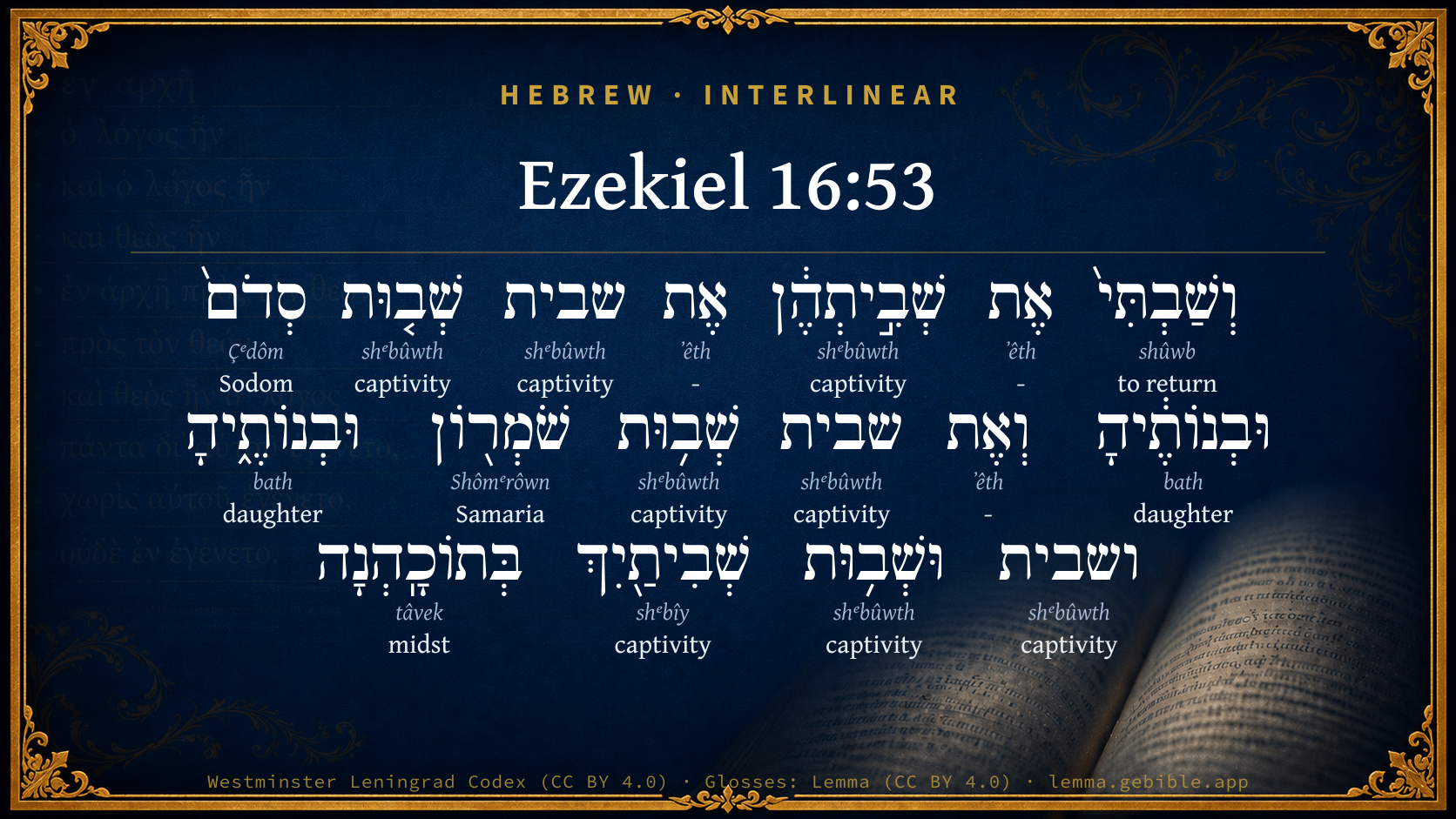
Ezekiel 16:53

Hebrew (Westminster Leningrad Codex) Ezekiel 16:53 appears in the Hebrew Old Testament. The text above is from the Westminster Leningrad Codex. Each word links to its Strong’s number, a concise gloss, and parsing drawn from the Open Scriptures Hebrew Bible morphology. Click any word for its full Brown-Driver-Briggs (BDB) entry.
Download image
Cite this verse

Ezekiel 16:53 (World English Bible). Public Domain. Lemma interlinear Bible study tool, https://lemma.gebible.app/v/ezekiel/16/53.

Show BibTeX & RIS
BibTeX
RIS
English Translation
I will turn again their captivity, the captivity of Sodom and her daughters, and the captivity of Samaria and her daughters, and the captivity of your captives in the midst of them;
World English Bible · Public Domain
Download a study sheet

One document with this verse’s original text, its word-by-word gloss line, the meaning frame, cross-references with their text, attributed commentary, and full source and license credits — printable, and it pastes into notes with its structure intact.

This verse Autodidact and up

Study sheet (.html) Plain text (.txt)

A passage Seminary Student

Up to 50 verses in one chapter. A passage sheet keeps up to 6 commentary sources and 12 cross-references per verse, in the order this page ranks them, and says so on the sheet whenever that leaves anything out. Ask for a single verse and you get the Autodidact verse sheet above.

Everything on this page stays free to read, with no account — the sheet is a download of what is already on screen, not access to it.

Want to remove ads? Support Godless Engineer
Compare translations 3

The same verse in 3 English versions, stacked beneath the original-language interlinear above. Click any original word for its lexicon entry.

Each is an independent rendering of the whole verse — the interlinear is not word-aligned to these translations.

Highlighted words mark where these versions differ — a whole-verse word diff, not a word-by-word alignment.

  • World English Bible Public Domain
    I will turn again their captivity, the captivity of Sodom and her daughters, and the captivity of Samaria and her daughters, and the captivity of your captives in the midst of them;
  • King James Version Public Domain
    When I shall bring again their captivity, the captivity of Sodom and her daughters, and the captivity of Samaria and her daughters, then will I bring again the captivity of thy captives in the midst of them:
  • unfoldingWord Literal Text CC BY-SA 4.0
    For I will restore their fortunes—the fortunes of Sodom and her daughters, and the fortunes of Samaria and her daughters; but your fortunes will be among them.

unfoldingWord Literal Text — © unfoldingWord, licensed CC BY-SA 4.0. Word-aligned USFM3 via Door43 (git.door43.org/unfoldingWord/en_ult).

Versions to compare (up to 4)

3 of 4 selected

Show all 18 translations

Every available English version of this verse, each an independent rendering of the whole verse.

  • World English Bible Public Domain
    I will turn again their captivity, the captivity of Sodom and her daughters, and the captivity of Samaria and her daughters, and the captivity of your captives in the midst of them;
  • Berean Standard Bible Public Domain
    But I will restore Sodom and her daughters from captivity, as well as Samaria and her daughters. And I will restore you along with them.
  • Majority Standard Bible Public Domain
    But I will restore Sodom and her daughters from captivity, as well as Samaria and her daughters. And I will restore you along with them.
  • King James Version Public Domain
    When I shall bring again their captivity, the captivity of Sodom and her daughters, and the captivity of Samaria and her daughters, then will I bring again the captivity of thy captives in the midst of them:
  • American Standard Version (1901) Public Domain
    And I will turn again their captivity, the captivity of Sodom and her daughters, and the captivity of Samaria and her daughters, and the captivity of thy captives in the midst of them;
  • Revised Version (1885) Public Domain
    And I will turn again their captivity, the captivity of Sodom and her daughters, and the captivity of Samaria and her daughters, and the captivity of thy captives in the midst of them:
  • Geneva Bible (1599) Public Domain
    Therefore I will bring againe their captiuitie with the captiuitie of Sodom, and her daughters, and with the captiuitie of Samaria, and her daughters: euen the captiuitie of thy captiues in the middes of them,
  • Douay-Rheims (1899) Public Domain
    And I will bring back and restore them by bringing back Sodom, with her daughters, and by bringing back Samaria, and her daughters: and I will bring those that return of thee in the midst of them.
  • Young's Literal Translation Public Domain
    And I have turned back `to' their captivity, The captivity of Sodom and her daughters, And the captivity of Samaria and her daughters, And the captivity of thy captives in their midst,
  • Literal Standard Version CC BY-SA 4.0
    And I have turned back [to] their captivity, || The captivity of Sodom and her daughters, || And the captivity of Samaria and her daughters, || And the captivity of your captives in their midst,
  • Unlocked Literal Bible CC BY-SA 4.0
    For I will restore their fortunes—the fortunes of Sodom and her daughters, and the fortunes of Samaria and her daughters; but your fortunes will be among them.
  • unfoldingWord Literal Text CC BY-SA 4.0
    For I will restore their fortunes—the fortunes of Sodom and her daughters, and the fortunes of Samaria and her daughters; but your fortunes will be among them.
  • Darby Bible Public Domain
    And I will bring again their captivity, the captivity of Sodom and her daughters, and the captivity of Samaria and her daughters, and the captivity of thy captives in the midst of them;
  • World Messianic Bible Public Domain
    “‘“I will reverse their captivity, the captivity of Sodom and her daughters, and the captivity of Samaria and her daughters, and the captivity of your captives among them;
  • Webster's Bible Public Domain
    When I shall bring again their captivity, the captivity of Sodom and her daughters, and the captivity of Samaria and her daughters, then will I bring again the captivity of thy captives in the midst of them:
  • Free Bible Version CC BY-SA 4.0
    Even so I'm going to bring Sodom and her daughters back from exile, and Samaria and her daughters too. I will bring you back together with them.
  • Bible in Basic English Public Domain
    And I will let their fate be changed, the fate of Sodom and her daughters, and the fate of Samaria and her daughters, and your fate with theirs.
  • JPS Tanakh (1917) Public Domain
    And I will turn their captivity, the captivity of Sodom and her daughters, and the captivity of Samaria and her daughters, and the captivity of thy captives in the midst of them;

Literal Standard Version (2020), Covenant Press — licensed CC BY-SA 4.0. Text via the HelloAO Bible API (eBible.org). Unlocked Literal Bible (unfoldingWord) — licensed CC BY-SA 4.0. Text via the HelloAO Bible API (eBible.org). unfoldingWord Literal Text — © unfoldingWord, licensed CC BY-SA 4.0. Word-aligned USFM3 via Door43 (git.door43.org/unfoldingWord/en_ult). Free Bible Version, Dr. Jonathan Gallagher — licensed CC BY-SA 4.0. Text via the HelloAO Bible API (eBible.org).

Word by word

More ways to search: Search by grammar → Find every occurrence → Compare this word →

Practice this passage: Drill this verse → Learn its vocabulary →

סְדֹם֙
Çᵉdôm
H5467
“Sodom”
Noun, Proper
Part of Speech
Noun
Type
Proper
Full BDB Definition

Origin: from an unused root meaning to scorch

TWOT: 1465

Sodom = "burning" - a Canaanite city, usually paired with Gomorrah, located in the area of the Dead Sea and the Jordan river; both cities destroyed by God in judgment
  1. וְשַׁבְתִּי֙ shûwb H7725 “and · to return” Conjunction + Verb, Qal, Sequential Perfect, 1st Person, Common, Singular
  2. אֶת ʼêth H853 “-” Particle, Direct Object
  3. שְׁבִ֣יתְהֶ֔ן shᵉbûwth H7622 “captivity · their” Noun, Common, Feminine, Singular, Construct + Suffix, Personal, 3rd Person, Feminine, Plural
  4. אֶת ʼêth H853 “-” Particle, Direct Object
  5. שבית shᵉbûwth H7622 “captivity of” Noun, Common, Feminine, Singular, Construct
  6. שְׁב֤וּת shᵉbûwth H7622 “captivity of” Noun, Common, Feminine, Singular, Construct
  7. וּבְנוֹתֶ֔יהָ bath H1323 “and · daughters · her” Conjunction + Noun, Common, Feminine, Plural, Construct + Suffix, Personal, 3rd Person, Feminine, Singular
  8. וְאֶת ʼêth H853 “and · -” Conjunction + Particle, Direct Object
  9. שבית shᵉbûwth H7622 “captivity of” Noun, Common, Feminine, Singular, Construct
  10. שְׁב֥וּת shᵉbûwth H7622 “captivity of” Noun, Common, Feminine, Singular, Construct
  11. שֹׁמְר֖וֹן Shômᵉrôwn H8111 “Samaria” Noun, Proper
  12. וּבְנוֹתֶ֑יהָ bath H1323 “and · daughters · her” Conjunction + Noun, Common, Feminine, Plural, Construct + Suffix, Personal, 3rd Person, Feminine, Singular
  13. ושבית shᵉbûwth H7622 “and · captivity of” Conjunction + Noun, Common, Feminine, Singular, Construct
  14. וּשְׁב֥וּת shᵉbûwth H7622 “and · captivity of” Conjunction + Noun, Common, Feminine, Singular, Construct
  15. שְׁבִיתַ֖יִךְ shᵉbîy H7628 “captivities · your” Noun, Common, Both, Plural, Construct + Suffix, Personal, 2nd Person, Feminine, Singular
  16. בְּתוֹכָֽהְנָה tâvek H8432 “in/at · midst · their” Preposition + Noun, Common, Masculine, Singular, Construct + Suffix, Personal, 3rd Person, Feminine, Plural

About this verse

These counts appear in no published source. They are computed here, from the morphology-tagged text and Lemma’s own curated glosses. What Lemma adds →

17
words
8
distinct lemmas
Prophets
section

Shared distinctive vocabulary

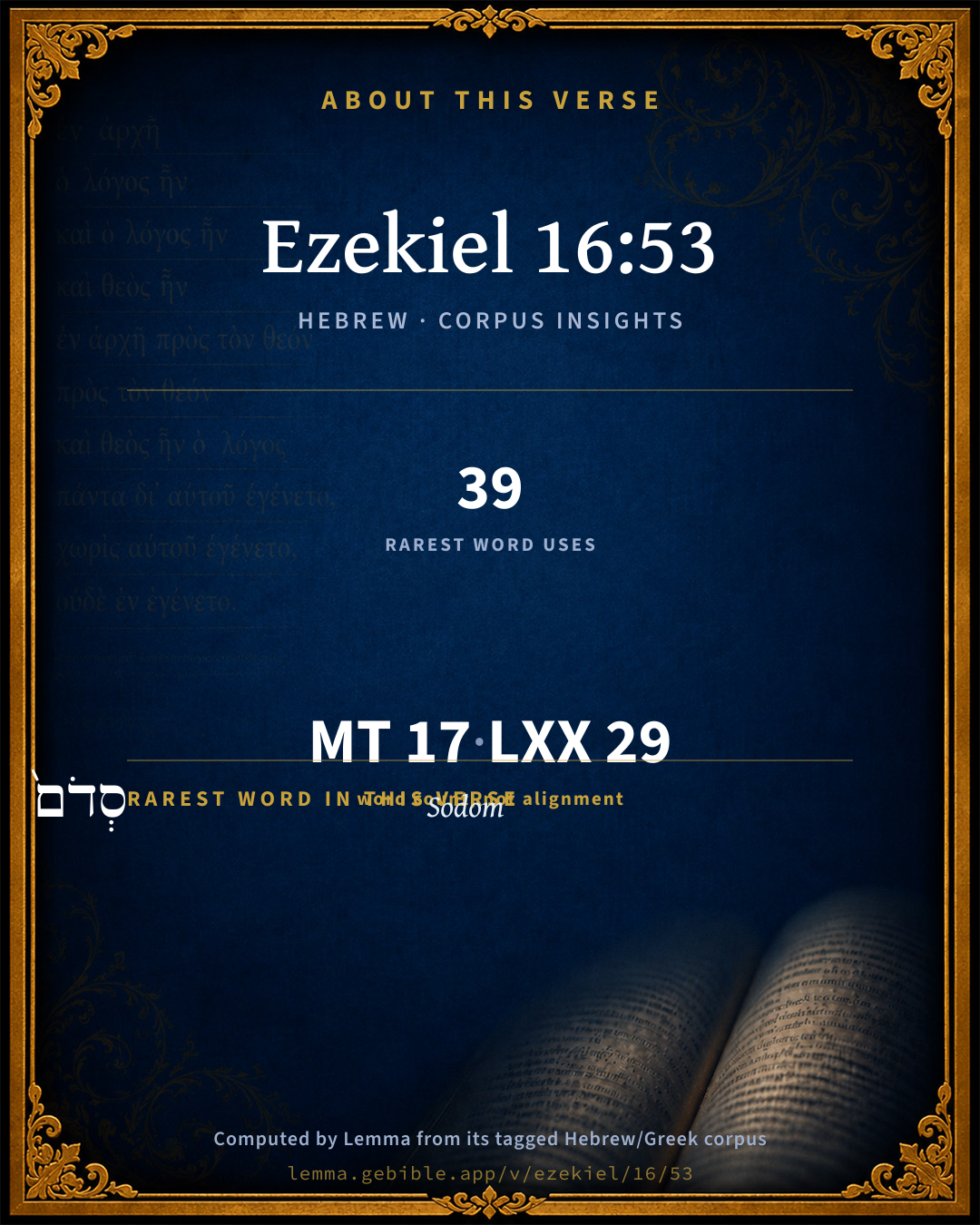
סְדֹם֙ Sodom H5467 occurs in 38 verses of the Hebrew Bible. Also found in:

Grammatical profile

  • 1 verb
  • 13 nouns
  • 3 particles

Verb forms

  • וְשַׁבְתִּי֙ Qal · Sequential Perfect

Repetition

Words recur within this verse — often emphatic in Hebrew:

  • שְׁבִ֣יתְהֶ֔ן captivity H7622 ×7
  • וּבְנוֹתֶ֔יהָ daughter H1323 ×2

Hebrew & Septuagint length

In English translation the verse runs 32 words from the Hebrew and 36 from the Septuagint (LXX English) — closely comparable.

A rough comparison of the two English renderings, which tokenize alike — not a word-level alignment.

Word counts can differ between the Hebrew and the Greek without any difference in meaning — e.g. the Hebrew direct-object marker אֵת has no separate Greek word, and Greek often adds the article ὁ.

In the original languages it is 17 Hebrew tokens and 29 Greek tokens — but the two are counted differently (Hebrew bundles its prefixes and suffixes into one token; the Greek is in lemma form), so that isn’t a like-for-like length.

Cross-references

17

Topical passages linked to Ezekiel 16:53 in the Treasury of Scripture Knowledge — connected by theme and wording, ordered by reader-vote popularity; previews shown in the World English Bible.

  • Isaiah 19:24–25 In that day shall Israel be the third with Egypt and with Assyria, a blessing in the midst of the earth;
  • Jeremiah 12:16 It shall happen, if they will diligently learn the ways of my people, to swear by my name, As Yahweh lives; even as they taught my people to swear by Baal; then shall they be built up in the midst of my people.
  • Ezekiel 29:14 and I will bring back the captivity of Egypt, and will cause them to return into the land of Pathros, into the land of their birth; and they shall be there a base kingdom.
  • Ezekiel 39:25 Therefore thus says the Lord Yahweh: Now will I bring back the captivity of Jacob, and have mercy on the whole house of Israel; and I will be jealous for my holy name.
  • Job 42:10 Yahweh turned the captivity of Job, when he prayed for his friends. Yahweh gave Job twice as much as he had before.
  • Psalms 14:7 Oh that the salvation of Israel would come out of Zion! When Yahweh restores the fortunes of his people, Then Jacob shall rejoice, and Israel shall be glad.
  • Psalms 85:1 Yahweh, you have been favorable to your land. You have restored the fortunes of Jacob.
  • Psalms 126:1 When Yahweh brought back those who returned to Zion, We were like those who dream.
  • Isaiah 1:9 Unless Yahweh of hosts had left to us a very small remnant, We would have been as Sodom; We would have been like Gomorrah.
  • Jeremiah 20:16 Let that man be as the cities which Yahweh overthrew, and didn't repent: and let him hear a cry in the morning, and shouting at noontime;
  • Jeremiah 31:23 Thus says Yahweh of Hosts, the God of Israel, Yet again shall they use this speech in the land of Judah and in the cities of it, when I shall bring again their captivity: Yahweh bless you, habitation of righteousness, mountain of holiness.
  • Jeremiah 48:47 Yet will I bring back the captivity of Moab in the latter days, says Yahweh. Thus far is the judgment of Moab.
  • Jeremiah 49:6 But afterward I will bring back the captivity of the children of Ammon, says Yahweh.
  • Jeremiah 49:39 But it shall happen in the latter days, that I will bring back the captivity of Elam, says Yahweh.
  • Ezekiel 16:60–61 Nevertheless I will remember my covenant with you in the days of your youth, and I will establish to you an everlasting covenant.
  • Joel 3:1 "For, behold, in those days, And in that time, When I restore the fortunes of Judah and Jerusalem,
  • Romans 11:23–31 They also, if they don't continue in their unbelief, will be grafted in, for God is able to graft them in again.

Cross-references courtesy of OpenBible.info (CC BY 4.0).

Hebrew and Greek witnesses Masoretic Hebrew ↔ Greek Septuagint

The same verse in the two great witnesses to the Old Testament, shown verse-for-verse.

These are two independent witnesses, not word-aligned to each other, and the Septuagint is shown in lemma (dictionary) form.

Hebrew Ezekiel 16:53 Masoretic · Westminster Leningrad Codex

וְשַׁבְתִּי֙ אֶת שְׁבִ֣יתְהֶ֔ן אֶת שבית שְׁב֤וּת סְדֹם֙ וּבְנוֹתֶ֔יהָ וְאֶת שבית שְׁב֥וּת שֹׁמְר֖וֹן וּבְנוֹתֶ֑יהָ ושבית וּשְׁב֥וּת שְׁבִיתַ֖יִךְ בְּתוֹכָֽהְנָה

I will turn again their captivity, the captivity of Sodom and her daughters, and the captivity of Samaria and her daughters, and the captivity of your captives in the midst of them;

World English Bible · Public Domain

Greek LXX Ezekiel 16:53 Septuagint · lemma form

καί ἀποστρέφω ὁ ἀποστροφή αὐτός ὁ ἀποστροφή σοδομα καί ὁ θυγάτηρ αὐτός καί ἀποστρέφω ὁ ἀποστροφή σαμαρεία καί ὁ θυγάτηρ αὐτός καί ἀποστρέφω ὁ ἀποστροφή σύ ἐν μέσος αὐτός

And I will turn their captivity, even the captivity of Sodom and her daughters; and I will turn the captivity of Samaria and her daughters; and I will turn your captivity in the midst of them:

LXX2012 (modern English Septuagint) · Public Domain

On this verse, The Cambridge Bible for Schools and Colleges discusses the Septuagint’s reading. Read the note in Commentary ↓

Hebrew: Westminster Leningrad Codex (CC BY 4.0). Greek: Septuagint (public domain); English from LXX2012 (modern English Septuagint) (Public Domain). How the Septuagint differs from the Hebrew →

Targum (Aramaic paraphrase)

1

The Targum is the ancient Jewish Aramaic paraphrase of the Hebrew Scriptures — an interpretive translation, not the Hebrew text itself. Onkelos (literal) and Pseudo-Jonathan (expansive) render the Torah, and Jonathan the Prophets. Coverage is partial: where no permissively-licensed English translation exists for a verse, only the Aramaic is shown. This is verse-level text, not a word-by-word alignment to the Hebrew.

  1. Targum Jonathan Prophets (Joshua–Malachi)
    וְאָתִיב יַת עַמְהֶן לְהֶן יַת עַמָא דִסְדוֹם וְכַפְרָנָהָא וְיַת עַמָא דְשׁוֹמְרוֹן וְכַפְרָנָהָא וְאָתֵיב גָלוּת עַמִיךְ בֵּינֵיהוֹן:

    (no public-domain English translation for this verse)

    Targum Jonathan — Aramaic: “Mikraot Gedolot” (public domain). English: “Sefaria Community Translation” (CC0 1.0 (public-domain dedication)); “London "Chaldee Paraphrase," 1871” (public domain). Text via Sefaria.

Commentary

Notes on Ezekiel 16:53 from classic Christian and Jewish commentators (each source and its license shown beneath its notes). The classic Christian expositions comment on the surrounding passage and are grouped to its opening verse, so a note may address several verses; the Jewish commentaries on the Tanakh (Rashi and others) are per-verse, so they appear only where the commentator wrote on this verse.

Lemma curates 59 commentaries, every one of them public domain or Creative Commons licensed, each selected and text-cleaned for this edition rather than reprinted as found. About our sources →

Trapp's Complete Commentary

John Trapp

Eze 16:53 When I shall bring again their captivity, the captivity of Sodom and her daughters, and the captivity of Samaria and her daughters, then [will I bring again] the captivity of thy captives in the midst of them:

Ver. 53. When I shall bring again.] Or, If I bring again, which I shall never do. The Jewish doctors indeed would from this verse gather that Sodom and all shall one day be restored again; but that is like to be a long day. The Jews, as they had taken up the opinion of Pythagoras about transanimation, so they had that other of Plato about the great revolution or restitution of all things after certain years.

Then will I bring again the captivity.] The Jews were never perfectly restored, in respect to the glory of the temple, and the state of the kingdom, &c.

John Trapp, A Commentary or Exposition upon All the Books of the Old and New Testament (1647–1656) — public domain. Text from a community e-Sword module.

The Biblical Illustrator

Joseph S. Exell

Eze_16:53-54

That thou mayest . . . be confounded in all that thou hast done.

The humiliation of success

The argument of this passage is very original. The prophet reaches past all limitations to the universal grace of God, and not so much by way of revelation as of inference. He has spoken of Israels past--how like a newborn child it was thrown out, the prey of any passer-by. Gods mercy found it, and reared it to strength--filling all the years with His goodness, but the nation answered with disloyalty, wanton and flagrant. In spite of chastisement and in spite of grace she sought the lowest; and in Ezekiels day, stripped of wealth and power and land, a disgraced and abandoned people, Israel seemed to have come back to where she was in the beginning when God found her. Is the story to be repeated without alteration? Ezekiel looks at the nations around, kindred in blood and language and custom, partners also in sin, and he sees that either all must perish together or all must come in together. And as he knows that God cannot cast off His people, his instincts of justice assure him that in bringing Israel back God must bring Sodom back, the most sunken and the most execrable of the race, and yet not so sunken as Israel. Sodom and Samaria, and such as they, must be pardoned for the sake of a city worse than themselves. It is substitution upside down. If there is room found in Gods mercy for Jerusalem, there must be for Sodom, and Sodom may come covered by the blackness of Jerusalems guilt. Our text is one point in the conclusion; it is the humiliation of success. Jerusalem brings in her train the evil cities in a day of jubilation--a day of the growth of the kingdom of God; but she herself is humbled, because everything reminds her of her sin. I wish to speak of the sobering and humbling quality of even the smallest success, which makes it a means of grace to those who enjoy it aright.

1. From the greatness of the work itself. Whatever view we may take of human nature, it must seem to us a great work to bring a man to God--to establish in him a new kingdom of desire and hope, so that he whose heart was narrow now regards the world with Christs eyes. That is a great work. It is the beginning of hope, the beginning of usefulness, and it is the end of sin. And constantly this great work is done by men: an impulse is given, a word spoken, a truth pressed. The more personal in this sense the impulse is, the deeper is the humiliation of the originator of it. He feels how little he has done, how feebly he has spoken; he has only flung words at One radiant idea of which he caught sight, and which he has not expressed. His work, he knows, has been so erring, so partial, so spasmodic, and God has sent this reward. On the one side, you feel how simple and how near such results are, that but for your indolence and inexpectancy they might have been more than they are; on the other, you know that, simple as they are, they are by the diameter of worlds out of your reach. It is not I that live, but Christ who lives in me; it is not I who work, but God. But whilst we cast upon God the burden, we must not miss the purifying efficacy of success. Of course, it is God who works; but it is also you or I. It is your idiosyncrasy, your peculiarity of temper, your happy knack which accounts for the immediate result. And it is just as you do set all you have against this result that you see the want of measure between them, and you are ashamed because of all you have done, in that you are a comfort to men.

2. Seeing self in another. We wish for men that they might see themselves as others see them, which is one inference of self-deceiving. We do not know how our qualities look, for custom and self-love blind us. We scarcely suspect how much alike we are until we think a man speaking in a certain way is describing us, whilst probably he is describing himself. The story is told of a ruffled baronet who complained to George Meredith of having been put into his Egoist as the egoistic hero. I had no thought of you; I thought of myself--of us all, is the answer reported. And as we do not know our likeness to men we turn from, we do not know our own ugliness. In this very chapter Ezekiel exhibits a thought of this kind. The Jews pointed with loathing at Sodom; the name of it had become proverbial, because God had blotted it out. It at least is worse than we; we may fairly shrink from that as a lower depth of which we know nothing, to which we have no proclivity. And the prophet says, What was the sin of Sodom? (verse 49). Behold this was its iniquity--pride, fulness of head, and prosperous ease, and she did not strengthen the hand of the poor and needy. There is nothing exceptional in it, nothing in Sodom which is not in you, he says. You meet with an ignorance, wilful and self-complacent; you struggle in another against that spiritual stupidity to which every worldly advantage is apparent, and to which none but a worldly advantage can be demonstrated. You find your efforts for some man thwarted by his intense sensuality, or by his doubleness and suspicion. You cannot advance, you cannot outwit his cunning or convince him of your sincerity. That stagnant and slumberous humour you cannot awake. To that pure animalism it is hopeless to speak of the glory of Christ. It is painful, disappointing, wearisome; but you come to know in striving with them what these things mean--sensuality, sloth, anger, envy: to many of us they are the too severe names of pleasant vices. But when for some mans good you set yourself to free him from them, you realise the ugliness, the tenacious and wasting energy of them. And at the same time you see yourself. It is myself I am fighting in that man: these are my faults. It is in that real dealing with men that we come to understand the humour of a saint who could say of an abandoned criminal, There, but for the grace of God, am I.

3. It is a discovery of the meaning of the grace shown to us. When habit has made a certain level of conduct easy, or when our past shows no heights or depths, we may easily imagine, that the work of grace was not very great in us. We were almost born Christians, born and baptized and bred in Christian homes, with ample knowledge and wise restraint and sedulous training. Not far from the kingdom of God at any time, we were lightly and easily brought within it. In strong contrast is another life, gone far astray, full of heat and passion, in which the lights burn sullenly: a man lost to decency, to hope, to God--what have you to say to him whose life has run in so orderly and honourable a course? Out of the depths he looks with some faint gleam of hope to you as you talk of Christ. What can you say to him? I never was very bad, and God has mercifully pardoned the little wrong there was: is that all you know? The occasion widens your heart. You want to help him, and that eager desire sends your thoughts back into Gods dealing with you. For the first time you know your sin; it was very great--the Pharisees sin an isolating, loveless self-complacency--and God came to me. Then you can say in answer, Your sin is not mine wholly; our lots have been different, and our temptations, and our falls; but God abundantly pardoned me, and He will pardon you. (W. MMacgregor, M. A.)

In that thou art a comfort unto theme--

How saints may help the devil

I. The acts of many of Christs followers have been the cause of justifying and comforting sinners in their evil ways.

1. The daily inconsistencies of the people of God have much to do in this matter.

(1) The covetousness of too many Christians has had this effect. Look, says the worldling, this man professes that his inheritance is above, and that his affection is set not on things on earth, but on the things of heaven; but look at him: he is just as earnest as I am about the things of this world; he can drive the screw home as tightly with his debtor as I can; he can scrape and cut with those that deal with him quite as keenly as ever I have done.

(2) Another point in which the sinner often excuses himself is the manifest worldliness of many Christians. You say yon are crucified to the world, and the world to you: it is a very merry sort of crucifixion.

(3) Look, too, at the manifest pride of many professors of religion. What., then, do worldlings say? You accuse us of pride; you are as proud as we are. You the humble followers of Jesus, who washed His saints feet? Not you; no, you would have no objection, we doubt not, to be washed by others, but we do not think it likely that you would ever wash ours. You the disciples of the fishermen of Galilee? Not you; you are too fine and great for that. Accuse us not of pride; why, you are as stiff-necked a generation as we ourselves are.

(4) I might mention another sad fact with regard to the Church which often stings us sorely,--the various enmities and strifes and divisions that arise.

2. Now, it is my mournful duty to go a step further. It is not merely these inconsistencies, but the glaring crimes of some professed disciples, that have greatly assisted sinners in sheltering themselves from the attacks of the Word of God. Every now and then the cedar falls in the midst of the forest.

3. How often do the people of God comfort sinners in their sins by their murmurings and complaints.

4. Perhaps the greatest evil has been done by the cold-heartedness and indifference of religious professors.

II. The consequences of this evil.

1. How often have you and I helped to keep sinners easy in their sin, by our inconsistency!

2. Do you not think that very often, when a sinners conscience has been roused, you and I have helped to give it a soporific draught by our coldness of heart?

3. Is it not possible that often sinners have been strengthened in their sin by you? They were but beginning in iniquity, and had you rebuked with honesty and sincerity, by your own holy life, they might have been led to see their folly, and might have ceased from sin; but you have strengthened their hands. So-and-so is not more scrupulous than I, says such an one; I may do what he does.

4. Nay, is it not possible that some of you Christians have helped to confirm men in their sins, and to destroy their souls? It is a masterpiece of the devil, when he can use Christs own soldiers against Christ. But this he has often done.

III. Bring out the great battering ram, to bear against this vain excuse of the wicked.

1. What hast thou to do with the inconsistencies of another? To his own master he shall stand or fall. Thou wilt be punished for thine own offences, remember, not for the offences of another. Man! I conjure thee, look this in the face. How can this help to assuage thy misery? How can this help to make thee happier in hell, because thou sayest there are so many hypocrites in this world?

2. But besides, thou knowest well enough that the Church is not so bad as thou sayest it is. Thou seest some that are inconsistent; but are there not many that are holy? There would be no hypocrites if there were not some true men. It is the quantity of true men that helps to pass off the hypocrite in the crowd.

3. Then again, I say, when thou comest before the bar of God, dost thou think that this will serve thee as an excuse, to begin to find fault with Gods own children? The rather this shall be an addition to thy sin, and thou shalt perish the more fearfully.

4. But come, man, once again: I would entreat of thee with all my might. What! canst thou be so foolish as to imagine, that because another man is destroying his own soul by hypocrisy, that this is a reason why thou shouldst destroy thine by indifference? (C. H. Spurgeon.)

Comfort to Sodom

What is the meaning of this text? Jerusalem is said to have been a comfort to Sodom and Samaria; and this is mentioned as if it were a fault. Are we not bidden to love even our enemies, and to do good even to them that hate us; and can it then be wrong to be a comfort even to the worst of mankind,--even to Samaria and Sodom? Yes, in such a case as this it is wrong to be a comfort to a bad man or a bad city; because in such a case it is the very reverse of a kind turn to be a comfort to them. It is doing harm to them, and not doing good to them, to be a comfort in this particular way. For Jerusalem had been a comfort to Sodom and Samaria, in such a manner as had encouraged them in their sins. Now, I am sure you will all readily see that there is a great and important principle suggested to us by the text. You know, every Christian is solemnly bound to do all he can to make other men Christians. The knowledge of the Gospel is not a thing which a man may have, and without blame keep to himself. And just as blessed and happy a thing as it is to bring another soul to the belief of the Gospel,--so wretched and wicked and fearful a thing is it when a man who bears the Christian name lives in such a way as positively encourages those around him to contemn and disbelieve Christianity.

1. There is one obvious way in which professing Christians may do this, which we mention only to pass it by, in the hope that none of us who bear even the Christian name are so sorely and shamefully guilty. This is the way in which we understand from the prophet that Jerusalem was a comfort to Sodom; and that was, by being actually as bad as Sodom itself. Would not every swearer and drunkard and liar in the parish quiet his conscience, with the reflection that he was no worse than that wicked professor of religion? Would not such a man be a comfort to all the Sodoms and Samarias in the district? It is easy to say, and it is true to say, that religion is a thing that must be judged of on the ground of its own merits, and quite apart from the conduct of those who profess to believe in it; yet, illogical as it may be, foolish and wrong as it may be, the mass of mankind will always encourage themselves in sinfulness when they find professing Christians going on in sin.

2. If any sincere Christian is present in a company where what is sinful is said or done, and if he permits it to pass without remark, or even appears tacitly to approve it, I do not see how he can clear himself from the charge of having been a comfort to Sodom. The apparent approval of one true and earnest Christian--even the very humblest in worldly rank--will have more influence to comfort the wicked man,--to keep his mind easy, and his conscience asleep,--than the loudest declarations of his own wicked associates that he is a fine fellow and has done nothing wrong. And I am not forgetting the restraints which the usages of civilised society impose upon our telling a man to his face what is our opinion of his conduct. The Christian is not called upon to go up to a man and tell him that he is a bad man, merely because he thinks he is one. There is a silent, unobtrusive disapproval, by which the humblest may be a check upon the highest; there is a silent, unobtrusive disapproval, expressed without words or demonstration of manner, one can hardly tell how, which even the most hardened sinner will find it very hard, very uncomfortable, to bear.

3. Another way in which a Christian may so act as to encourage and comfort an irreligious man in his godless ways is by seeking his society and acquaintance; showing him that you think him a congenial spirit, and that you feel it pleasant to be with him. How can he think, the unbeliever will judge,--How can he think that I am going to hell! Is it possible that he should like to be the companion of my walks,--to interchange thought and feeling with me,--to discuss great questions with me,--perhaps often to jest and laugh with me;--and all the while believe and know that, as sure as there is a God above us, I am going down to hell! Dont you see now what eternal damage you who are Christians may do an unbelieving neighbour? Let them feel that you dare not make those too dear, from whom the grave must part you forever! See that you be not a comfort to them!

4. I go on to mention, as a way in which Christians may encourage and countenance ungodly men in their doings,--the cherishing a worldly spirit,--being as eager for worldly advantage, and as unscrupulous as to the means by which it may be attained, as men who make no Christian profession. And, alas! my friends, how much of this them is among professing Christians! Do not many who bear the Christian name show that they are far more eager to get on in life than to prepare for immortality? Is there not as much vanity and pride and grasping at gain and self-seeking and contemptible worshipping of rank and wealth,--even when completely dissociated from worth and goodness,--among many professing Christians and Christian ministers, as in any class of men? The sharp bargain made by the communicant may do worse than levy an unfair tax upon his neighbours pocket: it may damage his neighbours soul! It may set him up to go and do likewise! It may lead him to think that there is no difference between the Christian and the worldly man at all!

5. I shall mention just one way more, in which a Christian may incur the condemnation pronounced in the text: this is, by never in any way warning his neighbour that he fears or knows he is not a Christian. I daresay some of you have some idea that it would be intruding into the priestly office were you to set yourselves to the work of bringing souls to Christ. But if you saw a friend manifestly stricken by fever or consumption, would it not be your duty to warn him, although you are not a physician? If you saw a friend drowning, would it not be your duty to try to save him, although you are not a member of the Humane Society? If a man be really in earnest about religion he will never bear the sight of a human being whom he daily sees and talks with going to eternal ruin, without a word of warning or advice! It is possible enough he may not like to listen to your warning words; it is possible enough you may make yourself an annoyance and a discomfort to him: he may think you are his enemy, because you tell him the truth; but oh! better, better that than to be a comfort to one to whom comfort is the anodyne that will drug to death, to whom comfort is the stream that will bear on to perdition! I have heard of one who on his deathbed said that if, as he humbly trusted, he had been led to yield himself to his Saviour, and so to find hope in death, it was by the simple and solemn warning of one in whom simple earnestness and heartfelt piety gave force to the words of early youth, unsophisticated and sincere. (A. K. H. Boyd, D. D.)

The Biblical Illustrator, edited by Joseph S. Exell (c. 1880s–1900s) — public domain. Text from a community e-Sword module.

Joseph Benson's Commentary

Eze 16:53-56. When I shall bring again the captivity of Sodom and her daughters, &c. — “Sodom and her daughters may mean cities placed in the district where Sodom stood. Sodom was not where the lake is, Gen 19:24.” — Bishop Newcome. “The Moabites and Ammonites, descended from Sodom, are called by this name.” — Michaelis. “When the fulness of the Gentiles shall come into the church, some of whom may be compared with Sodom for wickedness, Isa 1:9, then will I also remember you were my ancient people. St. Paul tells us the Jews will be provoked to emulation by the Gentiles coming into the church, and thereby be induced to acknowledge the truth, Rom 11:11-31. And the conversion of the Gentiles is expressed, Jer 48:47; Jer 49:6; Jer 49:39, by returning the captivity of Moab, Ammon, and Elam; and Isa 18:7; Isa 19:24-25; Isa 23:18, by the Egyptians, Syrians, Assyrians, and Ethiopians bringing presents to God, and acknowledging themselves his servants. And by the same analogy we may understand the bringing again the captivity of Sodom here, of the Gentiles coming into the church.” — Lowth. “The sense of this,” says Bishop Newcome, “is again expressed Eze 16:55, and both verses are to be explained by Eze 16:61. I refer the words rather to the future restoration of the Jews than to their return from Babylon.” This prediction was partly fulfilled in the age of the apostles and first disciples of Christ; but the full accomplishment of it is undoubtedly yet future. That thou mayest bear thine own shame — That thou mayest be humbled and made ashamed, in having those put upon a level with thee whom thou hadst before so greatly contemned, and thought so much beneath thee. For thy sister Sodom — Including the cities in or near the place where she stood, and the Ammonites, Moabites, and other neighbouring nations, termed her daughters, Eze 16:53; Eze 16:55, and here put for the Gentiles in general; was not mentioned in the day of thy pride — Was held in such contempt, that thou didst not think her worthy of being named by thee; before thy wickedness was discovered, Eze 16:57 — Before it was made apparent to the world by the judgments or punishments inflicted on thee. Or, as Bishop Newcome and some others interpret the words, “The exemplary punishment of Sodom was not duly considered and spoken of by thee in the time of thy prosperity and self-confidence; before thy humiliation showed thy wickedness, and defeats and distresses were brought on thee by the Syrians and Philistines.”

Joseph Benson's Commentary on the Old and New Testaments (1811–1818) — public domain. Text from a community e-Sword module.

The Preacher's Complete Homiletical Commentary

Joseph S. Exell (gen. ed.)

(Eze_16:53-63.)

EXEGETICAL NOTES.—Eze_16:53. “When I shall bring again their captivity, the captivity of Sodom and her daughters, and the captivity of Samaria and her daughters, then will I bring again the captivity of thy captives in the midst of them.” “The promise commences with an announcement of the restoration, not of Jerusalem, but of Sodom and Samaria. The two kingdoms, or peoples, upon which judgment first fell, shall also be the first to receive mercy; and it will not be till after then that Jerusalem, with the other cities of Judah, will also be restored to favour, in order that she may bear her disgrace, and be ashamed of her sins (Eze_16:54); that is to say, not because Sodom and Samaria have borne their punishment for a longer time, but to the deeper shaming, the more complete humiliation of Jerusalem. The Hebrew expression means, “to turn the captivity,” not “to bring back the captives;” and it is here used in a figurative sense for restitutio in statum integritatis. No carrying away took place in the case of Sodom.”—(Keil.)

Eze_16:54. “In that thou art a comfort unto them.” “By bearing disgrace, i.e., by its endurance of well-merited and disgraceful punishment, Jerusalem consoles her sisters, Samaria and Sodom; and that not merely by fellowship in misfortune, but by the fact that from the punishment endured by Jerusalem, both Samaria and Sodom can discern the righteousness of the ways of God, and find therein a foundation for their hope, that the righteous God will bring to an end the merited punishment as soon as its object has been attained.” (Keil.)

Eze_16:55. “When thy sisters, Sodom and her daughters shall return to their former estate.” “If Jerusalem, Samaria, and Sodom, are to be viewed as symbolical of the surrounding people whose centre they formed, or with whom they stood connected, no difficulty will arise relative to the restoration of Sodom. If we regard her as the representative of the Ammonites and Moabites, the descendants of Lot, we shall here have only a parallel prediction to Jer_48:47; Jer_49:6. However obscure the lights of history relative either to the captivity or the restoration of the nations beyond the Dead Sea, there can be little doubt that they participated more or less in the fate of the Jews, to whose country they lay contiguous. That most of the ten tribes of which Samaria had been the capital were restored under Cyrus, is now generally admitted. The restoration of all the three classes of people is here predicted to take place at the same time.”—(Henderson.)

Eze_16:56. “For thy sister Sodom was not mentioned by thy mouth in the day of thy pride.” They took no heed of the warning of Sodom’s example. Boasting themselves as “The Temple of the Lord,” they thought that they needed it not (Jer_7:4).

Eze_16:57. “As at the time of thy reproach of the daughters of Syria.” “By the reproach of the cities of Syria, was not meant anything derogatory to the character of those cities nationally considered, but the indignity offered by the Syrians to the Jews, when, under Rezin, they invaded the land of Judah (2Ki_15:37; Isa_7:1-9). That this is the construction to be put upon the words is evident from the parallelism, in the corresponding member of which the manner in which the Jews had been treated by the Philistines is mentioned. Compare for the insults offered by both, Isa_9:11-12.—(Henderson.)

Eze_16:58. “Thou hast borne thy lewdness and thine abominations.” Jerusalem would bear the guilt of these iniquities, and would know how great that burden was when she would be called upon to atone for her wrong-doing.

Eze_16:59. “I will even deal with thee as thou hast done.” In mercy Jehovah would “walk contrary unto them,” so that they might be humbled and thus brought to repentance. “Which hast despised the oath in breaking the covenant”. “Despising the oath points back to Deu_29:11-12, where the renewal of the covenant concluded at Sinai is described as an entrance into the covenant and oath which the Lord then made with His people. But even if Israel has faithlessly broken the covenant, and must bear the consequent punishment, the unfaithfulness of man can never alter the faithfulness of God. This is the link of connection between the resumption and further expansion of the promise in Eze_16:60 and the closing words of Eze_16:59. The remembrance of His covenant is mentioned in Lev_26:42-45 as the only motive that will induce God to restore Israel to favour again, when the humiliation effected by the endurance of punishment has brought it to a confession of its sins.”—(Keil.)

Eze_16:60. “Nevertheless I will remember My covenant with thee in the days of thy youth, and I will establish unto thee an everlasting covenant.” “The covenant which God concluded with Israel in the day of its youth, i.e., when he led it out of Egypt, He will establish as an everlasting covenant. Consequently it is not an entirely new covenant, but simply the perfecting the old one for everlasting duration. For the fact itself, compare Isa_55:3, where the making of the everlasting covenant is described as granting the steadfast mercies of David, i.e., as the fulfilment of the promise given to David (2 Samuel 7). This promise is called by David himself an everlasting covenant, which God had made with him (2Sa_23:5). And the assurance of its everlasting duration was to be found in the fact that this covenant did not rest upon the fulfilment of the law, but simply upon the forgiving grace of God (compare Eze_16:63 with Jer_31:31-34).”—(Keil).

Eze_16:61. “Then shalt thou remember thy ways and be ashamed.” They would be ashamed when they saw the other nations associated with them in the enjoyment of the same blessings. “I will give them unto thee for daughters, but not by thy covenant.” The covenant to which they assented at Horeb excluded all other nations from its benefits (Exo_24:7). The blessings which were to come upon all nations would flow from the earlier promise which God made to Abraham (Gal_3:13-14).

Eze_16:62. “And I will establsh My covenant with thee.” This was the old covenant made with Abraham, wherein Christ was promised, who was to bless all nations. That was a covenant purely of blessing, and in the form of it entirely unconditional (Gal_3:17).

Eze_16:63. “And never open thy mouth because of thy shame.” This would be the shame of the penitent, who is overwhelmed with a sense of God’s extraordinary goodness, and of his own foolishness and ingratitude (Rom_3:19).

HOMILETICS

GOD’S PURPOSE OF MERCY TOWARDS ISRAEL

I. It would not be defeated by the greatness of their sin. Israel had sinned against the clearest light, and in spite of great gifts and privileges. Their sin was greater than the common iniquity of the nations around them, for it was ingratitude and rebellion against the living God. Yet this did not overtask God’s infinite mercy, or close the door of hope against them for ever. With Him there is plenteous redemption. The gospel offers salvation to the worst of sinners, even to those who like Israel, have sinned against the greatest light.

II. Its strength lay in God’s ancient covenant with them. It was the old covenant which God would now call to mind that which He made with them when He first chose them as a people destined to accomplish His purpose of salvation for the world. In the meantime they were punished according to their works, which was justice. But, in the end, His grace would deal with them according to His mercy secured by His old covenant (Eze_16:60). Faith in God’s unchanging goodness was David’s comfort when he uttered his “last words.” He remembered many failures, and how he and his house had fallen far short of their high calling, but his soul stood firmly upon this rock, “Yet He hath made with me an everlasting covenant, ordered in all things, and sure: for this is all my salvation, and all my desire, although He make it not to grow” (2Sa_23:5). Thus David confessed that his house was no suitable home for Israel’s Great Ruler, but he had strong faith that grace would prevail over all this unworthiness. And now grace begins the work of reconciliation, of re-establishment. God had not broken His covenant, and now He will make the first advance towards its renewal and fulfilment. All would be seen to be of grace, and not of merit; and, therefore, there can be no ground of boasting on the part of Israel. God’s purpose of mercy towards mankind, in Jesus Christ, is intended to prevail over all their sin. The grace displayed in redemption is sufficient for the largest designs of mercy.

III. It would be accomplished through their humiliation.

1. They would be brought to see their own sin in all its magnitude. They would remember the past with shame, and the sense of God’s infinite mercy displayed in their forgiveness would close their months in utter astonishment. They would be both ashamed and confounded (Eze_16:61-63).

2. They would be put to shame by God’s dealings with other nations. The restoration of Sodom and Samaria was also promised (Eze_16:53-54). Nations which they thought were for ever beyond the reach of Divine mercy were about to be blessed. This great purpose of restoration is fully accomplished in the Gospel dispensation. God chose from His people, Israel, the apostles who were to preach the Gospel, “Salvation is of the Jews.” They were the people appointed to spread the glad tidings of salvation to the heathen. The old Covenant would expand into the large and unchangeable purpose of God’s mercy in the Gospel. From Jerusalem is to go forth the word of mercy that is to save the world. Thus in the end, it will be seen that God’s love is not partial, but contemplates the larger purpose of bringing the means of salvation within the reach of all.

(Eze_16:53-54)

But how could a restoration of Sodom and her daughters (Gomorrah, etc.) be predicted, when the destruction of these cities was accompanied by the sweeping away of all their inhabitants from off the face of the earth? Many of the commentators have attempted to remove the difficulty by assuming that Sodom here stands for the Moabites and Ammonites, who were descendants of Lot, who escaped from Sodom. But the untenableness of such an explanation is obvious, from the simple fact that the Ammonites and Moabites were no more Sodomites than Lot himself. And the view expressed by Origen and Jerome, that Sodom is a typical name, denoting heathenism generally, is also unsatisfactory. The way in which Sodom is classed with Samaria and Jerusalem, and the special reference to the judgment that fell upon Sodom (Eze_16:49-50), point undeniably to the real Sodom. The heathen world comes into consideration only so far as this, that the pardon of a heathen city, so deeply degraded as Sodom, carries with it the assurance that mercy will be extended to all heathen nations. We must therefore take the words as referring to the literal Sodom. Yet we certainly cannot for a moment think of any earthly restoration of Sodom. For even if we could conceive of a restoration of the cities that were destroyed by fire, and sunk into the depths of the Dead Sea, it is impossible to form any conception of an earthly and corporeal restoration of the inhabitants of those cities, who were destroyed at the same time; and in this connection it is chiefly to them that the words refer. This does not by any means prove that the thing itself is impossible, but simply that the realization of the prophecy must be sought for beyond the present order of things, in one that extends into the life everlasting.—(Keil).

Sodom represents the collective heathen world standing in like relations with her. That great crushing judgments will fall upon the whole heathen world no less than on Sodom itself is the uniform announcement of the prophets, also of Ez., in ch. 25 and 26; so that the remark, that “Sodom is not a type of heathendom on this account, because heathendom does not need to be restored,” is not to the point. The representative character of Sodom lies in the nature of the thing. If God pities the most notorious sinners among the heathen, how should He not pity all? And it is confirmed by Eze_47:18, where the sea introduced in place of Sodom is a symbol of the world dead in sins. Sodom also stands frequently elsewhere in the O.T. as a representative of deep corruption (Deu_32:32; Isa_1:10; Jer_23:14). But all doubt is excluded by Eze_16:61. There the representative character of Sodom is expressly affirmed. Yet we may not exclude even Sodom itself from salvation. The special references to it are too strong for this (comp. Eze_16:49-50) Michaelis says:—“As Samaria and Jerusalem, so must Sodom also, it appears, be taken literally.” As a restoration of the city is not to be thought of, its inhabitants swept away by the judgment can only be the object of salvation; and we have here an allusion to a continuance of the arrangements of grace after death for those for whom on earth salvation did not attain to its highest completion, the O. T. basis for 1Pe_3:20-21; 1Pe_4:6, especially for the latter passage; also for Mat_12:41-42, a passage that indeed only indirectly leads to the same result.—(Hengstenberg).

(Eze_16:62)

“I will establish my covenant with thee.” Men once sensible of breach with God are not easily induced to believe that God will bestow great mercies upon them. The Lord, therefore, out of His abundant kindness, doubles the promise of making and establishing His covenant with Jerusalem, so that her fears and disputes may cease, and she be ascertained thereof. “Thou shalt know that I am the Lord.” The Heb word signifies to know, to acknowledge, to understand, to be certain, and properly refers to the mind and understanding. The knowledge here meant is a saving knowledge; for He speaks not of that knowledge which arises from afflictions and judgments, of which He had oft spoken before. Thirteen times the Lord saith, that they should know that He was the Lord But this was by His judgments. Here He speaks of such knowledge as springs from a fountain and foundation of mercy. “Thou shalt know Me,” i.e. in another manner than thou didst before; thou shalt know Me spiritually, with a knowledge of faith and salvation (Joh_7:17; Joh_10:4). This differs from a legal and literal knowlege, for—

1. It is a more distinct knowledge of God. Human knowledge is more mixed, dark, and confused. Every ungodly man’s light is darkness (Job_10:22). But he who hath light from God in covenant, his light is clear. “The light of the righteous rejoiceth” (Pro_13:9). If it were confused and obscure, it would not rejoice. “The wisdom from above is pure” (Jas_3:17); and the more pure, the more clear, the more distinct.

2. It is a savoury, relishing knowledge, the soul is affected with it. “Taste and see that the Lord is good.” The true knowledge and taste of God is as sweet as any gain, as ever manna was. “His fruit was sweet to my taste.” His knowledge hath a savour in it (2Co_2:14).

3. It is a deep-rooted and well-settled knowledge. The Lord puts wisdom in the inward parts, and gives understanding to the hearts of those with whom He strikes His covenant (Job_38:36). “God who commanded the light to shine out of darkness hath shined in our hearts” (2Co_4:6). Not in our heads only, not on our hearts only, but in our hearts. God puts and writes His law in the hearts of His people (Jer_31:33). Wicked men have knowledge and light in their heads, but darkness in their hearts.

4. It is distinguishable from other kinds of knowledge by the effects

(1.) It is peaceable. It causeth men to live peaceably (Jas_3:17; Isa_11:9). When men know God savingly, they love peace, and pursue peace; but when knowledge is literal, they are contentious and bitter.

(2.) It humbleth much. The more men know God in His holiness, glory, and goodness, the more humble they will be (Eze_20:42-43). When Job had a clear and spiritual sight of God, he abhorred himself in dust and ashes (Job_42:5-6). In like manner the prophet Isaiah and Paul (Isa_6:5; 1Co_15:8-9).

(3.) It is working and powerful. Like fire, it consumes the lusts of men’s hearts, and separates the dross of their spirits. The truth purifies the soul (1Pe_1:22). Divine knowledge keeps under what hinders practice, and leads out the soul to action (Psa_109:3-4). Men have not the true knowledge of God when their lusts overpower them, and make them disobedient.

(4.) Trust and confidence in the Lord. The knowledge we speak of hath certainty in it, and causeth venturing (Psa_9:10). They that know God spiritually, His truths and promises, covenant, faithfulness, will resign up themselves to Him and lean upon Him. “In the Lord, Jehovah, is everlasting strength” (Isa_26:4). When a man hath the true, real, and clear knowledge of this he will trust in God. David had the right knowledge of God when he said, “He is my refuge and my fortress; my God, in Him will I trust” (Psa_91:2).—(Greenhill.)

(Eze_16:63)

1. Godly sorrow and shame for sin arises from a right knowledge of God in the covenant of grace. If the knowledge be spiritual and evangelical, the fruit of the covenant, men’s repentance will be suitable; sanctified knowledge will produce sanctified shame, sorrow, and tears (Zec_12:10). When men are in covenant with God, and have the spiritual knowledge of His love and bounty, in giving Christ to take away sin, and look upon Him in His piercings and sufferings for their sins, then they will mourn with a great but spiritual mourning, which is the most kindly and acceptable.

2. Those who rightly know God in the covenant of grace, will not murmur against Him for any of His dealings with them. They will be silent and submissive before Him. They know God is infinitely wise, just, and holy; that all their afflictions and chastisements are exceeding short of what they deserve; that nothing comes to pass without His Providence; that He can wrong none; that He can use unholy instruments holily, and hath holy ends in all His ways. Job met with very hard things; but knowing God the right way, he opened not his mouth against Him but for Him. So David, “I was dumb; I opened not my mouth, because Thou didst it” (Psa_39:9). He was silent, and patiently submitted unto the hand of God; he neither accused Him, nor excused himself. If I be reproached, persecuted, afflicted any way, I know it is Thy doing, and I will be dumb. Those who have spiritual knowledge of God, and spiritual sorrow for their sins are most silent. In whatsoever condition they be cast, they will say with the Church, “We will bear the indignation of the Lord, because we have sinned against Him” (Mic_7:9).

3. Sin is such an evil as provokes God. “When I am pacified towards thee.” If there were not offence, no place would be found for pacification, for where this has to be made provocation hath gone before. Sin provokes God bitterly, and makes him angry every day (Hos_12:14; Psa_7:11). To kindle His anger, even but a little, is a dangerous thing (Psa_2:12). Paul knew it when he said, “Do we provoke the Lord to jealousy; are we stronger than He?” (1Co_10:22).

4. Though sin do provoke God greatly and bitterly, yet He is to be pacified. He is not implacable. “He will not keep His anger for ever.” His mercy endures for ever, but not His anger; His wrath is momentary, but His kindness is everlasting (Isa_54:8). Aaron made an atonement for the people (Num_16:46). Phineas turned away his wrath (Num_25:11). Moses prevailed with God, and pacified Him when he was very angry (Exo_32:14). And when the people were full of sin, had greatly trespassed, “He being full of compassion, forgave their iniquity, and destroyed them not: yea many a time turned He His anger away, and did not stir up all His wrath (Psa_78:38).

5. God being pacified toward a people is a great mercy. This appears in two things:

(1.) All that hath offended is passed by and forgiven. “For all that thou hast done.” Not for one, or two, or a hundred things done, but for all done; the idolatry, oppression, pride, fulness of bread, idleness, neglect of the poor, injustice, profaneness, etc. Here is the greatness of Divine grace; be sins never so great, old, many, they are all done away.

(2.) He is so pacified, that He will not be angry with them again for those evil deeds. The Heb. word denotes such a covering of their sins, so that they cannot be easily seen again; an expiation, a blotting out (Isa_43:25). “The iniquity of Israel shall be sought for, and there shall be none, and the sins of Judah, and they shall not be found” (Jer_50:20).—(Greenhill).

The Preacher's Complete Homiletical Commentary (gen. ed. Joseph S. Exell; Funk & Wagnalls, c. 1892) — public domain (pre-1929). A full-Bible homiletical/sermon-outline anthology covering 65 of 66 books (2 John is absent from the source module). Text from a community e-Sword module.

Keil & Delitzsch

C. F. Keil & F. Delitzsch

But this disgrace will not be the conclusion. Because of the covenant which the Lord concluded with Israel, Jerusalem will not continue in misery, but will attain to the glory promised to the people of God; - and that in such a way that all boasting will be excluded, and Judah, with the deepest shame, will attain to a knowledge of the true compassion of God. - Yet, in order that all false confidence in the gracious promises of God may be prevented, and the sinful nation be thoroughly humbled, this last section of our word of God announces the restoration of Sodom and Samaria as well as that of Jerusalem, so that all boasting on the part of Israel is precluded. - Eze 16:53. And I will turn their captivity, the captivity of Sodom and her daughters, and the captivity of Samaria and her daughters, and the captivity of thy captivity in the midst of them: Eze 16:54. That thou mayest bear thy shame, and be ashamed of all that thou hast done, in comforting them. Eze 16:55. And thy sisters, Sodom and her daughters, will return to their first estate; and Samaria and her daughters will return to their first estate; and thou and thy daughters will return to your first estate. Eze 16:56. And Sodom thy sister was not a discourse in thy mouth in the day of thy haughtinesses, Eze 16:57. Before thy wickedness was disclosed, as at the time of the disgrace of the daughters of Aram and all its surroundings, the daughters of the Philistines, who despised thee round about. Eze 16:58. Thy wrong-doing and all thy abominations, thou bearest them, is the saying of Jehovah. Eze 16:59. For thus saith the Lord Jehovah, And I do with thee as thou hast done, who hast despised oath to break covenant. Eze 16:60. And I shall remember my covenant with thee in the days of thy youth, and shall establish an everlasting covenant with thee. Eze 16:61. And thou wilt remember thy ways, and be ashamed, when thou receivest thy sisters, those greater than thou to those smaller than thou; and I give them to thee for daughters, although they are not of thy covenant. Eze 16:62. And I will establish my covenant with thee; and thou wilt perceive that I am Jehovah; Eze 16:63. That thou mayest remember, and be ashamed, and there may no longer remain to thee an opening of the mouth because of thy disgrace, when I forgive thee all that thou hast done, is the saying of the Lord Jehovah. - The promise commences with an announcement of the restoration, not of Jerusalem, but of Sodom and Samaria. The two kingdoms, or peoples, upon which judgment first fell, shall also be the first to receive mercy; and it will not be till after then that Jerusalem, with the other cities of Judah, will also be restored to favour, in order that she may bear her disgrace, and be ashamed of her sins (Eze 16:54); that is to say, not because Sodom and Samaria have borne their punishment for a longer time, but to the deeper shaming, the more complete humiliation of Jerusalem. שׁוּב שׁבוּת, to turn the captivity, not "to bring back the captives" (see the comm. on Deu 30:3), is here used in a figurative sense for restitutio in statum integritatis, according to the explanation given of the expression in Eze 16:55. No carrying away, or captivity, took place in the case of Sodom. The form שׁבית, which the Chetib has adopted several times here, has just the same meaning as שׁבוּת. שׁבית שׁביתיך does not mean the captives of thy captivity, since the same word cannot be used first as a concrete and then as an abstract noun; nor does the combination serve to give greater emphasis, in the sense of a superlative - viz. "the captivity of thy captivities, equivalent to thy severest or most fearful captivity," - as Stark and Hvernick suppose. The genitive must be taken as explanatory, as already proposed by Hengstenberg and Kliefoth: "captivity, which is thy captivity;" and the pleonastic mode of expression is chosen to give greater prominence to the thought, "thine own captivity," than would have been given to it by a suffix attached to the simple noun. בּתוכהנה, in their midst, does not imply, that just as Judah was situated now in the very midst between Sodom and Samaria, so its captives would return home occupying the centre between those two (Hitzig); the reference is rather to fellowship in captivity, to the fact that Jerusalem would share the same fate, and endure the same punishment, as Samaria and Sodom (Hengst., Klief.). The concluding words of Eze 16:54, "in that thou comfortest them," do not refer to the sins already committed by Israel (as Kliefoth, who adopts the rendering, "didst comfort them," imagines), but to the bearing of such disgrace as makes Jerusalem ashamed of its sins. By bearing disgrace, i.e., by its endurance of well-merited and disgraceful punishment, Jerusalem consoles her sisters Samaria and Sodom; and that not merely by fellowship in misfortune, - solamen miseris etc. , (Calvin, Hitzig, etc.), - but by the fact that from the punishment endured by Jerusalem, both Samaria and Sodom can discern the righteousness of the ways of God, and find therein a foundation for their hope, that the righteous God will bring to an end the merited punishment as soon as its object has been attained (see the comm. on Eze 14:22-23). The turning of the captivity, according to Eze 16:55, will consist in the fact that Sodom, Samaria, and Jerusalem return לקדמתן, to their original state. קדמה does not mean the former or earlier state, but the original state, as in Isa 23:7. Kliefoth is wrong, however, in explaining this as meaning: "as they were, when they came in Adam from the creative hand of God." The original state is the status integritatis, not as a state of sinlessness or original righteousness and holiness, - for neither Jerusalem on the one hand, nor Samaria and Sodom on the other, had ever been in such a state as this, - but as an original state of glory, in which they were before they had fallen and sunk into ungodly ways.

But how could a restoration of Sodom and her daughters (Gomorrah, etc.) be predicted, when the destruction of these cities was accompanied by the sweeping away of all their inhabitants from off the face of the earth? Many of the commentators have attempted to remove the difficulty by assuming that Sodom here stands for the Moabites and Ammonites, who were descendants of Lot, who escaped from Sodom. But the untenableness of such an explanation is obvious, from the simple fact that the Ammonites and Moabites were no more Sodomites than Lot himself. And the view expressed by Origen and Jerome, and lately revived by Hvernick, that Sodom is a typical name denoting heathenism generally, is also unsatisfactory. The way in which Sodom is classed with Samaria and Jerusalem, and the special reference to the judgment that fell upon Sodom (Eze 16:49, Eze 16:50), point undeniably to the real Sodom. The heathen world comes into consideration only so far as this, that the pardon of a heathen city, so deeply degraded as Sodom, carries with it the assurance that mercy will be extended to all heathen nations. We must therefore take the words as referring to the literal Sodom. Yet we certainly cannot for a moment think of any earthly restoration of Sodom. For even if we could conceive of a restoration of the cities that were destroyed by fire, and sunk into the depths of the Dead Sea, it is impossible to form any conception of an earthly and corporeal restoration of the inhabitants of those cities, who ere destroyed at the same time; and in this connection it is chiefly to them that the words refer. This does not by any means prove that the thing itself is impossible, but simply that the realization of the prophecy must be sought for beyond the present order of things, in one that extends into the life everlasting.

As Eze 16:55 elucidates the contents of Eze 16:53, so the thought of Eze 16:54 is explained and still further expanded in Eze 16:56 and Eze 16:57. The meaning of Eze 16:56 is a subject of dispute; but so much is indisputable, that the attempt to Kliefoth to explain Eze 16:56 and Eze 16:57 as referring to the future, and signifying that in the coming day of its glory Israel will no longer carry Sodom as a legend in its mouth as it does now, does violence to the grammar, and is quite a mistake. It is no more allowable to take ולא היתה as a future, in the sense of "and will not be," than to render כּמו עת חרפּת redner ot naht " (Eze 16:57), "it will be like the time of scorn." Moreover, the application of בּיום גּאוניך to the day of future glory is precluded by the fact that in Eze 16:49 the word גּאון is used to denote the pride which was the chief sin of Sodom; and the reference to this verse very naturally suggests itself. The meaning of Eze 16:56 depends upon the rendering to be given to לשׁמוּעה. The explanation given by Rosenmller and Maurer, after Jerome, - viz. non erat in auditione, i.e., non audiebatur, thou didst not think at all of Sodom, didst not take its name into thy mouth, - is by no means satisfactory. שׁמוּעה means proclamation, discourse, and also report. If we adopt the last, we must take the sentence as interrogatory (לוא for הלוא), as Hengstenberg and Hitzig have done. Although this is certainly admissible, there are no clear indexes here to warrant our assumption of an interrogation, which is only hinted at by the tone. We therefore prefer the meaning "discourse:" thy sister Sodom was not a discourse in thy mouth in the day of thy haughtinesses, that thou didst talk of the fate of Sodom and lay it to heart when thou wast in prosperity. The plural גּאוניך is more emphatic than the singular. The day of the haughtinesses is defined in Eze 16:57 as the period before the wickedness of Judah had been disclosed. This was effected by means of the judgment, which burst upon Jerusalem on the part of Babylon. Through this judgment Jerusalem is said to have been covered with disgrace, as at the time when the daughters of Aram, i.e., the cities of Syria, and those of the Philistines (Aram on the east, and the Philistines on the west, Isa 9; 11), scorned and maltreated it round about. This refers primarily to the times of Ahaz, when the Syrians and Philistines pressed hard upon Judah (Kg2 15:37; Kg2 16:6; and Ch2 28:18-19). It must not be restricted to this, however; but was repeated in the reign of Jehoiachin, when Jehovah sent troops of the Chaldaeans, Aramaeans, Ammonites, and Moabites against him, to destroy Judah (Kg2 24:2). It is true, the Philistines are not mentioned here; but from the threat in Eze 25:15, we may infer that they also attempted at the same time to bring disgrace upon Judah. שׁאט = שׁוּט, according to Aramaean usage, to treat contemptuously, or with repudiation (cf. Eze 28:24, Eze 28:26). Jerusalem will have to atone for this pride, and to bear its wrong-doing and its abominations (Eze 16:58). For zimmâh, see the comm. on Eze 16:43. The perfect נשׂאתים indicates that the certainty of the punishment is just as great as if it had already commenced. The reason assigned for this thought in Eze 16:59 forms a transition to the further expansion of the promise in Eze 16:60. ועשׂית (Eze 16:59) has been correctly pointed by the Masoretes as the 1st person. The ו is copulative, and shows that what follows forms the concluding summary of all that precedes. אותך for אתּך, as in Eze 16:60, etc., to deal with any one. The construction of עשׂה, with an accusative of the person, to treat any one, cannot be sustained either from Eze 17:17 and Eze 23:25, or from Jer 33:9; and Gesenius is wrong in assuming that we meet with it in Isa 42:16.

Despising the oath (אלה) points back to Deu 29:11-12, where the renewal of the covenant concluded at Sinai is described as an entrance into the covenant and oath which the Lord then made with His people. - But even if Israel has faithlessly broken the covenant, and must bear the consequence punishment, the unfaithfulness of man can never alter the faithfulness of God. This is the link of connection between the resumption and further expansion of the promise in Eze 16:60 and the closing words of Eze 16:59. The remembrance of His covenant ins mentioned in Lev 26:42 and Lev 26:45 as the only motive that will induce God to restore Israel to favour again, when the humiliation effected by the endurance of punishment has brought it to a confession of its sins. The covenant which God concluded with Israel in the day of its youth, i.e., when He led it out of Egypt, He will establish as an everlasting covenant. Consequently it is not an entirely new covenant, but simply the perfecting of the old one for everlasting duration. For the fact itself, compare Isa 55:3, where the making of the everlasting covenant is described as granting the stedfast mercies of David, i.e., as the fulfilment of the promise given to David (2 Sam 7). This promise is called by David himself an everlasting covenant which God had made with him (Sa2 23:5). And the assurance of its everlasting duration was to be found in the fact that this covenant did not rest upon the fulfilment of the law, but simply upon the forgiving grace of God (compare Eze 16:63 with Jer 31:31-34). - The bestowal of this grace will put Israel in remembrance of its ways, and fill it with shame. In this sense, וזכרתּ (and thou shalt remember), in Eze 16:61, is placed side by side with זכרתּי (I will remember) in Eze 16:60. This shame will seize upon Israel when the establishment of an everlasting covenant is followed by the greater and smaller nations being associated with it in glory, and incorporated into it as children, though they are not of its covenant. The greater and smaller sisters are the greater and smaller nations, as members of the universal family of man, who are to be exalted to the glory of one large family of God. The restoration, which is promised in Eze 16:53 and Eze 16:55 to Sodom and Samaria alone, is expanded here into a prophecy of the reception of all the greater and smaller nations into fellowship in the glory of the people of God. We may see from this that Sodom and Samaria represent the heathen nations generally, as standing outside the Old Testament dispensation: Sodom representing those that were sunk in the deepest moral degradation, and Samaria those that had fallen from the state of grace. The attitude in which these nations stand towards Israel in the everlasting covenant of grace, is defined as the relation of daughters to a mother. If, therefore, Israel, which has been thrust out among the heathen on account of its deep fall, is not to return to its first estate till after the return of Sodom, which has been destroyed, and Samaria, which has been condemned, the election of Israel before all the nations of the earth to be the first-born son of Jehovah will continue unchanged, and Israel will form the stem of the new kingdom of God, into which the heathen nations will be incorporated. The words, "and not of thy covenant," have been taken by most of the commentators in the sense of, "not because thou hast kept the covenant;" but this is certainly incorrect. For even if "thy covenant" really formed an antithesis to "my covenant" (Eze 16:60 and Eze 16:62), "thy covenant" could not possibly signify the fulfilment of thy covenant obligations. The words belong to bânōth (daughters), who are thereby designated as extra-testamental - i.e., as not included in the covenant which God made with Israel, and consequently as having no claim by virtue of that covenant to participate in the glory of the everlasting covenant which is hereafter to be established. - When this covenant has been established, Israel will know that God is Jehovah, the unchangeably true (for the meaning of the name Jehovah, see the commentary on Gen 2:4); that it may call to mind, sc. both its sinful abominations and the compassionate grace of God, and be so filled with shame and penitence that it will no more venture to open its mouth, either for the purpose of finding excuses for its previous fall, or to murmur against God and His judgments, - namely, when the Lord forgives all its sins by establishing the everlasting covenant, the kernel and essence of which consists in the forgiveness of sins (cf. Jer 31:34). Thus will the experience of forgiving grace complete what judgment has already begun, viz., the transformation of proud and haughty sinners into meek and humble children of God, for whom the kingdom has been prepared from the beginning.

This thought brings the entire prophecy to a close, - a prophecy which embraces the whole of the world's history and the New Testament, the parallel to which is contained in the apostle's words, "God hath concluded them all in unbelief, that He might have mercy upon all" (Rom 11:32). - As the punishment threatened to the adulteress, i.e., to the nation of Israel that had despised its God and King, had been fulfilled upon Jerusalem and the Jews, and is in process of fulfilment still, so has the promise also been already fulfilled, so far as its commencement is concerned, though the complete and ultimate fulfilment is only to be expected in time to come. The turning of the captivity, both of Jerusalem and her daughters, and of Samaria and her daughters, commenced with the establishment of the everlasting covenant, i.e., of the covenant made through Christ, and with the reception of the believing portion of Israel in Judaea, Samaria, and Galilee (Act 8:5., Act 8:25, Act 9:31). And the turning of the captivity of Sodom commenced with the spread of the gospel among the heathen, and their entrance into the kingdom of Christ, inasmuch as Sodom with her daughters represents the morally degraded heathen world. Their reception into the kingdom of heaven, founded by Christ on earth, forms the commencement of the return of the forgiven to their first estate on the "restitution of all things," i.e., the restoration of all moral relations to their original normal constitution (compare Act 3:21 and Meyer's comm. thereon with Mat 17:11), which will attain its perfection in the παλιγγενεσία, the general restoration of the world to its original glory (compare Mat 19:28 with Rom 8:18. and Pe2 3:13). The prophecy before us in Eze 16:55 clearly points to this final goal. It is true that one might understand the return of Jerusalem and Samaria to their original state, which is predicted here as simply relating to the pardon of the covenant nation, whose apostasy had led to the rejection of both its parts; and this pardon might be sought in its reception into the kingdom of Christ and its restoration as the people of God. In that case the complete fulfilment of our prophecy would take place during the present aeon in the spread of the gospel among all nations, and the conversion of that portion of Israel which still remained hardened after the entrance of the full number of the Gentiles into the kingdom of God. But this limitation would be out of harmony with the equality of position assigned to Sodom and her daughters on the one hand, and Samaria and Jerusalem on the other. Though Sodom is not merely a type of the heathen world, the restoration of Sodom and her daughters cannot consist in the reception of the descendants of the cities on which the judgment fell into the kingdom of God or the Christian Church, since the peculiar manner in which those cities were destroyed prevented the possibility of any of the inhabitants remaining alive whose descendants could be converted to Christ and blessed in Him during the present period of the world. On the other hand, the opinion expressed by C. a Lapide, that the restoration of Sodom is to be referred and restricted to the conversion of the descendants of the inhabitants of Zoar, which was spared for Lot's sake, when the other cities of the plain were destroyed, is too much at variance with the words of the passage to allow of our accepting such a solution as this. The turning of the captivity of Sodom and her daughters, i.e., the forgiveness of the inhabitants of Sodom and the other cities of the plain, points beyond the present aeon, and the realization can only take place on the great day of the resurrection of the dead in the persons of the former inhabitants of Sodom and the neighbouring cities. And in the same way the restoration of Samaria and Jerusalem will not be completely fulfilled till after the perfecting of the kingdom of Christ in glory at the last day.

Consequently the prophecy before us goes beyond Rom 11:25., inasmuch as it presents, not to the covenant nation only, but, in Samaria and Sodom, to all the larger and smaller heathen nations also, the prospect of being eventually received into the everlasting kingdom of God; although, in accordance with the main purpose of this prophetic word, namely, to bring the pride of Israel completely down, this is simply hinted at, and no precise intimation is given of the manner in which the predicted apokatastasis will occur. But notwithstanding this indefiniteness, we must not explain away the fact itself by arbitrary expositions, since it is placed beyond all possible doubt by other passages of Scriptures. The words of our Lord in Mat 10:15 and Mat 11:24, to the effect that it will be more tolerable in the day of judgment for Sodom than for Capernaum and every other city that shall have rejected the preaching of the gospel, teach most indisputably that the way of mercy stands open still even for Sodom itself, and that the judgment which has fallen upon it does not carry with it the final decision with regard to its inhabitants. For Sodom did not put away the perfect revelation of mercy and salvation. If the mighty works which were done in Capernaum had been done in Sodom, it would have stood to the present day (Mat 11:23). And from this it clearly follows that all the judgments which fell before the time of Christ, instead of carrying with them the final decision, and involving eternal damnation, leave the possibility of eventual pardon open still. The last judgment, which is decisive for eternity, does not take place till after the full revelation of grace and truth in Christ. Not only will the gospel be preached to all nations before the end comes (Mat 24:14), but even to the dead; to the spirits in prison, who did not believe at the time of Noah, it has been already preached, at the time when Christ went to them in spirit, in order that, although judged according to man's way in the flesh, they might live according to God's way in the spirit (Pe1 3:19; Pe1 4:6). What the apostle teaches in the first of these passages concerning the unbelievers before the flood, and affirms in the second concerning the dead in general, is equally applicable according to our prophecy to the Sodomites who were judged after man's way in the flesh, and indeed generally to all heathen nations who either lived before Christ or departed from this earthly life without having heard the gospel preached. - It is according to these distinct utterances of the New Testament that the prophecy before us respecting the apokatastasis of Sodom, Samaria, and Jerusalem is to be interpreted; and this is not to be confounded with the heretical doctrine of the restoration, i.e., the ultimate salvation of all the ungodly, and even of the devil himself. If the preaching of the gospel precedes the last judgment, the final sentence in the judgment will be regulated by the attitude assumed towards the gospel by both the living and the dead. All souls that obstinately reject it and harden themselves in unbelief, will be given up to everlasting damnation. The reason why the conversion of Sodom and Samaria is not expressly mentioned, is to be found in the general tendency of the promise, in which the simple fact is announced without the intermediate circumstances, for the purpose of humbling Jerusalem. The conversion of Jerusalem also is not definitely stated to be the condition of pardon, but this is assumed as well known from the words of Lev 26, and is simply implied in the repeated assertion that Jerusalem will be seized with the deepest shame on account of the pardon which she receives.

Keil & Delitzsch — Biblical Commentary on the Old Testament (1861–1891) — public domain (CC PDM 1.0). Text via the HelloAO Bible API. (Old Testament only.)

Tyndale Open Study Notes

Tyndale Open Resources

16:53-54 The power of God’s grace, even more than his judgment, would make Jerusalem feel ashamed of her association with such “parents” and “sisters” (16:44-52).

Tyndale Open Study Notes — © Tyndale Open Resources, licensed CC BY-SA 4.0. Text via the HelloAO Bible API.

Geneva Bible (1599)

Geneva Bible translators

This he speaketh in comparison, seeing that he would restore Jerusalem when Sodom should be restored, that is, never: and this is meant of the greatest part of the Jews.

Geneva Bible (1599) marginal notes — public domain. Text via Bolls.life.

Jamieson, Fausset & Brown

Robert Jamieson, A. R. Fausset & David Brown

Here follows a promise of restoration. Even the sore chastisements coming on Judah would fail to reform its people; God's returning goodness alone would effect this, to show how entirely of grace was to be their restoration. The restoration of her erring sisters is mentioned before hers, even as their punishment preceded her punishment; so all self-boasting is excluded [FAIRBAIRN]. "Ye shall, indeed, at some time or other return, but Moab and Ammon shall return with you, and some of the ten tribes" [GROTIUS].

bring again . . . captivity--that is, change the affliction into prosperity (so Job 42:10). Sodom itself was not so restored (Jer 20:16), but Ammon and Moab (her representatives, as sprung from Lot who dwelt in Sodom) were (Jer 48:47; Jer 49:6); probably most of the ten tribes and the adjoining nations, Ammon and Moab, &c., were in part restored under Cyrus; but the full realization of the restoration is yet future; the heathen nations to be brought to Christ being typified by "Sodom," whose sins they now reproduce (Deu 32:32).

captivity of thy captives--literally, "of thy captivities." However, the gracious promise rather begins with the "nevertheless" (Eze 16:60), not here; for Eze 16:59 is a threat, not a promise. The sense here thus is, Thou shalt be restored when Sodom and Samaria are, but not till then (Eze 16:55), that is, never. This applies to the guilty who should be utterly destroyed (Eze 16:41-42); but it does not contradict the subsequent promise of restoration to their posterity (Num 14:29-33), and to the elect remnant of grace [CALVIN].

Jamieson, Fausset & Brown — Commentary Critical and Explanatory on the Whole Bible (1871) — public domain (CC PDM 1.0). Text via the HelloAO Bible API.

John Calvin's Commentaries

He here confirms again what we lately saw, that the Jews were doomed and devoted to final destruction, nor was it possible for them to escape any more than for Sodom to rise again and Samaria to be restored to her original dignity. The Jews foolishly corrupt this passage, since they think that restoration is promised to Israel and Sodom. But by Sodomites they mean the Moabites and Ammonites, the descendants of Lot who dwell at Sodom: but a child may see that this is trifling. There is no doubt that the Prophet here deprives the Jews of all hope of safety by reasoning upon an impossibility: as if he had said, you shall be safe when Sodom and Samaria are. We now understand the Prophet’s meaning. But the inquiry arises — how can he pronounce none of the Israelites safe, when their return home is so often promised? But we must bear in mind, what we saw elsewhere, and what it is often necessary to repeat, since many passages in the prophets would otherwise give rise to scruples. Therefore we have sometimes said, that the prophets speak of the people in two ways; for they sometimes regard the whole body of the nation promiscuously: but the Israelites were already alienated from God; afterwards the Jews also cut themselves off from him. Since therefore each people, considering them in a body and in the mass, to speak roughly, was outcast, it is not surprising if the prophets use this language — that no hope of mercy remained — since they had excluded themselves from God’s mercy. But afterwards they change their discourse to the remnant: for God always preserves a hidden seed, that the Church should not be utterly extinguished: for there must always be a Church in the world, but sometimes it is preserved miserably as it were in a sepulcher, since it is nowhere apparent. God, therefore, when he denounces final vengeance on the Jews, regards the body of the people, but then he promises that there shall be a small seed which he wishes to remain safe. Hence it is said in Isaiah, (Isaiah 8:16,) seal my law, bind up my testimony among my disciples; that is, address my disciples as if you were reading in a hidden corner any writing which you did not wish to be made public. Do you therefore collect my disciples together, that you may deliver to them my law and my testimony like a sealed letter. But now God cites to his tribunal those degenerate Jews who had nothing in common with Abraham, since they had made void and utterly abolished his covenant: Now, therefore, we see how the Jews perished together with Sodom and Samaria, and were never restored, that is, as far as relates to that. filth and dregs which were utterly unworthy of the honor of which they boasted. I will restore, therefore, their captivities; namely, the captivity of Sodom and of its cities, and the captivity of Samaria and its cities, and the captivity of thy captivities, that is, and the captivity of all thy land; I will restore you, says he, altogether; but he speaks ironically, and, as I have said, he shows that God’s taking pity upon the Jews was impossible. It follows —

John Calvin's Commentaries (1540-1563) — public domain. Text from the Calvin Translation Society English edition (1840s-50s) via the Christian Classics Ethereal Library (ccel.org). Calvin's coverage is partial (roughly two-thirds of the Bible); uncommented books and verses are honest gaps, never fabricated. The 19th-century editor's footnotes and remarks are omitted so the notes are faithfully Calvin's own voice.

Ellicott's Commentary for English Readers

(53) Shall bring again their captivity.—This is not a promise of restoration to Israel; but, on the contrary, is an expression of the utter hopelessness of their punishment in the strongest possible form. The “bringing again of captivity “does not, indeed, necessarily mean a return from exile (into which Sodom had not been carried); but, as explained in Eze_16:55, a return to the former estate, that is, a state of happiness and prosperity. In the case of Sodom this was manifestly impossible; and even in the case of Samaria it would, if accomplished, lack any historical identification. Sodom and her daughters (the surrounding cities) had perished with all their inhabitants many ages ago, leaving no descendants behind. Restoration was, therefore, obviously impossible; and by conditioning the restoration of Jerusalem on an impossible thing, it is meant to be most strongly denied.

A Bible Commentary for English Readers, edited by Charles John Ellicott (1878–1897) — public domain. Text from a community e-Sword module.

The Cambridge Bible for Schools and Colleges

gen. ed. J. J. S. Perowne

53. Sodom and Samaria shall be restored, and Jerusalem along with them.

When I shall bring again] Rather; and I will bring again. The phrase “turn the captivity” probably means: turn the fortunes (lit. the turning) of one.

captivity of thy captives] Most moderns by a slight change of reading after LXX. render: and I will bring again thy captivity in the midst of them. Cf. Isa_19:24, “In that day shall Israel be a third with Egypt and with Assyria, a blessing in the midst of the earth.”

The Cambridge Bible for Schools and Colleges (gen. ed. J. J. S. Perowne; Cambridge University Press, 1878–1918) — public domain. Text from a community e-Sword module.

John Gill's Exposition

That thou mayest bear thine own shame,.... So long as the captivity remains; even until Sodom and Samaria, the Gentiles, and the ten tribes, are called and converted:

and mayest be confounded in all that thou hast done; or, "for all that thou hast done" (e); for and because of all the abominable sins they had been guilty of:

in that thou art a comfort to them; to Sodom and Samaria; countenancing them in their sins; justifying their iniquities, and strengthening their hands in their wickedness, by doing the same, and greater abominations; or in partaking of the same punishment with them, captivity; this being a kind of solace to them, that they were not punished alone; so Jarchi.

(e) "propter omnia quae fecisti", Junius & Tremellius, Polanus, Piscator.

John Gill's Exposition of the Whole Bible (1746–1763) — public domain (CC PDM 1.0). Text via the HelloAO Bible API.

Albert Barnes' Notes on the Bible

A denunciation of hopeless ruin. When Sodom shall be rebuilt and shall flourish, when Samaria shall be again a mighty people, then, but not until then, shall Jerusalem be restored.

Albert Barnes' Notes on the Bible (1834–1885) — public domain. Text from a community e-Sword/MySword module.

Haydock's Catholic Bible Commentary

Back, &c. This relates to the conversion of the Gentiles out of all nations, and of many of the Jews, to the Church of Christ. (Challoner) --- Cyrus also liberated the tribes on the east as well as on the west of the Jordan, (Haydock) and in general all the captive nations. (Calmet) --- And restore. Hebrew, "the captivity, even the captivity of Sodom." Septuagint, "I will turn away their aversions, the," &c. I will give them a more docile spirit. (Haydock)

George Leo Haydock (1774–1849), Haydock's Catholic Family Bible and Commentary, 1859 edition — public domain. Excludes Psalms (Douay-Rheims chapter numbering differs from Protestant) and Deuterocanonical books (Catholic canon only).

Matthew Poole's English Annotations

It is disputed whether this be a promise or menace; it is most likely to be a threat; and if you consider the difference between a temporal and spiritual restitution, and the difference between an entire and partial restitution, it will be evident. Sodom and Samaria never were restored to that state they had been in, nor were the two tribes ever made so rich, mighty, and renowned, though God brought some of them out of Babylon; and yet were these words promissory, both Sodom, Samaria, and the two tribes would have been restored. The words seem to confirm irrecoverably a low, afflicted, despised state, as the future condition of the Jews for ever in their temporals.

Then; then, not before: this doth not preclude a future full restitution, but is an argument that concludes against the consequence, but a negation of the antecedent, as if it were said, If ever Sodom and Samaria may hope, then thou mayst hope for a restoring to thy former glory; but Sodom and Samaria never shall, therefore neither thou, O Jerusalem, and deluded Jews. And this may have respect to the false prophets, who deceived this people with promises of deliverance from being made captives, or of sudden restitution of all to them.

Matthew Poole's English Annotations on the Holy Bible (1683–1685) — public domain. Text from a community e-Sword/MySword module.

Whedon's Commentary on the Bible

Daniel D. Whedon

53. When I shall bring — Jerusalem need not expect to be brought out of captivity until her “sisters” are delivered also. Let Jerusalem examine Sodom’s sad record and then decide when her own punishment is likely to end.

Then will I bring again the captivity of thy captives — Read, with LXX., Peshito, and Vulgate, and I will bring again thy captivity.

Daniel D. Whedon (gen. ed.), Commentary on the Old and New Testaments (1874–1909) — public domain. Text from a community e-Sword module.

The Pulpit Commentary

When I shall bring again; better, with the Revised Version, both here and in ver. 55, and I will turn again. The Authorized Version reads like a sentence of hopeless and perpetual condemnation, as per impossible. When Sodom and Samaria should be pardoned, then, and not till then, should there be hope for Judah. But all that follows in the chapter shows that what is meant is a promise of restoration, not for Judah only, but also for her less guilty sisters. Ezekiel sees a far off hope for his own nation, and he cannot limit the mercy of God in bringing them also, as she was to be brought, to repentance. For them also punishment was a means to an end beyond itself, corrective, and not merely retributive. The language of Isaiah (Isa 19:23-2:5) as to Egypt and Assyria presents astriking parallel, and may have been in Ezekiel"s thoughts.

The salvation of Sodom.

That the notoriously wicked cities of the plain should come under the saving grace of God would seem to be one of the greatest paradoxes of redemption, and the more so as those cities had been utterly destroyed and the very sites of them obliterated. A reference to such an event opens up to us a marvellous vista in the deep possibilities of the future.

I THEY WHO ARE EQUAL IN SIN WILL BE EQUAL IN REDEMPTION. There is even some comfort to us in the sight of the great wickedness of the Jews, or rather in what is based upon it. We read of repealed promises of restoration for Israel. Now, if the chosen people had been exceptionally virtuous, or but mildly culpable in comparison with the rest of the world, it might well have been surmised that the salvation which was possible for Israel could not be stretched to reach others of greater wickedness. But if the "Jerusalem sinners" are equal to the worst of the world"s wicked people, if Jerusalem is sister to Samaria and Sodom in evil, the salvation which touches the one class of sinners may extend to the other. God is no respecter of persons. He has no favouritism. Redemption is as wide as sin.

II CHRIST"S REDEMPTION AIMS AT EMBRACING ALL SINNERS. His redemption is universal in two respects.

1. In extent. As the Lamb of God, he came to take away the sin of the, (Joh_1:29) not the sins of a certain nation, or those of one section of society. He commanded that "repentance and remission of sins should be preached in his Name among all nations". (Luk_24:47) If the gospel is to be offered to all, it must be that the salvation is effective for all. Nothing less could satisfy the heart of Jesus, and "he shall see of the travail of his soul, and shall be satisfied". (Isa_53:11)

2. In intensity. Not only are sinners of all nations and of all sections of society included in the redeeming love of Christ; sinners of blackest guilt are also within its merciful and mighty embrace.

(1) Christ is willing to save the worst, even the sinners of Sodom and Gomorrah; for there is no limit to his pity.

(2) He is able to save the worst; for he is "able to save unto the uttermost all that come unto God by him." To doubt that the worst can be saved is either to malign his love or to insult his power.

III CHRIST"S REDEMPTION SHOULD BE APPLIED TO ALL SINNERS. It is not sufficient that he has died for the sins of the whole world, nor that he is willing to save all Jerusalem, Samaria, Sodom, the very worst. For only they are effectually saved who have personally partaken of the grace of Christ.

1. It must be offered to all. Herein lies the duty of universal missionary agency. The gospel should be preached to the most remote nations, to the most degraded savages, to the most abandoned sinners. It is not for us to say that any are beyond its saving grace. But how of the heathen dead? how of Sodom, that has been utterly destroyed? how can Sodom be redeemed? Sodom may stand typically for the.worst contemporary sinners. Yet the truth of the text will be most completely satisfied if we deem it possible that Christ"s preaching to the spirits in prison extended to the men of Sodom. (1Pe_3:20)

2. It needs to be taken by all. Christ died to redeem all, even the worst sinners, yet none share in his redemption save through penitence and faith.

The Pulpit Commentary (1880–1919), ed. H.D.M. Spence-Jones & Joseph S. Exell — public domain. Text from a community e-Sword module.

John Wesley's Explanatory Notes

When - Sodom and Samaria never were restored to that state they had been in; nor were the two tribes ever made so rich, mighty, and renowned, though God brought some of them out of Babylon: the words confirm an irrecoverably low, and despised state, of the Jews in their temporals. Then - Then, not before.

John Wesley, Explanatory Notes Upon the Whole Bible (1754–1765) — public domain. Text via the GEBible commentary corpus.

Kretzmann's Popular Commentary

Paul E. Kretzmann

Mercy Promised for the latter end

v. 53. When I shall bring again their captivity, the captivity of Sodom and her daughters, and the captivity of Samaria and her daughters, restoring sinners of even the worst type to the enjoyment of His grace, then will I bring again the captivity of thy captives in the midst of them, rather, "and the captivity of thy captivity in their midst," Israel being placed on the same level with the greatest sinner from among the heathen, also in her relation to the grace of God,

v. 54. that thou mayest bear thine own shame, suffer the well-deserved punishment, and mayest be confounded in all that thou hast done, in that thou art a comfort unto them, her own eventual restoration serving as an encouragement to other sinners, that they also may find mercy.

v. 55. When thy sisters, Sodom and her daughters, shall return to their former estate, and Samaria and her daughters shall return to their former estate, the position which they held before they yielded to the godless behavior which brought the decline upon them, then thou and thy daughters shall return to your former estate. This is said only by way of comparison, to bring home the fact that the mercy of the Lord is able to lift up men from the very abysses of degradation and give them the privileges and blessings of his children for the sake of His mercy.

v. 56. For thy sister Sodom was not mentioned by thy mouth in the day of thy pride, her fate was not made the subject of discussion, with the purpose of letting it serve as a warning; Israel did not profit by the example of Sodom’s destruction,

v. 57. before thy wickedness was discovered, when Judah still stood proud and haughty, as at the time of thy reproach of the daughters of Syria, and all that are round about her, the daughters of the Philistines, which despise thee round about. By the judgment which was carried out upon Jerusalem on the part of the Chaldeans her wickedness was uncovered, to her great shame, as at the time when the Syrians on the east and the Philistines on the west took every opportunity to humiliate her.

v. 58. Thou hast borne thy lewdness and thine abominations, saith the Lord, suffering the well-deserved punishment of her sins, especially of her pride.

v. 59. For thus saith the Lord God, I will even deal with thee as thou hast done, in forgetting the oath of faithfulness and in forsaking the covenant relation, which hast despised the oath in breaking the covenant. Cf Deu 29:11-12. But although Israel has been guilty of treachery and must bear the punishment of her sins, yet all faithlessness on the part of men cannot change the eternal faithfulness of Jehovah.

v. 60. Nevertheless I will remember My covenant with thee in the days of thy youth, being ready once more to show mercy to a repentant people, and I will establish unto thee an everlasting covenant, the Messianic idea being brought out at this point.

v. 61. Then thou shalt remember thy ways, the goodness of God leading at least a few to repentance, and be ashamed, when thou shalt receive thy sisters, thine elder and thy younger, representatives from various parts of the heathen world becoming partakers of the privileges formerly accorded to Israel alone; and I will give them unto thee for daughters, but not by the covenant, that is, not by that of the Old Testament, under which Israel had been chosen.

v. 62. And I will establish My covenant with thee, namely, that of the new dispensation, and thou shalt know that I am the Lord, realizing the new covenant relation and making use of it in the proper way,

v. 63. that thou mayest remember and be confounded and never open thy mouth any more because of thy shame, all boasting on the part of man being excluded by the obvious deliverance by grace alone, when I am pacified toward thee for all that thou hast done, saith the Lord God. Thus the grace of God which has pardoned so many and so great sins is the one great subject of Gospel-preaching at all times. Nothing is so conducive to love and humility as the sense of the riches of God’s pardoning grace.

Paul E. Kretzmann, Popular Commentary of the Bible (1921–1924) — public domain. Text from a community e-Sword module.

unfoldingWord translationNotes

Door43 World Missions Community

General Information:

Yahweh continues to speak about Jerusalem as if the city were his unfaithful wife. The city represents the people who live there. (See: Metaphor and Metonymy)

their fortunes

"their wealth"

you will show your shame

"you will be ashamed" or "you will bear your disgrace"

you will be humiliated

This can be stated in active form. AT: "I will humiliate you" (See: Active or Passive)

you will be a comfort to them

The noun "comfort" can be translated with a verbal phrase. AT: "you will comfort Sodom and Samaria" (See: Abstract Nouns)

your sister Sodom and her daughters will be restored to their former condition

This can be stated in active form. AT: "I will restore your sister Sodom and her daughters to their former condition" (See: Active or Passive)

Samaria and her daughters will be restored to their former estate

This can be stated in active form. AT: "I will restore your sister Samaria and her daughters to their former estate" (See: Active or Passive)

estate

"condition"

you and your daughters will be restored to your former condition

This can be stated in active form. AT: "I will restore you and your daughters to your former condition" (See: Active or Passive)

translationWords

restore

Sodom

Samaria

shame

humiliate

comfort

restore

unfoldingWord translationNotes — © Distant Shores Media and the Door43 World Missions Community, licensed CC BY-SA 4.0. Source: git.door43.org/Door43/en_tn.

Rashi

Rabbi Shlomo Yitzchaki (Rashi)

the captivity of Sodom Heb. שְּׁבוּת. I shall cure the land of brimstone and salt, and I shall settle it with inhabitants.

in their midst Heb. בְּתוֹכָהְנָה, like בְּתוֹכָן.

Rashi on the Tanakh — English translations: “The Judaica Press complete Tanach with Rashi, translated by A. J. Rosenberg” (CC BY 4.0); “Pentateuch with Rashi's commentary by M. Rosenbaum and A.M. Silbermann, 1929-1934” (public domain); “The Metsudah Tanach series, Lakewood, N.J” (CC BY 4.0); and “The Book of Joshua, Metsudah Publications, 1997” (CC BY 4.0). Text via Sefaria.

Lesson kit

Teaching starters — assembled from the data on this page, not authored interpretation. Every prompt links to the verse data it draws on. Edit before teaching.

Ezekiel, in the Prophets, opens this verse with 17 words (8 distinct Hebrew lemmas). Its most distinctive word is Çᵉdôm (“Sodom”). A historical commentator’s framing appears above. Read the whole chapter for the surrounding context.

Discussion questions

  1. What does “Sodom” (Çᵉdôm) contribute to the verse as a whole?
  2. Genesis 10:19 shares the word «Sodom» with this verse. How do the two illuminate each other?
  3. “captivity” occurs 7× in this one verse. What is the effect of the repetition?
  4. These translations render this verse differently. What is at stake in choosing one wording over another?
  5. The verb «וְשַׁבְתִּי֙» is Qal Sequential Perfect. How does its form color the action?
  6. Reading how Trapp's Complete Commentary and The Biblical Illustrator read this verse, where do the two commentators agree and where do they part?

Things to notice

Reading settings

Reading text

Shown beneath each verse's original-language words.

Old Testament
Old Testament edition

Read the OT as the Masoretic Hebrew (MT) or the Greek Septuagint (LXX).

English shown for the Greek Septuagint (in the Hebrew ↔ Greek comparison).

Comparing translations? Open the Compare panel on any verse page to stack up to four side by side.