

Lamentations 3:64

Hebrew (Westminster Leningrad Codex) Lamentations 3:64 appears in the Hebrew Old Testament. The text above is from the Westminster Leningrad Codex. Each word links to its Strong’s number, a concise gloss, and parsing drawn from the Open Scriptures Hebrew Bible morphology. Click any word for its full Brown-Driver-Briggs (BDB) entry.
Download image
Cite this verse

Lamentations 3:64 (World English Bible). Public Domain. Lemma interlinear Bible study tool, https://lemma.gebible.app/v/lamentations/3/64.

Show BibTeX & RIS
BibTeX
RIS
English Translation
You will render to them a recompense, Yahweh, according to the work of their hands.
World English Bible · Public Domain
Download a study sheet

One document with this verse’s original text, its word-by-word gloss line, the meaning frame, cross-references with their text, attributed commentary, and full source and license credits — printable, and it pastes into notes with its structure intact.

This verse Autodidact and up

Study sheet (.html) Plain text (.txt)

A passage Seminary Student

Up to 50 verses in one chapter. A passage sheet keeps up to 6 commentary sources and 12 cross-references per verse, in the order this page ranks them, and says so on the sheet whenever that leaves anything out. Ask for a single verse and you get the Autodidact verse sheet above.

Everything on this page stays free to read, with no account — the sheet is a download of what is already on screen, not access to it.

Want to remove ads? Support Godless Engineer
Compare translations 3

The same verse in 3 English versions, stacked beneath the original-language interlinear above. Click any original word for its lexicon entry.

Each is an independent rendering of the whole verse — the interlinear is not word-aligned to these translations.

Highlighted words mark where these versions differ — a whole-verse word diff, not a word-by-word alignment.

  • World English Bible Public Domain
    You will render to them a recompense, Yahweh, according to the work of their hands.
  • King James Version Public Domain
    Render unto them a recompence, O LORD, according to the work of their hands.
  • unfoldingWord Literal Text CC BY-SA 4.0
    You will return to them recompense, Yahweh, according to the work of their hands.

unfoldingWord Literal Text — © unfoldingWord, licensed CC BY-SA 4.0. Word-aligned USFM3 via Door43 (git.door43.org/unfoldingWord/en_ult).

Versions to compare (up to 4)

3 of 4 selected

Show all 18 translations

Every available English version of this verse, each an independent rendering of the whole verse.

  • World English Bible Public Domain
    You will render to them a recompense, Yahweh, according to the work of their hands.
  • Berean Standard Bible Public Domain
    You will pay them back what they deserve, O LORD, according to the work of their hands.
  • Majority Standard Bible Public Domain
    You will pay them back what they deserve, O LORD, according to the work of their hands.
  • King James Version Public Domain
    Render unto them a recompence, O LORD, according to the work of their hands.
  • American Standard Version (1901) Public Domain
    Thou wilt render unto them a recompense, O Jehovah, according to the work of their hands.
  • Revised Version (1885) Public Domain
    Thou wilt render unto them a recompence, O LORD, according to the work of their hands.
  • Geneva Bible (1599) Public Domain
    Giue them a recompence, O Lord, according to the worke of their handes.
  • Douay-Rheims (1899) Public Domain
    Thau. Thou shalt render them a recompense, O Lord, according to the works of their hands.
  • Young's Literal Translation Public Domain
    Thou returnest to them the deed, O Jehovah, According to the work of their hands.
  • Literal Standard Version CC BY-SA 4.0
    You return to them the deed, O YHWH, || According to the work of their hands.
  • Unlocked Literal Bible CC BY-SA 4.0
    Pay back to them, Yahweh, according to what they have done.
  • unfoldingWord Literal Text CC BY-SA 4.0
    You will return to them recompense, Yahweh, according to the work of their hands.
  • Darby Bible Public Domain
    Render unto them a recompence, O Jehovah, according to the work of their hands;
  • World Messianic Bible Public Domain
    You will pay them back, LORD, according to the work of their hands.
  • Webster's Bible Public Domain
    Render to them a recompense, O LORD, according to the work of their hands.
  • Free Bible Version CC BY-SA 4.0
    Pay them back as they deserve, Lord, for all they've done!
  • Bible in Basic English Public Domain
    You will give them their reward, O Lord, answering to the work of their hands.
  • JPS Tanakh (1917) Public Domain
    Thou wilt render unto them a recompense, O LORD, according to the work of their hands.

Literal Standard Version (2020), Covenant Press — licensed CC BY-SA 4.0. Text via the HelloAO Bible API (eBible.org). Unlocked Literal Bible (unfoldingWord) — licensed CC BY-SA 4.0. Text via the HelloAO Bible API (eBible.org). unfoldingWord Literal Text — © unfoldingWord, licensed CC BY-SA 4.0. Word-aligned USFM3 via Door43 (git.door43.org/unfoldingWord/en_ult). Free Bible Version, Dr. Jonathan Gallagher — licensed CC BY-SA 4.0. Text via the HelloAO Bible API (eBible.org).

Word by word

More ways to search: Search by grammar → Find every occurrence → Compare this word →

Practice this passage: Drill this verse → Learn its vocabulary →

About this verse

These counts appear in no published source. They are computed here, from the morphology-tagged text and Lemma’s own curated glosses. What Lemma adds →

6
words
5
distinct lemmas
Prophets
section

Notable vocabulary

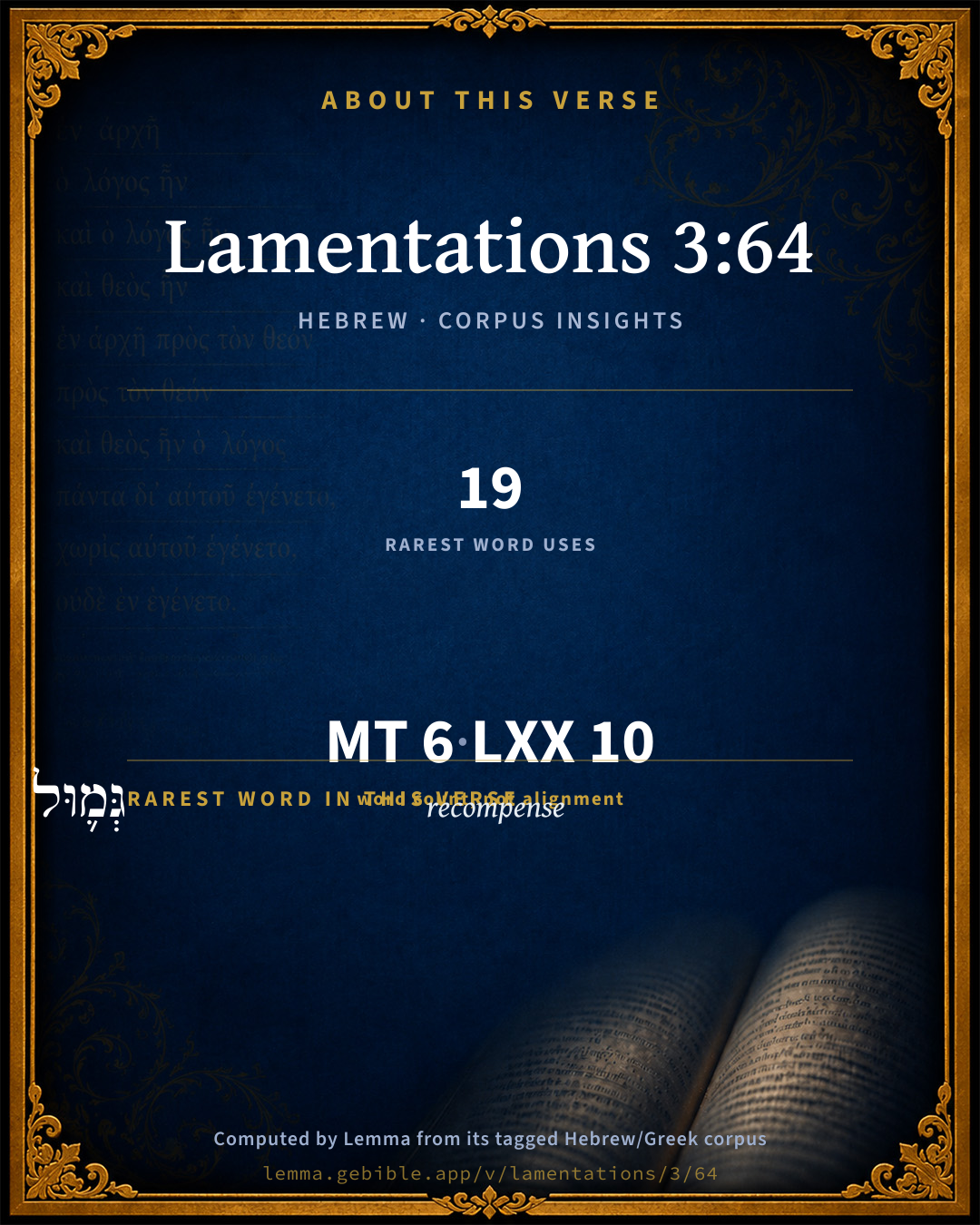
The rarest word here is גְּמ֛וּל recompense H1576 — appearing just 19 times in the whole Hebrew Bible.

Shared distinctive vocabulary

גְּמ֛וּל recompense H1576 occurs in 17 verses of the Hebrew Bible. Also found in:

Grammatical profile

  • 1 verb
  • 4 nouns
  • 1 preposition

Verb forms

  • תָּשִׁ֨יב Hiphil · Imperfect

Hebrew & Septuagint length

In English translation the verse runs 15 words from the Hebrew and 15 from the Septuagint (LXX English) — the same length.

A rough comparison of the two English renderings, which tokenize alike — not a word-level alignment.

Word counts can differ between the Hebrew and the Greek without any difference in meaning — e.g. the Hebrew direct-object marker אֵת has no separate Greek word, and Greek often adds the article ὁ.

In the original languages it is 6 Hebrew tokens and 10 Greek tokens — but the two are counted differently (Hebrew bundles its prefixes and suffixes into one token; the Greek is in lemma form), so that isn’t a like-for-like length.

Cross-references

6

Topical passages linked to Lamentations 3:64 in the Treasury of Scripture Knowledge — connected by theme and wording, ordered by reader-vote popularity; previews shown in the World English Bible.

  • Psalms 28:4 Give them according to their work, and according to the wickedness of their doings. Give them according to the operation of their hands. Bring back on them what they deserve.
  • Jeremiah 11:20 But, Yahweh of Hosts, who judge righteously, who try the heart and the mind, I shall see your vengeance on them; for to you have I revealed my cause.
  • 2 Timothy 4:14 Alexander, the coppersmith, did much evil to me. The Lord will repay him according to his works,
  • Revelation 6:10 They cried with a loud voice, saying, "How long, Master, the holy and true, until you judge and avenge our blood on those who dwell on the earth?"
  • Jeremiah 50:29 Call together the archers against Babylon, all those who bend the bow; encamp against her round about; let none of it escape: recompense her according to her work; according to all that she has done, do to her; for she has been proud against Yahweh, against the Holy One of Israel.
  • Revelation 18:6 Return to her just as she returned, and repay her double as she did, and according to her works. In the cup which she mixed, mix to her double.

Cross-references courtesy of OpenBible.info (CC BY 4.0).

Hebrew and Greek witnesses Masoretic Hebrew ↔ Greek Septuagint

The same verse in the two great witnesses to the Old Testament, shown verse-for-verse.

These are two independent witnesses, not word-aligned to each other, and the Septuagint is shown in lemma (dictionary) form.

Hebrew Lamentations 3:64 Masoretic · Westminster Leningrad Codex

תָּשִׁ֨יב לָהֶ֥ם גְּמ֛וּל יְהוָ֖ה כְּמַעֲשֵׂ֥ה יְדֵיהֶֽם

You will render to them a recompense, Yahweh, according to the work of their hands.

World English Bible · Public Domain

Greek LXX Lamentations 3:64 Septuagint · lemma form

ἀποδίδωμι αὐτός ἀνταπόδομα κύριος κατά ὁ ἔργον ὁ χείρ αὐτός

You will render them a recompense, O Lord, according to the works of their hands.

LXX2012 (modern English Septuagint) · Public Domain

On this verse, Joseph Benson's Commentary discusses the Septuagint’s reading. Read the note in Commentary ↓

Hebrew: Westminster Leningrad Codex (CC BY 4.0). Greek: Septuagint (public domain); English from LXX2012 (modern English Septuagint) (Public Domain). How the Septuagint differs from the Hebrew →

Commentary

Notes on Lamentations 3:64 from classic Christian and Jewish commentators (each source and its license shown beneath its notes). The classic Christian expositions comment on the surrounding passage and are grouped to its opening verse, so a note may address several verses; the Jewish commentaries on the Tanakh (Rashi and others) are per-verse, so they appear only where the commentator wrote on this verse.

Lemma curates 59 commentaries, every one of them public domain or Creative Commons licensed, each selected and text-cleaned for this edition rather than reprinted as found. About our sources →

Trapp's Complete Commentary

John Trapp

Lam 3:64 Render unto them a recompence, O LORD, according to the work of their hands.

Ver. 64. Render unto them a recompense.] Call them to an account, and requite them. Let their music be marred, and the meal once ended, send them in a reckoning.

John Trapp, A Commentary or Exposition upon All the Books of the Old and New Testament (1647–1656) — public domain. Text from a community e-Sword module.

Joseph Benson's Commentary

Lam 3:64-66. Render to them a recompense, &c. — See note on Jer 11:20. The verbs in these verses are not in the imperative mood, but all in the future tense, and certainly should have been so rendered, as indeed they are by the LXX., Αποδωσεις αυτοις ανταποδομα Κυριε — Αποδωσεις αυτοις — και διας μου μοχθον. Συ αυτους καταδιωξεις εν οργη, και εξαναλωσεις αυτους υποκατωθεν του ουρανου Κυριε. Thou wilt render unto them a recompense, O Lord — Thou wilt render unto them the grief of my heart. Thou wilt persecute them in wrath, and destroy them from under the heaven, O Lord. Thus also the Vulgate, Blaney, and many others.

Joseph Benson's Commentary on the Old and New Testaments (1811–1818) — public domain. Text from a community e-Sword module.

Tyndale Open Study Notes

Tyndale Open Resources

3:64-66 This prayer for vengeance is similar to several psalms (see “Prayers for Vengeance” Theme Note).

Tyndale Open Study Notes — © Tyndale Open Resources, licensed CC BY-SA 4.0. Text via the HelloAO Bible API.

Jamieson, Fausset & Brown

Robert Jamieson, A. R. Fausset & David Brown

(Jer 11:20; Ti2 4:14).

Jamieson, Fausset & Brown — Commentary Critical and Explanatory on the Whole Bible (1871) — public domain (CC PDM 1.0). Text via the HelloAO Bible API.

John Calvin's Commentaries

He adds here a conclusion; for he has hitherto been relating, as I have said, the evils which he suffered, and also the reproaches and unjust oppressions, in order that; he might have God propitious to him; for this is the way of conciliating favor when we are wrongfully dealt with; for it cannot be but that God will sustain our cause. He indeed testifies that he is ready to help the miserable; it is his own peculiar work to deliver captives from prison, to illuminate the blind, to succor the miserable and the oppressed. This is the reason, then, why the Prophet now confidently asks God to render to his enemies their reward, according to the work of their hands

Were any one to object, and say, that another rule is prescribed to us, even to pray for our enemies, even when they oppress us; the answer is this, that the faithful, when they prayed thus, did not bring any violent feelings of their own, but pure zeal, and rightly formed; for the Prophet here did not pray for evil indiscriminately on all, but on the reprobate, who were perpetually the enemies of God and of his Church. He might then with sincerity of heart have asked God to render to them their just reward. And whenever the saints broke forth thus against their enemies, and asked God to become an avenger, this principle must be ever borne in mind, that they did not indulge their own wishes, but were so guided by the Holy Spirit — that moderation was connected with that fervid zeal to which I have referred. The Prophet, then, as he speaks here of the Chaldeans, confidently asked God to destroy them, as we shall again presently see. We find also in the Psalms the same imprecations, especially on Babylon, — “Happy he who shall render to thee what thou hast brought on us, who shall dash thy children against a stone.” (Psalm 137:8, 9.) It follows, —

John Calvin's Commentaries (1540-1563) — public domain. Text from the Calvin Translation Society English edition (1840s-50s) via the Christian Classics Ethereal Library (ccel.org). Calvin's coverage is partial (roughly two-thirds of the Bible); uncommented books and verses are honest gaps, never fabricated. The 19th-century editor's footnotes and remarks are omitted so the notes are faithfully Calvin's own voice.

Ellicott's Commentary for English Readers

(64) Render unto them . . .—The words are noticeable as being taken from Psa_28:4, and reproduced by St. Paul in 2Ti_4:14.

A Bible Commentary for English Readers, edited by Charles John Ellicott (1878–1897) — public domain. Text from a community e-Sword module.

The Cambridge Bible for Schools and Colleges

gen. ed. J. J. S. Perowne

64–66. For the anticipation of punishment here expressed see on Jer_18:23; C.B. (Kirkpatrick) on Psa_28:4.

The Cambridge Bible for Schools and Colleges (gen. ed. J. J. S. Perowne; Cambridge University Press, 1878–1918) — public domain. Text from a community e-Sword module.

Matthew Poole's English Annotations

These three last verses are all but the same general petition, though expressed in various phrases; the prophet had prayed, Lam 3:59, that God would judge his people’s cause, here he prayeth that he would also judge his enemies, he only desireth justice against them, a recompence of the work of their hands.

Matthew Poole's English Annotations on the Holy Bible (1683–1685) — public domain. Text from a community e-Sword/MySword module.

The Pulpit Commentary

Render unto them, etc. The sacred poet is familiar with the psalms; here we have a condensation of Psa_28:4. The tone of vers. 64-66 reminds us of passages in the Book of Jeremiah; (see Jer_18:23 Jer_20:12)

Vers. 64-66. Righteous recompense.

Our conscience requires and approves of justice. Our weakness is too often in danger of cherishing resentment and malevolence. It is not safe, on most men"s part, to hope for retribution upon their personal enemies. Perhaps the record of Jeremiah"s feelings is not intended to be taken for an inculcation, or even a permission, of such imprecations upon our foes.

I THE GROUND UPON WHICH DIVINE JUDGMENT IS INVOKED.

1. It was not personal offence given which suggested such a cry for vengeance.

2. It was the overt, deliberate conduct of men who acted in disobedience and defiance towards God, and with inhumanity and barbarity towards their fellow men.

II THE TRIBUNAL TO WHICH THE CONDUCT OF THE WICKED IS REFERRED.

1. Not the fallible court of human justice or human requital.

2. But the court of Divine equity, in which none receives good for evil, in which every plea for mitigation of sentence is heard, and from which none can depart with a complaint upon the lips.

III THE PURPOSE FOR WHICH RETRIBUTION IS IMPLORED.

1. Not for the gratification of vindictive feelings.

2. Not for the exaltation of the oppressed at the expense of the oppressor.

3. But for the speedy deliverance of God"s wronged and harassed people.

4. For the advancement of God"s cause upon earth. For the honour of God"s glorious Name. "Shall not the Judge of all the earth do right? T.

The principle of retribution.

Whatever the feelings in the prophet"s heart may have been, at all events he lays down something like a principle on which he expects God will act in dealing with the wicked. It is not because he hates them, or because they have hurt him, that he wants them to suffer, but because they have done wrong. Further, he wants to see them dealt with according to the wrong they have done. Perhaps we ought to look at this question of recompense apart from its being made a matter of prayer. One would not like to think of it as a desirable petition in any prayer, that the wicked might be dealt with according to their wickedness. God"s law will secure all that is necessary, and we may trust the working of that law. Men will be recompensed according to the work of their hand, only this expression, "the work of their hand," must be taken with a very liberal meaning. What the heart of the wicked purposes, his hand generally carries out to some extent, and yet many qualifications must be made. To go literally according to the work of the hand would be to deal too severely in some instances, too leniently in others. We have to infer the heart from the hand, and our calculation of motives is a very rough and ready one. Human law, trying to be just and adequate, is not unfrequently unjust and cruel. We are so under the influence of things seen and temporal that a punishment only looks real when we can see it in operation, manifest to all. Our confidence should rather be that God has so made things by their very nature that a wicked heart becomes a miserable one. Whatsoever a man sows, he reaps. But then there is also another thing to be considered, and that is that God makes room for repentance. He who sows repentance will reap forgiveness and renewal of heart. We cannot undo the works of our hands, but God can bring good out of evil. Y.

The Pulpit Commentary (1880–1919), ed. H.D.M. Spence-Jones & Joseph S. Exell — public domain. Text from a community e-Sword module.

unfoldingWord translationNotes

Door43 World Missions Community

Pay back to them, Yahweh, according to what they have done

Here "Pay back to them" represents punishing them. What they have done can be stated clearly. AT: "Punish them, Yahweh, according to what they have done" or "Yahweh, they have made me suffer, so please make them suffer" (See: Metaphor and Assumed Knowledge and Implicit Information)

You will let their hearts be shameless

Here the "heart" is a metonym that represents their attitudes and emotions, and being "shameless" means not feeling ashamed of their sins even though they should. Their not being ashamed would give even more reason for God to punish them. AT: "You will let them feel no shame for their sins" (See: Metonymy)

May your condemnation be upon them

The abstract noun "condemnation" can be expressed with the verbs "condemn" or "curse." AT: "Condemn them" or "Curse them" (See: Abstract Nouns)

from under the heavens

Here "from under the heavens" represents everywhere on earth. AT: "wherever they are on earth" (See: Metonymy)

translationWords

heart

condemn

heaven

unfoldingWord translationNotes — © Distant Shores Media and the Door43 World Missions Community, licensed CC BY-SA 4.0. Source: git.door43.org/Door43/en_tn.

Lesson kit

Teaching starters — assembled from the data on this page, not authored interpretation. Every prompt links to the verse data it draws on. Edit before teaching.

Lamentations, in the Prophets, opens this verse with 6 words (5 distinct Hebrew lemmas). Its most distinctive word is gᵉmûwl (“recompense”). A historical commentator’s framing appears above. Read the whole chapter for the surrounding context.

Discussion questions

  1. The word gᵉmûwl carries the sense “recompense.” How does it shape the verse?
  2. Judges 9:16 shares the word «recompense» with this verse. How do the two illuminate each other?
  3. These translations render this verse differently; the difference is in the English rendering, not the original. What questions does that raise?
  4. The verb «תָּשִׁ֨יב» is Hiphil Imperfect. How does its form color the action?
  5. Reading how Trapp's Complete Commentary and Joseph Benson's Commentary read this verse, where do the two commentators agree and where do they part?

Things to notice

Reading settings

Reading text

Shown beneath each verse's original-language words.

Old Testament
Old Testament edition

Read the OT as the Masoretic Hebrew (MT) or the Greek Septuagint (LXX).

English shown for the Greek Septuagint (in the Hebrew ↔ Greek comparison).

Comparing translations? Open the Compare panel on any verse page to stack up to four side by side.