
Ezekiel 18:30

Hebrew (Westminster Leningrad Codex) Ezekiel 18:30 appears in the Hebrew Old Testament. The text above is from the Westminster Leningrad Codex. Each word links to its Strong’s number, a concise gloss, and parsing drawn from the Open Scriptures Hebrew Bible morphology. Click any word for its full Brown-Driver-Briggs (BDB) entry.
Download image
Cite this verse

Ezekiel 18:30 (World English Bible). Public Domain. Lemma interlinear Bible study tool, https://lemma.gebible.app/v/ezekiel/18/30.

Show BibTeX & RIS
BibTeX
RIS
English Translation
Therefore I will judge you, house of Israel, everyone according to his ways, says the Lord Yahweh. Return you, and turn yourselves from all your transgressions; so iniquity shall not be your ruin.
World English Bible · Public Domain
Download a study sheet

One document with this verse’s original text, its word-by-word gloss line, the meaning frame, cross-references with their text, attributed commentary, and full source and license credits — printable, and it pastes into notes with its structure intact.

This verse Autodidact and up

Study sheet (.html) Plain text (.txt)

A passage Seminary Student

Up to 50 verses in one chapter. A passage sheet keeps up to 6 commentary sources and 12 cross-references per verse, in the order this page ranks them, and says so on the sheet whenever that leaves anything out. Ask for a single verse and you get the Autodidact verse sheet above.

Everything on this page stays free to read, with no account — the sheet is a download of what is already on screen, not access to it.

Want to remove ads? Support Godless Engineer
Compare translations 3

The same verse in 3 English versions, stacked beneath the original-language interlinear above. Click any original word for its lexicon entry.

Each is an independent rendering of the whole verse — the interlinear is not word-aligned to these translations.

Highlighted words mark where these versions differ — a whole-verse word diff, not a word-by-word alignment.

  • World English Bible Public Domain
    Therefore I will judge you, house of Israel, everyone according to his ways, says the Lord Yahweh. Return you, and turn yourselves from all your transgressions; so iniquity shall not be your ruin.
  • King James Version Public Domain
    Therefore I will judge you, O house of Israel, every one according to his ways, saith the Lord GOD. Repent, and turn yourselves from all your transgressions; so iniquity shall not be your ruin.
  • unfoldingWord Literal Text CC BY-SA 4.0
    Therefore I will judge each man among you according to his ways, house of Israel!—this is the Lord Yahweh’s declaration. Repent and turn away from all your transgressions so that they will not be stumbling blocks of iniquity against you.

unfoldingWord Literal Text — © unfoldingWord, licensed CC BY-SA 4.0. Word-aligned USFM3 via Door43 (git.door43.org/unfoldingWord/en_ult).

Versions to compare (up to 4)

3 of 4 selected

Show all 18 translations

Every available English version of this verse, each an independent rendering of the whole verse.

  • World English Bible Public Domain
    Therefore I will judge you, house of Israel, everyone according to his ways, says the Lord Yahweh. Return you, and turn yourselves from all your transgressions; so iniquity shall not be your ruin.
  • Berean Standard Bible Public Domain
    Therefore, O house of Israel, I will judge you, each according to his ways, declares the Lord GOD. Repent and turn from all your transgressions, so that your iniquity will not become your downfall.
  • Majority Standard Bible Public Domain
    Therefore, O house of Israel, I will judge you, each according to his ways, declares the Lord GOD. Repent and turn from all your transgressions, so that your iniquity will not become your downfall.
  • King James Version Public Domain
    Therefore I will judge you, O house of Israel, every one according to his ways, saith the Lord GOD. Repent, and turn yourselves from all your transgressions; so iniquity shall not be your ruin.
  • American Standard Version (1901) Public Domain
    Therefore I will judge you, O house of Israel, every one according to his ways, saith the Lord Jehovah. Return ye, and turn yourselves from all your transgressions; so iniquity shall not be your ruin.
  • Revised Version (1885) Public Domain
    Therefore I will judge you, O house of Israel, every one according to his ways, saith the Lord GOD. Return ye, and turn yourselves from all your transgressions; so iniquity shall not be your ruin.
  • Geneva Bible (1599) Public Domain
    Therefore I will iudge you, O house of Israel, euery one according to his wayes, sayth the Lord God: returne therefore and cause others to turne away from all your transgressions: so iniquitie shall not be your destruction.
  • Douay-Rheims (1899) Public Domain
    Therefore will I judge every man according to his ways, O house of Israel, saith the Lord God. Be converted, and do penance for all your iniquities: and iniquity shall not be your ruin.
  • Young's Literal Translation Public Domain
    Therefore, each according to his ways I judge you, O house of Israel? An affirmation of the Lord Jehovah, Turn ye back, yea, turn yourselves back, From all your transgressions, And iniquity is not to you for a stumbling-block,
  • Literal Standard Version CC BY-SA 4.0
    Therefore, I judge each according to his ways, || O house of Israel,” || A declaration of Lord YHWH, || “Turn back, indeed, turn yourselves back, || From all your transgressions, || And iniquity is not for a stumbling-block to you,
  • Unlocked Literal Bible CC BY-SA 4.0
    Therefore I will judge each man among you according to his ways, house of Israel!—this is the Lord Yahweh's declaration. Repent and turn away from all your transgressions so that they will not be stumbling blocks of iniquity against you.
  • unfoldingWord Literal Text CC BY-SA 4.0
    Therefore I will judge each man among you according to his ways, house of Israel!—this is the Lord Yahweh’s declaration. Repent and turn away from all your transgressions so that they will not be stumbling blocks of iniquity against you.
  • Darby Bible Public Domain
    Therefore I will judge you, house of Israel, every one according to his ways, saith the Lord Jehovah. Return ye, and turn from all your transgressions; so iniquity shall not be your snare.
  • World Messianic Bible Public Domain
    “Therefore I will judge you, house of Israel, everyone according to his ways,” says the Lord GOD. “Return, and turn yourselves from all your transgressions, so iniquity will not be your ruin.
  • Webster's Bible Public Domain
    Therefore I will judge you, O house of Israel, every one according to his ways, saith the Lord GOD. Repent, and turn yourselves from all your transgressions; so iniquity shall not be your ruin.
  • Free Bible Version CC BY-SA 4.0
    Consequently I'm going to judge you, people of Israel! I will judge each of you depending on what you've done, declares the Lord God. Repent and stop rebelling so that your sins won't bring you down.
  • Bible in Basic English Public Domain
    For this cause I will be your judge, O children of Israel, judging every man by his ways, says the Lord. Come back and be turned from all your sins; so that they may not be the cause of your falling into evil.
  • JPS Tanakh (1917) Public Domain
    Therefore I will judge you, O house of Israel, every one according to his ways, saith the Lord GOD. Return ye, and turn yourselves from all your transgressions; so shall they not be a stumblingblock of iniquity unto you.

Literal Standard Version (2020), Covenant Press — licensed CC BY-SA 4.0. Text via the HelloAO Bible API (eBible.org). Unlocked Literal Bible (unfoldingWord) — licensed CC BY-SA 4.0. Text via the HelloAO Bible API (eBible.org). unfoldingWord Literal Text — © unfoldingWord, licensed CC BY-SA 4.0. Word-aligned USFM3 via Door43 (git.door43.org/unfoldingWord/en_ult). Free Bible Version, Dr. Jonathan Gallagher — licensed CC BY-SA 4.0. Text via the HelloAO Bible API (eBible.org).

Word by word

More ways to search: Search by grammar → Find every occurrence → Compare this word →

Practice this passage: Drill this verse → Learn its vocabulary →

לְמִכְשׁ֖וֹל
mikshôwl
H4383
“to/for · stumbling block of”
Preposition + Noun, Common, Masculine, Singular, Construct
Part of Speech
Preposition + Noun
Type
Common
Gender
Masculine
Number
Singular
State
Construct
Full BDB Definition

Origin: from H3782

TWOT: 1050c

a stumbling, means or occasion of stumbling, stumbling block - stumbling, fall - means or occasion of stumbling, stumbling block
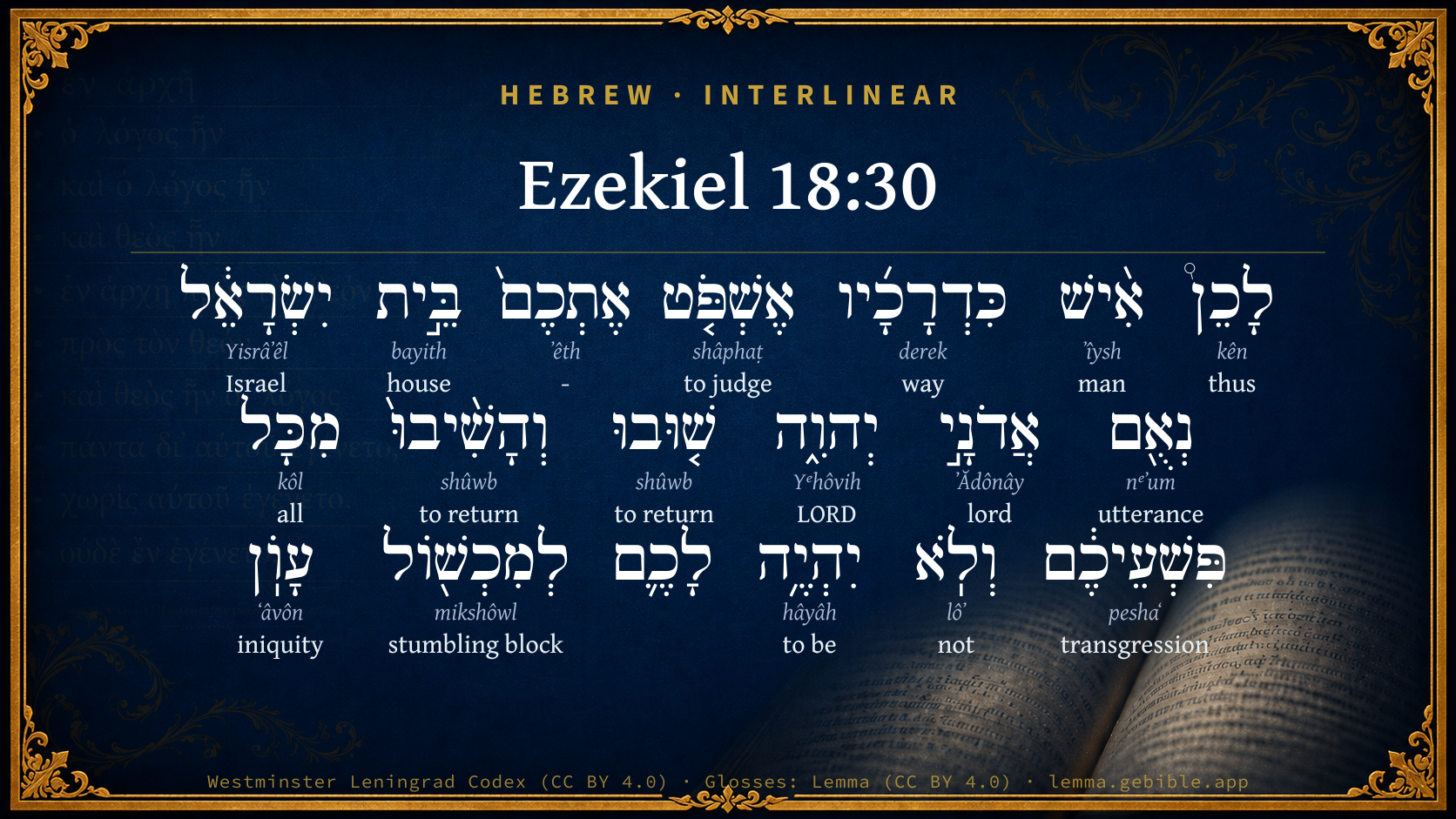
  1. לָכֵן֩ kên H3651 “to/for · thus” Preposition + Adverb
  2. אִ֨ישׁ ʼîysh H376 “man” Noun, Common, Masculine, Singular, Absolute
  3. כִּדְרָכָ֜יו derek H1870 “like/as · ways · his” Preposition + Noun, Common, Both, Plural, Construct + Suffix, Personal, 3rd Person, Masculine, Singular
  4. אֶשְׁפֹּ֤ט shâphaṭ H8199 “to judge” Verb, Qal, Imperfect, 1st Person, Common, Singular
  5. אֶתְכֶם֙ ʼêth H853 “- · you” Particle, Direct Object + Suffix, Personal, 2nd Person, Masculine, Plural
  6. בֵּ֣ית bayith H1004 “house of” Noun, Common, Masculine, Singular, Construct
  7. יִשְׂרָאֵ֔ל Yisrâʼêl H3478 “Israel” Noun, Proper
  8. נְאֻ֖ם nᵉʼum H5002 “utterance of” Noun, Common, Masculine, Singular, Construct
  9. אֲדֹנָ֣י ʼĂdônây H136 “Lord · my” Noun, Common, Masculine, Plural, Construct + Suffix, Personal, 1st Person, Common, Singular
  10. יְהוִ֑ה Yᵉhôvih H3069 “LORD” Noun, Proper
  11. שׁ֤וּבוּ shûwb H7725 “return” Verb, Qal, Imperative, 2nd Person, Masculine, Plural
  12. וְהָשִׁ֨יבוּ֙ shûwb H7725 “and · return” Conjunction + Verb, Hiphil, Imperative, 2nd Person, Masculine, Plural
  13. מִכָּל kôl H3605 “from · all of” Preposition + Noun, Common, Masculine, Singular, Construct
  14. פִּשְׁעֵיכֶ֔ם peshaʻ H6588 “transgressions · your” Noun, Common, Masculine, Plural, Construct + Suffix, Personal, 2nd Person, Masculine, Plural
  15. וְלֹֽא lôʼ H3808 “and · not” Conjunction + Particle, Negative
  16. יִהְיֶ֥ה hâyâh H1961 “to be” Verb, Qal, Imperfect, 3rd Person, Masculine, Singular
  17. עָוֺֽן ʻâvôn H5771 “iniquity” Noun, Common, Both, Singular, Absolute

About this verse

These counts appear in no published source. They are computed here, from the morphology-tagged text and Lemma’s own curated glosses. What Lemma adds →

19
words
17
distinct lemmas
Prophets
section

Notable vocabulary

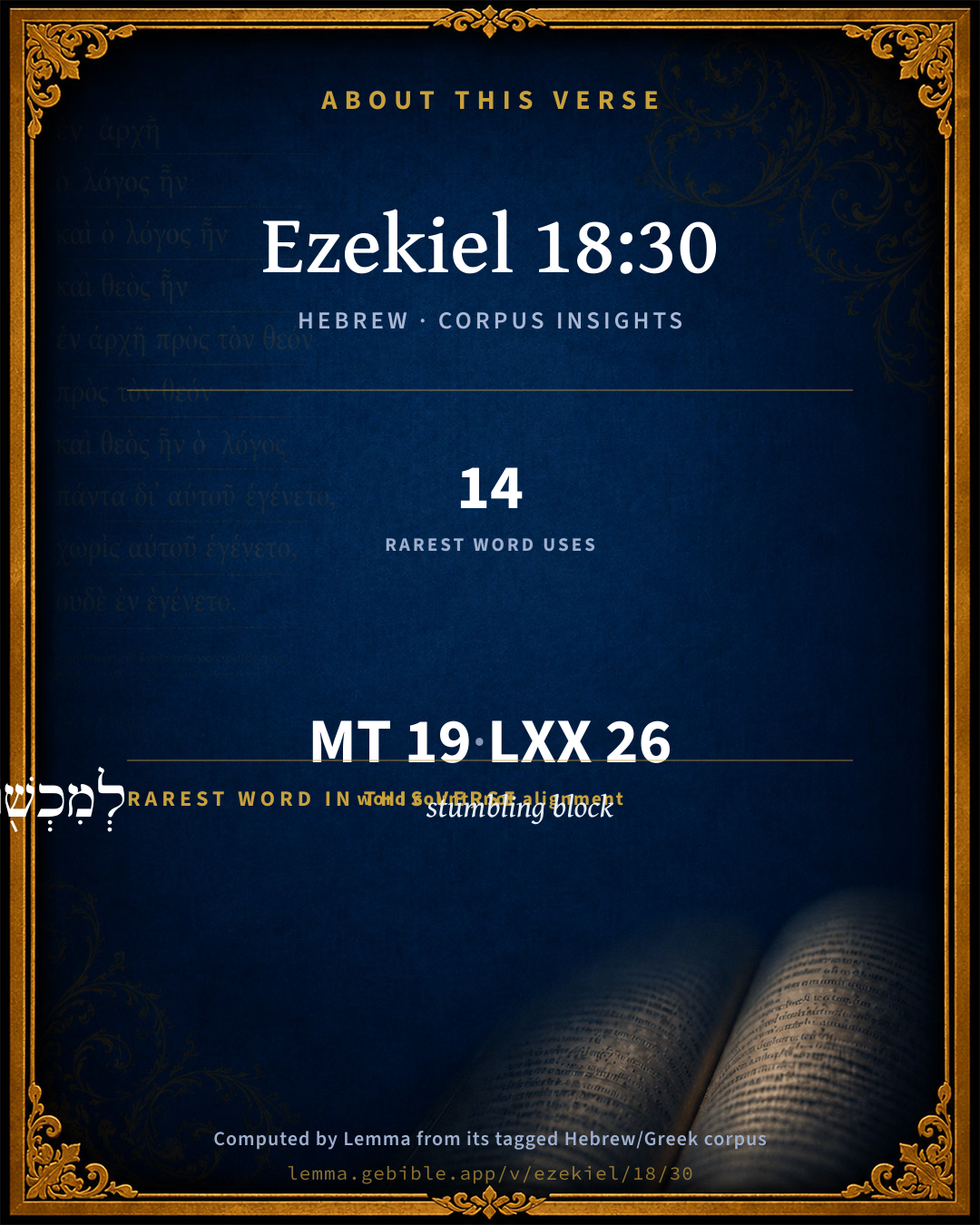
The rarest word here is לְמִכְשׁ֖וֹל stumbling block H4383 — appearing just 14 times in the whole Hebrew Bible.

Shared distinctive vocabulary

לְמִכְשׁ֖וֹל stumbling block H4383 occurs in 14 verses of the Hebrew Bible. Also found in:

Grammatical profile

  • 4 verbs
  • 11 nouns
  • 1 preposition
  • 1 adverb
  • 2 particles

Verb forms

  • אֶשְׁפֹּ֤ט Qal · Imperfect
  • שׁ֤וּבוּ Qal · Imperative
  • וְהָשִׁ֨יבוּ֙ Hiphil · Imperative
  • יִהְיֶ֥ה Qal · Imperfect

Repetition

A word recurs within this verse — often emphatic in Hebrew:

  • שׁ֤וּבוּ to return H7725 ×2

Hebrew & Septuagint length

In English translation the verse runs 33 words from the Hebrew and 36 from the Septuagint (LXX English) — closely comparable.

A rough comparison of the two English renderings, which tokenize alike — not a word-level alignment.

Word counts can differ between the Hebrew and the Greek without any difference in meaning — e.g. the Hebrew direct-object marker אֵת has no separate Greek word, and Greek often adds the article ὁ.

In the original languages it is 19 Hebrew tokens and 26 Greek tokens — but the two are counted differently (Hebrew bundles its prefixes and suffixes into one token; the Greek is in lemma form), so that isn’t a like-for-like length.

Cross-references

32

Topical passages linked to Ezekiel 18:30 in the Treasury of Scripture Knowledge — connected by theme and wording, ordered by reader-vote popularity; previews shown in the World English Bible.

  • Ezekiel 18:21 But if the wicked turn from all his sins that he has committed, and keep all my statutes, and do that which is lawful and right, he shall surely live, he shall not die.
  • Matthew 16:27 For the Son of Man will come in the glory of his Father with his angels, and then he will render to everyone according to his deeds.
  • Matthew 3:2 "Repent, for the Kingdom of Heaven is at hand!"
  • Ezekiel 14:6 Therefore tell the house of Israel, Thus says the Lord Yahweh: Return you, and turn yourselves from your idols; and turn away your faces from all your abominations.
  • Luke 13:3 I tell you, no, but, unless you repent, you will all perish in the same way.
  • Ezekiel 7:3 Now is the end on you, and I will send my anger on you, and will judge you according to your ways; and I will bring on you all your abominations.
  • Daniel 9:13 As it is written in the law of Moses, all this evil is come on us: yet have we not entreated the favor of Yahweh our God, that we should turn from our iniquities, and have discernment in your truth.
  • Hosea 12:6 Therefore turn to your God. Keep kindness and justice, And wait for your God continually.
  • Joel 2:12–13 "Yet even now," says Yahweh, "turn to me with all your heart, And with fasting, and with weeping, and with mourning."
  • Luke 13:5 I tell you, no, but, unless you repent, you will all perish in the same way."
  • Ezekiel 33:11 Tell them, As I live, says the Lord Yahweh, I have no pleasure in the death of the wicked; but that the wicked turn from his way and live: turn you, turn you from your evil ways; for why will you die, house of Israel?
  • Ecclesiastes 12:14 For God will bring every work into judgment, with every hidden thing, whether it is good, or whether it is evil.
  • Ezekiel 33:20 Yet you say, The way of the Lord is not equal. House of Israel, I will judge you everyone after his ways.
  • Matthew 3:8 Therefore bring forth fruit worthy of repentance!
  • Revelation 2:5 Remember therefore from where you have fallen, and repent and do the first works; or else I am coming to you swiftly, and will move your lampstand out of its place, unless you repent.
  • Revelation 2:16 Repent therefore, or else I am coming to you quickly, and I will make war against them with the sword of my mouth.
  • Romans 2:5 But according to your hardness and unrepentant heart you are treasuring up for yourself wrath in the day of wrath, revelation, and of the righteous judgment of God;
  • Revelation 2:21–23 I gave her time to repent, but she refuses to repent of her sexual immorality.
  • Ecclesiastes 3:17 I said in my heart, "God will judge the righteous and the wicked; for there is a time there for every purpose and for every work."
  • Ezekiel 7:8–9 Now will I shortly pour out my wrath on you, and accomplish my anger against you, and will judge you according to your ways; and I will bring on you all your abominations.
  • Ezekiel 7:27 The king shall mourn, and the prince shall be clothed with desolation, and the hands of the people of the land shall be troubled: I will do to them after their way, and according to their deserts will I judge them; and they shall know that I am Yahweh.
  • Ezekiel 33:9 Nevertheless, if you warn the wicked of his way to turn from it, and he doesn't turn from his way; he shall die in his iniquity, but you have delivered your soul.
  • Ezekiel 34:20 Therefore thus says the Lord Yahweh to them: Behold, I, even I, will judge between the fat sheep and the lean sheep.
  • Malachi 3:18 Then you shall return and discern between the righteous and the wicked, between him who serves God and him who doesn't serve him.
  • Matthew 25:32 Before him all the nations will be gathered, and he will separate them one from another, as a shepherd separates the sheep from the goats.
  • 2 Corinthians 5:10–11 For we must all be revealed before the judgment seat of Christ; that each one may receive the things in the body, according to what he has done, whether good or bad.
  • Galatians 6:4–5 But let each man test his own work, and then he will take pride in himself and not in his neighbor.
  • James 1:15 Then the lust, when it has conceived, bears sin; and the sin, when it is full grown, brings forth death.
  • 1 Peter 1:17 If you call on him as Father, who without respect of persons judges according to each man's work, pass the time of your living as strangers here in reverent fear:
  • Revelation 20:12 I saw the dead, the great and the small, standing before the throne, and they opened books. Another book was opened, which is the book of life. The dead were judged out of the things which were written in the books, according to their works.
  • Revelation 22:12 "Behold, I come quickly. My reward is with me, to repay to each man according to his work.
  • Acts 26:20 but declared first to them of Damascus, at Jerusalem, and throughout all the country of Judea, and also to the Gentiles, that they should repent and turn to God, doing works worthy of repentance.

Cross-references courtesy of OpenBible.info (CC BY 4.0).

Hebrew and Greek witnesses Masoretic Hebrew ↔ Greek Septuagint

The same verse in the two great witnesses to the Old Testament, shown verse-for-verse.

These are two independent witnesses, not word-aligned to each other, and the Septuagint is shown in lemma (dictionary) form.

Hebrew Ezekiel 18:30 Masoretic · Westminster Leningrad Codex

לָכֵן֩ אִ֨ישׁ כִּדְרָכָ֜יו אֶשְׁפֹּ֤ט אֶתְכֶם֙ בֵּ֣ית יִשְׂרָאֵ֔ל נְאֻ֖ם אֲדֹנָ֣י יְהוִ֑ה שׁ֤וּבוּ וְהָשִׁ֨יבוּ֙ מִכָּל פִּשְׁעֵיכֶ֔ם וְלֹֽא יִהְיֶ֥ה לָכֶ֛ם לְמִכְשׁ֖וֹל עָוֺֽן

Therefore I will judge you, house of Israel, everyone according to his ways, says the Lord Yahweh. Return you, and turn yourselves from all your transgressions; so iniquity shall not be your ruin.

World English Bible · Public Domain

Greek LXX Ezekiel 18:30 Septuagint · lemma form

ἕκαστος κατά ὁ ὁδός αὐτός κρίνω σύ οἶκος ἰσραήλ λέγω κύριος ἐπιστρέφω καί ἀποστρέφω ἐκ πᾶς ὁ ἀσέβεια σύ καί οὐ εἰμί σύ εἰς κόλασις ἀδικία

I will judge you, O house of Israel, says the Lord, each one according to his way: be converted, and turn from all your ungodliness, and it shall not become to you the punishment of iniquity.

LXX2012 (modern English Septuagint) · Public Domain

Hebrew: Westminster Leningrad Codex (CC BY 4.0). Greek: Septuagint (public domain); English from LXX2012 (modern English Septuagint) (Public Domain). How the Septuagint differs from the Hebrew →

Targum (Aramaic paraphrase)

1

The Targum is the ancient Jewish Aramaic paraphrase of the Hebrew Scriptures — an interpretive translation, not the Hebrew text itself. Onkelos (literal) and Pseudo-Jonathan (expansive) render the Torah, and Jonathan the Prophets. Coverage is partial: where no permissively-licensed English translation exists for a verse, only the Aramaic is shown. This is verse-level text, not a word-by-word alignment to the Hebrew.

  1. Targum Jonathan Prophets (Joshua–Malachi)
    בְּכֵן אֱנָשׁ כְּאוֹרְחָתֵיהּ אֶתְפְּרַע מִנְכוֹן בֵּית יִשְׂרָאֵל אֲמַר יְיָ אֱלֹהִים תּוּבוּ לְפוּלְחָנִי וְאַעְדוּ מִנְכוֹן פּוּלְחַן טַעֲוָתָא וְלָא יְהֵי לְכוֹן לְתִקְלַת חוֹבִין:

    (no public-domain English translation for this verse)

    Targum Jonathan — Aramaic: “Mikraot Gedolot” (public domain). English: “Sefaria Community Translation” (CC0 1.0 (public-domain dedication)); “London "Chaldee Paraphrase," 1871” (public domain). Text via Sefaria.

Commentary

Notes on Ezekiel 18:30 from classic Christian and Jewish commentators (each source and its license shown beneath its notes). The classic Christian expositions comment on the surrounding passage and are grouped to its opening verse, so a note may address several verses; the Jewish commentaries on the Tanakh (Rashi and others) are per-verse, so they appear only where the commentator wrote on this verse.

Lemma curates 59 commentaries, every one of them public domain or Creative Commons licensed, each selected and text-cleaned for this edition rather than reprinted as found. About our sources →

Matthew Henry's Commentary

We have here the conclusion and application of this whole matter. After a fair trial at the bar of right reason the verdict is brought in on God's side; it appears that his ways are equal. Judgment therefore is next to be given; and one would think it should be a judgment of condemnation, nothing short of Go, you cursed, into everlasting fire. But, behold, a miracle of mercy; the day of grace and divine patience is yet lengthened out; and therefore, though God will at last judge every one according to his ways, yet he waits to be gracious, and closes all with a call to repentance and a promise of pardon upon repentance.

I. Here are four necessary duties that we are called to, all amounting to the same: - 1. We must repent; we must change our mind and change our ways; we must be sorry for what we have done amiss and ashamed of it, and go as far as we can towards the undoing of it again. 2. We must turn ourselves from all our transgressions, Eze 18:30 and again Eze 18:32. Turn yourselves, face about; turn from sin, nay, turn against it as the enemy you loathe, turn to God as the friend you love. 3. We must cast away from us all our transgressions; we must abandon and forsake them with a resolution never to return to them again, give sin a bill of divorce, break all the leagues we have made with it, throw it overboard, as the mariners did Jonah (for it has raised the storm), cast it out of the soul, and crucify it as a malefactor. 4. We must make us a new heart and a new spirit. This was the matter of a promise, Eze 11:19. Here it is the matter of a precept. We must do our endeavour, and then God will not be wanting to us to give us his grace. St. Austin well explains this precept. Deus non jubet impossibilia, sed jubendo monet et facere quod possis et petere quod non possis - God does not enjoin impossibilities, but by his commands admonishes us to do what is in our power and to pray for what is not.

II. Here are four good arguments used to enforce these calls to repentance: - 1. It is the only way, and it is a sure way, to prevent the ruin which our sins have a direct tendency to: So iniquity shall not be your ruin, which implies that, if we do not repent, iniquity will be our ruin, here and for ever, but that, if we do, we are safe, we are snatched as brands out of the burning. 2. If we repent not, we certainly perish, and our blood will be upon our own heads. Why will you die, O house of Israel? What an absurd thing it is for you to choose death and damnation rather than life and salvation. Note, The reason why sinners die is because they will die; they will go down the way that leads to death, and not come up to the terms on which life is offered. Herein sinners, especially sinners of the house of Israel, are most unreasonable and act most unaccountably. 3. The God of heaven has no delight in our ruin, but desires our welfare (Eze 18:32): I have no pleasure in the death of him that dies, which implies that he has pleasure in the recovery of those that repent; and this is both an engagement and an encouragement to us to repent. 4. We are made for ever if we repent: Turn yourselves, and live. He that says to us, Repent, thereby says to us, Live, yea, he says to us, Live; so that life and death are here set before us.

Matthew Henry's Commentary on the Whole Bible (1708–1710) — public domain (CC PDM 1.0). Text via the HelloAO Bible API.

Trapp's Complete Commentary

John Trapp

Eze 18:30 Therefore I will judge you, O house of Israel, every one according to his ways, saith the Lord GOD. Repent, and turn [yourselves] from all your transgressions; so iniquity shall not be your ruin.

Ver. 30. Therefore I will judge you.] I will word it no longer with you, but clear up and vindicate my justice, which you have calumniated, in your deserved destruction, except ye repent.

Repent and turn yourselves.] Or, Others. Lay aside your complaints and contumelies against me, and take notice that the best thing you can do is to "take hold of my strength that ye may make peace with me, and ye shall make peace with me." {Isa 27:5}

John Trapp, A Commentary or Exposition upon All the Books of the Old and New Testament (1647–1656) — public domain. Text from a community e-Sword module.

The Biblical Illustrator

Joseph S. Exell

Eze_18:30-32

Repent, and turn yourselves from all your transgressions; so iniquity shall not be your ruin.

Preservative from ruin

I. The assumption of an awful fact. Iniquity induces ruin. The term ruin occurs but seldom in the sacred Scriptures. It is, however, one of awful import and aspect; a word ever used in an evil sense to describe the fearful disaster which has befallen him who was the subject of it. In the text the word is employed to describe the eternal misery of the soul.

1. He who is ruined has lost something of which he was formerly in possession. When an individual meets with sudden reverses of a painful character in his circumstances, and is called to sustain an extensive deprivation of property, we are accustomed to say, that such an one is ruined. But of all the loss and forfeiture which men can sustain, none can possibly be compared with that which is experienced by him who is ruined by his iniquity.

2. We apply this term to the demolition or destruction of a fabric. In hell there is nothing witnessed but ruin. Some of the finest and most noble intelligences ever formed, are there irreparably and eternally ruined. Morning stars which once sang for joy around the Almightys throne are in a state of wretchedness and perdition. This ruin is:

(1) Indescribably great. It is the ruin of man; a dignified, exalted, and intelligent being.

(2) Incapable of reparation. Cities may be rebuilt, and the waste of ages redeemed; habitations and palaces may be renovated, and shine forth in pristine magnificence and glory; but the ruin adverted to in the text cannot be repaired. The Most High would have accomplished this for sinners while they were on this world, and in a state of probation; but they set at nought all His counsel, and would none of His reproof; therefore: Pro_1:25-27.

(3) Punitive and painful. The ruin of a building made with hands is the ruin of unconscious, inactive, and unfeeling matter, utterly insensible of the desolation that reigns around. When man is ruined, there are inflicted pain and destruction of the most fearful description.

II. The efficacy of a divine admonition.

1. Repentance implies the existence of that which is sinful and erroneous (Rom_3:10-12; Rom_3:23).

2. Repentance comprises a consciousness of having done wrong, a conviction of sinfulness. We are so accustomed to think of ourselves more highly than we ought to think, that we need pray earnestly to God to show us what we are, and to open our eyes to behold wondrous things out of His law (Psa_119:18).

3. Repentance includes also sorrow for sin; a godly sorrow (2Co_7:10), a sorrow wrought in the heart by the Spirit of God.

4. Repentance is attended with confession of sin. This may be performed in a two-fold sense: first to God, and secondly to man. (R. Treffry.)

Breaking the entail of sin

I. The ruin which sin brings on the sinner.

1. Great.

2. Irreparable.

3. Awfully painful.

4. Inevitable.

II. The means by which ruin may be prevented.

1. Conviction of sin.

2. Contrition for sin.

3. Confession of sin.

4. Departure from sin.

5. An earnest desire, etc. (E. R. Derby.)

Gods vindication of Himself

I. A serious exhortation.

1. The grounds on which it proceeds. Judgment shall be given according to our ways.

2. The exhortation--to repentance. Turn away from what is useless, hurtful, loathsome. There must be no reserve.

II. An earnest remonstrance. Why will ye die?

1. Is it because your sins are too great to be pardoned?

2. Is it because God commands you to make new hearts and you cannot do it?

3. No, the reason is, the love of sin.

III. An encouraging declaration.

1. So iniquity shall not be your ruin. What a God of mercy is here!

2. I have no pleasure, etc. Judgment is His strange act; He holds off from striking till vengeance can slumber no longer. (John D. Lane, M. A.)

A call to the impenitent

I. The characters that are addressed. Such as are still the subjects of an evil nature, and are still living in sin against God.

II. The danger that is indicated. Iniquity is represented as inducing and exposing to ruin. We know what it is for a man to be ruined in his property--to be reduced from affluence to poverty--what it is for a man to be ruined as regards his health and constitution, and, consequently, in those enjoyments that are dependent on health. We know what it is for a man to be ruined in his character and credit, and everything that renders him respectable in society; but all the notions we can form of ruin, as referring to these external circumstances, will give us a very inadequate idea indeed of the ruin that sin induces--the ruin of the soul. The ruin of the soul implies exquisite, positive suffering, such as no language can describe--its final condemnation under the curse and wrath of God; a condemnation that cannot be repealed; a state of banishment from Gods presence and the glory of His power; final and eternal banishment. It is worth while to turn our thoughts to this, and to consider how it is that iniquity induces ruin, at once so dreadful and so awful. In the first place, I would say it operates in this way, inasmuch as it naturally produces the effect I have noticed, in robbing the soul of all its excellence. Again, it induces ruin, inasmuch as it operates in separating the soul immediately from God, who is the source of felicity, the fountain of good.

III. The only remedy accessible to sinners is repentance. Do not confound it, I would say, with the sorrow of the world. A man may be in grief, and may be the subject of great sorrow. This may not be repentance: sorrow it is; but, you know, there is the sorrow of the world as well as a sorrow of a godly sort. I would say, do not confound repentance with the mere fear of punishment. I would say, again, it is not a mere transitory impression of grief, on account of sin. True repentance, let me say, implies a knowledge of sin. It is the Holy Spirit alone that can give us right views on such a subject as this, and can make the Law a schoolmaster, to bring us to Christ--who can reveal to us the holiness of the law, the extent of its demands, as it applies not merely towards the actions, but to the thoughts and intents of the heart. And, in addition to this, repentance also implies the conviction of sin. The charge is fixed on his conscience, and he cannot throw it off. He feels that he is in this situation, and he cries, What must I do to be saved? Let me say, too, that conviction will be followed, where it is genuine, by suitable impressions and emotions. (J. Hill.)

Escape from ruin

I. God will judge us, everyone according to his ways: not according to our plan of our ways, but according to His. All men will hereafter be judged according to the dispensation they have been under. Those who are under the law will be judged by the law; sin in them will be the transgression of their law. Those who are without the law--that is, without a written law--will be judged without a written law--by the law of nature written upon their hearts. But those who have been under the Gospel will be judged by the Gospel.

II. If under this dispensation we are found impenitent sinners we shall be ruined. Ah! it is a touching thing to witness what we call ruin, even in this life; to see wringing of hands, and wringing of hearts, and hopeless grief; but ruin for eternity is infinitely worse than this; for the grave will soon end earthly sorrows, but the resurrection from the grave is only the beginning of eternal ruin.

III. If we are found repentant we shall not be ruined. Repentance has a different character according to the different conditions of men; but it always implies a change of mind, issuing in change of conduct, which change of conduct must needs have respect to the dispensations of religion under which God has brought men. If the Jewish nation, in a matter that threatened national ruin, repented and turned to God, according to their law, they obtained deliverance from that ruin that otherwise was coming upon them. If Christians under the Gospel turn to the provisions under that Gospel, they turn to Christ, and they obtain eternal life through Him. Conviction of sin, and misery on account of sin, is not repentance. (T. Snow.)

The Biblical Illustrator, edited by Joseph S. Exell (c. 1880s–1900s) — public domain. Text from a community e-Sword module.

Joseph Benson's Commentary

Eze 18:30-31. Therefore will I judge you, O house of Israel, every one according to his ways, &c. — You complain of the injustice of my ways or proceedings; but if I judge you according to the desert of your ways, you will certainly be all found guilty: and nothing but repentance, and a real turning to God in heart and life, can avert that ruin to which your sins have exposed you. Cast away from you all your transgressions — Here God, in a most tender and pathetic manner, exhorts the Israelites, and in them all sinners, to comply with those terms on which alone he could or can take men into favour, and save them from destruction, namely, the casting away or forsaking all their sins, whether of omission or commission, all their sinful tempers, words, or works; and giving up themselves sincerely and heartily to his love and service. And to show that a mere attendance on modes of worship, and an external obedience to the precepts of God’s law, are not sufficient, nor can be accepted without internal purity and holiness, he adds, Make you a new heart and a new spirit — Which words imply, both that a new heart and a new spirit are absolutely necessary in order to salvation, and that means must be used by us in order to the attainment of these blessings. It must be well observed, that what is here commanded as our duty, to show the necessity of our endeavours in the use of means, is elsewhere promised as God’s gift, (see Eze 36:26; Eze 11:19,) to show man’s inability to perform this duty, without the special grace of God, which, however, will not be denied to those who sincerely and earnestly seek it, in the way God has prescribed, namely, the way of prayer, watchfulness, self-denial, attention to and faith in the word and promise of God, assembling with his people, and carefully shunning the appearance of evil. For, as Lowth well observes, the difference of expression is thus to be reconciled, “that although God works in us to will and to do, and is the first mover in our regeneration, yet we must work together with his grace, and not quench or resist its motions:” see notes on Jer 31:18; Jer 31:33-34. To the same purpose are the words of Calmet here: “We can do nothing well of ourselves; we have of ourselves nothing but sin: all our power comes from God, and with the aid of his grace we can do all things. But if, on the one hand, we ought to humble ourselves on account of our impotence, on the other hand we ought to hope in him, who giveth to all liberally, and who willeth not our death, but our conversion. He informs us of our freedom of will, by enjoining us to make us a new heart: he would have us to do what we can, and to ask of him what we cannot.”

Joseph Benson's Commentary on the Old and New Testaments (1811–1818) — public domain. Text from a community e-Sword module.

Tyndale Open Study Notes

Tyndale Open Resources

18:30-32 This chapter concludes with a passionate appeal to the people of Israel to turn back and live. It was not too late for them to repent, turn from their sins, and be forgiven. God promised a new heart and a new spirit (11:19; 36:26) to all who would turn from their rebellion and humbly come to him.

Tyndale Open Study Notes — © Tyndale Open Resources, licensed CC BY-SA 4.0. Text via the HelloAO Bible API.

Jamieson, Fausset & Brown

Robert Jamieson, A. R. Fausset & David Brown

As God is to judge them "according to their ways" (Pro 1:31), their only hope is to "repent"; and this is a sure hope, for God takes no delight in judging them in wrath, but graciously desires their salvation on repentance.

I will judge you--Though ye cavil, it is a sufficient answer that I, your Judge, declare it so, and will judge you according to My will; and then your cavils must end.

Repent--inward conversion (Rev 2:5). In the Hebrew there is a play of like sounds, "Turn ye and return."

turn yourselves, &c.--the outward fruits of repentance. Not as the Margin, "turn others"; for the parallel clause (Eze 18:31) is, "cast away from you all your transgressions." Perhaps, however, the omission of the object after the verb in the Hebrew implies that both are included: Turn alike yourselves and all whom you can influence.

from all . . . transgressions--not as if believers are perfect; but they sincerely aim at perfection, so as to be habitually and wilfully on terms with no sin (Jo1 3:6-9):

your ruin--literally, "your snare," entangling you in ruin.

Jamieson, Fausset & Brown — Commentary Critical and Explanatory on the Whole Bible (1871) — public domain (CC PDM 1.0). Text via the HelloAO Bible API.

Adam Clarke's Commentary

Verse 30. Repent, and turn yourselves from all your transgressions] There is still life; still a God that has no pleasure in the death of a sinner, one who is ever ready to give his Holy Spirit to all them that ask him; therefore "repent and turn, so iniquity shall not be your ruin."

Adam Clarke's Commentary on the Bible (1810–1826) — public domain. Text from a community e-Sword/MySword module.

John Calvin's Commentaries

Here God precisely points out that he would discharge the office of judge, and then he reduces the Israelites to order, and refutes their audacity: for, as long as men do not feel God’s judgments hanging over them, and are not held completely in cheek, they grow restive in their petulance. We see how ferocious and wanton the reprobate are, because they are not held in by the fear of punishment, nor do they dread the judgments of God. Hence that he may take away every vestige of excuse, he says, I will be your judge: plead now; but I will decide your strives in one word, since each of you shall be judged by my will. It is certain, then, that God here asserts for himself the praise of justice and rectitude; but at the same time he brings forward his own authority, that he may strike terror into those who thus madly dare to oppose his sway, and call upon him to render an account. Now, therefore, we understand in what sense he says that he will judge them all according to their ways; that is, although you do not confess yourselves worthy of destruction, it is sufficient that I, as the lawful judge, pronounce you so. I will judge you justly, therefore, since I pronounce sentence according to your ways and to my supreme power, that all your complaints and murmurs may cease. He afterwards exhorts them to repentance, and signifies that they have no other remedy than being dissatisfied with their sins, and deprecating his wrath. Hence we collect that men rebel so extravagantly against God, while they wander away from themselves, since, if they descended within themselves, and sincerely examined their whole life, they would be instantly humbled before God; hence that thought should stimulate them to repentance: but because their conscience is stupid, and they are willingly brutish, they boldly blaspheme God. On the other hand, God now offers a remedy on their repentance and return from their wickedness. The word being converted, or return, refers to the renovation of the mind and heart: for this also is the beginning of repentance, that we should be inwardly renewed in mind, as Paul says, and so be made new men. (Ephesians 4:22, 23.) And this deserves notice, because many, when repentance is spoken of, fix their eyes only on the outward fruits of penitence. But we must begin at the root, as the Prophet teaches, by saying be you converted. But he afterwards adds, והשיבו, veheshibu, and return. This second word ought to be referred to the fruits of penitence; for as interior conversion comes first in order, when we leave off our peculiar vices, and renounce flesh and blood, the fruits and proofs of repentance thought to follow, as John said, Bring forth fruits as witnesses to your repentance. (Matthew 3:8; Luke 3:8.) We see, then, that the Prophet begins with purity of heart, and then comes to hands, as the Scripture elsewhere says, flint is, to outward works. He says, from all your iniquities or crimes, to show that a partial repentance is not approved by God. It is true, indeed, that even those who strive with all their might to act rightly, do not succeed in discharging their duty without many faults remaining; but we are not treating here of perfection, but only of sincere affection and serious endeavors. Let us then only strive seriously to return into the way, and to humble ourselves calmly and sincerely: this is the integrity which the Prophet now requires.

John Calvin's Commentaries (1540-1563) — public domain. Text from the Calvin Translation Society English edition (1840s-50s) via the Christian Classics Ethereal Library (ccel.org). Calvin's coverage is partial (roughly two-thirds of the Bible); uncommented books and verses are honest gaps, never fabricated. The 19th-century editor's footnotes and remarks are omitted so the notes are faithfully Calvin's own voice.

Ellicott's Commentary for English Readers

(30) Repent, and turn.—The three last verses of the chapter contain an earnest exhortation to the Israelites, based on the principles of God’s dealings with man just now declared, to repent and receive His mercy and blessing. Here, as before, there is no question of human sufficiency; and when the counsel is given (Eze_18:31), “Make you a new heart and a new spirit,” it is not meant to say that this can ever be the work of any other than God’s Holy Spirit; but that Spirit is ever given to them that ask Him, and the question of salvation is still one which each man must decide for himself before God. The whole point of the chapter is that God’s dealing with man is determined by man’s own attitude towards Him. He that is alienated in his heart from God, whatever may have been his previous life, God will judge; and he that now seeks to conform his life to God’s will, God will receive and forgive.

A Bible Commentary for English Readers, edited by Charles John Ellicott (1878–1897) — public domain. Text from a community e-Sword module.

The Cambridge Bible for Schools and Colleges

gen. ed. J. J. S. Perowne

30. iniquity … your ruin] More naturally: that it (your transgressing) be not a stumbling block of iniquity to you. The transgressions which they are called on to renounce are specially their idolatries, cf. ch. Eze_14:3, Eze_7:19, Eze_44:12.

30–32. Exhortation to repentance founded on the principle that God will deal with every man according to the condition in which he is found.

The Cambridge Bible for Schools and Colleges (gen. ed. J. J. S. Perowne; Cambridge University Press, 1878–1918) — public domain. Text from a community e-Sword module.

John Gill's Exposition

Cast away from you all your transgressions whereby ye have transgressed,.... As unprofitable and pernicious, to be abhorred and abstained from, and to be cast off, as loads and burdens upon them. Kimchi interprets it of the punishment of their sins, which might be cast off, or escaped, by repentance; perhaps it is best to interpret it of the casting away of their idols, by which they transgressed; see Eze 20:7;

and make you a new heart and a new spirit; which the Lord elsewhere promises to give, and he does give to his own elect; See Gill on Eze 11:19; and if here to be understood of a regenerated heart and spirit, in which are new principles of light, life, and love, grace and holiness, it will not prove that it is in the power of man to make himself such a heart and spirit; since from God's command, to man's power, is no argument; and the design of the exhortation is to convince men of their want of such a heart; of the importance of it: and which, through the efficacious grace of God, may be a means of his people having it, seeing he has in covenant promised it to them. The Targum renders it,

"a fearing heart, and a spirit of fear;''

that is, a heart and spirit to fear, serve, and worship the Lord, and not idols; and so the amount of the exhortation is, yield a hearty reverential obedience to the living God, and not to dumb idols; or that they would be hearty and sincere in their national repentance and reformation they are here pressed unto:

for why will ye die, O house of Israel? which is to be understood, not of an eternal death; since the deaths here spoken of was now upon them, what they were complaining of, and from which they might be recovered, Eze 18:2; but temporal calamity and affliction, as in Co2 1:10; and so in the following words.

John Gill's Exposition of the Whole Bible (1746–1763) — public domain (CC PDM 1.0). Text via the HelloAO Bible API.

Haydock's Catholic Bible Commentary

Do penance. This is requisite, as well as a change of conduct. (Worthington)

George Leo Haydock (1774–1849), Haydock's Catholic Family Bible and Commentary, 1859 edition — public domain. Excludes Psalms (Douay-Rheims chapter numbering differs from Protestant) and Deuterocanonical books (Catholic canon only).

Matthew Poole's English Annotations

Since you persist to implead me of iniquity in my judgments, after all I have said to clear myself, there is nothing left by which I may be cleared but this, to proceed with you according to your doings.

I will judge you; I will debate, determine with you.

O house of Israel; who do keep up this opinion of me, the proud contemnors of God, and justifiers of themselves.

Every one; none shall be overlooked or excused, every one shall be judged.

According to his ways; your ways shall be the standard and measure; if they are good, you shall receive good; if evil, you shall suffer evil; and then there can be no colour of complaint.

Repent; it will be safest for you that are proud quarrellers; be therefore advised, repent, and venture not your life and welfare on self-justification. Some others there were of better temper; they are exhorted by repentance to prevent wrath, and prepare for the mercy which the Lord ever showeth to the penitent, as Eze 18:21,22.

Turn yourselves; or, return yourselves; persuade others also. (Yourselves is not in the Hebrew.)

Iniquity; neither your ungodly practices, nor your unjust opinions of me and my ways, saith the Lord.

Shall not be your ruin, the cause of your temporal and eternal misery. Or thus, Cease from sin, then you will judge aright, and not be stumbled at the supposed inequality of my judgments: who leave sin, can see what mercy spared, pardoned, saved them; but who live in sin, will have soft thoughts for sin, and hard thoughts of God.

Matthew Poole's English Annotations on the Holy Bible (1683–1685) — public domain. Text from a community e-Sword/MySword module.

Whedon's Commentary on the Bible

Daniel D. Whedon

30. So iniquity shall not be your ruin — Or, that it be not to you a stumbling-block of [unto] iniquity. Sin when it is finished bringeth forth death. It leadeth to destruction and utter ruin. “God does not need to send an angel of judgment to punish the sinner. His own iniquity shall be his ruin.”

Daniel D. Whedon (gen. ed.), Commentary on the Old and New Testaments (1874–1909) — public domain. Text from a community e-Sword module.

The Pulpit Commentary

Vers. 30, 31. That work was to produce repentance, hope, and fear. The goodness and severity of God alike led up to that. For a man to remain in his sin will be fatal, but it is not the will of God that he should so remain. What he needs is the new heart and the new spirit, which are primarily, as Eze_11:19, God"s gift to men, but which men must make their own by seeking and receiving them. So iniquity shall not be your ruin; better, with the margin of the Revised Version, so shall they not be a stumbling block (same word as in Eze_3:20 Eze_7:19 Eze_14:3) of iniquity unto you. Repented sins shall be no more an occasion of offence. Men may rise on them to "higher things," as on "steppingstones of their dead selves.

The alternatives of judgment.

I THE JUDGMENT.

1. It is to be by God. "I will judge you." The all-searching and almighty Lord will be the Judge. None can elude his inquiry; none can resist his sentence.

2. It is a matter of the future. Therefore we cannot wisely make light of it by comparison with present experience. The future will be different from the present in this respect. Now is the time of probation; evil has therefore a liberty which will not continue. There will be a change of dispensations, that of judgment superseding the dispensation of grace.

3. It will certainly come. It is not conditional on possible circumstances. There is nothing hypothetical in the prophet"s words. God does not say, If I judge," but "I will judge you.

4. It will come home to Gods own people. God will judge the "house of Israel." Israel delighted in the prospect of the day of the Lord, when her oppressors, the neighbouring heathen nations, should be judged. But she herself will also be judged. God will judge Christendom; he will judge his Church. The Master calls his own servants to account. (Mat_25:14)

5. It will be individual. God will not judge the house of Israel as a whole, but "every one of you." Each will be judged separately. None will be overlooked.

6. It will be according to the conduct of life. "According to his ways.

(1) According to conduct not according to creed, feelings, aspirations, but deeds.

(2) According to normal conduct. His ways, i.e. his habits, his general course of conduct, not exceptional acts of virtue, nor occasional lapses below the usual manner of living. God judges on the conduct of the whole life.

II THE ALTERNATIVES.

1. Amendment. This involves two changes, an internal and an external.

(1) The internal change. Repentance. The first step towards amendment is that turn of mind which consists in grief and loathing for the past, together with a hearty desire for a better future.

(2) The external change. "Turn yourselves from all your transgressions." It is useless to weep over the deeds which we do not forsake. Repentance of heart must be proved and confirmed by change of conduct. The drunkard must not only weep over his last night"s debauch; he must give up the drink. The thief must cease to steal, the liar to lie, the blasphemer to swear. This is not to be fully accomplished without a change of heart (ver. 31). But while God only can truly regenerate us, we must voluntarily turn from the evil way and seek the new life.

2. Ruin. Ezekiel urges his readers to repent with the mingled warning and encouragement. "So iniquity shall not be your ruin.

(1) The consequences of condemnation are ruin. When God sits in judgment over an evil life, terrible issues are at stake. No mere temporary suffering will satisfy the just demands of law. The broad road leads to "destruction". (Mat_7:13) The end of sin is an utter undoing, a shipwreck of life, a confounding of the soul, death!

(2) This ruin flows directly from sin. God does not send an angel of judgment to punish the sinner. His own iniquity will be his ruin. Sin works directly on the soul as a deadly poison. Therefore all that the judgment of God can be required to do is to make it apparent that the ruin is justly earned, and to show that nothing can be justly done to avert it.

The Pulpit Commentary (1880–1919), ed. H.D.M. Spence-Jones & Joseph S. Exell — public domain. Text from a community e-Sword module.

Rashi

Rabbi Shlomo Yitzchaki (Rashi)

repent and cause others to repent Heb. שּׁוּבוּ וְהָשִּׁיבוּ, you repent and you cause others to repent (tourner, retourner in French), turn [others], return.

Rashi on the Tanakh — English translations: “The Judaica Press complete Tanach with Rashi, translated by A. J. Rosenberg” (CC BY 4.0); “Pentateuch with Rashi's commentary by M. Rosenbaum and A.M. Silbermann, 1929-1934” (public domain); “The Metsudah Tanach series, Lakewood, N.J” (CC BY 4.0); and “The Book of Joshua, Metsudah Publications, 1997” (CC BY 4.0). Text via Sefaria.

Lesson kit

Teaching starters — assembled from the data on this page, not authored interpretation. Every prompt links to the verse data it draws on. Edit before teaching.

Ezekiel, in the Prophets, opens this verse with 19 words (17 distinct Hebrew lemmas). Its most distinctive word is mikshôwl (“stumbling block”). A historical commentator’s framing appears above. Read the whole chapter for the surrounding context.

Discussion questions

  1. How does “stumbling block” (mikshôwl) shape what this verse is saying?
  2. How does Leviticus 19:14, which shares the word «stumbling block», read alongside this verse?
  3. What does the repetition of “to return” (2× in this one verse) do in this verse?
  4. These translations render this verse differently. What is at stake in choosing one wording over another?
  5. «אֶשְׁפֹּ֤ט» is a Qal Imperfect verb. How does that grammatical form shape the action described?
  6. Compare how Matthew Henry's Commentary and Trapp's Complete Commentary read this verse. Where do they agree or differ?

Things to notice

Reading settings

Reading text

Shown beneath each verse's original-language words.

Old Testament
Old Testament edition

Read the OT as the Masoretic Hebrew (MT) or the Greek Septuagint (LXX).

English shown for the Greek Septuagint (in the Hebrew ↔ Greek comparison).

Comparing translations? Open the Compare panel on any verse page to stack up to four side by side.