
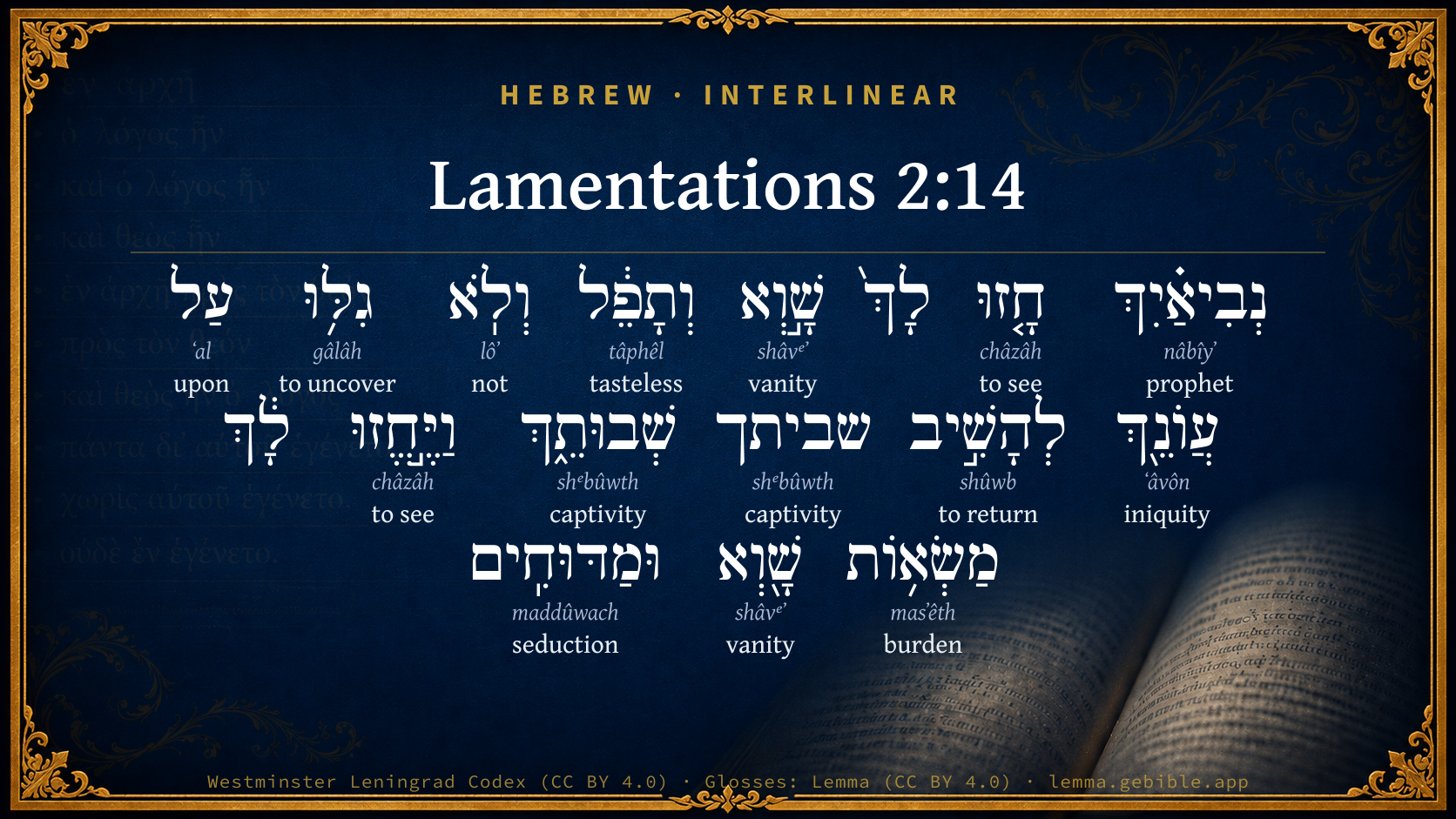
Lamentations 2:14

Hebrew (Westminster Leningrad Codex) Lamentations 2:14 appears in the Hebrew Old Testament. The text above is from the Westminster Leningrad Codex. Each word links to its Strong’s number, a concise gloss, and parsing drawn from the Open Scriptures Hebrew Bible morphology. Click any word for its full Brown-Driver-Briggs (BDB) entry.
Download image
Cite this verse

Lamentations 2:14 (World English Bible). Public Domain. Lemma interlinear Bible study tool, https://lemma.gebible.app/v/lamentations/2/14.

Show BibTeX & RIS
BibTeX
RIS
English Translation
Your prophets have seen for you false and foolish visions; They have not uncovered your iniquity, to bring back your captivity, But have seen for you false oracles and causes of banishment.
World English Bible · Public Domain
Highlights
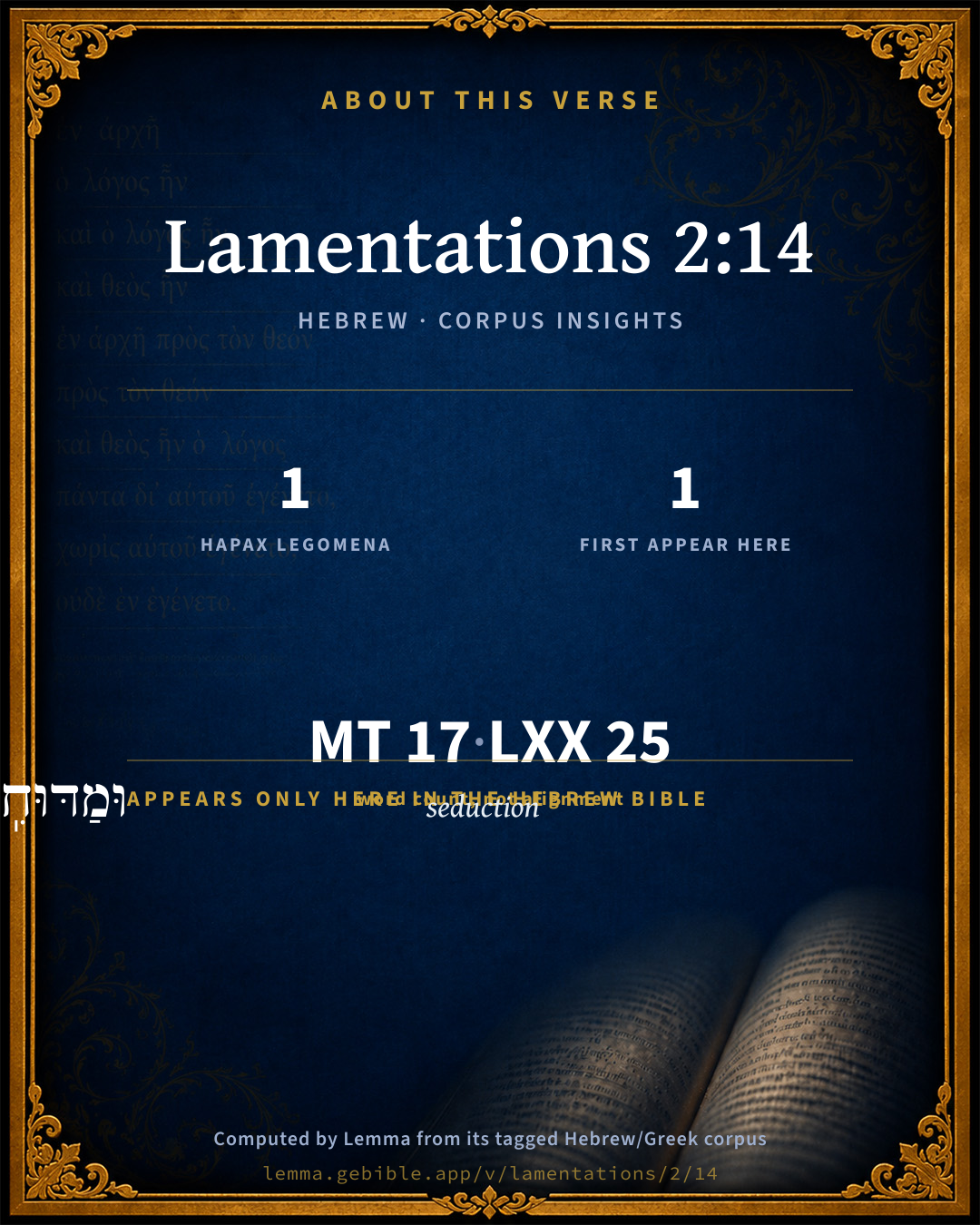
  • 1 hapax legomenon — only here in the Hebrew Bible
  • 1 first appearance in the Hebrew Bible
Full analysis ↓
Download a study sheet

One document with this verse’s original text, its word-by-word gloss line, the meaning frame, cross-references with their text, attributed commentary, and full source and license credits — printable, and it pastes into notes with its structure intact.

This verse Autodidact and up

Study sheet (.html) Plain text (.txt)

A passage Seminary Student

Up to 50 verses in one chapter. A passage sheet keeps up to 6 commentary sources and 12 cross-references per verse, in the order this page ranks them, and says so on the sheet whenever that leaves anything out. Ask for a single verse and you get the Autodidact verse sheet above.

Everything on this page stays free to read, with no account — the sheet is a download of what is already on screen, not access to it.

Want to remove ads? Support Godless Engineer
Compare translations 3

The same verse in 3 English versions, stacked beneath the original-language interlinear above. Click any original word for its lexicon entry.

Each is an independent rendering of the whole verse — the interlinear is not word-aligned to these translations.

Highlighted words mark where these versions differ — a whole-verse word diff, not a word-by-word alignment.

  • World English Bible Public Domain
    Your prophets have seen for you false and foolish visions; They have not uncovered your iniquity, to bring back your captivity, But have seen for you false oracles and causes of banishment.
  • King James Version Public Domain
    Thy prophets have seen vain and foolish things for thee: and they have not discovered thine iniquity, to turn away thy captivity; but have seen for thee false burdens and causes of banishment.
  • unfoldingWord Literal Text CC BY-SA 4.0
    Your prophets have seen for you falsehood and worthlessness, and they did not expose your iniquity to restore your fortunes. But they have seen for you oracles of falsehood and enticement. SAMEKH

unfoldingWord Literal Text — © unfoldingWord, licensed CC BY-SA 4.0. Word-aligned USFM3 via Door43 (git.door43.org/unfoldingWord/en_ult).

Versions to compare (up to 4)

3 of 4 selected

Show all 18 translations

Every available English version of this verse, each an independent rendering of the whole verse.

  • World English Bible Public Domain
    Your prophets have seen for you false and foolish visions; They have not uncovered your iniquity, to bring back your captivity, But have seen for you false oracles and causes of banishment.
  • Berean Standard Bible Public Domain
    The visions of your prophets were empty and deceptive; they did not expose your guilt to ward off your captivity. The burdens they envisioned for you were empty and misleading.
  • Majority Standard Bible Public Domain
    The visions of your prophets were empty and deceptive; they did not expose your guilt to ward off your captivity. The burdens they envisioned for you were empty and misleading.
  • King James Version Public Domain
    Thy prophets have seen vain and foolish things for thee: and they have not discovered thine iniquity, to turn away thy captivity; but have seen for thee false burdens and causes of banishment.
  • American Standard Version (1901) Public Domain
    Thy prophets have seen for thee false and foolish visions; And they have not uncovered thine iniquity, to bring back thy captivity, But have seen for thee false oracles and causes of banishment.
  • Revised Version (1885) Public Domain
    Thy prophets have seen visions for thee of vanity and foolishness; and they have not discovered thine iniquity, to bring again thy captivity: but have seen for thee burdens of vanity and causes of banishment.
  • Geneva Bible (1599) Public Domain
    Thy Prophets haue looked out vayne, and foolish things for thee, and they haue not discouered thine iniquitie, to turne away thy captiuitie, but haue looked out for thee false prophesies, and causes of banishment.
  • Douay-Rheims (1899) Public Domain
    Nun. Thy prophets have seen false and foolish things for thee: and they have not laid open thy iniquity, to excite thee to penance: but they have seen for thee false revelations and banishments.
  • Young's Literal Translation Public Domain
    Thy prophets have seen for thee a false and insipid thing, And have not revealed concerning thine iniquity, To turn back thy captivity, And they see for thee false burdens and causes of expulsion.
  • Literal Standard Version CC BY-SA 4.0
    Your prophets have seen for you a false and insipid thing, || And have not revealed concerning your iniquity, || To return your captivity, || And they see for you false burdens and causes of expulsion.
  • Unlocked Literal Bible CC BY-SA 4.0
    Your prophets have seen false and worthless visions for you. They have not exposed your iniquity to restore your fortunes, but for you they gave utterances that are false and misleading.
  • unfoldingWord Literal Text CC BY-SA 4.0
    Your prophets have seen for you falsehood and worthlessness, and they did not expose your iniquity to restore your fortunes. But they have seen for you oracles of falsehood and enticement. SAMEKH
  • Darby Bible Public Domain
    Thy prophets have seen vanity and folly for thee; and they have not revealed thine iniquity, to turn away thy captivity; but have seen for thee burdens of falsehood and causes of expulsion.
  • World Messianic Bible Public Domain
    Your prophets have seen false and foolish visions for you. They have not uncovered your iniquity, to reverse your captivity, but have seen for you false revelations and causes of banishment.
  • Webster's Bible Public Domain
    Thy prophets have seen vain and foolish things for thee: and they have not revealed thy iniquity, to turn away thy captivity; but have seen for thee false burdens and causes of banishment.
  • Free Bible Version CC BY-SA 4.0
    The visions of your prophets were false and worthless; they didn't point out your guilt to prevent you being taken into captivity. Instead they presented to you visions that were false and deceptive.
  • Bible in Basic English Public Domain
    The visions which your prophets have seen for you are false and foolish; they have not made clear to you your sin so that your fate might be changed: but they have seen for you false words, driving you away.
  • JPS Tanakh (1917) Public Domain
    Thy prophets have seen visions for thee of vanity and delusion; and they have not uncovered thine iniquity, to bring back thy captivity; but have prophesied for thee burdens of vanity and seduction.

Literal Standard Version (2020), Covenant Press — licensed CC BY-SA 4.0. Text via the HelloAO Bible API (eBible.org). Unlocked Literal Bible (unfoldingWord) — licensed CC BY-SA 4.0. Text via the HelloAO Bible API (eBible.org). unfoldingWord Literal Text — © unfoldingWord, licensed CC BY-SA 4.0. Word-aligned USFM3 via Door43 (git.door43.org/unfoldingWord/en_ult). Free Bible Version, Dr. Jonathan Gallagher — licensed CC BY-SA 4.0. Text via the HelloAO Bible API (eBible.org).

Word by word

More ways to search: Search by grammar → Find every occurrence → Compare this word →

Practice this passage: Drill this verse → Learn its vocabulary →

וּמַדּוּחִֽים
maddûwach
H4065
“and · seductions”
Conjunction + Noun, Common, Masculine, Plural, Absolute
Part of Speech
Conjunction + Noun
Type
Common
Gender
Masculine
Number
Plural
State
Absolute
Full BDB Definition

Origin: from H5080

TWOT: 1304a

seduction, enticement, a thing to draw aside
  1. נְבִיאַ֗יִךְ nâbîyʼ H5030 “prophets · your” Noun, Common, Masculine, Plural, Construct + Suffix, Personal, 2nd Person, Feminine, Singular
  2. חָ֤זוּ châzâh H2372 “to see” Verb, Qal, Perfect, 3rd Person, Common, Plural
  3. שָׁ֣וְא shâvᵉʼ H7723 “vanity” Noun, Common, Masculine, Singular, Absolute
  4. וְתָפֵ֔ל tâphêl H8602 “and · tasteless” Conjunction + Adjective, Adjective, Masculine, Singular, Absolute
  5. וְלֹֽא lôʼ H3808 “and · not” Conjunction + Particle, Negative
  6. גִלּ֥וּ gâlâh H1540 “to uncover” Verb, Piel, Perfect, 3rd Person, Common, Plural
  7. עַל ʻal H5921 “upon” Preposition
  8. עֲוֺנֵ֖ךְ ʻâvôn H5771 “iniquity · your” Noun, Common, Both, Singular, Construct + Suffix, Personal, 2nd Person, Feminine, Singular
  9. לְהָשִׁ֣יב shûwb H7725 “to return” Preposition + Verb, Hiphil, Infinitive Construct
  10. שביתך shᵉbûwth H7622 “captivity · your” Noun, Common, Feminine, Singular, Construct + Suffix, Personal, 2nd Person, Feminine, Singular
  11. שְׁבוּתֵ֑ךְ shᵉbûwth H7622 “captivity · your” Noun, Common, Feminine, Singular, Construct + Suffix, Personal, 2nd Person, Feminine, Singular
  12. וַיֶּ֣חֱזוּ châzâh H2372 “and · to see” Conjunction + Verb, Qal, Sequential Imperfect, 3rd Person, Masculine, Plural
  13. מַשְׂא֥וֹת masʼêth H4864 “burdens of” Noun, Common, Feminine, Plural, Construct
  14. שָׁ֖וְא shâvᵉʼ H7723 “vanity” Noun, Common, Masculine, Singular, Absolute

About this verse

These counts appear in no published source. They are computed here, from the morphology-tagged text and Lemma’s own curated glosses. What Lemma adds →

17
words
12
distinct lemmas
Prophets
section

Notable vocabulary

1 hapax legomenon — a word that appears only here in the entire Hebrew Bible:

  • וּמַדּוּחִֽים seduction H4065

First appearance in Scripture

This word makes its first canonical appearance in the Hebrew Bible here:

  • וּמַדּוּחִֽים seduction H4065

Shared distinctive vocabulary

וְתָפֵ֔ל tasteless H8602 occurs in 7 verses of the Hebrew Bible. Also found in:

Grammatical profile

  • 4 verbs
  • 8 nouns
  • 1 adjective
  • 3 prepositions
  • 1 particle

Verb forms

  • חָ֤זוּ Qal · Perfect
  • גִלּ֥וּ Piel · Perfect
  • לְהָשִׁ֣יב Hiphil · Infinitive Construct
  • וַיֶּ֣חֱזוּ Qal · Sequential Imperfect

Repetition

Words recur within this verse — often emphatic in Hebrew:

  • חָ֤זוּ to see H2372 ×2
  • שָׁ֣וְא vanity H7723 ×2
  • שביתך captivity H7622 ×2

Hebrew & Septuagint length

In English translation the verse runs 32 words from the Hebrew and 33 from the Septuagint (LXX English) — closely comparable.

A rough comparison of the two English renderings, which tokenize alike — not a word-level alignment.

Word counts can differ between the Hebrew and the Greek without any difference in meaning — e.g. the Hebrew direct-object marker אֵת has no separate Greek word, and Greek often adds the article ὁ.

In the original languages it is 17 Hebrew tokens and 25 Greek tokens — but the two are counted differently (Hebrew bundles its prefixes and suffixes into one token; the Greek is in lemma form), so that isn’t a like-for-like length.

Cross-references

25

Topical passages linked to Lamentations 2:14 in the Treasury of Scripture Knowledge — connected by theme and wording, ordered by reader-vote popularity; previews shown in the World English Bible.

  • Isaiah 58:1 Cry aloud, don't spare, lift up your voice like a trumpet, and declare to my people their disobedience, and to the house of Jacob their sins.
  • Jeremiah 5:31 the prophets prophesy falsely, and the priests bear rule by their means; and my people love to have it so: and what will you do in the end of it?
  • Ezekiel 22:28 Her prophets have daubed for them with whitewash, seeing false visions, and divining lies to them, saying, Thus says the Lord Yahweh, when Yahweh has not spoken.
  • Ezekiel 22:25 There is a conspiracy of her prophets in the midst of it, like a roaring lion ravening the prey: they have devoured souls; they take treasure and precious things; they have made her widows many in the midst of it.
  • Micah 3:5–7 Thus says Yahweh concerning the prophets who lead my people astray; for those who feed their teeth, they proclaim, "Peace!" and whoever doesn't provide for their mouths, they prepare war against him:
  • Jeremiah 2:8 The priests didn't say, Where is Yahweh? and those who handle the law didn't know me: the rulers also transgressed against me, and the prophets prophesied by Baal, and walked after things that do not profit.
  • Jeremiah 8:10–11 Therefore will I give their wives to others, and their fields to those who shall possess them: for everyone from the least even to the greatest is given to covetousness; from the prophet even to the priest every one deals falsely.
  • Isaiah 9:15–16 The elder and the honorable man, he is the head; and the prophet who teaches lies, he is the tail.
  • Jeremiah 6:13–14 For from the least of them even to the greatest of them everyone is given to covetousness; and from the prophet even to the priest everyone deals falsely.
  • Jeremiah 14:13–15 Then said I, Ah, Lord Yahweh! behold, the prophets tell them, You shall not see the sword, neither shall you have famine; but I will give you assured peace in this place.
  • Jeremiah 23:11–17 for both prophet and priest are profane; yes, in my house have I found their wickedness, says Yahweh.
  • Jeremiah 23:22 But if they had stood in my council, then had they caused my people to hear my words, and had turned them from their evil way, and from the evil of their doings.
  • Jeremiah 23:25–29 I have heard what the prophets have said, who prophesy lies in my name, saying, I have dreamed, I have dreamed.
  • Jeremiah 23:31–34 Behold, I am against the prophets, says Yahweh, who use their tongues, and say, He says.
  • Jeremiah 23:36 The burden of Yahweh shall you mention no more: for every man's own word shall be his burden; for you have perverted the words of the living God, of Yahweh of Hosts our God.
  • Jeremiah 27:9–10 But as for you, don't you listen to your prophets, nor to your diviners, nor to your dreams, nor to your soothsayers, nor to your sorcerers, who speak to you, saying, You shall not serve the king of Babylon:
  • Jeremiah 27:14–16 Don't listen to the words of the prophets who speak to you, saying, You shall not serve the king of Babylon; for they prophesy a lie to you.
  • Jeremiah 28:15 Then said the prophet Jeremiah to Hananiah the prophet, Hear now, Hananiah: Yahweh has not sent you; but you make this people to trust in a lie.
  • Jeremiah 29:8–9 For thus says Yahweh of hosts, the God of Israel: Don't let your prophets who are in the midst of you, and your diviners, deceive you; neither listen you to your dreams which you cause to be dreamed.
  • Jeremiah 37:19 Where now are your prophets who prophesied to you, saying, The king of Babylon shall not come against you, nor against this land?
  • Ezekiel 13:2–16 Son of man, prophesy against the prophets of Israel who prophesy, and say you to those who prophesy out of their own heart, Hear you the word of Yahweh:
  • Ezekiel 13:22 Because with lies you have grieved the heart of the righteous, whom I have not made sad; and strengthened the hands of the wicked, that he should not return from his wicked way, and be saved alive:
  • Micah 2:11 If a man walking in a spirit of falsehood lies: 'I will prophesy to you of wine and of strong drink;' He would be the prophet of this people.
  • Zephaniah 3:4 Her prophets are arrogant and treacherous people. Her priests have profaned the sanctuary. They have done violence to the law.
  • 2 Peter 2:1–3 But there also arose false prophets among the people, as among you also there will be false teachers, who will secretly bring in destructive heresies, denying even the Master who bought them, bringing on themselves swift destruction.

Cross-references courtesy of OpenBible.info (CC BY 4.0).

Hebrew and Greek witnesses Masoretic Hebrew ↔ Greek Septuagint

The same verse in the two great witnesses to the Old Testament, shown verse-for-verse.

These are two independent witnesses, not word-aligned to each other, and the Septuagint is shown in lemma (dictionary) form.

Hebrew Lamentations 2:14 Masoretic · Westminster Leningrad Codex

נְבִיאַ֗יִךְ חָ֤זוּ לָךְ֙ שָׁ֣וְא וְתָפֵ֔ל וְלֹֽא גִלּ֥וּ עַל עֲוֺנֵ֖ךְ לְהָשִׁ֣יב שביתך שְׁבוּתֵ֑ךְ וַיֶּ֣חֱזוּ לָ֔ךְ מַשְׂא֥וֹת שָׁ֖וְא וּמַדּוּחִֽים

Your prophets have seen for you false and foolish visions; They have not uncovered your iniquity, to bring back your captivity, But have seen for you false oracles and causes of banishment.

World English Bible · Public Domain

Greek LXX Lamentations 2:14 Septuagint · lemma form

προφήτης σύ ὁράω σύ μάταιος καί ἀφροσύνη καί οὐ ἀποκαλύπτω ἐπί ὁ ἀδικία σύ ὁ ἐπιστρέφω αἰχμαλωσία σύ καί ὁράω σύ λῆμμα μάταιος καί ἔξωσμα

NUN. Your prophets have seen for you vanities and folly: and they have not revealed your iniquity, to turn back your captivity; but they have seen for you vain burdens, and worthless visions.

LXX2012 (modern English Septuagint) · Public Domain

On this verse, Albert Barnes' Notes on the Bible discusses the Septuagint’s reading. Read the note in Commentary ↓

Hebrew: Westminster Leningrad Codex (CC BY 4.0). Greek: Septuagint (public domain); English from LXX2012 (modern English Septuagint) (Public Domain). How the Septuagint differs from the Hebrew →

Commentary

Notes on Lamentations 2:14 from classic Christian and Jewish commentators (each source and its license shown beneath its notes). The classic Christian expositions comment on the surrounding passage and are grouped to its opening verse, so a note may address several verses; the Jewish commentaries on the Tanakh (Rashi and others) are per-verse, so they appear only where the commentator wrote on this verse.

Lemma curates 59 commentaries, every one of them public domain or Creative Commons licensed, each selected and text-cleaned for this edition rather than reprinted as found. About our sources →

Trapp's Complete Commentary

John Trapp

Lam 2:14 Thy prophets have seen vain and foolish things for thee: and they have not discovered thine iniquity, to turn away thy captivity; but have seen for thee false burdens and causes of banishment.

Ver. 14. Thy prophets.] Thine, and not mine; for thou art miserable by thine own election, accessary to thine own ruin.

Have seen vain and foolish things for thee.] Visions of vanity, sapless and savourless stuff; the fruit, or rather froth, of their own fancies. {Jer 23:9-14}

And they have not discovered thine iniquity.] Conviction maketh way for conversion, and so preventeth utter subversion.

But have seen for thee false burdens,] viz., Against Babylon, in confidence whereof thou hast been hardened and heartened in thy sinful practices, to thine utter undoing.

And causes of banishment,] scil., Eventually, and as it hath proved.

John Trapp, A Commentary or Exposition upon All the Books of the Old and New Testament (1647–1656) — public domain. Text from a community e-Sword module.

The Biblical Illustrator

Joseph S. Exell

Lam_2:14

Thy prophets have seen vain and foolish things for thee.

Prophetic fidelity

The crying fault of the prophets is their reluctance to preach to people of their sins. Their mission distinctly involves the duty of doing so. They should not shun to declare the whole counsel of God. It is not within the province of the ambassador to make selections from among the despatches with which he has been entrusted in order to suit his own convenience. One of the gravest possible omissions is the neglect to give due weight to the tragic fact of sin. All the great prophets have been conspicuous for their fidelity to this painful and sometimes dangerous part of their work. If we would call up a typical picture of a prophet in the discharge of his task, we should present to our minds Elijah confronting Ahab, or John the Baptist before Herod, or Savonarola accusing Lorenzo de Medici, or John Knox preaching at the court of Mary Stuart. He is Isaiah declaring Gods abomination of sacrifices and incense when these are offered by blood-stained hands, or Chrysostom seizing the opportunity that followed the mutilation of the imperial statues at Antioch to preach to the dissolute city on the need of repentance, or Latimer denouncing the sins of London to the citizens assembled at Pauls Cross. The shallow optimism that disregards the shadows of life is trebly faulty when it appears in the pulpit. It falsifies facts in failing to take account of the stern realities of the evil side of them; it misses the grand opportunity of rousing the consciences of men and women by forcing them to attend to unwelcome truths, and thus encourages the heedlessness with which people rush headlong to ruin; and at the same time it even renders the declaration of the gracious truths of the Gospel, to which it devotes exclusive attention, ineffectual, because redemption is meaningless to those who do not recognise the present slavery and the future doom from which it brings deliverance. (W. F. Adeney, W. A.)

False teachers

1. False teachers are as grievous a plague as can be laid upon a people. They bring with them inevitable destruction (Mat_15:14).

2. They that refuse to receive the true ministers, God will give them over to be seduced by false teachers and to believe lies (2Ch_36:15; Pro_1:24; 2Th_2:10-12).

3. It is a certain note of a false prophet, to speak such things in the name of the Lord as are untrue, or misalleged to please the carnal desires of the people (Jer_14:13-15).

4. It is not sufficient for a true minister not to flatter; he must also discover the peoples sins unto them (Eze_13:4; 1Ki_18:18; Mat_3:7; Luk_3:8; Mat_14:4).

5. The only way to avoid Gods plagues is gladly to suffer ourselves bitterly to be reproved by Gods ministers.

6. The falsehood that is taught by false prophets, and believed by a seduced people, is the cause of all Gods punishments that light upon them. (J. Udall.)

False spiritual guides lead to ruin

A short time back the papers told of a vessel that had a most unfortunate trip. The captain became blind three days after leaving St. Pierre-Martinique and no one on board was capable of navigating the ship. The mate did his best and after drifting about for twenty-seven days came in sight of Newfoundland, where some fishermen saw her signals of distress and piloted her into port. If a ship with a blind captain is poorly off, what of a nation, a church, a village, where blind men are in charge: some born blind and by nature unqualified: others blind through worldly interests and a false learning! Blind leaders of the blind. And if the blind lead the blind, both shall fall into the ditch. (Footsteps of Truth.)

The Biblical Illustrator, edited by Joseph S. Exell (c. 1880s–1900s) — public domain. Text from a community e-Sword module.

Joseph Benson's Commentary

Lam 2:14. Thy prophets have seen vain and foolish things — The prophets, to whom thou didst choose to hearken, and whom thou didst believe, rather than those whom God sent to reveal his will, came and told thee idle tales, the fancies of their own minds, deluding thee with hopes of not being carried into captivity, or of a speedy return therefrom. They have not discovered thine iniquity, &c. — They have not given thy people a just sense of their iniquities, in order that, by being humbled and brought to true repentance, they might avert God’s judgments, but they have rather flattered them in their sins, and thereby have hastened on their ruin: see the margin. But have seen for thee false burdens — They have amused thee with false and fallacious prophecies, and that even after, as well as before, they were carried into captivity; (see Jer 29:8, &c.;) and causes of banishment — Hebrew, מדוחים, of casting out, of expulsion, as the word properly signifies: that is, their pretended revelations, promising peace, and giving hopes of impunity to thy people continuing in sin, were so far from profiting thee, that they were in a great measure the causes of thy captivity. Why prophecies are termed משׂאות, burdens, see notes on Isa 13:1, and Jer 23:33.

Joseph Benson's Commentary on the Old and New Testaments (1811–1818) — public domain. Text from a community e-Sword module.

The Preacher's Complete Homiletical Commentary

Joseph S. Exell (gen. ed.)

EXEGETICAL NOTES.—

(נ) Lam_2:14. The Book of Jeremiah contains ample evidence as to who those miserable comforters were. It shows that, during the period just preceding the overthrow of Judæa, there were a number of persons who were accustomed glibly to say, The burden of Jehovah, but who were mere pretenders to divine visions, who gave chaff and not wheat. The reason lay in the character of the people, that formed its own instruments in politics and religion. If a people prefer to have sensational statesmen, such statesmen will appear. If prophets prophecy falsely, it is because the people love to have it so. They say unto the prophets, Prophesy not unto us right things, speak unto us smooth things, prophesy deceits. They got what they wanted. Thy prophets have seen for thee, and the result is vanity and foolishness, unreal and unreasonable things. They did not make known the will of God so as to expose the evil ways and doings of the people, and prepare for amendment. They have not uncovered thine iniquity to turn away thy captivity. Instead of that, their boasted visions tended to produce burdens of vanity and causes of banishment. They prophesy a lie unto you, to remove you far from your land, and that I should drive you out.

HOMILETICS

FALSE PROPHETS

(Lam_2:14)

I. Are self-deluded. “Thy prophets have seen vain and foolish things for thee.” Thy prophets—they were certainly not God’s prophets. Their authority was self-assumed, and they ingratiated themselves into the favour of the people by prophesying only what was agreeable to their hearers. They indulged so lavishly in lies and deceit, that they almost persuaded themselves that what they uttered was truth. But they were deluded, and their delusion was self-induced. An inveterate habit of lying vitiates the moral sense; it becomes difficult to appreciate what is true. A lie poisons the atmosphere wherever it circulates. It has no legs and cannot stand, but it has wings and can fly far and wide.

II. Have no insight into the real cause of national calamities, and their teaching is powerless to prevent them. “They have not discovered thine iniquity, to turn away thy captivity.” The Syriac renders the words thus: They have not disclosed to thee thy sins, that so thou mightest repent, and I might have turned away thy captivity. They were so demoralised by the habitual practice of falsehood, that they were incompetent to judge the cause and drift of the national troubles. They could not see that disobedience to God was at the root of the general distress; or, if they did, they saw so little evil in it, or danger from it, that they did not deem it necessary to alarm the people by any words of warning. Had they been able to read the signs of the times and to act with promptness and fidelity in urging the people to repentance, Israel’s chastisement might have been averted. When responsible leaders are unfaithful, and abuse their trust by deceiving others, the misguided nation rushes on to its doom.

III. Invent messages full of deceit. “But have seen for thee false burdens and causes of banishment.” The word burdens does not mean here prophecies of a minatory character, for evidently the false prophets assured the people of prosperity and deliverance. The word is used in a contemptuous sense. The burdens, so different from the Divine message laid as a burden on the conscience of the genuine prophet, were, in this case, mere pretence, false, empty, and utterly inadequate to remove “the causes of banishment.” The false prophets, in their attempt to account for the captivity, invented any cause but the real one—the apostasy of the people. Deceit produces darker shades of deceit. One lie must be quickly thatched with another, or it will soon rain through. The way of falsehood is tortuous. A deaf and dumb boy being asked, “What is truth?” replied by thrusting his finger forward in a straight line. When asked, “What is falsehood?” he made a zigzag motion with his finger. The result of false teaching is disintegration, banishment, a driving out. Every lie, great or small, is the brink of a precipice, the depth of which nothing but Omniscience can fathom. The poet Campbell calls it, “The torrent’s smoothness, ere it dash below.”

LESSONS.—

1. The true prophet receives his commission directly from God.

2. While the prophet is faithful to his Divine calling he is preserved from error.

3. The false prophet deceives himself as well as others.

ILLUSTRATIONS.—A false prophet.

“The bigot theologian, in minute

Distinctions skilled, and doctrines unreduced

To practice; in debate how loud! how long!

How dexterous! in Christian love, how cold!

His vain conceits were orthodox alone.

The immutable and heavenly truth revealed

By God was nought to him; he had an art,

A kind of hellish charm, that made the lips

Of truth speak falsehood; to his liking turned

The meaning of the text; made trifles seem

The marrow of salvation;

Proved still his reasoning best, and his belief,

Though propped on fancies wild as madmen’s dreams,

Most rational, most Scriptural, most sound;

With mortal heresy denouncing all

Who in his arguments could see no force.

He proved all creeds false but his own, and found

At last his own most false—most false, because

He spent his time to prove all others so.”

—Pollok.

False doctrine. A man holding false and pernicious doctrines preached at a village chapel, and endeavoured to convince a large congregation that there is no punishment after death. At the close of the discourse he informed the people he would preach there again in four weeks, if they wished. A respectable merchant rose and said, “Sir, if your doctrine is true, we do not need you; and if it is false, we do not want you.”

False teaching dangerous when mixed with truth. Falsehood is never so successful as when she baits, her hook with truth. No opinions so fatally mislead us as those that are not wholly wrong, as no watches so effectually deceive the wearer as those that are sometimes right.—Colton.

—Error is never so dangerous as when it is the alloy of truth. Pure error would be rejected; but error mixed with truth makes use of the truth as a pioneer for it, and gets introduction where otherwise it would have none. Poison is never so dangerous as when mixed up with food; error is never so likely to do mischief as when it comes to us under the pretensions and patronage of that which is true.—Cumming.

Faith in falsehood disastrous.—When the English army under Harold, and the Norman under William the Conqueror, were set in array for that fearful conflict which decided the fate of the two armies and the political destinies of Great Britain, William, perceiving that he could not by a fair attack move the solid columns of the English ranks, had recourse to a false movement in order to gain the victory. He gave orders that one flank of his army should feign to be flying from the field in disorder. The officers of the English army believed the falsehood, pursued them, and were cut off. A second time a false movement was made in another part of the field. The English again believed, pursued, and were cut off. By these movements the fortunes of the day were determined. Although the English had the evidence of their senses, yet they were led to believe a falsehood. They acted in view of it. The consequence was the destruction of a great part of their army, and the establishment of the Norman power in England. It is an incontrovertible fact that the whole heathen world, ancient and modern, have believed in and worshipped unholy beings as gods. In consequence of believing falsehood concerning the character of God, all heathendom at the present hour is filled with ignorance, impurity, and crime.—J. B. Walker.

Falsehood.

“I scorn this hated scene

Of masking and disguise,

Where men on men still gleam

With falseness in their eyes:

Where all is counterfeit,

And truth hath never say;

Where hearts themselves do cheat,

Concealing hope’s decay.”—Motherwell.

The Preacher's Complete Homiletical Commentary (gen. ed. Joseph S. Exell; Funk & Wagnalls, c. 1892) — public domain (pre-1929). A full-Bible homiletical/sermon-outline anthology covering 65 of 66 books (2 John is absent from the source module). Text from a community e-Sword module.

Geneva Bible (1599)

Geneva Bible translators

Because the false prophets called themselves Seers, as the others were called, therefore he showeth that they saw amiss, because they did not reprove the people’s faults, but flattered them in their sins, which was the cause of their destruction.

Or, burdens.

Geneva Bible (1599) marginal notes — public domain. Text via Bolls.life.

Jamieson, Fausset & Brown

Robert Jamieson, A. R. Fausset & David Brown

Thy prophets--not God's (Jer 23:26).

vain . . . for thee--to gratify thy appetite, not for truth, but for false things.

not discovered thine iniquity--in opposition to God's command to the true prophets (Isa 58:1). Literally, "They have not taken off (the veil) which was on thine iniquity, so as to set it before thee."

burdens--Their prophecies were soothing and flattering; but the result of them was heavy calamities to the people, worse than even what the prophecies of Jeremiah, which they in derision called "burdens," threatened. Hence he terms their pretended prophecies "false burdens," which proved to the Jews "causes of their banishment" [CALVIN].

Jamieson, Fausset & Brown — Commentary Critical and Explanatory on the Whole Bible (1871) — public domain (CC PDM 1.0). Text via the HelloAO Bible API.

Adam Clarke's Commentary

Verse 14. They have not discovered thine iniquity] They did not reprove for sin, they flattered them in their transgressions; and instead of turning away thy captivity, by turning thee from thy sins, they have pretended visions of good in thy favour, and false burdens for thy enemies.

Adam Clarke's Commentary on the Bible (1810–1826) — public domain. Text from a community e-Sword/MySword module.

John Calvin's Commentaries

Here the Prophet condemns the Jews for that wantonness by which they had, as it were, designedly destroyed themselves, as though they had willfully drunk sweet poison. They had been inebriated with those fallacies which we have seen, when impostors promised them a prosperous condition; for we have seen that false prophets often boldly declared that whatever Jeremiah threatened was of no account. Since, then, the Jews were inebriated with such flatteries, and disregarded God’s judgment, and freely indulged themselves in their vices, the effect was, that God’s wrath had been always and continually kindled by them. Now, then, Jeremiah reproves them for such wantonness, even because they willfully sought to be deceived, and with avidity cast themselves into snares, by seeking for themselves flatterers as teachers. Micah also reproves them for the same thing, that they sought prophets who promised them a fruitful vintage and an abundant harvest. (Micah 2:10.) The meaning of Jeremiah is the same.

He says that prophets had prophesied, or had seen vanity for them; but the verb refers to prophecies, as prophets are called seers. He then says that the prophets had seen vanity and insipidity This availed not to extenuate the fault of the people; and Jeremiah does not here flatter the people, as though they had perished through the fault of others; and yet this was a common excuse, for most, when they had been deceived, complained that they had fallen through being led astray, and also that they had not been sufficiently cautious when subtle men were laying snares for them. But the Prophet here condemns the Jews, because they had been deceived by false prophets, as it was a just reward for their vainglory and ambition. For they had very delicate ears, and free reproofs could not be endured by them; in a word, when they rejected all sound doctrine, the devil must have necessarily succeeded in the place of God, as also Paul says,

“that those were justly punished who were blinded by God so as to believe a lie, because they received not the truth.” (2 Thessalonians 2:11, 12.)

We now perceive the design of the Prophet: he says that the Jews had indeed been deceived by the false prophets; but this had happened through their own fault, because they had not submitted to obey God, because they had rejected sound doctrine, because they had been rebellious against all his counsels. At the same time, not only their crime seems to have been thus exaggerated, but also their shame was brought before them, — because they had dared to set up these impostors against Jeremiah as well as other servants of God; for they had boasted greatly of these their false prophets whenever they sought to exult against God. How great was this presumption! When the false prophets had promised them security, they immediately triumphed in an insolent manner over Jeremiah, as though they were victorious. As, then, their wickedness and arrogance had been such against God, the Prophet justly retorts upon them, “Behold now as to your false prophets; for when they lately promised to you prosperity of every kind, I was inhumanly treated, and my calling was disdainfully repudiated by you; let now your false prophets come forward: be wise at length through your evils, and acknowledge what it is to have acted so haughtily against God and against his servants.” We now understand why the Prophet says, “They have seen for you vanity and insipidity.”

He adds, they have not opened, or revealed, &c. The preposition על, ol, is here redundant; the words are, “they have not revealed upon thine iniquity.” There is, indeed, a suitableness in the words in that language, that they had not applied their revelations to the iniquities of the people, for they would have been thus restored to the right way, and would have thus obviated the vengeance of God.

Now, this passage ought to be carefully noticed: Jeremiah spoke of the fallacies of the false prophets, which he said were insipid: he now expresses how they had deceived the people, even because they disclosed not their iniquities. Let us then know that there is nothing more necessary than to be warned, that being conscious of our iniquities we may repent. And this was the chief benefit to be derived from the teaching of the prophets. For the other part, the foretelling of future things would have had but little effect had not the prophets preached respecting the vengeance of God, — had they not exhorted the people to repentance, — had they not bidden them by faith to embrace the mercy of God. Then Jeremiah in a manner detects the false doctrines of those who had corrupted the prophetic doctrine, by saying that they had not disclosed iniquities. Let us then learn by this mark how to distinguish between the faithful servants of God and impostors. For the Lord by his word summons us before his tribunal, and would have our iniquities discovered, that we may loathe ourselves, and thus open an entrance for mercy. But when what is brought before us only tickles our ears and feeds our curiosity, and, at the same time, buries all our iniquities, let us then know that the refined things which vastly please men are insipid and useless. Let, then, the doctrine of repentance be approved by us, the doctrine which leads us to God’s tribunal, so that being cast down in ourselves we may flee to his mercy.

He afterwards adds, that they might turn back thy captivity; some prefer, “thy defection” — and this meaning is not unsuitable; but the Prophet, I have no doubt, refers to punishment rather than to a crime. Then the captivity of the people would have been reversed had the people in time repented; for we obviate God’s wrath by repentance: “If we judge ourselves,” says Paul, “we shall not be judged.” (1 Corinthians 11:31.) As, then, miserable men anticipate God’s judgment when they become judges of themselves, the Prophet does not without reason say that the false prophets had not disclosed their iniquities, so that they might remain quiet in their own country, and never be driven into exile. How so? for God would have been thus pacified, that is, had the people willingly turned to him, as it is said in Isaiah,

“And be converted, and I should heal them.” (Isaiah 6:10.)

Conversion, then, is said there to lead to healing; for as fire when fuel is withdrawn is extinguished, so also when we cease to sin fuel is not supplied to God’s wrath. We now, then, perceive the meaning of the Prophet; he, in short, intimates that people had been destroyed because they sought falsehoods, while the false prophets vainly flattered them; for they would have in due time escaped so great evils, had the prophets boldly exhorted the people to repentance.

He then adds, And they saw for thee prophecies of vanity and expulsions. Though the word משאת, meshat, is often taken in a bad sense for a burden, that is, a hard prophecy which shews that God’s vengeance is nigh, yet it is doubtful whether the Prophet takes it now in this sense, since he speaks of prophecies which gave hope of impunity to the people; and these were not משאות, meshaut, that is, they were not grievous and dreadful prophecies. But when all things are well considered, it will be evident that Jeremiah did not without reason adopt this word; for he afterwards adds an explanation. The word, משאה, meshae, is indeed taken sometimes as meaning any kind of prophecy, but it properly means what is comminatory. But now, what does Jeremiah say? They saw for thee burdens which thou hast escaped. For to render odious the doctrine of the holy man, they called whatever he taught, according to a proverbial saying, a burden. Thus, then, they created a prejudice against the holy man by saying that all his prophecies contained nothing but terror and trouble. Now, by way of concession, the Prophet says, “They themselves have indeed been prophets to you, and they saw, but saw at length burdens.”

While, then, the false prophets promised impunity to the people, they were flatterers, and no burden appeared, that is, no trouble; but these prophecies became at length much more grievous than all the threatenings with which Jeremiah had terrified them; and corresponding with this view is what immediately follows, expulsions. For the Prophet, I doubt not, shews here what fruit the vain flatteries by which the people had chosen to be deluded had produced: for hence it happened, that they had been expelled from their country and driven into exile. For if the reason was asked, why the people had been deprived of their own inheritance, the obvious answer would have been this, because they had chosen to be deceived, because they had hardened themselves in obstinacy by means of falsehoods and vain promises. Since, then, their exile was the fruit of false doctrine, Jeremiah says now that these impostors saw burdens of vanity, but which at length brought burdens; and then they saw, מדוחים meduchim, expulsions, even those things which had been the causes of expulsion or exile.

John Calvin's Commentaries (1540-1563) — public domain. Text from the Calvin Translation Society English edition (1840s-50s) via the Christian Classics Ethereal Library (ccel.org). Calvin's coverage is partial (roughly two-thirds of the Bible); uncommented books and verses are honest gaps, never fabricated. The 19th-century editor's footnotes and remarks are omitted so the notes are faithfully Calvin's own voice.

Ellicott's Commentary for English Readers

(14) Thy prophets have seen vain and foolish things.—The words are eminently characteristic of Jeremiah, whose whole life had been spent in conflict with the false prophets (Jer_2:8; Jer_5:13; Jer_6:13; Jer_8:10; Jer_14:14; Jer_28:9, and elsewhere), who spoke smooth things, and prophesied deceit. They did not call men to repent of their iniquity.

False burdens.—The noun is used, as in Jer_23:33, with a touch of irony, as being that in which the false prophets delighted. What they uttered, however, as a vision of God, did not tend to restoration, but was itself a “cause of banishment,” and tended to perpetuate and aggravate the miseries of exile.

A Bible Commentary for English Readers, edited by Charles John Ellicott (1878–1897) — public domain. Text from a community e-Sword module.

The Cambridge Bible for Schools and Colleges

gen. ed. J. J. S. Perowne

14. The thought that the false prophets are worthy of condemnation for buoying the people up with vain hopes is distinctly in Jeremiah’s manner (cp. Eze_12:24; Eze_13:6 f., Eze_22:28). It is true that we here wholly lack the vehement rebukes which he administered to the people and the priests for their disloyalty to Jehovah. But it is not necessarily fatal to the prophet’s authorship that the writer bestows unqualified pity on his fellow-countrymen. We can hardly look for invective in a sorrowful lament.

foolishness] i.e. what is meaningless, worthless.

discovered] uncovered, revealed (to thee), a sense now obsolete. Cp.

“Go, draw aside the curtains, and discover

The several caskets to this noble prince.”

Merch. of Ven. Act II. Sc. 7.

to bring again thy captivity] See on Jer_29:14.

burdens (better as mg. oracles) of vanity] i.e. false oracles. See on Jer_23:33 ff.

causes of banishment] or (less well) mg. things to draw thee aside, i.e. from Jehovah to idols. The Heb. word for “banishment” is not elsewhere found. It here points to the consequences which followed the teaching of the false prophets. Cp. Jer_27:10; Jer_27:15.

The Cambridge Bible for Schools and Colleges (gen. ed. J. J. S. Perowne; Cambridge University Press, 1878–1918) — public domain. Text from a community e-Sword module.

John Gill's Exposition

Thy prophets have seen vain and foolish things for thee,.... Not the prophets of the Lord; but false prophets, as the Targum; which were of the people's choosing, and were acceptable to them; prophets after their own hearts, because they prophesied smooth things, such as they liked; though in the issue they proved "vain" and "foolish", idle stories, impertinent talk, the fictions of their own brains; and yet they pretended to have visions of them from the Lord; as that within two years Jeconiah, and all the vessels of the temple carried away by the king of Babylon, should be returned; and that he would not come against Jerusalem, nor should it be delivered into his hands; see Jer 28:2;

and they have not discovered thine iniquity: they did not tell them of their sins; they took no pains to convince them of them, but connived at them; instead of reproving them for them, they soothed them in them; they did not "remove" the covering that was "over their iniquity" (u), as it might be rendered; which they might easily have done, and laid their sirs to open view: whereby they might have been ashamed of them, and brought to repentance for them. The Targum is,

"neither have they manifested the punishment that should come upon thee for thy sins;''

but, on the contrary, told them it should not come upon them; had they dealt faithfully with them, by showing them their transgressions, and the consequences of them, they might have been a means of preventing their ruin: and, as it here follows,

to turn away thy captivity; either to turn them from their backslidings and wanderings about, as Jarchi; or to turn them by repentance, as the Targum; or to prevent their going into captivity:

but have seen for thee false burdens, and causes of banishment; that is, false prophecies against Babylon, and in favour of the Jews; prophecies, even those that are true, being often called "burdens", as the "burden of Egypt", and "the burden of Damascus", &c. and the rather this name is here given to those false prophecies because the prophecies of Jeremiah were reproached by them with it, Jer 23:33, &c. and because these proved in the issue burdensome, sad, and sorrowful ones though they once tickled and pleased; and were the cause of the people's going into exile and captivity they listening to them: or they were "depulsions" or "expulsions" (w); drivings, that drove them from the right way; from God and his worship; from his word and prophets; and, at last, the means of driving them out of their own land; of impelling them to sin, and so of expelling them from their own country. The Targum renders it,

"words of error.''

(u) "et non revelarunt legmen pravitati tuae impositum", Christ. Ben. Miehaelis. (w) , Sept. "et expulsiones", Montanus, Vatablus, Calvin; "et ad depulsionem spectantium", Junius & Tremellius; "depulsiones, expulsiones", Stockius, p. 649.

John Gill's Exposition of the Whole Bible (1746–1763) — public domain (CC PDM 1.0). Text via the HelloAO Bible API.

Albert Barnes' Notes on the Bible

Thy prophets have seen vain and foolish things for thee - The Septuagint and Vulgate give the true meaning, “stupidity” (see Jer 23:13 note).

To turn away thy captivity - The right sense is, “They have not disclosed to thee thy sins, that so thou mightest repent, and I might have turned away thy captivity.”

Burdens - Applied contemptuously to predictions which proved “false” or “empty,” i. e. failed of accomplishment. On the deduction to be drawn from this, see Jer 28:9.

Causes of banishment - The result of the teaching of the false prophets would be that God would “drive out” the Jews from their land.

Some render the words “false ... banishment” by “oracles of falsehood and seduction.”

Albert Barnes' Notes on the Bible (1834–1885) — public domain. Text from a community e-Sword/MySword module.

Haydock's Catholic Bible Commentary

Revelations. Hebrew Masoth, "burdens" for the enemy. This sentence ought to come before and they, &c., as it is in the Vulgate. (Haydock)

George Leo Haydock (1774–1849), Haydock's Catholic Family Bible and Commentary, 1859 edition — public domain. Excludes Psalms (Douay-Rheims chapter numbering differs from Protestant) and Deuterocanonical books (Catholic canon only).

Matthew Poole's English Annotations

Not the Lord’s prophets in thee, but those prophets to whom you chose rather to hearken, and whom you believed rather than me and others sent by God to reveal his will unto you, came and told you idle and vain stories, that those who were carried into captivity should after two years return, &c. And by telling you such smooth and pleasant things, tickled your humours instead of discovering your sins, which were bringing these judgments upon you; whereas they ought to have dealt freely and faithfully with you, and have made you sensible of your sins, and this might have prevented your miserable captivity. But they rather spent their breath in telling you false stories to encourage you in your sinful courses, and so proved to you the causes of your banishment; or else they told you false stories, which they pretended to be the causes of the captivity of your brethren, in the mean time concealing the true causes, and suffering you to run on in the same errors, till you came to be more miserable than those that went into captivity before you.

Matthew Poole's English Annotations on the Holy Bible (1683–1685) — public domain. Text from a community e-Sword/MySword module.

Whedon's Commentary on the Bible

Daniel D. Whedon

14. Thy prophets — This is in continuation of the preceding verse. The false prophets had indeed cried “Peace, peace,” but there was no peace.

False burdens — The term burden is often technical in the sense of prophecies of a minatory character, but this is not the easiest sense in this place. True, as Keil suggests, it may mean threatening of evil against the enemies of Israel, but this would be no burden to the Jews. It is better to regard this word here as used in a more general sense, “oracles of deceit.”

Causes of banishment — Literally, expulsions. The original is a single word.

Daniel D. Whedon (gen. ed.), Commentary on the Old and New Testaments (1874–1909) — public domain. Text from a community e-Sword module.

The Pulpit Commentary

Thy prophets. Jeremiah constantly inveighs against the fallacious, immoral preaching of the great mass of his prophetic contemporaries. (comp. Jer_6:13, 14 14:13-15 23:14-40) Have seen vain and foolish things; i.e. have announced "visions" (prophecies) of an unreal and irrational tenor. Comp. Jer_23:13, where the same word here paraphrased as "irrational" (literally, insipid) occurs. Discovered; i.e. disclosed. To turn away thy captivity. The Captivity, then, might have been "turned away," if the other prophets had, like Jeremiah, disclosed the true spiritual state of the people, and moved them to repentance. False burdens. Suggestive references to these false prophecies occur in Jer_14:13, 14 23:31, 32 (see the Exposition on these passages). Causes of banishment. So Jeremiah, (Jer_27:10, Jer_27:15) "They prophesy a lie unto you, to remove you far from your land.

The vision of falsehood and folly.

Visions from the Lord have ceased (ver. 9). But the prophets continue to see visions of earthly limitation or even of diabolical delusion. These visions are false and foolish. Better have none than such.

I PROPHECY IN ITS CORRUPTION SEES THE FALSE AND FOOLISH IN PLACE OF THE TRUE AND WORTHY.

1. The mission of prophecy is to see and declare wisdom and reality. The attractiveness of the teaching is a snare if the matter of it is vain. People naturally favour the pleasant utterance of pleasant things. Doctrines are sometimes chosen because they are liked rather than because they are known to be sound, or the style and language of the preacher are more heeded than the substance of his message. But, if we were in earnest, ugly truths would always be accepted in preference to specious falsehoods.

2. The corruption of prophecy substitutes falsehood and folly for truth and wisdom. This may be experienced unconsciously. The teacher may not know that he has fallen. It is not only that his tongue utters lies, his eye sees no truth. His vision is distorted and he knows it not. He is not aware that he sees men as trees walking. Nor does he know that his folly is not wisdom. The failing of spiritual vision and decay of wisdom are the more calamitous because they are unconscious. They are a sort of spiritual insanity.

3. The evil of the corruption of prophecy is in the widespread delusion and degradation that it produces. "Thy prophets have seen vain and foolish things for thee." The prophet is a teacher as well as a seer. When the teacher errs the scholars are misled.

II THE FAILURE TO DISCOVER INIQUITY IS A PROOF THAT A PROPHET"S VISION IS FALSE AND FOOLISH.

1. A prophet is required to see human as well as Divine truth. It needs inspiration to read the secrets of the heart as much as to discover the mysteries of the unseen heavens or of the distant future. A prophet should be a discerner of spirits. If he cannot read the signs of the times he is a failure.

2. The failure to see iniquity is one especial evidence of perverted prophetic vision. The physician is first of all called upon to discover his patient"s disease. If he cannot detect this the rest of his work is of little use. Prophets may dream of the millennium and discourse of the celestial spheres; but so long as they are blind to the sins that men around them are perishing in, their primary mission must fail. Now, it needs a Divine inspiration rightly to see iniquity. Conventionality of thought leads to a complacent satisfaction with the normal state of the world, We must be out of it and above it to observe how it has fallen. The preacher who cannot see the sins of his age is worse than useless. He is a deluding flatterer. The individual man who is blind to his own sin has not the first ray of spiritual light which may guide him aright.

III THE FALSE AND FOOLISH VISION OF PROPHECY DOES NOT RESTORE PROSPERITY, BUT ON THE CONTRARY IT DIRECTLY LEADS TO RUIN. By vainly promising pleasant things it brings disastrous ones. The false prophets opposed Jeremiah and said the Captivity would not come. By that very falsehood they helped to hasten it. Had they preached repentance and warned of wrath, the doom might have been averted. None prepare souls for ruin more certainly than smooth speaking flattering optimists. When danger is near, the warning prophet may be the deliverer of his hearers. If the preacher fail to produce conviction of sin he cannot lead to salvation in Christ. So long as men do not see their lost condition they are in danger of their soul"s ruin. To them a pleasant religion is a fatal religion. A Jeremiah, a John the Baptist, and a John Knox are the best friends of their generation.

The share of the prophets in ruining Jerusalem.

I WHAT THE PROPHET OUGHT TO BE. The prophet of those times was a man bound to say things having depth and substance in them. And though the prophet has ceased, so far as formal office is concerned, yet there are still Divine things to be seen, and, when seen, spoken about by those qualified to speak. There are the deep things of God to be penetrated and explored by those willing to receive the insight. The Holy Spirit of God, offered so abundantly through Christ, is a Spirit of prophecy to all who have it. They need no formal prophet, inasmuch as they have a word, living and piercing, to all who take a right relation towards it. God means us to be occupied with serious, substantial matters, so large and deep and fruitful that we shall never outgrow our interest in them. The heart of man in its meditating power was made for great themes. The heart can never be filled with mere trifles. That is good advice given to preachers of the gospel to speak most on the greatest themes, such as are set forth again and again in the Scriptures, and, whether these things be preached about or not, every individual Christian should think about them. For while we cannot secure the topics of preachers, the topics of our own thoughts depend upon ourselves. It is just those who concern themselves a great deal about dogmas who are also most interested in the details of life and conduct.

II WHAT THE PROPHET MAY SINK TO BE. These prophets felt bound to magnify their office and say something. They ought to have spoken the truth; but for this they lacked inclination and perhaps courage. The next best thing would have been to remain silent; but then where would the prophet reputation have been? and, more serious question still with some, what would have become of the prophet emoluments? Hence we have here the double iniquity that the false was spoken and the true conceded. The prophets could only get credit for their falsehoods by a careful concealment of the truth. They had, as it were, to paste on truth a conspicuous label, proclaiming far and wide, "This is a lie." This verse suggests how they had the common experience of one lie leading on to another. The true prophet said that the burden Israel had to bear and the exile into which it had to go arose from its iniquities. Whereas the false, or rather the unfaithful prophet, having set iniquity as the cause of trouble altogether on one side, could only go on inventing explanations which explained nothing. Ezekiel 13 is a chapter which may very profitably be read in connection with this verse. The great lesson is to search for truth no matter with what toil, and keep it no matter at what cost. Y.

The Pulpit Commentary (1880–1919), ed. H.D.M. Spence-Jones & Joseph S. Exell — public domain. Text from a community e-Sword module.

John Wesley's Explanatory Notes

The prophets - False prophets told you vain stories. Not discovered - Whereas they ought to have made you sensible of your sins, and this might have prevented your captivity. False burdens - False stories to encourage you in sin, and so cause your banishment.

John Wesley, Explanatory Notes Upon the Whole Bible (1754–1765) — public domain. Text via the GEBible commentary corpus.

Keil & Delitzsch

C. F. Keil & F. Delitzsch

From her prophets, Jerusalem can expect neither comfort nor healing. For they have brought this calamity upon her through their careless and foolish prophesyings. Those meant are the false prophets, whose conduct Jeremiah frequently denounced; cf. Jer 2:8; Jer 5:12; Jer 6:13., Jer 8:10; Jer 14:14., Jer 23:17, Jer 23:32; Jer 27:10, Jer 27:15. They prophesied vanity, - peace when there was no peace, - and תפל, "absurdity," = תּפלה, Jer 23:13. They did not expose the sin and guilt of the people with the view of their amendment and improvement, and thereby removing the misery into which they had fallen by their sin; nor did they endeavour to restore the people to their right relation towards the Lord, upon which their welfare depended, or to avert their being driven into exile. On השׁיב שׁבוּת, cf. Jer 32:44. The meaning of this expression, as there unfolded, applies also to the passage now before us; and the translation, captivitatem avertere (Michaelis, Ngelsbach), or to "ward off thy captivity" (Luther, Thenius), is neither capable of vindication nor required by the context. Instead of healing the injuries of the people by discovering their sins, they have seen (prophesied) for them משׂאות, "burdens," i.e., utterances of threatening import (not effata; see on Jer 23:33), which contained שׁוא, "emptiness," and מדּוּחים, "rejection." The combination of "emptiness" with "burdens" does not prevent the latter word from being applied to threatening oracles; for the threats of the false prophets did not refer to Judah, but were directed against the enemies of Israel. For instance, that they might promise the people speedy deliverance from exile, they placed the downfall of the Chaldean power in immediate prospect; cf. Jer 28:2-4, Jer 28:11. מדּוּחים, is ἅπ. λεγ. as a noun, and is also dependent on "burdens" (cf. Ewald, 289, c): it signifies ejection from the land, not "persecution" (Rosenmller, Gesenius, Ewald, etc.), for Jeremiah uses נדח (in Niph. and Hiph.) always in the sense of rejection, expulsion from the country; and the word has here an unmistakeable reference to Jer 27:10, Jer 27:15 : "They prophesy lies to you, that they may eject you from your country."

Keil & Delitzsch — Biblical Commentary on the Old Testament (1861–1891) — public domain (CC PDM 1.0). Text via the HelloAO Bible API. (Old Testament only.)

Rashi

Rabbi Shlomo Yitzchaki (Rashi)

false and senseless visions words that have no taste, and in Old French aflestrimant, insipidity, sickliness.

and they have not exposed your iniquity to reprove you to your face about your way.

to straighten out your backsliding Heb. לְהָשִּׁיב שְׁבוּתֵךְ, an expression of (Jer. 8:5) שּׁוֹבְבָה (ibid. 3:14) שּׁוֹבְבִים, backsliding; (Isa. 57:17): “and he went rebelliously (שּׁוֹבָב).”

misleading oracles They misled you away from Me.

Rashi on the Tanakh — English translations: “The Judaica Press complete Tanach with Rashi, translated by A. J. Rosenberg” (CC BY 4.0); “Pentateuch with Rashi's commentary by M. Rosenbaum and A.M. Silbermann, 1929-1934” (public domain); “The Metsudah Tanach series, Lakewood, N.J” (CC BY 4.0); and “The Book of Joshua, Metsudah Publications, 1997” (CC BY 4.0). Text via Sefaria.

Lesson kit

Teaching starters — assembled from the data on this page, not authored interpretation. Every prompt links to the verse data it draws on. Edit before teaching.

Lamentations, in the Prophets, opens this verse with 17 words (12 distinct Hebrew lemmas). Its most distinctive word is maddûwach (“seduction”). A historical commentator’s framing appears above. Read the whole chapter for the surrounding context.

Discussion questions

  1. The word maddûwach carries the sense “seduction.” How does it shape the verse?
  2. This verse holds 1 word here found nowhere else in the Hebrew Bible. What might the rare word draw attention to?
  3. The word “seduction” first appears here in Scripture. What is being introduced at this debut?
  4. Job 6:6 shares the word «tasteless» with this verse. How do the two illuminate each other?
  5. “to see” occurs 2× in this one verse. What is the effect of the repetition?
  6. The translations on this page render this verse differently — a whole-verse word diff, not a word-by-word alignment. What might account for the different wordings?
  7. The verb «חָ֤זוּ» is Qal Perfect. How does its form color the action?
  8. Reading how Trapp's Complete Commentary and The Biblical Illustrator read this verse, where do the two commentators agree and where do they part?

Things to notice

  • 1 word in this verse appears nowhere else in the Hebrew Bible.
  • 1 word makes its first canonical appearance in Scripture here.
  • This verse counts 17 Hebrew ↔ 25 Greek words.
  • These translations choose different wording for 25 words in this verse.
  • “to see” occurs 2× in this single verse.

Reading settings

Reading text

Shown beneath each verse's original-language words.

Old Testament
Old Testament edition

Read the OT as the Masoretic Hebrew (MT) or the Greek Septuagint (LXX).

English shown for the Greek Septuagint (in the Hebrew ↔ Greek comparison).

Comparing translations? Open the Compare panel on any verse page to stack up to four side by side.