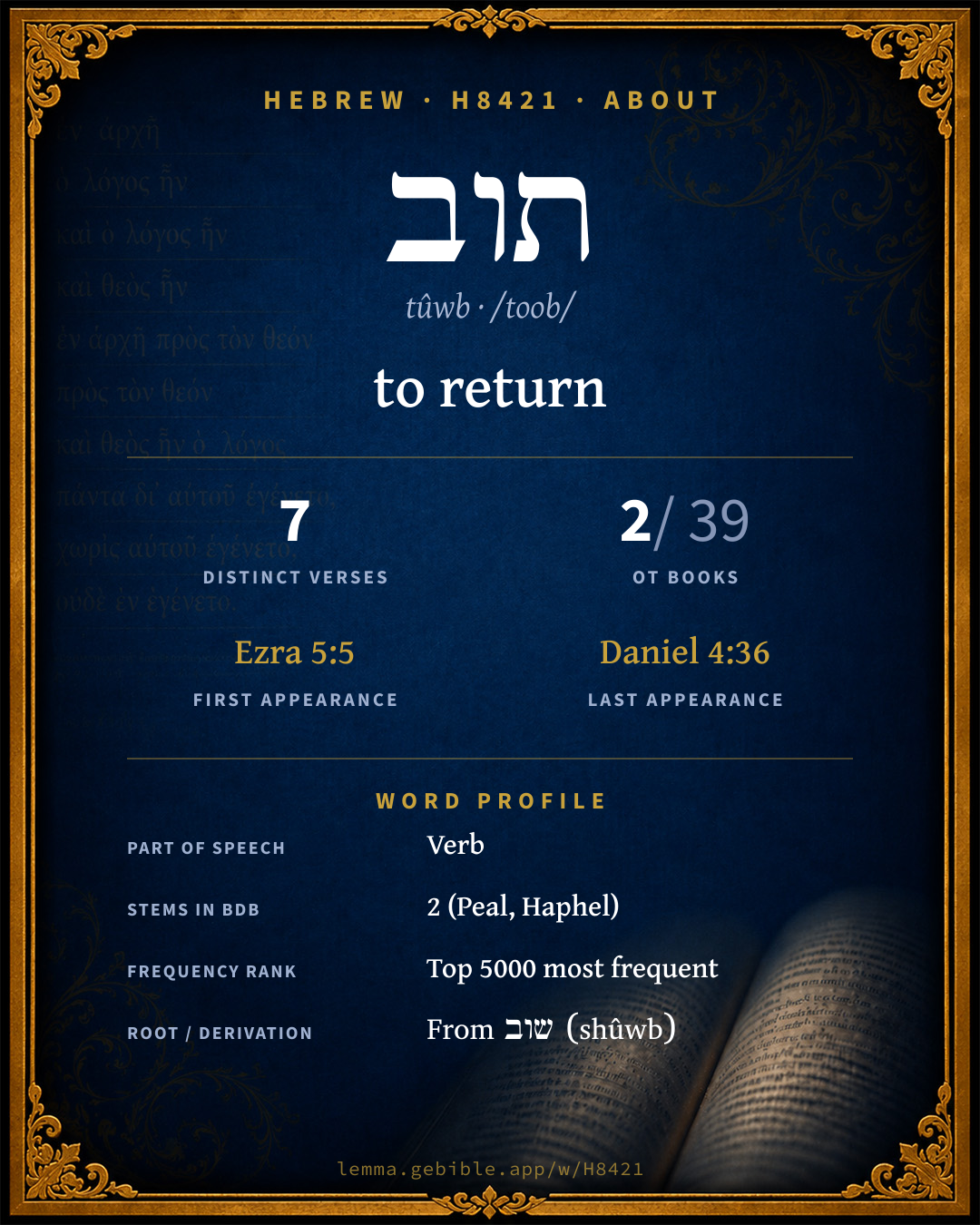
תּוּב
to return
‘to return’ is one of 2 main senses fuller range ↓
Full lexicon entry — Brown-Driver-Briggs (BDB)
From Brown-Driver-Briggs (BDB)
Where this word appears
See every Hiphil verb in the Hebrew Bible →
Grammar key — what these labels mean
Part of speech
- Verb
- An action or state-of-being word.
Stem
- Qal
- The basic, simple active stem — the plain form of the verb (“he wrote”).
- Hiphil
- The causative active stem (“he caused / brought about”).
Form
- Imperfect
- An incomplete, ongoing, or future action (“he will / would write”).
- Infinitive Construct
- A bound verbal noun, frequently with prepositions (“to write / in writing”).
- Perfect
- A completed action or state — Hebrew marks aspect (completeness) more than strict tense (“he wrote”).
Person
- 3rd Person
- The one spoken about (“he / she / it / they”).
Gender
- Masculine
- Grammatically masculine.
Number
- Singular
- One.
- Plural
- More than one (in Hebrew, generally three or more).
Grammatical forms
- Verb, Qal, Imperfect, 3rd Person, Masculine, Singular 3 times (38%)
- Verb, Hiphil, Infinitive Construct 1 time (13%)
- Verb, a, Imperfect, 3rd Person, Masculine, Plural 1 time (13%)
- Verb, Hiphil, Imperfect, 3rd Person, Masculine, Plural 1 time (13%)
- Verb, Hiphil, Perfect, 3rd Person, Masculine, Plural 1 time (13%)
- Verb, Hiphil, Perfect, 3rd Person, Masculine, Singular 1 time (13%)
Parsed forms decoded from the imported morphology (morphhb / Westminster Leningrad Codex — WLC text public domain, morphhb tagging CC BY 4.0), counted across 8 parsed occurrences — not distinct verses.
Every verse where H8421 appears — 7 distinct verses across 2 books. Click any verse to open its interlinear word-by-word view. Verse text shown in the World English Bible for context — . Each verse’s Hebrew form is shown with its reference; the English is not keyword-highlighted, since the data carries no word-level English alignment. Use “Compare translations” on any verse to read it across multiple English versions. This concordance covers the Hebrew Bible; Septuagint (Greek Old Testament) occurrences are not indexed here.
Ezra 3 verses
- Ezra 5:5 יְתִיב֥וּן a impf 3mp But the eye of their God was on the elders of the Jews, and they did not make them cease, until the matter should come to Darius, and then answer should be returned by letter concerning it.
- Ezra 5:11 הֲתִיב֣וּ/נָא Hiphil pf 3mp + sfx pers 1cp Thus they returned us answer, saying, We are the servants of the God of heaven and earth, and are building the house that was built these many years ago, which a great king of Israel built and finished.
- Ezra 6:5 יַהֲתִיב֗וּן Hiphil impf 3mp Also let the gold and silver vessels of the house of God, which Nebuchadnezzar took forth out of the temple which is at Jerusalem, and brought to Babylon, be restored, and brought again to the temple which is at Jerusalem, everyone to its place; and you shall put them in the house of God.
Daniel 4 verses
- Daniel 2:14 הֲתִיב֙ Hiphil pf 3ms Then Daniel returned answer with counsel and prudence to Arioch the captain of the king's guard, who was gone forth to kill the wise men of Babylon;
- Daniel 3:16 לַ/הֲתָבוּתָֽ/ךְ prep + Hiphil inf.cs + sfx pers 2ms Shadrach, Meshach, and Abednego answered the king, Nebuchadnezzar, we have no need to answer you in this matter.
- Daniel 4:34 יְת֔וּב Qal impf 3ms At the end of the days I, Nebuchadnezzar, lifted up my eyes to heaven, and my understanding returned to me, and I blessed the Most High, and I praised and honored him who lives forever; for his dominion is an everlasting dominion, and his kingdom from generation to generation.
- Daniel 4:36 יְת֣וּב יְת֣וּב Qal impf 3ms Qal impf 3ms At the same time my understanding returned to me; and for the glory of my kingdom, my majesty and brightness returned to me; and my counselors and my lords sought to me; and I was established in my kingdom, and excellent greatness was added to me.
About this entry
At a glance — auto-summarized from this page’s data, not written by a person. Every figure links to its source below. This summary describes the numbers; it doesn’t interpret them.
“to return” is the headline sense of the Hebrew verb תוב (tûwb). It clusters heavily in Daniel, which alone accounts for 57% of its uses. It turns up in 7 verses across 2 books, an uncommon footprint. First canonically at Ezra 5:5, it enters the text early. As a verb its force shifts by stem, across 2 stems (Peal, Haphel, and more). The sections below give every sense, occurrence, and version rendering.
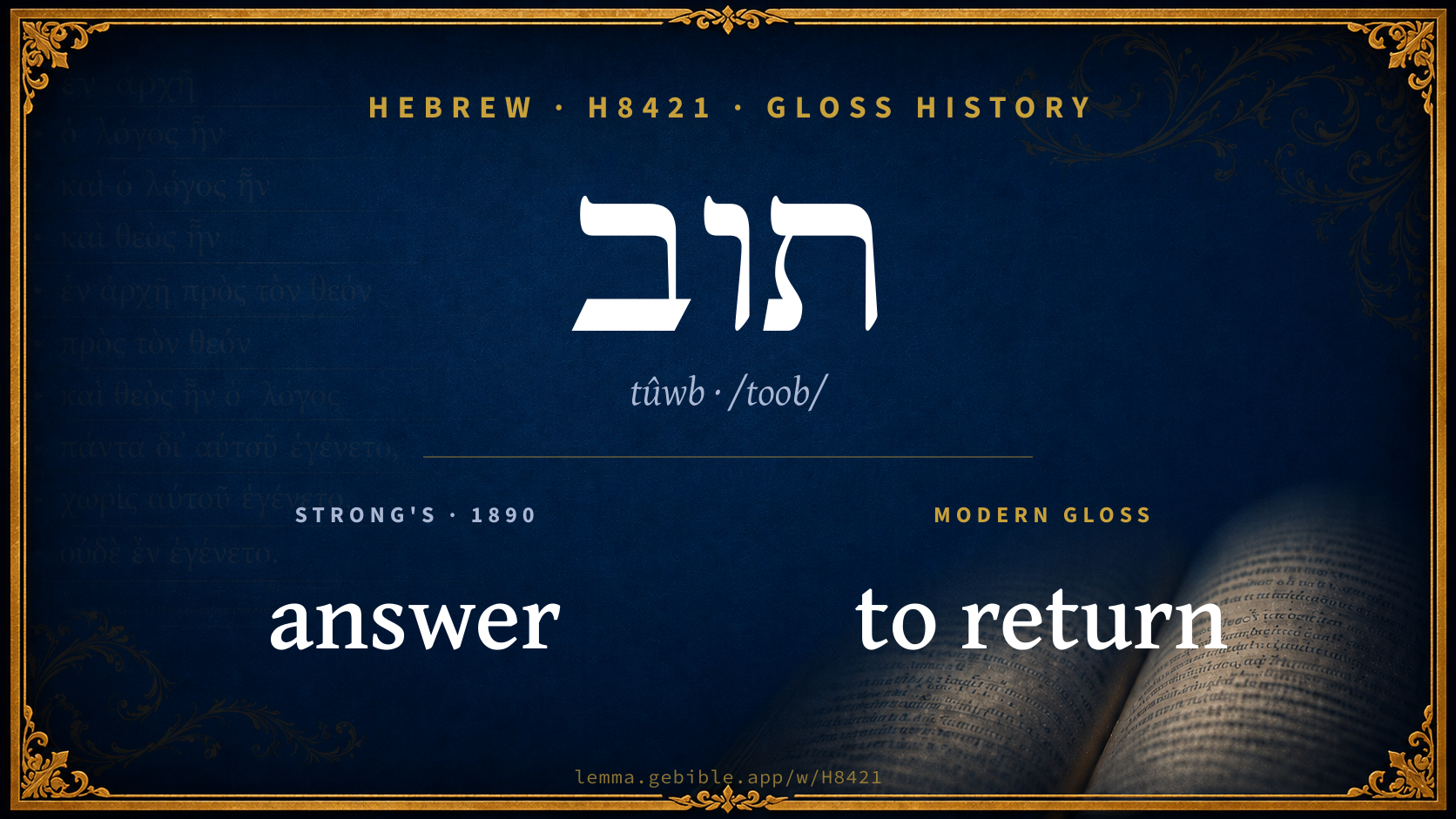
Gloss history
Strong's 1890 vs modern scholarship
About this word
Strong's H8421 catalogs a Hebrew word from the Hebrew Old Testament.
These counts are not copied from any lexicon or concordance. They are computed here, from the morphology-tagged Hebrew Old Testament. What Lemma adds →
- 7
- distinct verses
- The word appears in 7 distinct verses.
- 2 / 39
- OT books
- The word appears in 2 of 39 Old Testament books.
- #2,625
- by frequency
- Top 5000 most frequent Hebrew words (rank 2,625 of 8,640 Hebrew words by occurrence).
View all 7 occurrences in the concordance →
By traditional corpus
Conventional, traditional groupings — biblical authorship is debated, so this is a traditional corpus grouping, not an authorship claim. Each share is this word’s portion of its verses in that division of the Hebrew canon. Each figure is a share of the word’s 7 distinct verses.
- Writings (Ketuvim) 7 verses · 100%
How translations render this word
Counts come from each version’s own published word-to-Strong’s tagging or interlinear alignment — an approximate guide to how each version renders this word, not a word-level alignment the data otherwise carries. Because each total is that version’s own tagged count, the per-version totals vary from one another and need not match the appearance or distinct-verse counts above. These counts may also differ from a printed concordance because Lemma counts each distinctly tagged rendering and does not collapse phrase taggings into a single head-word total. This is a fixed set of word-tagged versions (KJV, ASV, BSB, ULT) and does not change with the reading translation you choose elsewhere. Each version’s license is shown beside its name below (and on Sources).
- King James Version: Returned 3×
- American Standard Version: Returned 3×, Answer 2×
- Berean Standard Bible: Was restored 2×
- unfoldingWord Literal Text: Returned 3×
King James Version Public Domain
Renders H8421 across 8 tagged occurrences — most commonly:
Plus 5 renderings that appear only once — usually multi-word phrases or single function words the recovered tagging swept in, not distinct renderings.
American Standard Version Public Domain
Renders H8421 across 8 tagged occurrences — most commonly:
Plus 3 renderings that appear only once — usually multi-word phrases or single function words the recovered tagging swept in, not distinct renderings.
Berean Standard Bible Public Domain
Renders H8421 across 8 tagged occurrences — most commonly:
Plus 6 renderings that appear only once — usually multi-word phrases or single function words the recovered tagging swept in, not distinct renderings.
unfoldingWord Literal Text CC BY-SA 4.0
Renders H8421 across 8 tagged occurrences — most commonly:
Plus 5 renderings that appear only once — usually multi-word phrases or single function words the recovered tagging swept in, not distinct renderings.
Senses in the full BDB
Hebrew verbs can shift meaning by stem (binyan): Qal is the basic action, Niphal is often passive or reflexive, Piel often intensifies or makes it factitive, and Hiphil is typically causative. The senses below are grouped under the stem BDB assigns to each. This entry also uses Peal (the basic Aramaic stem, parallel to Qal) and Haphel (the causative Aramaic stem, parallel to Hiphil).
What do BDB’s symbols mean?
BDB uses these scholarly abbreviations:
| Symbol | Meaning |
|---|---|
| 𝔊 | the Septuagint (the ancient Greek translation, LXX) |
| 𝔙 | the Vulgate (the Latin translation) |
| 𝔖 | the Syriac version (the Peshitta) |
| 𝔗 | the Targum (the Aramaic translation) |
| ψ | the Psalms |
| √ | root (the underlying root or stem) |
| ‖ | parallel passage (a synonymous or contrasted parallel) |
| † | the dagger: every passage where the word occurs is cited |
The 3 senses and sub-senses the full Brown-Driver-Briggs lexicon distinguishes for this word, in lexicon order (not ranked by frequency), with BDB’s own verbatim wording and sub-sense lettering. Shown in Hebrew script with BDB’s own scholarly abbreviations. The condensed entry is in the Lexicon Entry tab. See also the Forms in the corpus table below.
Peal
- . of brightness
Haphel
- 1. restore
- 2. return
Senses from the full Brown-Driver-Briggs lexicon (Brown, Driver, Briggs; Oxford 1906 — public domain), digitized via Sefaria, supplemented by the OpenScriptures HebrewLexicon (CC BY 4.0). Full attribution on Sources.
Word origin
Derived from שוב (shûwb) (H7725) — to return.
Jastrow Dictionary
A second Hebrew/Aramaic lexicon for comparison, covering Aramaic and post-biblical (Talmudic, Targumic, Midrashic) usage that the biblical-Hebrew BDB does not. Matched by lemma rather than by Strong’s number, so a lemma may carry more than one Jastrow headword (shown separately below), and the entries cover usage well beyond the Bible.
תּוּב I
- = h. שׁוּב,
- 1. to go back, return, do again. Targ. Gen. XIV, 7. Targ. O. ib. XVIII, 10 מֵיתַב אֵיתוּב ed. Berl. (ed. Vien. מִתַּב אִתּוּב); a. v. fr.—Part. תָּאֵב, תָּאֵיב; fr. which a verb תְּאֵב, תְּאֵיב. Targ. Ez. XXXV, 7. Targ. I Sam. XXVII, 9. Targ. Y. Gen. VIII, 3; a. fr.—Usually תָּיֵב, תָּיֵיב; f. תָּיְבָא, תָּיְי׳; pl. תָּיְבִין, תָּיְבֵי, תָּיְי׳; תָּיְבָן, תָּיְי׳. Targ. Am. IX, 1. Targ. I Sam. VII, 3. Targ. Gen. l. c.; a. fr.
- 2. to restore, v. infra., v. infra.
- 3. [to go back on,] to bethink one’s self, regret. Targ. O. a. Y. I Gen. VI, 6. Ib. 7. Targ. O. Ex. XXXII, 14; a. fr. e.g. Genesis 6:6
- , אֲתֵב, אוֹתִיב, הֵתֵיב
- 1. to lead back, turn; to give back, restore; to recompense. Targ. Jer. XXXII, 44. Targ. Ps. XIX, 8. Targ. Num. XXV, 11. Targ. Ex. XXII, 25. Targ. O. Num. V, 7 (Y. ed. Vien. יִתּוּב Pe.); a fr.—Part. pass. מְתֵיב. Targ. O. ib. 8 (ed. Vien. מְתֵב; Y. מְיֵיתַב(!)).— Trnsf. to throw up, vomit. Targ. Prov. XXV, 16.
- 2. to reconsider, bethink one’s self. Targ. O. Ex. XXXII, 12.
- 3. to answer, reply, refute. Targ. Num. XIII, 26. Targ. Job. XX, 2. Targ. Is. L, 11; a. fr.—Esp. to raise an objection, argue; to put a question. Pes. 2ᵃ, a. fr. מֵיתֵיבֵי they (the disputing scholars) raised an objection. Y. Ter. III, 42ᵇ מְתִיבִין קומי … ושתיק they put the question before R. J., and he kept silence. Y. Peah IV, 18ᵇ top התיב ר׳ זעירא וכ׳ R. Z. raised the question before &c. Ib. כל אילין … מוֹתִיב, v. הֲתוֹבְתָּא; (Y. Gitt. VIII, 49ᶜ top מֵשִׁיב h.). Sabb. 145ᵃ הוא מותיב וכ׳, v. פְּרַק. Y. R. Hash. I, 56ᵈ bot. הֲתִיבוּן וכ׳ they raised an objection &c. B. Kam. 56ᵇ bot. אֵיתֵיבֵיה … לרבה R. J. asked Rabbah. Lev. R. s. 11 אֵיתֵיבוּן וכ׳ they objected (by referring to the verse) &c. Ib. מְתִיבוּן ליה they argued against him. Y. Sabb. II, 5ᵃ bot. מְתִיב בר קפרא וכ׳ Bar Ḳ. argued before R. Ḥ. the elder; ומותיב לה והוא מְתַיֵּיב ליה and he raised the argument, and he also answered it. Ib. VII, 9ᵇ top וִיתִיבִינֵיה ר׳ וכ׳ and R. A. might have answered him &c.; ib. מן מה דלא מתיב וכ׳ because he did not answer him &c.; a. v. fr.
- same, to answer, meet an objection, v. supra.
- , Ittof. אִתּוֹתַב
- 1. to be brought back, be returned, restored. Targ. Gen. XLII, 28. Targ. Ex. X, 8. Targ. Ob. I, 15; a. fr.
- 2. to be answered; to be refuted. Targ. Job XI, 2. Ib. XIX, 7. Targ. Is. LIII, 7; a. fr.—Y. Taan. IV, 67ᶜ א"ל ולא כבר אִיתָּתְבַת said he to him, hast thou not been answered before?; א"ל ובגין דאִיתָּתְבִת תיבטל said he, and because I have been answered, shall it (that prayer) be abolished?; Y. Ber. IV, 7ᶜ top. Pes. 30ᵇ מאחר דאת׳ רבא וכ׳ (v. Rabb. D. S. a. l. note 8) now that R. bar I. has been refuted, why does Rab say &c.?; a. fr.
תּוּב II
- = h. שׁוּב II, again, furthermore. Targ. Job VII, 10. Targ. Ps. LXXVIII, 17; a. fr.—Naz. 20ᵇ ת׳ לא שבקת וכ׳ thou allowest no more room for the disciple (no more than three words of greeting); a. e.—With ן: תּוּבָן. Y. Ḥag. II, 77ᵇ ומה הויתה דריש ת׳ and what more hast thou been teaching? Y. Taan. III, 66ᶜ bot. נדר … דלא למיעבד כן ת׳ he vowed that he would never do it again. Y. B. Mets. II, 8ᶜ top מן כדון … לעי ת׳ henceforth thou shalt no longer have to work (for a living); a. e.—V. תּוּ II.
A Dictionary of the Targumim, the Talmud Babli and Yerushalmi, and the Midrashic Literature (Marcus Jastrow; London, Luzac, 1903) — Public Domain. Digitized via Sefaria. Digitized via Sefaria. Full attribution on Sources.
Forms in the corpus
The 7 distinct written forms H8421 takes in the Hebrew Bible, most frequent first — each parse links to that stem’s occurrences in the concordance. Hebrew forms include their vowel points and cantillation, so a single lemma takes many written forms.
| Form | Parsing | Example | Uses |
|---|---|---|---|
| יְת֣וּב | Verb, Qal, Imperfect, 3rd Person, Masculine, Singular | Daniel 4:36 | 2 |
| הֲתִיב֙ | Verb, Hiphil, Perfect, 3rd Person, Masculine, Singular | Daniel 2:14 | 1 |
| הֲתִיב֣וּ/נָא | Verb, Hiphil, Perfect, 3rd Person, Masculine, Plural | Ezra 5:11 | 1 |
| יְת֔וּב | Verb, Qal, Imperfect, 3rd Person, Masculine, Singular | Daniel 4:34 | 1 |
| יְתִיב֥וּן | Verb, a, Imperfect, 3rd Person, Masculine, Plural | Ezra 5:5 | 1 |
| יַהֲתִיב֗וּן | Verb, Hiphil, Imperfect, 3rd Person, Masculine, Plural | Ezra 6:5 | 1 |
| לַ/הֲתָבוּתָֽ/ךְ | Verb, Hiphil, Infinitive Construct | Daniel 3:16 | 1 |
Same root — word family
Other BDB entries built from the same root as H8421, grouped by Strong’s listed origin. These share a root / origin per the lexicon — not necessarily a shared meaning. Each links to that word’s own entry.
Derives from
Shares the same root
- משובה mᵉshûwbâh H4878 apostasy
- שובב shôwbâb H7726 backsliding
- שובב shôwbêb H7728 backsliding
- שובה shûwbâh H7729 withdrawal
- שיבה shîybâh H7870 restoration
- תשובה tᵉshûwbâh H8666 answer
Proper names from this root
People and places named from this root — a name, not an additional meaning of the word.
- יושב חסד Yûwshab Cheçed H3142 Jushab-hesed
- ישבי לחם Yâshubîy Lechem H3433 Jashubi-lehem
- ישבעם Yâshobʻâm H3434 Jashobeam
- ישוב Yâshûwb H3437 Jashub
- משובב Mᵉshôwbâb H4877 Meshobab
Compare all same-root words → Showing 4 of 13 — not the complete family. 5 of the same-root words are proper names (people or places). They share a root, not necessarily a meaning.
Septuagint verse parallels
This word appears in 5 verses that also exist in the Greek Old Testament (Septuagint), out of the 7 Hebrew verses it occurs in. You can read those verses in Greek by switching the Old Testament edition to the Septuagint.
Read these verses in the Septuagint
This is a verse-level parallel only — the same verses exist in both the Hebrew and Greek Old Testaments. No word-level Hebrew↔Greek correspondence is claimed: the data carries no such alignment, so no Greek word is shown as this Hebrew word’s translation. Coverage is not total — the Septuagint omits the deuterocanon and renumbers the Psalms, so some Hebrew verses have no direct Greek parallel.