
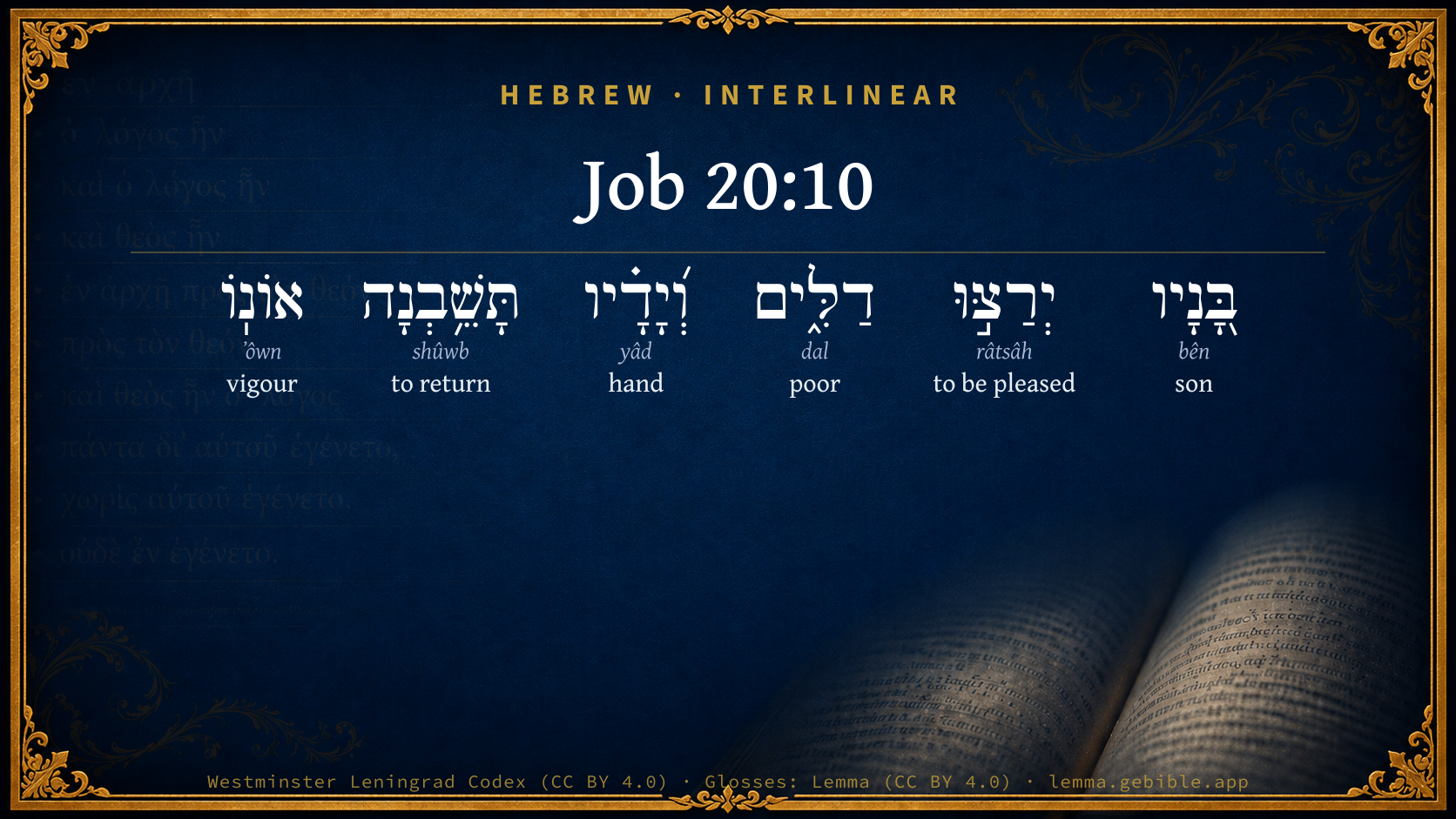
Job 20:10

Hebrew (Westminster Leningrad Codex) Job 20:10 appears in the Hebrew Old Testament. The text above is from the Westminster Leningrad Codex. Each word links to its Strong’s number, a concise gloss, and parsing drawn from the Open Scriptures Hebrew Bible morphology. Click any word for its full Brown-Driver-Briggs (BDB) entry.
Download image
Cite this verse

Job 20:10 (World English Bible). Public Domain. Lemma interlinear Bible study tool, https://lemma.gebible.app/v/job/20/10.

Show BibTeX & RIS
BibTeX
RIS
English Translation
His children shall seek the favor of the poor. His hands shall give back his wealth.
World English Bible · Public Domain
Download a study sheet

One document with this verse’s original text, its word-by-word gloss line, the meaning frame, cross-references with their text, attributed commentary, and full source and license credits — printable, and it pastes into notes with its structure intact.

This verse Autodidact and up

Study sheet (.html) Plain text (.txt)

A passage Seminary Student

Up to 50 verses in one chapter. A passage sheet keeps up to 6 commentary sources and 12 cross-references per verse, in the order this page ranks them, and says so on the sheet whenever that leaves anything out. Ask for a single verse and you get the Autodidact verse sheet above.

Everything on this page stays free to read, with no account — the sheet is a download of what is already on screen, not access to it.

Want to remove ads? Support Godless Engineer
Compare translations 3

The same verse in 3 English versions, stacked beneath the original-language interlinear above. Click any original word for its lexicon entry.

Each is an independent rendering of the whole verse — the interlinear is not word-aligned to these translations.

Highlighted words mark where these versions differ — a whole-verse word diff, not a word-by-word alignment.

  • World English Bible Public Domain
    His children shall seek the favor of the poor. His hands shall give back his wealth.
  • King James Version Public Domain
    His children shall seek to please the poor, and his hands shall restore their goods.
  • unfoldingWord Literal Text CC BY-SA 4.0
    His children will recompense the poor, and his hands will return his wealth.

unfoldingWord Literal Text — © unfoldingWord, licensed CC BY-SA 4.0. Word-aligned USFM3 via Door43 (git.door43.org/unfoldingWord/en_ult).

Versions to compare (up to 4)

3 of 4 selected

Show all 18 translations

Every available English version of this verse, each an independent rendering of the whole verse.

  • World English Bible Public Domain
    His children shall seek the favor of the poor. His hands shall give back his wealth.
  • Berean Standard Bible Public Domain
    His sons will seek the favor of the poor, for his own hands must return his wealth.
  • Majority Standard Bible Public Domain
    His sons will seek the favor of the poor, for his own hands must return his wealth.
  • King James Version Public Domain
    His children shall seek to please the poor, and his hands shall restore their goods.
  • American Standard Version (1901) Public Domain
    His children shall seek the favor of the poor, And his hands shall give back his wealth.
  • Revised Version (1885) Public Domain
    His children shall seek the favour of the poor, and his hands shall give back his wealth.
  • Geneva Bible (1599) Public Domain
    His children shall flatter the poore, and his hands shall restore his substance.
  • Douay-Rheims (1899) Public Domain
    His children shall be oppressed with want, and his hands shall render him his sorrow.
  • Young's Literal Translation Public Domain
    His sons do the poor oppress, And his hands give back his wealth.
  • Literal Standard Version CC BY-SA 4.0
    His sons oppress the poor, || And his hands give back his wealth.
  • Unlocked Literal Bible CC BY-SA 4.0
    His children will apologize to poor people; his hands will have to give back his wealth.
  • unfoldingWord Literal Text CC BY-SA 4.0
    His children will recompense the poor, and his hands will return his wealth.
  • Darby Bible Public Domain
    His children shall seek the favour of the poor, and his hands restore his wealth.
  • World Messianic Bible Public Domain
    His children will seek the favor of the poor. His hands will give back his wealth.
  • Webster's Bible Public Domain
    His children shall seek to please the poor, and his hands shall restore their goods.
  • Free Bible Version CC BY-SA 4.0
    Their children will have to pay back the poor; they will have to return their wealth.
  • Bible in Basic English Public Domain
    His children are hoping that the poor will be kind to them, and his hands give back his wealth.
  • JPS Tanakh (1917) Public Domain
    His children shall appease the poor, and his hands shall restore his wealth.

Literal Standard Version (2020), Covenant Press — licensed CC BY-SA 4.0. Text via the HelloAO Bible API (eBible.org). Unlocked Literal Bible (unfoldingWord) — licensed CC BY-SA 4.0. Text via the HelloAO Bible API (eBible.org). unfoldingWord Literal Text — © unfoldingWord, licensed CC BY-SA 4.0. Word-aligned USFM3 via Door43 (git.door43.org/unfoldingWord/en_ult). Free Bible Version, Dr. Jonathan Gallagher — licensed CC BY-SA 4.0. Text via the HelloAO Bible API (eBible.org).

Word by word

More ways to search: Search by grammar → Find every occurrence → Compare this word →

Practice this passage: Drill this verse → Learn its vocabulary →

About this verse

These counts appear in no published source. They are computed here, from the morphology-tagged text and Lemma’s own curated glosses. What Lemma adds →

6
words
6
distinct lemmas
Wisdom
section

Notable vocabulary

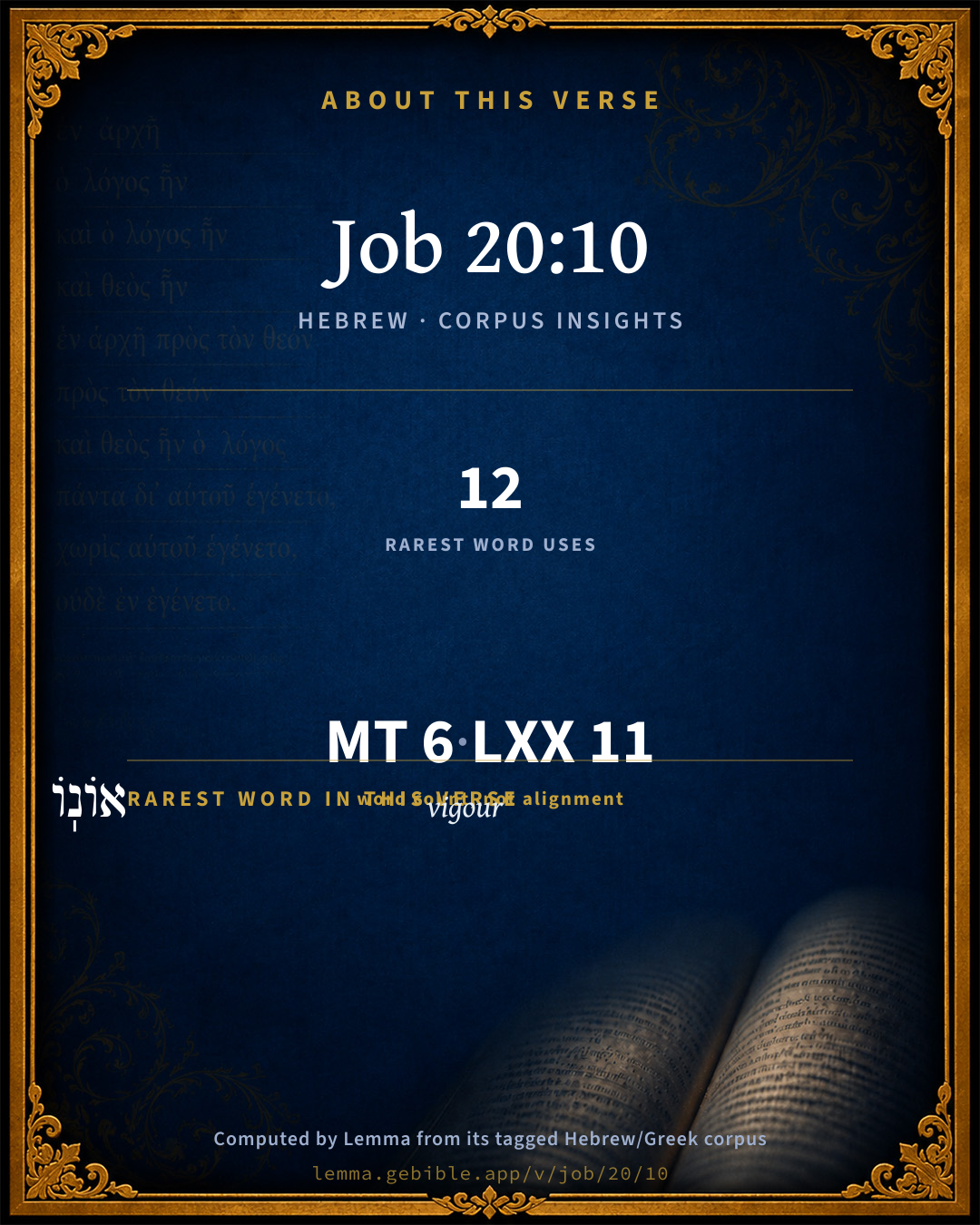
The rarest word here is אוֹנֽוֹ vigour H202 — appearing just 12 times in the whole Hebrew Bible.

Shared distinctive vocabulary

אוֹנֽוֹ vigour H202 occurs in 12 verses of the Hebrew Bible. Also found in:

Grammatical profile

  • 2 verbs
  • 3 nouns
  • 1 adjective

Verb forms

  • יְרַצּ֣וּ Piel · Imperfect
  • תָּשֵׁ֥בְנָה Hiphil · Imperfect

Hebrew & Septuagint length

In English translation the verse runs 16 words from the Hebrew and 15 from the Septuagint (LXX English) — closely comparable.

A rough comparison of the two English renderings, which tokenize alike — not a word-level alignment.

Word counts can differ between the Hebrew and the Greek without any difference in meaning — e.g. the Hebrew direct-object marker אֵת has no separate Greek word, and Greek often adds the article ὁ.

In the original languages it is 6 Hebrew tokens and 11 Greek tokens — but the two are counted differently (Hebrew bundles its prefixes and suffixes into one token; the Greek is in lemma form), so that isn’t a like-for-like length.

Cross-references

12

Topical passages linked to Job 20:10 in the Treasury of Scripture Knowledge — connected by theme and wording, ordered by reader-vote popularity; previews shown in the World English Bible.

  • Job 20:18 That for which he labored he shall restore, and shall not swallow it down; According to the substance that he has gotten, he shall not rejoice.
  • Job 27:16–17 Though he heap up silver as the dust, And prepare clothing as the clay;
  • Luke 19:8 Zacchaeus stood and said to the Lord, "Behold, Lord, half of my goods I give to the poor. If I have wrongfully exacted anything of anyone, I restore four times as much."
  • Exodus 9:2 For if you refuse to let them go, and hold them still,
  • Exodus 12:36 Yahweh gave the people favor in the sight of the Egyptians, so that they let them have what they asked. They despoiled the Egyptians.
  • Exodus 22:1 "If a man steals an ox or a sheep, and kills it, or sells it; he shall pay five oxen for an ox, and four sheep for a sheep.
  • Exodus 22:3 If the sun has risen on him, there shall be guilt of bloodshed for him; he shall make restitution. If he has nothing, then he shall be sold for his theft.
  • 2 Samuel 12:6 He shall restore the lamb fourfold, because he did this thing, and because he had no pity!"
  • Job 5:4 His children are far from safety, They are crushed in the gate. Neither is there any to deliver them,
  • Psalms 109:10 Let his children be wandering beggars. Let them be sought from their ruins.
  • Proverbs 6:31 But if he is found, he shall restore seven times. He shall give all the wealth of his house.
  • Proverbs 28:3 A needy man who oppresses the poor Is like a driving rain which leaves no crops.

Cross-references courtesy of OpenBible.info (CC BY 4.0).

Hebrew and Greek witnesses Masoretic Hebrew ↔ Greek Septuagint

The same verse in the two great witnesses to the Old Testament, shown verse-for-verse.

These are two independent witnesses, not word-aligned to each other, and the Septuagint is shown in lemma (dictionary) form.

Hebrew Job 20:10 Masoretic · Westminster Leningrad Codex

בָּ֭נָיו יְרַצּ֣וּ דַלִּ֑ים וְ֝יָדָ֗יו תָּשֵׁ֥בְנָה אוֹנֽוֹ

His children shall seek the favor of the poor. His hands shall give back his wealth.

World English Bible · Public Domain

Greek LXX Job 20:10 Septuagint · lemma form

ὁ υἱός αὐτός ὄλλυμι ἥσσων ὁ δέ χείρ αὐτός πυρσεύω ὀδύνη

Let his inferiors destroy his children, and let his hands kindle the fire of sorrow.

LXX2012 (modern English Septuagint) · Public Domain

Hebrew: Westminster Leningrad Codex (CC BY 4.0). Greek: Septuagint (public domain); English from LXX2012 (modern English Septuagint) (Public Domain). How the Septuagint differs from the Hebrew →

Commentary

Notes on Job 20:10 from classic Christian and Jewish commentators (each source and its license shown beneath its notes). The classic Christian expositions comment on the surrounding passage and are grouped to its opening verse, so a note may address several verses; the Jewish commentaries on the Tanakh (Rashi and others) are per-verse, so they appear only where the commentator wrote on this verse.

Lemma curates 59 commentaries, every one of them public domain or Creative Commons licensed, each selected and text-cleaned for this edition rather than reprinted as found. About our sources →

Matthew Henry's Commentary

The instances here given of the miserable condition of the wicked man in this world are expressed with great fulness and fluency of language, and the same thing returned to again and repeated in other words. Let us therefore reduce the particulars to their proper heads, and observe,

I. What his wickedness is for which he is punished.

1. The lusts of the flesh, here called the sins of his youth (Job 20:11); for those are the sins which, at that age, people are most tempted to. The forbidden pleasures of sense are said to be sweet in his mouth (Job 20:12); he indulges himself in all the gratifications of the carnal appetite, and takes an inordinate complacency in them, as yielding the most agreeable delights. That is the satisfaction which he hides under his tongue, and rolls there, as the most dainty delicate thing that can be. He keeps it still within his mouth (Job 20:13); let him have that, and he desires no more; he will never part with that for the spiritual and divine pleasures of religion, which he has no relish or nor affection for. His keeping it still in his mouth denotes his obstinately persisting in his sin (he spares it when he should kill and mortify it, and forsakes it not, but holds it fast, and goes on frowardly in it), and also his re-acting of his sin by revolving it and remembering it with pleasure, as that adulterous woman (Eze 23:19) who multiplied her whoredoms by calling to remembrance the days of her youth; so does this wicked man here. Or his hiding it and keeping it under his tongue denotes his industrious concealment of his beloved lust. Being a hypocrite, his haunts of sin are secret, that he may save the credit of his profession; but he who knows what is in the heart knows what is under the tongue too, and will discover it shortly.

2. The love of the world and the wealth of it. It is in worldly wealth that he places his happiness, and therefore he sets his heart upon it. See here, (1.) How greedy he is of it (Job 20:15): He has swallowed down riches as eagerly as ever a hungry man swallowed down meat; and is still crying, "Give, give." It is that which he desired (Job 20:20); it was, in his eye, the best gift, and that which he coveted earnestly. (2.) What pains he takes for it: It is that which he laboured for (Job 20:18), not by honest diligence in a lawful calling, but by an unwearied prosecution of all ways and methods, per fas, per nefas - right or wrong, to be rich. We must labour, not to be rich (Pro 23:4), but to be charitable, that we may have to give (Eph 4:28), not to spend. (3.) What great things he promises himself from it, intimated in the rivers, the floods, the brooks of honey and butter (Job 20:17); his being disappointed of them supposes that he had flattered himself with the hopes of them: he expected rivers of sensual delights.

3. Violence and oppression, and injustice in his poor neighbours, Job 20:19. This was the sin of the giants of the old world, and a sin that, as much as any, brings God's judgments upon nations and families. It is charged upon this wicked man, (1.) That he has forsaken the poor, taken no care of them, shown no kindness to them, nor made any provision for them. At first perhaps, for a pretence, he gave alms like the Pharisees, to gain a reputation; but, when he had served his turn by this practice, he left it off, and forsook the poor, whom before he seemed to be concerned for. Those who do good, but not from a good principle, though they may abound in it, will not abide in it. (2.) That he has oppressed them, crushed them, taken all advantages against them to do them a mischief. To enrich himself, he has robbed the spital, and made the poor poorer. (3.) That he has violently taken away their houses, which he had no right to, as Ahab took Naboth's vineyard, not by secret fraud, by forgery, perjury, or some trick in law, but avowedly, and by open violence.

II. What his punishment is for this wickedness.

1. He shall be disappointed in his expectations, and shall not find that satisfaction in his worldly wealth which he vainly promised himself (Job 20:17): He shall never see the rivers, the floods, the brooks of honey and butter, with which he hoped to glut himself. The world is not that to those who love it, and court it, and admire it, which they fancy it will be. The enjoyment sinks far below the raised expectation.

2. He shall be diseased and distempered in his body; and how little comfort a man has in riches if he has not health! Sickness and pain, especially it they be in extremity, embitter all his enjoyments. This wicked man has all the delights of sense wound up to the height of pleasurableness; but what real happiness can he enjoy when his bones are full of the sins of his youth (Job 20:11), that is, of the effects of those sins? By his drunkenness and gluttony, his uncleanness and wantonness, when he was young, he contracted those diseases which are painful to him long after, and perhaps make his life very miserable, and, as Solomon speaks, consume his flesh and his body, Pro 5:11. Perhaps he was given to fight when he was young, and then made nothing of a cut or a bruise in a fray; but he feels it in his bones long after. But can he get no ease, no relief? No, he is likely to carry his pains and diseases with him to the grave, or rather they are likely to carry him thither, and so the sins of his youth shall lie down with him in the dust; the very putrefying of his body in the grave is to him the effect of sin (Job 24:19), so that his iniquity is upon his bones there, Eze 32:27. The sin of sinners follows them to the other side death.

3. He shall be disquieted and troubled in his mind: Surely he shall not feel quietness in his belly, Job 20:20. He has not that ease in his own mind that people think he has, but is in continual agitation. The ill-gotten wealth which he has swallowed down makes him sick, and, like undigested meat, is always upbraiding him. Let none expect to enjoy that comfortably which they have gotten unjustly. The unquietness of his mind arises, (1.) From his conscience looking back, and filling him with the fear of the wrath of God against him for his wickedness. Even that wickedness which was sweet in the commission, and was rolled under the tongue as a delicate morsel, becomes bitter in the reflection, and, when it is reviewed, fills him with horror and vexation. In his bowels it is turned (Job 20:14) like John's book, in his mouth as sweet as honey, but, when he had eaten it, his belly was bitter, Rev 10:10. Such a thing is sin; it is turned into the gall of asps, than which nothing is more bitter, the poison of asps (Job 20:16), than which nothing more fatal, and so it will be to him; what he sucked so sweetly, and with so much pleasure, will prove to him the poison of asps; so will all unlawful gains be. The fawning tongue will prove the viper's tongue. All the charming graces that are thought to be in sin will, when conscience is awakened, turn into so many raging furies. (2.) From his cares, looking forward, Job 20:22. In the fulness of his sufficiency, when he thinks himself most happy, and most sure of the continuance of his happiness, he shall be in straits, that is, he shall think himself so, through the anxieties and perplexities of his own mind, as that rich man who, when his ground brought forth plentifully, cried out, What shall I do? Luk 12:17.

4. He shall be dispossessed of his estate; that shall sink and dwindle away to nothing, so that he shall not rejoice therein, Job 20:18. He shall not only never rejoice truly, but not long rejoice at all. (1.) What he has unjustly swallowed he shall be compelled to disgorge (Job 20:15): He swallowed down riches, and then thought himself sure of them, and that they were as much his own as the meat he had eaten; but he was deceived: he shall vomit them up again; his own conscience perhaps may make him so uneasy in the keeping of what he has gotten that, for the quiet of his own mind, he shall make restitution, and that not with the pleasure of a virtue, but the pain of a vomit, and with the utmost reluctancy. Or, if he do not himself refund what he has violently taken away, God will, by his providence, force him to it, and bring it about, one way or other, that ill-gotten goods shall return to the right owners: God shall cast them out of his belly, while yet the love of the sin is not cast out of his heart. So loud shall the clamours of the poor, whom he has impoverished, be against him, that he shall be forced to send his children to them to soothe them and beg their pardon (Job 20:10): His children shall seek to please the poor, while his own hands shall restore them their goods with shame (Job 20:18): That which he laboured for, by all the arts of oppression, shall he restore, and shall not so swallow it down as to digest it; it shall not stay with him, but according to his shame shall the restitution be; having gotten a great deal unjustly, he shall restore a great deal, so that when every one has his own he will have but little left for himself. To be made to restore what was unjustly gotten, by the sanctifying grace of God, as Zaccheus was, is a great mercy; he voluntarily and cheerfully restored four-fold, and yet had a great deal left to give to the poor, Luk 19:8. But to be forced to restore, as Judas was, merely by the horrors of a despairing conscience, has none of that benefit and comfort attending it, for he threw down the pieces of silver and went and hanged himself. (2.) He shall be stripped of all he has and become a beggar. He that spoiled others shall himself be spoiled (Isa 33:1); for every hand of the wicked shall be upon him. The innocent, whom he has wronged, sit down by their loss, saying, as David, Wickedness proceedeth from the wicked, but my hand shall not be upon him, Sa1 24:13. But though they have forgiven him, though they will make no reprisals, divine justice will, and often makes the wicked to avenge the quarrel of the righteous, and squeezes and crushes one bad man by the hand of another upon him. Thus, when he is plucked on all sides, he shall not save of that which he desired (Job 20:20), not only he shall not save it all, but he shall save nothing of it. There shall none of his meat (which he coveted so much, and fed upon with so much pleasure) be left, Job 20:21. All his neighbours and relations shall look upon him to be in such bad circumstances that, when he is dead, no man shall look for his goods, none of his kindred shall expect to be a penny the better for him, nor be willing to take out letters of administration for what he leaves behind him. In all this Zophar reflects upon Job, who had lost all and was reduced to the last extremity.

Matthew Henry's Commentary on the Whole Bible (1708–1710) — public domain (CC PDM 1.0). Text via the HelloAO Bible API.

The Cambridge Bible for Schools and Colleges

gen. ed. J. J. S. Perowne

10. His children shall seek to please] Or, seek the favour of. The margin is possible, The poor shall oppress his children, but less suitable.

restore their goods] Rather, his goods. He shall give back his wealth which he has gotten by unlawful and violent means. The first clause of Job_20:10 is closely connected with Job_20:9, and paints the abject condition of the sinner’s children after his death; the second clause of Job_20:10 and Job_20:11 return to the idea of the sinner’s destruction and assume that he is in life.

The Cambridge Bible for Schools and Colleges (gen. ed. J. J. S. Perowne; Cambridge University Press, 1878–1918) — public domain. Text from a community e-Sword module.

Trapp's Complete Commentary

John Trapp

Job 20:10 His children shall seek to please the poor, and his hands shall restore their goods.

Ver. 10. His children shall seek to please the poor] Tenuiores sunt ipsis tenuibus, saith Junius; shall be poorer than the poorest, and full glad to comply with them, and humour them, to beg with them, if not to beg of them. A just hand of God upon oppressors, whose work it hath been to make many poor; and now their posterity are brought to extreme poverty. Such shame consult these men to their houses, besides their sin against their own souls, Hab 2:10. {See Trapp on "Hab 2:10"} Some read it thus, The poor shall oppress his children; and how grievous that is, see Pro 28:3. {See Trapp on "Pro 28:3"} A heathen historian observed that Dionysius, after his death, paid dear for his sacrilege, in the disasters that befell his children (Val. lib. 1, cap. 2).

And his hands shall restore their goods] Or, For his hands shall, &c. They should indeed restore their ill gotten goods, though to the impoverishing of their posterity, though they left their children no more but a wallet, to beg from door to door. But such are rare birds; most men will rather venture it than be drawn, Zacchaeus like, to make restitution. God must give them a vomit, as Job 20:20, or they will lay up nothing; part they will not with those murdering morsels, that riches of iniquity {Luk 16:9} they have devoured, but what they can nor will nor choose, as being compelled to do it either by law or force, either by justice or violence. The right owners do not always receive what was by wrench or wile gotten from them; but these oppressors or their imps are many times rooked or robbed by others as bad as themselves (as the usurious Jews are in this day by the injurious Papists, who use them as spunges, which they may squeeze at their pleasure); God so disposing and ordering the disorders of men to his own glory.

John Trapp, A Commentary or Exposition upon All the Books of the Old and New Testament (1647–1656) — public domain. Text from a community e-Sword module.

Joseph Benson's Commentary

Job 20:10. His children shall seek to please the poor — Either, 1st, To get some small relief from them in their extreme necessity. Or, rather, 2d, Lest they should revenge themselves on them for the great and many injuries which their father did them, or should seek to the magistrate for reparation. His hands shall restore their goods — By the sentence of the judge, to whom the oppressed poor will appeal, notwithstanding all the endeavours of their oppressors to dissuade them from so doing.

Joseph Benson's Commentary on the Old and New Testaments (1811–1818) — public domain. Text from a community e-Sword module.

Tyndale Open Study Notes

Tyndale Open Resources

20:10 Because stolen riches are ill-gotten, they provide no lasting benefit (20:18-21).

Tyndale Open Study Notes — © Tyndale Open Resources, licensed CC BY-SA 4.0. Text via the HelloAO Bible API.

Geneva Bible (1599)

Geneva Bible translators

Whereas the father through ambition and tyranny oppressed the poor, the children through poverty and misery, shall seek favor at the poor.

So that the thing which he hath taken away by violence shall be restored again by force.

Geneva Bible (1599) marginal notes — public domain. Text via Bolls.life.

Jamieson, Fausset & Brown

Robert Jamieson, A. R. Fausset & David Brown

seek to please--"Atone to the poor" (by restoring the property of which they had been robbed by the father) [DE WETTE]. Better than English Version, "The children" are reduced to the humiliating condition of "seeking the favor of those very poor," whom the father had oppressed. But UMBREIT translates as Margin.

his hands--rather, "their (the children's) hands."

their goods--the goods of the poor. Righteous retribution! (Exo 20:5).

Jamieson, Fausset & Brown — Commentary Critical and Explanatory on the Whole Bible (1871) — public domain (CC PDM 1.0). Text via the HelloAO Bible API.

Adam Clarke's Commentary

Verse 10. His children shall seek to please the poor] They shall be reduced to the lowest degree of poverty and want, so as to be obliged to become servants to the poor. Cursed be Ham, a servant of servants shall he be. There are cases where the poor actually serve the poor; and this is the lowest or most abject state of poverty.

His hands shall restore their goods.] He shall be obliged to restore the goods that he has taken by violence.

Mr. Good translates: His branches shall be involved in his iniquity; i.e., his children shall suffer on his account. "His own hands shall render to himself the evil that he has done to others." - Calmet. The clause is variously translated.

Adam Clarke's Commentary on the Bible (1810–1826) — public domain. Text from a community e-Sword/MySword module.

Ellicott's Commentary for English Readers

(10) His children shall seek to please the poor.—That is, shall seek their favour by making good what had been taken from them, or otherwise; or it may be rendered, the poor shall oppress his children.

A Bible Commentary for English Readers, edited by Charles John Ellicott (1878–1897) — public domain. Text from a community e-Sword module.

John Gill's Exposition

His children shall seek to please the poor,.... In this and some following verses the miserable state of a wicked man is described, and which begins with his children, who are often visited in wrath for their parents' sins, especially when they tread in their steps, and follow their example; and it is an affliction to parents to see their children in distress, and particularly on their account, and even to be threatened with it. According to our version, the sense of this clause is, that after a wicked man's death his children shall seek to gain the good will and favour of the poor who have been oppressed by him, that they may not reproach them, or take revenge on them, or apply to the civil magistrate to have justice done them; but Jarchi renders the words,

"the poor shall oppress or destroy his children;''

and so the margin of our Bible, who, being enraged with the ill usage of their parents, shall fall upon them in great wrath, and destroy them, Pro 28:3; and the same Jewish writer restrains the words to the men of Sodom, who were oppressive and cruel to the poor; or rather the sense is, that the children of the wicked man shall be reduced to such extreme poverty, that they shall even seek relief of the poor, and supplicate and entreat them to give them something out of their small pittance; with which others in a good measure agree, who render the words, "his children shall please, being poor" (n); it shall be a pleasure and satisfaction to those they have been injurious to, to see their children begging their bread from door to door, see Psa 109:5;

and his hands shall restore their goods: or "for his hands", &c. (o); and so are a reason why his children shall be so reduced after his death as to need the relief of others, because their parent, in his lifetime, was obliged to make restitution of his ill gotten goods, so that in the end he had nothing to leave his children at his death; for this restitution spoken of is not voluntary, but forced. Sephorno thinks reference is had to the Egyptians lending jewels and other riches to the Israelites, whereby they were obliged to repay six hundred thousand men for their service.

(n) "filii ejus placabunt, mendici", Montanus. (o) So the English annotator.

John Gill's Exposition of the Whole Bible (1746–1763) — public domain (CC PDM 1.0). Text via the HelloAO Bible API.

Albert Barnes' Notes on the Bible

His children shall seek to please the poor - Margin, or, “the poor shall oppress his children.” The idea in the Hebrew seems to be, that his sons shall be reduced to the humiliating condition of asking the aid of the most needy and abject. Instead of being in a situation to assist others, and to indulge in a liberal hospitality, they themselves shall be reduced to the necessity of applying to the poor for the means of subsistence. There is great strength in this expression. It is usually regarded as humiliating to be compelled to ask aid at all; but the idea here is, that they would be reduced to the necessity of asking it of those who themselves needed it, “or would be beggars of beggars.”

And his hands shall restore their goods - Noyes renders this, “And their hands shall give back his wealth.” Rosenmuller supposes it means, “And their hands shall restore his iniquity;” that is, what their father took unjustly away. There can be but little doubt that this refers to his “sons,” and not to himself - though the singular suffix in the word (ידיו yâdāŷ), “his hands” is used. But the singular is sometimes used instead of the plural. The word rendered “goods” (און 'ôn), means “strength, power, and then wealth;” and the idea here is, that the hands of his sons would be compelled to give back the property which the father had unjustly acquired. Instead of retaining and enjoying it, they would be compelled to make restitution, and thus be reduced to penury and want.

Albert Barnes' Notes on the Bible (1834–1885) — public domain. Text from a community e-Sword/MySword module.

Haydock's Catholic Bible Commentary

Be. Hebrew, "seek to please the poor, and his hands shall restore their goods," which the wicked had gotten by oppression. (Haydock)

George Leo Haydock (1774–1849), Haydock's Catholic Family Bible and Commentary, 1859 edition — public domain. Excludes Psalms (Douay-Rheims chapter numbering differs from Protestant) and Deuterocanonical books (Catholic canon only).

Matthew Poole's English Annotations

Shall seek to please the poor; either,

1. To get some small relief from them in their extreme necessity. Or rather,

2. Lest they should revenge themselves of them for the great and many injuries which their father did them, or seek to the magistrate for reparations.

His hands shall restore their goods, by the sentence of the judge, to whom the oppressed poor will appeal, notwithstanding all their entreaties and endeavours to dissuade them from so-doing.

Matthew Poole's English Annotations on the Holy Bible (1683–1685) — public domain. Text from a community e-Sword/MySword module.

Whedon's Commentary on the Bible

Daniel D. Whedon

10. Seek to please the poor — Some adopt the marginal reading, but the text is preferable. So low are they reduced that they fawn upon the poor, lest the latter take revenge for the mis-doings of the parents of the former.

Their goods — His substance, that is, extorted wealth.

Daniel D. Whedon (gen. ed.), Commentary on the Old and New Testaments (1874–1909) — public domain. Text from a community e-Sword module.

The Pulpit Commentary

His children shall seek to please the poor. Another rendering is, "The poor shall oppress his children," since the meaning of the verb WXry is doubtful. But the translation of the Authorized Version seems preferable. His children will curry favour with the poor, either by making restitution to them on account of their father"s injuries, or simply because they are friendless, and desire to ingratiate themselves with some one. And his hands shall restore their goods (comp. vers. 15 and 18). He himself will be so crushed and broken in spirit that he will give back with his own hands the goods whereof he has deprived the poor. The restitution, i.e. , will be made, in many cases, not by the oppressor"s children, but by the oppressor himself.

The Pulpit Commentary (1880–1919), ed. H.D.M. Spence-Jones & Joseph S. Exell — public domain. Text from a community e-Sword module.

unfoldingWord translationNotes

Door43 World Missions Community

General Information:

Zophar continues speaking to Job.

His children

"The wicked person's children"

his hands will have to give back his wealth

Here the word "hands" refers to the wicked man's children. When he dies, his children will have to return everything that he took from others. (See: Metonymy)

His bones are full of youthful strength

The word "bones" represents his body. Being "full of youthful strength" represents being strong like a young person. AT: "His body is strong like a young person's body" (See: Synecdoche and Metaphor)

but it will lie down with him in the dust

The word "it" refers to his youthful strength. The metonym "lie down ... in the dust" represents dying. The strength dying is a metaphor for disappearing. AT: "but his youthful strength will die with him" or "but his youthful strength will disappear when he dies" (See: Metonymy and Metaphor)

translationWords

children

hand

unfoldingWord translationNotes — © Distant Shores Media and the Door43 World Missions Community, licensed CC BY-SA 4.0. Source: git.door43.org/Door43/en_tn.

Rashi

Rabbi Shlomo Yitzchaki (Rashi)

His sons will placate the poor This reply was stated in reference to the people of Sodom, who were robbers and were cruel to the poor.

and his hands will return He will return the plunder of his hands.

his plunder The power of his force.

Rashi on the Tanakh — English translations: “The Judaica Press complete Tanach with Rashi, translated by A. J. Rosenberg” (CC BY 4.0); “Pentateuch with Rashi's commentary by M. Rosenbaum and A.M. Silbermann, 1929-1934” (public domain); “The Metsudah Tanach series, Lakewood, N.J” (CC BY 4.0); and “The Book of Joshua, Metsudah Publications, 1997” (CC BY 4.0). Text via Sefaria.

Lesson kit

Teaching starters — assembled from the data on this page, not authored interpretation. Every prompt links to the verse data it draws on. Edit before teaching.

Job, in the Wisdom, opens this verse with 6 words (6 distinct Hebrew lemmas). Its most distinctive word is ʼôwn (“vigour”). A historical commentator’s framing appears above. Read the whole chapter for the surrounding context.

Discussion questions

  1. How does “vigour” (ʼôwn) shape what this verse is saying?
  2. Genesis 49:3 shares the word «vigour» with this verse. How do the two illuminate each other?
  3. These translations render this verse differently. What is at stake in choosing one wording over another?
  4. The verb «יְרַצּ֣וּ» is Piel Imperfect. How does its form color the action?
  5. Reading how Matthew Henry's Commentary and The Cambridge Bible for Schools and Colleges read this verse, where do the two commentators agree and where do they part?

Things to notice

Reading settings

Reading text

Shown beneath each verse's original-language words.

Old Testament
Old Testament edition

Read the OT as the Masoretic Hebrew (MT) or the Greek Septuagint (LXX).

English shown for the Greek Septuagint (in the Hebrew ↔ Greek comparison).

Comparing translations? Open the Compare panel on any verse page to stack up to four side by side.