
Ezekiel 14:6

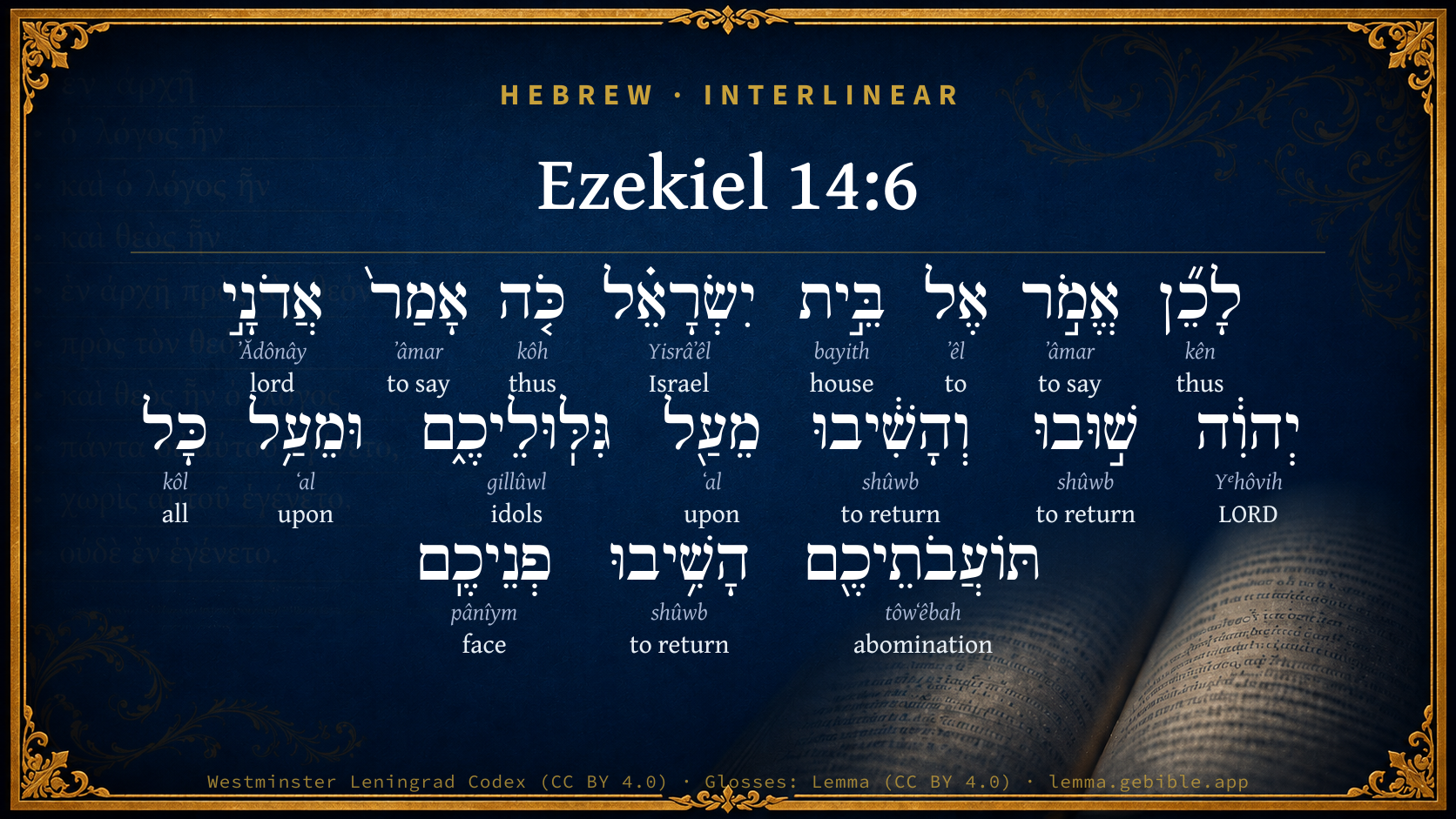
Hebrew (Westminster Leningrad Codex) Ezekiel 14:6 appears in the Hebrew Old Testament. The text above is from the Westminster Leningrad Codex. Each word links to its Strong’s number, a concise gloss, and parsing drawn from the Open Scriptures Hebrew Bible morphology. Click any word for its full Brown-Driver-Briggs (BDB) entry.
Download image
Cite this verse

Ezekiel 14:6 (World English Bible). Public Domain. Lemma interlinear Bible study tool, https://lemma.gebible.app/v/ezekiel/14/6.

Show BibTeX & RIS
BibTeX
RIS
English Translation
Therefore tell the house of Israel, Thus says the Lord Yahweh: Return you, and turn yourselves from your idols; and turn away your faces from all your abominations.
World English Bible · Public Domain
Download a study sheet

One document with this verse’s original text, its word-by-word gloss line, the meaning frame, cross-references with their text, attributed commentary, and full source and license credits — printable, and it pastes into notes with its structure intact.

This verse Autodidact and up

Study sheet (.html) Plain text (.txt)

A passage Seminary Student

Up to 50 verses in one chapter. A passage sheet keeps up to 6 commentary sources and 12 cross-references per verse, in the order this page ranks them, and says so on the sheet whenever that leaves anything out. Ask for a single verse and you get the Autodidact verse sheet above.

Everything on this page stays free to read, with no account — the sheet is a download of what is already on screen, not access to it.

Want to remove ads? Support Godless Engineer
Compare translations 3

The same verse in 3 English versions, stacked beneath the original-language interlinear above. Click any original word for its lexicon entry.

Each is an independent rendering of the whole verse — the interlinear is not word-aligned to these translations.

Highlighted words mark where these versions differ — a whole-verse word diff, not a word-by-word alignment.

  • World English Bible Public Domain
    Therefore tell the house of Israel, Thus says the Lord Yahweh: Return you, and turn yourselves from your idols; and turn away your faces from all your abominations.
  • King James Version Public Domain
    Therefore say unto the house of Israel, Thus saith the Lord GOD; Repent, and turn yourselves from your idols; and turn away your faces from all your abominations.
  • unfoldingWord Literal Text CC BY-SA 4.0
    Therefore say to the house of Israel, ‘The Lord Yahweh says this: Repent and turn away from your idols! Turn back your faces from all your abominations.

unfoldingWord Literal Text — © unfoldingWord, licensed CC BY-SA 4.0. Word-aligned USFM3 via Door43 (git.door43.org/unfoldingWord/en_ult).

Versions to compare (up to 4)

3 of 4 selected

Show all 18 translations

Every available English version of this verse, each an independent rendering of the whole verse.

  • World English Bible Public Domain
    Therefore tell the house of Israel, Thus says the Lord Yahweh: Return you, and turn yourselves from your idols; and turn away your faces from all your abominations.
  • Berean Standard Bible Public Domain
    Therefore tell the house of Israel that this is what the Lord GOD says: ‘Repent and turn away from your idols; turn your faces away from all your abominations.
  • Majority Standard Bible Public Domain
    Therefore tell the house of Israel that this is what the Lord GOD says: ‘Repent and turn away from your idols; turn your faces away from all your abominations.
  • King James Version Public Domain
    Therefore say unto the house of Israel, Thus saith the Lord GOD; Repent, and turn yourselves from your idols; and turn away your faces from all your abominations.
  • American Standard Version (1901) Public Domain
    Therefore say unto the house of Israel, Thus saith the Lord Jehovah: Return ye, and turn yourselves from your idols; and turn away your faces from all your abominations.
  • Revised Version (1885) Public Domain
    Therefore say unto the house of Israel, Thus saith the Lord GOD: Return ye, and turn yourselves from your idols; and turn away your faces from all your abominations.
  • Geneva Bible (1599) Public Domain
    Therfore say vnto the house of Israel, Thus sayth the Lord God, Returne, and withdraw your selues, and turne your faces from your idoles, and turne your faces from all your abominations.
  • Douay-Rheims (1899) Public Domain
    Therefore say to the house of Israel: Thus saith the Lord God: Be converted, and depart from your idols, and turn away your faces from all your abominations.
  • Young's Literal Translation Public Domain
    `Therefore say unto the house of Israel: Thus said the Lord Jehovah: Turn ye back, yea, turn ye back from your idols, and from all your abominations turn back your faces,
  • Literal Standard Version CC BY-SA 4.0
    Therefore say to the house of Israel, Thus said Lord YHWH: Turn back, indeed, turn back from your idols, and turn back your faces from all your abominations,
  • Unlocked Literal Bible CC BY-SA 4.0
    Therefore say to the house of Israel, 'The Lord Yahweh says this: Repent and turn away from your idols! Turn back your faces from all your abominations.
  • unfoldingWord Literal Text CC BY-SA 4.0
    Therefore say to the house of Israel, ‘The Lord Yahweh says this: Repent and turn away from your idols! Turn back your faces from all your abominations.
  • Darby Bible Public Domain
    Therefore say unto the house of Israel, Thus saith the Lord Jehovah: Return ye, and turn yourselves from your idols; and turn away your faces from all your abominations.
  • World Messianic Bible Public Domain
    “Therefore tell the house of Israel, ‘The Lord GOD says: “Return, and turn yourselves from your idols! Turn away your faces from all your abominations.
  • Webster's Bible Public Domain
    Therefore say to the house of Israel, Thus saith the Lord GOD; Repent, and turn yourselves from your idols; and turn away your faces from all your abominations.
  • Free Bible Version CC BY-SA 4.0
    So tell the people of Israel that this is what the Lord God says: Repent! Give up worshiping your idols Stop all your disgusting practices.
  • Bible in Basic English Public Domain
    For this cause say to the children of Israel, These are the words of the Lord: Come back and give up your false gods and let your faces be turned from your disgusting things.
  • JPS Tanakh (1917) Public Domain
    Therefore say unto the house of Israel: Thus saith the Lord GOD: Return ye, and turn yourselves from your idols; and turn away your faces from all your abominations.

Literal Standard Version (2020), Covenant Press — licensed CC BY-SA 4.0. Text via the HelloAO Bible API (eBible.org). Unlocked Literal Bible (unfoldingWord) — licensed CC BY-SA 4.0. Text via the HelloAO Bible API (eBible.org). unfoldingWord Literal Text — © unfoldingWord, licensed CC BY-SA 4.0. Word-aligned USFM3 via Door43 (git.door43.org/unfoldingWord/en_ult). Free Bible Version, Dr. Jonathan Gallagher — licensed CC BY-SA 4.0. Text via the HelloAO Bible API (eBible.org).

Word by word

More ways to search: Search by grammar → Find every occurrence → Compare this word →

Practice this passage: Drill this verse → Learn its vocabulary →

גִּלּֽוּלֵיכֶ֑ם
gillûwl
H1544
“idols · your”
Noun, Common, Masculine, Plural, Construct + Suffix, Personal, 2nd Person, Masculine, Plural
Part of Speech
Noun
Type
Common
Gender
Masculine
Number
Plural
State
Construct
Full BDB Definition

Origin: from H1556

TWOT: 353h

idols
  1. לָכֵ֞ן kên H3651 “to/for · thus” Preposition + Adverb
  2. אֱמֹ֣ר ʼâmar H559 “say” Verb, Qal, Imperative, 2nd Person, Masculine, Singular
  3. אֶל ʼêl H413 “to” Preposition
  4. בֵּ֣ית bayith H1004 “house of” Noun, Common, Masculine, Singular, Construct
  5. יִשְׂרָאֵ֗ל Yisrâʼêl H3478 “Israel” Noun, Proper
  6. כֹּ֤ה kôh H3541 “thus” Adverb
  7. אָמַר֙ ʼâmar H559 “to say” Verb, Qal, Perfect, 3rd Person, Masculine, Singular
  8. אֲדֹנָ֣י ʼĂdônây H136 “Lord · my” Noun, Common, Masculine, Plural, Construct + Suffix, Personal, 1st Person, Common, Singular
  9. יְהוִ֔ה Yᵉhôvih H3069 “LORD” Noun, Proper
  10. שׁ֣וּבוּ shûwb H7725 “return” Verb, Qal, Imperative, 2nd Person, Masculine, Plural
  11. וְהָשִׁ֔יבוּ shûwb H7725 “and · return” Conjunction + Verb, Hiphil, Imperative, 2nd Person, Masculine, Plural
  12. מֵעַ֖ל ʻal H5921 “from · upon” Preposition + Preposition
  13. וּמֵעַ֥ל ʻal H5921 “and · from · upon” Conjunction + Preposition + Preposition
  14. כָּל kôl H3605 “all of” Noun, Common, Masculine, Singular, Construct
  15. תּוֹעֲבֹתֵיכֶ֖ם tôwʻêbah H8441 “abominations · your” Noun, Common, Feminine, Plural, Construct + Suffix, Personal, 2nd Person, Masculine, Plural
  16. הָשִׁ֥יבוּ shûwb H7725 “return” Verb, Hiphil, Imperative, 2nd Person, Masculine, Plural
  17. פְנֵיכֶֽם pânîym H6440 “face(s) · your” Noun, Common, Both, Plural, Construct + Suffix, Personal, 2nd Person, Masculine, Plural

About this verse

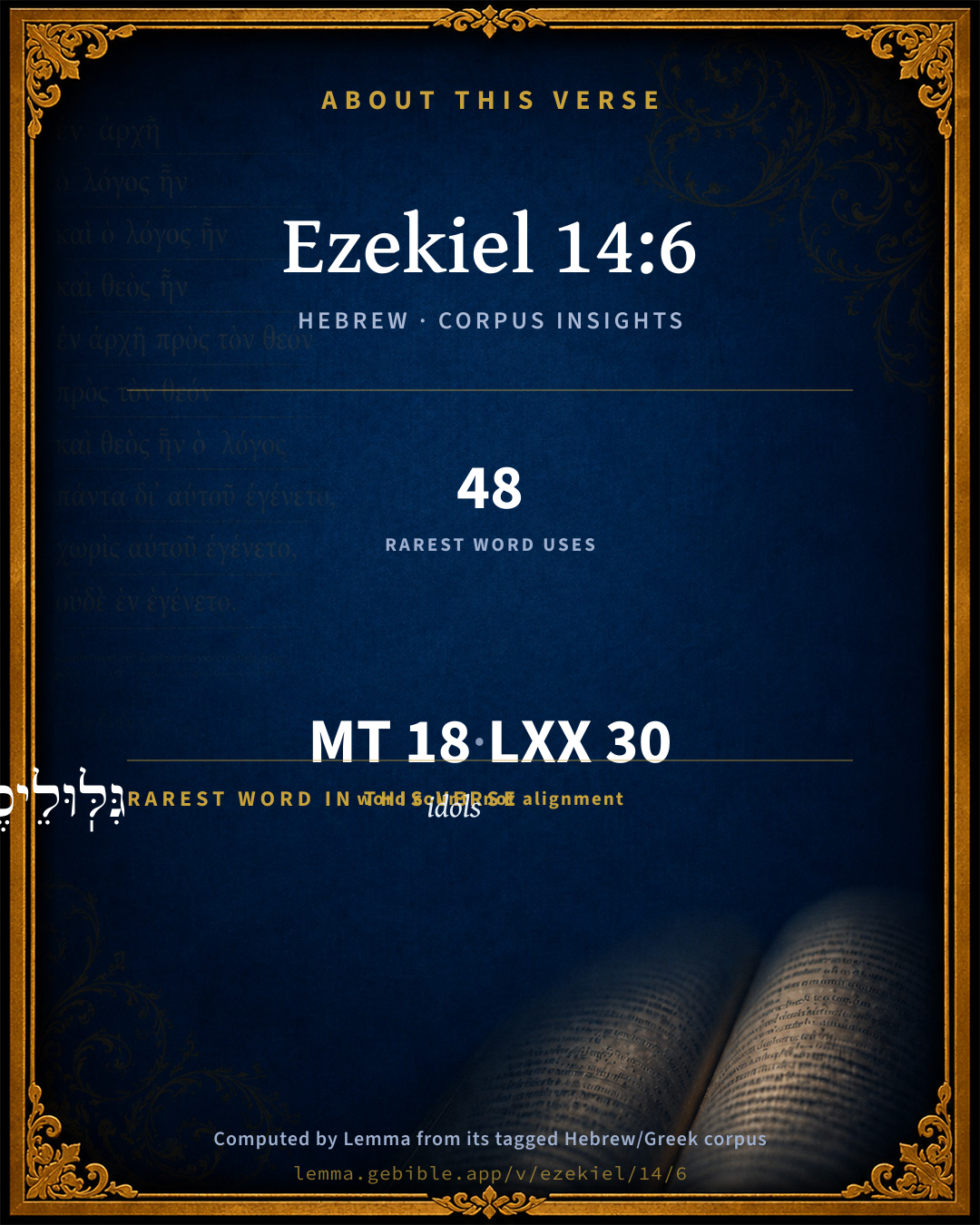
These counts appear in no published source. They are computed here, from the morphology-tagged text and Lemma’s own curated glosses. What Lemma adds →

18
words
14
distinct lemmas
Prophets
section

Shared distinctive vocabulary

גִּלּֽוּלֵיכֶ֑ם idols H1544 occurs in 45 verses of the Hebrew Bible. Also found in:

Grammatical profile

  • 5 verbs
  • 8 nouns
  • 3 prepositions
  • 2 adverbs

Verb forms

  • אֱמֹ֣ר Qal · Imperative
  • אָמַר֙ Qal · Perfect
  • שׁ֣וּבוּ Qal · Imperative
  • וְהָשִׁ֔יבוּ Hiphil · Imperative
  • הָשִׁ֥יבוּ Hiphil · Imperative

Repetition

Words recur within this verse — often emphatic in Hebrew:

  • שׁ֣וּבוּ to return H7725 ×3
  • אֱמֹ֣ר to say H559 ×2
  • מֵעַ֖ל upon H5921 ×2

Hebrew & Septuagint length

In English translation the verse runs 28 words from the Hebrew and 31 from the Septuagint (LXX English) — closely comparable.

A rough comparison of the two English renderings, which tokenize alike — not a word-level alignment.

Word counts can differ between the Hebrew and the Greek without any difference in meaning — e.g. the Hebrew direct-object marker אֵת has no separate Greek word, and Greek often adds the article ὁ.

In the original languages it is 18 Hebrew tokens and 30 Greek tokens — but the two are counted differently (Hebrew bundles its prefixes and suffixes into one token; the Greek is in lemma form), so that isn’t a like-for-like length.

Cross-references

27

Topical passages linked to Ezekiel 14:6 in the Treasury of Scripture Knowledge — connected by theme and wording, ordered by reader-vote popularity; previews shown in the World English Bible.

  • Ezekiel 18:30 Therefore I will judge you, house of Israel, everyone according to his ways, says the Lord Yahweh. Return you, and turn yourselves from all your transgressions; so iniquity shall not be your ruin.
  • Isaiah 2:20 In that day, men shall cast away their idols of silver, And their idols of gold, Which have been made for themselves to worship, To the moles and to the bats;
  • Isaiah 30:22 You shall defile the overlaying of your engraved images of silver, and the plating of your molten images of gold: you shall cast them away as an unclean thing; you shall tell it, Get you hence.
  • Lamentations 3:39–41 Why does a living man complain, a man for the punishment of his sins?
  • Ezekiel 36:31–32 Then shall you remember your evil ways, and your doings that were not good; and you shall loathe yourselves in your own sight for your iniquities and for your abominations.
  • James 4:8–10 Draw near to God, and he will draw near to you. Cleanse your hands, you sinners; and purify your hearts, you double-minded.
  • 1 Samuel 7:3 Samuel spoke to all the house of Israel, saying, If you do return to Yahweh with all your heart, then put away the foreign gods and the Ashtaroth from among you, and direct your hearts to Yahweh, and serve him only; and he will deliver you out of the hand of the Philistines.
  • 1 Kings 8:47–49 yet if they shall repent themselves in the land where they are carried captive, and turn again, and make supplication to you in the land of those who carried them captive, saying, We have sinned, and have done perversely, we have dealt wickedly;
  • Isaiah 55:6–7 Seek you Yahweh while he may be found; call you on him while he is near:
  • Jeremiah 8:5–6 Why then is this people of Jerusalem slidden back by a perpetual backsliding? they hold fast deceit, they refuse to return.
  • Jeremiah 50:4–5 In those days, and in that time, says Yahweh, the children of Israel shall come, they and the children of Judah together; they shall go on their way weeping, and shall seek Yahweh their God.
  • Ezekiel 14:4 Therefore speak to them, and tell them, Thus says the Lord Yahweh: Every man of the house of Israel who takes his idols into his heart, and puts the stumbling block of his iniquity before his face, and comes to the prophet; I Yahweh will answer him therein according to the multitude of his idols;
  • Hosea 14:1–3 Israel, return to Yahweh your God; For you have fallen because of your sin.
  • Hosea 14:8 Ephraim, what have I to do any more with idols? I answer, and will take care of him. I am like a green fir tree; From me your fruit is found."
  • Matthew 3:8–10 Therefore bring forth fruit worthy of repentance!
  • Acts 3:19 "Repent therefore, and turn again, that your sins may be blotted out, so that there may come times of refreshing from the presence of the Lord,
  • Acts 17:30 The times of ignorance therefore God overlooked. But now he commands that all people everywhere should repent,
  • Acts 26:20 but declared first to them of Damascus, at Jerusalem, and throughout all the country of Judea, and also to the Gentiles, that they should repent and turn to God, doing works worthy of repentance.
  • Romans 6:21 What fruit then did you have at that time in the things of which you are now ashamed? For the end of those things is death.
  • 2 Chronicles 29:6 For our fathers have trespassed, and done that which was evil in the sight of Yahweh our God, and have forsaken him, and have turned away their faces from the habitation of Yahweh, and turned their backs.
  • Nehemiah 1:8–9 Remember, I beg you, the word that you commanded your servant Moses, saying, If you trespass, I will scatter you abroad among the peoples:
  • Jeremiah 13:27 I have seen your abominations, even your adulteries, and your neighing, the lewdness of your prostitution, on the hills in the field. Woe to you, Jerusalem! you will not be made clean; how long shall it yet be?
  • Jeremiah 31:18–20 I have surely heard Ephraim bemoaning himself [thus], You have chastised me, and I was chastised, as a calf unaccustomed [to the yoke]: turn you me, and I shall be turned; for you are Yahweh my God.
  • Ezekiel 8:16 He brought me into the inner court of Yahweh's house; and see, at the door of the temple of Yahweh, between the porch and the altar, were about twenty-five men, with their backs toward the temple of Yahweh, and their faces toward the east; and they were worshipping the sun toward the east.
  • Ezekiel 16:63 that you may remember, and be confounded, and never open your mouth any more, because of your shame, when I have forgiven you all that you have done, says the Lord Yahweh.
  • Jonah 3:7–9 He made a proclamation and published through Nineveh by the decree of the king and his nobles, saying, "Let neither man nor animal, herd nor flock, taste anything; let them not feed, nor drink water;
  • Zephaniah 3:11 In that day you will not be disappointed for all your doings, in which you have transgressed against me; for then I will take away out of the midst of you your proudly exulting ones, and you will no more be haughty in my holy mountain.

Cross-references courtesy of OpenBible.info (CC BY 4.0).

Hebrew and Greek witnesses Masoretic Hebrew ↔ Greek Septuagint

The same verse in the two great witnesses to the Old Testament, shown verse-for-verse.

These are two independent witnesses, not word-aligned to each other, and the Septuagint is shown in lemma (dictionary) form.

Hebrew Ezekiel 14:6 Masoretic · Westminster Leningrad Codex

לָכֵ֞ן אֱמֹ֣ר אֶל בֵּ֣ית יִשְׂרָאֵ֗ל כֹּ֤ה אָמַר֙ אֲדֹנָ֣י יְהוִ֔ה שׁ֣וּבוּ וְהָשִׁ֔יבוּ מֵעַ֖ל גִּלּֽוּלֵיכֶ֑ם וּמֵעַ֥ל כָּל תּוֹעֲבֹתֵיכֶ֖ם הָשִׁ֥יבוּ פְנֵיכֶֽם

Therefore tell the house of Israel, Thus says the Lord Yahweh: Return you, and turn yourselves from your idols; and turn away your faces from all your abominations.

World English Bible · Public Domain

Greek LXX Ezekiel 14:6 Septuagint · lemma form

διά οὗτος εἶπον πρός ὁ οἶκος ὁ ἰσραήλ ὅδε λέγω κύριος κύριος ἐπιστρέφω καί ἀποστρέφω ἀπό ὁ ἐπιτήδευμα σύ καί ἀπό πᾶς ὁ ἀσέβεια σύ καί ἐπιστρέφω ὁ πρόσωπον σύ

Therefore say to the house of Israel, Thus says the Lord God, Be converted, and turn from your evil practices, and from all your sins, and turn your faces back again.

LXX2012 (modern English Septuagint) · Public Domain

Hebrew: Westminster Leningrad Codex (CC BY 4.0). Greek: Septuagint (public domain); English from LXX2012 (modern English Septuagint) (Public Domain). How the Septuagint differs from the Hebrew →

Targum (Aramaic paraphrase)

1

The Targum is the ancient Jewish Aramaic paraphrase of the Hebrew Scriptures — an interpretive translation, not the Hebrew text itself. Onkelos (literal) and Pseudo-Jonathan (expansive) render the Torah, and Jonathan the Prophets. Coverage is partial: where no permissively-licensed English translation exists for a verse, only the Aramaic is shown. This is verse-level text, not a word-by-word alignment to the Hebrew.

  1. Targum Jonathan Prophets (Joshua–Malachi)
    בְּכֵן אֲמַר לְבֵית יִשְׂרָאֵל כִּדְנַן אֲמַר יְיָ אֱלֹהִים תוּבוּ לְפוּלְחָנִי וְאַעְדוּ מִנְכוֹן פּוּלְחַן טַעֲוָתְכוֹן וְיַת כָּל חוֹבֵי פּוּלְחַן טַעֲוַת תּוֹעֲבַתְכוֹן אַרְחִיקוּ מִקְבֵיל אַפֵּיכוֹן:

    (no public-domain English translation for this verse)

    Targum Jonathan — Aramaic: “Mikraot Gedolot” (public domain). English: “Sefaria Community Translation” (CC0 1.0 (public-domain dedication)); “London "Chaldee Paraphrase," 1871” (public domain). Text via Sefaria.

Commentary

Notes on Ezekiel 14:6 from classic Christian and Jewish commentators (each source and its license shown beneath its notes). The classic Christian expositions comment on the surrounding passage and are grouped to its opening verse, so a note may address several verses; the Jewish commentaries on the Tanakh (Rashi and others) are per-verse, so they appear only where the commentator wrote on this verse.

Lemma curates 59 commentaries, every one of them public domain or Creative Commons licensed, each selected and text-cleaned for this edition rather than reprinted as found. About our sources →

Trapp's Complete Commentary

John Trapp

Eze 14:6 Therefore say unto the house of Israel, Thus saith the Lord GOD; Repent, and turn [yourselves] from your idols; and turn away your faces from all your abominations.

Ver. 6. Repent, and turn yourselves.] Or, Turn others; for true converts will be converting their brethren. They like not to go to heaven alone.

And turn away your faces.] Alii dicunt uxores vestras, saith Lavater here; your wives, which are according to your hearts, like as in water face answereth to face. Wean them from their idols, and win them over to the true God.

John Trapp, A Commentary or Exposition upon All the Books of the Old and New Testament (1647–1656) — public domain. Text from a community e-Sword module.

Joseph Benson's Commentary

Eze 14:6-8. Therefore say, Repent — Be truly sorry for your past sins, and give proof of your sorrow by forsaking them, &c.; and turn from your idols — Separate yourselves from them, that they may not finally and eternally separate you from God. And turn away your faces — Your heart and ways; from all your abominations — Not only from all your idolatries, but from all sinful practices. Turn your faces from them, abhor the very sight of them; not only forsake them, but do it with loathing and detestation. For every one of the house of Israel — Every Jew of the seed of Abraham, whom this warning first and principally concerns; or of the stranger that sojourneth, &c. — Every proselyte: or the expression may include the foreigners who lived in Judea, termed, in the fourth commandment, the stranger within their gates. For these, although they were neither circumcised nor subject to the ceremonial laws, yet were under an obligation to refrain from idolatry, or from worshipping any God but Jehovah. Which separateth himself from me — Who leaves me to worship idols. God considered them as separating themselves from him, not only if they wholly left off to worship him, but also if they worshipped as gods any other beings, real or imaginary, along with him. For he, being the only true God, could not, of course, admit of any other to be worshipped together with him, as no other being whatsoever had the least pretence to be worshipped as God. I the Lord will answer him by myself — I who am Jehovah, the only Creator, Preserver, and Lord of all things, will answer him according to my own inherent power, not by words, but by executing my judgments upon him. And he shall find by the answer, that it was not the prophet, but God that answered, so dreadful, searching, and astonishing shall my answer be. And I will set my face against that man —

I will make him a mark for my indignation; and will make him a sign and a proverb — A signal and remarkable instance of my vengeance; and will cut him off, &c. — By sudden death, attended with extraordinary circumstances.

Joseph Benson's Commentary on the Old and New Testaments (1811–1818) — public domain. Text from a community e-Sword module.

Whedon's Commentary on the Bible

Daniel D. Whedon

STATEMENT OF THE DIVINE LAW WHICH CONTROLS EVEN FALSE PROPHECY, Eze_14:6-11.

6. Repent — The Lord will give to these idolaters no view of the future until they pluck their idols out of their hearts and turn away from sin.

Daniel D. Whedon (gen. ed.), Commentary on the Old and New Testaments (1874–1909) — public domain. Text from a community e-Sword module.

Tyndale Open Study Notes

Tyndale Open Resources

14:6-7 When asking for God’s advice, rebels should only expect the response to be, Repent.

Tyndale Open Study Notes — © Tyndale Open Resources, licensed CC BY-SA 4.0. Text via the HelloAO Bible API.

Jamieson, Fausset & Brown

Robert Jamieson, A. R. Fausset & David Brown

Though God so threatened the people for their idolatry (Eze 14:5), yet He would rather they should avert the calamity by "repentance."

turn yourselves--CALVIN translates, "turn others" (namely, the stranger proselytes in the land). As ye have been the advisers of others (see Eze 14:7, "the stranger that sojourneth in Israel") to idolatry, so bestow at least as much pains in turning them to the truth; the surest proof of repentance. But the parallelism to Eze 14:3-4 favors English Version. Their sin was twofold: (1) "In their heart" or inner man; (2) "Put before their face," that is, exhibited outwardly. So their repentance is generally expressed by "repent," and is then divided into: (1) "Turn yourselves (inwardly) from your idols"; (2) "Turn away your faces (outwardly) from all your abominations." It is not likely that an exhortation to convert others should come between the two affecting themselves.

Jamieson, Fausset & Brown — Commentary Critical and Explanatory on the Whole Bible (1871) — public domain (CC PDM 1.0). Text via the HelloAO Bible API.

John Calvin's Commentaries

Now God shows why he had threatened the false prophets and the whole people so severely, namely, that they should repent; for the object of God’s rigor is, that, when terrified by his judgments, we should return into the way. Now, therefore, he exhorts them to repentance. Hence we gather the useful lesson, that whenever God inspires us with fear, he has no other intention than to humble us, and thus to provide for our salvation, when he reproves and threatens us so strongly by his prophets, and in truth is verbally angry with us, that he may really spare us. But the exhortation is short, that they may be converted and turned away from their idols, and may turn their faces from all their abominations. When he uses the word השיבו, heshibev, in the second clause, some understand “wives;” but this is frigid: others think the verb transitive, but yet impersonal, thus make yourselves return: this also is harsh. I have no doubt that the Prophet here exhorts the Israelites that each should desire to reconcile himself to God, and at the same time bring others with him. As many were mutually the authors of evils to each other, he now orders them to do their utmost to bring back others with them: and surely this is a true proof of our repentance, when we are not only converted to God one by one, but, when we stretch forth our hand to our brethren, and recall them from error; especially if they have wandered away through our fault, we must take care to make up for the injury by at least equal diligence. The sense therefore of the Prophet is, first, that, the Israelites should repent; next, that one should assist another to repentance, or that they should mutually unite in the pursuit of piety, just as each was previously corrupted by his companion and brother. This seems to be the full meaning. Besides, this series must be remarked: because many show zeal in seizing others, and stretching out the hand to free them from error; but they themselves never think of repenting. But the Holy Spirit here shows us the true method of proceeding, when he commands us to repent, and then extends our desires to our brethren who have need of our exhortations. At length he adds, withdraw your faces, or turn away from all your abominations. A part is here put by the Prophet for the whole, since turning away the face means the same as withdrawing all the senses. Since, therefore, they had been almost affixed to their own abominations to which they had cast their eyes, and were completely intent upon them, he orders them to turn away their faces, so as to bid them farewell. It follows —

John Calvin's Commentaries (1540-1563) — public domain. Text from the Calvin Translation Society English edition (1840s-50s) via the Christian Classics Ethereal Library (ccel.org). Calvin's coverage is partial (roughly two-thirds of the Bible); uncommented books and verses are honest gaps, never fabricated. The 19th-century editor's footnotes and remarks are omitted so the notes are faithfully Calvin's own voice.

Ellicott's Commentary for English Readers

(6) Repent and turn.—The announcements of the previous verses form the basis for the earnest call to a true repentance. There can be no hope for Israel in any merely outward reformation; they have to do with the Searcher of hearts, and the only repentance acceptable to Him is that which has its seat in the affections of the heart.

A Bible Commentary for English Readers, edited by Charles John Ellicott (1878–1897) — public domain. Text from a community e-Sword module.

The Cambridge Bible for Schools and Colleges

gen. ed. J. J. S. Perowne

6. The prophet is not permitted to give an answer to any inquiries of such men. Jehovah will answer them through himself (Eze_14:7); the message which the prophet has to deliver is, repentance or destruction!

The Cambridge Bible for Schools and Colleges (gen. ed. J. J. S. Perowne; Cambridge University Press, 1878–1918) — public domain. Text from a community e-Sword module.

John Gill's Exposition

Therefore say unto the house of Israel,.... Deliver out the following exhortation to repentance unto them; for God's end, in all his threatenings and judgments, is to bring men to repentance:

thus saith the Lord God, repent, and turn yourselves from your idols; or, "turn, and cause to be turned from your idols" (w); turn yourselves from the worship of idols, as the Targum, and do all that in you lies to turn others from the same; particularly your wives and young men, as Kimchi: and the rather they were obliged to do this, since in all probability they had been the means of drawing them into idolatry:

and turn away your faces from all your abominations; their idols, detestable to God, and ought to have been so to them; these he would have them turn their faces from, not so much as look at them, much less worship them, that they might not be ensnared by them; this is said, in opposition to their setting of them before their face, Eze 14:3.

(w) "convertimini, et facite converti", Pagninus, Montanus, Vatablus.

John Gill's Exposition of the Whole Bible (1746–1763) — public domain (CC PDM 1.0). Text via the HelloAO Bible API.

Haydock's Catholic Bible Commentary

Turn. Such people must first be admonished to relinquish idols, heresy, &c., that they may come to God. (Worthington)

George Leo Haydock (1774–1849), Haydock's Catholic Family Bible and Commentary, 1859 edition — public domain. Excludes Psalms (Douay-Rheims chapter numbering differs from Protestant) and Deuterocanonical books (Catholic canon only).

Matthew Poole's English Annotations

Unto the house of Israel; to these men the elders, whoever they are, give charge that they repent, and by them send word to the residue of the house of Jacob that they do so too.

Repent; be sorry and testify your sorrow for such sins.

And turn yourselves; renounce them for future, cease to be idolaters, let your visible carriage in reforming all be seen too. Amend heart and ways, let not your heart be towards idols in point of religion, nor your practice in point of outward deportment be vicious and immoral.

Matthew Poole's English Annotations on the Holy Bible (1683–1685) — public domain. Text from a community e-Sword/MySword module.

The Pulpit Commentary

Turn yourselves, etc.; literally, turn them. But there is no sufficient ground for the margin, "Turn others," the objective suffix being the "faces" of the following clause. in Eze_18:30, 32 the verb is used by itself. The prophet"s call is to a direct personal repentance, not to the work of preaching that repentance to others.

Repentance.

I THE FIRST STEP TOWARDS SALVATION IS REPENTANCE. It is true that God has moved towards us before we have thought of turning to him. It is his goodness that leads us to repentance. (Rom_2:4) "While we were yet sinners, Christ died for us". (Rom_5:8) But all this precedes our action. When we begin to see salvation, the first step must lead us to the wicket gate of repentance, and until that has been passed through there is no hope fur us. John the Baptist prepares the way for Christ. "Repent: for the kingdom of heaven is at hand." We may try the short cut of pride, and think to begin the happy Christian life without owning our sins and turning from them. It is impossible. The result will only be a miserable hypocrisy.

II REPENTANCE CONSISTS IN TURNING FROM THE EVIL WAY. "Repent, and turn yourselves," etc. It is an action, not merely a feeling. It cannot be without deep grief of soul, yet it does not consist in the grief; that is but an accompaniment, though undoubtedly an inevitable accompaniment. We cannot measure our repentance by the number of tears shed, but by the thoroughness of our revolt against our past. Neither is there any value in the amount of time spent in abject contrition. We are not in this way to consider whether we have repented sufficiently. The sole question is as to the reality and thoroughness of the change by which we turn from the old way and seek a better way.

III REPENTANCE IS CONFIRMED BY THE ABANDONMENT OF THE EVIL ONCE LOVED. The penitents are to turn from their "idols." Insincere repentance weeps for the sins it still clings to. The action of repentance is inward. But its consequences are seen in outward conduct. Savonarola, when called to the dying bed of Lorenzo di Medici, refused to offer any hope of pardon to the great Florentine, because, though he professed great concern for his soul, and deep grief for his sins, he refused to give back their liberties to the citizens. He would not act according to the profession of repentance, and therefore the stern reformer justly judged that the penitence could not be true and thorough.

IV REPENTANCE IS MET BY THE SAVING GRACE OF GOD. He calls upon us to repent, hut he des not require us to create new hearts in ourselves. He expects a sincere desire fur a better way. We must show our loathing for our old past by doing all in our power to relinquish it. Then God gives that redeeming grace which is the new birth, and whence springs the power for better living. Still, after receiving the grace, we need to preserve the lowliness of the penitent, although all tears are wiped away by the pardon of God. For we are always in danger of being dragged back into out old selves. "Illusion is briefs" says Schiller, "but repentance is long.

Repent!

This was the admonition of every herald of God, whether under the old covenant or the new. It was the burden of Isaiah and Ezekiel, and it was also the burden of John the forerunner and of Jesus the Messiah. From this it may be inferred that human nature and life, on the one hand, and the character and government of God on the other hand, are such that repentance is an indispensable condition of the establishment of right relations between God and man.

I THE NEED OF REPENTANCE. If we are upon Divine authority summoned to change, this must be because there is something wrong and reprehensible and dangerous in man"s heart and condition; if called upon to turn, we must be going the wrong way. The admonition of the text follows upon a picture of Israel"s idolatry and rebellion against a righteous God. The form of the sin may vary, but the principle of sin is ever the same. Whether in ancient or in modern times, in barbarous or in civilized states of society, men are universally prone to sin and guilty of sin. Where there is no sin, repentance is needless. It is in the departure of the heart"s affection and the life"s loyalty from the righteous God that man"s error lies. Israel"s idolatry symbolizes human iniquity.

II THE NATURE or REPENTANCE. As more fully explained in New Testament Scripture, this is a change of heart, of disposition, leading to a change of character and of life. Mere sorrow for sin is not repentance, inasmuch as emotion of every kind is to some extent matter of temperament, and sorrow does not always lead to reformation. True repentance goes much deeper, and prepares the way forevery spiritual blessing. He who repents looks at things otherwise than before, tutus his thoughts into another channel, his steps into another path.

III THE CALL TO REPENTANCE.

1. It is a gracious call. The justly offended sovereign may leave the rebel to the consequences of his acts. It is not thus that God deals with us. It is not his wish that any should perish. He sends his messengers to the offending race, with a summons to submission, with proffers of mercy.

2. It is an authoritative call. He commandeth men everywhere to repent. It is true that our Creator and Judge does not interfere with our liberty. Yet he publishes his will as binding upon every moral agent. He has a right to our repentance. It is our place to obey his summons, to offer the repentance which he demands and requires at our hands.

IV THE DIFFICULTY OF REPENTANCE. This lies in the very character itself of the change. If verbal submission or outward conformity only were required, this would be comparatively easy. But God, who searcheth the heart, will not be satisfied save with the heart"s subjection and conversion. Old habits of unspirituality, worldliness, and selfishness are not readily abandoned. Especially in advanced life a radical and inward change is effected, for the most part, only with effort and difficulty. It needs a supernatural motive and a supernatural power to cause old things to pass away and all things to become new, to exchange darkness for light, and the service of Satan for God. Such a supernatural motive we have in the gospel; such a supernatural power and agency in the Holy Spirit.

V THE FRUITS OF REPENTANCE.

1. These are exactly opposed in character to the fruits of self-indulgence.Other seed in other soil yields other harvest.

2. Reconciliation with God replaces enmity towards God. The conditionsof salvation, as laid down in the New Testament, are "repentance towards God, and faith in the Lord Jesus Christ.

3. Repentance works a change in a man"s own character; the principles andmotives and ends of life are all new.

4. Through the power of repentance a man"s relations to his fellow men arechanged justice takes the place of wrong, and love that of hatred and uncharitabieness. T.

The Pulpit Commentary (1880–1919), ed. H.D.M. Spence-Jones & Joseph S. Exell — public domain. Text from a community e-Sword module.

unfoldingWord translationNotes

Door43 World Missions Community

the house of Israel

The word "house" is a metonym for the family that lives in the house, in this case the Israelites, the descendants of Jacob over many years. See how you translated this in Ezekiel 3:1. AT: "the Israelite people group" (See: Metonymy)

Repent and turn away from your idols! Turn back your faces from all your abominations

Both of these phrases are ways to tell the people of Israel to stop worshiping idols. (See: Parallelism)

Repent and turn away

The words "repent" and "turn way" mean basically the same thing. Together they strengthen the command to stop worshiping idols. (See: Doublet)

Turn back your faces

Here the word "faces" represents the people. AT: "Turn back" (See: Synecdoche)

translationWords

Lord Yahweh

repent

turn

face

abomination

unfoldingWord translationNotes — © Distant Shores Media and the Door43 World Missions Community, licensed CC BY-SA 4.0. Source: git.door43.org/Door43/en_tn.

Rashi

Rabbi Shlomo Yitzchaki (Rashi)

Repent of your ways.

and move away Heb. וְהָשִּׁיבוּ, [remove] your hearts [as well].

from your idols which you brought up to your heart.

remove your faces opposite which you set the stumbling block of your iniquities.

Rashi on the Tanakh — English translations: “The Judaica Press complete Tanach with Rashi, translated by A. J. Rosenberg” (CC BY 4.0); “Pentateuch with Rashi's commentary by M. Rosenbaum and A.M. Silbermann, 1929-1934” (public domain); “The Metsudah Tanach series, Lakewood, N.J” (CC BY 4.0); and “The Book of Joshua, Metsudah Publications, 1997” (CC BY 4.0). Text via Sefaria.

Lesson kit

Teaching starters — assembled from the data on this page, not authored interpretation. Every prompt links to the verse data it draws on. Edit before teaching.

Ezekiel, in the Prophets, opens this verse with 18 words (14 distinct Hebrew lemmas). Its most distinctive word is gillûwl (“idols”). A historical commentator’s framing appears above. Read the whole chapter for the surrounding context.

Discussion questions

  1. What does “idols” (gillûwl) contribute to the verse as a whole?
  2. Leviticus 26:30 shares the word «idols» with this verse. How do the two illuminate each other?
  3. “to return” occurs 3× in this one verse. What is the effect of the repetition?
  4. The translations on this page render this verse differently — a whole-verse word diff, not a word-by-word alignment. What might account for the different wordings?
  5. The verb «אֱמֹ֣ר» is Qal Imperative. How does its form color the action?
  6. Reading how Trapp's Complete Commentary and Joseph Benson's Commentary read this verse, where do the two commentators agree and where do they part?

Things to notice

Reading settings

Reading text

Shown beneath each verse's original-language words.

Old Testament
Old Testament edition

Read the OT as the Masoretic Hebrew (MT) or the Greek Septuagint (LXX).

English shown for the Greek Septuagint (in the Hebrew ↔ Greek comparison).

Comparing translations? Open the Compare panel on any verse page to stack up to four side by side.