Ezekiel 18:8

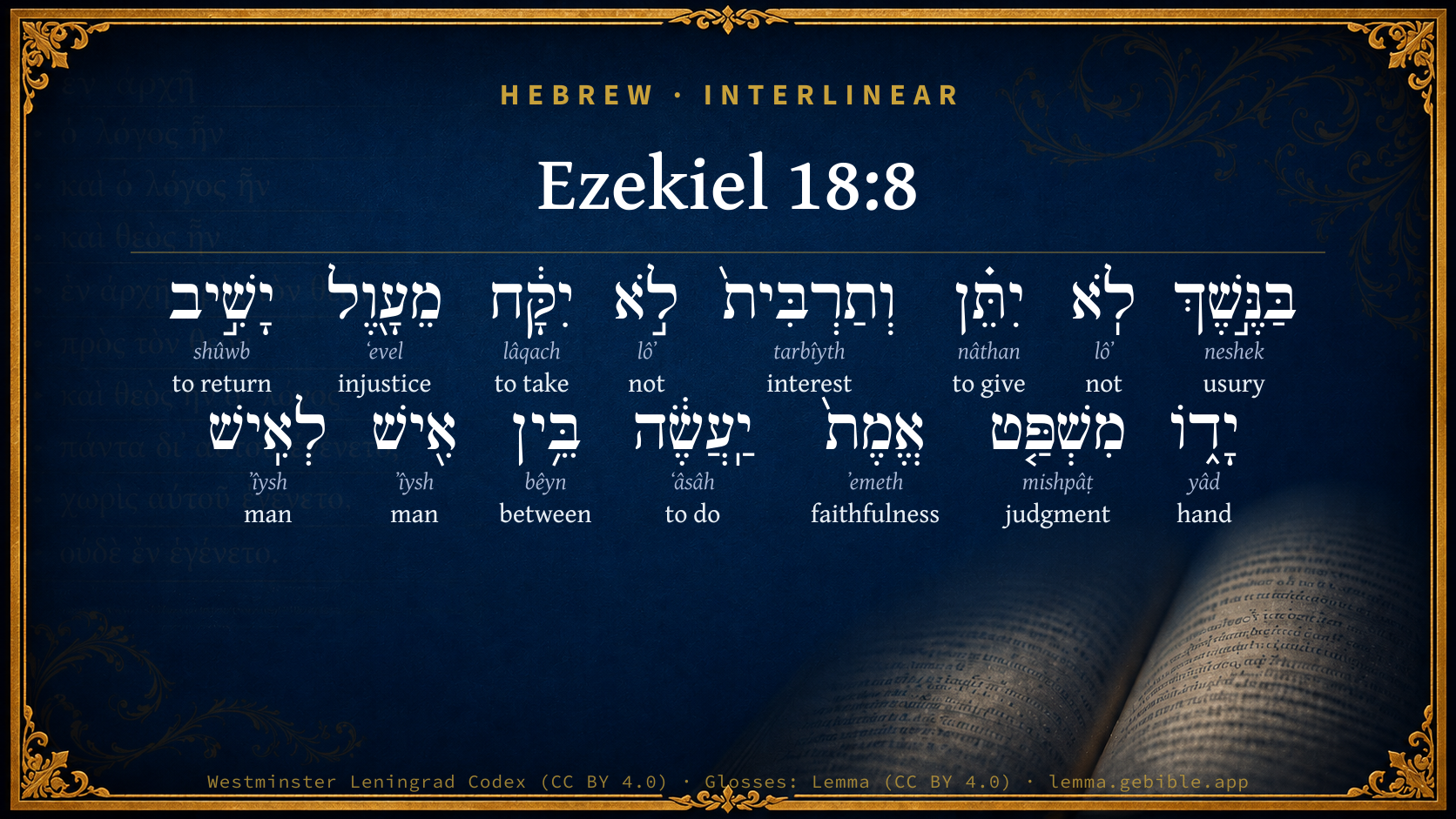
Hebrew (Westminster Leningrad Codex) Ezekiel 18:8 appears in the Hebrew Old Testament. The text above is from the Westminster Leningrad Codex. Each word links to its Strong’s number, a concise gloss, and parsing drawn from the Open Scriptures Hebrew Bible morphology. Click any word for its full Brown-Driver-Briggs (BDB) entry.
Download image
Cite this verse

Ezekiel 18:8 (World English Bible). Public Domain. Lemma interlinear Bible study tool, https://lemma.gebible.app/v/ezekiel/18/8.

Show BibTeX & RIS
BibTeX
RIS
English Translation
he who has not given forth on interest, neither has taken any increase, who has withdrawn his hand from iniquity, has executed true justice between man and man,
World English Bible · Public Domain
Download a study sheet

One document with this verse’s original text, its word-by-word gloss line, the meaning frame, cross-references with their text, attributed commentary, and full source and license credits — printable, and it pastes into notes with its structure intact.

This verse Autodidact and up

Study sheet (.html) Plain text (.txt)

A passage Seminary Student

Up to 50 verses in one chapter. A passage sheet keeps up to 6 commentary sources and 12 cross-references per verse, in the order this page ranks them, and says so on the sheet whenever that leaves anything out. Ask for a single verse and you get the Autodidact verse sheet above.

Everything on this page stays free to read, with no account — the sheet is a download of what is already on screen, not access to it.

Want to remove ads? Support Godless Engineer
Compare translations 3

The same verse in 3 English versions, stacked beneath the original-language interlinear above. Click any original word for its lexicon entry.

Each is an independent rendering of the whole verse — the interlinear is not word-aligned to these translations.

Highlighted words mark where these versions differ — a whole-verse word diff, not a word-by-word alignment.

  • World English Bible Public Domain
    he who has not given forth on interest, neither has taken any increase, who has withdrawn his hand from iniquity, has executed true justice between man and man,
  • King James Version Public Domain
    He that hath not given forth upon usury, neither hath taken any increase, that hath withdrawn his hand from iniquity, hath executed true judgment between man and man,
  • unfoldingWord Literal Text CC BY-SA 4.0
    What can be said about a man who does not charge too much interest for the money he loans, and he does not take too much profit for what he sells? It is said of him that he carries out justice and establishes faithfulness between people.

unfoldingWord Literal Text — © unfoldingWord, licensed CC BY-SA 4.0. Word-aligned USFM3 via Door43 (git.door43.org/unfoldingWord/en_ult).

Versions to compare (up to 4)

3 of 4 selected

Show all 18 translations

Every available English version of this verse, each an independent rendering of the whole verse.

  • World English Bible Public Domain
    he who has not given forth on interest, neither has taken any increase, who has withdrawn his hand from iniquity, has executed true justice between man and man,
  • Berean Standard Bible Public Domain
    He does not engage in usury or take excess interest, but he withholds his hand from iniquity and executes true justice between men.
  • Majority Standard Bible Public Domain
    He does not engage in usury or take excess interest, but he withholds his hand from iniquity and executes true justice between men.
  • King James Version Public Domain
    He that hath not given forth upon usury, neither hath taken any increase, that hath withdrawn his hand from iniquity, hath executed true judgment between man and man,
  • American Standard Version (1901) Public Domain
    he that hath not given forth upon interest, neither hath taken any increase, that hath withdrawn his hand from iniquity, hath executed true justice between man and man,
  • Revised Version (1885) Public Domain
    he that hath not given forth upon usury, neither hath taken any increase, that hath withdrawn his hand from iniquity, hath executed true judgment between man and man,
  • Geneva Bible (1599) Public Domain
    And hath not giuen foorth vpon vsurie, neither hath taken any increase, but hath withdrawen his hand from iniquitie, and hath executed true iudgement betweene man and man,
  • Douay-Rheims (1899) Public Domain
    Hath not lent upon usury, nor taken any increase: hath withdrawn his hand from iniquity, and hath executed true judgment between man and man:
  • Young's Literal Translation Public Domain
    In usury he doth not give, and increase taketh not, From perversity he turneth back his hand, True judgment he doth between man and man.
  • Literal Standard Version CC BY-SA 4.0
    He does not give in usury, and does not take increase, || He turns back his hand from perversity, || He does true judgment between man and man.
  • Unlocked Literal Bible CC BY-SA 4.0
    What can be said about a man who does not charge too much interest for the money he loans, and he does not take too much profit for what he sells? It is said of him that he carries out justice and establishes faithfulness between people.
  • unfoldingWord Literal Text CC BY-SA 4.0
    What can be said about a man who does not charge too much interest for the money he loans, and he does not take too much profit for what he sells? It is said of him that he carries out justice and establishes faithfulness between people.
  • Darby Bible Public Domain
    he hath not given forth upon usury, nor taken increase; he hath withdrawn his hand from unrighteousness, hath executed true judgment between man and man,
  • World Messianic Bible Public Domain
    he who hasn’t lent to them with interest, hasn’t taken any increase from them, who has withdrawn his hand from iniquity, has executed true justice between man and man,
  • Webster's Bible Public Domain
    He that hath not given forth upon interest, neither hath taken any increase, that hath withdrawn his hand from iniquity, hath executed true judgment between man and man,
  • Free Bible Version CC BY-SA 4.0
    He doesn't lend with interest or make a profit from loans. He refuses to do wrong and makes sure he's truly fair in his decisions between people.
  • Bible in Basic English Public Domain
    And has not given his money out at interest or taken great profits, and, turning his hand from evil-doing, has kept faith between man and man,
  • JPS Tanakh (1917) Public Domain
    he that hath not given forth upon interest, neither hath taken any increase, that hath withdrawn his hand from iniquity, hath executed true justice between man and man,

Literal Standard Version (2020), Covenant Press — licensed CC BY-SA 4.0. Text via the HelloAO Bible API (eBible.org). Unlocked Literal Bible (unfoldingWord) — licensed CC BY-SA 4.0. Text via the HelloAO Bible API (eBible.org). unfoldingWord Literal Text — © unfoldingWord, licensed CC BY-SA 4.0. Word-aligned USFM3 via Door43 (git.door43.org/unfoldingWord/en_ult). Free Bible Version, Dr. Jonathan Gallagher — licensed CC BY-SA 4.0. Text via the HelloAO Bible API (eBible.org).

Word by word

More ways to search: Search by grammar → Find every occurrence → Compare this word →

Practice this passage: Drill this verse → Learn its vocabulary →

וְתַרְבִּית֙
tarbîyth
H8636
“and · interest”
Conjunction + Noun, Common, Feminine, Singular, Absolute
Part of Speech
Conjunction + Noun
Type
Common
Gender
Feminine
Number
Singular
State
Absolute
Full BDB Definition

Origin: from H7235

TWOT: 2103f

increment, usury, interest, bonus
  1. בַּנֶּ֣שֶׁךְ neshek H5392 “in/at the · usury” Preposition, Determined + Noun, Common, Masculine, Singular, Absolute
  2. לֹֽא lôʼ H3808 “not” Particle, Negative
  3. יִתֵּ֗ן nâthan H5414 “to give” Verb, Qal, Imperfect, 3rd Person, Masculine, Singular
  4. לֹ֣א lôʼ H3808 “not” Particle, Negative
  5. יִקָּ֔ח lâqach H3947 “to take” Verb, Qal, Imperfect, 3rd Person, Masculine, Singular
  6. מֵעָ֖וֶל ʻevel H5766 “from · injustice” Preposition + Noun, Common, Both, Singular, Absolute
  7. יָשִׁ֣יב shûwb H7725 “to return” Verb, Hiphil, Imperfect, 3rd Person, Masculine, Singular
  8. יָד֑וֹ yâd H3027 “hand · his” Noun, Common, Both, Singular, Construct + Suffix, Personal, 3rd Person, Masculine, Singular
  9. מִשְׁפַּ֤ט mishpâṭ H4941 “judgment of” Noun, Common, Masculine, Singular, Construct
  10. אֱמֶת֙ ʼemeth H571 “faithfulness” Noun, Common, Feminine, Singular, Absolute
  11. יַֽעֲשֶׂ֔ה ʻâsâh H6213 “to do” Verb, Qal, Imperfect, 3rd Person, Masculine, Singular
  12. בֵּ֥ין bêyn H996 “between” Preposition
  13. אִ֖ישׁ ʼîysh H376 “man” Noun, Common, Masculine, Singular, Absolute
  14. לְאִֽישׁ ʼîysh H376 “to/for · man” Preposition + Noun, Common, Masculine, Singular, Absolute

About this verse

These counts appear in no published source. They are computed here, from the morphology-tagged text and Lemma’s own curated glosses. What Lemma adds →

15
words
13
distinct lemmas
Prophets
section

Notable vocabulary

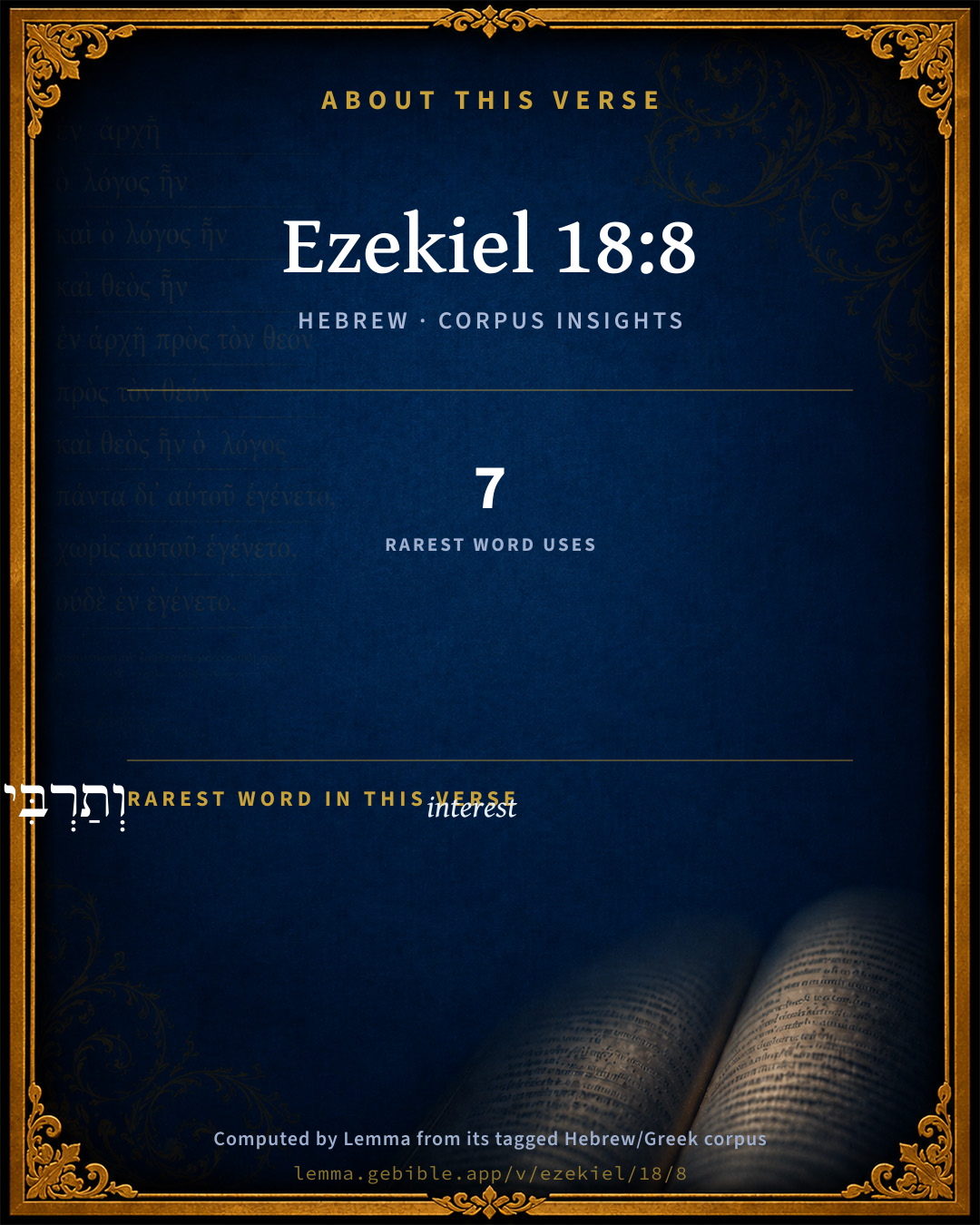
The rarest word here is וְתַרְבִּית֙ interest H8636 — appearing just 7 times in the whole Hebrew Bible.

Shared distinctive vocabulary

וְתַרְבִּית֙ interest H8636 occurs in 6 verses of the Hebrew Bible. Also found in:

Grammatical profile

  • 4 verbs
  • 8 nouns
  • 1 preposition
  • 2 particles

Verb forms

  • יִתֵּ֗ן Qal · Imperfect
  • יִקָּ֔ח Qal · Imperfect
  • יָשִׁ֣יב Hiphil · Imperfect
  • יַֽעֲשֶׂ֔ה Qal · Imperfect

Repetition

Words recur within this verse — often emphatic in Hebrew:

  • אִ֖ישׁ man H376 ×2
  • לֹֽא not H3808 ×2

Hebrew & Septuagint length

In English translation the verse runs 28 words from the Hebrew and 32 from the Septuagint (LXX English) — closely comparable.

A rough comparison of the two English renderings, which tokenize alike — not a word-level alignment.

Word counts can differ between the Hebrew and the Greek without any difference in meaning — e.g. the Hebrew direct-object marker אֵת has no separate Greek word, and Greek often adds the article ὁ.

Cross-references

23

Topical passages linked to Ezekiel 18:8 in the Treasury of Scripture Knowledge — connected by theme and wording, ordered by reader-vote popularity; previews shown in the World English Bible.

  • Exodus 22:25 "If you lend money to any of my people with you who is poor, you shall not be to him as a creditor; neither shall you charge him interest.
  • Zechariah 8:16 These are the things that you shall do: speak every man the truth with his neighbor. Execute the judgment of truth and peace in your gates,
  • Leviticus 25:35–37 "'If your brother has become poor, and his hand can't support him among you; then you shall uphold him. As a stranger and a sojourner he shall live with you.
  • Deuteronomy 23:19–20 You shall not lend on interest to your brother; interest of money, interest of food, interest of anything that is lent on interest:
  • Deuteronomy 1:16–17 I charged your judges at that time, saying, Hear [the causes] between your brothers, and judge righteously between a man and his brother, and the foreigner who is living with him.
  • Deuteronomy 16:18–20 Judges and officers shall you make you in all your gates, which Yahweh your God gives you, according to your tribes; and they shall judge the people with righteous judgment.
  • Psalms 15:5 He who doesn't lend out his money for usury, Nor take a bribe against the innocent. He who does these things shall never be shaken.
  • Ezekiel 18:13 has given forth on interest, and has taken increase; shall he then live? he shall not live: he has done all these abominations; he shall surely die; his blood shall be on him.
  • Ezekiel 18:17 who has withdrawn his hand from the poor, who has not received interest nor increase, has executed my ordinances, has walked in my statutes; he shall not die for the iniquity of his father, he shall surely live.
  • Ezekiel 22:12 In you have they taken bribes to shed blood; you have taken interest and increase, and you have greedily gained of your neighbors by oppression, and have forgotten me, says the Lord Yahweh.
  • Leviticus 19:15 "'You shall do no injustice in judgment: you shall not be partial to the poor, nor show favoritism to the great; but in righteousness shall you judge your neighbor.
  • Leviticus 19:35 "'You shall do no unrighteousness in judgment, in measures of length, of weight, or of quantity.
  • 2 Samuel 22:24 I was also perfect toward him; I kept myself from my iniquity.
  • Nehemiah 5:1–11 Then there arose a great cry of the people and of their wives against their brothers the Jews.
  • Nehemiah 5:15 But the former governors who were before me were chargeable to the people, and took of them bread and wine, besides forty shekels of silver; yes, even their servants bore rule over the people: but I didn't do so, because of the fear of God.
  • Job 29:7–17 When I went forth to the city gate, When I prepared my seat in the street,
  • Proverbs 28:8 He who increases his wealth by excessive interest Gathers it for one who has pity on the poor.
  • Proverbs 31:8–9 Open your mouth for the mute, In the cause of all who are left desolate.
  • Isaiah 1:17 Learn to do well. Seek justice, Relieve the oppressed, Judge the fatherless, Plead for the widow."
  • Isaiah 33:15 He who walks righteously, and speaks blamelessly; he who despises the gain of oppressions, who shakes his hands from taking a bribe, who stops his ears from hearing of blood, and shuts his eyes from looking on evil:
  • Jeremiah 15:10 Woe is me, my mother, that you have borne me a man of strife and a man of contention to the whole earth! I have not lent, neither have men lent to me; [yet] everyone of them does curse me.
  • Jeremiah 22:15–16 Shall you reign, because you strive to excel in cedar? Didn't your father eat and drink, and do justice and righteousness? then it was well with him.
  • Zechariah 7:9–10 "Thus has Yahweh of Hosts spoken, saying, 'Execute true judgment, and show kindness and compassion every man to his brother.

Cross-references courtesy of OpenBible.info (CC BY 4.0).

Hebrew and Greek witnesses Masoretic Hebrew ↔ Greek Septuagint

The same verse in the two great witnesses to the Old Testament, shown verse-for-verse.

These are two independent witnesses, not word-aligned to each other, and the Septuagint is shown in lemma (dictionary) form.

Hebrew Ezekiel 18:8 Masoretic · Westminster Leningrad Codex

בַּנֶּ֣שֶׁךְ לֹֽא יִתֵּ֗ן וְתַרְבִּית֙ לֹ֣א יִקָּ֔ח מֵעָ֖וֶל יָשִׁ֣יב יָד֑וֹ מִשְׁפַּ֤ט אֱמֶת֙ יַֽעֲשֶׂ֔ה בֵּ֥ין אִ֖ישׁ לְאִֽישׁ

he who has not given forth on interest, neither has taken any increase, who has withdrawn his hand from iniquity, has executed true justice between man and man,

World English Bible · Public Domain

Greek LXX Ezekiel 18:8 Septuagint · lemma form

καί ὁ ἀργύριον αὐτός ἐπί τόκος οὐ δίδωμι καί πλεονασμός οὐ λαμβάνω καί ἐκ ἀδικία ἀποστρέφω ὁ χείρ αὐτός κρίμα δίκαιος ποιέω ἀνά μέσος ἀνήρ καί ἀνά μέσος ὁ πλησίον αὐτός

and shall not lend his money upon usury, and shall not receive usurious increase, and shall turn back his hand from injustice, shall execute righteous judgment between a man and his neighbor,

LXX2012 (modern English Septuagint) · Public Domain

Hebrew: Westminster Leningrad Codex (CC BY 4.0). Greek: Septuagint (public domain); English from LXX2012 (modern English Septuagint) (Public Domain). How the Septuagint differs from the Hebrew →

Targum (Aramaic paraphrase)

1

The Targum is the ancient Jewish Aramaic paraphrase of the Hebrew Scriptures — an interpretive translation, not the Hebrew text itself. Onkelos (literal) and Pseudo-Jonathan (expansive) render the Torah, and Jonathan the Prophets. Coverage is partial: where no permissively-licensed English translation exists for a verse, only the Aramaic is shown. This is verse-level text, not a word-by-word alignment to the Hebrew.

  1. Targum Jonathan Prophets (Joshua–Malachi)
    בְּחִבּוּלְיָא לָא יְהַב וְרִבִּיתָא לָא נְסִיב מִשִׁקְרָא אֲתֵיב יְדֵהּ דִין דִקְשׁוֹט עֲבֵיד בֵּין גְבַר לִגְבַר:

    (no public-domain English translation for this verse)

    Targum Jonathan — Aramaic: “Mikraot Gedolot” (public domain). English: “Sefaria Community Translation” (CC0 1.0 (public-domain dedication)); “London "Chaldee Paraphrase," 1871” (public domain). Text via Sefaria.

Commentary

Notes on Ezekiel 18:8 from classic Christian and Jewish commentators (each source and its license shown beneath its notes). The classic Christian expositions comment on the surrounding passage and are grouped to its opening verse, so a note may address several verses; the Jewish commentaries on the Tanakh (Rashi and others) are per-verse, so they appear only where the commentator wrote on this verse.

Lemma curates 59 commentaries, every one of them public domain or Creative Commons licensed, each selected and text-cleaned for this edition rather than reprinted as found. About our sources →

Trapp's Complete Commentary

John Trapp

Eze 18:8 He [that] hath not given forth upon usury, neither hath taken any increase, [that] hath withdrawn his hand from iniquity, hath executed true judgment between man and man,

Ver. 8. He that hath not given forth upon usury.] Of this sin, see what I have said elsewhere. {Exo 22:25 Psa 15:5 Neh 5:10}

Neither hath taken any increase.] Interest we call it now, after the French, who first helped us to that fine word. {a} But let the patrons of usury consider that what distinctions soever they bring for it, God alloweth here of no usury, but condemneth both Neshec the biting, and Tarbith the toothless usury, as equally naught.

That hath withdrawn his hand from iniquity.] Whether it be injury to another, revenge, raking together riches of unrighteousness, reaching after honours, &c.

Hath executed true judgment.] Without partiality or passion, whether he be a judge or an arbitrator.

{a} Nihil interest inter funas et foenus; nihil inter mortem distat et sortem. - Ambros.

John Trapp, A Commentary or Exposition upon All the Books of the Old and New Testament (1647–1656) — public domain. Text from a community e-Sword module.

Tyndale Open Study Notes

Tyndale Open Resources

18:8 Lending money with interest to those in need was outlawed because of the temptation it presented to abuse the borrower (see Exod 22:25).

Tyndale Open Study Notes — © Tyndale Open Resources, licensed CC BY-SA 4.0. Text via the HelloAO Bible API.

Jamieson, Fausset & Brown

Robert Jamieson, A. R. Fausset & David Brown

usury--literally, "biting." The law forbade the Jew to take interest from brethren but permitted him to do so from a foreigner (Exo 22:25; Deu 23:19-20; Neh 5:7; Psa 15:5). The letter of the law was restricted to the Jewish polity, and is not binding now; and indeed the principle of taking interest was even then sanctioned, by its being allowed in the case of a foreigner. The spirit of the law still binds us, that we are not to take advantage of our neighbor's necessities to enrich ourselves, but be satisfied with moderate, or even no, interest, in the case of the needy.

increase--in the case of other kinds of wealth; as "usury" refers to money (Lev 25:36).

withdrawn . . . hand, &c.--Where he has the opportunity and might find a plausible plea for promoting his own gain at the cost of a wrong to his neighbor, he keeps back his hand from what selfishness prompts.

judgment--justice.

Jamieson, Fausset & Brown — Commentary Critical and Explanatory on the Whole Bible (1871) — public domain (CC PDM 1.0). Text via the HelloAO Bible API.

Adam Clarke's Commentary

Verse 8.

10. Hath not given forth upon usury] בנשך לא יתן beneshech lo yitten. נשך nasach signifies to bite; usury is properly so termed, because it bites into and devours the principal. Usury signifies, with us, exacting unlawful interest for money; and taking the advantage of a man's necessities to advance him cash on exorbitant profit. This bites the receiver in his property, and the lender in his salvation.

11. Neither hath taken any increase] In lending has not required more than was lent; and has not taken that product of the cash lent, which was more than the value for its use. This may be a part of the tenth article.

12. That hath withdrawn his hand from iniquity] Never associates with those who act contrary to justice and equity; his hand or influence being never found among evil workers.

13. Hath executed true judgment between man and man] Being neither swayed by prejudice, fear, nor favour.

These thirteen points concern his social and civil relations.

Adam Clarke's Commentary on the Bible (1810–1826) — public domain. Text from a community e-Sword/MySword module.

Ellicott's Commentary for English Readers

(8) Given forth upon usury.—In Scripture usury does not mean excessive interest, as often in modern legislation, but any interest at all. This was strictly forbidden in the law to be taken of any Hebrew, though allowed, without limit as to amount, from foreigners. It had nothing to do with the regulation of commercial transactions, but was simply a law of kindness to a fellow member of the same household of faith in a primitive state of society. The Israelite was to lend freely to his impoverished neighbour to assist him, but without any expectation of gain for himself.

Executed true judgment.—This applies, of course, especially and directly to judicial sentences, but extends also to all cases in which one is brought to intervene in any way in transactions between others. What is required is absolute fairness, truthfulness, and integrity in the constant transactions of man with man.

A Bible Commentary for English Readers, edited by Charles John Ellicott (1878–1897) — public domain. Text from a community e-Sword module.

The Cambridge Bible for Schools and Colleges

gen. ed. J. J. S. Perowne

8. On usury cf. the humane law, Lev_25:35-37. The case supposed is that of lending to the poor, Exo_22:25; Deu_23:20.

executed true judgment] When acting as judge, or as umpire between man and man.

The Cambridge Bible for Schools and Colleges (gen. ed. J. J. S. Perowne; Cambridge University Press, 1878–1918) — public domain. Text from a community e-Sword module.

John Gill's Exposition

If he beget a son that is a robber, a shedder of blood,.... But if this just man beget a son that is a thief and a murderer, as he may; for grace is not conveyed by natural generation, though sin is: a good man has often bad children, even such as are guilty of capital crimes, as a "robber", a "highwayman", a "breaker up", or "through", as the word (e) signifies; one that breaks through walls, and into houses, and breaks through all the laws of God and man; and sticks not to shed innocent blood in committing his thefts and robberies, as these sins often go together; such an one was Barabbas, whose name signifies the son of a father, and perhaps his father might be a good man:

and that doeth the like to any one of these things; or that does anyone of these things, whether theft or murder.

(e) "effractorem", Montanus, Vatablus, Junius & Tremellius, Polanus, Piscator, Grotius.

John Gill's Exposition of the Whole Bible (1746–1763) — public domain (CC PDM 1.0). Text via the HelloAO Bible API.

Albert Barnes' Notes on the Bible

Usury - is the profit exacted for the loan of money, “increase” that which is taken for goods; both are forbidden Lev 25:36; Deu 23:19. The placing out of capital at interest for commercial purposes is not taken into consideration. The case is that of money lent to a brother in distress.

Albert Barnes' Notes on the Bible (1834–1885) — public domain. Text from a community e-Sword/MySword module.

Haydock's Catholic Bible Commentary

Increase more than what he lent, on any pretext. (St. Jerome) (Calmet)

George Leo Haydock (1774–1849), Haydock's Catholic Family Bible and Commentary, 1859 edition — public domain. Excludes Psalms (Douay-Rheims chapter numbering differs from Protestant) and Deuterocanonical books (Catholic canon only).

Matthew Poole's English Annotations

Given forth; lent or put into another’s hand, on condition of returning not the same, or equal value, but much more.

Upon usury; biting usury, (as the word implieth,) which no doubt is prohibited because of the injury it doth to the borrower, and the undue gain it brings to the lender. A rigorous imposing conditions of gain for the loan of money or goods, and exacting them without respect to the condition of the borrower, whether he gain or lose; whether poverty occasioned his borrowing, or whether visible likelihood of gain by employing the borrowed goods; which sort of usury is against both the law of charity, as well as against the express will of God, who prohibits it, Exo 22:25; Lev 25:35-37; Deu 23:19,20.

Any is not in the Hebrew, though interpreters here insert it for the greater emphasis and weight. This

increase here mentioned is by the critics in the Hebrew said to be either a receiving of the borrower some gratuity for lending that, for which the borrower must pay use also; a kind of oppression too common among us, called procuration, or continuation; or else when the buyer is required to increase the price, or return the thing he bought, which growing dearer than at the time he received it, proves an oppression to him. And this I suppose was usual among the covetous traders, who sold and gave day for payment; but if the commodity grew dearer, they exacted the thing again, or the increased price.

That hath withdrawn his hand from iniquity: this I think is not here to be taken in the larger sense, as if it referred to all iniquity, but in a restrictive sense, and as it refers to the iniquity and injustice of lenders and sellers; he that with care and conscience hath withdrawn his hand from all indirect or direct ways of forbidden usury.

Hath executed true judgment between man and man: this refers to this particular case of usury and taking increase; as if the prophet would make every man judge of the case ere he takes any thing, and requires him to judge according to truth, whether any, or how much, may be expected and received, whether no wrong be to the lender or borrower in the case. And so the whole will amount to this, he that in his lending hath truly weighed the borrower’s case, and used him with kindness as he would be used himself, this man is no usurer.

Matthew Poole's English Annotations on the Holy Bible (1683–1685) — public domain. Text from a community e-Sword/MySword module.

Whedon's Commentary on the Bible

Daniel D. Whedon

8. References, Exo_22:25; Lev_25:36-37; Deu_1:16; Deu_23:19.

Usury — Any interest charged to Hebrews was prohibited by the law, and therefore was usury in the modern sense of illegal interest. “A brother who would not help a brother to a loan without interest was not thought worthy of the name.” The “increase” forbidden seems to have been any profit on the sale of goods beyond the cost of production as measured by the maintenance of the worker and his family (Plumptre). The money-making spirit was not encouraged by the Mosaic legislation.

Daniel D. Whedon (gen. ed.), Commentary on the Old and New Testaments (1874–1909) — public domain. Text from a community e-Sword module.

The Pulpit Commentary

He that hath not given forth his money upon usury. The word "usury," we must remember, is used, not, as with us, for exorbitant interest above the market rate, but for interest of any kind. This was allowed in commercial dealings with foreigners, (Deu_23:20) but was altogether forbidden in the ease of loans to Israelites. (Lev_25:35, Lev_25:37; Deu_23:19; Isa_24:2) The principle implied in this distinction was that, although it was, on strict principles of justice, allowable to charge for the use of money, as for the use of lands or the hire of cattle, Israel, as a people, was under the higher law of brotherhood. If money was to be lent at all, it was to be lent as to a brother in went (Mat_5:42; Luk_6:35) for the relief of his necessities, and not to make profit. A brother who would not help a brother by a loan without interest was thought unworthy of the name. The ideal of the social polity of Israel was that it was to consist of a population of small freeholders, bound together by ties of mutual help a national friendly society, rather than of traders and manufacturers; and hence the whole drift of its legislation tended to repress the money making spirit which afterwards became specially characteristic of its people, and ate like a canker into its life. The distinction between the two words seems to be that "usury" represents any interest on money; and "increase," any profit on the sale of goods beyond the cost of production, as measured by the maintenance of the worker and his family. To buy in the cheapest market and sell in the dearest was not to be the rule in a nation of brothers, and it was wiser to forbid it altogether rather than to sanction what we call a "reasonable rate" of interest or profit. Hath executed true judgment. The last special feature in the description of the righteous man is that he is free from the judicial corruption which has always been the ineradicable evil of Eastern social life. (1Sa_8:3 1Sa_12:3; Amo_5:12; Isa_33:15)

The Pulpit Commentary (1880–1919), ed. H.D.M. Spence-Jones & Joseph S. Exell — public domain. Text from a community e-Sword module.

John Wesley's Explanatory Notes

Increase - Illegal interest. Iniquity - Injustice of every kind.

John Wesley, Explanatory Notes Upon the Whole Bible (1754–1765) — public domain. Text via the GEBible commentary corpus.

unfoldingWord translationNotes

Door43 World Missions Community

General Information:

Yahweh continues to describe the actions of the righteous man.

interest

This word refers to the money paid by a person to use borrowed money. However, some modern versions interpret "any interest" in this passage as "too much interest."

establishes faithfulness between people

This means that he judges fairly the disputes that may arise between people.

that man walks in my statutes

Yahweh speaks of a person obeying his statutes as if the statutes were a path in which the person walks. AT: "that man obeys my statutes" (See: Metaphor)

translationWords

profit

just

walk

statute

righteous

Lord Yahweh

declare

unfoldingWord translationNotes — © Distant Shores Media and the Door43 World Missions Community, licensed CC BY-SA 4.0. Source: git.door43.org/Door43/en_tn.

Lesson kit

Teaching starters — assembled from the data on this page, not authored interpretation. Every prompt links to the verse data it draws on. Edit before teaching.

Ezekiel, in the Prophets, opens this verse with 15 words (13 distinct Hebrew lemmas). Its most distinctive word is tarbîyth (“interest”). A historical commentator’s framing appears above. Read the whole chapter for the surrounding context.

Discussion questions

  1. How does “interest” (tarbîyth) shape what this verse is saying?
  2. Leviticus 25:36 shares the word «interest» with this verse. How do the two illuminate each other?
  3. “man” occurs 2× in this one verse. What is the effect of the repetition?
  4. These translations render this verse differently. What is at stake in choosing one wording over another?
  5. The verb «יִתֵּ֗ן» is Qal Imperfect. How does its form color the action?
  6. Reading how Trapp's Complete Commentary and Tyndale Open Study Notes read this verse, where do the two commentators agree and where do they part?

Things to notice

Reading settings

Reading text

Shown beneath each verse's original-language words.

Old Testament
Old Testament edition

Read the OT as the Masoretic Hebrew (MT) or the Greek Septuagint (LXX).

English shown for the Greek Septuagint (in the Hebrew ↔ Greek comparison).

Comparing translations? Open the Compare panel on any verse page to stack up to four side by side.