
1 Samuel 6:8

Hebrew (Westminster Leningrad Codex) 1 Samuel 6:8 appears in the Hebrew Old Testament. The text above is from the Westminster Leningrad Codex. Each word links to its Strong’s number, a concise gloss, and parsing drawn from the Open Scriptures Hebrew Bible morphology. Click any word for its full Brown-Driver-Briggs (BDB) entry.
Download image
Cite this verse

1 Samuel 6:8 (World English Bible). Public Domain. Lemma interlinear Bible study tool, https://lemma.gebible.app/v/1-samuel/6/8.

Show BibTeX & RIS
BibTeX
RIS
English Translation
and take the ark of Yahweh, and lay it on the cart; and put the jewels of gold, which you return him for a trespass-offering, in a coffer by the side of it; and send it away, that it may go.
World English Bible · Public Domain
Highlights
  • 1 first appearance in the Hebrew Bible
Full analysis ↓
Download a study sheet

One document with this verse’s original text, its word-by-word gloss line, the meaning frame, cross-references with their text, attributed commentary, and full source and license credits — printable, and it pastes into notes with its structure intact.

This verse Autodidact and up

Study sheet (.html) Plain text (.txt)

A passage Seminary Student

Up to 50 verses in one chapter. A passage sheet keeps up to 6 commentary sources and 12 cross-references per verse, in the order this page ranks them, and says so on the sheet whenever that leaves anything out. Ask for a single verse and you get the Autodidact verse sheet above.

Everything on this page stays free to read, with no account — the sheet is a download of what is already on screen, not access to it.

Want to remove ads? Support Godless Engineer
Compare translations 3

The same verse in 3 English versions, stacked beneath the original-language interlinear above. Click any original word for its lexicon entry.

Each is an independent rendering of the whole verse — the interlinear is not word-aligned to these translations.

Highlighted words mark where these versions differ — a whole-verse word diff, not a word-by-word alignment.

  • World English Bible Public Domain
    and take the ark of Yahweh, and lay it on the cart; and put the jewels of gold, which you return him for a trespass-offering, in a coffer by the side of it; and send it away, that it may go.
  • King James Version Public Domain
    And take the ark of the LORD, and lay it upon the cart; and put the jewels of gold, which ye return him for a trespass offering, in a coffer by the side thereof; and send it away, that it may go.
  • unfoldingWord Literal Text CC BY-SA 4.0
    And you shall take the Box of Yahweh and put it into the cart, and you shall set the objects of gold that you are returning to him a guilt offering in a box by its side. And you shall send it away, that it may go.

unfoldingWord Literal Text — © unfoldingWord, licensed CC BY-SA 4.0. Word-aligned USFM3 via Door43 (git.door43.org/unfoldingWord/en_ult).

Versions to compare (up to 4)

3 of 4 selected

Show all 18 translations

Every available English version of this verse, each an independent rendering of the whole verse.

  • World English Bible Public Domain
    and take the ark of Yahweh, and lay it on the cart; and put the jewels of gold, which you return him for a trespass-offering, in a coffer by the side of it; and send it away, that it may go.
  • Berean Standard Bible Public Domain
    Take the ark of the LORD, set it on the cart, and in a chest beside it put the gold objects you are sending Him as a guilt offering. Then send the ark on its way,
  • Majority Standard Bible Public Domain
    Take the ark of the LORD, set it on the cart, and in a chest beside it put the gold objects you are sending back to Him as a guilt offering. Then send the ark on its way,
  • King James Version Public Domain
    And take the ark of the LORD, and lay it upon the cart; and put the jewels of gold, which ye return him for a trespass offering, in a coffer by the side thereof; and send it away, that it may go.
  • American Standard Version (1901) Public Domain
    and take the ark of Jehovah, and lay it upon the cart; and put the jewels of gold, which ye return him for a trespass-offering, in a coffer by the side thereof; and send it away, that it may go.
  • Revised Version (1885) Public Domain
    and take the ark of the LORD, and lay it upon the cart; and put the jewels of gold, which ye return him for a guilt offering, in a coffer by the side thereof; and send it away, that it may go.
  • Geneva Bible (1599) Public Domain
    Then take the Arke of the Lord, and set it vpon the cart, and put the iewels of gold which ye giue it for a sinne offering in a coffer by the side thereof, and send it away, that it may go.
  • Douay-Rheims (1899) Public Domain
    And you shall take the ark of the Lord, and lay it on the cart, and the vessels of gold, which you have paid him for sin, you shall put into a little box, at the side thereof: and send it away that it may go.
  • Young's Literal Translation Public Domain
    and ye have taken the ark of Jehovah, and put it on the cart, and the vessels of gold which ye have returned to Him -- a guilt-offering -- ye put in a coffer on its side, and have sent it away, and it hath gone;
  • Literal Standard Version CC BY-SA 4.0
    and you have taken the Ark of YHWH, and put it on the cart, and the vessels of gold which you have returned to Him—a guilt-offering—you put in a coffer on its side, and have sent it away, and it has gone;
  • Unlocked Literal Bible CC BY-SA 4.0
    Then take the ark of Yahweh and place it in the cart. Put the golden figures that you are returning to him as a guilt offering into a box to one side of it. Then send it off and let it go its own way.
  • unfoldingWord Literal Text CC BY-SA 4.0
    And you shall take the Box of Yahweh and put it into the cart, and you shall set the objects of gold that you are returning to him a guilt offering in a box by its side. And you shall send it away, that it may go.
  • Darby Bible Public Domain
    and take the ark of Jehovah, and lay it upon the cart, and the golden jewels, which ye return him as a trespass-offering, put in the coffer by the side thereof; and send it away that it may go.
  • World Messianic Bible Public Domain
    and take the LORD’s ark and lay it on the cart. Put the jewels of gold, which you return him for a trespass offering, in a box by its side; and send it away, that it may go.
  • Webster's Bible Public Domain
    And take the ark of the LORD, and lay it upon the cart; and put the jewels of gold which ye return to him for a trespass-offering, in a coffer by its side; and send it away, that it may go.
  • Free Bible Version CC BY-SA 4.0
    Pick up the Ark of the Lord, put it on the cart, and place the gold objects you are sending him as a guilt offering in a chest beside it. Then send the Ark away. Let it go whichever way it wants,
  • Bible in Basic English Public Domain
    And put the ark of the Lord on the cart, and the gold images which you are sending as a sin-offering in a chest by its side; and send it away so that it may go.
  • JPS Tanakh (1917) Public Domain
    And take the ark of the LORD, and lay it upon the cart; and put the jewels of gold, which ye return Him for a guilt-offering, in a coffer by the side thereof; and send it away, that it may go.

Literal Standard Version (2020), Covenant Press — licensed CC BY-SA 4.0. Text via the HelloAO Bible API (eBible.org). Unlocked Literal Bible (unfoldingWord) — licensed CC BY-SA 4.0. Text via the HelloAO Bible API (eBible.org). unfoldingWord Literal Text — © unfoldingWord, licensed CC BY-SA 4.0. Word-aligned USFM3 via Door43 (git.door43.org/unfoldingWord/en_ult). Free Bible Version, Dr. Jonathan Gallagher — licensed CC BY-SA 4.0. Text via the HelloAO Bible API (eBible.org).

Word by word

More ways to search: Search by grammar → Find every occurrence → Compare this word →

Practice this passage: Drill this verse → Learn its vocabulary →

בָאַרְגַּ֖ז
ʼargâz
H712
“in/at the · chest”
Preposition, Determined + Noun, Common, Masculine, Singular, Absolute
Part of Speech
Preposition + Noun
Type
Common
Gender
Masculine
Number
Singular
State
Absolute
Full BDB Definition

Origin: perhaps from H7264 (in the sense of being suspended)

TWOT: 2112d

box, chest, coffer
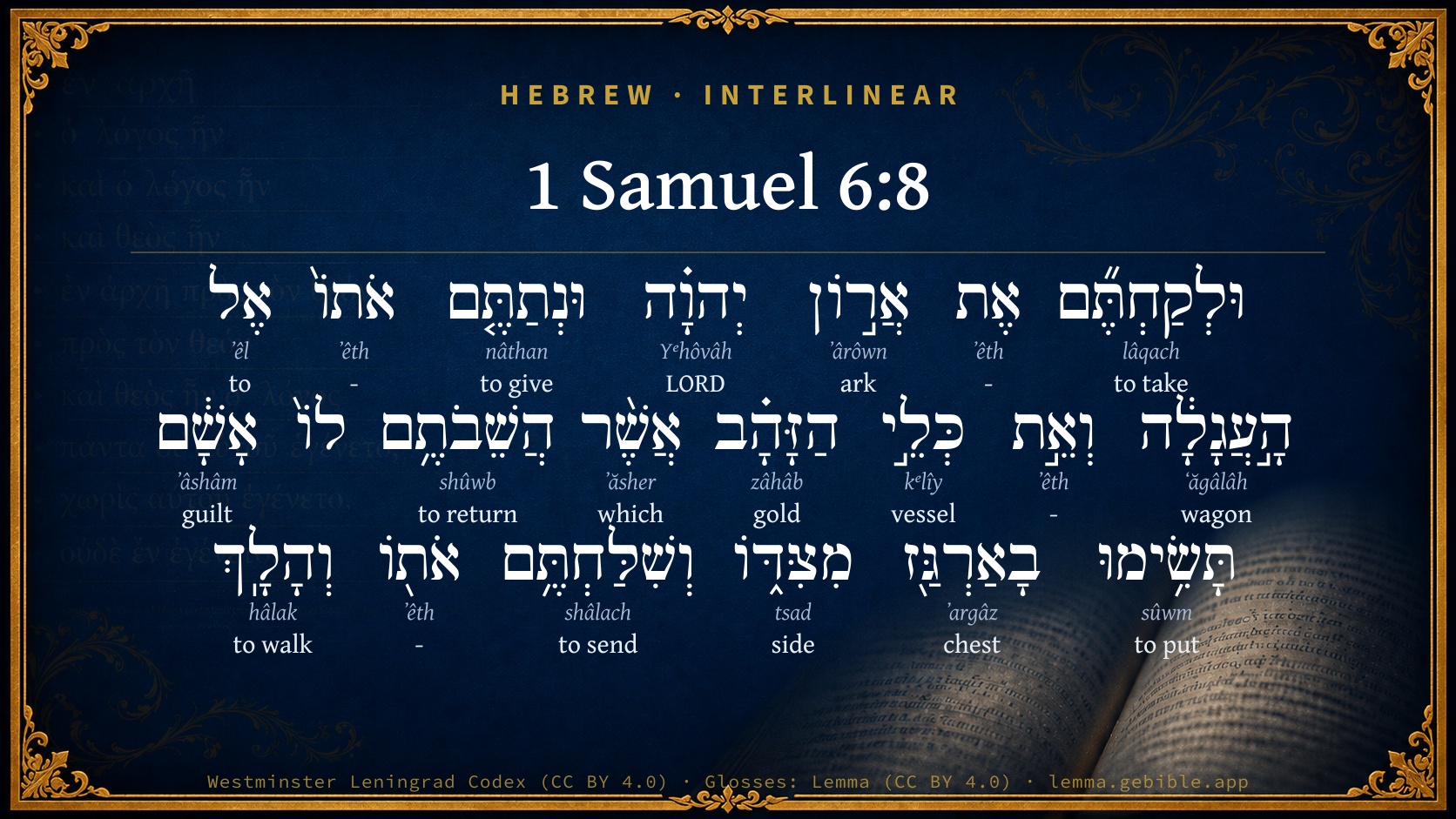
  1. וּלְקַחְתֶּ֞ם lâqach H3947 “and · to take” Conjunction + Verb, Qal, Sequential Perfect, 2nd Person, Masculine, Plural
  2. אֶת ʼêth H853 “-” Particle, Direct Object
  3. אֲר֣וֹן ʼârôwn H727 “ark of” Noun, Common, Both, Singular, Construct
  4. יְהוָ֗ה Yᵉhôvâh H3068 “LORD” Noun, Proper
  5. וּנְתַתֶּ֤ם nâthan H5414 “and · to give” Conjunction + Verb, Qal, Sequential Perfect, 2nd Person, Masculine, Plural
  6. אֹתוֹ֙ ʼêth H853 “- · him” Particle, Direct Object + Suffix, Personal, 3rd Person, Masculine, Singular
  7. אֶל ʼêl H413 “to” Preposition
  8. הָ֣עֲגָלָ֔ה ʻăgâlâh H5699 “the · wagon” Particle, Definite Article + Noun, Common, Feminine, Singular, Absolute
  9. וְאֵ֣ת ʼêth H853 “and · -” Conjunction + Particle, Direct Object
  10. כְּלֵ֣י kᵉlîy H3627 “vessels of” Noun, Common, Masculine, Plural, Construct
  11. הַזָּהָ֗ב zâhâb H2091 “the · gold” Particle, Definite Article + Noun, Common, Masculine, Singular, Absolute
  12. אֲשֶׁ֨ר ʼăsher H834 “which” Particle, Relative
  13. הֲשֵׁבֹתֶ֥ם shûwb H7725 “to return” Verb, Hiphil, Perfect, 2nd Person, Masculine, Plural
  14. אָשָׁ֔ם ʼâshâm H817 “guilt” Noun, Common, Masculine, Singular, Absolute
  15. תָּשִׂ֥ימוּ sûwm H7760 “to put” Verb, Qal, Imperfect, 2nd Person, Masculine, Plural
  16. מִצִּדּ֑וֹ tsad H6654 “from · side · his” Preposition + Noun, Common, Masculine, Singular, Construct + Suffix, Personal, 3rd Person, Masculine, Singular
  17. וְשִׁלַּחְתֶּ֥ם shâlach H7971 “and · to send” Conjunction + Verb, Piel, Sequential Perfect, 2nd Person, Masculine, Plural
  18. אֹת֖וֹ ʼêth H853 “- · him” Particle, Direct Object + Suffix, Personal, 3rd Person, Masculine, Singular
  19. וְהָלָֽךְ hâlak H1980 “and · to walk” Conjunction + Verb, Qal, Sequential Perfect, 3rd Person, Masculine, Singular

About this verse

These counts appear in no published source. They are computed here, from the morphology-tagged text and Lemma’s own curated glosses. What Lemma adds →

21
words
17
distinct lemmas
Historical
section

Notable vocabulary

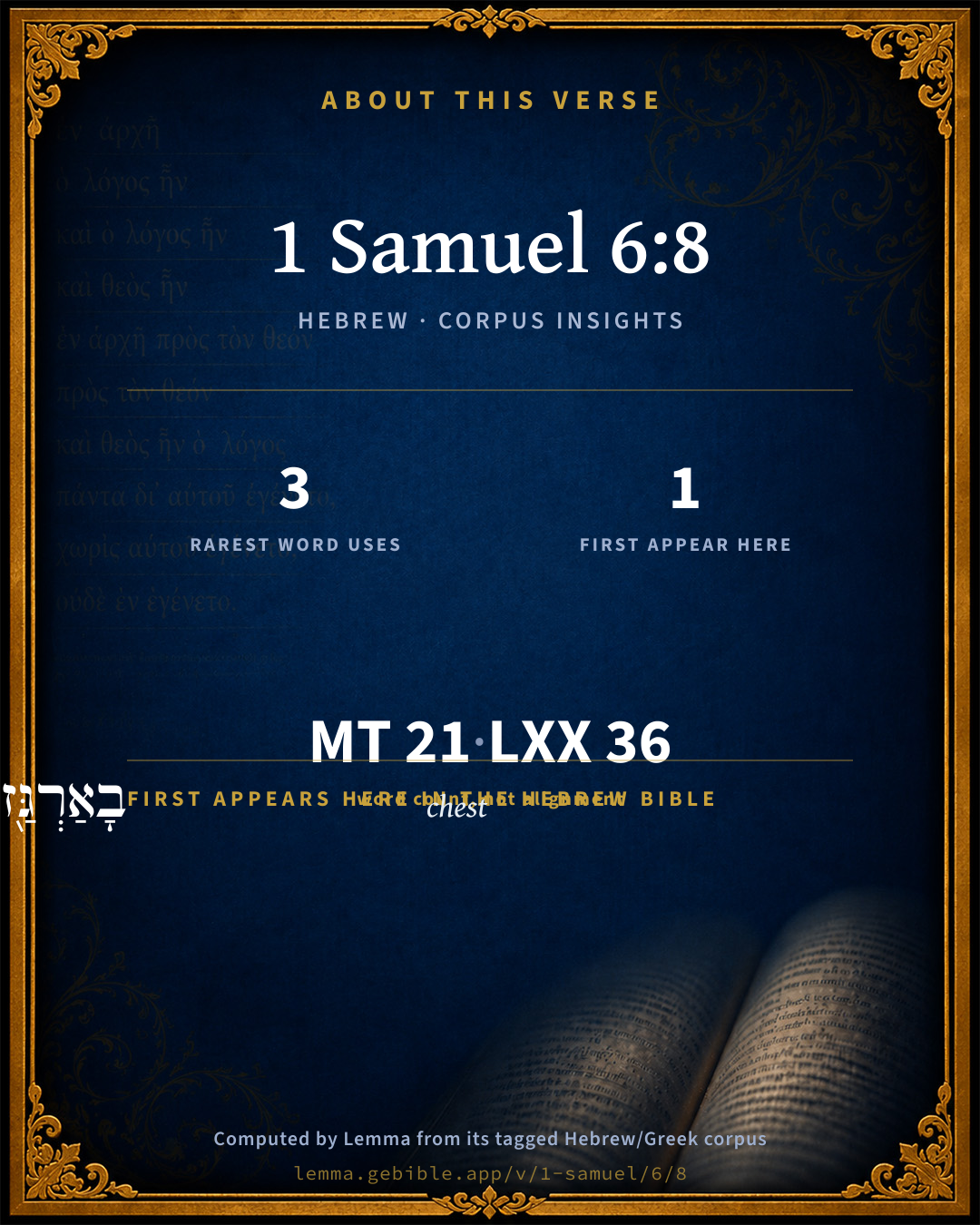
The rarest word here is בָאַרְגַּ֖ז chest H712 — appearing just 3 times in the whole Hebrew Bible.

First appearance in Scripture

This word makes its first canonical appearance in the Hebrew Bible here:

  • בָאַרְגַּ֖ז chest H712

Shared distinctive vocabulary

בָאַרְגַּ֖ז chest H712 occurs in 3 verses of the Hebrew Bible. Also found in:

Grammatical profile

  • 6 verbs
  • 8 nouns
  • 2 prepositions
  • 5 particles

Verb forms

  • וּלְקַחְתֶּ֞ם Qal · Sequential Perfect
  • וּנְתַתֶּ֤ם Qal · Sequential Perfect
  • הֲשֵׁבֹתֶ֥ם Hiphil · Perfect
  • תָּשִׂ֥ימוּ Qal · Imperfect
  • וְשִׁלַּחְתֶּ֥ם Piel · Sequential Perfect
  • וְהָלָֽךְ Qal · Sequential Perfect

Hebrew & Septuagint length

In English translation the verse runs 41 words from the Hebrew and 46 from the Septuagint (LXX English) — closely comparable.

A rough comparison of the two English renderings, which tokenize alike — not a word-level alignment.

Word counts can differ between the Hebrew and the Greek without any difference in meaning — e.g. the Hebrew direct-object marker אֵת has no separate Greek word, and Greek often adds the article ὁ.

In the original languages it is 21 Hebrew tokens and 36 Greek tokens — but the two are counted differently (Hebrew bundles its prefixes and suffixes into one token; the Greek is in lemma form), so that isn’t a like-for-like length.

Cross-references

1

Topical passages linked to 1 Samuel 6:8 in the Treasury of Scripture Knowledge — connected by theme and wording, ordered by reader-vote popularity; previews shown in the World English Bible.

  • 1 Samuel 6:3–5 They said, "If you send away the ark of the God of Israel, don't send it empty; but by all means return him a trespass-offering: then you shall be healed, and it shall be known to you why his hand is not removed from you."

Cross-references courtesy of OpenBible.info (CC BY 4.0).

Hebrew and Greek witnesses Masoretic Hebrew ↔ Greek Septuagint

The same verse in the two great witnesses to the Old Testament, shown verse-for-verse.

These are two independent witnesses, not word-aligned to each other, and the Septuagint is shown in lemma (dictionary) form.

Hebrew 1 Samuel 6:8 Masoretic · Westminster Leningrad Codex

וּלְקַחְתֶּ֞ם אֶת אֲר֣וֹן יְהוָ֗ה וּנְתַתֶּ֤ם אֹתוֹ֙ אֶל הָ֣עֲגָלָ֔ה וְאֵ֣ת כְּלֵ֣י הַזָּהָ֗ב אֲשֶׁ֨ר הֲשֵׁבֹתֶ֥ם לוֹ֙ אָשָׁ֔ם תָּשִׂ֥ימוּ בָאַרְגַּ֖ז מִצִּדּ֑וֹ וְשִׁלַּחְתֶּ֥ם אֹת֖וֹ וְהָלָֽךְ

and take the ark of Yahweh, and lay it on the cart; and put the jewels of gold, which you return him for a trespass-offering, in a coffer by the side of it; and send it away, that it may go.

World English Bible · Public Domain

Greek LXX 1 Samuel 6:8 Septuagint · lemma form

καί λαμβάνω ὁ κιβωτός καί τίθημι αὐτός ἐπί ὁ ἅμαξα καί ὁ σκεῦος ὁ χρυσοῦς ἀποδίδωμι αὐτός ὁ βάσανος καί τίθημι ἐν θέμα βερσεχθαν ἐκ μέρος αὐτός καί ἐκ ἀποστέλλω αὐτός καί ἀποἐλαύνω αὐτός καί ἀποἔρχομαι

And you⌃ shall take the ark and put it on the wagon; and you⌃ shall restore to it the golden articles for the trespass-offering in a coffer by the side of it: and you⌃ shall let it go, and sent it away, and you⌃ shall depart.

LXX2012 (modern English Septuagint) · Public Domain

On this verse, Haydock's Catholic Bible Commentary discusses the Septuagint’s reading. Read the note in Commentary ↓

Hebrew: Westminster Leningrad Codex (CC BY 4.0). Greek: Septuagint (public domain); English from LXX2012 (modern English Septuagint) (Public Domain). How the Septuagint differs from the Hebrew →

Targum (Aramaic paraphrase)

1

The Targum is the ancient Jewish Aramaic paraphrase of the Hebrew Scriptures — an interpretive translation, not the Hebrew text itself. Onkelos (literal) and Pseudo-Jonathan (expansive) render the Torah, and Jonathan the Prophets. Coverage is partial: where no permissively-licensed English translation exists for a verse, only the Aramaic is shown. This is verse-level text, not a word-by-word alignment to the Hebrew.

  1. Targum Jonathan Prophets (Joshua–Malachi)
    וְתִסְבּוּן יַת אֲרוֹנָא דַייָ וְתִתְּנוּן יָתֵיהּ בַּעֲגָלָתָא וְיַת מָנֵי דַהֲבָא דַאֲתֵיבְתּוּן קֳדָמוֹהִי קֻרְבַּן אֲשָׁמָא תְּשַׁווּן בְּתֵיבוּתָא מִסִטְרֵיהּ וְתִשְׁלְחוּן יָתֵיהּ וְיֵהָךְ:

    (no public-domain English translation for this verse)

    Targum Jonathan — Aramaic: “Mikraot Gedolot” (public domain). English: “Sefaria Community Translation” (CC0 1.0 (public-domain dedication)); “London "Chaldee Paraphrase," 1871” (public domain). Text via Sefaria.

Commentary

Notes on 1 Samuel 6:8 from classic Christian and Jewish commentators (each source and its license shown beneath its notes). The classic Christian expositions comment on the surrounding passage and are grouped to its opening verse, so a note may address several verses; the Jewish commentaries on the Tanakh (Rashi and others) are per-verse, so they appear only where the commentator wrote on this verse.

Lemma curates 59 commentaries, every one of them public domain or Creative Commons licensed, each selected and text-cleaned for this edition rather than reprinted as found. About our sources →

Trapp's Complete Commentary

John Trapp

1Sa 6:8 And take the ark of the LORD, and lay it upon the cart; and put the jewels of gold, which ye return him [for] a trespass offering, in a coffer by the side thereof; and send it away, that it may go.

Ver. 8. And put the jewels of gold … in a coffer.] For reverence’ sake of the ark, which they durst not open.

John Trapp, A Commentary or Exposition upon All the Books of the Old and New Testament (1647–1656) — public domain. Text from a community e-Sword module.

Joseph Benson's Commentary

1Sa 6:8. In a coffer by the side thereof — They had either heard, or by their present sufferings were made to fear, that it was dangerous to look into the ark; and therefore they did not open it to put their present within it.

Joseph Benson's Commentary on the Old and New Testaments (1811–1818) — public domain. Text from a community e-Sword module.

Geneva Bible (1599)

Geneva Bible translators

Meaning, the golden emerods and the golden mice.

Geneva Bible (1599) marginal notes — public domain. Text via Bolls.life.

Jamieson, Fausset & Brown

Robert Jamieson, A. R. Fausset & David Brown

take the ark of the Lord, and lay it upon the cart--This mode of carrying the sacred symbol was forbidden; but the ignorance of the Philistines made the indignity excusable (see on Sa2 6:6).

put the jewels . . . in a coffer by the side thereof--The way of securing treasure in the East is still in a chest, chained to the house wall or some solid part of the furniture.

Jamieson, Fausset & Brown — Commentary Critical and Explanatory on the Whole Bible (1871) — public domain (CC PDM 1.0). Text via the HelloAO Bible API.

Adam Clarke's Commentary

Verse 8. The jewels of gold] The word קלי keley, which our translators so often render jewels, signifies vessels, implements, ornaments, &c. A jewel of gold has an odd sound to those who always attach the idea of a precious stone to the term.

Adam Clarke's Commentary on the Bible (1810–1826) — public domain. Text from a community e-Sword/MySword module.

Ellicott's Commentary for English Readers

(8) In a coffer by the side thereof.—The reverent awe with which these Philistines treated the Ark, which had, they supposed, wrought them such great evil, presents a strong contrast to the careless curiosity of the men of Beth-shemesh with regard to the same sacred object—a careless curiosity, which was punished, as we so often find in the case of acts of sacrilege, with extreme severity.

A Bible Commentary for English Readers, edited by Charles John Ellicott (1878–1897) — public domain. Text from a community e-Sword module.

The Cambridge Bible for Schools and Colleges

gen. ed. J. J. S. Perowne

8. jewels of gold] Jewel is here used in a general sense = “any precious or costly object.” The Heb. word simply means “articles” or “vessels.”

The Cambridge Bible for Schools and Colleges (gen. ed. J. J. S. Perowne; Cambridge University Press, 1878–1918) — public domain. Text from a community e-Sword module.

John Gill's Exposition

And take the ark of the Lord, and lay it upon the cart,.... Which was dispensed with in these uncircumcised Philistines, there being no other to do this service:

and put the jewels of gold; or rather "vessels of gold" (p); the five golden emerods, and the five golden mice:

which ye return him for a trespass offering, in a coffer by the side thereof; in a basket, as the Syriac version: in a scrip, as the Arabic; in a purse, or bag, as Josephus (q); which latter is probable enough:

and send it away, that it may go; that is, set it a going, without any driver or guide; but leave it to take its course of itself to the land of Israel. Josephus (r) says it was set in a place where three ways met, that it might take which it might; and the taking of the right way must be a strong evidence of its being under the direction of God.

(p) "vasa aurea", Pagninus, Montanus, Vatablus, &c. (q) Antiqu. l. 6. c. 1. sect. 2. (r) Antiqu. l. 6. c. 1. sect. 2.

John Gill's Exposition of the Whole Bible (1746–1763) — public domain (CC PDM 1.0). Text via the HelloAO Bible API.

Haydock's Catholic Bible Commentary

Box. Hebrew argaz, (which the Septuagint retain; Haydock) means also "a purse or basket." (Calmet) --- Josephus ([Antiquities?] vi. 1,) says, "the box was placed upon the ark." (Haydock) --- We do not read what became of these presents afterwards: but it is supposed that they were kept in the sanctuary till the time of the captivity. (Calmet)

George Leo Haydock (1774–1849), Haydock's Catholic Family Bible and Commentary, 1859 edition — public domain. Excludes Psalms (Douay-Rheims chapter numbering differs from Protestant) and Deuterocanonical books (Catholic canon only).

Matthew Poole's English Annotations

Lay it upon the cart; which God winked at in them, both because they were ignorant of God’s law to the contrary, and because they had no Levites to carry it upon their shoulders.

In a coffer by the side thereof; for they durst not presume to open the ark, to put them within it.

Matthew Poole's English Annotations on the Holy Bible (1683–1685) — public domain. Text from a community e-Sword/MySword module.

Whedon's Commentary on the Bible

Daniel D. Whedon

8. Jewels of gold — Rather, vessels of gold; that is, the golden images mentioned in 1Sa_6:4.

A coffer — A chest, or box. They did not venture to open the ark and put the golden vessels in it, but placed them in a chest beside it.

Daniel D. Whedon (gen. ed.), Commentary on the Old and New Testaments (1874–1909) — public domain. Text from a community e-Sword module.

The Pulpit Commentary

Put the jewels of gold in a coffer. Instead of jewels the Hebrew word signifies any article of workmanship, and so figures, images wrought in gold. They were to be placed reverentially at the side of the ark, for it had wrought them so great evil that they had learned to look upon it with awe.

The Pulpit Commentary (1880–1919), ed. H.D.M. Spence-Jones & Joseph S. Exell — public domain. Text from a community e-Sword module.

Rashi

Rabbi Shlomo Yitzchaki (Rashi)

In the box. Escrin in O. F.

Rashi on the Tanakh — English translations: “The Judaica Press complete Tanach with Rashi, translated by A. J. Rosenberg” (CC BY 4.0); “Pentateuch with Rashi's commentary by M. Rosenbaum and A.M. Silbermann, 1929-1934” (public domain); “The Metsudah Tanach series, Lakewood, N.J” (CC BY 4.0); and “The Book of Joshua, Metsudah Publications, 1997” (CC BY 4.0). Text via Sefaria.

Lesson kit

Teaching starters — assembled from the data on this page, not authored interpretation. Every prompt links to the verse data it draws on. Edit before teaching.

1 Samuel, in the Historical, opens this verse with 21 words (17 distinct Hebrew lemmas). Its most distinctive word is ʼargâz (“chest”). A historical commentator’s framing appears above. Read the whole chapter for the surrounding context.

Discussion questions

  1. What does “chest” (ʼargâz) contribute to the verse as a whole?
  2. The word “chest” first appears here in Scripture. What is being introduced at this debut?
  3. 1 Samuel 6:11 shares the word «chest» with this verse. How do the two illuminate each other?
  4. These translations render this verse differently. What is at stake in choosing one wording over another?
  5. The verb «וּלְקַחְתֶּ֞ם» is Qal Sequential Perfect. How does its form color the action?
  6. Reading how Trapp's Complete Commentary and Joseph Benson's Commentary read this verse, where do the two commentators agree and where do they part?

Things to notice

Reading settings

Reading text

Shown beneath each verse's original-language words.

Old Testament
Old Testament edition

Read the OT as the Masoretic Hebrew (MT) or the Greek Septuagint (LXX).

English shown for the Greek Septuagint (in the Hebrew ↔ Greek comparison).

Comparing translations? Open the Compare panel on any verse page to stack up to four side by side.