
Zechariah 8:3

Hebrew (Westminster Leningrad Codex) Zechariah 8:3 appears in the Hebrew Old Testament. The text above is from the Westminster Leningrad Codex. Each word links to its Strong’s number, a concise gloss, and parsing drawn from the Open Scriptures Hebrew Bible morphology. Click any word for its full Brown-Driver-Briggs (BDB) entry.
Download image
Cite this verse

Zechariah 8:3 (World English Bible). Public Domain. Lemma interlinear Bible study tool, https://lemma.gebible.app/v/zechariah/8/3.

Show BibTeX & RIS
BibTeX
RIS
English Translation
Thus says Yahweh: "I have returned to Zion, and will dwell in the midst of Jerusalem. Jerusalem shall be called 'The City of Truth;' and the mountain of Yahweh of Hosts, 'The Holy Mountain.'"
World English Bible · Public Domain
Download a study sheet

One document with this verse’s original text, its word-by-word gloss line, the meaning frame, cross-references with their text, attributed commentary, and full source and license credits — printable, and it pastes into notes with its structure intact.

This verse Autodidact and up

Study sheet (.html) Plain text (.txt)

A passage Seminary Student

Up to 50 verses in one chapter. A passage sheet keeps up to 6 commentary sources and 12 cross-references per verse, in the order this page ranks them, and says so on the sheet whenever that leaves anything out. Ask for a single verse and you get the Autodidact verse sheet above.

Everything on this page stays free to read, with no account — the sheet is a download of what is already on screen, not access to it.

Want to remove ads? Support Godless Engineer
Compare translations 3

The same verse in 3 English versions, stacked beneath the original-language interlinear above. Click any original word for its lexicon entry.

Each is an independent rendering of the whole verse — the interlinear is not word-aligned to these translations.

Highlighted words mark where these versions differ — a whole-verse word diff, not a word-by-word alignment.

  • World English Bible Public Domain
    Thus says Yahweh: "I have returned to Zion, and will dwell in the midst of Jerusalem. Jerusalem shall be called 'The City of Truth;' and the mountain of Yahweh of Hosts, 'The Holy Mountain.'"
  • King James Version Public Domain
    Thus saith the LORD; I am returned unto Zion, and will dwell in the midst of Jerusalem: and Jerusalem shall be called a city of truth; and the mountain of the LORD of hosts the holy mountain.
  • unfoldingWord Literal Text CC BY-SA 4.0
    Yahweh of hosts says this: I will return to Zion and will live in the midst of Jerusalem, for Jerusalem will be called The City of Truth and the mountain of Yahweh of hosts will be called The Holy Mountain!

unfoldingWord Literal Text — © unfoldingWord, licensed CC BY-SA 4.0. Word-aligned USFM3 via Door43 (git.door43.org/unfoldingWord/en_ult).

Versions to compare (up to 4)

3 of 4 selected

Show all 18 translations

Every available English version of this verse, each an independent rendering of the whole verse.

  • World English Bible Public Domain
    Thus says Yahweh: "I have returned to Zion, and will dwell in the midst of Jerusalem. Jerusalem shall be called 'The City of Truth;' and the mountain of Yahweh of Hosts, 'The Holy Mountain.'"
  • Berean Standard Bible Public Domain
    This is what the LORD says: “I will return to Zion and dwell in Jerusalem. Then Jerusalem will be called the City of Truth, and the mountain of the LORD of Hosts will be called the Holy Mountain.”
  • Majority Standard Bible Public Domain
    This is what the LORD says: “I will return to Zion and dwell in Jerusalem. Then Jerusalem will be called the City of Truth, and the mountain of the LORD of Hosts will be called the Holy Mountain.”
  • King James Version Public Domain
    Thus saith the LORD; I am returned unto Zion, and will dwell in the midst of Jerusalem: and Jerusalem shall be called a city of truth; and the mountain of the LORD of hosts the holy mountain.
  • American Standard Version (1901) Public Domain
    Thus saith Jehovah: I am returned unto Zion, and will dwell in the midst of Jerusalem: and Jerusalem shall be called The city of truth; and the mountain of Jehovah of hosts, The holy mountain.
  • Revised Version (1885) Public Domain
    Thus saith the LORD: I am returned unto Zion, and will dwell in the midst of Jerusalem: and Jerusalem shall be called The city of truth; and the mountain of the LORD of hosts The holy mountain.
  • Geneva Bible (1599) Public Domain
    Thus saith the Lord, I wil returne vnto Zion, and wil dwel in the mids of Ierusalem: and Ierusalem shalbe called a citie of trueth, and the Mountaine of the Lord of hostes, the holy Mountaine.
  • Douay-Rheims (1899) Public Domain
    Thus saith the Lord of hosts: I am returned to Sion, and I will dwell in the midst of Jerusalem: and Jerusalem shall be called The city of truth, and the mountain of the Lord of hosts, The sanctified mountain.
  • Young's Literal Translation Public Domain
    Thus said Jehovah: I have turned back unto Zion, And I have dwelt in the midst of Jerusalem, And Jerusalem hath been called `The city of truth,' And the mountain of Jehovah of Hosts, `The holy mountain.'
  • Literal Standard Version CC BY-SA 4.0
    Thus said YHWH: I have turned back to Zion, || And I have dwelt in the midst of Jerusalem, || And Jerusalem has been called The City of Truth, || And The Mountain of YHWH of Hosts, || The Holy Mountain.
  • Unlocked Literal Bible CC BY-SA 4.0
    Yahweh of hosts says this: I will return to Zion and will live in the midst of Jerusalem, for Jerusalem will be called The City of Truth and the mountain of Yahweh of hosts will be called The Holy Mountain!
  • unfoldingWord Literal Text CC BY-SA 4.0
    Yahweh of hosts says this: I will return to Zion and will live in the midst of Jerusalem, for Jerusalem will be called The City of Truth and the mountain of Yahweh of hosts will be called The Holy Mountain!
  • Darby Bible Public Domain
    Thus saith Jehovah: I am returned unto Zion, and will dwell in the midst of Jerusalem; and Jerusalem shall be called, The city of truth; and the mountain of Jehovah of hosts, The holy mountain.
  • World Messianic Bible Public Domain
    The LORD says: “I have returned to Zion, and will dwell in the middle of Jerusalem. Jerusalem shall be called ‘The City of Truth;’ and the mountain of the LORD of Hosts, ‘The Holy Mountain.’”
  • Webster's Bible Public Domain
    Thus saith the LORD; I have returned to Zion, and will dwell in the midst of Jerusalem: and Jerusalem shall be called a city of truth; and the mountain of the LORD of hosts the holy mountain.
  • Free Bible Version CC BY-SA 4.0
    This is what the Lord says. I have returned to Zion, and I will live in Jerusalem. Then Jerusalem will be called the “Faithful City,” and the mountain of the Lord Almighty the “Holy Mountain.”
  • Bible in Basic English Public Domain
    This is what the Lord has said: I have come back to Zion, and will make my living-place in Jerusalem: and Jerusalem will be named The town of good faith; and the mountain of the Lord of armies The holy mountain.
  • JPS Tanakh (1917) Public Domain
    Thus saith the LORD: I return unto Zion, and will dwell in the midst of Jerusalem; and Jerusalem shall be called The city of truth; and the mountain of the LORD of hosts The holy mountain.

Literal Standard Version (2020), Covenant Press — licensed CC BY-SA 4.0. Text via the HelloAO Bible API (eBible.org). Unlocked Literal Bible (unfoldingWord) — licensed CC BY-SA 4.0. Text via the HelloAO Bible API (eBible.org). unfoldingWord Literal Text — © unfoldingWord, licensed CC BY-SA 4.0. Word-aligned USFM3 via Door43 (git.door43.org/unfoldingWord/en_ult). Free Bible Version, Dr. Jonathan Gallagher — licensed CC BY-SA 4.0. Text via the HelloAO Bible API (eBible.org).

Word by word

More ways to search: Search by grammar → Find every occurrence → Compare this word →

Practice this passage: Drill this verse → Learn its vocabulary →

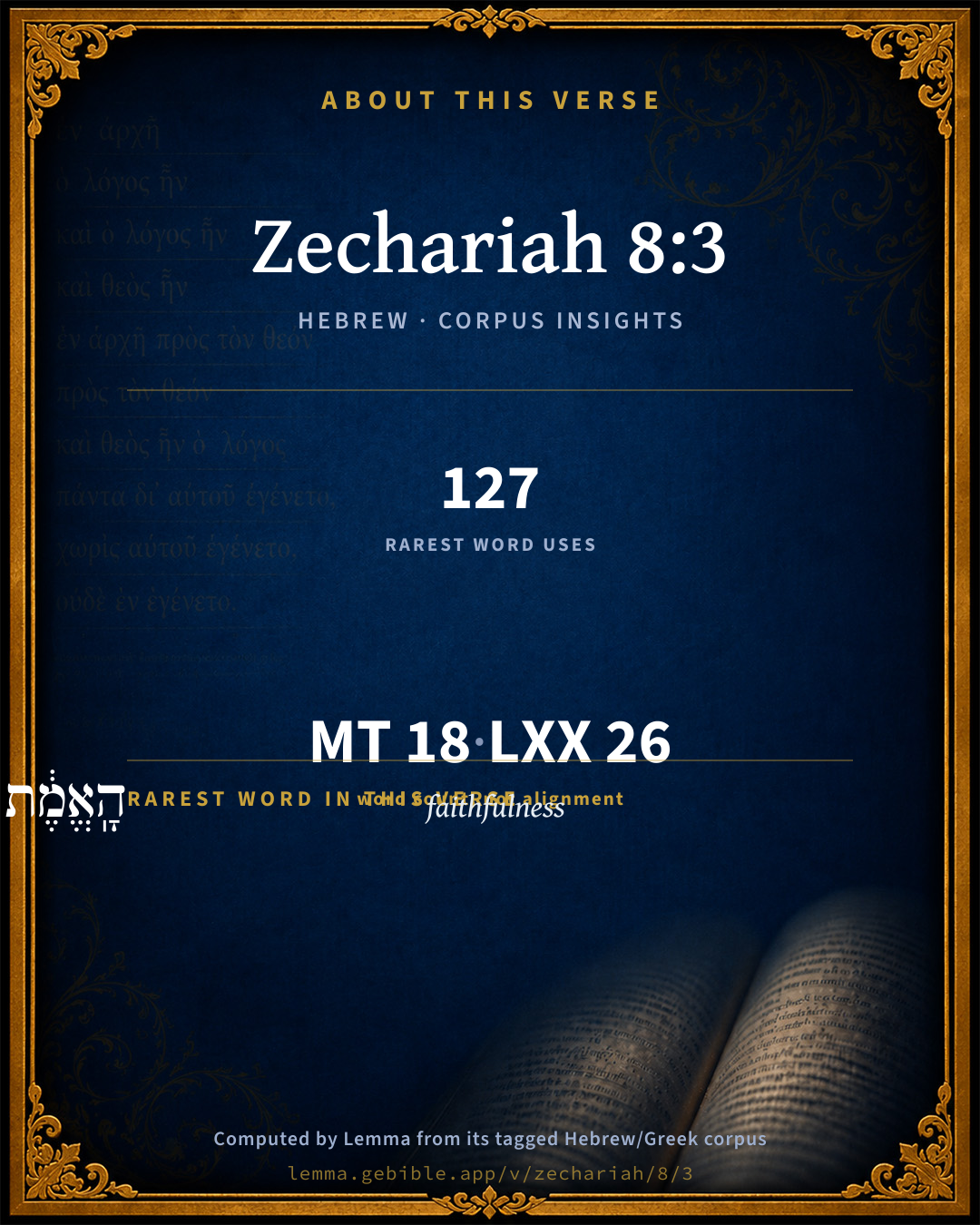
הָֽאֱמֶ֔ת
ʼemeth
H571
“the · faithfulness”
Particle, Definite Article + Noun, Common, Feminine, Singular, Absolute
Part of Speech
Particle + Noun
Type
Common
Gender
Feminine
Number
Singular
State
Absolute
Full BDB Definition

Origin: contracted from H539

TWOT: 116k

firmness, faithfulness, truth (noun feminine) - sureness, reliability - stability, continuance - faithfulness, reliableness - truth - as spoken - of testimony and judgment - of divine instruction - truth as a body of ethical or religious knowledge - true doctrine - in truth, truly (adverb)
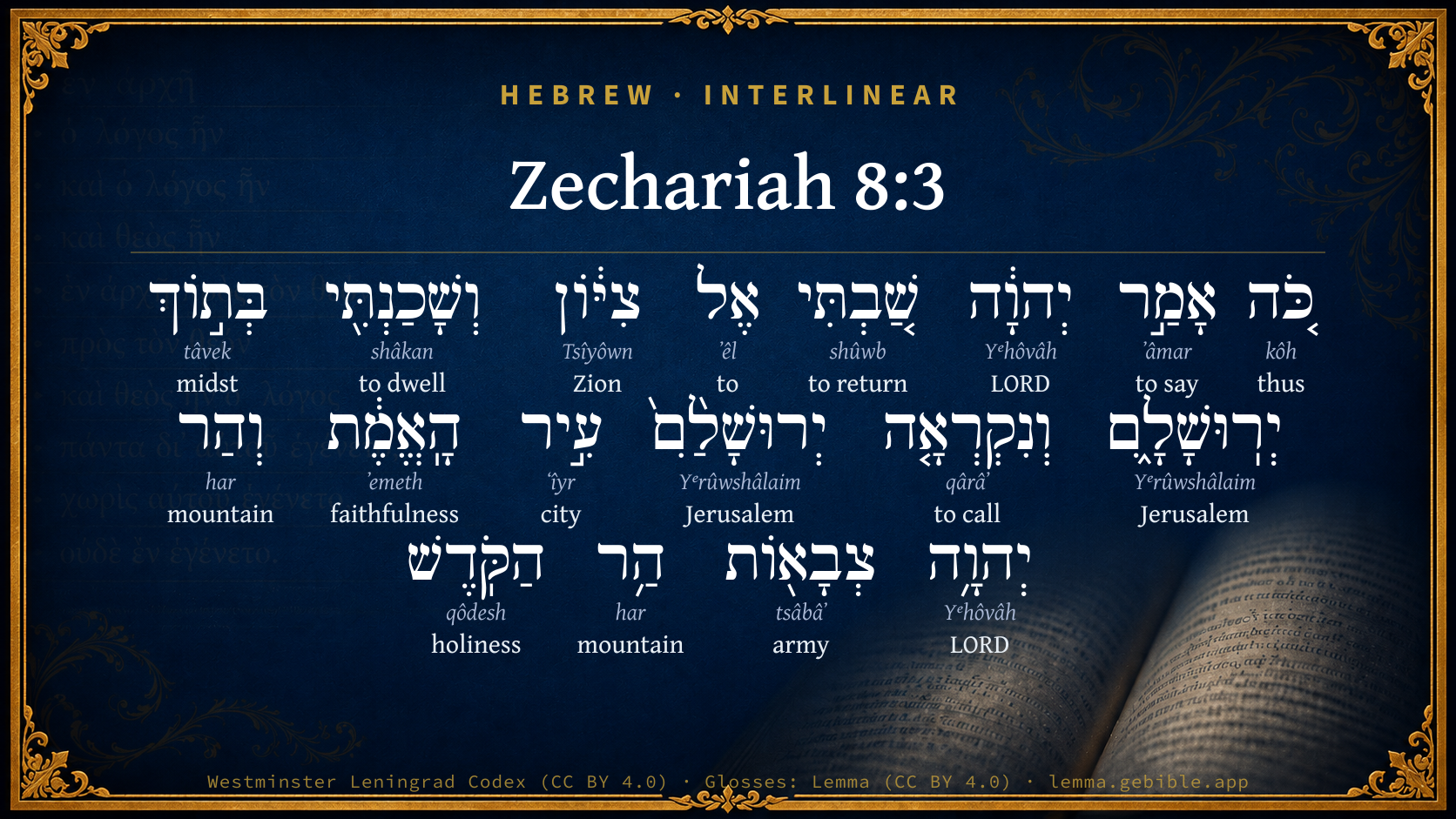
  1. כֹּ֚ה kôh H3541 “thus” Adverb
  2. אָמַ֣ר ʼâmar H559 “to say” Verb, Qal, Perfect, 3rd Person, Masculine, Singular
  3. יְהוָ֔ה Yᵉhôvâh H3068 “LORD” Noun, Proper
  4. שַׁ֚בְתִּי shûwb H7725 “to return” Verb, Qal, Perfect, 1st Person, Common, Singular
  5. אֶל ʼêl H413 “to” Preposition
  6. צִיּ֔וֹן Tsîyôwn H6726 “Zion” Noun, Proper
  7. וְשָׁכַנְתִּ֖י shâkan H7931 “and · to dwell” Conjunction + Verb, Qal, Perfect, 1st Person, Common, Singular
  8. בְּת֣וֹךְ tâvek H8432 “in/at · midst of” Preposition + Noun, Common, Masculine, Singular, Construct
  9. יְרֽוּשָׁלִָ֑ם Yᵉrûwshâlaim H3389 “Jerusalem” Noun, Proper
  10. וְנִקְרְאָ֤ה qârâʼ H7121 “and · to call” Conjunction + Verb, Niphal, Perfect, 3rd Person, Feminine, Singular
  11. יְרוּשָׁלִַ֨ם֙ Yᵉrûwshâlaim H3389 “Jerusalem” Noun, Proper
  12. עִ֣יר ʻîyr H5892 “city of” Noun, Common, Feminine, Singular, Construct
  13. וְהַר har H2022 “and · mountain of” Conjunction + Noun, Common, Masculine, Singular, Construct
  14. יְהוָ֥ה Yᵉhôvâh H3068 “LORD” Noun, Proper
  15. צְבָא֖וֹת tsâbâʼ H6635 “armies” Noun, Common, Both, Plural, Absolute
  16. הַ֥ר har H2022 “mountain of” Noun, Common, Masculine, Singular, Construct
  17. הַקֹּֽדֶשׁ qôdesh H6944 “the · holiness” Particle, Definite Article + Noun, Common, Masculine, Singular, Absolute

About this verse

These counts appear in no published source. They are computed here, from the morphology-tagged text and Lemma’s own curated glosses. What Lemma adds →

18
words
15
distinct lemmas
Prophets
section

Grammatical profile

  • 4 verbs
  • 12 nouns
  • 1 preposition
  • 1 adverb

Verb forms

  • אָמַ֣ר Qal · Perfect
  • שַׁ֚בְתִּי Qal · Perfect
  • וְשָׁכַנְתִּ֖י Qal · Perfect
  • וְנִקְרְאָ֤ה Niphal · Perfect

Repetition

Words recur within this verse — often emphatic in Hebrew:

  • יְהוָ֔ה LORD H3068 ×2
  • יְרֽוּשָׁלִָ֑ם Jerusalem H3389 ×2
  • וְהַר mountain H2022 ×2

Hebrew & Septuagint length

In English translation the verse runs 34 words from the Hebrew and 34 from the Septuagint (LXX English) — the same length.

A rough comparison of the two English renderings, which tokenize alike — not a word-level alignment.

Word counts can differ between the Hebrew and the Greek without any difference in meaning — e.g. the Hebrew direct-object marker אֵת has no separate Greek word, and Greek often adds the article ὁ.

In the original languages it is 18 Hebrew tokens and 26 Greek tokens — but the two are counted differently (Hebrew bundles its prefixes and suffixes into one token; the Greek is in lemma form), so that isn’t a like-for-like length.

Cross-references

25

Topical passages linked to Zechariah 8:3 in the Treasury of Scripture Knowledge — connected by theme and wording, ordered by reader-vote popularity; previews shown in the World English Bible.

  • Zechariah 1:16 Therefore thus says Yahweh: "I have returned to Jerusalem with mercy. My house shall be built in it," says Yahweh of Hosts, "and a line shall be stretched forth over Jerusalem."'
  • John 1:14 The Word became flesh, and lived among us. We saw his glory, such glory as of the one and only Son of the Father, full of grace and truth.
  • Isaiah 1:26 I will restore your judges as at the first, And your counselors as at the beginning. Afterward you shall be called 'The city of righteousness, A faithful town.'
  • Isaiah 66:20 They shall bring all your brothers out of all the nations for an offering to Yahweh, on horses, and in chariots, and in litters, and on mules, and on dromedaries, to my holy mountain Jerusalem, says Yahweh, as the children of Israel bring their offering in a clean vessel into the house of Yahweh.
  • Jeremiah 30:10–11 Therefore don't you be afraid, O Jacob my servant, says Yahweh; neither be dismayed, Israel: for, behold, I will save you from afar, and your seed from the land of their captivity; and Jacob shall return, and shall be quiet and at ease, and none shall make him afraid.
  • Jeremiah 31:23 Thus says Yahweh of Hosts, the God of Israel, Yet again shall they use this speech in the land of Judah and in the cities of it, when I shall bring again their captivity: Yahweh bless you, habitation of righteousness, mountain of holiness.
  • Jeremiah 33:16 In those days shall Judah be saved, and Jerusalem shall dwell safely; and this is [the name] by which she shall be called: Yahweh our righteousness.
  • Joel 3:17 "So you will know that I am Yahweh, your God, Dwelling in Zion, my holy mountain. Then Jerusalem will be holy, And no strangers will pass through her any more.
  • Zechariah 2:10–11 Sing and rejoice, daughter of Zion; for, behold, I come, and I will dwell in the midst of you,' says Yahweh.
  • Zechariah 14:20–21 In that day there will be on the bells of the horses, "HOLY TO YAHWEH;" and the pots in Yahweh's house will be like the bowls before the altar.
  • John 14:23 Jesus answered him, "If a man loves me, he will keep my word. My Father will love him, and we will come to him, and make our home with him.
  • 2 Corinthians 6:16 What agreement has a temple of God with idols? For you are a temple of the living God. Even as God said, "I will dwell in them, and walk in them; and I will be their God, and they will be my people."
  • Ephesians 2:21–22 in whom the whole building, fitted together, grows into a holy temple in the Lord;
  • Colossians 2:9 For in him all the fullness of the Godhead dwells bodily,
  • Revelation 21:3 I heard a loud voice out of heaven saying, "Behold, God's dwelling is with people, and he will dwell with them, and they will be his people, and God himself will be with them as their God.
  • Isaiah 2:2–3 It shall happen in the latter days, that the mountain of Yahweh's house shall be established on the top of the mountains, And shall be raised above the hills; And all nations shall flow to it.
  • Isaiah 12:6 Cry aloud and shout, you inhabitant of Zion; for great in the midst of you is the Holy One of Israel!"
  • Isaiah 60:14 The sons of those who afflicted you shall come bending to you; and all those who despised you shall bow themselves down at the soles of your feet; and they shall call you The city of Yahweh, The Zion of the Holy One of Israel.
  • Isaiah 65:25 The wolf and the lamb shall feed together, and the lion shall eat straw like the ox; and dust shall be the serpent's food. They shall not hurt nor destroy in all my holy mountain, says Yahweh.
  • Ezekiel 48:35 It shall be eighteen thousand [reeds] round about: and the name of the city from that day shall be, Yahweh is there.
  • Joel 3:21 I will cleanse their blood, That I have not cleansed: For Yahweh dwells in Zion."
  • Revelation 21:10 He carried me away in the Spirit to a great and high mountain, and showed me the holy city, Jerusalem, coming down out of heaven from God,
  • Revelation 21:27 There will in no way enter into it anything profane, or one who causes an abomination or a lie, but only those who are written in the Lamb's book of life.
  • Isaiah 1:21 How the faithful city has become a prostitute! She was full of justice; righteousness lodged in her, But now murderers.
  • Isaiah 11:9 They shall not hurt nor destroy in all my holy mountain; for the earth shall be full of the knowledge of Yahweh, as the waters cover the sea.

Cross-references courtesy of OpenBible.info (CC BY 4.0).

Hebrew and Greek witnesses Masoretic Hebrew ↔ Greek Septuagint

The same verse in the two great witnesses to the Old Testament, shown verse-for-verse.

These are two independent witnesses, not word-aligned to each other, and the Septuagint is shown in lemma (dictionary) form.

Hebrew Zechariah 8:3 Masoretic · Westminster Leningrad Codex

כֹּ֚ה אָמַ֣ר יְהוָ֔ה שַׁ֚בְתִּי אֶל צִיּ֔וֹן וְשָׁכַנְתִּ֖י בְּת֣וֹךְ יְרֽוּשָׁלִָ֑ם וְנִקְרְאָ֤ה יְרוּשָׁלִַ֨ם֙ עִ֣יר הָֽאֱמֶ֔ת וְהַר יְהוָ֥ה צְבָא֖וֹת הַ֥ר הַקֹּֽדֶשׁ

Thus says Yahweh: "I have returned to Zion, and will dwell in the midst of Jerusalem. Jerusalem shall be called 'The City of Truth;' and the mountain of Yahweh of Hosts, 'The Holy Mountain.'"

World English Bible · Public Domain

Greek LXX Zechariah 8:3 Septuagint · lemma form

ὅδε λέγω κύριος καί ἐπιστρέφω ἐπί σιων καί κατασκηνόω ἐν μέσος ἰερουσαλήμ καί καλέω ὁ ἰερουσαλήμ πόλις ὁ ἀληθινός καί ὁ ὄρος κύριος παντοκράτωρ ὄρος ἅγιος

Thus says the Lord; I will return to Sion, and dwell in the midst of Jerusalem: and Jerusalem shall be called a true city, and the mountain of the Lord Almighty a holy mountain.

LXX2012 (modern English Septuagint) · Public Domain

Hebrew: Westminster Leningrad Codex (CC BY 4.0). Greek: Septuagint (public domain); English from LXX2012 (modern English Septuagint) (Public Domain). How the Septuagint differs from the Hebrew →

Targum (Aramaic paraphrase)

1

The Targum is the ancient Jewish Aramaic paraphrase of the Hebrew Scriptures — an interpretive translation, not the Hebrew text itself. Onkelos (literal) and Pseudo-Jonathan (expansive) render the Torah, and Jonathan the Prophets. Coverage is partial: where no permissively-licensed English translation exists for a verse, only the Aramaic is shown. This is verse-level text, not a word-by-word alignment to the Hebrew.

  1. Targum Jonathan Prophets (Joshua–Malachi)
    כִּדְנַן אֲמַר יְיָ אֲתוּב לְצִיוֹן וְאַשְׁרֵי שְׁכִנְתִּי בְּגוֹ יְרוּשְׁלֵם וְתִתְקְרֵי יְרוּשְׁלֵם קַרְתָּא דְקוּשְׁטָא וְטוּר בֵּית מַקְדְשָׁא דַייָ צְבָאוֹת טוּרָא קַדִישָׁא:

    (no public-domain English translation for this verse)

    Targum Jonathan — Aramaic: “Mikraot Gedolot” (public domain). English: “Sefaria Community Translation” (CC0 1.0 (public-domain dedication)); “London "Chaldee Paraphrase," 1871” (public domain). Text via Sefaria.

Commentary

Notes on Zechariah 8:3 from classic Christian and Jewish commentators (each source and its license shown beneath its notes). The classic Christian expositions comment on the surrounding passage and are grouped to its opening verse, so a note may address several verses; the Jewish commentaries on the Tanakh (Rashi and others) are per-verse, so they appear only where the commentator wrote on this verse.

Lemma curates 59 commentaries, every one of them public domain or Creative Commons licensed, each selected and text-cleaned for this edition rather than reprinted as found. About our sources →

Trapp's Complete Commentary

John Trapp

Zec 8:3 Thus saith the LORD; I am returned unto Zion, and will dwell in the midst of Jerusalem: and Jerusalem shall be called a city of truth; and the mountain of the LORD of hosts the holy mountain.

Ver. 3. I am returned unto Zion] After a long absence, as it may seem by the late troubles, and that dismal dispersion, Zec 7:14. God was gone aside and returned to his place, till they should acknowledge their offence and seek his face: In their affliction, said he, they will seek me early. Neither was he frustrated, as appeareth, Hos 5:15; cf. Hos 6:1. Come, and let us return unto the Lord, say they. Do so, and then I will come again unto you as the rain, as the latter and former rain unto the earth, with a cornucopia of peace, plenty, and prosperity. Neither this only will I do as a stranger in the land, or as a wayfaring man, that tarrieth for a night,

But I will dwell in the midst of Jerusalem] My shechinah, or settled habitation, shall be in the midst of it, sc. in my temple there situated, Jer 14:8. Maimonides saith, that the Hebrew word here used signifieth continuationem stationis, a sure and settled abode; such as was that of the Godhead of Christ in his manhood. "For the Word was made flesh and dwelt among us," εσκηνωσεν. The word seems to be made of this Shacan in the text.

And Jerusalem shall be called a city of truth] A faithful city, Isa 1:26. A Verona rightly so called; a place where the sincere service of the true God is set up and practised; in opposition to other cities (such as Athens was, wholly given to idolatry, Act 17:16, κατειδωλον), that went a whoring after lying vanities, and so forsook their own mercies, Job 2:8.

And the mountain of the Lord of hosts the holy mountain] This and the former clause may safely and fitly be extended to the holy Catholic Church of the New Testament also; whereof Jerusalem and the mount Moriah, whereon the temple stood, were figures. The Rabbis themselves expect the good things here promised to be performed when their Messiah shall come, quem tantis ululatibus exposcunt.

John Trapp, A Commentary or Exposition upon All the Books of the Old and New Testament (1647–1656) — public domain. Text from a community e-Sword module.

Joseph Benson's Commentary

Zec 8:3. I am returned unto Zion — “I have punished her infidelities with all the rigour of despised and abused love; but, though sensible of her fault, my tenderness has continued, and my love is rekindled for her, upon her change in conduct, and return in true repentance to me. I have received her, restored my love to her, and will render to her my former kindnesses.” And will dwell in the midst of Jerusalem — Once more, as of old, I will manifest my presence and fix my residence there: according to my promise, repeated to my people, Jerusalem shall be my dwelling-place: see the note on Zec 2:10. Jerusalem shall be called, A city of truth — That is, it shall be such: the truth of God shall be known, believed, loved, and adhered to therein; the true God, and he only, shall be worshipped there, and that in sincerity and truth, and in the manner which he hath prescribed. Its citizens shall love and speak the truth, shall practise and execute true justice and judgment, and be faithful to Jehovah; and the mountain of the Lord, The holy mountain — On account of the pure and holy worship performed there, and the holy conduct of its inhabitants. We see a shadow of the accomplishment of this prophecy in the Jews, after their return from captivity; but this faithful city, this city of truth and holiness, in the strictness of the letter, is no other than the Christian Church, that chaste and faithful spouse of Jesus Christ, Eph 5:27.

Joseph Benson's Commentary on the Old and New Testaments (1811–1818) — public domain. Text from a community e-Sword module.

Tyndale Open Study Notes

Tyndale Open Resources

8:3 I will live in Jerusalem: The great hope of the postexilic community was that the Lord would return to dwell among his people again (see 1:16-17; Hag 2:4-7; cp. Ezek 48:35). • I am returning: God would return to Jerusalem not just because the Temple had been rebuilt but because the Hebrew community had been purified (Zech 3). • Isaiah compared Jerusalem to a faithful woman who became a prostitute (Isa 1:21). Zechariah shared Isaiah’s vision of Jerusalem’s change into a Faithful City (or city of truth) again (Isa 1:26).

Tyndale Open Study Notes — © Tyndale Open Resources, licensed CC BY-SA 4.0. Text via the HelloAO Bible API.

Geneva Bible (1599)

Geneva Bible translators

Because she shall be faithful and loyal toward me her husband.

Geneva Bible (1599) marginal notes — public domain. Text via Bolls.life.

Jamieson, Fausset & Brown

Robert Jamieson, A. R. Fausset & David Brown

I am returned--that is, I am determined to return. My decree to that effect is gone forth.

Jerusalem . . . city of truth--that is, faithful to her God, who is the God of truth (Isa 1:21, Isa 1:26; Joh 17:17). Never yet fully fulfilled, therefore still to be so.

the mountain of the Lord-- (Isa 2:2-3).

holy mountain-- (Jer 31:23).

Jamieson, Fausset & Brown — Commentary Critical and Explanatory on the Whole Bible (1871) — public domain (CC PDM 1.0). Text via the HelloAO Bible API.

Adam Clarke's Commentary

Verse 3. I am returned unto Zion] I have restored her from her captivity. I will dwell among them. The temple shall be rebuilt, and so shall Jerusalem; and instead of being false, unholy, and profligate, it shall be the city of truth, and my holy mountain. TRUTH shall dwell in it.

Adam Clarke's Commentary on the Bible (1810–1826) — public domain. Text from a community e-Sword/MySword module.

John Calvin's Commentaries

The Prophet now more clearly explains what he intended; but it was necessary to preserve this order — that enemies were to be by force ejected from their possession, and the Church delivered, before God could dwell in the midst of it; for how could God have proved that Jerusalem was under his guardianship and protection without having first subdued its enemies? It was not then without reason that the Prophet commenced with this promise — that God was prepared for war, and was burning with wrath, that he might deliver his Church from the hands of enemies. Then follows the fruit of the victory; for it would not have been enough for God to avenge the wrongs done to his chosen people, without gathering the dispersed and restoring the Church to its ancient condition. For it often happens that those who have been cruelly treated find an avenger; but no comfort, or very little comfort, comes to them, as they are made nothing better; but the Lord here refers to these two things — that he would take up arms to defend his chosen people, and also that he would become, as the case was, the defender and protector of the holy city.

The repetition of the sentence, Thus saith Jehovah of hosts, almost in every verse, was no doubt intended for the purpose of strengthening their faith; for it was, as I have already said a thing incredible. It was then necessary to bring forward often the name of God, that the faithful might more readily give assent to the prophecy which they knew proceeded from God, even the God of hosts, whose power is infinite, and to whom nothing is difficult, as we shall find it presently stated.

And he says that he had returned; not that the accomplishment of this prophecy was then visible, but the decree is put for the reality. God had been, as it were, for a long time silent, while his people were exposed as a sport to their enemies; and he seemed then to be far away from Jerusalem, for the place was desolate and waste, yea, it was a scene of dreadful vengeance. God, then, during the whole of that time, seemed to have forsaken the place, according to the testimony of Ezekiel, who says, that God had removed from the temple, and that it was an empty place, and as it were profane. On this account he says now that he had returned; for he intended openly to show that it had not in vain been made the seat of his glory, when he had commanded his name to be there invoked. It is indeed true that mount Sion had never been forsaken by God; but no other opinion could have been formed, when there were there no altar, no sacrifices, and no people to worship God; for this is said with reference to divine worship; and the holiness of the mount was also nothing, except as far as God had consecrated it to himself. Hence these two things were connected — the holiness of the mount and the presence of God. It therefore follows that God, according to the judgment of men, was absent, when no religion appeared there, and the Jews offered there no sacrifices.

He further says, that he had returned, that he might dwell in the midst of Jerusalem It was necessary to add this, that the Jews might be convinced that his return was not in vain; for many said that they foolishly made too much haste, and that though the commencement had been favorable, yet many troubles would come upon them in future, and that their building would be only for a short time, and that though they spent much toil and labor in rebuilding the city, it would yet be only for a season, as their enemies would shortly come and destroy their new edifices. Since then reports of this kind were spreading, it was necessary to support the minds of the godly, that they might be fully persuaded that God had returned to his people, and had become the restorer of his exiles for this end — that he might as before dwell at Jerusalem.

We now apprehend the Prophet’s object; it was as though he had said, that the people had not returned in vain to their country, but that they had been delivered by the authority of God, and that his dwelling at Jerusalem would be fixed and perpetual, as it had before been his habitation. We indeed know that the stability of the Church is not otherwise secured than by the presence of God, as it is said in Psalm 46, “God is in the midst of her, she shall not be moved;” for the Church would not be less exposed to sudden and frequent destruction than other things, were it not that God, her support, dwells in her. And this is what our Prophet means here when he says, that God would dwell there.

He adds, And called shall be Jerusalem the city of truth, and the mount of Jehovah the mount of holiness By the first clause the Prophet reminds us why God had for a time forsaken Jerusalem, even because it was a city given to falsehoods, wicked devices, deceits, and perverse counsels. As then the Jews had wholly degenerated from true religion, the Prophet intimates that the city became destitute of its guardian and protector, even of God himself. And for the same purpose are added the words, the mount of Jehovah shall be called the mount of holiness. For however proudly the Jews boasted that they worshipped God, they yet had profaned both the temple and the altar by their sins, as we have seen it proved by the Prophet Haggai. (Haggai 2:15.) Here then Zechariah indirectly reproves the Jews for having corrupted all purity by their frauds, and also for having, by the defilements of their sins, polluted Sion and the temple of God. At the same time he teaches us that God dwells in his Church where he sanctifies it.

Hence God is never idle while he dwells in his people; for he cleanses away every kind of impurity, every kind of deceit, that where he dwells may ever be a holy place. Therefore the Prophet not only promises here an external blessing to the Jews, but also shows that God performs what is far more excellent — that he cleanses the place where he intends to dwell, and the habitation which he chooses, and casts out every kind of filth. And since God promises to do this, we hence see that it is his own peculiar work and gift to cleanse all our impurities, and also to dissipate everything false and deceitful. The import of the whole is, that when God reconciles his people to himself, he not only brings an outward blessing of an earthly kind, but also something better and far more excellent, even the renewal of the heart and mind, and that when all things are polluted and filthy, he restores true and perfect cleanness and integrity.

We must further bear also in mind what I have already stated — that their sins are here intimated to the Jews, that they might be touched with shame, and seek repentance; for we have seen that they were very slow and tardy in this respect. It was then necessary to stimulate them that they might repent. For what the Prophet says clearly intimates that mount Sion had been profaned, though God had consecrated it to himself; for God’s worship had been there vitiated, and there was there no integrity; and that the faithful city, such at least as it ought to have been, had become full of falsehood and treachery; for truth is not to be confined to that fidelity which men ought to observe one towards another, but is to be extended to that sincerity which the faithful ought to possess as to the pure and sincere worship of God. This is the sum of the whole. It now follows —

John Calvin's Commentaries (1540-1563) — public domain. Text from the Calvin Translation Society English edition (1840s-50s) via the Christian Classics Ethereal Library (ccel.org). Calvin's coverage is partial (roughly two-thirds of the Bible); uncommented books and verses are honest gaps, never fabricated. The 19th-century editor's footnotes and remarks are omitted so the notes are faithfully Calvin's own voice.

Ellicott's Commentary for English Readers

(3) Comp. Zec_2:10-13.

Of truth—i.e., where truth and fidelity towards God have their home (comp. Isa_1:21), “the faithful city.” (For the other two titles, see Isa_2:2-3; Jer_31:23.) Zion shall return to her former condition of faithfulness, and consequent favour with God. (Comp. Zec_8:8.)

A Bible Commentary for English Readers, edited by Charles John Ellicott (1878–1897) — public domain. Text from a community e-Sword module.

The Cambridge Bible for Schools and Colleges

gen. ed. J. J. S. Perowne

3. I am returned … and will dwell] A repetition of the promises Zec_1:16; Zec_2:10.

a city of truth] Rather, The city of truth. Comp. Zec_8:16, Zep_3:13; and by way of contrast, Nah_3:1.

The Cambridge Bible for Schools and Colleges (gen. ed. J. J. S. Perowne; Cambridge University Press, 1878–1918) — public domain. Text from a community e-Sword module.

John Gill's Exposition

Thus saith the Lord of hosts,.... These words are used at every consolatory promise given, as Kimchi observes, for the confirmation of it:

there shall yet old men and old women dwell in the streets of Jerusalem; signifying that the inhabitants should be very healthful; no sweeping disease or calamity should be among them, but they should live to a good old age, as follows:

and every man with his staff in his hand for very age; or "because of multitude of days" (i); the length of time they should have lived in the world, being worn out, not with diseases, but with old age, and therefore obliged to use a staff when they walk the streets for their support; all which is an emblem of the healthfulness of the inhabitants of Zion, who have no reason to complain of sickness, because their sins are forgiven them; and of that spiritual and eternal life, which they that are written among the living in Jerusalem do enjoy; who are in understanding men, fathers in Christ, and are growing up to the measure of the stature of the fulness of Christ; see Isa 65:20.

(i) "prae multitudine dierum", V. L. Pagninus, Montanus, Junius & Tremellius, Cocceius, Burkius.

John Gill's Exposition of the Whole Bible (1746–1763) — public domain (CC PDM 1.0). Text via the HelloAO Bible API.

Albert Barnes' Notes on the Bible

I am returned - Dionysius: “Without change in Myself, I am turned to that people from the effect of justice to the sweetness of mercy, “and I will dwell in the midst of Jerusalem,” in the temple and the people, indwelling the hearts of the good by charity and grace. Christ also, Very God and Very Man, visibly conversed and was seen in Zion.” Osorius: “When He says, ‘I am turned,’ He shows that she was turned too. He had said, “Turn unto Me and I will turn unto you;” otherwise she would not have been received into favor by Him. As the fruit of this conversion, He promises her His presence, the ornaments of truth, the hope of security, and adorns her with glorious titles.”

God had symbolized to Ezekiel the departure of His special presence, in that the “glory of the God of Israel” which was over the temple, at “the very place where they placed the image of jealousy, “went up from the Cherub” Eze 8:4-5, whereupon it was, “to the threshold of the house” Eze 9:3; then “stood over the Cherubim” Eze 10:4, Eze 10:18; and then “went up from the midst of the city and stood upon the mountain, which is on the east side of the city” Eze 11:23, so removing from them. He had prophesied its return in the vision of the symbolic temple, how “the glory of the Lord came into the house by the way of the gate looking toward the East, and the Spirit took me up and brought me into the inner court, and behold, the glory of the Lord filled the house” Eze 43:4. This renewed dwelling in the midst of them, Zechariah too prophesies, in the same terms as in his third vision, “I will dwell in the midst of Jerusalem” (Zec 2:1-13 :14, Hebrew (Zec 2:10 in English)).

And Jerusalem shall be called the city of truth - , being what she is called, since God would not call her untruly; so Isaiah says, “afterward thou shalt be called the city of righteousness, the faithful city” Isa 1:26, and they shall call thee the city of the Lord, the Zion of the Holy One of Israel” . So Zephaniah had prophesied, “The remnant of Israel shall not do iniquity, nor speak lies” Zep 3:13. Truth embraces everything opposite to untruth; faithfulness, as opposed to faithlessness; sincerity, as opposed to simulation; veracity, as opposed to falsehood; honesty, as opposed to untruth in act; truth of religion or faith, as opposed to untrue doctrine. Dionysius: “It shall be called the city of truth, that is, of the True God or of truth of life, doctrine, and justice. It is chiefly verified by the Coming of Christ, who often preached in Jerusalem, in whom the city afterward believed.”

And the mountain of the Lord of hosts - Mount Zion, on which the temple shall be built, shall be called and be “the mountain of holiness.” This had been the favorite title of the Psalmists , and Isaiah (Isa 11:9; Isa 56:7; Isa 57:13; Isa 65:11, Isa 65:25; Isa 66:20; also in Joe 2:1; Joe 3:17; Oba 1:16; Zep 3:11; Dan 9:16, Dan 9:20); and Obadiah had foretold, “upon Mount Zion there shall be holiness” Oba 1:17; and Jeremiah, “As yet they shall use this speech in the land of Judah and in the cities thereof, when I shall bring again their captivity; The Lord shall bless thee, O habitation of justice, and mountain of holiness” Jer 31:23. It should be called and be; it should fulfill the destination of its titles; as, in the Apostles’ Creed we profess our belief of “the holy Catholic Church,” and holiness is one of its characteristics.

Albert Barnes' Notes on the Bible (1834–1885) — public domain. Text from a community e-Sword/MySword module.

Haydock's Catholic Bible Commentary

Truth. Idols and infidelity shall reign there no more. The Jews were more faithful after the captivity. But the Church of Christ is alone perfectly chaste. (Calmet)

George Leo Haydock (1774–1849), Haydock's Catholic Family Bible and Commentary, 1859 edition — public domain. Excludes Psalms (Douay-Rheims chapter numbering differs from Protestant) and Deuterocanonical books (Catholic canon only).

Matthew Poole's English Annotations

I am returned; I did in anger depart from sinful, and incorrigible, and unhumbled Israel, and sent them into a long captivity, and a far distance from my house; but now I am pacified, they punished, and I will be no longer absent from them; I am returned, not by change of place, but by change of my dealings with them.

Unto Zion; literally, to my place of ancient residence, where the temple and city of David stood; spiritually, to the church, wheresoever it was humbled in distresses.

And will dwell in the midst of Jerusalem; once more, as of old, I will fix my residence and afford my presence there, as 1Ki 6:13; Psa 68:16, according to promise repeated to my people. Jerusalem shall be my dwelling-place.

Jerusalem shall be called, it shall be, for I will make it, a city of truth; her citizens shall love the truth and speak it, shall worship me in truth of heart as well as in the true manner prescribed to them, and they shall inherit the truth of my promises too: much like to this is that of Eze 37:23-28.

And the mountain of the Lord of hosts the holy mountain; either Jerusalem shall be called

the mountain of the Lord of hosts; or Mount Moriah, on which the temple was built, shall be called, and be, the holy mountain, for that the temple is rebuilt there, and the holy worship of God restored there; impure idols, which were worshipped there by your impure fathers, and thereby was the mountain defiled, shall now be cast out, and none but the holy God worshipped in his holy temple.

Matthew Poole's English Annotations on the Holy Bible (1683–1685) — public domain. Text from a community e-Sword/MySword module.

The Pulpit Commentary

I am returned; (Zec_1:16) I return. When Jerusalem was taken and given over to the enemy, God seemed to have deserted her city"; (Eze_10:18 Eze_11:23) but new the restoration of the exiles, the rebuilding of the temple, the voice of prophecy, showed that the Lord had returned, and that new he will dwell in the midst of Jerusalem. (Zec_2:10) A city of truth; city of truth; no longer full of lies and treachery and infidelity. God dwelling therein, it shall be "the faithful, (Isa_1:26) in which all that is true and real shall flourish. (comp. ver. 16; Zep_3:13) The holy mountain. The hill whereon the temple is built shall be called the holy mountain, because the Lord dwelt in the sanctuary. The prophecy in this and the following verses received a partial fulfilment in the days between Zerubbabel and Christ; but there is a further accomplishment in store.

The Pulpit Commentary (1880–1919), ed. H.D.M. Spence-Jones & Joseph S. Exell — public domain. Text from a community e-Sword module.

John Wesley's Explanatory Notes

Shall be called a city of truth - Her citizens shall love the truth and speak it, shall worship me in truth of heart, as well as in the true manner prescribed to them.

John Wesley, Explanatory Notes Upon the Whole Bible (1754–1765) — public domain. Text via the GEBible commentary corpus.

Scofield Reference Notes

C. I. Scofield

holy mountain

Holiness, Sanctification, Summary: In the O.T. the words consecration, dedication, sanctification, and holiness are various renderings of one Hebrew word, are used of persons and of things, and have an identical meaning, i.e. set apart for God. Only when used of God himself (e.g. Lev 11:45), or of the holy angels (e.g. Dan 4:13) is any inward; Lev 11:45; Dan 4:13 moral quality necessarily implied. Doubtless a priest or other person set apart to the service of God, whose whole will and desire went with his setting apart, experienced progressively an inner detachment from evil; but that aspect is distinctively of the N.T., not of the O.T. Mat 4:5.

The Scofield Reference Bible (1917 edition), notes by C. I. Scofield — public domain. Text from a community e-Sword module.

Lesson kit

Teaching starters — assembled from the data on this page, not authored interpretation. Every prompt links to the verse data it draws on. Edit before teaching.

Zechariah, in the Prophets, opens this verse with 18 words (15 distinct Hebrew lemmas). Its most distinctive word is ʼemeth (“faithfulness”). A historical commentator’s framing appears above. Read the whole chapter for the surrounding context.

Discussion questions

  1. What does “faithfulness” (ʼemeth) contribute to the verse as a whole?
  2. Zechariah 1:16 shares this passage’s theme. How do the two illuminate each other?
  3. “LORD” occurs 2× in this one verse. What is the effect of the repetition?
  4. The translations on this page render this verse differently — a whole-verse word diff, not a word-by-word alignment. What might account for the different wordings?
  5. The verb «אָמַ֣ר» is Qal Perfect. How does its form color the action?
  6. Reading how Trapp's Complete Commentary and Joseph Benson's Commentary read this verse, where do the two commentators agree and where do they part?

Things to notice

Reading settings

Reading text

Shown beneath each verse's original-language words.

Old Testament
Old Testament edition

Read the OT as the Masoretic Hebrew (MT) or the Greek Septuagint (LXX).

English shown for the Greek Septuagint (in the Hebrew ↔ Greek comparison).

Comparing translations? Open the Compare panel on any verse page to stack up to four side by side.