Genesis 22:19

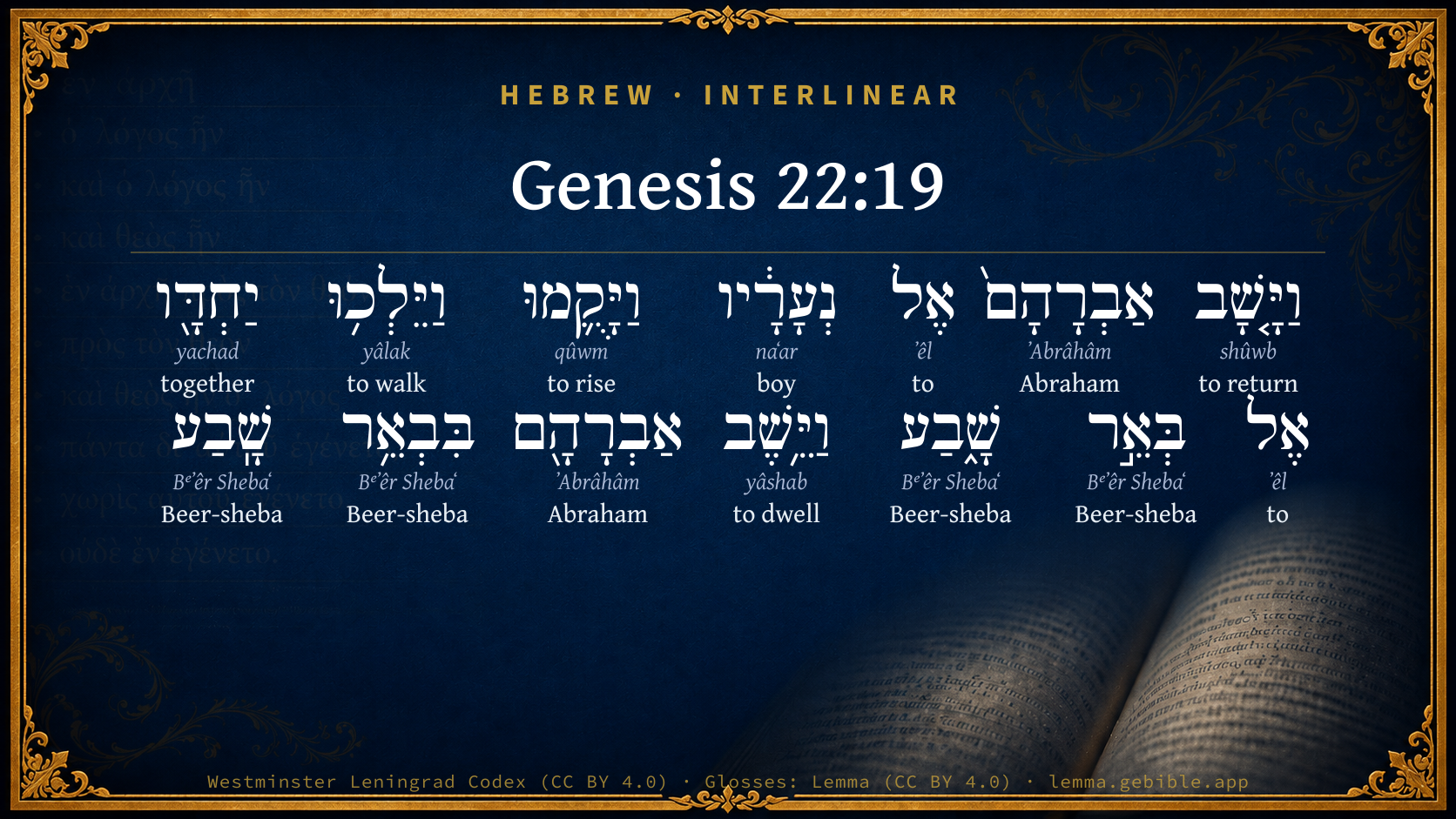
Hebrew (Westminster Leningrad Codex) Genesis 22:19 appears in the Hebrew Old Testament. The text above is from the Westminster Leningrad Codex. Each word links to its Strong’s number, a concise gloss, and parsing drawn from the Open Scriptures Hebrew Bible morphology. Click any word for its full Brown-Driver-Briggs (BDB) entry.
Download image
Cite this verse

Genesis 22:19 (World English Bible). Public Domain. Lemma interlinear Bible study tool, https://lemma.gebible.app/v/genesis/22/19.

Show BibTeX & RIS
BibTeX
RIS
English Translation
So Abraham returned to his young men, and they rose up and went together to Beersheba. Abraham lived at Beersheba.
World English Bible · Public Domain
Download a study sheet

One document with this verse’s original text, its word-by-word gloss line, the meaning frame, cross-references with their text, attributed commentary, and full source and license credits — printable, and it pastes into notes with its structure intact.

This verse Autodidact and up

Study sheet (.html) Plain text (.txt)

A passage Seminary Student

Up to 50 verses in one chapter. A passage sheet keeps up to 6 commentary sources and 12 cross-references per verse, in the order this page ranks them, and says so on the sheet whenever that leaves anything out. Ask for a single verse and you get the Autodidact verse sheet above.

Everything on this page stays free to read, with no account — the sheet is a download of what is already on screen, not access to it.

Want to remove ads? Support Godless Engineer
Compare translations 3

The same verse in 3 English versions, stacked beneath the original-language interlinear above. Click any original word for its lexicon entry.

Each is an independent rendering of the whole verse — the interlinear is not word-aligned to these translations.

Highlighted words mark where these versions differ — a whole-verse word diff, not a word-by-word alignment.

  • World English Bible Public Domain
    So Abraham returned to his young men, and they rose up and went together to Beersheba. Abraham lived at Beersheba.
  • King James Version Public Domain
    So Abraham returned unto his young men, and they rose up and went together to Beersheba; and Abraham dwelt at Beersheba.
  • unfoldingWord Literal Text CC BY-SA 4.0
    Then Abraham returned to his young men, and they got up and went together to Beersheba. And Abraham stayed at Beersheba. Abraham’s Brother Nahor’s Twelve Sons 22:20-24

unfoldingWord Literal Text — © unfoldingWord, licensed CC BY-SA 4.0. Word-aligned USFM3 via Door43 (git.door43.org/unfoldingWord/en_ult).

Versions to compare (up to 4)

3 of 4 selected

Show all 18 translations

Every available English version of this verse, each an independent rendering of the whole verse.

  • World English Bible Public Domain
    So Abraham returned to his young men, and they rose up and went together to Beersheba. Abraham lived at Beersheba.
  • Berean Standard Bible Public Domain
    Abraham went back to his servants, and they got up and set out together for Beersheba. And Abraham settled in Beersheba.
  • Majority Standard Bible Public Domain
    Abraham went back to his servants, and they got up and set out together for Beersheba. And Abraham settled in Beersheba.
  • King James Version Public Domain
    So Abraham returned unto his young men, and they rose up and went together to Beersheba; and Abraham dwelt at Beersheba.
  • American Standard Version (1901) Public Domain
    So Abraham returned unto his young men, and they rose up and went together to Beer-sheba. And Abraham dwelt at Beer-sheba.
  • Revised Version (1885) Public Domain
    So Abraham returned unto his young men, and they rose up and went together to Beer-sheba; and Abraham dwelt at Beer-sheba.
  • Geneva Bible (1599) Public Domain
    Then turned Abraham againe vnto his seruants, and they rose vp and went together to Beer-sheba: and Abraham dwelt at Beer-sheba.
  • Douay-Rheims (1899) Public Domain
    Abraham returned to his young men, and they went to Bersabee together, and he dwelt there.
  • Young's Literal Translation Public Domain
    And Abraham turneth back unto his young men, and they rise and go together unto Beer-Sheba; and Abraham dwelleth in Beer-Sheba.
  • Literal Standard Version CC BY-SA 4.0
    And Abraham turns back to his young men, and they rise and go together to Beer-Sheba; and Abraham dwells in Beer-Sheba.
  • Unlocked Literal Bible CC BY-SA 4.0
    So Abraham returned to his young men, and they departed and went together to Beersheba, and he lived at Beersheba.
  • unfoldingWord Literal Text CC BY-SA 4.0
    Then Abraham returned to his young men, and they got up and went together to Beersheba. And Abraham stayed at Beersheba. Abraham’s Brother Nahor’s Twelve Sons 22:20-24
  • Darby Bible Public Domain
    And Abraham returned to his young men, and they rose up and went together to Beer-sheba. And Abraham dwelt at Beer-sheba.
  • World Messianic Bible Public Domain
    So Abraham returned to his young men, and they rose up and went together to Beersheba. Abraham lived at Beersheba.
  • Webster's Bible Public Domain
    So Abraham returned to his young men, and they rose and went together to Beer-sheba; and Abraham dwelt at Beer-sheba.
  • Free Bible Version CC BY-SA 4.0
    Then Abraham returned to his servants, and they went back together to Beersheba where Abraham was living.
  • Bible in Basic English Public Domain
    Then Abraham went back to his young men and they went together to Beer-sheba, the place where Abraham was living.
  • JPS Tanakh (1917) Public Domain
    So Abraham returned unto his young men, and they rose up and went together to Beer-sheba; and Abraham dwelt at Beer-sheba.

Literal Standard Version (2020), Covenant Press — licensed CC BY-SA 4.0. Text via the HelloAO Bible API (eBible.org). Unlocked Literal Bible (unfoldingWord) — licensed CC BY-SA 4.0. Text via the HelloAO Bible API (eBible.org). unfoldingWord Literal Text — © unfoldingWord, licensed CC BY-SA 4.0. Word-aligned USFM3 via Door43 (git.door43.org/unfoldingWord/en_ult). Free Bible Version, Dr. Jonathan Gallagher — licensed CC BY-SA 4.0. Text via the HelloAO Bible API (eBible.org).

Word by word

More ways to search: Search by grammar → Find every occurrence → Compare this word →

Practice this passage: Drill this verse → Learn its vocabulary →

בְּאֵ֣ר
Bᵉʼêr Shebaʻ
H884
“Beer-sheba”
Noun, Proper
Part of Speech
Noun
Type
Proper
Full BDB Definition

Origin: from H875 and H7651 (in the sense of H7650 )

TWOT: None

Beer-sheba = "well of the sevenfold oath" - a city at the south edge of Israel
  1. וַיָּ֤שָׁב shûwb H7725 “and · to return” Conjunction + Verb, Qal, Sequential Imperfect, 3rd Person, Masculine, Singular
  2. אַבְרָהָם֙ ʼAbrâhâm H85 “Abraham” Noun, Proper
  3. אֶל ʼêl H413 “to” Preposition
  4. נְעָרָ֔יו naʻar H5288 “boys · his” Noun, Common, Masculine, Plural, Construct + Suffix, Personal, 3rd Person, Masculine, Singular
  5. וַיָּקֻ֛מוּ qûwm H6965 “and · to rise” Conjunction + Verb, Qal, Sequential Imperfect, 3rd Person, Masculine, Plural
  6. וַיֵּלְכ֥וּ yâlak H3212 “and · to walk” Conjunction + Verb, Qal, Sequential Imperfect, 3rd Person, Masculine, Plural
  7. יַחְדָּ֖ו yachad H3162 “together” Adverb
  8. אֶל ʼêl H413 “to” Preposition
  9. שָׁ֑בַע Bᵉʼêr Shebaʻ H884 “Beer-sheba” Noun, Proper
  10. וַיֵּ֥שֶׁב yâshab H3427 “and · to dwell” Conjunction + Verb, Qal, Sequential Imperfect, 3rd Person, Masculine, Singular
  11. אַבְרָהָ֖ם ʼAbrâhâm H85 “Abraham” Noun, Proper
  12. בִּבְאֵ֥ר Bᵉʼêr Shebaʻ H884 “in/at · Beer-sheba” Preposition + Noun, Proper
  13. שָֽׁבַע Bᵉʼêr Shebaʻ H884 “Beer-sheba” Noun, Proper

About this verse

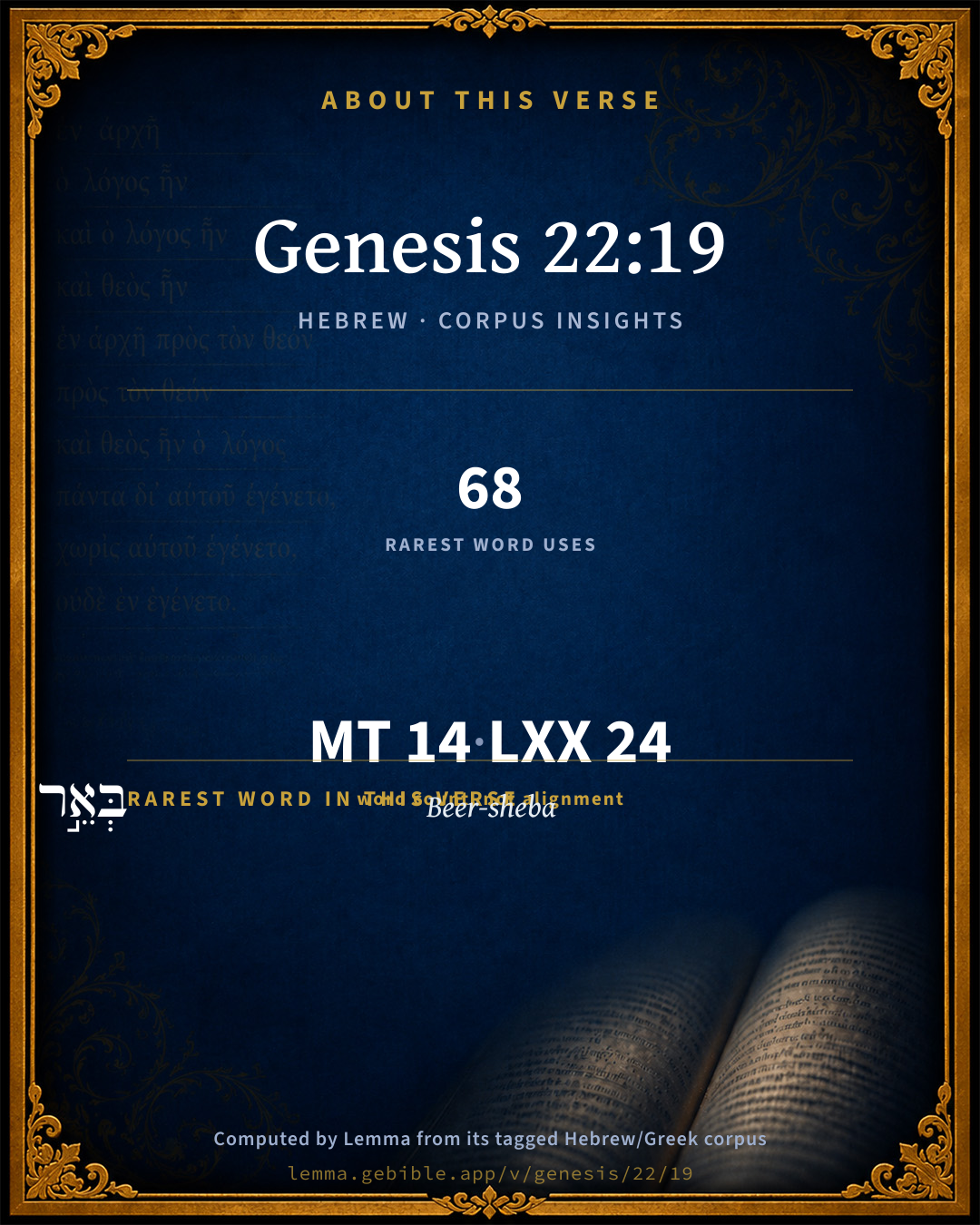
These counts appear in no published source. They are computed here, from the morphology-tagged text and Lemma’s own curated glosses. What Lemma adds →

14
words
9
distinct lemmas
Pentateuch
section

Grammatical profile

  • 4 verbs
  • 7 nouns
  • 2 prepositions
  • 1 adverb

Verb forms

  • וַיָּ֤שָׁב Qal · Sequential Imperfect
  • וַיָּקֻ֛מוּ Qal · Sequential Imperfect
  • וַיֵּלְכ֥וּ Qal · Sequential Imperfect
  • וַיֵּ֥שֶׁב Qal · Sequential Imperfect

Repetition

Words recur within this verse — often emphatic in Hebrew:

  • בְּאֵ֣ר Beer-sheba H884 ×4
  • אַבְרָהָם֙ Abraham H85 ×2
  • אֶל to H413 ×2

Hebrew & Septuagint length

In English translation the verse runs 20 words from the Hebrew and 26 from the Septuagint (LXX English) — closely comparable.

A rough comparison of the two English renderings, which tokenize alike — not a word-level alignment.

Word counts can differ between the Hebrew and the Greek without any difference in meaning — e.g. the Hebrew direct-object marker אֵת has no separate Greek word, and Greek often adds the article ὁ.

In the original languages it is 14 Hebrew tokens and 24 Greek tokens — but the two are counted differently (Hebrew bundles its prefixes and suffixes into one token; the Greek is in lemma form), so that isn’t a like-for-like length.

Cross-references

3

Topical passages linked to Genesis 22:19 in the Treasury of Scripture Knowledge — connected by theme and wording, ordered by reader-vote popularity; previews shown in the World English Bible.

  • Genesis 21:31 Therefore he called that place Beersheba, because they both swore there.
  • Joshua 15:28 and Hazar Shual, and Beersheba, and Biziothiah,
  • Judges 20:1 Then all the children of Israel went out, and the congregation was assembled as one man, from Dan even to Beersheba, with the land of Gilead, to Yahweh at Mizpah.

Cross-references courtesy of OpenBible.info (CC BY 4.0).

Hebrew and Greek witnesses Masoretic Hebrew ↔ Greek Septuagint

The same verse in the two great witnesses to the Old Testament, shown verse-for-verse.

These are two independent witnesses, not word-aligned to each other, and the Septuagint is shown in lemma (dictionary) form.

Hebrew Genesis 22:19 Masoretic · Westminster Leningrad Codex

וַיָּ֤שָׁב אַבְרָהָם֙ אֶל נְעָרָ֔יו וַיָּקֻ֛מוּ וַיֵּלְכ֥וּ יַחְדָּ֖ו אֶל בְּאֵ֣ר שָׁ֑בַע וַיֵּ֥שֶׁב אַבְרָהָ֖ם בִּבְאֵ֥ר שָֽׁבַע

So Abraham returned to his young men, and they rose up and went together to Beersheba. Abraham lived at Beersheba.

World English Bible · Public Domain

Greek LXX Genesis 22:19 Septuagint · lemma form

ἀποστρέφω δέ αβρααμ πρός ὁ παῖς αὐτός καί ἀναἵστημι πορεύομαι ἅμα ἐπί ὁ φρέαρ ὁ ὅρκος καί καταοἰκέω αβρααμ ἐπί ὁ φρέαρ ὁ ὅρκος

And it came to pass after these things, that it was reported to Abraam, saying, Behold, Melcha herself too has born sons to Nachor your brother,

LXX2012 (modern English Septuagint) · Public Domain

Hebrew: Westminster Leningrad Codex (CC BY 4.0). Greek: Septuagint (public domain); English from LXX2012 (modern English Septuagint) (Public Domain). How the Septuagint differs from the Hebrew →

Targum (Aramaic paraphrase)

2

The Targum is the ancient Jewish Aramaic paraphrase of the Hebrew Scriptures — an interpretive translation, not the Hebrew text itself. Onkelos (literal) and Pseudo-Jonathan (expansive) render the Torah, and Jonathan the Prophets. Coverage is partial: where no permissively-licensed English translation exists for a verse, only the Aramaic is shown. This is verse-level text, not a word-by-word alignment to the Hebrew.

  1. Targum Onkelos Torah (Genesis–Deuteronomy)
    וְתַב אַבְרָהָם לְוָת עוּלֵימוֹהִי וְקָמוּ וַאֲזָלוּ כַחֲדָא לִבְאֵר שָׁבַע וִיתֵיב אַבְרָהָם בִּבְאֵר שָׁבַע

    (no public-domain English translation for this verse)

    Targum Onkelos — Aramaic: “Onkelos Genesis” (public domain); “Onkelos Exodus” (public domain); “Onkelos Leviticus” (public domain); “Onkelos Numbers” (public domain); “Onkelos Deuteronomy” (public domain). English: “Sefaria Community Translation” (CC0 1.0 (public-domain dedication)); “J.W. Etheridge. The Targums of Onkelos and Jonathan Ben Uzziel on the Pentateuch. London: Longmans, Green, 1862” (public domain). Text via Sefaria.

  2. Targum Pseudo-Jonathan Torah (Genesis–Deuteronomy)
    וּדְבָרוּ מַלְאֲכֵי מְרוֹמָא יַת יִצְחָק וְאוֹבִלוֹהִי לְבֵי מֶדְרָשָׁא דְשֵׁם רַבָּא וַהֲוָה תַּמָן תְּלַת שְׁנִין וּבְהַהוּא יוֹמָא תַב אַבְרָהָם לְוַת עוּלֵמוֹי וְקָמוּ וַאֲזָלוּ כַּחֲדָא לְבֵירָא דְשָׁבַע וְיָתֵיב אַבְרָהָם בְּבֵירָא דְשָׁבַע

    And the angels on high took Izhak and brought him into the school (medresha) of Shem the Great; and he was there three years. And in the same day Abraham returned to his young men; and they arose and went together to the Well of the Seven, and Abraham dwelt at Beira-desheva.

    Targum Pseudo-Jonathan — Aramaic: “Targum Jonathan on Genesis” (public domain); “Targum Jonathan on Exodus” (public domain); “Targum Jonathan on Leviticus” (public domain); “Targum Jonathan on Numbers” (public domain); “Targum Jonathan on Deuteronomy” (public domain). English: “The Targum of Jonathan ben Uzziel, trans. J. W. Etheridge, London, 1862” (public domain). Text via Sefaria.

Commentary

Notes on Genesis 22:19 from classic Christian and Jewish commentators (each source and its license shown beneath its notes). The classic Christian expositions comment on the surrounding passage and are grouped to its opening verse, so a note may address several verses; the Jewish commentaries on the Tanakh (Rashi and others) are per-verse, so they appear only where the commentator wrote on this verse.

Lemma curates 59 commentaries, every one of them public domain or Creative Commons licensed, each selected and text-cleaned for this edition rather than reprinted as found. About our sources →

Trapp's Complete Commentary

John Trapp

Gen 22:19 So Abraham returned unto his young men, and they rose up and went together to Beersheba; and Abraham dwelt at Beersheba.

Ver. 19. Went together to Beersheba.] The Hebrews conceive, because here is no mention of Isaac’s return, that he was sent by his father to Shem, or that he remained for certain years in Mount Moriah. But this is uncertain.

John Trapp, A Commentary or Exposition upon All the Books of the Old and New Testament (1647–1656) — public domain. Text from a community e-Sword module.

The Biblical Illustrator

Joseph S. Exell

Gen_22:19

Abraham dwelt at Beersheba

Mans first hour in heaven, illustrated by the probable feelings of Abraham at Beersheba, immediately on his return from the offering up of Isaac

I.

ABRAHAM NOW AT BEERSHEBA HAD THE SATISFACTION OF HAVING PRACTICALLY RECOGNIZED GODS ABSOLUTE CLAIM UPON HIM.

1. An immense claim.

2. Yet righteous.

II. ABRAHAM AT BEERSHEBA HAD THE SATISFACTION OF HAVING PURSUED THE PATH OF RECTITUDE THROUGH THE GREATEST TRIALS.

1. In relation to the period at which it occurred.

2. In relation to the sentiment of his age.

3. In relation to his theological creed.

4. In relation to his domestic association.

5. In relation to his own nature.

III. ABRAHAM AT BEERSHEBA HAD THE SATISFACTION OF KNOWING THAT HE HAD OBTAINED THE APPROBATION OF HIS MAKER--expressed in three ways.

1. By a signal interposition.

2. By an unequivocal assurance.

3. By the unfolding of a glorious future. (Homilist.)

.

The Biblical Illustrator, edited by Joseph S. Exell (c. 1880s–1900s) — public domain. Text from a community e-Sword module.

John Calvin's Commentaries

19. And they rose up, and went together to Beer-sheba. Moses repeats, that Abraham, after having passed through this severe and incredible temptation, had a quiet abode in Beersheba. This narration is inserted, together with what follows concerning the increase of Abraham’s kindred, for the purpose of showing that the holy man, when he had been brought up again from the abyss of death, was made happy, in more ways than one. For God would so revive him, that he should be like a new man. Moses also records the progeny of Nahor, but for another reason; namely, because Isaac was to take his wife from it. For the mention of women in Scripture is rare; and it is credible that many daughters were born to Nahor, of whom one only, Rebekah, is here introduced. He distinguishes the sons of the concubine from the others; because they occupied a less honorable place. Not that the concubine was regarded as a harlot; but because she was an inferior wife, and not the mistress of the house, who had community of goods with her husband. The fact, however, that it entered into Nahor’s mind to take a second wife, does not render polygamy lawful; it only shows, that from the custom of other men, he supposed that to be lawful for him, which had really sprung from the worst corruption.

John Calvin's Commentaries (1540-1563) — public domain. Text from the Calvin Translation Society English edition (1840s-50s) via the Christian Classics Ethereal Library (ccel.org). Calvin's coverage is partial (roughly two-thirds of the Bible); uncommented books and verses are honest gaps, never fabricated. The 19th-century editor's footnotes and remarks are omitted so the notes are faithfully Calvin's own voice.

The Cambridge Bible for Schools and Colleges

gen. ed. J. J. S. Perowne

19. returned unto his young men] See Gen_22:5. It is characteristic of the reserve of the writer, that no mention is made of joy or congratulation or relief.

Beer-sheba] See Gen_21:31. Abraham was dwelling at Beer-sheba at the time when these things happened.

The Cambridge Bible for Schools and Colleges (gen. ed. J. J. S. Perowne; Cambridge University Press, 1878–1918) — public domain. Text from a community e-Sword module.

John Gill's Exposition

And it came to pass, after these things,.... Abraham's taking his son Isaac to the land of Moriah, building an altar on one of the mountains there, and laying him on it with an intention to sacrifice him, and offering of a ram in his stead, and the return of them both to Beersheba:

that it was told Abraham; by some person very probably who was lately come from those parts where the following persons lived; though Jarchi suggests this was told him by the Lord himself, and while he was thinking of taking a wife for Isaac of the daughters at Aner, or Eshcol, or Mamre; and to prevent which the following narration was given him:

saying, behold Milcah, she hath also borne children unto thy brother Nahor; as Sarah, supposed to be the same with Iscah, a daughter of Haran, had borne a son to him, and whom he had received again as from the dead; so Milcah, another daughter of Harsh, had borne children to his brother Nahor, whom he had left in Ur of the Chaldees, when he departed from thence, and who afterwards came and dwelt in Haran of Mesopotamia; see Gen 11:27.

John Gill's Exposition of the Whole Bible (1746–1763) — public domain (CC PDM 1.0). Text via the HelloAO Bible API.

The Pulpit Commentary

So Abraham returned unto his young men, and they role up and went together to Beer-sheba; and Abraham dwelt at Beersheba.

The Pulpit Commentary (1880–1919), ed. H.D.M. Spence-Jones & Joseph S. Exell — public domain. Text from a community e-Sword module.

Rashi

Rabbi Shlomo Yitzchaki (Rashi)

וישב אברהם בבאר שבע AND ABRAHAM DWELT AT BEER-SHEBA — This does not mean really dwelling there but merely staying there on his way home, because he was, as a matter of fact, living at Hebron. Twelve years before the Binding of Isaac he had left Beer-Sheba and had gone to Hebron, as it is said, (21:34) ‘‘And Abraham sojourned in the land of the Philistines many days”, i.e. exceeding in number the earlier days when he had resided at Hebron — altogether 26 years, as we have explained above (21:34).

Rashi on the Tanakh — English translations: “The Judaica Press complete Tanach with Rashi, translated by A. J. Rosenberg” (CC BY 4.0); “Pentateuch with Rashi's commentary by M. Rosenbaum and A.M. Silbermann, 1929-1934” (public domain); “The Metsudah Tanach series, Lakewood, N.J” (CC BY 4.0); and “The Book of Joshua, Metsudah Publications, 1997” (CC BY 4.0). Text via Sefaria.

Radak

Rabbi David Kimhi (Radak)

וישב אברהם, there was no need to mention that Yitzchok accompanied him. Rather it mentioned Avraham mentioned, because he was the principal.

וישב אברהם בבאר שבע, the Torah did not mention for how many years Avraham lived in Beer Sheva, seeing Sarah died in Hebron, [something which must have greatly dampened his joy at living there. Ed.]

Radak on the Tanakh — English translations: “Sefaria Community Translation” (CC0 1.0 (public-domain dedication)); “Eliyahu Munk, HaChut Hameshulash” (CC BY 4.0); “Rabbi Mike Feuer, Jerusalem Anthology” (CC BY 4.0); and “R. David Kimhi on the first book of Psalms, Translated by R.G. Finch, London, 1919” (public domain). Text via Sefaria.

Lesson kit

Teaching starters — assembled from the data on this page, not authored interpretation. Every prompt links to the verse data it draws on. Edit before teaching.

Genesis, in the Pentateuch, opens this verse with 14 words (9 distinct Hebrew lemmas). Its most distinctive word is Bᵉʼêr Shebaʻ (“Beer-sheba”). A historical commentator’s framing appears above. Read the whole chapter for the surrounding context.

Discussion questions

  1. What does “Beer-sheba” (Bᵉʼêr Shebaʻ) contribute to the verse as a whole?
  2. Genesis 21:31 shares this passage’s theme. How do the two illuminate each other?
  3. “Beer-sheba” occurs 4× in this one verse. What is the effect of the repetition?
  4. These translations render this verse differently. What is at stake in choosing one wording over another?
  5. The verb «וַיָּ֤שָׁב» is Qal Sequential Imperfect. How does its form color the action?
  6. Reading how Trapp's Complete Commentary and The Biblical Illustrator read this verse, where do the two commentators agree and where do they part?

Things to notice

Reading settings

Reading text

Shown beneath each verse's original-language words.

Old Testament
Old Testament edition

Read the OT as the Masoretic Hebrew (MT) or the Greek Septuagint (LXX).

English shown for the Greek Septuagint (in the Hebrew ↔ Greek comparison).

Comparing translations? Open the Compare panel on any verse page to stack up to four side by side.