Ezekiel 18:26

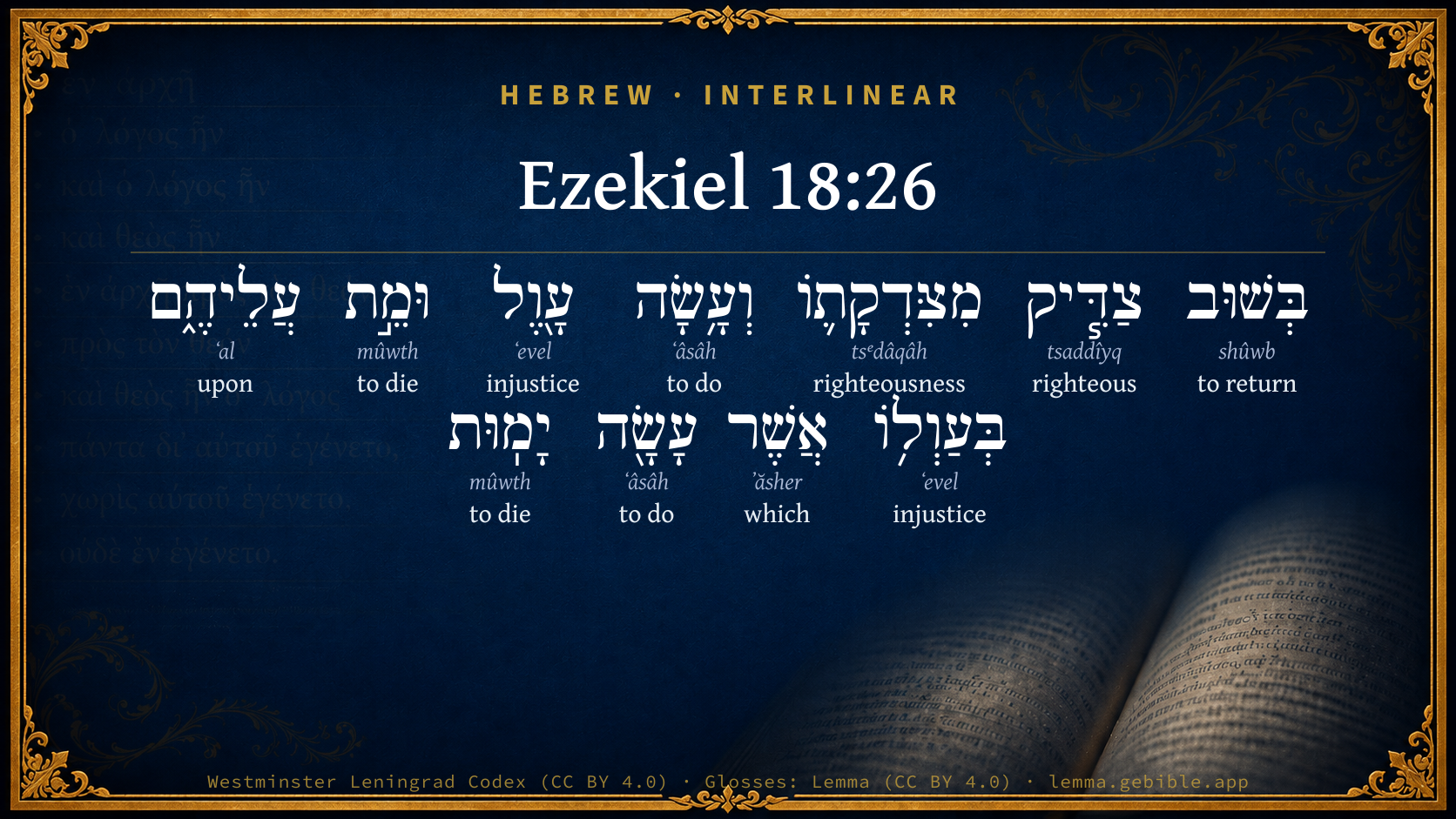
Hebrew (Westminster Leningrad Codex) Ezekiel 18:26 appears in the Hebrew Old Testament. The text above is from the Westminster Leningrad Codex. Each word links to its Strong’s number, a concise gloss, and parsing drawn from the Open Scriptures Hebrew Bible morphology. Click any word for its full Brown-Driver-Briggs (BDB) entry.
Download image
Cite this verse

Ezekiel 18:26 (World English Bible). Public Domain. Lemma interlinear Bible study tool, https://lemma.gebible.app/v/ezekiel/18/26.

Show BibTeX & RIS
BibTeX
RIS
English Translation
When the righteous man turns away from his righteousness, and commits iniquity, and dies therein; in his iniquity that he has done shall he die.
World English Bible · Public Domain
Download a study sheet

One document with this verse’s original text, its word-by-word gloss line, the meaning frame, cross-references with their text, attributed commentary, and full source and license credits — printable, and it pastes into notes with its structure intact.

This verse Autodidact and up

Study sheet (.html) Plain text (.txt)

A passage Seminary Student

Up to 50 verses in one chapter. A passage sheet keeps up to 6 commentary sources and 12 cross-references per verse, in the order this page ranks them, and says so on the sheet whenever that leaves anything out. Ask for a single verse and you get the Autodidact verse sheet above.

Everything on this page stays free to read, with no account — the sheet is a download of what is already on screen, not access to it.

Want to remove ads? Support Godless Engineer
Compare translations 3

The same verse in 3 English versions, stacked beneath the original-language interlinear above. Click any original word for its lexicon entry.

Each is an independent rendering of the whole verse — the interlinear is not word-aligned to these translations.

Highlighted words mark where these versions differ — a whole-verse word diff, not a word-by-word alignment.

  • World English Bible Public Domain
    When the righteous man turns away from his righteousness, and commits iniquity, and dies therein; in his iniquity that he has done shall he die.
  • King James Version Public Domain
    When a righteous man turneth away from his righteousness, and committeth iniquity, and dieth in them; for his iniquity that he hath done shall he die.
  • unfoldingWord Literal Text CC BY-SA 4.0
    When the righteous man turns away from his righteousness, and commits iniquity and dies because of them, then he will die in the iniquity that he has done.

unfoldingWord Literal Text — © unfoldingWord, licensed CC BY-SA 4.0. Word-aligned USFM3 via Door43 (git.door43.org/unfoldingWord/en_ult).

Versions to compare (up to 4)

3 of 4 selected

Show all 18 translations

Every available English version of this verse, each an independent rendering of the whole verse.

  • World English Bible Public Domain
    When the righteous man turns away from his righteousness, and commits iniquity, and dies therein; in his iniquity that he has done shall he die.
  • Berean Standard Bible Public Domain
    If a righteous man turns from his righteousness and practices iniquity, he will die for this. He will die because of the iniquity he has committed.
  • Majority Standard Bible Public Domain
    If a righteous man turns from his righteousness and practices iniquity, he will die for this. He will die because of the iniquity he has committed.
  • King James Version Public Domain
    When a righteous man turneth away from his righteousness, and committeth iniquity, and dieth in them; for his iniquity that he hath done shall he die.
  • American Standard Version (1901) Public Domain
    When the righteous man turneth away from his righteousness, and committeth iniquity, and dieth therein; in his iniquity that he hath done shall he die.
  • Revised Version (1885) Public Domain
    When the righteous man turneth away from his righteousness, and committeth iniquity, and dieth therein; in his iniquity that he hath done shall he die.
  • Geneva Bible (1599) Public Domain
    For when a righteous man turneth away from his righteousnes, and committeth iniquitie, he shall euen die for the same, he shall euen die for his iniquitie, that he hath done.
  • Douay-Rheims (1899) Public Domain
    For when the just turneth himself away from his justice, and committeth iniquity, he shall die therein: in the injustice that he hath wrought he shall die.
  • Young's Literal Translation Public Domain
    In the turning back of the righteous from his righteousness, And he hath done perversity, And he is dying by them, for his perversity That he hath done he dieth.
  • Literal Standard Version CC BY-SA 4.0
    In the turning back of the righteous from his righteousness, || And he has done perversity, || And he is dying by them, || He dies for his perversity that he has done.
  • Unlocked Literal Bible CC BY-SA 4.0
    When the righteous man turns away from his righteousness, and commits iniquity and dies because of them, then he will die in the iniquity that he has done.
  • unfoldingWord Literal Text CC BY-SA 4.0
    When the righteous man turns away from his righteousness, and commits iniquity and dies because of them, then he will die in the iniquity that he has done.
  • Darby Bible Public Domain
    When the righteous turneth away from his righteousness, and practiseth what is wrong, and dieth for it; in his wrong that he hath done shall he die.
  • World Messianic Bible Public Domain
    When the righteous man turns away from his righteousness, and commits iniquity, and dies in it, then he dies in his iniquity that he has done.
  • Webster's Bible Public Domain
    When a righteous man turneth away from his righteousness, and committeth iniquity, and dieth in them; for his iniquity that he hath done shall he die.
  • Free Bible Version CC BY-SA 4.0
    If someone who lives according to what's right stops doing right and does wrong, they will die. They will die because of wrong things they've done.
  • Bible in Basic English Public Domain
    When the upright man, turning away from his righteousness, does evil, death will overtake him; in the evil which he has done death will overtake him.
  • JPS Tanakh (1917) Public Domain
    When the righteous man turneth away from his righteousness, and committeth iniquity, he shall die therefor; for his iniquity that he hath done shall he die.

Literal Standard Version (2020), Covenant Press — licensed CC BY-SA 4.0. Text via the HelloAO Bible API (eBible.org). Unlocked Literal Bible (unfoldingWord) — licensed CC BY-SA 4.0. Text via the HelloAO Bible API (eBible.org). unfoldingWord Literal Text — © unfoldingWord, licensed CC BY-SA 4.0. Word-aligned USFM3 via Door43 (git.door43.org/unfoldingWord/en_ult). Free Bible Version, Dr. Jonathan Gallagher — licensed CC BY-SA 4.0. Text via the HelloAO Bible API (eBible.org).

Word by word

More ways to search: Search by grammar → Find every occurrence → Compare this word →

Practice this passage: Drill this verse → Learn its vocabulary →

עָ֖וֶל
ʻevel
H5766
“injustice”
Noun, Common, Both, Singular, Absolute
Part of Speech
Noun
Type
Common
Gender
Both
Number
Singular
State
Absolute
Full BDB Definition

Origin: from H5765

TWOT: 1580a , 1580b

injustice, unrighteousness, wrong - violent deeds of injustice - injustice (of speech) - injustice (generally)
  1. בְּשׁוּב shûwb H7725 “in/at · to return” Preposition + Verb, Qal, Infinitive Construct
  2. צַדִּ֧יק tsaddîyq H6662 “righteous” Adjective, Adjective, Masculine, Singular, Absolute
  3. מִצִּדְקָת֛וֹ tsᵉdâqâh H6666 “from · righteousness · his” Preposition + Noun, Common, Feminine, Singular, Construct + Suffix, Personal, 3rd Person, Masculine, Singular
  4. וְעָ֥שָׂה ʻâsâh H6213 “and · to do” Conjunction + Verb, Qal, Sequential Perfect, 3rd Person, Masculine, Singular
  5. וּמֵ֣ת mûwth H4191 “and · to die” Conjunction + Verb, Qal, Sequential Perfect, 3rd Person, Masculine, Singular
  6. עֲלֵיהֶ֑ם ʻal H5921 “upon · them” Preposition + Suffix, Personal, 3rd Person, Masculine, Plural
  7. בְּעַוְל֥וֹ ʻevel H5766 “in/at · injustice · his” Preposition + Noun, Common, Both, Singular, Construct + Suffix, Personal, 3rd Person, Masculine, Singular
  8. אֲשֶׁר ʼăsher H834 “which” Particle, Relative
  9. עָשָׂ֖ה ʻâsâh H6213 “to do” Verb, Qal, Perfect, 3rd Person, Masculine, Singular
  10. יָמֽוּת mûwth H4191 “to die” Verb, Qal, Imperfect, 3rd Person, Masculine, Singular

About this verse

These counts appear in no published source. They are computed here, from the morphology-tagged text and Lemma’s own curated glosses. What Lemma adds →

11
words
8
distinct lemmas
Prophets
section

Shared distinctive vocabulary

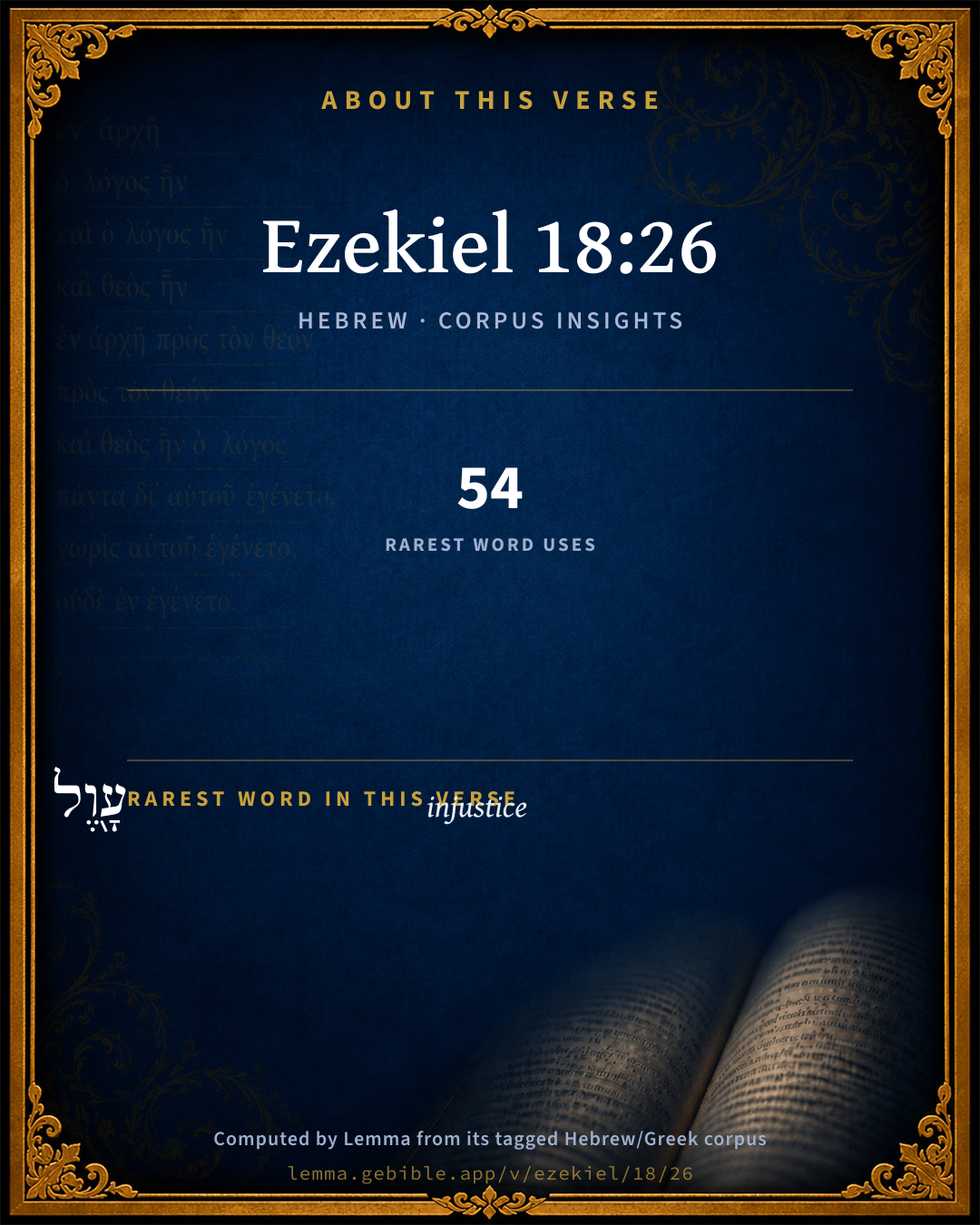
עָ֖וֶל injustice H5766 occurs in 51 verses of the Hebrew Bible. Also found in:

Grammatical profile

  • 5 verbs
  • 3 nouns
  • 1 adjective
  • 1 preposition
  • 1 particle

Verb forms

  • בְּשׁוּב Qal · Infinitive Construct
  • וְעָ֥שָׂה Qal · Sequential Perfect
  • וּמֵ֣ת Qal · Sequential Perfect
  • עָשָׂ֖ה Qal · Perfect
  • יָמֽוּת Qal · Imperfect

Repetition

Words recur within this verse — often emphatic in Hebrew:

  • וְעָ֥שָׂה to do H6213 ×2
  • עָ֖וֶל injustice H5766 ×2
  • וּמֵ֣ת to die H4191 ×2

Hebrew & Septuagint length

In English translation the verse runs 25 words from the Hebrew and 26 from the Septuagint (LXX English) — closely comparable.

A rough comparison of the two English renderings, which tokenize alike — not a word-level alignment.

Word counts can differ between the Hebrew and the Greek without any difference in meaning — e.g. the Hebrew direct-object marker אֵת has no separate Greek word, and Greek often adds the article ὁ.

Hebrew and Greek witnesses Masoretic Hebrew ↔ Greek Septuagint

The same verse in the two great witnesses to the Old Testament, shown verse-for-verse.

These are two independent witnesses, not word-aligned to each other, and the Septuagint is shown in lemma (dictionary) form.

Hebrew Ezekiel 18:26 Masoretic · Westminster Leningrad Codex

בְּשׁוּב צַדִּ֧יק מִצִּדְקָת֛וֹ וְעָ֥שָׂה עָ֖וֶל וּמֵ֣ת עֲלֵיהֶ֑ם בְּעַוְל֥וֹ אֲשֶׁר עָשָׂ֖ה יָמֽוּת

When the righteous man turns away from his righteousness, and commits iniquity, and dies therein; in his iniquity that he has done shall he die.

World English Bible · Public Domain

Greek LXX Ezekiel 18:26 Septuagint · lemma form

ἐν ὁ ἀποστρέφω ὁ δίκαιος ἐκ ὁ δικαιοσύνη αὐτός καί ποιέω παράπτωμα καί ἀποθνήσκω ἐν ὁ παράπτωμα ὅς ποιέω ἐν αὐτός ἀποθνήσκω

When the righteous turns away from his righteousness and commits a trespass, and dies in the trespass he has committed, he shall even die in it.

LXX2012 (modern English Septuagint) · Public Domain

Hebrew: Westminster Leningrad Codex (CC BY 4.0). Greek: Septuagint (public domain); English from LXX2012 (modern English Septuagint) (Public Domain). How the Septuagint differs from the Hebrew →

Targum (Aramaic paraphrase)

1

The Targum is the ancient Jewish Aramaic paraphrase of the Hebrew Scriptures — an interpretive translation, not the Hebrew text itself. Onkelos (literal) and Pseudo-Jonathan (expansive) render the Torah, and Jonathan the Prophets. Coverage is partial: where no permissively-licensed English translation exists for a verse, only the Aramaic is shown. This is verse-level text, not a word-by-word alignment to the Hebrew.

  1. Targum Jonathan Prophets (Joshua–Malachi)
    וְכַד יְתוּב זַכָּאָה מִזְכוּתֵהּ וְיַעְבֵּיד שְׁקַר וִימוּת עֲלֵיהוֹן בְּשִׁקְרֵיהּ דִי עֲבַד יְמוּת:

    (no public-domain English translation for this verse)

    Targum Jonathan — Aramaic: “Mikraot Gedolot” (public domain). English: “Sefaria Community Translation” (CC0 1.0 (public-domain dedication)); “London "Chaldee Paraphrase," 1871” (public domain). Text via Sefaria.

Commentary

Notes on Ezekiel 18:26 from classic Christian and Jewish commentators (each source and its license shown beneath its notes). The classic Christian expositions comment on the surrounding passage and are grouped to its opening verse, so a note may address several verses; the Jewish commentaries on the Tanakh (Rashi and others) are per-verse, so they appear only where the commentator wrote on this verse.

Lemma curates 59 commentaries, every one of them public domain or Creative Commons licensed, each selected and text-cleaned for this edition rather than reprinted as found. About our sources →

Trapp's Complete Commentary

John Trapp

Eze 18:26 When a righteous [man] turneth away from his righteousness, and committeth iniquity, and dieth in them; for his iniquity that he hath done shall he die.

Ver. 26. When a righteous man turneth,] q.d, Shall I say the selfsame over again to you? I had need do so surely, and all little enough.

And dieth in them,] sc., In his wicked ways: this undoeth him. It is not falling into the water that drowneth a man, but long lying under it.

John Trapp, A Commentary or Exposition upon All the Books of the Old and New Testament (1647–1656) — public domain. Text from a community e-Sword module.

Jamieson, Fausset & Brown

Robert Jamieson, A. R. Fausset & David Brown

The two last instances repeated in inverse order. God's emphatic statement of His principle of government needs no further proof than the simple statement of it.

in them--in the actual sins, which are the manifestations of the principle of "iniquity," mentioned just before.

Jamieson, Fausset & Brown — Commentary Critical and Explanatory on the Whole Bible (1871) — public domain (CC PDM 1.0). Text via the HelloAO Bible API.

John Calvin's Commentaries

The Prophet repeats what we formerly saw, namely, that the state of the case turned upon this, Whether the people had any cause of complaint when God absolves those who repent, and condemns the just who desert the course of a pious and holy life? Now, we must always return to this cardinal point, that God rewards every one according to his works, since he offers mercy to all the lost, and demands nothing else but a sincere and hearty return to him. Since, then, God treats the impious with such clemency, and is so ready to pardon them, what is the reason why men contend with him? If the just should retrace his steps, and after having shown some signs of the fear of God, throw off all obedience, who can object when God punishes him, and blots out the remembrance of his former righteousness? God, therefore, determines the result fairly in each case. We have explained how the phrase, the just should turn aside from their righteousness, ought to be understood, not that the elect ever utterly fall away, as many think their faith is extinguished, and every root of piety also in the sons of God; that is too absurd, because, as I have said, the gift of regeneration has perseverance always annexed to it: but here that righteousness which mankind recognize is intended. But we know how frequently it happens that what seemed entirely pure and perfect is deficient. Now, God pronounces that he would punish all who fall away from him, and would be accessible and propitious to miserable sinners who desire to be reconciled to him; and he repeats again, if the wicked have seen and turned away from his wickedness. We must mark this phrase, for it shows that thinking rightly is the commencement of repentance; because, though the reprobate knowingly and willingly transgress God’s law, it is certain that they labor under blindness and madness, so that the Scripture does not call them foolish and beside themselves in vain. He does not extenuate their faults, as if they sinned ignorantly; but he means that they were so blinded by diabolical madness as to think of nothing; for surely horror would immediately possess their minds if they only perceived God to be their adversary, and themselves to be making war with him. For this reason, therefore, when the Prophet describes to us the conversion of the wicked, he says, if he has seen; that is, if at length he has returned to a sound mind, and collected his senses, so that he may not rush on madly, as he has been accustomed to do, but may look upon both God and himself. It now follows —

John Calvin's Commentaries (1540-1563) — public domain. Text from the Calvin Translation Society English edition (1840s-50s) via the Christian Classics Ethereal Library (ccel.org). Calvin's coverage is partial (roughly two-thirds of the Bible); uncommented books and verses are honest gaps, never fabricated. The 19th-century editor's footnotes and remarks are omitted so the notes are faithfully Calvin's own voice.

John Gill's Exposition

Again, when the wicked man turneth away from his wickedness that he hath committed,.... Repents of his sins, and forsakes the vicious course of life he has lived:

and doeth that which is lawful and right; or "judgment" and "righteousness" (n); that which is agreeable to the law and will of God, and is just and right between man and man:

he shall save his soul alive; from famine, pestilence, the sword, or captivity; he shall be preserved, and not be involved in calamities and distress: or, "shall quicken his own soul" (o); which, in a spiritual sense, is only done by the Spirit and grace of God, and not by man himself; nor is the enjoyment of eternal life by the works of men, but through the grace of God, and righteousness of Christ.

(n) "judicium et justitiam", V. L. Pagninus, Montanus, Calvin, Cocceius. (o) "animam suam vivificabit", V. L. Pagninus, Montanus, Calvin; "vivificat", Cocceius.

John Gill's Exposition of the Whole Bible (1746–1763) — public domain (CC PDM 1.0). Text via the HelloAO Bible API.

Matthew Poole's English Annotations

See Eze 18:24, where the whole of this verse is explained.

Matthew Poole's English Annotations on the Holy Bible (1683–1685) — public domain. Text from a community e-Sword/MySword module.

The Pulpit Commentary

Vers. 26-29. The equity of the Divine judgments is asserted, as before, by fresh iteration rather than by new arguments. In a discourse delivered, as this probably was, orally, it was necessary, so to speak, to hammer in the truth upon men"s minds so that it might be driven home and do its work.

Vers. 26-28. Reversals of character.

We have here an instance of man"s misjudgment of God, and wrongful accusation of injustice against him. People who have borne good characters are punished by God, and others who have earned themselves odious reputations are spared. This is the stumbling block. But our text supplies the explanation of the apparent inconsistency. The good men have fallen into sin, and the bad men have repented and mended their lives. Therefore it is not unjust in God to treat them no longer according to their old characters.

I GOD JUDGES ACCORDING TO PRESENT CHARACTER. Human judgment is stiff and blunt. Having formed our estimate of a man, we hold it after all justification for it has vanished. We are blind to those traits in his character which do not agree with our theory; or, if we are forced to recognize them, our first impulse is to twist them into harmony with the theory. Thus men"s characters in the world outlive the facts on which they are founded. They are not all equal in this respect. A good character is more easily lost than a bad character. If a man has once earned an evil name, it is almost impossible for him to divest himself of it. People will not believe in his thorough conversion. This suspicion is partly due to ignorance of the hearts of men, and to a consequent danger of being imposed upon by hypocrisy. But God knows hearts. He is not bound by names and reputations. He sees present facts, and he judges men as they are. Then he judges according to present condition. He does not spare the fallen man on account of past goodness, and he does not rake up old charges against the penitent. We must not suppose, however, that God judges by a man"s latest act. This would throw in an element of chance. A man is not condemned because he happens to be doing wrong at the moment of death, or saved because death finds him on his knees in prayer.

But when the whole life is turned round, God judges by its present character, and not by its former state.

II REVERSALS OF CHARACTER ARE POSSIBLE. We are not arguing on hypothetical cases. The ways of God to men are to be justified in part by the knowledge that such cases exist.

1. The good man may fall away into sin. When this happens, the world lifts up its hands in horror at what it supposes to be a revelation of monstrous and long continued hypocrisy; but there may be no hypocrisy in the case. The fallen man may have been sincere in his earlier life of goodness. But he has turned aside from it. Here is a terrible warning. No character is crystalline; all characters are more or less mobile. The best man may fall. Then all his former goodness will not save him. We have reason for watchfulness, diffidence, and prayer for God"s protection.

2. The bad man may be recovered. The stern and changeless judgment of the world dooms one who has fallen to lifelong ignominy. This is cruel and murderous. If we lend a helping hand, the fallen may be lifted up. By the grace of Christ the most hardened sinner may be softened to penitence and turned into the ways of goodness. Then his former sin will not hang like a millstone about his neck to keep him forever down. God forgives it, and never mentions it again. It is the elder son, not the father, who refers to the former sins of the returned prodigal. (Luk_15:30)

The Pulpit Commentary (1880–1919), ed. H.D.M. Spence-Jones & Joseph S. Exell — public domain. Text from a community e-Sword module.

Lesson kit

Teaching starters — assembled from the data on this page, not authored interpretation. Every prompt links to the verse data it draws on. Edit before teaching.

Ezekiel, in the Prophets, opens this verse with 11 words (8 distinct Hebrew lemmas). Its most distinctive word is ʻevel (“injustice”). A historical commentator’s framing appears above. Read the whole chapter for the surrounding context.

Discussion questions

  1. How does “injustice” (ʻevel) shape what this verse is saying?
  2. Leviticus 19:15 shares the word «injustice» with this verse. How do the two illuminate each other?
  3. “to do” occurs 2× in this one verse. What is the effect of the repetition?
  4. These translations render this verse differently; the difference is in the English rendering, not the original. What questions does that raise?
  5. The verb «בְּשׁוּב» is Qal Infinitive Construct. How does its form color the action?
  6. Reading how Trapp's Complete Commentary and Jamieson, Fausset & Brown read this verse, where do the two commentators agree and where do they part?

Things to notice

Reading settings

Reading text

Shown beneath each verse's original-language words.

Old Testament
Old Testament edition

Read the OT as the Masoretic Hebrew (MT) or the Greek Septuagint (LXX).

English shown for the Greek Septuagint (in the Hebrew ↔ Greek comparison).

Comparing translations? Open the Compare panel on any verse page to stack up to four side by side.