Ezekiel 9:11

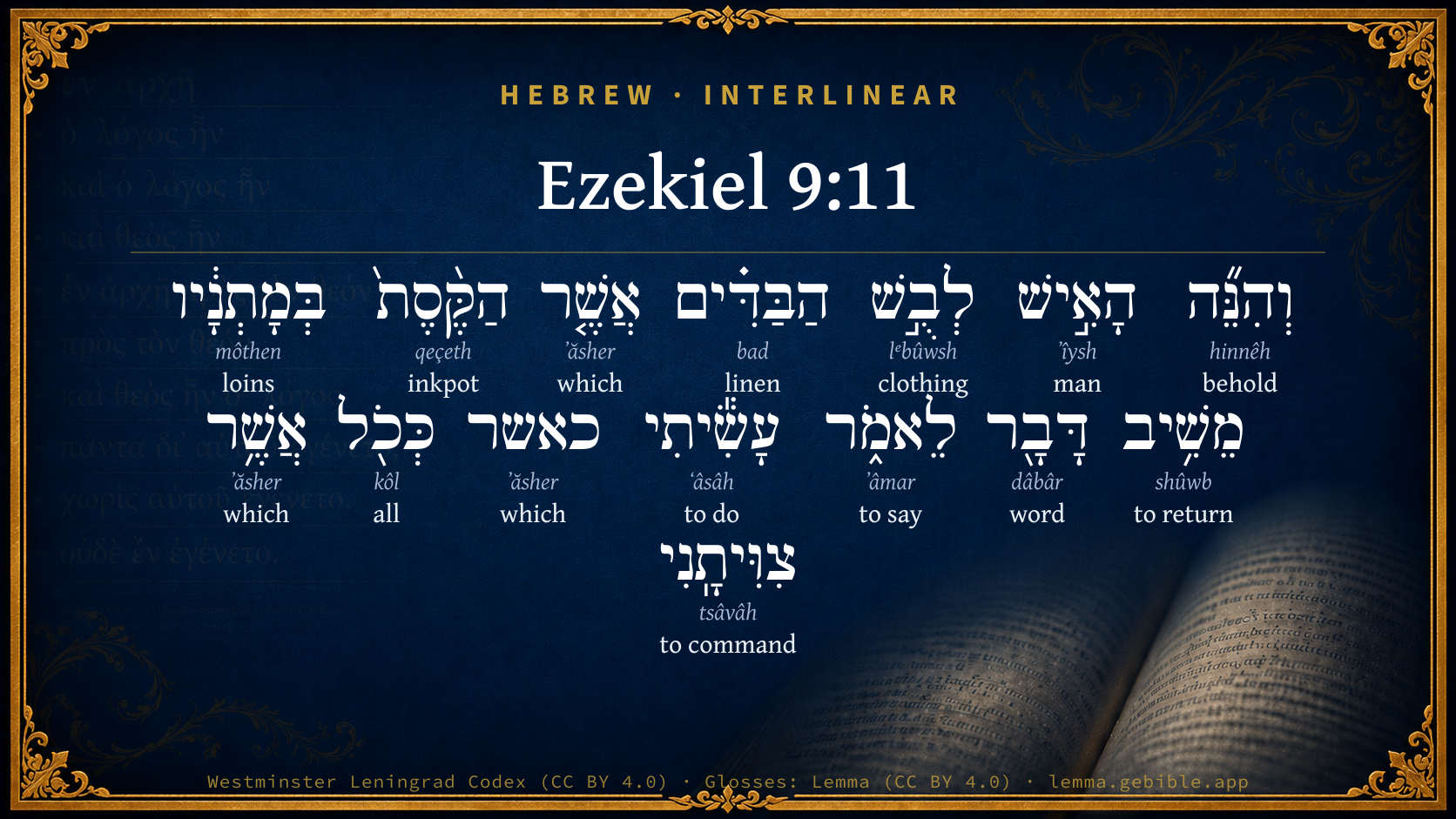
Hebrew (Westminster Leningrad Codex) Ezekiel 9:11 appears in the Hebrew Old Testament. The text above is from the Westminster Leningrad Codex. Each word links to its Strong’s number, a concise gloss, and parsing drawn from the Open Scriptures Hebrew Bible morphology. Click any word for its full Brown-Driver-Briggs (BDB) entry.
Download image
Cite this verse

Ezekiel 9:11 (World English Bible). Public Domain. Lemma interlinear Bible study tool, https://lemma.gebible.app/v/ezekiel/9/11.

Show BibTeX & RIS
BibTeX
RIS
English Translation
Behold, the man clothed in linen, who had the inkhorn by his side, reported the matter, saying, I have done as you have commanded me.
World English Bible · Public Domain
Download a study sheet

One document with this verse’s original text, its word-by-word gloss line, the meaning frame, cross-references with their text, attributed commentary, and full source and license credits — printable, and it pastes into notes with its structure intact.

This verse Autodidact and up

Study sheet (.html) Plain text (.txt)

A passage Seminary Student

Up to 50 verses in one chapter. A passage sheet keeps up to 6 commentary sources and 12 cross-references per verse, in the order this page ranks them, and says so on the sheet whenever that leaves anything out. Ask for a single verse and you get the Autodidact verse sheet above.

Everything on this page stays free to read, with no account — the sheet is a download of what is already on screen, not access to it.

Want to remove ads? Support Godless Engineer
Compare translations 3

The same verse in 3 English versions, stacked beneath the original-language interlinear above. Click any original word for its lexicon entry.

Each is an independent rendering of the whole verse — the interlinear is not word-aligned to these translations.

Highlighted words mark where these versions differ — a whole-verse word diff, not a word-by-word alignment.

  • World English Bible Public Domain
    Behold, the man clothed in linen, who had the inkhorn by his side, reported the matter, saying, I have done as you have commanded me.
  • King James Version Public Domain
    And, behold, the man clothed with linen, which had the inkhorn by his side, reported the matter, saying, I have done as thou hast commanded me.
  • unfoldingWord Literal Text CC BY-SA 4.0
    Behold! The man dressed in linen who had the scribe’s equipment by his side came back. He reported and said, “I have done all that you have commanded.”

unfoldingWord Literal Text — © unfoldingWord, licensed CC BY-SA 4.0. Word-aligned USFM3 via Door43 (git.door43.org/unfoldingWord/en_ult).

Versions to compare (up to 4)

3 of 4 selected

Show all 18 translations

Every available English version of this verse, each an independent rendering of the whole verse.

  • World English Bible Public Domain
    Behold, the man clothed in linen, who had the inkhorn by his side, reported the matter, saying, I have done as you have commanded me.
  • Berean Standard Bible Public Domain
    Then the man clothed in linen with the writing kit at his side reported back, “I have done as You commanded.”
  • Majority Standard Bible Public Domain
    Then the man clothed in linen with the writing kit at his side reported back, “I have done as You commanded.”
  • King James Version Public Domain
    And, behold, the man clothed with linen, which had the inkhorn by his side, reported the matter, saying, I have done as thou hast commanded me.
  • American Standard Version (1901) Public Domain
    And behold, the man clothed in linen, who had the inkhorn by his side, reported the matter, saying, I have done as thou hast commanded me.
  • Revised Version (1885) Public Domain
    And behold, the man clothed in linen, which had the inkhorn by his side, reported the matter, saying, I have done as thou hast commanded me.
  • Geneva Bible (1599) Public Domain
    And beholde, the man clothed with linen which had the ynkhorne by his side, made report, and saide, Lord, I haue done as thou hast commanded me.
  • Douay-Rheims (1899) Public Domain
    And behold the man that was clothed with linen, that had the inkhorn at his back, returned the word, saying: I have done as thou hast commanded me.
  • Young's Literal Translation Public Domain
    And lo, the man clothed with linen, at whose loins `is' the inkhorn, is bringing back word, saying, `I have done as Thou hast commanded me.'
  • Literal Standard Version CC BY-SA 4.0
    And behold, the man clothed with linen, at whose loins [is] the inkhorn, is bringing back word, saying, “I have done as You have commanded me.”
  • Unlocked Literal Bible CC BY-SA 4.0
    Behold! The man dressed in linen who had the scribe's equipment by his side came back. He reported and said, “I have done all that you have commanded.”
  • unfoldingWord Literal Text CC BY-SA 4.0
    Behold! The man dressed in linen who had the scribe’s equipment by his side came back. He reported and said, “I have done all that you have commanded.”
  • Darby Bible Public Domain
    And behold, the man clothed with linen, who had the ink-horn by his side, reported the matter, saying, I have done as thou hast commanded me.
  • World Messianic Bible Public Domain
    Behold, the man clothed in linen, who had the inkhorn by his side, reported the matter, saying, “I have done as you have commanded me.”
  • Webster's Bible Public Domain
    And behold, the man clothed with linen, who had the inkhorn by his side, reported the matter, saying, I have done as thou hast commanded me.
  • Free Bible Version CC BY-SA 4.0
    Then the man in linen with the writing kit returned and reported, “I've done what you told me to do.”
  • Bible in Basic English Public Domain
    Then the man clothed in linen, who had the inkpot at his side, came back and said, I have done what you gave me orders to do.
  • JPS Tanakh (1917) Public Domain
    And, behold, the man clothed in linen, who had the inkhorn on his side, reported, saying: 'I have done according to all that Thou hast commanded me.'

Literal Standard Version (2020), Covenant Press — licensed CC BY-SA 4.0. Text via the HelloAO Bible API (eBible.org). Unlocked Literal Bible (unfoldingWord) — licensed CC BY-SA 4.0. Text via the HelloAO Bible API (eBible.org). unfoldingWord Literal Text — © unfoldingWord, licensed CC BY-SA 4.0. Word-aligned USFM3 via Door43 (git.door43.org/unfoldingWord/en_ult). Free Bible Version, Dr. Jonathan Gallagher — licensed CC BY-SA 4.0. Text via the HelloAO Bible API (eBible.org).

Word by word

More ways to search: Search by grammar → Find every occurrence → Compare this word →

Practice this passage: Drill this verse → Learn its vocabulary →

הַקֶּ֨סֶת֙
qeçeth
H7083
“the · inkpot”
Particle, Definite Article + Noun, Common, Feminine, Singular, Absolute
Part of Speech
Particle + Noun
Type
Common
Gender
Feminine
Number
Singular
State
Absolute
Full BDB Definition

Origin: from the same as H3563 (or as H7185 )

TWOT: 2080b

pot (for ink), inkhorn, inkwell
  1. וְהִנֵּ֞ה hinnêh H2009 “and · behold” Conjunction + Particle, Demonstrative
  2. הָאִ֣ישׁ ʼîysh H376 “the · man” Particle, Definite Article + Noun, Common, Masculine, Singular, Absolute
  3. לְבֻ֣שׁ lᵉbûwsh H3830 “clothing” Verb, Qal, Participle Passive, Masculine, Singular, Construct
  4. הַבַּדִּ֗ים bad H906 “the · linen” Particle, Definite Article + Noun, Common, Masculine, Plural, Absolute
  5. אֲשֶׁ֤ר ʼăsher H834 “which” Particle, Relative
  6. בְּמָתְנָ֔יו môthen H4975 “in/at · loins · his” Preposition + Noun, Common, Masculine, Dual, Construct + Suffix, Personal, 3rd Person, Masculine, Singular
  7. מֵשִׁ֥יב shûwb H7725 “returning” Verb, Hiphil, Participle Active, Masculine, Singular, Absolute
  8. דָּבָ֖ר dâbâr H1697 “word” Noun, Common, Masculine, Singular, Absolute
  9. לֵאמֹ֑ר ʼâmar H559 “to say” Preposition + Verb, Qal, Infinitive Construct
  10. עָשִׂ֕יתִי ʻâsâh H6213 “to do” Verb, Qal, Perfect, 1st Person, Common, Singular
  11. כאשר ʼăsher H834 “like/as · which” Preposition + Particle, Relative
  12. כְּכֹ֖ל kôl H3605 “like/as · all” Preposition + Noun, Common, Masculine, Singular, Absolute
  13. אֲשֶׁ֥ר ʼăsher H834 “which” Particle, Relative
  14. צִוִּיתָֽנִי tsâvâh H6680 “to command · me” Verb, Piel, Perfect, 2nd Person, Masculine, Singular + Suffix, Personal, 1st Person, Common, Singular

About this verse

These counts appear in no published source. They are computed here, from the morphology-tagged text and Lemma’s own curated glosses. What Lemma adds →

15
words
13
distinct lemmas
Prophets
section

Notable vocabulary

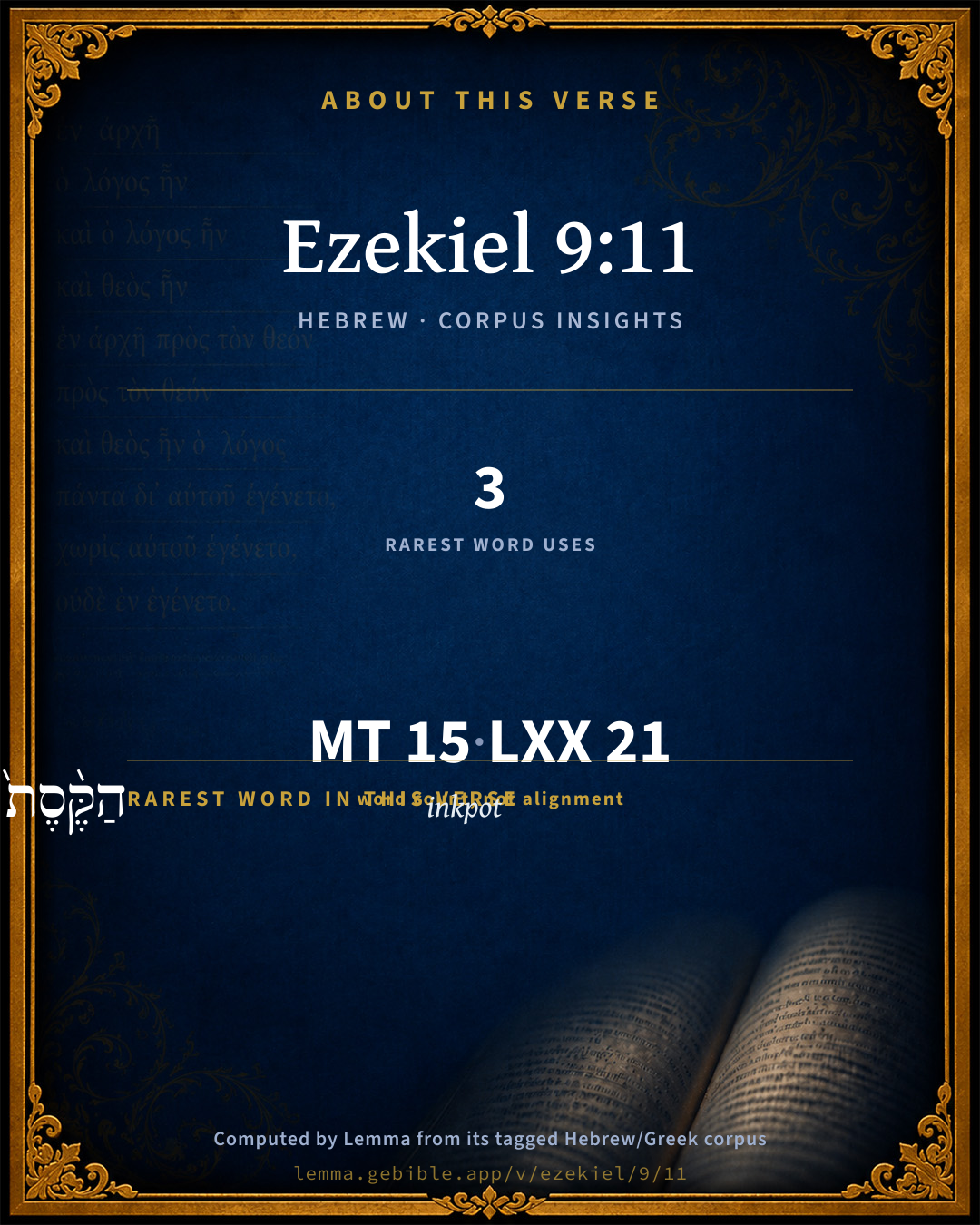
The rarest word here is הַקֶּ֨סֶת֙ inkpot H7083 — appearing just 3 times in the whole Hebrew Bible.

Shared distinctive vocabulary

הַקֶּ֨סֶת֙ inkpot H7083 occurs in 3 verses of the Hebrew Bible. Also found in:

Grammatical profile

  • 5 verbs
  • 6 nouns
  • 4 particles

Verb forms

  • לְבֻ֣שׁ Qal · Participle Passive
  • מֵשִׁ֥יב Hiphil · Participle Active
  • לֵאמֹ֑ר Qal · Infinitive Construct
  • עָשִׂ֕יתִי Qal · Perfect
  • צִוִּיתָֽנִי Piel · Perfect

Repetition

A word recurs within this verse — often emphatic in Hebrew:

  • אֲשֶׁ֤ר which H834 ×3

Hebrew & Septuagint length

In English translation the verse runs 25 words from the Hebrew and 28 from the Septuagint (LXX English) — closely comparable.

A rough comparison of the two English renderings, which tokenize alike — not a word-level alignment.

Word counts can differ between the Hebrew and the Greek without any difference in meaning — e.g. the Hebrew direct-object marker אֵת has no separate Greek word, and Greek often adds the article ὁ.

In the original languages it is 15 Hebrew tokens and 21 Greek tokens — but the two are counted differently (Hebrew bundles its prefixes and suffixes into one token; the Greek is in lemma form), so that isn’t a like-for-like length.

Cross-references

6

Topical passages linked to Ezekiel 9:11 in the Treasury of Scripture Knowledge — connected by theme and wording, ordered by reader-vote popularity; previews shown in the World English Bible.

  • Psalms 103:20 Praise Yahweh, you angels of his, Who are mighty in strength, who fulfill his word, Obeying the voice of his word.
  • Isaiah 46:10–11 declaring the end from the beginning, and from ancient times things that are not [yet] done; saying, My counsel shall stand, and I will do all my pleasure;
  • Zechariah 1:10–11 The man who stood among the myrtle trees answered, "They are the ones Yahweh has sent to go back and forth through the earth."
  • Zechariah 6:7–8 The strong went out, and sought to go that they might walk back and forth through the earth: and he said, "Go around and through the earth!" So they walked back and forth through the earth.
  • Revelation 16:2 The first went, and poured out his bowl into the earth, and it became a harmful and evil sore on the people who had the mark of the beast, and who worshiped his image.
  • Revelation 16:17 The seventh poured out his bowl into the air. A loud voice came forth out of the temple of heaven, from the throne, saying, "It is done!"

Cross-references courtesy of OpenBible.info (CC BY 4.0).

Hebrew and Greek witnesses Masoretic Hebrew ↔ Greek Septuagint

The same verse in the two great witnesses to the Old Testament, shown verse-for-verse.

These are two independent witnesses, not word-aligned to each other, and the Septuagint is shown in lemma (dictionary) form.

Hebrew Ezekiel 9:11 Masoretic · Westminster Leningrad Codex

וְהִנֵּ֞ה הָאִ֣ישׁ לְבֻ֣שׁ הַבַּדִּ֗ים אֲשֶׁ֤ר הַקֶּ֨סֶת֙ בְּמָתְנָ֔יו מֵשִׁ֥יב דָּבָ֖ר לֵאמֹ֑ר עָשִׂ֕יתִי כאשר כְּכֹ֖ל אֲשֶׁ֥ר צִוִּיתָֽנִי

Behold, the man clothed in linen, who had the inkhorn by his side, reported the matter, saying, I have done as you have commanded me.

World English Bible · Public Domain

Greek LXX Ezekiel 9:11 Septuagint · lemma form

καί ἰδού ὁ ἀνήρ ὁ ἐνδύω ὁ ποδήρης καί ζωννύω ὁ ζωνή ὁ ὀσφύς αὐτός καί ἀποκρίνω λέγω ποιέω καθώς ἐντέλλομαι

And, behold, the man clothed with the long robe, and girded with the girdle about his loins, answered and said, I have done as you did command me.

LXX2012 (modern English Septuagint) · Public Domain

Hebrew: Westminster Leningrad Codex (CC BY 4.0). Greek: Septuagint (public domain); English from LXX2012 (modern English Septuagint) (Public Domain). How the Septuagint differs from the Hebrew →

Targum (Aramaic paraphrase)

1

The Targum is the ancient Jewish Aramaic paraphrase of the Hebrew Scriptures — an interpretive translation, not the Hebrew text itself. Onkelos (literal) and Pseudo-Jonathan (expansive) render the Torah, and Jonathan the Prophets. Coverage is partial: where no permissively-licensed English translation exists for a verse, only the Aramaic is shown. This is verse-level text, not a word-by-word alignment to the Hebrew.

  1. Targum Jonathan Prophets (Joshua–Malachi)
    וְהָא גַבְרָא דְלָבֵישׁ לְבוּשָׁא דְפִנְקָסָא בְּחַרְצֵיהּ מֵתִיב פִּתְגָמָא לְמֵימַר עֲבָדֵית כְּמָא דְפַקֵדְתָּנִי:

    (no public-domain English translation for this verse)

    Targum Jonathan — Aramaic: “Mikraot Gedolot” (public domain). English: “Sefaria Community Translation” (CC0 1.0 (public-domain dedication)); “London "Chaldee Paraphrase," 1871” (public domain). Text via Sefaria.

Commentary

Notes on Ezekiel 9:11 from classic Christian and Jewish commentators (each source and its license shown beneath its notes). The classic Christian expositions comment on the surrounding passage and are grouped to its opening verse, so a note may address several verses; the Jewish commentaries on the Tanakh (Rashi and others) are per-verse, so they appear only where the commentator wrote on this verse.

Lemma curates 59 commentaries, every one of them public domain or Creative Commons licensed, each selected and text-cleaned for this edition rather than reprinted as found. About our sources →

Trapp's Complete Commentary

John Trapp

Eze 9:11 And, behold, the man clothed with linen, which [had] the inkhorn by his side, reported the matter, saying, I have done as thou hast commanded me.

Ver. 11. And behold the man reported the matter.] The Vulgate hath it respondit verbum, as if he had been asked before whether he had done as was bidden.

I have done as thou hast commanded me.] So did David; {Psa 119:112 Act 13:22} and the Son of David; {Joh 17:4; Joh 14:31} and Paul, witness his famous vox voice προαγωνιος. {2Ti 4:6-8} Let every of us so carry the matter toward God that at death we may say with that servant in Luk 17:9, "Lord, it is done as thou hast commanded."

John Trapp, A Commentary or Exposition upon All the Books of the Old and New Testament (1647–1656) — public domain. Text from a community e-Sword module.

The Biblical Illustrator

Joseph S. Exell

Eze_9:11

Reported the matter, saying, I have done as Thou hast commanded me.

The completion of the work of mercy

We do not find that those who were commissioned to destroy reported what destruction they had made, but he who was appointed to protect reported his matter, for it would be more pleasing both to God and to the prophet to hear of those who were saved than of those that perished. Or this report was made now because the thing was finished, whereas the destroying world would be a work of time, and when it was brought to an end then the report should be made. See how faithful Christ is to the trust reposed in Him. Is He commanded to secure eternal life to the chosen remnant? He has done as was commanded Him. Of all that Thou hast given Me I have lost none. (M. Henry.)

.

The Biblical Illustrator, edited by Joseph S. Exell (c. 1880s–1900s) — public domain. Text from a community e-Sword module.

Joseph Benson's Commentary

Eze 9:11. And the man clothed with linen reported the matter — Gave an account of what he had done in pursuance of his commission; he had found out all that mourned in secret for the sins of the land, and cried out against them by a public testimony, and he had marked them in order to their preservation. Lord, I have done as thou hast commanded me — We do not find that those who were commissioned to destroy reported what destruction they had made, but he who was appointed to protect reported his matter; for it would be more pleasing, both to God and the prophet, to hear of those that were saved than of those that perished.

Joseph Benson's Commentary on the Old and New Testaments (1811–1818) — public domain. Text from a community e-Sword module.

Tyndale Open Study Notes

Tyndale Open Resources

9:11 I have done as you commanded: The remnant had been successfully marked to save them from the wrath to come (9:3-4).

Tyndale Open Study Notes — © Tyndale Open Resources, licensed CC BY-SA 4.0. Text via the HelloAO Bible API.

Jamieson, Fausset & Brown

Robert Jamieson, A. R. Fausset & David Brown

I have done as thou hast commanded--The characteristic of Messiah (Joh 17:4). So the angels (Psa 103:21); and the apostles report their fulfilment of their orders (Mar 6:30).

Next: Ezekiel Chapter 10

Jamieson, Fausset & Brown — Commentary Critical and Explanatory on the Whole Bible (1871) — public domain (CC PDM 1.0). Text via the HelloAO Bible API.

Adam Clarke's Commentary

Verse 11. I have done as thou hast commanded me.] Angels and men must all give account of their conduct to God; for although he is every where, and his eye sees all things, yet they must personally account for all that they have done. I have done as thou hast commanded me. The penitents are all signed; the penitents are all safe. This is good news for them that mourn.

Adam Clarke's Commentary on the Bible (1810–1826) — public domain. Text from a community e-Sword/MySword module.

John Calvin's Commentaries

This sentence confirms what I said yesterday about God’s paternal anxiety towards the faithful. For the Prophet taught, before God would permit the Chaldeans to destroy the city, that an angel was sent before to succor the elect, and thus to oppose himself to the violence of the enemies: where we have said that it is shown to us as in a glass that God holds this order in his judgments, that his fatherly love towards the faithful always precedes them, so that he does not permit anything to happen to them but what tends to their safety. For this reason the angel now says, that he had done as he was commanded. Doubtless the obedience of the angel is reported to us, because it answers to the will of God. Hence, therefore, we gather that the safety of the faithful is always precious to God, and therefore they will always be safe and secure when we think heaven and earth mingled together. This then is the explanation. Now follows —

John Calvin's Commentaries (1540-1563) — public domain. Text from the Calvin Translation Society English edition (1840s-50s) via the Christian Classics Ethereal Library (ccel.org). Calvin's coverage is partial (roughly two-thirds of the Bible); uncommented books and verses are honest gaps, never fabricated. The 19th-century editor's footnotes and remarks are omitted so the notes are faithfully Calvin's own voice.

The Cambridge Bible for Schools and Colleges

gen. ed. J. J. S. Perowne

11. The man clad in linen returns, announcing the execution of Jehovah’s commands.

The Cambridge Bible for Schools and Colleges (gen. ed. J. J. S. Perowne; Cambridge University Press, 1878–1918) — public domain. Text from a community e-Sword module.

John Gill's Exposition

And, behold, the man clothed with linen, which had the inkhorn by his side,.... Eze 9:2; to whom the orders were given to mark the mourners in the city, Eze 9:4. The Syriac version is, "then I saw the man", &c. which must direct him to observe and call to mind the distinguishing goodness of God to his own people:

reported the matter, saying, I have done as thou hast commanded me; meaning that the righteous were marked, and had been preserved, while the others were slain. Christ, as man and Mediator, sustains the character of a servant; as such he has commands enjoined him, which he has obeyed; he has done all he was to do; he has fulfilled the whole will of God, and wrought out the complete salvation of his people; a report of which he made when here on earth, Joh 17:4; and will do again at the last day; when all his people will be gathered in, and he shall deliver the kingdom to the Father, and present them all to him, having been kept by his power, saying, "lo, I and the children thou hast given me", Isa 8:18; when all will be done as was commanded, and he undertook, and the report made accordingly. Ben Melech observes, that the "Keri", or marginal reading is,

"according to all which thou hast commanded me;''

as if he should say, there is nothing wanting of all that was commanded.

Next: Ezekiel Chapter 10

John Gill's Exposition of the Whole Bible (1746–1763) — public domain (CC PDM 1.0). Text via the HelloAO Bible API.

Matthew Poole's English Annotations

While God gave the prophet the account of the people’s sins, and of his own resolutions, Christ,

clothed with linen, the innocent one, and our Priest,

reported the matter, as it were came in, or returned from doing that work most delightful to him.

As thou hast commanded me; the Hebrew text is according, or as; but the reading is with all added, according to

all that which thou, O my Father, hast commanded me; as Joh 14:31.

Matthew Poole's English Annotations on the Holy Bible (1683–1685) — public domain. Text from a community e-Sword/MySword module.

Whedon's Commentary on the Bible

Daniel D. Whedon

11. I have done as thou hast commanded me — As leader of the six, he reports that he has put the divinely appointed mark upon all of God’s true followers in the city and that all others have been slain.

Daniel D. Whedon (gen. ed.), Commentary on the Old and New Testaments (1874–1909) — public domain. Text from a community e-Sword module.

The Pulpit Commentary

And, behold, etc. The speaker in the previous verses had been none other than the Presence which remained upon the cherubic lotto, while the seven ministers did their work. The captain of the seven now returns to report, as an officer to his king, that the work has been accomplished.

The completed task.

A man with an inkhorn had been sent round Jerusalem to set a cross on the foreheads of all penitent persons, and so to mark them for protection against the terrible coming slaughter. This pleasant task had been performed, and the messenger now returned, saying, "I have done as thou hast commanded me." These words are a suitable motto for a completed task.

I THE SERVANT OF GOD IS REQUIRED TO DO AS HIS MASTER COMMANDS HIM. He is not only required to serve, he is also required to obey; i.e. he is not merely to work for the benefit of his Master, he is to do what his Master wishes. Thus obedience is more than service; and it is harder of performance.

1. He should have a single eye to his Masters will. Possibly this may be contrary to his own inclinations, and even opposed to what he imagines would be most serviceable towards the end in view. Men may criticize, advise, mock, threaten. The servant of God must be ready to reply with St. Peter, "Whether it be right in the sight of God to hearken unto you more than unto God, judge ye," etc.. (Act_4:19) The will of God in the revelation of the Bible, the example of Christ, and a man"s own conscience is the one sole authority. With the enlightened liberty of Christianity thisdoes not come as a blind law, but appealing to conviction. Yet still, when thus we know the right, there is an end of the matter. The servant of God is then like the famous Six Hundred.

2. He has only to accomplish his Masters will. The man with the inkhorn has simply to mark the penitent not to rescue them, build a castle in which to hide them, fight on their behalf, The Christian soldier is to preach the gospel to every creature. The results he must have with God. Moreover, each is just to do his own part, and not to distress himself because he cannot also do his neighbour"s work. The terrible burden of the world would seem less if we realized our responsibility as lying just in obedience.

II THE JOY OF THE SERVANT OF GOD IS IN ACCOMPLISHING THE TASK HIS MASTER LAYS UPON HIM. God does not put upon his servants harder work than they can perform by his aid. Now we have to face our tasks, and perhaps they appear toilsome and formidable. It will be a most happy thing to be able to look back upon them as accomplished. Not, indeed, that any one perfectly fulfils the Master"s commands. Christ alone could cry, in the fullest sense of the words, "It is finished!". (Joh_19:30) Yet St. Paul could say, "I have fought a good fight, I have finished my course, I have kept the faith". (2Ti_4:7) And Christ will welcome his true steward with the words, "Well done, good and faithful servant". (Mat_25:23)

1. There is the joy of accomplishment. The task of a Sisyphus is one of the tortures of Tartarus. The aimlessness of the walk of the treadmill gives the sting to the convict"s punishment. There is a joy in accomplishment. Each stage passed, each height climbed, each task done, brings its own joy a joy of which the indolent can have no conception. The true servant will say

And I will ask for no reward, Except to serve thee still.

2. There is the joy of the Master"s approval. Christ makes obedience the condition of his friendship. (Joh_15:14)

True obedience.

The very word "obedience" is to some minds offensive and repulsive. Association may connect it with tyranny, and then it suggests harshness and severity on the one side, and merely compulsory submission on the other. But to the right minded no word is more welcome, for no moral quality is more honourable. The son obeys the wishes of his father; the soldier, the sailor, render immediate obedience to the word of command; to the school boy who is worthy of his advantages, his master"s will is law; the ambassador lives to carry out the instructions of the court by which he is commissioned. In fact, all through human life, especially in civilized and Christian communities, command and obedience are universal principles, binding society together. In the text we have an example of obedience rendered by one of his servants to the most high God; the profession of obedience here made is distinguished by remarkable simplicity and dignity.

I RELIGIOUS OBEDIENCE IS BASED UPON PERSONAL RELATIONS. There is natural law, which, in a certain sense, we may be said to obey, but with no voluntary adoption or choice. Being, so far as the body is concerned, subject to physical law, we are to that extent obedient without the moral quality and virtue of obedience. But law in its proper sense is the imposition of the will of a superior upon that of an inferior. Law of this kind is not always just, is not always deserving of reverence. The despot commands, and his trembling subject may obey; the slave driver commands, and the slave may from fear render unquestioning obedience. But, on the other hand, there are human relations which involve wise directions and willing compliance. And such are, in a sense, the copy of that beneficent relation which subsists between the Creator and his subject man. Mind comes into contact with mind. I have done as thou hast commanded me." The language brings the personalities into closest contact. The obedient is impelled, not by regard for his interests or by fears lest he suffer, but by the recognition of the personal right of God. It is always well, in the religious life, to look through the Law to the Lawgiver, through the decision to the Judge, through the fatherly word to the Father himself.

II RELIGIOUS OBEDIENCE INVOLVES AUTHORITY AND SUBJECTION. Authority is not, as has sometimes been taught, an invention of human ingenuity for the promotion of human convenience. In its essence it is Divine. It is something quite different from power, and something far higher. In human nature and in human society, authority is sometimes unaccompanied by power; force even usurps its proper place. Human beings are fallible in wisdom and imperfect in goodness; and it often happens that the exercise of authority is unjust and hateful. But the authority of God is always exercised with wisdom and with justice. Obedience to man is always a qualified, whilst obedience to God is an absolute, duty. The Divine will is indeed binding, and for this reason that the Divine judgment is always supremely excellent. In fact, every command of God is the utterance of the Infinite Reason. There is moral authority in God"s commands, which our judgment and conscience spontaneously acknowledge.

III RELIGIOUS OBEDIENCE IS MOTIVED AND INSPIRED BY GRATEFUL LOVE. There is much obedience rendered by man to man, merely upon compulsion, under the influence of fear. And there are those who, under similar motives, seek to serve God. Veneration for the Lawgiver, and admiration of commandments in themselves excellent and beautiful, constrain some men to devote themselves to a life of obedience. But the distinctively Christian obedience is that which is rendered from gratitude and affection to the Saviour. When his mission to earth is truly understood; when it is perceived that it was pity which led him to undertake the work of redemption; when not only his labours, but his sufferings and sacrifice, are pondered and appreciated; then love may well enkindle love, and those for whom Christ died may well ask what they shall render for all the benefits they receive from and through him. Who would not do anything to evince loyalty, affection, and gratitude, to a Friend so self-sacrificing, a Saviour so compassionate? Our Lord Jesus himself relied upon these motives. He did indeed claim obedience as his right: "Why call ye me Master and Lord, and do not the things which I say?" But he also asked obedience as a proof of response to his friendship: "Ye are my friends, if ye do whatsoever I command you;" "If ye love me, keep my commandments.

"Tis love that makes our willing feet In swift obedience move.

IV RELIGIOUS OBEDIENCE OVERCOMES NATURAL REPUGNANCE TO ANY COURSE OF ACTION PRESCRIBED BY DIVINE AUTHORITY. We have an illustration of this in the context. The special vocation of the man with the inkhorn was to set a mark upon the foreheads of the men who sighed and cried for all the abominations that were done; yet he seems also to have had charge of the officers of the city to whom was entrusted the awful task of punishment and destruction. The work of deliverance was agreeable and grateful; the work of chastisement and slaughter must have been painful and distressing. Yet in both directions the will of the rightful Lord and King was done; and the report was rendered of the fulfilment in all their completeness of the royal commands. It happens to us all now and again to be called to undertake some service from which we shrink, to which by our temperament and habits we are naturally averse. But obedience has to be rendered, not only when the commands given harmonize with our predilections, but when they arc sorely opposed to our natural or acquired tastes and inclinations. But rightful orders must be obeyed. As in the case of the Six Hundred

Theirs not to reason why; Theirs not to make reply: Theirs but to do and die.

So in the case of many a child of God, many a soldier of Christ, orders are known to be issued upon Divine authority which can only be obeyed at the risk of wealth, or reputation, or life. But such considerations have to be dismissed. Once satisfied that the commandments are Divine, the subject renders, if not a happy, yet a willing obedience. It is not to be expected that, in this imperfect state of being, obedience should always be enjoyment, though the aim of every Christian should be to say, with his Master, "I delight to do thy will, O my God!

V RELIGIOUS OBEDIENCE YIELDS SATISFACTION TO THE CONSCIENCE, If pleasure does not always accompany and follow true service, approval will not fail. Upon the grave of a great philanthropist may be read these lines

He does well who does his best. Brothers! I have done my best: I am weary: let me rest.

There may be something of self-righteousness in these lines. Here is an epitaph, however, which may be placed over any faithful servant of Christ

Life"s work well done; Life"s course well run; Life"s crown well won: Now comes rest.

There is, however, no reflection upon a life of obedience to compare in grandeur and beauty with that recorded to have been uttered by our Lord himself, "I have finished the work which thou gavest me to do." To have given up one"s own will, to have accepted the will of Heaven, to have toiled and suffered as an obedient son and servant in God"s cause, this is the better part, which will endure the retrospect of life"s closing hour.

VI RELIGIOUS OBEDIENCE SECURES ACCEPTANCE AND REWARD FROM THE SUPREME RULER HIMSELF. If rebellion is, in the sight of God, man"s one great error and sin, obedience is, in his sight, above all things acceptable. Every man who is saved is indeed saved by grace; but all are judged by their works. The good pleasure of the King promotes to higher service as the reward of diligence and fidelity. And there can be no words so welcome at the last as these, "Well done, good and faithful servant! T.

The Pulpit Commentary (1880–1919), ed. H.D.M. Spence-Jones & Joseph S. Exell — public domain. Text from a community e-Sword module.

Lesson kit

Teaching starters — assembled from the data on this page, not authored interpretation. Every prompt links to the verse data it draws on. Edit before teaching.

Ezekiel, in the Prophets, opens this verse with 15 words (13 distinct Hebrew lemmas). Its most distinctive word is qeçeth (“inkpot”). A historical commentator’s framing appears above. Read the whole chapter for the surrounding context.

Discussion questions

  1. The word qeçeth carries the sense “inkpot.” How does it shape the verse?
  2. Ezekiel 9:2 shares the word «inkpot» with this verse. How do the two illuminate each other?
  3. “which” occurs 3× in this one verse. What is the effect of the repetition?
  4. These translations render this verse differently. What is at stake in choosing one wording over another?
  5. The verb «לְבֻ֣שׁ» is Qal Participle Passive. How does its form color the action?
  6. Reading how Trapp's Complete Commentary and The Biblical Illustrator read this verse, where do the two commentators agree and where do they part?

Things to notice

Reading settings

Reading text

Shown beneath each verse's original-language words.

Old Testament
Old Testament edition

Read the OT as the Masoretic Hebrew (MT) or the Greek Septuagint (LXX).

English shown for the Greek Septuagint (in the Hebrew ↔ Greek comparison).

Comparing translations? Open the Compare panel on any verse page to stack up to four side by side.