
Zechariah 1:6

Hebrew (Westminster Leningrad Codex) Zechariah 1:6 appears in the Hebrew Old Testament. The text above is from the Westminster Leningrad Codex. Each word links to its Strong’s number, a concise gloss, and parsing drawn from the Open Scriptures Hebrew Bible morphology. Click any word for its full Brown-Driver-Briggs (BDB) entry.
Download image
Cite this verse

Zechariah 1:6 (World English Bible). Public Domain. Lemma interlinear Bible study tool, https://lemma.gebible.app/v/zechariah/1/6.

Show BibTeX & RIS
BibTeX
RIS
English Translation
But my words and my decrees, which I commanded my servants the prophets, didn't they overtake your fathers? "Then they repented and said, 'Just as Yahweh of Hosts determined to do to us, according to our ways, and according to our practices, so he has dealt with us.'"
World English Bible · Public Domain
Download a study sheet

One document with this verse’s original text, its word-by-word gloss line, the meaning frame, cross-references with their text, attributed commentary, and full source and license credits — printable, and it pastes into notes with its structure intact.

This verse Autodidact and up

Study sheet (.html) Plain text (.txt)

A passage Seminary Student

Up to 50 verses in one chapter. A passage sheet keeps up to 6 commentary sources and 12 cross-references per verse, in the order this page ranks them, and says so on the sheet whenever that leaves anything out. Ask for a single verse and you get the Autodidact verse sheet above.

Everything on this page stays free to read, with no account — the sheet is a download of what is already on screen, not access to it.

Want to remove ads? Support Godless Engineer
Compare translations 3

The same verse in 3 English versions, stacked beneath the original-language interlinear above. Click any original word for its lexicon entry.

Each is an independent rendering of the whole verse — the interlinear is not word-aligned to these translations.

Highlighted words mark where these versions differ — a whole-verse word diff, not a word-by-word alignment.

  • World English Bible Public Domain
    But my words and my decrees, which I commanded my servants the prophets, didn't they overtake your fathers? "Then they repented and said, 'Just as Yahweh of Hosts determined to do to us, according to our ways, and according to our practices, so he has dealt with us.'"
  • King James Version Public Domain
    But my words and my statutes, which I commanded my servants the prophets, did they not take hold of your fathers? and they returned and said, Like as the LORD of hosts thought to do unto us, according to our ways, and according to our doings, so hath he dealt with us.
  • unfoldingWord Literal Text CC BY-SA 4.0
    But my words and my statutes, which I commanded my servants the prophets, did they not overtake your fathers? And they returned and said, ‘Just as Yahweh of Armies planned to do to us, according to our ways and according to our deeds, thus he has done with us.’”

unfoldingWord Literal Text — © unfoldingWord, licensed CC BY-SA 4.0. Word-aligned USFM3 via Door43 (git.door43.org/unfoldingWord/en_ult).

Versions to compare (up to 4)

3 of 4 selected

Show all 18 translations

Every available English version of this verse, each an independent rendering of the whole verse.

  • World English Bible Public Domain
    But my words and my decrees, which I commanded my servants the prophets, didn't they overtake your fathers? "Then they repented and said, 'Just as Yahweh of Hosts determined to do to us, according to our ways, and according to our practices, so he has dealt with us.'"
  • Berean Standard Bible Public Domain
    But did not My words and My statutes, which I commanded My servants the prophets, overtake your fathers? They repented and said, ‘Just as the LORD of Hosts purposed to do to us according to our ways and deeds, so He has done to us.’”
  • Majority Standard Bible Public Domain
    But did not My words and My statutes, which I commanded My servants the prophets, overtake your fathers? They repented and said, ‘Just as the LORD of Hosts purposed to do to us according to our ways and deeds, so He has done to us.’”
  • King James Version Public Domain
    But my words and my statutes, which I commanded my servants the prophets, did they not take hold of your fathers? and they returned and said, Like as the LORD of hosts thought to do unto us, according to our ways, and according to our doings, so hath he dealt with us.
  • American Standard Version (1901) Public Domain
    But my words and my statutes, which I commanded my servants the prophets, did they not overtake your fathers? and they turned and said, Like as Jehovah of hosts thought to do unto us, according to our ways, and according to our doings, so hath he dealt with us.
  • Revised Version (1885) Public Domain
    But my words and my statutes, which I commanded my servants the prophets, did they not overtake your fathers? and they turned and said, Like as the LORD of hosts thought to do unto us, according to our ways, and according to our doings, so hath he dealt with us.
  • Geneva Bible (1599) Public Domain
    But did not my wordes and my statutes, which I commanded by my seruants ye Prophets, take holde of your fathers? and they returned, and sayd, As the Lord of hostes hath determined to doe vnto vs, according to our owne wayes, and according to our workes, so hath hee dealt with vs.
  • Douay-Rheims (1899) Public Domain
    But yet my words, and my ordinances, which I gave in charge to my servants the prophets, did they not take hold of your fathers, and they returned, and said: As the Lord of hosts thought to do to us according to our ways, and according to our devices, so he hath done to us.
  • Young's Literal Translation Public Domain
    Only, My words, and My statutes, That I commanded My servants the prophets, Have they not overtaken your fathers, And they turn back and say: As Jehovah of Hosts designed to do to us, According to our ways, and according to our doings, So He hath done to us?'
  • Literal Standard Version CC BY-SA 4.0
    Only, My words and My statutes, || That I commanded My servants the prophets, || Have they not overtaken your fathers? And they turn back and say: As YHWH of Hosts designed to do to us, || According to our ways, and according to our doings, || So He has done to us.”
  • Unlocked Literal Bible CC BY-SA 4.0
    But my words and my decrees that I commanded my servants the prophets, have they not overtaken your fathers? So they repented and said, 'Just as Yahweh of hosts planned to do to us what our ways and actions deserved, so he has dealt with us.'”
  • unfoldingWord Literal Text CC BY-SA 4.0
    But my words and my statutes, which I commanded my servants the prophets, did they not overtake your fathers? And they returned and said, ‘Just as Yahweh of Armies planned to do to us, according to our ways and according to our deeds, thus he has done with us.’”
  • Darby Bible Public Domain
    But my words and my statutes, which I commanded my servants the prophets, did they not overtake your fathers? And they turned and said, Like as Jehovah of hosts thought to do unto us, according to our ways and according to our doings, so hath he dealt with us.
  • World Messianic Bible Public Domain
    But my words and my decrees, which I commanded my servants the prophets, didn’t they overtake your fathers? “Then they repented and said, ‘Just as the LORD of Hosts determined to do to us, according to our ways and according to our practices, so he has dealt with us.’”
  • Webster's Bible Public Domain
    But my words and my statutes, which I commanded my servants the prophets, did they not take hold of your fathers? and they returned and said, As the LORD of hosts thought to do to us, according to our ways, and according to our doings, so hath he dealt with us.
  • Free Bible Version CC BY-SA 4.0
    But didn't all my instructions and warnings that I ordered my servants the prophets to communicate, didn't all that I said happen to your forefathers? So they repented and said, “What the Lord Almighty planned to do to us was what we deserved because of our ways and our actions. He did what he said he would.”
  • Bible in Basic English Public Domain
    But my words and my orders, which I gave to my servants the prophets, have they not overtaken your fathers? and turning back they said, As it was the purpose of the Lord of armies to do to us, in reward for our ways and our doings, so has he done.
  • JPS Tanakh (1917) Public Domain
    But My words and My statutes, which I commanded My servants the prophets, did they not overtake your fathers? so that they turned and said: Like as the LORD of hosts purposed to do unto us, according to our ways, and according to our doings, so hath He dealt with us.'

Literal Standard Version (2020), Covenant Press — licensed CC BY-SA 4.0. Text via the HelloAO Bible API (eBible.org). Unlocked Literal Bible (unfoldingWord) — licensed CC BY-SA 4.0. Text via the HelloAO Bible API (eBible.org). unfoldingWord Literal Text — © unfoldingWord, licensed CC BY-SA 4.0. Word-aligned USFM3 via Door43 (git.door43.org/unfoldingWord/en_ult). Free Bible Version, Dr. Jonathan Gallagher — licensed CC BY-SA 4.0. Text via the HelloAO Bible API (eBible.org).

Word by word

More ways to search: Search by grammar → Find every occurrence → Compare this word →

Practice this passage: Drill this verse → Learn its vocabulary →

זָמַ֜ם
zâmam
H2161
“to devise”
Verb, Qal, Perfect, 3rd Person, Masculine, Singular
Part of Speech
Verb
Stem
Qal
Form
Perfect
Person
3rd Person
Gender
Masculine
Number
Singular
Full BDB Definition

Origin: a primitive root

TWOT: 556

to have a thought, devise, plan, consider, purpose - (Qal) - to consider, fix thought upon - to purpose, devise - to plot (of evil intent)
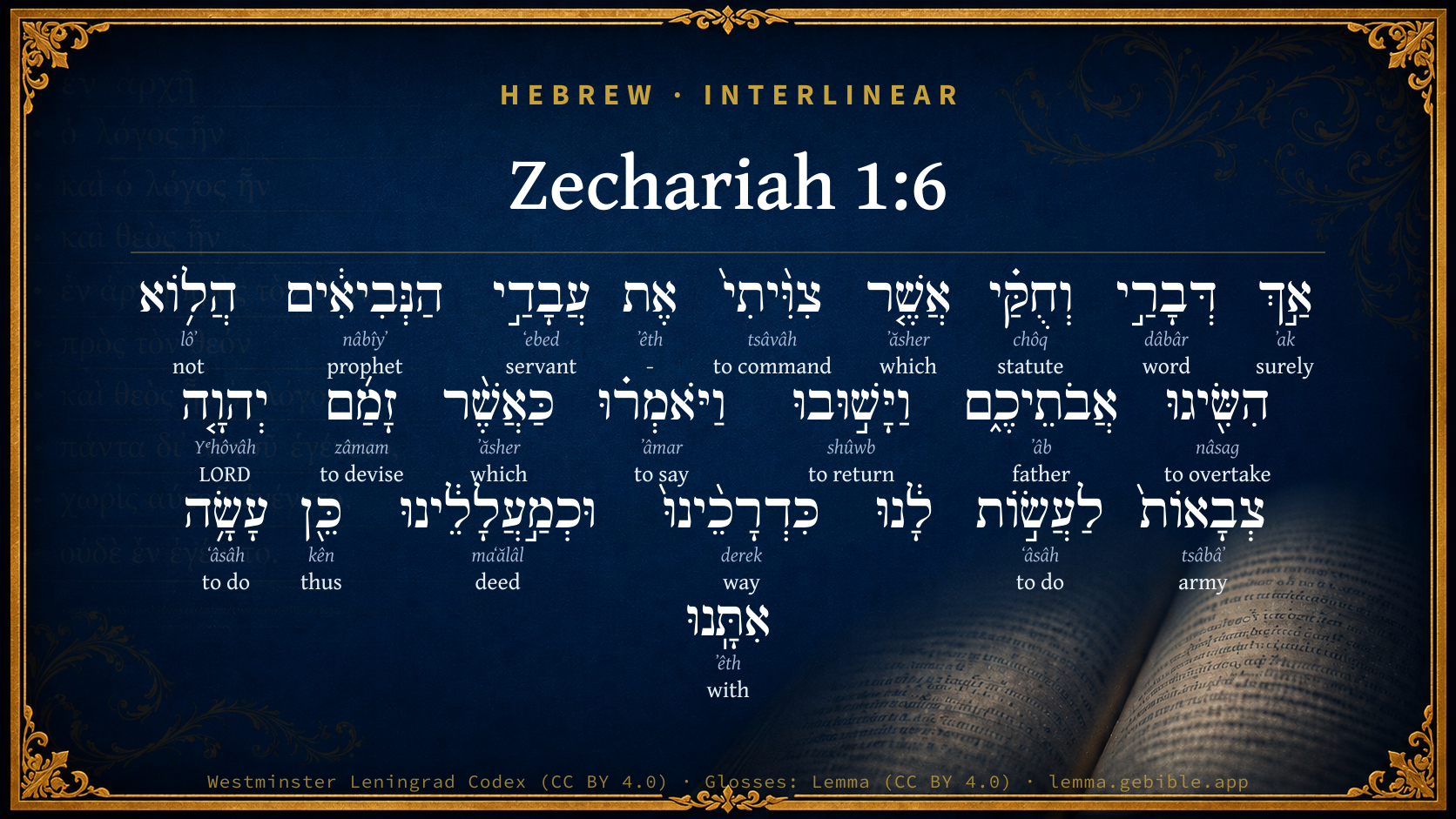
  1. אַ֣ךְ ʼak H389 “surely” Particle, Accusative
  2. דְּבָרַ֣י dâbâr H1697 “words · my” Noun, Common, Masculine, Plural, Construct + Suffix, Personal, 1st Person, Common, Singular
  3. וְחֻקַּ֗י chôq H2706 “and · statutes · my” Conjunction + Noun, Common, Masculine, Plural, Construct + Suffix, Personal, 1st Person, Common, Singular
  4. אֲשֶׁ֤ר ʼăsher H834 “which” Particle, Relative
  5. צִוִּ֨יתִי֙ tsâvâh H6680 “to command” Verb, Piel, Perfect, 1st Person, Common, Singular
  6. אֶת ʼêth H853 “-” Particle, Direct Object
  7. עֲבָדַ֣י ʻebed H5650 “servants · my” Noun, Common, Masculine, Plural, Construct + Suffix, Personal, 1st Person, Common, Singular
  8. הַנְּבִיאִ֔ים nâbîyʼ H5030 “the · prophets” Particle, Definite Article + Noun, Common, Masculine, Plural, Absolute
  9. הֲל֥וֹא lôʼ H3808 “not” Particle, Interrogative + Particle, Negative
  10. הִשִּׂ֖יגוּ nâsag H5381 “to overtake” Verb, Hiphil, Perfect, 3rd Person, Common, Plural
  11. אֲבֹתֵיכֶ֑ם ʼâb H1 “fathers · your” Noun, Common, Masculine, Plural, Construct + Suffix, Personal, 2nd Person, Masculine, Plural
  12. וַיָּשׁ֣וּבוּ shûwb H7725 “and · to return” Conjunction + Verb, Qal, Sequential Imperfect, 3rd Person, Masculine, Plural
  13. וַיֹּאמְר֗וּ ʼâmar H559 “and · to say” Conjunction + Verb, Qal, Sequential Imperfect, 3rd Person, Masculine, Plural
  14. כַּאֲשֶׁ֨ר ʼăsher H834 “like/as · which” Preposition + Particle, Relative
  15. יְהוָ֤ה Yᵉhôvâh H3068 “LORD” Noun, Proper
  16. צְבָאוֹת֙ tsâbâʼ H6635 “armies” Noun, Common, Both, Plural, Absolute
  17. לַעֲשׂ֣וֹת ʻâsâh H6213 “to do” Preposition + Verb, Qal, Infinitive Construct
  18. כִּדְרָכֵ֨ינוּ֙ derek H1870 “like/as · ways · our” Preposition + Noun, Common, Both, Plural, Construct + Suffix, Personal, 1st Person, Common, Plural
  19. וּכְמַ֣עֲלָלֵ֔ינוּ maʻălâl H4611 “and · like/as · deeds · our” Conjunction + Preposition + Noun, Common, Masculine, Plural, Construct + Suffix, Personal, 1st Person, Common, Plural
  20. כֵּ֖ן kên H3651 “thus” Particle, Demonstrative
  21. עָשָׂ֥ה ʻâsâh H6213 “to do” Verb, Qal, Perfect, 3rd Person, Masculine, Singular
  22. אִתָּֽנוּ ʼêth H854 “with · us” Preposition + Suffix, Personal, 1st Person, Common, Plural

About this verse

These counts appear in no published source. They are computed here, from the morphology-tagged text and Lemma’s own curated glosses. What Lemma adds →

24
words
21
distinct lemmas
Prophets
section

Notable vocabulary

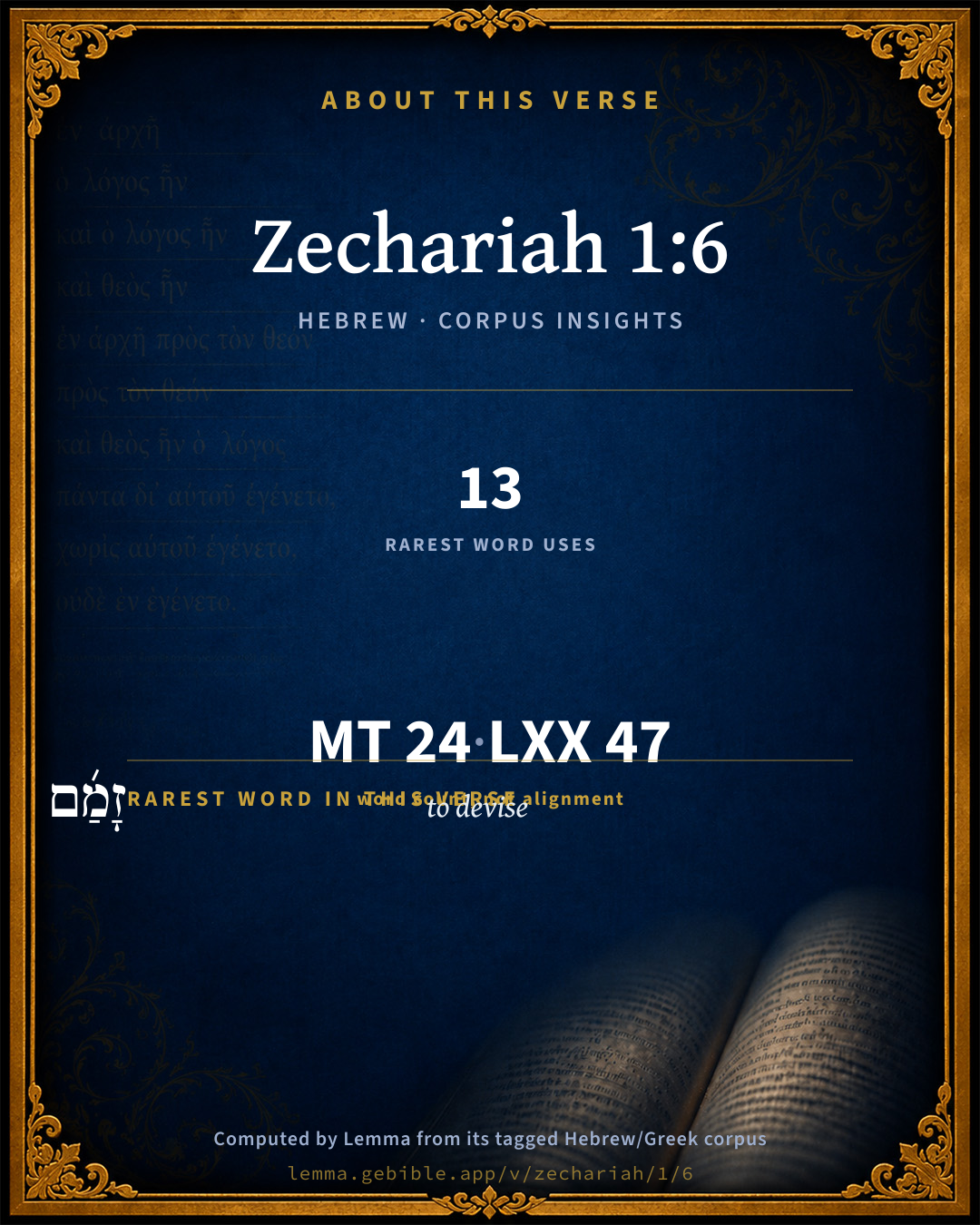
The rarest word here is זָמַ֜ם to devise H2161 — appearing just 13 times in the whole Hebrew Bible.

Shared distinctive vocabulary

זָמַ֜ם to devise H2161 occurs in 13 verses of the Hebrew Bible. Also found in:

Grammatical profile

  • 7 verbs
  • 9 nouns
  • 2 prepositions
  • 6 particles

Verb forms

  • צִוִּ֨יתִי֙ Piel · Perfect
  • הִשִּׂ֖יגוּ Hiphil · Perfect
  • וַיָּשׁ֣וּבוּ Qal · Sequential Imperfect
  • וַיֹּאמְר֗וּ Qal · Sequential Imperfect
  • זָמַ֜ם Qal · Perfect
  • לַעֲשׂ֣וֹת Qal · Infinitive Construct
  • עָשָׂ֥ה Qal · Perfect

Repetition

Words recur within this verse — often emphatic in Hebrew:

  • לַעֲשׂ֣וֹת to do H6213 ×2
  • אֲשֶׁ֤ר which H834 ×2

Hebrew & Septuagint length

In English translation the verse runs 48 words from the Hebrew and 58 from the Septuagint (LXX English) — closely comparable.

A rough comparison of the two English renderings, which tokenize alike — not a word-level alignment.

Word counts can differ between the Hebrew and the Greek without any difference in meaning — e.g. the Hebrew direct-object marker אֵת has no separate Greek word, and Greek often adds the article ὁ.

In the original languages it is 24 Hebrew tokens and 47 Greek tokens — but the two are counted differently (Hebrew bundles its prefixes and suffixes into one token; the Greek is in lemma form), so that isn’t a like-for-like length.

Cross-references

30

Topical passages linked to Zechariah 1:6 in the Treasury of Scripture Knowledge — connected by theme and wording, ordered by reader-vote popularity; previews shown in the World English Bible.

  • Lamentations 2:17 Yahweh has done that which he purposed; he has fulfilled his word that he commanded in the days of old; He has thrown down, and has not pitied: He has caused the enemy to rejoice over you; he has exalted the horn of your adversaries.
  • Ezekiel 12:25–28 For I am Yahweh; I will speak, and the word that I shall speak shall be performed; it shall be no more deferred: for in your days, rebellious house, will I speak the word, and will perform it, says the Lord Yahweh.
  • Deuteronomy 28:15 But it shall come to pass, if you will not listen to the voice of Yahweh your God, to observe to do all his commandments and his statutes which I command you this day, that all these curses shall come on you, and overtake you.
  • Jeremiah 23:20 The anger of Yahweh shall not return, until he has executed, and until he have performed the intents of his heart: in the latter days you shall understand it perfectly.
  • Matthew 24:35 Heaven and earth will pass away, but my words will not pass away.
  • Numbers 23:19 God is not a man, that he should lie, Neither the son of man, that he should repent: Has he said, and will he not do it? Or has he spoken, and will he not make it good?
  • Jeremiah 44:28 Those who escape the sword shall return out of the land of Egypt into the land of Judah, few in number; and all the remnant of Judah, who have gone into the land of Egypt to sojourn there, shall know whose word shall stand, mine, or theirs.
  • Daniel 9:11–12 Yes, all Israel have transgressed your law, even turning aside, that they should not obey your voice: therefore has the curse been poured out on us, and the oath that is written in the law of Moses the servant of God; for we have sinned against him.
  • Amos 9:10 All the sinners of my people will die by the sword, who say, 'Evil won't overtake nor meet us.'
  • Numbers 32:23 But if you will not do so, behold, you have sinned against Yahweh; and be sure your sin will find you out.
  • Numbers 33:56 It shall happen that as I thought to do to them, so will I do to you.
  • Deuteronomy 28:20 Yahweh will send on you cursing, confusion, and rebuke, in all that you put your hand to do, until you are destroyed, and until you perish quickly; because of the evil of your doings, by which you have forsaken me.
  • Deuteronomy 28:45 All these curses shall come on you, and shall pursue you, and overtake you, until you are destroyed; because you didn't listen to the voice of Yahweh your God, to keep his commandments and his statutes which he commanded you:
  • 2 Chronicles 36:17–21 Therefore he brought on them the king of the Chaldeans, who killed their young men with the sword in the house of their sanctuary, and had no compassion on young man or virgin, old man or gray-headed: he gave them all into his hand.
  • Job 6:29 Please return. Let there be no injustice; Yes, return again, my cause is righteous.
  • Isaiah 3:8–11 For Jerusalem is ruined, and Judah is fallen; Because their tongue and their doings are against Yahweh, To provoke the eyes of his glory.
  • Isaiah 44:26 who confirms the word of his servant, and performs the counsel of his messengers; who says of Jerusalem, She shall be inhabited; and of the cities of Judah, They shall be built, and I will raise up the waste places of it;
  • Isaiah 55:1 Ho, everyone who thirsts, come you to the waters, and he who has no money; come you, buy, and eat; yes, come, buy wine and milk without money and without price.
  • Jeremiah 4:4 Circumcise yourselves to Yahweh, and take away the foreskins of your heart, you men of Judah and inhabitants of Jerusalem; lest my wrath go forth like fire, and burn so that none can quench it, because of the evil of your doings.
  • Jeremiah 12:16–17 It shall happen, if they will diligently learn the ways of my people, to swear by my name, As Yahweh lives; even as they taught my people to swear by Baal; then shall they be built up in the midst of my people.
  • Jeremiah 18:8–11 if that nation, concerning which I have spoken, turn from their evil, I will repent of the evil that I thought to do to them.
  • Jeremiah 26:15 Only know for certain that, if you put me to death, you will bring innocent blood on yourselves, and on this city, and on the inhabitants of it; for of a truth Yahweh has sent me to you to speak all these words in your ears.
  • Lamentations 1:18 Yahweh is righteous; for I have rebelled against his commandment: Please hear all you peoples, and see my sorrow: My virgins and my young men are gone into captivity.
  • Lamentations 4:11–12 Yahweh has accomplished his wrath, he has poured out his fierce anger; He has kindled a fire in Zion, which has devoured the foundations of it.
  • Ezekiel 20:43 There shall you remember your ways, and all your doings, in which you have polluted yourselves; and you shall loathe yourselves in your own sight for all your evils that you have committed.
  • Ezekiel 37:11 Then he said to me, Son of man, these bones are the whole house of Israel: behold, they say, Our bones are dried up, and our hope is lost; we are clean cut off.
  • Hosea 2:6–11 Therefore, behold, I will hedge up your way with thorns, And I will build a wall against her, That she can't find her way.
  • Hosea 9:15 "All their wickedness is in Gilgal; For there I hated them. Because of the wickedness of their deeds I will drive them out of my house! I will love them no more. All their princes are rebels.
  • Malachi 3:18 Then you shall return and discern between the righteous and the wicked, between him who serves God and him who doesn't serve him.
  • 1 Thessalonians 5:4 But you, brothers, aren't in darkness, that the day should overtake you like a thief.

Cross-references courtesy of OpenBible.info (CC BY 4.0).

Hebrew and Greek witnesses Masoretic Hebrew ↔ Greek Septuagint

The same verse in the two great witnesses to the Old Testament, shown verse-for-verse.

These are two independent witnesses, not word-aligned to each other, and the Septuagint is shown in lemma (dictionary) form.

Hebrew Zechariah 1:6 Masoretic · Westminster Leningrad Codex

אַ֣ךְ דְּבָרַ֣י וְחֻקַּ֗י אֲשֶׁ֤ר צִוִּ֨יתִי֙ אֶת עֲבָדַ֣י הַנְּבִיאִ֔ים הֲל֥וֹא הִשִּׂ֖יגוּ אֲבֹתֵיכֶ֑ם וַיָּשׁ֣וּבוּ וַיֹּאמְר֗וּ כַּאֲשֶׁ֨ר זָמַ֜ם יְהוָ֤ה צְבָאוֹת֙ לַעֲשׂ֣וֹת לָ֔נוּ כִּדְרָכֵ֨ינוּ֙ וּכְמַ֣עֲלָלֵ֔ינוּ כֵּ֖ן עָשָׂ֥ה אִתָּֽנוּ

But my words and my decrees, which I commanded my servants the prophets, didn't they overtake your fathers? "Then they repented and said, 'Just as Yahweh of Hosts determined to do to us, according to our ways, and according to our practices, so he has dealt with us.'"

World English Bible · Public Domain

Greek LXX Zechariah 1:6 Septuagint · lemma form

πλήν ὁ λόγος ἐγώ καί ὁ νόμιμος ἐγώ δέχομαι ὅσος ἐγώ ἐντέλλομαι ἐν πνεῦμα ἐγώ ὁ δοῦλος ἐγώ ὁ προφήτης ὅς καταλαμβάνω ὁ πατήρ σύ καί ἀποκρίνω καί εἶπον καθώς παρατάσσω κύριος παντοκράτωρ ὁ ποιέω κατά ὁ ὁδός σύ καί κατά ὁ ἐπιτήδευμα σύ οὕτως ποιέω σύ

But do you⌃ receive my words and my ordinances, all that I command by my Spirit to my servants the prophets, who lived in the days of your fathers; and they answered and said, As the Lord Almighty determined to do to us, according to our ways, and according to our practices, so has he done to us.

LXX2012 (modern English Septuagint) · Public Domain

On this verse, Ellicott's Commentary for English Readers discusses the Septuagint’s reading. Read the note in Commentary ↓

Hebrew: Westminster Leningrad Codex (CC BY 4.0). Greek: Septuagint (public domain); English from LXX2012 (modern English Septuagint) (Public Domain). How the Septuagint differs from the Hebrew →

Targum (Aramaic paraphrase)

1

The Targum is the ancient Jewish Aramaic paraphrase of the Hebrew Scriptures — an interpretive translation, not the Hebrew text itself. Onkelos (literal) and Pseudo-Jonathan (expansive) render the Torah, and Jonathan the Prophets. Coverage is partial: where no permissively-licensed English translation exists for a verse, only the Aramaic is shown. This is verse-level text, not a word-by-word alignment to the Hebrew.

  1. Targum Jonathan Prophets (Joshua–Malachi)
    בְּרַם פִּתְגָמֵי וּקְיָמֵי דִי פַקְדֵת יַת עַבְדַי נְבִיַיָא הֲלָא אַדְבִּיקוּ אֲבָהַתְכוֹן וְתָבוּ וַאֲמָרוּ כְּמָא דַחֲשִׁיב יְיָ צְבָאוֹת לְמֶעְבַּד לָנָא כְּאוֹרְחָנָא וּכְעוֹבְדָנָא כֵּן עֲבַד עִמָנָא:

    (no public-domain English translation for this verse)

    Targum Jonathan — Aramaic: “Mikraot Gedolot” (public domain). English: “Sefaria Community Translation” (CC0 1.0 (public-domain dedication)); “London "Chaldee Paraphrase," 1871” (public domain). Text via Sefaria.

Commentary

Notes on Zechariah 1:6 from classic Christian and Jewish commentators (each source and its license shown beneath its notes). The classic Christian expositions comment on the surrounding passage and are grouped to its opening verse, so a note may address several verses; the Jewish commentaries on the Tanakh (Rashi and others) are per-verse, so they appear only where the commentator wrote on this verse.

Lemma curates 59 commentaries, every one of them public domain or Creative Commons licensed, each selected and text-cleaned for this edition rather than reprinted as found. About our sources →

Trapp's Complete Commentary

John Trapp

Zec 1:6 But my words and my statutes, which I commanded my servants the prophets, did they not take hold of your fathers? and they returned and said, Like as the LORD of hosts thought to do unto us, according to our ways, and according to our doings, so hath he dealt with us.

Ver. 6. Did they not take hold of your fathers] Overtake and catch them (as huntsmen their prey, or as one enemy doth another in flight, 1Ki 18:27 2Ki 25:5), to drag them down to the bottom of hell. A godly man, as he hath peace with God, with himself, and with the creatures; so he hath also with the ordinances, and may say, as Hezekiah, Good is the word of the Lord which thou hast spoken. Are not my words always good, saith God, to them that walk uprightly? Mic 2:7. Excellently Augustine, Adversarius est nobis, quamdiu sumus et ipsi nobis: quamdiu tu tibi inimicus es, inimicum habebis sermonem Dei. God’s word is adversary to none but such as are adversaries to themselves; neither doth it condemn any but such as shall be assuredly condemned by the Lord; for what is the word but the heart and soul of God ( cor et anima Dei), as Gregory saith. And what saith the essential Word of God, who came out of the bosom of his Father and knew all his counsel? "He that rejecteth me, and receiveth not my words, hath one that judgeth him: the word that I have spoken, the same shall judge him in the last day," Joh 12:48. Oh consider this, ye that forget God, that slight his word as if it were but wind, that belie the Lord, and say, "It is not he; neither shall the evil" (foretold) "come upon us; neither shall we see sword nor famine. And the prophets shall become wind, and the word is not in them: thus shall it be done unto them. Wherefore thus saith the Lord God of hosts, Because ye speak this word" (and is there not such language of many men’s hearts today?) "behold, I will make my words" (not wind, but) "fire, and this people wood, and it shall devour them," Jer 5:12-14. The word of God in the mouths of his ministers may well be likened to Moses’ rod; which, while he held it in his hand, it flourished, and brought forth almonds; but, being cast upon the ground, it became a serpent. Semblably, God’s words and statutes, if laid to heart, they yield fruit and comfort; but if slighted or snuffed at, {as Mal 1:13} serpent-like they will sting the soul, and become a savour of death, &c. This contempt will also call for a sword, to revenge the quarrel of the covenant; as it did upon these men’s fathers for their instance and admonition. It is reckoned by Daniel as a great aggravation of Belshazzar’s sin, Dan 5:22, that he was not sensible of his father Nebuchadnezzar’s pride and fall "And thou, his son, Belshazzar, hast not humbled thine heart, though thou knewest all this." The sin of these Jews in the text was the greater because their fathers and elders (either out of sound conversion, or at least out of clear conviction of conscience) had confessed and remonstrated the truth and justice of God in threatening and executing his judgments upon themselves, saying, as Lam 1:18 "The Lord is righteous; for we have rebelled against his commandments"; and as Lam 2:17 "The Lord hath done that which he had devised; he hath fulfilled his word; he hath thrown down and hath not pitied," &c. Hear them in their own words here: "Like as the Lord of hosts," whose power is irresistible, "thought" (devised, determined with himself, and accordingly denounced by his prophets) "to do unto us," who did not the words which he commanded us, Jer 11:8 "according to our ways," which were always grievous, Psa 10:5 "and according to our doings," that were not good, Eze 36:31 "so hath he dealt with us"; for he loves to retaliate, and to render to every transgression and disobedience a just recompence of reward, Heb 2:2.

John Trapp, A Commentary or Exposition upon All the Books of the Old and New Testament (1647–1656) — public domain. Text from a community e-Sword module.

The Biblical Illustrator

Joseph S. Exell

Zec_1:6

But My words

The dying men and the undying Word

The text comes from the first of Zechariahs prophecies.

In it he lays the foundation for all that he has subsequently to say. He points to the past, and summons up the august figures of the great pre-exilic prophets, and reminds his contemporaries that the words which they spoke had been verified in the experience of past generations. He declares that, though the hearers and the speakers of that prophetic Word had glided away into the vast unknown, the Word remained, lived still, and on his lips demanded the same obedience as it had vainly demanded from the generation that was past.

I. The mortal hearers and speakers of the abiding Word. A familiar theme. Look at it from the special angle, to bring into connection the eternal Word, and the transient vehicles and hearers of it. All the past hearers and speakers of the Word had that Word verified in their lives. Not one of them who, for the brief period of their earthly lives, came in contact with that Divine message, but realised, more or less consciously, the solemn truth of its promises and threatenings. Wherever they are now, their earthly relation to that Word is a determining factor in their condition. Wherefore we should give the more earnest heed to the things that we have heard.

II. The abiding Word which these hearers and speakers have had to do with. Just as reason requires some unalterable substratum below all the fleeting phenomena of the changeful creation,--a God who is the rock basis of all,--the staple to which all the links hang--so here we are driven back and back, by the very fact of the transiency of the transient, to grasp for a refuge and a stay, the permanency of the permanent. It is blessed for us when the lesson that the fleeting of all that can flee away, reads to us, is that, beneath it all, there is the Unchanging. Zechariah meant by the Word of God simply the prophetic utterances about the destiny and the punishment of the nation. We ought to mean by the Word of God, which liveth and abideth forever, not merely the written embodiment of it in this book, or that primarily, but the personal Word, the Incarnate Word, the everlasting Son of the Father. It is His perpetual existence rather than the continuous power of the truth which is the declaration of Himself, that is mighty for our strength and consolation when we think of the transient generations. Christ lives. Therefore we can front change and decay in all around calmly and triumphantly. Since we have this abiding Word, let us not dread changes, however startling and revolutionary. Jesus Christ does not change. There is a human element in the Churchs conception of Jesus Christ, and still more in their working out of the principles of the Gospel in institutions and forms, which partakes of the transiency of the men from whom they come.

III. The present generation and its relation to the abiding Word. Zechariah did not hesitate to put himself in line with the mighty forms of Isaiah, Jeremiah, Ezekiel, and Hosea. He, too, was a prophet. Some simple exhortations.

1. See to it that you accept that Word. Open not only your minds but your hearts to it. Hold it fast. In this time of unrest make sure of your grasp of the eternal central core of Christianity, Jesus Christ Himself, the Divine-human Saviour of the world. Accept Him, hold Him fast, trust to His guidance in present day questions. (A. Maclaren, D. D.)

The fleeting hearers and speakers and the undying Word

I. The passing away of hearers and speakers alike. All ingenious exposition of the words of text suggests that they are a brief dialogue, a kind of duel between the prophet and his hearers, in which the first question is his sword thrust at them, and the second is their return to him. In it they parry and return the prophets thrust. I prefer to regard the questions as continuous; the remonstrance of the prophet based upon the fact that hearers and speakers alike drift away into the unseen land, and are no more heard of. It is a very familiar and commonplace thought. Try to individualise the thought that is here. Reflect how surely, steadily, stealthily, constantly hearers and speakers of the immortal Word are drifting, drifting into the dark. Did you ever stand in some old cathedral, or ruined church, where for centuries the Word of God had been preached? And did there never come over you, with a strange rush of feeling, the thought, Where are all the men and women that bowed their knees here, beneath the vanished roof of this place?

II. The contrast between the fleeting hearers and speakers and the abiding Word. There is nothing so transient as the words that are spoken by Christian teachers. Even where the Word takes root in mens hearts, how swiftly the speaker of it passes and is forgotten. No workers so soon have their work covered with oblivion as preachers. In another way, too, the prophets fade and perish; inasmuch as new circumstances arise about which they know nothing; new phases of thought which antiquate their teachings; new difficulties in which their words have no counsel; new conflicts in which they can strike no blow. Yet, in all this mingled and fleeting human utterance, does there not lie an immortal and imperishable centre, even the Word of the living God? Much ingenuity is expended nowadays in trying to discriminate between the permanent and transient in Christian teaching. The enduring Word is that story of Christs incarnation, death for our sins, resurrection and ascension, which by the Gospel is preached unto you. Therefore we have to look beyond the dearest of human teachers, and those to whom we owe most. They truly were not suffered to continue by reason of death, but this Man (Christ) continueth ever our Friend, our Prophet, Priest, and King.

III. The witness of past generations to the immortal Word. They that heard and he that spake have passed into the silent land; but they passed not thither until they had found, in some measure, that both the warnings and the promises that had been uttered were Gods truth, and not mans dreams. Gods Word has leaden feet, but steady, and slow, and certain, it overtakes the wrong-doer. Do you take care. The generations that are gone found that the Word of the Lord was true; and if you reject His Word, you too may, before you die, find out, what you will certainly find out when you are dead, that He speaks no vain things.

IV. The practical effects of these solemn thoughts. I want to urge upon my brethren in the ministry that they should, in all their utterances, try to realise that they are prophets, dying, with a message to dying men. There is a great deal of modern preaching clever, eloquent, cultured, ingenious, which seems to have utterly forgotten that it has got a message of forgiveness and of cleansing by the blood of Christ to proclaim to men. And how these thoughts should influence hearers! How you would listen if you knew that this was your last sermon! (A. Maclaren, D. D.)

The eternity of Gods Word contrasted with the mutability of man

When Zechariah wrote, the Jews had just returned from the Babylonish captivity, and already, in spite of that severe warning, they were going back into their old habits, and bringing upon themselves fresh displays of the wrath of God. Both judgments and mercies either leave us better or worse. They lead us to repentant watchfulness, or else harden our hearts into utter carelessness and wilful sin. We might naturally have expected that the lessons of a long captivity would have cured the Jewish people of their old disease, but sin is of too deep and treacherous a character for external circumstances to uproot it. The sin of idolatry had, indeed, been cast out, but the sins of luxury and pride, self-righteousness and dogmatism, worldliness and unbelief, had taken its place, and the forecast of their future possession of the Jewish mind appears as soon as the Jews returned from captivity. Haggai and Zechariah were commissioned by God to reprove the selfish and worldly spirit of the people. Here the prophet enforces his exhortation by two considerations.

1. The mutable nature of man, passive in the hands of God, and thoroughly dependent on God. It is the height of folly for man to oppose God, who has all power to punish sin. All men must die. The Word they bring is eternal as God is eternal, but they themselves must perish. Zechariah would say, If such be the destiny of man, it is yours. Soon you must fade and fall. Turn ye from your fruitless and evil ways, and think not that ye can resist God.

2. The warning is enforced by considerations drawn from the unchangeable nature of the Divine Word. The prophets had died, but the certainty and stability of their prophecies had been vindicated by an express fulfilment. For the Word of God is eternal and unchangeable. Are you then profiting by it as you ought? (Joseph Maskell.)

The Biblical Illustrator, edited by Joseph S. Exell (c. 1880s–1900s) — public domain. Text from a community e-Sword module.

Tyndale Open Study Notes

Tyndale Open Resources

1:6 everything . . . happened: The covenant curses (Deut 28:15-68) had overtaken their ancestors who refused to obey God.

Tyndale Open Study Notes — © Tyndale Open Resources, licensed CC BY-SA 4.0. Text via the HelloAO Bible API.

Geneva Bible (1599)

Geneva Bible translators

Seeing ye saw the force of my doctrine in punishing your fathers, why do ye not fear the threatenings contained in the same, and declared by my Prophets?

As men astonished with my judgments, and not that they were touched with true repentance.

Geneva Bible (1599) marginal notes — public domain. Text via Bolls.life.

Jamieson, Fausset & Brown

Robert Jamieson, A. R. Fausset & David Brown

statutes--My determined purposes to punish for sin.

which I commanded my servants--namely, to announce to your fathers.

did they not take hold--that is, overtake, as a foe overtakes one fleeing.

they returned--Turning from their former self-satisfaction, they recognized their punishment as that which God's prophets had foretold.

thought to do--that is, decreed to do. Compare with this verse Lam 2:17.

our ways--evil ways (Jer 4:18; Jer 17:10; Jer 23:2).

Jamieson, Fausset & Brown — Commentary Critical and Explanatory on the Whole Bible (1871) — public domain (CC PDM 1.0). Text via the HelloAO Bible API.

Adam Clarke's Commentary

Verse 6. Did they not take hold of your fathers?] Every thing happened according to the predictions, and they were obliged to acknowledge this; and yet they would not turn from their evil way.

Adam Clarke's Commentary on the Bible (1810–1826) — public domain. Text from a community e-Sword/MySword module.

John Calvin's Commentaries

He then immediately adds, But my words and my statutes which I have committed to my Prophets, have they not laid hold on your fathers? We have seen that he made a concession in the last verse; but here God expressly declares what I have stated — that though men vanish, or are hence removed after a short time, yet heavenly truth is ever firm, and retains its own power. But the Prophet uses another form of expression, My words, he says, which I have committed to my servants, the Prophets, have they not laid on your father? that is, “ought the remembrance of the punishment, by which I intended to teach you, and your children, and your grandchildren, that ye might not provoke my wrath as your fathers did, to be lost by you? Since the ye see the effect of my doctrine in your fathers, why do ye not consider, that as I am always the same, my words cannot possibly be in vain at the present day, or be without effect?” We now see how clearly the Prophet distinguishes between the word of God and the condition of men; for God does not declare what is empty, nor give utterance to words which produce no effect; but he executes whatever he has committed to his Prophets.

He then adds, They returned and said, As Jehovah of hosts had purposed to do to us on account of our ways and our works, so he hath done. Added here is a confession, which ought to have perpetually stimulated the Jews, while they saw that the obstinacy of their fathers had been subdued by the scourges of God. It is indeed true, that though they been sharply chastised, many of them did not yet really repent. God however extorted from them the confession that they were justly punished. Even the ungodly then had been constrained to give glory to God, and to confess that they were justly treated as guilty; but their children became immediately forgetful — was this a stupidity capable of being excused? He at the same time indirectly warns posterity that they might not imitate the negligence of their fathers, who would not have repented had they not been severely chastised; but that they might, on the contrary anticipate the judgment of God. We then see why the Prophet mentions that the Jews, who had been severely treated, freely confessed that they had been chastised by the hand of God; but we must notice the words.

He says, that the fathers had returned. Though their repentance was not sincere, yet God intimates that such was their punishment that it drew from them the confession that is here mentioned. What then could their posterity mean? or how could they become so audaciously mad against God, when they saw that their fathers and their obstinacy had been, as it were, broken down by the severe strokes by which God had smitten them? He then subjoins, and said, As Jehovah hath prepared to do. They confessed that they suffered evils not through chance, but that the purpose of God was thus fulfilled, which they had previously despised and almost derided. They further confessed, that they justly suffered; and they referred to their works and to their course of life. Since, then, the father had made this confession, who had hardened themselves long in their sins, their posterity were wholly without excuse in going on still to their own ruin, in containing impenitent, though warned by examples so memorable. This is the import of the passage. It now follows —

John Calvin's Commentaries (1540-1563) — public domain. Text from the Calvin Translation Society English edition (1840s-50s) via the Christian Classics Ethereal Library (ccel.org). Calvin's coverage is partial (roughly two-thirds of the Bible); uncommented books and verses are honest gaps, never fabricated. The 19th-century editor's footnotes and remarks are omitted so the notes are faithfully Calvin's own voice.

Ellicott's Commentary for English Readers

(6) My words.—True, says the prophet, both your fathers and the former prophets are dead; “but” for all that, the words of the prophets were actually fulfilled in your fathers, as they themselves confessed. This is the interpretation of these verses given by Râv (second to third century A.D.) in Talmud Babli, Synhédrin, 105a. Another view of the passage is that it is equivalent to “The light of prophecy is dying out; while ye have the light, walk as children of the light.” But such an interpretation destroys the prophet’s argument.

My statutes.—Better, my decrees, as in Zep_2:2. LXX. introduce “receive ye,” after “my decrees.” After “I command,” they introduce “by my spirit,” probably from Zec_7:12.

Take hold of.—Better, as marg., overtake. LXX., οἳ κατελάβοσαν may be a corruption of ου κατελάβοσαν. (Comp. Lam_1:12.)

Returned.—Better, turned: i.e., repented. The same word is used in Zec_1:3. LXX., wrongly, καὶ ἀπεκρίθησαν, “answered.”

Like as the Lord of hosts thought to do . . .—So Jeremiah confessed in Lam_2:17. Zechariah had no doubt those words of Jeremiah in his mind at the time.

A Bible Commentary for English Readers, edited by Charles John Ellicott (1878–1897) — public domain. Text from a community e-Sword module.

The Cambridge Bible for Schools and Colleges

gen. ed. J. J. S. Perowne

6. my statutes] or decrees. The word may be used here, as it is in Zep_2:2; Psa_2:7 (in both which places it is rendered decree in A. V.), of some punishment, which God had purposed or decreed, and threatened by His prophets to send upon them unless they repented. But it may also be taken to refer, as it commonly does in the O. T., to the “statutes” of the Law, sanctioned by rewards and punishments, which it was the office of the prophet to repeat and enforce.

take hold of] Marg. and R.V. overtake. Comp. Deu_28:15; Deu_28:45, where the same word is used. Pusey quotes the well-known words of Horace, “Rarely hath punishment with limping tread parted with the forerunning miscreant.”

returned] Rather turned, as the word is rendered in Zec_1:3-4. They were brought at last to do, what before they had refused to do, Zec_1:4, and what you are now intreated to be wise in time to do, Zec_1:3, to turn from sin and turn to God.

thought to do] Comp. Lam_2:17, where the penitent confession is uttered by Jeremiah, as the representative of the people, almost in the words here recorded: “The Lord hath done that which he had devised (the same word as is here rendered, “thought”); he hath fulfilled his word that he had commanded in the days of old.”

dealt with us] Lit. done with us. As He thought, or purposed, to do, so hath He done.

The Visions. Zec_1:7 to Zec_6:15. Exactly five months had now elapsed since the building of the Temple was resumed, as the fruit of Haggai’s earnest expostulation (Hag_1:14-15). It was three months since Zechariah had uttered the call to repentance with which his Book opens (Zec_1:1); and in the mean time Haggai had again spoken in the name of the Lord, in his concluding prophecies (Hag_2:10-23). On the basis of the repentance, of which the people were giving practical proof in their honest endeavours to rebuild the Temple, and as an encouragement to them to persevere in the work, Zechariah now unfolds to them God’s purposes of mercy, as they had been unfolded to him in a series of eight visions, all of which had been vouchsafed to him, as it would seem, in a single night.

The Cambridge Bible for Schools and Colleges (gen. ed. J. J. S. Perowne; Cambridge University Press, 1878–1918) — public domain. Text from a community e-Sword module.

John Gill's Exposition

But my words and my statutes, which I commanded my servants the prophets,.... That is, the predictions which he ordered his prophets to declare in his name, that their fathers should die by the sword, or famine, or pestilence, or be carried captive, which he purposed in himself, and threatened them with:

did they not take hold of your fathers? overtake them, seize upon them, and have their accomplishment in them? not one thing has failed, or come short of being fulfilled, of all that was determined, or said should be done:

and they returned and said; that is, as many of them as perished not, but were carried captive; at least many of them, who either were thoroughly converted, and turned from their evil, or however in appearance: and who were obliged to own,

Like as the Lord of hosts thought to do unto us, according to our ways, and according to our doing, so hath he dealt with us: as he purposed, so he performed, and that with great justice and equity, being what their evil ways and doings righteously deserved; see Isa 14:24.

John Gill's Exposition of the Whole Bible (1746–1763) — public domain (CC PDM 1.0). Text via the HelloAO Bible API.

Albert Barnes' Notes on the Bible

Only My words and My decrees - Which God spake by them, “did not they overtake them?” (as Psa 2:7; Zep 2:2). Pagan reminiscence of God’s justice acknowledged , “Rarely hath punishment with limping tread parted with the forerunning miscreant.” “All these curses,” Moses foretells, “shall come upon thee and overtake thee, until thou art destroyed” Deu 28:45.

And they returned to God and said - The history of the Jews in Babylon is omitted in Holy Scripture, except as to His special dealings with Daniel and his three companions. Yet Jeremiah confesses in words, what Zechariah had apparently in his mind; “The Lord hath done that which He purposed; He hath fulfilled His word, which He commanded in the days of old” Lam 2:17. The Lamentations are one long confession of deserved punishment, such as Daniel too made in the name of his people with himself Dan 9:4-16.

It was one long waiting for God and for the restoration of His visible worship. Yet repentance was a condition of their restoration.

Albert Barnes' Notes on the Bible (1834–1885) — public domain. Text from a community e-Sword/MySword module.

Haydock's Catholic Bible Commentary

Fathers. They felt their effects. (Haydock) --- Returned; being converted by the sight of God’s judgments, Osee iv. 1., and 2 Esdras i. 6.

George Leo Haydock (1774–1849), Haydock's Catholic Family Bible and Commentary, 1859 edition — public domain. Excludes Psalms (Douay-Rheims chapter numbering differs from Protestant) and Deuterocanonical books (Catholic canon only).

Matthew Poole's English Annotations

But my words, the dreadful menaces which I spake by my prophets, and my statutes, the decreed judgments which my provoked justice resolved to execute on them, which I commanded my servants the prophets; which by my prophets as my heralds I proclaimed and published.

Did they not take hold of your fathers? overtake as a pursuing enemy overtakes and seizeth on his enemy and spoileth him; have not my judgments thus taken hold both on your fathers and on you?

They returned and said: by this it should seem that Zechariah gave them time to consider what answer to give.

So hath he dealt with us; it is true, as God said he would do, so he hath done against us, our fathers, our families, our cities and temples. God’s words have not failed, they died not, though our fathers did. This may be an abstract of their repentance.

Matthew Poole's English Annotations on the Holy Bible (1683–1685) — public domain. Text from a community e-Sword/MySword module.

The Pulpit Commentary

My words. The words that God put into the mouths of the prophets. (Jer_39:16 Lam_2:17) Statutes, usually applied to the Law, which the prophets had to announce and enforce; but it may mean "decrees" which God appointed. (Zep_2:2) The LXX inserts "receive ye" to govern these nouns. I commanded. The LXX adds, en pneumati mou , "by my inspiration." Did they not take hold of your fathers? Did they not overtake, etc.? Did not their threatened chastisements, however long delayed, reach your fathers in the end? And they returned; turned, as vers. 3, 4. They turned so far as to acknowledge that the threats had been fully accomplished. (see Dan_9:5 Ezr_9:6, etc.) Thought to do; paratetaktai (Septuagint), "designed, purposed to do". (comp. Lam_2:17)

God"s Word taking hold.

I THE FLIGHT. Men strive to get away from God. Some try one device, some another. (cf. Adam, Gen_3:10 Jon_1:3; Paul, Act_26:9) Such conduct is unnatural, wicked, and vain. (Psa_139:7)

II THE PURSUIT. The sinner followed. He feels that God knows all, and that the day of reckoning will come. Memory, conscience, Law, Scripture, prophecy of judgment. The officer of justice is on the sinner"s track. Any moment he may feel his hand on his shoulder, and hear the awful words, "You are my prisoner.

III THE OVERTAKING. Certain, for good or for evil. In the day of conviction, of true penitence, or of righteous retribution amidst the songs of rejoicing angels or the weeping and wailing of lost souls. What has been our experience? God"s Word "takes hold," as truth of the intellect, as righteousness of the conscience, as love of the heart. Mark Augustine in the garden at Milan; (Rom_13:13, Rom_13:14) Luther painfully climbing the church steps at Rome. (Rom_1:17) Study Bunyan"s "Grace Abounding." So of all the redeemed. Happy are we when we recognize that God"s Word comes, not as a foe, but as a friend; not to compel by force, but to constrain by love; not to drag us with fear and trembling before the Judge, hut to draw us gently to the cross and the Saviour. F.

The Pulpit Commentary (1880–1919), ed. H.D.M. Spence-Jones & Joseph S. Exell — public domain. Text from a community e-Sword module.

John Wesley's Explanatory Notes

My words - The dreadful menaces which I spake. My statutes - The decreed judgments which I resolved to execute on them, which by my prophets I proclaimed. Take hold - Overtake as a pursuing enemy overtakes, and seizeth on his enemy. They returned - By this it should seem that Zechariah gave them time to consider what answer to give. So hath he dealt - It is true, as God said he would do, so he hath done against us.

John Wesley, Explanatory Notes Upon the Whole Bible (1754–1765) — public domain. Text via the GEBible commentary corpus.

Lesson kit

Teaching starters — assembled from the data on this page, not authored interpretation. Every prompt links to the verse data it draws on. Edit before teaching.

Zechariah, in the Prophets, opens this verse with 24 words (21 distinct Hebrew lemmas). Its most distinctive word is zâmam (“to devise”). A historical commentator’s framing appears above. Read the whole chapter for the surrounding context.

Discussion questions

  1. What does “to devise” (zâmam) contribute to the verse as a whole?
  2. Genesis 11:6 shares the word «to devise» with this verse. How do the two illuminate each other?
  3. “to do” occurs 2× in this one verse. What is the effect of the repetition?
  4. These translations render this verse differently. What is at stake in choosing one wording over another?
  5. The verb «צִוִּ֨יתִי֙» is Piel Perfect. How does its form color the action?
  6. Reading how Trapp's Complete Commentary and The Biblical Illustrator read this verse, where do the two commentators agree and where do they part?

Things to notice

Reading settings

Reading text

Shown beneath each verse's original-language words.

Old Testament
Old Testament edition

Read the OT as the Masoretic Hebrew (MT) or the Greek Septuagint (LXX).

English shown for the Greek Septuagint (in the Hebrew ↔ Greek comparison).

Comparing translations? Open the Compare panel on any verse page to stack up to four side by side.