Jeremiah 8:4

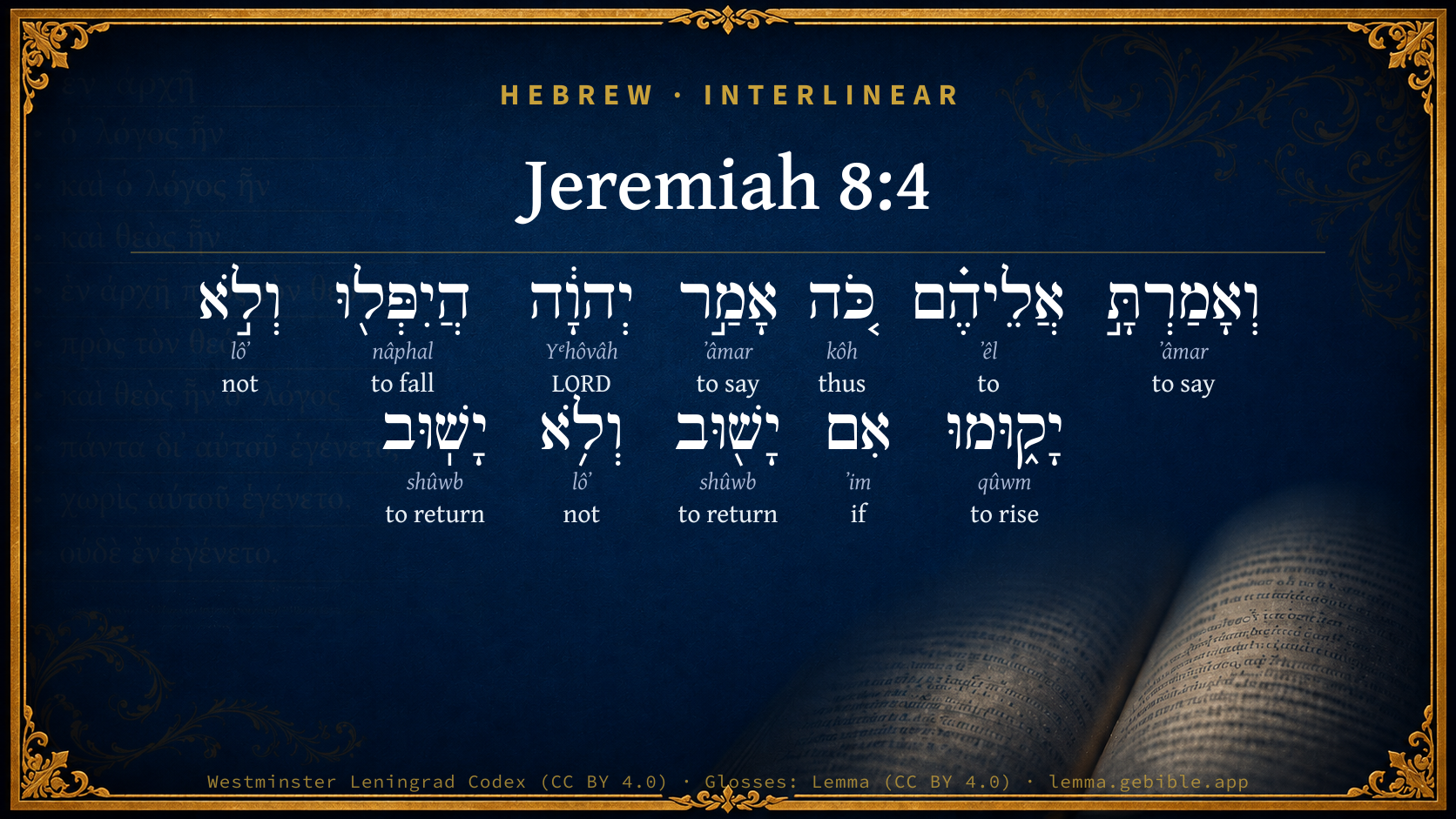
Hebrew (Westminster Leningrad Codex) Jeremiah 8:4 appears in the Hebrew Old Testament. The text above is from the Westminster Leningrad Codex. Each word links to its Strong’s number, a concise gloss, and parsing drawn from the Open Scriptures Hebrew Bible morphology. Click any word for its full Brown-Driver-Briggs (BDB) entry.
Download image
Cite this verse

Jeremiah 8:4 (World English Bible). Public Domain. Lemma interlinear Bible study tool, https://lemma.gebible.app/v/jeremiah/8/4.

Show BibTeX & RIS
BibTeX
RIS
English Translation
Moreover you shall tell them, Thus says Yahweh: Shall men fall, and not rise up again? Shall one turn away, and not return?
World English Bible · Public Domain
Download a study sheet

One document with this verse’s original text, its word-by-word gloss line, the meaning frame, cross-references with their text, attributed commentary, and full source and license credits — printable, and it pastes into notes with its structure intact.

This verse Autodidact and up

Study sheet (.html) Plain text (.txt)

A passage Seminary Student

Up to 50 verses in one chapter. A passage sheet keeps up to 6 commentary sources and 12 cross-references per verse, in the order this page ranks them, and says so on the sheet whenever that leaves anything out. Ask for a single verse and you get the Autodidact verse sheet above.

Everything on this page stays free to read, with no account — the sheet is a download of what is already on screen, not access to it.

Want to remove ads? Support Godless Engineer
Compare translations 3

The same verse in 3 English versions, stacked beneath the original-language interlinear above. Click any original word for its lexicon entry.

Each is an independent rendering of the whole verse — the interlinear is not word-aligned to these translations.

Highlighted words mark where these versions differ — a whole-verse word diff, not a word-by-word alignment.

  • World English Bible Public Domain
    Moreover you shall tell them, Thus says Yahweh: Shall men fall, and not rise up again? Shall one turn away, and not return?
  • King James Version Public Domain
    Moreover thou shalt say unto them, Thus saith the LORD; Shall they fall, and not arise? shall he turn away, and not return?
  • unfoldingWord Literal Text CC BY-SA 4.0
    And I will say to them, ‘Thus says Yahweh, “Will they fall and not rise? If one turns away, then does he not return?

unfoldingWord Literal Text — © unfoldingWord, licensed CC BY-SA 4.0. Word-aligned USFM3 via Door43 (git.door43.org/unfoldingWord/en_ult).

Versions to compare (up to 4)

3 of 4 selected

Show all 18 translations

Every available English version of this verse, each an independent rendering of the whole verse.

  • World English Bible Public Domain
    Moreover you shall tell them, Thus says Yahweh: Shall men fall, and not rise up again? Shall one turn away, and not return?
  • Berean Standard Bible Public Domain
    So you are to tell them this is what the LORD says: “Do men fall and not get up again? Does one turn away and not return?
  • Majority Standard Bible Public Domain
    So you are to tell them this is what the LORD says: “Do men fall and not get up again? Does one turn away and not return?
  • King James Version Public Domain
    Moreover thou shalt say unto them, Thus saith the LORD; Shall they fall, and not arise? shall he turn away, and not return?
  • American Standard Version (1901) Public Domain
    Moreover thou shalt say unto them, Thus saith Jehovah: Shall men fall, and not rise up again? Shall one turn away, and not return?
  • Revised Version (1885) Public Domain
    Moreover thou shalt say unto them, Thus saith the LORD: shall men fall, and not rise up again? shall one turn away, and not return?
  • Geneva Bible (1599) Public Domain
    Thou shalt say vnto them also, Thus sayeth the Lord, Shall they fall and not arise? shall he turne away and not turne againe?
  • Douay-Rheims (1899) Public Domain
    And thou shalt say to them: Thus saith the Lord: Shall not he that falleth, rise again? and he that is turned away, shall he not turn again?
  • Young's Literal Translation Public Domain
    And thou hast said unto them: Thus said Jehovah, Do they fall, and not rise? Doth he turn back, and not return?
  • Literal Standard Version CC BY-SA 4.0
    “And you have said to them, Thus said YHWH: Do they fall, and not rise? Does he turn back, and not return?
  • Unlocked Literal Bible CC BY-SA 4.0
    So say to them, 'Yahweh says this: Does anyone fall and not get up? Does anyone get lost and not try to return?
  • unfoldingWord Literal Text CC BY-SA 4.0
    And I will say to them, ‘Thus says Yahweh, “Will they fall and not rise? If one turns away, then does he not return?
  • Darby Bible Public Domain
    And thou shalt say unto them, Thus saith Jehovah: Do [men] fall, and not rise up? Doth one turn away, and not return?
  • World Messianic Bible Public Domain
    “Moreover you shall tell them, ‘The LORD says: “‘Do men fall, and not rise up again? Does one turn away, and not return?
  • Webster's Bible Public Domain
    Moreover, thou shalt say to them, Thus saith the LORD; Shall they fall, and not arise? shall he turn away, and not return?
  • Free Bible Version CC BY-SA 4.0
    Tell them this is what the Lord says: When people fall down, don't they get up again? When people go the wrong way, don't they turn around?
  • Bible in Basic English Public Domain
    Further, you are to say to them, This is what the Lord has said: Will those who are falling not be lifted up again? will he who has gone away not come back?
  • JPS Tanakh (1917) Public Domain
    Moreover thou shalt say unto them: Thus saith the LORD: Do men fall, and not rise up again? Doth one turn away, and not return?

Literal Standard Version (2020), Covenant Press — licensed CC BY-SA 4.0. Text via the HelloAO Bible API (eBible.org). Unlocked Literal Bible (unfoldingWord) — licensed CC BY-SA 4.0. Text via the HelloAO Bible API (eBible.org). unfoldingWord Literal Text — © unfoldingWord, licensed CC BY-SA 4.0. Word-aligned USFM3 via Door43 (git.door43.org/unfoldingWord/en_ult). Free Bible Version, Dr. Jonathan Gallagher — licensed CC BY-SA 4.0. Text via the HelloAO Bible API (eBible.org).

Word by word

More ways to search: Search by grammar → Find every occurrence → Compare this word →

Practice this passage: Drill this verse → Learn its vocabulary →

הֲיִפְּל֖וּ
nâphal
H5307
“to fall”
Particle, Interrogative + Verb, Qal, Imperfect, 3rd Person, Masculine, Plural
Part of Speech
Particle + Verb
Stem
Qal
Form
Imperfect
Person
3rd Person
Gender
Masculine
Number
Plural
Full BDB Definition

Origin: a primitive root

TWOT: 1392

to fall, lie, be cast down, fail - (Qal) - to fall - to fall (of violent death) - to fall prostrate, prostrate oneself before - to fall upon, attack, desert, fall away to, go away to, fall into the hand of - to fall short, fail, fall out, turn out, result - to settle, waste away, be offered, be inferior to - to lie, lie prostrate - (Hiphil) - to cause to fall, fell, throw down, knock out, lay prostrate - to overthrow - to make the lot fall, assign by lot, apportion by lot - to let drop, cause to fail (figuratively) - to cause to fall - (Hithpael) - to throw or prostrate oneself, throw oneself upon - to lie prostrate, prostrate oneself - (Pilel) to fall

  1. וְאָמַרְתָּ֣ ʼâmar H559 “and · to say” Conjunction + Verb, Qal, Sequential Perfect, 2nd Person, Masculine, Singular
  2. אֲלֵיהֶ֗ם ʼêl H413 “to · them” Preposition + Suffix, Personal, 3rd Person, Masculine, Plural
  3. כֹּ֚ה kôh H3541 “thus” Adverb
  4. אָמַ֣ר ʼâmar H559 “to say” Verb, Qal, Perfect, 3rd Person, Masculine, Singular
  5. יְהוָ֔ה Yᵉhôvâh H3068 “LORD” Noun, Proper
  6. וְלֹ֣א lôʼ H3808 “and · not” Conjunction + Particle, Negative
  7. יָק֑וּמוּ qûwm H6965 “to rise” Verb, Qal, Imperfect, 3rd Person, Masculine, Plural
  8. אִם ʼim H518 “if” Conjunction
  9. יָשׁ֖וּב shûwb H7725 “to return” Verb, Qal, Imperfect, 3rd Person, Masculine, Singular
  10. וְלֹ֥א lôʼ H3808 “and · not” Conjunction + Particle, Negative
  11. יָשֽׁוּב shûwb H7725 “to return” Verb, Qal, Imperfect, 3rd Person, Masculine, Singular

About this verse

These counts appear in no published source. They are computed here, from the morphology-tagged text and Lemma’s own curated glosses. What Lemma adds →

12
words
9
distinct lemmas
Prophets
section

Grammatical profile

  • 6 verbs
  • 1 noun
  • 1 preposition
  • 1 conjunction
  • 1 adverb
  • 2 particles

Verb forms

  • וְאָמַרְתָּ֣ Qal · Sequential Perfect
  • אָמַ֣ר Qal · Perfect
  • הֲיִפְּל֖וּ Qal · Imperfect
  • יָק֑וּמוּ Qal · Imperfect
  • יָשׁ֖וּב Qal · Imperfect
  • יָשֽׁוּב Qal · Imperfect

Repetition

Words recur within this verse — often emphatic in Hebrew:

  • וְאָמַרְתָּ֣ to say H559 ×2
  • יָשׁ֖וּב to return H7725 ×2
  • וְלֹ֣א not H3808 ×2

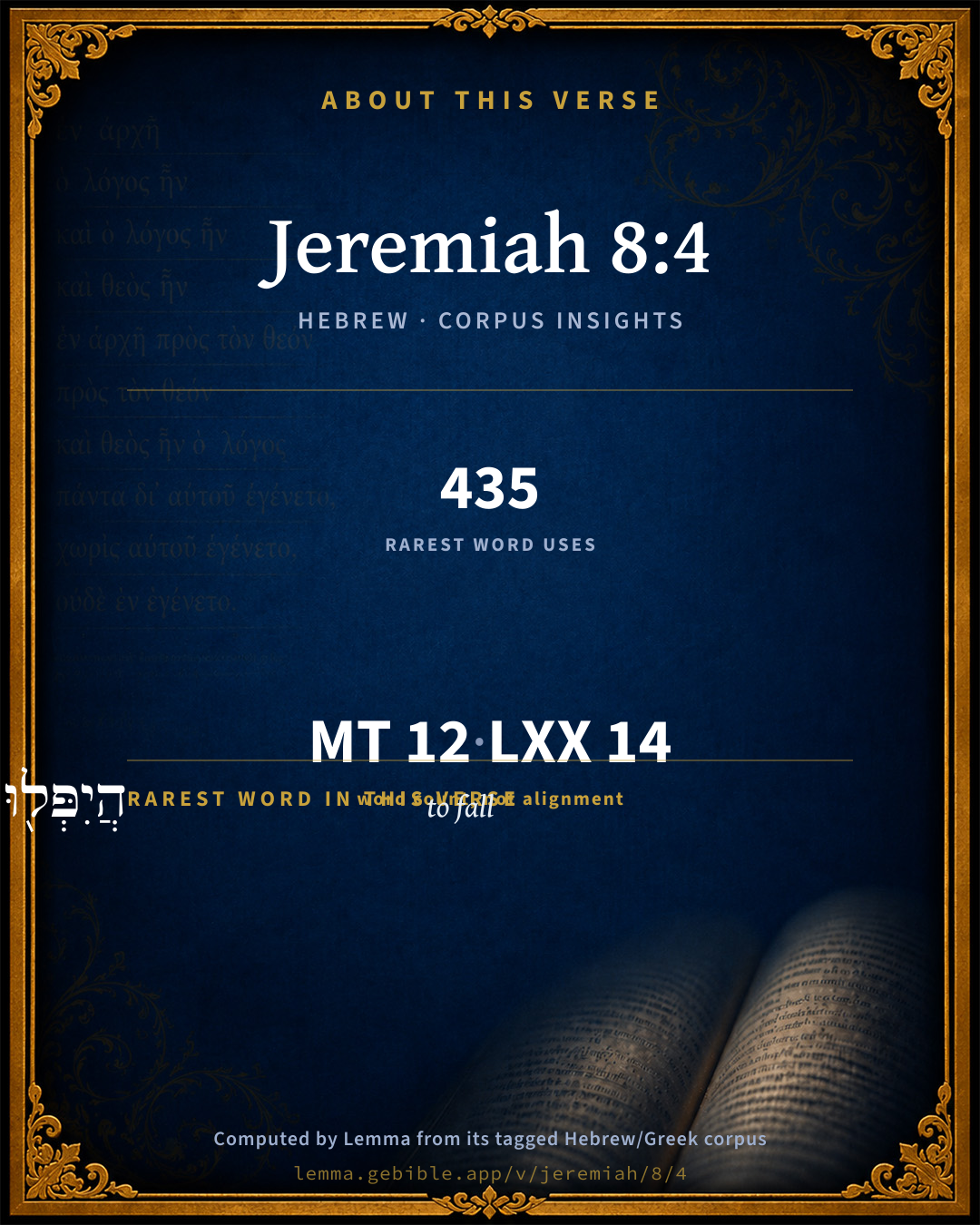
Hebrew & Septuagint length

In the original languages it is 12 Hebrew tokens and 14 Greek tokens — but the two are counted differently (Hebrew bundles its prefixes and suffixes into one token; the Greek is in lemma form), so that isn’t a like-for-like length.

Cross-references

15

Topical passages linked to Jeremiah 8:4 in the Treasury of Scripture Knowledge — connected by theme and wording, ordered by reader-vote popularity; previews shown in the World English Bible.

  • Proverbs 24:16 For a righteous man falls seven times, and rises up again; But the wicked are overthrown by calamity.
  • Hosea 6:1 "Come, and let us return to Yahweh; For he has torn us to pieces, And he will heal us; He has injured us, And he will bind up our wounds.
  • Micah 7:8 Don't rejoice against me, my enemy. When I fall, I will arise. When I sit in darkness, Yahweh will be a light to me.
  • Isaiah 55:7 let the wicked forsake his way, and the unrighteous man his thoughts; and let him return to Yahweh, and he will have mercy on him; and to our God, for he will abundantly pardon.
  • Jeremiah 3:1 They say, If a man put away his wife, and she go from him, and become another man's, will he return to her again? Won't that land be greatly polluted? But you have played the prostitute with many lovers; yet return again to me, says Yahweh.
  • 1 Kings 8:38 whatever prayer and supplication be made by any man, [or] by all your people Israel, who shall know every man the plague of his own heart, and spread forth his hands toward this house:
  • Isaiah 44:22 I have blotted out, as a thick cloud, your transgressions, and, as a cloud, your sins: return to me; for I have redeemed you.
  • Ezekiel 18:23 Have I any pleasure in the death of the wicked? says the Lord Yahweh; and not rather that he should return from his way, and live?
  • Hosea 7:10 The pride of Israel testifies to his face; Yet they haven't returned to Yahweh their God, Nor sought him, for all this.
  • Hosea 14:1 Israel, return to Yahweh your God; For you have fallen because of your sin.
  • Amos 5:2 "The virgin of Israel has fallen; She shall rise no more. She is cast down on her land; There is no one to raise her up."
  • Jeremiah 23:14 In the prophets of Jerusalem also I have seen a horrible thing: they commit adultery, and walk in lies; and they strengthen the hands of evil-doers, so that none does return from his wickedness: they are all of them become to me as Sodom, and the inhabitants of it as Gomorrah.
  • Jeremiah 36:3 It may be that the house of Judah will hear all the evil which I purpose to do to them; that they may return every man from his evil way; that I may forgive their iniquity and their sin.
  • Jeremiah 3:22 Return, you backsliding children, I will heal your backsliding. Behold, we are come to you; for you are Yahweh our God.
  • Jeremiah 4:1 If you will return, Israel, says Yahweh, if you will return to me, and if you will put away your abominations out of my sight; then you shall not be removed;

Cross-references courtesy of OpenBible.info (CC BY 4.0).

Hebrew and Greek witnesses Masoretic Hebrew ↔ Greek Septuagint

The same verse in the two great witnesses to the Old Testament, shown verse-for-verse.

These are two independent witnesses, not word-aligned to each other, and the Septuagint is shown in lemma (dictionary) form.

Hebrew Jeremiah 8:4 Masoretic · Westminster Leningrad Codex

וְאָמַרְתָּ֣ אֲלֵיהֶ֗ם כֹּ֚ה אָמַ֣ר יְהוָ֔ה הֲיִפְּל֖וּ וְלֹ֣א יָק֑וּמוּ אִם יָשׁ֖וּב וְלֹ֥א יָשֽׁוּב

Moreover you shall tell them, Thus says Yahweh: Shall men fall, and not rise up again? Shall one turn away, and not return?

World English Bible · Public Domain

Greek LXX Structure differs

In the Septuagint, Jeremiah is about an eighth shorter than the Hebrew and arranges its material differently — the Oracles Against the Nations (Hebrew chapters 46–51) appear in the middle of the Greek book, after 25:13. Because the chapter and verse boundaries do not line up, a verse-for-verse comparison with the Hebrew is not shown.

A verse-for-verse comparison isn’t shown here because the chapters and verses don’t line up. Switch to the LXX edition with the MT / LXX toggle above to read the Greek directly.

On this verse, Keil & Delitzsch discusses the Septuagint’s reading. Read the note in Commentary ↓

Hebrew: Westminster Leningrad Codex (CC BY 4.0). Greek: Septuagint (public domain); English from a public-domain English Septuagint. How the Septuagint differs from the Hebrew →

Targum (Aramaic paraphrase)

1

The Targum is the ancient Jewish Aramaic paraphrase of the Hebrew Scriptures — an interpretive translation, not the Hebrew text itself. Onkelos (literal) and Pseudo-Jonathan (expansive) render the Torah, and Jonathan the Prophets. Coverage is partial: where no permissively-licensed English translation exists for a verse, only the Aramaic is shown. This is verse-level text, not a word-by-word alignment to the Hebrew.

  1. Targum Jonathan Prophets (Joshua–Malachi)
    וְתֵימַר לְהוֹן כִּדְנַן אֲמַר יְיָ הֲיִפְּלוּן וְלָא יְקוּמוֹן אִם לְמֵיתַב גְלֵי קָדָמַי דְלָא יְתוּבוּן:

    (no public-domain English translation for this verse)

    Targum Jonathan — Aramaic: “Mikraot Gedolot” (public domain). English: “Sefaria Community Translation” (CC0 1.0 (public-domain dedication)); “London "Chaldee Paraphrase," 1871” (public domain). Text via Sefaria.

Commentary

Notes on Jeremiah 8:4 from classic Christian and Jewish commentators (each source and its license shown beneath its notes). The classic Christian expositions comment on the surrounding passage and are grouped to its opening verse, so a note may address several verses; the Jewish commentaries on the Tanakh (Rashi and others) are per-verse, so they appear only where the commentator wrote on this verse.

Lemma curates 59 commentaries, every one of them public domain or Creative Commons licensed, each selected and text-cleaned for this edition rather than reprinted as found. About our sources →

Matthew Henry's Commentary

The prophet here is instructed to set before this people the folly of their impenitence, which was it that brought this ruin upon them. They are here represented as the most stupid senseless people in the world, that would not be made wise by all the methods that Infinite Wisdom took to bring them to themselves and their right mind, and so to prevent the ruin that was coming upon them.

I. They would not attend to the dictates of reason. They would not act in the affairs of their souls with the same common prudence with which they acted in other things. Sinners would become saints if they would but show themselves men, and religion would soon rule them if right reason might. Observe it here. Come, and let us reason together, saith the Lord (Jer 8:4, Jer 8:5): Shall men fall and not arise? If men happen to fall to the ground, to fall into the dirt, will they not get up again as fast as they can? They are not such fools as to lie still when they are down. Shall a man turn aside out of the right way? Yes, the most careful traveller may miss his way; but then, as soon as he is aware of it, will he not return? Yes, certainly he will, with all speed, and will thank him that showed him his mistake. Thus men do in other things. Why then has this people of Jerusalem slidden back by a perpetual backsliding? Why do not they, when they have fallen into sin, hasten to get up again by repentance? Why do not they, when they see they have missed their way, correct their error and reform? No man in his wits will go on in a way that he knows will never bring him to his journey's end; why then has this people slidden back by a perpetual backsliding? See the nature of sin - it is a backsliding it is going back from the right way, not only into a by-path, but into a contrary path, back from the way that leads to life to that which leads to utter destruction. And this backsliding, if almighty grace do not interpose to prevent it, will be a perpetual backsliding. The sinner not only wanders endlessly, but proceeds end-ways towards ruin. The same subtlety of the tempter that brings men to sin holds them fast in it, and they contribute to their own captivity: They hold fast deceit. Sin is a great cheat, and they hold it fast; they love it dearly, and resolve to stick to it, and baffle all the methods God takes to separate between them and their sins. The excuses they make for their sins are deceits, and so are all their hopes of impunity; yet they hold fast these, and will not be undeceived, and therefore they refuse to return. Note, There is some deceit or other which those hold fast that go on wilfully in sinful ways, some lie in their right hand, by which they keep hold of their sins.

II. They would not attend to the dictates of conscience, which is our reason reflecting upon ourselves and our own actions, Jer 8:6. Observe, 1. What expectations there were from them, that they would bethink themselves: I hearkened and heard. The prophet listened to see what effect his preaching had upon them; God himself listened, as one that desires not the death of sinners, that would have been glad to hear any thing that promised repentance, that would certainly have heard it if there had been any thing said of that tendency, and would soon have answered it with comfort, as he did David when he said, I will confess, Psa 32:5. God looks upon men when they have done amiss (Job 33:27), to see what they will do next; he hearkens and hears. 2. How these expectations were disappointed: They spoke not aright, as I thought they would have done. They did not only not do right, but not so much as speak right; God could not get a good word from them, nothing on which to ground any favour to them or hopes concerning them. There was none of them that spoke aright, none that repented him of his wickedness. those that have sinned then, and then only, speak aright when they speak of repenting; and it is sad when those that have made so much work for repentance do not say a word of repenting. Not only did God not find any repenting of the national wickedness, which might have helped to empty the measure of public guilt, but none repented of that particular wickedness which he knew himself guilty of. (1.) They did not so much as take the first step towards repentance; they did not so much as say, What have I done? There was no motion towards it, not the least sign or token of it. Note, True repentance beings in a serious and impartial inquiry into ourselves, what have we done, arising from a conviction that we have done amiss. (2.) They were so far from repenting of their sins that they went on resolutely in their sins: Every one turned to his course, his wicked course, that course of sin which he had chosen and accustomed himself to, as the horse rushes into the battle, eager upon action, and scorning to be curbed. How the horse rushes into the battle is elegantly described, Job 39:21, etc. He mocks at fear and is not affrighted. Thus the daring sinner laughs at the threatenings of the word as bugbears, and runs violently upon the instruments of death and slaughter, and nothing will be restrained from him.

III. They would not attend to the dictates of providence, nor understand the voice of God in them, Jer 8:7. It is an instance of their sottishness that, though they are God's people, and therefore should readily understand his mind upon every intimation of it, yet they know not the judgment of the Lord; they apprehend not the meaning either of a mercy or an affliction, not how to accommodate themselves to either, nor to answer God's intention in either. They know not how to improve the seasons of grave that God affords them when he sends them his prophets, nor how to make use of the rebukes they are under when his voice cries in the city. They discern not the signs of the times (Mat 16:3), nor are aware how God is dealing with them. They know not that way of duty which God had prescribed them, though it be written both in their hearts and in their books. 2. It is an aggravation of their sottishness that there is so much sagacity in the inferior creatures. The stork in the heaven knows her appointed times of coming and continuing; so do other season-birds, the turtle, the crane, and the swallow. These by a natural instinct change their quarters, as the temper of the air alters; they come when the spring comes, and go, we know not whither, when the winter approaches, probably into warmer climates, as some birds come with winter and go when that is over.

IV. They would not attend to the dictates of the written word. They say, We are wise; but how can they say so? Jer 8:8. With what face can they pretend to any thing of wisdom, when they do not understand themselves so well as the brute-creatures? Why, truly, they think they are wise because the law of the Lord is with them, the book of the law and the interpreters of it; and their neighbours, for the same reason, conclude they are wise, Deu 4:6. But their pretensions are groundless for all this: Lo, certainly in vain made he it; surely never any people had Bibles to so little purpose as they have. They might as well have been without the law, unless they had made a better use of it. God has indeed made it able to make men wise to salvation, but as to them it is made so in vain, for they are never the wiser for it: The pen of the scribes, of those that first wrote the law and of those that now write expositions of it, is in vain. Both the favour of their God and the labour of their scribes are lost upon them; they receive the grace of God therein in vain. Note, There are many that enjoy abundance of the means of grace, that have great plenty of Bibles and ministers, but they have them in vain; they do not answer the end of their having them. But it might be said, They have some wise men among them, to whom the law and the pen of the scribes are not in vain. To this it is answered (Jer 8:9): The wise men are ashamed, that is, they have reasons to be so, that they have not made a better use of their wisdom, and lived more up to it. They are confounded and taken; all their wisdom has not served to keep them from those courses that tend to their ruin. They are taken in the same snares that others of their neighbours, who have not pretended to so much wisdom, are taken in, and filled with the same confusion. Those that have more knowledge than others, and yet do no better than others for their own souls, have reason to be ashamed. They talk of their wisdom, but, Lo, they have rejected the word of the Lord; they would not be governed by it, would not follow its direction, would not do what they knew; and then what wisdom is in them? None to any purpose; none that will be found to their praise at the great day, how much soever it is found to their pride now. The pretenders to wisdom, who said, "We are wise and the law of the Lord is with us," were the priests and the false prophets; with them the prophet here deals plainly. 1. He threatens the judgments of God against them. Their families and estates shall be ruined (Jer 8:10): Their wives shall be given to others, when they are taken captives, and their fields. shall be taken from them by their victorious enemy and shall be given to those that shall inherit them, not only strip them for once, but take possession of them as their own and acquire a property in them as their own and acquire a property in them, which they shall transmit to their posterity. And (Jer 8:12), notwithstanding all their pretensions to wisdom and sanctity, they shall fall among those that fall; for, if the blind lead the blind, both shall fall together into the ditch. In the time of their visitation, when the wickedness of the land comes to be enquired into, it will be found that they have contributed to it more than any, and therefore they shall be sure to be cast down and cast out. 2. He gives a reason for these judgments (Jer 8:10-12), even the same account of their badness which we meet with before (Jer 6:13-15), where it was opened at large. (1.) They were greedy of the wealth of this world, which is bad enough in any, but worst in prophets and priests, who should be best acquainted with another world and therefore should be most dead to this. But these, from the least to the greatest, were given to covetousness. The priests teach for hire and the prophets divine for money, Mic 3:11. (2.) They made no conscience of speaking truth, no, not when they spoke as priests and prophets: Every one deals falsely, looks one way and rows another. There is no such thing as sincerity among them. (3.) They flattered people in their sins, and so flattered them into destruction. They pretended to be the physicians of the state, but knew not how to apply proper remedies to its growing maladies; they healed them slightly, killed the patient with palliative cures, silencing their fears and complaints with, "Peace, peace, all is well, and there is no danger," when the God of heaven was proceeding in his controversy with them, so that there could be no peace to them. (4.) When it was made to appear how basely they prevaricated they were not at all ashamed of it, but rather gloried in it, (Jer 8:12): They could not blush, so perfectly lost were they to all sense of virtue and honour. When they were convicted of the grossest forgeries they would justify what they had done, and laugh at those whom they had imposed upon. Such as these were ripe for ruin.

Matthew Henry's Commentary on the Whole Bible (1708–1710) — public domain (CC PDM 1.0). Text via the HelloAO Bible API.

Adam Clarke's Commentary

Verse 4. Moreover thou shalt say] Dr. Blayney very properly observes, "In that part of the prophecy which follows next, the difference of speakers requires to be attended to; the transition being quick and sudden, but full of life and energy. The prophet at first, in the name of God, reproves the people's incorrigibility; he charges their wise ones with folly, and threatens them with grievous calamities, Jer 8:4-13. In the three next verses he seems to apostrophize his countrymen in his own person, and as one of the people that dwelt in the open towns, advising those that were in the like situation to retire with him into some of the fortified cities, and there wait the event with patience, since there was nothing but terror abroad, and the noise of the enemy, who had already begun to ravage the country, Jer 8:14-16. God speaks, Jer 8:17, and threatens to bring foes against them that should be irresistible. The prophet appears again in his own person, commiserating the daughter of his people, who is heard bewailing her forlorn case in a distant land; while the voice of God, like that of conscience, breaks in upon her complaints, and shows her that all this ruin is brought upon her by her own infidelities, Jer 8:18-20. The prophet once more resumes his discourse; he regrets that no remedy can be found to close up the wounds of his country, and pathetically weeps over the number of her slain, Jer 8:21; Jer 9:1."

Shall they fall, and not arise? shall he turn away, and not return?] That is, It is as possible for sinners to return from their sin to God, for his grace is ever at hand to assist, as it is for God, who is pouring out his judgments, to return to them on their return to him. But these held fast deceit, and refused to return; they would not be undeceived.

Adam Clarke's Commentary on the Bible (1810–1826) — public domain. Text from a community e-Sword/MySword module.

The Cambridge Bible for Schools and Colleges

gen. ed. J. J. S. Perowne

4. We have had (chs. Jer_7:29 to Jer_8:3) a kind of parenthesis, setting forth the nature of the coming punishment. Jeremiah now returns to the subject of the conduct which has procured it.

Chs. Jer_8:4 to Jer_9:1. Forecast of punishment as the result of sin

The section may be thus summarized.

(i) Jer_8:4-9. Human fortunes and conduct are as a rule liable to change, but Israel pursues a steady course of disobedience. Migratory birds obeying unerringly their instincts compare favourably with the men who have intellect to understand Jehovah’s teaching, yet falsify or ignore it. (ii) Jer_8:10-12. Even prophets and priests are covetous, insincere, foolishly optimistic, and unblushingly wicked. They must suffer the penalty. Their wives and lands shall be given to others. (iii) Jer_8:13-17. They are as a tree without fruit or leaf. It remains only in despair to take refuge within walls. The northern foes’ approach can be already heard. They devastate city and country alike. No charm can avert this serpent-like attack. (iv) Jer_8:18 to Jer_9:1. There sounds from afar the cry of dismay from those who have moved Jehovah to anger. The time for deliverance has gone by. Is there indeed no remedy? No, none. Would that my tears were as limitless as the calamity which calls them forth.

The Cambridge Bible for Schools and Colleges (gen. ed. J. J. S. Perowne; Cambridge University Press, 1878–1918) — public domain. Text from a community e-Sword module.

Trapp's Complete Commentary

John Trapp

Jer 8:4 Moreover thou shalt say unto them, Thus saith the LORD; Shall they fall, and not arise? shall he turn away, and not return?

Ver. 4. Shall they fall, and not arise?] Or, When men fall, will they not arise? Or, Will not one that hath turned aside return? To fall may befall any man; but shall he lie there, and not essay to get up again? To lose his way may be incident to the wisest; but who but a fool would not make haste to get into the right way again Errare humanum est: perseverare, diabolicum. To error is human, to continue erring is devilish. And yet these stubborn Jews refuse to rise or return.

John Trapp, A Commentary or Exposition upon All the Books of the Old and New Testament (1647–1656) — public domain. Text from a community e-Sword module.

The Biblical Illustrator

Joseph S. Exell

Jer_8:4-7

Why then is this people of Jerusalem slidden back by a perpetual backsliding.

A great evil and an urgent question

I. A great evil. Backsliding.

1. It is an evil in its nature; it is a great sin against God, involving the basest ingratitude, the abuse of the greatest mercies, and the violation of the most solemn vows.

2. It is an evil in its influence.

(1) Upon self. It arrests the progress of the soul, darkens its prospects, curtails its liberty, and destroys its usefulness.

(2) Upon others. It encourages the religious sceptic, it staggers the anxious inquirer, it embarrasses the friends of truth.

II. An urgent question. Why?

1. Not by the force of circumstances over which they have no control. No power in the universe drives them back against their will.

2. Not by the withdrawal of heavens helping agency.

3. The causes are in themselves. Neglect of the means of spiritual improvement, the study of the Scriptures, and the ministry of the Word; the cherishing of some secret sin; engrossment in worldly pursuits; fellowship with sceptical and ungodly men. (Homilist.)

Backsliding tendencies

The tendency to the lukewarmness of spiritual life is in us all. Take a bar of iron out of the furnace on a winter day, and lay it down in the air, and there is nothing more wanted. Leave it there, and very soon the white heat will change into livid dulness, and then there will come a scale over it, and in a short time it will be as cold as the frosty atmosphere around it. And so there is always a refrigerating process acting upon us which needs to be counteracted by continual contact with the fiery furnace of spiritual warmth, or else we are cooled down to the degree of cold around us. (A. Maclaren.)

To the backslider

I. The causes of backsliding.

1. The fear of man.

2. Inter course with worldly society.

3. Presumption.

4. Secret sin.

5. Neglect of prayer.

II. The symptoms of backsliding.

1. The absence of pleasure in attending to the secret exercises of religion.

2. Irregular and unprofitable attendance on public ordinances.

3. Unwillingness to act or suffer for the honour of Christ.

4. Uncharitable feelings toward fellow Christians.

5. Indulgence in sins once abandoned.

III. The forms of backsliding.

1. Declension into error.

2. Declension into unbelief.

3. Declension into lukewarmness, or want of love.

4. Declension into prayerlessness.

5. Declension into immorality.

6. Declension into open rejection of a Christian profession.

IV. The evils of backsliding.

V. The cure of backsliding.

1. Let the backslider remember from whence he has fallen.

2. Let the backslider reflect on his guilt and danger.

3. Let the backslider return to God, from whom he has wandered.

4. Let the backslider live near to Christ.

5. Let the backslider forsake the sin into which he has fallen.

6. Let the backslider learn to depend on the promised aid of the Holy Spirit. (G. Brooks.)

National degeneracy

I. What denominates a religious people. The Jews were a religious people in distinction from all other nations who were given to superstition and idolatry. They professed to believe the existence of the only living and true God. All the nations at this day, who profess to believe the truth of Christianity, and who observe the public worship of God and the ordinances of the Gospel, are called religious nations, though the great majority may be totally destitute of vital piety. It is the explicit profession and external conduct of a people that give them their religious character.

II. When a religious people may be said to be a backsliding clue. Grace, in the present state, does not entirely destroy nature. Large measures of moral corruption remain in the hearts of the best of men in the most religious nations. So, every people, who profess to believe the Gospel and live under its influence, have something in them that dislikes the character, the laws, and the government of God. On this account they are bent to backsliding from Him. Among every religious people there is a great, if not the greatest part of them, who are under only the restraining, and not the sanctifying, influence of the Gospel. It is when they break over such restraints as ought to keep them from backsliding from Him; and they are perpetually backsliding, while they are constantly breaking over one restraint after another.

1. They break over the restraints of His goodness. He promised to make them the most numerous, the most wealthy, and the most respectable nation on earth.

2. A religious people who are perpetually backsliding grow worse and worse under the restraint of Divine authority. He gave His peculiar people His judgments, His statutes, and His laws, which were far superior to those of any other nation. There was another way by which God often laid a restraint upon His backsliding people, and that was by His rod of correction; but they often broke over this restraint, and persisted in their wicked ways.

3. A perpetually backsliding people will hold fast deceit, and refuse to return to God from whom they have revolted, even under the severest tokens of His wrath.

III. Why a backsliding people will persist in backsliding. This is owing to some great delusion.

1. They delude themselves by backsliding very gradually. They first forget the goodness of God in one smaller favour, and then in another; and this leads them to forget God in greater and greater favours, until Divine goodness loses all its restraining influence over them. In the same imperceptible manner they break over all the restraints of Divine authority and of Divine corrections. Such a gradual backsliding becomes more and more habitual, and, of course, more and more insensible. Every backslider always feels self-condemned for the first instances of his deviation from the path of duty. But one deviation naturally leads to another, and serves to palliate it, till self-regret and self-reproach cease to operate, and men feel as easy and innocent in their gradual declensions as they did before they began to backslide; and, like Ephraim, while they have grey hairs here and there upon them, they know it not.

2. All backsliding consists in mens walking in the ways of their hearts, instead of walking in the ways of Gods commandments. They backslide because they love to backslide; and what they love, they endeavour to persuade themselves is right. If they are reproved, they will justify rather than condemn their backsliding.

3. Backsliders are more or less under the blinding and deluding influence of the great adversary of souls. He is now deluding all the heathen world, and insensibly involving them in fatal darkness, and leading them blindly to destruction. And he is more or less concerned in spreading errors and delusions in all the Christian world, who love and hold fast deceit.

Improvement--

1. It appears from the description of a religious people which has been given in this discourse, that we in this country deserve that character.

2. If we have given a just description of a perpetually backsliding people, that character justly belongs to us.

3. It appears from what has been said, that our national sins are very great and aggravated. They are of the nature of backsliding, which greatly enhances their criminality. Backsliding is not a sin of ignorance, but a sin of knowledge. Our national vices, immoralities, and errors, have been commited against greater light and stronger restraints than those of any other nation.

4. It appears from what has been said, that no external means nor motives will reform a backsliding people. They backslide so gradually and insensibly, and are so fond of their backslidings, and are under such a powerful influence of the great deceiver, that they will hold fast deceit, and refuse to repent, return, and reform. Their perpetual backsliding is perpetually stupefying their hearts and consciences; for they feel no guilt and fear no danger. They are certainly out of the reach of men and means to save them from ruin. Hence,

5. This people have abundant occasion for fasting, humiliation, and prayer. Their situation is extremely critical and dangerous, and every way adapted to affect every benevolent heart. It is the imperious duty of all the Noahs, Jobs, and Daniels to arise and plead with God to take His own work into His own hands, and bow the hearts of this people to Himself. (N. Emmons, D. D.)

They refused to return.--

Mans backwardness to repent

1. God reasons with us from what we do in other cases. Shall they fall, etc. (Jer_8:4). He makes us judges in our own cause. If a man slips and gets a fall, does he lie where he fell, without making any attempt to get up again? Why, then, God saith, doth this people what no others do? Why do they fall, and rise not? stray, and return not? Despair of pardon leads many to continue in sin. But is there cause for this despair? Is it God that is unwilling? No; they refused to return. The Lord, as it were, saith, How often would I have gathered them together, and they would not! My outward calling you by the Word, My inward moving by me Spirit, My many benefits, My gentle chastisements, My long-suffering--all show, that I was willing for your return.

2. God reasons with us from His own anxious desire. He represents Himself to us as hearkening with patient, attentive ear, if He may catch from us the words of repentance. And what does God expect to hear from us? What have I done? These words, said not with the lips only, but from the deep feelings of the heart, may lead to better things. How vile was the act of sin in itself! how full is it of shame and remorse! What have I done, as in the sight of God, so fearful in power, so glorious in majesty? What have I done as for any profit derived, any passing, empty pleasure? How have I injured my body and my soul!

3. God sends us to the birds of the sky; to creatures without reason, that we, reasonable beings, may learn our duty from them. Yea, the stork, etc. These birds have an appointed time for coming back; they know and observe it. There is an accepted time, if we would know it; if, like the birds, we would observe, and take it; and the Scripture tells us, that that time is now. (E. Blencowe, M. A.)

The Biblical Illustrator, edited by Joseph S. Exell (c. 1880s–1900s) — public domain. Text from a community e-Sword module.

Joseph Benson's Commentary

Jer 8:4-6. Moreover, thou shalt say, &c. — The prophet is here directed to set before the Jews the unreasonableness and folly of their impenitence, which was the thing that brought this ruin upon them. And he represents them as the most stupid and senseless people in the world, that would not be made wise by any of the methods which infinite wisdom took to bring them to a right mind. Thus saith the Lord, Shall they fall and not arise? — If men happen to make a false step and fall to the ground, do they not endeavour immediately to rise again? Shall he — Shall any traveller; turn away — Namely, out of his right road, and not return into it when he is informed of his error? Why then is this people slidden back by a perpetual backsliding? — Having fallen into sin, why do they not endeavour to rise again by repentance? Having missed their way, and being clearly shown that they have, why to they not correct their error and return into it? It is “an expostulation,” says Lowth, “implying that men are seldom so far gone in wickedness as not to be touched with some remorse for their evil doings, and make some general resolutions of amendment:” but the Jews were “guilty of one perpetual apostacy, as if they could deceive God by their hypocritical pretences, without taking any steps toward a reformation.” They hold fast deceit, they refuse to return — They have turned aside into a false way, a way in which they promise themselves prosperity, but which will bring them to ruin; their error is demonstrated to them, and yet they refuse to relinquish it: they hold it fast, and proceed forward to destruction. I hearkened and heard, &c. — These also are the words of God, expressing himself after the manner of men, who are wont to look and listen diligently after the things they are very desirous of. Thus God represents himself as waiting and looking continually to see marks of the people’s repentance, that he might show them mercy, and avert his threatened judgments. But they spake not aright — I neither heard a word nor saw an action which manifested any sorrow for their apostacy, or any inclination to return to their duty and allegiance. No man repented him, saying, What have I done? — None of them did so much as take the first step toward repentance; they did not even examine into their conduct, and call themselves to an account for their actions. Every one turned to his course, &c. — Proceeded on in his accustomed way, committing all wickedness without restraint.

Joseph Benson's Commentary on the Old and New Testaments (1811–1818) — public domain. Text from a community e-Sword module.

Whedon's Commentary on the Bible

Daniel D. Whedon

IMPENITENCE AND PUNISHMENT, Jer_8:4-12.

4. Shall they fall, etc. — Better, Do men fall and not rise? etc., the expression being impersonal. If men fall, they do not continue lying on the ground. If a man loses his way, he does not persist in going on, but turns about to retrace his steps. Here commences the second division of this discourse, in which the prophet sets forth the obstinacy of the people in wickedness and the fearfulness of their judgment.

Daniel D. Whedon (gen. ed.), Commentary on the Old and New Testaments (1874–1909) — public domain. Text from a community e-Sword module.

Keil & Delitzsch

C. F. Keil & F. Delitzsch

The People's Obstinacy in Wickedness, and the Dreadfulness of the Judgment. - Since the people cleaves stedfastly to its sin (Jer 8:4-13), the Lord must punish sorely (Jer 8:14 -23). - Jer 8:4-13. "And say to them, Thus hath the Lord said: Doth one fall, and not rise again? or doth one turn away, and not turn back again? Jer 8:5. Why doth this people of Jerusalem turn itself away with a perpetual turning? They hold fast by deceit, they refuse to return. Jer 8:6. I listened and heard: they speak not aright; no one repenteth him of his wickedness, saying, What have I done? They all turn to their course again, like a horse rushing into the battle. Jer 8:7. Yea, the stork in the heaven knoweth her appointed times; and turtle-dove, and swallow, and crane, keep the time of their coming; but my people know not the judgment of Jahveh. Jer 8:8. How can ye say, Wise are we, and the law of Jahve we have? Certainly the lying pen of the scribes hath made it a lie. Jer 8:9. Ashamed the wise men become, confounded and taken; lo, the word of Jahveh they spurn at; and whose wisdom have they? Jer 8:10. Therefore will I give their wives unto others, their fields to new heirs: for from the small to the great, they are all greedy for gain; from the prophet even unto the priest, they all use deceit. Jer 8:11. And they heal the hurt of the daughter of my people as it were a light matter, saying, Peace, peace; and yet there is no peace. Jer 8:12. They have been put to shame because they have done abomination; yet they take not shame to themselves, ashamedness they know not. Therefore they shall fall amongst them that fall: in the time of their visitation they shall stumble, that Jahve said. Jer 8:13. Away, away will I sweep them, saith Jahveh: no grapes on the vine, and no figs on the fig-tree, and the leaf is withered; so I appoint unto them those that shall pass over them."

This strophe connects itself with what precedes. A judgment, dreadful as has been described in Jer 7:32-8:3, will come on Judah, because the people cleaves stiffneckedly to its sins. The ואמרתּ of Jer 8:4 corresponds to that in Jer 7:28. The questioning clauses in Jer 8:4 contain universal truths, which are applied to the people of Judah in Jer 8:5. The subjects to יפּלוּ and ישׁוּב are indefinite, hence singular and plural with like significance: cf. Gesen. 137, 3; Ew. 294, b. The verb ישׁוּב, turn oneself, turn about, is here used in a double sense: first, as turn away from one; and then turn towards him, return again. In the application in Jer 8:5, the Pilel is used for to turn away from, and strengthened by: with perpetual turning away or backsliding. נצּחת is not partic. Niph. fem. from נצח, but an adjectival formation, continual, enduring, from נצח, continuance, durableness. "Jerusalem" belongs to "this people:" this people of Jerusalem; the loose grammatical connection by means of the stat. constr. not being maintained, if the first idea gives a sense intelligible by itself, so that the second noun may then be looked on rather in the light of an apposition conveying additional information; cf. Ew. 290, c. תּרמית, equivalent to מרמה, deceit against God. they refuse to return. Sense: they will not receive the truth, repent and return to God. The same idea is developed in Jer 8:6. The first person: I have listened and heard, Hitz. insists, refers to the prophet, "who is justified as to all he said in Jer 8:5 by what he has seen." But we cannot account that even an "apt" view of the case, which makes the prophet cite his own observations to show that God had not spoken without cause. It is Jahveh that speaks in Jer 8:5; and seeing that Jer 8:6 gives not the slightest hint of any change in the speaker, we are bound to take Jer 8:6 also as spoken by God. Thus, to prove that they cleave unto deceit, Jahveh says that He has given heed to their deeds and habits, and heard how they speak the לוא־כן, the not right, i.e., lies and deceit. The next clause: not one repents him of his wickedness, corresponds to: they refuse to return; cf. Jer 8:5 (נחם is partic.). Instead of this, the whole of it, i.e., all of them, turn again to their course. שׁוּב with ב, construed as in Hos 12:7 : turn oneself to a thing, so as to enter into it. For מרוּצה, the sig. course is certified to by Sa2 18:27. The Chet. מרצותם .tehC e is doubtless merely an error of transcription for מרוּצתם, as is demanded by the Keri. Turn again into their course. The thought is: instead of considering, of becoming repentant, they continue their evil courses. This, too, is substantially what Hitz. gives. Ros., Graf, and others, again, take this in the sense of turning themselves away in their course; but it is not fair to deduce this sense for שׁוּב without מן from Jer 8:4; nor is the addition of "from me" justifiable. Besides, this explanation does not suit the following comparison with the horse. It is against analogy to derive מרצותם from רצה with the sig. desire, cupidity. Ew., following the Chald., adopts this sense both here and in Jer 22:17 and Jer 23:10, though it is not called for in any of these passages, and is unsuitable in Jer 22:17. As a horse rusheth into the battle. שׁטף, pour forth, overflow, hence rush on impetuously; by Jerome rightly translated, cum impetu vadens. Several commentators compare the Latin se effundere (Caes. Bell. Gall. v. 19) and effundi (Liv. xxviii. 7); but the cases are not quite in point, since in both the words are used of the cavalry, and not of the steed by itself. This simile makes way for more in Jer 8:7. Even the fowls under the heaven keep the time of their coming and departure, but Israel takes no concern for the judgment of its God; cf. Isa 1:3. חסידה, (avis) pia, is the stork, not the heron; see on Lev 11:19. "In the heaven" refers to the flight of the stork. All the birds mentioned here are birds of passage. תּור and סוּס are turtle-dove and pigeon. For סוּס the Masoretes read סיס, apparently to distinguish the word from that for horse; and so the oriental Codd. propose to read in Isa 38:14, although they wrote עגוּר .סוּס is the crane (acc. to Saad. and Rashi), both here and in Isa 38:14, where Gesen., Knob., and others, mistaking the asyndeton, take it as an adjective in the sig. sighing.

(Note: Starting from this unproved interpretation of Isa 38:14, and supporting their case from the lxx translation of the present passage, τρυγὼν καὶ χελιδὼν ἀγροῦ στρουθία, Hitz. and Graf argue that עגוּר is not the name of any particular bird, but only a qualifying word to סוּס, in order to distinguish the swallow from the horse, the sense more commonly attached to the same word. But that confused text of the lxx by no means justifies us in supposing that the ו cop. was introduced subsequently into the Heb. text. It is possible that ἁγροῦ is only a corrupt representation of עגוּר, and the στρουθία came into the lxx text in consequence of this corruption. but certainly the fact that the lxx, as also Aquil. and Symm., both here and in Isa 38:14, did not know what to make of the Hebrew word, and so transcribed it in Greek letters, leads us to conclude that these translators permitted themselves to be guided by Isa 38, and omitted here also the copula, which was there omitted before עגוּר.

מועדים are the fixed times for the arrival and departure of the birds of passage.

Keil & Delitzsch — Biblical Commentary on the Old Testament (1861–1891) — public domain (CC PDM 1.0). Text via the HelloAO Bible API. (Old Testament only.)

Tyndale Open Study Notes

Tyndale Open Resources

8:4-17 These three short poems were probably delivered during Jehoiakim’s reign.

8:4-7 These verses itemize the evidence of Judah’s sins. The people had fallen into idolatrous ritual sex and followed the ways of idol worship. They remained in their delusions because their minds and hearts were trapped by lies, a term that is often applied to idols (5:3, 6; 7:24; 9:6; Prov 24:16; Isa 44:20; Amos 5:2; Mic 7:8).

Tyndale Open Study Notes — © Tyndale Open Resources, licensed CC BY-SA 4.0. Text via the HelloAO Bible API.

Geneva Bible (1599)

Geneva Bible translators

Is there no hope that they will return?

Geneva Bible (1599) marginal notes — public domain. Text via Bolls.life.

Jamieson, Fausset & Brown

Robert Jamieson, A. R. Fausset & David Brown

"Is it not a natural instinct, that if one falls, he rises again; if one turns away (that is, wanders from the way), he will return to the point from which he wandered? Why then does not Jerusalem do so?" He plays on the double sense of return; literal and metaphorical (Jer 3:12; Jer 4:1).

Jamieson, Fausset & Brown — Commentary Critical and Explanatory on the Whole Bible (1871) — public domain (CC PDM 1.0). Text via the HelloAO Bible API.

John Calvin's Commentaries

Though God had reminded his Prophet of the event, yet he still invites the Jews to repentance; not that there was any hope of restoring them to a right mind, (for he had said that they were wholly irreclaimable,) but that their perverseness might be less excusable; and it was also his object to afford some relief to the small number of the godly who still remained; for they had not all fallen away into impiety, though the great body of the people had become corrupt. God then, partly to aggravate the sin of the ungodly, and partly to provide for his faithful people, exhorts those to repentance, who were yet wholly intractable. And here we ought to consider that God’s goodness, when abused, brings a much heavier judgment. God does here in a manner contend with the wickedness of his people, by setting before them the hope of pardon, if they repented.

Thou shalt then say to them; that is, “Though I have already testified to thee that thy labor would be in vain, yet thou shalt not give over thy work.” Shall they who have fallen rise again? This sentence is variously explained; the greater part of interpreters confine it to the Jews only, “Shall the Jews who have fallen rise again?” As to the second clause, some give this explanation, “If Israel returns, will not God also return?” that is, from his wrath, or, “Will he not be propitious?” Or, “If Israel turns away, will not God also turn away?” Others understand both parts of the sentence of the people, “If the people have once turned away, will they not yet return to God?” For the verb שוב, shub, has contrary meanings; it means, to fall away, to rebel, to go back; and it means also to return. But after having maturely considered the words and the design of the Prophet, I think it to be a general statement, as though he had said, “When any one falls, he immediately thinks of recovering his fall; when any one deviates from the right course, being warned of his going astray, he immediately looks for the road. This is what is usually done, what then means this so great a stupidity, that the people of Jerusalem do not repent, when yet they ought to have long ago acknowledged their fall and their wanderings?”

John Calvin's Commentaries (1540-1563) — public domain. Text from the Calvin Translation Society English edition (1840s-50s) via the Christian Classics Ethereal Library (ccel.org). Calvin's coverage is partial (roughly two-thirds of the Bible); uncommented books and verses are honest gaps, never fabricated. The 19th-century editor's footnotes and remarks are omitted so the notes are faithfully Calvin's own voice.

Ellicott's Commentary for English Readers

(4) Shall he turn.—Better, as both clauses arc indefinite, Shall men fall and not arise? Shall one turn away and not return? The appeal is made to the common practice of men. Those who fall struggle to their feet again. One who finds that he has lost his way retraces his steps. In its spiritual aspect the words assert the possibility of repentance in all but every case, however desperate it may seem. St. Paul’s question, “Have they stumbled that they should fall?” (Rom_11:11), expresses something of the same belief in the ultimate triumph of the Divine purpose of good. As yet, that purpose, as the next verse shows, seemed to be thwarted.

A Bible Commentary for English Readers, edited by Charles John Ellicott (1878–1897) — public domain. Text from a community e-Sword module.

John Gill's Exposition

Moreover, thou shalt say unto them,.... The Jews, in Jeremiah's time, in order to leave them inexcusable, though the Lord had before assured that they would not hearken to him, Jer 7:27,

thus saith the Lord, shall they fall, and not rise? men, when they fall, endeavour to get up again, and generally they do:

shall he turn away, and not return? when a man turns out of the right way into a wrong one, as soon as he is sensible of his mistake, he returns back; this is usually done among men. This is generally the case in a natural sense, and might be expected in a moral sense; that whereas these people had fallen into sin, they would rise again by repentance; and, having turned from the good ways of God, would soon return again to them.

John Gill's Exposition of the Whole Bible (1746–1763) — public domain (CC PDM 1.0). Text via the HelloAO Bible API.

Albert Barnes' Notes on the Bible

The prophet here resumes from Jer 7:28 the main subject of his prophecy. He again invites the Jews to repentance.

Shall they fall? - The argument is that when men fall, they do not lie upon the ground, but endeavor to get up again: and when a man loses his way, he does not persist in going on, but turns round, and retraces his steps. Israel then will be only following the dictates of comnon sense in desisting from that which she now knows to be her ruin.

Albert Barnes' Notes on the Bible (1834–1885) — public domain. Text from a community e-Sword/MySword module.

Haydock's Catholic Bible Commentary

Again. Why then do not the people strive to repent?

George Leo Haydock (1774–1849), Haydock's Catholic Family Bible and Commentary, 1859 edition — public domain. Excludes Psalms (Douay-Rheims chapter numbering differs from Protestant) and Deuterocanonical books (Catholic canon only).

Matthew Poole's English Annotations

Moreover thou shalt say unto them; though possibly it be all in vain, yet thou shalt keep in thy work.

Shall they fall, and not arise? an interrogation that hath the force of a negative, i.e. surely none. Or, Will men, is there no hope? And are they upon this ground desperate? Or rather, Will men fall, and not arise? Are they such fools, that having fallen by their sins, and been foretold all that is coming, that they will not accept of a remedy? Jer 7:27; Hos 14:1.

Shall he turn away, and not return? a metaphor taken from one that is out of his way; can any imagine that if one tell him of it, and direct him aright, that he will not hearken to him, and turn back? It is even against nature itself for a man not to seek his own good.

Matthew Poole's English Annotations on the Holy Bible (1683–1685) — public domain. Text from a community e-Sword/MySword module.

The Pulpit Commentary

Ver. 4-Jer_7:2, Jer_7:28. Shall they fall, etc.? rather, Do men fall... doth a man turn away? One of those appeals to common sense in which the prophets delight. Who ever sees a fallen man stay quietly on the ground without attempting to rise? or a man who has wandered out of the path persist in going in the wrong direction?

Vers. 4-6. Persistent depravity.

I PERSISTENT DEPRAVITY MUST BE DISTINGUISHED FROM A CASUAL LAPSE INTO SIN.

1. This is marked by a constant habit of sin, a falling without rising again. The best man is often guilty of mistakes, but he soon seeks to recover himself. (Psa_37:24) His habit is upright, the direction he follows on the whole, though now and then he may lose ground for a short time, is right. But the man who is persistently depraved makes the wrong way his main course, and if he ever deviates from it does so accidentally or only under some temporary impulse, soon returning as by instinct to wallow in the mire, where only he feels at home. (2Pe_2:22)

2. This is characterized by absence of repentance after sinning. No man is heard to repent (Ver. 6). After a good man has fallen into sin he is overwhelmed with shame, plunged into dark depths of grief, tortured with bitter pangs of contrition, like Peter when he "went out and wept bitterly." But the persistently depraved man feels no such distresses. The sun shines as brightly after he has contracted a new crime as before. His serene self-complacency is not ruffled by one spasm of inward revulsion.

3. This is characterized by an impetuous impulse to sin. A good man may fall into sin. One who is persistently depraved rushes into it. To the former sin comes as defeat after a battle in which his better nature has fought and failed; to the latter it comes unresisted, welcomed: he "returneth to his course" with eagerness, "as the horse rusheth into the battle.

II PERSISTENT DEPRAVITY IS FAR MORE CULPABLE THAN A CASUAL LAPSE INTO sin. All sin is culpable. Sin cannot be entirely accidental in any case, or it would cease to be sin. But persistent sin is by far the most evil form of sin.

1. A casual fall may be induced by powerful external temptation; persistent depravity must rise from an internal appetite.

2. A casual fall may come as a sudden surprise when a man is off his guard; persistent depravity must be clearly perceived and consciously cherished.

3. A casual fall may be the result of a sudden outburst of passion which results in something approaching temporary insanity; persistent depravity must be calm and cold-blooded, standing the test of reflection. This is altogether beyond what could be anticipated. You are not surprised that a man should stumble occasionally in the darkness of this world, amidst the snares and pitfalls of temptation, with the natural weakness of humanity, or that he should sometimes miss his way or be lured aside from the right road to pleasanter paths; but that he should not care to rise after falling, not think of returning when he sees the error of his way, but should keep to it with a consistency which would be heroic in a better course, such depravity is unnatural and monstrous.

HOMILIES BY A.F. MUIR Vers. 4-7. Apostasy an anomalous and incalculable thing.

I THE ANALOGIES Or COMMON SENSE AND INSTINCT ARE FALSIFIED. (Vers. 4-6.) If a man fall, he will rise again to his feet; if he has made a mistake or gone in a wrong direction, and discovers it, he will turn again, unless he be absolutely bereft of his senses. One might expect similar behavior in spiritual matters. But in the wickedness and defection of Israel it was not so; their apostasy seemed perpetual. The migratory birds are taught by instinct when to return. The season of their coming again is almost as calculable as that of their going. But the departure of the sinner is incomprehensible, and his return cannot with certainty be expected. Nay, the likelihood is he will continue in his sin, and pursue his own destruction to the hitter end. In this, as in many other instances, the career of the sinner can only be explained on the score of infatuation. His moral sense is perverted or destroyed. In place of that quick response which conscience ought to make to the voice of duty, there comes over his spirit an insensibility to moral considerations, and a growing ignorance of things Divine gradually deepening into outer darkness.

II IT IS UNMOVED BY THE CONSIDERATIONS THAT OUGHT TO AFFECT IT. (Ver. 5) The growing misery and unhappiness which it occasions are not strong enough to check the tendency to sin, if indeed their connection with it is clearly perceived or acknowledged. The cravings of the spiritual nature have to give place to "the lust of the flesh, the lust of the eye, and the pride of life." By-and-by they are stilled, not by being satisfied, but by being stifled; and a curious heedlessness, which is deaf to all the voices of prophetic warning and entreaty, increasingly characterizes it. Under such circumstances it is difficult to discover any common point of contact or argument that shall be valid to both parties. When reason is left behind, it is not to higher, but to lower, susceptibilities that appeal has to be made.

III THE CONCERN, THE CLAIMS, AND THE GRACIOUS PROVISION OF GOD ARE AS NOTHING. (Ver. 6) The saint in the times of his calamity calls upon God to incline his ear. In the fearful condition and moral insensibility of his people to Shelf wickedness and danger God is represented as of himself inclining his ear and listening attentively for the lightest sigh of repentance. He calls, but no notice is taken. The means of salvation he has provided are neglected, or abused. The form of godliness is cultivated when the spirit has fled and the exercises of religion are the chief foes to its reality. What can be the conclusion to all this? They are spiritually dead. There is neither power nor inclination to seek for better things. Nothing but supernatural grace and long-suffering love can avail to save them. M.

Vers. 4-11. Backsliding in its worst forms.

All departures from God are evil, but some are only temporary, and are quickly followed by repentance, return, and restoration. There are others, however, of a far more serious kind, and we have in these verses a great deal told us concerning them. We are told of some of

I THEIR CHARACTERISTICS.

1. So contrary to men"s wonted ways. For when men find that they have brought evil on themselves, they will at once seek to undo such evil (Ver. 4). If a man fall, he win not lie still in the mire or in the road, but will get up again as speedily as may be. If he have mistaken his path and got on a wrong track, wilt he not, as soon as he discovers his mistake, quickly retrace his steps that he may get into the right way? That is how men act in the common affairs of life. But, though Judah and Jerusalem knew well that they had fallen, yet they showed no desire to rise, and though they could not but know they were altogether out of the right way, they showed no willingness to return.

2. Resists the strivings of God"s Spirit and all his drawings of them to himself. Ver. 7 implies such God-implanted instincts in men"s souls, but declares that, unlike the ever-obedient birds, man resists and refuses the call of God.

3. Becomes shameless. (Jer_6:12) This feature we have had noticed before; (cf. Jer_6:15) it arrested the prophet"s attention as being evil exceedingly.

4. Determined and defiant. (Ver. 6)

5. Is at last perpetual. (Ver. 5) They have gone into an evil way, and they abide in that way, no power of Divine grace being able to draw them therefrom. So terrible is this worst form of backsliding, it is perpetual.

II THEIR CONSEQUENCES. The evil fruit such sin bears is shown here.

1. Deep sorrow to the heart of God. How pathetic is this lament] How it echoes the anguish of those words, "How shall I give thee up!" "How often would I have gathered thee!" etc.! Such is the tone of these (Vers. 4-8). The Divine grief is audible through every part.

2. Shame to the backsliders themselves. (Ver. 9) It is ever so. These chapters have been giving illustration upon illustration of this result. And our own observation and the experience of all who have turned from God to sin all alike confirm what God"s Word has said.

3. Utter and absolute ruin. (Ver. 10) The dreadful sorrows of the vanquished in beholding their most beloved ones torn from them to a fate worse than death, and their lands which they had inherited from their fathers taken possession of by their conquerors, these common incidents of war are cited as illustrative of the utter ruin which would come upon these ungodly ones. And evermore will men find it an exceeding bitter thing to depart from the living God. We are also shown some of

III THEIR CAUSES.

1. Deception. Ver. 5, "They hold fast deceit." How many are the falsities by which men are deceived, and to which they hold fast as if they were sure facts on which their souls might rest. (cf. Vers. 8, 11; 7:4, 8)

2. Dislike of God"s ways. "They refuse to return." They had no desire to detect the falsity of their trust; they were glad to have any excuse for refusal.

3. Strong preference for the world"s ways. Ver. 10, "Every one... given to covetousness." The ways of God suffered not such worldliness, but the ways they had chosen gave free permission. Here is ever the secret of departure from God. But can nothing be done? "Is there no balm in Gilead?" (ver. 22). Note, then

IV THEIR CURE. How shall this evil spirit be cast out and the right spirit be restored? In Ver. 6 the process is shown to us. There is:

1. Realization of the results of our sin. The backslider is represented as contemplating with dismay the awful consequences of his sin, and asking, "What have I done?" It is "the conviction of sin" which is the beginning work of God"s Spirit in the sinner"s heart. See the prodigal contemplating the ruin he had brought upon himself. This was the first step in his "coming to himself.

2. Repentance of our wickedness. (Ver. 6) Not general repentance, but each man seeing his own wickedness and repenting of that. The man has come to look on it as God looks on it. Formerly he loved his sin, now he hates it. One element of our Savior"s atonement was this, that he in our nature and as our representative, looked upon our sin as God looked on it, and so offered to God for us a true repentance. We, however contrite in heart, could offer none such, for as it has been truly said, "Our very repentance needs to be repented of, and our tears washed in the blood of Christ." But this element of all true atonement that he who makes such atonement looks on the wrong done as he who has been wronged looks on it was present in Christ"s atonement, and is one reason wherefore "the blood of Christ cleanseth from all sin.

3. Confession. This is the "speaking aright" which is told of in Ver. 6. They had been denying, excusing, maintaining their sin heretofore, anything but speaking aright about it; but now there is heard the right language of confession: "I have sinned.

4. Practical turning from the evil way. As before each had turned determinedly to his own self-chosen course (Ver. 6), now they would turn from it. Such is the way of the backslider"s return and restoration, a way up which there is no smooth easy sliding as there was down, but in which every step has to be firmly made and resolutely kept to a way difficult indeed, but, blessed be God, not impossible.

V THE COUNSEL. Let each wanderer from God ask himself the question, "What have I done?

1. Such inquiry can do no harm; and:

2. Is likely to be of great advantage.

3. The time for such inquiry is lessening day by day.

4. It is a fearful thing" for an unforgiven man "to fall into the hands of the living God. C.

Vers. 4-7. The unnatural conduct of Jerusalem.

Still more humiliation for the proud, self-satisfied city. The prophet comes with a heavenly light, revealing the very foundations of her glory, and showing how unsubstantial they are, how easily exposed as contradicting truth and the highest propriety. What is aimed at here is to set before man, by the force of contrast, what he ought to be, in the sum of all his faculties made one by a will which acts according to the commandment of God. And so we see

I A LESSON FROM THE SUBORDINATE PART OF MAN"S NATURE. If a man falls, he instantly attempts to rise again. Even if there is some serious injury, it is commonly discovered by the failure of the man"s attempt to rise; and so from the subordinate part of our nature there is a rebuke to the higher and governing part. A very striking instance of such a rebuke would be given in the falling of a drunken man to the ground. He staggers to his feet again if he can. If he remains on the ground it is a sign, to use the common expression, that "he is very far gone indeed;" and in such an instance may we not truly say that the body is rebuking the will for its imbecility and its base slavery to appetite? So if a man is going anywhere, and turns unwittingly from the straight path; such a turning may be made very easily, and the wrong path be kept in for a while, but presently there will be some sign to show the error, and with more or less delay there will be a return to the right path. Here, then, are two instances, level with the experience of everybody, of what is natural for man to do, viz. come back from a wrong state as soon as ever he can; and if the position be only looked at truly, it will be seen that it is as unnatural for a man to remain in spiritual degradation as to continue lying on the ground.

II A LESSON FROM THAT PART OF THE CREATION WHICH IS SUBJECTED TO MAN. There is the horse. He can be so trained as to become a potent force in the battle-field, and if he becomes uncontrollable and rushes hither and thither, as dangerous to friend as to foe, it is not because of any rebellious purpose, but a brief madness has seized on him. Let a few hours pass, and he may be submissive and serviceable as before. "We put bit" in the horses" months, that they may obey us; and we turn about their whole body." "The ox knoweth his owner, and the ass his master"s crib: but Israel doth not know, my people doth not consider." The very birds of the air, seemingly so free from all restraint, come and go according to certain laws. If the beasts which man has tamed to his use, and on which he daily depends, were to treat him as he treats God, what an awkward, nay more, what a perilous scene this world would become! The whole visible universe, ground beneath, air around, and far away into the immensities of space, are crowded with admonitions to perversely disobedient man. These birds mentioned here, by certain wondrous intimations to which they are ever heedful exceptions only going to prove the rule help to carry on the government of God. They are faithful to their nature, and their faithfulness is again but a sign of God"s own faithfulness in the orderliness of the seasons. Then go beyond the ordinary subjection of God"s creation to his will. Look at what we call" miracles." Think of the passage of the Red Sea, the speaking of Balaam"s ass, the obedience of the fish in the Sea of Galilee to the will of Jesus, the storm becoming a calm, the venomous serpent dropping innocuous from the hand of Paul. What rebukes these are to man, who persists in walking in his own way! Man himself proceeds with all confidence in the training of brute beasts. He takes the colt and the puppy, and makes them abundantly useful. He is pretty sure how they will turn out. The trouble he takes with them is rewarded in the end. But with regard to his own child, though he has watched over it far more carefully than any of his beasts, he may be bitterly disappointed. His training may be mocked, as it were, and put to shame and so, rising from the human parent to the thought of God in heaven, we see Israel similarly perverse, negligent of all that has been done to make right ways for it and keep it in them. Y.

The Pulpit Commentary (1880–1919), ed. H.D.M. Spence-Jones & Joseph S. Exell — public domain. Text from a community e-Sword module.

John Wesley's Explanatory Notes

Not arise - Will they never think of rising again? Not return - Will he wander forever?

John Wesley, Explanatory Notes Upon the Whole Bible (1754–1765) — public domain. Text via the GEBible commentary corpus.

Kretzmann's Popular Commentary

Paul E. Kretzmann

The Jews Persist in Wickedness

v. 4. Moreover, thou shalt say unto them, Thus saith the Lord, Shall they fall and not arise? Shall he turn away and not return? or, "Shall a man fall and not get up again? Shall one wander off and not return to the right path?" It is a natural instinct and inclination of men to get up after a fall, to search for the right path if one has lost his way.

v. 5. Why, then, is this people of Jerusalem slidden back by a perpetual backsliding? Why do they persist so obstinately in their perverse ways? They hold fast deceit, clinging to their hypocritical behavior, they refuse to return, they stubbornly cling to the error of their ways.

v. 6. I hearkened and heard, listening carefully for some evidence of repentance, but they spake not aright, they were far from confessing any wrong on their part; no man repented him of his wickedness, saying, What have I done? aghast at the evidences of his guilt. Every one turned to his course, to his own wicked ways, as the horse rusheth into the battle, with a mad impetuousness which cannot be restrained.

v. 7. Yea, the stork in the heaven knoweth her appointed times, the regular migration seasons; and the turtle, that is, the turtle-dove, and the crane and the swallow observe the time of their coming, returning with unfailing certainty from their winter quarters to their summer homes; but My people, those whom the Lord had originally chosen to be His children, know not the judgment of the Lord, thus showing less understanding than the irrational birds. Cf Isa 1:3.

v. 8. How do ye say, We are wise, and the Law of the Lord is with us? They prided themselves upon their possessing the Law, Rom 2:17; but this fact alone served rather to emphasize their dead orthodoxy, since they ignored the very teachings which they so emphatically proclaimed. Lo, certainly in vain made He it; the pen of the scribes is in vain, the false teachers, who spread their lies with word of mouth and pen, were spreading falsehood, even while they professed to be zealous for the truth. Their false pen converted the Law of God into a lie, just as the false teachers of all times have done.

v. 9. The wise men are ashamed, put to shame and reproach, they are dismayed, confounded, and taken. Lo, they have rejected the Word of the Lord, and what wisdom is in them? Having despised and set aside the only norm of doctrine and life, the only source of true wisdom, they could not lay claim to any kind of knowledge and understanding any more, they were fools in the sight of God.

v. 10. Therefore, on account of the wickedness thus shown by the false teachers, will I give their wives unto others and their fields to them that shall inherit them; for every one, from the least even unto the greatest, is given to covetousness; from the prophet even unto the priest every one dealeth falsely.

v. 11. For they have healed the hurt of the daughter of My people slightly, saying, Peace, peace! when there is no peace.

v. 12. Were they ashamed when they had committed abomination? Nay, they were not at all ashamed, neither could they blush; therefore shall they fall among them that fall, in the time of their visitation they shall be cast down, saith the Lord. Jer 6:12-15. The punishment of the Lord will ever strike the false teachers, if not here in time, then at the Last Judgment.

Paul E. Kretzmann, Popular Commentary of the Bible (1921–1924) — public domain. Text from a community e-Sword module.

unfoldingWord translationNotes

Door43 World Missions Community

Connecting Statement:

Yahweh continues to speak of his judgment on the people of Judah.

General Information:

The words "them" and "they" in these verses refer to the people of Judah.

So say to them

Yahweh is telling Jeremiah what to say to the people of Judah.

Does anyone fall and not get up? Does anyone get lost and not try to return? Why has this people, Jerusalem, turned away in permanent faithlessness?

These questions make the point that the way that the people of Judah were acting did not make sense. They can be translated as a statement. AT: "You know that when someone falls, he gets back up, and when someone gets lost, they try to find their way back. It does not make sense that this people, Jerusalem, has turned away in permanent faithlessness." (See: Rhetorical Question)

Jerusalem

The word "Jerusalem" here is a synecdoche for all the people of Judah. AT: "Judah" (See: Synecdoche)

hold on to treachery

What the people of Judah were doing is spoken of as if they were clinging to treachery and would not let it go. (See: Metaphor)

They hold on to treachery

The abstract noun "treachery" is spoken of as if it were a physical object that a person could hold on to. It can be translated using the verb "deceive." Holding on to something is a metaphor for loving. AT: "They refuse to turn away from what deceives them" or "They love the people who deceive them" (See: Abstract Nouns and Metaphor)

translationWords

people group

Jerusalem

turn

faithless

repent

unfoldingWord translationNotes — © Distant Shores Media and the Door43 World Missions Community, licensed CC BY-SA 4.0. Source: git.door43.org/Door43/en_tn.

Rashi

Rabbi Shlomo Yitzchaki (Rashi)

Shall they fall and not rise Is it good for them to cast themselves into a fall from which there is no rising?

if he repents, will He not return? If they wish to repent of their wickedness, will the Holy One, blessed be He, not return from His decree? Another explanation: If they repent, the repentance will not be permanent, for they will quickly return to their wickedness, and in this manner Jonathan rendered it: If to repent, it is revealed before Me that they will not repent.

Rashi on the Tanakh — English translations: “The Judaica Press complete Tanach with Rashi, translated by A. J. Rosenberg” (CC BY 4.0); “Pentateuch with Rashi's commentary by M. Rosenbaum and A.M. Silbermann, 1929-1934” (public domain); “The Metsudah Tanach series, Lakewood, N.J” (CC BY 4.0); and “The Book of Joshua, Metsudah Publications, 1997” (CC BY 4.0). Text via Sefaria.

Lesson kit

Teaching starters — assembled from the data on this page, not authored interpretation. Every prompt links to the verse data it draws on. Edit before teaching.

Jeremiah, in the Prophets, opens this verse with 12 words (9 distinct Hebrew lemmas). Its most distinctive word is nâphal (“to fall”). A historical commentator’s framing appears above. Read the whole chapter for the surrounding context.

Discussion questions

  1. How does “to fall” (nâphal) shape what this verse is saying?
  2. How does Proverbs 24:16, which shares this passage’s theme, read alongside this verse?
  3. What does the repetition of “to say” (2× in this one verse) do in this verse?
  4. These translations render this verse differently. What is at stake in choosing one wording over another?
  5. «וְאָמַרְתָּ֣» is a Qal Sequential Perfect verb. How does that grammatical form shape the action described?
  6. Compare how Matthew Henry's Commentary and Adam Clarke's Commentary read this verse. Where do they agree or differ?

Things to notice

Reading settings

Reading text

Shown beneath each verse's original-language words.

Old Testament
Old Testament edition

Read the OT as the Masoretic Hebrew (MT) or the Greek Septuagint (LXX).

English shown for the Greek Septuagint (in the Hebrew ↔ Greek comparison).

Comparing translations? Open the Compare panel on any verse page to stack up to four side by side.