
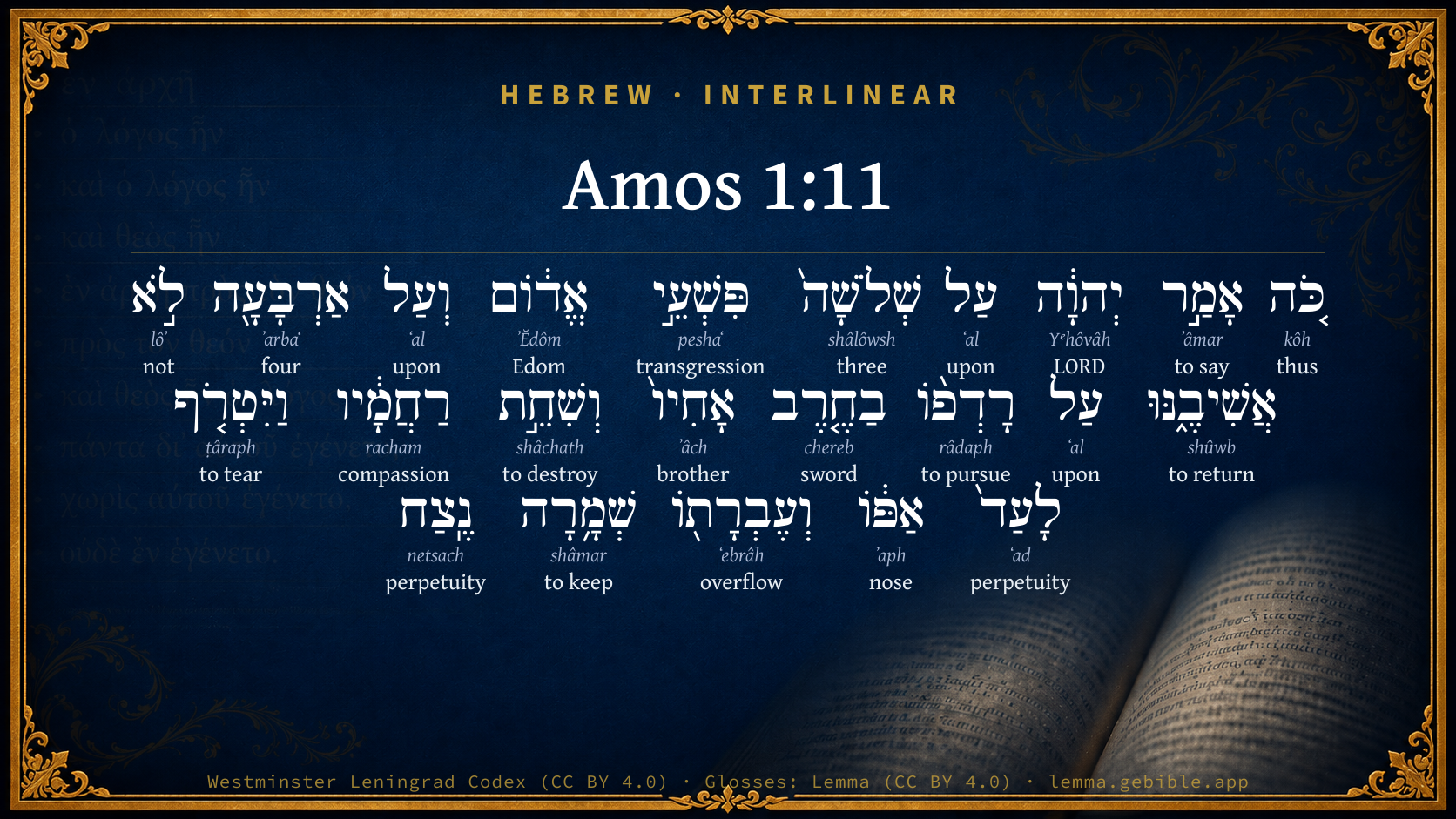
Amos 1:11

Hebrew (Westminster Leningrad Codex) Amos 1:11 appears in the Hebrew Old Testament. The text above is from the Westminster Leningrad Codex. Each word links to its Strong’s number, a concise gloss, and parsing drawn from the Open Scriptures Hebrew Bible morphology. Click any word for its full Brown-Driver-Briggs (BDB) entry.
Download image
Cite this verse

Amos 1:11 (World English Bible). Public Domain. Lemma interlinear Bible study tool, https://lemma.gebible.app/v/amos/1/11.

Show BibTeX & RIS
BibTeX
RIS
English Translation
Thus says Yahweh: "For three transgressions of Edom, yes, for four, I will not turn away its punishment; Because he pursued his brother with the sword, And cast off all pity, And his anger raged continually, And he kept his wrath forever;
World English Bible · Public Domain
Download a study sheet

One document with this verse’s original text, its word-by-word gloss line, the meaning frame, cross-references with their text, attributed commentary, and full source and license credits — printable, and it pastes into notes with its structure intact.

This verse Autodidact and up

Study sheet (.html) Plain text (.txt)

A passage Seminary Student

Up to 50 verses in one chapter. A passage sheet keeps up to 6 commentary sources and 12 cross-references per verse, in the order this page ranks them, and says so on the sheet whenever that leaves anything out. Ask for a single verse and you get the Autodidact verse sheet above.

Everything on this page stays free to read, with no account — the sheet is a download of what is already on screen, not access to it.

Want to remove ads? Support Godless Engineer
Compare translations 3

The same verse in 3 English versions, stacked beneath the original-language interlinear above. Click any original word for its lexicon entry.

Each is an independent rendering of the whole verse — the interlinear is not word-aligned to these translations.

Highlighted words mark where these versions differ — a whole-verse word diff, not a word-by-word alignment.

  • World English Bible Public Domain
    Thus says Yahweh: "For three transgressions of Edom, yes, for four, I will not turn away its punishment; Because he pursued his brother with the sword, And cast off all pity, And his anger raged continually, And he kept his wrath forever;
  • King James Version Public Domain
    Thus saith the LORD; For three transgressions of Edom, and for four, I will not turn away the punishment thereof; because he did pursue his brother with the sword, and did cast off all pity, and his anger did tear perpetually, and he kept his wrath for ever:
  • unfoldingWord Literal Text CC BY-SA 4.0
    This is what Yahweh says, “For three sins of Edom, even for four, I will not turn away punishment, because he pursued his brother with the sword and cast off all pity. His anger raged continually, and his wrath lasted forever.

unfoldingWord Literal Text — © unfoldingWord, licensed CC BY-SA 4.0. Word-aligned USFM3 via Door43 (git.door43.org/unfoldingWord/en_ult).

Versions to compare (up to 4)

3 of 4 selected

Show all 18 translations

Every available English version of this verse, each an independent rendering of the whole verse.

  • World English Bible Public Domain
    Thus says Yahweh: "For three transgressions of Edom, yes, for four, I will not turn away its punishment; Because he pursued his brother with the sword, And cast off all pity, And his anger raged continually, And he kept his wrath forever;
  • Berean Standard Bible Public Domain
    This is what the LORD says: “For three transgressions of Edom, even four, I will not revoke My judgment, because he pursued his brother with the sword and stifled all compassion; his anger raged continually, and his fury flamed incessantly.
  • Majority Standard Bible Public Domain
    This is what the LORD says: “For three transgressions of Edom, even four, I will not revoke My judgment, because he pursued his brother with the sword and stifled all compassion; his anger raged continually, and his fury flamed incessantly.
  • King James Version Public Domain
    Thus saith the LORD; For three transgressions of Edom, and for four, I will not turn away the punishment thereof; because he did pursue his brother with the sword, and did cast off all pity, and his anger did tear perpetually, and he kept his wrath for ever:
  • American Standard Version (1901) Public Domain
    Thus saith Jehovah: For three transgressions of Edom, yea, for four, I will not turn away the punishment thereof; because he did pursue his brother with the sword, and did cast off all pity, and his anger did tear perpetually, and he kept his wrath for ever:
  • Revised Version (1885) Public Domain
    Thus saith the LORD: For three transgressions of Edom, yea, for four, I will not turn away the punishment thereof; because he did pursue his brother with the sword, and did cast off all pity, and his anger did tear perpetually, and he kept his wrath for ever:
  • Geneva Bible (1599) Public Domain
    Thus sayeth the Lord, For three transgressions of Edom, and for foure, I will not turne to it, because hee did pursue his brother with the sworde, and did cast off all pitie, and his anger spoyled him euermore, and his wrath watched him alway.
  • Douay-Rheims (1899) Public Domain
    Thus saith the Lord: For three crimes of Edom, and for four I will not convert him: because he hath pursued his brother with the sword, and hath cast off all pity, and hath carried on his fury, and hath kept his wrath to the end.
  • Young's Literal Translation Public Domain
    Thus said Jehovah: For three transgressions of Edom, And for four, I do not reverse it, Because of his pursuing with a sword his brother, And he hath destroyed his mercies, And tear perpetually doth his anger, And his wrath -- he hath kept it for ever,
  • Literal Standard Version CC BY-SA 4.0
    Thus said YHWH: “For three transgressions of Edom, || And for four, I do not reverse it, || Because of his pursuing his brother with a sword, || And he has destroyed his mercies, || And his anger tears continuously, || And his wrath—he has kept it forever,
  • Unlocked Literal Bible CC BY-SA 4.0
    This is what Yahweh says, “For three sins of Edom, even for four, I will not turn away punishment, because he pursued his brother with the sword and cast off all pity. His anger raged continually, and his wrath lasted forever.
  • unfoldingWord Literal Text CC BY-SA 4.0
    This is what Yahweh says, “For three sins of Edom, even for four, I will not turn away punishment, because he pursued his brother with the sword and cast off all pity. His anger raged continually, and his wrath lasted forever.
  • Darby Bible Public Domain
    Thus saith Jehovah: For three transgressions of Edom, and for four, I will not revoke its sentence; because he pursued his brother with the sword, and cast off all pity; and his anger did tear continually, and he kept his wrath for ever.
  • World Messianic Bible Public Domain
    The LORD says: “For three transgressions of Edom, yes, for four, I will not turn away its punishment, because he pursued his brother with the sword and cast off all pity, and his anger raged continually, and he kept his wrath forever;
  • Webster's Bible Public Domain
    Thus saith the LORD; For three transgressions of Edom, and for four, I will not turn away its punishment: because he pursued his brother with the sword, and cast off all pity, and his anger did tear perpetually, and he kept his wrath for ever:
  • Free Bible Version CC BY-SA 4.0
    This is what the Lord says: The people of Edom have repeatedly sinned and so I will not hesitate to punish them, for they hunted down the Israelites to whom they were related, killing them with swords. They attacked without mercy, tearing the Israelites to pieces in an angry rage that never stopped.
  • Bible in Basic English Public Domain
    These are the words of the Lord: For three crimes of Edom, and for four, I will not let its fate be changed; because his sword was turned against his brother, without pity, and his wrath was burning at all times, and he was angry for ever.
  • JPS Tanakh (1917) Public Domain
    Thus saith the LORD: For three transgressions of Edom, yea, for four, I will not reverse it: because he did pursue his brother with the sword, and did cast off all pity, and his anger did tear perpetually, and he kept his wrath for ever.

Literal Standard Version (2020), Covenant Press — licensed CC BY-SA 4.0. Text via the HelloAO Bible API (eBible.org). Unlocked Literal Bible (unfoldingWord) — licensed CC BY-SA 4.0. Text via the HelloAO Bible API (eBible.org). unfoldingWord Literal Text — © unfoldingWord, licensed CC BY-SA 4.0. Word-aligned USFM3 via Door43 (git.door43.org/unfoldingWord/en_ult). Free Bible Version, Dr. Jonathan Gallagher — licensed CC BY-SA 4.0. Text via the HelloAO Bible API (eBible.org).

Word by word

More ways to search: Search by grammar → Find every occurrence → Compare this word →

Practice this passage: Drill this verse → Learn its vocabulary →

וַיִּטְרֹ֤ף
ṭâraph
H2963
“and · to tear”
Conjunction + Verb, Qal, Sequential Imperfect, 3rd Person, Masculine, Singular
Part of Speech
Conjunction + Verb
Stem
Qal
Form
Sequential Imperfect
Person
3rd Person
Gender
Masculine
Number
Singular
Full BDB Definition

Origin: a primitive root

TWOT: 827

to tear, rend, pluck - (Qal) to tear, rend - (Niphal) to be torn in pieces - (Poal) to be torn in pieces - (Hiphil) to provide food
  1. כֹּ֚ה kôh H3541 “thus” Adverb
  2. אָמַ֣ר ʼâmar H559 “to say” Verb, Qal, Perfect, 3rd Person, Masculine, Singular
  3. יְהוָ֔ה Yᵉhôvâh H3068 “LORD” Noun, Proper
  4. עַל ʻal H5921 “upon” Preposition
  5. שְׁלֹשָׁה֙ shâlôwsh H7969 “three” Adjective, Cardinal number, Masculine, Singular, Absolute
  6. פִּשְׁעֵ֣י peshaʻ H6588 “transgressions of” Noun, Common, Masculine, Plural, Construct
  7. אֱד֔וֹם ʼĔdôm H123 “Edom” Noun, Proper
  8. וְעַל ʻal H5921 “and · upon” Conjunction + Preposition
  9. אַרְבָּעָ֖ה ʼarbaʻ H702 “four” Adjective, Cardinal number, Masculine, Singular, Absolute
  10. לֹ֣א lôʼ H3808 “not” Particle, Negative
  11. אֲשִׁיבֶ֑נּוּ shûwb H7725 “to return · him” Verb, Hiphil, Imperfect, 1st Person, Common, Singular + Suffix, Personal, 3rd Person, Masculine, Singular
  12. עַל ʻal H5921 “upon” Preposition
  13. רָדְפ֨וֹ râdaph H7291 “to pursue · him” Verb, Qal, Infinitive Construct + Suffix, Personal, 3rd Person, Masculine, Singular
  14. בַחֶ֤רֶב chereb H2719 “in/at the · sword” Preposition, Determined + Noun, Common, Feminine, Singular, Absolute
  15. אָחִיו֙ ʼâch H251 “brother · his” Noun, Common, Masculine, Singular, Construct + Suffix, Personal, 3rd Person, Masculine, Singular
  16. וְשִׁחֵ֣ת shâchath H7843 “and · to destroy” Conjunction + Verb, Piel, Perfect, 3rd Person, Masculine, Singular
  17. רַחֲמָ֔יו racham H7356 “compassion · his” Noun, Common, Masculine, Plural, Construct + Suffix, Personal, 3rd Person, Masculine, Singular
  18. לָעַד֙ ʻad H5703 “to/for · perpetuity” Preposition + Noun, Common, Masculine, Singular, Absolute
  19. אַפּ֔וֹ ʼaph H639 “nose · his” Noun, Common, Masculine, Singular, Construct + Suffix, Personal, 3rd Person, Masculine, Singular
  20. וְעֶבְרָת֖וֹ ʻebrâh H5678 “and · overflow · his” Conjunction + Noun, Common, Feminine, Singular, Construct + Suffix, Personal, 3rd Person, Masculine, Singular
  21. שְׁמָ֥רָה shâmar H8104 “to keep · her” Verb, Qal, Perfect, 3rd Person, Masculine, Singular + Suffix, Personal, 3rd Person, Feminine, Singular
  22. נֶֽצַח netsach H5331 “perpetuity” Noun, Common, Masculine, Singular, Absolute

About this verse

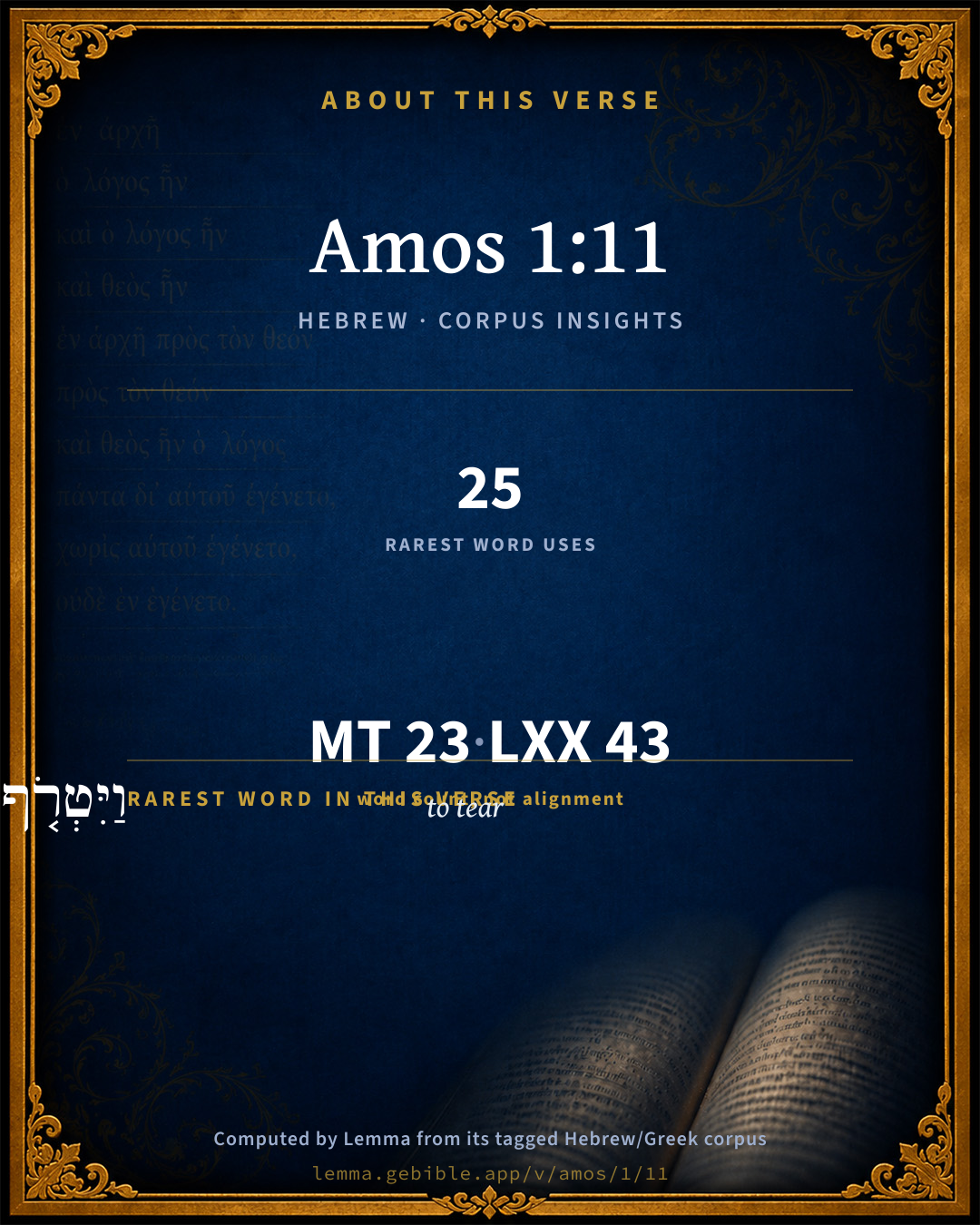
These counts appear in no published source. They are computed here, from the morphology-tagged text and Lemma’s own curated glosses. What Lemma adds →

23
words
21
distinct lemmas
Prophets
section

Notable vocabulary

The rarest word here is וַיִּטְרֹ֤ף to tear H2963 — appearing just 25 times in the whole Hebrew Bible.

Shared distinctive vocabulary

וַיִּטְרֹ֤ף to tear H2963 occurs in 22 verses of the Hebrew Bible. Also found in:

Grammatical profile

  • 6 verbs
  • 10 nouns
  • 2 adjectives
  • 3 prepositions
  • 1 adverb
  • 1 particle

Verb forms

  • אָמַ֣ר Qal · Perfect
  • אֲשִׁיבֶ֑נּוּ Hiphil · Imperfect
  • רָדְפ֨וֹ Qal · Infinitive Construct
  • וְשִׁחֵ֣ת Piel · Perfect
  • וַיִּטְרֹ֤ף Qal · Sequential Imperfect
  • שְׁמָ֥רָה Qal · Perfect

Repetition

A word recurs within this verse — often emphatic in Hebrew:

Hebrew & Septuagint length

In English translation the verse runs 42 words from the Hebrew and 50 from the Septuagint (LXX English) — closely comparable.

A rough comparison of the two English renderings, which tokenize alike — not a word-level alignment.

Word counts can differ between the Hebrew and the Greek without any difference in meaning — e.g. the Hebrew direct-object marker אֵת has no separate Greek word, and Greek often adds the article ὁ.

In the original languages it is 23 Hebrew tokens and 43 Greek tokens — but the two are counted differently (Hebrew bundles its prefixes and suffixes into one token; the Greek is in lemma form), so that isn’t a like-for-like length.

Cross-references

24

Topical passages linked to Amos 1:11 in the Treasury of Scripture Knowledge — connected by theme and wording, ordered by reader-vote popularity; previews shown in the World English Bible.

  • Ezekiel 25:12–14 Thus says the Lord Yahweh: Because Edom has dealt against the house of Judah by taking vengeance, and has greatly offended, and revenged himself on them;
  • Numbers 20:14–21 Moses sent messengers from Kadesh to the king of Edom, Thus says your brother Israel, You know all the travail that has happened to us:
  • 2 Chronicles 28:17 For again the Edomites had come and struck Judah, and carried away captives.
  • Psalms 137:7 Remember, Yahweh, against the children of Edom, The day of Jerusalem; Who said, "Raze it! Raze it even to its foundation!"
  • Jeremiah 49:7–22 Of Edom. Thus says Yahweh of Hosts: Is wisdom no more in Teman? is counsel perished from the prudent? is their wisdom vanished?
  • Joel 3:19 Egypt will be a desolation, And Edom will be a desolate wilderness, For the violence done to the children of Judah, Because they have shed innocent blood in their land.
  • Malachi 1:4 Whereas Edom says, "We are beaten down, but we will return and build the waste places;" thus says Yahweh of Hosts, "They shall build, but I will throw down; and men will call them 'The Wicked Land,' even the people against whom Yahweh shows wrath forever."
  • Ezekiel 35:1–15 Moreover the word of Yahweh came to me, saying,
  • Obadiah 1:1–14 The vision of Obadiah. This is what the Lord Yahweh says about Edom. We have heard news from Yahweh, and an ambassador is sent among the nations, saying, "Arise, and let's rise up against her in battle.
  • Deuteronomy 2:4–8 Command you the people, saying, You are to pass through the border of your brothers the children of Esau, who dwell in Seir; and they will be afraid of you: take good heed to yourselves therefore;
  • Deuteronomy 23:7 You shall not abhor an Edomite; for he is your brother: you shall not abhor an Egyptian, because you lived as a foreigner in his land.
  • Psalms 83:3–8 They conspire with cunning against your people. They plot against your cherished ones.
  • Ecclesiastes 7:9 Don't be hasty in your spirit to be angry, for anger rests in the bosom of fools.
  • Isaiah 63:1–7 Who is this who comes from Edom, with dyed garments from Bozrah? this who is glorious in his clothing, marching in the greatness of his strength? I who speak in righteousness, mighty to save.
  • Micah 7:18 Who is a God like you, who pardons iniquity, And passes over the disobedience of the remnant of his heritage? He doesn't retain his anger forever, Because he delights in loving kindness.
  • Genesis 27:40–41 By your sword will you live, and you will serve your brother. It will happen, when you will break loose, That you shall shake his yoke from off your neck."
  • Isaiah 21:11–12 The burden of Dumah. One calls to me out of Seir, Watchman, what of the night? Watchman, what of the night?
  • Isaiah 34:1–17 Come near, you nations, to hear; and listen, you peoples: let the earth hear, and the fullness of it; the world, and all things that come forth from it.
  • Isaiah 57:16 For I will not contend forever, neither will I be always angry; for the spirit would faint before me, and the souls who I have made.
  • Lamentations 4:21–22 Rejoice and be glad, daughter of Edom, that dwell in the land of Uz: The cup shall pass through to you also; you shall be drunken, and shall make yourself naked.
  • Malachi 1:2 "I have loved you," says Yahweh. Yet you say, "How have you loved us?" "Wasn't Esau Jacob's brother?" says Yahweh, "Yet I loved Jacob;
  • Ephesians 4:26–27 "Be angry, and don't sin." Don't let the sun go down on your wrath,
  • Ephesians 5:1 Be therefore imitators of God, as beloved children.
  • Psalms 85:5 Will you be angry with us forever? Will you draw out your anger to all generations?

Cross-references courtesy of OpenBible.info (CC BY 4.0).

Hebrew and Greek witnesses Masoretic Hebrew ↔ Greek Septuagint

The same verse in the two great witnesses to the Old Testament, shown verse-for-verse.

These are two independent witnesses, not word-aligned to each other, and the Septuagint is shown in lemma (dictionary) form.

Hebrew Amos 1:11 Masoretic · Westminster Leningrad Codex

כֹּ֚ה אָמַ֣ר יְהוָ֔ה עַל שְׁלֹשָׁה֙ פִּשְׁעֵ֣י אֱד֔וֹם וְעַל אַרְבָּעָ֖ה לֹ֣א אֲשִׁיבֶ֑נּוּ עַל רָדְפ֨וֹ בַחֶ֤רֶב אָחִיו֙ וְשִׁחֵ֣ת רַחֲמָ֔יו וַיִּטְרֹ֤ף לָעַד֙ אַפּ֔וֹ וְעֶבְרָת֖וֹ שְׁמָ֥רָה נֶֽצַח

Thus says Yahweh: "For three transgressions of Edom, yes, for four, I will not turn away its punishment; Because he pursued his brother with the sword, And cast off all pity, And his anger raged continually, And he kept his wrath forever;

World English Bible · Public Domain

Greek LXX Amos 1:11 Septuagint · lemma form

ὅδε λέγω κύριος ἐπί ὁ τρεῖς ἀσέβεια ὁ ιδουμαία καί ἐπί ὁ τέσσαρες οὐ ἀποστρέφω αὐτός ἕνεκα ὁ διώκω αὐτός ἐν ῥομφαία ὁ ἀδελφός αὐτός καί λυμαίνω μήτρα ἐπί γῆ καί ἁρπάζω εἰς μαρτύριον φρίκη αὐτός καί ὁ ὅρμημα αὐτός φυλάσσω εἰς νεῖκος

Thus says the Lord; For three sins of Idumea, and for four, I will not turn away from them; because they pursued their brother with the sword, and destroyed the mother upon the earth, and summoned up his anger for a testimony, and kept up his fury to the end.

LXX2012 (modern English Septuagint) · Public Domain

On this verse, Haydock's Catholic Bible Commentary discusses the Septuagint’s reading. Read the note in Commentary ↓

Hebrew: Westminster Leningrad Codex (CC BY 4.0). Greek: Septuagint (public domain); English from LXX2012 (modern English Septuagint) (Public Domain). How the Septuagint differs from the Hebrew →

Targum (Aramaic paraphrase)

1

The Targum is the ancient Jewish Aramaic paraphrase of the Hebrew Scriptures — an interpretive translation, not the Hebrew text itself. Onkelos (literal) and Pseudo-Jonathan (expansive) render the Torah, and Jonathan the Prophets. Coverage is partial: where no permissively-licensed English translation exists for a verse, only the Aramaic is shown. This is verse-level text, not a word-by-word alignment to the Hebrew.

  1. Targum Jonathan Prophets (Joshua–Malachi)
    כִּדְנַן אֲמַר יְיָ עַל תְּלָתָא חוֹבֵי אֱדוֹם וְעַל אַרְבְּעָא לָא אֶשְׁבּוֹק לְהוֹן עַל רָדְפֵיהּ בְּחַרְבָּא אֲחוּהִי וְחַבֵּיל רַחֲמוֹהִי וּקְטֵיל קְטַל עַלְמִין רוּגְזֵיהּ וְחַמְתֵיהּ נָטְרָא לְאַפְרָשׁ:

    (no public-domain English translation for this verse)

    Targum Jonathan — Aramaic: “Mikraot Gedolot” (public domain). English: “Sefaria Community Translation” (CC0 1.0 (public-domain dedication)); “London "Chaldee Paraphrase," 1871” (public domain). Text via Sefaria.

Commentary

Notes on Amos 1:11 from classic Christian and Jewish commentators (each source and its license shown beneath its notes). The classic Christian expositions comment on the surrounding passage and are grouped to its opening verse, so a note may address several verses; the Jewish commentaries on the Tanakh (Rashi and others) are per-verse, so they appear only where the commentator wrote on this verse.

Lemma curates 59 commentaries, every one of them public domain or Creative Commons licensed, each selected and text-cleaned for this edition rather than reprinted as found. About our sources →

Adam Clarke's Commentary

Verse 11. For three transgressions of Edom] That the Edomites (notwithstanding what Calmet observes above of the brotherly covenant) were always implacable enemies of the Jews, is well known; but most probably that which the prophet has in view was the part they took in distressing the Jews when Jerusalem was besieged, and finally taken, by the Chaldeans. See Ob 1:11-14; Eze 25:12; Eze 35:5; Ps 137:7.

Adam Clarke's Commentary on the Bible (1810–1826) — public domain. Text from a community e-Sword/MySword module.

The Cambridge Bible for Schools and Colleges

gen. ed. J. J. S. Perowne

11. because he did pursue his brother with the sword] Edom and Israel are frequently spoken of as ‘brethren’ (Deu_2:4; Deu_23:7; Oba_1:10; Oba_1:12; cf. Gen_27:40-41): they were more closely related to each other than was either to any of their other neighbours: and the unbrotherly attitude assumed too often by Edom towards Israel is the head and front of his offence. Cf. Oba_1:10 (of the behaviour of Edom at the time when Jerusalem was taken by the Chaldaeans; see Amo_1:11-14), “For the violence done to thy brother Jacob shame shall cover thee, and thou shalt be cut off for ever.”

and did cast off all pity] and corrupted (or destroyed) his compassion, i.e. suppressed, or stifled, the natural instinct of tender regard which a person would normally cherish towards a brother, and which would render it impossible for him to ‘pursue’ him ‘with the sword.’

and his anger did tear perpetually] For the figure, see Job_16:9. Edom’s anger against his brother was ever raging, tearing (Psa_7:2) or rending its victims, like some wild animal. But the parallelism of the following clause makes it possible that we ought to read ‘and retained his anger’ (ויטר for ויטרף): see Psa_103:9; Lev_19:18; Nah_1:2 (parallel with avenge); and, as here, parallel with keep (שמר), Jer_3:5 (so Pesh. Vulg. Gunning, Wellhausen and others).

and he kept his wrath for ever] i.e. nursed, cherished it: instead of letting time dissipate it, he cherished it, in a spirit of revenge, till a fresh opportunity arose for displaying it in act. This revengeful temper of Edom displayed itself especially, not in malicious words only, but also in deed, at the time when Jerusalem was taken by the Chaldaeans: see Oba_1:10-14; Eze_25:12-14; Ezekiel 35 (where it is made, as here, the ground of predictions of desolation); cf. also Isa_34:5-17; Jer_49:7-22; Lam_4:21 f.; Mal_1:4; Joe_3:19; Psa_137:7.

11–12. Edom. The home of the Edomites was S. of the Dead Sea, immediately on the E. of the deep depression, which extends from the Dead Sea to the Gulf of Akabah, in ancient times the S. part of the ‘Arábah (comp. on Amo_6:14), now the valley of the ‘Arãbah. The capital of Edom was Sela (Petra), remarkably situated in a hollow, shut in by mountain-cliffs and accessible only through two narrow defiles (cf. Robinson, B.R[131] ii. 128 ff.; Sinai and Palestine, p. 87 ff.; Hull, Mount Seir, p. 85 ff.; Pusey, Minor Prophets, on Obadiah, p. 235). Though now desolate, and inhabited only by wandering Bedawin, Edom was in ancient times fertile and prosperous; and its people were quite one of the more considerable and powerful of Israel’s neighbours. Much jealousy and rivalry, breaking out at times into open hostilities, prevailed between the two nations: this is prefigured in the story of their ancestors, both at the time of their birth (Gen_25:22 f.), and subsequently (ib. Gen_27:41, cf. Gen_32:7 ff.), and is often alluded to in the Old Testament, especially in its later parts. David subdued Edom, ruling it by means of Jewish ‘deputies,’ or governors (2Sa_8:13 f.; 1Ki_11:15 f.; cf. 1Ki_22:47); and this state of dependence appears to have continued until, some two centuries afterwards, under Jehoram (849–842 b.c.), it successfully revolted (2Ki_8:20-22). Amaziah (801–792) gained a victory (2Ki_14:7), which so weakened Edom that his successor, Uzziah (ib. 2Ki_14:22), was able to plant Jewish colonists in Elath, on the Red Sea; but it was never again permanently subject to Judah.

[131] .R. … Edw. Robinson, Biblical Researches in Palestine (ed. 2, 1856).

The Cambridge Bible for Schools and Colleges (gen. ed. J. J. S. Perowne; Cambridge University Press, 1878–1918) — public domain. Text from a community e-Sword module.

Trapp's Complete Commentary

John Trapp

Amo 1:11 Thus saith the LORD; For three transgressions of Edom, and for four, I will not turn away [the punishment] thereof; because he did pursue his brother with the sword, and did cast off all pity, and his anger did tear perpetually, and he kept his wrath for ever:

Ver. 11. For three transgressions of Edom, &c.] i.e. of the Edomites, the Rabbis understand the Romans, those false brethren the Pope’s bloodhounds. See the parallel made by Dr Taylor, in his sermon called the Romish Edomite.

Because he did pursue his brother with the sword] First, when he drove him from house and home for fear of his life, which he threatened to take from him, Gen 27:41-45; and afterwards came against him (returning homewards) with four hundred cut-throats at his heels, Gen 32:6; Gen 32:8, "to smite the mother with the children," Gen 32:11. Next, in his posterity, those sworn swordsmen of the devil; that denied God’s Israel passage in the wilderness, coming out against him with much people, and with a strong hand, Num 20:20, to his great discouragement, Num 21:4. And ever after bore him an aching tooth, and waited him a shrewd turn; joining with the enemy, and taking all advantages of mischief. See 2Ch 28:17 Psa 137:7 Oba 1:10-11. Malice is commonly hereditary, and runs in the blood; and (as we use to say of runner) the older it is, the stronger.

And did cast off all pity] Heb. corrupted his compassions, forgot his brotherhood, banished natural affection out of his bosom, and put off all humanity. The Rabbis tell us, that out of the profaneness of his spirit Esau put away his circumcision, by drawing up again the foreskin with a surgeon’s instrument. Whether this were so or not, I have not to say; but that he corrupted his compassions (if any ever he had), violated the law of nature, and abolished the love of a brother, the "brotherly covenant," this text assureth us; even all the affections, duties, and respects of blood and nature by which he was bound. His grandfather Abraham could say to his nephew Lot, "Let there be no difference between thee and me; for we are brethren," Gen 13:8. This one consideration was retentive enough, cooler sufficient to his choler; it was even as the Angel that stayed his hand when the blow was coming, Gen 22:12. It should have been so with Edom; good blood would not have belied itself; but he had lost his brotherly bowels, and even put off manhood; he had wiped out all stirrings of good nature, as a man wipeth a dish, "wiping it and turning it upside down," 2Ki 21:18, as the Scripture speaketh in another case: or as when a man emptieth wine out of a cup, the sides are yet moist; but when it is rinsed and wiped, there remains not the least taste or tincture.

And his anger did tear perpetually] i.e. He in his anger did tear, as a beast of prey, and rage without intermission. The enemies of the Church do so still: such is their implacable hatred against God and his truth; they "eat up God’s people as they eat bread," Psa 14:4, yea, they tread down and tear in pieces, as if there were none to deliver. At the town of Barre, in France, when it was taken by the Papists, all kinds of cruelty was used, saith Mr Fox: children were cut up, and the guts of some of them and hearts pulled out, which in rage they tare and gnawed with their teeth. The Italians likewise which served the king there did, for hatred of religion, break forth into such fury, that they did rip up a living child, and took his liver being as yet red-hot, and eat it as meat. Erasmus tells of an Augustine friar, who openly in the pulpit at Antwerp, wished that Luther were there, that he might bite out his throat with his teeth. And Friar Brusierd, in a conference with Bilney, brake out into these angry words: But that I believe and know that God and all his saints will take revengement everlasting on thee, I would surely with these nails of mine be thy death. Pray therefore with David, "Deliver not the soul of thy turtle-dove" to these destroyers. "Cursed be their anger, for it is fierce; and their wrath, for it is cruel," Psa 74:19 Gen 49:7.

And kept his wrath for ever] Though himself was mortal, yet his wrath might seem to be immortal; as was Hannibal’s against the Romans, and our Edward I’s against the Scots; against whom being about to march, he adjured his son and nobles, that, if he died in his journey into Scotland, they should carry his corpse with them about Scotland, and not allow it to be interred till they had absolutely subdued the country. Anger may rush into a wise man’s bosom, but should not rest there (Aug. eph \\\87. Ecc 7:9); for it corrupteth the heart, as vinegar doth the vessel wherein it long continueth. Of the Athenians it was said, that their anger was αειμνηστος, everlasting; but that was but small to their condemnation. Thou shalt neither revenge nor remember ill turns, Lev 19:18, where servare is put for servare iram; to keep, for to keep one’s anger; to show that there is nothing that a man is more ready to keep, as being a vindictive creature. Aristotle saith (but absurdly) that it is more manly to be revenged than to be reconciled; and this the world calleth manhood, but indeed it is doghood rather. The manlier any man is, the milder and more merciful, as David, 2Sa 1:12. And Julius Caesar, when he had Pompey’s head presented to him wept, and said, Non mihi placet vindicta sed victoria, I seek not revenge but victory. And the apostle purposely disgraceth revenge of injury by a word that signifieth disgrace, loss of victory, or impotence of mind. {ηττημα, 1Co 6:7} Thunder, hail, tempest, neither trouble nor hurt celestial bodies; no more doth anger great minds. Edom was short spirited, soon kindled and not easily appeased; his wrath kept no bounds, as the word here used importeth; his coals were coals of juniper, fierce and long lasting; his fire not elementary, but culinary; nourished by low and unworthy considerations; a fruit of the flesh, and such as excludes out of heaven, Gal 5:20-21. It was not the passion but the habit of hatred which St James calleth the devil, Jas 4:7, and St Paul counselleth men not to give place to that devil; and for that end, not to let the sun go down upon their wrath, Eph 4:26. See Eze 25:5, where Edom is charged with a perpetual hatred, and therefore threatened with blood and desolation, as here.

John Trapp, A Commentary or Exposition upon All the Books of the Old and New Testament (1647–1656) — public domain. Text from a community e-Sword module.

The Biblical Illustrator

Joseph S. Exell

Amo_1:11-12

For three transgressions of Edom, and for four, I will not turn away the punishment thereof.

Edom

1. A threatening. Here a certain number is put for an uncertain. It may be treated jointly. Three and foyer make seven. Thus may be indicated the multitude and magnitude of the wickedness, and the greatness and heaviness of the punishment. It may be treated severally, and in this sense; going on still, even to a fourth time, in provoking Me, and adding obstinacy and impenitency to their side, I will bear them no longer.

2. The equity. These Idumaeans were stubbornly wicked, and heaped up sin upon sin.

3. Execution of judgment. I win send a fire. Fire is put in Scripture for a most grievous plague, by sword, or famine, or pestilence. Now for the application.

Edom is a special type of the kingdom of Anti-Christ. Antichristian Esau is Edom. The similitude between them we will consider--

1. In their persons;

2. in their sins; and

3. in their judgments. (T. Taylor, D. D.)

The Biblical Illustrator, edited by Joseph S. Exell (c. 1880s–1900s) — public domain. Text from a community e-Sword module.

Joseph Benson's Commentary

Amo 1:11-12. For three transgressions of Edom, &c. — The Edomites, or Idumeans, are often threatened for their enmity against the Israelites, because they took all occasions to oppress and insult over them in their distress. Because he did pursue his brother with the sword — The Edomites retained the same hatred and animosity against their brethren, the Israelites, which their father Esau had expressed against his brother Jacob. But I will send a fire upon Teman, &c. — Teman and Bozrah were two principal cities of Idumea. The destruction here denounced against them was afterward brought upon them, in some degree, by Sennacherib, but more especially by Nebuchadnezzar: see notes on Jer 49:7-22, and Eze 25:15.

Joseph Benson's Commentary on the Old and New Testaments (1811–1818) — public domain. Text from a community e-Sword module.

The Preacher's Complete Homiletical Commentary

Joseph S. Exell (gen. ed.)

CRITICAL NOTES.]

Amo_1:11-12. Edom] No particular crime, but implacable hatred charged, which broke out into acts of cruelty.

THE JUDGMENT OF EDOM.—Amo_1:11-12

Edom and the two following nations were related to Israel by lineal descent. But they set aside the ties of blood, and perpetrated abominable cruelties.

I. The reason of the judgment. A relentless hatred towards God’s people, breaking out in acts of cruelty, from one generation to another.

1. It was unnatural hatred. “Did cast off all pity.” His better feelings were subdued. Natural pity for a brother in distress was stifled or suppressed as if pity were evil in itself, and to be extinguished within us. This is most sinful and unnatural. It corrupts, deadens a man’s feelings, and “steels him against sympathy with others.” “For pity melts the mind to love.” “Compassion is an emotion of which we ought never to be ashamed,” says Blair. “Graceful is the tear of sympathy, and the heart that melts at the tale of woe; we should not permit ease and indulgence to contract our affections, and wrap us up in a selfish enjoyment. But we should accustom ourselves to think of the distresses of human life, of the solitary cottage, the dying parent, and the weeping orphan.”

2. It was cruel hatred. “He did pursue his brother with the sword.” His malice destroyed his compassion. He cast off the pity of man and indulged in the fierceness of a beast. His anger was insatiable and knew no bounds. “Fierce are the wars of brethren; and they who love exceedingly also hate exceedingly,” says the proverb. No hatred seems so intense as that between relations and brothers. To slay a neighbour is to slay a man, and to pursue a brother is fratricide. “Wrath is cruel, and anger is outrageous; but who is able to stand before envy?”

3. It was perpetual hatred. “His anger did tear perpetually, and he kept his wrath for ever.” Their enmity was intensified by their kinship, and the murderous thoughts of Esau towards Jacob seemed to be revived in posterity, and become a prominent feature in national character (Eze_35:5; Oba_1:1). Wrath was not kept in restraint, but let loose like a raging beast. It was hereditary, full of revenge, which they gratified by outrageous cruelties. “Thou hast had a perpetual hatred, and hast shed the blood of the children of Israel, by the force of the sword in the time of their calamity.”

II. The character of the judgment. Their cities would be overthrown, and their capital destroyed by tire. God may forbear awhile, even with the worst persecutors, but their cruelty will at length bring vengeance to their own doors. “The fire of our anger against our brethren kindles the fire of God’s anger against us,” says an old writer. “For I have sworn by myself, saith the Lord, that Bozrah shall become a desolation, a reproach, a waste, and a curse” (Jer_49:13).

ILLUSTRATIONS TO CHAPTER 1

Amo_1:11. Cast off pity. Bonaparte carried the town of Jaffa by assault, and many of the garrison were put to the sword. But the greater part fled into mosques, implored mercy from their pursuers, and were granted their lives. But Napoleon expressed resentment at the conduct of the troops, lost all pity, and to relieve himself of the care of his prisoners, ordered nearly 4000 to march on rising ground to be shot. When Bonaparte saw the smoke from volleys of musketry and grape, it is said that he could not contain his joy.

Pity is the virtue of the law,

And none but tyrants use it cruelly.

The Preacher's Complete Homiletical Commentary (gen. ed. Joseph S. Exell; Funk & Wagnalls, c. 1892) — public domain (pre-1929). A full-Bible homiletical/sermon-outline anthology covering 65 of 66 books (2 John is absent from the source module). Text from a community e-Sword module.

Keil & Delitzsch

C. F. Keil & F. Delitzsch

Edom. - Amo 1:11. "Thus saith Jehovah: For three transgressions of Edom, and for four, I shall not reverse it, because it pursues its brother with the sword, and stifles its compassion, and its anger tears in pieces for ever, and it keeps its wrath for ever, Amo 1:12. I send fire into Teman, and it will devour the palaces of Bozrah." Edom and the two following nations were related to Israel by lineal descent. In the case of Edom, Amos does not condemn any particular sins, but simply its implacable, mortal hatred towards its brother nation Israel, which broke out into acts of cruelty at every possible opportunity. ושׁחת רחמיו, he annihilates, i.e., suppresses, stifles his sympathy or his compassionate love; this is still dependent upon על רדפו, the preposition על continuing in force as a conjunction before the infinitive (i.e., as equivalent to על אשׁר), and the infinitive passing into the finite verb (cf. Amo 2:4). In the next clause אפּו is the subject: its wrath tears in pieces, i.e., rages destructively (compare Job 16:9, where târaph is applied to the wrath of God). In the last clause, on the other hand, Edom is again the subject; but it is now regarded as a kingdom, and construed as a feminine, and consequently עברתו is the object, and placed at the head as an absolute noun. שׁמרה, with the tone upon the penult. (milel) on account of netsach, which follows with the tone upon the first syllable, stands for שׁמרהּ (it preserves it), the mappik being omitted in the toneless syllable (compare Ewald, 249, b). If עברתו were the subject, the verb would have to be pointed שׁמרה. Again, the rendering proposed by Ewald, "his fury lies in wait for ever," is precluded by the fact that שׁמר, when applied to wrath in Jer 3:5, signifies to keep, or preserve, and also by the fact that lying in wait is generally inapplicable to an emotion. Teman, according to Jerome (ad h. l.), is Idumaeorum regio quae vergit ad australem partem, so that here, just as in Amo 2:2 and Amo 2:5, the land is mentioned first, and then the capital.

(Note: It is true that, according to Eusebius, Jerome does also mention in the Onom. a villa (κώμη) named Teman, which was five Roman miles from Petra, and in which there was a Roman garrison; and also that there is a Teman in Eastern Hauran (see Wetzstein in Delitzsch's Comm. on Job, i. 73); but in the Old Testament Teman is never to be understood as referring to a city.)

Bozrah, an important city, supposed to be the capital of Idumaea (see comm. on Gen 36:33). It was to the south of the Dead Sea, and has been preserved in el-Buseireh, a village with ruins in Jebl (see Robinson, Pal. ii. p. 570), and must not be confounded with Bossra in Hauran (Burckhardt, Syr. p. 364).

Keil & Delitzsch — Biblical Commentary on the Old Testament (1861–1891) — public domain (CC PDM 1.0). Text via the HelloAO Bible API. (Old Testament only.)

Tyndale Open Study Notes

Tyndale Open Resources

1:11 Edom was another betrayer (see 1:9; Gen 36; see also Gen 25:23-30; 27:39-40). • The NLT adds the Israelites to make explicit what relatives (literally brother) means (see Gen 25:25-30). “Brothers” can also refer to parties to a treaty (see Amos 1:9). Apparently Edom exerted constant pressure on the borders of Israel and Judah, raiding and plundering at moments of weakness (Jer 49:7-22; Obad 1:1-9).

Tyndale Open Study Notes — © Tyndale Open Resources, licensed CC BY-SA 4.0. Text via the HelloAO Bible API.

Geneva Bible (1599)

Geneva Bible translators

He was a continual enemy unto him.

Hebrew, corrupt his compassions.

Geneva Bible (1599) marginal notes — public domain. Text via Bolls.life.

Jamieson, Fausset & Brown

Robert Jamieson, A. R. Fausset & David Brown

Edom . . . did pursue his brother-- (Isa 34:5). The chief aggravation to Edom's violence against Israel was that they both came from the same parents, Isaac and Rebekah (compare Gen 25:24-26; Deu 23:7-8; Oba 1:10, Oba 1:12; Mal 1:2).

cast off all pity--literally, "destroy compassions," that is, did suppress all the natural feeling of pity for a brother in distress.

his wrath for ever--As Esau kept up his grudge against Jacob, for having twice supplanted him, namely, as to the birthright and the blessing (Gen 27:41), so Esau's posterity against Israel (Num 20:14, Num 20:21). Edom first showed his spite in not letting Israel pass through his borders when coming from the wilderness, but threatening to "come out against him with the sword"; next, when the Syrians attacked Jerusalem under Ahaz (compare Ch2 28:17, with Kg2 16:5); next, when Nebuchadnezzar assailed Jerusalem (Psa 137:7-8). In each case Edom chose the day of Israel's calamity for venting his grudge. This is the point of Edom's guilt dwelt on in Oba 1:10-13. God punishes the children, not for the sin of their fathers, but for their own filling up the measure of their fathers' guilt, as children generally follow in the steps of, and even exceed, their fathers' guilt (compare Exo 20:5).

Jamieson, Fausset & Brown — Commentary Critical and Explanatory on the Whole Bible (1871) — public domain (CC PDM 1.0). Text via the HelloAO Bible API.

John Calvin's Commentaries

The Prophet now passes to the Idumeans themselves. He had denounced ruin on the uncircumcised nations who delivered up the Jews into their hands: but they deserved a much heavier punishment, because their crime was much more atrocious. The Idumeans derived their origin, as it is well known, from their common father Isaac and bore the same symbol of God’s covenant, for they were circumcised. Since nearness of blood, and that sacred union, could not make them gentle to the Jews, we hence perceive how brutal was their inhumanity. They were then unworthy of being forgiven by God, when he became so severe a judge against heathen nations. But the Prophet says now, that the Idumeans had sinned more than their neighbors, and that their obstinacy was unhealable and that hence they could no longer be borne, for they had too long abused God’s forbearance, who had withheld his vengeance until this time.

He charges them with this crime, that they pursued their brother with the sword. There is here an anomaly of the number, for he speaks of the whole people. Edom then pursued his brother, that is, the Jews. But the Prophet has intentionally put the singular number to enhance their crime: for he here placed here, as it were, two men, Edom and Jacob, who were really brothers, and even twins. Was it not then a most execrable ferocity in Edom to pursue his own brother Jacob? He then sets before us here two nations as two men, that he might more fully exhibit the barbarity of the Idumeans in forgetting their kindred, and in venting their rage against their own blood. They have then pursued their brother with the sword; that is, they have been avowed enemies, for they had joined themselves to heathen nations. When the Assyrians came against the Israelites, the Idumeans put on arms: and this, perhaps, happened before that war; for when the Syrians and Israelites conspired against the Jews, it is probable that the Idumeans joined in the same alliance. However this may have been, the Prophet reproaches them with cruelty for arming themselves against their own kindred, without any regard for their own blood.

He afterwards adds, They have destroyed their own compassions; some render the words, “their own bowels;” and others in a strained and improper manner transfer the relative to the sons of Jacob, as though the Prophet had said, that Edom had destroyed the compassions, which were due, on account of their near relationship, from the posterity of Jacob. But the sense of the Prophet is clearly this, — that they destroyed their own compassions, which means, that they put off all sense of religion, and cast aside the first affections of nature. He then calls those the compassions of Edom, even such as he ought to have been influenced by: but as he had thrown aside all regard for humanity, there was not in him that compassion which he ought to have had.

He then adds, His anger has perpetually raged He now compares the cruelty of the Idumeans to that of wild beasts; for they raged like fierce wild animals, and spared not their own blood. They then raged perpetually, even endlessly, and retained their indignation perpetually. The Prophet seems here to allude to Edom or Esau, the father of the nation; for he cherished long, we know, his wrath against his brother; as he dared not to kill his brother during his father’s life. Hence he said, I will wait till my father’s death, then I will avenge myself, (Genesis 27:41) Since Esau then nourished this cruel hatred against his brother Jacob, the prophet here charges his posterity with the same crime; as though he had said, that they were too much like their father, or too much retained his perverse disposition, as they cherished and ever retained revenge in their hearts, and were wholly implacable. There may have been other causes of hatred between the Idumeans and the posterity of Jacob: but they ought, notwithstanding, whatever displeasure there may have been, to have forgiven their brethren. It was a monstrous thing past endurance, when a regard for their own blood did not reconcile those who were, by sacred bonds, connected together. We now perceive the object of the Prophet: and we here learn, that the Idumeans were more severely condemned than those mentioned before, and for this reason, — because they raged so cruelly against their own kindred.

John Calvin's Commentaries (1540-1563) — public domain. Text from the Calvin Translation Society English edition (1840s-50s) via the Christian Classics Ethereal Library (ccel.org). Calvin's coverage is partial (roughly two-thirds of the Bible); uncommented books and verses are honest gaps, never fabricated. The 19th-century editor's footnotes and remarks are omitted so the notes are faithfully Calvin's own voice.

Ellicott's Commentary for English Readers

CURSE ON EDOM.

(11) Edom.—Comp. the prophecy of Obadiah and Isa_34:5. See also Dict. of the Bible, art. “Edom.” All through their history Edom sided with the enemies of Israel. (Comp. 1Sa_14:47; 2Sa_8:14; Psa_60:9; and 2Ch_21:8-10.)

Cast Off.—It would be better to render stifled. In the following clause read “And his indignation rended continually, and his wrath lurked ever on the watch.” But another punctuation of the Hebrew original yields a different sense. “As for his wrath, he hath kept it for ever” (almost as E.V.). This corresponds closely with Jer_3:5.

A Bible Commentary for English Readers, edited by Charles John Ellicott (1878–1897) — public domain. Text from a community e-Sword module.

John Gill's Exposition

Thus saith the Lord for three transgressions of Edom,.... Or the Edomites, the posterity of Esau, whose name was Edom, so called from the red pottage he sold his birthright for to his brother Jacob:

and for four, I will not turn away the punishment thereof; See Gill on Amo 1:3. Among these three or four transgressions, not only what follows is included, but their idolatry; for that the Edomites had their idols is certain, though what they were cannot be said; see Ch2 25:14;

because he did pursue his brother with the sword: not Esau his brother Jacob; for though he purposed in his heart to slay him, which obliged him to flee; and frightened him, upon his return, by meeting him with four hundred men; yet he never pursued him with the sword; but his posterity, the Edomites, not only would not suffer the Israelites their brethren to pass by their borders, but came out against them with a large army, Num 20:18; and in the times of Ahaz they came against Judah with the sword, and smote them, and carried away captives, Ch2 28:17; and were at the taking and destruction of Jerusalem, and assisted and encouraged in it, Psa 137:7; though to these latter instances the prophet could have no respect, because they were after his time:

and did cast off all pity; bowels of compassion, natural affection, such as ought to be between brethren, even all humanity: or "corrupted", or "destroyed all pity" (w); showed none, but extinguished all sparks of it, as their behaviour to the Israelites showed, when upon their borders in the wilderness:

and his anger did tear perpetually; it was deeply rooted in them; it began in their first father Esau, on account of the blessing and birthright Jacob got from him; and it descended from father to son in all generations, and was vented in a most cruel manner, like the ravening of a lion, or any other beast of prey:

and kept his wrath for ever; reserved it in their breasts till they had an opportunity of showing it, as Esau their father proposed to do, Gen 27:41.

(w) "corrupert misericordias suas", Pagninus, Montanus, Mercerus; "corrumpens miserationes suas", Junius & Tremellius; "corrupit", Piscator, Cocceius.

John Gill's Exposition of the Whole Bible (1746–1763) — public domain (CC PDM 1.0). Text via the HelloAO Bible API.

Albert Barnes' Notes on the Bible

Edom - God had impressed on Israel its relation of brotherhood to Edom. Moses expressed it to Edom himself , and, after the suspicious refusal of Edom to allow Israel to march on the highway through his territory, he speaks as kindly of him, as before; “And when we passed by from our brethren, the children of Esau” Deu 2:8. It was the unkindness of worldly politics, and was forgiven. The religious love of the Egyptian and the Edomite was, on distinct grounds, made part of the law. “Thou shalt not abhor an Edomite, for he is thy brother: thou shalt not abhor an Egyptian; because thou wast a stranger in his land” Deu 23:7. The grandchild of an Egyptian or of an Edomite was religiously to become as an Israelite Deu 23:8. Not a foot of Edomite territory was Israel to appropriate, however provoked. It was God’s gift to Edom, as much as Canaan to Israel. “They shall be afraid of you, and ye shall take exceeding heed to yourselves. Quarrel not with them, for I will give you, of their land, no, not so much as the treading of the sole of the foot, for I have given Mount Seir unto Esau for a possession” Deu 2:4-5.

From this time until that of Saul, there is no mention of Edom; only that the Maonites and the Amalekites, who oppressed Israel Jdg 6:3; Jdg 10:12, were kindred tribes with Edom. The increasing strength of Israel in the early days of Saul seems to have occasioned a conspiracy against him, such as Asaph afterward complains of; “They have said, come and let us cut them off from being a nation, that the name of Israel may be no more in remembrance. For they have consulted together with one consent, they are confederate against Thee; the tabernacles of Edom and the Ishmaelites; of Moab and the Hagarenes; Gebal and Ammon and Amalek; the Philistines with the inhabitants of Tyre; Assur also is joined with them; they have been an arm to the children of Lot” Psa 83:4-8. Such a combination began probably in the time of Saul. “He fought against all his enemies on every side; against Moab, and against the children of Ammon, and against the king of Edom, and against the Philistines” 1Sa 14:47.

They were “his enemies,” and that, round about, encircling Israel, as hunters did their prey. “Edom,” on the south and southeast; “Moab” and “Ammon” on the east; the Syrians of “Zobah” on the north; the Philistines on the west enclosed him as in a net, and he repulsed them one by one. “Whichever why he turned, he worsted” them. It follows “he delivered Israel out of the hands of them that spoiled them” 1Sa 14:48. The aggression was from Edom, and that in combination with old oppressors of Israel, not from Saul . The wars of Saul and of David were defensive wars. Israel was recovering from a state of depression, not oppressing. “The valley of salt” 2Sa 8:13, where David defeated the Edomites, was also doubtless within the borders of Judah, since “the city of salt” was Jos 15:62; and the valley of salt was probably near the remarkable “mountain of salt,” 5 56 miles long, near the end of the Dead Sea , which, as being Canaanite, belonged to Israel. It was also far north of Kadesh, which was “the utmost boundary” of Edom Num 20:16.

From that Psalm too of mingled thanksgiving and prayer which David composed after the victory, “in the valley of salt” (Psa 60:1-12 title), it appears that, even after that victory, David’s army had not yet entered Edom. “Who will bring me into the strong city? who will lead me into Edom?” Psa 60:9. That same Psalm speaks of grievous suffering before, “in” which God had “cast” them “off” and “scattered” them; “made the earth tremble and cleft it;” so that “it reeled” Psa 60:1-3, Psa 60:10. Joab too had “returned” from the war in the north against the Syrians of Mesopotamia, to meet the Edomites. Whether in alliance with the Syrians, or taking advantage of the absence of the main army there, the Edomites had inflicted some heavy blow on Israel; a battle in which Abishai killed 18,000 men 1Ch 18:12 had been indecisive. The Edomites were relpalsed by the rapid counter-march of Joab. The victory, according to the Psalm, was still incomplete 1Ch 18:1, 1Ch 18:5, 1Ch 18:9-12. David put “garrisons in Edom” 2Sa 8:14, to restrain them from further outbreaks. Joab avenged the wrong of the Edomites, conformably to his character 1Ki 11:16; but the fact that “the captain of the host” had “to go up to bury the slain” (1Ki 11:15. It should be rendered, not, after he had slain, but, and he killed, etc.), shows the extent of the deadly blow, which he so fearfully avenged.

The store set by the king of Egypt on Hadad, the Edomite prince who fled to him 1Ki 11:14-20, shows how gladly Egypt employed Edom as an enemy to Israel. It has been said that he rebelled and failed . Else it remained under a dependent king appointed by Judah, for 1 12 century (1Ki 22:47; 2Ki 3:9 ff). One attempt against Judah is recorded 2Ch 20:10, when those of Mount Seir combined with Moab and Ammon against Jehoshaphat after his defeat at Ramoth-gilead. They had penetrated beyond Engedi 2Ch 20:2, 2Ch 20:16, 2Ch 20:20, on the road which Arab marauders take now , toward the wilderness of Tekoa, when God set them against one another, and they fell by each other’s hands 2Ch 20:22-24. But Jehoshaphat’s prayer at this time evinces that Israel’s had been a defensive warfare. Otherwise, he could not have appealed to God, “the children of Ammon and Moab and mount Seir, whom Thou wouldest not let Israel invade when they came out of the land of Egypt, but they turned from them, and destroyed them not, behold, they reward us, to come to cast us out of Thy possession, which Thou hast given us to inherit” 2Ch 20:10-11.

Judah held Edom by aid of garrisons, as a wild beast is held in a cage, that they might not injure them, but had taken no land from them, nor expelled them. Edom sought to cast Israel out of God’s land. Revolts cannot be without bloodshed; and so it is perhaps the more probable, that the words of Joel, “for the violence against the children of Judah, because they have shed innocent blood in their land” Joe 3:19, relate to a massacre of the Jews, when Esau revolted from Jehoram 2Ki 8:20-22. We have seen, in the Indian Massacres, how every living being of the ruling power may, on such occasions, be sought out for destruction. Edom gained its independence, and Jehoram, who sought to recover his authority, escaped with his life by cutting through the Edomite army by night 2Ki 8:21. Yet in Amaziha’s time they were still on the offensive, since the battle wherein he defeated them, was again “in the valley of salt” 2Ki 14:7; 2Ch 25:11, 2Ch 25:14.

Azariah, in whose reign Amos prophesied, regained Elath from them, the port for the Indian trade 2Ch 26:2. Of the origin of that war, we know nothing; only the brief words as to the Edomite invasion against Ahaz, “and yet again had the Edomites come, and smitten in Judah, and carried captive a captivity” 2Ch 28:17, attest previous and, it may be, habitual invasions. For no one such invasion had been named. It may probably mean, “they did yet again, what they had been in the habit of doing.” But in matter of history, the prophets, in declaring the grounds of God’s judgments, supply much which it was not the object of the historical books to relate. “They” are histories of God’s dealings with His people, His chastisements of them or of His sinful instruments in chastising them. Rarely, except when His supremacy was directly challenged, do they record the ground of the chastisements of pagan nations. Hence, to those who look on the surface only, the wars of the neighboring nations against Israel look but like the alternations of peace and war, victory and defeat, in modern times. The prophets draw up the veil, and show us the secret grounds of man’s misdeeds and God’s judgments.

Because he did pursue his brother - The characteristic sin of Edom, and its punishment are one main subject of the prophecy of Obadiah, inveterate malice contrary to the law of kindred. Eleven hundred years had passed since the birth of their forefathers, Jacob and Esan. But, with God, eleven hundred years had not worn out kindred. He who willed to knit together all creation, human beings and angels, in one in Christ Eph 1:10, and, as a means of union, “made of one blood all nations of people for to dwell on all the face of the earth” Act 17:26, used all sorts of ways to impress this idea of brotherhood. “We” forget relationship mostly in the third generation, often sooner; and we think it strange when a nation long retains the memories of those relationships . God, in His law, stamped on His people’s minds those wider meanings. To slay a man was to slay a “brother” Gen 9:5.

Even the outcast Canaan was a brother Gen 9:25 to Shem and Ham. Lot speaks to the men of Sodom amidst their iniquities, “my brethren” Gen 19:7; Jacob so salutes those unknown to him Gen 29:4. The descendants of Ishmael and Isaac were to be brethren; so were those of Esau and Jacob Gen 16:12; Gen 25:18. The brotherhood of blood was not to wear out, and there was to be a brotherhood of love also Gen 27:29, Gen 27:37. Every Israelite was a brother ; each tribe was a brother to every other Deu 10:9; Deu 18:2; Jdg 20:23, Jdg 20:28; the force of the appeal was remembered, even when passion ran high 2Sa 2:26. It enters habitually into the divine legislation. “Thou shall open thy hand wide unto thy brother Deu 15:11; if thy brother, a” Hebrew, sell himself to thee Deu 15:12; thou shalt not see thy brother’s ox or his sheep go astray and hide thyself from them Deu 22:1-4; if thy brother be waxen poor, then shalt thou relieve him, though a stranger and a sojourner, that he may live with thee” (Lev 25:35-39; add Lev 19:17; Deu 24:7, Deu 24:10, Deu 24:14).

In that same law, Edom’s relationship as a brother was acknowledged. It was an abiding law that Israel was not to take land, nor to refuse to admit him into the congregation of the Lord. Edom too remembered the relation, but to hate him. The nations around Israel seem to have been little at war with one another, bound together by common hatred against God’s people. Of their wars indeed we should not hear, for they had no religious interest. They would be but the natural results of the passions of unregenerate nature. Feuds there doubtless were and forays, but no attempts at permanent conquest or subdual. Their towns remain in their own possession . Tyre does not invade Philistia; nor Philistia, Tyre or Edom. But all combine against Israel. The words, “did pursue his brother with the sword,” express more than is mentioned in the historical books.

To “pursue” is more than to fight. They followed after, in order to destroy a remnant, “and cast off all pity:” literally, and more strongly, “corrupted his compassions, tendernesses.” Edom did violence to his natural feelings, as Ezekiel, using the same word, says of Tyre, “corrupting Eze 28:17 his wisdom,” that is, perverting it from the end for which God gave it, and so destroying it. Edom “steeled himself,” as we say, against his better feelings,” his better nature,” “deadened” them. But so they do not live again. Man is not master of the life and death of his feelings, anymore than of his natural existence. He can destroy; he cannot re-create. And he does, so far, “corrupt,” decay, do to death, his own feelings, whenever, in any signal instance, he acts against them. Edom was not simply unfeeling. He destroyed all “his tender yearnings” over suffering, such as God has put into every human heart, until it destroys them. Ordinary anger is satisfied and slaked by its indulgence; malice is fomented and fed and invigorated by it. Edom ever, as occasion gratified his anger; “his anger did tear continually;” yet, though raging as some wild ravening animal, without control, “he kept his wrath for ever,” not within bounds, but to let it loose anew. He retained it when he ought to have parted with it, and let it loose when he ought to have restrained it.

“What is best, when spoiled, becomes the worst,” is proverbial truth. : “As no love wellnigh is more faithful than that of brothers, so no hatred, when it hath once begun, is more unjust, no odium fiercer. Equality stirs up and inflames the mind; the shame of giving way and the love of preeminence is the more inflamed, in that the memory of infancy and whatever else would seem to gender good will, when once they are turned aside from the right path, produce hatred and contempt.” They were proverbial sayings of paganism, “fierce are the wars of brethren” , and “they who have loved exceedingly, they too hate exceedingly.” : “The Antiochi, the Seleuci, the Gryphi, the Cyziceni, when they learned not to be all but brothers, but craved the purple and diadems, overwhelmed themselves and Asia too with many calamities.”

Albert Barnes' Notes on the Bible (1834–1885) — public domain. Text from a community e-Sword/MySword module.

Haydock's Catholic Bible Commentary

Sword. Edom was subdued by David, and remained tributary till Joram. It attempted to recover its liberty under Josaphat, though the Hebrew text have improperly Aram, 2 Paralipomenon xx. 2, 23. The two nations were often at variance. (Calmet) --- Cast off. Septuagint, "violated the womb, or the mother on the earth."

George Leo Haydock (1774–1849), Haydock's Catholic Family Bible and Commentary, 1859 edition — public domain. Excludes Psalms (Douay-Rheims chapter numbering differs from Protestant) and Deuterocanonical books (Catholic canon only).

Matthew Poole's English Annotations

Three transgressions: see Amo 1:3.

Edom: see Amo 1:6.

I will not turn away the punishment thereof: see Amo 1:3. He did pursue; watch for and lay hold on every occasion to oppress Israel.

His brother; Jacob and his posterity here are meant, as is Esau and his posterity. Esau personally considered was an enemy to the person of Jacob, and vowed his ruin, forced him to flee into Padan-aram, and on his return thence frighted Jacob too by coming out with four hundred men armed; the posterity of Esau behaved themselves no whit more friendly.

With the sword; either joining with the enemies, as Psa 83:6-8; 137:7, or setting a war on foot on their own account, as 2Ch 28:17, against them.

Cast off all pity; common humanity was by Edom cast off, when Jacob’s posterity needed it, as appears by their denial of passage and selling to them necessaries for their relief in travelling by their country, Num 20:14-21; nay, they armed against Israel, Num 20:20. Common pity would have forborne strangers travelling by our coasts; how much more brethren. The inhumanity of the Edomites appeared yet further in this, that they were chapmen to buy all the captive Israelites, and to sell them to the heathen for slaves, which is certainly the height of inhumanity.

His anger, which is expressed by fierceness, and with vehemency,

did tear, as a ravenous, hungry, and fierce lion tears the prey; so the word.

Perpetually; though sometimes this anger did intermit for want of opportunity, yet on every occasion it revived, and showed itself again.

Kept his wrath for ever; lest the fire of his wrath should extinguish, Edom did record, treasure up, and reserved the seeds of his displeasure, as men rake up fire in ashes to blow it up into a flame; such was Edom’s wrath, a wrath that exceeded all bounds, as the word imports, and never ceased.

Matthew Poole's English Annotations on the Holy Bible (1683–1685) — public domain. Text from a community e-Sword/MySword module.

Whedon's Commentary on the Bible

Daniel D. Whedon

11, 12. The sin and punishment of Edom.

Edom — The Edomite territory was located south and southeast of the Dead Sea and east of the Arabah, the deep depression connecting the southern end of the Dead Sea with the Gulf of Akabah (see on Amo_6:14). During the exile the Edomites (Idumaeans) crossed this depression and settled in southern Judah. Edom was not as fertile as Palestine or Moab, though it is described as possessing, in the days of Moses, fields, vineyards, wells, and a highway (Num_20:17-19). With the exception of a few places the land was not suitable for agriculture, and it yielded scarcely enough for the keeping of flocks. As a result the Edomites became desert robbers, forcing a living from the caravans passing through their territory and from the neighboring more fertile regions. They were the dread of the Hebrews during the desert wanderings (Num_20:14 ff.) and during a large part of their national history.

His brother — Israel (see on Oba_1:10).

Pursue… with the sword — An apt characterization of the relation between Israel and Edom throughout their entire history (Numbers 20; Oba_1:10-14; Psa_137:7; compare Joe_3:19; Mal_1:2-5). This hostility merited the greater condemnation because the two nations were related so intimately. It is not necessary to suppose that the prophet had in mind any specific outbreak, though analogy with the other denunciations would point in that direction. A revolt against Judah is mentioned in 2Ki_8:20-22; but others, unrecorded in the Old Testament, may have been undertaken against Israel.

Cast off all pity — Margin, “corrupted his compassions.” Other translations are unnatural and need not be mentioned. Corrupt is used in the sense of suppress, or stifle, the natural instinct of compassion which may be expected to exist between brothers.

His anger did tear perpetually — Or, in his anger he did tear perpetually; that is, his anger did not exhaust itself in one outbreak (Job_16:9; Psa_7:2). Peshitto and Vulgate favor an emendation which gives a smoother parallelism, and is accepted by most modern scholars, “and he cherished his anger perpetually” (Jer_3:5; compare Nah_1:2; Psa_103:9).

Kept his wrath forever — Time was not allowed to dissipate it; carefully it was nursed. Such conduct calls for judgment.

Teman — Mentioned again in Jer_49:7; Oba_1:9; Job_2:11, etc. According to Eusebius and Jerome, Teman was a district of Edom, but also a village about fifteen miles from the capital, Petra. The direction from Petra is not certain; in Eze_25:13, however, it is mentioned as being in the opposite direction from Dedan; the latter was in the southeast; Teman, therefore, must have been in the northwest or north or northeast. Since no walls are mentioned (compare Amo_1:7; Amo_1:10; Amo_1:14, etc.), it is thought that the reference here is to the district.

Bozrah — Named again in Gen_36:33; Jer_49:13, etc.; not the city bearing the same name mentioned in Jer_48:24. It is identified with the modern el-Busaireh, a small village surrounded by extensive ruins, about thirty-five miles north of Petra and about twenty miles southeast of the Dead Sea. The capital of Edom in Amos’s day was Sela, the later Petra (see on Oba_1:3).

The fulfillment of this oracle also may be traced in part in the later history of Edom. With other states in western Asia, Edom paid homage to Tiglath-pileser III, after having paid tribute to an earlier king, Adad-nirari III (about 800 B.C.). Of later kings Sennacherib, Esar-haddon, and Ashur-banapal enumerate the Edomites among their vassals; evidently they were never able, though they made frequent attempts, to free themselves from the Assyrians, while the prestige of the latter endured. Edom became a part of Nebuchadnezzar’s domain (Jer_27:3-4). During the exile the Edomites crossed the Arabah and settled in southern Judah. At the time of Malachi Edom seems to have been desolate (Amo_1:3-4); and toward the close of the fourth century B.C. Arabian tribes established themselves permanently in the territory of Edom. After the Mohammedan conquests the Edomite cities disappeared entirely. On the authenticity of this oracle see pp. 220ff.

Daniel D. Whedon (gen. ed.), Commentary on the Old and New Testaments (1874–1909) — public domain. Text from a community e-Sword module.

The Pulpit Commentary

Vers. 11, 12. The judgment on Edom.

His brother. The prophet proceeds to denounce the three nations cognate to Israel, of which the Edomites were the nearest and the most inimical. From the time of Esau until now they had been consistent in enmity, and it is this unbrotherly conduct rather than any specific outrages which Amos here condemns. Edom is accused of relentless persecution, inhumanity, savage fury, and persistent anger. (For the brotherhood of Edom, see Num_20:14; Deu_2:4, Deu_2:5, 8 23:7, etc. For his hostility to Israel, see Num_20:18; 1Ki_11:14; 2Ki_8:20; 2Ch_20:10 2Ch_25:11, 12 28:17) The prophecy of Obadiah is directed against Edom. (comp. also Eze_25:12 Eze_35:5, Eze_35:15; Joe_3:19) Did cast off all pity; literally, corrupted his compassions; i.e. did violence to his natural feelings. Sonato Eze_28:17, "Thou hast corrupted thy wisdom," perverted it from its proper end. The LXX gives, ejlumh mhtera (mhtran, Alex.) ejpi ghv, "did violence to the mother that bare them." On this Jerome remarks, "Pro misericordia Septuaginta vulvam transtulerant, ducti ambiguitate verborum, quia rehem et vulvam et misericordiam significat." Did tear, as a wild beast tears his prey. So in Job_16:9, where the same word is used, "He hath torn me in his wrath". (Hos_6:1) And he kept his wrath forever; more literally, and its fury it (Edom) keeps forever. The quarrels of relations are proverbially bitter. Arist., "Polit.," 7:7, Oqen eirhtai calepoi galemoi ajdelfwn kai toi pera sterxantev oiJ de kaira misousin (p. 193, Bekk.).

Vers. 11, 12.

The woe against Edom.

We have here an inspired description of an ideal hate. It is loaded with every quality, and emphasized by every circumstance, and stained by every act, which could conspire to establish for it an "unbeaten record" in the emulation of evil passions.

I IT RESTS ON A BROTHER. Over and above the brotherhood arising out of their common humanity (Act_17:26; Gen_9:5) Israel and Edom were bound by the nearer tie of descent from the twin sons of their common ancestor Isaac. And on the basis of this relation they are spoken of as brothers in a special sense. (Deu_23:5) To the relation of brotherhood belongs the duty of love, (1Jn_2:10) which must be distinctive in proportion as the relation is close. (1Pe_2:17) And the breach of this law of love is great in proportion to its normal strength. It is bad to hate an enemy, but it is worse to hate a friend, and worse still to hate a brother. It is against nature, for "no man hateth his own flesh". (Eph_5:29) It is against our innate tendency to love them that love us. And it is against the popular sentiment which expects us to "love as brethren." Hatred of a brother is the grossest hate there is.

II IT IS AGGRESSIVE. "He pursues his brother with the sword." It is hard for hatred to be still. It is a restless devil in the heart. It wants to inflict injury. It actually inflicts it the first opportunity. If opportunity does not come, it seeks it and makes it. In the presence of the hated one it can no more be quiescent than fire in contact with fuel. Edom"s hatred of Israel did not fail thus to express its intensity. On every opportunity it broke out into offensive and cruel action (2Ch_28:17; Psa_137:7; Eze_25:12) Rapine, outrage, and murder, and the incitement of others to these, are fitting credentials to an ideal hate.

III IT IS MURDEROUS. "Tears in pieces." It inflicts not injury only, but deadly injury. It must have blood. And it not only kills, but murders. Unable to fight Israel in battle, Edom always played the part of "wrecker," and spoiled the dead, and murdered the wounded, after some stronger enemy had defeated them. (Psa_137:7) Then it murdered with an excess of truculence and savage cruelty that were natural to weakness rather than to strength. Hatred is a passion "blood alone can quell." "Whosoever hateth his brother is a murderer;" a murderer in fact if opportunity offers, in any case a murderer in heart. Let hatred enter your heart, and from the moment it settles you wear the brand of Cain.

IV IT IS PITILESS. "Did cast off all pity." No special occasion or act is mentioned, because the thing was habitual. A traditional and inordinate hate of Israel was fostered till it became a first principle of the Edomite"s creed, and was gratified till it ate all his humanity out. Too weak to be a soldier, he became a murderous looter, and when the Assyrian or Philistine had vanquished Israel in battle, the Edomite came vulture-like on the scene to butcher the living, and pillage and mangle the dead. (Oba_1:10-14) There is a pity proper to the human heart on the platform of mere nature. Of the "flowers of Eden we still inherit" is a ruth that shrinks from murder in cold blood. Where the crime is committed, this feeling has previously been choked out. The power to do this, to harden and deaden his own nature, is one of man"s most fatal gifts. He disregards the voice of pity till it becomes dumb. He fights against the movings of passion till at lass they are felt no more.

V IT IS INSATIABLE. "His anger endures forever." The persistence of Edom"s hate was matter of contemporary notoriety, (Eze_35:5) and it was precisely what one might expect. There is an infinity that belongs to the human soul, and which imparts itself to all its affections. Love is not exhausted by indulgence, but strengthened. It goes on and grows forever, and so with hate. One who knew well has said

Now hatred is by far the longest pleasure; Men love in haste, but they detest at leisure. (Byron. )

Hate is fed by indulgence as a fire is fed by fuel. Do not think your hatred will be appeased when you have got what you consider a just revenge. It will only then begin to burn with normal fierceness. Such feelings grow by what they feed on. The only way to banish them is to cut off the supplies. Starve a hungry hate, by giving it neither outlet nor audience, and it will soon atrophy and die.

VI IT IS ALL ON ONE SIDE. Israel"s relation to Edom as friendly, considerate, and disinterested, was laid down in explicit terms, (Deu_23:7 Deu_2:4, Deu_2:5) whilst the brotherhood of the two nations was emphasized (Num_20:14; Deu_2:8) Cruel things were done in spite of this (1Sa_14:47; 2Sa_8:14; 1Ki_11:15, 1Ki_11:16) but they were done in defensive wars, and after Edom"s enmity had proved itself incurable. It is a robust and thoroughly malignant hate that beats down and burns in spite of others" friendly attitude and feeling. Such hate belongs to a nature utterly inverted, and no longer human but devilish. And in proportion as it is such it becomes impossible of cure. The fire that burns without fuel, and in spite of water, has the elements of perpetuity in it. It is the beginning of the fire that shall never be quenched.

Vers. 11, 12.

A brother"s faithlessness and injustice.

If Tyre was doubly blamable because, being an ally, she turned against Israel, much more deserving of censure was Edom, inasmuch as Edom was near akin to Israel, and yet was guilty of the Conduct described in this passage.

I KINDRED INVOLVES SACRED OBLIGATIONS TO MUTUAL REGARD AND SUCCOUR. Moses had addressed Edom as a brother, and Israel had forborne to attack Edom, even when tempted to do so by most unneighbourly, unbrotherly conduct. The proper response to such conduct would have been something very different from what is here recorded.

Amongst all nations, and in every stage of society, common descent from one ancestor is accepted as a bond of brotherhood and a pledge of friendliness.

II THERE ARE INSTANCES IN WHICH THESE OBLIGATIONS ARE UTTERLY DISREGARDED. Such was the case with the Edomites. We trace in their conduct towards their kinsmen of Israel several stages of iniquity.

1. Aggression. Edom "pursued his brother with the sword.

2. Pitiless anger. Edom "corrupted his compassions.

3. Implacability. Edom "kept his wrath forever." Such treatment wouldhave been unjustifiable from any nation towards another; but the relation and circumstances made it flagrantly and atrociously wicked in the instance under consideration.

III VIOLATION OF OBLIGATIONS SO SACRED INCURS DIVINE DISPLEASURE AND MERITED PUNISHMENT. A nation sins and a nation suffers. Doubtless innocent persons endure in many cases the sufferings which the guilty deserve. This is a mystery of Divine providence. Yet it is evident that cities, tribes, nations, may be, and often have been, chastised, as a proof of the Divine rule, as a correction for human disobedience, and as an inducement to repentance. T.

The Pulpit Commentary (1880–1919), ed. H.D.M. Spence-Jones & Joseph S. Exell — public domain. Text from a community e-Sword module.

John Wesley's Explanatory Notes

Pursue - Watched for, and laid hold on every occasion to oppress Israel. Did tear - As a ravenous and fierce lion tears the prey.

John Wesley, Explanatory Notes Upon the Whole Bible (1754–1765) — public domain. Text via the GEBible commentary corpus.

unfoldingWord translationNotes

Door43 World Missions Community

For three sins of ... even for four

This is a poetic device. It does not mean that a specific number of sins had been committed, but indicates that many sins had led to God's judgment. See how you translated these words in Amos 1:3.

Edom

Here "Edom" represents the people of the country of Edom. AT: "the people of Edom" (See: Metonymy)

I will not turn away punishment

Yahweh uses two negatives here to emphasize that he would punish them. See how you translated these words in Amos 1:3. (See: Litotes)

he pursued his brother

The assumed knowledge is that Esau, from whom the people of Edom were descended, was the brother of Jacob, from whom the people of Israel were descended. Here "his brother" represents the people of Israel. AT: "he pursued the people of Israel" (See: Assumed Knowledge and Implicit Information and Metonymy)

cast off all pity

"showed them no mercy"

His anger raged continually, and his wrath lasted forever

These two phrases mean the same thing and are repeated to emphasize his continued anger. The abstract nouns "anger" and "wrath" can be translated using the adjectives "angry" and "furious." AT: "He was continually angry and always furious" (See: Parallelism and Abstract Nouns)

his wrath lasted forever

This is an exaggeration that is meant to express the ongoing nature of his wrath. (See: Hyperbole and Generalization)

Teman ... Bozrah

These are names of places. See: How to Translate Names

it will devour the palaces of Bozrah

Here Yahweh's judgment is spoken of as if it were a fire that was consuming the palaces. (See: Metaphor)

translationWords

Edom

brother

sword

anger

wrath

eternity

devour

unfoldingWord translationNotes — © Distant Shores Media and the Door43 World Missions Community, licensed CC BY-SA 4.0. Source: git.door43.org/Door43/en_tn.

Rashi

Rabbi Shlomo Yitzchaki (Rashi)

for pursuing their brother with a sword—As it is said: (Num. 20:18) “Lest I go forth against you with the sword.” And he still clings to his anger, keeps his wrath, and has not retracted it.

and grasped forever their anger—He clung to it and did not let it go.

Rashi on the Tanakh — English translations: “The Judaica Press complete Tanach with Rashi, translated by A. J. Rosenberg” (CC BY 4.0); “Pentateuch with Rashi's commentary by M. Rosenbaum and A.M. Silbermann, 1929-1934” (public domain); “The Metsudah Tanach series, Lakewood, N.J” (CC BY 4.0); and “The Book of Joshua, Metsudah Publications, 1997” (CC BY 4.0). Text via Sefaria.

Lesson kit

Teaching starters — assembled from the data on this page, not authored interpretation. Every prompt links to the verse data it draws on. Edit before teaching.

Amos, in the Prophets, opens this verse with 23 words (21 distinct Hebrew lemmas). Its most distinctive word is ṭâraph (“to tear”). A historical commentator’s framing appears above. Read the whole chapter for the surrounding context.

Discussion questions

  1. What does “to tear” (ṭâraph) contribute to the verse as a whole?
  2. How does Genesis 37:33, which shares the word «to tear», read alongside this verse?
  3. What does the repetition of “upon” (3× in this one verse) do in this verse?
  4. The translations on this page render this verse differently — a whole-verse word diff, not a word-by-word alignment. What might account for the different wordings?
  5. «אָמַ֣ר» is a Qal Perfect verb. How does that grammatical form shape the action described?
  6. Compare how Adam Clarke's Commentary and The Cambridge Bible for Schools and Colleges read this verse. Where do they agree or differ?

Things to notice

Reading settings

Reading text

Shown beneath each verse's original-language words.

Old Testament
Old Testament edition

Read the OT as the Masoretic Hebrew (MT) or the Greek Septuagint (LXX).

English shown for the Greek Septuagint (in the Hebrew ↔ Greek comparison).

Comparing translations? Open the Compare panel on any verse page to stack up to four side by side.