Exodus 19:8

Hebrew (Westminster Leningrad Codex) Exodus 19:8 appears in the Hebrew Old Testament. The text above is from the Westminster Leningrad Codex. Each word links to its Strong’s number, a concise gloss, and parsing drawn from the Open Scriptures Hebrew Bible morphology. Click any word for its full Brown-Driver-Briggs (BDB) entry.
Download image
Cite this verse

Exodus 19:8 (World English Bible). Public Domain. Lemma interlinear Bible study tool, https://lemma.gebible.app/v/exodus/19/8.

Show BibTeX & RIS
BibTeX
RIS
English Translation
All the people answered together, and said, "All that Yahweh has spoken we will do." Moses reported the words of the people to Yahweh.
World English Bible · Public Domain
Download a study sheet

One document with this verse’s original text, its word-by-word gloss line, the meaning frame, cross-references with their text, attributed commentary, and full source and license credits — printable, and it pastes into notes with its structure intact.

This verse Autodidact and up

Study sheet (.html) Plain text (.txt)

A passage Seminary Student

Up to 50 verses in one chapter. A passage sheet keeps up to 6 commentary sources and 12 cross-references per verse, in the order this page ranks them, and says so on the sheet whenever that leaves anything out. Ask for a single verse and you get the Autodidact verse sheet above.

Everything on this page stays free to read, with no account — the sheet is a download of what is already on screen, not access to it.

Want to remove ads? Support Godless Engineer
Compare translations 3

The same verse in 3 English versions, stacked beneath the original-language interlinear above. Click any original word for its lexicon entry.

Each is an independent rendering of the whole verse — the interlinear is not word-aligned to these translations.

Highlighted words mark where these versions differ — a whole-verse word diff, not a word-by-word alignment.

  • World English Bible Public Domain
    All the people answered together, and said, "All that Yahweh has spoken we will do." Moses reported the words of the people to Yahweh.
  • King James Version Public Domain
    And all the people answered together, and said, All that the LORD hath spoken we will do. And Moses returned the words of the people unto the LORD.
  • unfoldingWord Literal Text CC BY-SA 4.0
    And all the people responded together, and they said, “We will do everything that Yahweh has said.” And Moses brought the words of the people back to Yahweh.

unfoldingWord Literal Text — © unfoldingWord, licensed CC BY-SA 4.0. Word-aligned USFM3 via Door43 (git.door43.org/unfoldingWord/en_ult).

Versions to compare (up to 4)

3 of 4 selected

Show all 18 translations

Every available English version of this verse, each an independent rendering of the whole verse.

  • World English Bible Public Domain
    All the people answered together, and said, "All that Yahweh has spoken we will do." Moses reported the words of the people to Yahweh.
  • Berean Standard Bible Public Domain
    And all the people answered together, “We will do everything that the LORD has spoken.” So Moses brought their words back to the LORD.
  • Majority Standard Bible Public Domain
    And all the people answered together, “We will do everything that the LORD has spoken.” So Moses brought their words back to the LORD.
  • King James Version Public Domain
    And all the people answered together, and said, All that the LORD hath spoken we will do. And Moses returned the words of the people unto the LORD.
  • American Standard Version (1901) Public Domain
    And all the people answered together, and said, All that Jehovah hath spoken we will do. And Moses reported the words of the people unto Jehovah.
  • Revised Version (1885) Public Domain
    And all the people answered together, and said, All that the LORD hath spoken we will do. And Moses reported the words of the people unto the LORD.
  • Geneva Bible (1599) Public Domain
    And the people answered all together, and sayd, All that the Lord hath commanded, we will doe. And Moses reported the wordes of the people vnto the Lord.
  • Douay-Rheims (1899) Public Domain
    And all the people answered together: All that the Lord hath spoken, we will do. And when Moses had related the people's words to the Lord,
  • Young's Literal Translation Public Domain
    and all the people answer together and say, `All that Jehovah hath spoken we do;' and Moses returneth the words of the people unto Jehovah.
  • Literal Standard Version CC BY-SA 4.0
    and all the people answer together and say, “All that YHWH has spoken we do”; and Moses returns the words of the people to YHWH.
  • Unlocked Literal Bible CC BY-SA 4.0
    All the people answered together and said, “We will do everything that Yahweh has said.” Then Moses came to report the people's words to Yahweh.
  • unfoldingWord Literal Text CC BY-SA 4.0
    And all the people responded together, and they said, “We will do everything that Yahweh has said.” And Moses brought the words of the people back to Yahweh.
  • Darby Bible Public Domain
    And all the people answered together, and said, All that Jehovah has spoken will we do! And Moses brought the words of the people back to Jehovah.
  • World Messianic Bible Public Domain
    All the people answered together, and said, “All that the LORD has spoken we will do.” Moses reported the words of the people to the LORD.
  • Webster's Bible Public Domain
    And all the people answered together, and said, All that the LORD hath spoken we will do. And Moses returned the words of the people to the LORD.
  • Free Bible Version CC BY-SA 4.0
    Everyone answered, “We promise to do everything the Lord says.” Then Moses took the people's answer back to the Lord.
  • Bible in Basic English Public Domain
    And all the people, answering together, said, Whatever the Lord has said we will do. And Moses took back to the Lord the words of the people.
  • JPS Tanakh (1917) Public Domain
    And all the people answered together, and said: 'All that the LORD hath spoken we will do.' And Moses reported the words of the people unto the LORD.

Literal Standard Version (2020), Covenant Press — licensed CC BY-SA 4.0. Text via the HelloAO Bible API (eBible.org). Unlocked Literal Bible (unfoldingWord) — licensed CC BY-SA 4.0. Text via the HelloAO Bible API (eBible.org). unfoldingWord Literal Text — © unfoldingWord, licensed CC BY-SA 4.0. Word-aligned USFM3 via Door43 (git.door43.org/unfoldingWord/en_ult). Free Bible Version, Dr. Jonathan Gallagher — licensed CC BY-SA 4.0. Text via the HelloAO Bible API (eBible.org).

Word by word

More ways to search: Search by grammar → Find every occurrence → Compare this word →

Practice this passage: Drill this verse → Learn its vocabulary →

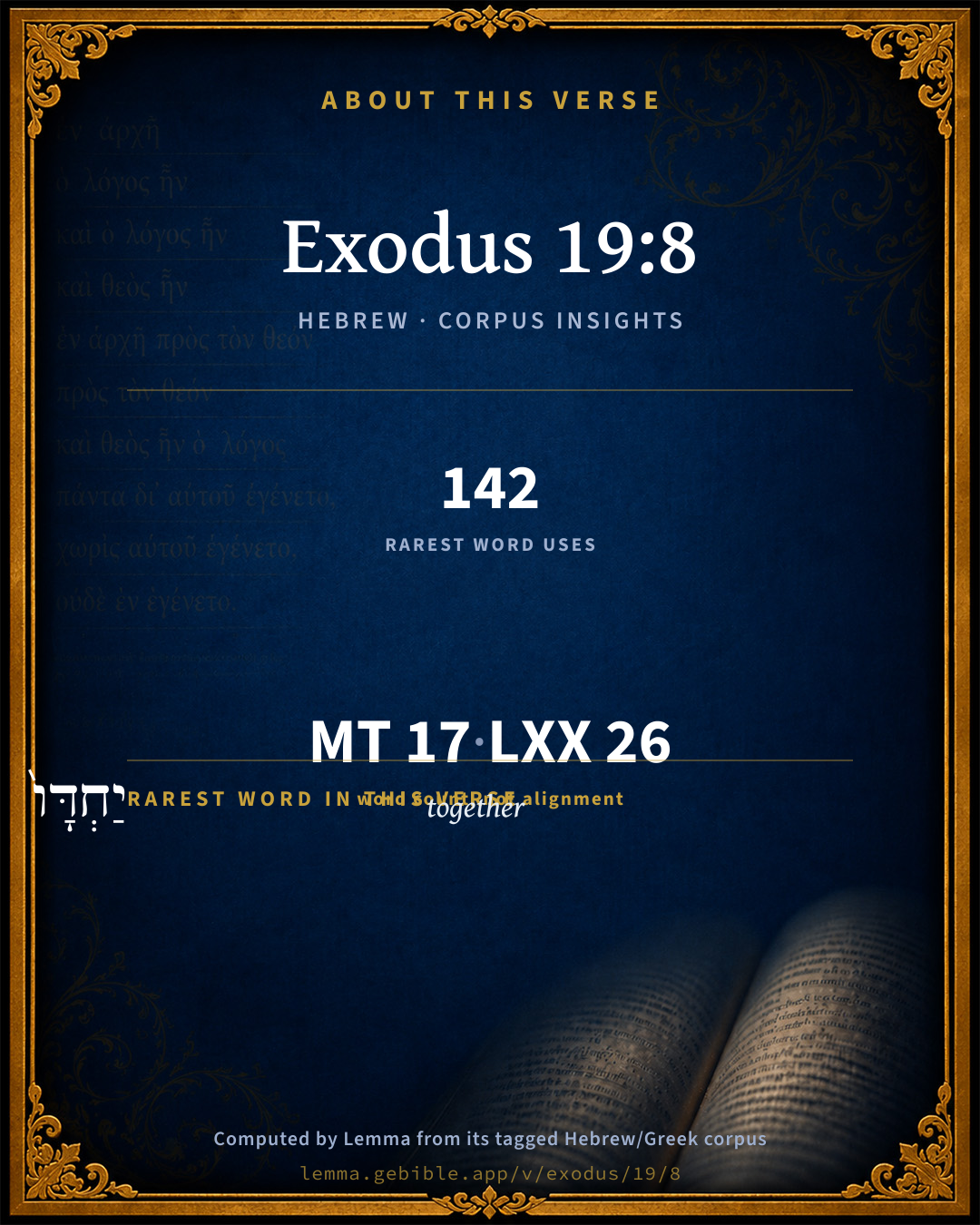
יַחְדָּו֙
yachad
H3162
“together”
Adverb
Part of Speech
Adverb
Full BDB Definition

Origin: from H3161

TWOT: 858b

union, unitedness (noun masculine) - together, altogether, all together, alike (adverb)
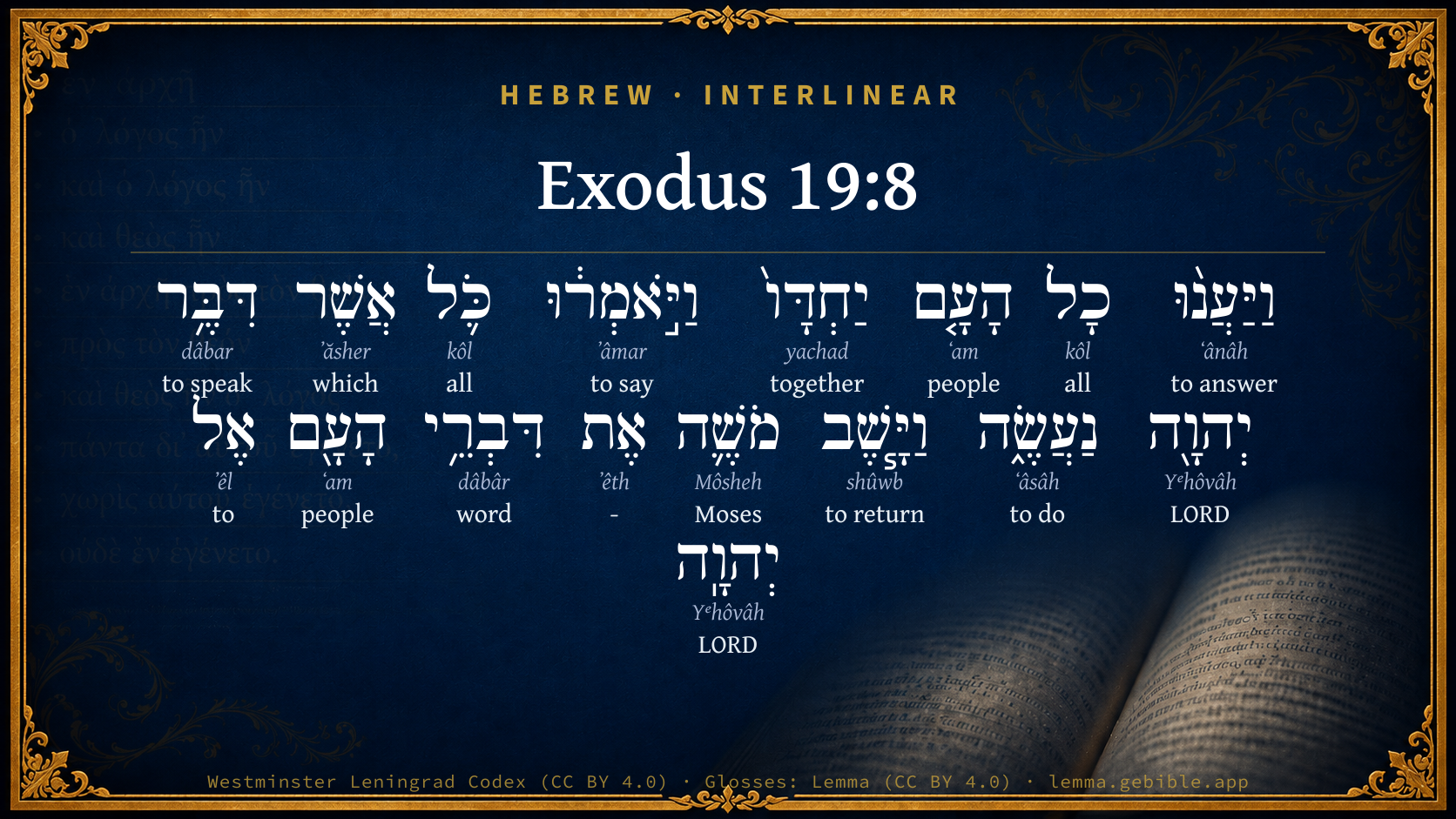
  1. וַיַּעֲנ֨וּ ʻânâh H6030 “and · to answer” Conjunction + Verb, Qal, Sequential Imperfect, 3rd Person, Masculine, Plural
  2. כָל kôl H3605 “all of” Noun, Common, Masculine, Singular, Construct
  3. הָעָ֤ם ʻam H5971 “the · people” Particle, Definite Article + Noun, Common, Masculine, Singular, Absolute
  4. וַיֹּ֣אמְר֔וּ ʼâmar H559 “and · to say” Conjunction + Verb, Qal, Sequential Imperfect, 3rd Person, Masculine, Plural
  5. כֹּ֛ל kôl H3605 “all” Noun, Common, Masculine, Singular, Absolute
  6. אֲשֶׁר ʼăsher H834 “which” Particle, Relative
  7. דִּבֶּ֥ר dâbar H1696 “to speak” Verb, Piel, Perfect, 3rd Person, Masculine, Singular
  8. יְהוָ֖ה Yᵉhôvâh H3068 “LORD” Noun, Proper
  9. נַעֲשֶׂ֑ה ʻâsâh H6213 “to do” Verb, Qal, Imperfect, 1st Person, Common, Plural
  10. וַיָּ֧שֶׁב shûwb H7725 “and · to return” Conjunction + Verb, Hiphil, Sequential Imperfect, 3rd Person, Masculine, Singular
  11. מֹשֶׁ֛ה Môsheh H4872 “Moses” Noun, Proper
  12. אֶת ʼêth H853 “-” Particle, Direct Object
  13. דִּבְרֵ֥י dâbâr H1697 “words of” Noun, Common, Masculine, Plural, Construct
  14. הָעָ֖ם ʻam H5971 “the · people” Particle, Definite Article + Noun, Common, Masculine, Singular, Absolute
  15. אֶל ʼêl H413 “to” Preposition
  16. יְהוָֽה Yᵉhôvâh H3068 “LORD” Noun, Proper

About this verse

These counts appear in no published source. They are computed here, from the morphology-tagged text and Lemma’s own curated glosses. What Lemma adds →

17
words
14
distinct lemmas
Pentateuch
section

Grammatical profile

  • 5 verbs
  • 8 nouns
  • 1 preposition
  • 1 adverb
  • 2 particles

Verb forms

  • וַיַּעֲנ֨וּ Qal · Sequential Imperfect
  • וַיֹּ֣אמְר֔וּ Qal · Sequential Imperfect
  • דִּבֶּ֥ר Piel · Perfect
  • נַעֲשֶׂ֑ה Qal · Imperfect
  • וַיָּ֧שֶׁב Hiphil · Sequential Imperfect

Repetition

Words recur within this verse — often emphatic in Hebrew:

  • כָל all H3605 ×2
  • הָעָ֤ם people H5971 ×2
  • יְהוָ֖ה LORD H3068 ×2

Hebrew & Septuagint length

In English translation the verse runs 24 words from the Hebrew and 29 from the Septuagint (LXX English) — closely comparable.

A rough comparison of the two English renderings, which tokenize alike — not a word-level alignment.

Word counts can differ between the Hebrew and the Greek without any difference in meaning — e.g. the Hebrew direct-object marker אֵת has no separate Greek word, and Greek often adds the article ὁ.

In the original languages it is 17 Hebrew tokens and 26 Greek tokens — but the two are counted differently (Hebrew bundles its prefixes and suffixes into one token; the Greek is in lemma form), so that isn’t a like-for-like length.

Cross-references

7

Topical passages linked to Exodus 19:8 in the Treasury of Scripture Knowledge — connected by theme and wording, ordered by reader-vote popularity; previews shown in the World English Bible.

  • Exodus 24:7 He took the book of the covenant and read it in the hearing of the people, and they said, "All that Yahweh has spoken will we do, and be obedient."
  • Exodus 24:3 Moses came and told the people all the words of Yahweh, and all the ordinances; and all the people answered with one voice, and said, "All the words which Yahweh has spoken will we do."
  • Joshua 24:24 The people said to Joshua, Yahweh our God will we serve, and to his voice will we listen.
  • Exodus 20:19 They said to Moses, "Speak with us yourself, and we will listen; but don't let God speak with us, lest we die."
  • Deuteronomy 5:27–29 Go you near, and hear all that Yahweh our God shall say: and speak you to us all that Yahweh our God shall speak to you; and we will hear it, and do it.
  • Nehemiah 10:29 They joined with their brothers, their nobles, and entered into a curse, and into an oath, to walk in God's law, which was given by Moses the servant of God, and to observe and do all the commandments of Yahweh our Lord, and his ordinances and his statutes;
  • Deuteronomy 26:17–19 You have declared Yahweh this day to be your God, and that you would walk in his ways, and keep his statutes, and his commandments, and his ordinances, and listen to his voice:

Cross-references courtesy of OpenBible.info (CC BY 4.0).

Hebrew and Greek witnesses Masoretic Hebrew ↔ Greek Septuagint

The same verse in the two great witnesses to the Old Testament, shown verse-for-verse.

These are two independent witnesses, not word-aligned to each other, and the Septuagint is shown in lemma (dictionary) form.

Hebrew Exodus 19:8 Masoretic · Westminster Leningrad Codex

וַיַּעֲנ֨וּ כָל הָעָ֤ם יַחְדָּו֙ וַיֹּ֣אמְר֔וּ כֹּ֛ל אֲשֶׁר דִּבֶּ֥ר יְהוָ֖ה נַעֲשֶׂ֑ה וַיָּ֧שֶׁב מֹשֶׁ֛ה אֶת דִּבְרֵ֥י הָעָ֖ם אֶל יְהוָֽה

All the people answered together, and said, "All that Yahweh has spoken we will do." Moses reported the words of the people to Yahweh.

World English Bible · Public Domain

Greek LXX Exodus 19:8 Septuagint · lemma form

ἀποκρίνω δέ πᾶς ὁ λαός ὁμοθυμαδόν καί εἶπον πᾶς ὅσος εἶπον ὁ θεός ποιέω καί ἀκούω ἀναφέρω δέ μωυσῆς ὁ λόγος ὁ λαός πρός ὁ θεός

And all the people answered with one accord, and said, All things that God has spoken, we will do and listen to: and Moses reported these words to God.

LXX2012 (modern English Septuagint) · Public Domain

On this verse, John Gill's Exposition discusses the Septuagint’s reading. Read the note in Commentary ↓

Hebrew: Westminster Leningrad Codex (CC BY 4.0). Greek: Septuagint (public domain); English from LXX2012 (modern English Septuagint) (Public Domain). How the Septuagint differs from the Hebrew →

Targum (Aramaic paraphrase)

2

The Targum is the ancient Jewish Aramaic paraphrase of the Hebrew Scriptures — an interpretive translation, not the Hebrew text itself. Onkelos (literal) and Pseudo-Jonathan (expansive) render the Torah, and Jonathan the Prophets. Coverage is partial: where no permissively-licensed English translation exists for a verse, only the Aramaic is shown. This is verse-level text, not a word-by-word alignment to the Hebrew.

  1. Targum Onkelos Torah (Genesis–Deuteronomy)
    וַאֲתִיבוּ כָל עַמָא כַּחֲדָא וַאֲמָרוּ כֹּל דִי מַלִיל יְיָ נַעְבֵּד וַאֲתֵיב משֶׁה יָת פִּתְגָמֵי עַמָא קֳדָם יְיָ:

    (no public-domain English translation for this verse)

    Targum Onkelos — Aramaic: “Onkelos Genesis” (public domain); “Onkelos Exodus” (public domain); “Onkelos Leviticus” (public domain); “Onkelos Numbers” (public domain); “Onkelos Deuteronomy” (public domain). English: “Sefaria Community Translation” (CC0 1.0 (public-domain dedication)); “J.W. Etheridge. The Targums of Onkelos and Jonathan Ben Uzziel on the Pentateuch. London: Longmans, Green, 1862” (public domain). Text via Sefaria.

  2. Targum Pseudo-Jonathan Torah (Genesis–Deuteronomy)
    וְאָתִיבוּ כָּל עַמָּא כַּחֲדָא וַאֲמָרוּ כָּל דְּמַלֵּיל יְיָ נַעֲבֵיד וְאָתֵיב משֶׁה יַת פִּתְגָמֵי עַמָּא קֳדָם יְיָ

    And all the people responded together, and said, All that the Lord hath spoken we will do. And Mosheh carried back the words of the people before the Lord.

    Targum Pseudo-Jonathan — Aramaic: “Targum Jonathan on Genesis” (public domain); “Targum Jonathan on Exodus” (public domain); “Targum Jonathan on Leviticus” (public domain); “Targum Jonathan on Numbers” (public domain); “Targum Jonathan on Deuteronomy” (public domain). English: “The Targum of Jonathan ben Uzziel, trans. J. W. Etheridge, London, 1862” (public domain). Text via Sefaria.

Commentary

Notes on Exodus 19:8 from classic Christian and Jewish commentators (each source and its license shown beneath its notes). The classic Christian expositions comment on the surrounding passage and are grouped to its opening verse, so a note may address several verses; the Jewish commentaries on the Tanakh (Rashi and others) are per-verse, so they appear only where the commentator wrote on this verse.

Lemma curates 59 commentaries, every one of them public domain or Creative Commons licensed, each selected and text-cleaned for this edition rather than reprinted as found. About our sources →

Trapp's Complete Commentary

John Trapp

Exo 19:8 And all the people answered together, and said, All that the LORD hath spoken we will do. And Moses returned the words of the people unto the LORD.

Ver. 8. All that the Lord hath spoken.] Sed, quid dignum tanto feret hic promissor hiatu! How easily over estimate we our own abilities! Pollicitis dives quilibet esse potest. Words are good cheap.

John Trapp, A Commentary or Exposition upon All the Books of the Old and New Testament (1647–1656) — public domain. Text from a community e-Sword module.

Adam Clarke's Commentary

Verse 8. And all the people answered, c.] The people, having such gracious advantages laid before them, most cheerfully consented to take God for their portion as he had graciously promised to take them for his people. Thus a covenant was made, the parties being mutually bound to each other.

Moses returned the words] When the people had on their part consented to the covenant, Moses appears to have gone immediately up to the mountain and related to God the success of his mission; for he was now on the mount, as appears from Ex 19:14.

Adam Clarke's Commentary on the Bible (1810–1826) — public domain. Text from a community e-Sword/MySword module.

Ellicott's Commentary for English Readers

(8) All the people answered together.—There was no hesitation, no diversity of opinion, no self-distrust. In view of the great privileges offered to them, all were willing, nay, eager, to promise for themselves that “they would obey God’s voice indeed, and keep his covenant.” In the glow and warmth of their feelings the difficulty of perfect obedience did not occur to them.

Moses returned the words—i.e., “took them back,” “reported them.”

A Bible Commentary for English Readers, edited by Charles John Ellicott (1878–1897) — public domain. Text from a community e-Sword module.

John Gill's Exposition

And all the people answered together,.... By their heads and representatives, the elders, summoned before Moses, to whom he declared the whole will of God; or this being communicated by them to their respective tribes and families, they were all of one mind; there was not a contradicting voice among them, they all gave the same answer, or all united in returning for answer what follows:

all that the Lord hath spoken we will do; obey his voice in all things he directs unto, or commands to be done, and keep the covenant he should make with them, and observe whatever was required on their parts; which was well spoken, if with the heart, and if, under a consciousness of their own weakness, they had expressed their desire of dependence upon the grace of God to enable them to perform, see Deu 5:28. The Septuagint version adds, "and we will hear", or be obedient, as in Exo 24:7,

and Moses returned the words of the people unto the Lord; not for his information, who knew very well what they had said, but for the discharge of his office as a mediator and messenger between God and them: this, according to Jarchi, was on the third day of the month.

John Gill's Exposition of the Whole Bible (1746–1763) — public domain (CC PDM 1.0). Text via the HelloAO Bible API.

Albert Barnes' Notes on the Bible

All that the Lord ... - By this answer the people accepted the covenant. It was the preliminary condition of their complete admission into the state of a royal priesthood.

Albert Barnes' Notes on the Bible (1834–1885) — public domain. Text from a community e-Sword/MySword module.

Haydock's Catholic Bible Commentary

Related, as a mediator acting between two parties, (Haydock) though God knew all before. Thus his servants cease not to lay before him their own and our wants. (Worthington)

George Leo Haydock (1774–1849), Haydock's Catholic Family Bible and Commentary, 1859 edition — public domain. Excludes Psalms (Douay-Rheims chapter numbering differs from Protestant) and Deuterocanonical books (Catholic canon only).

Matthew Poole's English Annotations

Not for God’s information, but for the people’s greater obligation, and to learn what answer he should return from God to them.

Matthew Poole's English Annotations on the Holy Bible (1683–1685) — public domain. Text from a community e-Sword/MySword module.

Whedon's Commentary on the Bible

Daniel D. Whedon

8. All the people answered together — From the language employed in the preceding verse, and from the nature of the case, we most naturally infer that this answer of the people was obtained, not in one open assembly of all the nation, but through the mediation of the elders. These elders, representing each a different portion of the people, would have ready means of communicating with the different tribes, and obtaining at short notice their sentiments on any important matter. The word together, accordingly, means here the oneness or unanimity of the people’s response. The answer returned was as that of one man. These two verses (7th and 8th) illustrate what any reader of sense ought to take for granted in such a history as this. We are not to suppose that every detail of communication is given. A great many small gatherings of the people may often have been held in different parts of the plain, and in the adjacent valleys, to hear the words of Jehovah; sometimes communications may have been delivered by numerous messengers without any public assembly. Any reasonable hypothesis of this kind is legitimate in interpretation.

Daniel D. Whedon (gen. ed.), Commentary on the Old and New Testaments (1874–1909) — public domain. Text from a community e-Sword module.

The Pulpit Commentary

And all the people answered together. It would seem that the elders submitted to the whole congregation the question propounded by Moses; or at any rate submitted it to a popular meeting, fairly representing the congregation. No doubt the exact purport of the question was made known by the usual means beforehand, and the assembly was summoned to declare, by acclamation, its assent or dissent. The result was a unanimous shout of approval:All that the Lord hath spoken we will doi.e. , "we will obey his voice indeed, and keep his covenant" (see ver. 5). In this way they accepted the covenant beforehand, not knowing what its exact provisions would be, but assured in their hearts that all would be right, just, and good; and anxious to secure the promised blessings (vers. 5, 6) for themselves and their posterity Moses returned the words of the people unto the Lordi.e. , Moses was the mouthpiece both ways. He took the messages of God to the people, and carried back ("returned") their answer.

The Pulpit Commentary (1880–1919), ed. H.D.M. Spence-Jones & Joseph S. Exell — public domain. Text from a community e-Sword module.

John Wesley's Explanatory Notes

And they answered together; all that the Lord hath spoken we will do - Thus accepting the Lord to be to them a God, and giving up themselves to be to him a people.

John Wesley, Explanatory Notes Upon the Whole Bible (1754–1765) — public domain. Text via the GEBible commentary corpus.

Scofield Reference Notes

C. I. Scofield

we will do

The Fifth Dispensation: Law. This dispensation extends from Sinai to Calvary--from Exodus to the Cross. The history of Israel in the wilderness and in the land is one long record of the violation of the law. The testing of the nation by law ended in the judgment of the Captivities, but the dispensation itself ended at the Cross.

(1) Man’s state at the beginning Exo 19:1-4.

(2) His responsibility Exo 19:5; Exo 19:6; Rom 10:5.

(3) His failure 2Ki 17:7-17; 2Ki 17:19; Act 2:22; Act 2:23.

(4) The judgment 2Ki 17:1-6; 2Ki 17:20; 2Ki 25:1-11; Luk 21:20-24

For Another Point of View: See Topic 301180

See, for the other six dispensations: INNOCENCE (Gen 1:28); CONSCIENCE (Gen 3:23); HUMAN GOVERNMENT (Gen 8:20); PROMISE (Gen 12:1); GRACE (Joh 1:17); KINGDOM (Eph 1:10)

(See Scofield "Gen 1:28"). See Scofield "Gen 3:23". See Scofield "Gen 8:21". See Scofield "Gen 12:1". See Scofield "Joh 1:17". See Scofield "Eph 1:10".

The Scofield Reference Bible (1917 edition), notes by C. I. Scofield — public domain. Text from a community e-Sword module.

Rashi

Rabbi Shlomo Yitzchaki (Rashi)

וישב משה את דברי העם וגו׳ AND MOSES RETURNED THE WORDS OF THE PEOPLE [UNTO THE LORD] on the next day, which was the third of the month, for he never ascended the mountain to God except early in the morning (Shabbat 86a). But was it really necessary for Moses to deliver the reply to God; God is Omniscient! — But the explanation is that Scripture intends to teach you good manners from the example of Moses: for he did not say, “Since He who sent me knows the reply there is no need for me to report it” (Mekhilta).

Rashi on the Tanakh — English translations: “The Judaica Press complete Tanach with Rashi, translated by A. J. Rosenberg” (CC BY 4.0); “Pentateuch with Rashi's commentary by M. Rosenbaum and A.M. Silbermann, 1929-1934” (public domain); “The Metsudah Tanach series, Lakewood, N.J” (CC BY 4.0); and “The Book of Joshua, Metsudah Publications, 1997” (CC BY 4.0). Text via Sefaria.

Ramban (Nachmanides)

Rabbi Moshe ben Nachman (Ramban / Nachmanides)

VAYASHEV MOSHEH’ THE WORDS OF THE PEOPLE UNTO THE ETERNAL. This means that Moses returned in the sense of “returning,” and not of “reporting”: “he returned to G-d with the words of the people.” “And there was no need to mention that ‘he went up to the mountain,’ since Scripture speaks here briefly” (Ibn Ezra). before Him to the mountain with the people’s answer. Now everything is revealed to Him, and He did not inquire of him, “What did this people answer you?” It is similar in meaning to the verse: And the Eternal heard the voice of your words, when ye spoke unto me. And when Moses came before Him, the Holy One, blessed be He, said, Lo, I come unto thee in a thick cloud, that the people may hear when I speak with thee, and may also believe thee forever. Then Moses said before Him, i.e., the words they had said, “Master of the universe, etc.” On the significance of this interpretation of Ramban, see further, Note 186. “Master of the universe, your children are people of faith, and they accept upon themselves whatever You will speak.”The above usage [of the word vayashev as meaning “returning” or “coming back”] is also found in the verse, ‘vayashivu’ unto them word… and they showed them the fruit of the Land, which means: “They [i.e., the spies] came back to them with the things which they saw.” [It cannot mean that “they reported” to them], for afterwards Scripture says there, And they told him, and said., Verse 27. [Hence, vayashivu in the preceding verse must mean that “they came back” with the things they had seen.] here means that “Moses came back” with the words of the people to G-d. Actually, however, as Ramban continues to explain, he did not report them, as everything was revealed to Him. This differs with Ibn Ezra’s interpretation, as explained in the following note. There is thus no need for Rabbi Abraham ibn Ezra’s interpretation on this point., why does it say again at the end of Verse 9, and Moses told the words of the people unto the Eternal? To remove this difficulty, Ibn Ezra said that vayageid Mosheh (and Moses told) in Verse 9 means that “Moses had already told the words of the people to G-d.” It is thus clear that Ibn Ezra explained vayashev Mosheh in Verse 8 as meaning that Moses “reported” the words of the people to G-d. Hence, Ibn Ezra’s difficulty and his forced solution. Ramban, however, explains vayashev Mosheh as meaning that Moses returned to G-d to report these words. Actually, there was no need to report them, as explained above. Then G-d said to him, Lo, I come unto thee, etc. (Verse 9), and finally vayageid Mosheh: Moses told these words to G-d, i.e., that His children are men of faith and that they accept upon themselves whatever He will speak. “There is thus no need for Ibn Ezra’s interpretation on this point,” as Ramban succinctly puts it.

Ramban (Nachmanides) on the Tanakh — English translation: “Commentary on the Torah by Ramban (Nachmanides). Translated and annotated by Charles B. Chavel. New York, Shilo Pub. House, 1971-1976” (CC BY 4.0). Text via Sefaria.

Lesson kit

Teaching starters — assembled from the data on this page, not authored interpretation. Every prompt links to the verse data it draws on. Edit before teaching.

Exodus, in the Pentateuch, opens this verse with 17 words (14 distinct Hebrew lemmas). Its most distinctive word is yachad (“together”). A historical commentator’s framing appears above. Read the whole chapter for the surrounding context.

Discussion questions

  1. What does “together” (yachad) contribute to the verse as a whole?
  2. Exodus 24:7 shares this passage’s theme. How do the two illuminate each other?
  3. “all” occurs 2× in this one verse. What is the effect of the repetition?
  4. The translations on this page render this verse differently — a whole-verse word diff, not a word-by-word alignment. What might account for the different wordings?
  5. The verb «וַיַּעֲנ֨וּ» is Qal Sequential Imperfect. How does its form color the action?
  6. Reading how Trapp's Complete Commentary and Adam Clarke's Commentary read this verse, where do the two commentators agree and where do they part?

Things to notice

Reading settings

Reading text

Shown beneath each verse's original-language words.

Old Testament
Old Testament edition

Read the OT as the Masoretic Hebrew (MT) or the Greek Septuagint (LXX).

English shown for the Greek Septuagint (in the Hebrew ↔ Greek comparison).

Comparing translations? Open the Compare panel on any verse page to stack up to four side by side.