Joshua 19:12

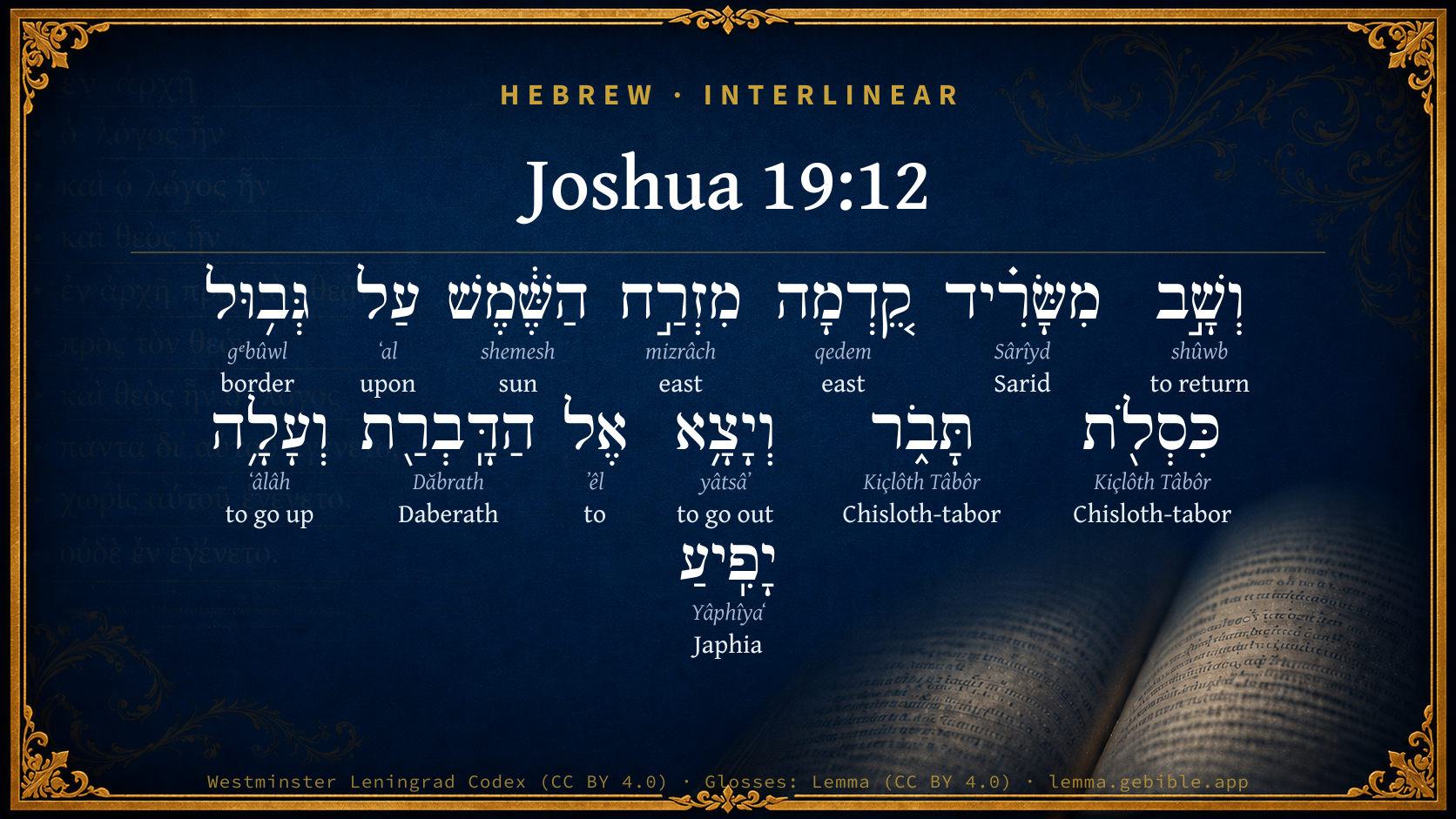
Hebrew (Westminster Leningrad Codex) Joshua 19:12 appears in the Hebrew Old Testament. The text above is from the Westminster Leningrad Codex. Each word links to its Strong’s number, a concise gloss, and parsing drawn from the Open Scriptures Hebrew Bible morphology. Click any word for its full Brown-Driver-Briggs (BDB) entry.
Download image
Cite this verse

Joshua 19:12 (World English Bible). Public Domain. Lemma interlinear Bible study tool, https://lemma.gebible.app/v/joshua/19/12.

Show BibTeX & RIS
BibTeX
RIS
English Translation
and it turned from Sarid eastward toward the sunrise to the border of Chisloth Tabor; and it went out to Daberath, and went up to Japhia;
World English Bible · Public Domain
Highlights
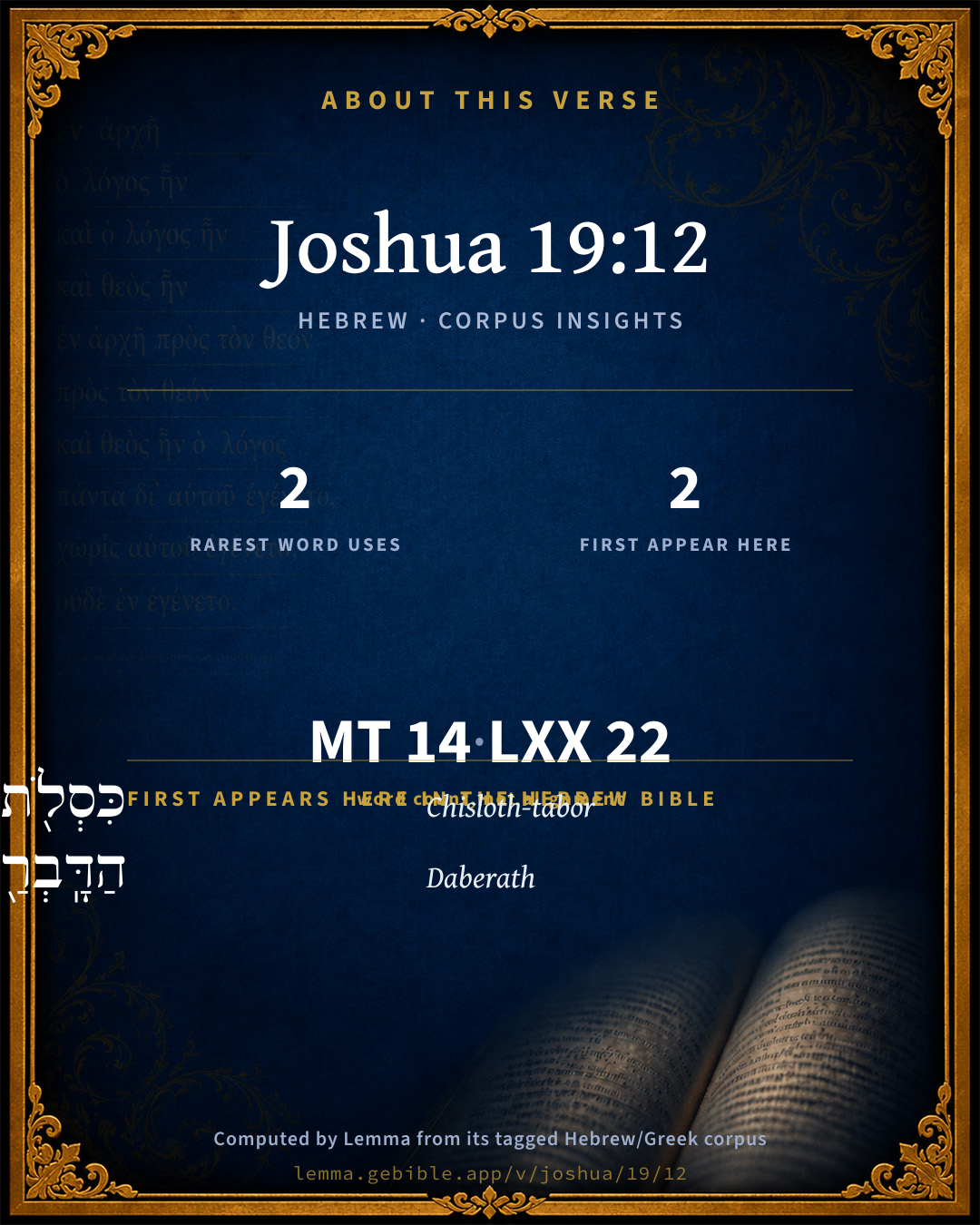
  • 2 first appearances in the Hebrew Bible
Full analysis ↓
Download a study sheet

One document with this verse’s original text, its word-by-word gloss line, the meaning frame, cross-references with their text, attributed commentary, and full source and license credits — printable, and it pastes into notes with its structure intact.

This verse Autodidact and up

Study sheet (.html) Plain text (.txt)

A passage Seminary Student

Up to 50 verses in one chapter. A passage sheet keeps up to 6 commentary sources and 12 cross-references per verse, in the order this page ranks them, and says so on the sheet whenever that leaves anything out. Ask for a single verse and you get the Autodidact verse sheet above.

Everything on this page stays free to read, with no account — the sheet is a download of what is already on screen, not access to it.

Want to remove ads? Support Godless Engineer
Compare translations 3

The same verse in 3 English versions, stacked beneath the original-language interlinear above. Click any original word for its lexicon entry.

Each is an independent rendering of the whole verse — the interlinear is not word-aligned to these translations.

Highlighted words mark where these versions differ — a whole-verse word diff, not a word-by-word alignment.

  • World English Bible Public Domain
    and it turned from Sarid eastward toward the sunrise to the border of Chisloth Tabor; and it went out to Daberath, and went up to Japhia;
  • King James Version Public Domain
    And turned from Sarid eastward toward the sunrising unto the border of Chislothtabor, and then goeth out to Daberath, and goeth up to Japhia,
  • unfoldingWord Literal Text CC BY-SA 4.0
    And it turned eastward from Sarid, the rising of the sun, upon the border of Kisloth Tabor. And it went out to Daberath and went up Japhia.

unfoldingWord Literal Text — © unfoldingWord, licensed CC BY-SA 4.0. Word-aligned USFM3 via Door43 (git.door43.org/unfoldingWord/en_ult).

Versions to compare (up to 4)

3 of 4 selected

Show all 18 translations

Every available English version of this verse, each an independent rendering of the whole verse.

  • World English Bible Public Domain
    and it turned from Sarid eastward toward the sunrise to the border of Chisloth Tabor; and it went out to Daberath, and went up to Japhia;
  • Berean Standard Bible Public Domain
    From Sarid it turned eastward along the border of Chisloth-tabor and went on to Daberath and up to Japhia.
  • Majority Standard Bible Public Domain
    From Sarid it turned eastward along the border of Chisloth-tabor and went on to Daberath and up to Japhia.
  • King James Version Public Domain
    And turned from Sarid eastward toward the sunrising unto the border of Chislothtabor, and then goeth out to Daberath, and goeth up to Japhia,
  • American Standard Version (1901) Public Domain
    and it turned from Sarid eastward toward the sunrising unto the border of Chisloth-tabor; and it went out to Daberath, and went up to Japhia;
  • Revised Version (1885) Public Domain
    and it turned from Sarid eastward toward the sunrising unto the border of Chisloth-tabor; and it went out to Daberath, and went up to Japhia;
  • Geneva Bible (1599) Public Domain
    And turneth from Sarid Eastward towarde the sunne rising vnto the border of Chisloth-tabor, and goeth out to Daberath, and ascendeth to Iaphia,
  • Douay-Rheims (1899) Public Domain
    And it returneth from Sarid eastward to the borders of Ceseleththabor: and it goeth out to Dabereth, and ascendeth towards Japhie.
  • Young's Literal Translation Public Domain
    and turned back from Sarid eastward, at the sun-rising, by the border of Chisloth-Tabor, and gone out unto Daberath, and gone up to Japhia,
  • Literal Standard Version CC BY-SA 4.0
    and turned back from Sarid eastward, at the sun-rising, by the border of Chisloth-Tabor, and gone out to Daberath, and gone up to Japhia,
  • Unlocked Literal Bible CC BY-SA 4.0
    From Sarid the border turned eastward toward the east and went to the border of Kisloth Tabor. From there it went to Daberath and then up to Japhia.
  • unfoldingWord Literal Text CC BY-SA 4.0
    And it turned eastward from Sarid, the rising of the sun, upon the border of Kisloth Tabor. And it went out to Daberath and went up Japhia.
  • Darby Bible Public Domain
    and turned from Sarid eastward, toward the sun-rising, to the border of Chisloth-Tabor, and went out to Dabrath, and went up to Japhia;
  • World Messianic Bible Public Domain
    It turned from Sarid eastward toward the sunrise to the border of Chisloth Tabor. It went out to Daberath, and went up to Japhia.
  • Webster's Bible Public Domain
    And turned from Sarid eastward, towards the sun-rising, to the border of Chisloth-tabor, and then goeth out to Daberath, and goeth up to Japhia,
  • Free Bible Version CC BY-SA 4.0
    Going the other way from Sarid, the boundary headed east to the border of Kislot-tabor, on to Daberath, and then up to Japhia.
  • Bible in Basic English Public Domain
    Then turning east from Sarid to the limit of Chisloth-tabor, it goes out to Daberath, and up to Japhia;
  • JPS Tanakh (1917) Public Domain
    And it turned from Sarid eastward toward the sunrising unto the border of Chisloth-tabor; and it went out to Dobrath, and went up to Japhia.

Literal Standard Version (2020), Covenant Press — licensed CC BY-SA 4.0. Text via the HelloAO Bible API (eBible.org). Unlocked Literal Bible (unfoldingWord) — licensed CC BY-SA 4.0. Text via the HelloAO Bible API (eBible.org). unfoldingWord Literal Text — © unfoldingWord, licensed CC BY-SA 4.0. Word-aligned USFM3 via Door43 (git.door43.org/unfoldingWord/en_ult). Free Bible Version, Dr. Jonathan Gallagher — licensed CC BY-SA 4.0. Text via the HelloAO Bible API (eBible.org).

Word by word

More ways to search: Search by grammar → Find every occurrence → Compare this word →

Practice this passage: Drill this verse → Learn its vocabulary →

מִשָּׂרִ֗יד
Sârîyd
H8301
“from · Sarid”
Preposition + Noun, Proper
Part of Speech
Preposition + Noun
Type
Proper
Full BDB Definition

Origin: the same as H8300

TWOT: None

Sarid = "survivor" - a place or landmark on the border of Zebulun
  1. וְשָׁ֣ב shûwb H7725 “and · to return” Conjunction + Verb, Qal, Perfect, 3rd Person, Masculine, Singular
  2. קֵ֚דְמָה qedem H6924 “east · toward” Noun, Common, Masculine, Singular, Absolute + Suffix, Demonstrative
  3. מִזְרַ֣ח mizrâch H4217 “east of” Noun, Common, Masculine, Singular, Construct
  4. הַשֶּׁ֔מֶשׁ shemesh H8121 “the · sun” Particle, Definite Article + Noun, Common, Both, Singular, Absolute
  5. עַל ʻal H5921 “upon” Preposition
  6. גְּב֥וּל gᵉbûwl H1366 “border of” Noun, Common, Masculine, Singular, Construct
  7. כִּסְלֹ֖ת Kiçlôth Tâbôr H3696 “Chisloth-tabor” Noun, Proper
  8. תָּבֹ֑ר Kiçlôth Tâbôr H3696 “Chisloth-tabor” Noun, Proper
  9. וְיָצָ֥א yâtsâʼ H3318 “and · to go out” Conjunction + Verb, Qal, Perfect, 3rd Person, Masculine, Singular
  10. אֶל ʼêl H413 “to” Preposition
  11. הַדָּֽבְרַ֖ת Dăbrath H1705 “the · Daberath” Particle, Definite Article + Noun, Proper
  12. וְעָלָ֥ה ʻâlâh H5927 “and · to go up” Conjunction + Verb, Qal, Perfect, 3rd Person, Masculine, Singular
  13. יָפִֽיעַ Yâphîyaʻ H3309 “Japhia” Noun, Proper

About this verse

These counts appear in no published source. They are computed here, from the morphology-tagged text and Lemma’s own curated glosses. What Lemma adds →

14
words
13
distinct lemmas
Historical
section

Notable vocabulary

The rarest word here is מִשָּׂרִ֗יד Sarid H8301 — appearing just 2 times in the whole Hebrew Bible.

First appearance in Scripture

These words make their first canonical appearance in the Hebrew Bible here:

  • כִּסְלֹ֖ת Chisloth-tabor H3696
  • הַדָּֽבְרַ֖ת Daberath H1705

Shared distinctive vocabulary

מִשָּׂרִ֗יד Sarid H8301 occurs in 2 verses of the Hebrew Bible. Also found in:

Grammatical profile

  • 3 verbs
  • 9 nouns
  • 2 prepositions

Verb forms

  • וְשָׁ֣ב Qal · Perfect
  • וְיָצָ֥א Qal · Perfect
  • וְעָלָ֥ה Qal · Perfect

Repetition

A word recurs within this verse — often emphatic in Hebrew:

  • כִּסְלֹ֖ת Chisloth-tabor H3696 ×2

Hebrew & Septuagint length

In English translation the verse runs 26 words from the Hebrew and 30 from the Septuagint (LXX English) — closely comparable.

A rough comparison of the two English renderings, which tokenize alike — not a word-level alignment.

Word counts can differ between the Hebrew and the Greek without any difference in meaning — e.g. the Hebrew direct-object marker אֵת has no separate Greek word, and Greek often adds the article ὁ.

In the original languages it is 14 Hebrew tokens and 22 Greek tokens — but the two are counted differently (Hebrew bundles its prefixes and suffixes into one token; the Greek is in lemma form), so that isn’t a like-for-like length.

Cross-references

6

Topical passages linked to Joshua 19:12 in the Treasury of Scripture Knowledge — connected by theme and wording, ordered by reader-vote popularity; previews shown in the World English Bible.

  • Joshua 19:22 and the border reached to Tabor, and Shahazumah, and Beth-shemesh; and the goings out of their border were at the Jordan: sixteen cities with their villages.
  • Joshua 21:28 Out of the tribe of Issachar, Kishion with its suburbs, Daberath with its suburbs,
  • Judges 4:6 She sent and called Barak the son of Abinoam out of Kedesh-naphtali, and said to him, Hasn't Yahweh, the God of Israel, commanded, [saying], Go and draw to Mount Tabor, and take with you ten thousand men of the children of Naphtali and of the children of Zebulun?
  • Judges 4:12 They told Sisera that Barak the son of Abinoam was gone up to Mount Tabor.
  • 1 Chronicles 6:72 and out of the tribe of Issachar, Kedesh with its suburbs, Daberath with its suburbs,
  • Psalms 89:12 The north and the south, you have created them. Tabor and Hermon rejoice in your name.

Cross-references courtesy of OpenBible.info (CC BY 4.0).

Hebrew and Greek witnesses Masoretic Hebrew ↔ Greek Septuagint

The same verse in the two great witnesses to the Old Testament, shown verse-for-verse.

These are two independent witnesses, not word-aligned to each other, and the Septuagint is shown in lemma (dictionary) form.

Hebrew Joshua 19:12 Masoretic · Westminster Leningrad Codex

וְשָׁ֣ב מִשָּׂרִ֗יד קֵ֚דְמָה מִזְרַ֣ח הַשֶּׁ֔מֶשׁ עַל גְּב֥וּל כִּסְלֹ֖ת תָּבֹ֑ר וְיָצָ֥א אֶל הַדָּֽבְרַ֖ת וְעָלָ֥ה יָפִֽיעַ

and it turned from Sarid eastward toward the sunrise to the border of Chisloth Tabor; and it went out to Daberath, and went up to Japhia;

World English Bible · Public Domain

Greek LXX Joshua 19:12 Septuagint · lemma form

καί ἀναστρέφω ἀπό σεδδουκ ἐκ ἐναντίος ἀπό ἀνατολή βαιθσαμυς ἐπί ὁ ὅριον χασελωθαιθ καί διαἔρχομαι ἐπί δαβιρωθ καί προσ ἀναβαίνω ἐπί φαγγαι

And the border returned from Sedduc in a contrary direction eastward from Baethsamys, to the borders of Chaselothaith, and shall pass on to Dabiroth, and shall proceed upward to Phangai.

LXX2012 (modern English Septuagint) · Public Domain

Hebrew: Westminster Leningrad Codex (CC BY 4.0). Greek: Septuagint (public domain); English from LXX2012 (modern English Septuagint) (Public Domain). How the Septuagint differs from the Hebrew →

Targum (Aramaic paraphrase)

1

The Targum is the ancient Jewish Aramaic paraphrase of the Hebrew Scriptures — an interpretive translation, not the Hebrew text itself. Onkelos (literal) and Pseudo-Jonathan (expansive) render the Torah, and Jonathan the Prophets. Coverage is partial: where no permissively-licensed English translation exists for a verse, only the Aramaic is shown. This is verse-level text, not a word-by-word alignment to the Hebrew.

  1. Targum Jonathan Prophets (Joshua–Malachi)
    וְתַב מִשָׂרִיד לְקִידוּמָא מַדְנַח שִׁמְשָׁא עַל תְּחוּם כִּסְלוֹת תָּבוֹר וְנָפֵיק לְדֻבְּרַת וּסְלִיק לְיָפִיעַ:

    (no public-domain English translation for this verse)

    Targum Jonathan — Aramaic: “Mikraot Gedolot” (public domain). English: “Sefaria Community Translation” (CC0 1.0 (public-domain dedication)); “London "Chaldee Paraphrase," 1871” (public domain). Text via Sefaria.

Commentary

Notes on Joshua 19:12 from classic Christian and Jewish commentators (each source and its license shown beneath its notes). The classic Christian expositions comment on the surrounding passage and are grouped to its opening verse, so a note may address several verses; the Jewish commentaries on the Tanakh (Rashi and others) are per-verse, so they appear only where the commentator wrote on this verse.

Lemma curates 59 commentaries, every one of them public domain or Creative Commons licensed, each selected and text-cleaned for this edition rather than reprinted as found. About our sources →

Trapp's Complete Commentary

John Trapp

Jos 19:12 And turned from Sarid eastward toward the sunrising unto the border of Chislothtabor, and then goeth out to Daberath, and goeth up to Japhia,

Ver. 12. Chislothtabor.] A mountain in the lower Galilee, called by Josephus, Itabirion. Here it is commonly conceived that our Saviour was transfigured. And of this place Jerome, on Hos 5:1, writeth copiously and elegantly.

John Trapp, A Commentary or Exposition upon All the Books of the Old and New Testament (1647–1656) — public domain. Text from a community e-Sword module.

Ellicott's Commentary for English Readers

(12) And goeth up to Japhia.—Better, and had gone up to Japhia, which lies west of the two places previously named. Daberath is the south-east boundary. El-Mesh-hed lies north of this.

A Bible Commentary for English Readers, edited by Charles John Ellicott (1878–1897) — public domain. Text from a community e-Sword module.

The Cambridge Bible for Schools and Colleges

gen. ed. J. J. S. Perowne

12. and turned from Sarid eastward] As the border turned from Sarid westward, so also it turned from the same point toward the east, toward the sunrising, unto the border of

Chisloth-tabor] now Iksâl, a rocky height two miles and a half to the west of Mount Tabor. Robinson’s Bib. Res. iii. 182. For Tabor, see below, Jos_19:22.

Daberath] Thence it went on to Daberath, a Levitical city, Jos_21:28; 1Ch_6:72, now Debârieh, a small village “lying on the side of a ledge of rocks directly at the foot of Tabor.”

and goeth up to Japhia] “and stieth up açens Jasie;” Wyclif. Japhia (= glancing) is two miles south of Nazareth, the modern Yâfa. Note the words “goeth up,” and compare the following words of Porter: “For three quarters of an hour more we wind through picturesque glens, their beds green with corn, and their banks dark with the foliage of the dwarf oak, hawthorn, and wild pear. Yâfa now appears on the top of a tell, down in a glen on the right.” Handbook, ii. p. 385. It was fortified by Josephus, and afterwards captured by Trajan and Titus under the orders of Vespasian; and in the storm and sack of the place 15000 of the inhabitants were put to the sword, and 2130 taken captive. The valley of Nazareth lies 400 feet higher than the plain at the western foot of Tabor.

The Cambridge Bible for Schools and Colleges (gen. ed. J. J. S. Perowne; Cambridge University Press, 1878–1918) — public domain. Text from a community e-Sword module.

John Gill's Exposition

And from thence passeth on along on the east to Gittahhepher,.... Which was the native place of Jonah the prophet, Kg2 14:25; and where Jerom says (r) his grave was shown, and was a small village in his time two miles from Sippore, then called Diocaesarea:

to Ittahkazin; of this place we have no account elsewhere, but it was not far from the former:

and goeth out to Remmonmethoar to Neah; where the eastern border ended. Some versions make Remmonmethoar distinct places; but where either of them were exactly is not known: some, as the Targum, Jarchi, and Kimchi, render the word "Methoar which goes about"; that is, the border went about from Remmon to Neah, which by Jerom is called Anna, and who observes (s), that there is another village called Anna, ten miles from Neapolis, as you go to Aelia; and by whom also Methoar is reckoned a distinct place, and called Amathar.

(r) Praefat. in Jonam. (s) De loc. Heb. fol. 38. H.

John Gill's Exposition of the Whole Bible (1746–1763) — public domain (CC PDM 1.0). Text via the HelloAO Bible API.

Matthew Poole's English Annotations

Daberath, a city in Issachar, as appears from Jos 21:18.

Matthew Poole's English Annotations on the Holy Bible (1683–1685) — public domain. Text from a community e-Sword/MySword module.

Whedon's Commentary on the Bible

Daniel D. Whedon

12. Chisloth-tabor, Robinson is inclined to identify with the village of Iksal, near the base of Mount Tabor, on a low, rocky ridge, and containing many excavated sepulchres. On Mount Tabor see note at Jdg_4:6. Daberath has been identified with the modern Deburieh, a small village just at the northwestern base of Tabor. Japhia, now called Yafa, is a half hour’s ride southwest of Nazareth, and contains about thirty houses. It is the traditional birthplace of St. James.

Daniel D. Whedon (gen. ed.), Commentary on the Old and New Testaments (1874–1909) — public domain. Text from a community e-Sword module.

The Pulpit Commentary

Chisloth-Tabor. The loins or flanks of Tabor. Tabor, (the name signifies either quarry see note on Shebarim, probably a kindred word, Jos_7:5 or navel) is one of the most conspicuous mountains of Palestine. Like Soracte, above the Campagna of Rome, "the cone-shaped figure of Tabor can be seen on all sides," though it rises only 1, 750 feet (French) above the level of the sea, 800 above the plain at its northeastern base, and 600 above Nazareth on the north-west (Ritter, 2:311). Chisloth-Tabor was on the northwest side of the base of Tabor. Tabor has been supposed to have been the scene of the Transfiguration. But Ritter points out that from the time of Antiochus the Great, 200 years before Christ, to the destruction of Jerusalem, the summit of Tabor was a fortress. And he notices that while Jerome and Cyril mention this tradition, Eusebius, who lived 100 years earlier, knows nothing of it.

The Pulpit Commentary (1880–1919), ed. H.D.M. Spence-Jones & Joseph S. Exell — public domain. Text from a community e-Sword module.

unfoldingWord translationNotes

Door43 World Missions Community

Sarid ... Kisloth Tabor ... Daberath ... Japhia ... Gath Hepher ... Eth Kazin ... Rimmon ... Neah

These are the names of cities. (See: How to Translate Names)

unfoldingWord translationNotes — © Distant Shores Media and the Door43 World Missions Community, licensed CC BY-SA 4.0. Source: git.door43.org/Door43/en_tn.

Rashi

Rabbi Shlomo Yitzchaki (Rashi)

Kislos-tovor. I say that [כִּסְלוֹת] is an expression of flanks, כְּסָלִים, flancs in old French. This is similar to what is stated in Vayikro 3:4. It is not at its highest point and not at its bottom, but on its slope, near the middle, closer to the rear, than the front, like the flanks of an animal. [Thus in this verse it reads the flanks of Mt. Tabor]. However when Scripture states, Oznos-Tavor, it refers to a place near its top, the place where the ears are situated.

Rashi on the Tanakh — English translations: “The Judaica Press complete Tanach with Rashi, translated by A. J. Rosenberg” (CC BY 4.0); “Pentateuch with Rashi's commentary by M. Rosenbaum and A.M. Silbermann, 1929-1934” (public domain); “The Metsudah Tanach series, Lakewood, N.J” (CC BY 4.0); and “The Book of Joshua, Metsudah Publications, 1997” (CC BY 4.0). Text via Sefaria.

Lesson kit

Teaching starters — assembled from the data on this page, not authored interpretation. Every prompt links to the verse data it draws on. Edit before teaching.

Joshua, in the Historical, opens this verse with 14 words (13 distinct Hebrew lemmas). Its most distinctive word is Sârîyd (“Sarid”). A historical commentator’s framing appears above. Read the whole chapter for the surrounding context.

Discussion questions

  1. The word Sârîyd carries the sense “Sarid.” How does it shape the verse?
  2. 2 words make their first appearance in Scripture here. What does this debut establish?
  3. How does Joshua 19:10, which shares the word «Sarid», read alongside this verse?
  4. What does the repetition of “Chisloth-tabor” (2× in this one verse) do in this verse?
  5. These translations render this verse differently. What is at stake in choosing one wording over another?
  6. «וְשָׁ֣ב» is a Qal Perfect verb. How does that grammatical form shape the action described?
  7. Compare how Trapp's Complete Commentary and Ellicott's Commentary for English Readers read this verse. Where do they agree or differ?

Things to notice

Reading settings

Reading text

Shown beneath each verse's original-language words.

Old Testament
Old Testament edition

Read the OT as the Masoretic Hebrew (MT) or the Greek Septuagint (LXX).

English shown for the Greek Septuagint (in the Hebrew ↔ Greek comparison).

Comparing translations? Open the Compare panel on any verse page to stack up to four side by side.