
Amos 1:9

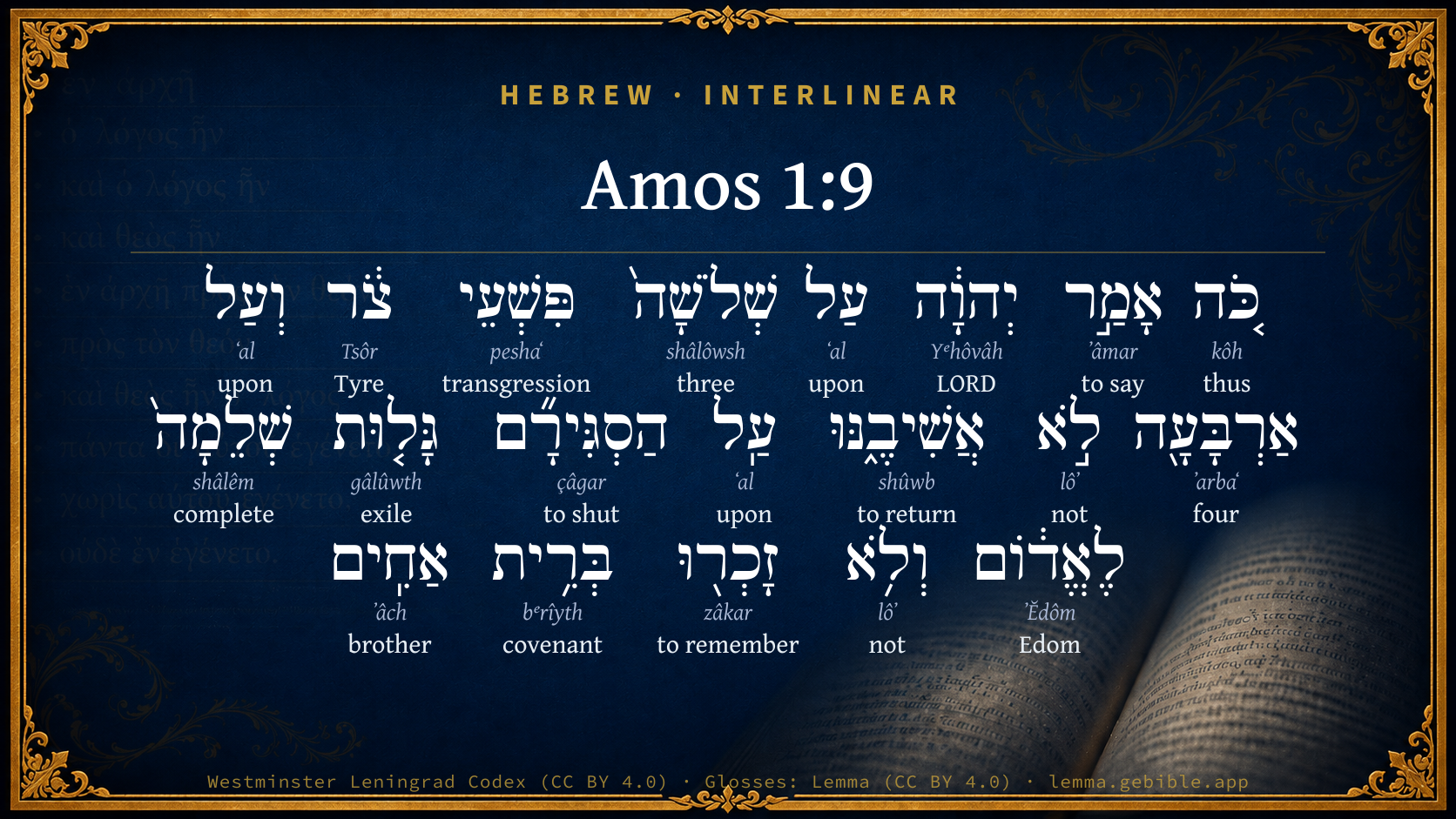
Hebrew (Westminster Leningrad Codex) Amos 1:9 appears in the Hebrew Old Testament. The text above is from the Westminster Leningrad Codex. Each word links to its Strong’s number, a concise gloss, and parsing drawn from the Open Scriptures Hebrew Bible morphology. Click any word for its full Brown-Driver-Briggs (BDB) entry.
Download image
Cite this verse

Amos 1:9 (World English Bible). Public Domain. Lemma interlinear Bible study tool, https://lemma.gebible.app/v/amos/1/9.

Show BibTeX & RIS
BibTeX
RIS
English Translation
Thus says Yahweh: "For three transgressions of Tyre, yes, for four, I will not turn away its punishment; Because they delivered up the whole community to Edom, And didn't remember the brotherly covenant;
World English Bible · Public Domain
Download a study sheet

One document with this verse’s original text, its word-by-word gloss line, the meaning frame, cross-references with their text, attributed commentary, and full source and license credits — printable, and it pastes into notes with its structure intact.

This verse Autodidact and up

Study sheet (.html) Plain text (.txt)

A passage Seminary Student

Up to 50 verses in one chapter. A passage sheet keeps up to 6 commentary sources and 12 cross-references per verse, in the order this page ranks them, and says so on the sheet whenever that leaves anything out. Ask for a single verse and you get the Autodidact verse sheet above.

Everything on this page stays free to read, with no account — the sheet is a download of what is already on screen, not access to it.

Want to remove ads? Support Godless Engineer
Compare translations 3

The same verse in 3 English versions, stacked beneath the original-language interlinear above. Click any original word for its lexicon entry.

Each is an independent rendering of the whole verse — the interlinear is not word-aligned to these translations.

Highlighted words mark where these versions differ — a whole-verse word diff, not a word-by-word alignment.

  • World English Bible Public Domain
    Thus says Yahweh: "For three transgressions of Tyre, yes, for four, I will not turn away its punishment; Because they delivered up the whole community to Edom, And didn't remember the brotherly covenant;
  • King James Version Public Domain
    Thus saith the LORD; For three transgressions of Tyrus, and for four, I will not turn away the punishment thereof; because they delivered up the whole captivity to Edom, and remembered not the brotherly covenant:
  • unfoldingWord Literal Text CC BY-SA 4.0
    This is what Yahweh says: “For three sins of Tyre, even for four, I will not turn away punishment, because they had delivered up a whole people to Edom, and they did not remember their covenant of brotherhood.

unfoldingWord Literal Text — © unfoldingWord, licensed CC BY-SA 4.0. Word-aligned USFM3 via Door43 (git.door43.org/unfoldingWord/en_ult).

Versions to compare (up to 4)

3 of 4 selected

Show all 18 translations

Every available English version of this verse, each an independent rendering of the whole verse.

  • World English Bible Public Domain
    Thus says Yahweh: "For three transgressions of Tyre, yes, for four, I will not turn away its punishment; Because they delivered up the whole community to Edom, And didn't remember the brotherly covenant;
  • Berean Standard Bible Public Domain
    This is what the LORD says: “For three transgressions of Tyre, even four, I will not revoke My judgment, because they delivered up a whole congregation of exiles to Edom and broke a covenant of brotherhood.
  • Majority Standard Bible Public Domain
    This is what the LORD says: “For three transgressions of Tyre, even four, I will not revoke My judgment, because they delivered up a whole congregation of exiles to Edom and broke a covenant of brotherhood.
  • King James Version Public Domain
    Thus saith the LORD; For three transgressions of Tyrus, and for four, I will not turn away the punishment thereof; because they delivered up the whole captivity to Edom, and remembered not the brotherly covenant:
  • American Standard Version (1901) Public Domain
    Thus saith Jehovah: For three transgressions of Tyre, yea, for four, I will not turn away the punishment thereof; because they delivered up the whole people to Edom, and remembered not the brotherly covenant:
  • Revised Version (1885) Public Domain
    Thus saith the LORD: For three transgressions of Tyre, yea, for four, I will not turn away the punishment thereof; because they delivered up the whole people to Edom, and remembered not the brotherly covenant:
  • Geneva Bible (1599) Public Domain
    Thus sayth the Lord, For three transgressions of Tyrus, and for foure, I will not turne to it, because they shut the whole captiuitie in Edom, and haue not remembred the brotherly couenant.
  • Douay-Rheims (1899) Public Domain
    Thus saith the Lord: For three crimes of Tyre, and for four I will not convert it: because they have shut up an entire captivity in Edom, and have not remembered the covenant of brethren.
  • Young's Literal Translation Public Domain
    Thus said Jehovah: For three transgressions of Tyre, And for four, I do not reverse it, Because of their delivering up a complete captivity to Edom, And they remembered not the brotherly covenant,
  • Literal Standard Version CC BY-SA 4.0
    Thus said YHWH: “For three transgressions of Tyre, || And for four, I do not reverse it, || Because of their delivering up a complete captivity to Edom, || And they did not remember the brotherly covenant,
  • Unlocked Literal Bible CC BY-SA 4.0
    This is what Yahweh says: “For three sins of Tyre, even for four, I will not turn away punishment, because they had delivered up a whole people to Edom, and they broke their covenant of brotherhood.
  • unfoldingWord Literal Text CC BY-SA 4.0
    This is what Yahweh says: “For three sins of Tyre, even for four, I will not turn away punishment, because they had delivered up a whole people to Edom, and they did not remember their covenant of brotherhood.
  • Darby Bible Public Domain
    Thus saith Jehovah: For three transgressions of Tyre, and for four, I will not revoke its sentence; because they delivered up the whole captivity to Edom, and remembered not the brotherly covenant.
  • World Messianic Bible Public Domain
    The LORD says: “For three transgressions of Tyre, yes, for four, I will not turn away its punishment; because they delivered up the whole community to Edom, and didn’t remember the brotherly covenant;
  • Webster's Bible Public Domain
    Thus saith the LORD; For three transgressions of Tyre, and for four, I will not turn away its punishment: because they delivered up the whole captivity to Edom, and remembered not the brotherly covenant:
  • Free Bible Version CC BY-SA 4.0
    This is what the Lord says: The people of Tyre have repeatedly sinned and so I will not hesitate to punish them, for they exiled whole communities, handing them over to Edom, and did not keep their agreement to help each other as members of the same family.
  • Bible in Basic English Public Domain
    These are the words of the Lord: For three crimes of Tyre, and for four, I will not let its fate be changed; because they gave up all the people prisoners to Edom, without giving a thought to the brothers' agreement between them.
  • JPS Tanakh (1917) Public Domain
    Thus saith the LORD: For three transgressions of Tyre, yea, for four, I will not reverse it: because they delivered up a whole captivity to Edom, and remembered not the brotherly covenant.

Literal Standard Version (2020), Covenant Press — licensed CC BY-SA 4.0. Text via the HelloAO Bible API (eBible.org). Unlocked Literal Bible (unfoldingWord) — licensed CC BY-SA 4.0. Text via the HelloAO Bible API (eBible.org). unfoldingWord Literal Text — © unfoldingWord, licensed CC BY-SA 4.0. Word-aligned USFM3 via Door43 (git.door43.org/unfoldingWord/en_ult). Free Bible Version, Dr. Jonathan Gallagher — licensed CC BY-SA 4.0. Text via the HelloAO Bible API (eBible.org).

Word by word

More ways to search: Search by grammar → Find every occurrence → Compare this word →

Practice this passage: Drill this verse → Learn its vocabulary →

גָּל֤וּת
gâlûwth
H1546
“exile”
Noun, Common, Feminine, Singular, Absolute
Part of Speech
Noun
Type
Common
Gender
Feminine
Number
Singular
State
Absolute
Full BDB Definition

Origin: from H1540

TWOT: 350b

exile, exiles - (TWOT) captivity
  1. כֹּ֚ה kôh H3541 “thus” Adverb
  2. אָמַ֣ר ʼâmar H559 “to say” Verb, Qal, Perfect, 3rd Person, Masculine, Singular
  3. יְהוָ֔ה Yᵉhôvâh H3068 “LORD” Noun, Proper
  4. עַל ʻal H5921 “upon” Preposition
  5. שְׁלֹשָׁה֙ shâlôwsh H7969 “three” Adjective, Cardinal number, Masculine, Singular, Absolute
  6. פִּשְׁעֵי peshaʻ H6588 “transgressions of” Noun, Common, Masculine, Plural, Construct
  7. צֹ֔ר Tsôr H6865 “Tyre” Noun, Proper
  8. וְעַל ʻal H5921 “and · upon” Conjunction + Preposition
  9. אַרְבָּעָ֖ה ʼarbaʻ H702 “four” Adjective, Cardinal number, Masculine, Singular, Absolute
  10. לֹ֣א lôʼ H3808 “not” Particle, Negative
  11. אֲשִׁיבֶ֑נּוּ shûwb H7725 “to return · him” Verb, Hiphil, Imperfect, 1st Person, Common, Singular + Suffix, Personal, 3rd Person, Masculine, Singular
  12. עַֽל ʻal H5921 “upon” Preposition
  13. הַסְגִּירָ֞ם çâgar H5462 “to shut · them” Verb, Hiphil, Infinitive Construct + Suffix, Personal, 3rd Person, Masculine, Plural
  14. שְׁלֵמָה֙ shâlêm H8003 “complete” Adjective, Adjective, Feminine, Singular, Absolute
  15. לֶאֱד֔וֹם ʼĔdôm H123 “to/for · Edom” Preposition + Noun, Proper
  16. וְלֹ֥א lôʼ H3808 “and · not” Conjunction + Particle, Negative
  17. זָכְר֖וּ zâkar H2142 “to remember” Verb, Qal, Perfect, 3rd Person, Common, Plural
  18. בְּרִ֥ית bᵉrîyth H1285 “covenant of” Noun, Common, Feminine, Singular, Construct
  19. אַחִֽים ʼâch H251 “brothers” Noun, Common, Masculine, Plural, Absolute

About this verse

These counts appear in no published source. They are computed here, from the morphology-tagged text and Lemma’s own curated glosses. What Lemma adds →

20
words
17
distinct lemmas
Prophets
section

Notable vocabulary

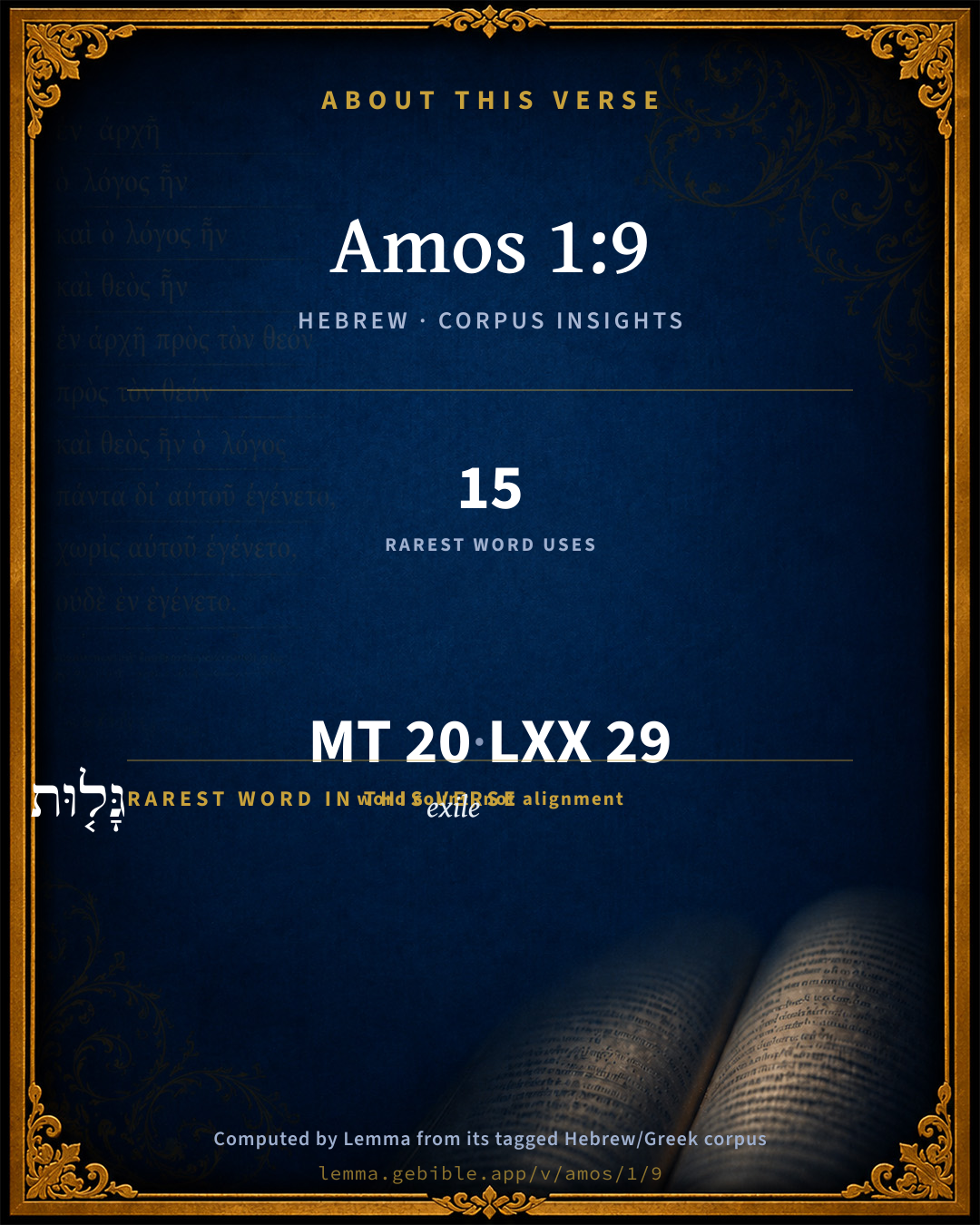
The rarest word here is גָּל֤וּת exile H1546 — appearing just 15 times in the whole Hebrew Bible.

Shared distinctive vocabulary

גָּל֤וּת exile H1546 occurs in 14 verses of the Hebrew Bible. Also found in:

Grammatical profile

  • 4 verbs
  • 7 nouns
  • 3 adjectives
  • 3 prepositions
  • 1 adverb
  • 2 particles

Verb forms

  • אָמַ֣ר Qal · Perfect
  • אֲשִׁיבֶ֑נּוּ Hiphil · Imperfect
  • הַסְגִּירָ֞ם Hiphil · Infinitive Construct
  • זָכְר֖וּ Qal · Perfect

Repetition

Words recur within this verse — often emphatic in Hebrew:

Hebrew & Septuagint length

In English translation the verse runs 33 words from the Hebrew and 36 from the Septuagint (LXX English) — closely comparable.

A rough comparison of the two English renderings, which tokenize alike — not a word-level alignment.

Word counts can differ between the Hebrew and the Greek without any difference in meaning — e.g. the Hebrew direct-object marker אֵת has no separate Greek word, and Greek often adds the article ὁ.

In the original languages it is 20 Hebrew tokens and 29 Greek tokens — but the two are counted differently (Hebrew bundles its prefixes and suffixes into one token; the Greek is in lemma form), so that isn’t a like-for-like length.

Cross-references

13

Topical passages linked to Amos 1:9 in the Treasury of Scripture Knowledge — connected by theme and wording, ordered by reader-vote popularity; previews shown in the World English Bible.

  • 1 Kings 9:11–14 (now Hiram the king of Tyre had furnished Solomon with cedar trees and fir trees, and with gold, according to all his desire), that then king Solomon gave Hiram twenty cities in the land of Galilee.
  • Isaiah 23:1–18 The burden of Tyre. Howl, you ships of Tarshish; for it is laid waste, so that there is no house, no entering in: from the land of Kittim it is revealed to them.
  • Joel 3:4–8 "Yes, and what are you to me, Tyre, and Sidon, And all the regions of Philistia? Will you repay me? And if you repay me, I will swiftly and speedily return your repayment on your own head.
  • Zechariah 9:2–4 And Hamath, also, which borders on it; Tyre and Sidon, because they are very wise.
  • 2 Samuel 5:11 Hiram king of Tyre sent messengers to David, and cedar trees, and carpenters, and masons; and they built David a house.
  • 2 Chronicles 2:8–16 Send me also cedar trees, fir trees, and algum trees, out of Lebanon; for I know that your servants know how to cut timber in Lebanon: and, behold, my servants shall be with your servants,
  • Ezekiel 26:1–21 It happened in the eleventh year, in the first [day] of the month, that the word of Yahweh came to me, saying,
  • 1 Kings 5:1–11 Hiram king of Tyre sent his servants to Solomon; for he had heard that they had anointed him king in the room of his father: for Hiram was ever a lover of David.
  • Jeremiah 25:22 and all the kings of Tyre, and all the kings of Sidon, and the kings of the isle which is beyond the sea;
  • Jeremiah 47:4 because of the day that comes to destroy all the Philistines, to cut off from Tyre and Sidon every helper who remains: for Yahweh will destroy the Philistines, the remnant of the isle of Caphtor.
  • Amos 1:6 Thus says Yahweh: "For three transgressions of Gaza, yes, for four, I will not turn away its punishment; Because they carried away captive the whole community, To deliver them up to Edom;
  • Amos 1:11 Thus says Yahweh: "For three transgressions of Edom, yes, for four, I will not turn away its punishment; Because he pursued his brother with the sword, And cast off all pity, And his anger raged continually, And he kept his wrath forever;
  • Matthew 11:21 "Woe to you, Chorazin! Woe to you, Bethsaida! For if the mighty works had been done in Tyre and Sidon which were done in you, they would have repented long ago in sackcloth and ashes.

Cross-references courtesy of OpenBible.info (CC BY 4.0).

Hebrew and Greek witnesses Masoretic Hebrew ↔ Greek Septuagint

The same verse in the two great witnesses to the Old Testament, shown verse-for-verse.

These are two independent witnesses, not word-aligned to each other, and the Septuagint is shown in lemma (dictionary) form.

Hebrew Amos 1:9 Masoretic · Westminster Leningrad Codex

כֹּ֚ה אָמַ֣ר יְהוָ֔ה עַל שְׁלֹשָׁה֙ פִּשְׁעֵי צֹ֔ר וְעַל אַרְבָּעָ֖ה לֹ֣א אֲשִׁיבֶ֑נּוּ עַֽל הַסְגִּירָ֞ם גָּל֤וּת שְׁלֵמָה֙ לֶאֱד֔וֹם וְלֹ֥א זָכְר֖וּ בְּרִ֥ית אַחִֽים

Thus says Yahweh: "For three transgressions of Tyre, yes, for four, I will not turn away its punishment; Because they delivered up the whole community to Edom, And didn't remember the brotherly covenant;

World English Bible · Public Domain

Greek LXX Amos 1:9 Septuagint · lemma form

ὅδε λέγω κύριος ἐπί ὁ τρεῖς ἀσέβεια τύρος καί ἐπί ὁ τέσσαρες οὐ ἀποστρέφω αὐτός ἀντί ὅς συνκλείω αἰχμαλωσία ὁ σαλωμών εἰς ὁ ιδουμαία καί οὐ μιμνήσκω διαθήκη ἀδελφός

Thus says the Lord; For three transgressions of Tyre, and for four, I will not turn away from it; because they shut up the prisoners of Solomon into Idumea, and remembered not the covenant of brethren.

LXX2012 (modern English Septuagint) · Public Domain

Hebrew: Westminster Leningrad Codex (CC BY 4.0). Greek: Septuagint (public domain); English from LXX2012 (modern English Septuagint) (Public Domain). How the Septuagint differs from the Hebrew →

Targum (Aramaic paraphrase)

1

The Targum is the ancient Jewish Aramaic paraphrase of the Hebrew Scriptures — an interpretive translation, not the Hebrew text itself. Onkelos (literal) and Pseudo-Jonathan (expansive) render the Torah, and Jonathan the Prophets. Coverage is partial: where no permissively-licensed English translation exists for a verse, only the Aramaic is shown. This is verse-level text, not a word-by-word alignment to the Hebrew.

  1. Targum Jonathan Prophets (Joshua–Malachi)
    כִּדְנַן אֲמַר יְיָ עַל תְּלָתָא חוֹבֵי צוֹר וְעַל אַרְבְּעָא לָא אֶשְׁבּוֹק לְהוֹן עַל דְמַסְרִינוּן גָלוּ שְׁלֵימָא לֶאֱדוֹם וְלָא אִידְכָּרוּ קִיֵם אַחִין:

    (no public-domain English translation for this verse)

    Targum Jonathan — Aramaic: “Mikraot Gedolot” (public domain). English: “Sefaria Community Translation” (CC0 1.0 (public-domain dedication)); “London "Chaldee Paraphrase," 1871” (public domain). Text via Sefaria.

Commentary

Notes on Amos 1:9 from classic Christian and Jewish commentators (each source and its license shown beneath its notes). The classic Christian expositions comment on the surrounding passage and are grouped to its opening verse, so a note may address several verses; the Jewish commentaries on the Tanakh (Rashi and others) are per-verse, so they appear only where the commentator wrote on this verse.

Lemma curates 59 commentaries, every one of them public domain or Creative Commons licensed, each selected and text-cleaned for this edition rather than reprinted as found. About our sources →

Trapp's Complete Commentary

John Trapp

Amo 1:9 Thus saith the LORD; For three transgressions of Tyrus, and for four, I will not turn away [the punishment] thereof; because they delivered up the whole captivity to Edom, and remembered not the brotherly covenant:

Ver. 9. For three transgressions of Tyrus] That crown of the sea, Isa 23:8, media insuperabilis unda, island unconquorerable by sea, till Alexander’s time, who joined it to the continent, and afterwards ruined it. Charged it is here as those before, 1. With incurable obstinace; 2. With extreme cruelty.

Because they delivered up the whole captivity] Which either themselves had taken, or that had fled to them for refuge in some common calamity; but were betrayed by them into the hands of their bitterest enemies. See Amo 1:6, and acknowledge the truth of that Divine proverb, "The tender mercies of the wicked are cruel": they help their clients no otherwise than the wolf in the fable helped the sheep of his cough, by sucking his blood.

And have not remembered the brotherly covenant] That passed of old between David, Solomon, and Hiram their king. Or rather, that between Jacob and Esau and their respective posterity, which the Tyrians should have promoted by labouring a reconciliation between these dissenting brethren; but they contrariwise blew up the coals, and rather stirred up more strife then stinted it. They called not to mind what unity and amity ought to be between people so near allied; and what good offices they should therefore have done for them.

“ Protenus indigni fraternum rumpere foedus. ” Horat.

"Thou shalt not abhor an Edomite, for he is thy brother." This is God’s argument to Israel, Deu 23:7. Should not the Tyrians have said the like to the Edomites, and so sought to have pacified them, rather than gratified them in their hereditary hatred and deadly feud, &c.? They put themselves among those worst of men, which, given over of God, though they know the law, how that they which commit such things are worthy of death, yet not only do the same, but also take pleasure in those that do them, Rom 1:32.

John Trapp, A Commentary or Exposition upon All the Books of the Old and New Testament (1647–1656) — public domain. Text from a community e-Sword module.

The Biblical Illustrator

Joseph S. Exell

Amo_1:9-10

I will send a fire on the wall of Tyrus, which shall devour the palaces thereof.

The Divine judgment on Tyre

To follow out the accomplishment of the prophecies respecting Tyre, under the conduct of so good a guide as Bishop Newton, is a most interesting occupation. He gives the following quotation from Maundrell. This city, standing in the sea, upon a peninsula, promises at a distance something very magnificent. But when you come to it, you find no similitude of that glory for which it was so renowned in ancient times. On the north side, it was an old Turkish, ungarrisoned castle; besides which you see nothing here but a mere Babel of broken walls, pillars, vaults, etc., there being not so much as one entire house left; its present inhabitants are only a few poor wretches, harbouring themselves in the vaults, and subsisting chiefly upon fishing, who seem to be preserved in this place by Divine providence, as a visible evidence, how God has fulfilled His word concerning Tyre, namely, that it should be as a top of a rock, a place for fishers to dry their nets on. Newton himself says: Such hath been the fate of this city, once the most famous in the world for trade and commerce. But trade is a fluctuating thing: it passed from Tyre to Alexandria, from Alexandria to Venice, from Venice to Antwerp, from Antwerp to Amsterdam and London, the English rivalling the Dutch, as the French are now rivalling both. All nations almost are now wisely applying themselves to trade; and it behoves those who are in possession of it to take the greatest care they do not lose it. It is a plant of tender growth, and requires sun and soil and fine seasons to make it thrive and flourish. It will not grow like the palm tree, which, with the more weight and pressure, rises the more. Liberty is a friend to that, as that is a friend to liberty. But the greatest enemy to both is licentiousness, which tramples upon all law and lawful authority, encourages riots and tumults, promotes drunkenness and debauchery, sticks at nothing to supply its extravagance, practises every art of illicit gain, ruins credit, ruins trade, and will, in the end, ruin liberty itself. Neither kingdoms nor commonwealths, neither public companies nor private persons, can long carry on a beneficial, flourishing trade without virtue and what virtue teacheth, sobriety, industry, frugality, modesty, honesty, punctuality, humanity, charity, the love of our country, and the fear of God. The prophets will inform us how the Tyrians lost it; and the like causes will always produce the like effects. (Vincent W. Ryan, M. A.)

The Biblical Illustrator, edited by Joseph S. Exell (c. 1880s–1900s) — public domain. Text from a community e-Sword module.

Joseph Benson's Commentary

Amo 1:9. For three transgressions of Tyrus, &c. — This prediction is probably to be understood of the destruction of Tyre by Nebuchadnezzar, as foretold by Isaiah, Jeremiah, and Ezekiel: see the margin. Because they delivered up the whole captivity to Edom — Without doubt the Edomites used the Jewish captives with great barbarity, as the delivering of these captives up to them is also assigned as a principal reason of the punishment of Tyre, as it was of the punishment of Damascus, Amo 1:6. And remembered not the brotherly covenant — That strict league and friendship begun between David and Hiram, king of Tyre, and afterward continued by Solomon, (see the margin,) Hiram giving Solomon the title of My brother, as we read 1Ki 9:13.

Joseph Benson's Commentary on the Old and New Testaments (1811–1818) — public domain. Text from a community e-Sword module.

Whedon's Commentary on the Bible

Daniel D. Whedon

9, 10. The sin and punishment of Phoenicia. Tyrus [“Tyre”] — The most important of the cities of Phoenicia, representing here the entire nation (see on Joe_3:4; Zec_9:2). The crime condemned is similar to that of Philistia.

They delivered up the whole captivity [“people”] — See on Amo_1:6. If the last clause of Amo_1:9 is a condemnation of a second crime, independent of the slave trade, it may be correct to say that “the Phoenicians are not charged with taking captives, as are the Philistines (Amo_1:6), but with delivering them, that is, acting as agents for those who actually took them.” However, the last clause of Amo_1:9 may be a circumstantial clause, “without remembering the brotherly covenant.” If so, the two are brought into closer relation, and the crime condemned is most probably the taking and selling of slaves in violation of some sacred agreement.

The brotherly covenant — Literally, and margin, “the covenant of brethren.” This is commonly interpreted of the covenant between Solomon and Hiram of Tyre (1Ki_5:1 ff.; compare Amo_9:13). Against this interpretation Driver urges with some justice, “It is scarcely likely that the crowning offense of Tyre should be forgetfulness of a treaty entered into nearly three hundred years previously.” If the two clauses are connected, the breaking of the covenant and the taking or delivering of slaves sustain some relation to each other; when the slave raids were undertaken the breaking of a covenant was involved. It is nowhere stated that the slaves were Hebrews, or that the covenant was a covenant with Israel. Amo_2:1, makes it certain that Amos’s denunciations were not limited to sins against the chosen nation. Hence it is not unreasonable to suppose that the slaves were taken from other Phoenician or from Canaanitish communities with which the Tyrians sustained treaty relations, the breaking of which constituted the breach of the “brotherly covenant.” Tyre, being a commercial city, would find it advantageous to maintain friendly relations with its neighbors, which might be sealed by treaties, as in the case of Israel. For selfish purposes these sacred treaties were broken, and this treachery called forth the severe denunciation of the prophet. It is mere assumption to say that the covenant between Hiram and Solomon “had an especial provision against selling them (that is, captured Jews) away from their own land.”

Other prophets agree with Amos in foretelling the doom of Tyre (Isaiah 23; Jer_25:22; Ezekiel 26-28; Joe_3:4; Zec_9:3-4); but it was a long time before the ruin of Tyre was accomplished. The Tyrian policy, to purchase peace by the payment of heavy tribute rather than to encounter the Assyrian armies, postponed the disaster for centuries. This policy had its origin even before the time of Amos. Ashur-nasir-pal of Assyria (885-860) received tribute from Tyre and other Phoenician cities. Shalmaneser II (in 842, 839) and Tiglath-pileser III (in 734) also received tribute. Shalmaneser IV is said to have attacked the city; he was defeated on sea and a siege from the land side, after having been maintained for five years, had to be raised. Sennacherib and Esar-haddon appear to have been no more successful; but in 664 Ashur-banapal took the city by storm. It soon regained its prestige, and at a later time Nebuchadnezzar besieged the city; the siege continued for thirteen years, and its outcome is in doubt (Eze_29:18). The heaviest blow fell in 332, when, after a siege of seven months, the city fell before Alexander the Great. In the taking of the city six thousand are said to have perished by the sword, two thousand to have been crucified, and thirty thousand women, children, and slaves to have been sold. It recovered rapidly and played an important role until 1291 A.D., when it fell permanently into the hands of the Saracens. Now its site is covered by an insignificant Arab village. “After having been the mother of colonies and the mistress of the seas, bearing her merchandise into otherwise unvisited lands and adjusting the supply and demand of the world, Tyre is now content, at the close of her career, to be a stagnant village in stagnant Turkey.” On the authenticity of this oracle see pp. 220ff.

Daniel D. Whedon (gen. ed.), Commentary on the Old and New Testaments (1874–1909) — public domain. Text from a community e-Sword module.

The Preacher's Complete Homiletical Commentary

Joseph S. Exell (gen. ed.)

CRITICAL NOTES.]

Amo_1:9-10. Tyrus] The crime here is sale of prisoners, like the preceding, to Edom; a violation of the covenant of David and Solomon with the king of Tyre (2Sa_5:11; 1Ki_5:1; 1Ki_9:11).

THE JUDGMENT ON TYRE.—Amo_1:9-10

The third people spoken against are the inhabitants of Tyre.

I. The ground of the judgment. Like other nations they were guilty of many sins.

1. They trafficked in human souls. If they did not carry away, “they delivered up the whole captivity” to the mortal enemy of the Jews. They sold their captives to Grecians far away (Joe_3:3), and cared not for the hardships of those who fled to them for shelter.

2. They violated the sacred covenant. “And remembered not the brotherly covenant.” David and Solomon entered into a friendly alliance with the king of Tyre (2Sa_5:11; 1Ki_5:15). Hiram supplied Solomon with timber and carpenters in return for oil and corn; recognized David as chosen of God, and was “ever a lover of David” (1Ki_5:1). The covenant no doubt recognized God as the true God, and guaranteed religious privileges, undisturbed peace and safety. No king of Israel or Judah had ever made war with Phœnicia. Yet they forgot this friendly feeling, and remembered not the brotherly covenant. They sinned in helping Edom in their vile trade; in forgetting their solemn obligation, and in disregarding God for the sake of mercantile gain. A costlier object than man does not exist. He who seeks to enrich himself by the possession and traffic of his fellow-creatures will be branded as a pest to humanity.

God gave us over beast, fish, fowl,

Dominion absolute; that right we hold

By his donation; but man over man

He made not lord, such title to himself

Reserving—human left for human free.

II. The nature of the punishment. “I will send a fire on the wall of Tyrus, which shall devour the palaces thereof.” Many parts of Tyre were burnt by fiery missiles of the Chaldeans under Nebuchadnezzar. He took it after a thirteen eos’ siege. Alexander of Macedon subsequently overthrew it. “Note,” says one, “that though the crime charged may have been immediately due to the greed of the merchants of Tyre, acting in their private capacity, the whole community is held responsible for their deeds. It is the duty of every State to restrain and punish the unjust aggressions of its citizens on other communities, and if it fails to do so, it must abide the consequences.”

ILLUSTRATIONS TO CHAPTER 1

Amo_1:9. Brotherly covenant. Be steadfast in thy covenant, and be conversant therein, and wax old in thy work (Sir_11:20). Remember thy covenants, and bear no malice to thy neighbour (Sir_28:7).

The Preacher's Complete Homiletical Commentary (gen. ed. Joseph S. Exell; Funk & Wagnalls, c. 1892) — public domain (pre-1929). A full-Bible homiletical/sermon-outline anthology covering 65 of 66 books (2 John is absent from the source module). Text from a community e-Sword module.

Keil & Delitzsch

C. F. Keil & F. Delitzsch

Tyre or Phoenicia. - Amo 1:9. "Thus saith Jehovah: For three transgressions of Tyre, and for four, I shall not reverse it, because they have delivered up prisoners in full number to Edom, and have not remembered the brotherly covenant, Amo 1:10. I send fire into the wall of Tyrus, and it will devour their palaces." In the case of Phoenicia, the capital only (Tzōr, i.e., Tyrus; see at Jos 19:29) is mentioned. The crime with which it is charged is similar to the one for which the Philistines were blamed, with this exception, that instead of על־הגלותם להסגּיר (Amo 1:6) we have simply על־הסגּירם. If, therefore, Tyre is only charged with delivering up the captives to Edom, and not with having carried them away, it must have bought the prisoners from an enemy of Israel, and then disposed of them to Edom. From what enemy they were purchased, it is impossible to determine with certainty. Probably from the Syrians, in the wars of Hazael and Benhadad with Israel; for there is nothing at variance with this in the fact that, when they purchased Israelitish captives in the time of Joram, they sold them to Javan. For a commercial nation, carrying on so extensive a trade as the Phoenicians did, would have purchased prisoners in more than one war, and would also have disposed of them as slaves to more nations than one. Tyre had contracted all the more guilt through this trade in Israelitish salves, from the fact that it had thereby been ummindful of the brotherly covenant, i.e., of the friendly relation existing between Israel and itself-for example, the friendly alliance into which David and Solomon had entered with the king of Tyre (Sa2 5:11; Kg1 5:15.) - and also from the fact that no king of Israel or Judah had ever made war upon Phoenicia.

Keil & Delitzsch — Biblical Commentary on the Old Testament (1861–1891) — public domain (CC PDM 1.0). Text via the HelloAO Bible API. (Old Testament only.)

Tyndale Open Study Notes

Tyndale Open Resources

1:9 Tyre and Sidon were the principal seaports of Phoenicia. • Tyre’s crime, like Philistia’s (1:6-8), was selling whole villages of Israelite captives to the Edomites as slaves, a captivity made more bitter by a sense of betrayal (see 2 Sam 5:11; 1 Kgs 5:1, 11; 16:30-31). Tyre’s reputation was “anything is for sale”; Isaiah portrayed the city as a prostitute peddling her wares (Isa 23:15-17).

Tyndale Open Study Notes — © Tyndale Open Resources, licensed CC BY-SA 4.0. Text via the HelloAO Bible API.

Geneva Bible (1599)

Geneva Bible translators

For Esau (of whom came the Edomites) and Jacob were brethren, therefore they ought to have admonished them of their brotherly friendship, and not to have provoked them to hatred.

Geneva Bible (1599) marginal notes — public domain. Text via Bolls.life.

Jamieson, Fausset & Brown

Robert Jamieson, A. R. Fausset & David Brown

Tyrus . . . delivered up the . . . captivity to Edom--the same charge as against the Philistines (Amo 1:6).

remembered not the brotherly covenant--the league of Hiram of Tyre with David and Solomon, the former supplying cedars for the building of the temple and king's house in return for oil and corn (Sa2 5:11; Kg1 5:2-6; Kg1 9:11-14, Kg1 9:27; Kg1 9:10-22; Ch1 14:1; Ch2 8:18; Ch2 9:10).

Jamieson, Fausset & Brown — Commentary Critical and Explanatory on the Whole Bible (1871) — public domain (CC PDM 1.0). Text via the HelloAO Bible API.

Adam Clarke's Commentary

Verse 9. Tyrus] See an ample description of this place, and of its desolation and final ruin, in the notes on Eze 26:1-28:19.

The brotherly covenant] This possibly refers to the very friendly league made between Solomon and Hiram, king of Tyre, 1Kg 5:12; but some contend that the brotherly covenant refers to the consanguinity between the Jews and Edomites. The Tyrians, in exercising cruelties upon these, did it, in effect, on the Jews, with whom they were connected by the most intimate ties of kindred; the two people having descended from the two brothers, Jacob and Esau. See Calmet.

Adam Clarke's Commentary on the Bible (1810–1826) — public domain. Text from a community e-Sword/MySword module.

John Calvin's Commentaries

He uses nearly the same words respecting Tyrus which he did respecting Gaza, and charges it with the same sin, which was that of removing the Jews from their country, as refugees and exiles, into Idumea, and of selling them as captives to the Idumeans. As of all the rest, he declares the same of Tyrus, that they had not lightly sinned, and that therefore no moderate chastisement was sufficient; for they had for a long time abused God’s forbearance, and had become stubborn in their wickedness.

But what he says, that they had not been mindful of the covenant of brethren, some refer to Hiram and David; for we know that they had a brotherly intercourse, and called each other by the name of brothers; so great was the kindness between them. Some then think that the Tyrians are here condemned for having forgotten this covenant; for there ought to have remained among them some regard for the friendship which had existed between the two kings. But I know not whether this is too strained a view: I rather incline to another, and that is, that the Syrians delivered up the Jews and the Israelites to the Idumeans, when yet they knew them to be brethren: and they who implicate themselves in a matter of this kind are by no means excusable. When I see one conspiring for the ruin of his own brother, I see a detestable and a monstrous thing; if I abhor not a participation in the same crime, I am involved in the same guilt. When therefore the Syrians saw the Idumeans raging cruelly against their brethren, for they were descended from the same family, they ought doubtless to have shown to the Idumeans how alienated they were from all humanity and how perfidious they were against their own brethren and relatives. Now the Prophet says, that they had been unmindful of the covenant of brethren, because they made themselves assistants in so great and execrable a crime as that of carrying away Jews into Idumea, and of shutting them up there, when they knew that the Idumeans sought nothing else but the entire ruin of their own brethren. This seems to be the real meaning of the Prophet.

John Calvin's Commentaries (1540-1563) — public domain. Text from the Calvin Translation Society English edition (1840s-50s) via the Christian Classics Ethereal Library (ccel.org). Calvin's coverage is partial (roughly two-thirds of the Bible); uncommented books and verses are honest gaps, never fabricated. The 19th-century editor's footnotes and remarks are omitted so the notes are faithfully Calvin's own voice.

Ellicott's Commentary for English Readers

CURSE ON TYRUS.

(9) The brotherly covenant.—The “covenant of brethren” (margin) was the league made between Hiram and David, and afterwards between Hiram and Solomon (2Sa_5:11; 1Ki_5:1; 1Ki_5:12). This ancient covenant was forgotten in Phœnicia’s mercantile cupidity, and Tyre was tempted to sell Hebrew captives to Greeks and Idumeans. (Comp. Isaiah 23; Ezekiel 26, and the special excursus in the Speaker’s Commentary.)

A Bible Commentary for English Readers, edited by Charles John Ellicott (1878–1897) — public domain. Text from a community e-Sword module.

The Cambridge Bible for Schools and Colleges

gen. ed. J. J. S. Perowne

9–10. Tyre, the great commercial city of the North, next receives her doom from the prophet’s lips. Tyre, as the most important of the Phoenician cities, is taken as representing Phoenicia generally. For defensive purposes Tyre was strongly fortified; but the Phoenicians were not an aggressive people: they were devoted to commerce: Tyre was a ‘mart of nations’ (Isa_23:3), a centre of trade by land as well as by sea (see the striking picture of the variety and extent of Tyrian commerce in Ezekiel 27); hence her relations with the Hebrews, as with her neighbours generally, were peaceful. The Tyrians were also celebrated for skill in artistic work: Hiram, king of Tyre, sent Tyrian workmen to build a palace for David; a formal treaty was concluded between Hiram and Solomon; Tyrian builders prepared timber and stones for the Temple; and a Tyrian artist designed and cast the chief ornaments and vessels of metal belonging to it (2Sa_5:11; 1Ki_5:1-12; 1Ki_5:18; 1Ki_7:13-45).

because they delivered up entire populations to Edom] The charge is similar to that brought against the Philistines, Amo_1:6; the Tyrians however are not accused of taking captives, but only of delivering them to others, i.e. of acting as agents for those who actually took them. For the Tyrians taking part in the trade of slaves, cf. Eze_27:13; and see on Joe_3:6. What ‘exiled companies’ are alluded to does not appear; they need not necessarily have consisted of Israelites; the reference may be as well to gangs of slaves procured with violence from other nations.

and remembered not the brotherly covenant] lit. the covenant of—i.e. between—brothers: this forgetfulness was an aggravation of the offence, which is not mentioned in the case of Gaza, Amo_1:6. The allusion is commonly supposed to be to the league, or ‘covenant,’ concluded between Hiram and Solomon, 1Ki_5:12 (for ‘brother’ used figuratively of one joined in amity to another, see 1Ki_9:13; 1Ki_20:32); but it is scarcely likely that the crowning offence of Tyre should be forgetfulness of a treaty entered into nearly 300 years previously; more probably the reference is to the way in which, repudiating some alliance formed with other Phoenician towns, the Tyrians were the means of procuring slaves from them for Edom. As Amo_2:1 shews, Amos does not restrict his censure to wrongs perpetrated against Israel: it is the rights common to humanity at large, which he vindicates and defends.

Isaiah (ch. 23), Jeremiah, at least incidentally (Jer_25:22), Ezekiel (ch. 26–28), Zechariah (Zec_9:3 f.), all foretell the ruin of Tyre; but it was long before it was accomplished. The Tyrians, it seems, escaped as a rule the hostility of the Assyrians by acquiescing in a condition of dependence and by timely payment of tribute. Thus Asshurnazirpal (b.c. 885–860) boasts of marching with his army as far as the “great sea of the West,” and receiving tribute from Tyre, Sidon, Gebal, and Arvæd; but he claims no conquest by arms (K.A.T[121][122], p. 157; R.P[123][124] iii. 73 f.). Shalmaneser II. receives tribute in his 18th and 21st years (b.c. 842, 839) from Tyre and Sidon (K.A.T[125][126], p. 207, 210; R.P[127][128] iv. 44 f.),—in the former year, together with that of Jehu, Hiram, king of Tyre, pays tribute to Tiglath-pileser in 734 (ib. p. 253). Shalmaneser IV. besieged Tyre for five years, but it does not appear that he took it. Both Esarhaddon and Asshurbanipal name “Baal of Tyre” among their tributaries (K.A.T[129][130], p. 356). Tyre sustained a long siege—according to Josephus one of 13 years—at the hands of Nebuchadnezzar; but it is not stated whether he captured it,—Ezekiel, in his allusion (Eze_29:18), implies that he did not. In the subsequent centuries the greatest blow which befel Tyre was its capture, after a seven months’ siege, by Alexander the Great, when 30,000 of its inhabitants were sold into slavery. It recovered itself, however, and continued for long afterwards to be an important naval and commercial city: Jerome (c. a.d. 400) describes it as Phoenices nobilissima et pulcherrima civitas, and says that mercantile transactions of nearly all nations were carried on in it. The final blow was not given to Tyre till a.d. 1291, when it was taken by the Saracens; and since then the site of the once populous and thriving city has been little more than a barren strand.

[121] .A.T. … Eb. Schrader, Die Keilinschriften und das A. T., ed. 2, 1883 (translated under the title The Cuneiform Inscriptions and the O. T. 1885, 1888). The references are to the pagination of the German, which is given on the margin of the English translation.

[122] … Eb. Schrader, Die Keilinschriften und das A. T., ed. 2, 1883 (translated under the title The Cuneiform Inscriptions and the O. T. 1885, 1888). The references are to the pagination of the German, which is given on the margin of the English translation.

[123] .P. … Records of the Past, first and second series, respectively.

[124] … Records of the Past, first and second series, respectively.

[125] .A.T. … Eb. Schrader, Die Keilinschriften und das A. T., ed. 2, 1883 (translated under the title The Cuneiform Inscriptions and the O. T. 1885, 1888). The references are to the pagination of the German, which is given on the margin of the English translation.

[126] … Eb. Schrader, Die Keilinschriften und das A. T., ed. 2, 1883 (translated under the title The Cuneiform Inscriptions and the O. T. 1885, 1888). The references are to the pagination of the German, which is given on the margin of the English translation.

[127] .P. … Records of the Past, first and second series, respectively.

[128] … Records of the Past, first and second series, respectively.

[129] .A.T. … Eb. Schrader, Die Keilinschriften und das A. T., ed. 2, 1883 (translated under the title The Cuneiform Inscriptions and the O. T. 1885, 1888). The references are to the pagination of the German, which is given on the margin of the English translation.

[130] … Eb. Schrader, Die Keilinschriften und das A. T., ed. 2, 1883 (translated under the title The Cuneiform Inscriptions and the O. T. 1885, 1888). The references are to the pagination of the German, which is given on the margin of the English translation.

The Cambridge Bible for Schools and Colleges (gen. ed. J. J. S. Perowne; Cambridge University Press, 1878–1918) — public domain. Text from a community e-Sword module.

John Gill's Exposition

Thus saith the Lord, for three transgressions of Tyrus,.... Or Tyre, a very ancient city in Palestine; of which See Gill on Isa 23:1;

and for four, I will not turn away the punishment thereof; See Gill on Amo 1:3;

because they delivered up the whole captivity to Edom: such of the Israelites that fell into their hands, or fled to them for shelter, they delivered up to the Edomites, their implacable adversaries, or sold them to them, as they did to the Grecians, Joe 3:6;

and remembered not the brotherly covenant; either the covenant and agreement that should be among brethren, as the Jews and Edomites were which the Tyrians should have remembered, and persuaded them to live peaceably; and not have delivered the one into the hands of the other, to be used in a cruel manner as slaves: or else the covenant made between Hiram king of Tyre, and David king of Israel, and which was renewed between Hiram and Solomon, on account of which they called each other brethren, Sa2 5:11. The Phoenicians, of whom, the Tyrians were the principal, are noted for being faithless and treacherous (f). "Punica fides" (g) was the same as "French faith" now; the perfidy of Hannibal is well known (h). Cicero (i) says the Carthaginians, which were a colony of the Tyrians, were a deceitful and lying people; and Virgil (k) calls the Tyrians themselves "Tyrios bilingues", "double tongued Tyrians", which, Servius interprets deceitful, as referring more to the mind than to the tongue; and observes from Livy the perfidy of the Phoenicians in general, that they have nothing true nor sacred among them; no fear of God, no regard to an oath, nor any religion; and which are the three or four transgressions for which they are said here they should be punished; for, besides their ill usage of the Jews, their idolatry no doubt came into the account: the god that was worshipped at Tyre was Hercules, by whom was meant the sun, as Macrobius (l) observes; and as there were several Heathen gods of this name, he whom the Tyrians worshipped is the fourth of the name with Cicero (m); the same is the Melicarthus of Sanchoniatho (n), which signifies the king of the city, by which Bochart (o) thinks Tyre is intended. To be a priest of Hercules was the second honour to that of king, as Justin (p) observes; and so careful were the Tyrians of this deity, that they used to chain him, that he might not depart from them; see Jer 10:4; and a most magnificent temple they had in honour of him, and which, they pretended, was exceeding ancient, as old as the city itself, the antiquity of which they speak extravagantly of Herodotus (q) says he saw this temple, and which was greatly ornamented, and particularly had two pillars, one of gold, and another of emerald; and inquiring of the priests, they told; him it was built when their city was, ten thousand three hundred years before that time; but according to their own historians (r), Hiram, who lived in the days of Solomon, built the temple of Hercules, as well as that of Astarte; for though she is called the goddess of the Sidonians, she was also worshipped by the Tyrians; as he also ornamented the temple of Jupiter Olympius, and annexed it to the city, which deity also it seems had worship paid it in this place.

(f) Alex. ab Alex. Genial Dier. l. 5. c. 10. (g) Vid. Reinesiura de Ling. Punic. c. 2. sect. 12. (h) Vid. Valer. Maxim. l. 9. c. 6. (i) Contra Rullum, Orat. 16. (k) Aeneid. l. 1. (l) Saturnal. l. 1. c. 20. (m) De Naturn Deorum, l. 3. (n) Apud Euseb. Praepar. Evangel. l. 2. p. 38. (o) Canaan, l. 2. col. 709. (p) E Trogo, l. 18. c. 4. (q) Euterp, sive l. 2. c. 44. (r) Meander & Dius apud Joseph. Antiqu. l. 8. c. 5. sect. 3.

John Gill's Exposition of the Whole Bible (1746–1763) — public domain (CC PDM 1.0). Text via the HelloAO Bible API.

Albert Barnes' Notes on the Bible

The last crowning sin, for which judgment is pronounced on Tyre, is the same as that of Philistia, and probably was enacted in concert with it. In Tyre, there was this aggravation, that it was a violation of a previous treaty and friendship. It was not a covenant only, nor previous friendliness only; but a specific covenant, founded on friendship which they forgat and brake. If they retained the memory of Hiram’s contact with David and Solomon, it was a sin against light too. After David had expelled the Jebusites from Jerusalem, “Hiram King of Tyre sent messengers to David, and cedar trees and carpenters and masons; and they built David a house” 2Sa 5:11. The Philistines contrariwise invaded him 2Sa 5:17. This recognition of him by Hiram was to David a proof, “that the Lord had established him king over Israel, and that He had exalted his kingdom for His people, Israel’s sake” 2Sa 5:12.

Hiram seems, then, to have recognized something super-human in the exaltation of David. “Hiram was ever a lover of David” 1Ki 5:1. This friendship he continued to Solomon, and recognized his God as “the” God. Scripture embodies the letter of Hiram; “Because the Lord hath loved his people, He hath made thee king over them. Blessed be the Lord God of Israel, that made heaven and earth, who hath given to David a wise son - that he might build are house for the Lord” . He must have known then the value which the pious Israelites attached to the going up to that temple. A later treaty, offered by Demetrius Nicator to Jonathan, makes detailed provision that the Jews should have “the feasts and sabbaths and new moons and the solemn days and the three days before the feast and the three days after the feast, as days of immunity and freedom.”

The three days before the feast were given, that they might go up to the feast. Other treaties guarantee to the Jews religious privileges . A treaty between Solomon and Hiram, which should not secure any religious privileges needed by Jews in Hiram’s dominion, is inconceivable. But Jews were living among the Zidonians (see the note at Joe 3:6). The treaty also, made between Hiram and Solomon, was subsequent to the arrangement by which Hiram was to supply cedars to Solomon, and Solomon to furnish the grain of which Hiram stood in need 1Ki 5:7-11. “The Lord gave Solomon wisdom, as He promised him” 1Ki 5:12; and, as a fruit of that wisdom, “there was peace between Hiram and Solomon; and they two made a covenant.” The terms of that covenant are not there mentioned; but a covenant involves conditions. it was not a mere peace; but a distinct covenant, sanctioned by religious rites and by sacrifice.

“This brotherly covenant Tyre remembered not,” when they delivered up to Edom “a complete captivity,” all the Jews who came into their hands. It seems then, that that covenant had an special provision against selling them away from their own land. This same provision other people made for love of their country or their homes; the Jews, for love of their religion. This covenant Tyre remembered not, but brake. They knew doubtless why Edom sought to possess the Israelites; but the covetousness of Tyre fed the cruelty of Edom, and God punished the broken appeal to Himself.

Albert Barnes' Notes on the Bible (1834–1885) — public domain. Text from a community e-Sword/MySword module.

Haydock's Catholic Bible Commentary

Brethren; for Edom and the Jews sprung from the same stock. Some think that he alludes to the alliance of the king of Tyre and David. But that had long ceased, and was not agreeable to the law; (Exodus xxii. 32., and 3 Kings ix. 13.; Calmet) at least when it was attended with much danger. (Haydock)

George Leo Haydock (1774–1849), Haydock's Catholic Family Bible and Commentary, 1859 edition — public domain. Excludes Psalms (Douay-Rheims chapter numbering differs from Protestant) and Deuterocanonical books (Catholic canon only).

Matthew Poole's English Annotations

The prophet having foretold the destruction of the Syrians and the Philistines, for their inhumanity and barbarous cruelty against the Jews, he doth now in the same manner and words foretell the destruction of the Tyrians. See Amo 1:3.

Because they delivered up the whole captivity to Edom: see Amo 1:6, where these passages are already explained.

And remembered not the brotherly covenant, which was between Hiram on the one part, and David and Solomon on the other part, on account whereof these Tyrians ought to have befriended the Jews, and not betrayed them; so some: others thus, The nearness of blood between Israel and Edom should have been remembered by the Tyrians, and they should therefore have persuaded Edom to carry it as became a brother, and by their mediation the Tyrians should have made peace between Israel and Edom; but they did not so, they took advantage of times, and made merchandise of Israel, sold such as either fled for refuge from other enemies, or such as fell into the hands of the Tyrians, joining with Hazael and Ben-hadad in their wars against Israel. What other sins Tyre added to this between this time and Nebuchadnezzar’s besieging and subduing Tyre were then punished, when after thirteen years’ siege it was taken, of which see Eze 26; 27; 28;, where at large Tyre is spoken of.

Matthew Poole's English Annotations on the Holy Bible (1683–1685) — public domain. Text from a community e-Sword/MySword module.

The Pulpit Commentary

Vers. 9, 10. The judgment on Tyre.

They delivered up the whole captivity (see note on ver. 6). The sin of Tyre, the great Phoenician merchant city, was committed in concert with the Philistines, (comp. Psa_83:7) and was of the same character, except that she is not accused of carrying away the captives, but only of handing them over to the Edomites. It is probable that the Phoenicians had gotten into their hands, by purchase or some other means, Israelitish prisoners, whom they delivered over to the Edomites, forgetting the brotherly covenant made by their forefathers with David and Solomon (2Sa_5:11; 1Ki_5:1, 7-11 9:11-14; 2Ch_2:11) The cruel conduct of Tyre was quits unprovoked, as no Jewish king had made war against Phoenicia or its capital.

Vers. 9, 10.

The woe against Tyre.

Tyre stands for Phoenicia, of which it was the capital. It was a renowned and very ancient city. Greatest, richest, proudest, and most luxurious, perhaps, of all the cities of its time, it passed through vicissitudes which were equally beyond the common lot. As with most ancient capitals, there were points at which its path and that of Israel crossed, involving that there should be corresponding points where they would recross, and on these the prophet has intently fixed his eye. Of the denunciation against it observe

I IT SINNED IN CHARACTER. The Phoenicians were a commercial people, and theirs was a commercial sin. "They delivered up the whole captivity to Edom." They did not make war, nor take prisoners, but they traded in them as slaves bought them probably from the Syrians and sold them to the Ionians. ("Grecians," Joe_3:6) For this their woe is denounced; and thus early was branded with condemnation "the wild and guilty phantasy that man can hold a property in man." The image of God is not a thing to be trafficked in. "The law" is against men stealers (1Ti_1:10) among other criminals. A man"s liberty is precious to him next to life itself. Slavery is the intolerable theft of his manhood and moral agency, and is contrary to the entire spirit of the Bible.

II IT SINNED AGAINST A COVENANT. This was no doubt the covenant between Hiram and Solomon. (1Ki_5:12) It was a covenant of peace, of which the trading in Hebrew captives was a flagrant violation. This circumstance made the detestable traffic doubly guilty. It was two sins in one perjury added on to oppression. And all Christian sin is in this red, poet its counterpart. The believer is in covenant with God. He has said, "This God is my God forever and ever," etc. Any after sin is, therefore, a breach both of God"s Law and his own vow. The believing sinner has broken through more restraints and violated more laws than the unbelieving, and so is double dyed in guilt. The difficulty of bringing such to repentance again Heb_6:4-6) is no doubt closely connected with this fact.

III THE FORGOTTEN COVENANT WAS A BROTHERLY COVENANT. This circumstance aggravated the guilt of the violation. Ties are strong in proportion as they are amicable. The electric core of friendship in the cable of a mutual tie gives it a character all its own. The breaking of it means to both parties more of change and loss in proportion as this core is relatively large. The Phoenicio-Israelitish covenant was brotherly:

1. In its origin. It was the outcome of brotherly feeling and affection previously existing. "Hiram," we read, "was ever a lover of David", (1Ki_5:1) and in token of it he had voluntarily sent materials and workmen, and had built him a house. (2Sa_5:11) And the feeling was evidently transferred to Solomon. Hiram and he were on such cordial terms that he asked for, and Hiram readily sent him, skilful Sidonian woodmen to hew trees, and an accomplished Tyrian graver to act as foreman over his own workmen in carving, engraving, embroidery, and doing other cunning work for the temple. (2Ch_2:3-16) Solomon in turn gave Hiram wheat and oil in liberal measure for provisioning his house, and the outcome of these cordial relations was that "they two made a league together", (1Ki_5:11, 1Ki_5:12) the brotherly Covenant referred to. The covenant was brotherly also:

1. In its working. It was renewed from time to time with various additions, and was long kept by both parties. Israel never made war against Tyre, nor broke the letter or spirit of their fraternal league. The heartless sin of Tyre was, therefore, not only a violation of the covenant provisions, but of the intimate and cordial relations which it both expressed and fostered. It was a sin against both vows and close relations, and put on thus an aspect of double criminality.

2. The covenant had even a religious aspect. Hiram grounds the good will and help, extended to Solomon, on the facts that the people he ruled and the house he was going to build were God"s, as well as on the fact that he had a special gift of wisdom from above. (2Ch_2:11, 2Ch_2:12) His covenant was thus made with Israel as God"s people, and in testimony of his belief in Jehovah as the true God, and his desire to advance his glory. This fact adds much to the significance and solemnity of the covenant, and so of the breach of it. What is done in God"s name and as an act of homage to him is done under the highest sanctions possible. The commonest act is glorified, the smallest act becomes great in the greatness of its underlying principle. And as is the doing so is the undoing. The higher the promiser has risen, the lower has the violator fallen. Tyre"s sin implied and sealed a large amount of previous deterioration, and so the more emphatically sealed her doom.

Vers. 9, 10.

The violation of a brotherly covenant.

The reproach addressed to Tyre, on account of Tyre"s league with Edom against the Israelites, is peculiarly severe. This is to be explained by the previous history of the two nations. Hiram, King of Tyre, had been a warm friend both of David and of Solomon. A close and intimate connection had thus been formed. And when Tyre made war upon the Jews and, like Philistia, gave Israel into the hands of Edom, the grievance was felt to be peculiarly distressing. In fact, it was recognized as such by the inspired prophet of Jehovah.

I THE DEEPEST FOUNDATION FOR NATIONAL FRIENDSHIPS IS THEIR COMMON BROTHERHOOD IN THE FAMILY OF GOD. The Creator has made them of one blood, has appointed the bounds of their habitation, has given to each nation its own advantages, its own opportunities, its own responsibilities. Each has thus a service to render to the Lord and Father of all; and consequently each has a claim to the respect and good will of neighbouring nations.

II NATIONAL FRIENDSHIP IS RECOMMENDED AND PROMOTED BY MUTUAL INTEREST. The exchange of commodities which had taken place between Tyre and Jerusalem may be regarded as an example of the use which one country may be to another a use in some way or other always to be reciprocated. In peace every nation may supply the lack of others; whilst in war both nations so engaged inflict loss and injury. No doubt, when excited by passion, nations lose sight of their welfare; yet it is wall to cultivate in men"s minds the conviction that unity and concord are of the highest material as well as moral advantage.

III NATIONAL FRIENDSHIP MAY BE CEMENTED BY SOLEMN COVENANTS AND ALLIANCES. Human nature is such that it is contributive to many desirable ends that men should enter into solemn compact and should ratify covenants with one another. When nations enter into friendly alliance, it is always regarded as peculiarly base when one nation, without overpowering reason for doing so, turns against the other, and betrays or attacks it. Such seems to have been the action of Tyre.

IV BROTHERLY COVENANTS BETWEEN NATIONS CANNOT BE VIOLATED WITH IMPUNITY. Tyre was one of the great cities of antiquity, especially famous for maritime and Commercial prosperity. Proud and confident in its greatness, Tyre little anticipated the fate which Providence had in reserve for it. Yet the inspired prophet foresaw the ruin of Tyre, and connected that ruin with the perfidy for which the city was in this passage so justly blamed. The Lord who rules in the whole earth is a Judge righteous and supreme, whose sentences will surely be executed. T.

The Pulpit Commentary (1880–1919), ed. H.D.M. Spence-Jones & Joseph S. Exell — public domain. Text from a community e-Sword module.

John Wesley's Explanatory Notes

The brotherly covenant - Which was between Hiram on the one part, and David and Solomon on the other.

John Wesley, Explanatory Notes Upon the Whole Bible (1754–1765) — public domain. Text via the GEBible commentary corpus.

Kretzmann's Popular Commentary

Paul E. Kretzmann

Against Tyre, Edom, and Ammon

v. 9. Thus saith the Lord, the individual announcements coming with a special reference to the inspired nature of their contents, For three transgressions of Tyre, the great metropolis and seaport of Phoenicia, Cf Isaiah 23, and for four, I will not turn away the punishment thereof, refusing to change the punishment which He had decided upon, because they delivered up the whole captivity, all the captives obtained from the Philistines or the Syrians as the result of one of their campaigns, to Edom and remembered not the brotherly covenant, both David and Solomon having been allied with Phoenicia by a special treaty;

v. 10. but I will send a fire on the wall of Tyrus, which shall devour the palaces thereof, the prophecy being fulfilled during the Babylonian and Grecian conquests.

v. 11. Thus saith the Lord, For three transgressions of Edom, and for four, I will not turn away the punishment thereof, refusing, also in this instance, to give them any consideration after once their doom was decided upon, because he did pursue his brother with the sword, in the ineradicable hatred which always marked the attitude of the Edomites against Israel and Judah, and did cast off all pity, deliberately smothering every feeling of compassion, and. his anger did tear perpetually, being bent upon murder, and he kept his wrath forever;

v. 12. but I will send a fire upon Teman, which was probably a northern province of Idumea, which shall devour the palaces of Bozrah, the capital of the country, south of the Dead Sea.

v. 13. Thus saith the Lord, For three transgressions of the children of Ammon, the ancient enemies of Israel, who lived northeast of the Dead Sea, on the edge of the Arabian Desert, and for four, I will not turn away the punishment thereof, not reverse His intention of punishing them severely, because they have ripped up the women with child of Gilead, in the unspeakably cruel manner employed in many instances in those days, that they might enlarge their border, taking possession once more of the territory gained by the tribes of Israel east of Jordan, Reuben, Gad, and half of Manasseh;

v. 14. but I will kindle a fire in the wall of Rabbah, the capital of their country, and it shall devour the palaces thereof, with shouting in the day of battle, as soon as the enemies would enter the city, with a tempest in the day of the whirlwind, for, the enemies would come in a tumultuous assault and carry all before them;

v. 15. and their king shall go into captivity, Cf Jer 49:3, he and his princes together, saith the Lord. A nation may indulge in heinous crimes for some time, but when the Lord so decides, its career will come to an abrupt end.

Paul E. Kretzmann, Popular Commentary of the Bible (1921–1924) — public domain. Text from a community e-Sword module.

unfoldingWord translationNotes

Door43 World Missions Community

For three sins of ... even for four

This is a poetic device. It does not mean that a specific number of sins had been committed, but indicates that many sins had led to God's judgment. See how you translated these words in Amos 1:3.

Tyre

Here "Tyre" represents the people of the city of Tyre. AT: "the people of Tyre" (See: Metonymy)

I will not turn away punishment

Yahweh uses two negatives here to emphasize that he would punish them. See how you translated these words in Amos 1:3. (See: Litotes)

their covenant of brotherhood

"the agreement they made to treat you as brothers"

it will devour her fortresses

Here Yahweh's judgment is spoken of as if it were a fire that was consuming the fortresses. (See: Metaphor)

translationWords

Tyre

people group

punish

Edom

covenant

send

devour

unfoldingWord translationNotes — © Distant Shores Media and the Door43 World Missions Community, licensed CC BY-SA 4.0. Source: git.door43.org/Door43/en_tn.

Rashi

Rabbi Shlomo Yitzchaki (Rashi)

and did not remember the brotherly covenant—which existed between Hiram and Solomon, as it is said: (I Kings 5:26) “And they both made a league together.” And they called each other brothers, as it is said: (ibid. 9:13) “And he said: ‘What are these cities that you have given me, my brother?’”

Rashi on the Tanakh — English translations: “The Judaica Press complete Tanach with Rashi, translated by A. J. Rosenberg” (CC BY 4.0); “Pentateuch with Rashi's commentary by M. Rosenbaum and A.M. Silbermann, 1929-1934” (public domain); “The Metsudah Tanach series, Lakewood, N.J” (CC BY 4.0); and “The Book of Joshua, Metsudah Publications, 1997” (CC BY 4.0). Text via Sefaria.

Lesson kit

Teaching starters — assembled from the data on this page, not authored interpretation. Every prompt links to the verse data it draws on. Edit before teaching.

Amos, in the Prophets, opens this verse with 20 words (17 distinct Hebrew lemmas). Its most distinctive word is gâlûwth (“exile”). A historical commentator’s framing appears above. Read the whole chapter for the surrounding context.

Discussion questions

  1. How does “exile” (gâlûwth) shape what this verse is saying?
  2. 2 Kings 25:27 shares the word «exile» with this verse. How do the two illuminate each other?
  3. “upon” occurs 3× in this one verse. What is the effect of the repetition?
  4. These translations render this verse differently; the difference is in the English rendering, not the original. What questions does that raise?
  5. The verb «אָמַ֣ר» is Qal Perfect. How does its form color the action?
  6. Reading how Trapp's Complete Commentary and The Biblical Illustrator read this verse, where do the two commentators agree and where do they part?

Things to notice

Reading settings

Reading text

Shown beneath each verse's original-language words.

Old Testament
Old Testament edition

Read the OT as the Masoretic Hebrew (MT) or the Greek Septuagint (LXX).

English shown for the Greek Septuagint (in the Hebrew ↔ Greek comparison).

Comparing translations? Open the Compare panel on any verse page to stack up to four side by side.