Ezekiel 35:9

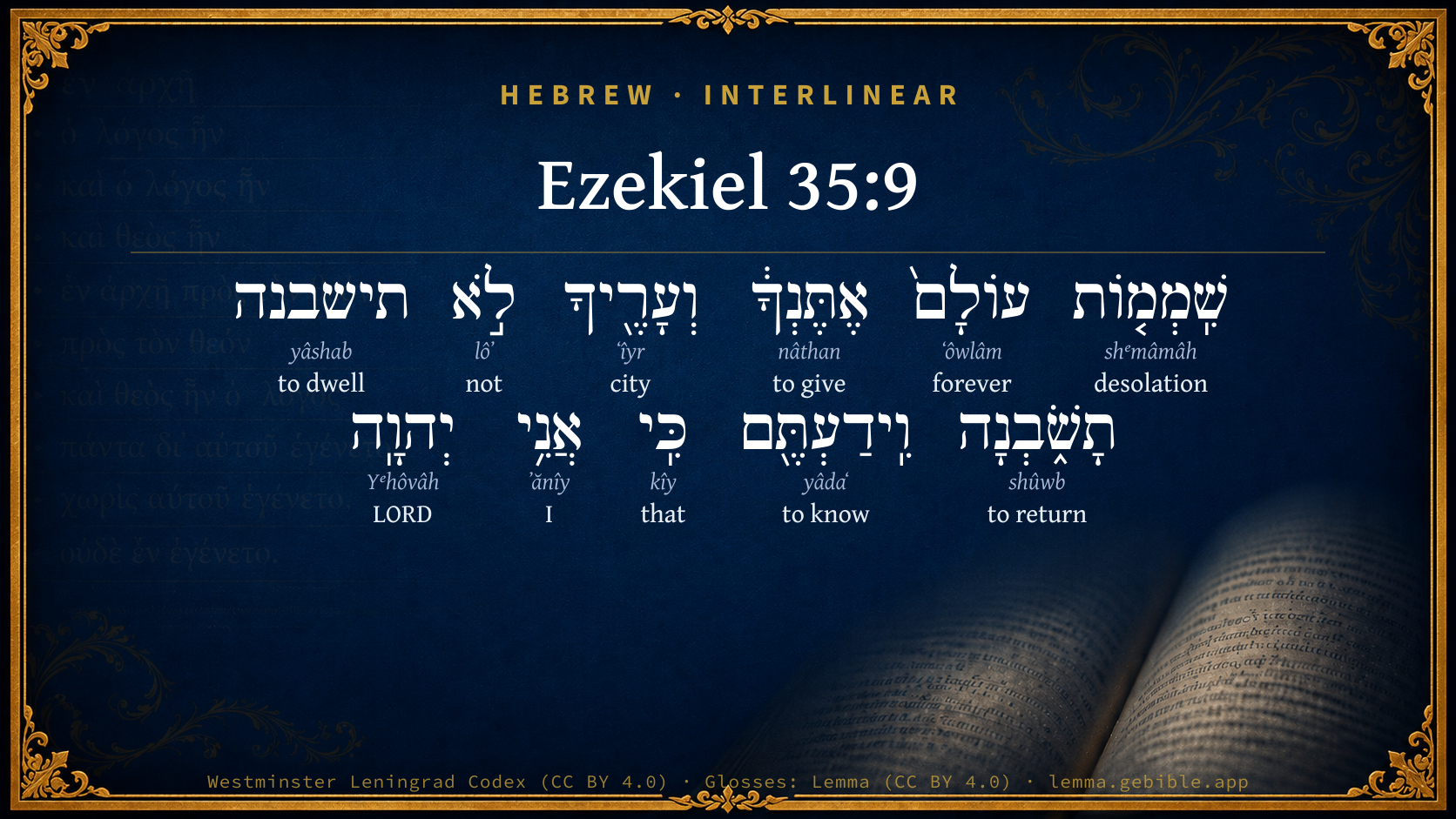
Hebrew (Westminster Leningrad Codex) Ezekiel 35:9 appears in the Hebrew Old Testament. The text above is from the Westminster Leningrad Codex. Each word links to its Strong’s number, a concise gloss, and parsing drawn from the Open Scriptures Hebrew Bible morphology. Click any word for its full Brown-Driver-Briggs (BDB) entry.
Download image
Cite this verse

Ezekiel 35:9 (World English Bible). Public Domain. Lemma interlinear Bible study tool, https://lemma.gebible.app/v/ezekiel/35/9.

Show BibTeX & RIS
BibTeX
RIS
English Translation
I will make you a perpetual desolation, and your cities shall not be inhabited; and you shall know that I am Yahweh.
World English Bible · Public Domain
Download a study sheet

One document with this verse’s original text, its word-by-word gloss line, the meaning frame, cross-references with their text, attributed commentary, and full source and license credits — printable, and it pastes into notes with its structure intact.

This verse Autodidact and up

Study sheet (.html) Plain text (.txt)

A passage Seminary Student

Up to 50 verses in one chapter. A passage sheet keeps up to 6 commentary sources and 12 cross-references per verse, in the order this page ranks them, and says so on the sheet whenever that leaves anything out. Ask for a single verse and you get the Autodidact verse sheet above.

Everything on this page stays free to read, with no account — the sheet is a download of what is already on screen, not access to it.

Want to remove ads? Support Godless Engineer
Compare translations 3

The same verse in 3 English versions, stacked beneath the original-language interlinear above. Click any original word for its lexicon entry.

Each is an independent rendering of the whole verse — the interlinear is not word-aligned to these translations.

Highlighted words mark where these versions differ — a whole-verse word diff, not a word-by-word alignment.

  • World English Bible Public Domain
    I will make you a perpetual desolation, and your cities shall not be inhabited; and you shall know that I am Yahweh.
  • King James Version Public Domain
    I will make thee perpetual desolations, and thy cities shall not return: and ye shall know that I am the LORD.
  • unfoldingWord Literal Text CC BY-SA 4.0
    I will make you a perpetual desolation. Your cities will not be inhabited, but you will know that I am Yahweh.

unfoldingWord Literal Text — © unfoldingWord, licensed CC BY-SA 4.0. Word-aligned USFM3 via Door43 (git.door43.org/unfoldingWord/en_ult).

Versions to compare (up to 4)

3 of 4 selected

Show all 18 translations

Every available English version of this verse, each an independent rendering of the whole verse.

  • World English Bible Public Domain
    I will make you a perpetual desolation, and your cities shall not be inhabited; and you shall know that I am Yahweh.
  • Berean Standard Bible Public Domain
    I will make you a perpetual desolation, and your cities will not be inhabited. Then you will know that I am the LORD.
  • Majority Standard Bible Public Domain
    I will make you a perpetual desolation, and your cities will not be inhabited. Then you will know that I am the LORD.
  • King James Version Public Domain
    I will make thee perpetual desolations, and thy cities shall not return: and ye shall know that I am the LORD.
  • American Standard Version (1901) Public Domain
    I will make thee a perpetual desolation, and thy cities shall not be inhabited; and ye shall know that I am Jehovah.
  • Revised Version (1885) Public Domain
    I will make thee perpetual desolations, and thy cities shall not be inhabited: and ye shall know that I am the LORD.
  • Geneva Bible (1599) Public Domain
    I wil make thee perpetual desolations, and thy cities shall not returne, and ye shall knowe that I am the Lord.
  • Douay-Rheims (1899) Public Domain
    I will make thee everlasting desolations, and thy cities shall not be inhabited: and thou shalt know that I am the Lord God.
  • Young's Literal Translation Public Domain
    Desolations age-during I make thee, And thy cities do not return, And ye have known that I `am' Jehovah.
  • Literal Standard Version CC BY-SA 4.0
    I make you continuous desolations, || And your cities do not return, || And you have known that I [am] YHWH.
  • Unlocked Literal Bible CC BY-SA 4.0
    I will make you a perpetual desolation. Your cities will not be inhabited, but you will know that I am Yahweh.
  • unfoldingWord Literal Text CC BY-SA 4.0
    I will make you a perpetual desolation. Your cities will not be inhabited, but you will know that I am Yahweh.
  • Darby Bible Public Domain
    I will make thee perpetual desolations, and thy cities shall not be inhabited: and ye shall know that I [am] Jehovah.
  • World Messianic Bible Public Domain
    I will make you a perpetual desolation, and your cities will not be inhabited. Then you will know that I am the LORD.
  • Webster's Bible Public Domain
    I will make thee perpetual desolations, and thy cities shall not return: and ye shall know that I am the LORD.
  • Free Bible Version CC BY-SA 4.0
    I will ruin you forever. Your towns will not be inhabited again. Then you will acknowledge that I am the Lord.
  • Bible in Basic English Public Domain
    I will make you waste for ever, and your towns will be unpeopled: and you will be certain that I am the Lord.
  • JPS Tanakh (1917) Public Domain
    I will make thee perpetual desolations, and thy cities shall not return; and ye shall know that I am the LORD.

Literal Standard Version (2020), Covenant Press — licensed CC BY-SA 4.0. Text via the HelloAO Bible API (eBible.org). Unlocked Literal Bible (unfoldingWord) — licensed CC BY-SA 4.0. Text via the HelloAO Bible API (eBible.org). unfoldingWord Literal Text — © unfoldingWord, licensed CC BY-SA 4.0. Word-aligned USFM3 via Door43 (git.door43.org/unfoldingWord/en_ult). Free Bible Version, Dr. Jonathan Gallagher — licensed CC BY-SA 4.0. Text via the HelloAO Bible API (eBible.org).

Word by word

More ways to search: Search by grammar → Find every occurrence → Compare this word →

Practice this passage: Drill this verse → Learn its vocabulary →

שִֽׁמְמ֤וֹת
shᵉmâmâh
H8077
“desolations of”
Noun, Common, Feminine, Plural, Construct
Part of Speech
Noun
Type
Common
Gender
Feminine
Number
Plural
State
Construct
Full BDB Definition

Origin: from H8076

TWOT: 2409b , 2409c

devastation, waste, desolation
  1. עוֹלָם֙ ʻôwlâm H5769 “forever” Noun, Common, Masculine, Singular, Absolute
  2. אֶתֶּנְךָ֔ nâthan H5414 “to give · you” Verb, Qal, Imperfect, 1st Person, Common, Singular + Suffix, Personal, 2nd Person, Masculine, Singular
  3. וְעָרֶ֖יךָ ʻîyr H5892 “and · cities · your” Conjunction + Noun, Common, Feminine, Plural, Construct + Suffix, Personal, 2nd Person, Masculine, Singular
  4. לֹ֣א lôʼ H3808 “not” Particle, Negative
  5. תישבנה yâshab H3427 “to dwell” Verb, Qal, Imperfect, 3rd Person, Feminine, Plural
  6. תָשֹׁ֑בְנָה shûwb H7725 “to return” Verb, Qal, Imperfect, 3rd Person, Feminine, Plural
  7. וִֽידַעְתֶּ֖ם yâdaʻ H3045 “and · to know” Conjunction + Verb, Qal, Sequential Perfect, 2nd Person, Masculine, Plural
  8. כִּֽי kîy H3588 “that” Conjunction
  9. אֲנִ֥י ʼănîy H589 “I” Pronoun, Personal, 1st Person, Common, Singular
  10. יְהוָֽה Yᵉhôvâh H3068 “LORD” Noun, Proper

About this verse

These counts appear in no published source. They are computed here, from the morphology-tagged text and Lemma’s own curated glosses. What Lemma adds →

11
words
11
distinct lemmas
Prophets
section

Shared distinctive vocabulary

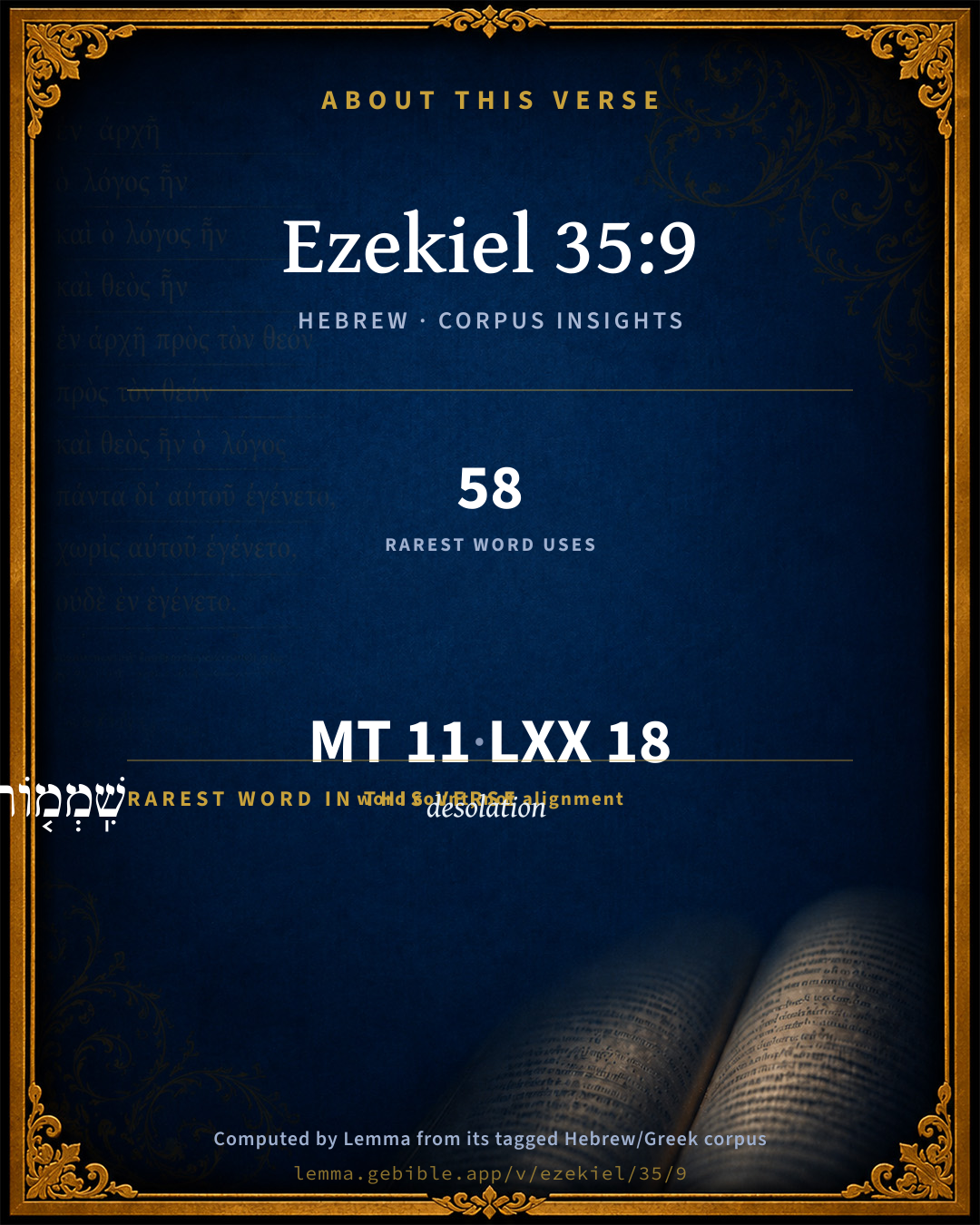
שִֽׁמְמ֤וֹת desolation H8077 occurs in 54 verses of the Hebrew Bible. Also found in:

Grammatical profile

  • 4 verbs
  • 4 nouns
  • 1 pronoun
  • 1 conjunction
  • 1 particle

Verb forms

  • אֶתֶּנְךָ֔ Qal · Imperfect
  • תישבנה Qal · Imperfect
  • תָשֹׁ֑בְנָה Qal · Imperfect
  • וִֽידַעְתֶּ֖ם Qal · Sequential Perfect

Hebrew & Septuagint length

In English translation the verse runs 22 words from the Hebrew and 25 from the Septuagint (LXX English) — closely comparable.

A rough comparison of the two English renderings, which tokenize alike — not a word-level alignment.

Word counts can differ between the Hebrew and the Greek without any difference in meaning — e.g. the Hebrew direct-object marker אֵת has no separate Greek word, and Greek often adds the article ὁ.

In the original languages it is 11 Hebrew tokens and 18 Greek tokens — but the two are counted differently (Hebrew bundles its prefixes and suffixes into one token; the Greek is in lemma form), so that isn’t a like-for-like length.

Cross-references

10

Topical passages linked to Ezekiel 35:9 in the Treasury of Scripture Knowledge — connected by theme and wording, ordered by reader-vote popularity; previews shown in the World English Bible.

  • Ezekiel 25:13 therefore thus says the Lord Yahweh, I will stretch out my hand on Edom, and will cut off man and animal from it; and I will make it desolate from Teman; even to Dedan shall they fall by the sword.
  • Ezekiel 6:7 The slain shall fall in the midst of you, and you shall know that I am Yahweh.
  • Ezekiel 35:4 I will lay your cities waste, and you shall be desolate; and you shall know that I am Yahweh.
  • Malachi 1:3–4 but Esau I hated, and made his mountains a desolation, and gave his heritage to the jackals of the wilderness."
  • Jeremiah 49:13 For I have sworn by myself, says Yahweh, that Bozrah shall become an astonishment, a reproach, a waste, and a curse; and all the cities of it shall be perpetual wastes.
  • Jeremiah 49:17–18 Edom shall become an astonishment: everyone who passes by it shall be astonished, and shall hiss at all the plagues of it.
  • Ezekiel 7:4 My eye shall not spare you, neither will I have pity; but I will bring your ways on you, and your abominations shall be in the midst of you: and you shall know that I am Yahweh.
  • Ezekiel 7:9 My eye shall not spare, neither will I have pity: I will bring on you according to your ways; and your abominations shall be in the midst of you; and you shall know that I, Yahweh, do strike.
  • Ezekiel 36:11 and I will multiply on you man and animal; and they shall increase and be fruitful; and I will cause you to be inhabited after your former estate, and will do better [to you] than at your beginnings: and you shall know that I am Yahweh.
  • Zephaniah 2:9 Therefore as I live, says Yahweh of Hosts, the God of Israel, surely Moab will be as Sodom, and the children of Ammon as Gomorrah, a possession of nettles, and salt pits, and a perpetual desolation. The remnant of my people will plunder them, and the survivors of my nation will inherit them.

Cross-references courtesy of OpenBible.info (CC BY 4.0).

Hebrew and Greek witnesses Masoretic Hebrew ↔ Greek Septuagint

The same verse in the two great witnesses to the Old Testament, shown verse-for-verse.

These are two independent witnesses, not word-aligned to each other, and the Septuagint is shown in lemma (dictionary) form.

Hebrew Ezekiel 35:9 Masoretic · Westminster Leningrad Codex

שִֽׁמְמ֤וֹת עוֹלָם֙ אֶתֶּנְךָ֔ וְעָרֶ֖יךָ לֹ֣א תישבנה תָשֹׁ֑בְנָה וִֽידַעְתֶּ֖ם כִּֽי אֲנִ֥י יְהוָֽה

I will make you a perpetual desolation, and your cities shall not be inhabited; and you shall know that I am Yahweh.

World English Bible · Public Domain

Greek LXX Ezekiel 35:9 Septuagint · lemma form

ἐρημία αἰώνιος τίθημι σύ καί ὁ πόλις σύ οὐ μή καταοἰκέω ἔτι καί γιγνώσκω ὅτι ἐγώ εἰμί κύριος

I will make you a perpetual desolation, and your cities shall not be inhabited any more: and you shall know that I am the Lord.

LXX2012 (modern English Septuagint) · Public Domain

On this verse, The Pulpit Commentary discusses the Septuagint’s reading. Read the note in Commentary ↓

Hebrew: Westminster Leningrad Codex (CC BY 4.0). Greek: Septuagint (public domain); English from LXX2012 (modern English Septuagint) (Public Domain). How the Septuagint differs from the Hebrew →

Targum (Aramaic paraphrase)

1

The Targum is the ancient Jewish Aramaic paraphrase of the Hebrew Scriptures — an interpretive translation, not the Hebrew text itself. Onkelos (literal) and Pseudo-Jonathan (expansive) render the Torah, and Jonathan the Prophets. Coverage is partial: where no permissively-licensed English translation exists for a verse, only the Aramaic is shown. This is verse-level text, not a word-by-word alignment to the Hebrew.

  1. Targum Jonathan Prophets (Joshua–Malachi)
    צְדוּ עֲלַם אֶתְּנִינַךְ וְקִרְוָךְ לָא יִתְיַתְבָן וְתֵידְעוּן אֲרֵי אֲנָא יְיָ:

    (no public-domain English translation for this verse)

    Targum Jonathan — Aramaic: “Mikraot Gedolot” (public domain). English: “Sefaria Community Translation” (CC0 1.0 (public-domain dedication)); “London "Chaldee Paraphrase," 1871” (public domain). Text via Sefaria.

Commentary

Notes on Ezekiel 35:9 from classic Christian and Jewish commentators (each source and its license shown beneath its notes). The classic Christian expositions comment on the surrounding passage and are grouped to its opening verse, so a note may address several verses; the Jewish commentaries on the Tanakh (Rashi and others) are per-verse, so they appear only where the commentator wrote on this verse.

Lemma curates 59 commentaries, every one of them public domain or Creative Commons licensed, each selected and text-cleaned for this edition rather than reprinted as found. About our sources →

Trapp's Complete Commentary

John Trapp

Eze 35:9 I will make thee perpetual desolations, and thy cities shall not return: and ye shall know that I [am] the LORD.

Ver. 9. I will make thee perpetual desolations.] For thy perpetual hatred. {Eze 35:5}

And thy cities.] See Eze 35:4.

John Trapp, A Commentary or Exposition upon All the Books of the Old and New Testament (1647–1656) — public domain. Text from a community e-Sword module.

Geneva Bible (1599)

Geneva Bible translators

To wit, to their former estate.

Geneva Bible (1599) marginal notes — public domain. Text via Bolls.life.

Jamieson, Fausset & Brown

Robert Jamieson, A. R. Fausset & David Brown

shall not return--to their former state (Eze 16:55); shall not be restored. The Hebrew text (Chetib) reads, "shall not be inhabited" (compare Eze 26:20; Mal 1:3-4).

Jamieson, Fausset & Brown — Commentary Critical and Explanatory on the Whole Bible (1871) — public domain (CC PDM 1.0). Text via the HelloAO Bible API.

Adam Clarke's Commentary

Verse 9. Perpetual desolations] Thou shalt have perpetual desolation for thy perpetual hatred.

Adam Clarke's Commentary on the Bible (1810–1826) — public domain. Text from a community e-Sword/MySword module.

The Cambridge Bible for Schools and Colleges

gen. ed. J. J. S. Perowne

9. cities shall not return] Probably, shall not be inhabited (Heb. text teshabnah). The pointing “return” possibly reposes on Eze_16:55.

The Cambridge Bible for Schools and Colleges (gen. ed. J. J. S. Perowne; Cambridge University Press, 1878–1918) — public domain. Text from a community e-Sword module.

John Gill's Exposition

I will make thee perpetual desolations, and thy cities shall not return,.... To their former dignity and glory; should not be built and inhabited again, but lie waste for ever: this agrees with what is prophesied of Edom, Mal 1:4 and will be true of Rome or Babylon when destroyed; it will never rise more, but be like a millstone in the midst of the sea, Rev 18:21,

and ye shall know that I am the Lord; See Gill on Eze 35:4.

John Gill's Exposition of the Whole Bible (1746–1763) — public domain (CC PDM 1.0). Text via the HelloAO Bible API.

Albert Barnes' Notes on the Bible

Return - Or, “be inhabited.”

Albert Barnes' Notes on the Bible (1834–1885) — public domain. Text from a community e-Sword/MySword module.

Haydock's Catholic Bible Commentary

Inhabited for a considerable time, as [in] chap. xxvi. 20.

George Leo Haydock (1774–1849), Haydock's Catholic Family Bible and Commentary, 1859 edition — public domain. Excludes Psalms (Douay-Rheims chapter numbering differs from Protestant) and Deuterocanonical books (Catholic canon only).

Matthew Poole's English Annotations

Edom’s sin was perpetual hatred, and Edom’s punishment shall be perpetual desolations. Edomites would never return into friendship with the Israelites, but still hate, and molest, and waste them; now for just recompence Edom’s cities shall be wasted, and never return to their former glory.

Matthew Poole's English Annotations on the Holy Bible (1683–1685) — public domain. Text from a community e-Sword/MySword module.

The Pulpit Commentary

Thy cities shall not return, as in Eze_16:55 (Authorized Version after the Keri) or, shall not be inhabited, as in Eze_26:20 Eze_29:11 Eze_36:33 (LXX and Revised Version, both of which follow the Chethib) Hengstenberg"s translation, "Thy cities shall not sit," but lie prostrate, is not extremely happy.

The Pulpit Commentary (1880–1919), ed. H.D.M. Spence-Jones & Joseph S. Exell — public domain. Text from a community e-Sword module.

John Wesley's Explanatory Notes

Return - To their former glory.

John Wesley, Explanatory Notes Upon the Whole Bible (1754–1765) — public domain. Text via the GEBible commentary corpus.

Rashi

Rabbi Shlomo Yitzchaki (Rashi)

and your cities will not return [Heb. תָשֹּׁבְנָה,] not as I said about Egypt (above 29:14): “And I will return the captives of Egypt”; (Jer. 49:6): “And afterward, I will return the captivity of the children of Ammon.” And this is what Malachi (1:3) said, “And I hated Esau, and I made his mountains desolate,” for I made them destined for everlasting desolations.

Rashi on the Tanakh — English translations: “The Judaica Press complete Tanach with Rashi, translated by A. J. Rosenberg” (CC BY 4.0); “Pentateuch with Rashi's commentary by M. Rosenbaum and A.M. Silbermann, 1929-1934” (public domain); “The Metsudah Tanach series, Lakewood, N.J” (CC BY 4.0); and “The Book of Joshua, Metsudah Publications, 1997” (CC BY 4.0). Text via Sefaria.

Lesson kit

Teaching starters — assembled from the data on this page, not authored interpretation. Every prompt links to the verse data it draws on. Edit before teaching.

Ezekiel, in the Prophets, opens this verse with 11 words (11 distinct Hebrew lemmas). Its most distinctive word is shᵉmâmâh (“desolation”). A historical commentator’s framing appears above. Read the whole chapter for the surrounding context.

Discussion questions

  1. The word shᵉmâmâh carries the sense “desolation.” How does it shape the verse?
  2. Exodus 23:29 shares the word «desolation» with this verse. How do the two illuminate each other?
  3. These translations render this verse differently. What is at stake in choosing one wording over another?
  4. The verb «אֶתֶּנְךָ֔» is Qal Imperfect. How does its form color the action?
  5. Reading how Trapp's Complete Commentary and Geneva Bible (1599) read this verse, where do the two commentators agree and where do they part?

Things to notice

Reading settings

Reading text

Shown beneath each verse's original-language words.

Old Testament
Old Testament edition

Read the OT as the Masoretic Hebrew (MT) or the Greek Septuagint (LXX).

English shown for the Greek Septuagint (in the Hebrew ↔ Greek comparison).

Comparing translations? Open the Compare panel on any verse page to stack up to four side by side.