
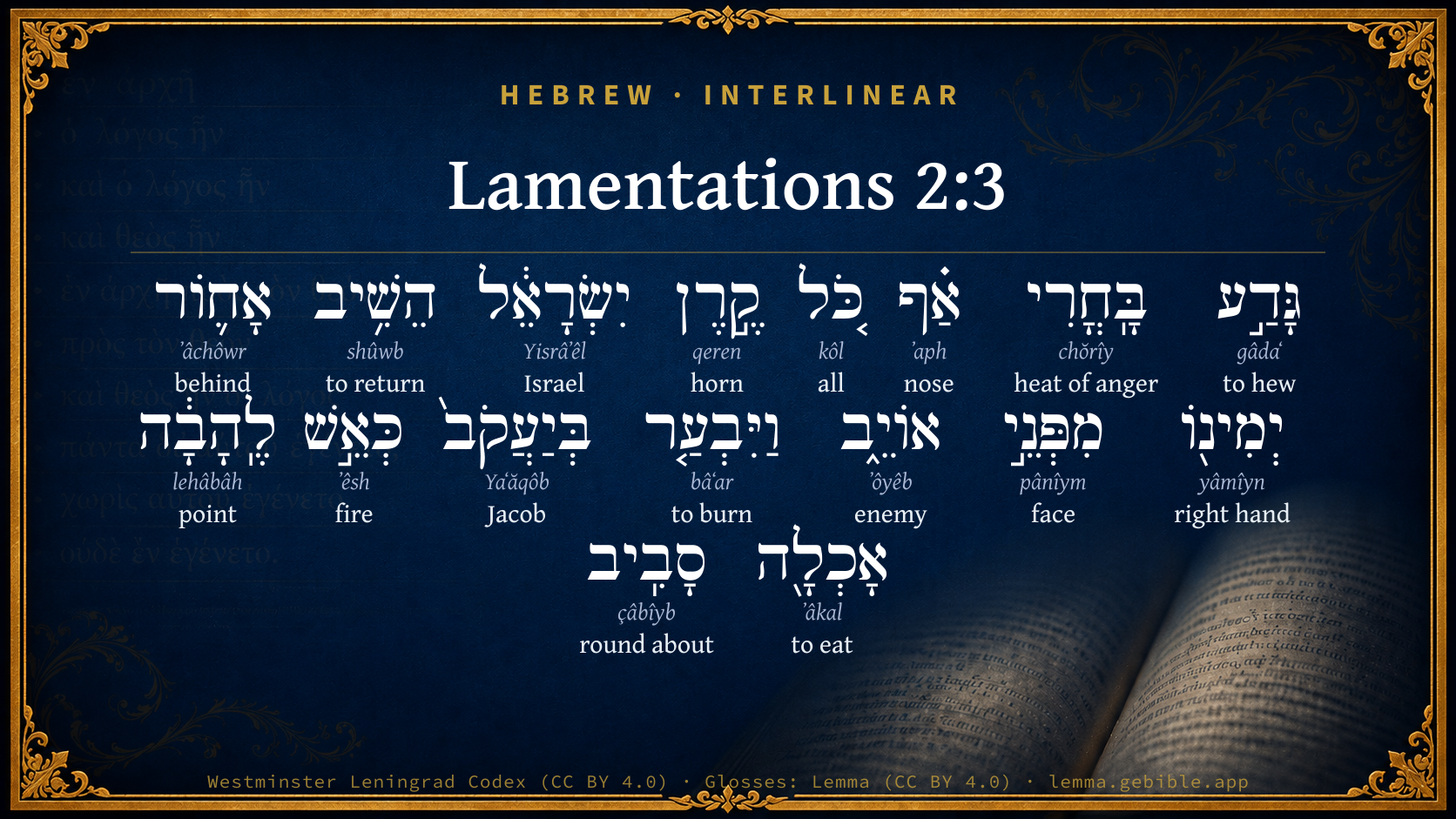
Lamentations 2:3

Hebrew (Westminster Leningrad Codex) Lamentations 2:3 appears in the Hebrew Old Testament. The text above is from the Westminster Leningrad Codex. Each word links to its Strong’s number, a concise gloss, and parsing drawn from the Open Scriptures Hebrew Bible morphology. Click any word for its full Brown-Driver-Briggs (BDB) entry.
Download image
Cite this verse

Lamentations 2:3 (World English Bible). Public Domain. Lemma interlinear Bible study tool, https://lemma.gebible.app/v/lamentations/2/3.

Show BibTeX & RIS
BibTeX
RIS
English Translation
He has cut off in fierce anger all the horn of Israel; He has drawn back his right hand from before the enemy: He has burned up Jacob like a flaming fire, which devours round about.
World English Bible · Public Domain
Download a study sheet

One document with this verse’s original text, its word-by-word gloss line, the meaning frame, cross-references with their text, attributed commentary, and full source and license credits — printable, and it pastes into notes with its structure intact.

This verse Autodidact and up

Study sheet (.html) Plain text (.txt)

A passage Seminary Student

Up to 50 verses in one chapter. A passage sheet keeps up to 6 commentary sources and 12 cross-references per verse, in the order this page ranks them, and says so on the sheet whenever that leaves anything out. Ask for a single verse and you get the Autodidact verse sheet above.

Everything on this page stays free to read, with no account — the sheet is a download of what is already on screen, not access to it.

Want to remove ads? Support Godless Engineer
Compare translations 3

The same verse in 3 English versions, stacked beneath the original-language interlinear above. Click any original word for its lexicon entry.

Each is an independent rendering of the whole verse — the interlinear is not word-aligned to these translations.

Highlighted words mark where these versions differ — a whole-verse word diff, not a word-by-word alignment.

  • World English Bible Public Domain
    He has cut off in fierce anger all the horn of Israel; He has drawn back his right hand from before the enemy: He has burned up Jacob like a flaming fire, which devours round about.
  • King James Version Public Domain
    He hath cut off in his fierce anger all the horn of Israel: he hath drawn back his right hand from before the enemy, and he burned against Jacob like a flaming fire, which devoureth round about.
  • unfoldingWord Literal Text CC BY-SA 4.0
    He has cut off in the burning of nose every horn of Israel. He has turned back his right hand from the face of the enemy, and he burned in Jacob like a fire of flame consuming all around. DALETH

unfoldingWord Literal Text — © unfoldingWord, licensed CC BY-SA 4.0. Word-aligned USFM3 via Door43 (git.door43.org/unfoldingWord/en_ult).

Versions to compare (up to 4)

3 of 4 selected

Show all 18 translations

Every available English version of this verse, each an independent rendering of the whole verse.

  • World English Bible Public Domain
    He has cut off in fierce anger all the horn of Israel; He has drawn back his right hand from before the enemy: He has burned up Jacob like a flaming fire, which devours round about.
  • Berean Standard Bible Public Domain
    In fierce anger He has cut off every horn of Israel and withdrawn His right hand at the approach of the enemy. He has burned in Jacob like a flaming fire that consumes everything around it.
  • Majority Standard Bible Public Domain
    In fierce anger He has cut off every horn of Israel and withdrawn His right hand at the approach of the enemy. He has burned in Jacob like a flaming fire that consumes everything around it.
  • King James Version Public Domain
    He hath cut off in his fierce anger all the horn of Israel: he hath drawn back his right hand from before the enemy, and he burned against Jacob like a flaming fire, which devoureth round about.
  • American Standard Version (1901) Public Domain
    He hath cut off in fierce anger all the horn of Israel; He hath drawn back his right hand from before the enemy: And he hath burned up Jacob like a flaming fire, which devoureth round about.
  • Revised Version (1885) Public Domain
    He hath cut off in fierce anger all the horn of Israel; he hath drawn back his right hand from before the enemy: and he hath burned up Jacob like a flaming fire, which devoureth round about.
  • Geneva Bible (1599) Public Domain
    Hee hath cut off in his fierce wrath all the horne of Israel: he hath drawen backe his right hand from before the enemie, and there was kindled in Iaakob like a flame of fire, which deuoured rounde about.
  • Douay-Rheims (1899) Public Domain
    Ghimel. He hath broken in his fierce anger all the horn of Israel: he hath drawn back his right hand from before the enemy: and he hath kindled in Jacob as it were a flaming fire devouring round about.
  • Young's Literal Translation Public Domain
    He hath cut off in the heat of anger every horn of Israel, He hath turned backward His right hand From the face of the enemy, And He burneth against Jacob as a flaming fire, It hath devoured round about.
  • Literal Standard Version CC BY-SA 4.0
    He has cut off in the heat of anger every horn of Israel, || He has turned backward His right hand || From the face of the enemy, || And He burns against Jacob as a flaming fire, || It has devoured all around.
  • Unlocked Literal Bible CC BY-SA 4.0
    With fierce anger he has cut off every horn of Israel. He has withdrawn his right hand from before the enemy. He has burned up Jacob like a blazing fire that devours everything around it.
  • unfoldingWord Literal Text CC BY-SA 4.0
    He has cut off in the burning of nose every horn of Israel. He has turned back his right hand from the face of the enemy, and he burned in Jacob like a fire of flame consuming all around. DALETH
  • Darby Bible Public Domain
    He hath cut off in fierce anger all the horn of Israel: he hath withdrawn his right hand from before the enemy; and he burned up Jacob like a flaming fire, devouring round about.
  • World Messianic Bible Public Domain
    He has cut off all the horn of Israel in fierce anger. He has drawn back his right hand from before the enemy. He has burned up Jacob like a flaming fire, which devours all around.
  • Webster's Bible Public Domain
    He hath cut off in his fierce anger all the horn of Israel: he hath drawn back his right hand from before the enemy, and he burned against Jacob like a flaming fire, which devoureth on every side.
  • Free Bible Version CC BY-SA 4.0
    In his fury he has destroyed all of Israel's power, refusing to help as the enemy attacked. He was like a fire blazing in the land of Jacob, burning everything up.
  • Bible in Basic English Public Domain
    In his burning wrath every horn of Israel has been cut off; his right hand has been turned back before the attacker: he has put a fire in Jacob, causing destruction round about.
  • JPS Tanakh (1917) Public Domain
    He hath cut off in fierce anger all the horn of Israel; He hath drawn back His right hand from before the enemy; and He hath burned in Jacob like a flaming fire, which devoureth round about.

Literal Standard Version (2020), Covenant Press — licensed CC BY-SA 4.0. Text via the HelloAO Bible API (eBible.org). Unlocked Literal Bible (unfoldingWord) — licensed CC BY-SA 4.0. Text via the HelloAO Bible API (eBible.org). unfoldingWord Literal Text — © unfoldingWord, licensed CC BY-SA 4.0. Word-aligned USFM3 via Door43 (git.door43.org/unfoldingWord/en_ult). Free Bible Version, Dr. Jonathan Gallagher — licensed CC BY-SA 4.0. Text via the HelloAO Bible API (eBible.org).

Word by word

More ways to search: Search by grammar → Find every occurrence → Compare this word →

Practice this passage: Drill this verse → Learn its vocabulary →

בָּֽחֳרִי
chŏrîy
H2750
“in/at · heat of anger of”
Preposition + Noun, Common, Masculine, Singular, Construct
Part of Speech
Preposition + Noun
Type
Common
Gender
Masculine
Number
Singular
State
Construct
Full BDB Definition

Origin: from H2734

TWOT: 736b

heat (of anger), burning (of anger)
  1. גָּדַ֣ע gâdaʻ H1438 “to hew” Verb, Qal, Perfect, 3rd Person, Masculine, Singular
  2. אַ֗ף ʼaph H639 “nose” Particle, Accusative
  3. כֹּ֚ל kôl H3605 “all of” Noun, Common, Masculine, Singular, Construct
  4. קֶ֣רֶן qeren H7161 “horn of” Noun, Common, Both, Singular, Construct
  5. יִשְׂרָאֵ֔ל Yisrâʼêl H3478 “Israel” Noun, Proper
  6. הֵשִׁ֥יב shûwb H7725 “to return” Verb, Hiphil, Perfect, 3rd Person, Masculine, Singular
  7. אָח֛וֹר ʼâchôwr H268 “behind” Noun, Common, Masculine, Singular, Absolute
  8. יְמִינ֖וֹ yâmîyn H3225 “right hand · his” Noun, Common, Feminine, Singular, Construct + Suffix, Personal, 3rd Person, Masculine, Singular
  9. מִפְּנֵ֣י pânîym H6440 “from · face(s) of” Preposition + Noun, Common, Both, Plural, Construct
  10. אוֹיֵ֑ב ʼôyêb H341 “enemy” Verb, Qal, Participle Active, Masculine, Singular, Absolute
  11. וַיִּבְעַ֤ר bâʻar H1197 “and · to burn” Conjunction + Verb, Qal, Sequential Imperfect, 3rd Person, Masculine, Singular
  12. בְּיַעֲקֹב֙ Yaʻăqôb H3290 “in/at · Jacob” Preposition + Noun, Proper
  13. כְּאֵ֣שׁ ʼêsh H784 “like/as · fire of” Preposition + Noun, Common, Both, Singular, Construct
  14. לֶֽהָבָ֔ה lehâbâh H3852 “point” Noun, Common, Feminine, Singular, Absolute
  15. אָכְלָ֖ה ʼâkal H398 “to eat” Verb, Qal, Perfect, 3rd Person, Feminine, Singular
  16. סָבִֽיב çâbîyb H5439 “round about” Noun, Common, Both, Singular, Absolute

About this verse

These counts appear in no published source. They are computed here, from the morphology-tagged text and Lemma’s own curated glosses. What Lemma adds →

17
words
17
distinct lemmas
Prophets
section

Notable vocabulary

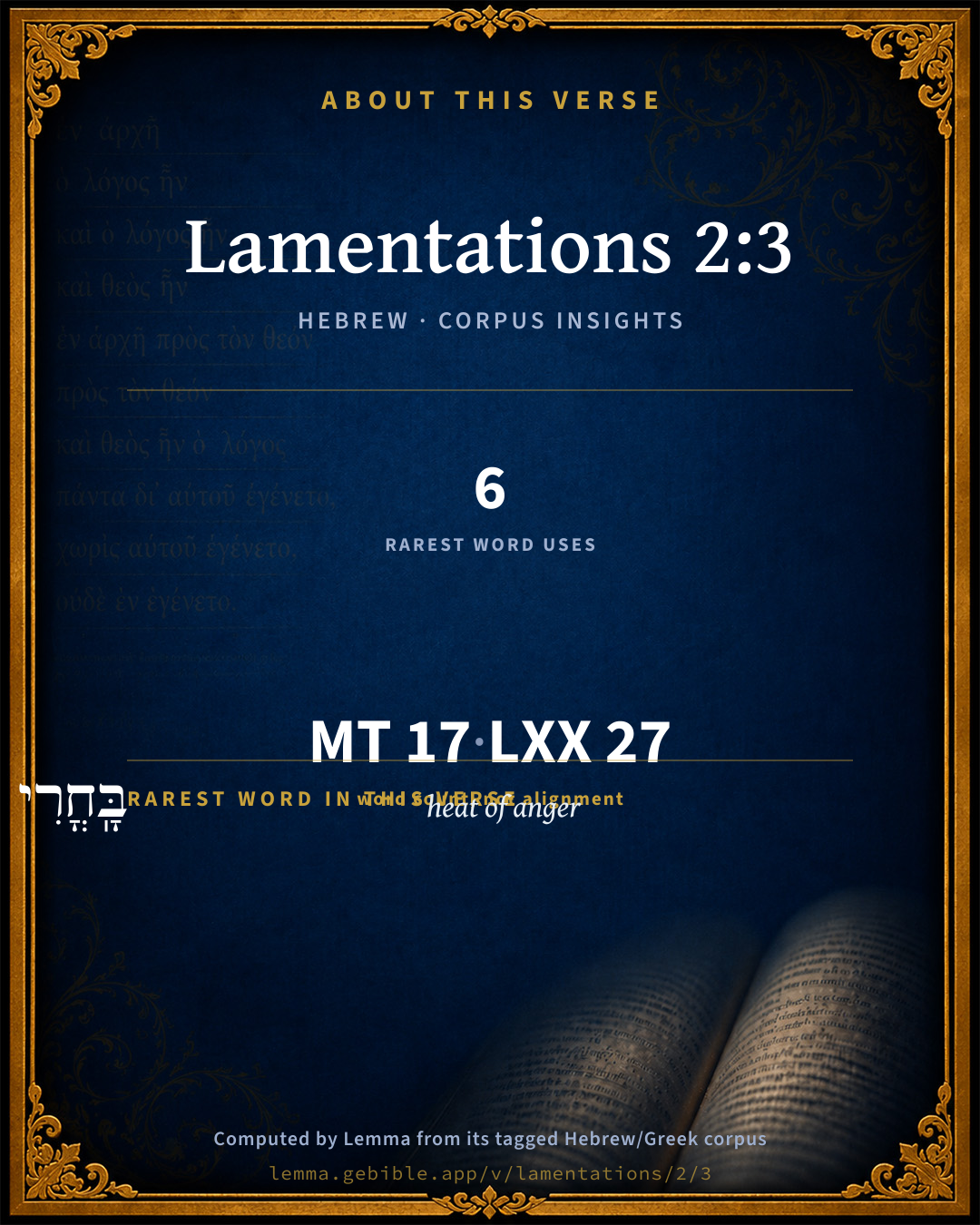
The rarest word here is בָּֽחֳרִי heat of anger H2750 — appearing just 6 times in the whole Hebrew Bible.

Shared distinctive vocabulary

בָּֽחֳרִי heat of anger H2750 occurs in 6 verses of the Hebrew Bible. Also found in:

Grammatical profile

  • 5 verbs
  • 11 nouns
  • 1 particle

Verb forms

  • גָּדַ֣ע Qal · Perfect
  • הֵשִׁ֥יב Hiphil · Perfect
  • אוֹיֵ֑ב Qal · Participle Active
  • וַיִּבְעַ֤ר Qal · Sequential Imperfect
  • אָכְלָ֖ה Qal · Perfect

Hebrew & Septuagint length

In English translation the verse runs 36 words from the Hebrew and 44 from the Septuagint (LXX English) — closely comparable.

A rough comparison of the two English renderings, which tokenize alike — not a word-level alignment.

Word counts can differ between the Hebrew and the Greek without any difference in meaning — e.g. the Hebrew direct-object marker אֵת has no separate Greek word, and Greek often adds the article ὁ.

In the original languages it is 17 Hebrew tokens and 27 Greek tokens — but the two are counted differently (Hebrew bundles its prefixes and suffixes into one token; the Greek is in lemma form), so that isn’t a like-for-like length.

Cross-references

19

Topical passages linked to Lamentations 2:3 in the Treasury of Scripture Knowledge — connected by theme and wording, ordered by reader-vote popularity; previews shown in the World English Bible.

  • Psalms 74:11 Why do you draw back your hand, even your right hand? Take it out of your pocket and consume them!
  • Psalms 75:5 Don't lift up your horn on high. Don't speak with a stiff neck."
  • Psalms 75:10 I will cut off all the horns of the wicked, But the horns of the righteous shall be lifted up.
  • Isaiah 42:25 Therefore he poured on him the fierceness of his anger, and the strength of battle; and it set him on fire round about, yet he didn't know; and it burned him, yet he didn't lay it to heart.
  • Psalms 79:5 How long, Yahweh? Will you be angry forever? Will your jealousy burn like fire?
  • Psalms 89:46 How long, Yahweh? Will you hide yourself forever? Will your wrath burn like fire?
  • Jeremiah 48:25 The horn of Moab is cut off, and his arm is broken, says Yahweh.
  • Deuteronomy 32:22 For a fire is kindled in my anger, Burns to the lowest Sheol, Devours the earth with its increase, Sets on fire the foundations of the mountains.
  • Job 16:15 I have sewed sackcloth on my skin, And have thrust my horn in the dust.
  • Psalms 89:24 But my faithfulness and my loving kindness will be with him. In my name, his horn will be exalted.
  • Psalms 132:17 There I will make the horn of David to bud. I have ordained a lamp for my anointed.
  • Isaiah 1:31 The strong will be like tinder, And his work like a spark. They will both burn together, And no one will quench them."
  • Jeremiah 4:4 Circumcise yourselves to Yahweh, and take away the foreskins of your heart, you men of Judah and inhabitants of Jerusalem; lest my wrath go forth like fire, and burn so that none can quench it, because of the evil of your doings.
  • Jeremiah 7:20 Therefore thus says the Lord Yahweh: Behold, my anger and my wrath shall be poured out on this place, on man, and on animal, and on the trees of the field, and on the fruit of the ground; and it shall burn, and shall not be quenched.
  • Jeremiah 21:4–5 Thus says Yahweh, the God of Israel, Behold, I will turn back the weapons of war that are in your hands, with which you fight against the king of Babylon, and against the Chaldeans who besiege you, without the walls; and I will gather them into the midst of this city.
  • Jeremiah 21:14 I will punish you according to the fruit of your doings, says Yahweh; and I will kindle a fire in her forest, and it shall devour all that is round about her.
  • Malachi 4:1 "For, behold, the day comes, it burns as a furnace; and all the proud, and all who work wickedness, will be stubble; and the day that comes will burn them up," says Yahweh of Hosts, "that it shall leave them neither root nor branch.
  • Luke 1:69 And has raised up a horn of salvation for us in the house of his servant David
  • Luke 3:17 whose fan is in his hand, and he will thoroughly cleanse his threshing floor, and will gather the wheat into his barn; but he will burn up the chaff with unquenchable fire."

Cross-references courtesy of OpenBible.info (CC BY 4.0).

Hebrew and Greek witnesses Masoretic Hebrew ↔ Greek Septuagint

The same verse in the two great witnesses to the Old Testament, shown verse-for-verse.

These are two independent witnesses, not word-aligned to each other, and the Septuagint is shown in lemma (dictionary) form.

Hebrew Lamentations 2:3 Masoretic · Westminster Leningrad Codex

גָּדַ֣ע בָּֽחֳרִי אַ֗ף כֹּ֚ל קֶ֣רֶן יִשְׂרָאֵ֔ל הֵשִׁ֥יב אָח֛וֹר יְמִינ֖וֹ מִפְּנֵ֣י אוֹיֵ֑ב וַיִּבְעַ֤ר בְּיַעֲקֹב֙ כְּאֵ֣שׁ לֶֽהָבָ֔ה אָכְלָ֖ה סָבִֽיב

He has cut off in fierce anger all the horn of Israel; He has drawn back his right hand from before the enemy: He has burned up Jacob like a flaming fire, which devours round about.

World English Bible · Public Domain

Greek LXX Lamentations 2:3 Septuagint · lemma form

συνκλαίω ἐν ὀργή θυμός αὐτός πᾶς κέρας ἰσραήλ ἀποστρέφω ὀπίσω δεξιός αὐτός ἀπό πρόσωπον ἐχθρός καί ἀναἅπτω ἐν ἰακώβ ὡς πῦρ φλόξ καί καταἐσθίω πᾶς ὁ κύκλος

GIMEL. He has broken in his fierce anger all the horn of Israel: he has turned back his right hand from the face of the enemy, and has kindled a flame in Jacob as a fire, and it has devoured all things round about.

LXX2012 (modern English Septuagint) · Public Domain

Hebrew: Westminster Leningrad Codex (CC BY 4.0). Greek: Septuagint (public domain); English from LXX2012 (modern English Septuagint) (Public Domain). How the Septuagint differs from the Hebrew →

Commentary

Notes on Lamentations 2:3 from classic Christian and Jewish commentators (each source and its license shown beneath its notes). The classic Christian expositions comment on the surrounding passage and are grouped to its opening verse, so a note may address several verses; the Jewish commentaries on the Tanakh (Rashi and others) are per-verse, so they appear only where the commentator wrote on this verse.

Lemma curates 59 commentaries, every one of them public domain or Creative Commons licensed, each selected and text-cleaned for this edition rather than reprinted as found. About our sources →

Trapp's Complete Commentary

John Trapp

Lam 2:3 He hath cut off in [his] fierce anger all the horn of Israel: he hath drawn back his right hand from before the enemy, and he burned against Jacob like a flaming fire, [which] devoureth round about.

Ver. 3. He hath cut off in his anger all the horn of Israel,] i.e., All the strength and beauty, the royal majesty especially. {Psa 89:24; Psa 132:17}

He hath drawn back his right hand.] Wherewith he was wont to shelter them and to fight for them. Or, Israel’s right hand - scil., by disabling them; for it is God that strengtheneth and weakeneth the arm of either party. {Eze 30:24}

And he burned against Jacob.] Or, In Jacob - i.e., He declareth his displeasure among his people as clearly as a flame of fire that is easily discerned.

John Trapp, A Commentary or Exposition upon All the Books of the Old and New Testament (1647–1656) — public domain. Text from a community e-Sword module.

Keil & Delitzsch

C. F. Keil & F. Delitzsch

In Lam 2:3 and Lam 2:4, the writer describes the hostile conduct of the Lord towards Israel, by which the kingdom of Judah was destroyed. Thenius utterly mistakes the poetic character of the description given, and evidently finds in it the several events that occurred up to the taking of the city, all mentioned in their natural order; according to this, the perfects would require to be translated as preterites. But this view can be made out only by giving an arbitrary meaning to the several figures used; e.g., it is alleged that "every horn" means the frontier fortresses, that the expression "before the enemy" refers to the time when the latter turned his face against Jerusalem, and so on. The three members of Lam 2:3 contain a climax: deprivation of the power to resist; the withdrawal of aid; the necessary consequence of which was the burning like a flame of fire. "To cut down the horn" means to take away offensive and defensive power; see on Jer 48:25. "Every horn" is not the same as "all horns," but means all that was a horn of Israel (Gerlach). This included not merely the fortresses of Judah, but every means of defence and offence belonging to the kingdom, including men fit for war, who are neither to be excluded nor (with Le Clerc) to be all that is understood by "every horn." In the expression ימינו...השׁיב, the suffix, as in קשׁתּו, Lam 2:4, refers to Jahveh, because the suffix joined to יד always points back to the subject of the verb השׁיב; cf. Psa 74:11. God drew back His hand before the enemy, i.e., He withdrew from the people His assistance in the struggle against the enemy. Such is the meaning given long ago by the Chaldee: nec auxiliatus est populo suo coram hoste. ויּבער בּיעקב does not mean "He consumed Jacob;" but He burned (i.e., made a conflagration) in Jacob; for, in every passage in which בּער is construed with בּ, it does not mean to "burn something," but to burn in or among, or to kindle a fire (cf. Job 1:16, where the burning up is only expressed by ותּאכלם, Num 11:3; Psa 106:18), or to set something on fire, Isa 42:25. The burning represents devastation; hence the comparison of יבער with "like fire of flame (= flaming, brightly blazing fire, cf. Isa 4:5; Psa 105:32) that devours round about." The subject of יבער is Jahveh, not ira Jovae (Rosenmller), or להבה (Neumann), or the enemy (Gerlach). The transition from the perfect with ו consec. does not cause any change of the subject; this is shown by Lam 2:4 and Lam 2:5, where also the second clause is connected with the first by means of ו consec. But the statement of Gerlach - that if Jahveh and not the enemy be the subject, then the consecutive sentence (the burning among Jacob as the result of the withdrawal of Jahveh's hand before the enemy) would be inexplicable - gives no evidence of its truth. The kindling or making of the fire in Jacob is, of course, represented as a result of what is previously stated, yet not as the consequence merely of the withdrawal of his hand, but also of the cutting off of every horn. In both of these ways, God has kindled in Jacob a fire which grows into a destructive conflagration. - In Lam 2:4 the idea is still further developed: God not merely delivered up His people to the enemy, leaving them defenceless and helpless, but also came forward Himself to fight against them as an enemy. He bent His bow like a warrior, showing Himself, in reference to His claims, as an adversary or oppressor. The specification "His right hand" is added, not so much for the purpose of defining more exactly the activity of the right hand (using it to shoot the arrows or wield the sword; cf. Deu 32:41., Psa 7:13.), as rather with the view of expressing more precisely the hostile attitude of God, since the right hand of God is at other times represented as the instrument of help. The expression "and He slew," which follows, does not require us to think of a sword in the right hand of God, since we can also kill with arrows. God slew as an enemy; He destroyed everything that was precious in men's sight, i.e., to merely omnes homines aetate, specie, dignitate conspicuos (C. B. Michaelis, Rosenmller, Thenius); for, in Psa 78:47, חרג is also used with reference to the effect of hail on the vine; and the arrows shot from the bow are merely named by synecdoche, and by way of specification, as instruments of war for destruction. Still less can מחמדּי־עין signify omnia ea templi ornamenta, quibus merito gloriabatur populus (Kalkschmidt), since it is not till Lam 2:6. that the temple is spoken of. "The word is to be taken in its widest generality, which is indicated by 'all;' accordingly, it comprehends everything that can be looked upon as dear," including children (cf. Eze 24:25) and the sanctuary, though all these do not exhaust the meaning of the word (Gerlach). Upon the tent of the daughter of Zion He poured out His fury in fire. The daughter of Zion means the inhabitants of Jerusalem: her tent is not the temple (Kalkschmidt, Ewald), which is never called the tent of the daughter of Zion, but only that of Jahveh (Kg1 2:28, etc.); but her house, i.e., the city as a collection of dwellings. The figure of the outpouring of wrath is often used, not only in Jer 6:11; Jer 10:25; Jer 42:18, etc., but also in Hos 5:10; Zep 3:8; Psa 69:25; Psa 76:6, etc.

Keil & Delitzsch — Biblical Commentary on the Old Testament (1861–1891) — public domain (CC PDM 1.0). Text via the HelloAO Bible API. (Old Testament only.)

Tyndale Open Study Notes

Tyndale Open Resources

2:3-4 bends his bow: In the past, the Lord had been a mighty warrior on Israel’s behalf (see Exod 14:13–15:21; Josh 23:9-11; Judg 7; 2 Kgs 19:32-35); now he waged war against Jerusalem (see Isa 63:10; Ezek 24:25).

Tyndale Open Study Notes — © Tyndale Open Resources, licensed CC BY-SA 4.0. Text via the HelloAO Bible API.

Geneva Bible (1599)

Geneva Bible translators

Meaning, the glory and strength, as 1 Sam. 2:1.

That is, his succor which he was wont to send us, when our enemies oppressed us.

Geneva Bible (1599) marginal notes — public domain. Text via Bolls.life.

Jamieson, Fausset & Brown

Robert Jamieson, A. R. Fausset & David Brown

horn--worn in the East as an ornament on the forehead, and an emblem of power and majesty (Sa1 2:10; Psa 132:17; see on Jer 48:25).

drawn back . . . fight hand-- (Psa 74:11). God has withdrawn the help which He before gave them. Not as HENDERSON, "He has turned back his (Israel's) right hand" (Psa 89:43).

Jamieson, Fausset & Brown — Commentary Critical and Explanatory on the Whole Bible (1871) — public domain (CC PDM 1.0). Text via the HelloAO Bible API.

Adam Clarke's Commentary

Verse 3. The horn of Israel] His power and strength. It is a metaphor taken from cattle, whose principal strength lies in their horns.

Hath drawn back his right hand] He did not support us when our enemies came against us.

Adam Clarke's Commentary on the Bible (1810–1826) — public domain. Text from a community e-Sword/MySword module.

John Calvin's Commentaries

Jeremiah expresses the same thing in various ways; but all that he says tends to shew that it was an evidence of God’s extreme vengeance, when the people, the city, and the Temple, were destroyed. But it ought to be observed, that God is here represented as the author of that calamity: the Prophet would have otherwise lamented in vain over the ruin of his own country; but as in all adversities he acknowledged the hand of God, he afterwards added, that God had a just reason why he was so grievously displeased with his own people.

He then says, that every horn had been broken by God. We know that by horn is meant strength as well as excellency or dignity and I am disposed to include both here, though the word breaking seems rather to refer to strength or power. But the whole clause must be noticed, that God had broken every horn of Israel in the indignation of his wrath. The Prophet intimates that God had not been angry with his people as though he had been offended by slight transgressions, but that the measure of his wrath had been unusual, even because the impiety of the people had so burst forth, that the offense given to God could not have been slight. Then, by indignation of wrath the Prophet does not mean an excess, as though God had through a violent impulse rushed forth to take vengeance; but he rather intimates that the people had become so wicked, that it did not behoove God to punish in an ordinary way an impiety so inveterate.

He then adds, that God had withdrawn, his right hand from before the enemy, and that at the same time he had burned like a fire, the flame of which had devoured all around. The Prophet here refers to two things; the first is, that though God had been accustomed to help his people, and to oppose their enemies, as they had experienced his aid in the greatest dangers, yet now his people were forsaken and left destitute of all hope. The first clause, then, declares, that God would not be the deliverer of his people as formerly, because they had forsaken him. But he speaks figuratively, that God had drawn back his right hand; and God’s right hand means his protection, as it is well known. But the Prophet’s meaning is by no means obscure, even that there was hereafter no hope that God would meet the enemies of his people, and thus preserve them in safety, for he had drawn back his hand. But there is a second thing added, even that God’s hand burned like fire. Now it was in itself a grievous thing that the people had been so rejected by God, that no help could be expected from him; but it was still a harder thing, that he went forth armed to destroy his people. And the metaphor of fire ought to be noticed; for had he said that God’s right hand was against his people, the expression would not have been so forcible; but when he compared God’s right hand to fire which burned, and whose flame consumed all Israel, it was a much more dreadful thing.

Moreover, by these words the Israelites were reminded that they were not to lament their calamities in an ordinary way, but ought, on the contrary, to have seriously considered the cause of all their evils, even the provoking of God’s wrath against themselves; and not only so, but that God was angry with them in an unusual degree, and yet justly, so that they had no reason to complain. It follows, —

John Calvin's Commentaries (1540-1563) — public domain. Text from the Calvin Translation Society English edition (1840s-50s) via the Christian Classics Ethereal Library (ccel.org). Calvin's coverage is partial (roughly two-thirds of the Bible); uncommented books and verses are honest gaps, never fabricated. The 19th-century editor's footnotes and remarks are omitted so the notes are faithfully Calvin's own voice.

Ellicott's Commentary for English Readers

(3) All the horn of Israel . . .—The horn, as elsewhere (1Sa_2:1; Psa_92:10; Psa_112:9), is the symbol of strength, aggressive or defensive, and may therefore stand here for every element of strength, warriors, rulers, fortresses.

He burned against Jacob.—Better, And He kindled a burning; i.e., was as one who applies the torch.

A Bible Commentary for English Readers, edited by Charles John Ellicott (1878–1897) — public domain. Text from a community e-Sword module.

The Cambridge Bible for Schools and Colleges

gen. ed. J. J. S. Perowne

3. Jehovah has (a) cut off the mighty ones of Israel, (b) withdrawn His own protection from His people, (c) taken the offensive against them.

all the horn] mg. every horn, the horn being the symbol of power.

burned up Jacob] He has carried destruction into the heart of the nation.

The Cambridge Bible for Schools and Colleges (gen. ed. J. J. S. Perowne; Cambridge University Press, 1878–1918) — public domain. Text from a community e-Sword module.

John Gill's Exposition

He hath cut off in his fierce anger all the horn of Israel,.... All its power and strength, especially its kingly power, which is often signified by a horn in Scripture; see Dan 7:24; this the Lord took away in his fierce anger, and left the land destitute of all relief, help, defence and protection; whether from its king and princes, or from its men of war or fortified places; all being cut off and destroyed:

he hath drawn back his right hand from before the enemy; either his own right hand, with which he had used to fight for his people, and protect them, but now withdrawing it, left them to the mercy of their enemies; or Israel's right hand, which he so weakened, that they had no power to resist the enemy, and defend themselves:

and he burned against Jacob like a flaming fire which devoureth round about; that is, his wrath was like a burning flaming fire, which consumes all around, wherever it comes; thus the Lord in his anger consumed Jacob, and left neither root nor branch.

John Gill's Exposition of the Whole Bible (1746–1763) — public domain (CC PDM 1.0). Text via the HelloAO Bible API.

Albert Barnes' Notes on the Bible

Since the horn is the symbol of power, the cutting off of every horn means the depriving Israel of all power of resistance. The drawing back of God’s right hand signifies the withdrawal of that special Providence which used to protect the chosen people.

And he burned ... - Or, “and” he kindled a fire in Jacob: as the active enemy of “Jacob,” Himself applying the torch.

Albert Barnes' Notes on the Bible (1834–1885) — public domain. Text from a community e-Sword/MySword module.

Haydock's Catholic Bible Commentary

Horn: beauty and power, (Haydock) the two kingdoms, the fortresses, (Calmet) and all their strength, denoted by horns. (Worthington) --- Hand; refusing us protection, and aiding the Chaldeans.

George Leo Haydock (1774–1849), Haydock's Catholic Family Bible and Commentary, 1859 edition — public domain. Excludes Psalms (Douay-Rheims chapter numbering differs from Protestant) and Deuterocanonical books (Catholic canon only).

Matthew Poole's English Annotations

He hath cut off in his fierce anger all the horn of Israel; that is, the beauty and strength of Israel, so horn signifieth by a usual metaphor in Scripture, Psa 74:4; Jer 48:25, &c., the horn being much the beauty of the beast, as also that member by which the beast puts forth its strength in assaulting its adversary.

He hath drawn back his right hand from before the enemy; either God hath drawn back his assistance which he was wont to give the Jews against their enemies; or Israel, through God’s leaving of them, hath drawn back his right hand; but it seems rather to be understood of God’s weakening the Israelites’ right hands, so as they were not able to hold them up (as before) against their enemies.

He burned against Jacob like a flaming fire, which devoureth round about; God had consumed them, not in this or that part, but round about, as a fire seizing a house or heap of combustible matter at once, on all sides.

Matthew Poole's English Annotations on the Holy Bible (1683–1685) — public domain. Text from a community e-Sword/MySword module.

Whedon's Commentary on the Bible

Daniel D. Whedon

3. Cut off… the horn — Symbolizing all offensive and defensive power. Among a people so simple and so near to nature “the horn” would be a most natural and expressive symbol of dominion and power. In drawing back his right hand from before the enemy he withdrew his providence and help, while the following clause implies that he had become the “archenemy of Jacob.”

Daniel D. Whedon (gen. ed.), Commentary on the Old and New Testaments (1874–1909) — public domain. Text from a community e-Sword module.

The Pulpit Commentary

All the horn; rather, every horn; i.e. all the means of defence, especially the fortresses. He hath drawn back his right hand; i.e. he hath withdrawn his assistance in war. He burned against; rather, he burned up.

The Pulpit Commentary (1880–1919), ed. H.D.M. Spence-Jones & Joseph S. Exell — public domain. Text from a community e-Sword module.

John Wesley's Explanatory Notes

The horn - All their beauty and strength. Drawn back - God hath drawn back his assistance which he was wont to give the Jews against their enemies. Round about - God consumed them, not in this or that part, but round about, as a fire seizing an house at once on all sides.

John Wesley, Explanatory Notes Upon the Whole Bible (1754–1765) — public domain. Text via the GEBible commentary corpus.

unfoldingWord translationNotes

Door43 World Missions Community

General Information:

The author continues the use of metaphors to express how the Lord opposed Judah.

he has cut off every horn of Israel

This speaks of the Lord taking away Israel's strength as if he were cutting off its horns. The word "horn" refers to an animal horn, not a musical instrument. AT: "he has taken away all of Israel's strength" (See: Metaphor)

withdrawn his right hand from before the enemy

Here the Lord's protection is represented by his "right hand." AT: "stopped protecting us from our enemies" (See: Metonymy)

He has burned up Jacob like a blazing fire that devours everything around it

This speaks of how the Lord has destroyed Jacob as if a fire has completely burned it. AT: "He has destroyed Jacob like a blazing fire destroys everything"

Jacob

Here "Jacob" refers to the places where his descendants lived. AT: "Israel" (See: Metonymy)

Like an enemy he has bent his bow toward us, with his right is ready to shoot

A soldier has to bend his bow in order to shoot an arrow from it. This speaks of the Lord preparing to attack Israel as if he were an enemy about to shoot them with a bow and arrow. AT: "He has prepared to kill us, like an enemy who has made his bow ready to shoot us" (See: Simile)

in the tent of the daughter of Zion

The "daughter of Zion" is a poetic name for Jerusalem, which is spoken of here as if it were a woman. The phrase "tent of the daughter of Zion" speaks of Jerusalem as a "tent" emphasizing that it is the home of those who live there. AT: "who live in Jerusalem" (See: Personification and Metaphor)

he has poured out his wrath like fire

This speaks of the Lord's wrath as if it were a liquid that he were pouring out on the people. His wrath is also compared to a "fire" to emphasize how destructive it is. AT: "in his anger he has destroyed everything like a blazing fire" (See: Metaphor)

translationWords

cut off

right hand

adversary

fire

devour

bow and arrow

slaughter

people group

precious

tent

unfoldingWord translationNotes — © Distant Shores Media and the Door43 World Missions Community, licensed CC BY-SA 4.0. Source: git.door43.org/Door43/en_tn.

Rashi

Rabbi Shlomo Yitzchaki (Rashi)

He has withdrawn His right hand He withdrew Himself as though withdrawing His right hand from waging war on behalf of His children.

Rashi on the Tanakh — English translations: “The Judaica Press complete Tanach with Rashi, translated by A. J. Rosenberg” (CC BY 4.0); “Pentateuch with Rashi's commentary by M. Rosenbaum and A.M. Silbermann, 1929-1934” (public domain); “The Metsudah Tanach series, Lakewood, N.J” (CC BY 4.0); and “The Book of Joshua, Metsudah Publications, 1997” (CC BY 4.0). Text via Sefaria.

Lesson kit

Teaching starters — assembled from the data on this page, not authored interpretation. Every prompt links to the verse data it draws on. Edit before teaching.

Lamentations, in the Prophets, opens this verse with 17 words (17 distinct Hebrew lemmas). Its most distinctive word is chŏrîy (“heat of anger”). A historical commentator’s framing appears above. Read the whole chapter for the surrounding context.

Discussion questions

  1. The word chŏrîy carries the sense “heat of anger.” How does it shape the verse?
  2. Exodus 11:8 shares the word «heat of anger» with this verse. How do the two illuminate each other?
  3. The translations on this page render this verse differently — a whole-verse word diff, not a word-by-word alignment. What might account for the different wordings?
  4. The verb «גָּדַ֣ע» is Qal Perfect. How does its form color the action?
  5. Reading how Trapp's Complete Commentary and Keil & Delitzsch read this verse, where do the two commentators agree and where do they part?

Things to notice

Reading settings

Reading text

Shown beneath each verse's original-language words.

Old Testament
Old Testament edition

Read the OT as the Masoretic Hebrew (MT) or the Greek Septuagint (LXX).

English shown for the Greek Septuagint (in the Hebrew ↔ Greek comparison).

Comparing translations? Open the Compare panel on any verse page to stack up to four side by side.