
Ecclesiastes 3:20

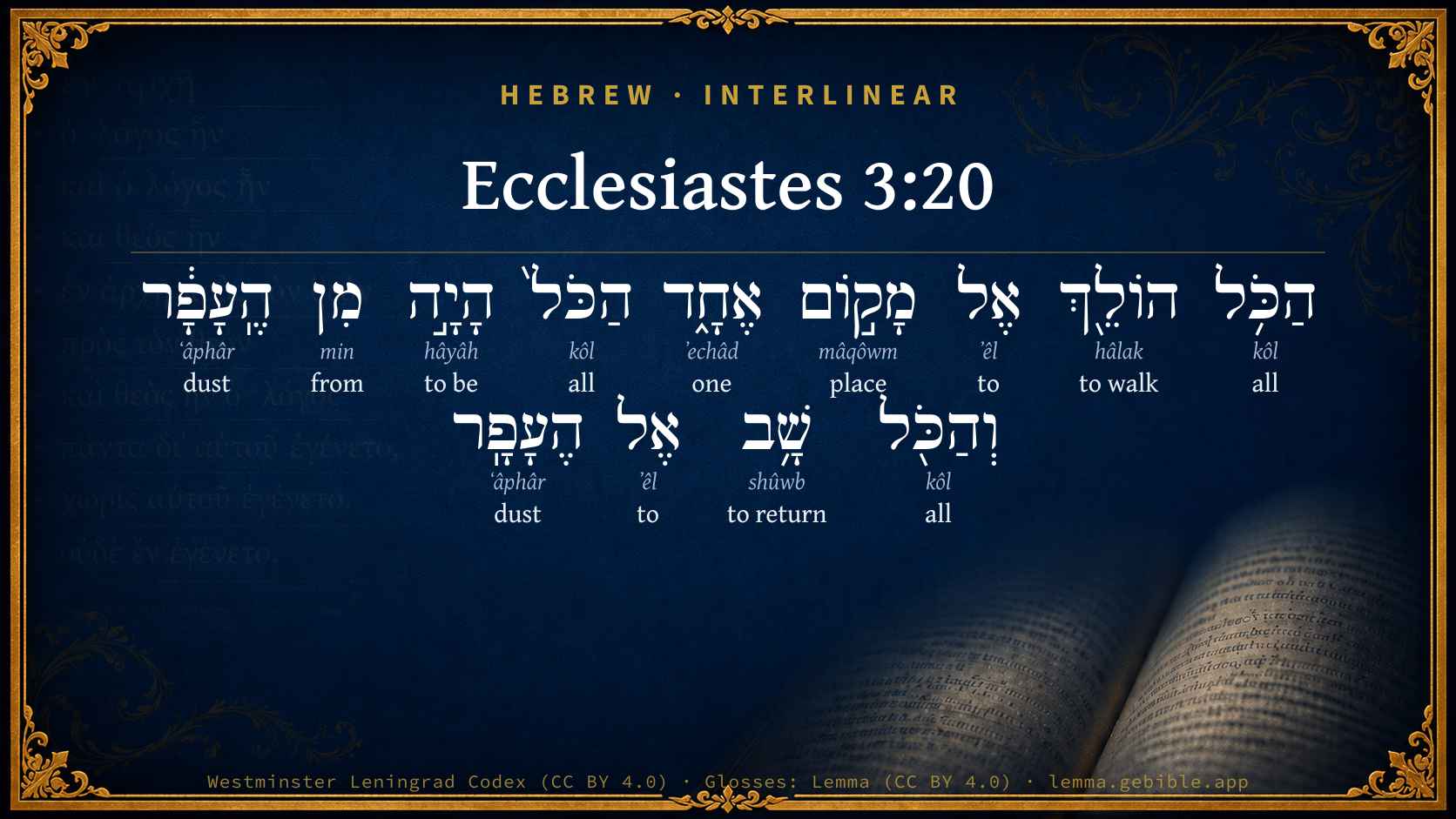
Hebrew (Westminster Leningrad Codex) Ecclesiastes 3:20 appears in the Hebrew Old Testament. The text above is from the Westminster Leningrad Codex. Each word links to its Strong’s number, a concise gloss, and parsing drawn from the Open Scriptures Hebrew Bible morphology. Click any word for its full Brown-Driver-Briggs (BDB) entry.
Download image
Cite this verse

Ecclesiastes 3:20 (World English Bible). Public Domain. Lemma interlinear Bible study tool, https://lemma.gebible.app/v/ecclesiastes/3/20.

Show BibTeX & RIS
BibTeX
RIS
English Translation
All go to one place. All are from the dust, and all turn to dust again.
World English Bible · Public Domain
Download a study sheet

One document with this verse’s original text, its word-by-word gloss line, the meaning frame, cross-references with their text, attributed commentary, and full source and license credits — printable, and it pastes into notes with its structure intact.

This verse Autodidact and up

Study sheet (.html) Plain text (.txt)

A passage Seminary Student

Up to 50 verses in one chapter. A passage sheet keeps up to 6 commentary sources and 12 cross-references per verse, in the order this page ranks them, and says so on the sheet whenever that leaves anything out. Ask for a single verse and you get the Autodidact verse sheet above.

Everything on this page stays free to read, with no account — the sheet is a download of what is already on screen, not access to it.

Want to remove ads? Support Godless Engineer
Compare translations 3

The same verse in 3 English versions, stacked beneath the original-language interlinear above. Click any original word for its lexicon entry.

Each is an independent rendering of the whole verse — the interlinear is not word-aligned to these translations.

Highlighted words mark where these versions differ — a whole-verse word diff, not a word-by-word alignment.

  • World English Bible Public Domain
    All go to one place. All are from the dust, and all turn to dust again.
  • King James Version Public Domain
    All go unto one place; all are of the dust, and all turn to dust again.
  • unfoldingWord Literal Text CC BY-SA 4.0
    Both are going to one place. Both are from the dust, and both return to the dust.

unfoldingWord Literal Text — © unfoldingWord, licensed CC BY-SA 4.0. Word-aligned USFM3 via Door43 (git.door43.org/unfoldingWord/en_ult).

Versions to compare (up to 4)

3 of 4 selected

Show all 18 translations

Every available English version of this verse, each an independent rendering of the whole verse.

  • World English Bible Public Domain
    All go to one place. All are from the dust, and all turn to dust again.
  • Berean Standard Bible Public Domain
    All go to one place; all come from dust, and all return to dust.
  • Majority Standard Bible Public Domain
    All go to one place; all come from dust, and all return to dust.
  • King James Version Public Domain
    All go unto one place; all are of the dust, and all turn to dust again.
  • American Standard Version (1901) Public Domain
    All go unto one place; all are of the dust, and all turn to dust again.
  • Revised Version (1885) Public Domain
    All go unto one place; all are of the dust, and all turn to dust again.
  • Geneva Bible (1599) Public Domain
    All goe to one place, and all was of the dust, and all shall returne to the dust.
  • Douay-Rheims (1899) Public Domain
    And all things go to one place: of earth they were made, and into earth they return together.
  • Young's Literal Translation Public Domain
    The whole are going unto one place, the whole have been from the dust, and the whole are turning back unto the dust.
  • Literal Standard Version CC BY-SA 4.0
    The whole are going to one place, the whole have been from the dust, and the whole are turning back to the dust.
  • Unlocked Literal Bible CC BY-SA 4.0
    Everything is going to the same place. Everything comes from the dust, and everything returns to the dust.
  • unfoldingWord Literal Text CC BY-SA 4.0
    Both are going to one place. Both are from the dust, and both return to the dust.
  • Darby Bible Public Domain
    All go unto one place: all are of the dust, and all return to dust.
  • World Messianic Bible Public Domain
    All go to one place. All are from the dust, and all turn to dust again.
  • Webster's Bible Public Domain
    All go to one place; all are of the dust, and all turn to dust again.
  • Free Bible Version CC BY-SA 4.0
    They all end up in the same place—they all came from dust, and they all return to dust.
  • Bible in Basic English Public Domain
    All go to one place, all are of the dust, and all will be turned to dust again.
  • JPS Tanakh (1917) Public Domain
    All go unto one place; all are of the dust, and all return to dust.

Literal Standard Version (2020), Covenant Press — licensed CC BY-SA 4.0. Text via the HelloAO Bible API (eBible.org). Unlocked Literal Bible (unfoldingWord) — licensed CC BY-SA 4.0. Text via the HelloAO Bible API (eBible.org). unfoldingWord Literal Text — © unfoldingWord, licensed CC BY-SA 4.0. Word-aligned USFM3 via Door43 (git.door43.org/unfoldingWord/en_ult). Free Bible Version, Dr. Jonathan Gallagher — licensed CC BY-SA 4.0. Text via the HelloAO Bible API (eBible.org).

Word by word

More ways to search: Search by grammar → Find every occurrence → Compare this word →

Practice this passage: Drill this verse → Learn its vocabulary →

הֶֽעָפָ֔ר
ʻâphâr
H6083
“the · dust”
Particle, Definite Article + Noun, Common, Masculine, Singular, Absolute
Part of Speech
Particle + Noun
Type
Common
Gender
Masculine
Number
Singular
State
Absolute
Full BDB Definition

Origin: from H6080

TWOT: 1664a

dry earth, dust, powder, ashes, earth, ground, mortar, rubbish - dry or loose earth - debris - mortar - ore
  1. הַכֹּ֥ל kôl H3605 “the · all” Particle, Definite Article + Noun, Common, Masculine, Singular, Absolute
  2. הוֹלֵ֖ךְ hâlak H1980 “walking” Verb, Qal, Participle Active, Masculine, Singular, Absolute
  3. אֶל ʼêl H413 “to” Preposition
  4. מָק֣וֹם mâqôwm H4725 “place” Noun, Common, Masculine, Singular, Absolute
  5. אֶחָ֑ד ʼechâd H259 “one” Adjective, Cardinal number, Masculine, Singular, Absolute
  6. הַכֹּל֙ kôl H3605 “the · all” Particle, Definite Article + Noun, Common, Masculine, Singular, Absolute
  7. הָיָ֣ה hâyâh H1961 “to be” Verb, Qal, Perfect, 3rd Person, Masculine, Singular
  8. מִן min H4480 “from” Preposition
  9. וְהַכֹּ֖ל kôl H3605 “and · the · all” Conjunction + Particle, Definite Article + Noun, Common, Masculine, Singular, Absolute
  10. שָׁ֥ב shûwb H7725 “to return” Verb, Qal, Perfect, 3rd Person, Masculine, Singular
  11. אֶל ʼêl H413 “to” Preposition
  12. הֶעָפָֽר ʻâphâr H6083 “the · dust” Particle, Definite Article + Noun, Common, Masculine, Singular, Absolute

About this verse

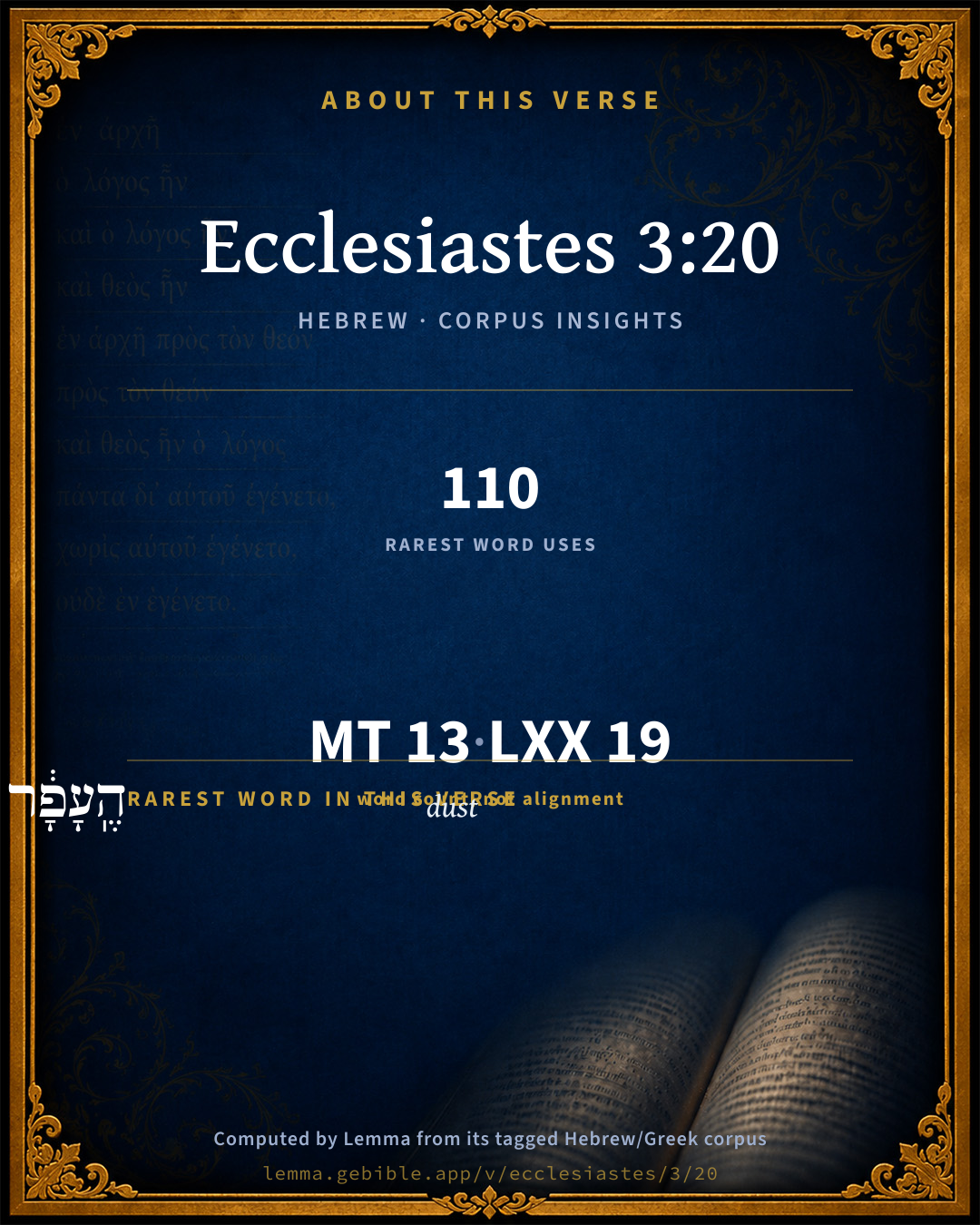
These counts appear in no published source. They are computed here, from the morphology-tagged text and Lemma’s own curated glosses. What Lemma adds →

13
words
9
distinct lemmas
Wisdom
section

Grammatical profile

  • 3 verbs
  • 6 nouns
  • 1 adjective
  • 3 prepositions

Verb forms

  • הוֹלֵ֖ךְ Qal · Participle Active
  • הָיָ֣ה Qal · Perfect
  • שָׁ֥ב Qal · Perfect

Repetition

Words recur within this verse — often emphatic in Hebrew:

  • הַכֹּ֥ל all H3605 ×3
  • הֶֽעָפָ֔ר dust H6083 ×2
  • אֶל to H413 ×2

Hebrew & Septuagint length

In English translation the verse runs 16 words from the Hebrew and 17 from the Septuagint (LXX English) — closely comparable.

A rough comparison of the two English renderings, which tokenize alike — not a word-level alignment.

Word counts can differ between the Hebrew and the Greek without any difference in meaning — e.g. the Hebrew direct-object marker אֵת has no separate Greek word, and Greek often adds the article ὁ.

In the original languages it is 13 Hebrew tokens and 19 Greek tokens — but the two are counted differently (Hebrew bundles its prefixes and suffixes into one token; the Greek is in lemma form), so that isn’t a like-for-like length.

Cross-references

16

Topical passages linked to Ecclesiastes 3:20 in the Treasury of Scripture Knowledge — connected by theme and wording, ordered by reader-vote popularity; previews shown in the World English Bible.

  • Genesis 3:19 By the sweat of your face will you eat bread until you return to the ground, for out of it you were taken. For you are dust, and to dust you shall return."
  • Job 34:15 All flesh would perish together, And man would turn again to dust.
  • Ecclesiastes 12:7 And the dust returns to the earth as it was, And the spirit returns to God who gave it.
  • Numbers 27:13 When you have seen it, you also shall be gathered to your people, as Aaron your brother was gathered;
  • Job 7:9 As the cloud is consumed and vanishes away, So he who goes down to Sheol shall come up no more.
  • Job 10:9–10 Remember, I beg you, that you have fashioned me as clay. Will you bring me into dust again?
  • Psalms 104:29 You hide your face: they are troubled; You take away their breath: they die, and return to the dust.
  • Ecclesiastes 3:21 Who knows the spirit of man, whether it goes upward, and the spirit of the animal, whether it goes downward to the earth?"
  • Ecclesiastes 6:6 Yes, though he live a thousand years twice told, and yet fails to enjoy good, don't all go to one place?
  • Ecclesiastes 9:10 Whatever your hand finds to do, do it with your might; for there is no work, nor device, nor knowledge, nor wisdom, in Sheol, where you are going.
  • Genesis 25:8 Abraham gave up the spirit, and died in a good old age, an old man, and full of years, and was gathered to his people.
  • Genesis 25:17 These are the years of the life of Ishmael: one hundred thirty-seven years. He gave up the spirit and died, and was gathered to his people.
  • Job 17:13 If I look for Sheol as my house, If I have spread my couch in the darkness,
  • Psalms 49:14 They are appointed as a flock for Sheol. Death shall be their shepherd. The upright shall have dominion over them in the morning. Their beauty shall decay in Sheol, Far from their mansion.
  • Daniel 12:2 Many of those who sleep in the dust of the earth shall awake, some to everlasting life, and some to shame and everlasting contempt.
  • Job 30:24 "However doesn't one stretch out a hand in his fall? Or in his calamity therefore cry for help?

Cross-references courtesy of OpenBible.info (CC BY 4.0).

Hebrew and Greek witnesses Masoretic Hebrew ↔ Greek Septuagint

The same verse in the two great witnesses to the Old Testament, shown verse-for-verse.

These are two independent witnesses, not word-aligned to each other, and the Septuagint is shown in lemma (dictionary) form.

Hebrew Ecclesiastes 3:20 Masoretic · Westminster Leningrad Codex

הַכֹּ֥ל הוֹלֵ֖ךְ אֶל מָק֣וֹם אֶחָ֑ד הַכֹּל֙ הָיָ֣ה מִן הֶֽעָפָ֔ר וְהַכֹּ֖ל שָׁ֥ב אֶל הֶעָפָֽר

All go to one place. All are from the dust, and all turn to dust again.

World English Bible · Public Domain

Greek LXX Ecclesiastes 3:20 Septuagint · lemma form

ὁ πᾶς πορεύομαι εἰς τόπος εἷς ὁ πᾶς γίγνομαι ἀπό ὁ χοῦς καί ὁ πᾶς ἐπιστρέφω εἰς ὁ χοῦς

All go to one place; all were formed of the dust, and all will return to dust.

LXX2012 (modern English Septuagint) · Public Domain

Hebrew: Westminster Leningrad Codex (CC BY 4.0). Greek: Septuagint (public domain); English from LXX2012 (modern English Septuagint) (Public Domain). How the Septuagint differs from the Hebrew →

Commentary

Notes on Ecclesiastes 3:20 from classic Christian and Jewish commentators (each source and its license shown beneath its notes). The classic Christian expositions comment on the surrounding passage and are grouped to its opening verse, so a note may address several verses; the Jewish commentaries on the Tanakh (Rashi and others) are per-verse, so they appear only where the commentator wrote on this verse.

Lemma curates 59 commentaries, every one of them public domain or Creative Commons licensed, each selected and text-cleaned for this edition rather than reprinted as found. About our sources →

Trapp's Complete Commentary

John Trapp

Ecc 3:20 All go unto one place; all are of the dust, and all turn to dust again.

Ver. 20. All are of the dust.] {See Trapp on "Gen 3:19"}

John Trapp, A Commentary or Exposition upon All the Books of the Old and New Testament (1647–1656) — public domain. Text from a community e-Sword module.

Joseph Benson's Commentary

Ecc 3:20-21. All go unto one place — To the earth, as it is expressed Ecc 3:21, out of which they were both taken. All turn to dust again — All their bodies, as it is explained Ecc 12:7. Who knoweth the spirit of a man — True it is, there is a difference, which is known by good men, but the generality of mankind never mind it; their hearts are wholly set on present and sensible things, and take no thought for the things of the future and invisible world.

Joseph Benson's Commentary on the Old and New Testaments (1811–1818) — public domain. Text from a community e-Sword module.

Tyndale Open Study Notes

Tyndale Open Resources

3:20 from dust . . . to dust: The Teacher refers to God’s judgment against human rebellion in Eden (see Gen 3:19).

Tyndale Open Study Notes — © Tyndale Open Resources, licensed CC BY-SA 4.0. Text via the HelloAO Bible API.

Adam Clarke's Commentary

Verse 20. All go unto one place]

"Man was born

To die, nor aught exceeds in this respect

The vilest brute. Both transient, frail, and vain,

Draw the same breath; alike grow old, decay,

And then expire: both to one grave descend;

There blended lie, to native dust return'd."-C.

Adam Clarke's Commentary on the Bible (1810–1826) — public domain. Text from a community e-Sword/MySword module.

The Cambridge Bible for Schools and Colleges

gen. ed. J. J. S. Perowne

20. All go unto one place] The “place” thus spoken of is not the Sheol of the Hebrews or the Hades of the Greeks, which implied, however vaguely, some notion of a shadowy disembodied existence, for the souls of men as distinct from those of brutes, but simply the earth as at once the mother, the nourisher, and the sepulchre of every form of life. So Lucretius, as a disciple of Epicurus, speaks (De Rer. Nat. v. 259) of earth as being

“Omniparens eadem rerum commune sepulcrum.”

“The mother and the sepulchre of all.”

all are of the dust] There is an obviously deliberate reference to the narrative of the Creation in Gen_2:7. To those who did not see below the surface, it seemed to affirm, as it did to the Sadducee, the denial of a life to come. “Dust thou art and unto dust shalt thou return” was the sentence passed, they might say, as on the brute creation, so on man also (Gen_3:19).

The Cambridge Bible for Schools and Colleges (gen. ed. J. J. S. Perowne; Cambridge University Press, 1878–1918) — public domain. Text from a community e-Sword module.

John Gill's Exposition

All go unto one place,.... The earth (w) from whence they came;

all are of the dust, and all turn to dust again; Adam's body was made of the dust of the earth, and so all his posterity, all of them; in which they agree with beasts, who are made of the dust also; and, when they die, return to it; see Gen 2:7.

(w) "Magna parens terra est", Ovid. Metamorph. l. 1. Fab. 7.

John Gill's Exposition of the Whole Bible (1746–1763) — public domain (CC PDM 1.0). Text via the HelloAO Bible API.

Matthew Poole's English Annotations

All go unto one place; to the earth, as it is expressed, Ecc 3:21, out of which they were both taken.

All turn to dust again; which is meant only of their bodies, as it is explained, Ecc 12:7.

Matthew Poole's English Annotations on the Holy Bible (1683–1685) — public domain. Text from a community e-Sword/MySword module.

Whedon's Commentary on the Bible

Daniel D. Whedon

20. All are of the dust — “Dust thou art, and unto dust shalt thou return.” The perishing and dissolution of the bodies of men and beasts are visibly similar. There can be no doubt about that. And how of the spirit?

Daniel D. Whedon (gen. ed.), Commentary on the Old and New Testaments (1874–1909) — public domain. Text from a community e-Sword module.

The Pulpit Commentary

All go unto one place. All, men and brutes, are buried in the. (Ecc_12:7) The author is not thinking of Sheol, the abode of departed spirits, but merely regarding earth as the universal tomb of all creatures. Plumptre quotes Lueretius, "De Rer. Nat.," 5:260

Omniparens eadem rerum commune sepulchrum.

The mother and the sepulcher of all.

Thus Bailey, "Festus

The course of nature seems a course of death; The prize of life"s brief race, to cease to run; The sole substantial thing, death"s nothingness.

All are of the dust (Gen_3:19; Psa_104:29 Psa_146:4) So Ecc 41:10, "All things that are of earth shall turn to earth again." This is true of the material part of men and brutes alike; the question of the destiny of the immaterial part is touched in the next verse.

The Pulpit Commentary (1880–1919), ed. H.D.M. Spence-Jones & Joseph S. Exell — public domain. Text from a community e-Sword module.

John Wesley's Explanatory Notes

One place - To the earth, out of which they were taken. All turn - All their bodies.

John Wesley, Explanatory Notes Upon the Whole Bible (1754–1765) — public domain. Text via the GEBible commentary corpus.

Keil & Delitzsch

C. F. Keil & F. Delitzsch

"All goes hence to one place; all has sprung out of the dust, and all returns to the dust again." The "one place" is (as at Ecc 6:6) the earth, the great graveyard which finally receives all the living when dead. The art. of the first העפר is that denoting species; the art. of the second is retrospective: to the dust whence he sprang (cf. Psa 104:29; Psa 146:4); otherwise, Gen 3:19 (cf. Job 34:15), "to dust shalt thou return," shalt become dust again. From dust to dust (Sir. 40:11; 41:10) is true of every living corporeal thing. It is true there exists the possibility that with the spirit of the dying man it may be different from what it is with the spirit of the dying beast, but yet that is open to question.

Keil & Delitzsch — Biblical Commentary on the Old Testament (1861–1891) — public domain (CC PDM 1.0). Text via the HelloAO Bible API. (Old Testament only.)

Lesson kit

Teaching starters — assembled from the data on this page, not authored interpretation. Every prompt links to the verse data it draws on. Edit before teaching.

Ecclesiastes, in the Wisdom, opens this verse with 13 words (9 distinct Hebrew lemmas). Its most distinctive word is ʻâphâr (“dust”). A historical commentator’s framing appears above. Read the whole chapter for the surrounding context.

Discussion questions

  1. The word ʻâphâr carries the sense “dust.” How does it shape the verse?
  2. How does Genesis 3:19, which shares this passage’s theme, read alongside this verse?
  3. What does the repetition of “all” (3× in this one verse) do in this verse?
  4. These translations render this verse differently. What is at stake in choosing one wording over another?
  5. «הוֹלֵ֖ךְ» is a Qal Participle Active verb. How does that grammatical form shape the action described?
  6. Compare how Trapp's Complete Commentary and Joseph Benson's Commentary read this verse. Where do they agree or differ?

Things to notice

Reading settings

Reading text

Shown beneath each verse's original-language words.

Old Testament
Old Testament edition

Read the OT as the Masoretic Hebrew (MT) or the Greek Septuagint (LXX).

English shown for the Greek Septuagint (in the Hebrew ↔ Greek comparison).

Comparing translations? Open the Compare panel on any verse page to stack up to four side by side.