
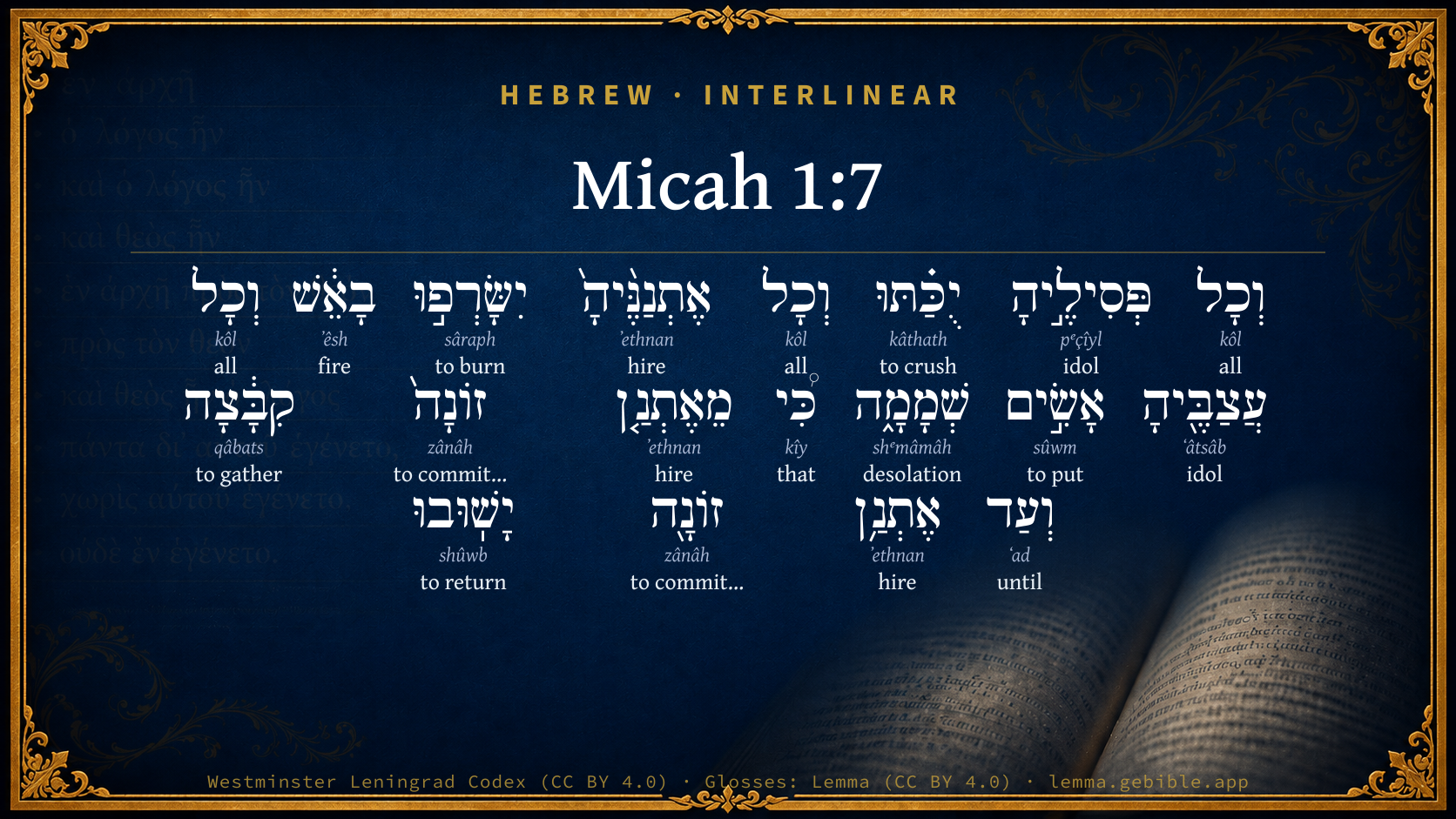
Micah 1:7

Hebrew (Westminster Leningrad Codex) Micah 1:7 appears in the Hebrew Old Testament. The text above is from the Westminster Leningrad Codex. Each word links to its Strong’s number, a concise gloss, and parsing drawn from the Open Scriptures Hebrew Bible morphology. Click any word for its full Brown-Driver-Briggs (BDB) entry.
Download image
Cite this verse

Micah 1:7 (World English Bible). Public Domain. Lemma interlinear Bible study tool, https://lemma.gebible.app/v/micah/1/7.

Show BibTeX & RIS
BibTeX
RIS
English Translation
All her idols will be beaten to pieces, And all her temple gifts will be burned with fire, And all her images I will destroy; For of the hire of a prostitute has she gathered them, And to the hire of a prostitute shall they return."
World English Bible · Public Domain
Download a study sheet

One document with this verse’s original text, its word-by-word gloss line, the meaning frame, cross-references with their text, attributed commentary, and full source and license credits — printable, and it pastes into notes with its structure intact.

This verse Autodidact and up

Study sheet (.html) Plain text (.txt)

A passage Seminary Student

Up to 50 verses in one chapter. A passage sheet keeps up to 6 commentary sources and 12 cross-references per verse, in the order this page ranks them, and says so on the sheet whenever that leaves anything out. Ask for a single verse and you get the Autodidact verse sheet above.

Everything on this page stays free to read, with no account — the sheet is a download of what is already on screen, not access to it.

Want to remove ads? Support Godless Engineer
Compare translations 3

The same verse in 3 English versions, stacked beneath the original-language interlinear above. Click any original word for its lexicon entry.

Each is an independent rendering of the whole verse — the interlinear is not word-aligned to these translations.

Highlighted words mark where these versions differ — a whole-verse word diff, not a word-by-word alignment.

  • World English Bible Public Domain
    All her idols will be beaten to pieces, And all her temple gifts will be burned with fire, And all her images I will destroy; For of the hire of a prostitute has she gathered them, And to the hire of a prostitute shall they return."
  • King James Version Public Domain
    And all the graven images thereof shall be beaten to pieces, and all the hires thereof shall be burned with the fire, and all the idols thereof will I lay desolate: for she gathered it of the hire of an harlot, and they shall return to the hire of an harlot.
  • unfoldingWord Literal Text CC BY-SA 4.0
    And all her carved images will be crushed, and all her wages will be burned in the fire, and all her idols I will make a desolation, for from the wages of a prostitute she gathered, and to the wages of a prostitute they will return.”

unfoldingWord Literal Text — © unfoldingWord, licensed CC BY-SA 4.0. Word-aligned USFM3 via Door43 (git.door43.org/unfoldingWord/en_ult).

Versions to compare (up to 4)

3 of 4 selected

Show all 18 translations

Every available English version of this verse, each an independent rendering of the whole verse.

  • World English Bible Public Domain
    All her idols will be beaten to pieces, And all her temple gifts will be burned with fire, And all her images I will destroy; For of the hire of a prostitute has she gathered them, And to the hire of a prostitute shall they return."
  • Berean Standard Bible Public Domain
    All her carved images will be smashed to pieces; all her wages will be burned in the fire, and I will destroy all her idols. Since she collected the wages of a prostitute, they will be used again on a prostitute.
  • Majority Standard Bible Public Domain
    All her carved images will be smashed to pieces; all her wages will be burned in the fire, and I will destroy all her idols. Since she collected the wages of a prostitute, they will be used again on a prostitute.
  • King James Version Public Domain
    And all the graven images thereof shall be beaten to pieces, and all the hires thereof shall be burned with the fire, and all the idols thereof will I lay desolate: for she gathered it of the hire of an harlot, and they shall return to the hire of an harlot.
  • American Standard Version (1901) Public Domain
    And all her graven images shall be beaten to pieces, and all her hires shall be burned with fire, and all her idols will I lay desolate; for of the hire of a harlot hath she gathered them, and unto the hire of a harlot shall they return.
  • Revised Version (1885) Public Domain
    And all her graven images shall be beaten to pieces, and all her hires shall be burned with fire, and all her idols will I lay desolate: for of the hire of an harlot hath she gathered them, and unto the hire of an harlot shall they return.
  • Geneva Bible (1599) Public Domain
    And all the grauen images thereof shalbe broken, and all the giftes thereof shalbe burnt with the fire, and all the idoles thereof will I destroy: for she gathered it of the hire of an harlot, and they shall returne to the wages of an harlot.
  • Douay-Rheims (1899) Public Domain
    And all her graven things shall be cut in pieces, and all her wages shall be burnt with fire, and I will bring to destruction all her idols: for they were gathered together of the hire of a harlot, and unto the hire of a harlot they shall return.
  • Young's Literal Translation Public Domain
    And all her graven images are beaten down, And all her gifts are burnt with fire, And all her idols I make a desolation, For, from the hire of a harlot she gathered, and unto the hire of a harlot they return.
  • Literal Standard Version CC BY-SA 4.0
    And all her carved images are beaten down, || And all her wages are burned with fire, || And all her idols I make a desolation, || For from the wage of a harlot she gathered, and to the wage of a harlot they return.”
  • Unlocked Literal Bible CC BY-SA 4.0
    All her carved figures will be broken to pieces, and all her gifts that she received will be burned with fire, and I will destroy all her idols. Since she gathered her gifts from the wages of prostitutes, they will become the wages of prostitutes again.”
  • unfoldingWord Literal Text CC BY-SA 4.0
    And all her carved images will be crushed, and all her wages will be burned in the fire, and all her idols I will make a desolation, for from the wages of a prostitute she gathered, and to the wages of a prostitute they will return.”
  • Darby Bible Public Domain
    And all her graven images shall be beaten to pieces, and all her harlot-gifts shall be burned with fire, and all her idols will I make a desolation; for of the hire of a harlot hath she gathered [them], and to a harlot's hire shall they return.
  • World Messianic Bible Public Domain
    All her idols will be beaten to pieces, all her temple gifts will be burned with fire, and I will destroy all her images; for of the hire of a prostitute has she gathered them, and to the hire of a prostitute shall they return.”
  • Webster's Bible Public Domain
    And all her graven images shall be beaten to pieces, and all her hires shall be burned with the fire, and all her idols will I lay desolate: for she gathered it from the hire of a harlot, and they shall return to the hire of a harlot.
  • Free Bible Version CC BY-SA 4.0
    All their carved idols will be smashed to pieces. All that was earned by their temple prostitutes will be burned. All of their idols will be destroyed, for what she collected through the earnings of temple prostitutes will be taken away and used to pay other temple prostitutes.
  • Bible in Basic English Public Domain
    And all her pictured images will be hammered into bits, and all the payments for her loose ways will be burned with fire, and all the images of her gods I will make waste: for with the price of a loose woman she got them together, and as the price of a loose woman will they be given back.
  • JPS Tanakh (1917) Public Domain
    And all her graven images shall be beaten to pieces, and all her hires shall be burned with fire, and all her idols will I lay desolate; for of the hire of a harlot hath she gathered them, and unto the hire of a harlot shall they return.

Literal Standard Version (2020), Covenant Press — licensed CC BY-SA 4.0. Text via the HelloAO Bible API (eBible.org). Unlocked Literal Bible (unfoldingWord) — licensed CC BY-SA 4.0. Text via the HelloAO Bible API (eBible.org). unfoldingWord Literal Text — © unfoldingWord, licensed CC BY-SA 4.0. Word-aligned USFM3 via Door43 (git.door43.org/unfoldingWord/en_ult). Free Bible Version, Dr. Jonathan Gallagher — licensed CC BY-SA 4.0. Text via the HelloAO Bible API (eBible.org).

Word by word

More ways to search: Search by grammar → Find every occurrence → Compare this word →

Practice this passage: Drill this verse → Learn its vocabulary →

אֶתְנַנֶּ֨יהָ֙
ʼethnan
H868
“hires · her”
Noun, Common, Masculine, Plural, Construct + Suffix, Personal, 3rd Person, Feminine, Singular
Part of Speech
Noun
Type
Common
Gender
Masculine
Number
Plural
State
Construct
Full BDB Definition

Origin: the same as H866

TWOT: 2529a

hire of prostitute, price - hire (of harlot) - of idolatrous Israel, Jerusalem, Tyre (figuratively)
  1. וְכָל kôl H3605 “and · all of” Conjunction + Noun, Common, Masculine, Singular, Construct
  2. פְּסִילֶ֣יהָ pᵉçîyl H6456 “idols · her” Noun, Common, Masculine, Plural, Construct + Suffix, Personal, 3rd Person, Feminine, Singular
  3. יֻכַּ֗תּוּ kâthath H3807 “to crush” Verb, Hophal, Imperfect, 3rd Person, Masculine, Plural
  4. וְכָל kôl H3605 “and · all of” Conjunction + Noun, Common, Masculine, Singular, Construct
  5. יִשָּׂרְפ֣וּ sâraph H8313 “to burn” Verb, Niphal, Imperfect, 3rd Person, Masculine, Plural
  6. בָאֵ֔שׁ ʼêsh H784 “in/at the · fire” Preposition, Determined + Noun, Common, Both, Singular, Absolute
  7. וְכָל kôl H3605 “and · all of” Conjunction + Noun, Common, Masculine, Singular, Construct
  8. עֲצַבֶּ֖יהָ ʻâtsâb H6091 “idols · her” Noun, Common, Masculine, Plural, Construct + Suffix, Personal, 3rd Person, Feminine, Singular
  9. אָשִׂ֣ים sûwm H7760 “to put” Verb, Qal, Imperfect, 1st Person, Common, Singular
  10. שְׁמָמָ֑ה shᵉmâmâh H8077 “desolation” Noun, Common, Feminine, Singular, Absolute
  11. כִּ֠י kîy H3588 “that” Conjunction
  12. מֵאֶתְנַ֤ן ʼethnan H868 “from · hire of” Preposition + Noun, Common, Masculine, Singular, Construct
  13. זוֹנָה֙ zânâh H2181 “committing fornication” Verb, Qal, Participle Active, Feminine, Singular, Absolute
  14. קִבָּ֔צָה qâbats H6908 “to gather” Verb, Piel, Perfect, 3rd Person, Feminine, Singular
  15. וְעַד ʻad H5704 “and · until” Conjunction + Preposition
  16. אֶתְנַ֥ן ʼethnan H868 “hire of” Noun, Common, Masculine, Singular, Construct
  17. זוֹנָ֖ה zânâh H2181 “committing fornication” Verb, Qal, Participle Active, Feminine, Singular, Absolute
  18. יָשֽׁוּבוּ shûwb H7725 “to return” Verb, Qal, Imperfect, 3rd Person, Masculine, Plural

About this verse

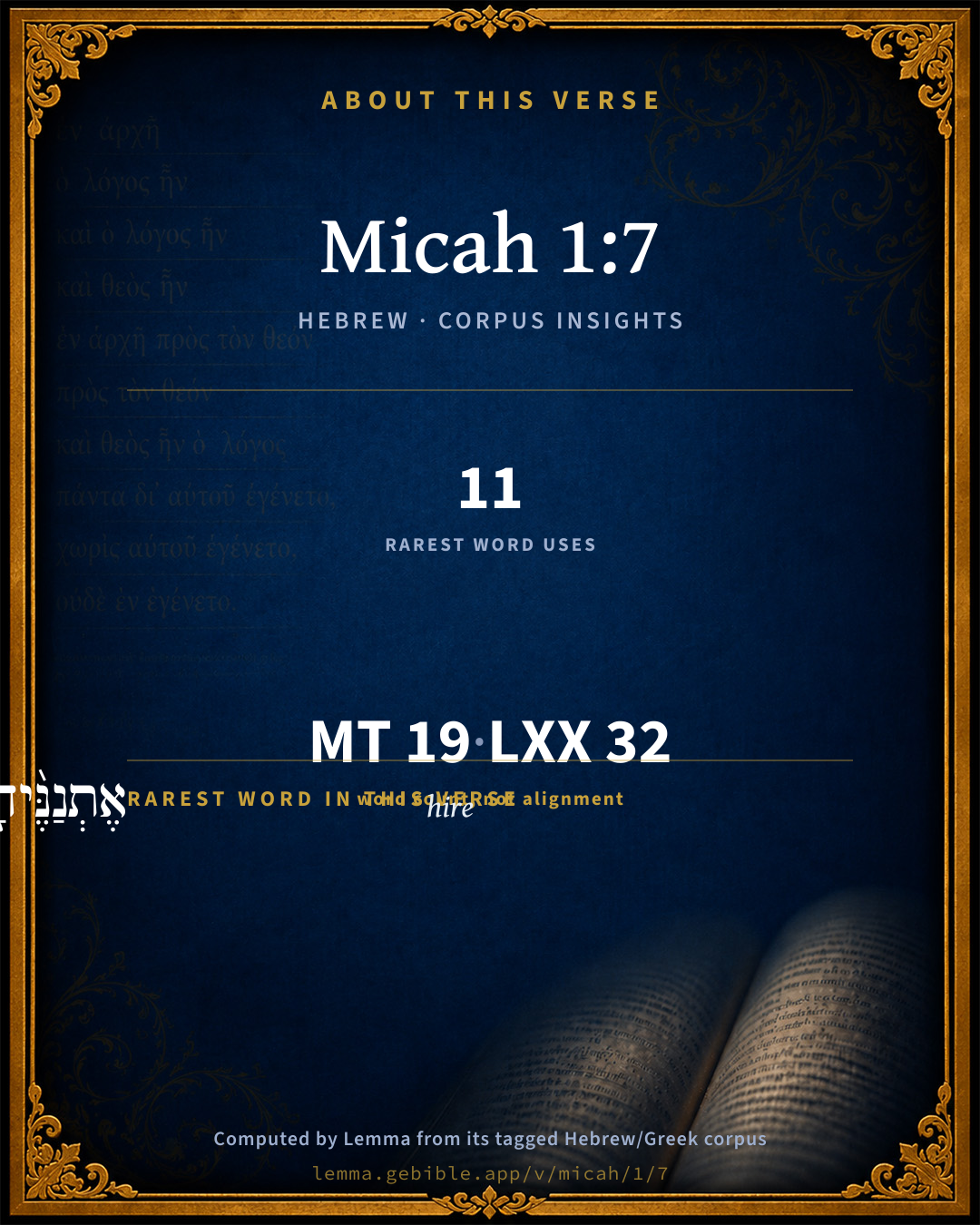
These counts appear in no published source. They are computed here, from the morphology-tagged text and Lemma’s own curated glosses. What Lemma adds →

19
words
14
distinct lemmas
Prophets
section

Notable vocabulary

The rarest word here is אֶתְנַנֶּ֨יהָ֙ hire H868 — appearing just 11 times in the whole Hebrew Bible.

Shared distinctive vocabulary

אֶתְנַנֶּ֨יהָ֙ hire H868 occurs in 8 verses of the Hebrew Bible. Also found in:

Grammatical profile

  • 7 verbs
  • 10 nouns
  • 1 preposition
  • 1 conjunction

Verb forms

  • יֻכַּ֗תּוּ Hophal · Imperfect
  • יִשָּׂרְפ֣וּ Niphal · Imperfect
  • אָשִׂ֣ים Qal · Imperfect
  • זוֹנָה֙ Qal · Participle Active
  • קִבָּ֔צָה Piel · Perfect
  • זוֹנָ֖ה Qal · Participle Active
  • יָשֽׁוּבוּ Qal · Imperfect

Repetition

Words recur within this verse — often emphatic in Hebrew:

  • וְכָל all H3605 ×3
  • אֶתְנַנֶּ֨יהָ֙ hire H868 ×3
  • זוֹנָה֙ to commit fornication H2181 ×2

Hebrew & Septuagint length

In English translation the verse runs 46 words from the Hebrew and 48 from the Septuagint (LXX English) — closely comparable.

A rough comparison of the two English renderings, which tokenize alike — not a word-level alignment.

Word counts can differ between the Hebrew and the Greek without any difference in meaning — e.g. the Hebrew direct-object marker אֵת has no separate Greek word, and Greek often adds the article ὁ.

In the original languages it is 19 Hebrew tokens and 32 Greek tokens — but the two are counted differently (Hebrew bundles its prefixes and suffixes into one token; the Greek is in lemma form), so that isn’t a like-for-like length.

Cross-references

16

Topical passages linked to Micah 1:7 in the Treasury of Scripture Knowledge — connected by theme and wording, ordered by reader-vote popularity; previews shown in the World English Bible.

  • Deuteronomy 23:18 You shall not bring the hire of a prostitute, or the wages of a dog, into the house of Yahweh your God for any vow: for even both these are an abomination to Yahweh your God.
  • Hosea 2:12 I will lay waste her vines and her fig trees, About which she has said, 'These are my wages that my lovers have given me; And I will make them a forest,' And the animals of the field shall eat them.
  • Hosea 8:6 For this is even from Israel! The workman made it, and it is no God; Indeed, the calf of Samaria shall be broken in pieces.
  • Hosea 10:5–6 The inhabitants of Samaria will be in terror for the calves of Beth Aven; For its people will mourn over it, Along with its priests who rejoiced over it, For its glory, because it has departed from it.
  • Revelation 18:3 For all the nations have drunk of the wine of the wrath of her sexual immorality, the kings of the earth committed sexual immorality with her, and the merchants of the earth grew rich from the abundance of her luxury."
  • Leviticus 26:30 I will destroy your high places, and cut down your incense altars, and cast your dead bodies upon the bodies of your idols; and my soul will abhor you.
  • Deuteronomy 9:21 I took your sin, the calf which you had made, and burnt it with fire, and stamped it, grinding it very small, until it was as fine as dust: and I cast the dust of it into the brook that descended out of the mountain.
  • 2 Kings 23:14–15 He broke in pieces the pillars, and cut down the Asherim, and filled their places with the bones of men.
  • 2 Chronicles 31:1 Now when all this was finished, all Israel who were present went out to the cities of Judah, and broke in pieces the pillars, and hewed down the Asherim, and broke down the high places and the altars out of all Judah and Benjamin, in Ephraim also and Manasseh, until they had destroyed them all. Then all the children of Israel returned, every man to his possession, into their own cities.
  • 2 Chronicles 34:6–7 [So did he] in the cities of Manasseh and Ephraim and Simeon, even to Naphtali, in their ruins round about.
  • Isaiah 27:9 Therefore by this shall the iniquity of Jacob be forgiven, and this is all the fruit of taking away his sin: that he makes all the stones of the altar as chalk stones that are beaten in sunder, [so that] the Asherim and the sun-images shall rise no more.
  • Jeremiah 44:17–18 But we will certainly perform every word that is gone forth out of our mouth, to burn incense to the queen of the sky, and to pour out drink-offerings to her, as we have done, we and our fathers, our kings and our princes, in the cities of Judah, and in the streets of Jerusalem; for then had we plenty of food, and were well, and saw no evil.
  • Hosea 2:5 For their mother has played the prostitute. She who conceived them has done shamefully; For she said, 'I will go after my lovers, Who give me my bread and my water, My wool and my flax, My oil and my drink.'
  • Joel 3:3 And have cast lots for my people, And have given a boy for a prostitute, And sold a girl for wine, that they may drink.
  • Revelation 18:9 The kings of the earth, who committed sexual immorality and lived wantonly with her, will weep and wail over her, when they look at the smoke of her burning,
  • Revelation 18:12–13 merchandise of gold, silver, precious stones, pearls, fine linen, purple, silk, scarlet, all expensive wood, every vessel of ivory, every vessel made of most precious wood, and of brass, and iron, and marble;

Cross-references courtesy of OpenBible.info (CC BY 4.0).

Hebrew and Greek witnesses Masoretic Hebrew ↔ Greek Septuagint

The same verse in the two great witnesses to the Old Testament, shown verse-for-verse.

These are two independent witnesses, not word-aligned to each other, and the Septuagint is shown in lemma (dictionary) form.

Hebrew Micah 1:7 Masoretic · Westminster Leningrad Codex

וְכָל פְּסִילֶ֣יהָ יֻכַּ֗תּוּ וְכָל אֶתְנַנֶּ֨יהָ֙ יִשָּׂרְפ֣וּ בָאֵ֔שׁ וְכָל עֲצַבֶּ֖יהָ אָשִׂ֣ים שְׁמָמָ֑ה כִּ֠י מֵאֶתְנַ֤ן זוֹנָה֙ קִבָּ֔צָה וְעַד אֶתְנַ֥ן זוֹנָ֖ה יָשֽׁוּבוּ

All her idols will be beaten to pieces, And all her temple gifts will be burned with fire, And all her images I will destroy; For of the hire of a prostitute has she gathered them, And to the hire of a prostitute shall they return."

World English Bible · Public Domain

Greek LXX Micah 1:7 Septuagint · lemma form

καί πᾶς ὁ γλυπτός αὐτός κατακόπτω καί πᾶς ὁ μίσθωμα αὐτός ἐνπίπρημι ἐν πῦρ καί πᾶς ὁ εἴδωλον αὐτός τίθημι εἰς ἀφανισμός διότι ἐκ μίσθωμα πορνεία συνἄγω καί ἐκ μίσθωμα πορνεία συνστρέφω

And they shall cut in pieces all the graven images, and all that she has hired they shall burn with fire, and I will utterly destroy all her idols: because she has gathered of the hires of fornication, and of the hires of fornication has she amassed wealth.

LXX2012 (modern English Septuagint) · Public Domain

On this verse, The Pulpit Commentary discusses the Septuagint’s reading. Read the note in Commentary ↓

Hebrew: Westminster Leningrad Codex (CC BY 4.0). Greek: Septuagint (public domain); English from LXX2012 (modern English Septuagint) (Public Domain). How the Septuagint differs from the Hebrew →

Targum (Aramaic paraphrase)

1

The Targum is the ancient Jewish Aramaic paraphrase of the Hebrew Scriptures — an interpretive translation, not the Hebrew text itself. Onkelos (literal) and Pseudo-Jonathan (expansive) render the Torah, and Jonathan the Prophets. Coverage is partial: where no permissively-licensed English translation exists for a verse, only the Aramaic is shown. This is verse-level text, not a word-by-word alignment to the Hebrew.

  1. Targum Jonathan Prophets (Joshua–Malachi)
    וְכָל צַלְמָנָהָא יִדְקְרוּן וְכָל טַעֲוָתָהָא יִתּוֹקְדוּן בְּנוּרָא וְכָל בָּתֵּי דַחֲלָתָהָא אֲשַׁוֵי לְצָדוּ אֲרֵי מַאֲגַר זַנְיָתָא אִתְכְּנָשׁוּ וּלְבֵית פָּלְחֵי טַעֲוָתָהָא יִתְמַסְרוּן:

    (no public-domain English translation for this verse)

    Targum Jonathan — Aramaic: “Mikraot Gedolot” (public domain). English: “Sefaria Community Translation” (CC0 1.0 (public-domain dedication)); “London "Chaldee Paraphrase," 1871” (public domain). Text via Sefaria.

Commentary

Notes on Micah 1:7 from classic Christian and Jewish commentators (each source and its license shown beneath its notes). The classic Christian expositions comment on the surrounding passage and are grouped to its opening verse, so a note may address several verses; the Jewish commentaries on the Tanakh (Rashi and others) are per-verse, so they appear only where the commentator wrote on this verse.

Lemma curates 59 commentaries, every one of them public domain or Creative Commons licensed, each selected and text-cleaned for this edition rather than reprinted as found. About our sources →

Trapp's Complete Commentary

John Trapp

Mic 1:7 And all the graven images thereof shall be beaten to pieces, and all the hires thereof shall be burned with the fire, and all the idols thereof will I lay desolate: for she gathered [it] of the hire of an harlot, and they shall return to the hire of an harlot.

Ver. 7. And all the graven images thereof] Upon these the jealous God will execute vengeance: so to show his hatred of idolatry. "The stones of the altars he will make as chalk stones that are beaten in sunder, the groves and the images shall not stand up," Isa 27:9. As for those that "worship them, and repent not of the works of their hands," Rev 9:20, they shall smart surely for their idolatries, as did those of old in the wilderness; and the more ingenuous of their posterity acknowledge at this day, that there is no punishment befalleth them in which there is not still an ounce of that golden calf. True it is, that the Samaritan superstition which was grosser at first (and for which they were carried captive by the Assyrian), was afterwards refined by Manasseh, a Jewish priest, that in Alexander’s time made a defection to him, and brought many Jews with him, but that saved them not from utter destruction.

And all the hires thereof shall be burnt with fire] Her rewards given her by her sweet hearts, Hos 2:5; Hos 2:12; Hos 9:1; her vowed presents and memories (as Papists now call them), her monies and donaries, shall be set on a light fire. God will confute their vain confidences, as he did those Popish rebels of Norfolk, in Edward VI’s time, who brought into the battle the Pix under his canopy, and with all his trinkets, crosses, banners, candlesticks, memories, &c., which in the end could neither help themselves nor save their friends from the hands of their enemies (Acts and Mon. fol. 1190).

For she gathered it of the hire of an harlot, &c.] Ill-gotten goods thrive not. Few harlots are found to be rich. Indeed we read of Phryne, a notable strumpet, that she offered to rebuild the walls of Thebes, on the condition that this might be engraved on them, ’O μεν Aλεξανδρος κατεσκαψεν, &c. Alexander pulled them down, and Phryne set them up again, but it would not be accepted. Flora also, the Roman harlot, was very rich; and so is the whore of Babylon to this day, by her trading with the merchants of the earth; but this will not hold long, Rev 18:10. In one hour shall her judgment come, and in one hour so great riches shall come to nothing, Rev 18:17. England was wont to be counted and called the Pope’s ass, for bearing his burdens, and his puteus inexhaustus, his infinite pit of treasure, whence he drew at pleasure. Polydore Virgil was sometime collector of his Peter Pence here, &c.; but Henry VIII cashiered and cast him out hence, depriving him of his harlot hire. And well he had done, had he not given occasion to those that came after to complain, Possidebant Papistae, possident iam Rapistae.

John Trapp, A Commentary or Exposition upon All the Books of the Old and New Testament (1647–1656) — public domain. Text from a community e-Sword module.

The Pulpit Commentary

Graven images. The stone idols. (Isa_10:10) Septuagint, ta glupta . The hires thereof. The word properly means, "the wages of prostitution." Idolatry is viewed as spiritual fornication, and the offerings made to the idol temples are reckoned to be harlot gifts. Hosea speaks in the same way. (Hos_2:5, Hos_2:8, 12 9:1; comp. Isa_23:17 Eze_16:31) There may be allusion to the shameful practices consecrated with the name of religion, the proceeds of which went to the support of idolatry (see RAPC Bar 6:43; Herod., 1:199; Strabo, 16:1). Idols; more costly images, made probably of or plated with precious metals. For she gathered it; rather, them, the images and idols, from the offerings made by idolaters, spiritual fornicators, hence called the hire of a harlot. They shall return to the hire of an harlot. The treasures obtained by idolatry shall go to another idolatrous people, viz. the Assyrians; the dedicated offerings in the temples at Samaria shall be carried off to Nineveh to adorn the temples there. (comp. Dan_1:2 Dan_5:3 Ezr_1:7) The sentence seems to be a kind of proverbial saying, like the Latin, Male parta, male dilabuntur. Sehegg compares the German, Wie gewonnen, so zerronnen, and Unrect Gut that sein Gut. The judgment on Samaria was executed by the Assyrians. Three times in his short reign of less than six years did Shalmaneser IV invade Israel. Shortly after his accession, having reason to suspect the fidelity of Hoshea, he "came up against him", (2Ki_17:3) and so overawed him by the exhibition of his superior power that the King of Israel submitted without a struggle, "became his servants and gave him presents," or rendered him tribute. But Hoshea"s allegiance was not yet secured. Encouraged by the enterprise and success of the Ethiopian monarch So, or Shebek, who had defeated and slain the Egyptian king, and established himself firmly on the throne of Upper Egypt, Hoshea, in reliance on Egyptian aid, again threw off the yoke of Assyria, and refused the customary tribute. His punishment was speedy and sharp. Shalmaneser had no difficulty in making himself master of his person, "shut him up and bound him in prison." On a fresh act of rebellion, of what nature we are not informed, Shalmaneser made his third attack. This time he was everywhere resisted, and ended by laying siege to Samaria itself. Before this city his forces were detained for more than two years; nor was it till B.C. 722, when apparently his own reign had come to an end, that Samaria was taken, his successor Sargon claiming the conquest as appertaining to his first year (Rawlinson, "Ancient Monarchies," 2. ch. 9.).

The Pulpit Commentary (1880–1919), ed. H.D.M. Spence-Jones & Joseph S. Exell — public domain. Text from a community e-Sword module.

Geneva Bible (1599)

Geneva Bible translators

Which they gathered by evil practices, and thought that their idols had enriched them therewith for their service unto them.

The gain that came by their idols shall be consumed as a thing of naught: for as the wages or riches of harlots are wickedly gotten, so are they vilely and speedily spent.

Geneva Bible (1599) marginal notes — public domain. Text via Bolls.life.

Jamieson, Fausset & Brown

Robert Jamieson, A. R. Fausset & David Brown

all the hires--the wealth which Israel boasted of receiving from her idols as the "rewards" or "hire" for worshipping them (Hos 2:5, Hos 2:12).

idols . . . will I . . . desolate--that is, give them up to the foe to strip off the silver and gold with which they are overlaid.

she gathered it of the hire of an harlot, and they shall return to the hire of an harlot--Israel gathered (made for herself) her idols from the gold and silver received from false gods, as she thought, the "hire" of her worshipping them; and they shall again become what they had been before, the hire of spiritual harlotry, that is, the prosperity of the foe, who also being worshippers of idols will ascribe the acquisition to their idols [MAURER]. GROTIUS explains it, The offerings sent to Israel's temple by the Assyrians, whose idolatry Israel adopted, shall go back to the Assyrians, her teachers in idolatry, as the hire or fee for having taught it. The image of a harlot's hire for the supposed temporal reward of spiritual fornication, is more common in Scripture (Hos 9:1).

Jamieson, Fausset & Brown — Commentary Critical and Explanatory on the Whole Bible (1871) — public domain (CC PDM 1.0). Text via the HelloAO Bible API.

Adam Clarke's Commentary

Verse 7. All the hires thereof shall be burned] Multitudes of women gave the money they gained by their public prostitution at the temples for the support of the priesthood, the ornamenting of the walls, altars, and images. So that these things, and perhaps several of the images themselves, were literally the hire of the harlots: and God threatens here to deliver all into the hands of enemies who should seize on this wealth, and literally spend it in the same way in which it was acquired; so that "to the hire of a harlot these things should return."

Adam Clarke's Commentary on the Bible (1810–1826) — public domain. Text from a community e-Sword/MySword module.

John Calvin's Commentaries

The Prophet goes on with the same subject, and says, that the ruin of Samaria was at hand, so that its idols would be broken, and also, that its wealth would be destroyed which she had gathered by illegitimate means, and which she thought to be the reward of her idolatry. But God mentions idols here expressly by his Prophet, in order to confirm what we noticed yesterday — that the cause of vengeance was, because Samaria had abandoned itself to ungodly forms of worship, and had departed from the Law. That the Israelites might then understand the cause for which God would so severely punish them, the Prophet here makes express mention of their graven images and idols. God is not indeed angry with stones and wood; but he observes the abuse and the perversion of them, when men pollute themselves by wickedly worshipping such things. This is the reason why God says here that the graven images of Samaria would be broken in pieces, and that its idols would be destroyed.

With regard to the wages, the Prophet no doubt designed to stamp with disgrace all the wealth of Samaria. אתנן, atanen, is properly a gift or a present. But as he twice repeats it, and says, that what Samaria possessed was the reward of an harlot, and then, that it would return to the reward of an harlot, he, in the first place, I have no doubt, upbraids the Israelites, because they, after the manner of harlots and strumpets, had heaped together their great riches: and this was done by Jeroboam, who constructed a new form of worship, in order to secure his own kingdom. The Israelites then began to flourish; and we also know how wealthy that kingdom became, and how proud they were on account of their riches. As, then, the Israelites despised the kingdom of Judah, and thought themselves in every way happy, and as they ascribed all this, as we have seen in Hosea, to their superstitions, Micah speaks here according to their view of things, when he says, Idolatry has been gainful to you, this splendor dazzles your eyes; but your rewards I have already doomed to the burning: they shall then be burnt, and thus perish. Hosea also, as we have seen, made use of the same comparison, — that the children of Israel felicitated themselves in their impiety, like a harlot, who, while she gains many presents from those who admire her beauty, seems not conscious of her turpitude and baseness: such were the Israelites. The Prophets therefore does not say, without reason, Behold, your rewards, by burning, shall perish, or, be consumed with fire. Why so? Because ye have gathered them, he says, from the reward of an harlot, and all this shall return to the reward of an harlot.

This last clause ought to be restricted to the gifts or wealth of Samaria; for it cannot properly be applied to idols or graven images. The import of the whole then is that God would be the avenger of idolatry with regard to the city of Samaria and the whole kingdom of Israel. Besides, as the Israelites boasted that their ungodly forms of worship turned out to their happiness and prosperity, God declares that the whole of this success would be evanescent, like that of the harlot, who amasses great wealth, which soon vanishes away: and we see that thus it commonly happens.

Some explain the passage thus, — that the gifts, with which the Israelites adorned their temples, would return to be the reward of an harlot, that is, would he transferred to Chaldea, and that the Babylonians would, in their turn, adorn with them their idols. But this view is not suitable to the place; for the Prophet does not say that what Samaria had gathered would be a prey or a spoil to enemies but that it would perish by fire. He speaks therefore, proverbially when he says that the produce, from the reward of an harlot, would return to be the reward of an harlot, that is, that it would become nothing; for the Lord sets a curse on such riches as strumpets gain by their baseness, while they prostitute themselves. Since, then, the whole of such wealth is under the curse of God, it must necessarily soon pass away like smoke: and this, in my view, is the real meaning of the Prophet. It now follows —

John Calvin's Commentaries (1540-1563) — public domain. Text from the Calvin Translation Society English edition (1840s-50s) via the Christian Classics Ethereal Library (ccel.org). Calvin's coverage is partial (roughly two-thirds of the Bible); uncommented books and verses are honest gaps, never fabricated. The 19th-century editor's footnotes and remarks are omitted so the notes are faithfully Calvin's own voice.

Ellicott's Commentary for English Readers

(7) And all the hires thereof.—The falling away of Israel from her loyalty to God is compared generally by the prophets to a wife deserting her husband; and these “hires” are the offerings made to the shrines of the idols to which the Israelites forsaking Jehovah had transferred their worship. All these treasures shall be destroyed; the Assyrians shall carry them off for the adornment of their temples.

A Bible Commentary for English Readers, edited by Charles John Ellicott (1878–1897) — public domain. Text from a community e-Sword module.

The Cambridge Bible for Schools and Colleges

gen. ed. J. J. S. Perowne

7. the hires] i.e. the rich votive offerings in the sanctuaries, shortly afterwards called ‘the hire of a harlot,’ with reference to the shameful practices of heathenish religion (Deu_23:17-18).

shall return] i.e. shall again become (as Gen_3:19 ‘unto dust shalt thou return’). The material of the costly images acquired through the offerings of devotees shall again be used for votive offerings in other no less shameful religions, based, like those of heathen Syria, on the worship of the powers and processes of nature.

The Cambridge Bible for Schools and Colleges (gen. ed. J. J. S. Perowne; Cambridge University Press, 1878–1918) — public domain. Text from a community e-Sword module.

John Gill's Exposition

And all the graven images thereof shall be beaten to pieces,.... By the Assyrian army, for the sake of the gold and silver of which they were, made, or with which they were adorned, as was usually done by conquerors to the gods of the nations they conquered; these were the calf of Samaria, and other idols; and not only those in the city of Samaria, but in all the other cities of Israel which fell into the hands of the Assyrian monarch; see Isa 10:11;

and all the hires thereof shall be burnt with fire; this the Targum also interprets of idols; such as escaped the plunder of the soldiers should be burnt with fire: Kimchi, by "hires", understands the beautiful garments, and other ornaments, with which they adorned their idols, which were gifts unto them; and they committing spiritual adultery with them, these are compared to the hire of a harlot: or it may design their fine houses, and the furniture of them, all their substance and riches, which they looked upon as obtained by entering into alliances with idolatrous nations, and as the hire and reward of their idolatry; all these should be consumed by fire when the city was taken:

and all the idols thereof will I lay desolate; such as were not broke to pieces, nor burnt, should be thrown down, and trampled upon, and made no account of, or carried away with other spoil. The Targum interprets it of the houses or temples of their idols, which should be demolished. By this and the preceding clause it appears, that, besides the golden calf, there were other idols worshipped in Samaria. In the times of Ahab was the image of Baal, with others, for which he built an altar and a temple in Samaria, and a grove, Kg1 16:31; and at the time it was taken by Shalmaneser there were idols in it, as appears from Isa 10:10; and there were still more after a colony of the Babylonians and others were introduced into it; the names of which were Succothbenoth, Nergal, Ashima, Nibhaz, Tartak, Adrammelech, and Anammelech. The first of these is thought, by Selden (e) to be Venus; and the two last, both by him and Braunius (f), to be the same with Mo, having the signification of a king in them, as that word signifies, and children being burnt unto them: they are all difficult to be understood. The account the Jews (g) give of them is, that "Succothbenoth" were images of a hen and chickens; "Nergal", a cock; "Ashima", a goat without hair; "Nibhaz", or "Nibchan", as sometimes read, a dog; and "Tartak", an ass; "Adrammelech", a mule, or a peacock; and "Anammelech", a horse, or a pheasant. And it was not unusual for some of these creatures to be worshipped by the Heathens, as a cock by the Syrians, and others; a goat by the Mendesians; and the dog Anubis, perhaps the same with Nibhaz, by the Egyptians (h). And though the inhabitants of Samaria might be better instructed, after Manasseh and other Jews came to reside among them in later times, still they retained idolatrous practices; and, even in the times of our Lord, they were ignorant of the true object of religious worship, Joh 4:22; and they are charged by the Jewish writers (i) with worshipping the image of a dove on Mount Gerizim, and also such strange gods, the teraphim, which Jacob hid under the oak at Sichem; however, let their idols be what they will they worshipped, they are now utterly destroyed, according to this prophecy;

for she gathered it of the hire of an harlot, and they shall return to the hire of an harlot; as all the riches of Samaria and its inhabitants were gathered together as the reward of their idolatry, as they imagined, so they should return to idolaters, the Assyrians; to Nineveh, called the well favoured harlot, Nah 3:4; the metropolis of the Assyrian empire; and to the house or temple of those that worshipped idols, as the Targum; with which they should adorn their idols, or use them in idolatrous worship: or the sense in general is, that as their riches were ill gotten, as the hire of a harlot, and which never prospers, so theirs should come to nothing; as it came, so it should go: according to our proverb, "lightly come, lightly go". The allusion seems to be to harlots prostituting themselves in the temples of idols, which was common among the Heathens, as at Comana and Corinth, as Strabo (k) relates; and particularly among the Babylonians and Assyrians, which may be here referred to: for Herodotus (l) says, it was a law with the Babylonians that every woman of that country should once in her life sit in the temple of Venus, and lie with a strange man: here women used to sit with a crown upon their heads: nor might they return home until some stranger threw money into their laps, and took them out of the temple, and lay with them; and he that cast it must say, I implore the goddess Mylitta for thee; the name by which the Assyrians call Venus; nor was it lawful to reject the price or the money, be it what it would, for it was converted to holy uses, and Strabo (m) affirms much the same. So the Phoenician women used to prostitute themselves in the temples of their idols, and dedicate there the hire of their bodies to their gods, thinking thereby to appease their deities, and obtain good things for themselves (n).

(e) De Dis Syris Syntagm. 2. c. 7. p. 309. (f) Selecta Sacra, l. 4. c. 8. sect. 117. p. 465. (g) T. Bab. Sanhedrin, fol. 63. 2. Vid. etiam T. Hieros. Avoda Zara, fol. 42. 3, 4. (h) Vid. Godwin's Moses and Aaron, l. 4. c. 7. (i) Maimon. in Misn. Beracot, c. 8. sect. 11. & Bartenora in ib. c. 7. sect. 1. & in Nidda, c. 4. sect. 1. Shalshelet Hakabala, fol. 15. 2. (k) Geograph. l. 12. p. 385. (l) Clio, sive l. 1. c. 199. (m) Ibid. l. 16. p. 513. (n) Athanasius contra Gentes, p. 21.

John Gill's Exposition of the Whole Bible (1746–1763) — public domain (CC PDM 1.0). Text via the HelloAO Bible API.

Albert Barnes' Notes on the Bible

And all the graven images thereof shall be beaten to pieces - Its idols in whom she trusts, so far from protecting her, shall themselves go into captivity, broken up for the gold and silver whereof they were made. The wars of the Assyrians being religious wars , the idolatry of Assyria destroyed the idolatry and idols of Israel.

And all the hires thereof shall be burned with fire - All forsaking of God being spiritual fornication from Him who made His creatures for Himself, the hires are all which man would gain by that desertion of his God, employed in man’s contact with his idols, whether as bribing his idols to give him what are the gifts of God, or as himself bribed by them. For there is no pure service, save that of the love of God. God alone can be loved purely, for Himself; offerings to Him alone are the creature’s pure homage to the Creator, going out of itself, not looking back to itself, not seeking itself, but stretching forth to Him and seeking Him for Himself. Whatever man gives to or hopes from his idols, man himself is alike his object in both. The hire then is, alike what he gives to his idols, the gold whereof he makes his Baal , the offerings which the pagan used to lay up in their temples, and what, as he thought, he himself received back. For he gave only earthly things, in order to receive back things of earth. He hired their service to him, and his earthly gains were his hire. It is a strong mockery in the mouth of God, that they had these things from their idols. He speaks to them after their thoughts. Yet it is true that, although God overrules all, man does receive from Satan Mat 4:9, the god of this world 2Co 4:4, all which he gains amiss. It is the price for which he sells his soul and profanes himself. Yet herein were the pagan more religious than the Christian worldling. The pagan did offer an ignorant service to they knew not what. Our idolatry of mammon, as being less abstract, is more evident self-worship, a more visible ignoring and so a more open dethroning of God, a worship of a material prosperity, of which we seem ourselves to be the authors, and to which we habitually immolate the souls of men, so habitually that we have ceased to be conscious of it.

And all the idols thereof will I lay desolate - Literally, “make a desolation.” They, now thronged by their worshipers, should be deserted; their place and temple, a waste. He thrice repeats all; all her graven images, all her hires, all her idols; all should be destroyed. He subjoins a threefold destruction which should overtake them; so that, while the Assyrian broke and carried off the more precious, or burned what could be burned, and, what could not be burned, nor was worth transporting, should be left desolate, all should come to an end. He sets the whole the more vividly before the mind; exhibiting to us so many separate pictures of the mode of destruction.

For from the hire of a harlot she gathered them, and to the hire of a harlot they shall return - Jerome: “The wealth and manifold provision which (as she thought) were gained by fornication with her idols, shall go to another harlot, Nineveh; so that, as they went a whoring in their own land, they should go to another land of idols and fornication, the Assyrians.” They Rom 1:23 turned their glory into shame, changing the glory of the incorruptible God into an image made like unto corruptible man; and so it should turn to them into shame. It sprung out of their shame, and should turn to it again. “Ill got, ill spent.” Evil gain, cursed in its origin, has the curse of God upon it, and makes its gainer a curse, and ends accursedly. “Make not ill gains,” says even a pagan. (H. 354. L), “ill gains are equal to losses;” and another , “Unlawful sweetness a most bitter end awaiteth.”

Probably, the most literal sense is not to be excluded. The degrading idolatrous custom, related of Babylon and Cyprus , still continued among the Babylonians at the date of the book of Baruch (Baruch 6:43), and to the Christian era . Augustine speaks of it as having existed among the Phoenicians, and Theodoret says that it was still practiced by some in Syria. The existence of the idolatrous custom is presupposed by the prohibition by Moses Deu 23:18; and, in the time of Hosea self-desecration was an idolatrous rite in Israel . In the day of Judgment, when the foundation of those who build their house upon the sand, shall be laid bare, the riches which they gained unlawfully shall be burned up; all the idols, which they set up instead of God , “the vain thoughts, and useless fancies, and hurtful forms and images which they picture in their mind, defiling it, and hindering it from the steadfast contemplation of divine things, will be punished. They were the hire of the soul which went astray from God, and they who conceived them will, with them, become the prey again of that infernal host which is unceasingly turned from God.”

Albert Barnes' Notes on the Bible (1834–1885) — public domain. Text from a community e-Sword/MySword module.

Haydock's Catholic Bible Commentary

Her wages. That is, her donaries or presents offered to her idols; or the hire of all her traffic and labour. (Challoner) --- Samaria had trafficked with infidels, and thus grew rich, but imitated their idolatry; (Worthington) and therefore was ruined, and her citizens and riches (Haydock) removed into Assyria. (Worthington) --- Harlot. They were gathered together by one idolatrous city, viz., Samaria: and they shall be carried away to another idolatrous city, viz., Ninive. (Challoner) --- The hire of prostitution was not to be received in God’s temple, (Deuteronomy xxiii. 18.) which prohibition shews the antiquity of this abominable custom, Baruch vi. 9. (St. Augustine, City of God iv. 10.) (Calmet)

George Leo Haydock (1774–1849), Haydock's Catholic Family Bible and Commentary, 1859 edition — public domain. Excludes Psalms (Douay-Rheims chapter numbering differs from Protestant) and Deuterocanonical books (Catholic canon only).

Matthew Poole's English Annotations

All the graven images; erected in honour to the idols they worshipped, which usually were the images or similitudes resembling their idols, their gods of silver, gold, or stone and brass, or wood.

Shall be beaten to pieces; pulled out of their chapels, shrines, or repositories by the conquering Assyrians, who would as was customary with such nations, deal with the gods as with enemies conquered, trample upon them, and use them most contemptibly; and when they break into pieces idols of rich materials, it was to carry them away with them as their booty; others were broken in contempt of them.

All the hires, or rewards, or gifts, which idolaters thought their idols gave them, as Hos 2:5; or the rich gifts given for the honour and service of the idols by deceived idolaters; or all the wealth Israel got by leagues with idolaters.

Shall be burnt with the fire; when their cities or temples are burnt, as no doubt many were burnt by the Assyrian before he could reduce them to obedience, in which conflagrations many rich donatives belonging to idols were consumed to ashes, or melted down.

And all the idols thereof will I lay desolate; thus shall the idols of Samaria be made desolate, i.e. their temples burnt, their images either beaten in pieces in contempt, or to be carried away (if the materials they were made of were worth the carriage); however, they shall neither remain, nor be worshipped any more in Israel or Samaria, but be carried away captives with their captive worshippers.

For she, the kingdom of the ten tribes, or Samaria, gathered it, their wealth, or the rich presents made to their idols, or both, of the hire of a harlot; as harlots get rich gifts of their lovers, so did this deceived people think, and say, that their idols gave them the wealth they had; or else as impudent adulteresses, that hire lewd men to come in to them; so this hire was that these blind idolaters (like shameless adulteresses) gave to their idols.

And they, these rich presents,

shall return to the hire of an harlot; shall be either turned by the Assyrians to the service and honour of their idols, presented as gifts in acknowledgment of their greatness and prosperity, to be the blessings their idols have. given to them, as Hos 10:6; or else thus, as what is got by harlots brings shame and a curse with it, and never continues long, but is as basely wasted as it was gotten, so shall it be with all the ill-gotten goods of these Samaritan idolaters, and all their wealth.

Matthew Poole's English Annotations on the Holy Bible (1683–1685) — public domain. Text from a community e-Sword/MySword module.

John Wesley's Explanatory Notes

The hires - The rich gifts given for the honour and service of the idols by deceived idolaters. She - The kingdom of Samaria. It - Their wealth, or the rich presents made to their idols. Of an harlot - As harlots get rich gifts of their lovers. They - These rich presents shall be turned by the Assyrians to the service and honour of their idols.

John Wesley, Explanatory Notes Upon the Whole Bible (1754–1765) — public domain. Text via the GEBible commentary corpus.

Rashi

Rabbi Shlomo Yitzchaki (Rashi)

for from the hire of a harlot it gathered—all these riches.

and to the hire of a harlot shall they return—And all its [Samaria’s] gatherings will be used up like other harlots’ hires. Jonathan renders: And to the house of the idol worshippers shall all its gatherings be delivered.

Rashi on the Tanakh — English translations: “The Judaica Press complete Tanach with Rashi, translated by A. J. Rosenberg” (CC BY 4.0); “Pentateuch with Rashi's commentary by M. Rosenbaum and A.M. Silbermann, 1929-1934” (public domain); “The Metsudah Tanach series, Lakewood, N.J” (CC BY 4.0); and “The Book of Joshua, Metsudah Publications, 1997” (CC BY 4.0). Text via Sefaria.

Lesson kit

Teaching starters — assembled from the data on this page, not authored interpretation. Every prompt links to the verse data it draws on. Edit before teaching.

Micah, in the Prophets, opens this verse with 19 words (14 distinct Hebrew lemmas). Its most distinctive word is ʼethnan (“hire”). A historical commentator’s framing appears above. Read the whole chapter for the surrounding context.

Discussion questions

  1. The word ʼethnan carries the sense “hire.” How does it shape the verse?
  2. Deuteronomy 23:18 shares the word «hire» with this verse. How do the two illuminate each other?
  3. “all” occurs 3× in this one verse. What is the effect of the repetition?
  4. These translations render this verse differently; the difference is in the English rendering, not the original. What questions does that raise?
  5. The verb «יֻכַּ֗תּוּ» is Hophal Imperfect. How does its form color the action?
  6. Reading how Trapp's Complete Commentary and The Pulpit Commentary read this verse, where do the two commentators agree and where do they part?

Things to notice

Reading settings

Reading text

Shown beneath each verse's original-language words.

Old Testament
Old Testament edition

Read the OT as the Masoretic Hebrew (MT) or the Greek Septuagint (LXX).

English shown for the Greek Septuagint (in the Hebrew ↔ Greek comparison).

Comparing translations? Open the Compare panel on any verse page to stack up to four side by side.