Daniel 11:28

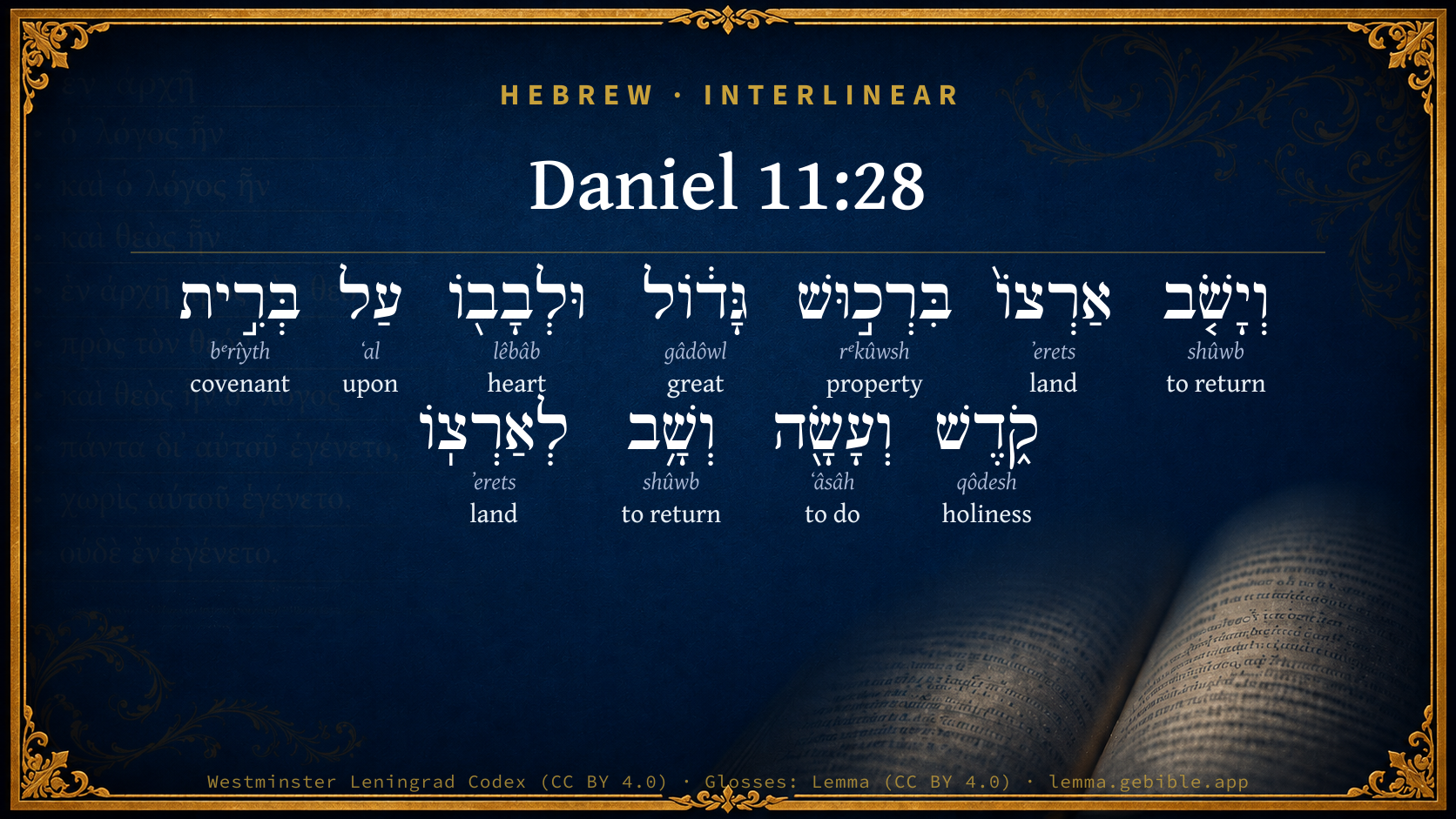
Hebrew (Westminster Leningrad Codex) Daniel 11:28 appears in the Hebrew Old Testament. The text above is from the Westminster Leningrad Codex. Each word links to its Strong’s number, a concise gloss, and parsing drawn from the Open Scriptures Hebrew Bible morphology. Click any word for its full Brown-Driver-Briggs (BDB) entry.
Download image
Cite this verse

Daniel 11:28 (World English Bible). Public Domain. Lemma interlinear Bible study tool, https://lemma.gebible.app/v/daniel/11/28.

Show BibTeX & RIS
BibTeX
RIS
English Translation
Then shall he return into his land with great substance; and his heart [shall be] against the holy covenant; and he shall do [his pleasure], and return to his own land.
World English Bible · Public Domain
Download a study sheet

One document with this verse’s original text, its word-by-word gloss line, the meaning frame, cross-references with their text, attributed commentary, and full source and license credits — printable, and it pastes into notes with its structure intact.

This verse Autodidact and up

Study sheet (.html) Plain text (.txt)

A passage Seminary Student

Up to 50 verses in one chapter. A passage sheet keeps up to 6 commentary sources and 12 cross-references per verse, in the order this page ranks them, and says so on the sheet whenever that leaves anything out. Ask for a single verse and you get the Autodidact verse sheet above.

Everything on this page stays free to read, with no account — the sheet is a download of what is already on screen, not access to it.

Want to remove ads? Support Godless Engineer
Compare translations 3

The same verse in 3 English versions, stacked beneath the original-language interlinear above. Click any original word for its lexicon entry.

Each is an independent rendering of the whole verse — the interlinear is not word-aligned to these translations.

Highlighted words mark where these versions differ — a whole-verse word diff, not a word-by-word alignment.

  • World English Bible Public Domain
    Then shall he return into his land with great substance; and his heart [shall be] against the holy covenant; and he shall do [his pleasure], and return to his own land.
  • King James Version Public Domain
    Then shall he return into his land with great riches; and his heart shall be against the holy covenant; and he shall do exploits, and return to his own land.
  • unfoldingWord Literal Text CC BY-SA 4.0
    Then he will return to his land with much plunder, but his heart will be set against the holy covenant. He will take action and then return to his own land.

unfoldingWord Literal Text — © unfoldingWord, licensed CC BY-SA 4.0. Word-aligned USFM3 via Door43 (git.door43.org/unfoldingWord/en_ult).

Versions to compare (up to 4)

3 of 4 selected

Show all 18 translations

Every available English version of this verse, each an independent rendering of the whole verse.

  • World English Bible Public Domain
    Then shall he return into his land with great substance; and his heart [shall be] against the holy covenant; and he shall do [his pleasure], and return to his own land.
  • Berean Standard Bible Public Domain
    The king of the North will return to his land with great wealth, but his heart will be set against the holy covenant; so he will do damage and return to his own land.
  • Majority Standard Bible Public Domain
    The king of the North will return to his land with great wealth, but his heart will be set against the holy covenant; so he will do damage and return to his own land.
  • King James Version Public Domain
    Then shall he return into his land with great riches; and his heart shall be against the holy covenant; and he shall do exploits, and return to his own land.
  • American Standard Version (1901) Public Domain
    Then shall he return into his land with great substance; and his heart `shall be' against the holy covenant; and he shall do `his pleasure', and return to his own land.
  • Revised Version (1885) Public Domain
    Then shall he return into his land with great substance; and his heart shall be against the holy covenant; and he shall do his pleasure, and return to his own land.
  • Geneva Bible (1599) Public Domain
    Then shall he returne into his land with great substance: for his heart shall be against the holy couenant: so shall he doe and returne to his owne land.
  • Douay-Rheims (1899) Public Domain
    And he shall return into his land with much riches: and his heart shall be against the holy covenant, and he shall succeed and shall return into his own land.
  • Young's Literal Translation Public Domain
    And he turneth back `to' his land with great substance, and his heart `is' against the holy covenant, and he hath wrought, and turned back to his land.
  • Literal Standard Version CC BY-SA 4.0
    And he turns back [to] his land with great substance, and his heart [is] against the holy covenant, and he has worked, and turned back to his land.
  • Unlocked Literal Bible CC BY-SA 4.0
    Then the king of the North will go back into his land with great riches, with his heart set against the holy covenant. He will act and then will return to his own land.
  • unfoldingWord Literal Text CC BY-SA 4.0
    Then he will return to his land with much plunder, but his heart will be set against the holy covenant. He will take action and then return to his own land.
  • Darby Bible Public Domain
    And he shall return into his land with great substance; and his heart shall be against the holy covenant; and he shall practise, and return to his own land.
  • World Messianic Bible Public Domain
    Then he will return into his land with great wealth. His heart will be against the holy covenant. He will take action, and return to his own land.
  • Webster's Bible Public Domain
    Then shall he return into his land with great riches; and his heart shall be against the holy covenant; and he shall do exploits, and return to his own land.
  • Free Bible Version CC BY-SA 4.0
    The king of the north will return to his own country with all the wealth he has looted. He will be determined to attack the people of the holy agreement, and do all he can to destroy it before returning to his own country.
  • Bible in Basic English Public Domain
    And he will go back to his land with great wealth; and his heart will be against the holy agreement; and he will do his pleasure and go back to his land.
  • JPS Tanakh (1917) Public Domain
    And he shall return to his own land with great substance; and his heart shall be against the holy covenant; and he shall do his pleasure, and return to his own land.

Literal Standard Version (2020), Covenant Press — licensed CC BY-SA 4.0. Text via the HelloAO Bible API (eBible.org). Unlocked Literal Bible (unfoldingWord) — licensed CC BY-SA 4.0. Text via the HelloAO Bible API (eBible.org). unfoldingWord Literal Text — © unfoldingWord, licensed CC BY-SA 4.0. Word-aligned USFM3 via Door43 (git.door43.org/unfoldingWord/en_ult). Free Bible Version, Dr. Jonathan Gallagher — licensed CC BY-SA 4.0. Text via the HelloAO Bible API (eBible.org).

Word by word

More ways to search: Search by grammar → Find every occurrence → Compare this word →

Practice this passage: Drill this verse → Learn its vocabulary →

בִּרְכ֣וּשׁ
rᵉkûwsh
H7399
“in/at · property”
Preposition + Noun, Common, Masculine, Singular, Absolute
Part of Speech
Preposition + Noun
Type
Common
Gender
Masculine
Number
Singular
State
Absolute
Full BDB Definition

Origin: from pass part of H7408

TWOT: 2167b

property, goods, possessions - property, goods - general term for all movable goods - of livestock - of stores, utensils, etc
  1. וְיָשֹׁ֤ב shûwb H7725 “and · to return” Conjunction + Verb, Qal, Jussive, 3rd Person, Masculine, Singular
  2. אַרְצוֹ֙ ʼerets H776 “land · his” Noun, Common, Both, Singular, Construct + Suffix, Personal, 3rd Person, Masculine, Singular
  3. גָּד֔וֹל gâdôwl H1419 “great” Adjective, Adjective, Masculine, Singular, Absolute
  4. וּלְבָב֖וֹ lêbâb H3824 “and · heart · his” Conjunction + Noun, Common, Masculine, Singular, Construct + Suffix, Personal, 3rd Person, Masculine, Singular
  5. עַל ʻal H5921 “upon” Preposition
  6. בְּרִ֣ית bᵉrîyth H1285 “covenant of” Noun, Common, Feminine, Singular, Construct
  7. קֹ֑דֶשׁ qôdesh H6944 “holiness” Noun, Common, Masculine, Singular, Absolute
  8. וְעָשָׂ֖ה ʻâsâh H6213 “and · to do” Conjunction + Verb, Qal, Sequential Perfect, 3rd Person, Masculine, Singular
  9. וְשָׁ֥ב shûwb H7725 “and · to return” Conjunction + Verb, Qal, Sequential Perfect, 3rd Person, Masculine, Singular
  10. לְאַרְצֽוֹ ʼerets H776 “to/for · land · his” Preposition + Noun, Common, Both, Singular, Construct + Suffix, Personal, 3rd Person, Masculine, Singular

About this verse

These counts appear in no published source. They are computed here, from the morphology-tagged text and Lemma’s own curated glosses. What Lemma adds →

11
words
9
distinct lemmas
Prophets
section

Shared distinctive vocabulary

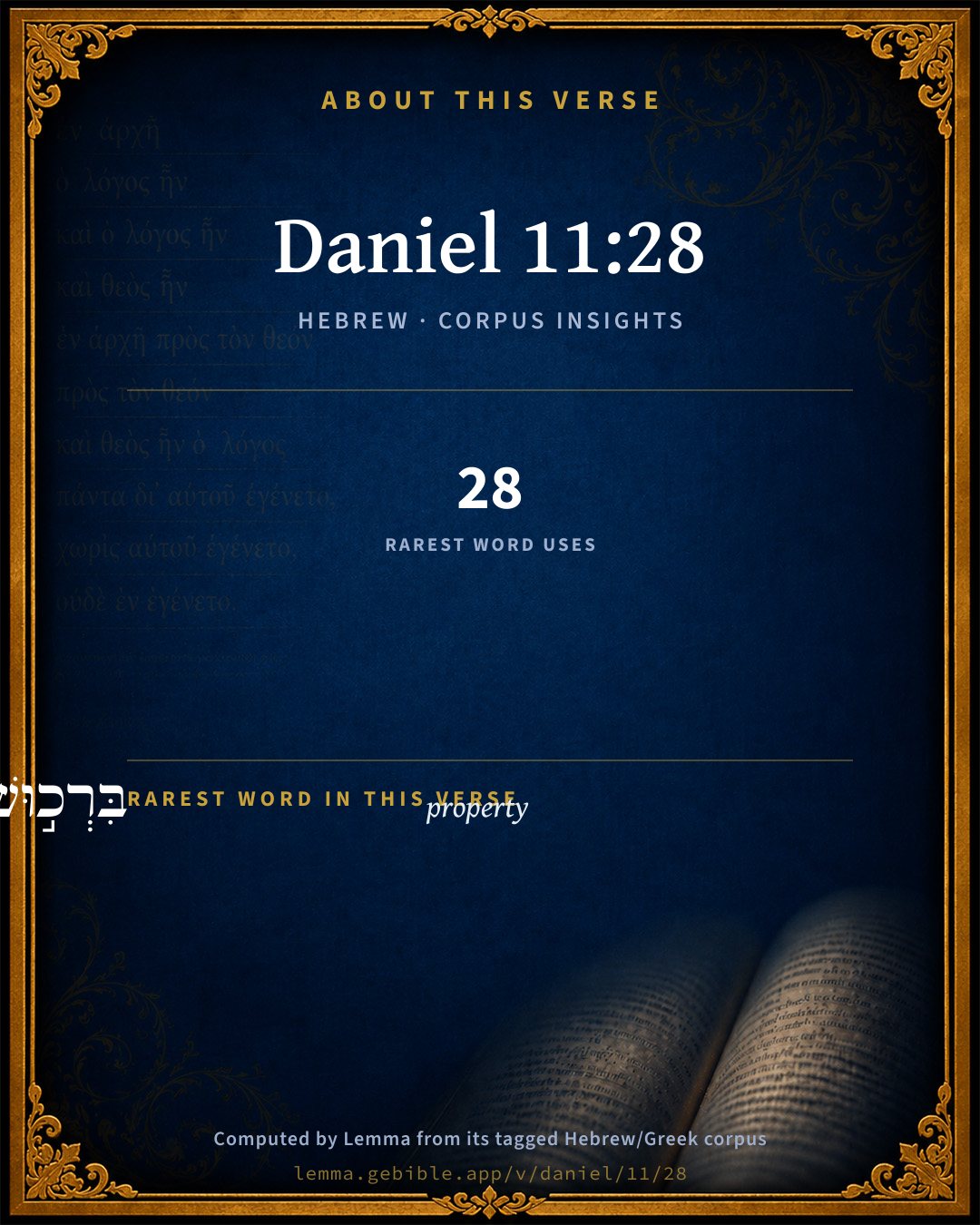
בִּרְכ֣וּשׁ property H7399 occurs in 27 verses of the Hebrew Bible. Also found in:

Grammatical profile

  • 3 verbs
  • 6 nouns
  • 1 adjective
  • 1 preposition

Verb forms

  • וְיָשֹׁ֤ב Qal · Jussive
  • וְעָשָׂ֖ה Qal · Sequential Perfect
  • וְשָׁ֥ב Qal · Sequential Perfect

Repetition

Words recur within this verse — often emphatic in Hebrew:

  • וְיָשֹׁ֤ב to return H7725 ×2
  • אַרְצוֹ֙ land H776 ×2

Hebrew & Septuagint length

In English translation the verse runs 31 words from the Hebrew and 31 from the Septuagint (LXX English) — the same length.

A rough comparison of the two English renderings, which tokenize alike — not a word-level alignment.

Word counts can differ between the Hebrew and the Greek without any difference in meaning — e.g. the Hebrew direct-object marker אֵת has no separate Greek word, and Greek often adds the article ὁ.

Cross-references

4

Topical passages linked to Daniel 11:28 in the Treasury of Scripture Knowledge — connected by theme and wording, ordered by reader-vote popularity; previews shown in the World English Bible.

  • Daniel 8:24 His power shall be mighty, but not by his own power; and he shall destroy wonderfully, and shall prosper and do [his pleasure]; and he shall destroy the mighty ones and the holy people.
  • Daniel 11:22 The overwhelming forces shall be overwhelmed from before him, and shall be broken; yes, also the prince of the covenant.
  • Daniel 11:30–32 For ships of Kittim shall come against him; therefore he shall be grieved, and shall return, and have indignation against the holy covenant, and shall do [his pleasure]: he shall even return, and have regard to those who forsake the holy covenant.
  • Acts 3:25 You are the children of the prophets, and of the covenant which God made with our fathers, saying to Abraham, 'In your seed will all the families of the earth be blessed.'

Cross-references courtesy of OpenBible.info (CC BY 4.0).

Hebrew and Greek witnesses Masoretic Hebrew ↔ Greek Septuagint

The same verse in the two great witnesses to the Old Testament, shown verse-for-verse.

These are two independent witnesses, not word-aligned to each other, and the Septuagint is shown in lemma (dictionary) form.

Hebrew Daniel 11:28 Masoretic · Westminster Leningrad Codex

וְיָשֹׁ֤ב אַרְצוֹ֙ בִּרְכ֣וּשׁ גָּד֔וֹל וּלְבָב֖וֹ עַל בְּרִ֣ית קֹ֑דֶשׁ וְעָשָׂ֖ה וְשָׁ֥ב לְאַרְצֽוֹ

Then shall he return into his land with great substance; and his heart [shall be] against the holy covenant; and he shall do [his pleasure], and return to his own land.

World English Bible · Public Domain

Greek LXX Daniel 11:28 Septuagint · lemma form

καί ἐπιστρέφω εἰς ὁ χώρα αὐτός ἐν χρῆμα πολύς καί ὁ καρδία αὐτός ἐπί ὁ διαθήκη ὁ ἅγιος ποιέω καί ἐπιστρέφω ἐπί ὁ χώρα αὐτός

And he shall return to his land with much substance; and his heart shall be against the holy covenant; and he shall perform great deeds, and return to his own land.

LXX2012 (modern English Septuagint) · Public Domain

Hebrew: Westminster Leningrad Codex (CC BY 4.0). Greek: Septuagint (public domain); English from LXX2012 (modern English Septuagint) (Public Domain). How the Septuagint differs from the Hebrew →

Commentary

Notes on Daniel 11:28 from classic Christian and Jewish commentators (each source and its license shown beneath its notes). The classic Christian expositions comment on the surrounding passage and are grouped to its opening verse, so a note may address several verses; the Jewish commentaries on the Tanakh (Rashi and others) are per-verse, so they appear only where the commentator wrote on this verse.

Lemma curates 59 commentaries, every one of them public domain or Creative Commons licensed, each selected and text-cleaned for this edition rather than reprinted as found. About our sources →

Trapp's Complete Commentary

John Trapp

Dan 11:28 Then shall he return into his land with great riches; and his heart [shall be] against the holy covenant; and he shall do [exploits], and return to his own land.

Ver. 28. Then shall he return into his land with great riches.] But little content. Gain, when it is either the "Mammon of unrighteousness," or "wages of wickedness," is true loss.

And his heart shall be against the holy covenant,] i.e., Against the Jews, God’s covenanters, and against the true religion. The Church is haeres crucis, saith Luther: the truth goes seldom without a scratched face.

John Trapp, A Commentary or Exposition upon All the Books of the Old and New Testament (1647–1656) — public domain. Text from a community e-Sword module.

Joseph Benson's Commentary

Dan 11:28. Then shall he return into his land with great riches — Namely, with the spoils taken in Egypt, which were of immense value. And his heart shall be against the holy covenant — “While he was absent in Egypt a false report was spread of his death; and Jason, thinking this a favourable opportunity for recovering the high-priesthood, marched to Jerusalem with a thousand men, assaulted and took the city, drove Menelaus into the castle, and exercised great cruelties upon the citizens. Antiochus, hearing of this, concluded that the whole nation had revolted; and being informed that the people had made great rejoicings at the report of his death, he determined to take a severe revenge, and went up with a great army, as well as with great indignation, against Jerusalem. He besieged and took the city by force of arms, slew 40,000 of the inhabitants, and sold as many more for slaves, polluted the temple and altar with swines’ flesh, profaned the holy of holies by breaking into it, took away the golden vessels, and other sacred treasures, to the value of eighteen hundred talents, restored Menelaus to his office and authority, and constituted one Philip, by nature a Phrygian, in manners a barbarian, governor of Judea. When he had done these exploits he returned to his own land.” — Bishop Newton.

Joseph Benson's Commentary on the Old and New Testaments (1811–1818) — public domain. Text from a community e-Sword module.

The Expositor's Bible

FOURTH SECTION

(Dan_11:28-35)

Events between the first attack of Antiochus on Jerusalem (B.C. 170) and his plunder of the Temple to the first revolt of the Maccabees (B.C. 167).

Dan_11:28 (B.C. 168).-Returning from Egypt with great plunder, Antiochus shall set himself against the Holy Covenant. He put down the usurping high priest Jason, who, with much slaughter, had driven out his rival usurper and brother, Menelaus. He massacred many Jews, and returned to Antioch enriched with golden vessels seized from the Temple.

Dan_11:29 -In B.C. 168 Antiochus again invaded Egypt, but with none of the former splendid results. For Ptolemy Philometor and Physkon had joined in sending an embassy to Rome to ask for help and protection. In consequence of this, "ships from Kittim"-namely, the Roman fleet-came against him, bringing the Roman commissioner, Gaius Popilius Laenas. When Popilius met Antiochus, the king put out his hand to embrace him; but the Roman merely held out his tablets, and bade Antiochus read the Roman demand that he and his army should at once evacuate Egypt. "I will consult my friends on the subject," said Antiochus. Popilius, with infinite haughtiness and audacity, simply drew a circle in the sand with his vine-stick round the spot on which the king stood, and said, "You must decide before you step out of that circle." Antiochus stood amazed and humiliated; but seeing that there was no help for it, promised in despair to do all that the Romans demanded.

Dan_11:30 -Returning from Egypt in an indignant frame of mind, he turned his exasperation against the Jews and the Holy Covenant, especially extending his approval to those who apostatised from it.

Dan_11:31 -Then (B.C. 168) shall come the climax of horror. Antiochus shall send troops to the Holy Land, who shall desecrate the sanctuary and fortress of the Temple, and abolish the daily sacrifice (Kisleu 15), and set up the abomination that maketh desolate.

Dan_11:32 -To carry out these ends the better, and with the express purpose of putting an end to the Jewish religion, he shall pervert or "make profane" by flatteries the renegades who are ready to apostatise from the faith of their fathers. But there shall be a faithful remnant who will bravely resist him to the uttermost. "The people who know their God will be valiant, and do great deeds."

Dan_11:33 -To keep alive the national faith "wise teachers of the people shall instruct many," and will draw upon their own heads the fury of persecution, so that many shall fall by sword, and by flame, and by captivity, and by spoliation for many days.

Dan_11:34 -But in the midst of this fierce onslaught of cruelty they shall be "holpen" with a little help. "There shall arise the sect of the Chasidim," or "the Pious," bound together by "Tugendbund" to maintain the Laws which Israel received from Moses of old. These good and faithful champions of a righteous cause will indeed be weakened by the false adherence of waverers and flatterers.

Dan_11:35 -To purge the party from such spies and Laodiceans, the teachers, like the aged priest Mattathias at Modin, and the aged scribe Eleazar, will have to brave even martyrdom itself till the time of the end.

William Robertson Nicoll, ed., The Expositor's Bible (London: Hodder & Stoughton, 1887–1910) — public domain. 65 of 66 books (1 Corinthians is not separately keyed, as that volume carries no machine-parseable verse references); section-level commentary keyed to the opening verse. Introductory and overview sections not keyed to a specific passage are excluded.

Tyndale Open Study Notes

Tyndale Open Resources

11:28 Antiochus IV plundered Jerusalem and the Temple in 170 BC, killing thousands and enslaving others (1 Maccabees 1:20-42; 2 Maccabees 5:1-23). His arrogance was unbounded (1 Maccabees 1:24-25; cp. Dan 7:28; 8:9).

Tyndale Open Study Notes — © Tyndale Open Resources, licensed CC BY-SA 4.0. Text via the HelloAO Bible API.

Geneva Bible (1599)

Geneva Bible translators

Which he shall take of the Jews in spoiling Jerusalem and the Temple, and this is told them before to move them to patience, knowing that all things are done by God’s providence.

Geneva Bible (1599) marginal notes — public domain. Text via Bolls.life.

Jamieson, Fausset & Brown

Robert Jamieson, A. R. Fausset & David Brown

(1 Maccabees 1:19, 20, &c.).

against the holy covenant--On his way back to Syria, he attacked Jerusalem, the metropolis of Jehovah's covenant-people, slew eighty thousand, took forty thousand prisoners, and sold forty thousand as slaves (2 Maccabees 5:5-14).

he shall do exploits--He shall effect his purpose. Guided by Menelaus, the high priest, he entered the sanctuary with blasphemies, took away the gold and silver vessels, sacrificed swine on the altar, and sprinkled broth of the flesh through the temple (2 Maccabees 5:15-21).

Jamieson, Fausset & Brown — Commentary Critical and Explanatory on the Whole Bible (1871) — public domain (CC PDM 1.0). Text via the HelloAO Bible API.

Adam Clarke's Commentary

Verse 28. Then shall he return onto his land with great riches] Antiochus did return, laden with riches, from the spoils that he took in Egypt; see 1Macc 1:19, 20. And hearing that there had been a report of his death, at which the citizens of Jerusalem had made great rejoicings,-

His heart shall be against the holy covenant] He was determined to take a severe revenge, and he had an ostensible pretext for it, for Jason, who had been deprived of the high priesthood, hearing the report of the death of Antiochus, raised forces, marched against Jerusalem, took it, and obliged Menelaus, the high priest, to shut himself up in the castle. Antiochus brought a great army against Jerusalem; took it by storm; slew forty thousand of the inhabitants; sold as many more for slaves; boiled swine's flesh, and sprinkled the temple and the altar with the broth; broke into the holy of holies; took away the golden vessels and other sacred treasures, to the value of one thousand eight hundred talents; restored Menelaus to his office; and made one Philip, a Phrygian, governor of Judea. 1Macc 1:24; 2Macc 5:21. Prideaux and Newton. These are what we term exploits; which having finished, he returned to his own land.

Adam Clarke's Commentary on the Bible (1810–1826) — public domain. Text from a community e-Sword/MySword module.

John Calvin's Commentaries

Here the angel predicts the calamitous nature of that peace for the people of God, because Antiochus should turn his arms against Jerusalem and the whole Jewish people. It is said, He shall return to his own land, because he shall not possess Egypt. This return implies the victory of Antiochus, and yet his betaking himself within the boundaries of his own realm. When he adds, with great pomp, or great riches, he shews the source whence that wealth should be derived, — his heart should be against the holy covenant. He partially destroyed Jerusalem and the temple of God. He was compelled to leave the temple and many treasures, through either shame, or reverence, or a miracle, as we read in the 2nd Book of Maccabees (Maccabees 5:2.) He would willingly have stripped the whole temple, but God then restrained him, while he had gathered for himself great wealth. Hence the angel joins the two events, he should return to Syria with great wealth, and his heart should be against the holy covenant. Some refer this to persons, as if the angel meant the people who were in covenant with God. But the simpler sense pleases me better, — he should carry on war against God, because he was not enriched with such ample spoils as he had expected. We have mentioned his making peace with his enemy: lest, therefore, this expedition should be fruitless, he spoiled the temple of God. Thus his heart was elated against God and against his holy covenant The other exposition is too cold and too forced.

And he shall do it and shall return to his own land. This return at the end of the verse is taken in a different sense from that at the beginning, as now he should use his own will as a conqueror, and no one should oppose his arrival in his own territories. These two expressions are to be read together, — he shall do it and return to his own dominions The meaning of the word for “do” we have already explained. The angel signifies the absence of every obstacle which could prevent the destruction of the city and temple by Antiochus. This was a severe trial, and would cause the minds of the faithful to be disturbed and tossed about because God gave up his temple to this cruel tyrant, and permitted the sacred vessels and the hidden treasures to be carried off with the greatest ignominy. It was necessary, then, to inform the faithful beforehand of this grievous slaughter, lest its novelty should astonish them and overthrow the constancy of their faith. Hence we gather this practical instruction — God often predicts many sorrowful events for us, and yet this instruction ought not to embitter our feelings; for he wishes to fortify us against the trial which the novelty of the event, must occasion. Thus the angel, while treating of occurrences by no means agreeable, was a useful herald of all the calamities which must happen, lest anything unusual or unexpected should fall upon the pious. Thus they would acknowledge the affliction to proceed from God’s hand; and while they were exposed to the lust of Antiochus, yet God by his certain and incomprehensible counsel allowed much license to this impious tyrant. It afterwards follows

John Calvin's Commentaries (1540-1563) — public domain. Text from the Calvin Translation Society English edition (1840s-50s) via the Christian Classics Ethereal Library (ccel.org). Calvin's coverage is partial (roughly two-thirds of the Bible); uncommented books and verses are honest gaps, never fabricated. The 19th-century editor's footnotes and remarks are omitted so the notes are faithfully Calvin's own voice.

Ellicott's Commentary for English Readers

(28) Then shall he return.—He returns, apparently bringing abundant spoils with him, and while on the journey sets his heart against the holy covenant.

Great riches.—The prophecy points distinctly to Antiochus after his return from Egypt. (See 1Ma_1:19-28; 2Ma_5:11-17.) This was the occasion of his first attack upon the theocracy. The typical character of Antiochus is drawn in Dan_11:30, &c., with still greater clearness.

He shall do—i.e., prosper in his undertakings against the covenant. (See the passages from the Books of Maccabees referred to in the last Note.)

A Bible Commentary for English Readers, edited by Charles John Ellicott (1878–1897) — public domain. Text from a community e-Sword module.

The Cambridge Bible for Schools and Colleges

gen. ed. J. J. S. Perowne

28. Then] And. A chronological sequence is not expressed in the Heb.; and is perhaps (see the beginning of the last note) not intended by the writer.

he shall return to his own land] in 170, at the close of his ‘first’ Egyptian campaign,—in whatever sense this may be understood (see on Dan_11:27). The clause anticipates what really took place only after what is described in the two following clauses; and hence, it is repeated, in its proper place, at the end of the verse.

with great substance] the ‘spoils of Egypt’ (1Ma_1:19): the word, as Dan_11:13; Dan_11:24. Cf. the allusion in Orac. Sib. iii. 614–5.

against the holy covenant] alluding to Antiochus’ hostile visit to Jerusalem, in which he ‘entered presumptuously into the sanctuary,’ and carried away the golden vessels, and other treasures, belonging to the Temple, besides massacring many of the Jews (1Ma_1:20-24).

and he shall do] in the pregnant sense explained on Dan_8:12 : R.V. ‘do (his pleasure).’

and return to his own land] 1Ma_1:24; 2Ma_5:21.

The Cambridge Bible for Schools and Colleges (gen. ed. J. J. S. Perowne; Cambridge University Press, 1878–1918) — public domain. Text from a community e-Sword module.

John Gill's Exposition

Then shall he return into his land with great riches,.... That is, Antiochus, with the spoils of Egypt, and the gifts and presents he had received there; so the author of the first book of Maccabees says,

"20 And after that Antiochus had smitten Egypt, he returned again in the hundred forty and third year, and went up against Israel and Jerusalem with a great multitude, 21 And entered proudly into the sanctuary, and took away the golden altar, and the candlestick of light, and all the vessels thereof,'' (1 Maccabees 1)

that is, of the era of the Selucidae, and the fifth or sixth year of his reign:

and his heart shall be against the holy covenant; not the covenant he had made with Ptolemy, which was a fraudulent one; but the covenant between God and the Jews; whereby they became a distinct and peculiar people, having a religion, laws, and ordinances, different from all others; for which reason they were hated by other nations, and particularly by Antiochus; and his heart was the more enraged against them at this time, for the following reason; a false rumour being spread in Judea that Antiochus was dead, Jason took the opportunity to recover the office of high priest from his brother Menelaus; and, with a thousand men, took the city of Jerusalem, drove his brother into the castle, and slew many he took for his enemies. Antiochus, hearing of this, concluded the whole nation of the Jews had revolted from him; and therefore took Judea in his way from Egypt, in order to suppress this rebellion; in the Apocrypha:

"5 Now when there was gone forth a false rumour, as though Antiochus had been dead, Jason took at the least a thousand men, and suddenly made an assault upon the city; and they that were upon the walls being put back, and the city at length taken, Menelaus fled into the castle: 6 But Jason slew his own citizens without mercy, not considering that to get the day of them of his own nation would be a most unhappy day for him; but thinking they had been his enemies, and not his countrymen, whom he conquered. 11 Now when this that was done came to the king's ear, he thought that Judea had revolted: whereupon removing out of Egypt in a furious mind, he took the city by force of arms,'' (2 Maccabees 5)

and he shall do exploits; in Jerusalem, very wicked ones indeed! he ordered his soldiers to slay all they met, without mercy, old and young, women and children, virgins and young men; and in three days' time eighty thousand were slain, forty thousand bound, and no less sold: he went into the temple, and took all the vessels in it, and all the gold and silver, and hidden treasures of it, to the value of a thousand and eight hundred talents, in the Apocrypha:

"12 And commanded his men of war not to spare such as they met, and to slay such as went up upon the houses. 13 Thus there was killing of young and old, making away of men, women, and children, slaying of virgins and infants. 14 And there were destroyed within the space of three whole days fourscore thousand, whereof forty thousand were slain in the conflict; and no fewer sold than slain. 15 Yet was he not content with this, but presumed to go into the most holy temple of all the world; Menelaus, that traitor to the laws, and to his own country, being his guide: 16 And taking the holy vessels with polluted hands, and with profane hands pulling down the things that were dedicated by other kings to the augmentation and glory and honour of the place, he gave them away. 21 So when Antiochus had carried out of the temple a thousand and eight hundred talents, he departed in all haste unto Antiochia, weening in his pride to make the land navigable, and the sea passable by foot: such was the haughtiness of his mind.'' (2 Maccabees 5)

"23 He took also the silver and the gold, and the precious vessels: also he took the hidden treasures which he found. 24 And when he had taken all away, he went into his own land, having made a great massacre, and spoken very proudly. 25 Therefore there was a great mourning in Israel, in every place where they were;'' (1 Maccabees 1)

and return to his own land; having done these exploits, he made what haste he could to Antioch, with the spoils of Egypt, and the plunder of the temple at Jerusalem, in the Apocrypha:

"And when he had taken all away, he went into his own land, having made a great massacre, and spoken very proudly.'' (1 Maccabees 1:24)

"So when Antiochus had carried out of the temple a thousand and eight hundred talents, he departed in all haste unto Antiochia, weening in his pride to make the land navigable, and the sea passable by foot: such was the haughtiness of his mind.'' (2 Maccabees 5:21)

John Gill's Exposition of the Whole Bible (1746–1763) — public domain (CC PDM 1.0). Text via the HelloAO Bible API.

Albert Barnes' Notes on the Bible

Then shall he return into his land with great riches - Enriched with the spoils of Egypt. Having taken Memphis, and the fairest portions of Egypt, he would, of course, carry great wealth to his own country on his return. Thus it is said in 1 Macc. 1:19: “Thus they got the strong cities in the land of Egypt, and he took the spoils thereof.” The meaning here is, that he would “set out” to return to his own land. As a matter of fact, on his way he would pause to bring desolation on Jerusalem, as is intimated in the subsequent part of the verse.

And his heart shall be against the holy covenant - The words “holy covenant” are a technical expression to denote the Jewish institutions. The Hebrew people were called the “covenant people,” as being a people with whom God had entered into covenant. All their privileges were regarded as the result of that covenant, and hence, the word came to be applied to all the institutions of the nation. When it is said that his heart Was against that covenant, the meaning is, that he was enraged against it; and determined to bring calamity upon the place and people connected with it. The reason of this was the following: When he was in Egypt, a report was spread abroad that he was dead. In consequence of this rumour, Jason took the opportunity of recovering the office of high priest from his brother Menelaus, and with a thousand men took Jerusalem, drove Menelaus into the castle, and killed many whom he took for his enemies. Antiochus, hearing of this, supposed that all the Jews had revolted, and determined to inflict summary chastisement on them on his way to his own land. See Jahn, “Hebrew Commonwealth,” p. 263.

And he shall do exploits, and return to his own land - The word “exploits” is supplied by the translators. The Hebrew is, simply, “he shall do;” that is, he shall accomplish the purpose of his heart on the covenant people. In this expedition he took Jerusalem, whether by storm or by stratagem is not quite certain. Diodorus Siculus, and the author of the second book of Maccabees, and Josephus (Jeweish Wars, i. 1, 2, and vi. 10, 1), say that it was by storm. The account which he gives in his “Antiquities” (b. xii. ch. v. Section 3) is, that he took it by stratagem, but the statement in the “Jewish Wars” is much more probable, for Antiochus plundered the city, killed eighty thousand persons, men, women, and children, took forty thousand prisoners, and sold as many into slavery, 2 Macc. 5:5, 6, 11-14. As if this were not enough, under the guidance of the high priest Menelaus, he went into the sanctuary, uttering blasphemous language, took away all the gold and silver vessels he could find there, the golden table, altar, and candlestick, and all the great vessels, and that he might leave nothing behind, searched the subterranean vaults, and in this manner collected eighteen hundred talents of gold. He then sacrificed swine on the altar, boiled a piece of the flesh, and sprinkled the whole temple with the broth, 2 Macc. 5:15-21; 1 Macc. 1:21-28; Diodorus Sic. xxxiv. 1; Jahn, “Hebrew Commonwealth,” p. 264.

Albert Barnes' Notes on the Bible (1834–1885) — public domain. Text from a community e-Sword/MySword module.

Haydock's Catholic Bible Commentary

Riches, taken in Egypt (Calmet) and in Jerusalem. (Haydock) --- The people had refused to receive Jason; and Epiphanes treated them in the most barbarous manner, profaned the temple, &c. (1 Machabees i. 23. and 2 Machabees vi. 21.) (Calmet)

George Leo Haydock (1774–1849), Haydock's Catholic Family Bible and Commentary, 1859 edition — public domain. Excludes Psalms (Douay-Rheims chapter numbering differs from Protestant) and Deuterocanonical books (Catholic canon only).

Matthew Poole's English Annotations

Antiochus shall depart with his booty gotten in Egypt into his kingdom of Syria, and be content with the bounds of that, leaving Egypt behind him.

And his heart shall be against the holy covenant; against the law and covenant of God, with the people that worshipped God according to his rule and will. He shall do exploits, and return to his own land; he shall greatly afflict and vex the people of God; yet was it a mercy they had this warning of this sore trial. Antiochus was a fit instrument of the devil for this work, being rich and proud, and thought he might take this in his way: God permitting this horn to push and gore, for his people’s sins, and for a preparation to his own ruin.

Matthew Poole's English Annotations on the Holy Bible (1683–1685) — public domain. Text from a community e-Sword/MySword module.

Whedon's Commentary on the Bible

Daniel D. Whedon

28. His heart shall be against the holy covenant — This “holy covenant” is not the one just made with Philometer (Dan_11:27) as careless readers would suppose. The “holy covenant” is here used instead of “people of the holy covenant” for the same purpose doubtless as the other enigmatical phrases to be found everywhere in this apocalypse, to confuse the careless and for the enjoyment of the “wise.” Antiochus on his return from Egypt found that Menelaus, whom he had approved as high priest in Jerusalem, had been ousted from his place by Jason — who had heard that Antiochus had died on this Egyptian campaign — and many of his followers killed (2Ma_5:5). Antiochus “in a fury” immediately marched against the city, capturing it, massacring many thousands of its population, and looting the sacred treasures of the temple (1 Maccabees 1; 2 Macc. v; Josephus, Antiquities, XII, Dan_5:3; Apion, Dan_2:7).

He shall do exploits, and return — R.V., “he shall do his pleasure, and return.” Having worked his will in Jerusalem he left a “most cruel barbarian” as governor of Jerusalem and continued his journey home to Antioch.

Daniel D. Whedon (gen. ed.), Commentary on the Old and New Testaments (1874–1909) — public domain. Text from a community e-Sword module.

The Pulpit Commentary

Then shall he return into his land with great riches; and his heart shall be against the holy covenant; and he shall do exploits, and return to his own land. The Greek versions and the Vulgate are in close agreement with the Massoretic text. The Peshitta differs only by omitting the last clause, which certainly seems a redundance. On his return from his Egyptian campaign, Epiphanes, we learn from RAPC 1Ma 1:20-23, plundered the temple of all its treasures. On the somewhat suspicious authority of RAPC 2Ma 4. some have referred to the report spread that Antiochus was dead, and that, taking advantage of this, Jason seized the city and drove Menelaus into the citadel; and that, bearing of this uproar, Antiochus, imagining that Judaea had revolted, retired from Egypt, and wreaked vengeance on Jerusalem, taking it by assault. The slaughter inflicted is confirmed by other authorities; but the resistance implied in the assertion that he took the city by force of arms (dorualwton) is contradicted by Josephus and 1 Maccabees.

Evil prosperity.

I TEMPORAL PROSPERITY MAY BE ATTAINED APART FROM MORAL GOODNESS. It is not found in experience that the old Jewish ideal is realizable in which the righteous all prosper, and the wicked are all in adversity. (Job_36:11, Job_36:12) Bad men often grow rich and flourish in external success. (Psa_73:3)

1. This is no proof of the weakness of moral and spiritual forces in the economy of life,

(1) because physical prosperity is made to depend largely on physical causes;

(2) because energy of will and intellectual ability may exist apart from moral worth, and may secure temporal success;

(3) because adversity is not regarded by God as a supreme evil, nor prosperity as a supreme good both are subservient to higher aims;

(4) because justice and right have not scope in this world to effect their ultimate triumph.

2. This should warn us from the erroneous conclusions

(1) that our prosperity is a proof of our goodness; and

(2) that it is an evidence of Gods favour.

II WHEN TEMPORAL PROSPERITY IS ENJOYED WITHOUT MORAL GOODNESS, IT IS LIKELY TO BE A CURSE TO THE OWNER OF IT.

1. All the higher uses of prosperity will be neglected. These are to lift up our hearts to God and his love; to give leisure from care for the service of God; and to bestow talents for the good of mankind. If the higher uses of prosperity are neglected, the prosperity can only degrade us.

1. We are likely to become unduly satisfied with ourselves. Dust glitters like gold in the sunlight; and worthless people are tempted to think themselves of great value when the sun of prosperity shines upon them. Hence groundless pride, vanity and blindness, poverty of soul, guilt of sin, and danger of ruin.

2. We are inclined to set our heart on temporal comforts. This danger always follows prosperity. It may be mitigated by right spiritual thoughts of the wants of the soul which no earthly possessions can satisfy, and by the infinitely more precious heavenly treasures. Where such thoughts are not cherished the danger is great.

3. We are inclined to over-estimate the capacities of earthly riches, to suppose that they can secure the future from harm.

4. If we have begun to walk in evil ways we shall be hardened and hastened in them by the absence of needful checks, and under the influence of foolish feelings of triumphant success.

The Pulpit Commentary (1880–1919), ed. H.D.M. Spence-Jones & Joseph S. Exell — public domain. Text from a community e-Sword module.

John Wesley's Explanatory Notes

Then shall he return - Antiochus shall depart with his booty gotten in Egypt. Against the holy covenant - Against the law of God, with the people that worshipped God according to his will.

John Wesley, Explanatory Notes Upon the Whole Bible (1754–1765) — public domain. Text via the GEBible commentary corpus.

Keil & Delitzsch

C. F. Keil & F. Delitzsch

The success gained by the crafty king of the north in his war against the king of the south (Dan 11:25.) increases his endeavours after the enlarging of his dominions. Returning from Egypt with great riches, i.e., with rich spoil, he raises his heart against the holy covenant. By the potentialis ישׁב (he shall return) this new undertaking is placed in the point of view of a divine decree, to denote that he thereby brings about his own destruction. קדשׁ בּרית signifies not the holy people in covenant with God (v. Lengerke, Maurer, and many older interpreters), but the divine institution of the Old Covenant, the Jewish Theocracy. The Jews are only members of this covenant, cf. Dan 11:30. Calvin is right when he says: Mihi simplicior sensus probatur, quod scilicet bellum gerat adversus Deum. The holy covenant is named instead of the covenant people to represent the undertaking as an outrage against the kingdom of God, which was founded in Israel. ועשׂה, and he shall do, perform, that which his heart thinks, or that which he has in his mind against the holy covenant. The historical fulfilment is narrated in 1 Macc. 1:22-29. לארצו ושׁב resumes ארצו וישׁב, and teaches us that Antiochus undertook the first assault against the holy covenant on his return from Egypt into his kingdom (to Antioch), as is expressly stated in 1 Macc. 1:20.

Keil & Delitzsch — Biblical Commentary on the Old Testament (1861–1891) — public domain (CC PDM 1.0). Text via the HelloAO Bible API. (Old Testament only.)

unfoldingWord translationNotes

Door43 World Missions Community

riches, with his heart set against the holy covenant

Here "heart" represents the mind or thoughts of a person. The idiom "his heart set against" means to be determined to oppose something. This can be stated as a new sentence. AT: "riches. He will be determined to oppose the holy covenant" (See: Metonymy and Idiom)

with his heart set against the holy covenant

The king's desire to act against the holy covenant represents his desire to stop the Israelites from obeying that covenant. AT: "determined to stop the Israelites from obeying the holy covenant" (See: Metonymy)

the holy covenant

Here "holy" describes God's covenant with Israel. It implies that the covenant should be honored and obeyed because it comes from God himself. AT: "God's covenant, which all the Israelites should obey"

He will act

This implies that the king will do certain actions in Israel. AT: "He will do what he wants to in Israel" (See: Assumed Knowledge and Implicit Information)

translationWords

heart

holy

covenant

unfoldingWord translationNotes — © Distant Shores Media and the Door43 World Missions Community, licensed CC BY-SA 4.0. Source: git.door43.org/Door43/en_tn.

Rashi

Rabbi Shlomo Yitzchaki (Rashi)

And he will return The Roman king [will return] to his land from [fighting] with the king of the south with many possessions.

and his heart is on the covenant with the holy ones to abrogate his treaty with Israel.

and he will succeed Heb. וְעָשָׂה, lit. and he will do, i.e., and he will succeed and return to his land.

Rashi on the Tanakh — English translations: “The Judaica Press complete Tanach with Rashi, translated by A. J. Rosenberg” (CC BY 4.0); “Pentateuch with Rashi's commentary by M. Rosenbaum and A.M. Silbermann, 1929-1934” (public domain); “The Metsudah Tanach series, Lakewood, N.J” (CC BY 4.0); and “The Book of Joshua, Metsudah Publications, 1997” (CC BY 4.0). Text via Sefaria.

Lesson kit

Teaching starters — assembled from the data on this page, not authored interpretation. Every prompt links to the verse data it draws on. Edit before teaching.

Daniel, in the Prophets, opens this verse with 11 words (9 distinct Hebrew lemmas). Its most distinctive word is rᵉkûwsh (“property”). A historical commentator’s framing appears above. Read the whole chapter for the surrounding context.

Discussion questions

  1. What does “property” (rᵉkûwsh) contribute to the verse as a whole?
  2. How does Genesis 12:5, which shares the word «property», read alongside this verse?
  3. What does the repetition of “to return” (2× in this one verse) do in this verse?
  4. These translations render this verse differently; the difference is in the English rendering, not the original. What questions does that raise?
  5. «וְיָשֹׁ֤ב» is a Qal Jussive verb. How does that grammatical form shape the action described?
  6. Compare how Trapp's Complete Commentary and Joseph Benson's Commentary read this verse. Where do they agree or differ?

Things to notice

  • These translations choose different wording for 14 words in this verse.
  • “to return” occurs 2× in this single verse.
  • 9 distinct Hebrew lemmas span 11 words in this verse.

Reading settings

Reading text

Shown beneath each verse's original-language words.

Old Testament
Old Testament edition

Read the OT as the Masoretic Hebrew (MT) or the Greek Septuagint (LXX).

English shown for the Greek Septuagint (in the Hebrew ↔ Greek comparison).

Comparing translations? Open the Compare panel on any verse page to stack up to four side by side.