Genesis 18:33

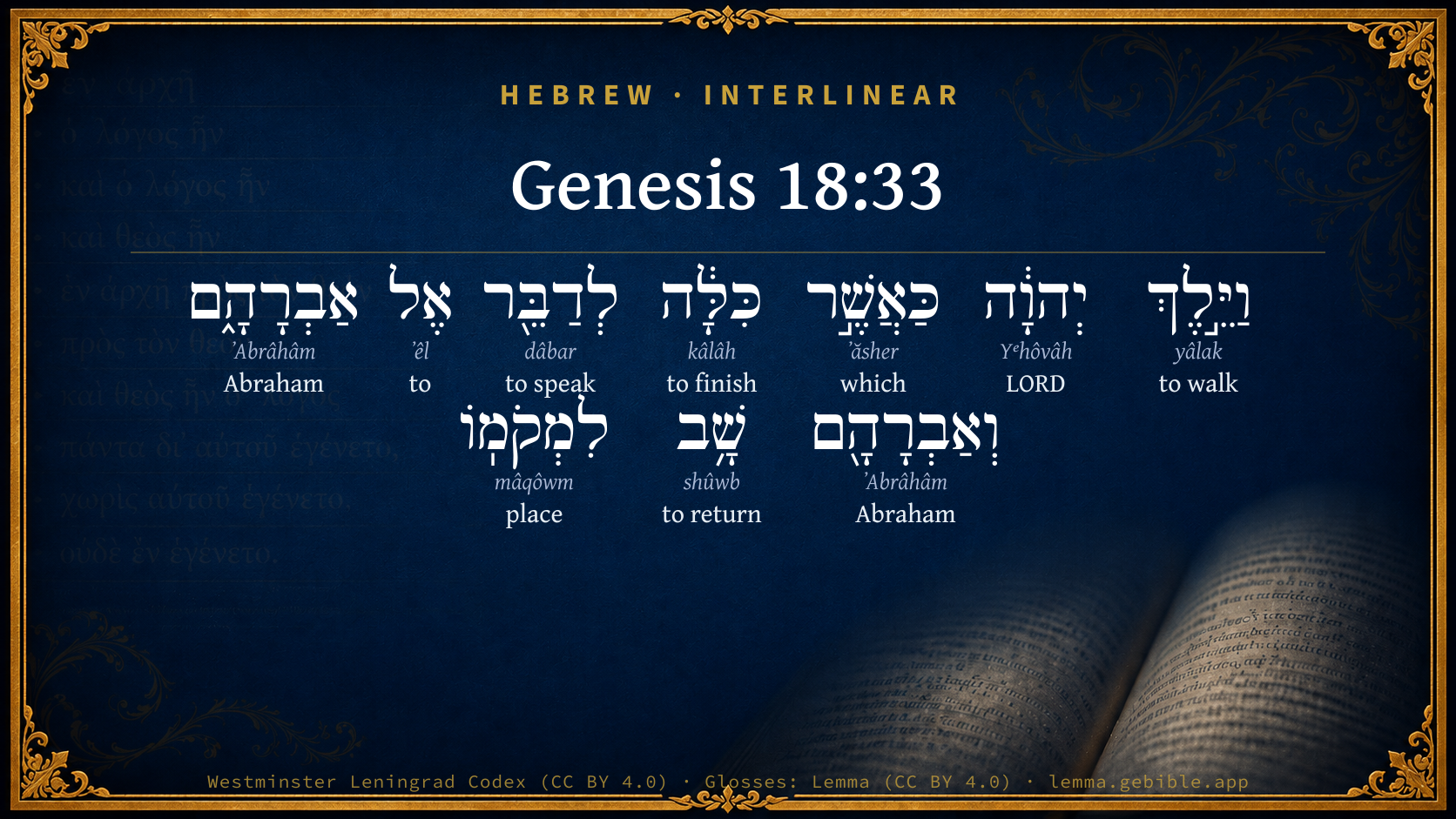
Hebrew (Westminster Leningrad Codex) Genesis 18:33 appears in the Hebrew Old Testament. The text above is from the Westminster Leningrad Codex. Each word links to its Strong’s number, a concise gloss, and parsing drawn from the Open Scriptures Hebrew Bible morphology. Click any word for its full Brown-Driver-Briggs (BDB) entry.
Download image
Cite this verse

Genesis 18:33 (World English Bible). Public Domain. Lemma interlinear Bible study tool, https://lemma.gebible.app/v/genesis/18/33.

Show BibTeX & RIS
BibTeX
RIS
English Translation
Yahweh went his way, as soon as he had finished communing with Abraham, and Abraham returned to his place.
World English Bible · Public Domain
Download a study sheet

One document with this verse’s original text, its word-by-word gloss line, the meaning frame, cross-references with their text, attributed commentary, and full source and license credits — printable, and it pastes into notes with its structure intact.

This verse Autodidact and up

Study sheet (.html) Plain text (.txt)

A passage Seminary Student

Up to 50 verses in one chapter. A passage sheet keeps up to 6 commentary sources and 12 cross-references per verse, in the order this page ranks them, and says so on the sheet whenever that leaves anything out. Ask for a single verse and you get the Autodidact verse sheet above.

Everything on this page stays free to read, with no account — the sheet is a download of what is already on screen, not access to it.

Want to remove ads? Support Godless Engineer
Compare translations 3

The same verse in 3 English versions, stacked beneath the original-language interlinear above. Click any original word for its lexicon entry.

Each is an independent rendering of the whole verse — the interlinear is not word-aligned to these translations.

Highlighted words mark where these versions differ — a whole-verse word diff, not a word-by-word alignment.

  • World English Bible Public Domain
    Yahweh went his way, as soon as he had finished communing with Abraham, and Abraham returned to his place.
  • King James Version Public Domain
    And the LORD went his way, as soon as he had left communing with Abraham: and Abraham returned unto his place.
  • unfoldingWord Literal Text CC BY-SA 4.0
    Then Yahweh left as soon as he finished speaking to Abraham, and Abraham returned to his place.

unfoldingWord Literal Text — © unfoldingWord, licensed CC BY-SA 4.0. Word-aligned USFM3 via Door43 (git.door43.org/unfoldingWord/en_ult).

Versions to compare (up to 4)

3 of 4 selected

Show all 18 translations

Every available English version of this verse, each an independent rendering of the whole verse.

  • World English Bible Public Domain
    Yahweh went his way, as soon as he had finished communing with Abraham, and Abraham returned to his place.
  • Berean Standard Bible Public Domain
    When the LORD had finished speaking with Abraham, He departed, and Abraham returned home.
  • Majority Standard Bible Public Domain
    When the LORD had finished speaking with Abraham, He departed, and Abraham returned home.
  • King James Version Public Domain
    And the LORD went his way, as soon as he had left communing with Abraham: and Abraham returned unto his place.
  • American Standard Version (1901) Public Domain
    And Jehovah went his way, as soon as he had left off communing with Abraham: and Abraham returned unto his place.
  • Revised Version (1885) Public Domain
    And the LORD went his way, as soon as he had left communing with Abraham: and Abraham returned unto his place.
  • Geneva Bible (1599) Public Domain
    And the Lord went his way when he had left communing with Abraham, and Abraham returned vnto his place.
  • Douay-Rheims (1899) Public Domain
    I beseech thee, saith he, be not angry, Lord, if I speak yet once more: What if tell should be found there? And he said: I will not destroy it for the sake of ten.
  • Young's Literal Translation Public Domain
    And Jehovah goeth on, when He hath finished speaking unto Abraham, and Abraham hath turned back to his place.
  • Literal Standard Version CC BY-SA 4.0
    And YHWH goes on, when He has finished speaking to Abraham, and Abraham has turned back to his place.
  • Unlocked Literal Bible CC BY-SA 4.0
    Yahweh went on his way as soon as he had finished talking with Abraham, and Abraham returned home.
  • unfoldingWord Literal Text CC BY-SA 4.0
    Then Yahweh left as soon as he finished speaking to Abraham, and Abraham returned to his place.
  • Darby Bible Public Domain
    And Jehovah went away when he had ended speaking to Abraham; and Abraham returned to his place.
  • World Messianic Bible Public Domain
    The LORD went his way as soon as he had finished communing with Abraham, and Abraham returned to his place.
  • Webster's Bible Public Domain
    And the LORD went his way, as soon as he had left communing with Abraham: and Abraham returned to his place.
  • Free Bible Version CC BY-SA 4.0
    The Lord left once he had finished speaking with Abraham, and Abraham went home.
  • Bible in Basic English Public Domain
    And the Lord went on his way when his talk with Abraham was ended, and Abraham went back to his place.
  • JPS Tanakh (1917) Public Domain
    And the LORD went His way, as soon as He had left off speaking to Abraham; and Abraham returned unto his place.

Literal Standard Version (2020), Covenant Press — licensed CC BY-SA 4.0. Text via the HelloAO Bible API (eBible.org). Unlocked Literal Bible (unfoldingWord) — licensed CC BY-SA 4.0. Text via the HelloAO Bible API (eBible.org). unfoldingWord Literal Text — © unfoldingWord, licensed CC BY-SA 4.0. Word-aligned USFM3 via Door43 (git.door43.org/unfoldingWord/en_ult). Free Bible Version, Dr. Jonathan Gallagher — licensed CC BY-SA 4.0. Text via the HelloAO Bible API (eBible.org).

Word by word

More ways to search: Search by grammar → Find every occurrence → Compare this word →

Practice this passage: Drill this verse → Learn its vocabulary →

About this verse

These counts appear in no published source. They are computed here, from the morphology-tagged text and Lemma’s own curated glosses. What Lemma adds →

10
words
9
distinct lemmas
Pentateuch
section

Grammatical profile

  • 4 verbs
  • 4 nouns
  • 1 preposition
  • 1 particle

Verb forms

  • וַיֵּ֣לֶךְ Qal · Sequential Imperfect
  • כִּלָּ֔ה Piel · Perfect
  • לְדַבֵּ֖ר Piel · Infinitive Construct
  • שָׁ֥ב Qal · Perfect

Repetition

A word recurs within this verse — often emphatic in Hebrew:

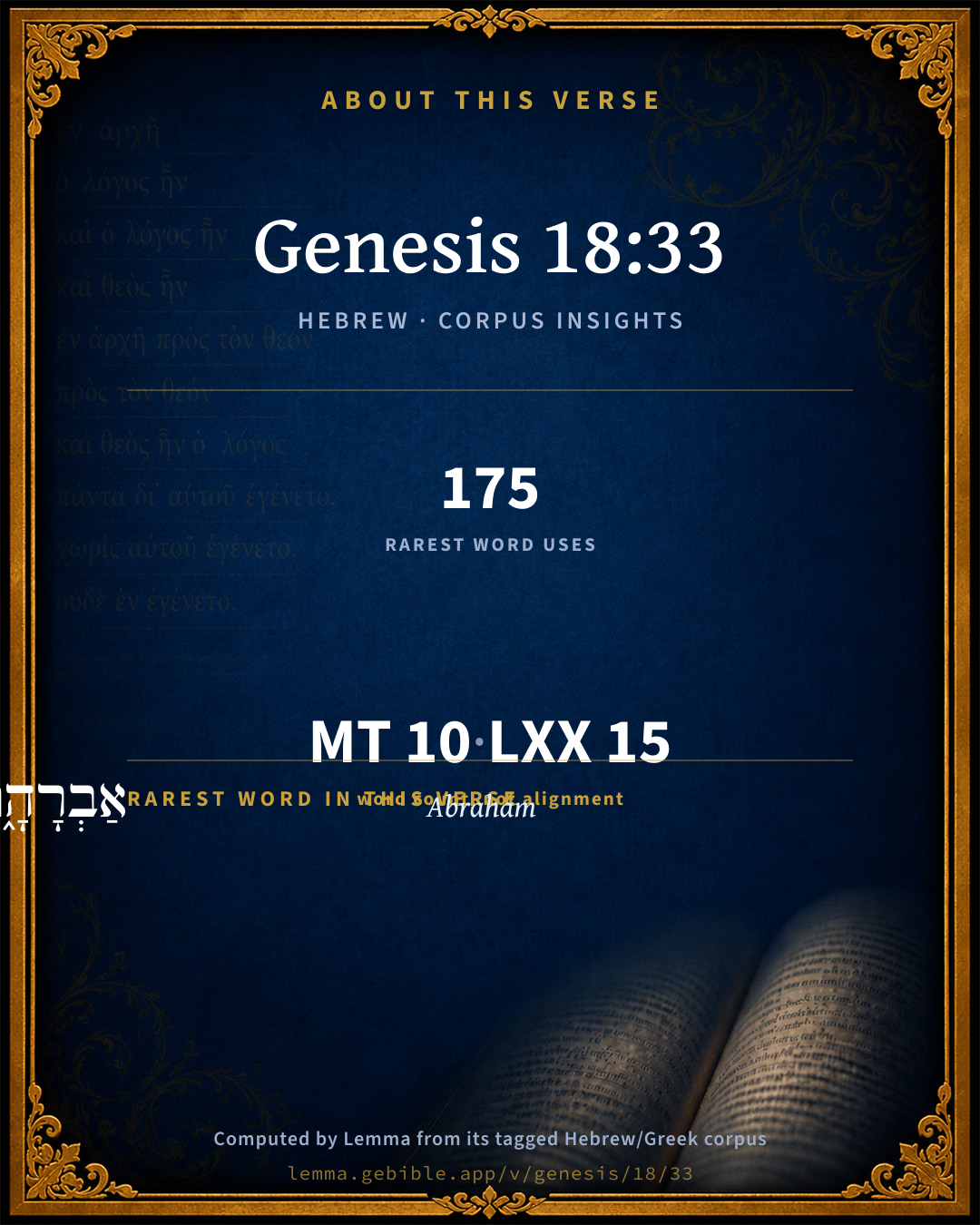
  • אַבְרָהָ֑ם Abraham H85 ×2

Hebrew & Septuagint length

In English translation the verse runs 19 words from the Hebrew and 17 from the Septuagint (LXX English) — closely comparable.

A rough comparison of the two English renderings, which tokenize alike — not a word-level alignment.

Word counts can differ between the Hebrew and the Greek without any difference in meaning — e.g. the Hebrew direct-object marker אֵת has no separate Greek word, and Greek often adds the article ὁ.

In the original languages it is 10 Hebrew tokens and 15 Greek tokens — but the two are counted differently (Hebrew bundles its prefixes and suffixes into one token; the Greek is in lemma form), so that isn’t a like-for-like length.

Cross-references

4

Topical passages linked to Genesis 18:33 in the Treasury of Scripture Knowledge — connected by theme and wording, ordered by reader-vote popularity; previews shown in the World English Bible.

  • Genesis 32:26 The man said, "Let me go, for the day breaks." Jacob said, "I won't let you go, unless you bless me."
  • Genesis 18:22 The men turned from there, and went toward Sodom, but Abraham stood yet before Yahweh.
  • Genesis 18:16 The men rose up from there, and looked toward Sodom. Abraham went with them to see them on their way.
  • Genesis 31:55 Early in the morning, Laban rose up, and kissed his sons and his daughters, and blessed them. Laban departed and returned to his place.

Cross-references courtesy of OpenBible.info (CC BY 4.0).

Hebrew and Greek witnesses Masoretic Hebrew ↔ Greek Septuagint

The same verse in the two great witnesses to the Old Testament, shown verse-for-verse.

These are two independent witnesses, not word-aligned to each other, and the Septuagint is shown in lemma (dictionary) form.

Hebrew Genesis 18:33 Masoretic · Westminster Leningrad Codex

וַיֵּ֣לֶךְ יְהוָ֔ה כַּאֲשֶׁ֣ר כִּלָּ֔ה לְדַבֵּ֖ר אֶל אַבְרָהָ֑ם וְאַבְרָהָ֖ם שָׁ֥ב לִמְקֹמֽוֹ

Yahweh went his way, as soon as he had finished communing with Abraham, and Abraham returned to his place.

World English Bible · Public Domain

Greek LXX Genesis 18:33 Septuagint · lemma form

ἀποἔρχομαι δέ κύριος ὡς παύω λαλέω ὁ αβρααμ καί αβρααμ ἀποστρέφω εἰς ὁ τόπος αὐτός

And the Lord departed, when he left off speaking to Abraam, and Abraam returned to his place.

LXX2012 (modern English Septuagint) · Public Domain

Hebrew: Westminster Leningrad Codex (CC BY 4.0). Greek: Septuagint (public domain); English from LXX2012 (modern English Septuagint) (Public Domain). How the Septuagint differs from the Hebrew →

Targum (Aramaic paraphrase)

2

The Targum is the ancient Jewish Aramaic paraphrase of the Hebrew Scriptures — an interpretive translation, not the Hebrew text itself. Onkelos (literal) and Pseudo-Jonathan (expansive) render the Torah, and Jonathan the Prophets. Coverage is partial: where no permissively-licensed English translation exists for a verse, only the Aramaic is shown. This is verse-level text, not a word-by-word alignment to the Hebrew.

  1. Targum Onkelos Torah (Genesis–Deuteronomy)
    וְאִסְתַּלַּק יְקָרָא דַּיְיָ כַּד שֵׁצִי לְמַלָּלָא עִם אַבְרָהָם וְאַבְרָהָם תָּב לְאַתְרֵהּ

    (no public-domain English translation for this verse)

    Targum Onkelos — Aramaic: “Onkelos Genesis” (public domain); “Onkelos Exodus” (public domain); “Onkelos Leviticus” (public domain); “Onkelos Numbers” (public domain); “Onkelos Deuteronomy” (public domain). English: “Sefaria Community Translation” (CC0 1.0 (public-domain dedication)); “J.W. Etheridge. The Targums of Onkelos and Jonathan Ben Uzziel on the Pentateuch. London: Longmans, Green, 1862” (public domain). Text via Sefaria.

  2. Targum Pseudo-Jonathan Torah (Genesis–Deuteronomy)
    וְאִסְתַּלֵק יְקָרָא דַיְיָ כַּד פָּסַק לְמַלָלָא עִם אַבְרָהָם וְאַבְרָהָם תַּב לְאַתְרֵיהּ

    And the majesty of the {Shekinah of the} Lord went up when He had ceased to speak with Abraham; and Abraham returned to his place.

    Targum Pseudo-Jonathan — Aramaic: “Targum Jonathan on Genesis” (public domain); “Targum Jonathan on Exodus” (public domain); “Targum Jonathan on Leviticus” (public domain); “Targum Jonathan on Numbers” (public domain); “Targum Jonathan on Deuteronomy” (public domain). English: “The Targum of Jonathan ben Uzziel, trans. J. W. Etheridge, London, 1862” (public domain). Text via Sefaria.

Commentary

Notes on Genesis 18:33 from classic Christian and Jewish commentators (each source and its license shown beneath its notes). The classic Christian expositions comment on the surrounding passage and are grouped to its opening verse, so a note may address several verses; the Jewish commentaries on the Tanakh (Rashi and others) are per-verse, so they appear only where the commentator wrote on this verse.

Lemma curates 59 commentaries, every one of them public domain or Creative Commons licensed, each selected and text-cleaned for this edition rather than reprinted as found. About our sources →

Trapp's Complete Commentary

John Trapp

Gen 18:33 And the LORD went his way, as soon as he had left communing with Abraham: and Abraham returned unto his place.

Ver. 33. And the Lord went his way.] Abraham bargined with the Lord so long, till he had brought him down from fifty to ten: and mark, that he stopped begging ere God stopped lessening. Let us find praying hearts, and he will find a pitying heart.

John Trapp, A Commentary or Exposition upon All the Books of the Old and New Testament (1647–1656) — public domain. Text from a community e-Sword module.

Joseph Benson's Commentary

Gen 18:33. Abraham returned to his place — To wait what the event would be; and it proved that his prayer was heard; and yet Sodom was not spared, because there were not ten righteous persons in it.

Joseph Benson's Commentary on the Old and New Testaments (1811–1818) — public domain. Text from a community e-Sword module.

Jamieson, Fausset & Brown

Robert Jamieson, A. R. Fausset & David Brown

the Lord . . . left communing . . . and Abraham returned unto his place--Why did Abraham cease to carry his intercessions farther? Either because he fondly thought that he was now sure of the cities being preserved (Luk 13:9), or because the Lord restrained his mind from further intercession (Jer 7:16; Jer 11:14). But there were not ten "righteous persons." There was only one, and he might without injustice have perished in the general overthrow (Ecc 9:2). But a difference is sometimes made, and on this occasion the grace of God was manifested in a signal manner for the sake of Abraham. What a blessing to be connected with a saint of God!

Next: Genesis Chapter 19

Jamieson, Fausset & Brown — Commentary Critical and Explanatory on the Whole Bible (1871) — public domain (CC PDM 1.0). Text via the HelloAO Bible API.

Ellicott's Commentary for English Readers

(33) The Lord (Jehovah) went his way.—Not to avoid further importunity, for Abraham had ended his entreaty, and obtained all that he had asked for; but because the purpose of the revelation was fulfilled. Besides the primary object of making known the perfect justice of God’s dealings with men, it further showed that the Gentile world was both subject to Jehovah’s dominion, and that there was mercy for it as well as for the covenant people. Such, in future times, was also the lesson of the Book of Jonah.

A Bible Commentary for English Readers, edited by Charles John Ellicott (1878–1897) — public domain. Text from a community e-Sword module.

The Cambridge Bible for Schools and Colleges

gen. ed. J. J. S. Perowne

33. communing with] i.e. “speaking to,” as in Gen_18:27; Gen_18:29; Gen_18:31.

unto his place] i.e. “the terebinths of Mamre” (Gen_18:1), from which Abraham had gone forth to escort the Angels (Gen_18:16). In the expression “the Lord went his way” (Heb. “went”) the writer leaves us uninformed as to the manner of Jehovah’s separation from Abraham. There is no mention of “Sodom,” as the place to which he “went,” is in Gen_18:22.

For other instances in which human intercession is raised to avert Divine anger, and is the means of forgiveness, cf. Exo_32:9-14; Num_14:15-20; Amo_7:4-6. In all these cases, he that intercedes seeks, on the one hand, to enter into the mind of God in His holiness and in His mercy; and then, on the other, to be the spokesman and representative of the community whose sin he confesses, and in whose behalf he entreats forgiveness and deliverance.

The Cambridge Bible for Schools and Colleges (gen. ed. J. J. S. Perowne; Cambridge University Press, 1878–1918) — public domain. Text from a community e-Sword module.

John Gill's Exposition

And the Lord went his way, as soon as he had left communing with Abraham,.... It is great and wonderful condescension for God to commune with a creature; it is an act of sovereignty how long he will continue to do so; communion with him always is not to be expected in this life; he communes for a while, and then leaves off and goes his way, see Jer 14:8; the Son of God in an human form, as soon as he had done talking with Abraham, perhaps disappeared to him, and went his way to Sodom, for there we find him in the next chapter:

and Abraham returned unto his place; to his tent in the plains of Mamre, waiting to observe or hear what would be the issue and event of things respecting Sodom and Gomorrah.

Next: Genesis Chapter 19

John Gill's Exposition of the Whole Bible (1746–1763) — public domain (CC PDM 1.0). Text via the HelloAO Bible API.

Whedon's Commentary on the Bible

Daniel D. Whedon

33. Went his way — Abraham ceased to intercede and Jehovah ceased to answer. Other works and plans engage Jehovah, and he passes from one scene to another. Lo, all we see and know “are but parts of his ways.” “My father worketh hitherto, and I work.” Joh_5:17. The Theophanies of the Old Testament furnish not only profound revelations of Deity, but inspiration to holy activity.

In Abraham’s intercession we do well to note: 1) How the righteous may be the salt of the earth. 2) The long-suffering and the righteousness of God. 3) The humility and boldness with which we should plead before God. 4) The efficacy of prayer.

Daniel D. Whedon (gen. ed.), Commentary on the Old and New Testaments (1874–1909) — public domain. Text from a community e-Sword module.

The Pulpit Commentary

And the Lord (Jehovah) went his way, i.e. vanished (Keil); not to avoid further entreaties on the part of Abraham (Delitzsch), but for the reason specified in the next wordsas soon as he had left communing with Abraham (because Abraham"s supplications were ended): and Abraham returned unto his place (viz., Mature near Hebron).

The Pulpit Commentary (1880–1919), ed. H.D.M. Spence-Jones & Joseph S. Exell — public domain. Text from a community e-Sword module.

John Wesley's Explanatory Notes

Abraham returned into his place - To wait what the event would be; and it proved that his prayer was heard, and yet Sodom not spared, because there were not ten righteous in it.

John Wesley, Explanatory Notes Upon the Whole Bible (1754–1765) — public domain. Text via the GEBible commentary corpus.

Rashi

Rabbi Shlomo Yitzchaki (Rashi)

'וילך ה 'וגו AND THE LORD WENT AWAY — As soon as the counsel for the defence had nothing more to say the Judge took his departure.

ואברהם שב למקומו AND ABRAHAM RETURNED UNTO HIS PLAGE — The Judge departed, the Advocate went away, but the Prosecutor continued his accusation, and on that account— ויבואו שני המלאכים סדומה “The two angels came to Sodom” to destroy it (Genesis Rabbah 49:14).

Rashi on the Tanakh — English translations: “The Judaica Press complete Tanach with Rashi, translated by A. J. Rosenberg” (CC BY 4.0); “Pentateuch with Rashi's commentary by M. Rosenbaum and A.M. Silbermann, 1929-1934” (public domain); “The Metsudah Tanach series, Lakewood, N.J” (CC BY 4.0); and “The Book of Joshua, Metsudah Publications, 1997” (CC BY 4.0). Text via Sefaria.

Radak

Rabbi David Kimhi (Radak)

'וילך ה, G’d’s presence withdrew from Avraham, and it became clear to him as part of his vision that he had returned to his terrestrial home, the very place where he had become the recipient of this prophetic vision.

Radak on the Tanakh — English translations: “Sefaria Community Translation” (CC0 1.0 (public-domain dedication)); “Eliyahu Munk, HaChut Hameshulash” (CC BY 4.0); “Rabbi Mike Feuer, Jerusalem Anthology” (CC BY 4.0); and “R. David Kimhi on the first book of Psalms, Translated by R.G. Finch, London, 1919” (public domain). Text via Sefaria.

Lesson kit

Teaching starters — assembled from the data on this page, not authored interpretation. Every prompt links to the verse data it draws on. Edit before teaching.

Genesis, in the Pentateuch, opens this verse with 10 words (9 distinct Hebrew lemmas). Its most distinctive word is ʼAbrâhâm (“Abraham”). A historical commentator’s framing appears above. Read the whole chapter for the surrounding context.

Discussion questions

  1. What does “Abraham” (ʼAbrâhâm) contribute to the verse as a whole?
  2. How does Genesis 32:26, which shares this passage’s theme, read alongside this verse?
  3. What does the repetition of “Abraham” (2× in this one verse) do in this verse?
  4. These translations render this verse differently. What is at stake in choosing one wording over another?
  5. «וַיֵּ֣לֶךְ» is a Qal Sequential Imperfect verb. How does that grammatical form shape the action described?
  6. Compare how Trapp's Complete Commentary and Joseph Benson's Commentary read this verse. Where do they agree or differ?

Things to notice

Reading settings

Reading text

Shown beneath each verse's original-language words.

Old Testament
Old Testament edition

Read the OT as the Masoretic Hebrew (MT) or the Greek Septuagint (LXX).

English shown for the Greek Septuagint (in the Hebrew ↔ Greek comparison).

Comparing translations? Open the Compare panel on any verse page to stack up to four side by side.