Genesis 8:3

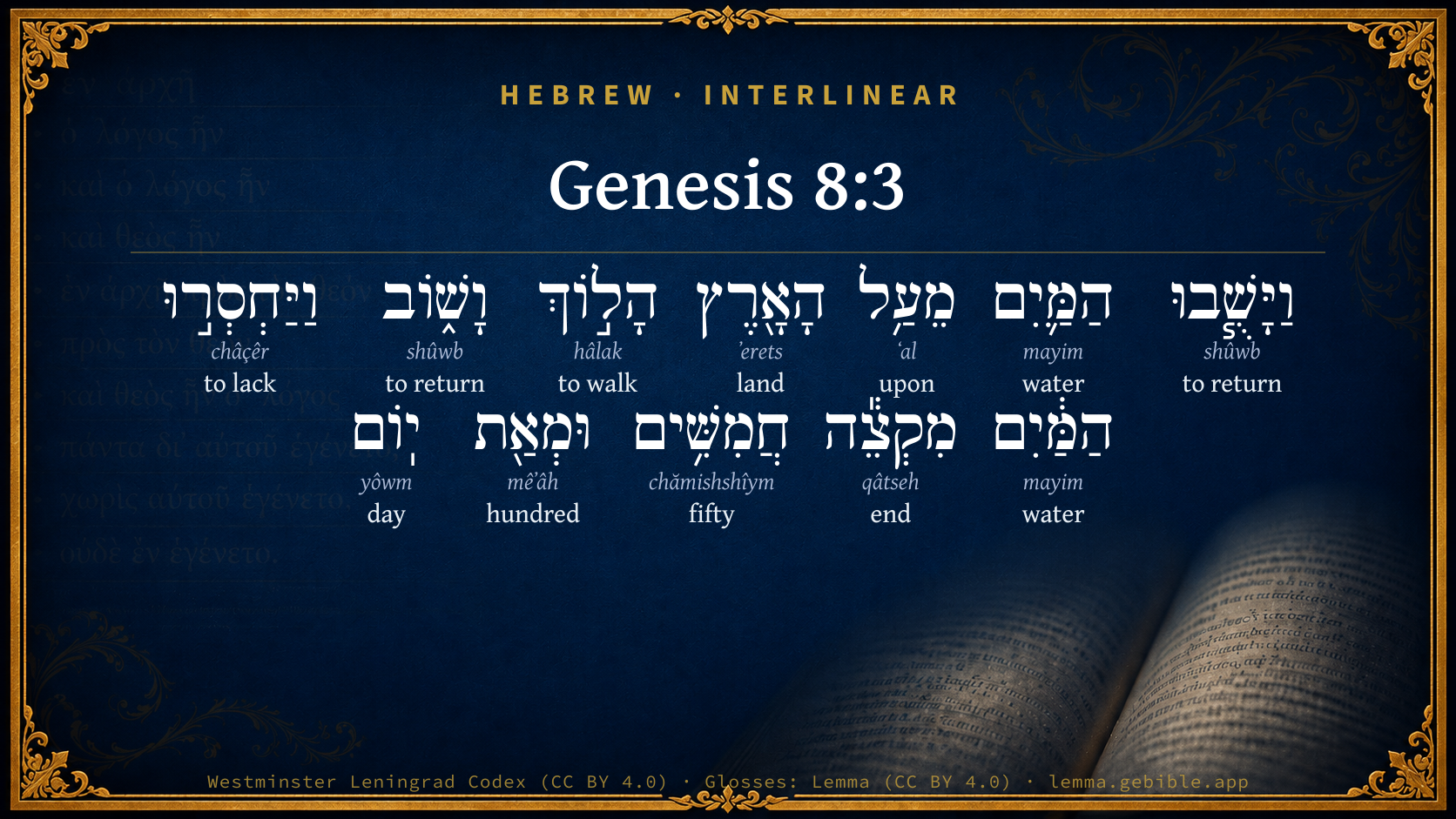
Hebrew (Westminster Leningrad Codex) Genesis 8:3 appears in the Hebrew Old Testament. The text above is from the Westminster Leningrad Codex. Each word links to its Strong’s number, a concise gloss, and parsing drawn from the Open Scriptures Hebrew Bible morphology. Click any word for its full Brown-Driver-Briggs (BDB) entry.
Download image
Cite this verse

Genesis 8:3 (World English Bible). Public Domain. Lemma interlinear Bible study tool, https://lemma.gebible.app/v/genesis/8/3.

Show BibTeX & RIS
BibTeX
RIS
English Translation
The waters receded from off the earth continually. After the end of one hundred fifty days the waters decreased.
World English Bible · Public Domain
Highlights Full analysis ↓
Download a study sheet

One document with this verse’s original text, its word-by-word gloss line, the meaning frame, cross-references with their text, attributed commentary, and full source and license credits — printable, and it pastes into notes with its structure intact.

This verse Autodidact and up

Study sheet (.html) Plain text (.txt)

A passage Seminary Student

Up to 50 verses in one chapter. A passage sheet keeps up to 6 commentary sources and 12 cross-references per verse, in the order this page ranks them, and says so on the sheet whenever that leaves anything out. Ask for a single verse and you get the Autodidact verse sheet above.

Everything on this page stays free to read, with no account — the sheet is a download of what is already on screen, not access to it.

Want to remove ads? Support Godless Engineer
Compare translations 3

The same verse in 3 English versions, stacked beneath the original-language interlinear above. Click any original word for its lexicon entry.

Each is an independent rendering of the whole verse — the interlinear is not word-aligned to these translations.

Highlighted words mark where these versions differ — a whole-verse word diff, not a word-by-word alignment.

  • World English Bible Public Domain
    The waters receded from off the earth continually. After the end of one hundred fifty days the waters decreased.
  • King James Version Public Domain
    And the waters returned from off the earth continually: and after the end of the hundred and fifty days the waters were abated.
  • unfoldingWord Literal Text CC BY-SA 4.0
    Then the waters receded steadily from the earth, and the end of the 150 days the waters had decreased,

unfoldingWord Literal Text — © unfoldingWord, licensed CC BY-SA 4.0. Word-aligned USFM3 via Door43 (git.door43.org/unfoldingWord/en_ult).

Versions to compare (up to 4)

3 of 4 selected

Show all 18 translations

Every available English version of this verse, each an independent rendering of the whole verse.

  • World English Bible Public Domain
    The waters receded from off the earth continually. After the end of one hundred fifty days the waters decreased.
  • Berean Standard Bible Public Domain
    The waters receded steadily from the earth, and after 150 days the waters had gone down.
  • Majority Standard Bible Public Domain
    The waters receded steadily from the earth, and after 150 days the waters had gone down.
  • King James Version Public Domain
    And the waters returned from off the earth continually: and after the end of the hundred and fifty days the waters were abated.
  • American Standard Version (1901) Public Domain
    and the waters returned from off the earth continually: and after the end of a hundred and fifty days the waters decreased.
  • Revised Version (1885) Public Domain
    and the waters returned from off the earth continually: and after the end of an hundred and fifty days the waters decreased.
  • Geneva Bible (1599) Public Domain
    And the waters returned from aboue the earth, going and returning: and after the ende of the hundreth and fiftieth day the waters abated.
  • Douay-Rheims (1899) Public Domain
    And the waters returned from off the earth going and coming: and they began to be abated after a hundred and fifty days.
  • Young's Literal Translation Public Domain
    And turn back do the waters from off the earth, going on and returning; and the waters are lacking at the end of a hundred and fifty days.
  • Literal Standard Version CC BY-SA 4.0
    And the waters return from off the earth, going on and returning; and the waters are lacking at the end of one hundred and fifty days.
  • Unlocked Literal Bible CC BY-SA 4.0
    The flood waters went down slowly from the earth, and after the end of a hundred and fifty days the waters had gone down.
  • unfoldingWord Literal Text CC BY-SA 4.0
    Then the waters receded steadily from the earth, and the end of the 150 days the waters had decreased,
  • Darby Bible Public Domain
    And the waters retired from the earth, continually retiring; and in the course of a hundred and fifty days the waters abated.
  • World Messianic Bible Public Domain
    The waters continually receded from the earth. After the end of one hundred fifty days the waters receded.
  • Webster's Bible Public Domain
    And the waters returned from off the earth continually: and after the end of the hundred and fifty days the waters were abated.
  • Free Bible Version CC BY-SA 4.0
    The floodwaters steadily receded from the earth. They had gone down so much that by 150 days after the flood began
  • Bible in Basic English Public Domain
    And the waters went slowly back from the earth, and at the end of a hundred and fifty days the waters were lower.
  • JPS Tanakh (1917) Public Domain
    And the waters returned from off the earth continually; and after the end of a hundred and fifty days the waters decreased.

Literal Standard Version (2020), Covenant Press — licensed CC BY-SA 4.0. Text via the HelloAO Bible API (eBible.org). Unlocked Literal Bible (unfoldingWord) — licensed CC BY-SA 4.0. Text via the HelloAO Bible API (eBible.org). unfoldingWord Literal Text — © unfoldingWord, licensed CC BY-SA 4.0. Word-aligned USFM3 via Door43 (git.door43.org/unfoldingWord/en_ult). Free Bible Version, Dr. Jonathan Gallagher — licensed CC BY-SA 4.0. Text via the HelloAO Bible API (eBible.org).

Word by word

More ways to search: Search by grammar → Find every occurrence → Compare this word →

Practice this passage: Drill this verse → Learn its vocabulary →

וַיַּחְסְר֣וּ
châçêr
H2637
“and · to lack”
Conjunction + Verb, Qal, Sequential Imperfect, 3rd Person, Masculine, Plural
Part of Speech
Conjunction + Verb
Stem
Qal
Form
Sequential Imperfect
Person
3rd Person
Gender
Masculine
Number
Plural
Full BDB Definition

Origin: a primitive root

TWOT: 705

to lack, be without, decrease, be lacking, have a need - (Qal) - to lack - to be lacking - to diminish, decrease - (Piel) to cause to lack - (Hiphil) to cause to be lacking
  1. וַיָּשֻׁ֧בוּ shûwb H7725 “and · to return” Conjunction + Verb, Qal, Sequential Imperfect, 3rd Person, Masculine, Plural
  2. הַמַּ֛יִם mayim H4325 “the · water(s)” Particle, Definite Article + Noun, Common, Masculine, Plural, Absolute
  3. מֵעַ֥ל ʻal H5921 “from · upon” Preposition + Preposition
  4. הָאָ֖רֶץ ʼerets H776 “the · land” Particle, Definite Article + Noun, Common, Both, Singular, Absolute
  5. הָל֣וֹךְ hâlak H1980 “to walk” Verb, Qal, Infinitive Absolute
  6. וָשׁ֑וֹב shûwb H7725 “and · to return” Conjunction + Verb, Qal, Infinitive Absolute
  7. הַמַּ֔יִם mayim H4325 “the · water(s)” Particle, Definite Article + Noun, Common, Masculine, Plural, Absolute
  8. מִקְצֵ֕ה qâtseh H7097 “from · end of” Preposition + Noun, Common, Both, Singular, Construct
  9. חֲמִשִּׁ֥ים chămishshîym H2572 “fifty” Adjective, Cardinal number, Both, Plural, Absolute
  10. וּמְאַ֖ת mêʼâh H3967 “and · hundred” Conjunction + Adjective, Cardinal number, Both, Singular, Construct
  11. יֽוֹם yôwm H3117 “day” Noun, Common, Masculine, Singular, Absolute

About this verse

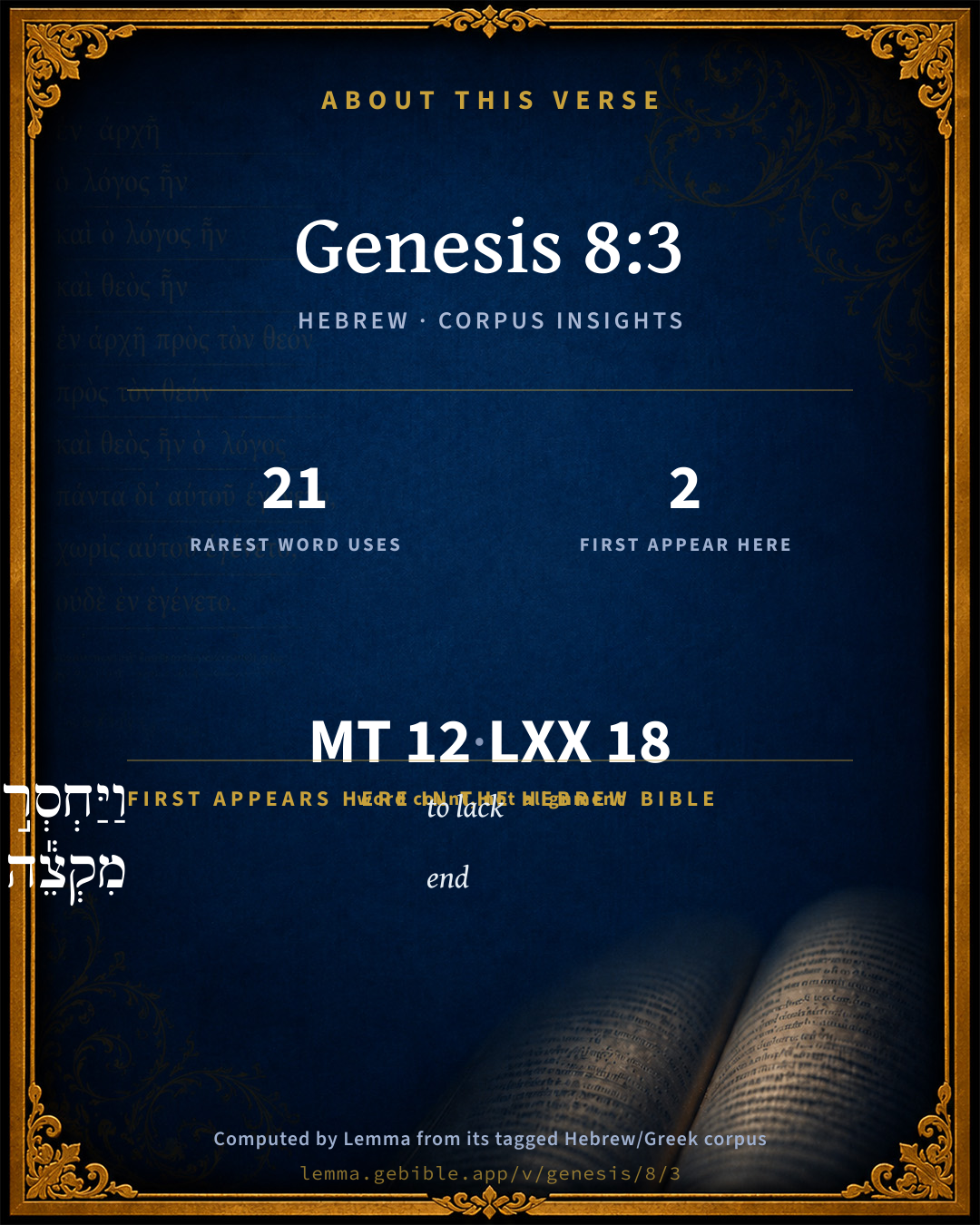
These counts appear in no published source. They are computed here, from the morphology-tagged text and Lemma’s own curated glosses. What Lemma adds →

12
words
10
distinct lemmas
Pentateuch
section

Notable vocabulary

The rarest word here is וַיַּחְסְר֣וּ to lack H2637 — appearing just 21 times in the whole Hebrew Bible.

First appearance in Scripture

These words make their first canonical appearance in the Hebrew Bible here:

  • וַיַּחְסְר֣וּ to lack H2637
  • מִקְצֵ֕ה end H7097

Shared distinctive vocabulary

וַיַּחְסְר֣וּ to lack H2637 occurs in 21 verses of the Hebrew Bible. Also found in:

Grammatical profile

  • 4 verbs
  • 5 nouns
  • 2 adjectives
  • 1 preposition

Verb forms

  • וַיָּשֻׁ֧בוּ Qal · Sequential Imperfect
  • הָל֣וֹךְ Qal · Infinitive Absolute
  • וָשׁ֑וֹב Qal · Infinitive Absolute
  • וַיַּחְסְר֣וּ Qal · Sequential Imperfect

Repetition

Words recur within this verse — often emphatic in Hebrew:

  • וַיָּשֻׁ֧בוּ to return H7725 ×2
  • הַמַּ֛יִם water H4325 ×2

Hebrew & Septuagint length

In English translation the verse runs 19 words from the Hebrew and 40 from the Septuagint (LXX English) — the Septuagint runs noticeably longer here. See the side-by-side →

A rough comparison of the two English renderings, which tokenize alike — not a word-level alignment.

Word counts can differ between the Hebrew and the Greek without any difference in meaning — e.g. the Hebrew direct-object marker אֵת has no separate Greek word, and Greek often adds the article ὁ.

In the original languages it is 12 Hebrew tokens and 18 Greek tokens — but the two are counted differently (Hebrew bundles its prefixes and suffixes into one token; the Greek is in lemma form), so that isn’t a like-for-like length.

Cross-references

2

Topical passages linked to Genesis 8:3 in the Treasury of Scripture Knowledge — connected by theme and wording, ordered by reader-vote popularity; previews shown in the World English Bible.

  • Genesis 7:24 The waters prevailed on the earth one hundred fifty days.
  • Genesis 7:11 In the six hundredth year of Noah's life, in the second month, on the seventeenth day of the month, on the same day all the fountains of the great deep were burst open, and the sky's windows were opened.

Cross-references courtesy of OpenBible.info (CC BY 4.0).

Hebrew and Greek witnesses Masoretic Hebrew ↔ Greek Septuagint

The same verse in the two great witnesses to the Old Testament, shown verse-for-verse.

Here the Septuagint runs noticeably longer than the Hebrew — LXX2012 (modern English Septuagint) 40 words vs World English Bible 19. A rough length comparison of the two English translations, not a word-level alignment — read both below.

These are two independent witnesses, not word-aligned to each other, and the Septuagint is shown in lemma (dictionary) form.

Hebrew Genesis 8:3 Masoretic · Westminster Leningrad Codex

וַיָּשֻׁ֧בוּ הַמַּ֛יִם מֵעַ֥ל הָאָ֖רֶץ הָל֣וֹךְ וָשׁ֑וֹב וַיַּחְסְר֣וּ הַמַּ֔יִם מִקְצֵ֕ה חֲמִשִּׁ֥ים וּמְאַ֖ת יֽוֹם

The waters receded from off the earth continually. After the end of one hundred fifty days the waters decreased.

World English Bible · Public Domain

Greek LXX Genesis 8:3 Septuagint · lemma form

καί ἐνδίδωμι ὁ ὕδωρ πορεύομαι ἀπό ὁ γῆ ἐνδίδωμι καί ἐλαττονέω ὁ ὕδωρ μετά πεντήκοντα καί ἑκατόν ἡμέρα

And the water subsided, and went off the earth, and after one hundred and fifty days the water was diminished, and the ark rested in the seventh month, on the twenty-seventh day of the month, on the mountains of Ararat.

LXX2012 (modern English Septuagint) · Public Domain

On this verse, The Pulpit Commentary discusses the Septuagint’s reading. Read the note in Commentary ↓

Hebrew: Westminster Leningrad Codex (CC BY 4.0). Greek: Septuagint (public domain); English from LXX2012 (modern English Septuagint) (Public Domain). How the Septuagint differs from the Hebrew →

Targum (Aramaic paraphrase)

2

The Targum is the ancient Jewish Aramaic paraphrase of the Hebrew Scriptures — an interpretive translation, not the Hebrew text itself. Onkelos (literal) and Pseudo-Jonathan (expansive) render the Torah, and Jonathan the Prophets. Coverage is partial: where no permissively-licensed English translation exists for a verse, only the Aramaic is shown. This is verse-level text, not a word-by-word alignment to the Hebrew.

  1. Targum Onkelos Torah (Genesis–Deuteronomy)
    וְתָבוּ מַיָּא מֵעַל אַרְעָא אָזְלִין וְתָיְבִין וַחֲסָרוּ מַיָּא מִסּוֹף מְאָה וְחַמְשִׁין יוֹמִין

    and the waters turned from on the earth, going and returning; and the waters diminished from the end of a hundred and fifty days.

    Targum Onkelos — Aramaic: “Onkelos Genesis” (public domain); “Onkelos Exodus” (public domain); “Onkelos Leviticus” (public domain); “Onkelos Numbers” (public domain); “Onkelos Deuteronomy” (public domain). English: “Sefaria Community Translation” (CC0 1.0 (public-domain dedication)); “J.W. Etheridge. The Targums of Onkelos and Jonathan Ben Uzziel on the Pentateuch. London: Longmans, Green, 1862” (public domain). Text via Sefaria.

  2. Targum Pseudo-Jonathan Torah (Genesis–Deuteronomy)
    וּתְאִיבוּ מַיָא מֵעֲלוֹי אַרְעָא אָזְלִין וְתַיְיבִין וְחָסְרוּ מַיָא מִסוֹף מְאָה וְחַמְשִׁין יוֹמִין

    And the waters returned from being on the earth, going and returning. And the waters were minished at the end of a hundred and fifty days.

    Targum Pseudo-Jonathan — Aramaic: “Targum Jonathan on Genesis” (public domain); “Targum Jonathan on Exodus” (public domain); “Targum Jonathan on Leviticus” (public domain); “Targum Jonathan on Numbers” (public domain); “Targum Jonathan on Deuteronomy” (public domain). English: “The Targum of Jonathan ben Uzziel, trans. J. W. Etheridge, London, 1862” (public domain). Text via Sefaria.

Commentary

Notes on Genesis 8:3 from classic Christian and Jewish commentators (each source and its license shown beneath its notes). The classic Christian expositions comment on the surrounding passage and are grouped to its opening verse, so a note may address several verses; the Jewish commentaries on the Tanakh (Rashi and others) are per-verse, so they appear only where the commentator wrote on this verse.

Lemma curates 59 commentaries, every one of them public domain or Creative Commons licensed, each selected and text-cleaned for this edition rather than reprinted as found. About our sources →

Trapp's Complete Commentary

John Trapp

Gen 8:3 And the waters returned from off the earth continually: and after the end of the hundred and fifty days the waters were abated.

Ver. 3. And the waters returned continually.] Or, hastily (Heb., הזלד εשׁεα). In going and returning; or, heaving and shoving, with all possible speed to return to their place, at God’s appointment. See a like cheerfulness in God’s servants. {Zec 8:21 Isa 9:8 Psa 110:3}

John Trapp, A Commentary or Exposition upon All the Books of the Old and New Testament (1647–1656) — public domain. Text from a community e-Sword module.

Joseph Benson's Commentary

Gen 8:3-5. The waters returned from off the earth continually — Hebrews they were going and returning; a gradual departure. The heat of the sun exhaled much, and perhaps the subterraneous caverns soaked in more. And the ark rested upon the mountains of Ararat — Or, Armenia, whither it was directed, not by Noah’s prudence, but the wise providence of God. The tops of the mountains were seen — Like little islands appearing above water. They felt ground above forty days before they saw it, according to Dr. Lightfoot’s computation, whence he infers, that if the waters decreased proportionably, the ark drew eleven cubits in water.

Joseph Benson's Commentary on the Old and New Testaments (1811–1818) — public domain. Text from a community e-Sword module.

John Calvin's Commentaries

3. And after the end of the hundred and fifty days. Some think that the whole time, from the beginning of the deluge to the abatement of the waters, is here noted; and thus they include the forty days in which Moses relates that there was continued rain. But I make this distinction, that until the fortieth day, the waters rose gradually by fresh additions; then that they remained nearly in the same state for one hundred and fifty days; for both computations make the period a little more than six months and a half. And Moses says, that about the end of the seventh month, the diminution of the waters appeared to be such that the ark settled upon the highest summit of a mountain, or touched some ground. And by this lengthened space of time, the Lord would show the more plainly, that the dreadful desolation of the world had not fallen upon it accidentally, but was a remarkable proof of his judgment; while the deliverance of Noah was a magnificent work of his grace, and worthy of everlasting remembrance. If, however, we number the seventh month from the beginning of the year, (as some do,) and not from the time that Noah entered the ark, the subsidence of which Moses speaks, took place earlier, namely, as soon as the ark had floated five months. If this second opinion is received, there will be the same reckoning of ten months; for the sense will be, that in the eighth month after the commencement of the deluge, the tops of the mountains appeared. Concerning the name Ararat, I follow the opinion most received. And I do not see why some should deny it to be Armenian the mountains of which are declared, by ancient authors, almost with one consents to be the highest. The Chaldean paraphrase also points out the particular part, which he calls mountains of Cardu, which others call Cardueni. But whether that be true, which Josephus has handed down respecting the fragments of the ark found there in his time; remnants of which, Jerome says, remained to his own age, I leave undecided.

John Calvin's Commentaries (1540-1563) — public domain. Text from the Calvin Translation Society English edition (1840s-50s) via the Christian Classics Ethereal Library (ccel.org). Calvin's coverage is partial (roughly two-thirds of the Bible); uncommented books and verses are honest gaps, never fabricated. The 19th-century editor's footnotes and remarks are omitted so the notes are faithfully Calvin's own voice.

Ellicott's Commentary for English Readers

(3) The waters returned from off the earth.—This backward motion of the waters also seems to indicate that a vast wave from the sea had swept over the land, in addition to the forty days of rain.

Were abated.—Heb., decreased. Those in the ark would notice the changing current, and would know, by their being aground, that the flood was diminishing. But it was not till the first day of the tenth month that the tops of the mountains were seen. This slow abatement of the waters and their stillness, described in Gen_8:1, makes it probable that the ark had grounded on some land-locked spot.

A Bible Commentary for English Readers, edited by Charles John Ellicott (1878–1897) — public domain. Text from a community e-Sword module.

John Gill's Exposition

And the waters returned from off the earth continually,.... Or "going and returning" (s); they went off from the earth, and returned to their proper places appointed for them; some were dried up by the wind, and exhaled by the sun into the air: and others returned to their channels and cavities in the earth, or soaked into it:

and after the end of the hundred and fifty days, the waters were abated; or began to abate, as Jarchi and the Vulgate Latin version; which days are to be reckoned from the beginning of the flood, including the forty days' rain; though Jarchi reckons them from the time of the ceasing of it; so that there were from the beginning of the flood one hundred and ninety days; six months, and ten days of the year of the flood now past; and in this he is followed by Dr. Lightfoot (t): but the former reckoning seems best, and agrees better with what follows.

(s) , "eundo et redeundo", Pagninus, Montanus. (t) Works, vol. 1. p. 6.

John Gill's Exposition of the Whole Bible (1746–1763) — public domain (CC PDM 1.0). Text via the HelloAO Bible API.

Haydock's Catholic Bible Commentary

And the waters returned, &c. St. Jerome on this passage remarks, "that all waters and torrents repair to the womb of the abyss, through the hidden veins of the earth," and by the abyss understands the sea: according to that of Ecclesiastes i. 7, all the rivers run into the sea. But as the sea itself, on this occasion, exceeded its limits, (otherwise its waters would not have been higher than the land) the sense perhaps confined to this, that the waters by degrees were diminished; as we may say of the inundations of land, that the waters are gone off, not by the regular course of ditches, but from the effects of the sun and winds which dry them up. (Estius)

George Leo Haydock (1774–1849), Haydock's Catholic Family Bible and Commentary, 1859 edition — public domain. Excludes Psalms (Douay-Rheims chapter numbering differs from Protestant) and Deuterocanonical books (Catholic canon only).

The Pulpit Commentary

And the waters returned from off the earth continually. Literally, going and returning. "More and more" (Gesenius). The first verb expresses the continuance and self-increasing state of the action involved in the second; cf. (Gen_26:13; 1Sa_6:12; 2Ki_2:11) (Furst) Gradually (Murphy, Ewald). The expression "denotes the turning-point after the waters had become calm" (T. Lewis). May it not be an attempt to represent the undulatory motion of the waves in an ebbing tide, in which the water seems first to advance, but only to retire with greater vehemence, reversing the movement of a flowing tide, in which it first retires and then advances in the one case returning to go, in the other going to return? The LXX, as usual, indicates the visible effect rather than the actual phenomenon: kaidou toomenon ajpo thv ghv. And after the end of the hundred and fifty days the waters were abated. Literally, were cut off, hence diminished; imminsutae sunt (Vulgate); hjlattonouto to udwr (LXX). The first stage was the quieting of the waters; the second was the commencement of an ebbing or backward motion; the third was a perceptible diminution of the waters.

The Pulpit Commentary (1880–1919), ed. H.D.M. Spence-Jones & Joseph S. Exell — public domain. Text from a community e-Sword module.

John Wesley's Explanatory Notes

The waters returned from off the earth continually - Hebrew. they were going and returning; a gradual departure. The heat of the sun exhaled much, and perhaps the subterraneous caverns soaked in more.

John Wesley, Explanatory Notes Upon the Whole Bible (1754–1765) — public domain. Text via the GEBible commentary corpus.

Rashi

Rabbi Shlomo Yitzchaki (Rashi)

מקצה חמשים ומאת יום AFTER THE END OF ONE HUNDRED AND FIFTY DAYS they began to decrease: that was on the first day of Sivan. How so? The rains ceased to fall on the twenty-seventh day of Kislev — you have three days left in Kislev, and the 29 days of Tebeth make 32, and Shebat, Adar, Nisan and Eyar have together 118, making altogether 150.

Rashi on the Tanakh — English translations: “The Judaica Press complete Tanach with Rashi, translated by A. J. Rosenberg” (CC BY 4.0); “Pentateuch with Rashi's commentary by M. Rosenbaum and A.M. Silbermann, 1929-1934” (public domain); “The Metsudah Tanach series, Lakewood, N.J” (CC BY 4.0); and “The Book of Joshua, Metsudah Publications, 1997” (CC BY 4.0). Text via Sefaria.

Radak

Rabbi David Kimhi (Radak)

וישבו המים..הלוך ושוב, this formulation described the gradual nature of the waters abating and the water level on the globe falling. The period this took corresponded to the 40+150 days described during which the waters rose, giving us a total of 340 days. When you add the 3 times 7 days which elapsed for the 3 missions of the raven and the pigeon respectively, you have a total of 361 days, very close to the 365 days described in the Torah as the period which elapsed from the onset of the rain until Noach left the ark. The beginning of the return to normal commenced on the second day of Sivan. As soon as the waters had peaked, they began to recede.

Radak on the Tanakh — English translations: “Sefaria Community Translation” (CC0 1.0 (public-domain dedication)); “Eliyahu Munk, HaChut Hameshulash” (CC BY 4.0); “Rabbi Mike Feuer, Jerusalem Anthology” (CC BY 4.0); and “R. David Kimhi on the first book of Psalms, Translated by R.G. Finch, London, 1919” (public domain). Text via Sefaria.

Lesson kit

Teaching starters — assembled from the data on this page, not authored interpretation. Every prompt links to the verse data it draws on. Edit before teaching.

Genesis, in the Pentateuch, opens this verse with 12 words (10 distinct Hebrew lemmas). Its most distinctive word is châçêr (“to lack”). The Greek Septuagint runs longer here. A historical commentator’s framing appears above. Read the whole chapter for the surrounding context.

Discussion questions

  1. What does “to lack” (châçêr) contribute to the verse as a whole?
  2. 2 words make their first appearance in Scripture here. What does this debut establish?
  3. How does Genesis 8:5, which shares the word «to lack», read alongside this verse?
  4. What does the repetition of “to return” (2× in this one verse) do in this verse?
  5. The Septuagint runs longer here than the Hebrew. What might account for the difference?
  6. These translations render this verse differently; the difference is in the English rendering, not the original. What questions does that raise?
  7. «וַיָּשֻׁ֧בוּ» is a Qal Sequential Imperfect verb. How does that grammatical form shape the action described?
  8. Compare how Trapp's Complete Commentary and Joseph Benson's Commentary read this verse. Where do they agree or differ?

Things to notice

Reading settings

Reading text

Shown beneath each verse's original-language words.

Old Testament
Old Testament edition

Read the OT as the Masoretic Hebrew (MT) or the Greek Septuagint (LXX).

English shown for the Greek Septuagint (in the Hebrew ↔ Greek comparison).

Comparing translations? Open the Compare panel on any verse page to stack up to four side by side.