
Hosea 6:11

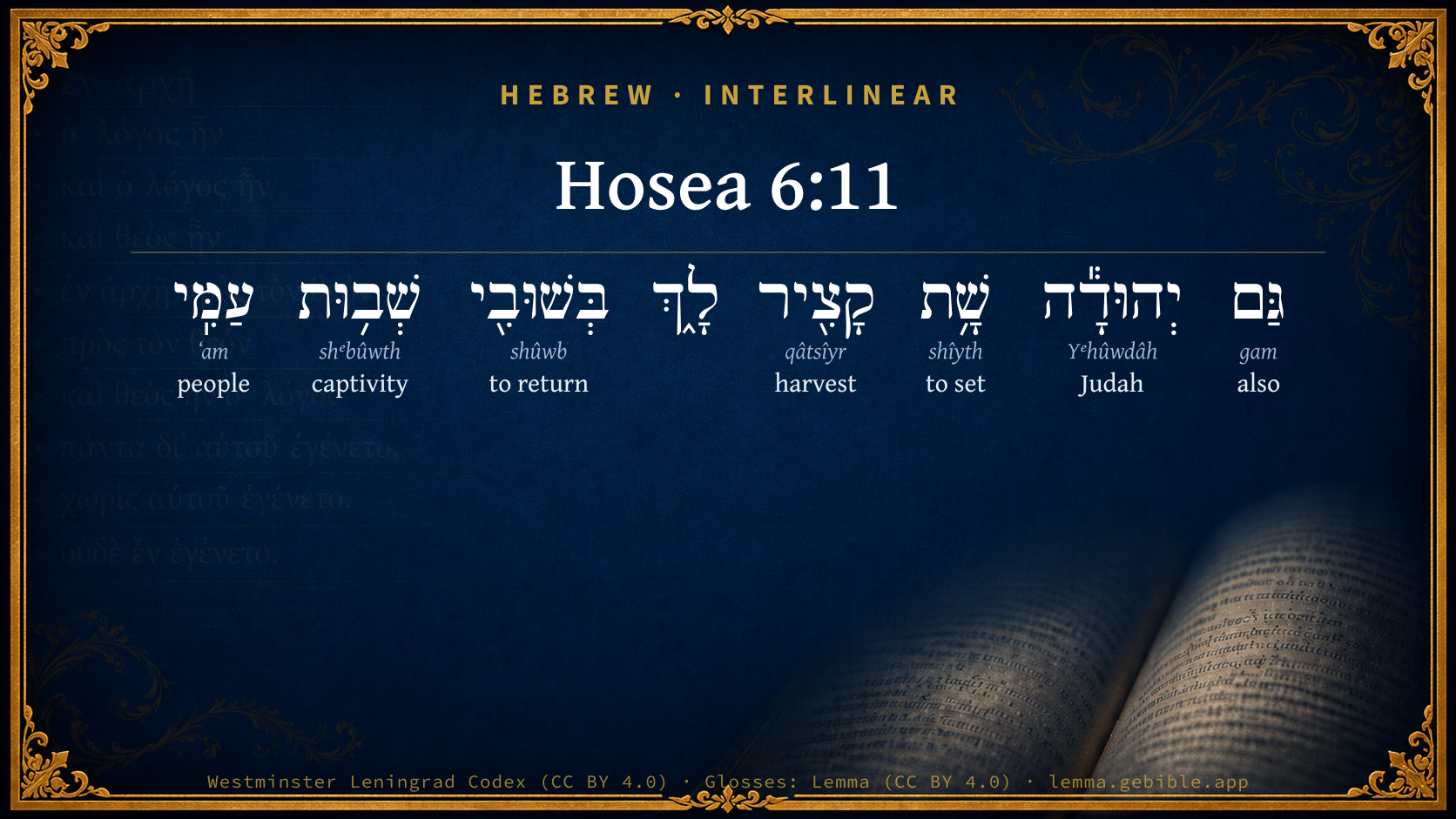
Hebrew (Westminster Leningrad Codex) Hosea 6:11 appears in the Hebrew Old Testament. The text above is from the Westminster Leningrad Codex. Each word links to its Strong’s number, a concise gloss, and parsing drawn from the Open Scriptures Hebrew Bible morphology. Click any word for its full Brown-Driver-Briggs (BDB) entry.
Download image
Cite this verse

Hosea 6:11 (World English Bible). Public Domain. Lemma interlinear Bible study tool, https://lemma.gebible.app/v/hosea/6/11.

Show BibTeX & RIS
BibTeX
RIS
English Translation
"Also, Judah, there is a harvest appointed for you, When I restore the fortunes of my people.
World English Bible · Public Domain
Download a study sheet

One document with this verse’s original text, its word-by-word gloss line, the meaning frame, cross-references with their text, attributed commentary, and full source and license credits — printable, and it pastes into notes with its structure intact.

This verse Autodidact and up

Study sheet (.html) Plain text (.txt)

A passage Seminary Student

Up to 50 verses in one chapter. A passage sheet keeps up to 6 commentary sources and 12 cross-references per verse, in the order this page ranks them, and says so on the sheet whenever that leaves anything out. Ask for a single verse and you get the Autodidact verse sheet above.

Everything on this page stays free to read, with no account — the sheet is a download of what is already on screen, not access to it.

Want to remove ads? Support Godless Engineer
Compare translations 3

The same verse in 3 English versions, stacked beneath the original-language interlinear above. Click any original word for its lexicon entry.

Each is an independent rendering of the whole verse — the interlinear is not word-aligned to these translations.

Highlighted words mark where these versions differ — a whole-verse word diff, not a word-by-word alignment.

  • World English Bible Public Domain
    "Also, Judah, there is a harvest appointed for you, When I restore the fortunes of my people.
  • King James Version Public Domain
    Also, O Judah, he hath set an harvest for thee, when I returned the captivity of my people.
  • unfoldingWord Literal Text CC BY-SA 4.0
    Also, Judah, he has appointed a harvest for you. When I restore the fortunes of my people,

unfoldingWord Literal Text — © unfoldingWord, licensed CC BY-SA 4.0. Word-aligned USFM3 via Door43 (git.door43.org/unfoldingWord/en_ult).

Versions to compare (up to 4)

3 of 4 selected

Show all 18 translations

Every available English version of this verse, each an independent rendering of the whole verse.

  • World English Bible Public Domain
    "Also, Judah, there is a harvest appointed for you, When I restore the fortunes of my people.
  • Berean Standard Bible Public Domain
    Also for you, O Judah, a harvest is appointed, when I restore My people from captivity.
  • Majority Standard Bible Public Domain
    Also for you, O Judah, a harvest is appointed, when I restore My people from captivity.
  • King James Version Public Domain
    Also, O Judah, he hath set an harvest for thee, when I returned the captivity of my people.
  • American Standard Version (1901) Public Domain
    Also, O Judah, there is a harvest appointed for thee, when I bring back the captivity of my people.
  • Revised Version (1885) Public Domain
    Also, O Judah, there is an harvest appointed for thee, when I bring again the captivity of my people.
  • Geneva Bible (1599) Public Domain
    Yea, Iudah hath set a plant for thee, whiles I woulde returne ye captiuitie of my people.
  • Douay-Rheims (1899) Public Domain
    And thou also, O Juda, set thee a harvest, when I shall bring back captivity of my people.
  • Young's Literal Translation Public Domain
    Also, O Judah, appointed is a harvest to thee, In My turning back `to' the captivity of My people!
  • Literal Standard Version CC BY-SA 4.0
    Also, O Judah, a harvest is appointed to you, || In My turning back [to] the captivity of My people!”
  • Unlocked Literal Bible CC BY-SA 4.0
    For you also, Judah, a harvest has been appointed, when I will restore the fortunes of my people.
  • unfoldingWord Literal Text CC BY-SA 4.0
    Also, Judah, he has appointed a harvest for you. When I restore the fortunes of my people,
  • Darby Bible Public Domain
    Also, for thee, Judah, is a harvest appointed, when I shall turn again the captivity of my people.
  • World Messianic Bible Public Domain
    “Also, Judah, there is a harvest appointed for you, when I restore the fortunes of my people.
  • Webster's Bible Public Domain
    Also, O Judah, he hath set a harvest for thee, when I returned the captivity of my people.
  • Free Bible Version CC BY-SA 4.0
    And as for you, Judah, your harvest-time has been set! When I restore the fortunes of my people,
  • Bible in Basic English Public Domain
    And Judah has put up disgusting images for himself.
  • JPS Tanakh (1917) Public Domain
    Also, O Judah, there is a harvest appointed for thee! When I would turn the captivity of My people,

Literal Standard Version (2020), Covenant Press — licensed CC BY-SA 4.0. Text via the HelloAO Bible API (eBible.org). Unlocked Literal Bible (unfoldingWord) — licensed CC BY-SA 4.0. Text via the HelloAO Bible API (eBible.org). unfoldingWord Literal Text — © unfoldingWord, licensed CC BY-SA 4.0. Word-aligned USFM3 via Door43 (git.door43.org/unfoldingWord/en_ult). Free Bible Version, Dr. Jonathan Gallagher — licensed CC BY-SA 4.0. Text via the HelloAO Bible API (eBible.org).

Word by word

More ways to search: Search by grammar → Find every occurrence → Compare this word →

Practice this passage: Drill this verse → Learn its vocabulary →

About this verse

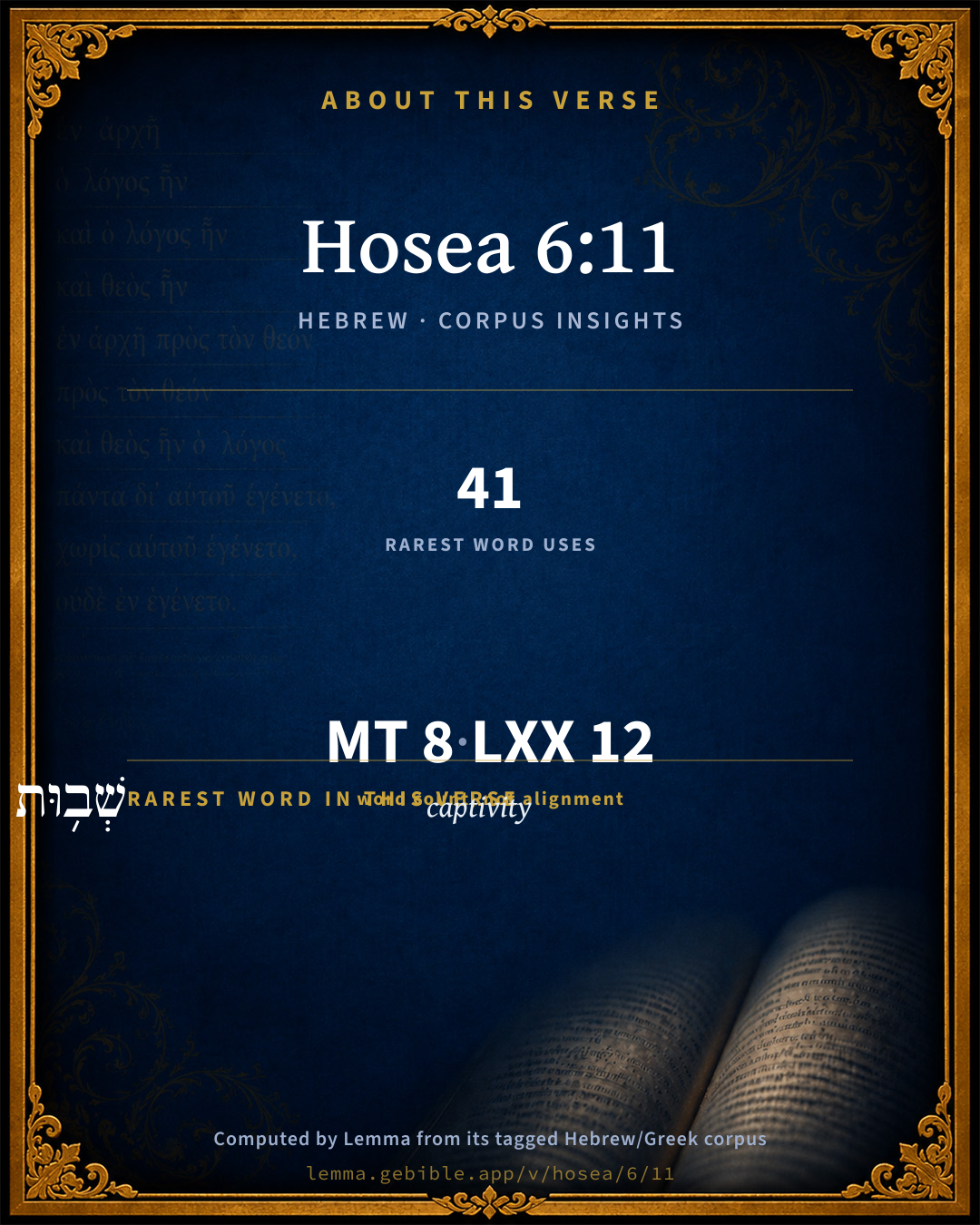
These counts appear in no published source. They are computed here, from the morphology-tagged text and Lemma’s own curated glosses. What Lemma adds →

8
words
7
distinct lemmas
Prophets
section

Shared distinctive vocabulary

שְׁב֥וּת captivity H7622 occurs in 26 verses of the Hebrew Bible. Also found in:

Grammatical profile

  • 2 verbs
  • 4 nouns
  • 1 preposition
  • 1 particle

Verb forms

  • שָׁ֥ת Qal · Perfect
  • בְּשׁוּבִ֖י Qal · Infinitive Construct

Hebrew & Septuagint length

In English translation the verse runs 17 words from the Hebrew and 16 from the Septuagint (LXX English) — closely comparable.

A rough comparison of the two English renderings, which tokenize alike — not a word-level alignment.

Word counts can differ between the Hebrew and the Greek without any difference in meaning — e.g. the Hebrew direct-object marker אֵת has no separate Greek word, and Greek often adds the article ὁ.

In the original languages it is 8 Hebrew tokens and 12 Greek tokens — but the two are counted differently (Hebrew bundles its prefixes and suffixes into one token; the Greek is in lemma form), so that isn’t a like-for-like length.

Cross-references

7

Topical passages linked to Hosea 6:11 in the Treasury of Scripture Knowledge — connected by theme and wording, ordered by reader-vote popularity; previews shown in the World English Bible.

  • Joel 3:13 Put in the sickle; For the harvest is ripe. Come, tread, for the winepress is full, The vats overflow, for their wickedness is great."
  • Job 42:10 Yahweh turned the captivity of Job, when he prayed for his friends. Yahweh gave Job twice as much as he had before.
  • Jeremiah 51:33 For thus says Yahweh of hosts, the God of Israel: The daughter of Babylon is like a threshing floor at the time when it is trodden; yet a little while, and the time of harvest shall come for her.
  • Revelation 14:15 Another angel came out from the temple, crying with a loud voice to him who sat on the cloud, "Send forth your sickle, and reap; for the hour to reap has come; for the harvest of the earth is ripe!"
  • Psalms 126:1 When Yahweh brought back those who returned to Zion, We were like those who dream.
  • Micah 4:12 But they don't know the thoughts of Yahweh, Neither do they understand his counsel; For he has gathered them like the sheaves to the threshing floor.
  • Zephaniah 2:7 The coast will be for the remnant of the house of Judah. They will find pasture. In the houses of Ashkelon, they will lie down in the evening, for Yahweh, their God, will visit them, and restore them.

Cross-references courtesy of OpenBible.info (CC BY 4.0).

Hebrew and Greek witnesses Masoretic Hebrew ↔ Greek Septuagint

The same verse in the two great witnesses to the Old Testament, shown verse-for-verse.

These are two independent witnesses, not word-aligned to each other, and the Septuagint is shown in lemma (dictionary) form.

Hebrew Hosea 6:11 Masoretic · Westminster Leningrad Codex

גַּם יְהוּדָ֕ה שָׁ֥ת קָצִ֖יר לָ֑ךְ בְּשׁוּבִ֖י שְׁב֥וּת עַמִּֽי

"Also, Judah, there is a harvest appointed for you, When I restore the fortunes of my people.

World English Bible · Public Domain

Greek LXX Hosea 6:11 Septuagint · lemma form

ἄρχω τρυγάω σεαυτοῦ ἐν ὁ ἐπιστρέφω ἐγώ ὁ αἰχμαλωσία ὁ λαός ἐγώ

I have seen horrible things there, even the fornication of Ephraim: Israel and Juda are defiled;

LXX2012 (modern English Septuagint) · Public Domain

Hebrew: Westminster Leningrad Codex (CC BY 4.0). Greek: Septuagint (public domain); English from LXX2012 (modern English Septuagint) (Public Domain). How the Septuagint differs from the Hebrew →

Targum (Aramaic paraphrase)

1

The Targum is the ancient Jewish Aramaic paraphrase of the Hebrew Scriptures — an interpretive translation, not the Hebrew text itself. Onkelos (literal) and Pseudo-Jonathan (expansive) render the Torah, and Jonathan the Prophets. Coverage is partial: where no permissively-licensed English translation exists for a verse, only the Aramaic is shown. This is verse-level text, not a word-by-word alignment to the Hebrew.

  1. Targum Jonathan Prophets (Joshua–Malachi)
    אַף דְבֵית יְהוּדָה שְׁרִיאוּ לְאַסְנָאָה חוֹבֵיהוֹן אַף לְהוֹן יִמְטֵי חוֹבִין בַּאֲתָבוּתִי גַלְוַת עַמִי:

    (no public-domain English translation for this verse)

    Targum Jonathan — Aramaic: “Mikraot Gedolot” (public domain). English: “Sefaria Community Translation” (CC0 1.0 (public-domain dedication)); “London "Chaldee Paraphrase," 1871” (public domain). Text via Sefaria.

Commentary

Notes on Hosea 6:11 from classic Christian and Jewish commentators (each source and its license shown beneath its notes). The classic Christian expositions comment on the surrounding passage and are grouped to its opening verse, so a note may address several verses; the Jewish commentaries on the Tanakh (Rashi and others) are per-verse, so they appear only where the commentator wrote on this verse.

Lemma curates 59 commentaries, every one of them public domain or Creative Commons licensed, each selected and text-cleaned for this edition rather than reprinted as found. About our sources →

Trapp's Complete Commentary

John Trapp

Hos 6:11 Also, O Judah, he hath set an harvest for thee, when I returned the captivity of my people.

Ver. 11. Also, O Judah, he hath set an harvest for thee] This is a very difficult text, and much vexed by interpreters. Et hic nisi Lyra lyrasset, nos omnes delirassemus. Lyra sets this sense upon the text, and I accord him: Though thou, Judah, art also to be carried captive; yet God hath set, or provided for thee, a harvest in thine own land, when I shall have returned the captivity of my people, viz. under the conduct of Zorobabel, by the decree of Cyrus. Here, then, is a promise of a joyful harvest to Judah, who is not to be punished with like severity as Israel, Hos 1:7, and for the change of person, when I returned, for he shall have returned. See Isa 29:19 Jer 31:23 Zep 3:20 Psa 14:7. Simul Iudae captivitas et reditus praedicitur significanter admodum, saith Jerome here; both the captivity and return of Judah is here very significantly foretold. It is a very good note that one giveth here, sc. that God in his chastisement ever showeth himself mindful of his covenant; after a long barrenness, he setteth for his people a plentiful harvest, and turneth again their captivity, after that for a time he hath tried them. His mercy also and faithfulness herein appeareth, that be mingleth promises with threatenings; and while he utterly destroyeth the kingdom of the ten tribes, he preserveth the commonwealth of Judah, wherein the Messiah was to come, and whereof there was not (by the ancient prophecies) to be a dissolution, till Shiloh came. Hence it is that promises of the restoration of Judah are ever intermingled, lest any should doubt the manifestation of the Messiah in the fulness of time.

John Trapp, A Commentary or Exposition upon All the Books of the Old and New Testament (1647–1656) — public domain. Text from a community e-Sword module.

The Biblical Illustrator

Joseph S. Exell

Hos_6:11

Also, O Judah, He hath set an harvest for thee.

Naturalness of retribution

Divine punishment for sin is elsewhere spoken of as a harvest.

I. Retribution is natural in its season. There are the appointed weeks of harvest. These weeks come round with an undeviating regularity. Punishment comes to the sinner naturally, so far as the proper time is concerned. In this life the sinner has many harvests. Every transgression is a seed, and the seed sometimes grows rapidly and ripens fast.

II. That retribution is natural in its results. In harvest, the man reaps the kind of seed he has sown, whatever it may be, barley or wheat. Also as a rule the amount; if he has sown sparingly he reaps sparingly, if with abundance he will reap abundantly. He gets what he wrought for. It is just so in the retributive ministry of God. Hence he will never be able to blame either God or His creation for his wretched destiny, he reaps the fruit of his own doings.

III. The retribution is natural in its approach. As soon as the seed is sown and germination begins, it proceeds slowly and silently from day to day, week to week, and month to month, towards maturition, its harvest state. It is just so with sin, it proceeds naturally to work out its results. Lust, when it is conceived, bringeth forth sin; sin, when it is finished, bringeth forth death. (Homilist.)

.

The Biblical Illustrator, edited by Joseph S. Exell (c. 1880s–1900s) — public domain. Text from a community e-Sword module.

Keil & Delitzsch

C. F. Keil & F. Delitzsch

In conclusion, Judah is mentioned again, that it may not regard itself as better or less culpable. Hos 6:11. "Also, O Judah, a harvest is appointed for thee, when I turn the imprisonment of my people." Judah stands at the head as an absolute noun, and is then defined by the following לך. The subject to shâth cannot be either Israel or Jehovah. The first, which Hitzig adopts, "Israel has prepared a harvest for thee," does not supply a thought at all in harmony with the connection; and the second is precluded by the fact that Jehovah Himself is the speaker. Shâth is used here in a passive sense, as in Job 38:11 (cf. Ges. 137, 3*). קציר, harvest, is a figurative term for the judgment, as in Joe 3:13, Jer 51:33. As Judah has sinned as well as Israel, it cannot escape the punishment (cf. Hos 5:5, Hos 5:14). שׁוּב שׁבוּת never means to bring back the captives; but in every passage in which it occurs it simply means to turn the captivity, and that in the figurative sense of restitutio in integrum (see at Deu 30:3). ‛Ammı̄, my people, i.e., the people of Jehovah, is not Israel of the ten tribes, but the covenant nation as a whole. Consequently shebhūth ‛ammı̄ is the misery into which Israel (of the twelve tribes) had been brought, through its falling away from God, not the Assyrian or Babylonian exile, but the misery brought about by the sins of the people. God could only avert this by means of judgments, through which the ungodly were destroyed and the penitent converted. Consequently the following is the thought which we obtain from the verse: "When God shall come to punish, that He may root out ungodliness, and bring back His people to their true destination, Judah will also be visited with the judgment." We must not only reject the explanation adopted by Rosenmller, Maurer, and Umbreit, "when Israel shall have received its chastisement, and be once more received and restored by the gracious God, the richly merited punishment shall come upon Judah also," but that of Schmieder as well, who understands by the "harvest" a harvest of joy. They are both founded upon the false interpretation of shūbh shebhūth, as signifying the bringing back of the captives; and in the first there is the arbitrary limitation of ‛ammı̄ to the ten tribes. Our verse says nothing as to the question when and how God will turn the captivity of the people and punish Judah; this must be determined from other passages, which announce the driving into exile of both Israel and Judah, and the eventual restoration of those who are converted to the Lord their God. The complete turning of the captivity of the covenant nation will not take place till Israel as a nation shall be converted to Christ its Saviour.

Keil & Delitzsch — Biblical Commentary on the Old Testament (1861–1891) — public domain (CC PDM 1.0). Text via the HelloAO Bible API. (Old Testament only.)

Geneva Bible (1599)

Geneva Bible translators

That is, doth imitate thine idolatry, and hath taken grafts of thy trees.

Geneva Bible (1599) marginal notes — public domain. Text via Bolls.life.

Jamieson, Fausset & Brown

Robert Jamieson, A. R. Fausset & David Brown

an harvest--namely, of judgments (as in Jer 51:33; Joe 3:13; Rev 14:15). Called a "harvest" because it is the fruit of the seed which Judah herself had sown (Hos 8:7; Hos 10:12; Job 4:8; Pro 22:8). Judah, under Ahaz, lost a hundred twenty thousand "slain in one day (by Israel under Pekah), because they had forsaken the Lord God of their fathers."

when I returned the captivity of my people--when I, by Oded My prophet, caused two hundred thousand women, sons, and daughters, of Judah to be restored from captivity by Israel (Ch2 28:6-15). This prophecy was delivered under Pekah [LUDOVICUS DE DIEU]. MAURER explains, When Israel shall have been exiled for its sins, and has been subsequently restored by Me, thou, Judah, also shalt be exiled for thine. But as Judah's punishment was not at the time when God restored Israel, LUDOVICUS DE DIEU'S'S explanation must be taken. GROTIUS translates, "When I shall have returned to make captive (that is, when I shall have again made captive) My people." The first captivity of Israel under Tiglath-pileser was followed by a second under Shalmaneser. Then came the siege of Jerusalem, and the capture of the fenced cities of Judah, by Sennacherib, the forerunner of other attacks, ending in Judah's captivity. But the Hebrew is elsewhere used of restoration, not renewed punishment (Deu 30:3; Psa 14:7).

Next: Hosea Chapter 7

Jamieson, Fausset & Brown — Commentary Critical and Explanatory on the Whole Bible (1871) — public domain (CC PDM 1.0). Text via the HelloAO Bible API.

Adam Clarke's Commentary

Verse 11. O Judah, he hath set a harvest for thee] Thou also hast transgressed; thy harvest will come; thou shalt be reaped down and sent into captivity. The sickle is already thrust in. That which thou hast sowed shalt thou reap. They who sow unto the flesh shall reap corruption.

When I returned the captivity of my people.] Bp. Newcome translates, "Among those who lead away the captivity of my people." There is thy harvest; they who have led Israel into captivity shall lead thee also into the same. The Assyrians and Babylonians were the same kind of people; equally idolatrous, equally oppressive, equally cruel. From the common reading some suppose this to be a promise of return from captivity. It is true that Judah was gathered together again and brought back to their own land, but the majority of the Israelites did not return, and are not now to be found.

Adam Clarke's Commentary on the Bible (1810–1826) — public domain. Text from a community e-Sword/MySword module.

John Calvin's Commentaries

Then he adds, Judah also has set a plantation for thee That I may finish the chapter, I will briefly notice this verse. Interpreters render it thus, “Also Judah, thou hast set for thyself an harvest:” but the verb, as it is evident, is in the third person; it cannot then be rendered otherwise than, ‘Also Judah has set.’ They who render it in the second person, “Thou hast set for thyself an harvest,” elicit this sense, “Thou also Judah, whom I have chosen for myself, hast set for thyself an harvest, that is, thou hast prepared a miserable harvest for thyself; for thou sowest ungodliness, whose fruit thou shalt hereafter gather:” but this is strained. Now since the word קציר, kotsir, signifies in Hebrew not only “harvest,” but also “a plant,” it may properly be so taken in this place, Also Judah, while I was returning the captivity of my people, did set for himself a plant; that is, he propagated his own impieties. God indeed addresses here the Israelites, and complains of Judah; for the Jews, we know, were retained by the Lord, when the ten tribes separated. This defection of the ten tribes did not cause religion to fail wholly among the whole people. There remained the pure worship of God, at least as to the outward form, at Jerusalem. The Lord then complains not here of Judah without a cause. He had said before, ‘Judah shall be saved by his God;’ but now he says, ‘Judah also has set for himself a plant;’ that is, “superstitions have been long and widely enough springing up among all Israel, they have spread through all the corners of the land: and now Judah also,” he says, “is planting his own shoots, for he draws the Israelites to himself;” there is therefore a new propagation, and this is done, While I am returning the captivity of my people; that is, “while I am seeking to restore the scattering of my people.”

In a word, God shows here that there was no part any longer whole. When one undertakes the cure of a diseased body, and when he sees at least some parts whole, he has some hope of applying a remedy; but when not even a finger remains sound, what can the physician do? So also the Lord says in this place, “There was at least some hope of Judah, for some form of my worship remained there, and the purer teaching of the law continued; but now Judah propagates superstitions for Israel; observing that the whole land of Israel is full of superstitions, he takes from thence shoots and slips, and corrupts the remaining portion of the land, which has hitherto remained sacred to me.” We now perceive, as I think, the genuine meaning of the Prophet.

John Calvin's Commentaries (1540-1563) — public domain. Text from the Calvin Translation Society English edition (1840s-50s) via the Christian Classics Ethereal Library (ccel.org). Calvin's coverage is partial (roughly two-thirds of the Bible); uncommented books and verses are honest gaps, never fabricated. The 19th-century editor's footnotes and remarks are omitted so the notes are faithfully Calvin's own voice.

Ellicott's Commentary for English Readers

(11) An harvest.—The harvest is not of joy, but of sorrow and affliction, befalling Judah, like Israel, for her sins: a contrast to the usual accompaniments of the season when the Feast of Tabernacles was celebrated (Deu_12:13-16; Lev_23:40; Psa_126:5-6). In regard of the last clause of the verse, “when I turn the captivity of my people,” it is best to unite it with the succeeding chapter. (So Ewald, Reuss, &c.) Some writers (as recently, Nowack) explain the Hebrew word for captivity by a different etymology, and here interpret “destiny,” or “fate.” The full turning of the captivity cannot be realised till Ephraim and Judah accept the Christ.

A Bible Commentary for English Readers, edited by Charles John Ellicott (1878–1897) — public domain. Text from a community e-Sword module.

John Gill's Exposition

Also, O Judah, he hath set an harvest for thee,.... That is, God hath set and appointed a time of wrath and vengeance for thee, which is sometimes signified by a harvest, Rev 14:15; because thou hast been guilty of idolatry also, as well as Ephraim or the ten tribes: or rather it may be rendered, "but, O Judah" (h), he, that is, God, hath set an harvest for thee; appointed a time of joy and gladness, as a time of harvest is:

when I returned, or "return" (i),

the captivity of my people; the people of Judah from the Babylonish captivity; so that here is a prophecy both of their captivity, and of their return from it: and it may be applied unto their return from their spiritual captivity to sin, Satan, and the law, through the Gospel of Christ and his apostles, first published in Judea, by means of which there was a large harvest of souls gathered in, and was an occasion of great joy.

(h) "sed", V. L. Munster, Grotius. (i) "cum ego reduco", Calvin.

Next: Hosea Chapter 7

John Gill's Exposition of the Whole Bible (1746–1763) — public domain (CC PDM 1.0). Text via the HelloAO Bible API.

Albert Barnes' Notes on the Bible

Also, O Judah, He hath set a harvest for thee, when I returned - (rather, when I return) the captivity of My people.

The “harvest” may be either for good or for bad. If the harvest is spoken of, as bestowed upon the people, then, as being of chief moment for preserving the life of the body, it is a symbol of all manner of good, temporal or spiritual, bestowed by God. If the people is spoken of, as themselves being the harvest which is ripe and ready to be cut down, then it is a symbol of their being ripe in sin, ready for punishment, to be cut off by God’s judgments. In this sense, it is said of Babylon, “Yet a little while, and the time of her harvest shall come” Jer 51:33; and of the pagan, “put ye in the sickle, for their harvest is ripe, for their wickedness is great” Joe 3:13; and of the whole earth, “the harvest of the earth is ripe” Rev 14:15. Here God must be speaking of a “harvest,” which he willed hereafter to give “to” Judah. For the time of the harvest was to be, when He should “return the captivity of His people,” restoring them out of their captivity, a time of His favor and of manifold blessings.

A “harvest” then God “appointed for Judah.” But when? Not at that time, not for a long, long period, not for any time during the life of man, but at the end of the captivity of 70 years. God promises relief, but after suffering. Yet He casts a ray of light, even while threatening the intermediate darkness. He foreshows to them a future harvest, even while their coming lot was captivity and privation. “Now” Judah, His people, was entangled in the sins of Ephraim, and, like them, was to be punished. Suffering and chastisement were the condition of healing and restoration. But whereas the destruction of the kingdom of Israel was final, and they were no more to be restored as a whole, God who loveth mercy, conveys the threat of impending punishment under the promise of future mercy. He had rich mercies in store for Judah, yet not until after the captivity, when He should again own them as “My people.” Meantime, there was withdrawal of the favor of God, distress, and want.

The distinction between Judah and Israel lay in the promise of God to David. “The Lord hath sworn in truth to David, He will not turn from it; of the fruit of thy body will I set upon thy throne” Psa 132:11. It lay in the counsels of God, but it was executed through those who knew not of those counsels. The ten tribes were carried away by the Assyrians into Media; Judah, by Nebuchadnezzar, into Babylon. The Babylonian empire, which, under Nebuchadnezzar, was the terror of Asia, was but a continuation of the Assyrian, being founded by a revolted Assyrian general. . The seat of empire was removed, the policy was unchanged. In man’s sight there was no hope that Babylon would give back her captives, anymore than Assyria, or than the grave would give back her dead. To restore the Jews, was to reverse the human policy, which had removed them; it was to re-create an enemy; strong in his natural position, lying between themselves and Egypt, who could strengthen, if he willed, their great rival.

The mixed multitude of Babylonians and others, whom the king of Assyria had settled in Samaria, in their letter to a successor of Cyrus, appealed to these fears, and induced the impostor Smerdis to interrupt the restoration of Jerusalem. They say; “We have sent and certified the king, that search may be made in the book of the records of thy fathers. So shalt thou find in the book of the records, and know that this city is a rebellious city, and hurtful unto kings and provinces, and that they have moved sedition within the same of old time, for which cause was this city destroyed” Ezr 4:14-15. The king did find in his records, that Judah had been of old powerful, and had refused the yoke of Babylon. “I commanded, and search hath been made, and it is found that this city of old time hath made insurrection against kings, and that rebellion and sedition hath been made therein. There have been mighty kings over Jerusalem, which have ruled over all countries beyond the river, and toll, tribute, and custom, hath been given to them” Ezr 4:19-20.

Conquerors do not think of restoring their slaves, nor of reversing their policy, even when there is no constraining motive to persevere in it. What is done, remains. This policy of transplanting nations, when once begun, was adopted, as a regular part of Assyrian, Babylonian, and Persian policy . Yet no case is known, in which the people once removed were permitted to return, save the Jews. But God first foretold, that Cyrus should restore His people and build His temple; then, through people’s wills He ordered the overthrow of empires. Cyrus overcame the league against him, and destroyed first the Lydian, then the Babylonian, empire. God then brought to his knowledge the prophecy concerning him, given by Isaiah 178 years before, and disposed his heart to do, what Isaiah had foretold that he should do. “Cyrus made his proclamation throughout all his kingdom.”

The terms were ample. “Who is there among you of all His people? His God be with him, and let him go up to Jerusalem, which is in Judah, and build the house of the Lord God of Israel (He is the God) which is in Jerusalem” Ezr 1:3. The proclamation must have reached “the cities of the Medes,” where the ten tribes were. But they only, “whose spirit God had raised,” returned to their land. Israel remained, of his own free will, behind; and fulfilled unwittingly the prophecy that they should be “wanderers among the nations,” while in Judah “the Lord brought again the captivity of His people,” and gave them “the harvest” which He had “appointed” for them. A Psalmist of that day speaks of the strangeness of the deliverance to them. “When the Lord turned again the captivity of Zion, we were like them that dream” Psa 126:1, Psa 126:5. And primarily of that “bringing” back “the captivity of His people,” he uses Hosea’s image of the “harvest.” “They which sow in tears shall reap in joy.” To the eye of the politician, it was an overthrow of empires and convulsion of the world, the herald of further convulsions, by which the new-established empire was in its turn overthrown. In the real, the religious, history of mankind, of far greater moment were those fifty thousand souls, to whom, with Zorobabel of the line of David, Cyrus gave leave to return. In them he fulfilled prophecy, and prepared for that further fulfillment, after his own empire had been long dissolved, and when, from the line of Zorobabel, was that Birth which was promised in Bethlehem of Judah.

Albert Barnes' Notes on the Bible (1834–1885) — public domain. Text from a community e-Sword/MySword module.

Haydock's Catholic Bible Commentary

Harvest. This implies punishment or felicity. The turn of Juda shall come, and he shall be chastised; but after the captivity, he shall enjoy plenty, chap. ii. 15., and Isaias ix. 3. (Calmet)

George Leo Haydock (1774–1849), Haydock's Catholic Family Bible and Commentary, 1859 edition — public domain. Excludes Psalms (Douay-Rheims chapter numbering differs from Protestant) and Deuterocanonical books (Catholic canon only).

Matthew Poole's English Annotations

This verse is confessedly very dark to interpreters, who agree not whether Judah be vocative or nominative; or who it is that setteth, whether Ephraim, Judah, or God; or what captivity is here meant, whether one past or to come: the conciseness of our prophet makes him very obscure.

Also, O Judah; or also Judah, i.e. as Israel is polluted, and must expect to be chastised; or, O Judah, thou art like polluted Israel in sin, and mightest be every way like in punishment.

He hath set an harvest for thee; but thy God hath appointed a harvest for thee, thou shalt not as Israel be utterly cut off, a seed of thee shall be sowed, and thou shalt reap the harvest with joy.

When I returned; when I shall return, rather, so it looks to what is to come; or else, forasmuch as I will turn

the captivity of my people, the house of Judah.

Matthew Poole's English Annotations on the Holy Bible (1683–1685) — public domain. Text from a community e-Sword/MySword module.

The Pulpit Commentary

Also, O Judah, he hath set a harvest for thee. The subject of shath is the indeterminate third person, like the French on, and our "they" or "one." The third person singular masculine, the third person plural, the second person singular masculine, and the passive voice are all used in this way. So here it is: "One hath appointed (set) a harvest for thee," or "a harvest is appointed for thee." The harvest is either recompense or retribution, and thus it is either good or evil, for as a man sows he maps. The context shows that the reaping here is punishment. Judah had sinned like Israel; and, in the case of both, a seed-time of sin produced a harvest of suffering and sorrow. When I returned (better, return, or, restore) the captivity of my people. The restoration here mentioned is thought

(1) by some to be the bringing back of the captives; but

(2) Keil and others, with good reason, understand it to be turning of the captivity, and that figuratively, that is to say, the restoration of his people"s well-being. The shebhuth is the misery of the Hebrew people; the shubh shebhuth, recovery end restoration of them to their true destroy, But this necessitates a previous purification by punishment: with this Judah, as well as Israel, shall be visited. It is as though God said, "Let not Judah claim superiority over Israel, nor expect to escape Divine judgment more than Israel. Each reaps what he sows. When Israel has received the deserved chastisement, Judah"s turn shall then come also." The "turning of captivity" is a formula denoting the restoration of the lost fortune or well-being of a people or person; thus Job_42:10, "And the Lord turned the captivity of Job.

Naturalness of retribution.

"Also, O Judah, he hath set a harvest for thee." Dr. Henderson ends the chapter with this clause and begins the next chapter with the latter clause of this verse. Some regard the harvest here as used in a good sense, as pointing to the ingathering of the people of God. But such a view is scarcely admissible. It evidently refers to punishment, and some suppose to that terrible punishment that fell on Judah as recorded in 2Ch_26:6-9. Divine punishment for sin is elsewhere spoken of as a harvest: "Put ye in the sickle, for the harvest is ripe: come, get you down; for the press is full, the fats overflow; for their wickedness is great." "Another angel came out of the temple, crying with a loud voice to him that sat on the cloud, Thrust in thy sickle, and reap: for the time is come for thee to reap; for the harvest of the earth is ripe." The imagery suggests

I That retribution is natural in its season. There are the "appointed weeks, of harvest." These weeks come round with an undeviating regularity, and they come because the immutable One has decreed their advent. "Seedtime and harvest shall not fail." Punishment comes to the sinner naturally, so far as the proper time is concerned. In this life the sinner has many harvests. Every transgression is a seed, and the seed sometimes grows rapidly and ripens fast. In truth, to some extent man reaps today morally what he sowed yesterday; not the whole crop, it is true, for every sin is awfully prolific, but some portion. The law of memory, habit, causation, render this constant reaping inevitable. No man can do a wrong thing anywhere or any when, without its bringing to him sooner or later a harvest, even in this life. But in the after-world there is a full and complete harvest. All the sins committed are there ripened into crops of corresponding miseries. Yonder is the harvest; there is the reaping reaping reaping, and little else than reaping forever. The wicked there reap "the fruit of their own doings.

II That retribution is natural in its RESULTS. In harvest, the man reaps the kind of seed he has sown, whatever it may be, barley or wheat. Also as a rule the amount. if he has sown sparingly, he reaps sparingly; if with abundance, he will reap abundantly. He gets what he wrought for. It is just so in the retributive ministry of God. "Whatsoever a man soweth, that shall he also reap." The cheat shall be cheated, the oppressor shall be oppressed, the malicious shall be hated. "With what measure ye mete, it shall be measured to you again." The sinner in every pang of suffering will recognize the fruit of some sinful act of his. He will feel evermore that his misery has grown out of such a sin, and this out of that, and so on. Hence he will never be able to blame either God or his creation for his wretched destiny; he reaps "the fruit of his own doings.

III That retribution is natural in its APPROACH. As soon as the seed is sown and germination begins, it proceeds slowly and silently from day to day, week to week, and month to month, towards maturition, its harvest state. It is just so with sin; it proceeds naturally to work out its results. "Lust, when it is conceived, bringeth forth sin; sin, when it is finished, bringeth forth death." Punishment for sin does not require the positive and direct interposition of eternal justice; it comes comes as the harvest comes comes by the established laws of the moral universe. In truth, sin is more certain to ripen than the seed of the husbandman. Ungenial soil, foul weather, nipping frosts, scorching rays, destructive insects, may destroy the seed in the ground, so that it may never spring even to blade. But sin, unless uprooted by God"s redemptive hand, cannot be destroyed, must grow, and ripen into a harvest of misery. "Be sure your sins will find you out." Though the mills of God grind slowly, yet they grind exceeding small; Though with patience he stands waiting, with exactness grinds he all. (Longfellow.)

The Pulpit Commentary (1880–1919), ed. H.D.M. Spence-Jones & Joseph S. Exell — public domain. Text from a community e-Sword module.

John Wesley's Explanatory Notes

He - But God hath appointed an harvest for thee; thou shalt not as Israel be cut off; a seed of thee shall be sowed, and thou shalt reap the harvest with joy.

John Wesley, Explanatory Notes Upon the Whole Bible (1754–1765) — public domain. Text via the GEBible commentary corpus.

Rashi

Rabbi Shlomo Yitzchaki (Rashi)

Judah, too Since they sinned.

appointed Heb. שָׁת. The appointer appointed a time for retribution for her.

harvest The time of her leaving and her exile. Comp. “A little more time and the time of harvest shall come to her,” in reference to the retribution of Babylon, in the Book of Jeremiah (51:33).

when I will return the backsliding of My people When I admonish them to return from their backsliding.

the backsliding of My people Heb. שְׁבוּת, an expression of the straying of youth and childhood, anwejjsdoure in O.F. Comp. (Jer. 3:14) “backsliding children (שוֹבָבִים)”; (ibid. 31:21) “backsliding daughter (הַבַּת הַשׁוֹבֵבָה).”

Rashi on the Tanakh — English translations: “The Judaica Press complete Tanach with Rashi, translated by A. J. Rosenberg” (CC BY 4.0); “Pentateuch with Rashi's commentary by M. Rosenbaum and A.M. Silbermann, 1929-1934” (public domain); “The Metsudah Tanach series, Lakewood, N.J” (CC BY 4.0); and “The Book of Joshua, Metsudah Publications, 1997” (CC BY 4.0). Text via Sefaria.

Lesson kit

Teaching starters — assembled from the data on this page, not authored interpretation. Every prompt links to the verse data it draws on. Edit before teaching.

Hosea, in the Prophets, opens this verse with 8 words (7 distinct Hebrew lemmas). Its most distinctive word is shᵉbûwth (“captivity”). A historical commentator’s framing appears above. Read the whole chapter for the surrounding context.

Discussion questions

  1. The word shᵉbûwth carries the sense “captivity.” How does it shape the verse?
  2. Deuteronomy 30:3 shares the word «captivity» with this verse. How do the two illuminate each other?
  3. These translations render this verse differently. What is at stake in choosing one wording over another?
  4. The verb «שָׁ֥ת» is Qal Perfect. How does its form color the action?
  5. Reading how Trapp's Complete Commentary and The Biblical Illustrator read this verse, where do the two commentators agree and where do they part?

Things to notice

Reading settings

Reading text

Shown beneath each verse's original-language words.

Old Testament
Old Testament edition

Read the OT as the Masoretic Hebrew (MT) or the Greek Septuagint (LXX).

English shown for the Greek Septuagint (in the Hebrew ↔ Greek comparison).

Comparing translations? Open the Compare panel on any verse page to stack up to four side by side.