
Exodus 4:7

Hebrew (Westminster Leningrad Codex) Exodus 4:7 appears in the Hebrew Old Testament. The text above is from the Westminster Leningrad Codex. Each word links to its Strong’s number, a concise gloss, and parsing drawn from the Open Scriptures Hebrew Bible morphology. Click any word for its full Brown-Driver-Briggs (BDB) entry.
Download image
Cite this verse

Exodus 4:7 (World English Bible). Public Domain. Lemma interlinear Bible study tool, https://lemma.gebible.app/v/exodus/4/7.

Show BibTeX & RIS
BibTeX
RIS
English Translation
He said, "Put your hand inside your cloak again." He put his hand inside his cloak again, and when he took it out of his cloak, behold, it had turned again as his other flesh.
World English Bible · Public Domain
Download a study sheet

One document with this verse’s original text, its word-by-word gloss line, the meaning frame, cross-references with their text, attributed commentary, and full source and license credits — printable, and it pastes into notes with its structure intact.

This verse Autodidact and up

Study sheet (.html) Plain text (.txt)

A passage Seminary Student

Up to 50 verses in one chapter. A passage sheet keeps up to 6 commentary sources and 12 cross-references per verse, in the order this page ranks them, and says so on the sheet whenever that leaves anything out. Ask for a single verse and you get the Autodidact verse sheet above.

Everything on this page stays free to read, with no account — the sheet is a download of what is already on screen, not access to it.

Want to remove ads? Support Godless Engineer
Compare translations 3

The same verse in 3 English versions, stacked beneath the original-language interlinear above. Click any original word for its lexicon entry.

Each is an independent rendering of the whole verse — the interlinear is not word-aligned to these translations.

Highlighted words mark where these versions differ — a whole-verse word diff, not a word-by-word alignment.

  • World English Bible Public Domain
    He said, "Put your hand inside your cloak again." He put his hand inside his cloak again, and when he took it out of his cloak, behold, it had turned again as his other flesh.
  • King James Version Public Domain
    And he said, Put thine hand into thy bosom again. And he put his hand into his bosom again; and plucked it out of his bosom, and, behold, it was turned again as his other flesh.
  • unfoldingWord Literal Text CC BY-SA 4.0
    And he said, “Return your hand into your bosom.” And he returned his hand into his bosom, and he brought it out from his bosom, and behold, it was restored like his flesh.

unfoldingWord Literal Text — © unfoldingWord, licensed CC BY-SA 4.0. Word-aligned USFM3 via Door43 (git.door43.org/unfoldingWord/en_ult).

Versions to compare (up to 4)

3 of 4 selected

Show all 18 translations

Every available English version of this verse, each an independent rendering of the whole verse.

  • World English Bible Public Domain
    He said, "Put your hand inside your cloak again." He put his hand inside his cloak again, and when he took it out of his cloak, behold, it had turned again as his other flesh.
  • Berean Standard Bible Public Domain
    “Put your hand back inside your cloak,” said the LORD. So Moses put his hand back inside his cloak, and when he took it out, it was restored, like the rest of his skin.
  • Majority Standard Bible Public Domain
    “Put your hand back inside your cloak,” said the LORD. So Moses put his hand back inside his cloak, and when he took it out, it was restored, like the rest of his skin.
  • King James Version Public Domain
    And he said, Put thine hand into thy bosom again. And he put his hand into his bosom again; and plucked it out of his bosom, and, behold, it was turned again as his other flesh.
  • American Standard Version (1901) Public Domain
    And he said, Put thy hand into thy bosom again. (And he put his hand into his bosom again; and when he took it out of his bosom, behold, it was turned again as his `other' flesh.)
  • Revised Version (1885) Public Domain
    And he said, Put thine hand into thy bosom again. (And he put his hand into his bosom again; and when he took it out of his bosom, behold, it was turned again as his other flesh.)
  • Geneva Bible (1599) Public Domain
    Moreouer he said, Put thine hand into thy bosome againe. So he put his hande into his bosome againe, and pluckt it out of his bosome, and behold, it was turned againe as his other flesh.
  • Douay-Rheims (1899) Public Domain
    And he said: Put back thy hand into thy bosom. He put it back, and brought it out again, and it was like the other flesh.
  • Young's Literal Translation Public Domain
    and He saith, `Put back thy hand unto thy bosom;' and he putteth back his hand unto his bosom, and he bringeth it out from his bosom, and lo, it hath turned back as his flesh --
  • Literal Standard Version CC BY-SA 4.0
    and He says, “Put your hand back into your bosom”; and he puts his hand back into his bosom, and he brings it out from his bosom, and behold, it has turned back as his flesh—
  • Unlocked Literal Bible CC BY-SA 4.0
    Yahweh said, “Put your hand inside your robe again.” So Moses put his hand inside his robe, and when he brought it out, he saw that it was made healthy again, like the rest of his flesh.
  • unfoldingWord Literal Text CC BY-SA 4.0
    And he said, “Return your hand into your bosom.” And he returned his hand into his bosom, and he brought it out from his bosom, and behold, it was restored like his flesh.
  • Darby Bible Public Domain
    And he said, Put thy hand into thy bosom again. And he put his hand into his bosom again, and took it out of his bosom, and behold, it was turned again as his flesh.
  • World Messianic Bible Public Domain
    He said, “Put your hand inside your cloak again.” He put his hand inside his cloak again, and when he took it out of his cloak, behold, it had turned again as his other flesh.
  • Webster's Bible Public Domain
    And he said, Put thy hand into thy bosom again. And he put his hand into his bosom again, and drew it out of his bosom, and behold, it was turned again as his other flesh.
  • Free Bible Version CC BY-SA 4.0
    “Now put your hand back inside your clothes,” the Lord said. Moses did so. When he took it out again, his hand had returned to normal.
  • Bible in Basic English Public Domain
    And he said, Put your hand inside your robe again. (And he put his hand into his robe again, and when he took it out he saw that it had become like his other flesh.)
  • JPS Tanakh (1917) Public Domain
    And He said: 'Put thy hand back into thy bosom. — And he put his hand back into his bosom; and when he took it out of his bosom, behold, it was turned again as his other flesh. —

Literal Standard Version (2020), Covenant Press — licensed CC BY-SA 4.0. Text via the HelloAO Bible API (eBible.org). Unlocked Literal Bible (unfoldingWord) — licensed CC BY-SA 4.0. Text via the HelloAO Bible API (eBible.org). unfoldingWord Literal Text — © unfoldingWord, licensed CC BY-SA 4.0. Word-aligned USFM3 via Door43 (git.door43.org/unfoldingWord/en_ult). Free Bible Version, Dr. Jonathan Gallagher — licensed CC BY-SA 4.0. Text via the HelloAO Bible API (eBible.org).

Word by word

More ways to search: Search by grammar → Find every occurrence → Compare this word →

Practice this passage: Drill this verse → Learn its vocabulary →

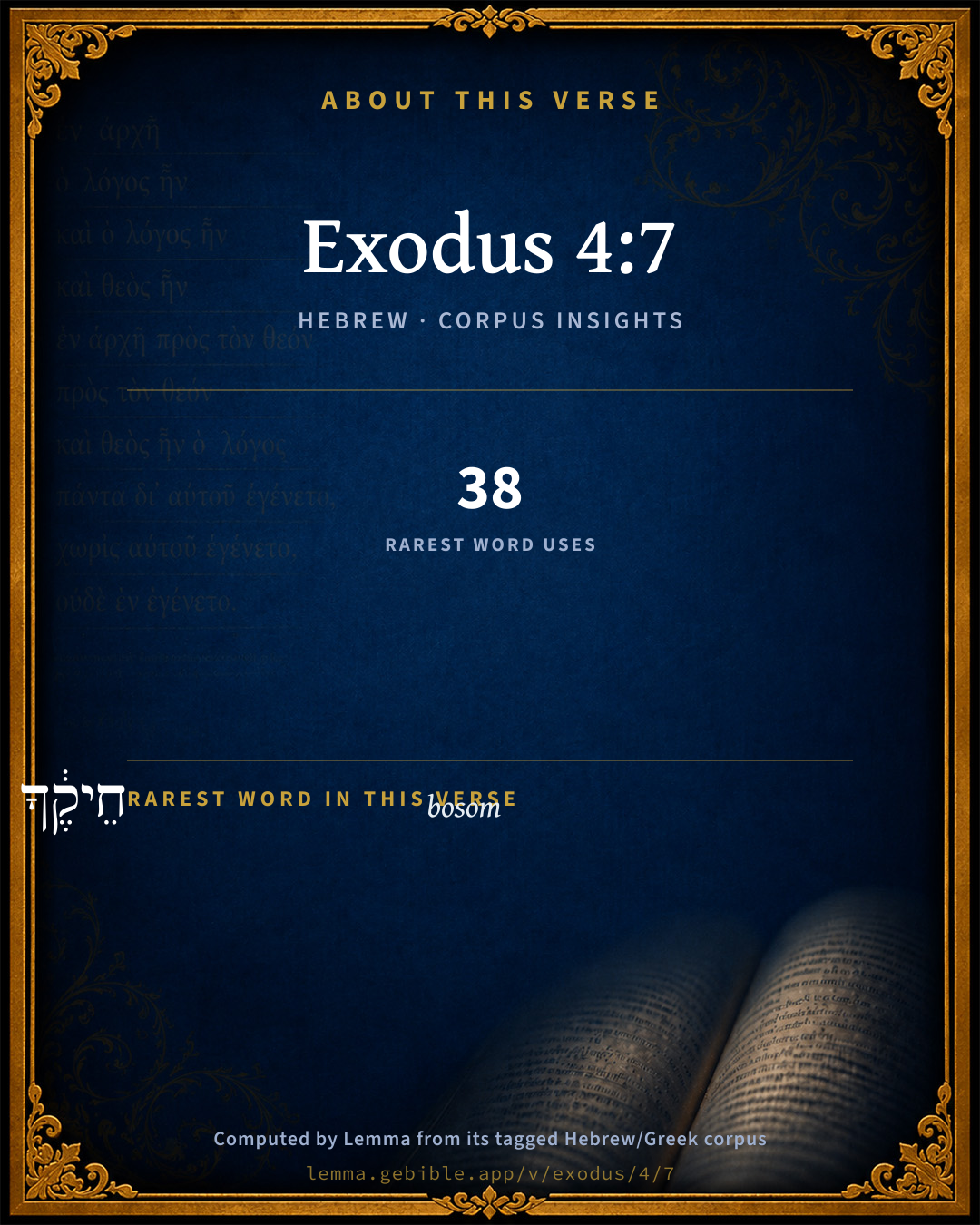
חֵיקֶ֔ךָ
chêyq
H2436
“bosom · your”
Noun, Common, Masculine, Singular, Construct + Suffix, Personal, 2nd Person, Masculine, Singular
Part of Speech
Noun
Type
Common
Gender
Masculine
Number
Singular
State
Construct
Full BDB Definition

Origin: from an unused root, apparently meaning to inclose

TWOT: 629a

bosom, hollow, bottom, midst
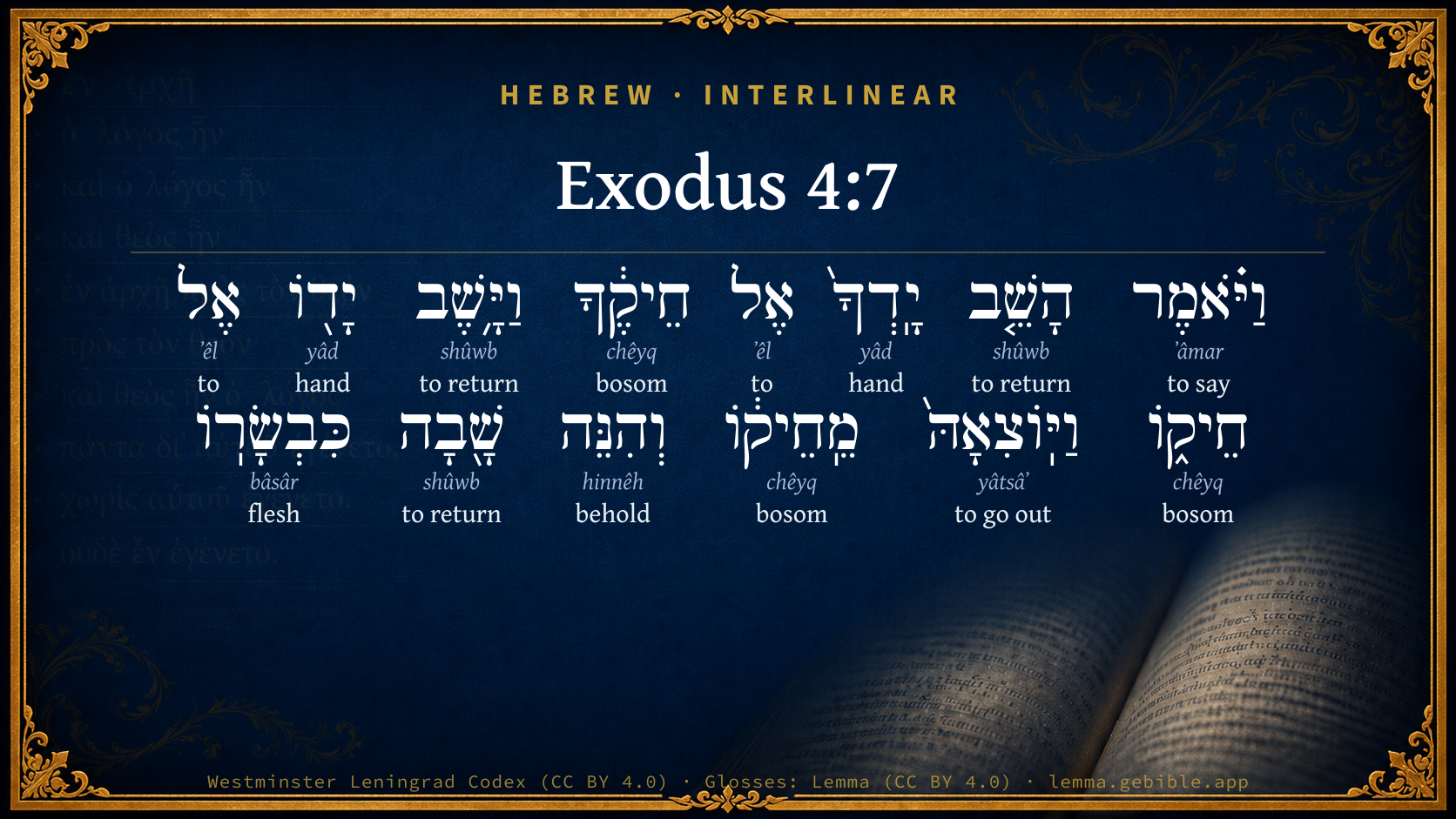
  1. וַיֹּ֗אמֶר ʼâmar H559 “and · to say” Conjunction + Verb, Qal, Sequential Imperfect, 3rd Person, Masculine, Singular
  2. הָשֵׁ֤ב shûwb H7725 “return” Verb, Hiphil, Imperative, 2nd Person, Masculine, Singular
  3. יָֽדְךָ֙ yâd H3027 “hand · your” Noun, Common, Both, Singular, Construct + Suffix, Personal, 2nd Person, Masculine, Singular
  4. אֶל ʼêl H413 “to” Preposition
  5. וַיָּ֥שֶׁב shûwb H7725 “and · to return” Conjunction + Verb, Hiphil, Sequential Imperfect, 3rd Person, Masculine, Singular
  6. יָד֖וֹ yâd H3027 “hand · his” Noun, Common, Both, Singular, Construct + Suffix, Personal, 3rd Person, Masculine, Singular
  7. אֶל ʼêl H413 “to” Preposition
  8. חֵיק֑וֹ chêyq H2436 “bosom · his” Noun, Common, Masculine, Singular, Construct + Suffix, Personal, 3rd Person, Masculine, Singular
  9. וַיּֽוֹצִאָהּ֙ yâtsâʼ H3318 “and · to go out · her” Conjunction + Verb, Hiphil, Sequential Imperfect, 3rd Person, Masculine, Singular + Suffix, Personal, 3rd Person, Feminine, Singular
  10. מֵֽחֵיק֔וֹ chêyq H2436 “from · bosom · his” Preposition + Noun, Common, Masculine, Singular, Construct + Suffix, Personal, 3rd Person, Masculine, Singular
  11. וְהִנֵּה hinnêh H2009 “and · behold” Conjunction + Particle, Demonstrative
  12. שָׁ֖בָה shûwb H7725 “to return” Verb, Qal, Perfect, 3rd Person, Feminine, Singular
  13. כִּבְשָׂרֽוֹ bâsâr H1320 “like/as · flesh · his” Preposition + Noun, Common, Masculine, Singular, Construct + Suffix, Personal, 3rd Person, Masculine, Singular

About this verse

These counts appear in no published source. They are computed here, from the morphology-tagged text and Lemma’s own curated glosses. What Lemma adds →

14
words
8
distinct lemmas
Pentateuch
section

Shared distinctive vocabulary

חֵיקֶ֔ךָ bosom H2436 occurs in 34 verses of the Hebrew Bible. Also found in:

Grammatical profile

  • 5 verbs
  • 6 nouns
  • 2 prepositions
  • 1 particle

Verb forms

  • וַיֹּ֗אמֶר Qal · Sequential Imperfect
  • הָשֵׁ֤ב Hiphil · Imperative
  • וַיָּ֥שֶׁב Hiphil · Sequential Imperfect
  • וַיּֽוֹצִאָהּ֙ Hiphil · Sequential Imperfect
  • שָׁ֖בָה Qal · Perfect

Repetition

Words recur within this verse — often emphatic in Hebrew:

  • הָשֵׁ֤ב to return H7725 ×3
  • חֵיקֶ֔ךָ bosom H2436 ×3
  • יָֽדְךָ֙ hand H3027 ×2
  • אֶל to H413 ×2

Hebrew & Septuagint length

In English translation the verse runs 35 words from the Hebrew and 38 from the Septuagint (LXX English) — closely comparable.

A rough comparison of the two English renderings, which tokenize alike — not a word-level alignment.

Word counts can differ between the Hebrew and the Greek without any difference in meaning — e.g. the Hebrew direct-object marker אֵת has no separate Greek word, and Greek often adds the article ὁ.

Cross-references

4

Topical passages linked to Exodus 4:7 in the Treasury of Scripture Knowledge — connected by theme and wording, ordered by reader-vote popularity; previews shown in the World English Bible.

  • Deuteronomy 32:39 See now that I, even I, am he, There is no god with me: I kill, and I make alive; I wound, and I heal; There is none who can deliver out of my hand.
  • 2 Kings 5:14 Then went he down, and dipped [himself] seven times in the Jordan, according to the saying of the man of God; and his flesh came again like the flesh of a little child, and he was clean.
  • Matthew 8:3 Jesus stretched out his hand, and touched him, saying, "I want to. Be made clean." Immediately his leprosy was cleansed.
  • Numbers 12:13–15 Moses cried to Yahweh, saying, Heal her, God, I beg you.

Cross-references courtesy of OpenBible.info (CC BY 4.0).

Hebrew and Greek witnesses Masoretic Hebrew ↔ Greek Septuagint

The same verse in the two great witnesses to the Old Testament, shown verse-for-verse.

These are two independent witnesses, not word-aligned to each other, and the Septuagint is shown in lemma (dictionary) form.

Hebrew Exodus 4:7 Masoretic · Westminster Leningrad Codex

וַיֹּ֗אמֶר הָשֵׁ֤ב יָֽדְךָ֙ אֶל חֵיקֶ֔ךָ וַיָּ֥שֶׁב יָד֖וֹ אֶל חֵיק֑וֹ וַיּֽוֹצִאָהּ֙ מֵֽחֵיק֔וֹ וְהִנֵּה שָׁ֖בָה כִּבְשָׂרֽוֹ

He said, "Put your hand inside your cloak again." He put his hand inside his cloak again, and when he took it out of his cloak, behold, it had turned again as his other flesh.

World English Bible · Public Domain

Greek LXX Exodus 4:7 Septuagint · lemma form

καί εἶπον πάλιν εἰςφέρω ὁ χείρ σύ εἰς ὁ κόλπος σύ καί εἰςφέρω ὁ χείρ εἰς ὁ κόλπος αὐτός καί ἐκφέρω αὐτός ἐκ ὁ κόλπος αὐτός καί πάλιν ἀπο καταἵστημι εἰς ὁ χρόα ὁ σάρξ αὐτός

And he said again, Put your hand into your bosom; and he put his hand into his bosom, and brought his hand out of his bosom, and it was again restored to the complexion of his other flesh.

LXX2012 (modern English Septuagint) · Public Domain

Hebrew: Westminster Leningrad Codex (CC BY 4.0). Greek: Septuagint (public domain); English from LXX2012 (modern English Septuagint) (Public Domain). How the Septuagint differs from the Hebrew →

Targum (Aramaic paraphrase)

2

The Targum is the ancient Jewish Aramaic paraphrase of the Hebrew Scriptures — an interpretive translation, not the Hebrew text itself. Onkelos (literal) and Pseudo-Jonathan (expansive) render the Torah, and Jonathan the Prophets. Coverage is partial: where no permissively-licensed English translation exists for a verse, only the Aramaic is shown. This is verse-level text, not a word-by-word alignment to the Hebrew.

  1. Targum Onkelos Torah (Genesis–Deuteronomy)
    וַאֲמַר אָתֵיב יְדָךְ לְעִטְפָךְ וַאֲתֵיב יְדֵהּ לְעִטְּפֵהּ וְאַפְקַהּ מֵעִטְפֵהּ וְהָא תָבַת הֲוַת כְּבִשְׂרֵהּ:

    (no public-domain English translation for this verse)

    Targum Onkelos — Aramaic: “Onkelos Genesis” (public domain); “Onkelos Exodus” (public domain); “Onkelos Leviticus” (public domain); “Onkelos Numbers” (public domain); “Onkelos Deuteronomy” (public domain). English: “Sefaria Community Translation” (CC0 1.0 (public-domain dedication)); “J.W. Etheridge. The Targums of Onkelos and Jonathan Ben Uzziel on the Pentateuch. London: Longmans, Green, 1862” (public domain). Text via Sefaria.

  2. Targum Pseudo-Jonathan Torah (Genesis–Deuteronomy)
    וַאֲמַר אָתֵיב יְדָךְ לְעִיטְפָךְ וְאָתֵיב יְדֵיהּ לְחוּבֵיהּ וְהַנְפָּקָהּ מִן גוֹי חוּבֵיהּ וְתָבַת לְמֶהֱוֵי בַרְיָא הֵי כְּבִישְרֵיהּ

    And He said, Return thy hand into thy bosom (Aitaph); and he returned his hand to his breast, and withdrew it from his breast, and it had become clean as his flesh.

    Targum Pseudo-Jonathan — Aramaic: “Targum Jonathan on Genesis” (public domain); “Targum Jonathan on Exodus” (public domain); “Targum Jonathan on Leviticus” (public domain); “Targum Jonathan on Numbers” (public domain); “Targum Jonathan on Deuteronomy” (public domain). English: “The Targum of Jonathan ben Uzziel, trans. J. W. Etheridge, London, 1862” (public domain). Text via Sefaria.

Commentary

Notes on Exodus 4:7 from classic Christian and Jewish commentators (each source and its license shown beneath its notes). The classic Christian expositions comment on the surrounding passage and are grouped to its opening verse, so a note may address several verses; the Jewish commentaries on the Tanakh (Rashi and others) are per-verse, so they appear only where the commentator wrote on this verse.

Lemma curates 59 commentaries, every one of them public domain or Creative Commons licensed, each selected and text-cleaned for this edition rather than reprinted as found. About our sources →

Trapp's Complete Commentary

John Trapp

Exo 4:7 And he said, Put thine hand into thy bosom again. And he put his hand into his bosom again; and plucked it out of his bosom, and, behold, it was turned again as his [other] flesh.

Ver. 7. As his other flesh.] To show him that God, by small means, could bring about great matters, and that in a moment. See Isa 66:7-8. Which yet was ill applied by Cardinal Pool to this revolting nation in Queen Mary’s days.

John Trapp, A Commentary or Exposition upon All the Books of the Old and New Testament (1647–1656) — public domain. Text from a community e-Sword module.

Joseph Benson's Commentary

Exo 4:7. It was turned again as his other flesh — The inflicting of this disease, and curing it again in an instant, was so much the greater miracle, as the leprosy is a disease generally reckoned incurable by human art, especially the white leprosy, so called, because it overspreads the skin with white spots like snow.

Joseph Benson's Commentary on the Old and New Testaments (1811–1818) — public domain. Text from a community e-Sword module.

John Gill's Exposition

And he said, put thine hand into thy bosom again,.... With the leprosy on it:

and he put his hand into his bosom again, and plucked it out of his bosom; quickly after he had put it in:

and, behold, it was turned again as his other flesh; it was cured of the leprosy, and recovered its colour, and was as sound as before, and as any other part of his body. This was a very astonishing miracle, that he should be at once smote with a leprosy; that this should be only in his hand, and not in any other part of his body; and that it should be cured immediately, without the use of any means; and by this miracle Moses, and the Israelites, might be instructed and confirmed in the power of God, that he that could so suddenly inflict such a disease, and so easily cure it, was able to deliver them out of captivity, which was as death; and that however until Moses might be in himself to be a deliverer of the people, signified by his weak and leprous hand, yet being quickened and strengthened by the Lord, would be able to answer to the character; though, after all, the deliverance must be imputed not to his hand and power, but to the mighty hand and power of God.

John Gill's Exposition of the Whole Bible (1746–1763) — public domain (CC PDM 1.0). Text via the HelloAO Bible API.

Haydock's Catholic Bible Commentary

Again. When Moses first appeared in defence of his brethren, Pharao afflicted them more grievously; but at last he was forced to let them go. (Menochius)

George Leo Haydock (1774–1849), Haydock's Catholic Family Bible and Commentary, 1859 edition — public domain. Excludes Psalms (Douay-Rheims chapter numbering differs from Protestant) and Deuterocanonical books (Catholic canon only).

Rashi

Rabbi Shlomo Yitzchaki (Rashi)

ויוצאה מחיקו והנה שבה כבשרו AND HE BROUGHT IT OUT OF HIS BOSOM AND, BEHOLD, IT HAD RETURNED AS HIS OTHER FLESH — From this we may infer that the measure of Divine good comes more quickly than the measure of the punishment He inflicts, for in the former case it does not say מחיקו after the word ויוצאה. (Shabbat 97a; Exodus Rabbah 3:13).

Rashi on the Tanakh — English translations: “The Judaica Press complete Tanach with Rashi, translated by A. J. Rosenberg” (CC BY 4.0); “Pentateuch with Rashi's commentary by M. Rosenbaum and A.M. Silbermann, 1929-1934” (public domain); “The Metsudah Tanach series, Lakewood, N.J” (CC BY 4.0); and “The Book of Joshua, Metsudah Publications, 1997” (CC BY 4.0). Text via Sefaria.

Lesson kit

Teaching starters — assembled from the data on this page, not authored interpretation. Every prompt links to the verse data it draws on. Edit before teaching.

Exodus, in the Pentateuch, opens this verse with 14 words (8 distinct Hebrew lemmas). Its most distinctive word is chêyq (“bosom”). A historical commentator’s framing appears above. Read the whole chapter for the surrounding context.

Discussion questions

  1. The word chêyq carries the sense “bosom.” How does it shape the verse?
  2. How does Genesis 16:5, which shares the word «bosom», read alongside this verse?
  3. What does the repetition of “to return” (3× in this one verse) do in this verse?
  4. The translations on this page render this verse differently — a whole-verse word diff, not a word-by-word alignment. What might account for the different wordings?
  5. «וַיֹּ֗אמֶר» is a Qal Sequential Imperfect verb. How does that grammatical form shape the action described?
  6. Compare how Trapp's Complete Commentary and Joseph Benson's Commentary read this verse. Where do they agree or differ?

Things to notice

  • These translations choose different wording for 17 words in this verse.
  • “to return” occurs 3× in this single verse.
  • 8 distinct Hebrew lemmas span 14 words in this verse.

Reading settings

Reading text

Shown beneath each verse's original-language words.

Old Testament
Old Testament edition

Read the OT as the Masoretic Hebrew (MT) or the Greek Septuagint (LXX).

English shown for the Greek Septuagint (in the Hebrew ↔ Greek comparison).

Comparing translations? Open the Compare panel on any verse page to stack up to four side by side.