Hosea 12:2

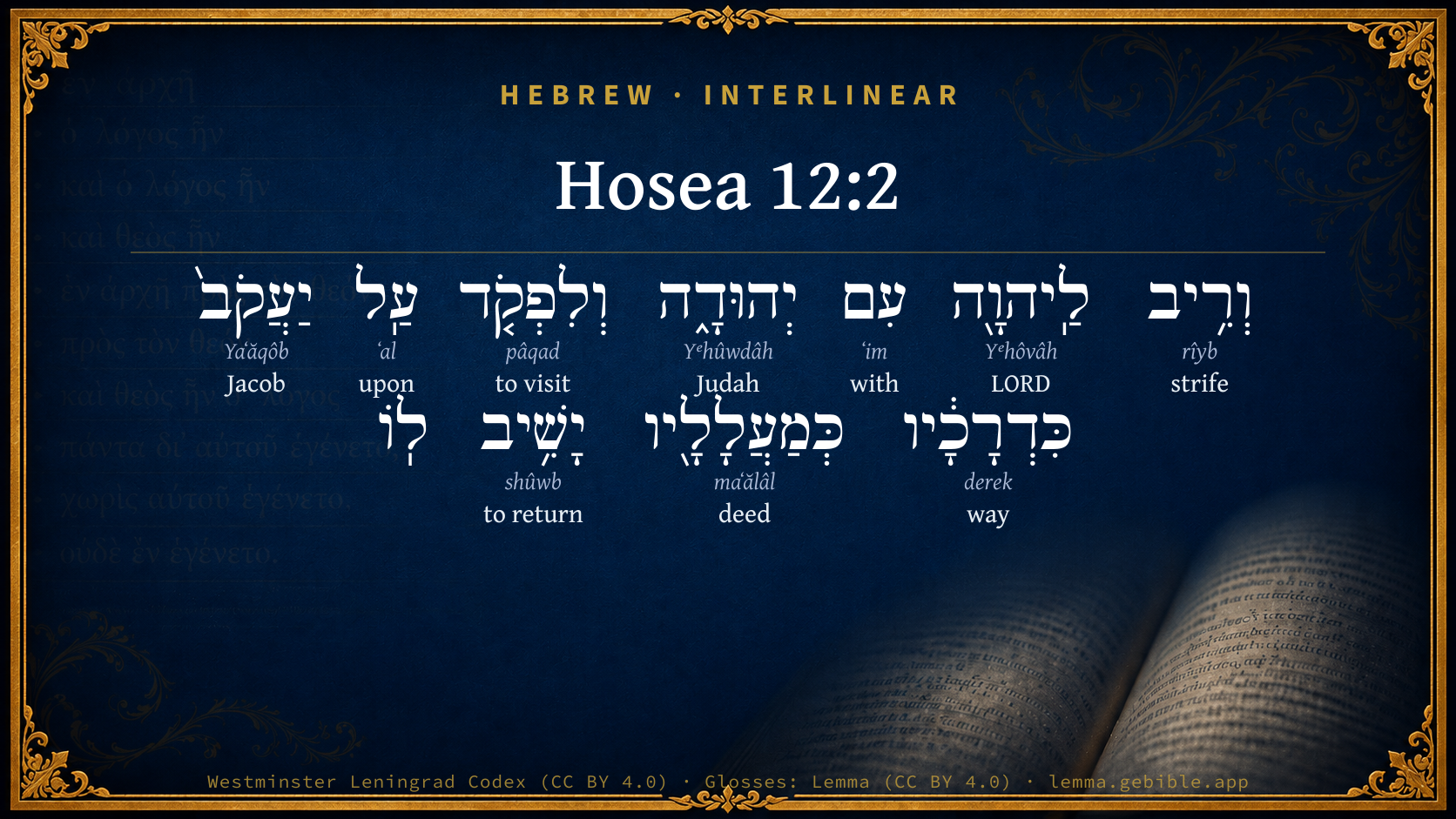
Hebrew (Westminster Leningrad Codex) Hosea 12:2 appears in the Hebrew Old Testament. The text above is from the Westminster Leningrad Codex. Each word links to its Strong’s number, a concise gloss, and parsing drawn from the Open Scriptures Hebrew Bible morphology. Click any word for its full Brown-Driver-Briggs (BDB) entry.
Download image
Cite this verse

Hosea 12:2 (World English Bible). Public Domain. Lemma interlinear Bible study tool, https://lemma.gebible.app/v/hosea/12/2.

Show BibTeX & RIS
BibTeX
RIS
English Translation
Yahweh also has a controversy with Judah, And will punish Jacob according to his ways; According to his deeds he will repay him.
World English Bible · Public Domain
Download a study sheet

One document with this verse’s original text, its word-by-word gloss line, the meaning frame, cross-references with their text, attributed commentary, and full source and license credits — printable, and it pastes into notes with its structure intact.

This verse Autodidact and up

Study sheet (.html) Plain text (.txt)

A passage Seminary Student

Up to 50 verses in one chapter. A passage sheet keeps up to 6 commentary sources and 12 cross-references per verse, in the order this page ranks them, and says so on the sheet whenever that leaves anything out. Ask for a single verse and you get the Autodidact verse sheet above.

Everything on this page stays free to read, with no account — the sheet is a download of what is already on screen, not access to it.

Want to remove ads? Support Godless Engineer
Compare translations 3

The same verse in 3 English versions, stacked beneath the original-language interlinear above. Click any original word for its lexicon entry.

Each is an independent rendering of the whole verse — the interlinear is not word-aligned to these translations.

Highlighted words mark where these versions differ — a whole-verse word diff, not a word-by-word alignment.

  • World English Bible Public Domain
    Yahweh also has a controversy with Judah, And will punish Jacob according to his ways; According to his deeds he will repay him.
  • King James Version Public Domain
    The LORD hath also a controversy with Judah, and will punish Jacob according to his ways; according to his doings will he recompense him.
  • unfoldingWord Literal Text CC BY-SA 4.0
    And a dispute to Yahweh with Judah, and to punish Jacob according to his ways; according to his deeds he will repay to him.

unfoldingWord Literal Text — © unfoldingWord, licensed CC BY-SA 4.0. Word-aligned USFM3 via Door43 (git.door43.org/unfoldingWord/en_ult).

Versions to compare (up to 4)

3 of 4 selected

Show all 18 translations

Every available English version of this verse, each an independent rendering of the whole verse.

  • World English Bible Public Domain
    Yahweh also has a controversy with Judah, And will punish Jacob according to his ways; According to his deeds he will repay him.
  • Berean Standard Bible Public Domain
    The LORD also brings a charge against Judah. He will punish Jacob according to his ways and repay him according to his deeds.
  • Majority Standard Bible Public Domain
    The LORD has a charge to bring against Judah. He will punish Jacob according to his ways and repay him according to his deeds.
  • King James Version Public Domain
    The LORD hath also a controversy with Judah, and will punish Jacob according to his ways; according to his doings will he recompense him.
  • American Standard Version (1901) Public Domain
    Jehovah hath also a controversy with Judah, and will punish Jacob according to his ways; according to his doings will he recompense him.
  • Revised Version (1885) Public Domain
    The LORD hath also a controversy with Judah, and will punish Jacob according to his ways; according to his doings will he recompense him.
  • Geneva Bible (1599) Public Domain
    The Lord hath also a controuersie with Iudah, and will visite Iaakob, according to his waies: according to his workes, wil he recompence him.
  • Douay-Rheims (1899) Public Domain
    Therefore there is a judgment of the Lord with Juda, and a visitation for Jacob: he will render to him according to his ways, and according to his devices.
  • Young's Literal Translation Public Domain
    And a controversy hath Jehovah with Judah, To lay a charge on Jacob according to his ways, According to his doings He returneth to him.
  • Literal Standard Version CC BY-SA 4.0
    And YHWH has a controversy with Judah, || To lay a charge on Jacob according to his ways, || He returns to him according to his doings.
  • Unlocked Literal Bible CC BY-SA 4.0
    Yahweh also has a lawsuit against Judah and will punish Jacob for what he has done; he will repay him for his deeds.
  • unfoldingWord Literal Text CC BY-SA 4.0
    And a dispute to Yahweh with Judah, and to punish Jacob according to his ways; according to his deeds he will repay to him.
  • Darby Bible Public Domain
    Jehovah hath also a controversy with Judah, and he will punish Jacob according to his ways; according to his doings will he recompense him.
  • World Messianic Bible Public Domain
    The LORD also has a controversy with Judah, and will punish Jacob according to his ways; according to his deeds he will repay him.
  • Webster's Bible Public Domain
    \\12:1\\Ephraim feedeth on wind, and followeth after the east wind: he daily multiplieth lies and desolation; and they do make a covenant with the Assyrians, and oil is carried into Egypt.
  • Free Bible Version CC BY-SA 4.0
    The Lord also has an accusation against Judah, and will punish Jacob for the way the people act; he will repay them for what they have done.
  • Bible in Basic English Public Domain
    Ephraim's food is the wind, and he goes after the east wind: deceit and destruction are increasing day by day; they make an agreement with Assyria, and take oil into Egypt.
  • JPS Tanakh (1917) Public Domain
    (12-3) The LORD hath also a controversy with Judah, and will punish Jacob according to his ways, according to his doings will He recompense him.

Literal Standard Version (2020), Covenant Press — licensed CC BY-SA 4.0. Text via the HelloAO Bible API (eBible.org). Unlocked Literal Bible (unfoldingWord) — licensed CC BY-SA 4.0. Text via the HelloAO Bible API (eBible.org). unfoldingWord Literal Text — © unfoldingWord, licensed CC BY-SA 4.0. Word-aligned USFM3 via Door43 (git.door43.org/unfoldingWord/en_ult). Free Bible Version, Dr. Jonathan Gallagher — licensed CC BY-SA 4.0. Text via the HelloAO Bible API (eBible.org).

Word by word

More ways to search: Search by grammar → Find every occurrence → Compare this word →

Practice this passage: Drill this verse → Learn its vocabulary →

כְּמַעֲלָלָ֖יו
maʻălâl
H4611
“like/as · deeds · his”
Preposition + Noun, Common, Masculine, Plural, Construct + Suffix, Personal, 3rd Person, Masculine, Singular
Part of Speech
Preposition + Noun
Type
Common
Gender
Masculine
Number
Plural
State
Construct
Full BDB Definition

Origin: from H5953

TWOT: 1627e

deed, practice - practice (usually bad) - deeds - acts
  1. וְרִ֥יב rîyb H7379 “and · strife” Conjunction + Noun, Common, Both, Singular, Absolute
  2. לַֽיהוָ֖ה Yᵉhôvâh H3068 “to/for · LORD” Preposition + Noun, Proper
  3. עִם ʻim H5973 “with” Preposition
  4. יְהוּדָ֑ה Yᵉhûwdâh H3063 “Judah” Noun, Proper
  5. וְלִפְקֹ֤ד pâqad H6485 “and · to visit” Conjunction + Preposition + Verb, Qal, Infinitive Construct
  6. עַֽל ʻal H5921 “upon” Preposition
  7. יַעֲקֹב֙ Yaʻăqôb H3290 “Jacob” Noun, Proper
  8. כִּדְרָכָ֔יו derek H1870 “like/as · ways · his” Preposition + Noun, Common, Both, Plural, Construct + Suffix, Personal, 3rd Person, Masculine, Singular
  9. יָשִׁ֥יב shûwb H7725 “to return” Verb, Hiphil, Imperfect, 3rd Person, Masculine, Singular

About this verse

These counts appear in no published source. They are computed here, from the morphology-tagged text and Lemma’s own curated glosses. What Lemma adds →

11
words
10
distinct lemmas
Prophets
section

Shared distinctive vocabulary

כְּמַעֲלָלָ֖יו deed H4611 occurs in 41 verses of the Hebrew Bible. Also found in:

Grammatical profile

  • 2 verbs
  • 6 nouns
  • 3 prepositions

Verb forms

  • וְלִפְקֹ֤ד Qal · Infinitive Construct
  • יָשִׁ֥יב Hiphil · Imperfect

Hebrew & Septuagint length

In English translation the verse runs 23 words from the Hebrew and 26 from the Septuagint (LXX English) — closely comparable.

A rough comparison of the two English renderings, which tokenize alike — not a word-level alignment.

Word counts can differ between the Hebrew and the Greek without any difference in meaning — e.g. the Hebrew direct-object marker אֵת has no separate Greek word, and Greek often adds the article ὁ.

Cross-references

20

Topical passages linked to Hosea 12:2 in the Treasury of Scripture Knowledge — connected by theme and wording, ordered by reader-vote popularity; previews shown in the World English Bible.

  • Micah 6:2 Hear, you mountains, Yahweh's controversy, And you enduring foundations of the earth; For Yahweh has a controversy with his people, And he will contend with Israel.
  • Isaiah 10:6 I will send him against a profane nation, and against the people of my wrath will I give him a charge, to take the spoil, and to take the prey, and to tread them down like the mire of the streets.
  • Hosea 4:1 Hear the word of Yahweh, you children of Israel; For Yahweh has a charge against the inhabitants of the land: "Indeed there is no truth, Nor goodness, Nor knowledge of God in the land.
  • Isaiah 3:11 Woe to the wicked! Disaster is upon them; For the deeds of his hands will be paid back to him.
  • Isaiah 8:7–8 now therefore, behold, the Lord brings up on them the waters of the River, strong and many, [even] the king of Assyria and all his glory: and it shall come up over all its channels, and go over all its banks;
  • Isaiah 10:12 Therefore it shall happen that, when the Lord has performed his whole work on Mount Zion and on Jerusalem, I will punish the fruit of the stout heart of the king of Assyria, and the glory of his high looks.
  • Jeremiah 3:8–11 I saw, when, for this very cause that backsliding Israel had committed adultery, I had put her away and given her a bill of divorce, yet treacherous Judah, her sister, didn't fear; but she also went and played the prostitute.
  • Jeremiah 25:31 A noise shall come even to the end of the earth; for Yahweh has a controversy with the nations; he will enter into judgment with all flesh: as for the wicked, he will give them to the sword, says Yahweh.
  • Hosea 2:13 I will visit on her the days of the Baals, To which she burned incense, When she decked herself with her earrings and her jewels, And went after her lovers, And forgot me," says Yahweh.
  • Hosea 8:13 As for the sacrifices of my offerings, they sacrifice flesh and eat it; But Yahweh doesn't accept them. Now he will remember their iniquity, And punish their sins. They will return to Egypt.
  • 2 Kings 17:19–20 Also Judah didn't keep the commandments of Yahweh their God, but walked in the statutes of Israel which they made.
  • Isaiah 24:21 It shall happen in that day, that Yahweh will punish the host of the high ones on high, and the kings of the earth on the earth.
  • Isaiah 59:18 According to their deeds, accordingly he will repay, wrath to his adversaries, recompense to his enemies; to the islands he will repay recompense.
  • Ezekiel 23:11–21 Her sister Oholibah saw this, yet was she more corrupt in her doting than she, and in her prostitution which were more than the prostitution of her sister.
  • Ezekiel 23:31–32 You have walked in the way of your sister; therefore will I give her cup into your hand.
  • Hosea 4:9 It will be, like people, like priest; And I will punish them for their ways, And will repay them for their deeds.
  • Hosea 9:9 They have deeply corrupted themselves, As in the days of Gibeah. He will remember their iniquity. He will punish them for their sins.
  • Matthew 16:27 For the Son of Man will come in the glory of his Father with his angels, and then he will render to everyone according to his deeds.
  • Romans 2:6 who "will pay back to everyone according to their works:"
  • Galatians 6:7 Don't be deceived. God is not mocked, for whatever a man sows, that will he also reap.

Cross-references courtesy of OpenBible.info (CC BY 4.0).

Hebrew and Greek witnesses Masoretic Hebrew ↔ Greek Septuagint

The same verse in the two great witnesses to the Old Testament, shown verse-for-verse.

These are two independent witnesses, not word-aligned to each other, and the Septuagint is shown in lemma (dictionary) form.

Hebrew Hosea 12:2 Masoretic · Westminster Leningrad Codex

וְרִ֥יב לַֽיהוָ֖ה עִם יְהוּדָ֑ה וְלִפְקֹ֤ד עַֽל יַעֲקֹב֙ כִּדְרָכָ֔יו כְּמַעֲלָלָ֖יו יָשִׁ֥יב לֽוֹ

Yahweh also has a controversy with Judah, And will punish Jacob according to his ways; According to his deeds he will repay him.

World English Bible · Public Domain

Greek LXX Hosea 12:2 Septuagint · lemma form

ὁ δέ ἐφράιμ πονηρός πνεῦμα διώκω καύσων ὅλος ὁ ἡμέρα κενός καί μάταιος πληθύνω καί διαθήκη μετά ἀσσύριος διατίθημι καί ἔλαιον εἰς αἴγυπτος ἐνπορεύομαι

And the Lord has a controversy with Juda, in order to punish Jacob: according to his ways and according to his practices will he recompense him.

LXX2012 (modern English Septuagint) · Public Domain

On this verse, Whedon's Commentary on the Bible discusses the Septuagint’s reading. Read the note in Commentary ↓

Hebrew: Westminster Leningrad Codex (CC BY 4.0). Greek: Septuagint (public domain); English from LXX2012 (modern English Septuagint) (Public Domain). How the Septuagint differs from the Hebrew →

Targum (Aramaic paraphrase)

1

The Targum is the ancient Jewish Aramaic paraphrase of the Hebrew Scriptures — an interpretive translation, not the Hebrew text itself. Onkelos (literal) and Pseudo-Jonathan (expansive) render the Torah, and Jonathan the Prophets. Coverage is partial: where no permissively-licensed English translation exists for a verse, only the Aramaic is shown. This is verse-level text, not a word-by-word alignment to the Hebrew.

  1. Targum Jonathan Prophets (Joshua–Malachi)
    בֵּית יִשְׂרָאֵל דָמָן לִדְרוּחַ זְרַע וְעַלְעוֹל חֲצַד כָּל יוֹמָא כַּדְבִין וּבִזָא מַסְגָן וּקְיָם עִם אַתּוּרָאָה אָקִימוּ וְקוּרְבָּנָא לְמִצְרַיִם מוֹבְלִין:

    (no public-domain English translation for this verse)

    Targum Jonathan — Aramaic: “Mikraot Gedolot” (public domain). English: “Sefaria Community Translation” (CC0 1.0 (public-domain dedication)); “London "Chaldee Paraphrase," 1871” (public domain). Text via Sefaria.

Commentary

Notes on Hosea 12:2 from classic Christian and Jewish commentators (each source and its license shown beneath its notes). The classic Christian expositions comment on the surrounding passage and are grouped to its opening verse, so a note may address several verses; the Jewish commentaries on the Tanakh (Rashi and others) are per-verse, so they appear only where the commentator wrote on this verse.

Lemma curates 59 commentaries, every one of them public domain or Creative Commons licensed, each selected and text-cleaned for this edition rather than reprinted as found. About our sources →

Trapp's Complete Commentary

John Trapp

Hos 12:2 The LORD hath also a controversy with Judah, and will punish Jacob according to his ways; according to his doings will he recompense him.

Ver. 2. The Lord hath also a controversy with Judah] Lest the prophet should be thought partial in the law, Mal 2:9, {See Trapp on "Mal 2:9"} and lest Ephraim should say of Judah, as once Oded did of Israel, "Are there not with them, even with them also, sins against the Lord?" 2Ch 28:10. The prophet answers by way of concession, that there were so indeed; and that therefore God had a controversy with them, a litigation, or disceptation: he was expostulating with them by words, and some lighter strokes, notwithstanding he had commended them before, as ruling with God, and retaining his pure worship. God would take his time to deal with them too for their many impieties, and especially for running to Egypt for help, as they did in the days of Ahaz and Zedekiah, see Isa 30:2; Isa 31:1; but because they were not yet so bad as the ten tribes, nor so desperately wicked, therefore the Lord was yet but pleading with them; he had not passed sentence, he was not resolved upon their ruin and utter extirpation, Hos 4:15; Hos 5:5-14; Hos 6:11; as he was for the ten tribes, those foul apostates and shameless covenantbreakers; concerning whom he saith, and is set upon it,

I will punish Jacob according to his ways] See the like words Hos 4:9. {See Trapp on "Hos 4:9"} He calls them Jacob, because they gloried much in him, their progenitor; as did likewise the Samaritans that succeeded them, Joh 4:12. So did the Jews in Mic 2:7. But the prophet Hosea answereth them in effect (as there) by proving a disparity. "O thou that art named the house of Jacob" (that wilt needs be named so, and therein pridest thyself), "is the Spirit of the Lord straitened?" (ye are not surely straitened in him, but in your own bowels, that ye express Jacob no better, that ye resemble him no more). "Are these his doings?" was Jacob a man of your practices? No; {a} for he left no means unattempted that he might attain the blessing; he strove for it with his brother in the womb, βρεφος, afterwards with the angel, against whom with much wrestling and raising of dust he prevailed, as it followeth in the two next verses.

{a} Odiosum et impium dogma Anabaptistarum, qui ideo pueris baptismum negant, quia sensu ac mente careant. Luther in loc.

John Trapp, A Commentary or Exposition upon All the Books of the Old and New Testament (1647–1656) — public domain. Text from a community e-Sword module.

Geneva Bible (1599)

Geneva Bible translators

Which in those points was like to Ephraim, but not in idolatries.

Geneva Bible (1599) marginal notes — public domain. Text via Bolls.life.

Jamieson, Fausset & Brown

Robert Jamieson, A. R. Fausset & David Brown

controversy with Judah-- (Hos 4:1; Mic 6:2). Judah, under Ahaz, had fallen into idolatry (Kg2 16:3, &c.).

Jacob--that is, the ten tribes. If Judah, the favored portion of the nation, shall not be spared, much less degenerate Israel.

Jamieson, Fausset & Brown — Commentary Critical and Explanatory on the Whole Bible (1871) — public domain (CC PDM 1.0). Text via the HelloAO Bible API.

Adam Clarke's Commentary

Verse 2. The Lord hath also a controversy with Judah] The rest of the prophecy belongs both to Judah and Israel. He reproaches both with their ingratitude, and threatens them with God's anger. In order to make their infidelity the more hateful, and their malice the more sensible, he opposes to them the righteousness, obedience, and piety of their father Jacob. He recalls to their minds the benefits they had received since they returned from Egypt. He speaks afterwards of their kings; and how, in their ingratitude, they refused to have him for their monarch. Having mentioned this fact, he subjoins reflections, exhortations, invectives, and threatenings, and continues this subject in this and the two following chapters.-Calmet.

Adam Clarke's Commentary on the Bible (1810–1826) — public domain. Text from a community e-Sword/MySword module.

John Calvin's Commentaries

It may seem strange that the Prophet should now say, that God had a controversy with Judah; for he had before said, that Judah stood faithful with the saints. It seems indeed inconsistent, that God should litigate with the Jews, and yet declare them to be upright and separate them from the perfidious and ungodly. What then does this mean? The Prophet, as we have said, spake comparatively of the tribe of Judah, when he said that they remained faithful with the saints: for he did not intend wholly to exculpate the Jews, who were also full of grievous evils; but he intended to praise the worship which as yet prevailed at Jerusalem, that the impiety of the ten tribes might appear less excusable, who of their own accord had departed from the rule which God had given.

When any one at this day reproves the Papists, they say, that another mode of worship is unknown to them, and that they have been thus taught by their forefathers, and that the worship which they observe has so continued from antiquity, that they dare not either to change it or to deviate from it. Such might have been the excuse made by the Israelites. But the prophet charges them with voluntary defection, for the temple which God had chosen for himself stood in their sight; there the face of God was in a manner to be seen; for all things were arranged according to the heavenly pattern which had been shown to Moses in the mount. Since then pure religion was before their eyes, was not their sin proved by this very fact, that having neglected the word of God, they gave themselves up to new and fictitious modes of worship? The Prophet then had before praised the worship, but not the manners, of the tribe of Judah; and he now comes to their manners, and says, that there were many things in Judah which God would chastise.

The Lord then hath a controversy with Judah; and he will begin with that tribe, and will then come down to the house of Jacob The Prophet, however, speaks here only in passing of the house of Judah, and touches but lightly on the controversy he had with that portion of the people. How was this? Because he was not a teacher, as it has been said already, set over the kingdom of Judah, but only over the Israelites. He now refers only to that kingdom for the purpose of striking terror into his own people: as though he said “Think ye that the forbearance of God is to be forever, because he has hitherto borne with you? Nay, God will begin to contend with the tribe of Judah. I have said, indeed, that they are innocent compared with you; but yet they shall not escape punishment; for in a short time God will summon them to judgement. If he will not spare the Jews, how can your great crimes go unpunished? For certainly you deserve hundred deaths in comparison with the Jews, among whom at least some integrity and uprightness exist; for they have made no change in the worship of God. Their life is corrupt; but yet the law of God and religion are not despised by them as they are by you. If then God will not spare them, much less will he spare you.”

We now understand for what purpose the Prophet says that God had a controversy with Judah; for it was not his design to terrify the Jews themselves, or to exhort them to repentance, except it may be by the way; but his object was to present an example to the Israelites, that they might fear; for they ought to have thought within themselves, “If this shall be done in the green, what shall become of the dry tree? (Luke 23:31.) If God will exercise with so much severity his vengeance against our brethren the Jews, among whom pure religion as yet exists, what sort of end and how dreadful is that which awaits us, who have departed from the law, the worship, the teaching, and the obedience of God, who are become truce-breakers, and degenerate, and in every way profane?”

Hence he immediately adds, And will punish Jacob “God will indeed begin with the tribe of Judah; this will be the prelude, and he will treat the Jews more mildly than you; but against you he will thunder in full force. It will not then be a remonstrance to draw you to repentance, but a punishment such as ye deserve; for he has already contended with you more than enough.”

According to his ways. according to his doings, will he recompense him. He sets down here ways and doings, with no superfluous repetition, but to show that the repentance of this people had been already more than sufficiently looked for; for they had not ceased for a long time to pursue their own wickedness. The Prophet then, no doubt, condemns here the Jews for their perverse wickedness, that they never left off their sins, though they had now for a long time been admonished, and had been often reproved by the Prophets. It now follows —

John Calvin's Commentaries (1540-1563) — public domain. Text from the Calvin Translation Society English edition (1840s-50s) via the Christian Classics Ethereal Library (ccel.org). Calvin's coverage is partial (roughly two-thirds of the Bible); uncommented books and verses are honest gaps, never fabricated. The 19th-century editor's footnotes and remarks are omitted so the notes are faithfully Calvin's own voice.

Ellicott's Commentary for English Readers

(2) Jacob refers to the northern kingdom.

A Bible Commentary for English Readers, edited by Charles John Ellicott (1878–1897) — public domain. Text from a community e-Sword module.

The Cambridge Bible for Schools and Colleges

gen. ed. J. J. S. Perowne

2. Jacob] Here used for the northern kingdom, to prepare the way for the etymological allusion in Hos_12:3.

The Cambridge Bible for Schools and Colleges (gen. ed. J. J. S. Perowne; Cambridge University Press, 1878–1918) — public domain. Text from a community e-Sword module.

John Gill's Exposition

The Lord hath also a controversy with Judah,.... The two tribes of Judah and Benjamin, as well as the ten tribes; for though they had ruled with God, and had been faithful with the saints in the first times of the apostasy of Israel; yet afterwards they sadly degenerated, and fell into idolatry likewise, particularly in the time of Ahaz, in which Hosea prophesied; and therefore the Lord had somewhat against them; nor would he spare them, but reprove them by the prophets, and rebuke them in his providences; bring them to his bar, and lay before them their evils, and threaten them with punishment in case of impenitence, as follows:

and will punish Jacob according to his ways; all the posterity of Jacob, whether Ephraim or Judah; those of the ten tribes, or of the two, who all descended from Jacob: or, "will visit according to his ways" (s); if right, and agreeably to the mind and word of God, in a way of grace and mercy; but if wrong, crooked, and perverse, then in a way of punishment; for visiting is used both ways:

according to his doings will he recompense him; as they were good or bad; if good, will reward them with a reward of grace; if bad, with vengeance. The Targum paraphrases it,

"according to his right works.''

(s) "ad visitandum juxta vias ejus", Pagninus, Montanus; "visitabit secundum vias ejus", Piscator.

John Gill's Exposition of the Whole Bible (1746–1763) — public domain (CC PDM 1.0). Text via the HelloAO Bible API.

Albert Barnes' Notes on the Bible

The Lord hath also a controversy with Judah, and will punish Jacob - The guilt of Judah was not open apostasy, nor had he filled up the measure of his sins. Of him, then, God saith only, that He “had a controversy with” him, as our Lord says to the “Angel of the Church of Pergamos, I have a few things against thee. Repent, or else I will come unto thee quickly, and fight against thee with the sword of My mouth” Rev 2:12, Rev 2:16. Of Ephraim, whose sin was complete, He says, that the Lord “is to punish.” God had set His mind, as we say, on punishing him; He had (so to speak) set Himself to do it. Jacob, like Israel, is here the name for the chief part of Israel, i. e., the ten tribes. Our Lord uses the same gradation in speaking of different degrees of evil-speaking; “Whosoever of you is angry without a cause, shall be in danger of the judgment; and whosoever shall say to his brother, Raca, shall be in danger of the council; but whosoever shall say, Thou fool, shall be in danger of hell-fire” Mat 5:22. : “The justice of God falls more severely on those who degenerate from a holy parent, than on those who have no incitement to good from the piety of their home.” To amplify this , “The prophet explains what good things Jacob received, to show both the mercy of God to Jacob, and the hardness of Ephraim toward God. While Jacob was yet in his mother’s womb, he took his brother by the heel, not by any strength of his own, but by the mercy of God, who knows and loves those whom he hath predestinated.”

Albert Barnes' Notes on the Bible (1834–1885) — public domain. Text from a community e-Sword/MySword module.

Haydock's Catholic Bible Commentary

Judgment. Hebrew, "trial." What follows refers to all the people, whose impiety is contrasted with Jacob’s virtue.

George Leo Haydock (1774–1849), Haydock's Catholic Family Bible and Commentary, 1859 edition — public domain. Excludes Psalms (Douay-Rheims chapter numbering differs from Protestant) and Deuterocanonical books (Catholic canon only).

Matthew Poole's English Annotations

The Lord hath also a controversy with Judah; though Judah, compared with Ephraim, be faithful, yet when considered in his ways and doings he is found faulty in many things, and God hath just matter of complaint against Judah in point of manners; in public worship Judah was faithful, kept to God and the temple, though not without some defects, but in their lives there were many more and greater faults, about which God will contend that Judah may be reformed.

Judah; the two tribes.

Will punish; or visit with chastising to amend, else to destroy: there is hope of Judah that he will be reclaimed, therefore I will try by gentler visitations, by fatherly corrections, yet I will not leave him as hopeless, nor as faultless.

Jacob; not the patriarch, but those who are of him; his children, but that have degenerated from his ways of love, fear, trust, and obedience. Both Ephraim and Judah are of Jacob, but both have corrupted themselves, and therefore will I proceed against both; and if Judah, the less faulty, escape not, Ephraim can have no hope to escape; if Judah be whipped with rods because a disobedient son, Ephraim may fear a sword because he hath been and still is an obstinate rebel.

According to his ways; neither can justly complain then, since their different ways are made the standard of the different proceedings of God against them, he will not lay upon either more than is equal; who suffers most hath deserved more, and who suffers least needed so much to amend him.

According to his doings will he recompense him: this is an elegant and very usual ingemination of the same thing, which doth assure it will be done, and should affect us the more.

Matthew Poole's English Annotations on the Holy Bible (1683–1685) — public domain. Text from a community e-Sword/MySword module.

Whedon's Commentary on the Bible

Daniel D. Whedon

2. The southern kingdom was equally guilty.

Controversy — See on Hos_4:1.

Judah — Some substitute “Israel.” Also, which is in the English translations, is not in the original (see on Hos_5:5).

Jacob — Since the name stands in parallelism with Judah it would seem to be a poetic synonym of the latter. If Israel is substituted in the first clause Jacob may be regarded as a poetic synonym of Israel, used so as to prepare the way for the references to the patriarch Jacob. If Hos_11:12 b, is original still another interpretation is possible: Judah — the southern kingdom; Jacob, which is equivalent to Israel — the northern kingdom: the two together make up the whole nation. The third interpretation is favored by Hos_12:13, which seems to imply that in chapter 12 Hosea compares the whole nation with its ancestor.

His ways… doings — The faithless conduct condemned in Hos_11:12; Hos_12:1 (compare Hos_4:9; Hos_7:2).

In Hos_12:3-5 (compare Hos_12:13) the prophet introduces abruptly a reference to three incidents in the life of the patriarch Jacob: one connected with his birth (Gen_25:26), another with his return from Aram (Gen_32:22 ff.), and a third with his journey to or from Aram (Gen_28:10-22; Gen_35:9-15). The place of these historical references in the argument of Hosea is variously interpreted. Some see in them a commendation of the patriarch, whose acts indicated his anxiety for divine and paternal blessings; this commendation implies a condemnation of his descendants who are spiritually indifferent. Others see in them a condemnation of the patriarch, who even before his birth practiced deceit and who in manhood sought to take advantage of God and man. Small wonder that his descendants are full of lies and falsehoods. Still others see a condemnation of Jacob in the first reference and a commendation in the others. On the whole, the first interpretation is to be preferred.

Took his brother by the heel — Though the exact meaning of the verb is uncertain, the thought is that Jacob desired to be born first, so as to enjoy the rights of the firstborn (Gen_27:36). The prophet does not justify the act.

For purposes of illustration it is not necessary to pass judgment on the merits of an act (compare Luk_16:1 ff.). In later life the patriarch manifested still greater anxiety for the divine blessing.

By his strength — R.V., “in his manhood” (Gen_49:3).

Had power with God — Margin R.V., “strove”; margin A.V., “behaved himself princely.” Again the exact meaning of the verb is uncertain. The reference is to Gen_32:22 ff.

Hos_12:4 describes the conflict in greater detail.

The angel — Equivalent to “God” in Hos_12:3 (see on Zec_1:11).

Prevailed — His persistence was rewarded.

Wept — Jacob’s tears were a further evidence of his anxiety. The shedding of tears is not mentioned in Genesis.

Made supplication — Compare Gen_32:26. If only Israel would follow the footsteps of Jacob they too would receive the divine blessing.

He — It seems best to carry over the subject from the preceding and make he refer to Jacob.

Him — Jehovah. Both the order and the prophet’s purpose, to impress upon the Israelites the truth that the vision at Beth-el was the result of Jacob’s spiritual longings, make it probable that he thought of that vision as having been granted on Jacob’s return from Aram (Gen_35:9-15).

He spake — That is, Jehovah.

With us — What Jehovah said to Jacob applied equally to his descendants. The text is greatly improved, however, if we read, with Peshitto and other ancient versions, “with him,” that is, with Jacob. LXX. also seems to have read the pronoun of the third person singular, though in other respects its text of 4b is inferior to the Hebrew.

Hos_12:5 is thought by many to be a later addition, “by some pious reader of a very late date.” The English translators evidently took 5a in apposition to he, the subject of spake (Hos_12:4). By identifying the God who blessed the yearning Jacob with Jehovah, whom, nominally at least, they worshiped as their deliverer and helper, the prophet prepared the way for the exhortation in Hos_12:6. If he rewarded the perseverance of your ancestor he will in the same manner reward you, if you earnestly seek him. The thought remains the same if we regard, as seems more probable, Hos_12:5 in construction independent of the preceding: “And Jehovah is the God of hosts; Jehovah is his memorial name.”

Memorial — R.V., “memorial name.” The name by which the God of Israel is to be remembered (Exo_3:15).

Jehovah God of hosts — Identical in meaning with the shorter “Jehovah of hosts.” As used by the prophets, this title designates Jehovah as the Lord of all powers in the world and in nature. There is still a difference of opinion as to the original significance of host. 1. Some think that host referred primarily to the angels. According to Ewald the phrase arose on the occasion of some great victory, when it seemed as if the host of heavenly beings had come down to the relief of the people (compare Psa_103:21; Neh_9:6). 2. Others think that the hosts were originally the armies of Israel, whose leader Jehovah is represented as being (Exo_7:4; Exo_12:41; Exo_12:51). 3. Still others take it to refer primarily to the stars, which are frequently called “the hosts of heaven” (Deu_4:19; Isa_34:4). 4. Sayce connects it with Babylonian mythology. Jehovah, he identifies with Sin, the moon-god. Sin is called “the enchanter of the spirits of the hosts.” This title in its Hebrew form was, he thinks, transferred from Sin to Jehovah. But whatever the primary usage of the title the prophets gave to it a sublimer content.

Daniel D. Whedon (gen. ed.), Commentary on the Old and New Testaments (1874–1909) — public domain. Text from a community e-Sword module.

The Pulpit Commentary

The Lord hath also a controversy with Judah; and will punish (margin, visit upon) Jacob according to his ways. God here presents himself at once as plaintiff and judge, widening the range of his pleadings. The controversy with Israel takes a wider sweep, and comprehends Judah culpable, though apparently in a less degree. But though Judah comes in for a share of punishment, that punishment shall be proportionate to their delinquencies those like Judah that sinned less shall suffer less; while the more heinous transgressors, such as Israel had proved to be, would come in for severer punishment. To Jacob, here embracing the ten tribes of Israel and the two of Judah, the chastisement would be meted out in exact accordance with his ways. The apparent contradiction between ver. 12 of last chapter, where, as most translate it, Judah is represented as ruling with God and being faithful with the saints, and the present inclusion of Judah in controversy with Jehovah, occasioned

(1) a rendering and explanation of this verse which Aben Ezra declares to be both ungrammatical and unscriptural. "He" says Aben Ezra." who explains that Judah is faithful and he shall be reproving, and asserts that Scripture makes no mention of Jehovah having a controversy against Judah, but employs the sense being that Jehovah and Judah have a strife against Ephraim, errs from the way of Scripture and grammar, for the prophet has written above (ver. 13), "Judah saw his wound;" "I will make Ephraim to ride; Judah shall plough;" and in reference to both of them he says," Ye shall eat the fruit of lies." He also forgets "The herdmen of Gerar did strive with ( Isaac"s herdmen;" "And the people strove with Moses;" and many other places i.e. where is found with the sense of "contending. Therefore he joins Ephraim with Judah, and says, "The Lord hath also a controversy with Judah, and will punish Jacob according to his ways, because this name (i.e. Jacob) comprehends them both (Ephraim and Judah).

(2) The meaning is given concisely and correctly by Rashi thus: "He (Jehovah) announces to them the words of his controversy which their brethren of the house of Israel had caused him; and they should not wonder if he would punish (literally, "visit on") Jacob according to his ways." The change in the ease of Judah, Kimchi accounts for by reference to their subsequent apostasy, especially that of their kings, as follows: "Although he said, "And Judah yet reigneth with God," he meant, although be holds fast by the service of God in the house of the sanctuary; so afterwards they practiced evil deeds as their kings were evil; therefore he said," Jehovah has a controversy and correction with Judah and Jacob to visit upon them according to their doings, as their kings were evil, for they did not remember my mercy with them and with their father Jacob, because the whole was for sake of his posterity; and I showed him a sign which should be to his seed after him, if they gave their heart to me.... And the sign which I showed them is only done for sake of his seed. But they have not acknowledged this, for if they had acknowledged this, they would have cleaved to me and my service, and I would have ratified to them the blessing of Jacob their father. The infinitive with le is not infrequently employed in the sense of our future, thus, dqpl, it is to be visited, equivalent to "he shall or must visit upon it" This idiom is common in Syriac, but always with atid. According to his doings will he recompense him. The milder expression is applied to Judah he has a controversy with him, but will punish Jacob, restricted by some to Ephraim or the ten tribes. Better understand Jacob of both Judah and Israel, who are both to be recompensed, each according to his works.

The Pulpit Commentary (1880–1919), ed. H.D.M. Spence-Jones & Joseph S. Exell — public domain. Text from a community e-Sword module.

John Wesley's Explanatory Notes

Jacob - Ephraim and Judah are of Jacob, both have corrupted themselves, and therefore I will proceed against both.

John Wesley, Explanatory Notes Upon the Whole Bible (1754–1765) — public domain. Text via the GEBible commentary corpus.

Rashi

Rabbi Shlomo Yitzchaki (Rashi)

joins the wind Heb. רֹעֵה. An expression of רֵעַ, a friend. He joins words of the wind, viz. idolatry. and oil Their oil they carry to Egypt to give a bribe to Egypt to aid them.

Rashi on the Tanakh — English translations: “The Judaica Press complete Tanach with Rashi, translated by A. J. Rosenberg” (CC BY 4.0); “Pentateuch with Rashi's commentary by M. Rosenbaum and A.M. Silbermann, 1929-1934” (public domain); “The Metsudah Tanach series, Lakewood, N.J” (CC BY 4.0); and “The Book of Joshua, Metsudah Publications, 1997” (CC BY 4.0). Text via Sefaria.

Lesson kit

Teaching starters — assembled from the data on this page, not authored interpretation. Every prompt links to the verse data it draws on. Edit before teaching.

Hosea, in the Prophets, opens this verse with 11 words (10 distinct Hebrew lemmas). Its most distinctive word is maʻălâl (“deed”). A historical commentator’s framing appears above. Read the whole chapter for the surrounding context.

Discussion questions

  1. The word maʻălâl carries the sense “deed.” How does it shape the verse?
  2. How does Deuteronomy 28:20, which shares the word «deed», read alongside this verse?
  3. These translations render this verse differently; the difference is in the English rendering, not the original. What questions does that raise?
  4. «וְלִפְקֹ֤ד» is a Qal Infinitive Construct verb. How does that grammatical form shape the action described?
  5. Compare how Trapp's Complete Commentary and Geneva Bible (1599) read this verse. Where do they agree or differ?

Things to notice

Reading settings

Reading text

Shown beneath each verse's original-language words.

Old Testament
Old Testament edition

Read the OT as the Masoretic Hebrew (MT) or the Greek Septuagint (LXX).

English shown for the Greek Septuagint (in the Hebrew ↔ Greek comparison).

Comparing translations? Open the Compare panel on any verse page to stack up to four side by side.